Exam-Style Problems
⬅ Back to SubchapterJune 2023 p33 q1
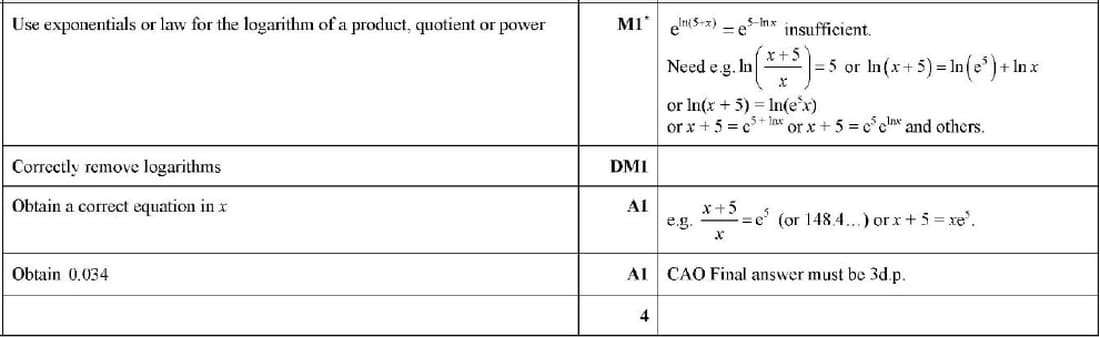
Solve the equation \(\ln(x+5) = 5 + \ln x\). Give your answer correct to 3 decimal places.
Nov 2020 p32 q1
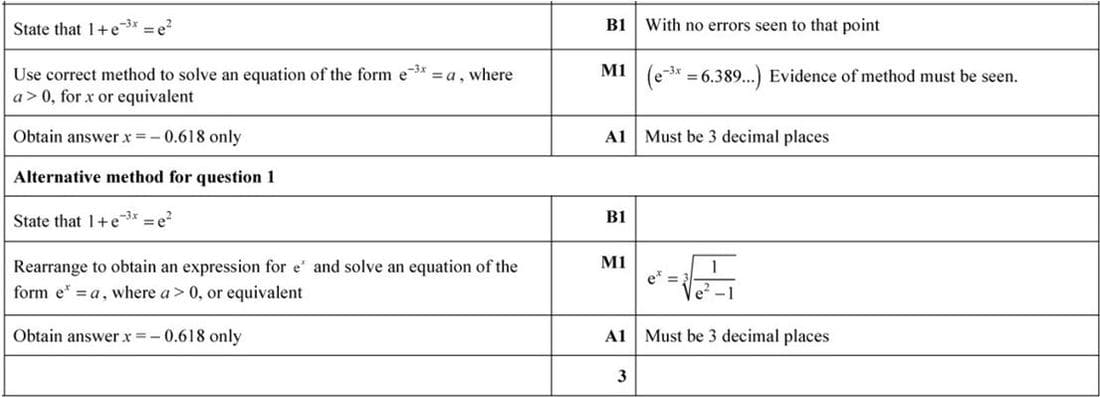
Solve the equation
\(\ln(1 + e^{-3x}) = 2\).
Give the answer correct to 3 decimal places.
Feb/Mar 2020 p32 q2
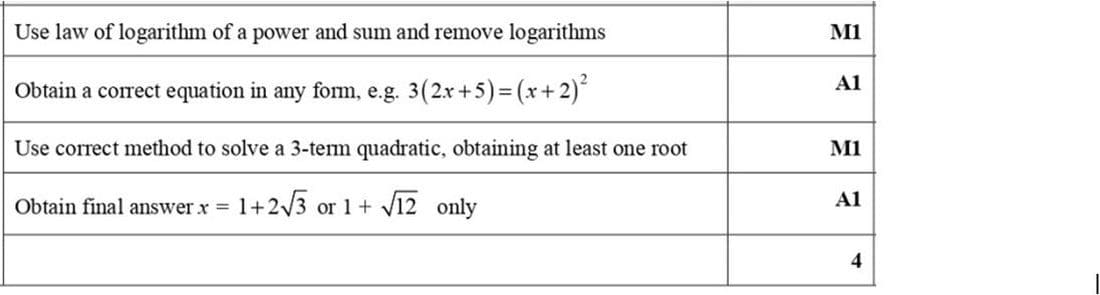
Solve the equation \(\ln 3 + \ln(2x + 5) = 2 \ln(x + 2)\). Give your answer in a simplified exact form.
Nov 2019 p32 q1
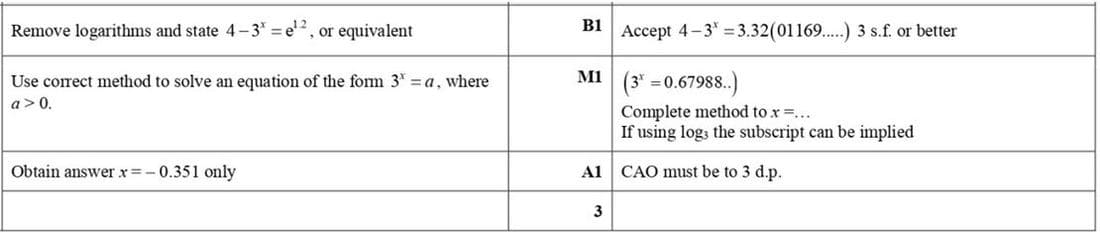
Solve the equation \(5 \ln(4 - 3^x) = 6\). Show all necessary working and give the answer correct to 3 decimal places.
June 2019 p31 q2
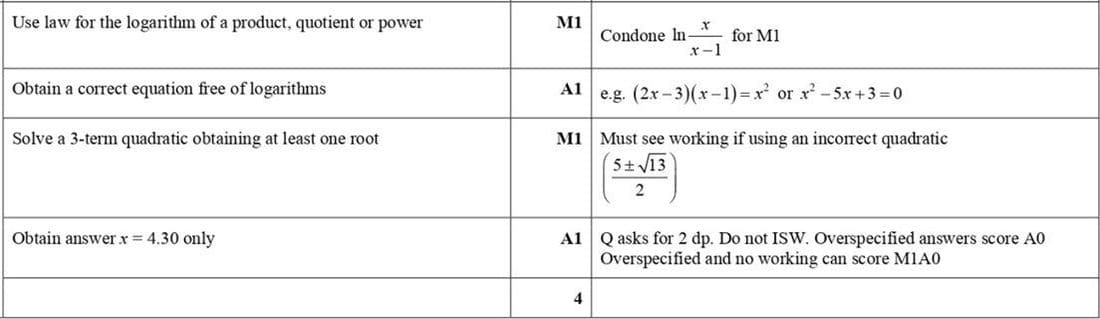
Showing all necessary working, solve the equation \(\ln(2x - 3) = 2 \ln x - \ln(x - 1)\). Give your answer correct to 2 decimal places.
June 2018 p31 q1
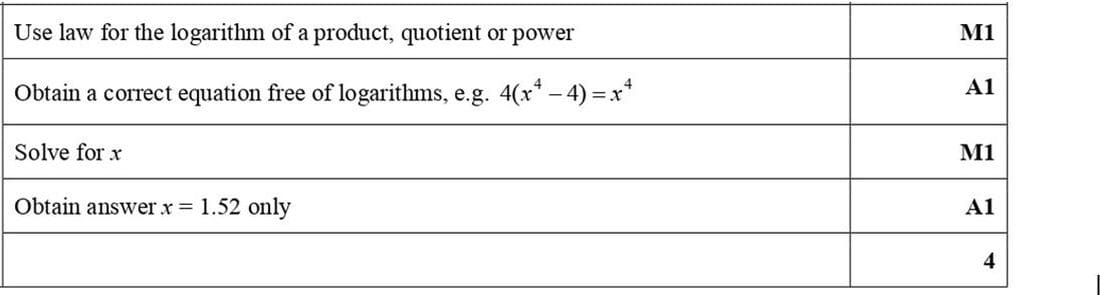
Showing all necessary working, solve the equation \(\ln(x^4 - 4) = 4 \ln x - \ln 4\), giving your answer correct to 2 decimal places.
June 2017 p32 q1
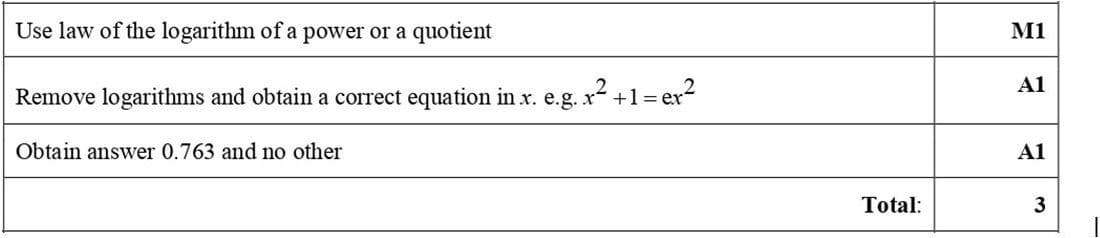
Solve the equation \(\ln(x^2 + 1) = 1 + 2 \ln x\), giving your answer correct to 3 significant figures.
Feb/Mar 2023 p2 q1
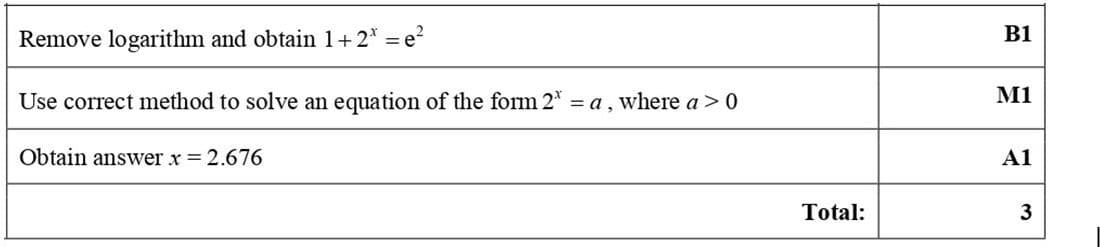
Solve the equation \(\ln(1 + 2^x) = 2\), giving your answer correct to 3 decimal places.
Feb/Mar 2016 p32 q1
Solve the equation \(\ln(x^2 + 4) = 2 \ln x + \ln 4\), giving your answer in an exact form.

June 2015 p33 q1
Solve the equation \(\ln(x + 4) = 2 \ln x + \ln 4\), giving your answer correct to 3 significant figures.

Nov 2014 p31 q1
Use logarithms to solve the equation \(e^x = 3^{x-2}\), giving your answer correct to 3 decimal places.

June 2023 p32 q2
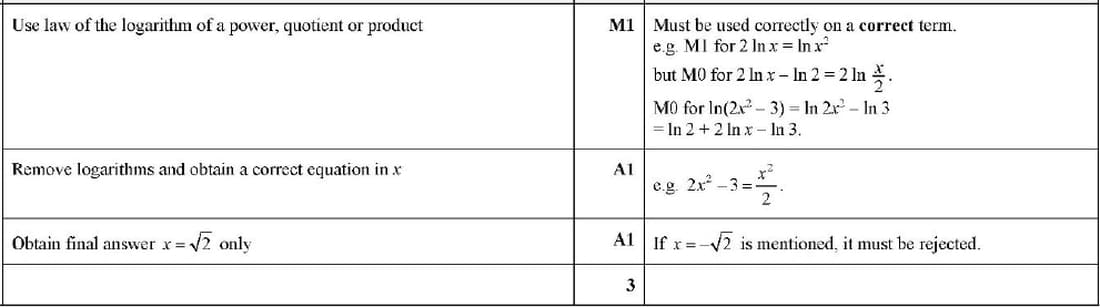
Solve the equation \(\ln(2x^2 - 3) = 2 \ln x - \ln 2\), giving your answer in an exact form.
June 2014 p32 q2
Solve the equation
\(2 \ln(5 - e^{-2x}) = 1\),
giving your answer correct to 3 significant figures.

June 2014 p31 q6
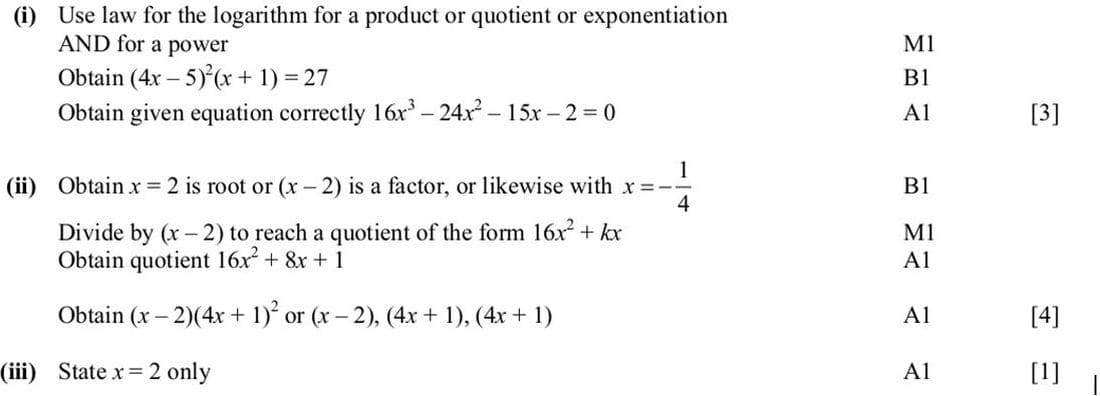
It is given that \(2\ln(4x - 5) + \ln(x + 1) = 3\ln 3\).
- Show that \(16x^3 - 24x^2 - 15x - 2 = 0\).
- By first using the factor theorem, factorise \(16x^3 - 24x^2 - 15x - 2\) completely.
- Hence solve the equation \(2\ln(4x - 5) + \ln(x + 1) = 3\ln 3\).
Nov 2012 p33 q1
Solve the equation \(\ln(x+5) = 1 + \ln x\), giving your answer in terms of \(e\).

June 2012 p33 q2
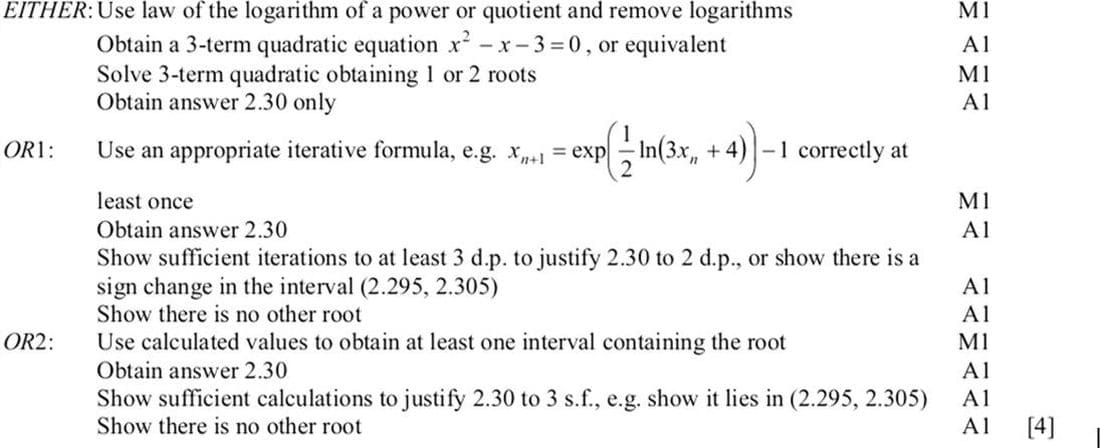
Solve the equation \(\ln(2x + 3) = 2 \ln x + \ln 3\), giving your answer correct to 3 significant figures.

June 2012 p32 q1
Solve the equation
\(\ln(3x + 4) = 2 \ln(x + 1)\),
giving your answer correct to 3 significant figures.
Nov 2010 p31 q2
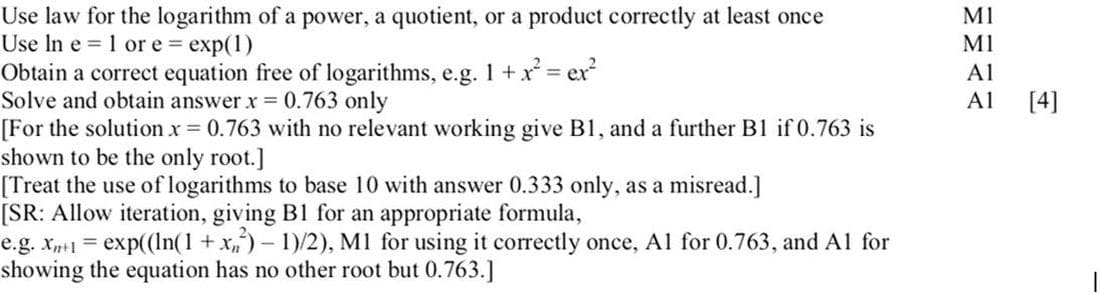
Solve the equation \(\ln(1 + x^2) = 1 + 2 \ln x\), giving your answer correct to 3 significant figures.
Nov 2009 p32 q1
Solve the equation \(\ln(5-x) = \ln 5 - \ln x\), giving your answers correct to 3 significant figures.

June 2009 p3 q1
Solve the equation \(\ln(2 + e^{-x}) = 2\), giving your answer correct to 2 decimal places.

Nov 2008 p3 q1
Solve the equation
\(\ln(x+2) = 2 + \ln x\),
giving your answer correct to 3 decimal places.

Nov 2004 p3 q2
Solve the equation \(\ln(1 + x) = 1 + \ln x\), giving your answer correct to 2 significant figures.

Nov 2022 p33 q1
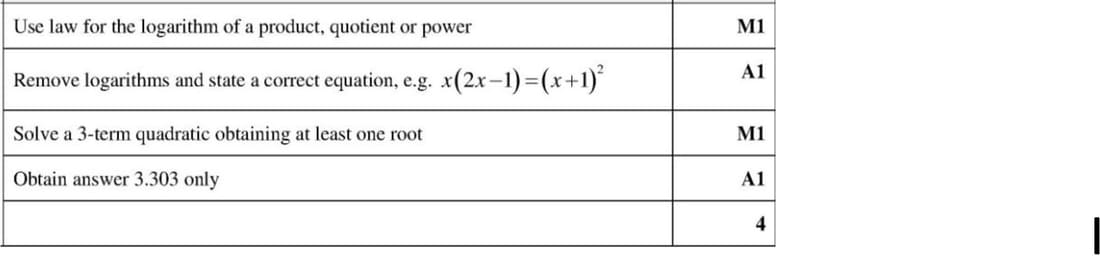
Solve the equation \(\ln(2x - 1) = 2 \ln(x + 1) - \ln x\). Give your answer correct to 3 decimal places.
Nov 2022 p32 q1
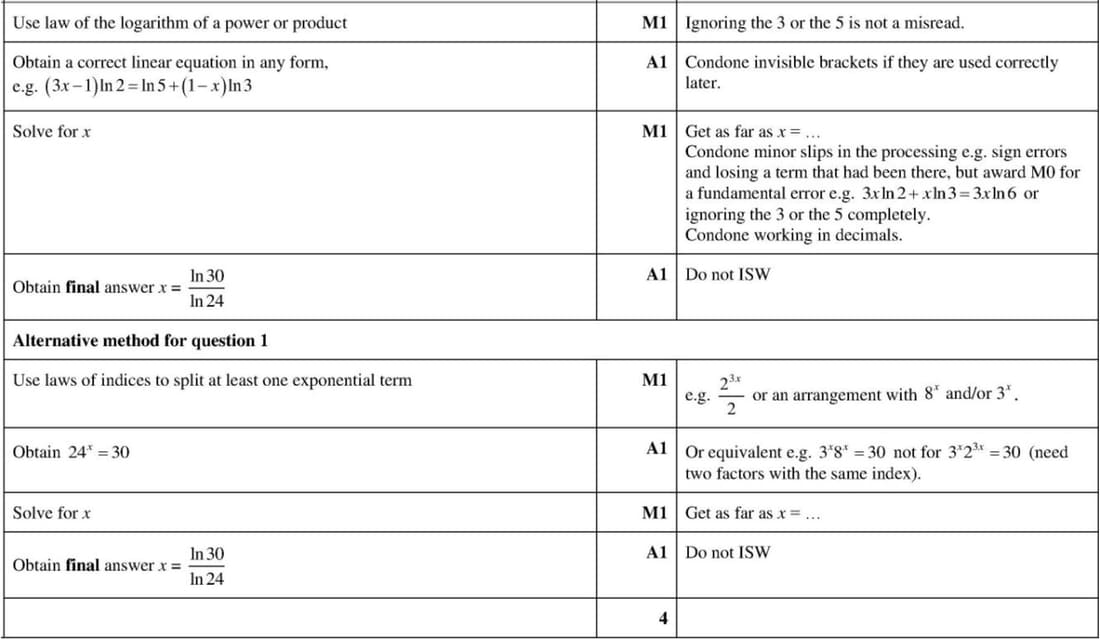
Solve the equation \(2^{3x-1} = 5(3^{1-x})\). Give your answer in the form \(\frac{\ln a}{\ln b}\) where \(a\) and \(b\) are integers.
Nov 2022 p31 q3
Solve the equation \(2^{3x-1} = 5(3^{-x})\). Give your answer in the form \(\frac{\ln a}{\ln b}\), where \(a\) and \(b\) are integers.

June 2022 p32 q1
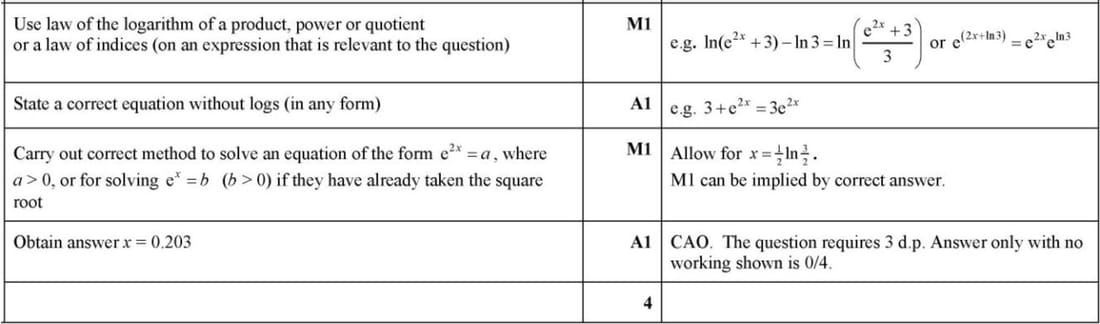
Solve the equation \(\ln(e^{2x} + 3) = 2x + \ln 3\), giving your answer correct to 3 decimal places.
June 2022 p31 q1
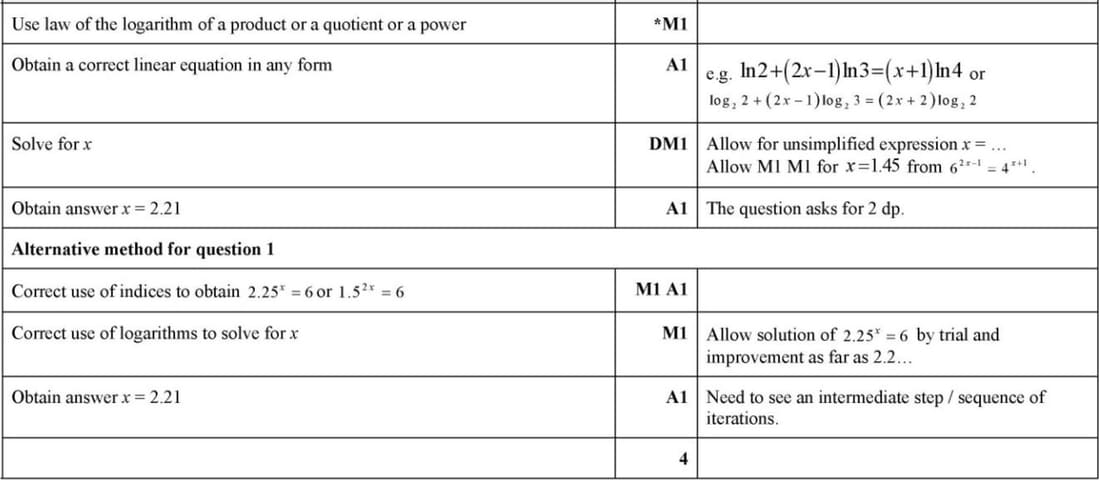
Solve the equation \(2(3^{2x-1}) = 4^{x+1}\), giving your answer correct to 2 decimal places.
Nov 2021 p32 q1
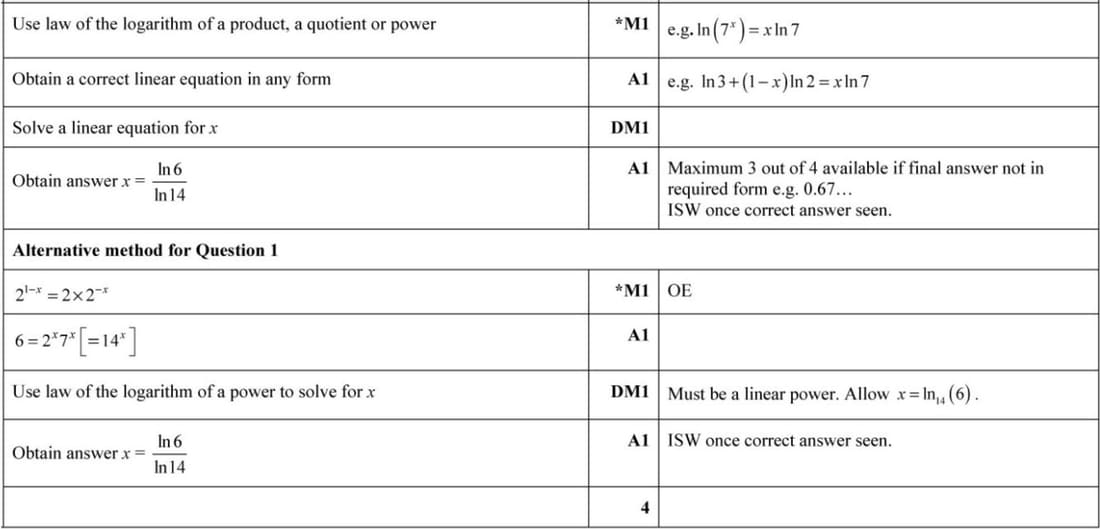
Find the value of \(x\) for which \(3(2^{1-x}) = 7^x\). Give your answer in the form \(\frac{\ln a}{\ln b}\), where \(a\) and \(b\) are integers.
Feb/Mar 2021 p32 q1
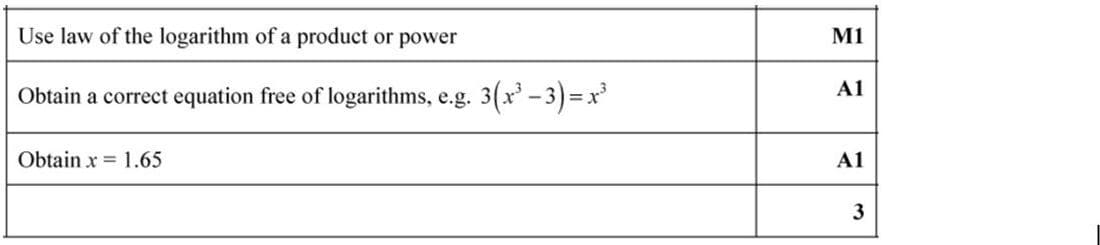
Solve the equation \(\ln(x^3 - 3) = 3 \ln x - \ln 3\). Give your answer correct to 3 significant figures.
June 2023 p31 q1
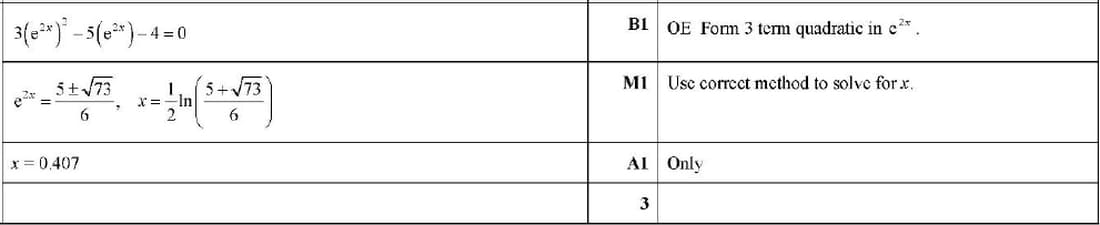
Solve the equation
\(3e^{2x} - 4e^{-2x} = 5\).
Give the answer correct to 3 decimal places.
June 2021 p31 q2
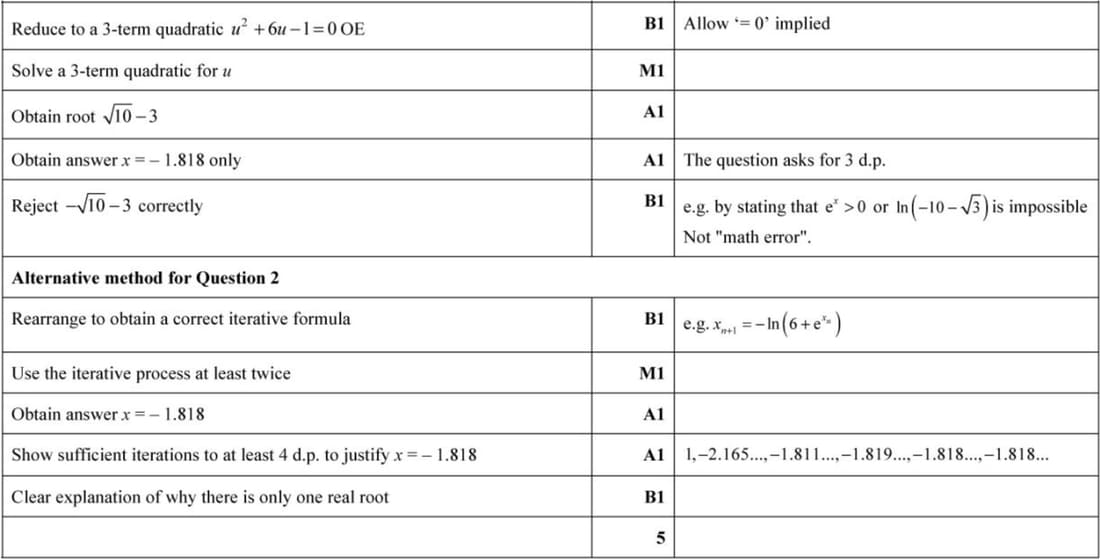
Find the real root of the equation \(\frac{2e^x + e^{-x}}{2 + e^x} = 3\), giving your answer correct to 3 decimal places. Your working should show clearly that the equation has only one real root.
June 2020 p33 q3
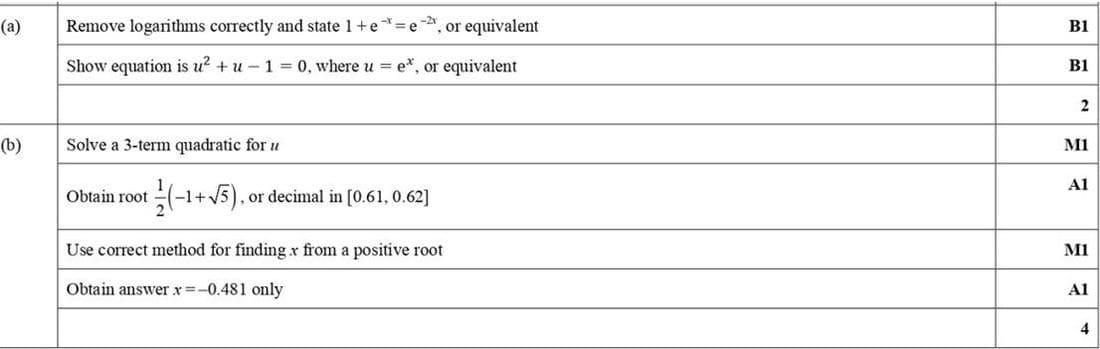
(a) Show that the equation \(\ln(1 + e^{-x}) + 2x = 0\) can be expressed as a quadratic equation in \(e^x\).
(b) Hence solve the equation \(\ln(1 + e^{-x}) + 2x = 0\), giving your answer correct to 3 decimal places.
Nov 2018 p32 q4
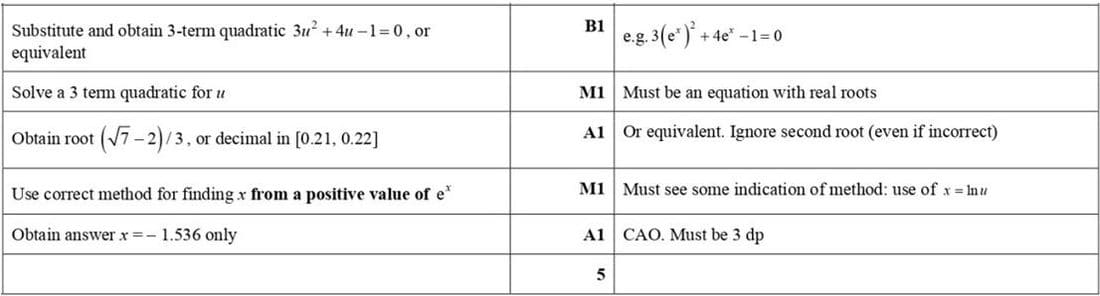
Showing all necessary working, solve the equation
\(\frac{e^x + e^{-x}}{e^x + 1} = 4\),
giving your answer correct to 3 decimal places.
Nov 2018 p31 q2
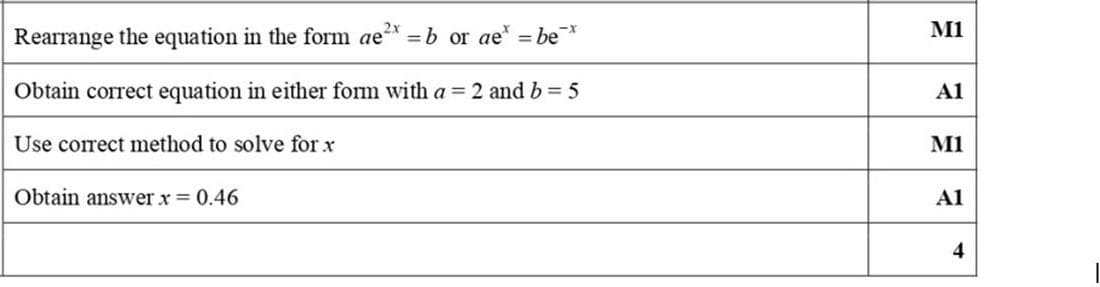
Showing all necessary working, solve the equation \(\frac{2e^x + e^{-x}}{e^x - e^{-x}} = 4\), giving your answer correct to 2 decimal places.
June 2017 p33 q3
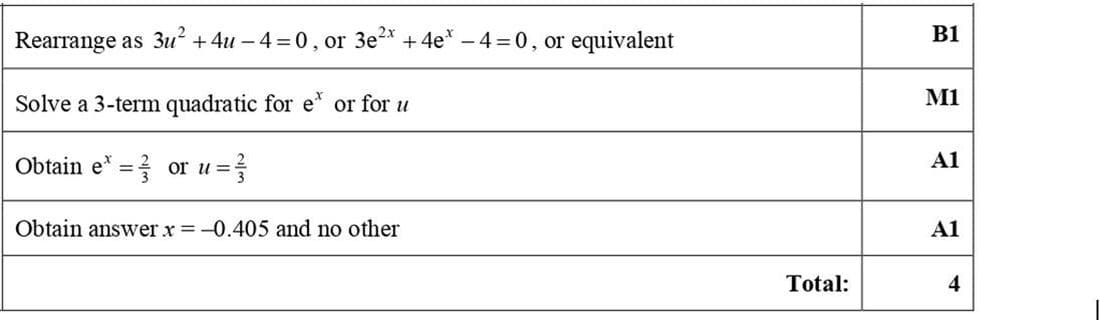
Using the substitution \(u = e^x\), solve the equation \(4e^{-x} = 3e^x + 4\). Give your answer correct to 3 significant figures.
Nov 2011 p31 q1
Using the substitution \(u = e^x\), or otherwise, solve the equation
\(e^x = 1 + 6e^{-x}\),
giving your answer correct to 3 significant figures.

June 2008 p3 q2
Solve, correct to 3 significant figures, the equation
\(e^x + e^{2x} = e^{3x}\).
Feb/Mar 2023 p32 q1
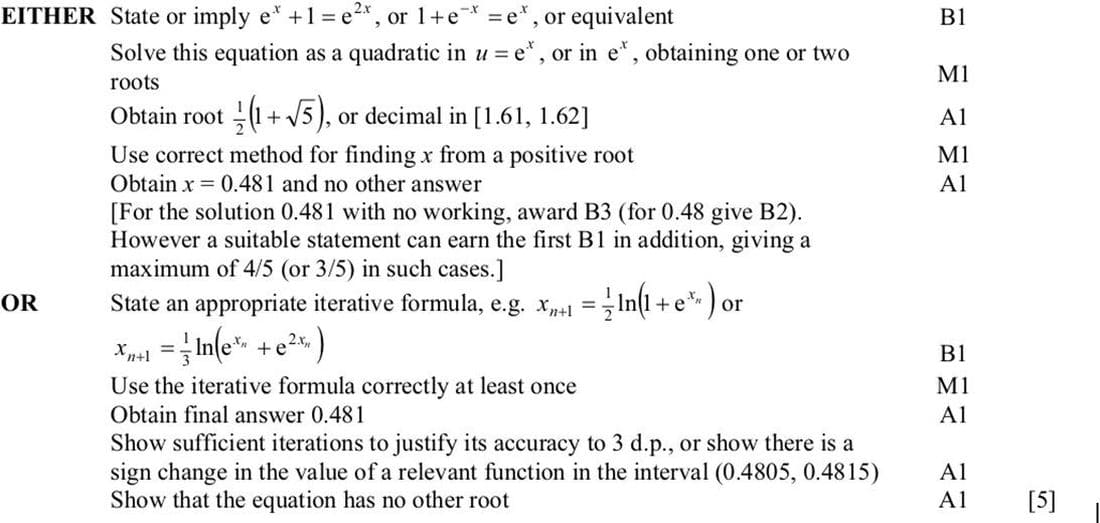
It is given that \(x = \ln(2y - 3) - \ln(y + 4)\).
Express \(y\) in terms of \(x\).
Nov 2019 p31 q1
Given that \(\ln(1 + e^{2y}) = x\), express \(y\) in terms of \(x\).

Nov 2016 p33 q1
It is given that \(z = \ln(y+2) - \ln(y+1)\). Express \(y\) in terms of \(z\).

Nov 2013 p33 q1
Given that \(2 \ln(x + 4) - \ln x = \ln(x + a)\), express \(x\) in terms of \(a\).

June 2013 p33 q2
It is given that \(\ln(y + 1) - \ln y = 1 + 3 \ln x\). Express \(y\) in terms of \(x\), in a form not involving logarithms.

June 2006 p3 q1
Given that \(x = 4(3^{-y})\), express \(y\) in terms of \(x\).
