Exam-Style Problems
⬅ Back to SubchapterNov 2023 p13 q1
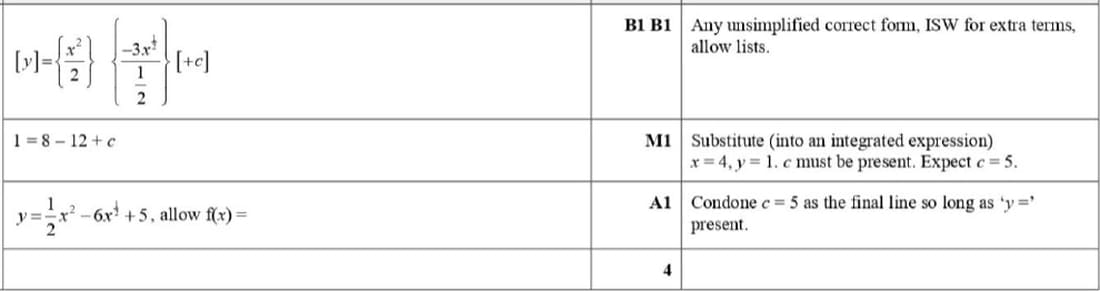
A curve is such that its gradient at a point \((x, y)\) is given by \(\frac{dy}{dx} = x - 3x^{-\frac{1}{2}}\). It is given that the curve passes through the point \((4, 1)\).
Find the equation of the curve.
Nov 2022 p11 q2
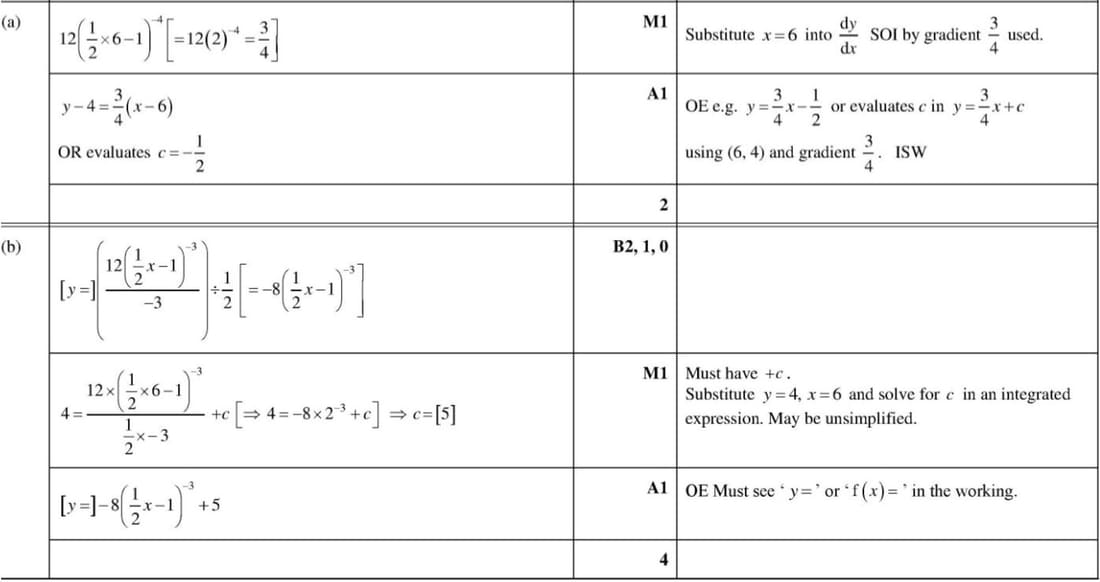
The equation of a curve is such that \(\frac{dy}{dx} = 12\left(\frac{1}{2}x - 1\right)^{-4}\). It is given that the curve passes through the point \(P(6, 4)\).
(a) Find the equation of the tangent to the curve at \(P\).
(b) Find the equation of the curve.
June 2022 p12 q3
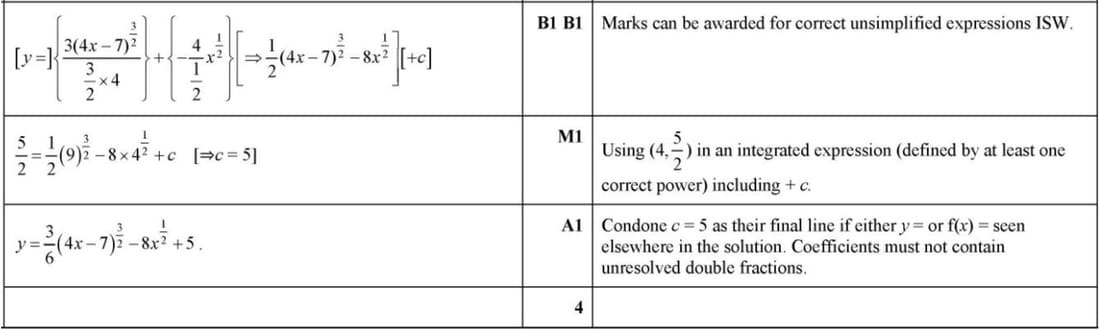
The equation of a curve is such that \(\frac{dy}{dx} = 3(4x - 7)^{\frac{1}{2}} - 4x^{-\frac{1}{2}}\). It is given that the curve passes through the point \((4, \frac{5}{2})\).
Find the equation of the curve.
June 2022 p11 q10
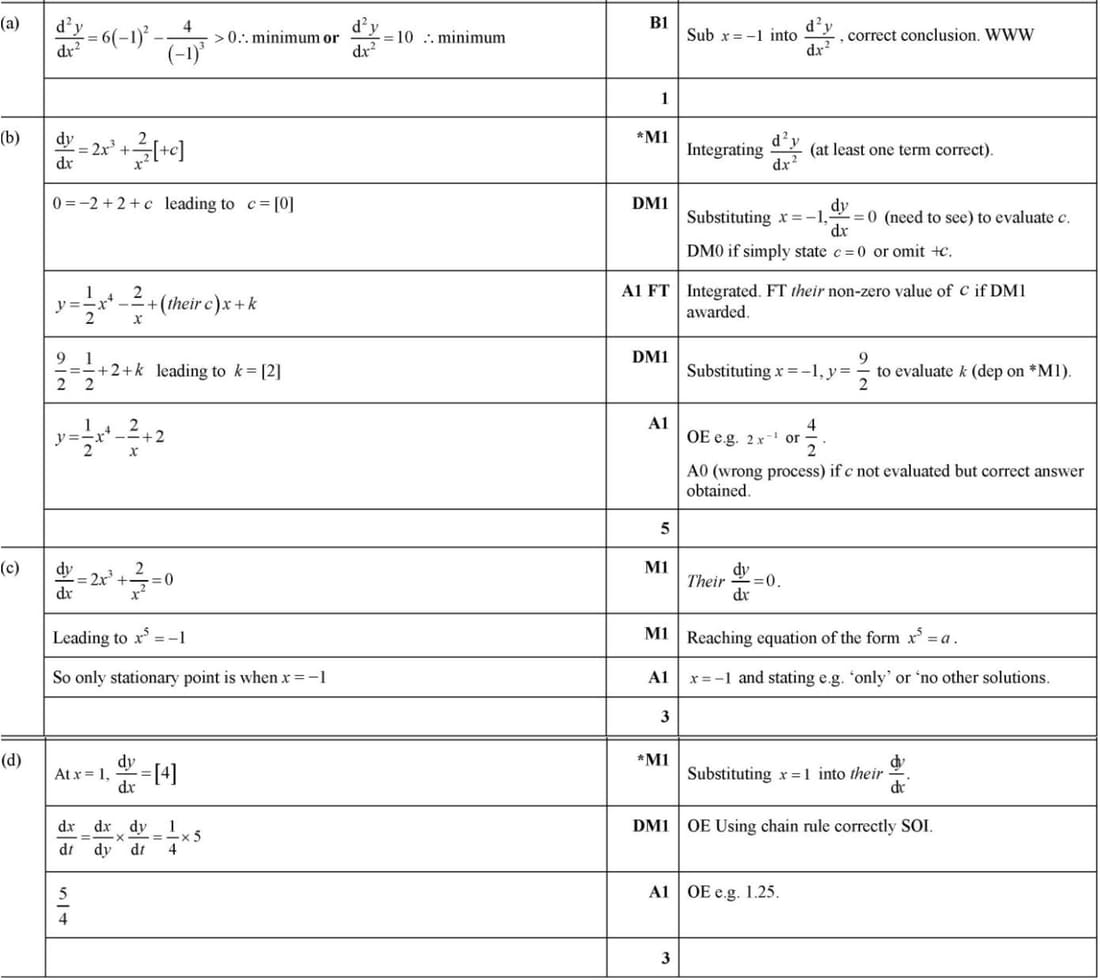
The equation of a curve is such that \(\frac{d^2y}{dx^2} = 6x^2 - \frac{4}{x^3}\). The curve has a stationary point at \((-1, \frac{9}{2})\).
(a) Determine the nature of the stationary point at \((-1, \frac{9}{2})\).
(b) Find the equation of the curve.
(c) Show that the curve has no other stationary points.
(d) A point \(A\) is moving along the curve and the \(y\)-coordinate of \(A\) is increasing at a rate of 5 units per second. Find the rate of increase of the \(x\)-coordinate of \(A\) at the point where \(x = 1\).
Feb/Mar 2022 p12 q1
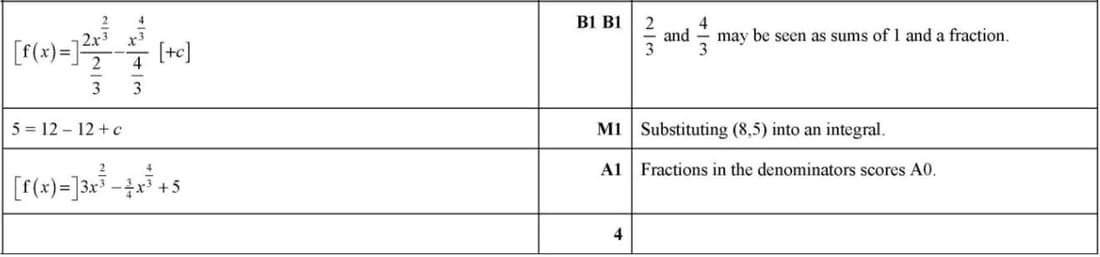
A curve with equation \(y = f(x)\) is such that \(f'(x) = 2x^{-\frac{1}{3}} - x^{\frac{1}{3}}\). It is given that \(f(8) = 5\).
Find \(f(x)\).
Nov 2021 p12 q4
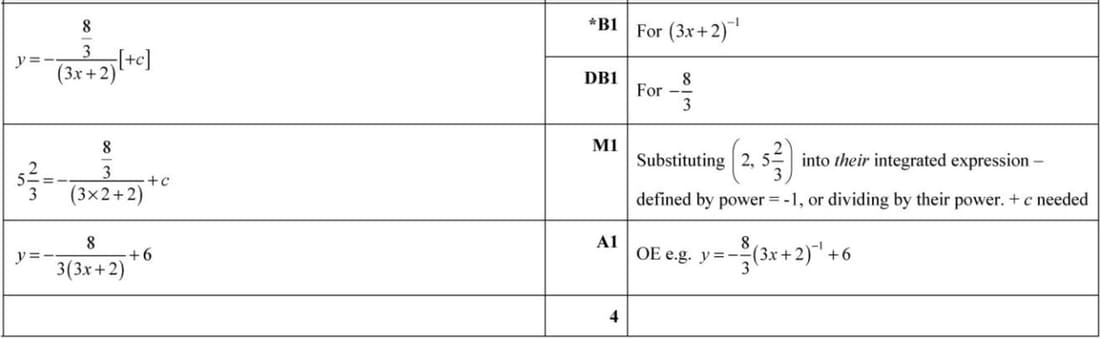
A curve is such that \(\frac{dy}{dx} = \frac{8}{(3x + 2)^2}\). The curve passes through the point \((2, 5\frac{2}{3})\).
Find the equation of the curve.
June 2021 p13 q1
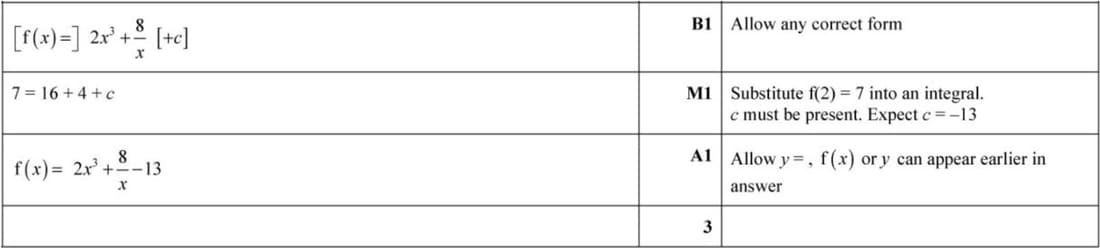
A curve with equation \(y = f(x)\) is such that \(f'(x) = 6x^2 - \frac{8}{x^2}\). It is given that the curve passes through the point \((2, 7)\).
Find \(f(x)\).
June 2021 p12 q11
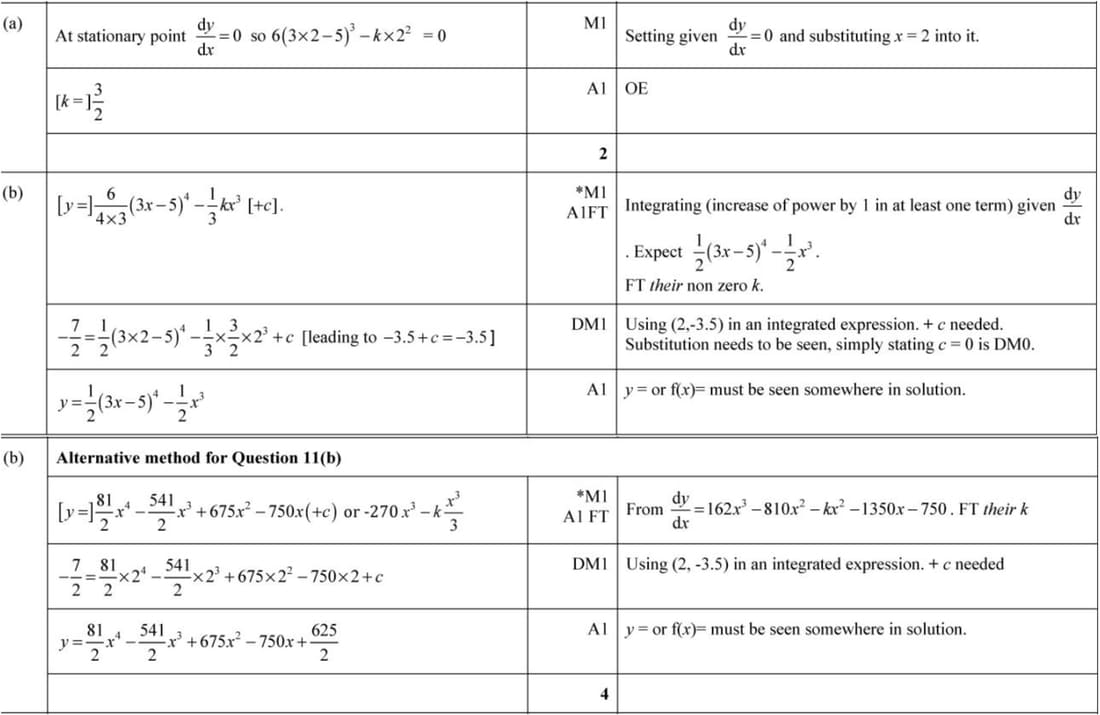
The gradient of a curve is given by \(\frac{dy}{dx} = 6(3x-5)^3 - kx^2\), where \(k\) is a constant. The curve has a stationary point at \((2, -3.5)\).
(a) Find the value of \(k\).
(b) Find the equation of the curve.
June 2021 p11 q1
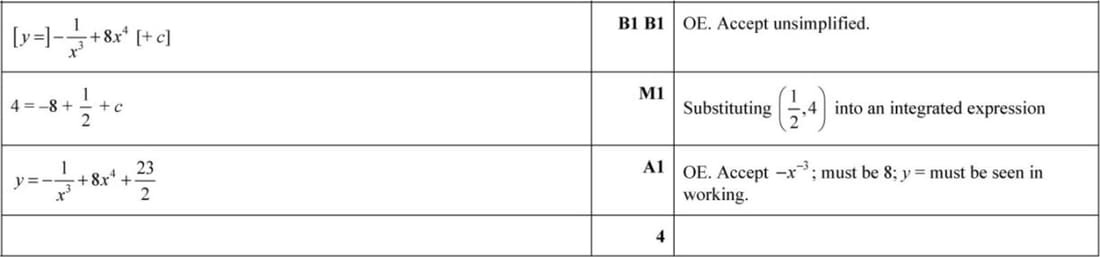
The equation of a curve is such that \(\frac{dy}{dx} = \frac{3}{x^4} + 32x^3\). It is given that the curve passes through the point \(\left( \frac{1}{2}, 4 \right)\).
Find the equation of the curve.
Feb/Mar 2021 p12 q6
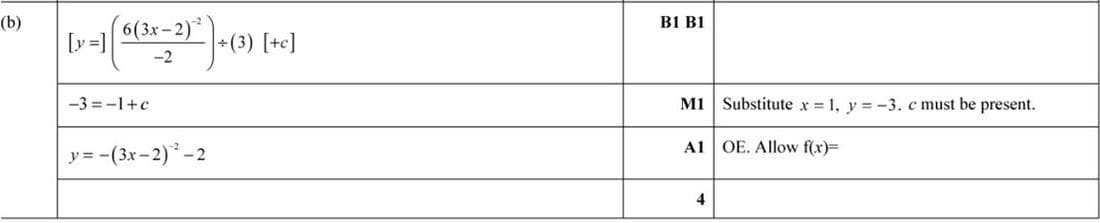
A curve is such that \(\frac{dy}{dx} = \frac{6}{(3x - 2)^3}\) and \(A(1, -3)\) lies on the curve.
Find the equation of the curve.
Nov 2020 p13 q2
The function \(f\) is defined by \(f(x) = \frac{2}{(x+2)^2}\) for \(x > -2\).
(a) Find \(\int_{1}^{\infty} f(x) \, dx\).
(b) The equation of a curve is such that \(\frac{dy}{dx} = f(x)\). It is given that the point \((-1, -1)\) lies on the curve.
Find the equation of the curve.

Nov 2023 p12 q3
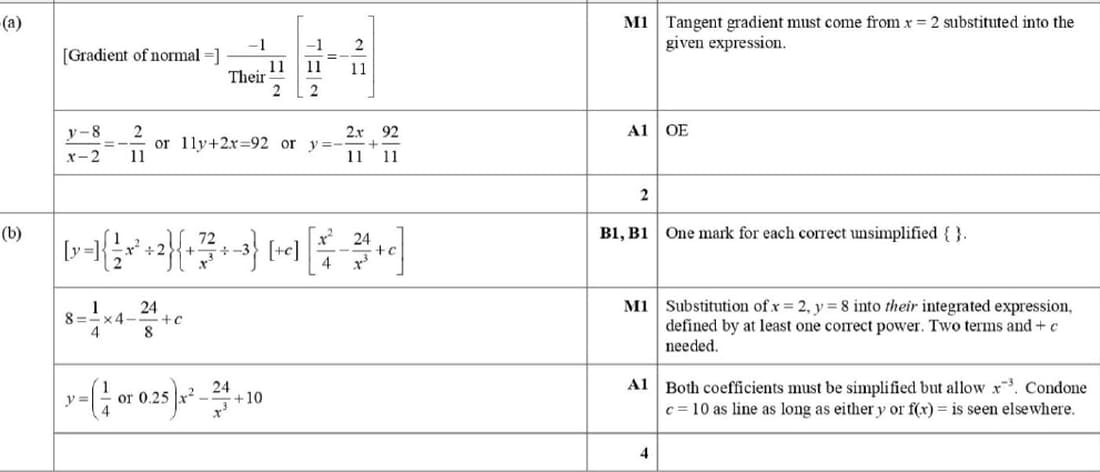
The equation of a curve is such that \(\frac{dy}{dx} = \frac{1}{2}x + \frac{72}{x^4}\). The curve passes through the point \(P(2, 8)\).
(a) Find the equation of the normal to the curve at \(P\).
(b) Find the equation of the curve.
Nov 2020 p12 q7
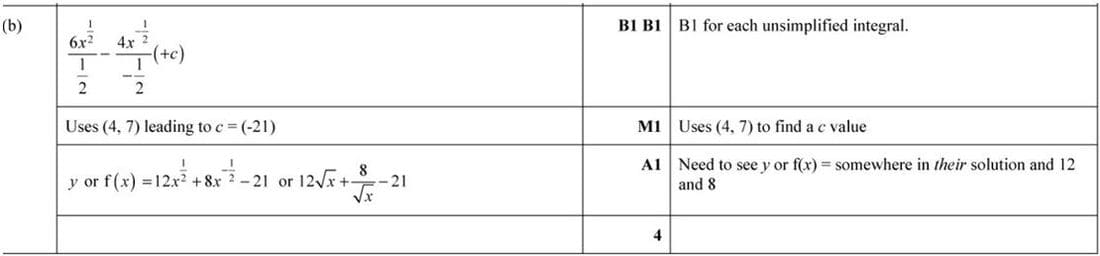
The point (4, 7) lies on the curve \(y = f(x)\) and it is given that \(f'(x) = 6x^{-\frac{1}{2}} - 4x^{-\frac{3}{2}}\).
Find the equation of the curve.
Nov 2020 p11 q2
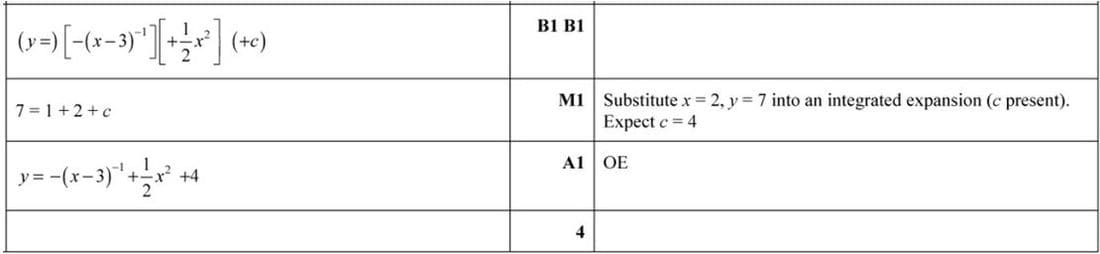
The equation of a curve is such that \(\frac{dy}{dx} = \frac{1}{(x-3)^2} + x\). It is given that the curve passes through the point (2, 7).
Find the equation of the curve.
June 2020 p13 q2
The equation of a curve is such that \(\frac{dy}{dx} = 3x^{\frac{1}{2}} - 3x^{-\frac{1}{2}}\). It is given that the point (4, 7) lies on the curve.
Find the equation of the curve.

June 2019 p12 q3
A curve is such that \(\frac{dy}{dx} = x^3 - \frac{4}{x^2}\). The point \(P(2, 9)\) lies on the curve.
Find the equation of the curve.

June 2018 p11 q3
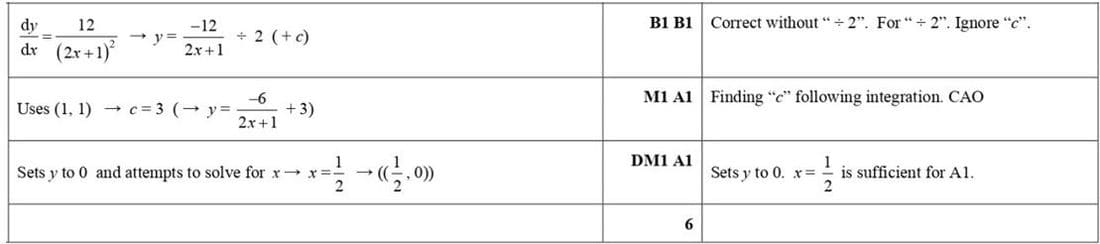
A curve is such that \(\frac{dy}{dx} = \frac{12}{(2x+1)^2}\). The point (1, 1) lies on the curve. Find the coordinates of the point at which the curve intersects the x-axis.
Feb/Mar 2018 p12 q1
A curve passes through the point (4, -6) and has an equation for which \(\frac{dy}{dx} = x^{-\frac{1}{2}} - 3\). Find the equation of the curve.

Nov 2017 p12 q8
A curve is such that \(\frac{dy}{dx} = -x^2 + 5x - 4\).
Given that the curve passes through the point (6, 2), find the equation of the curve.

Nov 2016 p12 q1
A curve is such that \(\frac{dy}{dx} = \frac{8}{\sqrt{4x + 1}}\). The point \((2, 5)\) lies on the curve. Find the equation of the curve.

June 2016 p12 q2
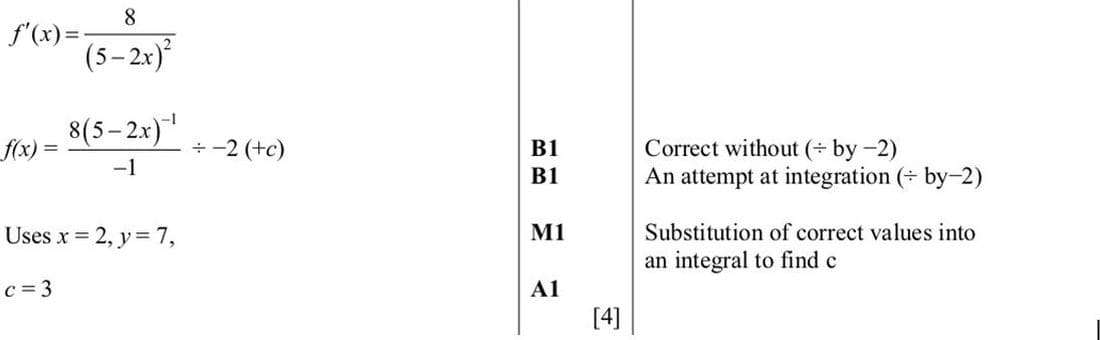
A curve is such that \(\frac{dy}{dx} = \frac{8}{(5 - 2x)^2}\). Given that the curve passes through (2, 7), find the equation of the curve.
Feb/Mar 2016 p12 q2
A curve for which \(\frac{dy}{dx} = 3x^2 - \frac{2}{x^3}\) passes through \((-1, 3)\). Find the equation of the curve.

Nov 2023 p11 q10
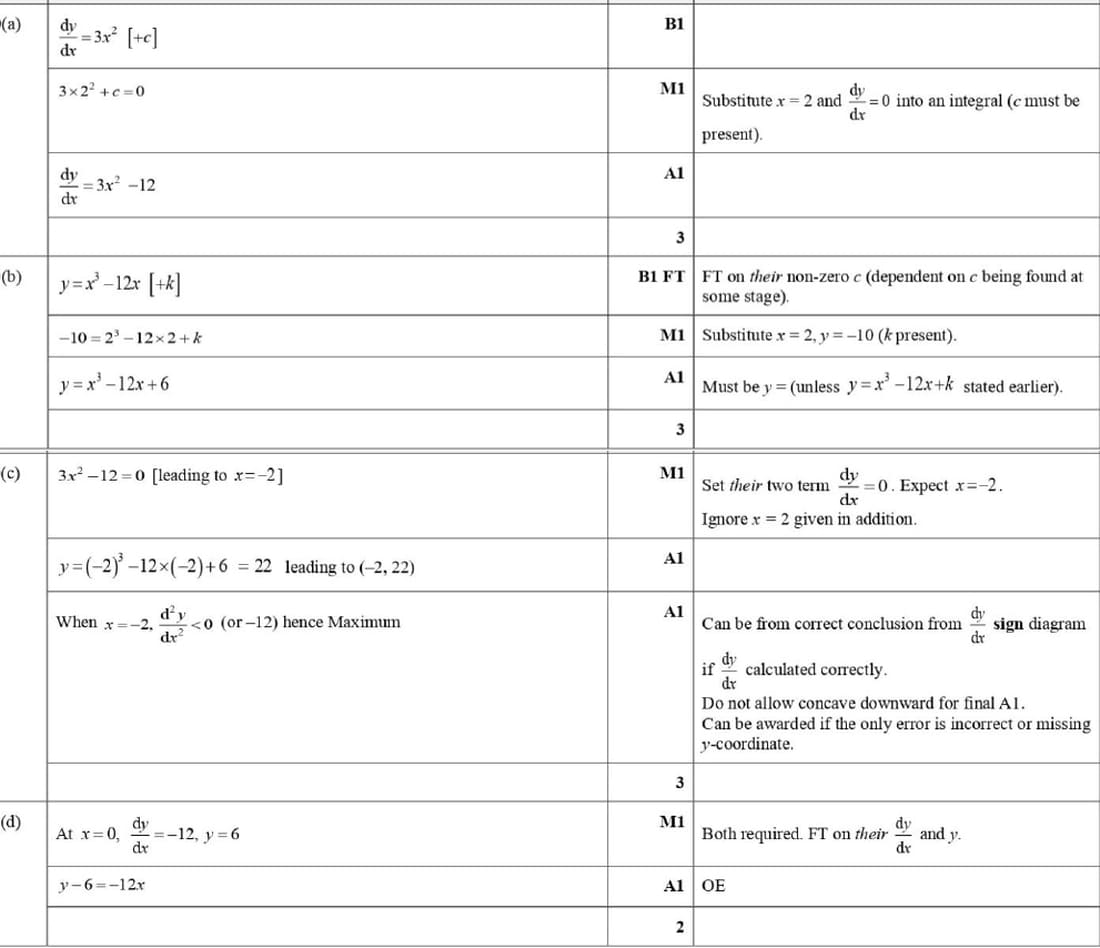
A curve has a stationary point at \((2, -10)\) and is such that \(\frac{d^2y}{dx^2} = 6x\).
\((a) Find \(\frac{dy}{dx}\>.\)
(b) Find the equation of the curve.
(c) Find the coordinates of the other stationary point and determine its nature.
(d) Find the equation of the tangent to the curve at the point where the curve crosses the y-axis.
Nov 2015 p11 q2
The function \(f\) is such that \(f'(x) = 3x^2 - 7\) and \(f(3) = 5\). Find \(f(x)\).

June 2015 p13 q2
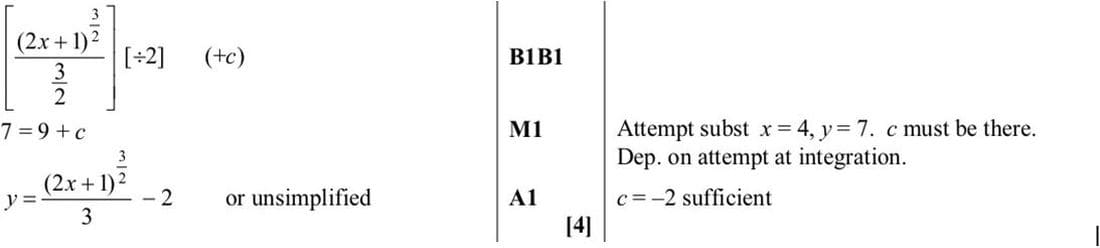
A curve is such that \(\frac{dy}{dx} = (2x + 1)^{\frac{1}{2}}\) and the point \((4, 7)\) lies on the curve. Find the equation of the curve.
June 2015 p12 q1
The function \(f\) is such that \(f'(x) = 5 - 2x^2\) and \((3, 5)\) is a point on the curve \(y = f(x)\). Find \(f(x)\).

Nov 2013 p13 q2
A curve has equation \(y = f(x)\). It is given that \(f'(x) = x^{-\frac{3}{2}} + 1\) and that \(f(4) = 5\). Find \(f(x)\).

Nov 2013 p11 q2
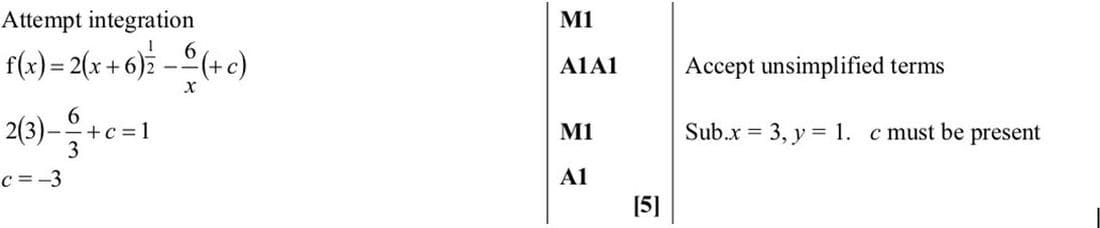
A curve has equation \(y = f(x)\). It is given that \(f'(x) = \frac{1}{\sqrt{x+6}} + \frac{6}{x^2}\) and that \(f(3) = 1\). Find \(f(x)\). [5]
June 2013 p13 q1
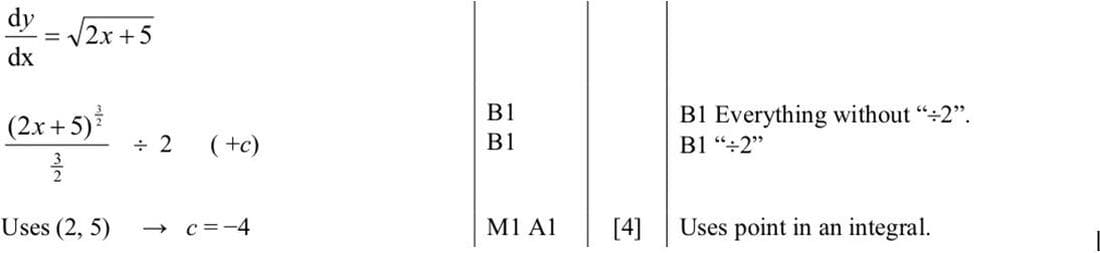
A curve is such that \(\frac{dy}{dx} = \sqrt{2x + 5}\) and \((2, 5)\) is a point on the curve. Find the equation of the curve.
June 2013 p12 q1
A curve is such that \(\frac{dy}{dx} = \frac{6}{x^2}\) and \((2, 9)\) is a point on the curve. Find the equation of the curve.

June 2013 p11 q9
A curve has equation \(y = f(x)\) and is such that \(f'(x) = 3x^{\frac{1}{2}} + 3x^{-\frac{1}{2}} - 10\).
It is given that the curve \(y = f(x)\) passes through the point \((4, -7)\). Find \(f(x)\).

Nov 2012 p13 q8
A curve is such that \(\frac{dy}{dx} = 2(3x + 4)^{\frac{3}{2}} - 6x - 8\).
It is now given that the stationary point on the curve has coordinates \((-1, 5)\). Find the equation of the curve.

Nov 2012 p11 q2
A curve is such that \(\frac{dy}{dx} = -\frac{8}{x^3} - 1\) and the point (2, 4) lies on the curve. Find the equation of the curve.

June 2023 p13 q9
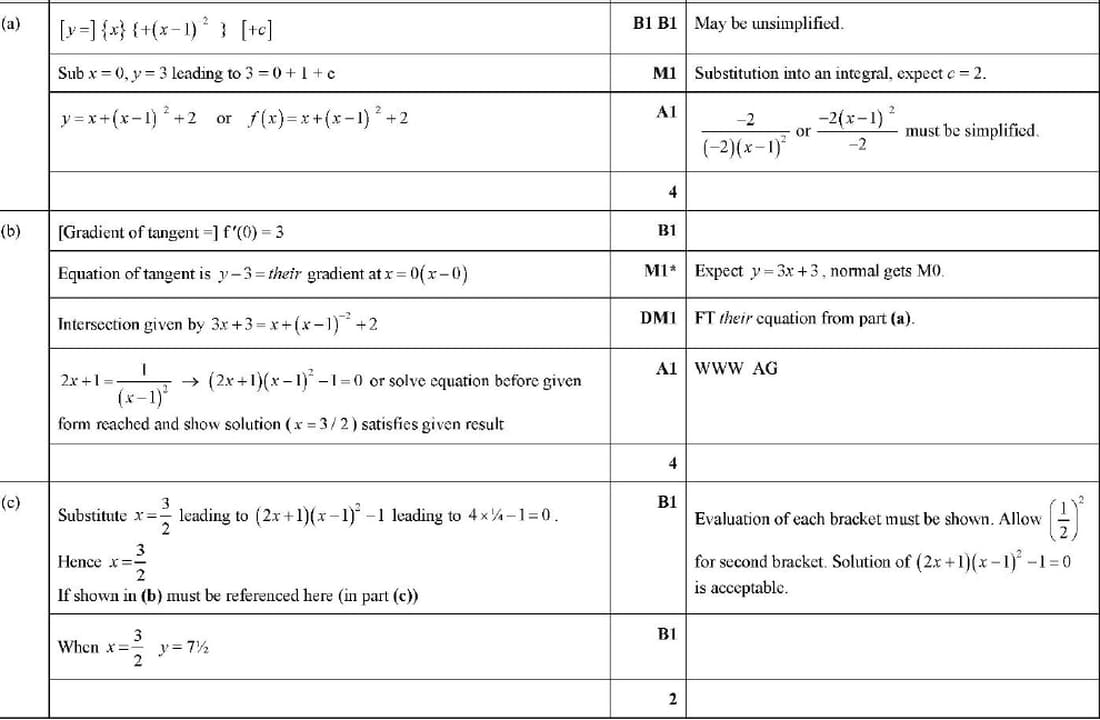
A curve which passes through (0, 3) has equation \(y = f(x)\). It is given that \(f'(x) = 1 - \frac{2}{(x-1)^3}\).
(a) Find the equation of the curve.
The tangent to the curve at (0, 3) intersects the curve again at one other point, \(P\).
(b) Show that the \(x\)-coordinate of \(P\) satisfies the equation \((2x + 1)(x - 1)^2 - 1 = 0\).
(c) Verify that \(x = \frac{3}{2}\) satisfies this equation and hence find the \(y\)-coordinate of \(P\).
June 2011 p13 q9
A curve is such that \(\frac{dy}{dx} = \frac{2}{\sqrt{x}} - 1\) and \(P(9, 5)\) is a point on the curve.
Find the equation of the curve.

Nov 2010 p13 q6
A curve has equation \(y = f(x)\). It is given that \(f'(x) = 3x^2 + 2x - 5\).
Given that the curve passes through \((1, 3)\), find \(f(x)\).

Nov 2009 p12 q1
The equation of a curve is such that \(\frac{dy}{dx} = \frac{3}{\sqrt{x}} - x\). Given that the curve passes through the point (4, 6), find the equation of the curve.

June 2005 p1 q1
A curve is such that \(\frac{dy}{dx} = 2x^2 - 5\). Given that the point \((3, 8)\) lies on the curve, find the equation of the curve.

June 2023 p12 q1
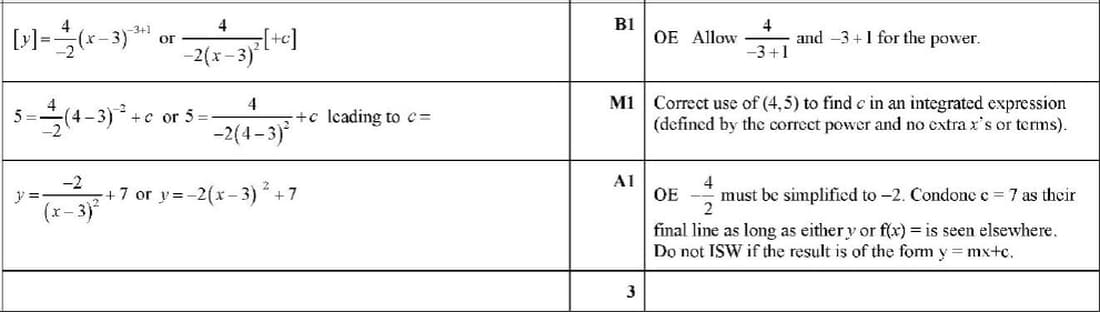
The equation of a curve is such that \(\frac{dy}{dx} = \frac{4}{(x-3)^3}\) for \(x > 3\). The curve passes through the point (4, 5).
Find the equation of the curve.
June 2023 p11 q11
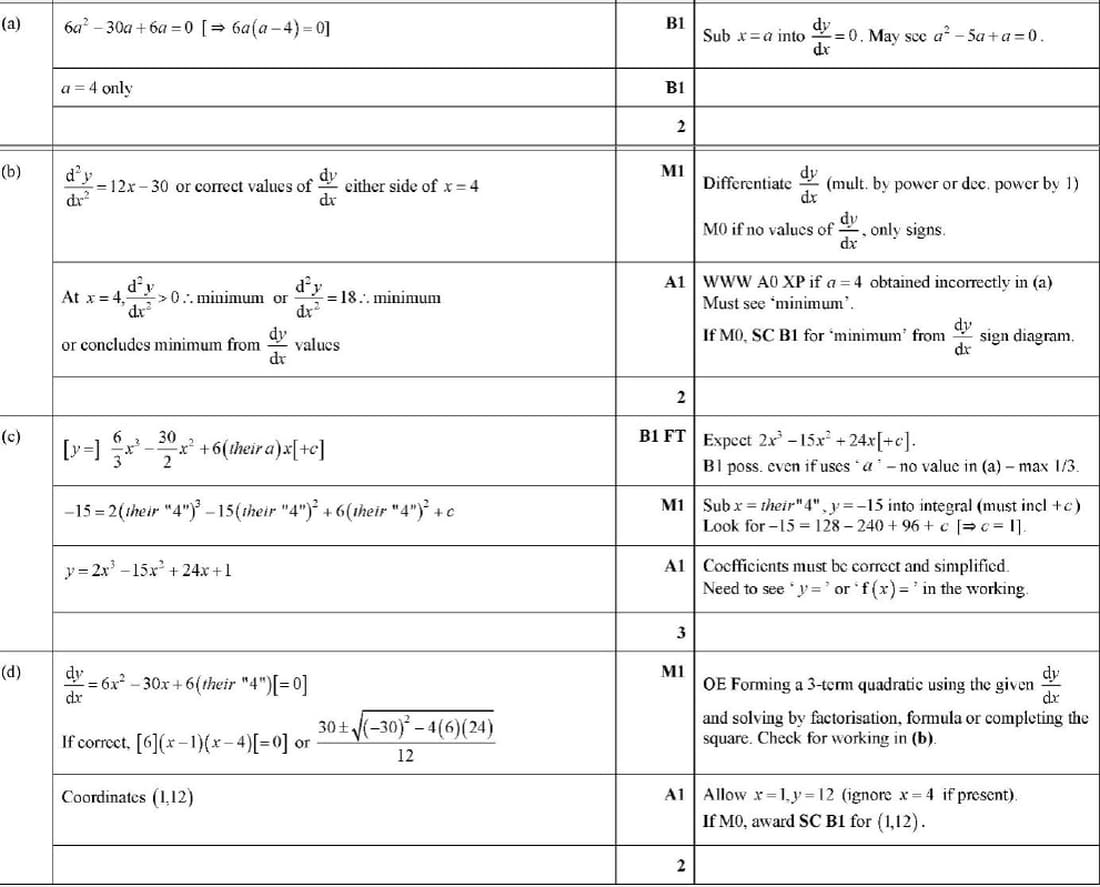
The equation of a curve is such that \(\frac{dy}{dx} = 6x^2 - 30x + 6a\), where \(a\) is a positive constant. The curve has a stationary point at \((a, -15)\).
(a) Find the value of \(a\).
(b) Determine the nature of this stationary point.
(c) Find the equation of the curve.
(d) Find the coordinates of any other stationary points on the curve.
Mar 2023 p12 q10
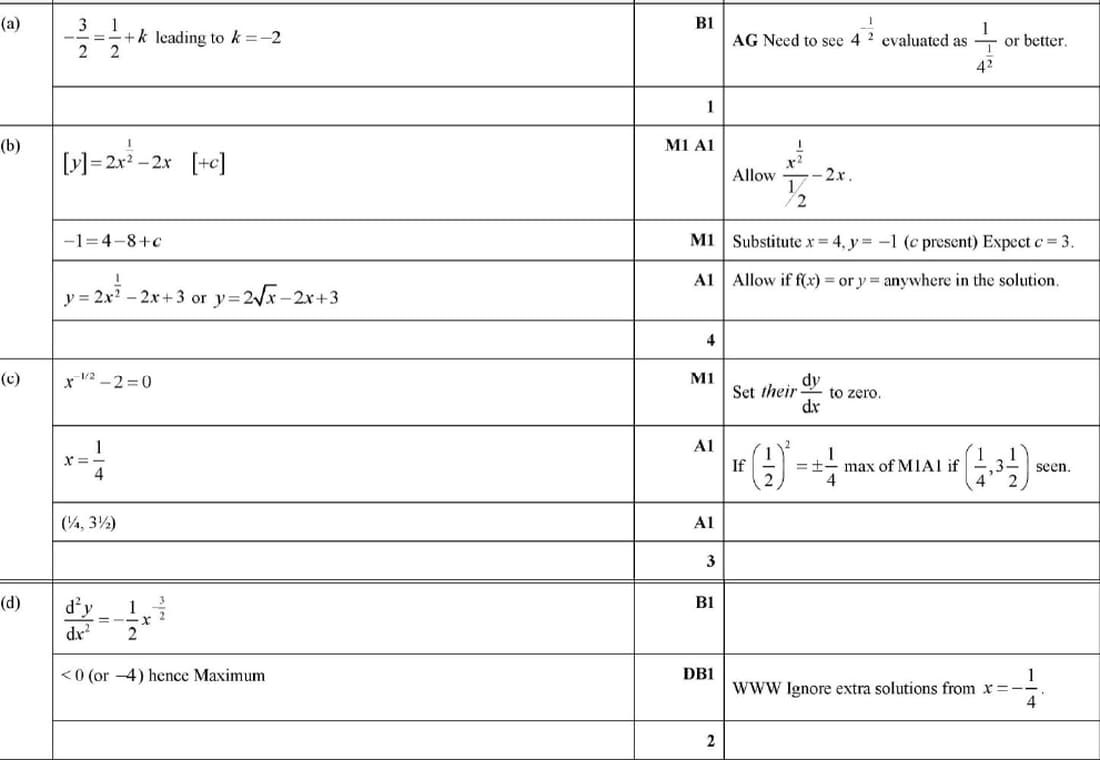
At the point (4, -1) on a curve, the gradient of the curve is \(-\frac{3}{2}\). It is given that \(\frac{dy}{dx} = x^{-\frac{1}{2}} + k\), where \(k\) is a constant.
(a) Show that \(k = -2\).
(b) Find the equation of the curve.
(c) Find the coordinates of the stationary point.
(d) Determine the nature of the stationary point.
Nov 2022 p13 q7
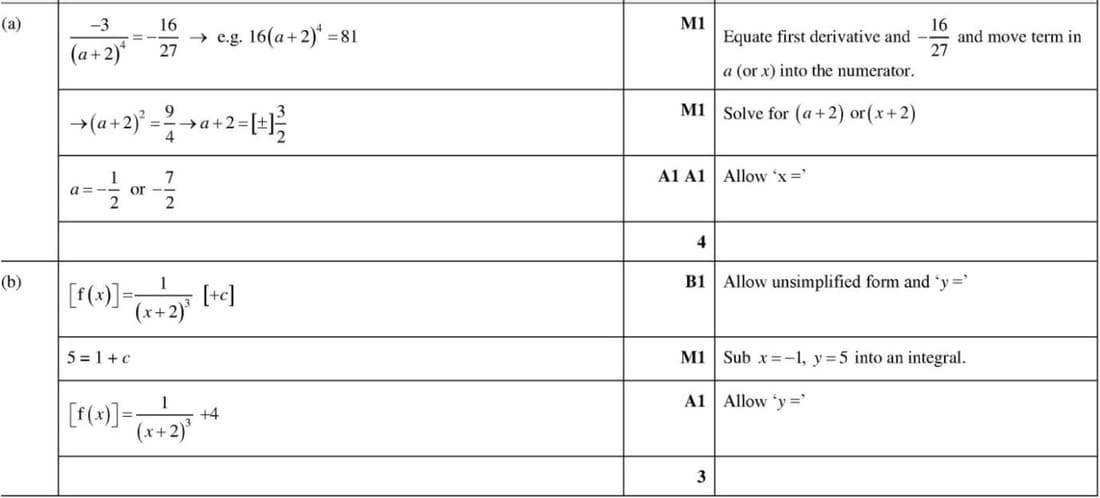
The curve \(y = f(x)\) is such that \(f'(x) = \frac{-3}{(x+2)^4}\).
(a) The tangent at a point on the curve where \(x = a\) has gradient \(-\frac{16}{27}\). Find the possible values of \(a\).
(b) Find \(f(x)\) given that the curve passes through the point \((-1, 5)\).
Nov 2022 p12 q8
The equation of a curve is such that \(\frac{dy}{dx} = 3x^{\frac{1}{2}} - 3x^{-\frac{1}{2}}\). The curve passes through the point \((3, 5)\).
(a) Find the equation of the curve.
(b) Find the \(x\)-coordinate of the stationary point.
(c) State the set of values of \(x\) for which \(y\) increases as \(x\) increases.