Exam-Style Problems
⬅ Back to SubchapterNov 2022 p11 q8
The function f is defined by \(f(x) = 2 - \frac{3}{4x-p}\) for \(x > \frac{p}{4}\), where \(p\) is a constant.
Find \(f'(x)\) and hence determine whether \(f\) is an increasing function, a decreasing function or neither.

Nov 2017 p11 q2
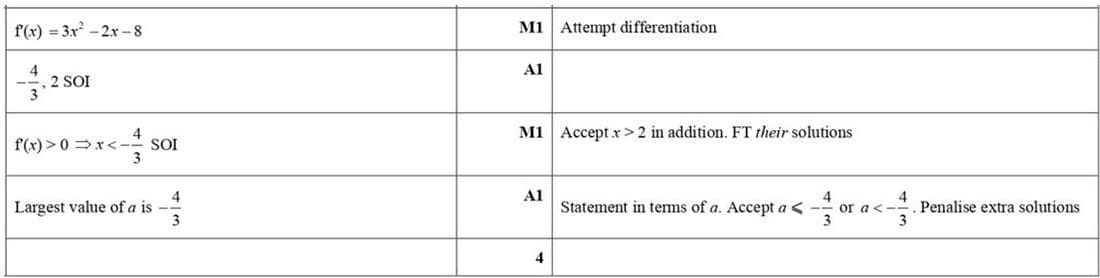
A function \(f\) is defined by \(f : x \mapsto x^3 - x^2 - 8x + 5\) for \(x < a\). It is given that \(f\) is an increasing function. Find the largest possible value of the constant \(a\).
Nov 2016 p13 q4
The function \(f\) is such that \(f(x) = x^3 - 3x^2 - 9x + 2\) for \(x > n\), where \(n\) is an integer. It is given that \(f\) is an increasing function. Find the least possible value of \(n\).

Nov 2015 p13 q3
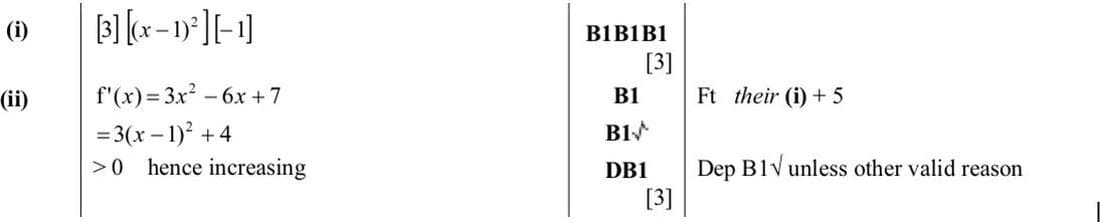
(i) Express \(3x^2 - 6x + 2\) in the form \(a(x+b)^2 + c\), where \(a, b\) and \(c\) are constants.
(ii) The function \(f\), where \(f(x) = x^3 - 3x^2 + 7x - 8\), is defined for \(x \in \mathbb{R}\). Find \(f'(x)\) and state, with a reason, whether \(f\) is an increasing function, a decreasing function or neither.
June 2015 p13 q8
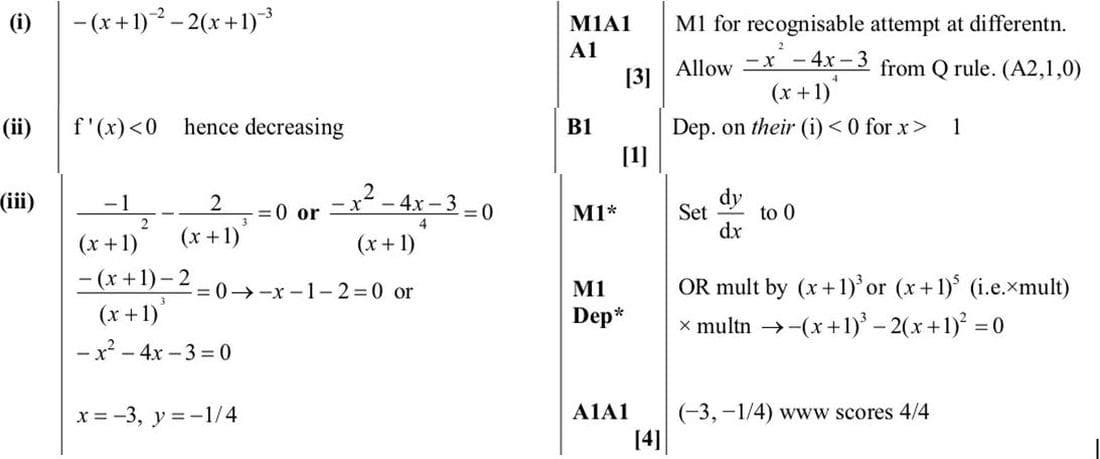
The function f is defined by \(f(x) = \frac{1}{x+1} + \frac{1}{(x+1)^2}\) for \(x > -1\).
- Find \(f'(x)\).
- State, with a reason, whether f is an increasing function, a decreasing function or neither.
The function g is defined by \(g(x) = \frac{1}{x+1} + \frac{1}{(x+1)^2}\) for \(x < -1\).
- Find the coordinates of the stationary point on the curve \(y = g(x)\).
Nov 2014 p13 q3
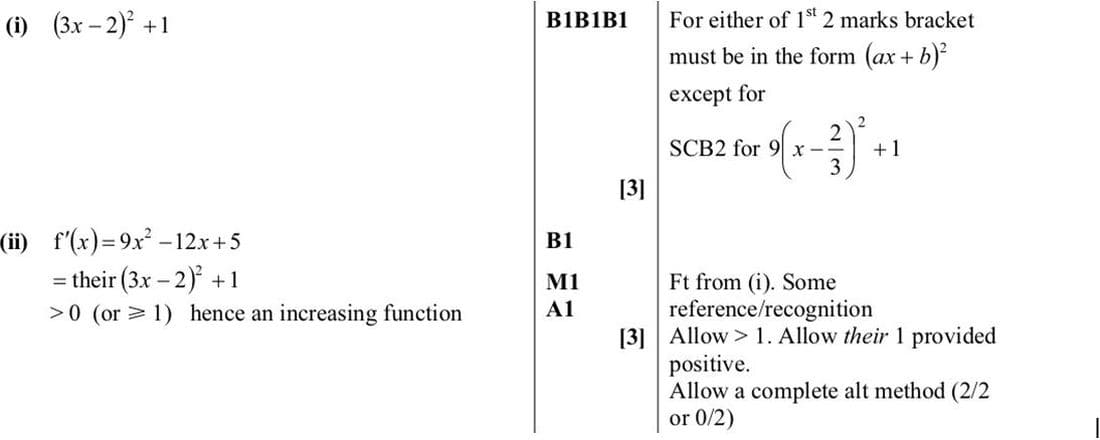
(i) Express \(9x^2 - 12x + 5\) in the form \((ax + b)^2 + c\).
(ii) Determine whether \(3x^3 - 6x^2 + 5x - 12\) is an increasing function, a decreasing function or neither.
Nov 2014 p12 q6
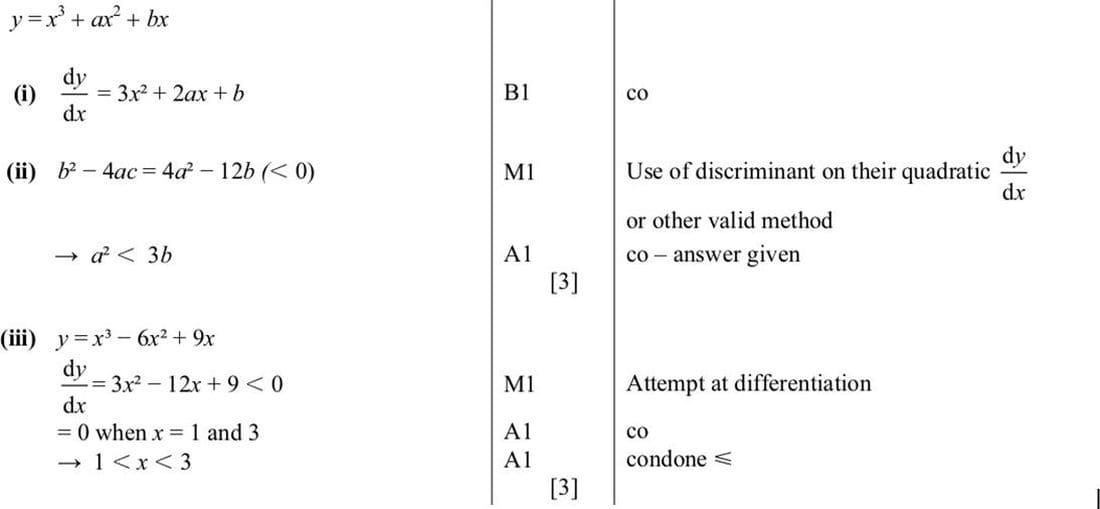
The equation of a curve is \(y = x^3 + ax^2 + bx\), where \(a\) and \(b\) are constants.
(i) In the case where the curve has no stationary point, show that \(a^2 < 3b\).
(ii) In the case where \(a = -6\) and \(b = 9\), find the set of values of \(x\) for which \(y\) is a decreasing function of \(x\).
June 2013 p12 q9
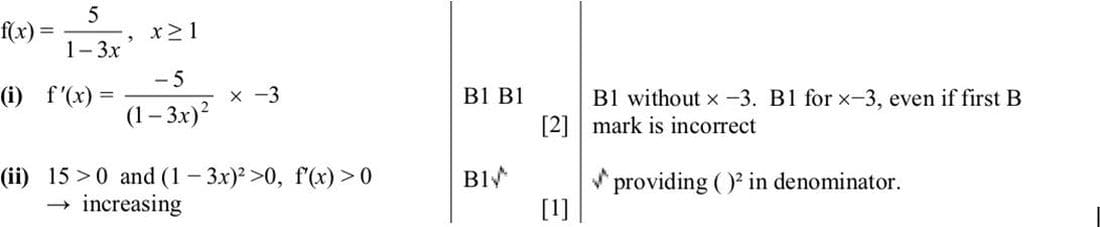
A function \(f\) is defined by \(f(x) = \frac{5}{1 - 3x}\), for \(x \geq 1\).
(i) Find an expression for \(f'(x)\).
(ii) Determine, with a reason, whether \(f\) is an increasing function, a decreasing function or neither.
June 2013 p11 q1
It is given that \(f(x) = (2x - 5)^3 + x\), for \(x \in \mathbb{R}\). Show that \(f\) is an increasing function.

Nov 2012 p13 q2
It is given that \(f(x) = \frac{1}{x^3} - x^3\), for \(x > 0\). Show that \(f\) is a decreasing function.

Nov 2010 p13 q6
A curve has equation \(y = f(x)\). It is given that \(f'(x) = 3x^2 + 2x - 5\).
Find the set of values of \(x\) for which \(f\) is an increasing function.

Problem 1147
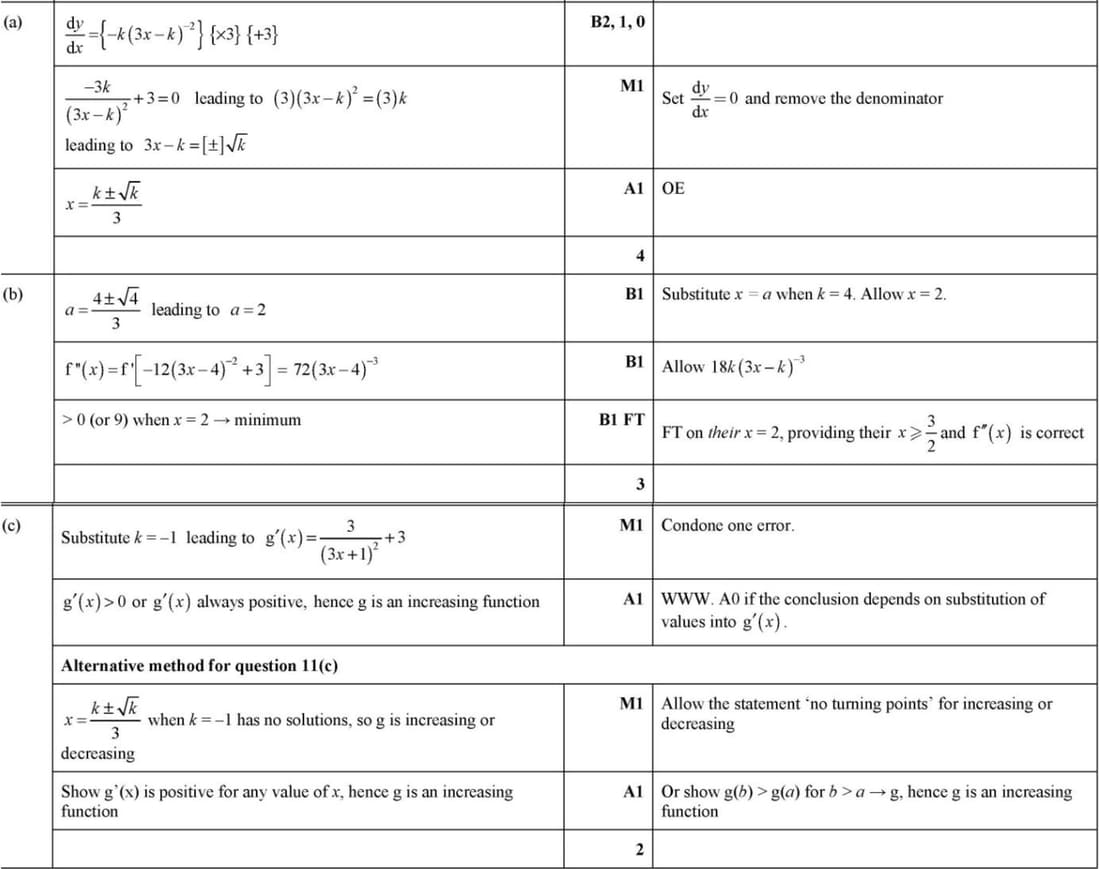
It is given that a curve has equation \(y = k(3x-k)^{-1} + 3x\), where \(k\) is a constant.
(a) Find, in terms of \(k\), the values of \(x\) at which there is a stationary point.
The function \(f\) has a stationary value at \(x = a\) and is defined by \(f(x) = 4(3x-4)^{-1} + 3x\) for \(x \geq \frac{3}{2}\).
(b) Find the value of \(a\) and determine the nature of the stationary value.
(c) The function \(g\) is defined by \(g(x) = -(3x+1)^{-1} + 3x\) for \(x \geq 0\).
Determine, making your reasoning clear, whether \(g\) is an increasing function, a decreasing function or neither.
June 2010 p12 q10
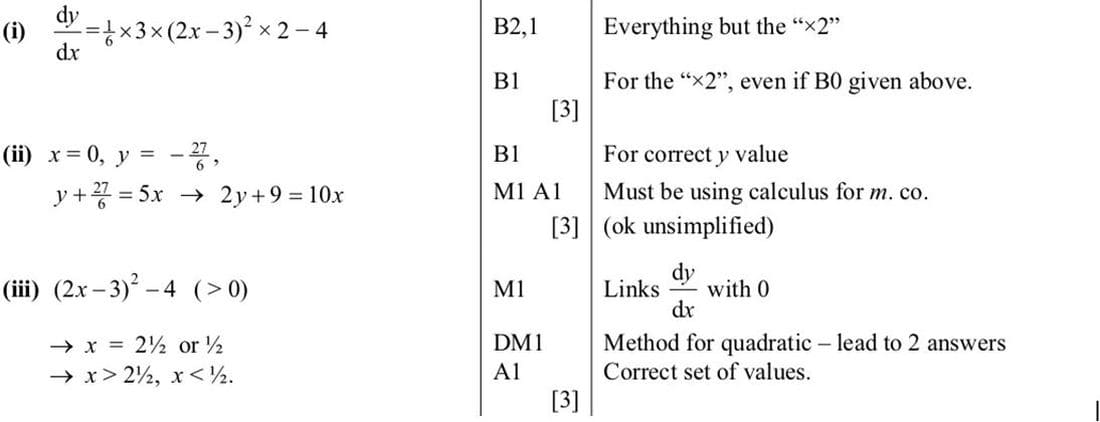
The equation of a curve is \(y = \frac{1}{6}(2x - 3)^3 - 4x\).
(i) Find \(\frac{dy}{dx}\).
(ii) Find the equation of the tangent to the curve at the point where the curve intersects the y-axis.
(iii) Find the set of values of \(x\) for which \(\frac{1}{6}(2x - 3)^3 - 4x\) is an increasing function of \(x\).
Nov 2009 p12 q8
The function \(f\) is such that \(f(x) = \frac{3}{2x+5}\) for \(x \in \mathbb{R}, x \neq -2.5\).
Obtain an expression for \(f'(x)\) and explain why \(f\) is a decreasing function.

June 2008 p1 q6
The function f is such that \(f(x) = (3x + 2)^3 - 5\) for \(x \geq 0\).
Obtain an expression for \(f'(x)\) and hence explain why f is an increasing function.

June 2007 p1 q11
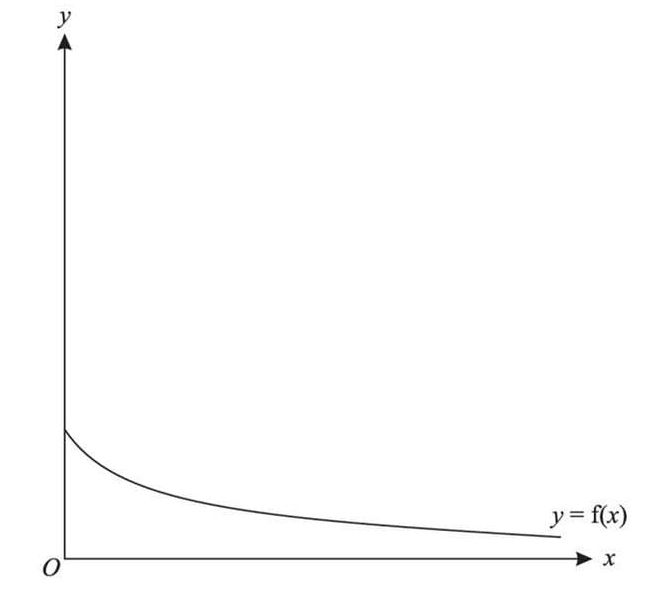
The diagram shows the graph of \(y = f(x)\), where \(f : x \mapsto \frac{6}{2x+3}\) for \(x \geq 0\).
Find an expression, in terms of \(x\), for \(f'(x)\) and explain how your answer shows that \(f\) is a decreasing function.

June 2006 p1 q10
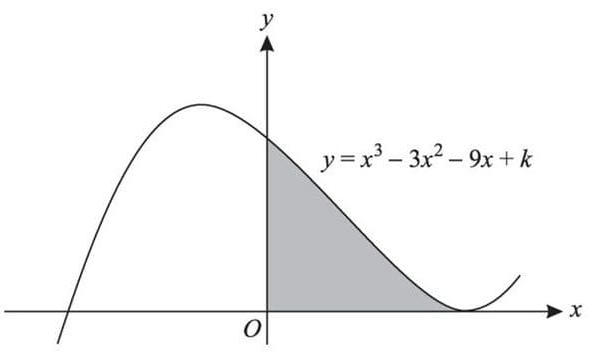
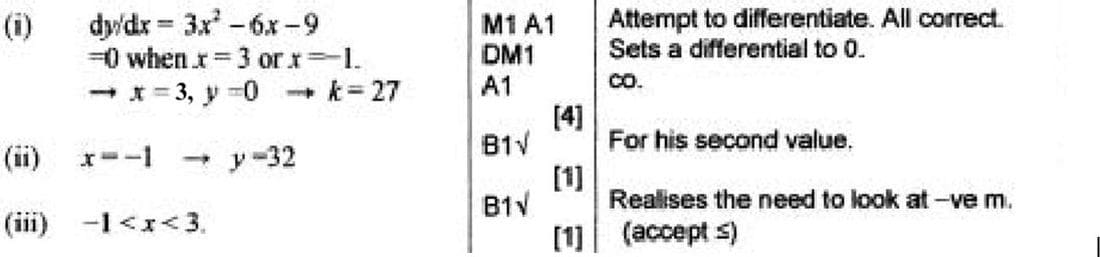
The diagram shows the curve \(y = x^3 - 3x^2 - 9x + k\), where \(k\) is a constant. The curve has a minimum point on the \(x\)-axis.
(i) Find the value of \(k\).
(ii) Find the coordinates of the maximum point of the curve.
(iii) State the set of values of \(x\) for which \(x^3 - 3x^2 - 9x + k\) is a decreasing function of \(x\).
Nov 2005 p1 q8
A function f is defined by f : x ↦ (2x − 3)3 − 8, for 2 ≤ x ≤ 4.
Find an expression, in terms of x, for f'(x) and show that f is an increasing function.

Nov 2021 p13 q3
The function \(f\) is defined by \(f(x) = x^5 - 10x^3 + 50x\) for \(x \in \mathbb{R}\).
Determine whether \(f\) is an increasing function, a decreasing function or neither.

June 2021 p13 q2
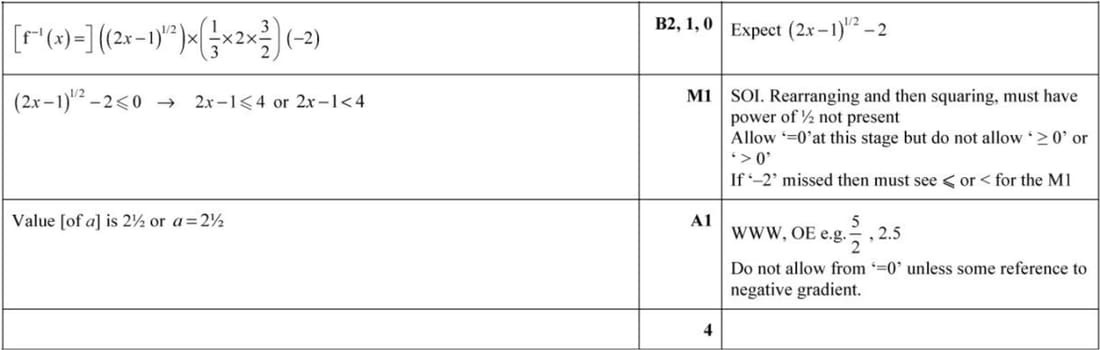
The function \(f\) is defined by \(f(x) = \frac{1}{3}(2x - 1)^{\frac{3}{2}} - 2x\) for \(\frac{1}{2} < x < a\). It is given that \(f\) is a decreasing function.
Find the maximum possible value of the constant \(a\).
Feb/Mar 2020 p12 q1
The function \(f\) is defined by \(f(x) = \frac{1}{3x+2} + x^2\) for \(x < -1\).
Determine whether \(f\) is an increasing function, a decreasing function or neither.

Nov 2019 p11 q2
An increasing function, \(f\), is defined for \(x > n\), where \(n\) is an integer. It is given that \(f'(x) = x^2 - 6x + 8\). Find the least possible value of \(n\).

Nov 2018 p13 q2
The function \(f\) is defined by \(f'(x) = x^3 + 2x^2 - 4x + 7\) for \(x \geq -2\). Determine, showing all necessary working, whether \(f\) is an increasing function, a decreasing function or neither.

June 2018 p13 q8
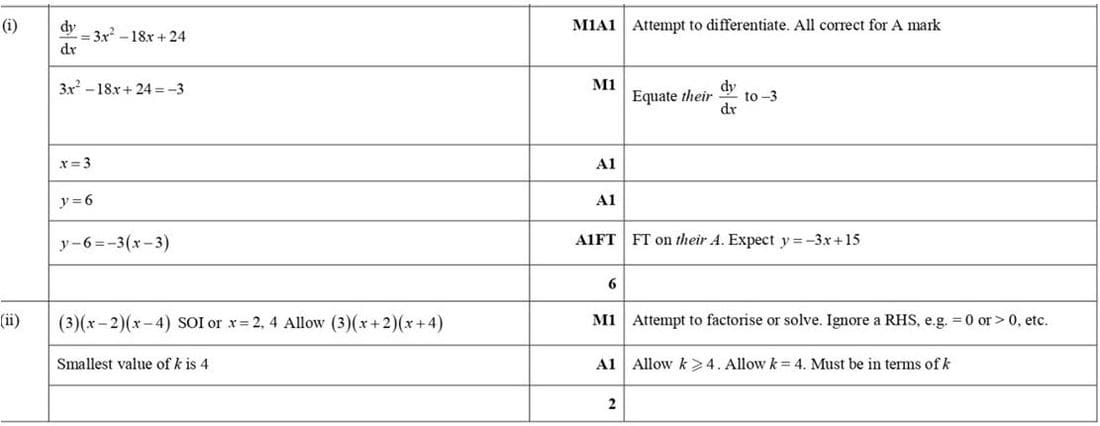
(i) The tangent to the curve \(y = x^3 - 9x^2 + 24x - 12\) at a point \(A\) is parallel to the line \(y = 2 - 3x\). Find the equation of the tangent at \(A\).
(ii) The function \(f\) is defined by \(f(x) = x^3 - 9x^2 + 24x - 12\) for \(x > k\), where \(k\) is a constant. Find the smallest value of \(k\) for \(f\) to be an increasing function.
Nov 2017 p13 q4
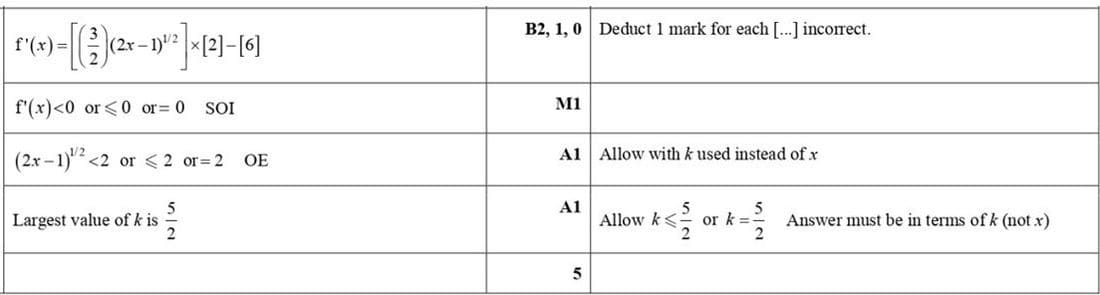
The function \(f\) is such that \(f(x) = (2x - 1)^{\frac{3}{2}} - 6x\) for \(\frac{1}{2} < x < k\), where \(k\) is a constant. Find the largest value of \(k\) for which \(f\) is a decreasing function.