Exam-Style Problems
⬅ Back to SubchapterNov 2023 p13 q4
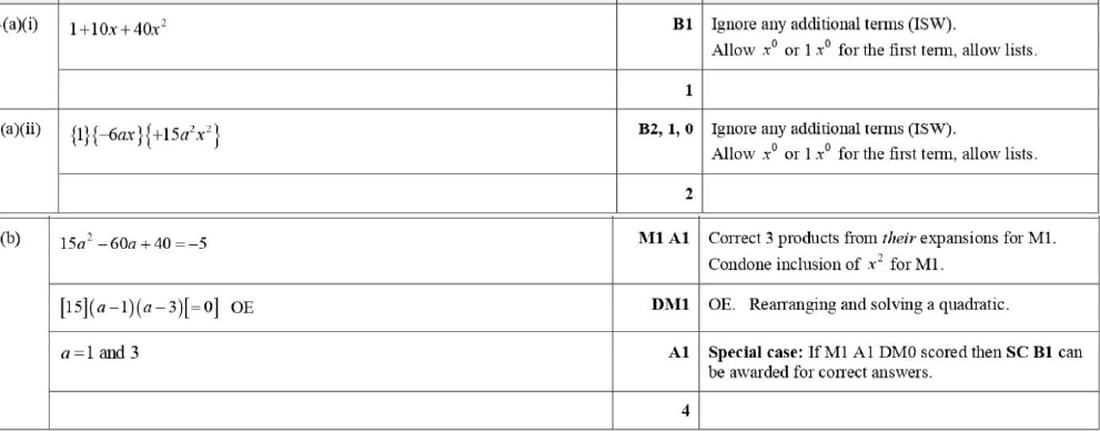
(a) Expand the following in ascending powers of x up to and including the term in x2.
(i) \((1 + 2x)^5\).
(ii) \((1 - ax)^6\), where a is a constant.
In the expansion of \((1 + 2x)^5(1 - ax)^6\), the coefficient of x2 is -5.
(b) Find the possible values of a.
Nov 2021 p13 q2
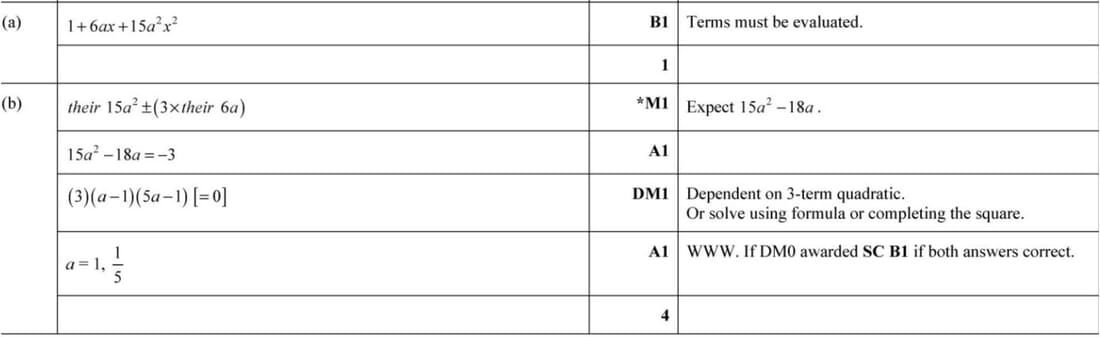
(a) Find the first three terms, in ascending powers of \(x\), in the expansion of \((1 + ax)^6\).
(b) Given that the coefficient of \(x^2\) in the expansion of \((1 - 3x)(1 + ax)^6\) is \(-3\), find the possible values of the constant \(a\).
Nov 2021 p12 q8
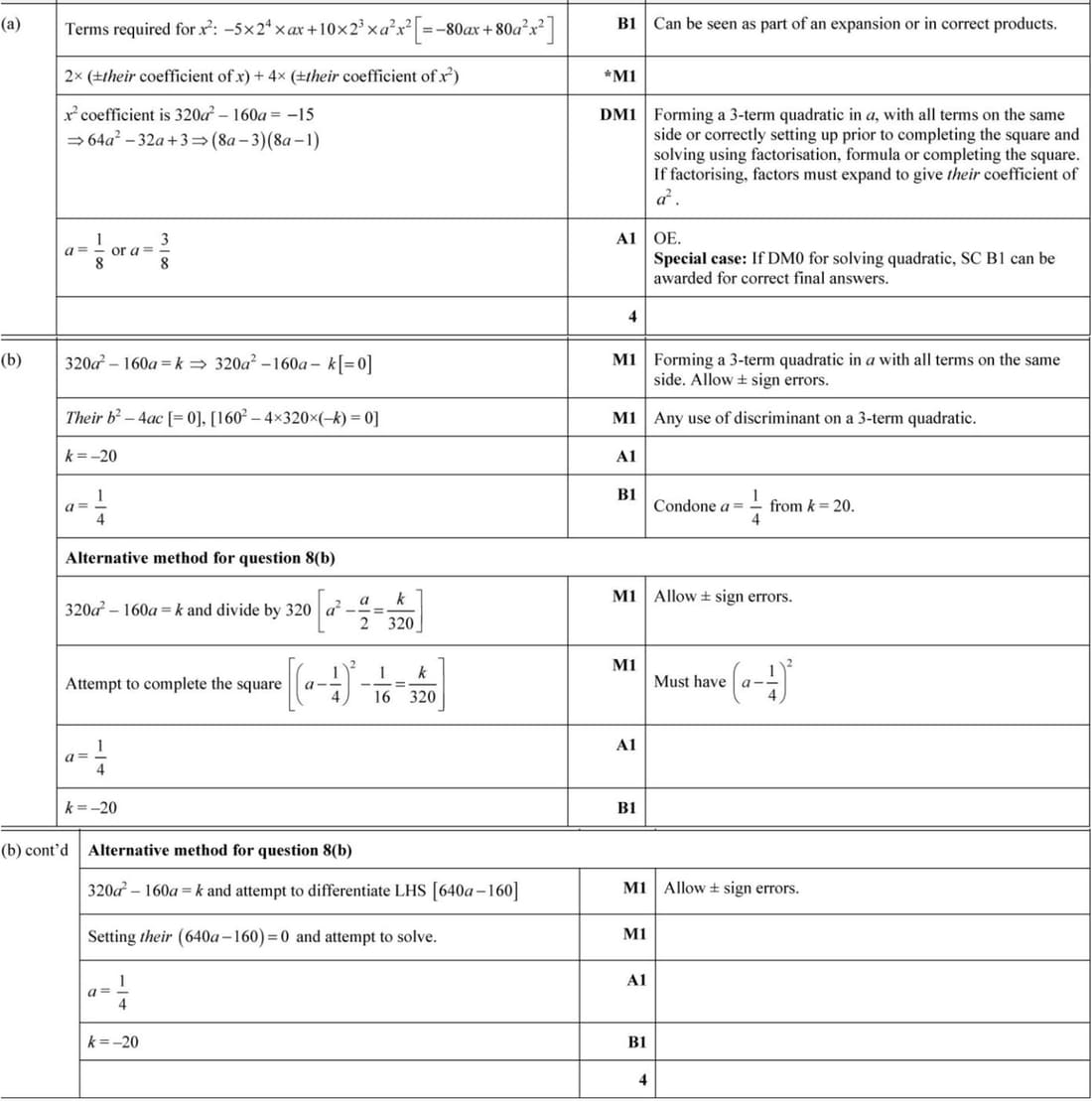
(a) It is given that in the expansion of \((4 + 2x)(2 - ax)^5\), the coefficient of \(x^2\) is \(-15\). Find the possible values of \(a\).
(b) It is given instead that in the expansion of \((4 + 2x)(2 - ax)^5\), the coefficient of \(x^2\) is \(k\). It is also given that there is only one value of \(a\) which leads to this value of \(k\). Find the values of \(k\) and \(a\).
June 2021 p12 q4
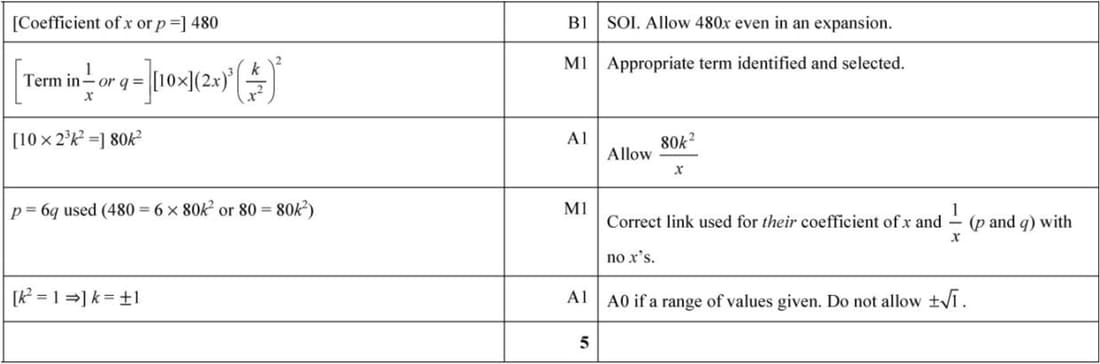
The coefficient of x in the expansion of \(\left(4x + \frac{10}{x}\right)^3\) is p. The coefficient of \(\frac{1}{x}\) in the expansion of \(\left(2x + \frac{k}{x^2}\right)^5\) is q.
\(Given that p = 6q, find the possible values of k.\)
Nov 2020 p12 q1
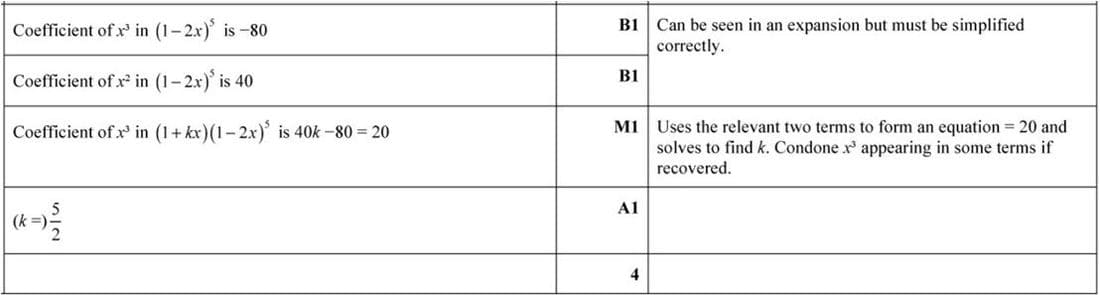
The coefficient of \(x^3\) in the expansion of \((1 + kx)(1 - 2x)^5\) is 20.
Find the value of the constant \(k\).
Nov 2020 p11 q5
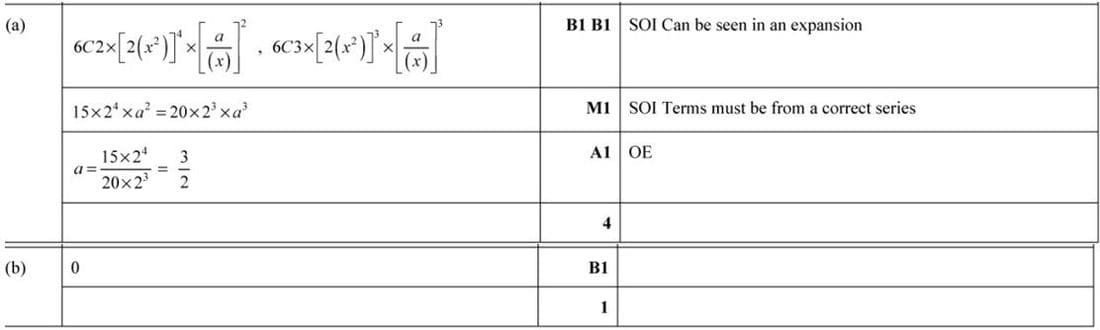
In the expansion of \((2x^2 + \frac{a}{x})^6\), the coefficients of \(x^6\) and \(x^3\) are equal.
(a) Find the value of the non-zero constant \(a\).
(b) Find the coefficient of \(x^6\) in the expansion of \((1-x^3)(2x^2 + \frac{a}{x})^6\).
June 2020 p11 q2
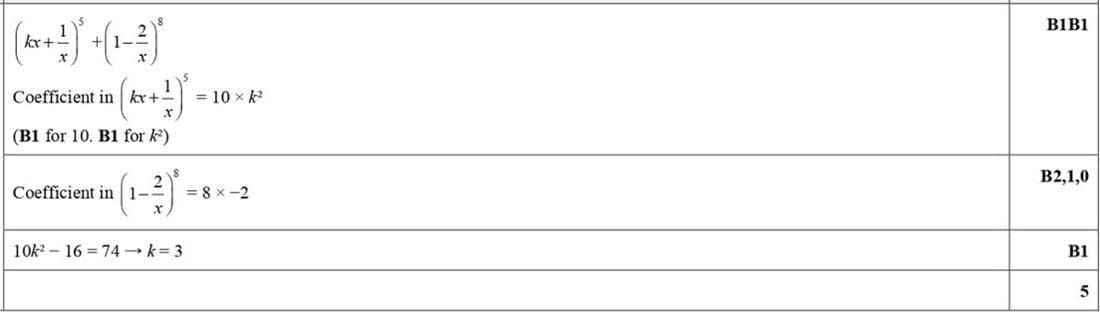
The coefficient of \(\frac{1}{x}\) in the expansion of \(\left( kx + \frac{1}{x} \right)^5 + \left( 1 - \frac{2}{x} \right)^8\) is 74.
Find the value of the positive constant \(k\).
Feb/Mar 2020 p12 q6
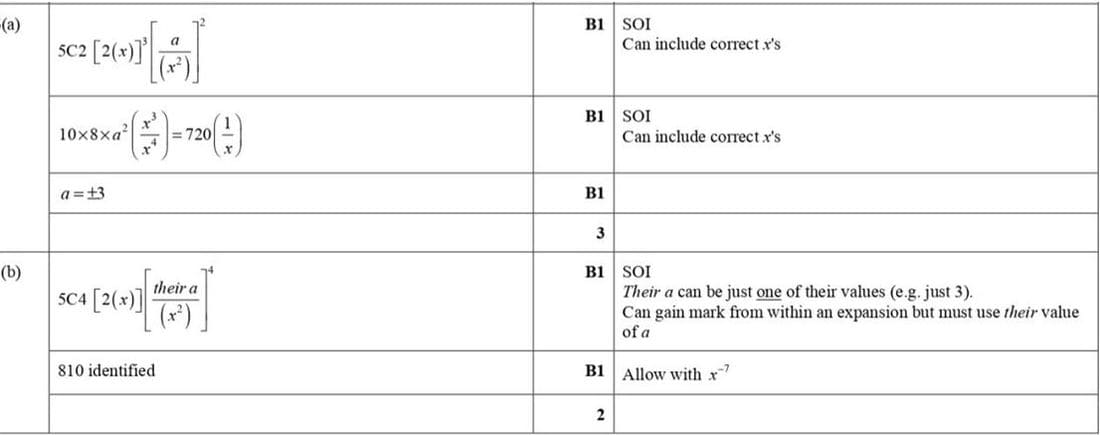
The coefficient of \(\frac{1}{x}\) in the expansion of \(\left( 2x + \frac{a}{x^2} \right)^5\) is 720.
(a) Find the possible values of the constant \(a\).
(b) Hence find the coefficient of \(\frac{1}{x^7}\) in the expansion.
Nov 2019 p12 q1
The coefficient of \(x^2\) in the expansion of \((4 + ax)\left(1 + \frac{x}{2}\right)^6\) is 3. Find the value of the constant \(a\).

June 2019 p11 q1
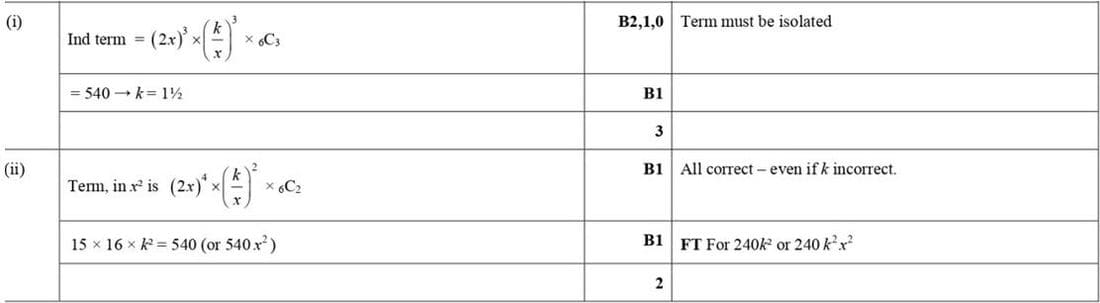
The term independent of x in the expansion of \(\left( 2x + \frac{k}{x} \right)^6\), where k is a constant, is 540.
(i) Find the value of k.
(ii) For this value of k, find the coefficient of x2 in the expansion.
Feb/Mar 2019 p12 q1
The coefficient of \(x^3\) in the expansion of \((1 - px)^5\) is \(-2160\). Find the value of the constant \(p\).

Nov 2023 p12 q1
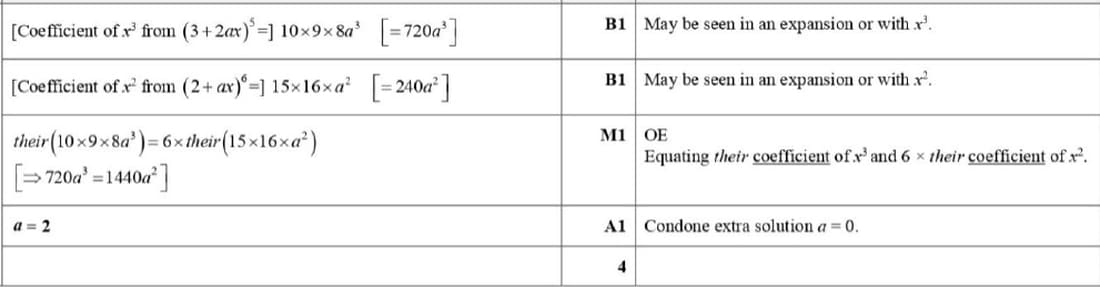
The coefficient of \(x^3\) in the expansion of \((3 + 2ax)^5\) is six times the coefficient of \(x^2\) in the expansion of \((2 + ax)^6\).
Find the value of the constant \(a\).
June 2018 p12 q1
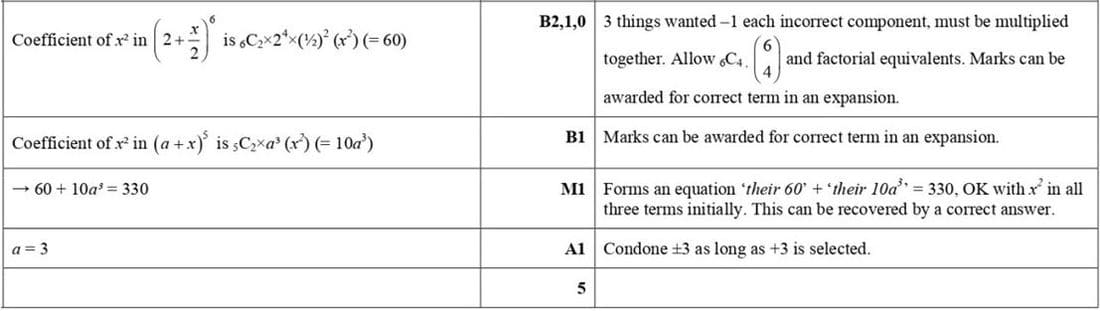
The coefficient of \(x^2\) in the expansion of \(\left( 2 + \frac{x}{2} \right)^6 + (a + x)^5\) is 330. Find the value of the constant \(a\).
June 2017 p13 q1
The coefficients of x and x2 in the expansion of (2 + ax)7 are equal. Find the value of the non-zero constant a.

June 2017 p11 q1
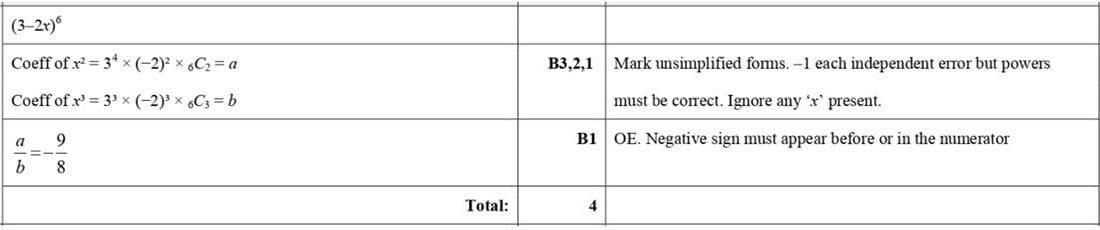
The coefficients of x2 and x3 in the expansion of (3 - 2x)6 are a and b respectively. Find the value of \(\frac{a}{b}\).
Feb/Mar 2017 p12 q2
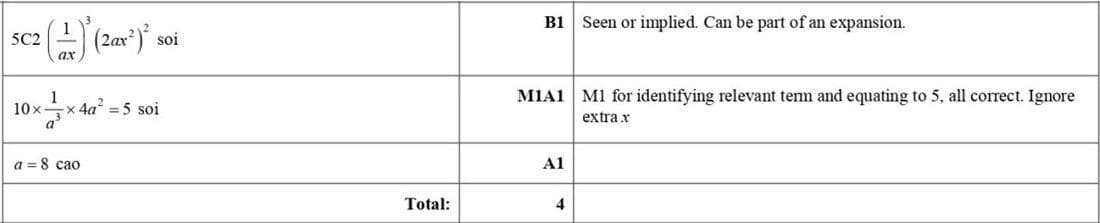
In the expansion of \(\left( \frac{1}{ax} + 2ax^2 \right)^5\), the coefficient of \(x\) is 5. Find the value of the constant \(a\).
Nov 2016 p13 q2
The coefficient of \(x^3\) in the expansion of \((1 - 3x)^6 + (1 + ax)^5\) is 100. Find the value of the constant \(a\).

Nov 2016 p12 q4
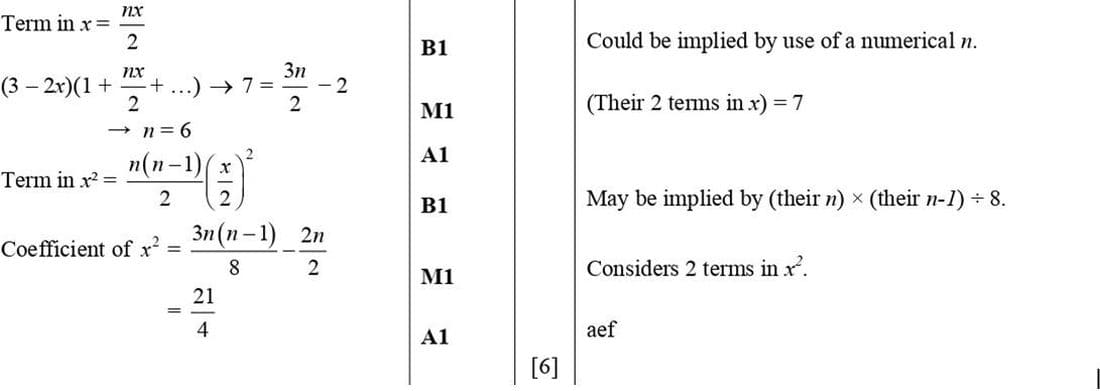
In the expansion of \((3 - 2x)\left(1 + \frac{x}{2}\right)^n\), the coefficient of \(x\) is 7. Find the value of the constant \(n\) and hence find the coefficient of \(x^2\).
Nov 2015 p12 q2
In the expansion of \((x + 2k)^7\), where \(k\) is a non-zero constant, the coefficients of \(x^4\) and \(x^5\) are equal. Find the value of \(k\).

Nov 2014 p13 q1
In the expansion of \((2 + ax)^6\), the coefficient of \(x^2\) is equal to the coefficient of \(x^3\). Find the value of the non-zero constant \(a\).

Nov 2014 p11 q1
In the expansion of \((2 + ax)^7\), the coefficient of \(x\) is equal to the coefficient of \(x^2\). Find the value of the non-zero constant \(a\).

Nov 2012 p12 q1
In the expansion of \(\left(x^2 - \frac{a}{x}\right)^7\), the coefficient of \(x^5\) is \(-280\). Find the value of the constant \(a\).

June 2023 p13 q3
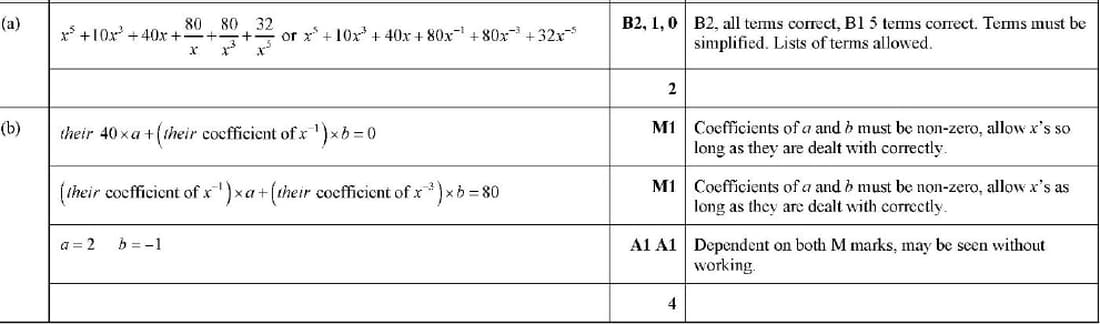
(a) Give the complete expansion of \(\left( x + \frac{2}{x} \right)^5\).
(b) In the expansion of \((a + bx^2) \left( x + \frac{2}{x} \right)^5\), the coefficient of \(x\) is zero and the coefficient of \(\frac{1}{x}\) is 80. Find the values of the constants \(a\) and \(b\).
June 2012 p12 q3
The coefficient of \(x^3\) in the expansion of \((a + x)^5 + (2 - x)^6\) is 90. Find the value of the positive constant \(a\).

Nov 2011 p13 q1
The coefficient of \(x^2\) in the expansion of \(\left( k + \frac{1}{3}x \right)^5\) is 30. Find the value of the constant \(k\).

June 2011 p13 q1
The coefficient of \(x^3\) in the expansion of \((a+x)^5 + (1-2x)^6\), where \(a\) is positive, is 90. Find the value of \(a\).

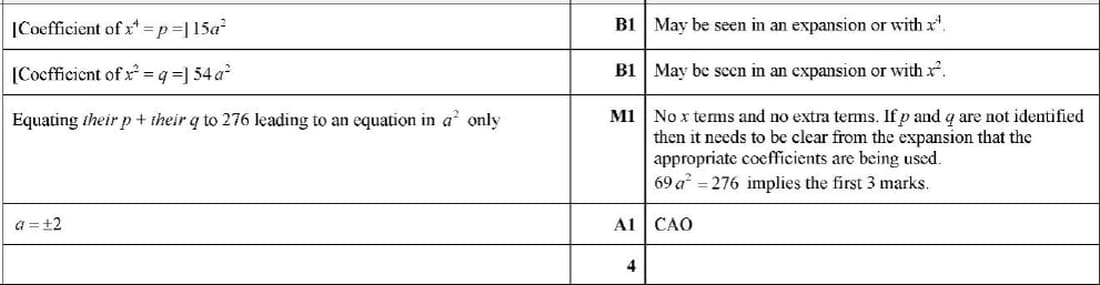
June 2023 p12 q2
The coefficient of \(x^4\) in the expansion of \((x + a)^6\) is \(p\) and the coefficient of \(x^2\) in the expansion of \((ax + 3)^4\) is \(q\). It is given that \(p + q = 276\).
Find the possible values of the constant \(a\).
Feb/Mar 2023 p12 q6
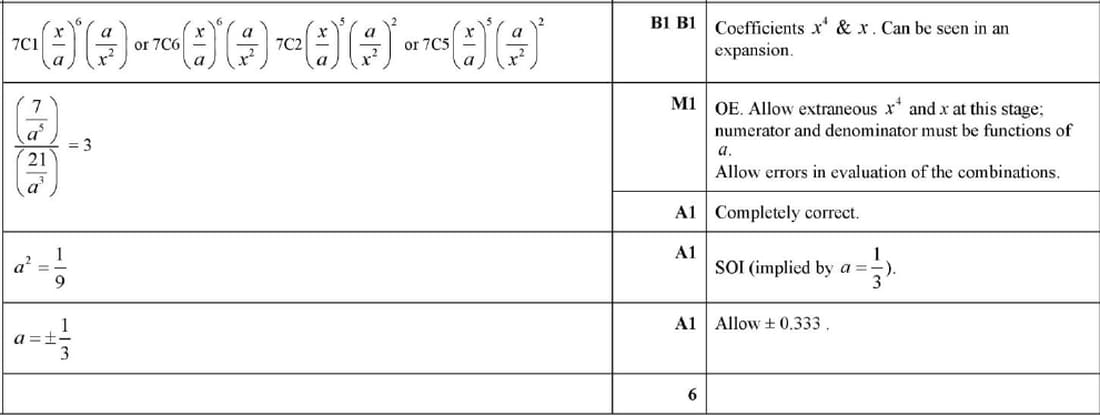
In the expansion of \(\left( \frac{x}{a} + \frac{a}{x^2} \right)^7\), it is given that
\(\frac{\text{the coefficient of } x^4}{\text{the coefficient of } x} = 3.\)
Find the possible values of the constant \(a\).
Nov 2022 p11 q4
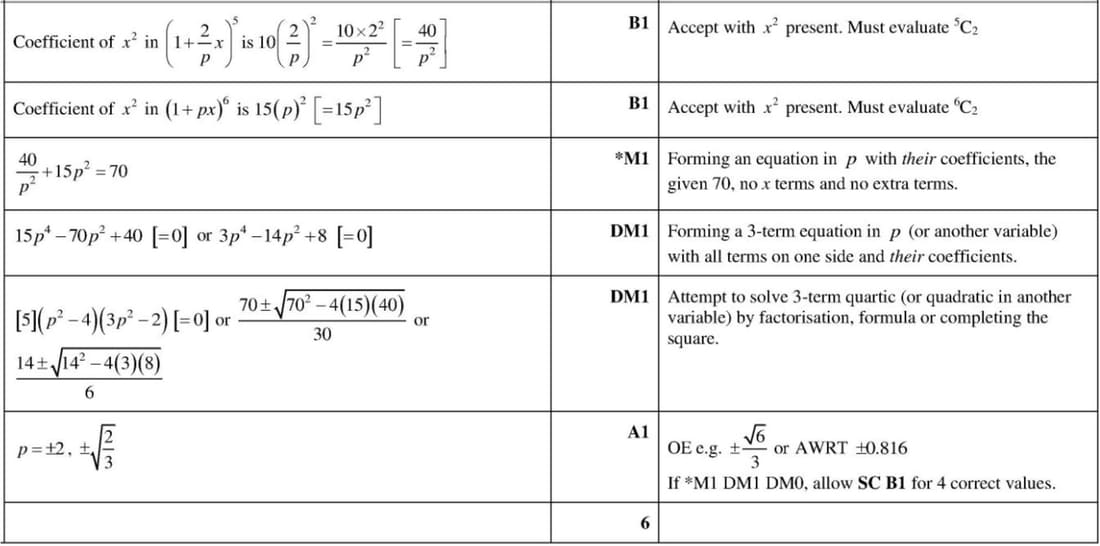
The coefficient of \(x^2\) in the expansion of \(\left( 1 + \frac{2}{p} x \right)^5 + (1 + px)^6\) is 70.
Find the possible values of the constant \(p\).
June 2022 p13 q1
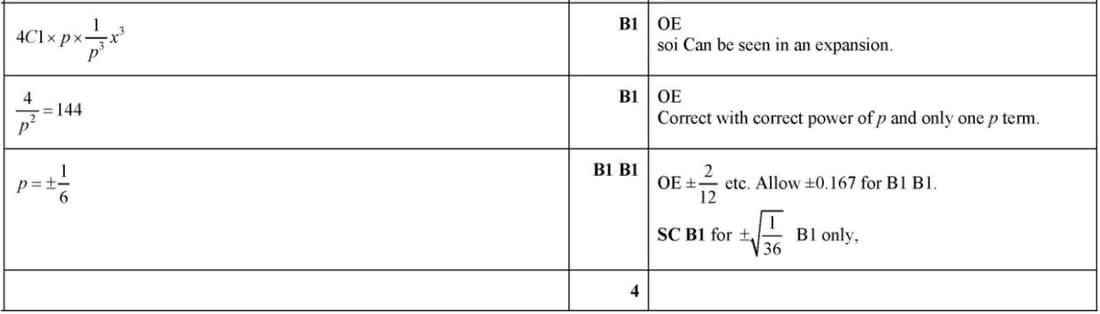
The coefficient of \(x^3\) in the expansion of \(\left(p + \frac{1}{p}x\right)^4\) is 144.
Find the possible values of the constant \(p\).
June 2022 p12 q1
The coefficient of \(x^4\) in the expansion of \((3 + x)^5\) is equal to the coefficient of \(x^2\) in the expansion of \(\left(2x + \frac{a}{x}\right)^6\).
Find the value of the positive constant \(a\).
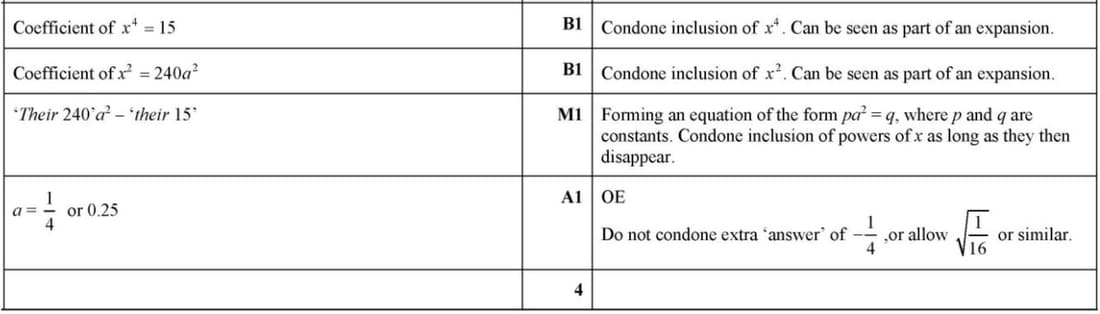
June 2022 p11 q3
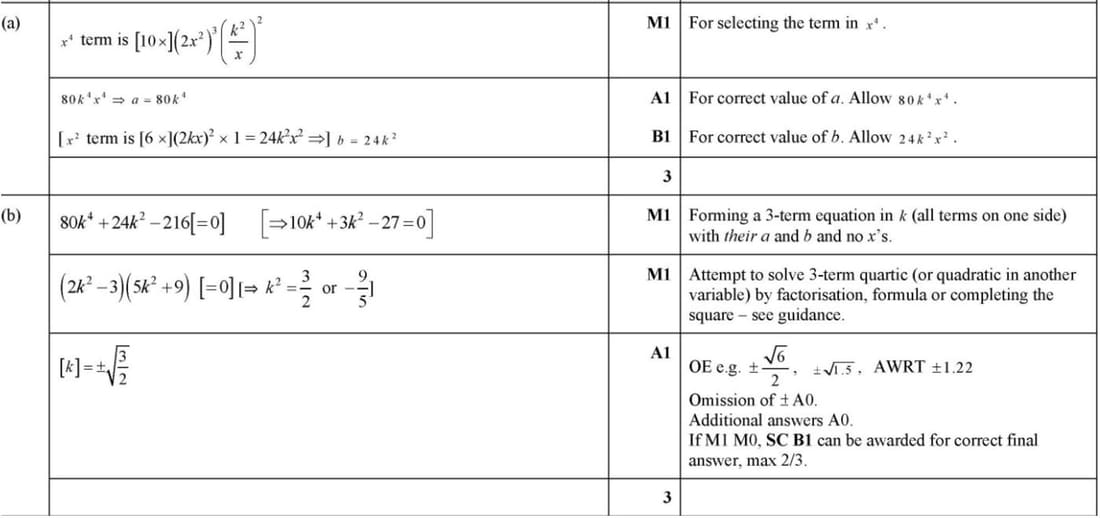
The coefficient of \(x^4\) in the expansion of \(\left( 2x^2 + \frac{k^2}{x} \right)^5\) is \(a\). The coefficient of \(x^2\) in the expansion of \((2kx - 1)^4\) is \(b\).
(a) Find \(a\) and \(b\) in terms of the constant \(k\).
(b) Given that \(a + b = 216\), find the possible values of \(k\).