Exam-Style Problems
⬅ Back to SubchapterJune 2023 p13 q8
A progression has first term a and second term \(\frac{a^2}{a+2}\), where a is a positive constant.
For the case where the progression is arithmetic and \(a = 6\), determine the least value of n required for the sum of the first n terms to be less than -480.

Nov 2020 p12 q4
The sum, \(S_n\), of the first \(n\) terms of an arithmetic progression is given by
\(S_n = n^2 + 4n\).
The \(k\)th term in the progression is greater than 200.
Find the smallest possible value of \(k\).

June 2020 p12 q4
The nth term of an arithmetic progression is \(\frac{1}{2}(3n - 15)\).
Find the value of n for which the sum of the first n terms is 84.

June 2020 p11 q1
The sum of the first nine terms of an arithmetic progression is 117. The sum of the next four terms is 91.
Find the first term and the common difference of the progression.

Nov 2019 p12 q8
Over a 21-day period an athlete prepares for a marathon by increasing the distance she runs each day by 1.2 km. On the first day she runs 13 km.
(i) Find the distance she runs on the last day of the 21-day period.
(ii) Find the total distance she runs in the 21-day period.

June 2019 p12 q10
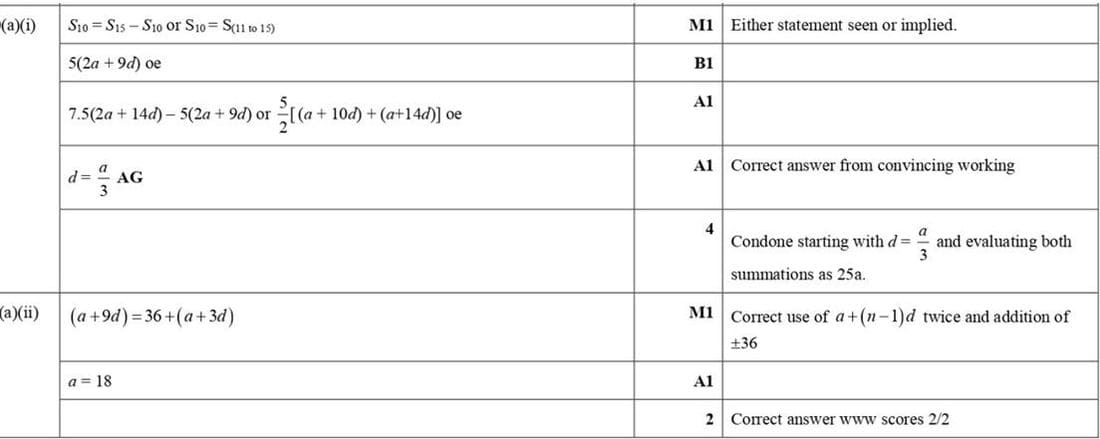
In an arithmetic progression, the sum of the first ten terms is equal to the sum of the next five terms. The first term is \(a\).
(i) Show that the common difference of the progression is \(\frac{1}{3}a\).
(ii) Given that the tenth term is 36 more than the fourth term, find the value of \(a\).
Feb/Mar 2019 p12 q6
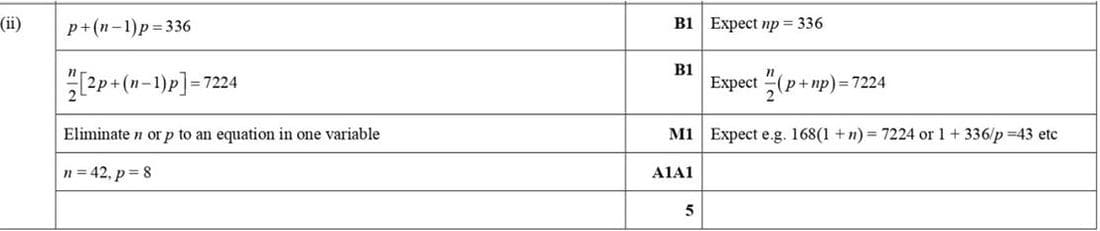
In another case, p and 2p are the first and second terms respectively of an arithmetic progression. The nth term is 336 and the sum of the first n terms is 7224. Write down two equations in n and p and hence find the values of n and p.
Nov 2018 p13 q5
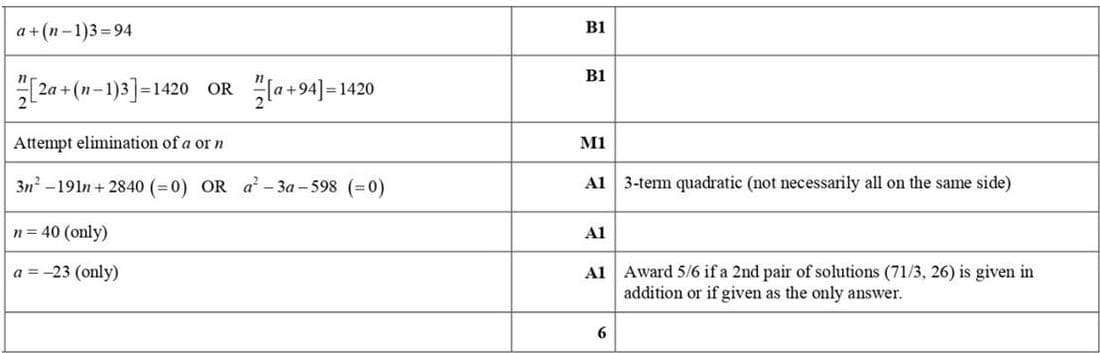
In an arithmetic progression the first term is a and the common difference is 3. The nth term is 94 and the sum of the first n terms is 1420. Find n and a.
Nov 2018 p11 q4
The first term of a series is 6 and the second term is 2.
For the case where the series is an arithmetic progression, find the sum of the first 80 terms.

June 2018 p11 q8
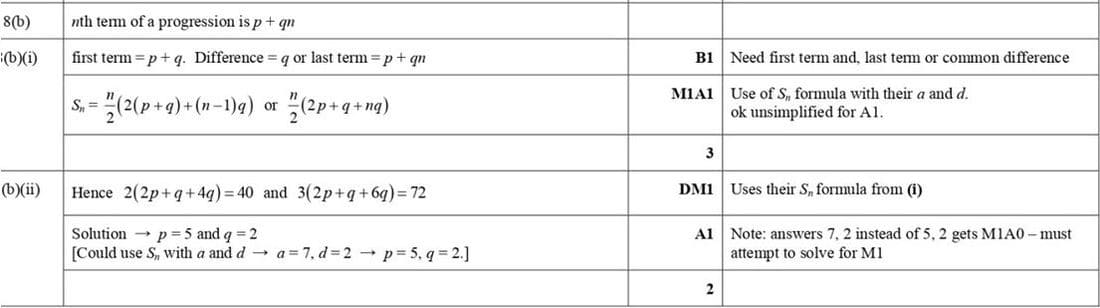
The nth term of a progression is p + qn, where p and q are constants, and Sn is the sum of the first n terms.
- Find an expression, in terms of p, q and n, for Sn.
- Given that S4 = 40 and S6 = 72, find the values of p and q.
Nov 2017 p13 q1
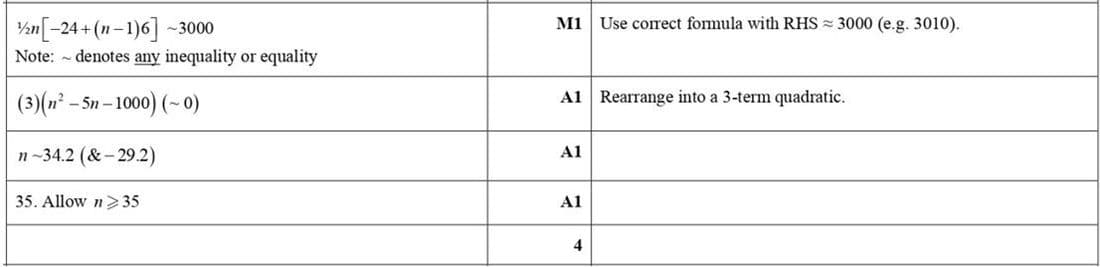
An arithmetic progression has first term \(-12\) and common difference \(6\). The sum of the first \(n\) terms exceeds \(3000\). Calculate the least possible value of \(n\).
Feb/Mar 2023 p12 q4
The circumference round the trunk of a large tree is measured and found to be 5.00 m. After one year the circumference is measured again and found to be 5.02 m.
Given that the circumferences at yearly intervals form an arithmetic progression, find the circumference 20 years after the first measurement.

Nov 2017 p12 q3
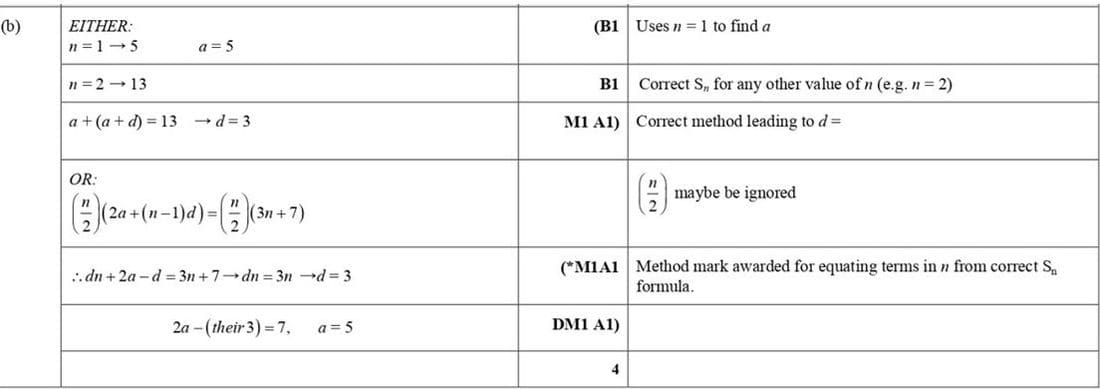
The sum of the first n terms of an arithmetic progression is \(\frac{1}{2}n(3n + 7)\). Find the 1st term and the common difference of the progression.
Nov 2017 p11 q3
The first two terms of an arithmetic progression are 15 and 19 respectively. The first two terms of a second arithmetic progression are 420 and 415 respectively. The two progressions have the same sum of the first n terms. Find the value of n.

June 2017 p12 q7
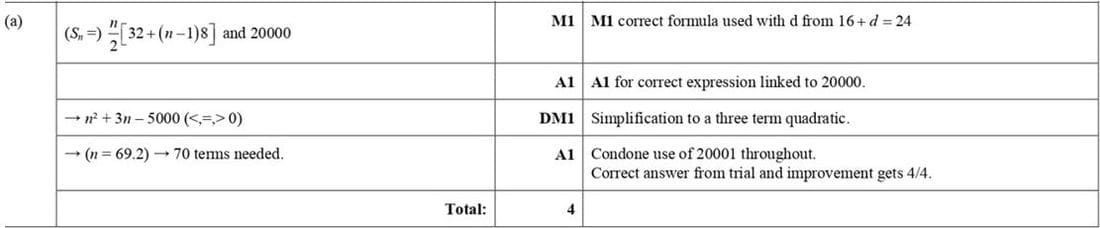
The first two terms of an arithmetic progression are 16 and 24. Find the least number of terms of the progression which must be taken for their sum to exceed 20,000.
June 2017 p11 q4
An arithmetic progression has a first term of 32, a 5th term of 22 and a last term of -28. Find the sum of all the terms in the progression.

Nov 2016 p12 q8
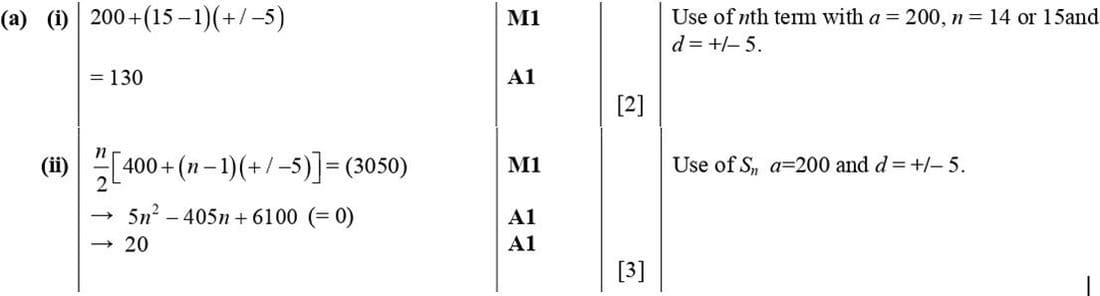
A cyclist completes a long-distance charity event across Africa. The total distance is 3050 km. He starts the event on May 1st and cycles 200 km on that day. On each subsequent day he reduces the distance cycled by 5 km.
(i) How far will he travel on May 15th?
(ii) On what date will he finish the event?
June 2016 p12 q9
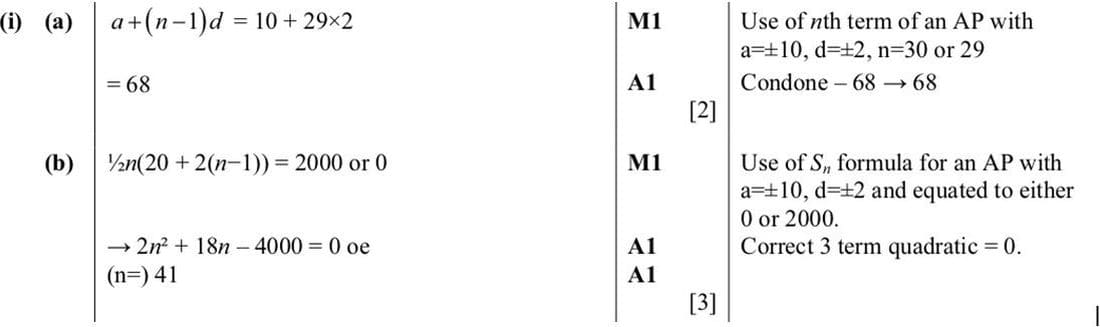
A water tank holds 2000 litres when full. A small hole in the base is gradually getting bigger so that each day a greater amount of water is lost.
On the first day after filling, 10 litres of water are lost and this increases by 2 litres each day.
(a) How many litres will be lost on the 30th day after filling?
(b) The tank becomes empty during the nth day after filling. Find the value of n.
Feb/Mar 2016 p12 q3
The 12th term of an arithmetic progression is 17 and the sum of the first 31 terms is 1023. Find the 31st term.

Nov 2015 p11 q8
The first term of a progression is \(4x\) and the second term is \(x^2\).
For the case where the progression is arithmetic with a common difference of 12, find the possible values of \(x\) and the corresponding values of the third term.

June 2015 p13 q9
The first term of an arithmetic progression is \(-2222\) and the common difference is 17. Find the value of the first positive term.

June 2015 p12 q8
The first, second and last terms in an arithmetic progression are 56, 53 and -22 respectively. Find the sum of all the terms in the progression.

Nov 2022 p12 q2
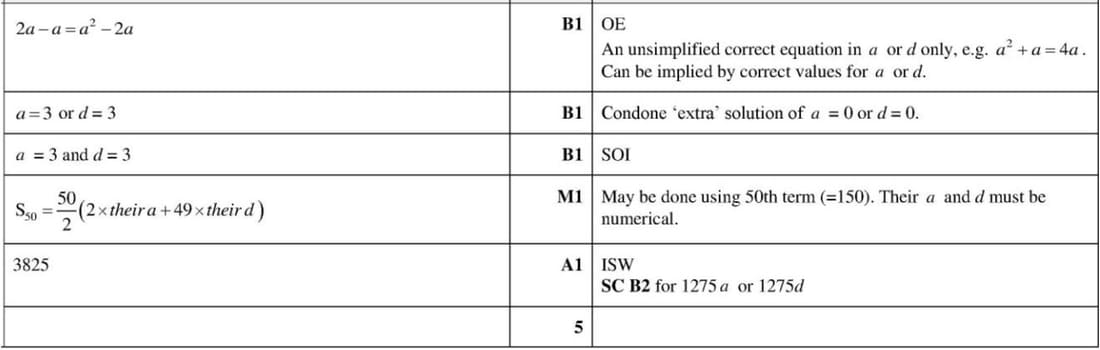
The first, second and third terms of an arithmetic progression are \(a, 2a\) and \(a^2\) respectively, where \(a\) is a positive constant.
Find the sum of the first 50 terms of the progression.
June 2015 p11 q7
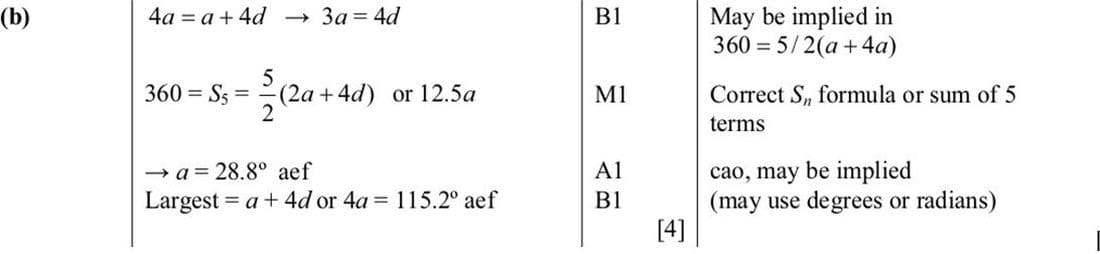
A circle is divided into 5 sectors in such a way that the angles of the sectors are in arithmetic progression. Given that the angle of the largest sector is 4 times the angle of the smallest sector, find the angle of the largest sector.
Nov 2014 p12 q8
The sum, \(S_n\), of the first \(n\) terms of an arithmetic progression is given by \(S_n = 32n - n^2\). Find the first term and the common difference.

Nov 2014 p11 q7
An arithmetic progression has first term 7. The nth term is 84 and the (3n)th term is 245. Find the value of n.

June 2014 p11 q5
An arithmetic progression has first term \(a\) and common difference \(d\). It is given that the sum of the first 200 terms is 4 times the sum of the first 100 terms.
(i) Find \(d\) in terms of \(a\).
(ii) Find the 100th term in terms of \(a\).

Nov 2013 p13 q5
In an arithmetic progression, the fifth term is 197 and the sum of the first ten terms is 2040. Find the common difference.

Nov 2013 p12 q7
An athlete runs the first mile of a marathon in 5 minutes. His speed reduces in such a way that each mile takes 12 seconds longer than the preceding mile.
(i) Given that the nth mile takes 9 minutes, find the value of n.
(ii) Assuming that the length of the marathon is 26 miles, find the total time, in hours and minutes, to complete the marathon.

Nov 2013 p11 q9
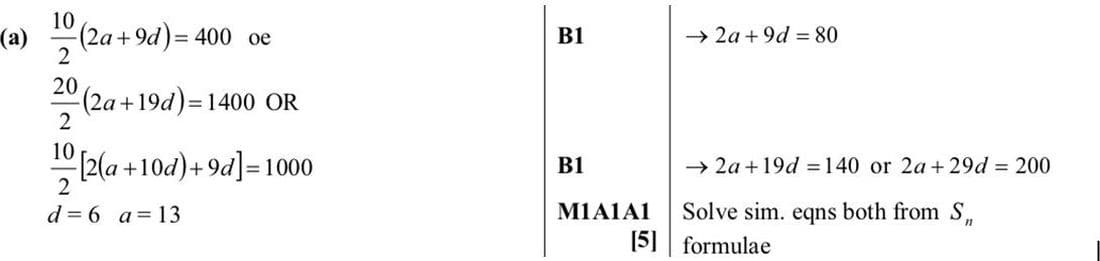
In an arithmetic progression the sum of the first ten terms is 400 and the sum of the next ten terms is 1000. Find the common difference and the first term.
June 2013 p13 q9
In an arithmetic progression, the sum, \(S_n\), of the first \(n\) terms is given by \(S_n = 2n^2 + 8n\). Find the first term and the common difference of the progression.

June 2013 p12 q10
The first and last terms of an arithmetic progression are 12 and 48 respectively. The sum of the first four terms is 57. Find the number of terms in the progression.

Nov 2012 p12 q8
A circle is divided into n sectors in such a way that the angles of the sectors are in arithmetic progression. The smallest two angles are 3° and 5°. Find the value of n.

June 2022 p13 q3
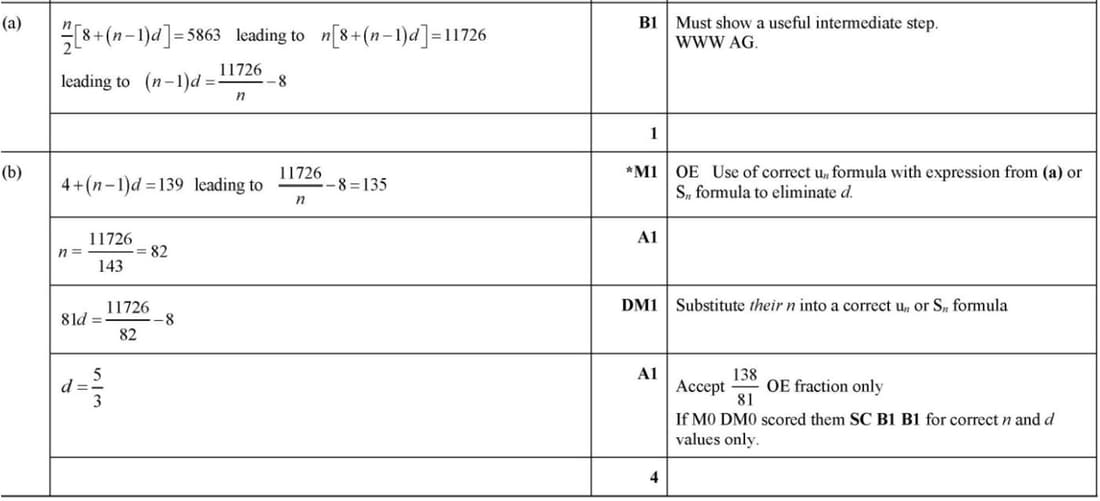
An arithmetic progression has first term 4 and common difference \(d\). The sum of the first \(n\) terms of the progression is 5863.
(a) Show that \((n-1)d = \frac{11726}{n} - 8\).
(b) Given that the \(n\)th term is 139, find the values of \(n\) and \(d\), giving the value of \(d\) as a fraction.
Nov 2012 p11 q1
The first term of an arithmetic progression is 61 and the second term is 57. The sum of the first n terms is n. Find the value of the positive integer n.

June 2012 p12 q7
In an arithmetic progression, the sum of the first n terms, denoted by Sn, is given by
\(S_n = n^2 + 8n\).
Find the first term and the common difference.

Nov 2011 p12 q10
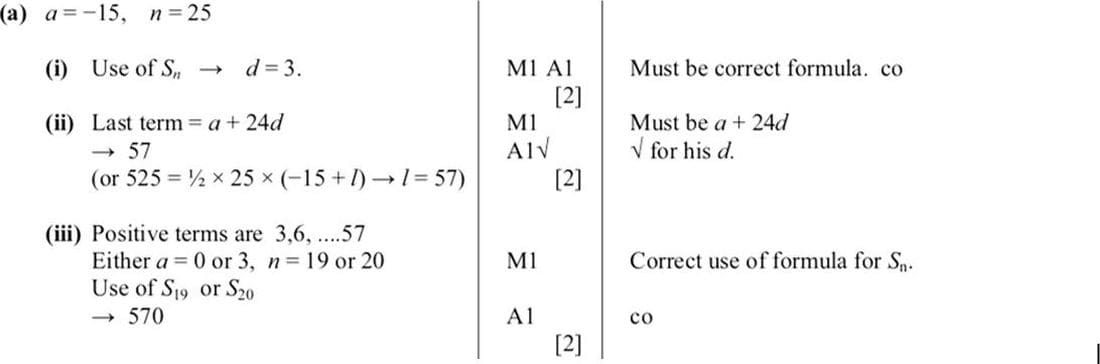
An arithmetic progression contains 25 terms and the first term is -15. The sum of all the terms in the progression is 525. Calculate
(i) the common difference of the progression,
(ii) the last term in the progression,
(iii) the sum of all the positive terms in the progression.
Nov 2011 p11 q6
The sixth term of an arithmetic progression is 23 and the sum of the first ten terms is 200. Find the seventh term.

June 2011 p13 q6
An arithmetic progression is such that the eighth term is three times the third term. Show that the sum of the first eight terms is four times the sum of the first four terms.

June 2011 p12 q10
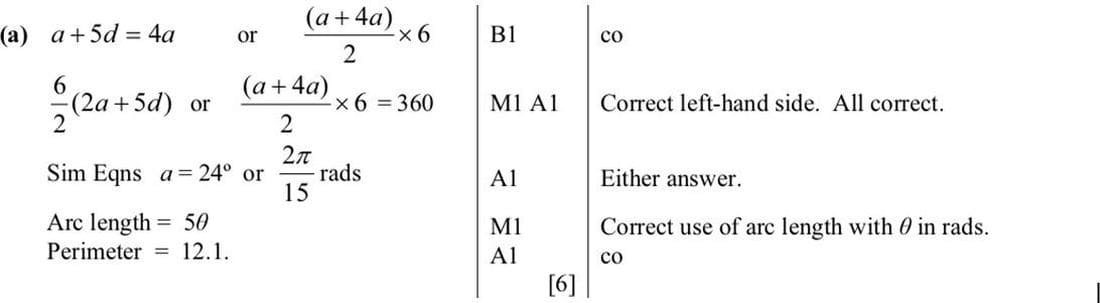
A circle is divided into 6 sectors in such a way that the angles of the sectors are in arithmetic progression. The angle of the largest sector is 4 times the angle of the smallest sector. Given that the radius of the circle is 5 cm, find the perimeter of the smallest sector.
Nov 2010 p13 q9
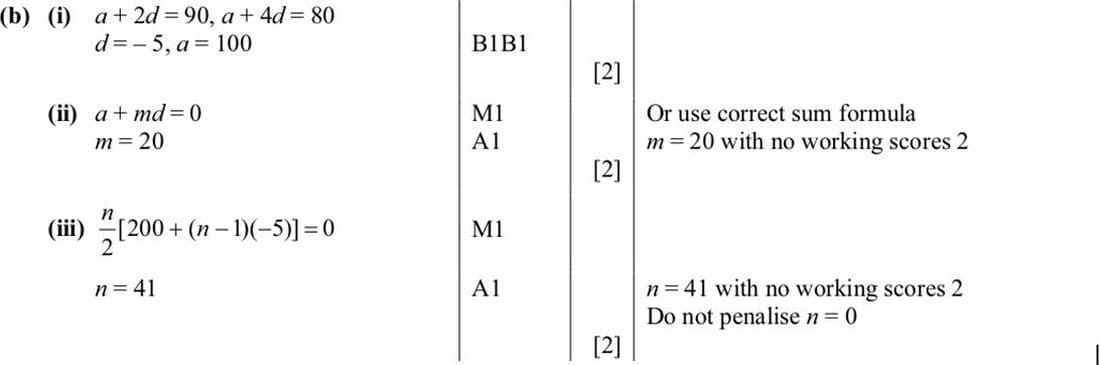
An arithmetic progression has third term 90 and fifth term 80.
(i) Find the first term and the common difference.
(ii) Find the value of \(m\) given that the sum of the first \(m\) terms is equal to the sum of the first \((m + 1)\) terms.
(iii) Find the value of \(n\) given that the sum of the first \(n\) terms is zero.
Nov 2010 p12 q5
The first and second terms of an arithmetic progression are 161 and 154 respectively. The sum of the first m terms is zero. Find the value of m.

Nov 2010 p11 q6
The fifth term of an arithmetic progression is 18 and the sum of the first 5 terms is 75. Find the first term and the common difference.

June 2010 p12 q7
Find the sum of all the multiples of 5 between 100 and 300 inclusive.

June 2022 p12 q4
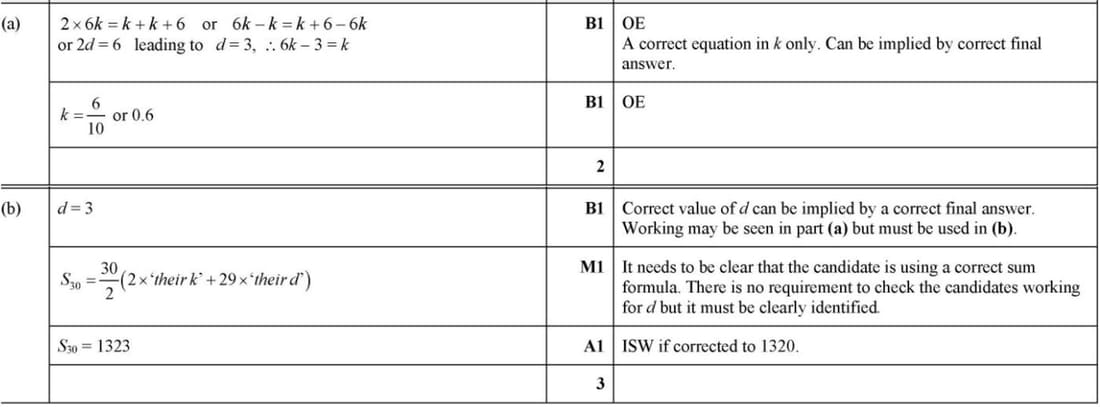
The first, second and third terms of an arithmetic progression are \(k\), \(6k\) and \(k + 6\) respectively.
(a) Find the value of the constant \(k\).
(b) Find the sum of the first 30 terms of the progression.
June 2010 p11 q3
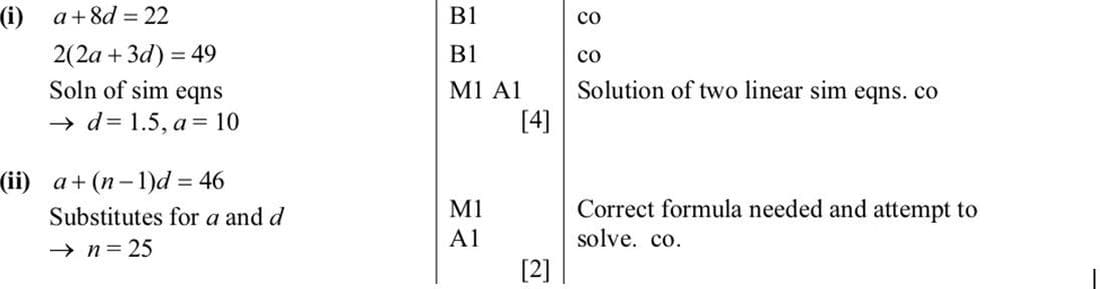
The ninth term of an arithmetic progression is 22 and the sum of the first 4 terms is 49.
(i) Find the first term of the progression and the common difference.
The nth term of the progression is 46.
(ii) Find the value of n.
June 2009 p1 q7
The first two terms in an arithmetic progression are 5 and 9. The last term in the progression is the only term which is greater than 200. Find the sum of all the terms in the progression.

Nov 2008 p1 q3
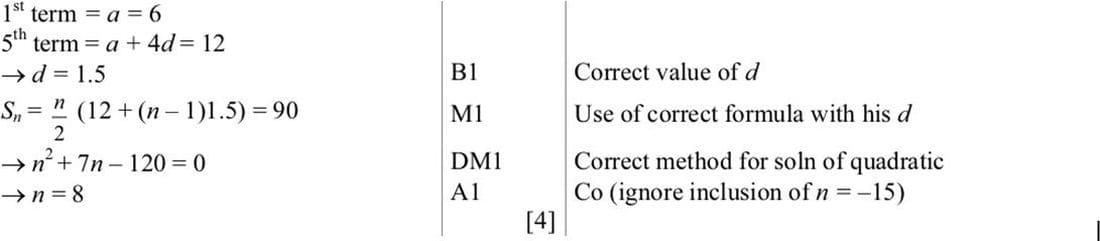
The first term of an arithmetic progression is 6 and the fifth term is 12. The progression has n terms and the sum of all the terms is 90. Find the value of n.
Nov 2006 p1 q6
Find the sum of all the integers between 100 and 400 that are divisible by 7.

Nov 2004 p1 q2
Find the sum of all the terms in the arithmetic progression 180, 175, 170, \ldots, 25.

Nov 2003 p1 q3
A debt of $3726 is repaid by weekly payments which are in arithmetic progression. The first payment is $60 and the debt is fully repaid after 48 weeks. Find the third payment.

June 2003 p1 q4
In an arithmetic progression, the 1st term is -10, the 15th term is 11 and the last term is 41. Find the sum of all the terms in the progression.
June 2022 p11 q2
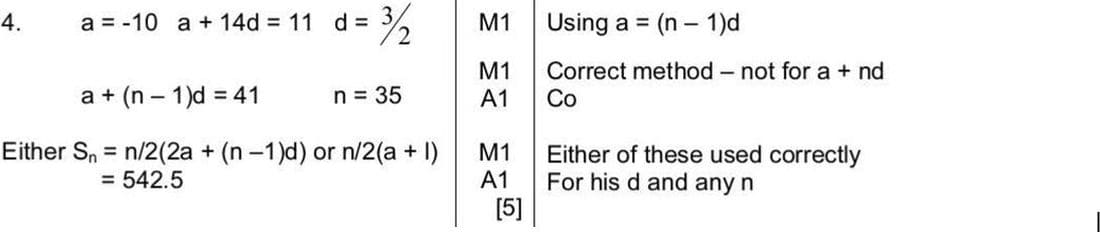
The thirteenth term of an arithmetic progression is 12 and the sum of the first 30 terms is -15.
Find the sum of the first 50 terms of the progression.
Nov 2021 p13 q4
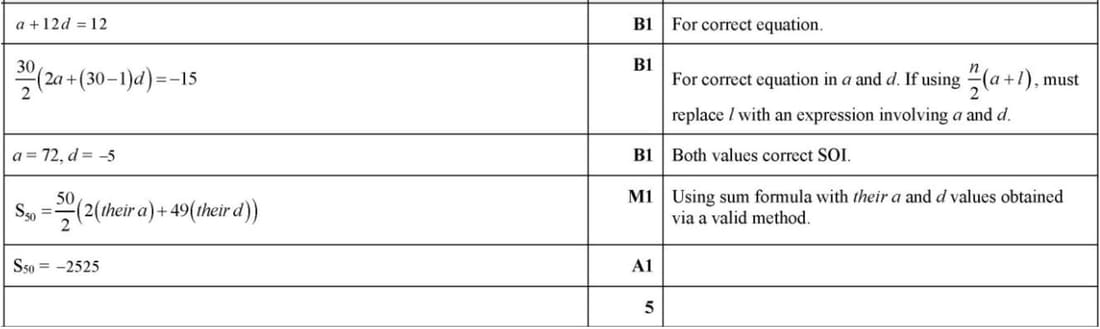
The first term of an arithmetic progression is 84 and the common difference is \(-3\).
(a) Find the smallest value of \(n\) for which the \(n\)th term is negative.
(b) It is given that the sum of the first \(2k\) terms of this progression is equal to the sum of the first \(k\) terms. Find the value of \(k\).
June 2021 p13 q9
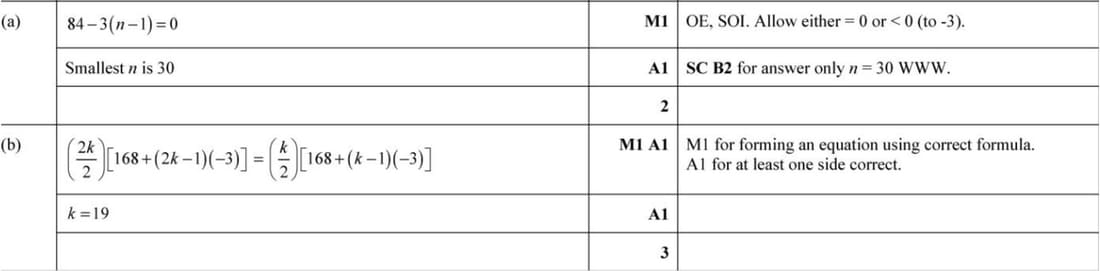
An arithmetic progression P has first term a and common difference d. An arithmetic progression Q has first term 2(a + 1) and common difference (d + 1). It is given that
\(\frac{\text{5th term of } P}{\text{12th term of } Q} = \frac{1}{3}\) and \(\frac{\text{Sum of first 5 terms of } P}{\text{Sum of first 5 terms of } Q} = \frac{2}{3}.\)
Find the value of a and the value of d.
June 2021 p11 q2
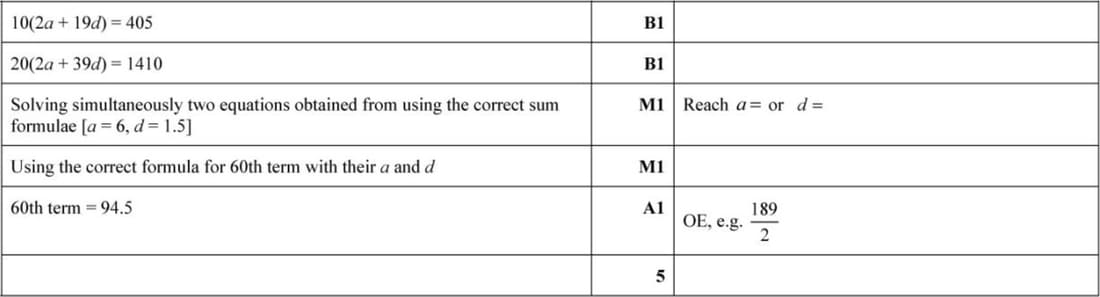
The sum of the first 20 terms of an arithmetic progression is 405 and the sum of the first 40 terms is 1410.
Find the 60th term of the progression.