Exam-Style Problems
⬅ Back to SubchapterProblem 429
(a) Show that the equation
\(5 \cos \theta - \sin \theta \tan \theta + 1 = 0\)
may be expressed in the form \(a \cos^2 \theta + b \cos \theta + c = 0\), where \(a, b\) and \(c\) are constants to be found.
(b) Hence solve the equation \(5 \cos \theta - \sin \theta \tan \theta + 1 = 0\) for \(0 < \theta < 2\pi\).
Problem 430
(a) Show that the equation \(\frac{1}{\sin \theta + \cos \theta} + \frac{1}{\sin \theta - \cos \theta} = 1\) may be expressed in the form \(a \sin^2 \theta + b \sin \theta + c = 0\), where \(a, b\) and \(c\) are constants to be found.
(b) Hence solve the equation \(\frac{1}{\sin \theta + \cos \theta} + \frac{1}{\sin \theta - \cos \theta} = 1\) for \(0^\circ \leq \theta \leq 360^\circ\).
Problem 431
(a) Solve the equation \(6\sqrt{y} + \frac{2}{\sqrt{y}} - 7 = 0\).
(b) Hence solve the equation \(6\sqrt{\tan x} + \frac{2}{\sqrt{\tan x}} - 7 = 0\) for \(0^\circ \leq x \leq 360^\circ\).
Problem 432
The function \(f\) is given by \(f(x) = 4 \cos^4 x + \cos^2 x - k\) for \(0 \leq x \leq 2\pi\), where \(k\) is a constant.
(a) Given that \(k = 3\), find the exact solutions of the equation \(f(x) = 0\).
(b) Use the quadratic formula to show that, when \(k > 5\), the equation \(f(x) = 0\) has no solutions.
Problem 433
(a) Prove the identity \(\frac{\sin^3 \theta}{\sin \theta - 1} - \frac{\sin^2 \theta}{1 + \sin \theta} \equiv -\tan^2 \theta (1 + \sin^2 \theta)\).
(b) Hence solve the equation \(\frac{\sin^3 \theta}{\sin \theta - 1} - \frac{\sin^2 \theta}{1 + \sin \theta} = \tan^2 \theta (1 - \sin^2 \theta)\) for \(0 < \theta < 2\pi\).
Problem 434
(a) Show that \(\frac{\sin \theta + 2 \cos \theta}{\cos \theta - 2 \sin \theta} - \frac{\sin \theta - 2 \cos \theta}{\cos \theta + 2 \sin \theta} \equiv \frac{4}{5 \cos^2 \theta - 4}\).
(b) Hence solve the equation \(\frac{\sin \theta + 2 \cos \theta}{\cos \theta - 2 \sin \theta} - \frac{\sin \theta - 2 \cos \theta}{\cos \theta + 2 \sin \theta} = 5\) for \(0^\circ < \theta < 180^\circ\).
Problem 435
(a) Show that the equation \(\frac{\tan x + \cos x}{\tan x - \cos x} = k\), where \(k\) is a constant, can be expressed as \((k + 1) \sin^2 x + (k - 1) \sin x - (k + 1) = 0\).
(b) Hence solve the equation \(\frac{\tan x + \cos x}{\tan x - \cos x} = 4\) for \(0^\circ \leq x \leq 360^\circ\).
Problem 436
Solve the equation \(2 \cos \theta = 7 - \frac{3}{\cos \theta}\) for \(-90^\circ < \theta < 90^\circ\).
Problem 437
(a) Prove the identity \(\frac{1 - 2 \sin^2 \theta}{1 - \sin^2 \theta} \equiv 1 - \tan^2 \theta\).
(b) Hence solve the equation \(\frac{1 - 2 \sin^2 \theta}{1 - \sin^2 \theta} = 2 \tan^4 \theta\) for \(0^\circ \leq \theta \leq 180^\circ\).
Problem 438
Solve the equation \(3 \tan^2 \theta + 1 = \frac{2}{\tan^2 \theta}\) for \(0^\circ < \theta < 180^\circ\).
Problem 439
(i) Show that the equation \(3 \cos^4 \theta + 4 \sin^2 \theta - 3 = 0\) can be expressed as \(3x^2 - 4x + 1 = 0\), where \(x = \cos^2 \theta\).
(ii) Hence solve the equation \(3 \cos^4 \theta + 4 \sin^2 \theta - 3 = 0\) for \(0^\circ \leq \theta \leq 180^\circ\).
Problem 440
(a) Verify the identity \((2x - 1)(4x^2 + 2x - 1) \equiv 8x^3 - 4x + 1\).
(b) Prove the identity \(\frac{\tan^2 \theta + 1}{\tan^2 \theta - 1} \equiv \frac{1}{1 - 2 \cos^2 \theta}\).
(c) Using the results of (a) and (b), solve the equation \(\frac{\tan^2 \theta + 1}{\tan^2 \theta - 1} = 4 \cos \theta\), for \(0^\circ \leq \theta \leq 180^\circ\).
Problem 441
(i) Given that \(4 \tan x + 3 \cos x + \frac{1}{\cos x} = 0\), show, without using a calculator, that \(\sin x = -\frac{2}{3}\).
(ii) Hence, showing all necessary working, solve the equation \(4 \tan(2x - 20^\circ) + 3 \cos(2x - 20^\circ) + \frac{1}{\cos(2x - 20^\circ)} = 0\) for \(0^\circ \leq x \leq 180^\circ\).
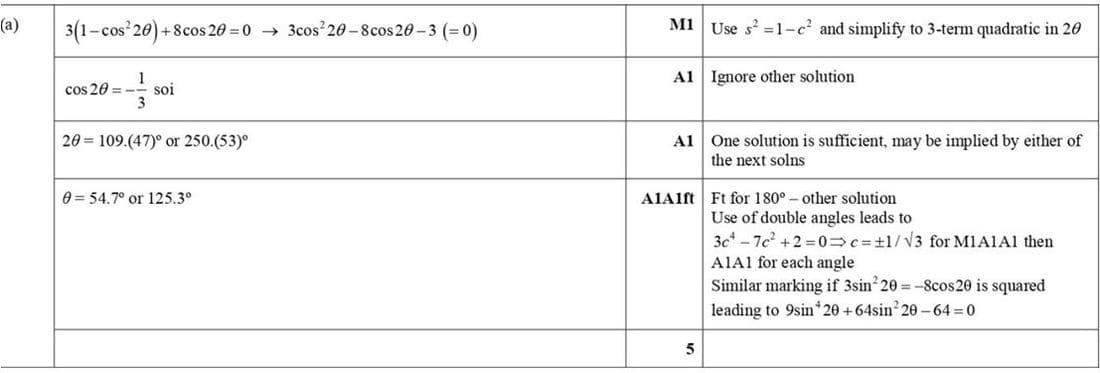
March 2019 p12 q7a
Solve the equation \(3 \sin^2 2\theta + 8 \cos 2\theta = 0\) for \(0^\circ \leq \theta \leq 180^\circ\).
Problem 443
(i) Show that \(\frac{\tan \theta + 1}{1 + \cos \theta} + \frac{\tan \theta - 1}{1 - \cos \theta} \equiv \frac{2(\tan \theta - \cos \theta)}{\sin^2 \theta}\).
(ii) Hence, showing all necessary working, solve the equation \(\frac{\tan \theta + 1}{1 + \cos \theta} + \frac{\tan \theta - 1}{1 - \cos \theta} = 0\) for \(0^\circ < \theta < 90^\circ\).
Problem 444
(i) Show that the equation \(\frac{\cos \theta - 4}{\sin \theta} - \frac{4 \sin \theta}{5 \cos \theta - 2} = 0\) may be expressed as \(9 \cos^2 \theta - 22 \cos \theta + 4 = 0\).
(ii) Hence solve the equation \(\frac{\cos \theta - 4}{\sin \theta} - \frac{4 \sin \theta}{5 \cos \theta - 2} = 0\) for \(0^\circ \leq \theta \leq 360^\circ\).
Problem 445
Express the equation \(\frac{5 + 2 \tan x}{3 + 2 \tan x} = 1 + \tan x\) as a quadratic equation in \(\tan x\) and hence solve the equation for \(0 \leq x \leq \pi\).
Problem 446
(i) Show that the equation \(\frac{\cos \theta + 4}{\sin \theta + 1} + 5 \sin \theta - 5 = 0\) may be expressed as \(5 \cos^2 \theta - \cos \theta - 4 = 0\).
(ii) Hence solve the equation \(\frac{\cos \theta + 4}{\sin \theta + 1} + 5 \sin \theta - 5 = 0\) for \(0^\circ \leq \theta \leq 360^\circ\).
Problem 447
(i) Show that the equation \(\cos 2x(\tan^2 2x + 3) + 3 = 0\) can be expressed as \(2 \cos^2 2x + 3 \cos 2x + 1 = 0\).
(ii) Hence solve the equation \(\cos 2x(\tan^2 2x + 3) + 3 = 0\) for \(0^\circ \leq x \leq 180^\circ\).
Problem 448
(i) Show that the equation \((\sin \theta + 2 \cos \theta)(1 + \sin \theta - \cos \theta) = \sin \theta(1 + \cos \theta)\) may be expressed as \(3 \cos^2 \theta - 2 \cos \theta - 1 = 0\).
(ii) Hence solve the equation \((\sin \theta + 2 \cos \theta)(1 + \sin \theta - \cos \theta) = \sin \theta(1 + \cos \theta)\) for \(-180^\circ \leq \theta \leq 180^\circ\).
Problem 449
(i) Show that \(\cos^4 x \equiv 1 - 2\sin^2 x + \sin^4 x\).
(ii) Hence, or otherwise, solve the equation \(8\sin^4 x + \cos^4 x = 2\cos^2 x\) for \(0^\circ \leq x \leq 360^\circ\).
Problem 450
(i) Show that \(3 \sin x \tan x - \cos x + 1 = 0\) can be written as a quadratic equation in \(\cos x\) and hence solve the equation \(3 \sin x \tan x - \cos x + 1 = 0\) for \(0 \leq x \leq \pi\).
(ii) Find the solutions to the equation \(3 \sin 2x \tan 2x - \cos 2x + 1 = 0\) for \(0 \leq x \leq \pi\).
Problem 451
(a) Show that the equation
\(4 \sin x + \frac{5}{\tan x} + \frac{2}{\sin x} = 0\)
may be expressed in the form \(a \cos^2 x + b \cos x + c = 0\), where \(a, b\) and \(c\) are integers to be found.
(b) Hence solve the equation \(4 \sin x + \frac{5}{\tan x} + \frac{2}{\sin x} = 0\) for \(0^\circ \leq x \leq 360^\circ\).
Problem 452
Solve the equation \(3 \sin^2 \theta = 4 \cos \theta - 1\) for \(0^\circ \leq \theta \leq 360^\circ\).
Problem 453
Show that the equation \(\frac{1}{\cos \theta} + 3 \sin \theta \tan \theta + 4 = 0\) can be expressed as \(3 \cos^2 \theta - 4 \cos \theta - 4 = 0\), and hence solve the equation \(\frac{1}{\cos \theta} + 3 \sin \theta \tan \theta + 4 = 0\) for \(0^\circ \leq \theta \leq 360^\circ\).
Problem 454
(i) Show that the equation \(\frac{4 \cos \theta}{\tan \theta} + 15 = 0\) can be expressed as \(4 \sin^2 \theta - 15 \sin \theta - 4 = 0\).
(ii) Hence solve the equation \(\frac{4 \cos \theta}{\tan \theta} + 15 = 0\) for \(0^\circ \leq \theta \leq 360^\circ\).
Problem 455
(i) Prove the identity \(\frac{\sin \theta - \cos \theta}{\sin \theta + \cos \theta} \equiv \frac{\tan \theta - 1}{\tan \theta + 1}\).
(ii) Hence solve the equation \(\frac{\sin \theta - \cos \theta}{\sin \theta + \cos \theta} = \frac{\tan \theta}{6}\), for \(0^\circ \leq \theta \leq 180^\circ\).
Problem 456
(i) Show that the equation \(1 + \sin x \tan x = 5 \cos x\) can be expressed as \(6 \cos^2 x - \cos x - 1 = 0\).
(ii) Hence solve the equation \(1 + \sin x \tan x = 5 \cos x\) for \(0^\circ \leq x \leq 180^\circ\).
Problem 457
(i) Solve the equation \(4 \sin^2 x + 8 \cos x - 7 = 0\) for \(0^\circ \leq x \leq 360^\circ\).
(ii) Hence find the solution of the equation \(4 \sin^2 \left(\frac{1}{2} \theta\right) + 8 \cos \left(\frac{1}{2} \theta\right) - 7 = 0\) for \(0^\circ \leq \theta \leq 360^\circ\).
Problem 458
(i) Express the equation \(2 \cos^2 \theta = \tan^2 \theta\) as a quadratic equation in \(\cos^2 \theta\).
(ii) Solve the equation \(2 \cos^2 \theta = \tan^2 \theta\) for \(0 \leq \theta \leq \pi\), giving solutions in terms of \(\pi\).
Problem 459
Solve the equation \(7 \cos x + 5 = 2 \sin^2 x\), for \(0^\circ \leq x \leq 360^\circ\).
Problem 460
(i) Show that the equation \(2 \cos x = 3 \tan x\) can be written as a quadratic equation in \(\sin x\).
(ii) Solve the equation \(2 \cos 2y = 3 \tan 2y\), for \(0^\circ \leq y \leq 180^\circ\).
Problem 461
(i) Solve the equation \(2 \cos^2 \theta = 3 \sin \theta\), for \(0^\circ \leq \theta \leq 360^\circ\).
(ii) The smallest positive solution of the equation \(2 \cos^2(n\theta) = 3 \sin(n\theta)\), where \(n\) is a positive integer, is \(10^\circ\). State the value of \(n\) and hence find the largest solution of this equation in the interval \(0^\circ \leq \theta \leq 360^\circ\).
Problem 462
(a) Show that the equation
\(3 \tan^2 x - 3 \sin^2 x - 4 = 0\)
may be expressed in the form \(a \cos^4 x + b \cos^2 x + c = 0\), where \(a, b\) and \(c\) are constants to be found.
(b) Hence solve the equation \(3 \tan^2 x - 3 \sin^2 x - 4 = 0\) for \(0^\circ \leq x \leq 180^\circ\).
Problem 463
(i) Prove the identity \(\tan x + \frac{1}{\tan x} \equiv \frac{1}{\sin x \cos x}\).
(ii) Solve the equation \(\frac{2}{\sin x \cos x} = 1 + 3 \tan x\), for \(0^\circ \leq x \leq 180^\circ\).
Problem 464
(i) Given that
\(3 \sin^2 x - 8 \cos x - 7 = 0\),
show that, for real values of \(x\),
\(\cos x = -\frac{2}{3}\).
(ii) Hence solve the equation
\(3 \sin^2(\theta + 70^\circ) - 8 \cos(\theta + 70^\circ) - 7 = 0\)
for \(0^\circ \leq \theta \leq 180^\circ\).
Problem 465
(i) Show that the equation \(2 \tan^2 \theta \sin^2 \theta = 1\) can be written in the form \(2 \sin^4 \theta + \sin^2 \theta - 1 = 0\).
(ii) Hence solve the equation \(2 \tan^2 \theta \sin^2 \theta = 1\) for \(0^\circ \leq \theta \leq 360^\circ\).
Problem 466
Solve the equation \(15 \sin^2 x = 13 + \cos x\) for \(0^\circ \leq x \leq 180^\circ\).
Problem 467
(i) Show that the equation \(2 \sin x \tan x + 3 = 0\) can be expressed as \(2 \cos^2 x - 3 \cos x - 2 = 0\).
(ii) Solve the equation \(2 \sin x \tan x + 3 = 0\) for \(0^\circ \leq x \leq 360^\circ\).
Problem 468
(i) Show that the equation \(2 \tan^2 \theta \cos \theta = 3\) can be written in the form \(2 \cos^2 \theta + 3 \cos \theta - 2 = 0\).
(ii) Hence solve the equation \(2 \tan^2 \theta \cos \theta = 3\), for \(0^\circ \leq \theta \leq 360^\circ\).
Problem 469
(i) Show that the equation \(3 \sin x \tan x = 8\) can be written as \(3 \cos^2 x + 8 \cos x - 3 = 0\).
(ii) Hence solve the equation \(3 \sin x \tan x = 8\) for \(0^\circ \leq x \leq 360^\circ\).
Problem 470
Solve the equation \(3 \sin^2 \theta - 2 \cos \theta - 3 = 0\), for \(0^\circ \leq \theta \leq 180^\circ\).
Problem 471
(i) Show that the equation \(\sin^2 \theta + 3 \sin \theta \cos \theta = 4 \cos^2 \theta\) can be written as a quadratic equation in \(\tan \theta\).
(ii) Hence, or otherwise, solve the equation in part (i) for \(0^\circ \leq \theta \leq 180^\circ\).
Problem 472
(i) Show that the equation \(4 \sin^4 \theta + 5 = 7 \cos^2 \theta\) may be written in the form \(4x^2 + 7x - 2 = 0\), where \(x = \sin^2 \theta\).
(ii) Hence solve the equation \(4 \sin^4 \theta + 5 = 7 \cos^2 \theta\), for \(0^\circ \leq \theta \leq 360^\circ\).
Problem 473
(a) (i) By first expanding \((\cos \theta + \sin \theta)^2\), find the three solutions of the equation \((\cos \theta + \sin \theta)^2 = 1\) for \(0 \leq \theta \leq \pi\).
(ii) Hence verify that the only solutions of the equation \(\cos \theta + \sin \theta = 1\) for \(0 \leq \theta \leq \pi\) are \(0\) and \(\frac{1}{2}\pi\).
(b) Prove the identity \(\frac{\sin \theta}{\cos \theta + \sin \theta} + \frac{1 - \cos \theta}{\cos \theta - \sin \theta} \equiv \frac{\cos \theta + \sin \theta - 1}{1 - 2 \sin^2 \theta}\).
(c) Using the results of (a)(ii) and (b), solve the equation \(\frac{\sin \theta}{\cos \theta + \sin \theta} + \frac{1 - \cos \theta}{\cos \theta - \sin \theta} = 2(\cos \theta + \sin \theta - 1)\) for \(0 \leq \theta \leq \pi\).
Problem 474
(i) Show that the equation \(3 \tan \theta = 2 \cos \theta\) can be expressed as \(2 \sin^2 \theta + 3 \sin \theta - 2 = 0\).
(ii) Hence solve the equation \(3 \tan \theta = 2 \cos \theta\), for \(0^\circ \leq \theta \leq 360^\circ\).
Problem 475
(i) Show that \(\sin x \tan x\) may be written as \(\frac{1 - \cos^2 x}{\cos x}\).
(ii) Hence solve the equation \(2 \sin x \tan x = 3\), for \(0^\circ \leq x \leq 360^\circ\).
Problem 476
By first obtaining a quadratic equation in \(\cos \theta\), solve the equation
\(\tan \theta \sin \theta = 1\)
for \(0^\circ < \theta < 360^\circ\).
Problem 477
Solve the equation \(8 \sin^2 \theta + 6 \cos \theta + 1 = 0\) for \(0^\circ < \theta < 180^\circ\).
Problem 478
(a) Prove the identity \(\frac{\sin \theta}{\sin \theta + \cos \theta} + \frac{\cos \theta}{\sin \theta - \cos \theta} \equiv \frac{\tan^2 \theta + 1}{\tan^2 \theta - 1}\).
(b) Hence find the exact solutions of the equation \(\frac{\sin \theta}{\sin \theta + \cos \theta} + \frac{\cos \theta}{\sin \theta - \cos \theta} = 2\) for \(0 \leq \theta \leq \pi\).
Problem 479
Solve the equation \(8 \cos^2 \theta - 10 \cos \theta + 2 = 0\) for \(0^\circ \leq \theta \leq 180^\circ\).