Exam-Style Problems
⬅ Back to SubchapterNov 2017 p12 q2
762
A function \(f\) is defined by \(f : x \mapsto 4 - 5x\) for \(x \in \mathbb{R}\).
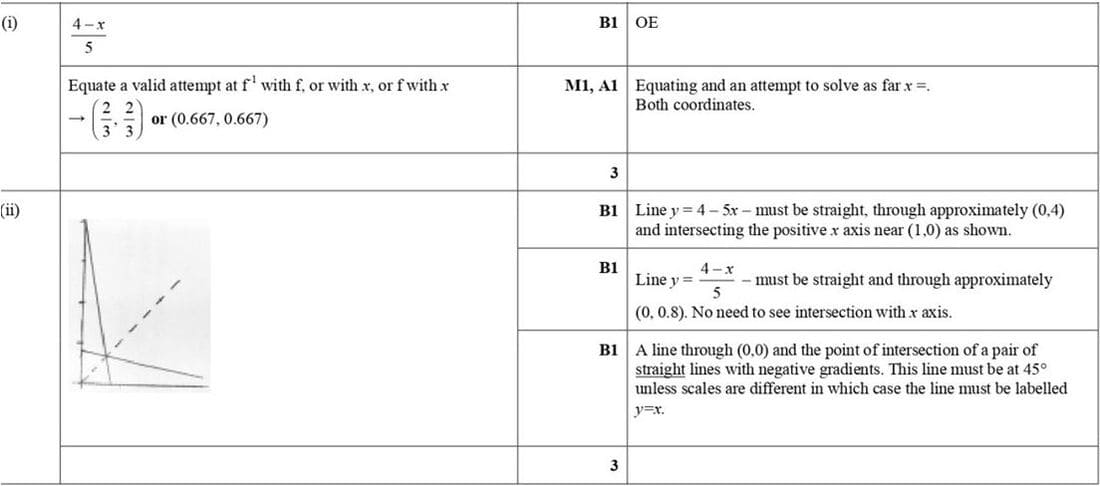
(i) Find an expression for \(f^{-1}(x)\) and find the point of intersection of the graphs of \(y = f(x)\) and \(y = f^{-1}(x)\).
(ii) Sketch, on the same diagram, the graphs of \(y = f(x)\) and \(y = f^{-1}(x)\), making clear the relationship between the graphs.
Nov 2021 p13 q6
763
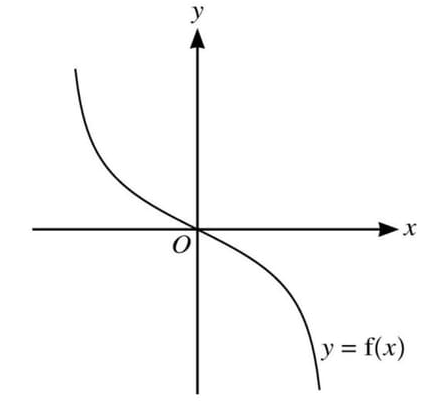
The diagram shows the graph of \(y = f(x)\).
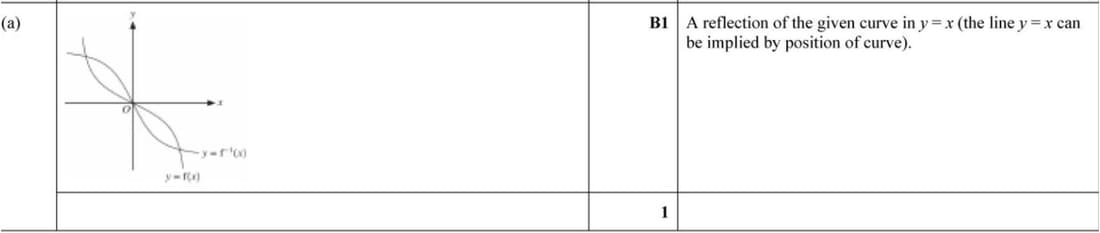
On this diagram sketch the graph of \(y = f^{-1}(x)\).
June 2012 p13 q11
764
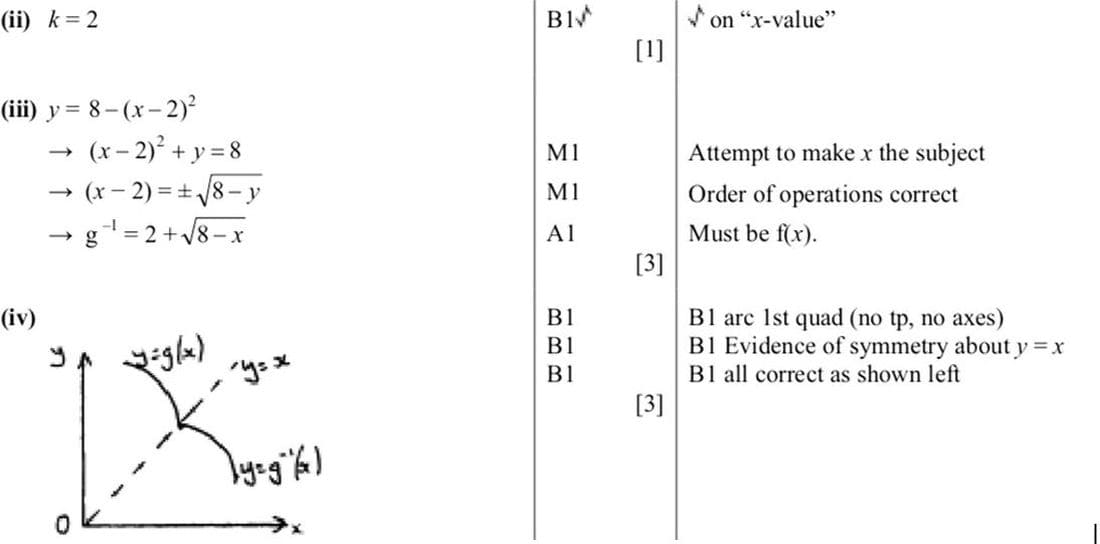
The function g is such that \(g(x) = 8 - (x - 2)^2\), for \(k \leq x \leq 4\), where \(k\) is a constant.
(ii) State the smallest value of \(k\) for which \(g\) has an inverse.
For this value of \(k\),
(iii) find an expression for \(g^{-1}(x)\),
(iv) sketch, on the same diagram, the graphs of \(y = g(x)\) and \(y = g^{-1}(x)\).
Nov 2011 p11 q11
765
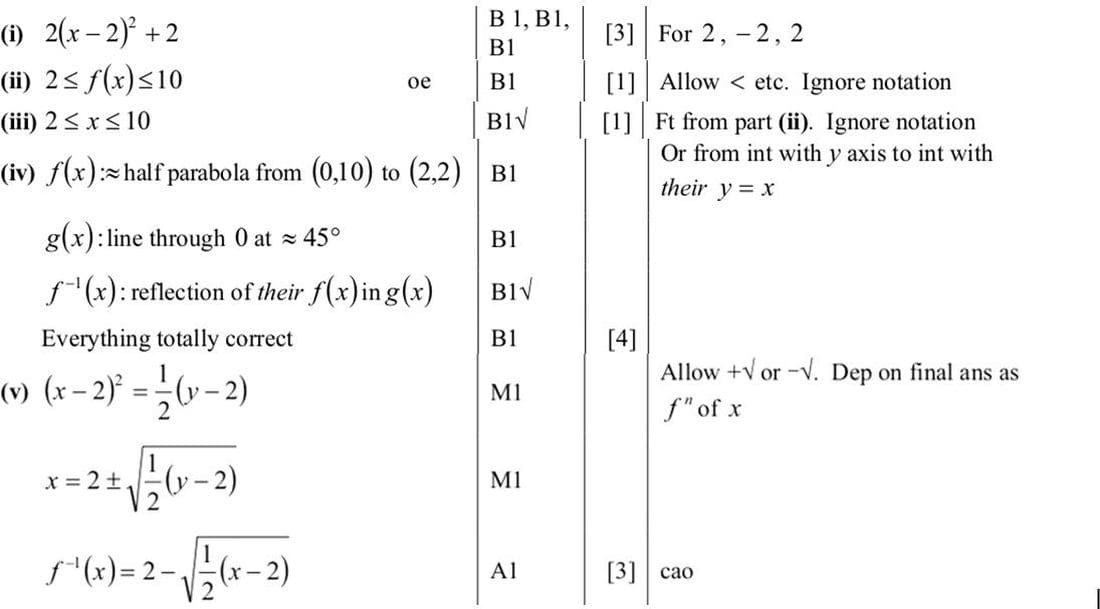
Functions f and g are defined by
\(f : x \mapsto 2x^2 - 8x + 10\) for \(0 \leq x \leq 2\),
\(g : x \mapsto x\) for \(0 \leq x \leq 10\).
- Express \(f(x)\) in the form \(a(x + b)^2 + c\), where \(a, b\) and \(c\) are constants.
- State the range of \(f\).
- State the domain of \(f^{-1}\).
- Sketch on the same diagram the graphs of \(y = f(x)\), \(y = g(x)\) and \(y = f^{-1}(x)\), making clear the relationship between the graphs.
- Find an expression for \(f^{-1}(x)\).
June 2007 p1 q11
766
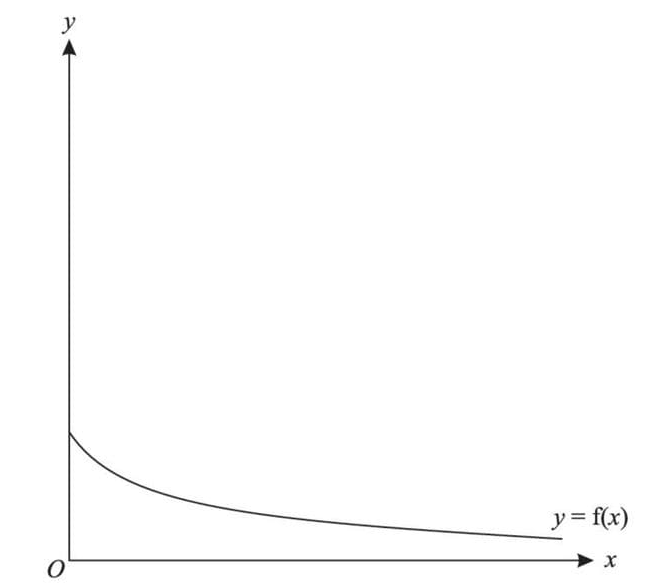
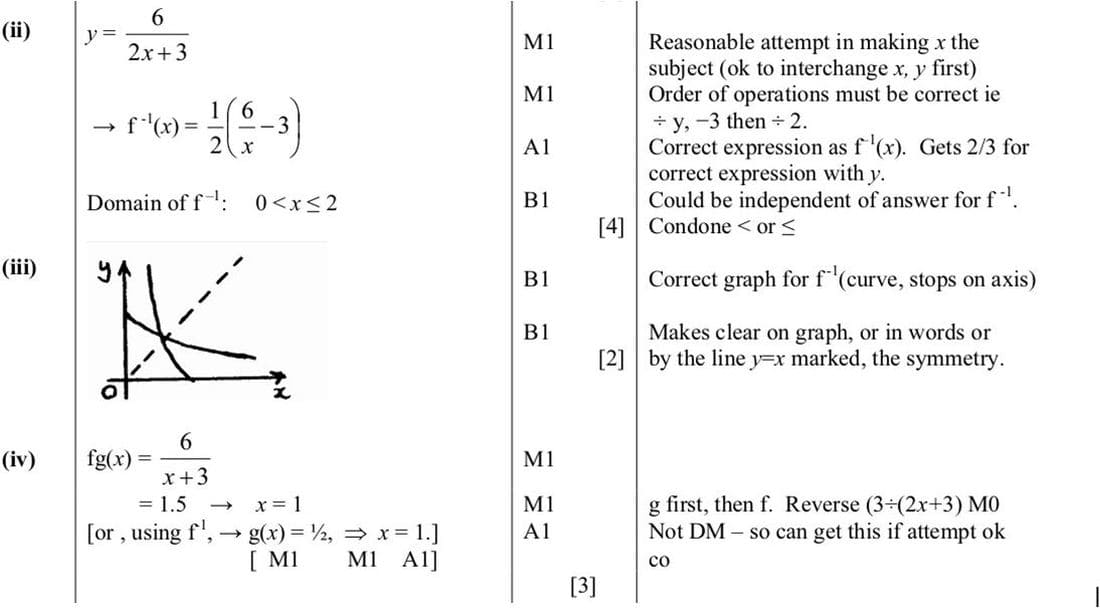
The diagram shows the graph of \(y = f(x)\), where \(f : x \mapsto \frac{6}{2x+3}\) for \(x \geq 0\).
(ii) Find an expression, in terms of \(x\), for \(f^{-1}(x)\) and find the domain of \(f^{-1}\).
(iii) Copy the diagram and, on your copy, sketch the graph of \(y = f^{-1}(x)\), making clear the relationship between the graphs.
The function \(g\) is defined by \(g : x \mapsto \frac{1}{2}x\) for \(x \geq 0\).
(iv) Solve the equation \(fg(x) = \frac{3}{2}\).
June 2012 p12 q10
767
Given the function \(f : x \mapsto 2x + 5\) for \(x \in \mathbb{R}\), sketch the graphs of \(y = f(x)\) and \(y = f^{-1}(x)\) on the same diagram, making clear the relationship between the two graphs.

Nov 2011 p13 q9
768
Given the function \(f : x \mapsto 2x + 3\) for \(x \leq 0\), on the same diagram sketch the graphs of \(y = f(x)\) and \(y = f^{-1}(x)\), showing the coordinates of their point of intersection and the relationship between the graphs.

June 2011 p13 q10
769
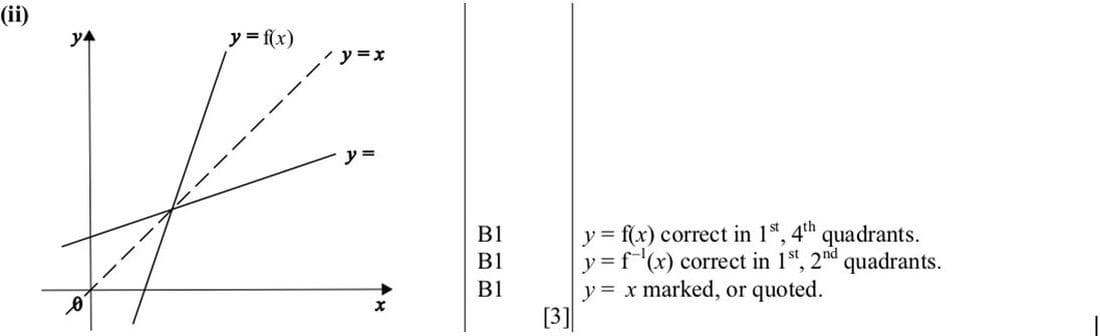
Let \(f : x \mapsto 3x - 4, \; x \in \mathbb{R}\).
Sketch in a single diagram the graphs of \(y = f(x)\) and \(y = f^{-1}(x)\), making clear the relationship between the graphs.
Nov 2009 p11 q10
770
Let \(f : x \mapsto 2x + 1\), \(x \in \mathbb{R}\), \(x > 0\).
Sketch in a single diagram the graphs of \(y = f(x)\) and \(y = f^{-1}(x)\), making clear the relationship between the graphs.

Nov 2008 p1 q10
771
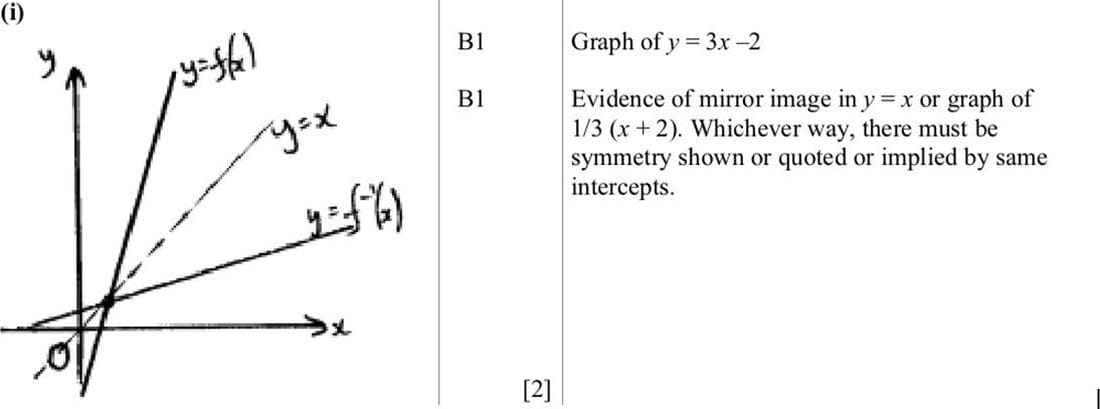
The function \(f\) is defined by \(f : x \mapsto 3x - 2\) for \(x \in \mathbb{R}\).
Sketch, in a single diagram, the graphs of \(y = f(x)\) and \(y = f^{-1}(x)\), making clear the relationship between the two graphs.
June 2004 p1 q10
772
Given the function \(g : x \mapsto 2x + 3\), where \(x \in \mathbb{R}\), sketch, in a single diagram, the graphs of \(y = g(x)\) and \(y = g^{-1}(x)\), making clear the relationship between the graphs.

Nov 2003 p1 q10
773
Given the function \(f: x \mapsto 2x - 5\), \(x \in \mathbb{R}\), sketch, on a single diagram, the graphs of \(y = f(x)\) and \(y = f^{-1}(x)\), making clear the relationship between these two graphs.

June 2002 p1 q10
774
Given the function \(f : x \mapsto 3x + 2\), \(x \in \mathbb{R}\), sketch, in a single diagram, the graphs of \(y = f(x)\) and \(y = f^{-1}(x)\), making clear the relationship between the two graphs.

June 2020 p13 q9
775
The functions f and g are defined by
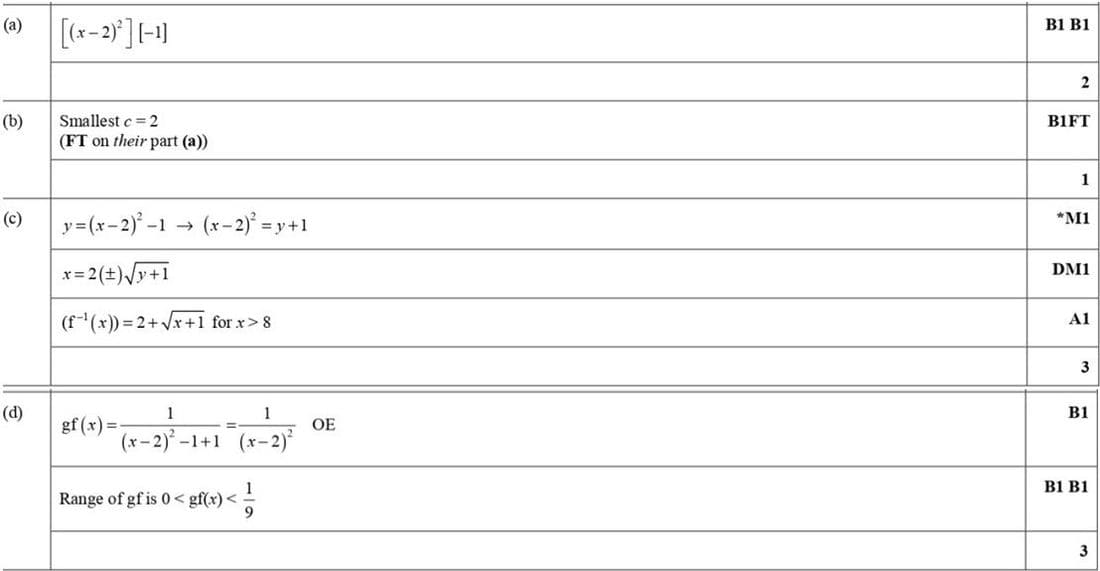
\(f(x) = x^2 - 4x + 3\) for \(x > c\), where \(c\) is a constant,
\(g(x) = \frac{1}{x+1}\) for \(x > -1\).
(a) Express \(f(x)\) in the form \((x-a)^2 + b\).
It is given that \(f\) is a one-one function.
(b) State the smallest possible value of \(c\).
It is now given that \(c = 5\).
(c) Find an expression for \(f^{-1}(x)\) and state the domain of \(f^{-1}\).
(d) Find an expression for \(gf(x)\) and state the range of \(gf\).
Feb/Mar 2016 p12 q8
776
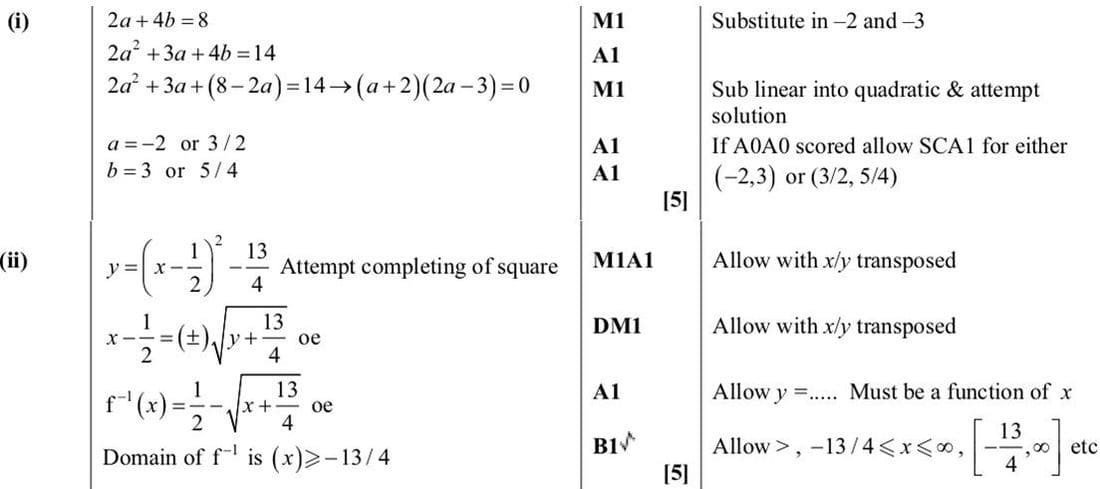
The function \(f\) is such that \(f(x) = a^2x^2 - ax + 3b\) for \(x \leq \frac{1}{2a}\), where \(a\) and \(b\) are constants.
(i) For the case where \(f(-2) = 4a^2 - b + 8\) and \(f(-3) = 7a^2 - b + 14\), find the possible values of \(a\) and \(b\).
(ii) For the case where \(a = 1\) and \(b = -1\), find an expression for \(f^{-1}(x)\) and give the domain of \(f^{-1}\).
Nov 2015 p13 q8
777
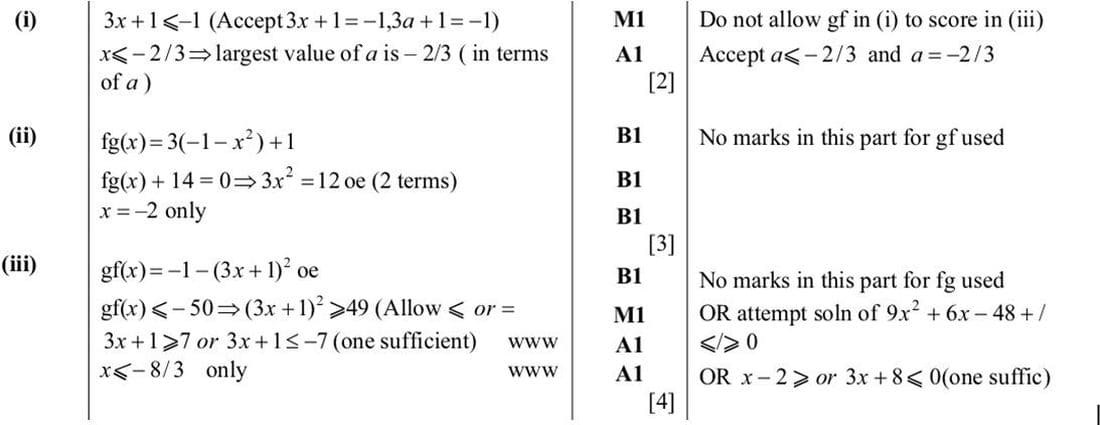
The function f is defined by \(f(x) = 3x + 1\) for \(x \leq a\), where \(a\) is a constant. The function g is defined by \(g(x) = -1 - x^2\) for \(x \leq -1\).
(i) Find the largest value of \(a\) for which the composite function \(gf\) can be formed.
For the case where \(a = -1\),
(ii) solve the equation \(fg(x) + 14 = 0\),
(iii) find the set of values of \(x\) which satisfy the inequality \(gf(x) \leq -50\).
Nov 2015 p12 q8
778
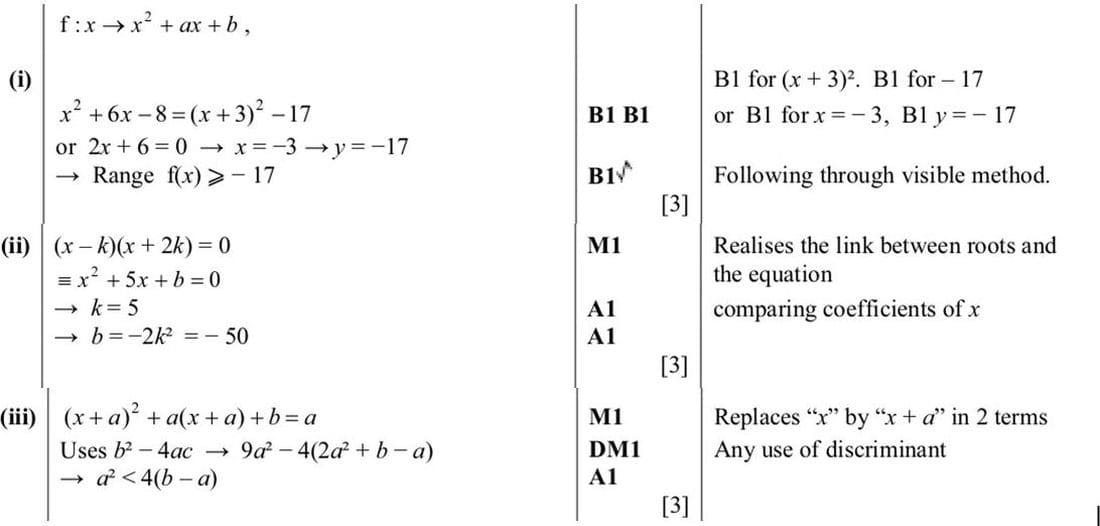
The function \(f\) is defined, for \(x \in \mathbb{R}\), by \(f : x \mapsto x^2 + ax + b\), where \(a\) and \(b\) are constants.
(i) In the case where \(a = 6\) and \(b = -8\), find the range of \(f\).
(ii) In the case where \(a = 5\), the roots of the equation \(f(x) = 0\) are \(k\) and \(-2k\), where \(k\) is a constant. Find the values of \(b\) and \(k\).
(iii) Show that if the equation \(f(x+a) = a\) has no real roots, then \(a^2 < 4(b-a)\).
June 2015 p13 q6
779
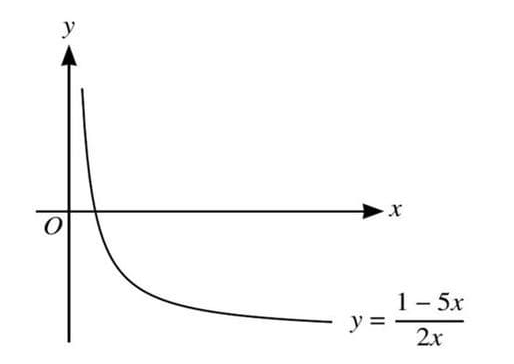
The diagram shows the graph of \(y = f^{-1}(x)\), where \(f^{-1}\) is defined by \(f^{-1}(x) = \frac{1 - 5x}{2x}\) for \(0 < x \leq 2\).
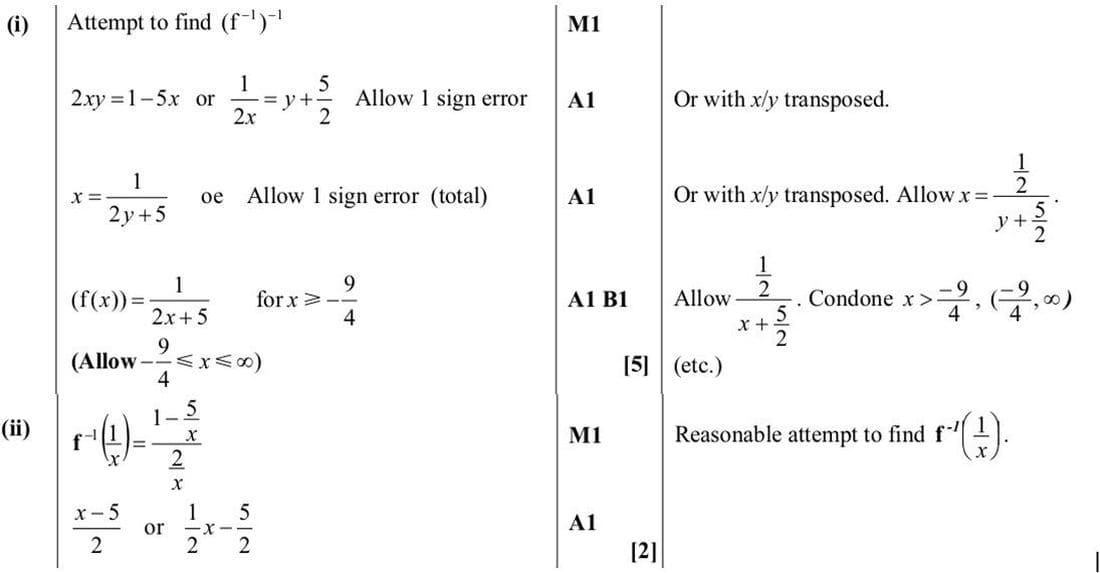
(i) Find an expression for \(f(x)\) and state the domain of \(f\).
(ii) The function \(g\) is defined by \(g(x) = \frac{1}{x}\) for \(x \geq 1\). Find an expression for \(f^{-1}g(x)\), giving your answer in the form \(ax + b\), where \(a\) and \(b\) are constants to be found.
Nov 2014 p13 q10
780
The functions f and g are defined for \(x \geq 0\) by
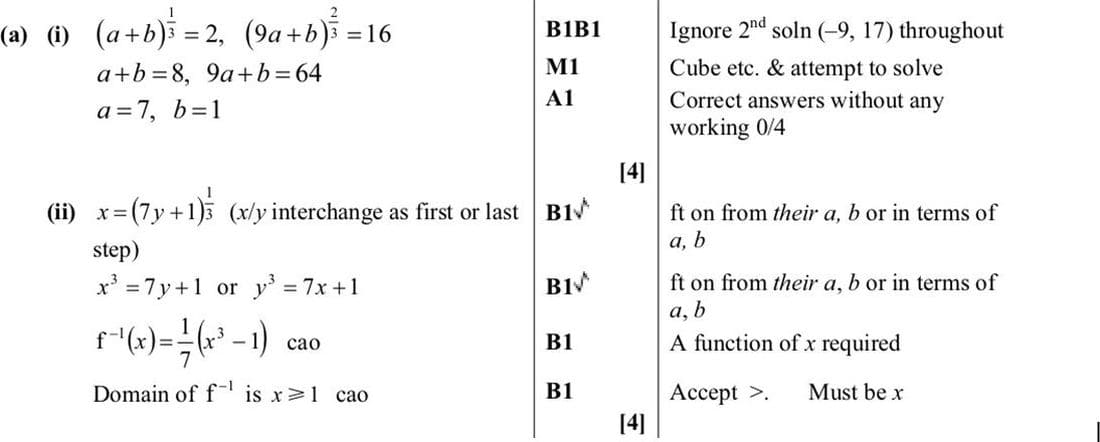
\(f : x \mapsto (ax + b)^{\frac{1}{3}}\), where \(a\) and \(b\) are positive constants,
\(g : x \mapsto x^2\).
Given that \(fg(1) = 2\) and \(gf(9) = 16\),
- calculate the values of \(a\) and \(b\),
- obtain an expression for \(f^{-1}(x)\) and state the domain of \(f^{-1}\).
Nov 2014 p11 q10
781
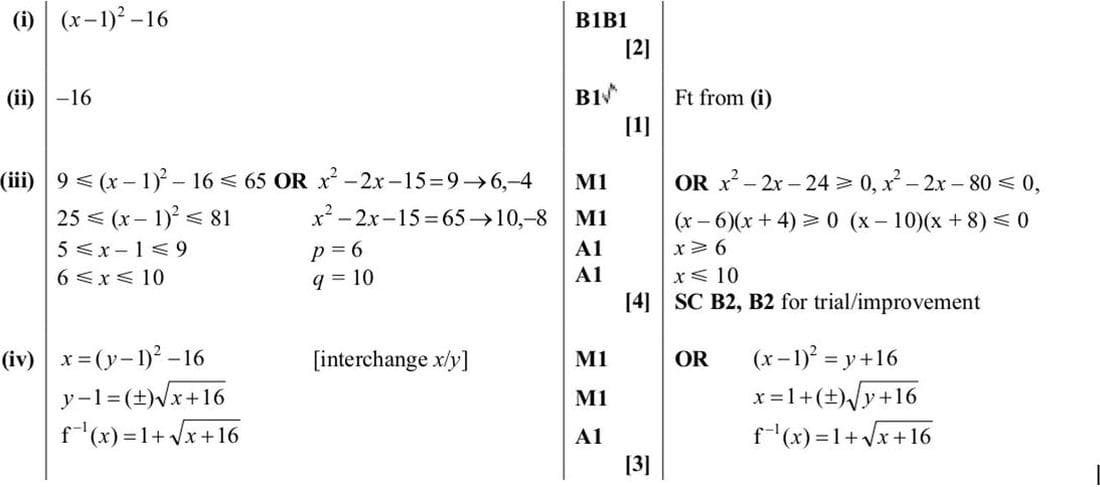
(i) Express \(x^2 - 2x - 15\) in the form \((x + a)^2 + b\).
The function \(f\) is defined for \(p \leq x \leq q\), where \(p\) and \(q\) are positive constants, by \(f : x \mapsto x^2 - 2x - 15\).
The range of \(f\) is given by \(c \leq f(x) \leq d\), where \(c\) and \(d\) are constants.
(ii) State the smallest possible value of \(c\).
For the case where \(c = 9\) and \(d = 65\),
(iii) find \(p\) and \(q\),
(iv) find an expression for \(f^{-1}(x)\).
June 2014 p11 q10
782
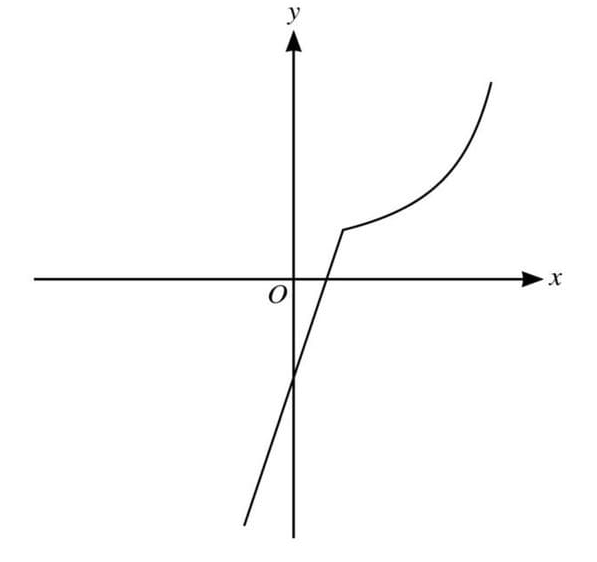
The diagram shows the function \(f\) defined for \(-1 \leq x \leq 4\), where
\(f(x) = \begin{cases} 3x - 2 & \text{for } -1 \leq x \leq 1, \\ \frac{4}{5-x} & \text{for } 1 < x \leq 4. \end{cases}\)
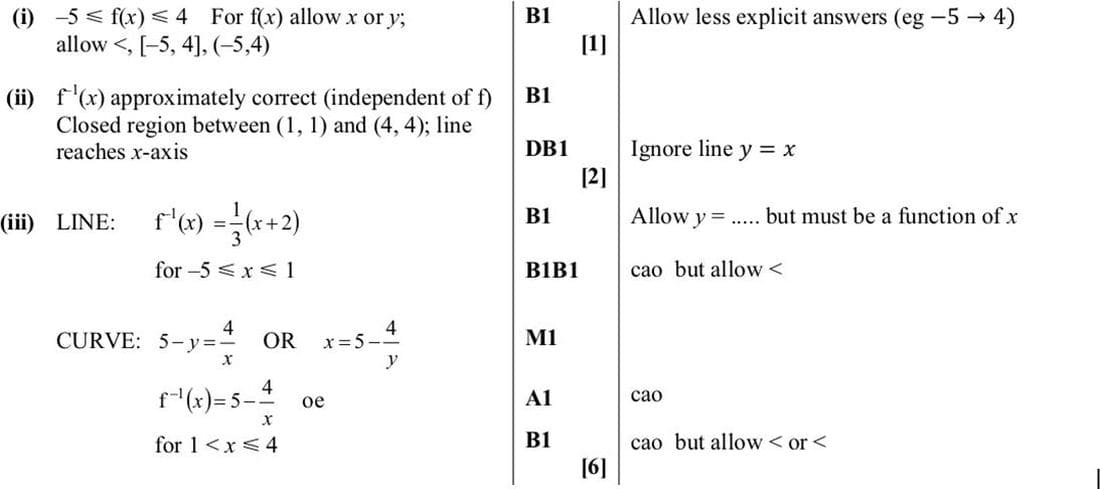
(i) State the range of \(f\).
(ii) Copy the diagram and on your copy sketch the graph of \(y = f^{-1}(x)\).
(iii) Obtain expressions to define the function \(f^{-1}\), giving also the set of values for which each expression is valid.
Nov 2013 p13 q10
783
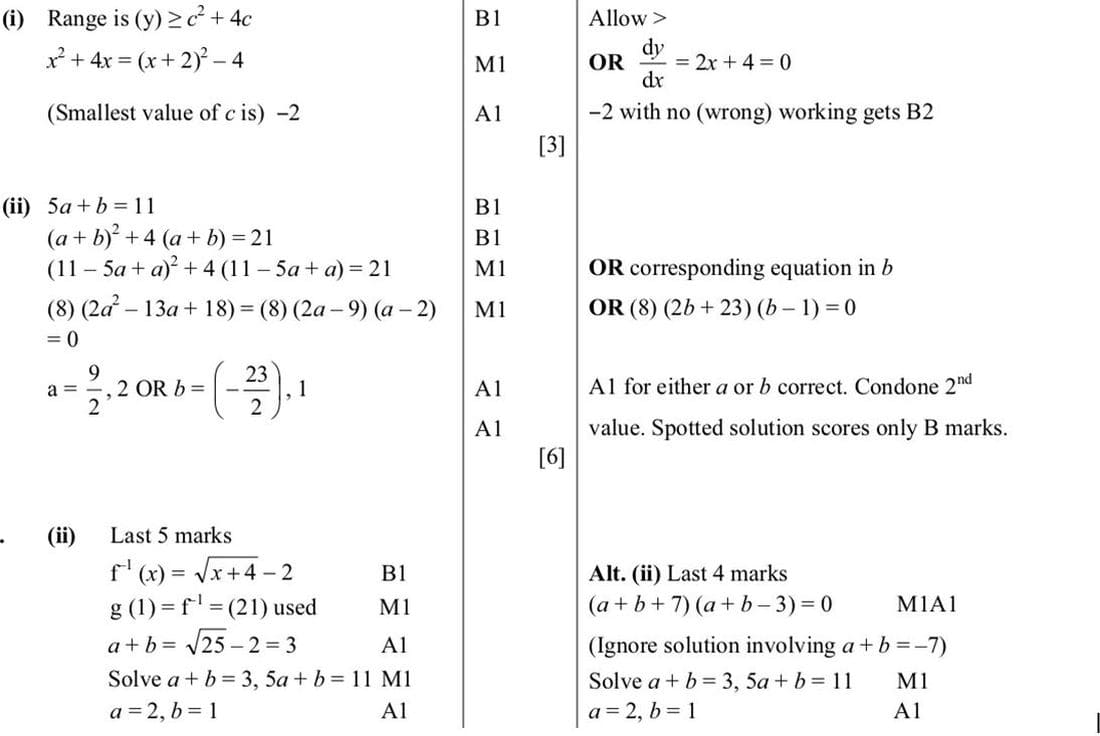
The function f is defined by \(f : x \mapsto x^2 + 4x\) for \(x \geq c\), where \(c\) is a constant. It is given that \(f\) is a one-one function.
(i) State the range of \(f\) in terms of \(c\) and find the smallest possible value of \(c\).
The function \(g\) is defined by \(g : x \mapsto ax + b\) for \(x \geq 0\), where \(a\) and \(b\) are positive constants. It is given that, when \(c = 0\), \(gf(1) = 11\) and \(fg(1) = 21\).
(ii) Write down two equations in \(a\) and \(b\) and solve them to find the values of \(a\) and \(b\).
Nov 2012 p13 q7
784
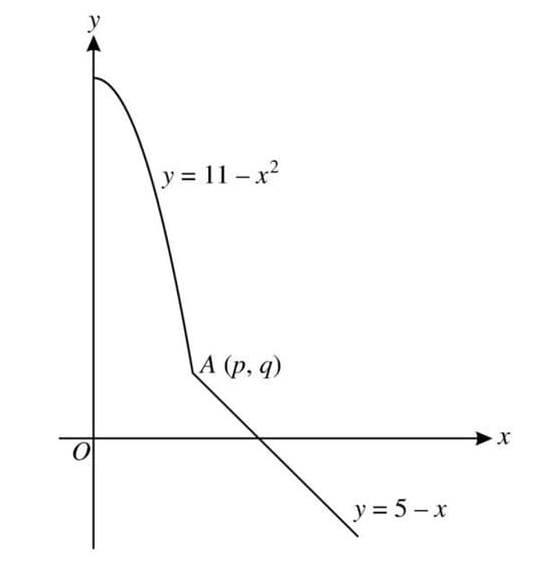
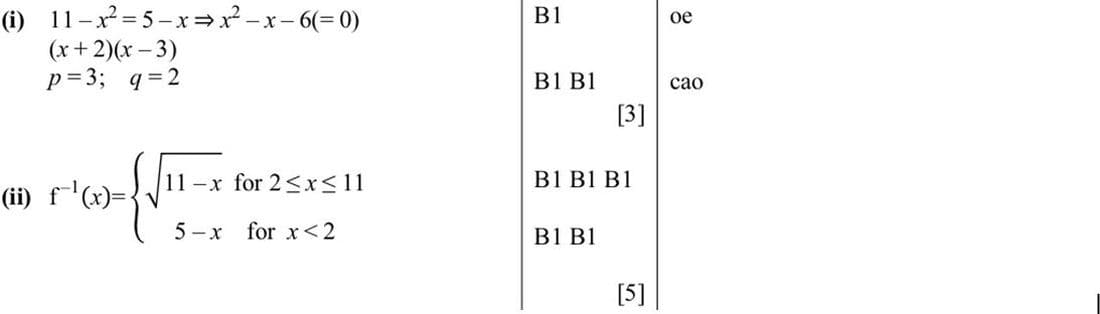
(i) The diagram shows part of the curve \(y = 11 - x^2\) and part of the straight line \(y = 5 - x\) meeting at the point \(A (p, q)\), where \(p\) and \(q\) are positive constants. Find the values of \(p\) and \(q\).
(ii) The function \(f\) is defined for the domain \(x \geq 0\) by
\(f(x) = \begin{cases} 11 - x^2 & \text{for } 0 \leq x \leq p, \\ 5 - x & \text{for } x > p. \end{cases}\)
Express \(f^{-1}(x)\) in a similar way.
June 2012 p11 q8
785
The function \(f : x \mapsto x^2 - 4x + k\) is defined for the domain \(x \geq p\), where \(k\) and \(p\) are constants.
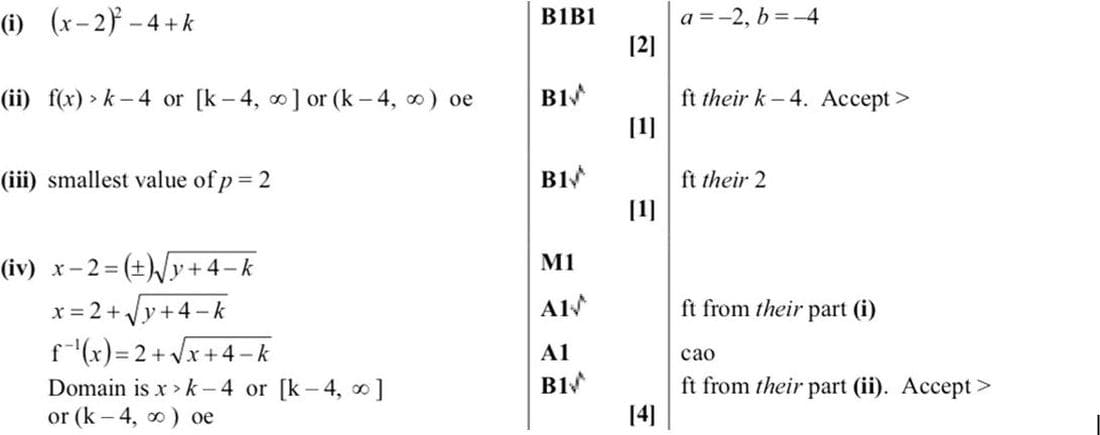
- Express \(f(x)\) in the form \((x + a)^2 + b + k\), where \(a\) and \(b\) are constants. [2]
- State the range of \(f\) in terms of \(k\). [1]
- State the smallest value of \(p\) for which \(f\) is one-one. [1]
- For the value of \(p\) found in part (iii), find an expression for \(f^{-1}(x)\) and state the domain of \(f^{-1}\), giving your answers in terms of \(k\). [4]
June 2019 p13 q4
786
The function f is defined by \(f(x) = \frac{48}{x-1}\) for \(3 \leq x \leq 7\). The function g is defined by \(g(x) = 2x - 4\) for \(a \leq x \leq b\), where \(a\) and \(b\) are constants.
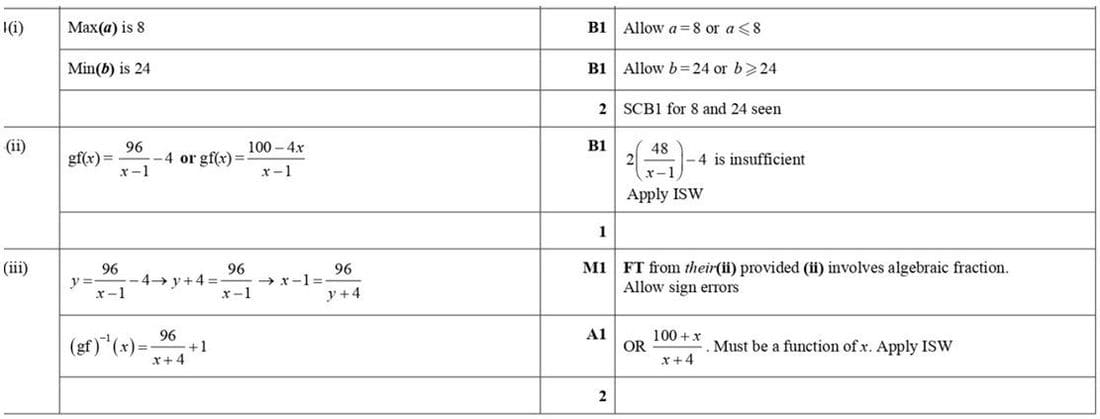
(i) Find the greatest value of \(a\) and the least value of \(b\) which will permit the formation of the composite function gf.
It is now given that the conditions for the formation of gf are satisfied.
(ii) Find an expression for \(gf(x)\).
(iii) Find an expression for \((gf)^{-1}(x)\).
Nov 2010 p13 q7
787
The diagram shows the function \(f\) defined for \(0 \leq x \leq 6\) by:
\(x \mapsto \frac{1}{2}x^2\) for \(0 \leq x \leq 2\),
\(x \mapsto \frac{1}{2}x + 1\) for \(2 < x \leq 6\).
(i) State the range of \(f\).
(ii) Copy the diagram and on your copy sketch the graph of \(y = f^{-1}(x)\).
(iii) Obtain expressions to define \(f^{-1}(x)\), giving the set of values of \(x\) for which each expression is valid.


Nov 2010 p12 q7
788
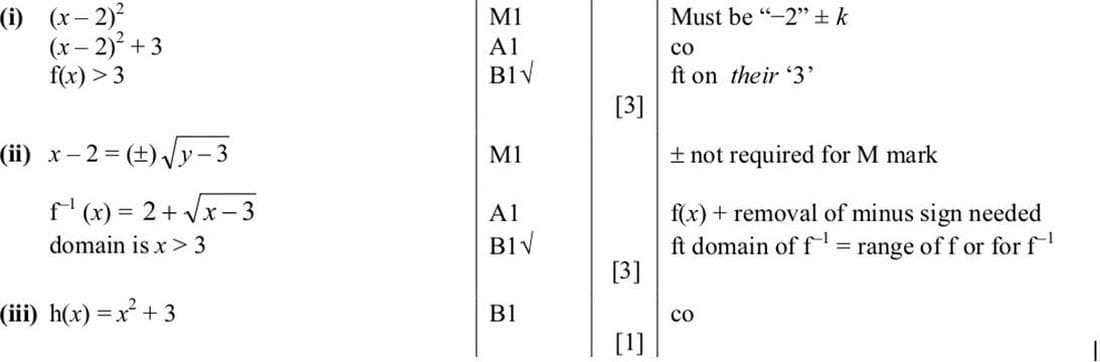
The function f is defined by
\(f(x) = x^2 - 4x + 7\) for \(x > 2\).
(i) Express \(f(x)\) in the form \((x-a)^2 + b\) and hence state the range of \(f\).
(ii) Obtain an expression for \(f^{-1}(x)\) and state the domain of \(f^{-1}\).
The function g is defined by
\(g(x) = x - 2\) for \(x > 2\).
The function h is such that \(f = hg\) and the domain of \(h\) is \(x > 0\).
(iii) Obtain an expression for \(h(x)\).
Nov 2018 p13 q11
789
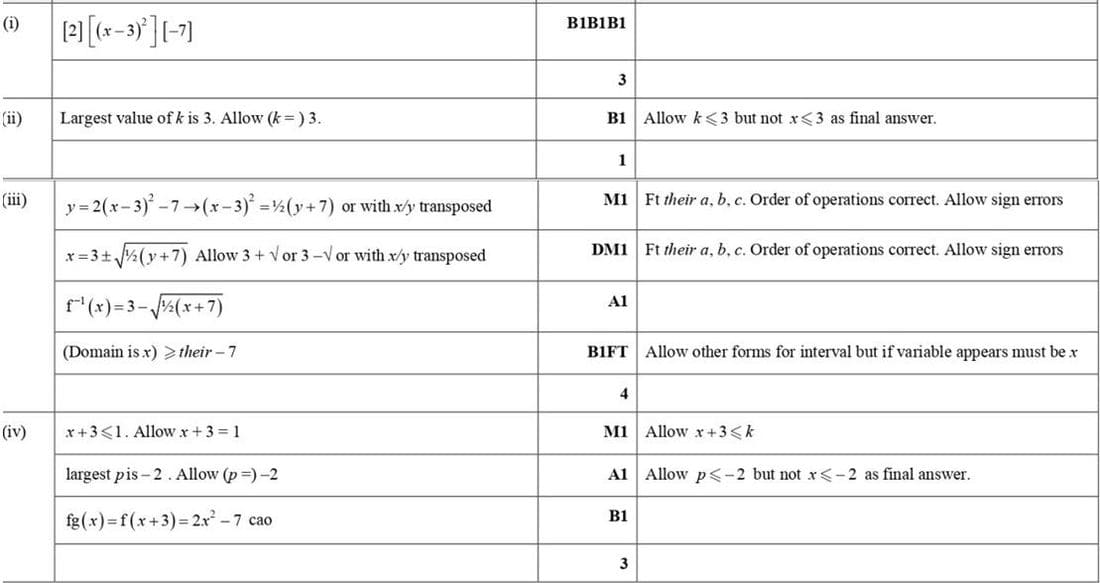
(i) Express \(2x^2 - 12x + 11\) in the form \(a(x + b)^2 + c\), where \(a, b\) and \(c\) are constants.
The function \(f\) is defined by \(f(x) = 2x^2 - 12x + 11\) for \(x \leq k\).
(ii) State the largest value of the constant \(k\) for which \(f\) is a one-one function.
(iii) For this value of \(k\) find an expression for \(f^{-1}(x)\) and state the domain of \(f^{-1}\).
The function \(g\) is defined by \(g(x) = x + 3\) for \(x \leq p\).
(iv) With \(k\) now taking the value 1, find the largest value of the constant \(p\) which allows the composite function \(fg\) to be formed, and find an expression for \(fg(x)\) whenever this composite function exists.
Nov 2018 p11 q11
790
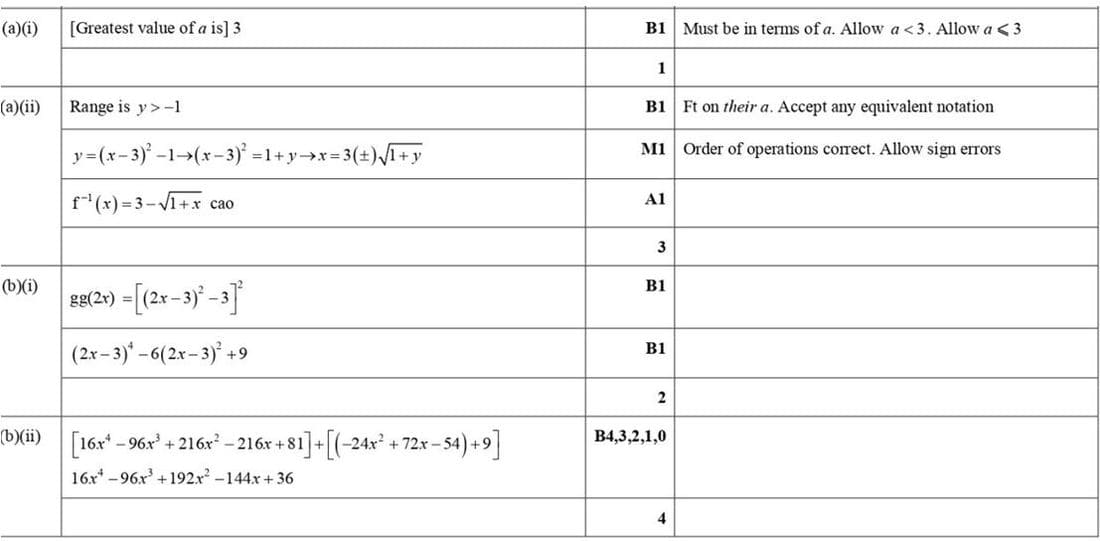
(a) The one-one function \(f\) is defined by \(f(x) = (x - 3)^2 - 1\) for \(x < a\), where \(a\) is a constant.
(i) State the greatest possible value of \(a\).
(ii) It is given that \(a\) takes this greatest possible value. State the range of \(f\) and find an expression for \(f^{-1}(x)\).
(b) The function \(g\) is defined by \(g(x) = (x - 3)^2\) for \(x \geq 0\).
(i) Show that \(gg(2x)\) can be expressed in the form \((2x - 3)^4 + b(2x - 3)^2 + c\), where \(b\) and \(c\) are constants to be found.
(ii) Hence expand \(gg(2x)\) completely, simplifying your answer.
June 2018 p13 q10
791
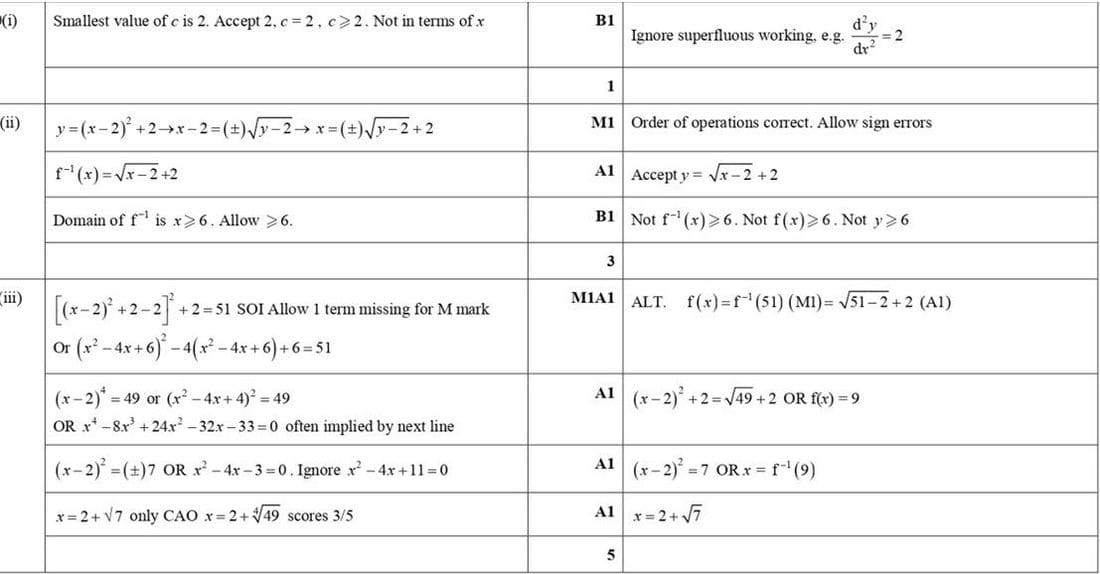
The one-one function \(f\) is defined by \(f(x) = (x-2)^2 + 2\) for \(x \geq c\), where \(c\) is a constant.
- State the smallest possible value of \(c\).
- In parts (ii) and (iii) the value of \(c\) is 4.
- Find an expression for \(f^{-1}(x)\) and state the domain of \(f^{-1}\).
- Solve the equation \(ff(x) = 51\), giving your answer in the form \(a + \sqrt{b}\).
June 2018 p11 q9
792
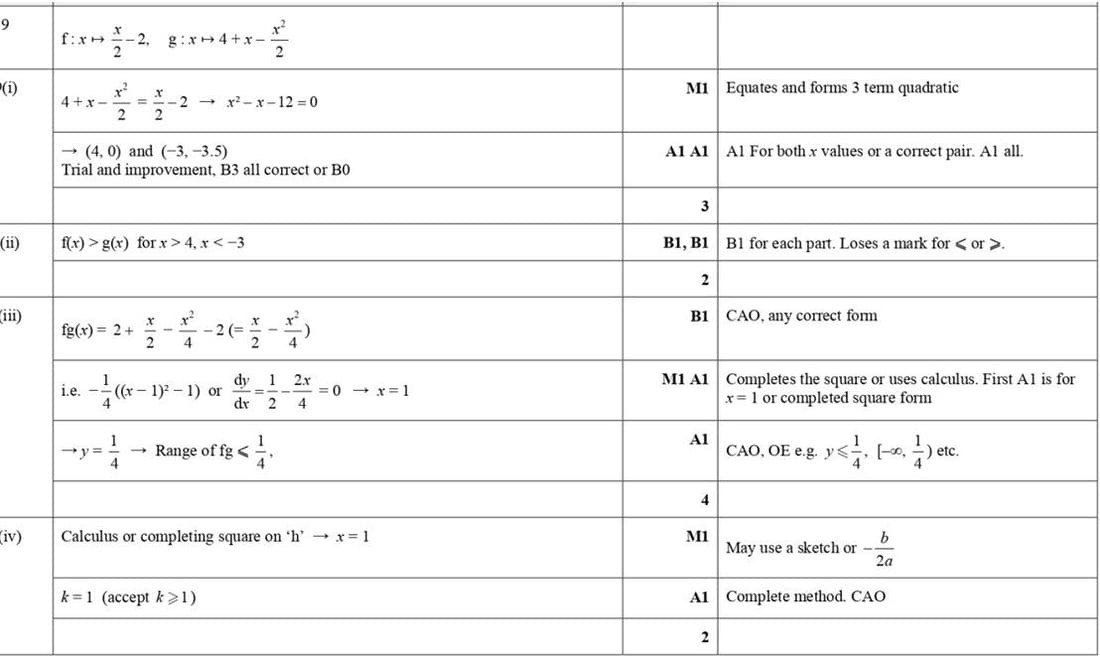
Functions f and g are defined for \(x \in \mathbb{R}\) by
\(f : x \mapsto \frac{1}{2}x - 2\),
\(g : x \mapsto 4 + x - \frac{1}{2}x^2\).
(i) Find the points of intersection of the graphs of \(y = f(x)\) and \(y = g(x)\).
(ii) Find the set of values of \(x\) for which \(f(x) > g(x)\).
(iii) Find an expression for \(fg(x)\) and deduce the range of \(fg\).
The function \(h\) is defined by \(h : x \mapsto 4 + x - \frac{1}{2}x^2\) for \(x \geq k\).
(iv) Find the smallest value of \(k\) for which \(h\) has an inverse.
Feb/Mar 2018 p12 q10
793
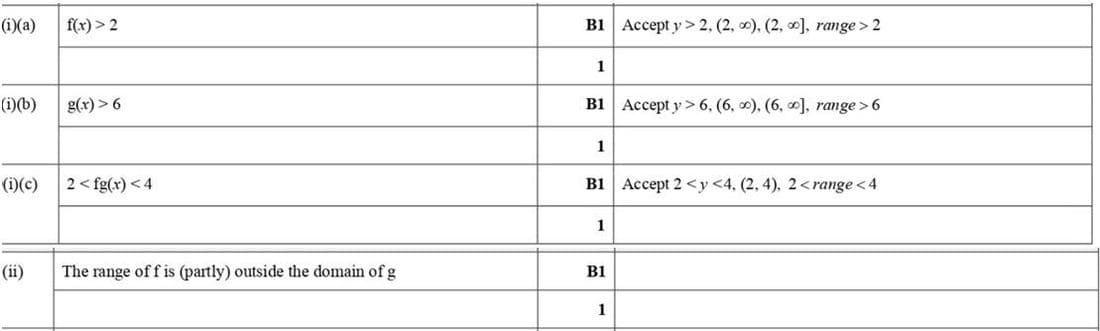
Functions \(f\) and \(g\) are defined by
\(f(x) = \frac{8}{x-2} + 2\) for \(x > 2\),
\(g(x) = \frac{8}{x-2} + 2\) for \(2 < x < 4\).
(i) (a) State the range of the function \(f\). [1]
(b) State the range of the function \(g\). [1]
(c) State the range of the function \(fg\). [1]
(ii) Explain why the function \(gf\) cannot be formed. [1]
Nov 2016 p13 q8
794
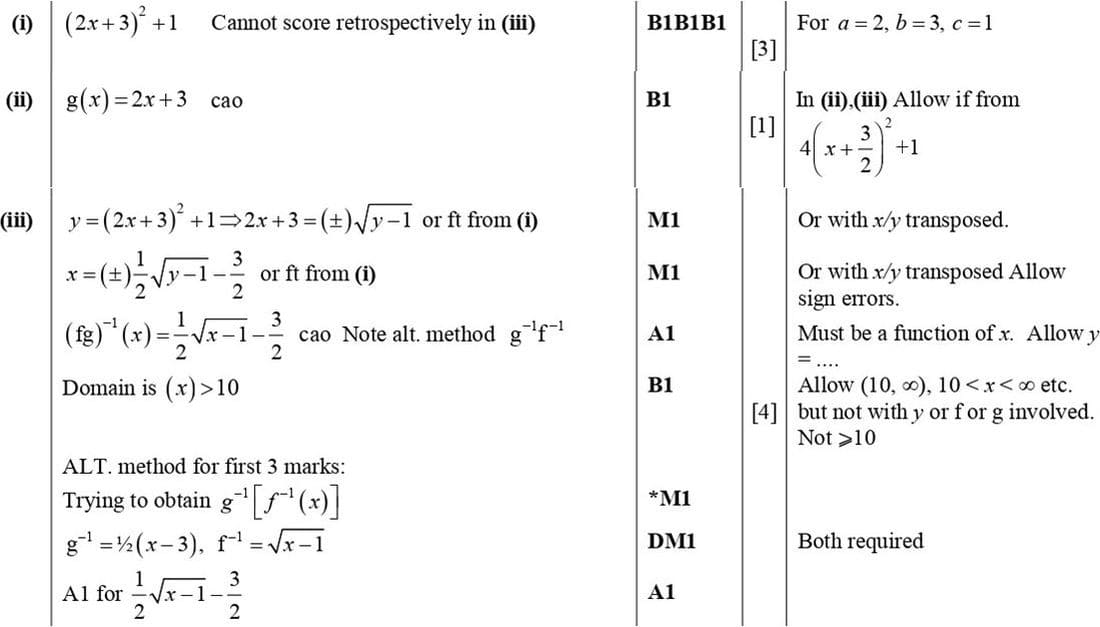
(i) Express \(4x^2 + 12x + 10\) in the form \((ax + b)^2 + c\), where \(a, b\) and \(c\) are constants.
(ii) Functions \(f\) and \(g\) are both defined for \(x > 0\). It is given that \(f(x) = x^2 + 1\) and \(fg(x) = 4x^2 + 12x + 10\). Find \(g(x)\).
(iii) Find \((fg)^{-1}(x)\) and give the domain of \((fg)^{-1}\).
June 2016 p13 q10
795
The function f is such that \(f(x) = 2x + 3\) for \(x \geq 0\). The function g is such that \(g(x) = ax^2 + b\) for \(x \leq q\), where \(a, b\) and \(q\) are constants. The function fg is such that \(fg(x) = 6x^2 - 21\) for \(x \leq q\).
(i) Find the values of \(a\) and \(b\).
(ii) Find the greatest possible value of \(q\).
It is now given that \(q = -3\).
(iii) Find the range of \(fg\).
(iv) Find an expression for \((fg)^{-1}(x)\) and state the domain of \((fg)^{-1}\).
