Exam-Style Problems
⬅ Back to SubchapterFM June 2021 p12 q01
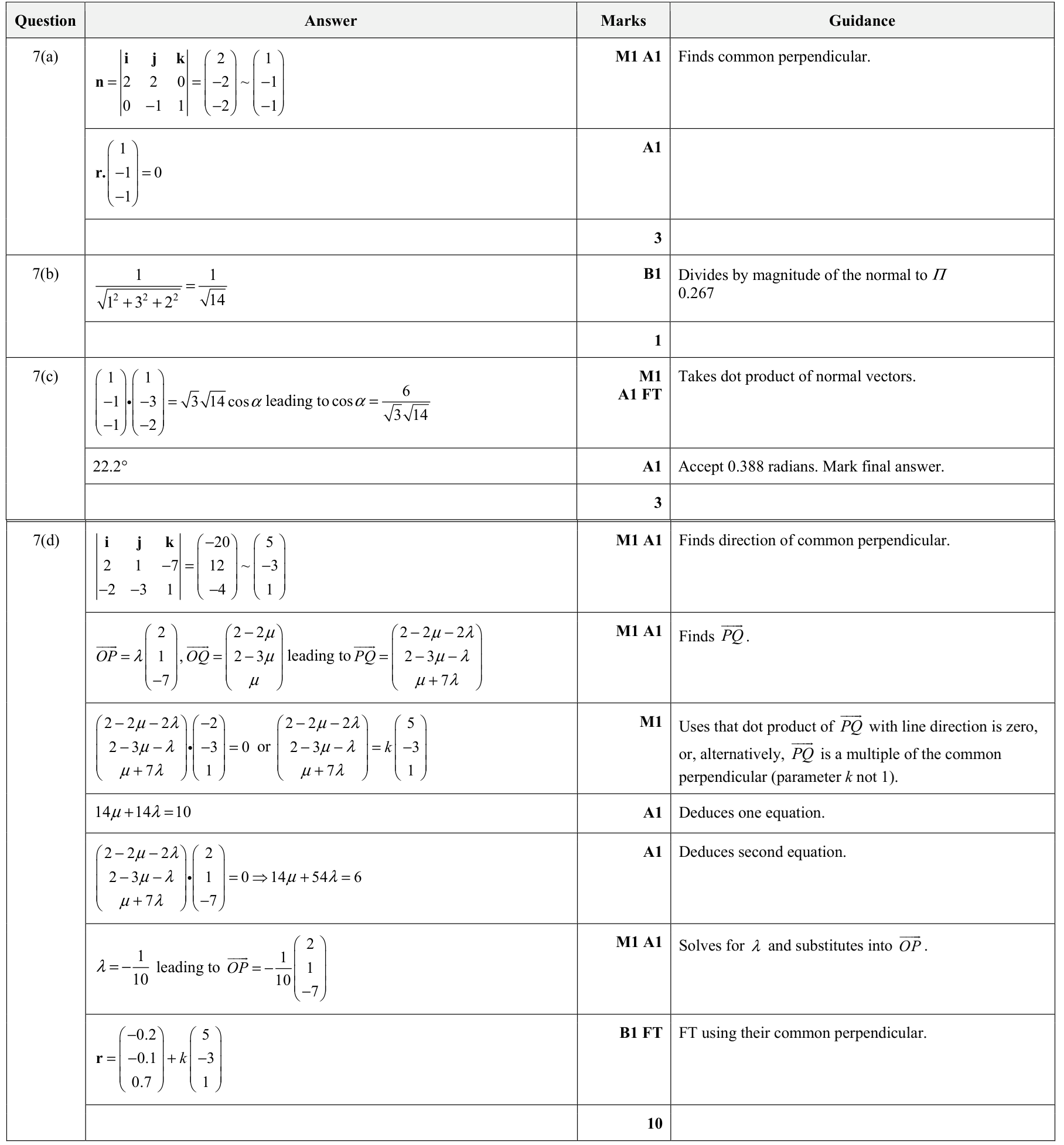
Prove by mathematical induction that \(2^{4n} + 3^{1n} - 2\) is divisible by 15 for all positive integers \(n\).
FM June 2021 p12 q02
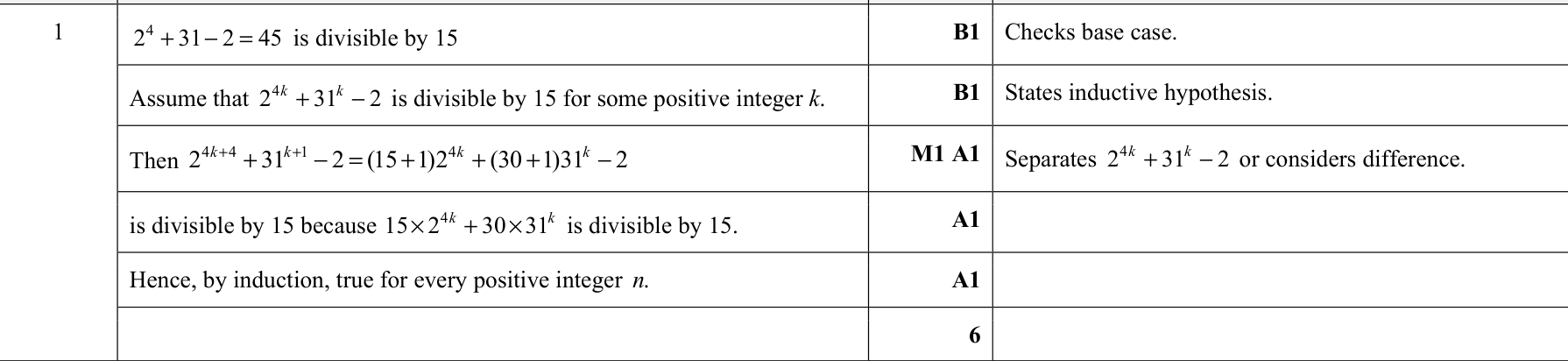
(a) Use standard results from the List of formulae (MF19) to find \(\sum_{r=1}^{n} (1 - r - r^2)\) in terms of \(n\), simplifying your answer.
(b) Show that \(\frac{1 - r - r^2}{(r^2 + 2r + 2)(r^2 + 1)} = \frac{r + 1}{(r+1)^2 + 1} - \frac{r}{r^2 + 1}\) and hence use the method of differences to find \(\sum_{r=1}^{n} \frac{1 - r - r^2}{(r^2 + 2r + 2)(r^2 + 1)}\).
FM June 2021 p12 q03
The equation \(x^4 - 2x^3 - 1 = 0\) has roots \(\alpha, \beta, \gamma, \delta\).
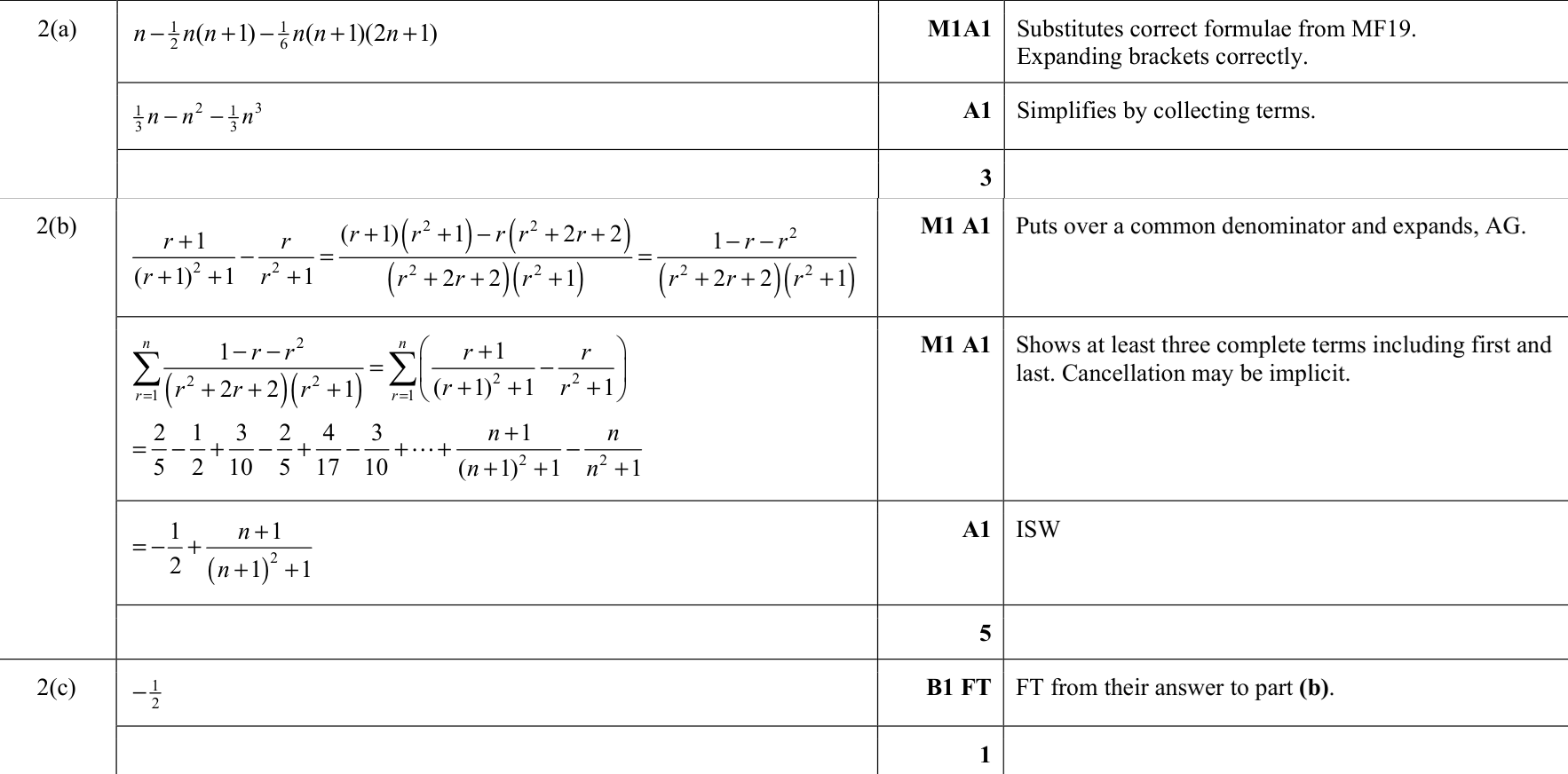
(a) Find a quartic equation whose roots are \(\alpha^3, \beta^3, \gamma^3, \delta^3\) and state the value of \(\alpha^3 + \beta^3 + \gamma^3 + \delta^3\).
(b) Find the value of \(\frac{1}{\alpha^3} + \frac{1}{\beta^3} + \frac{1}{\gamma^3} + \frac{1}{\delta^3}\).
(c) Find the value of \(\alpha^4 + \beta^4 + \gamma^4 + \delta^4\).
FM June 2021 p12 q04
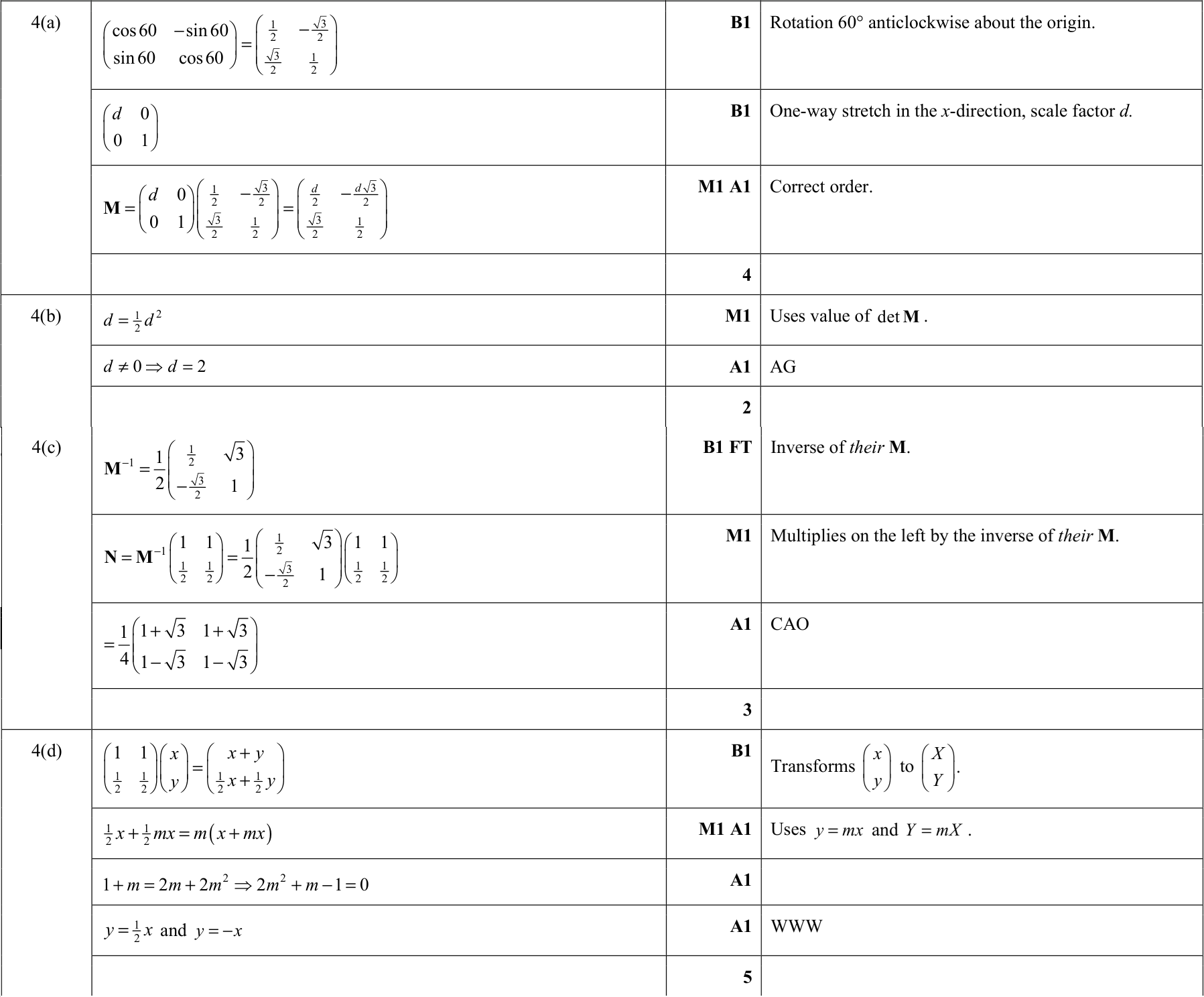
The matrix \(\mathbf{M}\) represents the sequence of two transformations in the \(x\)-\(y\) plane given by a rotation of \(60^\circ\) anticlockwise about the origin followed by a one-way stretch in the \(x\)-direction with scale factor \(d\) \((d \neq 0)\).
- Find \(\mathbf{M}\) in terms of \(d\).
- The unit square in the \(x\)-\(y\) plane is transformed by \(\mathbf{M}\) onto a parallelogram of area \(\tfrac{1}{2} d^2\) square units. Show that \(d = 2\).
- The matrix \(\mathbf{N}\) is such that \[ \mathbf{M}\mathbf{N} = \begin{pmatrix} 1 & 1 \\ \tfrac{1}{2} & \tfrac{1}{2} \end{pmatrix}. \] Find \(\mathbf{N}\).
- Find the equations of the invariant lines, through the origin, of the transformation in the \(x\)-\(y\) plane represented by \(\mathbf{M}\mathbf{N}\).
FM June 2021 p12 q05
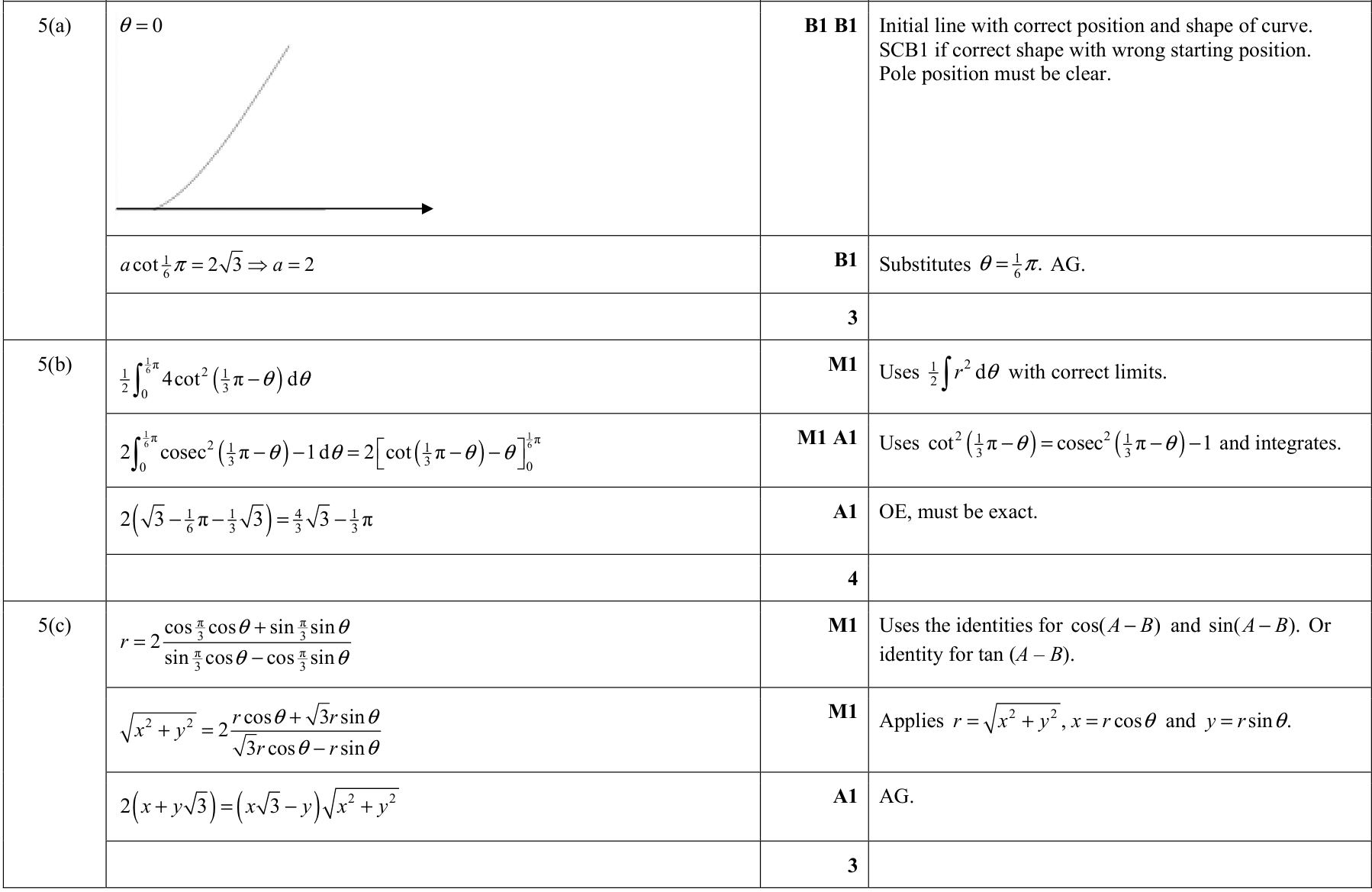
The curve C has polar equation \(r = a \cot\left(\frac{1}{3}\pi - \theta\right)\), where \(a\) is a positive constant and \(0 \leq \theta \leq \frac{1}{6}\pi\).
It is given that the greatest distance of a point on C from the pole is \(2\sqrt{3}\).
- Sketch C and show that \(a = 2\). [3]
- Find the exact value of the area of the region bounded by C, the initial line and the half-line \(\theta = \frac{1}{6}\pi\). [4]
- Show that C has Cartesian equation \(2(x + y\sqrt{3}) = (x\sqrt{3} - y)\sqrt{x^2 + y^2}\). [3]
FM June 2021 p12 q06
Let \(t\) be a positive constant.
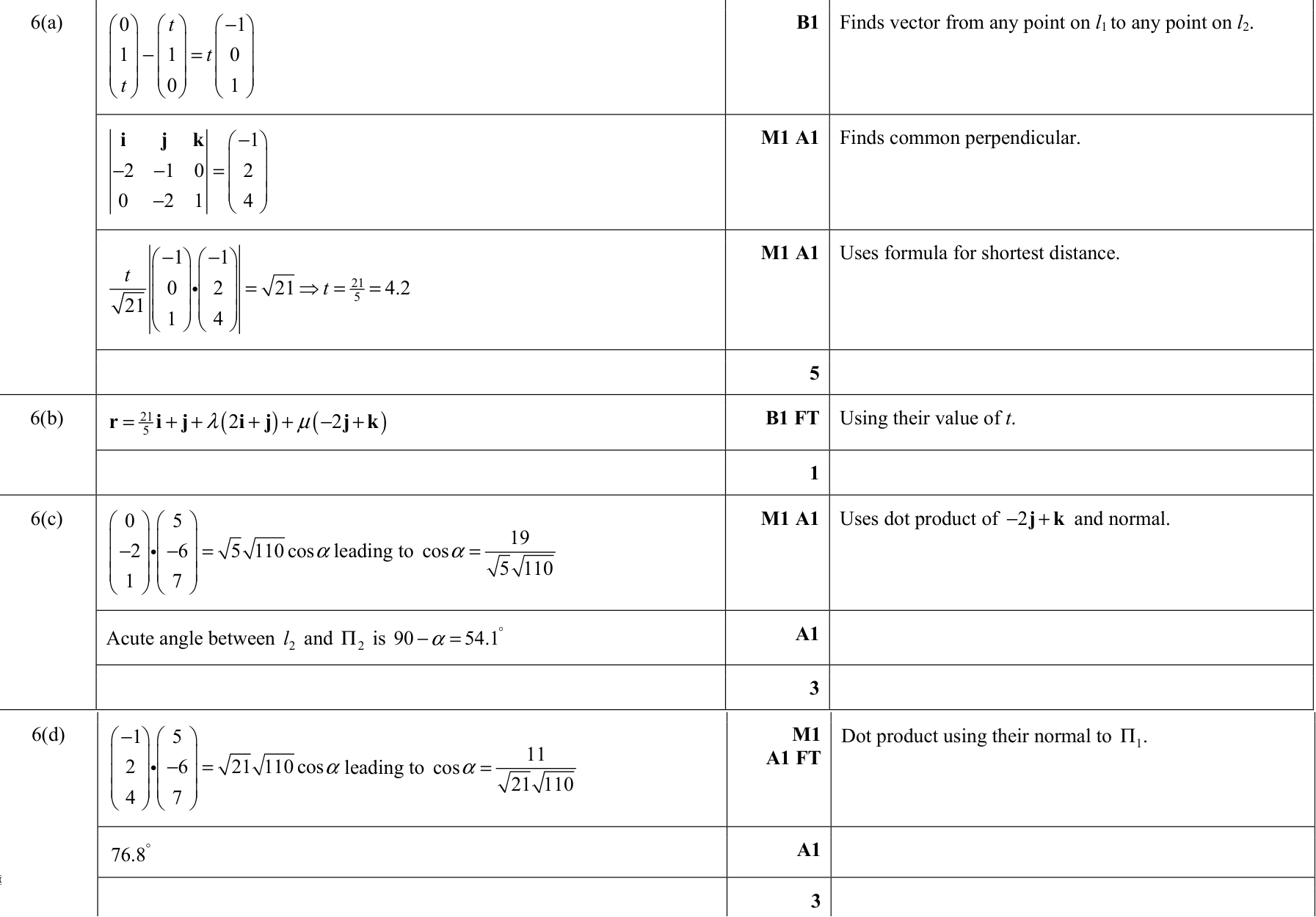
The line \(l_1\) passes through the point with position vector \(t\mathbf{i} + \mathbf{j}\) and is parallel to the vector \(-2\mathbf{i} - \mathbf{j}\).
The line \(l_2\) passes through the point with position vector \(\mathbf{j} + t\mathbf{k}\) and is parallel to the vector \(-2\mathbf{j} + \mathbf{k}\).
It is given that the shortest distance between the lines \(l_1\) and \(l_2\) is \(\sqrt{21}\).
(a) Find the value of \(t\). [5]
The plane \(\Pi_1\) contains \(l_1\) and is parallel to \(l_2\).
(b) Write down an equation of \(\Pi_1\), giving your answer in the form \(\mathbf{r} = \mathbf{a} + \lambda \mathbf{b} + \mu \mathbf{c}\).
The plane \(\Pi_2\) has Cartesian equation \(5x - 6y + 7z = 0\).
(c) Find the acute angle between \(l_2\) and \(\Pi_2\). [3]
(d) Find the acute angle between \(\Pi_1\) and \(\Pi_2\). [3]
FM June 2021 p12 q07
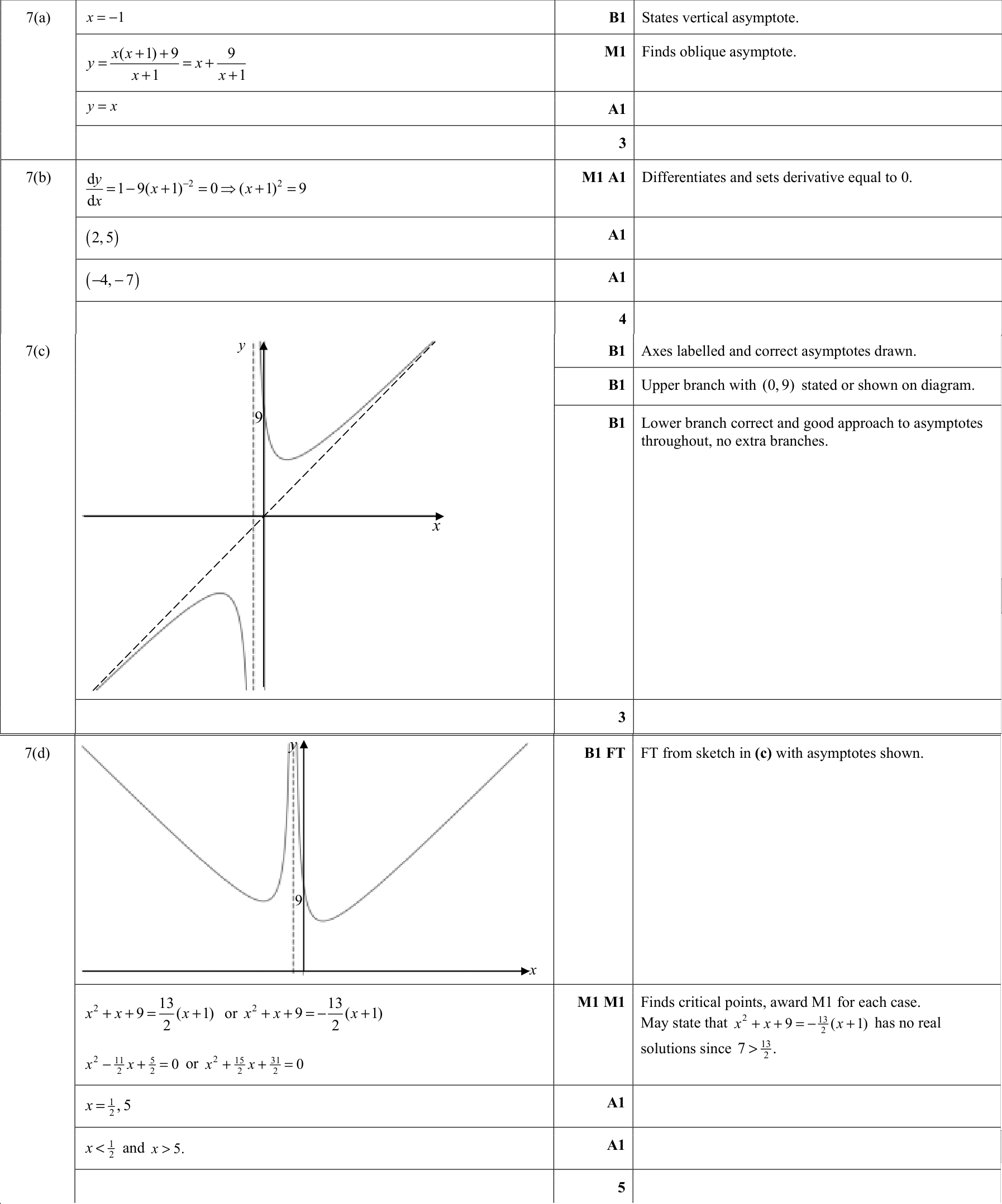
The curve C has equation \(y = \frac{x^2 + x + 9}{x + 1}\).
(a) Find the equations of the asymptotes of C.
(b) Find the coordinates of the stationary points on C.
FM June 2021 p13 q01
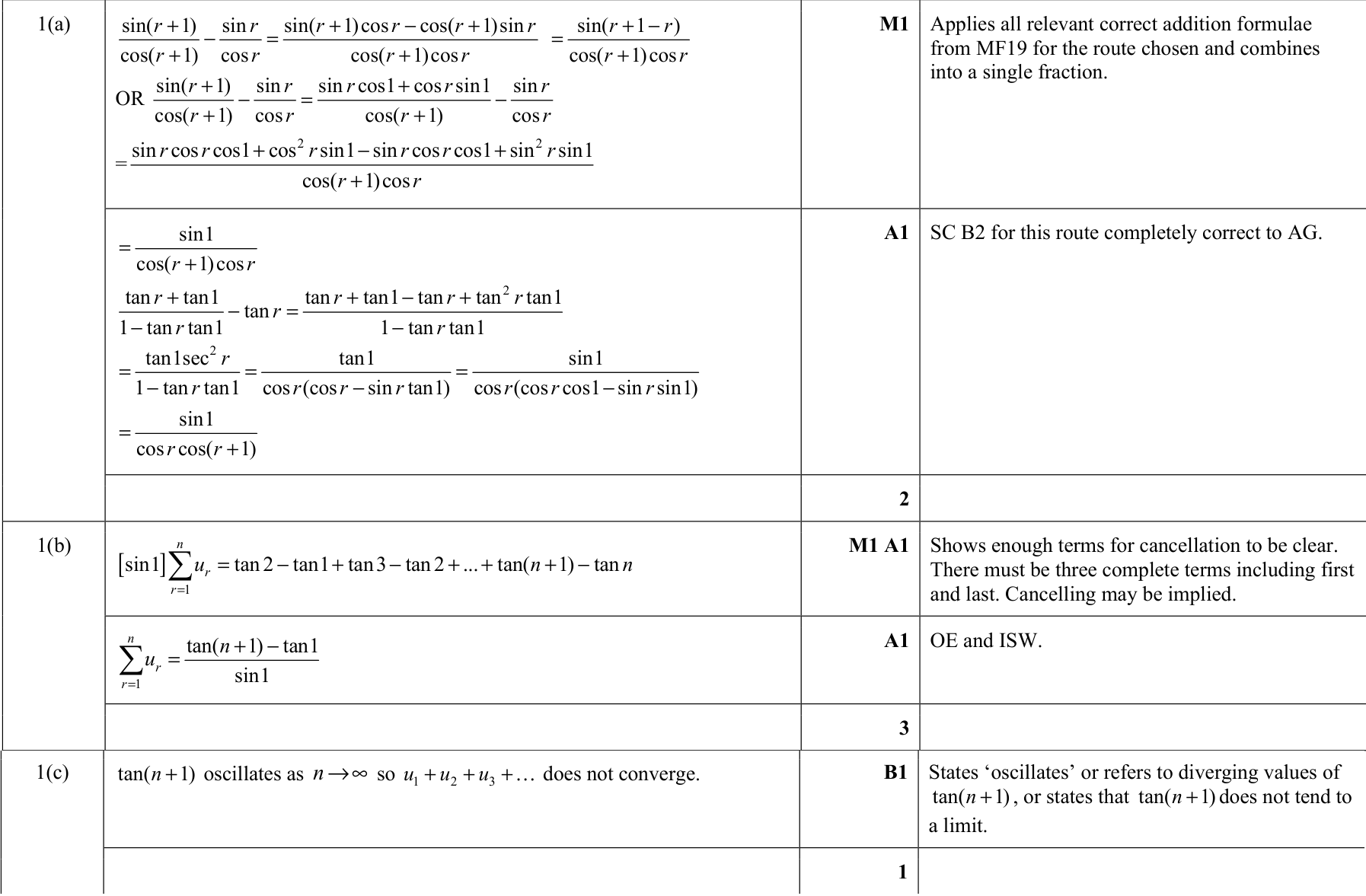
(a) Show that \(\tan(r+1) - \tan r = \frac{\sin 1}{\cos(r+1)\cos r}\).
Let \(u_r = \frac{1}{\cos(r+1)\cos r}\).
(b) Use the method of differences to find \(\sum_{r=1}^{n} u_r\).
(c) Explain why the infinite series \(u_1 + u_2 + u_3 + \ldots\) does not converge.
FM June 2021 p13 q02
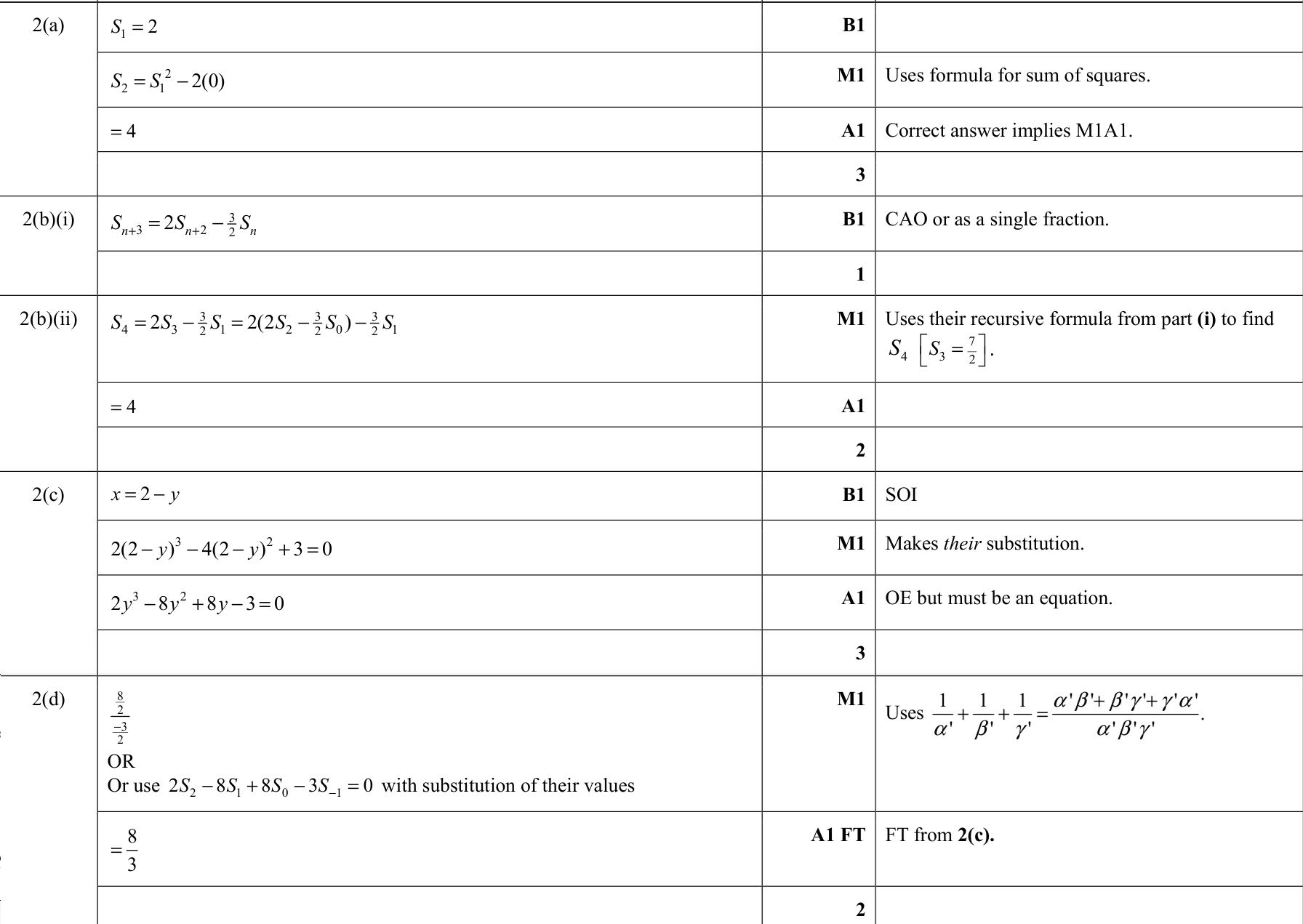
The cubic equation \(2x^3 - 4x^2 + 3 = 0\) has roots \(\alpha, \beta, \gamma\). Let \(S_n = \alpha^n + \beta^n + \gamma^n\).
- (a) State the value of \(S_1\) and find the value of \(S_2\).
- (b)
- Express \(S_{n+3}\) in terms of \(S_{n+2}\) and \(S_n\).
- Hence, or otherwise, find the value of \(S_4\).
- (c) Use the substitution \(y = S_1 - x\), where \(S_1\) is the numerical value found in part (a), to find and simplify an equation whose roots are \(\alpha + \beta, \beta + \gamma, \gamma + \alpha\).
- (d) Find the value of \(\frac{1}{\alpha + \beta} + \frac{1}{\beta + \gamma} + \frac{1}{\gamma + \alpha}\).
FM June 2021 p13 q03
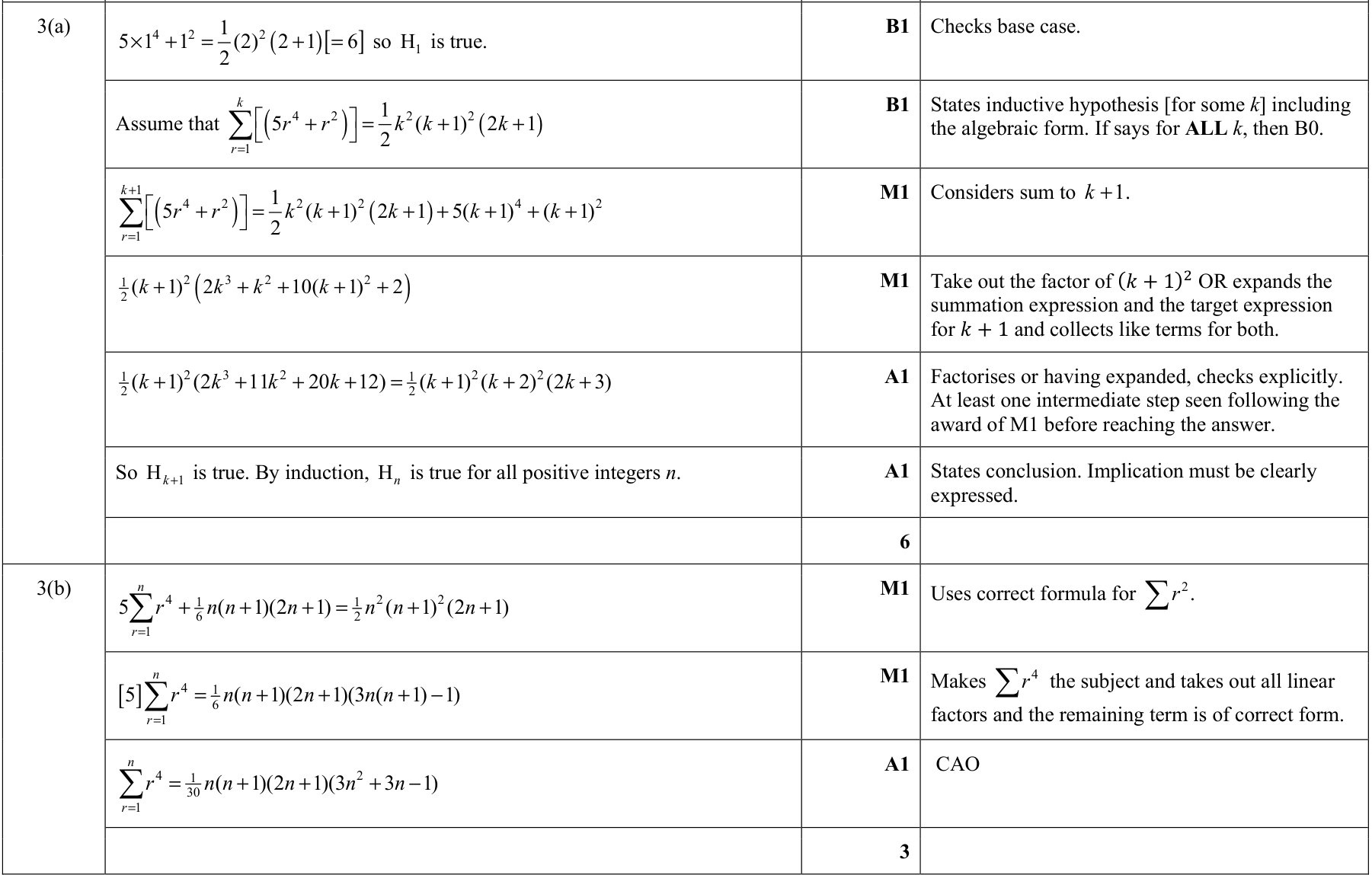
(a) Prove by mathematical induction that, for all positive integers \(n\),
\(\sum_{r=1}^{n} (5r^4 + r^2) = \frac{1}{2} n^2 (n+1)^2 (2n+1).\)
(b) Use the result given in part (a) together with the List of formulae (MF19) to find \(\sum_{r=1}^{n} r^4\) in terms of \(n\), fully factorising your answer.
FM June 2021 p13 q04
The matrices A, B and C are given by
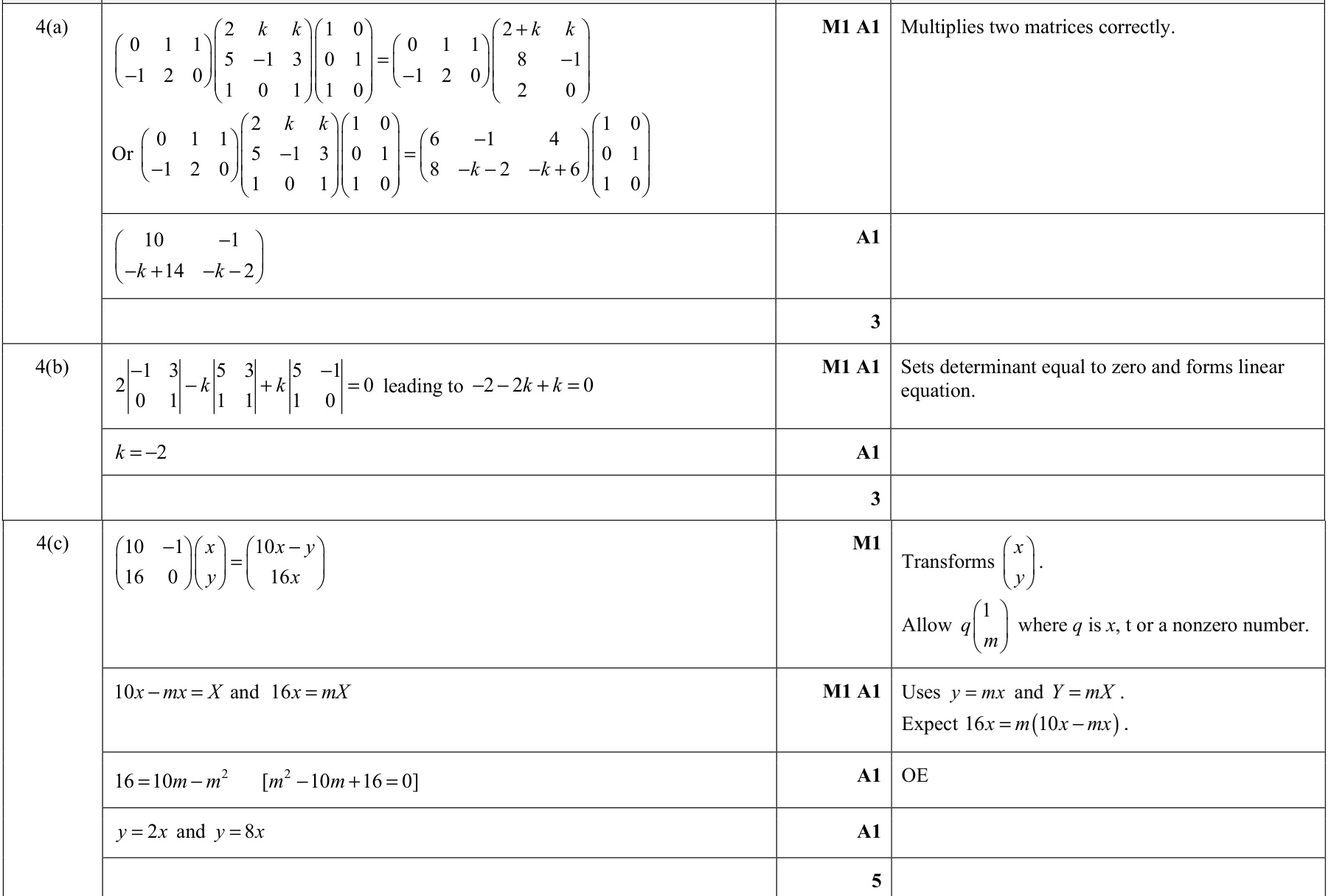
\(A = \begin{pmatrix} 2 & k & k \\ 5 & -1 & 3 \\ 1 & 0 & 1 \end{pmatrix}, \quad B = \begin{pmatrix} 1 & 0 \\ 0 & 1 \\ 1 & 0 \end{pmatrix} \quad \text{and} \quad C = \begin{pmatrix} 0 & 1 & 1 \\ -1 & 2 & 0 \end{pmatrix},\)
where \(k\) is a real constant.
- Find \(CAB\).
- Given that \(A\) is singular, find the value of \(k\).
- Using the value of \(k\) from part (b), find the equations of the invariant lines, through the origin, of the transformation in the \(x-y\) plane represented by \(CAB\).
FM June 2021 p13 q05
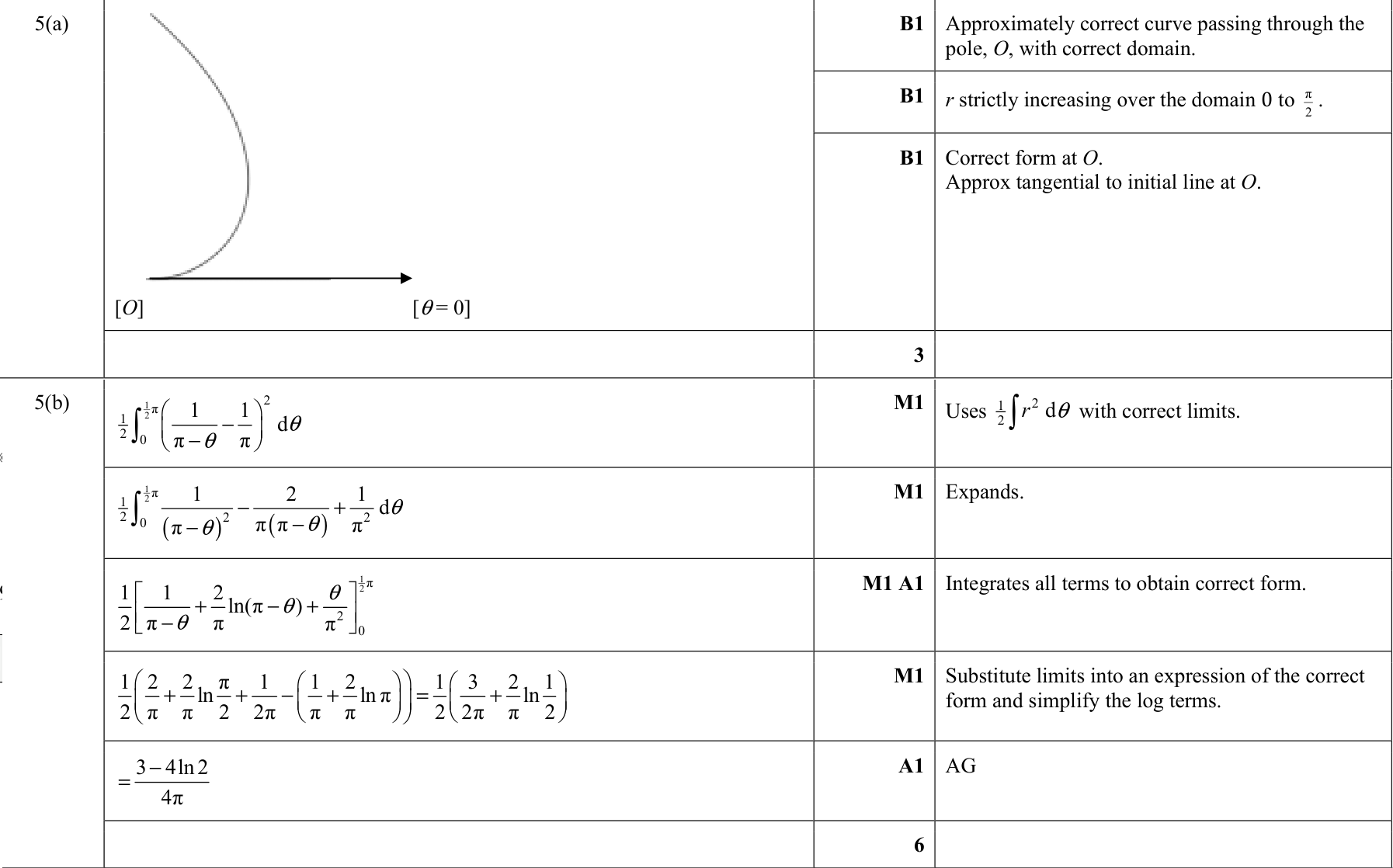
The curve C has polar equation \(r = \frac{1}{\pi - \theta} - \frac{1}{\pi}\), where \(0 \leq \theta \leq \frac{1}{2}\pi\).
(a) Sketch C.
(b) Show that the area of the region bounded by the half-line \(\theta = \frac{1}{2}\pi\) and C is \(\frac{3 - 4 \ln 2}{4\pi}\).
FM June 2021 p13 q06
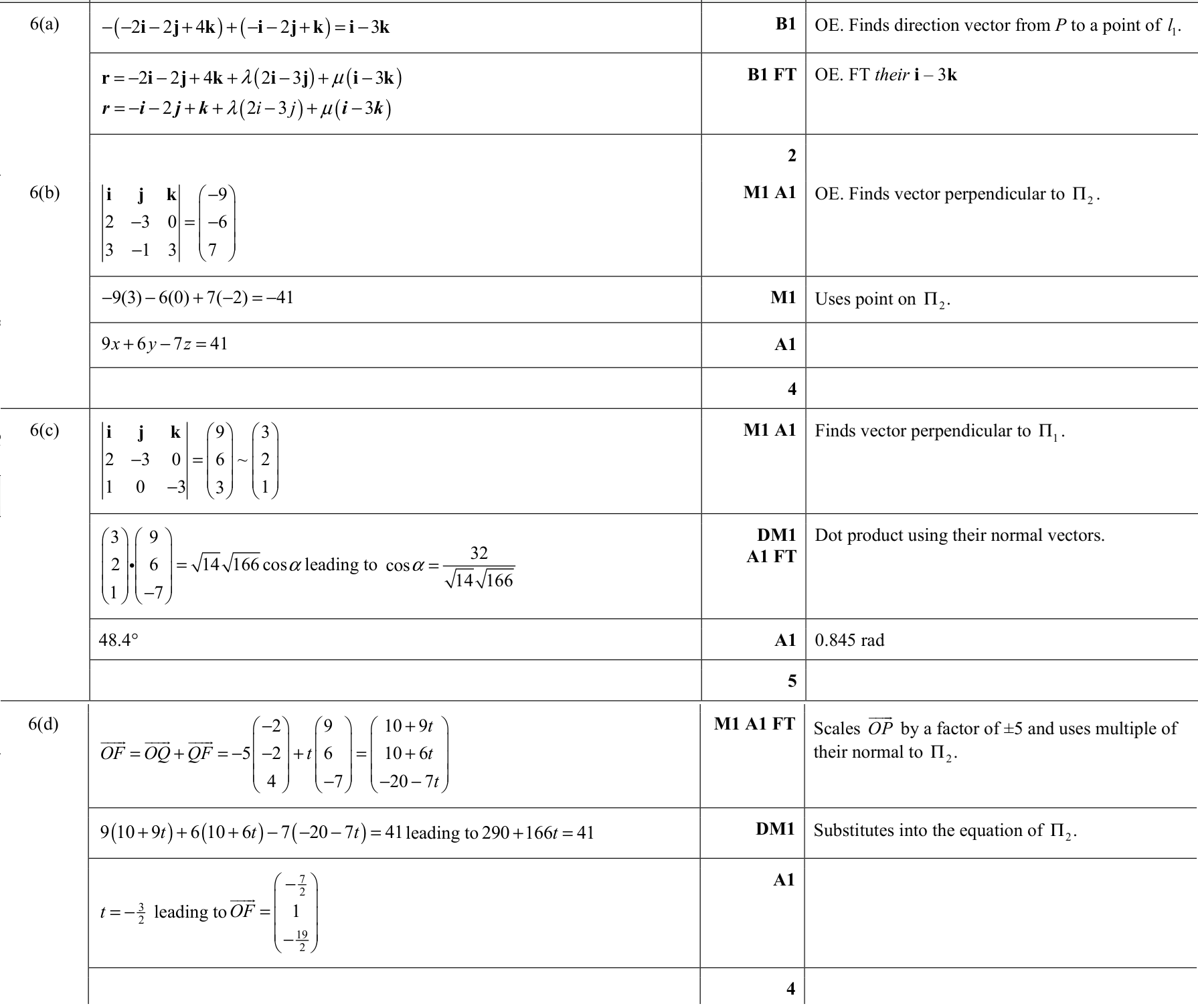
The lines \(l_1\) and \(l_2\) have equations \(\mathbf{r} = -\mathbf{i} - 2\mathbf{j} + \mathbf{k} + s(2\mathbf{i} - 3\mathbf{j})\) and \(\mathbf{r} = 3\mathbf{i} - 2\mathbf{k} + t(3\mathbf{i} - \mathbf{j} + 3\mathbf{k})\) respectively.
The plane \(\Pi_1\) contains \(l_1\) and the point \(P\) with position vector \(-2\mathbf{i} - 2\mathbf{j} + 4\mathbf{k}\).
- (a) Find an equation of \(\Pi_1\), giving your answer in the form \(\mathbf{r} = \mathbf{a} + \lambda \mathbf{b} + \mu \mathbf{c}\).
- (b) The plane \(\Pi_2\) contains \(l_2\) and is parallel to \(l_1\). Find an equation of \(\Pi_2\), giving your answer in the form \(ax + by + cz = d\).
- (c) Find the acute angle between \(\Pi_1\) and \(\Pi_2\).
- (d) The point \(Q\) is such that \(\overrightarrow{OQ} = -5\overrightarrow{OP}\). Find the position vector of the foot of the perpendicular from the point \(Q\) to \(\Pi_2\).
FM June 2021 p13 q07
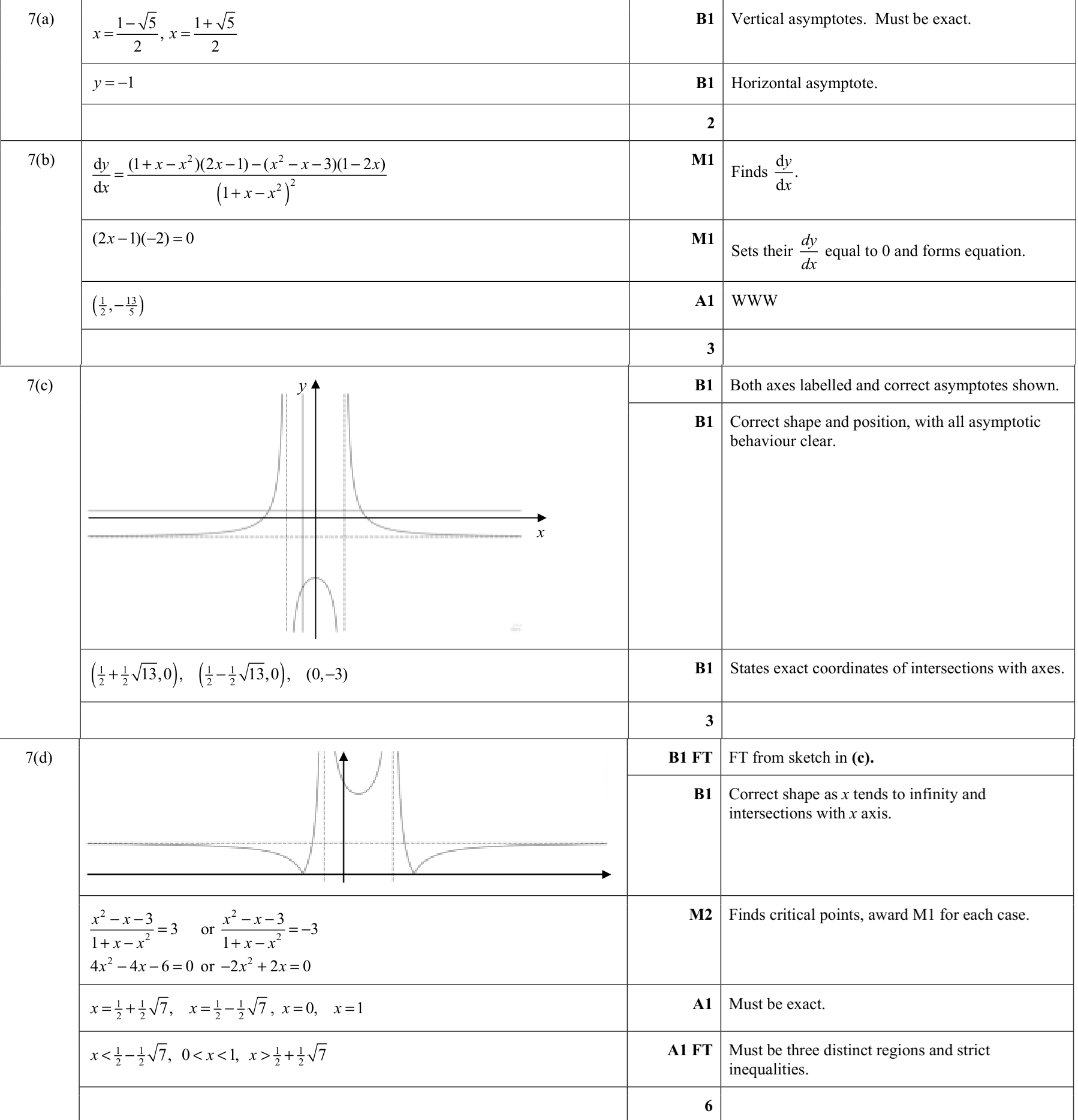
The curve \(C\) has equation \(y = \frac{x^2 - x - 3}{1 + x - x^2}\).
- (a) Find the equations of the asymptotes of \(C\).
- (b) Find the coordinates of any stationary points on \(C\).
- (c) Sketch \(C\), stating the coordinates of the intersections with the axes.
- (d) Sketch the curve with equation \(y = \left| \frac{x^2 - x - 3}{1 + x - x^2} \right|\) and find in exact form the set of values of \(x\) for which \(\left| \frac{x^2 - x - 3}{1 + x - x^2} \right| < 3\).
FM November 2021 p11 q01
It is given that
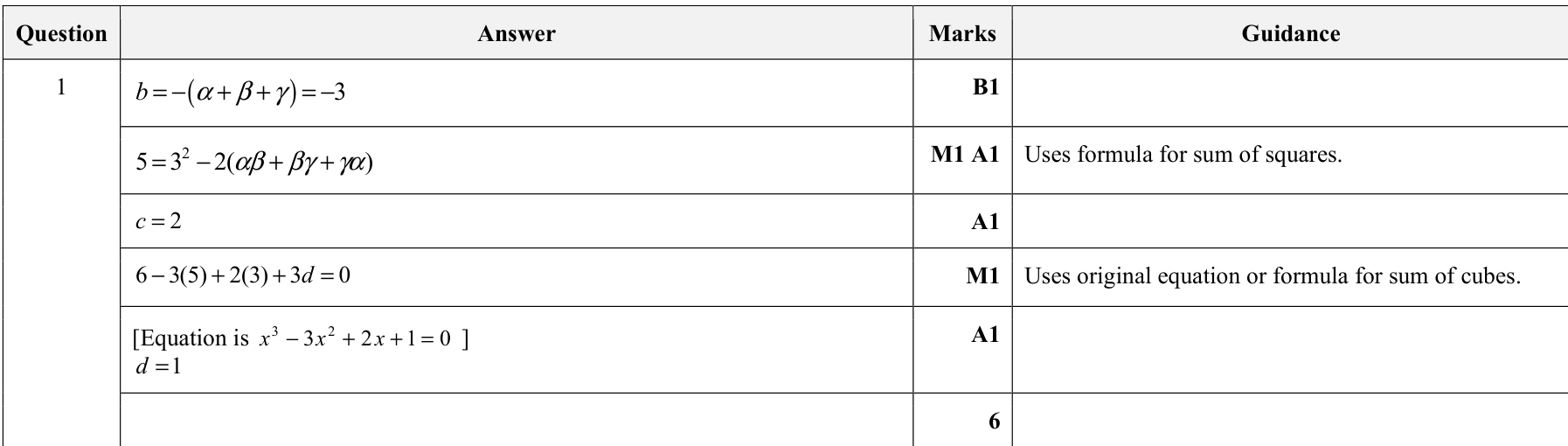
\(\alpha + \beta + \gamma = 3, \quad \alpha^2 + \beta^2 + \gamma^2 = 5, \quad \alpha^3 + \beta^3 + \gamma^3 = 6.\)
The cubic equation \(x^3 + bx^2 + cx + d = 0\) has roots \(\alpha, \beta, \gamma\).
Find the values of \(b, c\) and \(d\).
FM November 2021 p11 q02
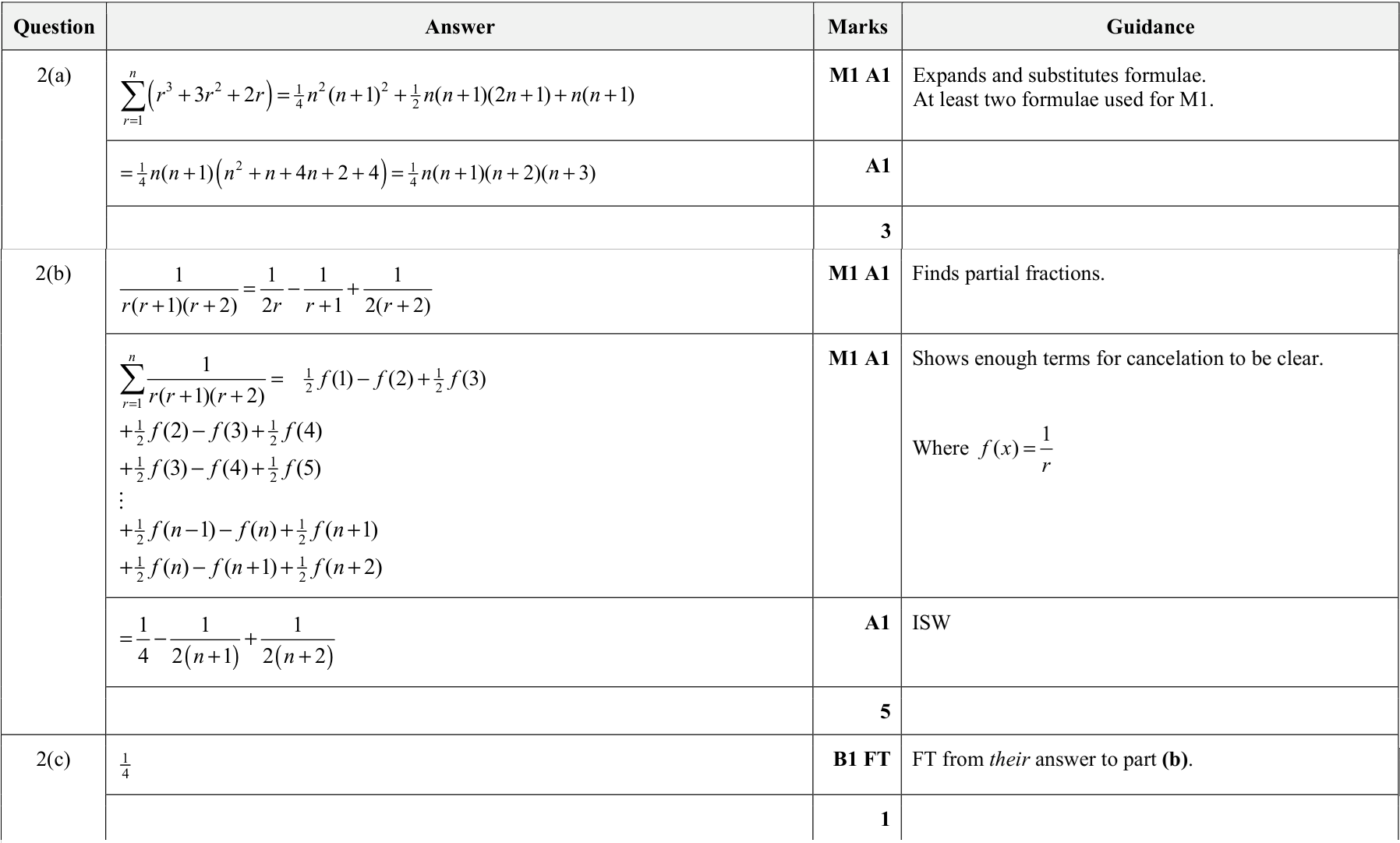
(a) Use standard results from the list of formulae (MF19) to find \(\sum_{r=1}^{n} r(r+1)(r+2)\) in terms of \(n\), fully factorising your answer.
(b) Express \(\frac{1}{r(r+1)(r+2)}\) in partial fractions and hence use the method of differences to find \(\sum_{r=1}^{n} \frac{1}{r(r+1)(r+2)}\).
(c) Deduce the value of \(\sum_{r=1}^{\infty} \frac{1}{r(r+1)(r+2)}\).
FM November 2021 p11 q03
The sequence of real numbers \(a_1, a_2, a_3, \ldots\) is such that \(a_1 = 1\) and
\(a_{n+1} = \left( a_n + \frac{1}{a_n} \right)^3.\)
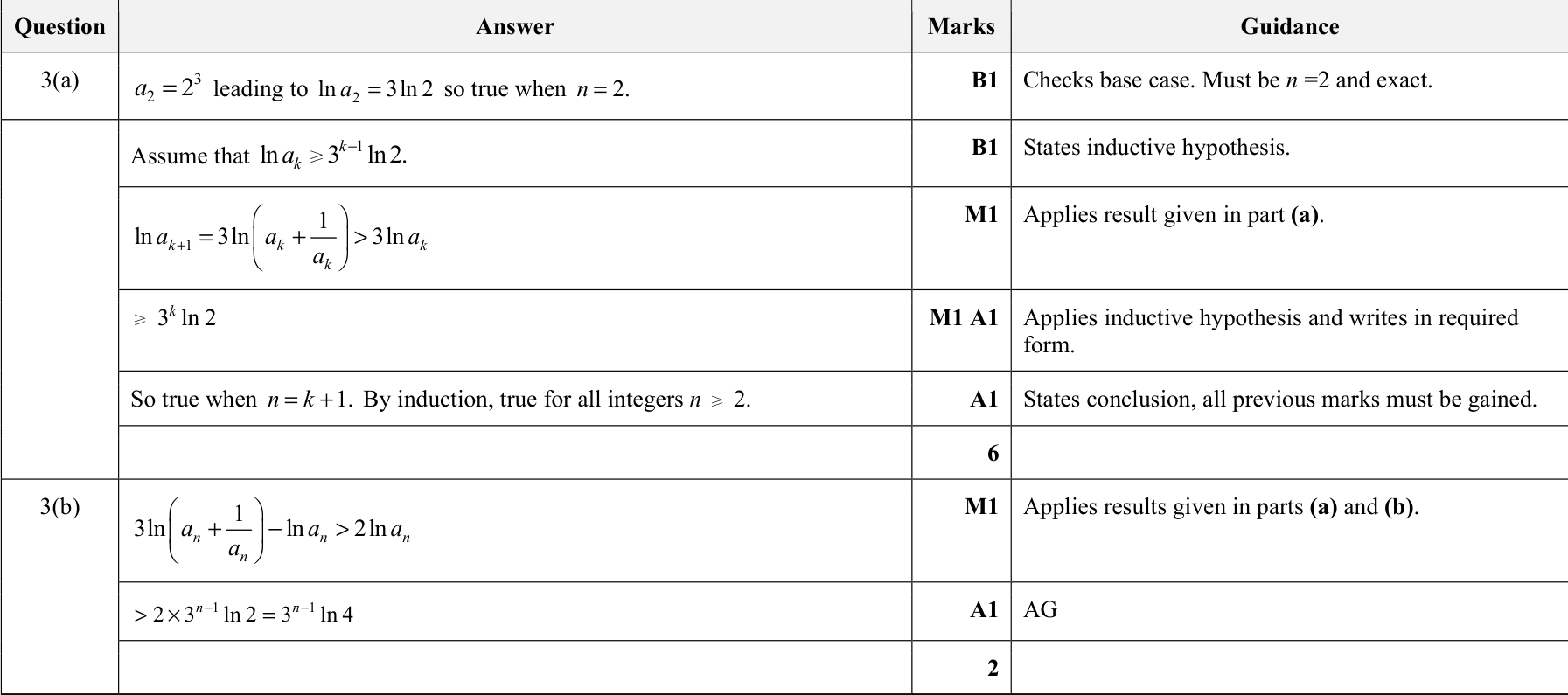
(a) Prove by mathematical induction that \(\ln a_n \geq 3^{n-1} \ln 2\) for all integers \(n \geq 2\).
[You may use the fact that \(\ln \left( x + \frac{1}{x} \right) > \ln x\) for \(x > 0\).]
(b) Show that \(\ln a_{n+1} - \ln a_n > 3^{n-1} \ln 4\) for \(n \geq 2\).
FM November 2021 p11 q04
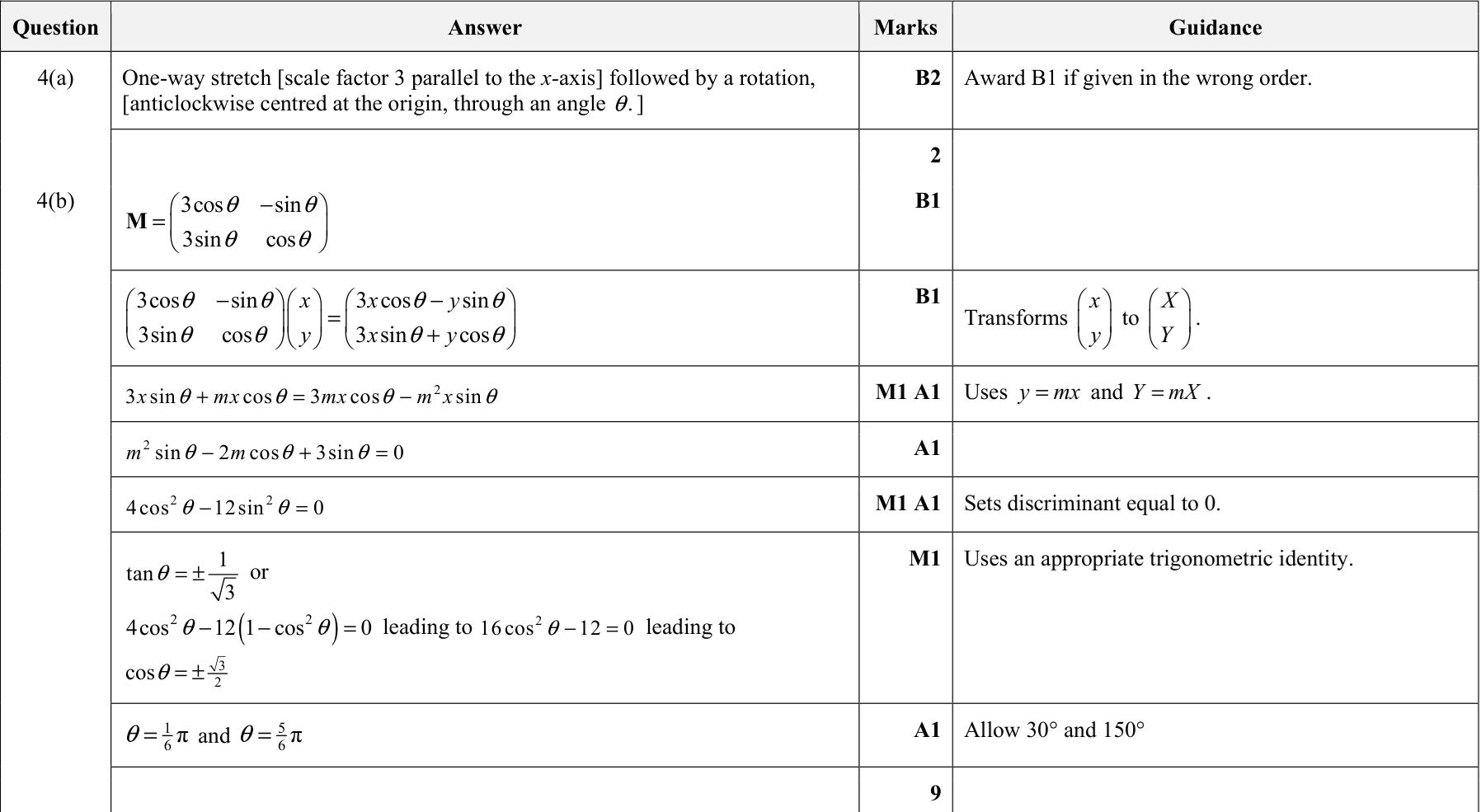
The matrix M is given by \(\mathbf{M} = \begin{pmatrix} \cos \theta & -\sin \theta \\ \sin \theta & \cos \theta \end{pmatrix} \begin{pmatrix} 3 & 0 \\ 0 & 1 \end{pmatrix}\).
(a) The matrix M represents a sequence of two geometrical transformations. State the type of each transformation, and make clear the order in which they are applied. [2]
(b) Find the values of \(\theta\), for \(0 \leq \theta \leq \pi\), for which the transformation represented by M has exactly one invariant line through the origin, giving your answers in terms of \(\pi\). [9]
FM November 2021 p11 q05
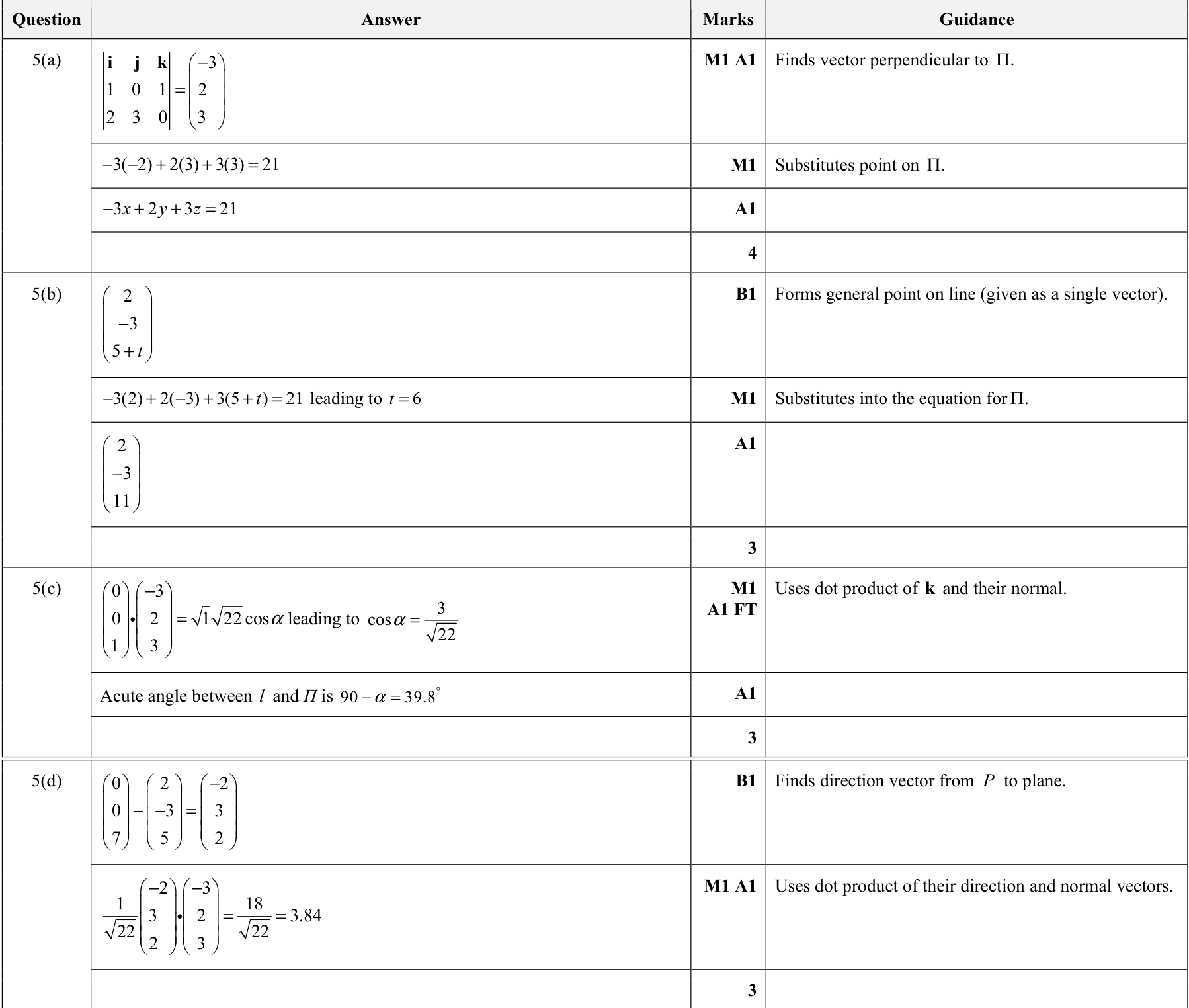
The plane \(\Pi\) has equation \(\mathbf{r} = -2\mathbf{i} + 3\mathbf{j} + 3\mathbf{k} + \lambda (\mathbf{i} + \mathbf{k}) + \mu (2\mathbf{i} + 3\mathbf{j})\).
- Find a Cartesian equation of \(\Pi\), giving your answer in the form \(ax + by + cz = d\).
- The line \(l\) passes through the point \(P\) with position vector \(2\mathbf{i} - 3\mathbf{j} + 5\mathbf{k}\) and is parallel to the vector \(\mathbf{k}\). Find the position vector of the point where \(l\) meets \(\Pi\).
- Find the acute angle between \(l\) and \(\Pi\).
- Find the perpendicular distance from \(P\) to \(\Pi\).
FM November 2021 p11 q06
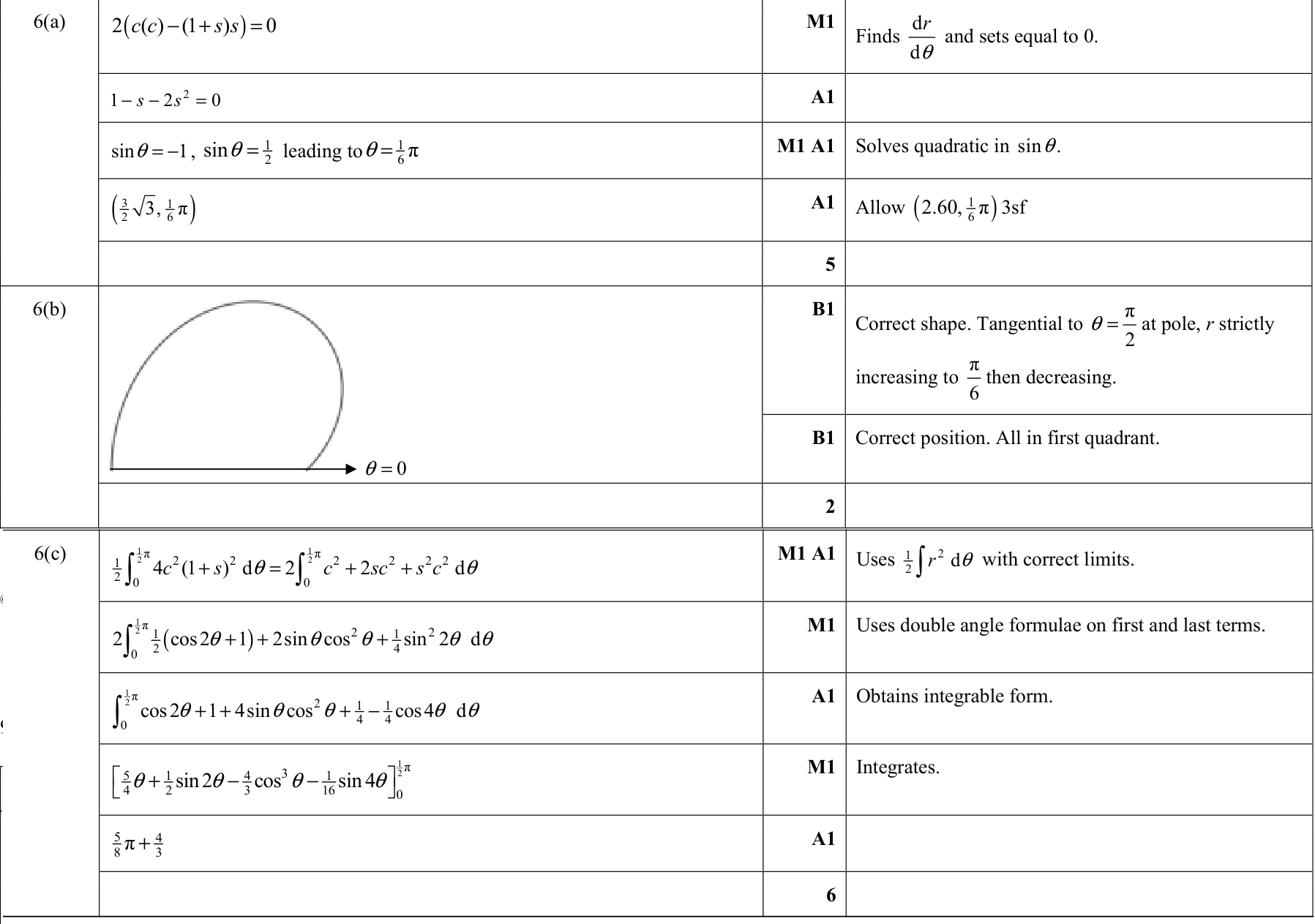
The curve C has polar equation \(r = 2 \cos \theta (1 + \sin \theta)\), for \(0 \leq \theta \leq \frac{1}{2} \pi\).
- Find the polar coordinates of the point on C that is furthest from the pole.
- Sketch C.
- Find the area of the region bounded by C and the initial line, giving your answer in exact form.
FM November 2021 p11 q07
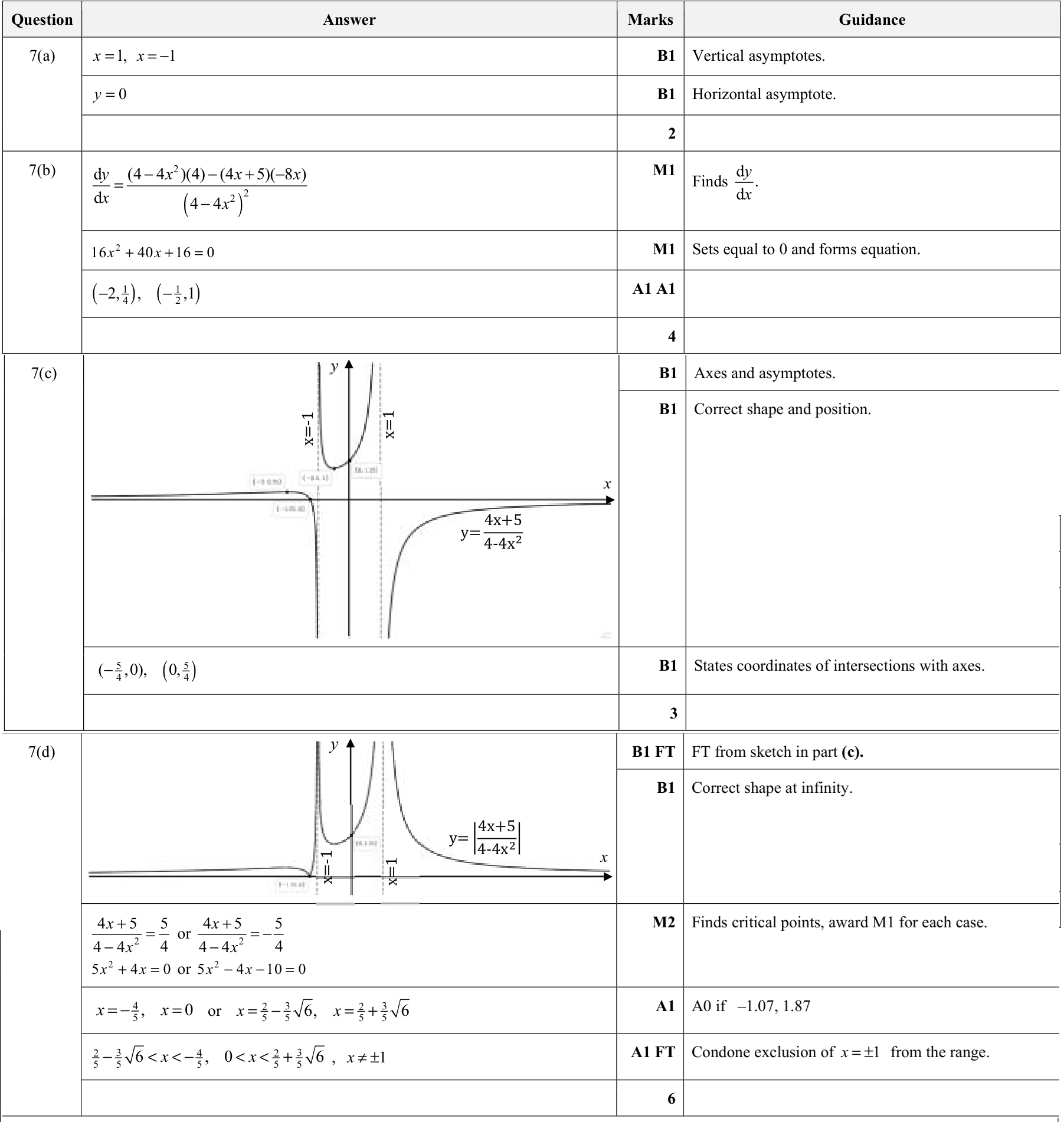
The curve \(C\) has equation \(y = \frac{4x+5}{4-4x^2}\).
- Find the equations of the asymptotes of \(C\).
- Find the coordinates of any stationary points on \(C\).
- Sketch \(C\), stating the coordinates of the intersections with the axes.
- Sketch the curve with equation \(y = \left| \frac{4x+5}{4-4x^2} \right|\) and find in exact form the set of values of \(x\) for which \(4|4x+5| > 5|4-4x^2|\).
FM November 2021 p12 q01
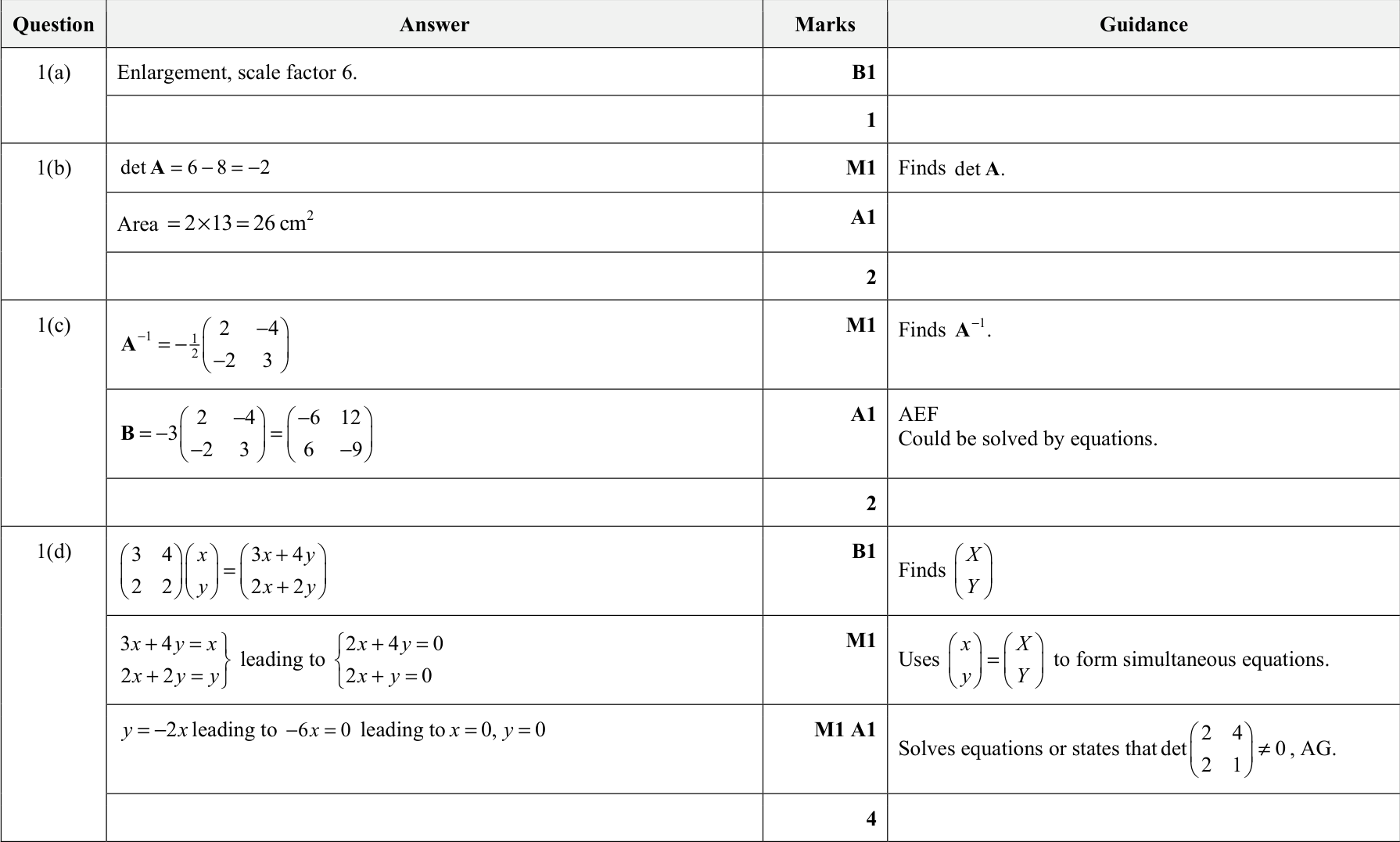
(a) Give full details of the geometrical transformation in the x-y plane represented by the matrix \(\begin{pmatrix} 6 & 0 \\ 0 & 6 \end{pmatrix}\).
Let \(\mathbf{A} = \begin{pmatrix} 3 & 4 \\ 2 & 2 \end{pmatrix}\).
(b) The triangle DEF in the x-y plane is transformed by \(\mathbf{A}\) onto triangle PQR. Given that the area of triangle DEF is 13 cm2, find the area of triangle PQR.
(c) Find the matrix \(\mathbf{B}\) such that \(\mathbf{AB} = \begin{pmatrix} 6 & 0 \\ 0 & 6 \end{pmatrix}\).
(d) Show that the origin is the only invariant point of the transformation in the x-y plane represented by \(\mathbf{A}\).
FM November 2021 p12 q02
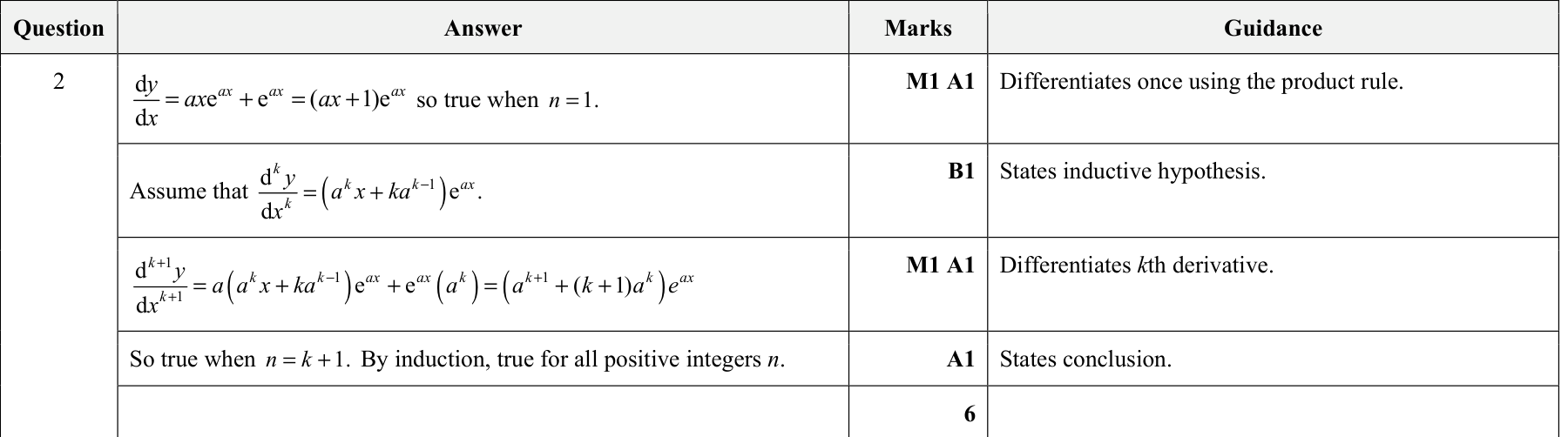
It is given that \(y = xe^{ax}\), where \(a\) is a constant.
Prove by mathematical induction that, for all positive integers \(n\),
\(\frac{d^n y}{dx^n} = \left( a^n x + na^{n-1} \right) e^{ax}.\)
FM November 2021 p12 q03
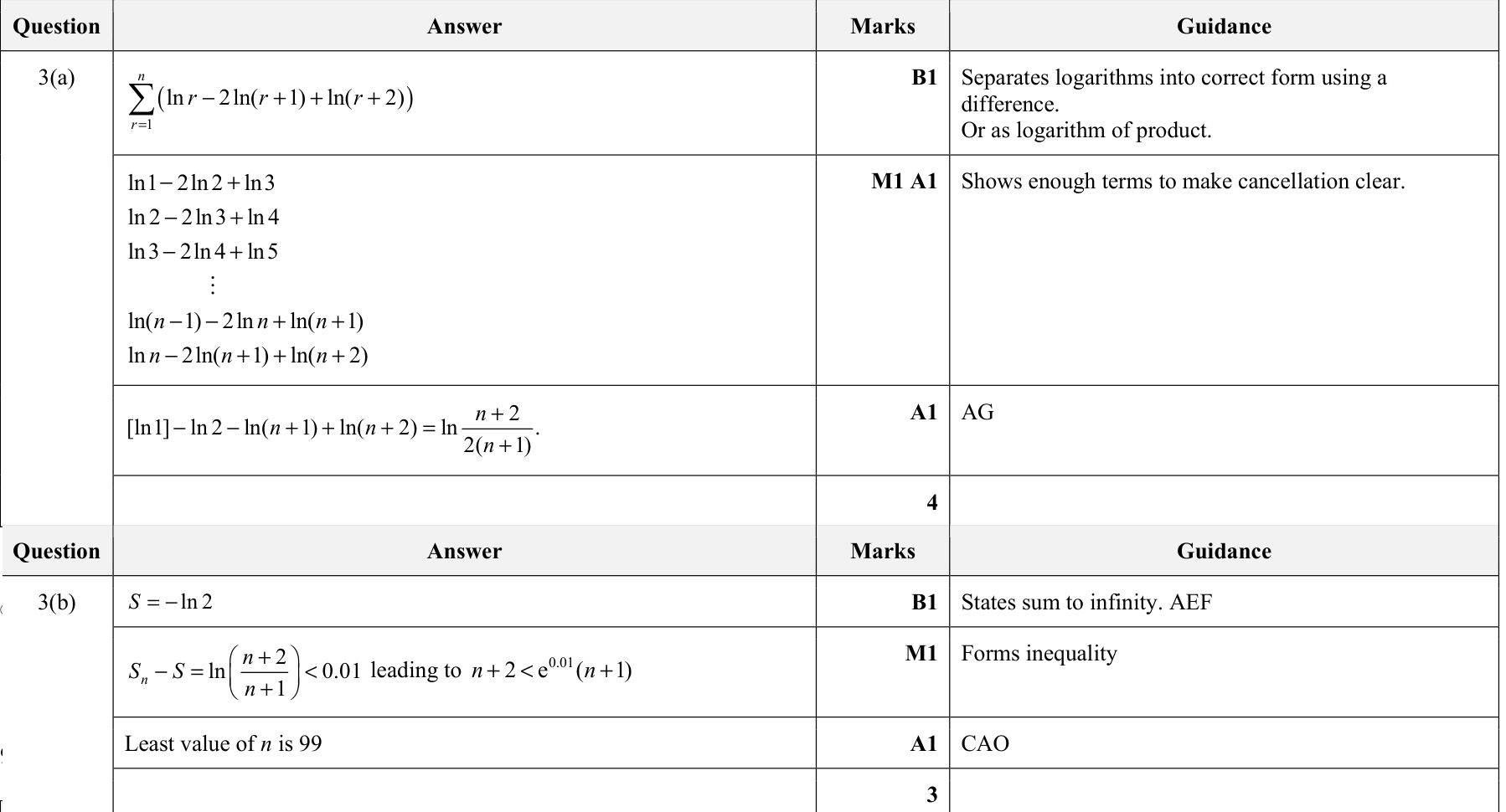
Let \(S_n = \sum_{r=1}^{n} \ln \frac{r(r+2)}{(r+1)^2}\).
(a) Using the method of differences, or otherwise, show that \(S_n = \ln \frac{n+2}{2(n+1)}\).
Let \(S = \sum_{r=1}^{\infty} \ln \frac{r(r+2)}{(r+1)^2}\).
(b) Find the least value of \(n\) such that \(S_n - S < 0.01\).
FM November 2021 p12 q04
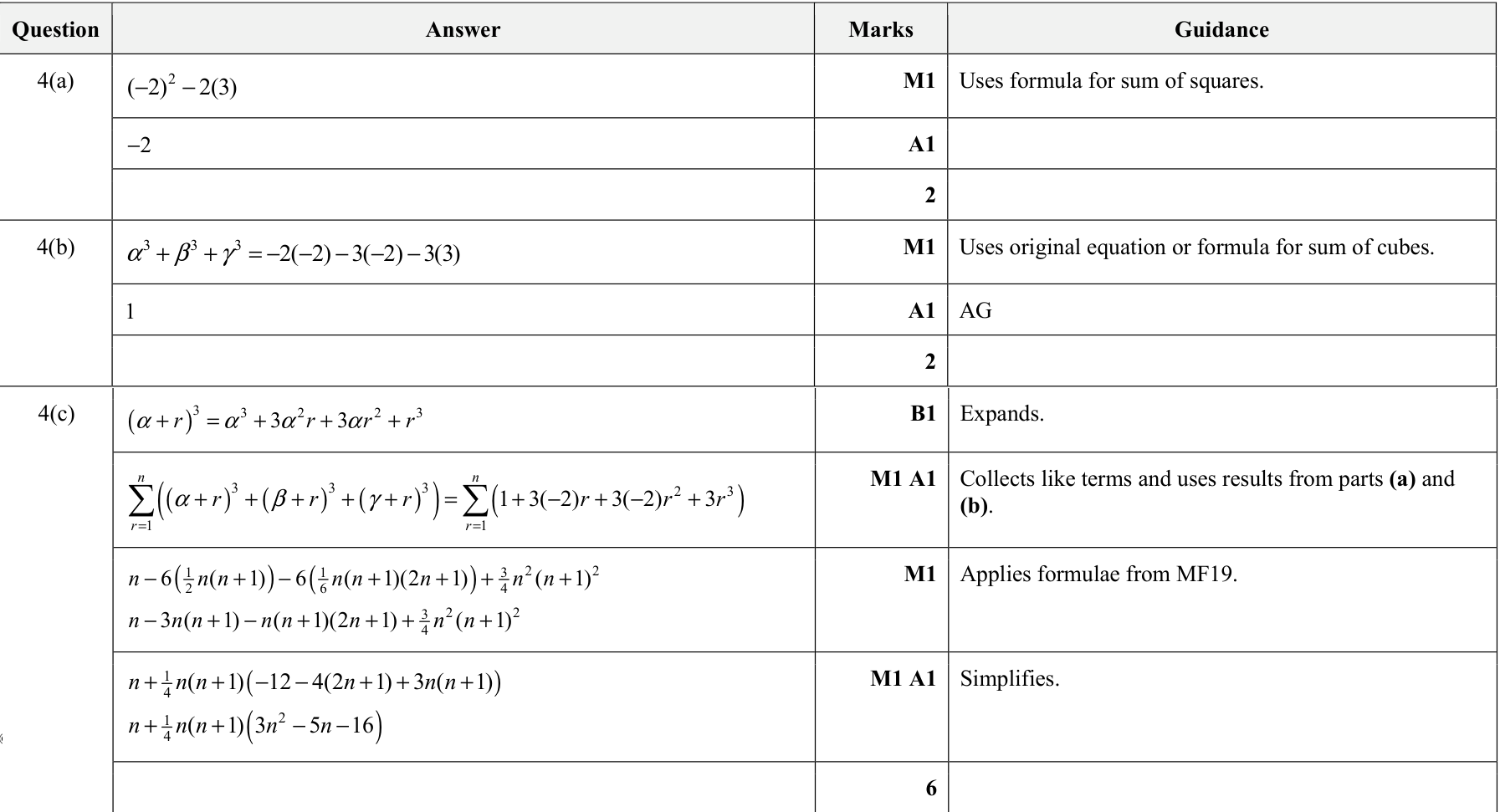
The cubic equation \(x^3 + 2x^2 + 3x + 3 = 0\) has roots \(\alpha, \beta, \gamma\).
(a) Find the value of \(\alpha^2 + \beta^2 + \gamma^2\).
(b) Show that \(\alpha^3 + \beta^3 + \gamma^3 = 1\).
(c) Use standard results from the list of formulae (MF19) to show that
\(\sum_{r=1}^{n} ((\alpha + r)^3 + (\beta + r)^3 + (\gamma + r)^3) = n + \frac{1}{4}n(n+1)(an^2 + bn + c),\)
where \(a, b, c\) are constants to be determined.
FM November 2021 p12 q05
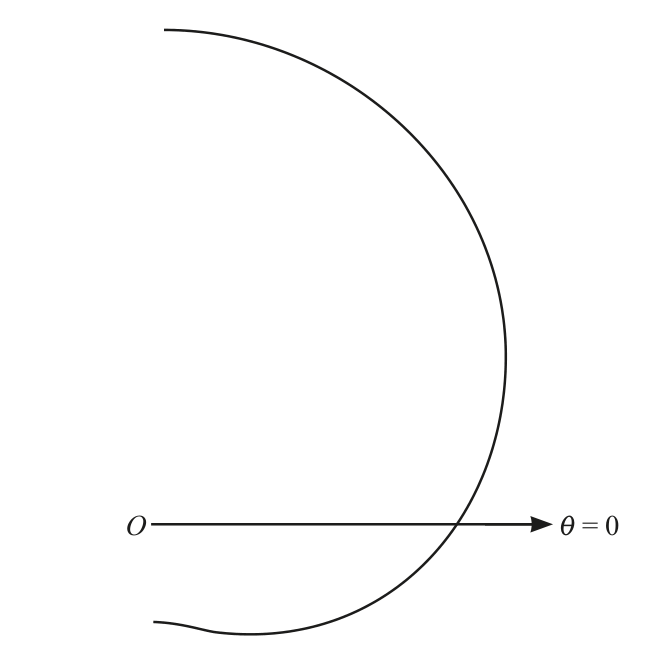
The curve C has polar equation \(r = 3 + 2 \sin \theta\), for \(-\pi < \theta \leq \pi\).
(a) The diagram shows part of C. Sketch the rest of C on the diagram.
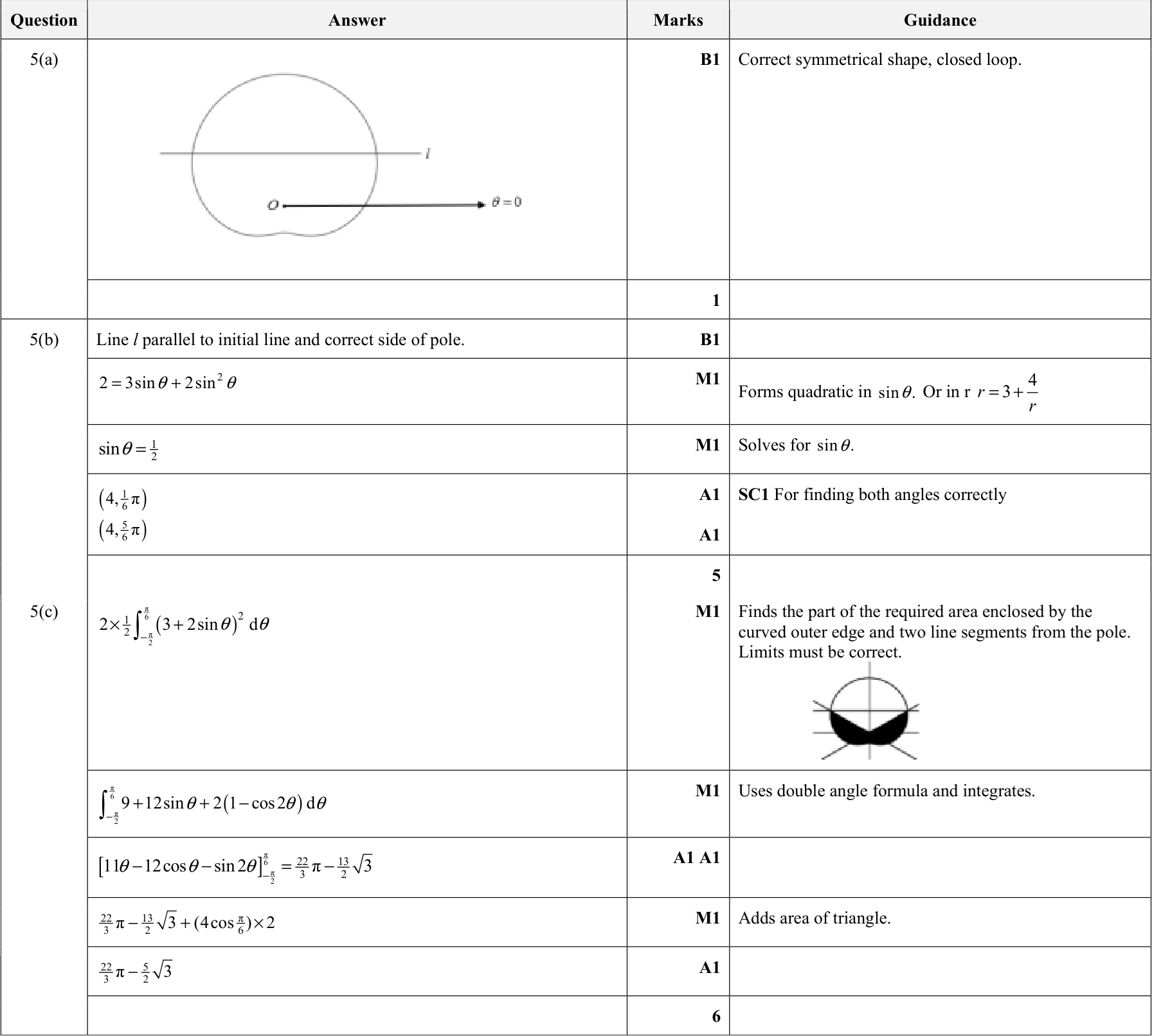
The straight line l has polar equation \(r \sin \theta = 2\).
(b) Add l to the diagram in part (a) and find the polar coordinates of the points of intersection of C and l.
(c) The region R is enclosed by C and l, and contains the pole. Find the area of R, giving your answer in exact form.
FM November 2021 p12 q06
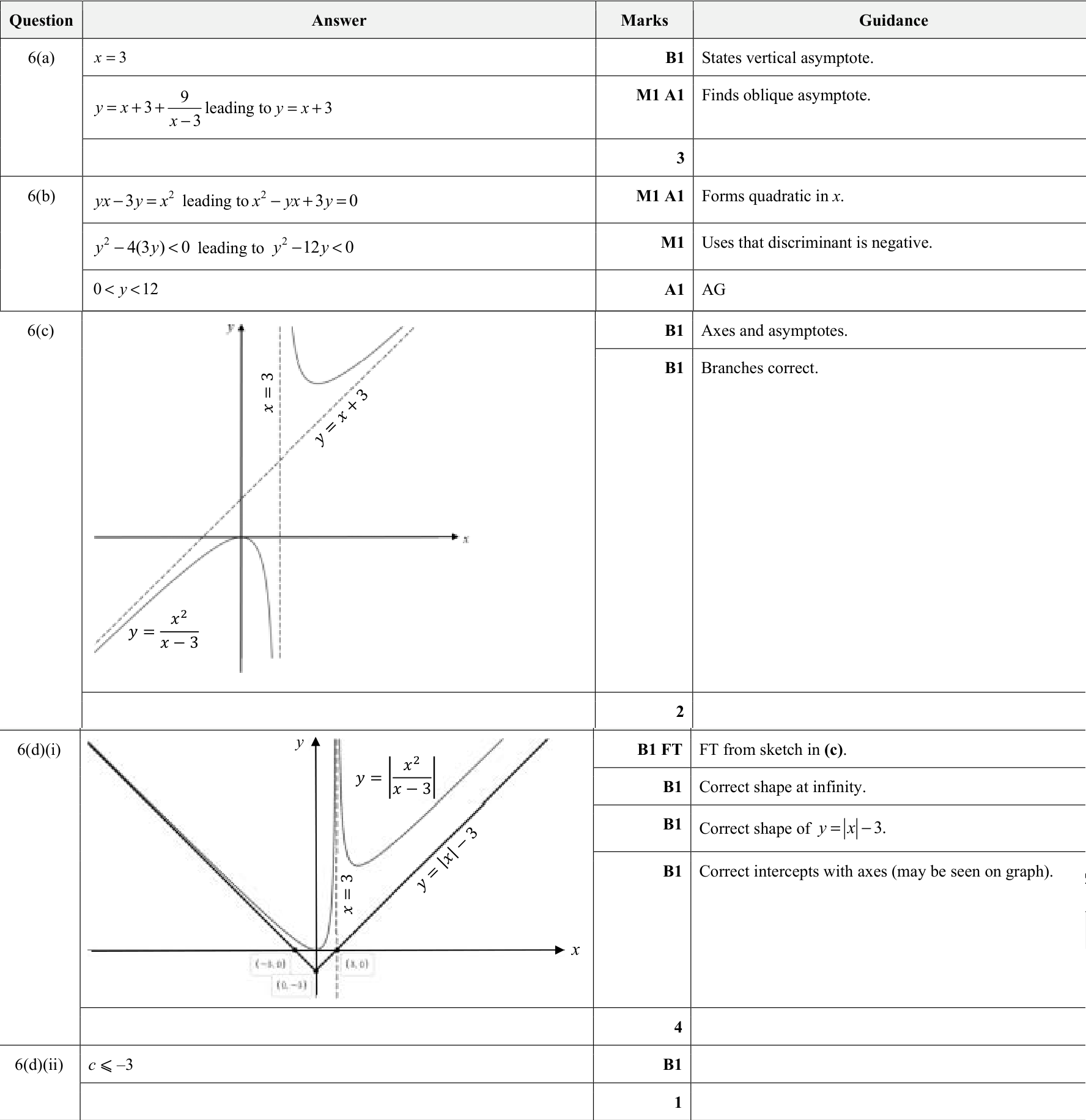
The curve C has equation \(y = \frac{x^2}{x-3}\).
- (a) Find the equations of the asymptotes of C.
- (b) Show that there is no point on C for which \(0 < y < 12\).
- (c) Sketch C.
- (d)
- Sketch the graphs of \(y = \left| \frac{x^2}{x-3} \right|\) and \(y = |x| - 3\) on a single diagram, stating the coordinates of the intersections with the axes.
- Use your sketch to find the set of values of \(c\) for which \(\left| \frac{x^2}{x-3} \right| \leq |x| + c\) has no solution.
FM November 2021 p12 q07
The points A, B, C have position vectors
\(2\mathbf{i} + 2\mathbf{j}, \quad -\mathbf{j} + \mathbf{k} \quad \text{and} \quad 2\mathbf{i} + \mathbf{j} - 7\mathbf{k}\)
respectively, relative to the origin O.
(a) Find an equation of the plane OAB, giving your answer in the form \(\mathbf{r} \cdot \mathbf{n} = p\).
The plane \(\Pi\) has equation \(x - 3y - 2z = 1\).
(b) Find the perpendicular distance of \(\Pi\) from the origin.
(c) Find the acute angle between the planes OAB and \(\Pi\).
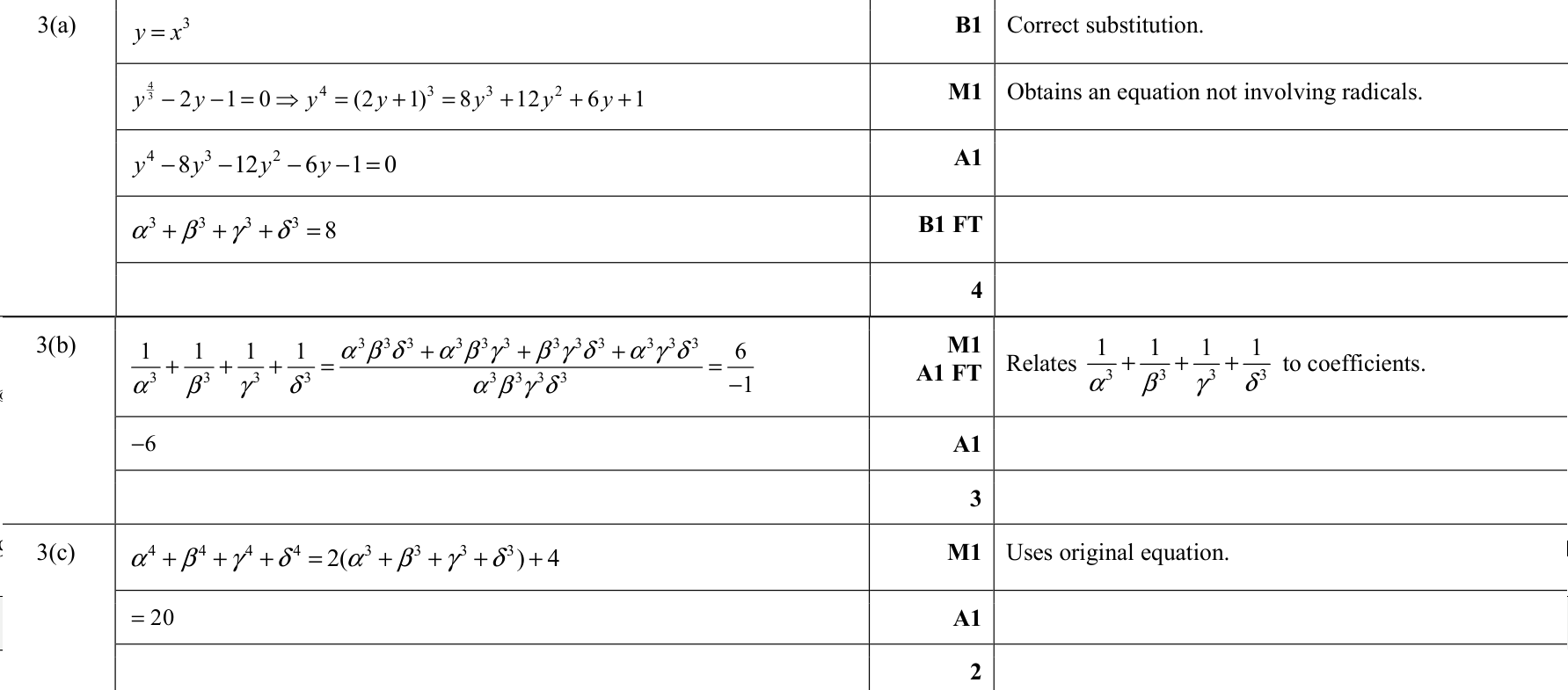
(d) Find an equation for the common perpendicular to the lines OC and AB.