Exam-Style Problems
⬅ Back to SubchapterFM June 2022 p12 q01
4232
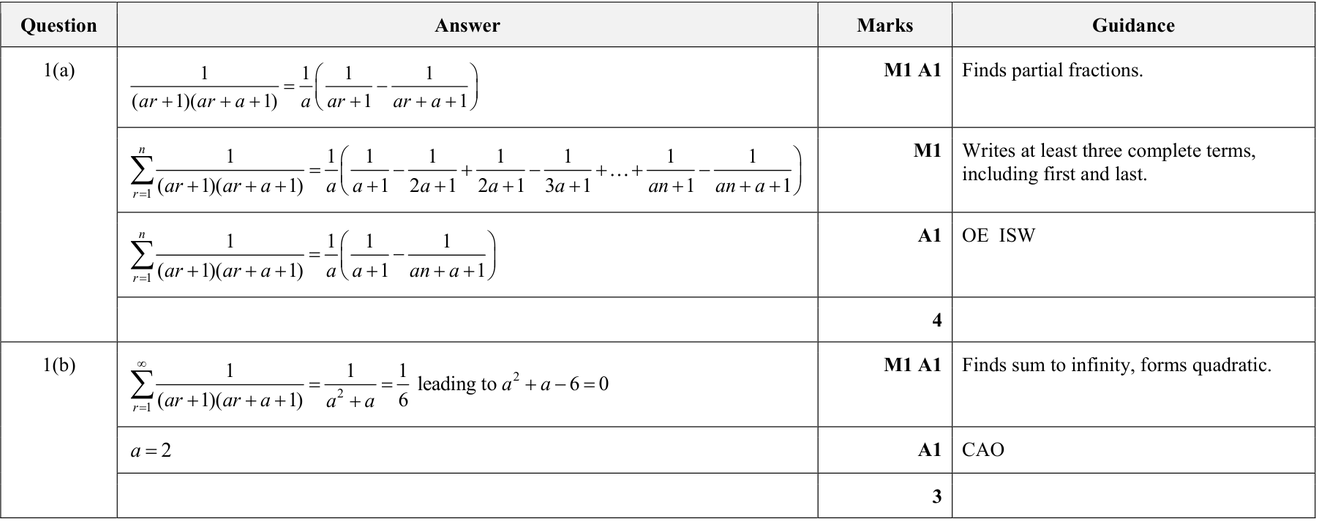
Let \(a\) be a positive constant.
(a) Use the method of differences to find \(\sum_{r=1}^{n} \frac{1}{(ar+1)(ar+a+1)}\) in terms of \(n\) and \(a\).
(b) Find the value of \(a\) for which \(\sum_{r=1}^{\infty} \frac{1}{(ar+1)(ar+a+1)} = \frac{1}{6}\).
FM June 2022 p12 q02
4233
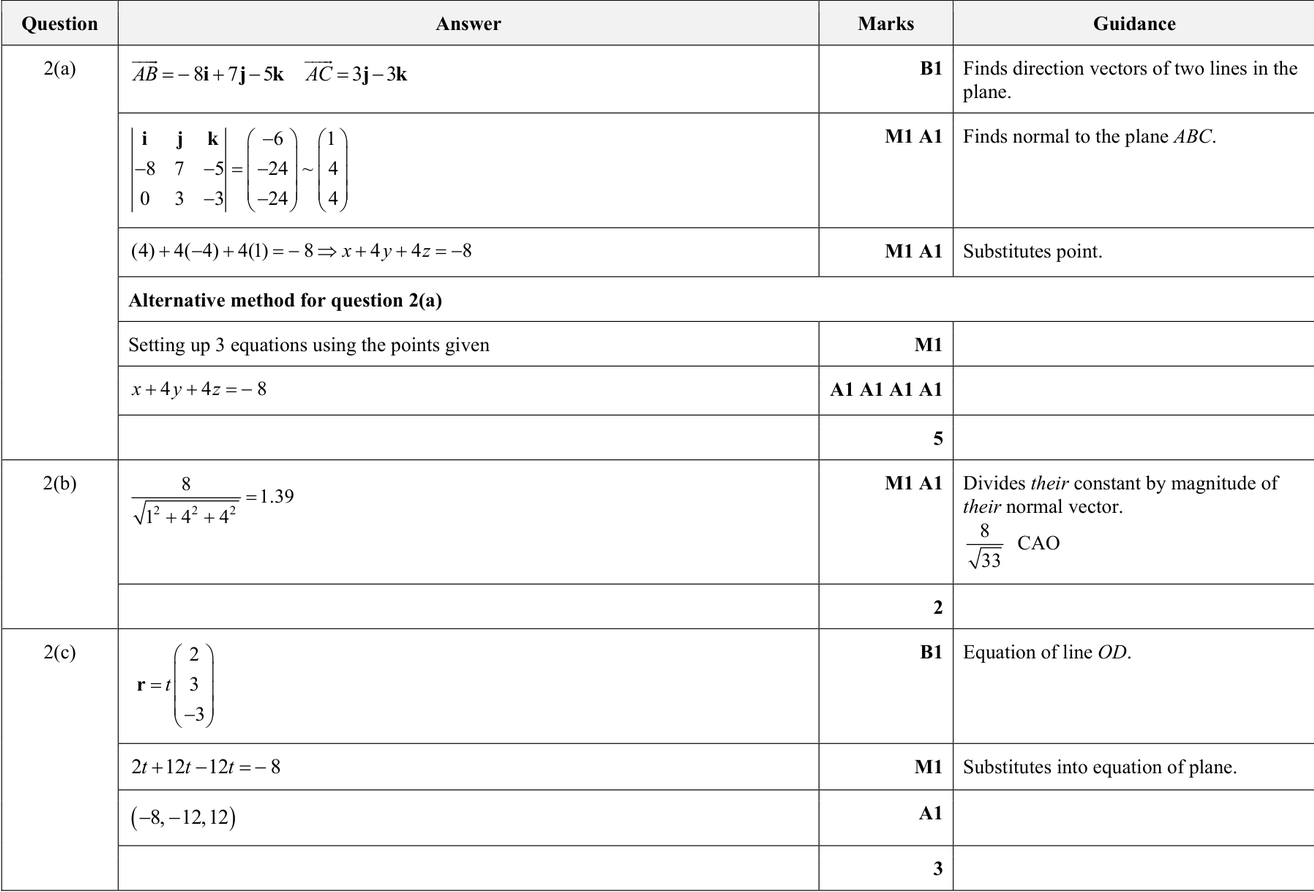
The points A, B, C have position vectors
\(4\mathbf{i} - 4\mathbf{j} + \mathbf{k}\),\( \quad -4\mathbf{i} + 3\mathbf{j} - 4\mathbf{k}\), \(\quad 4\mathbf{i} - \mathbf{j} - 2\mathbf{k}\),
respectively, relative to the origin O.
(a) Find the equation of the plane ABC, giving your answer in the form \(ax + by + cz = d\).
(b) Find the perpendicular distance from O to the plane ABC.
(c) The point D has position vector \(2\mathbf{i} + 3\mathbf{j} - 3\mathbf{k}\).
Find the coordinates of the point of intersection of the line OD with the plane ABC.
FM June 2022 p12 q03
4234
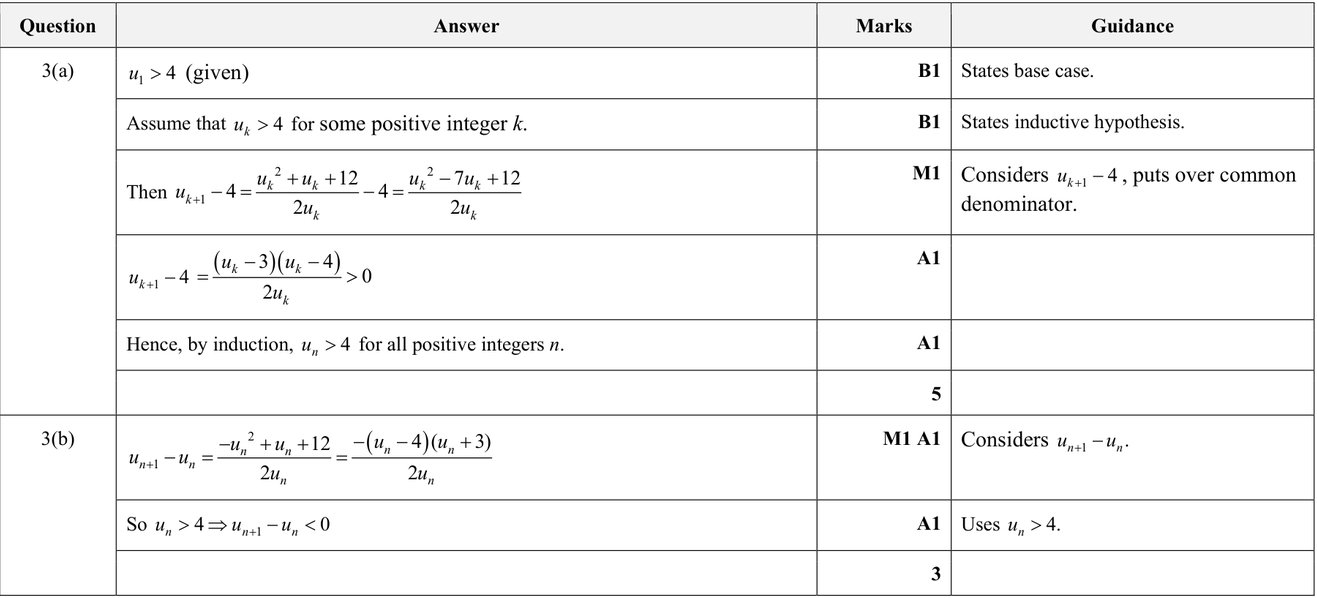
The sequence of positive numbers \(u_1, u_2, u_3, \ldots\) is such that \(u_1 > 4\) and, for \(n \geq 1\),
\(u_{n+1} = \frac{u_n^2 + u_n + 12}{2u_n}.\)
(a) By considering \(u_{n+1} - 4\), or otherwise, prove by mathematical induction that \(u_n > 4\) for all positive integers \(n\). [5]
(b) Show that \(u_{n+1} < u_n\) for \(n \geq 1\). [3]
FM June 2022 p12 q04
4235
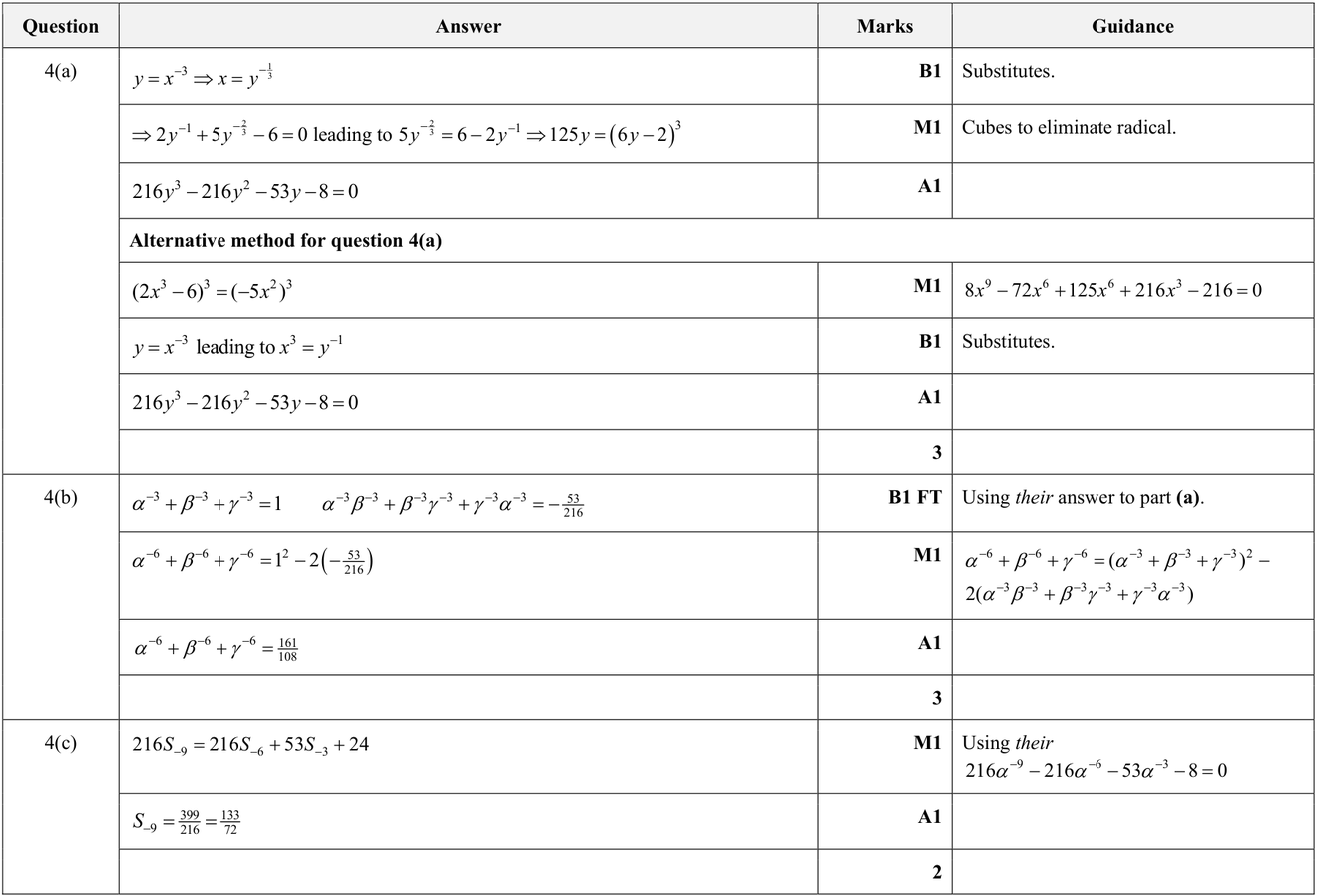
The cubic equation \(2x^3 + 5x^2 - 6 = 0\) has roots \(\alpha, \beta, \gamma\).
(a) Find a cubic equation whose roots are \(\frac{1}{\alpha^3}, \frac{1}{\beta^3}, \frac{1}{\gamma^3}\).
(b) Find the value of \(\frac{1}{\alpha^6} + \frac{1}{\beta^6} + \frac{1}{\gamma^6}\).
(c) Find also the value of \(\frac{1}{\alpha^9} + \frac{1}{\beta^9} + \frac{1}{\gamma^9}\).
FM June 2022 p12 q05
4236
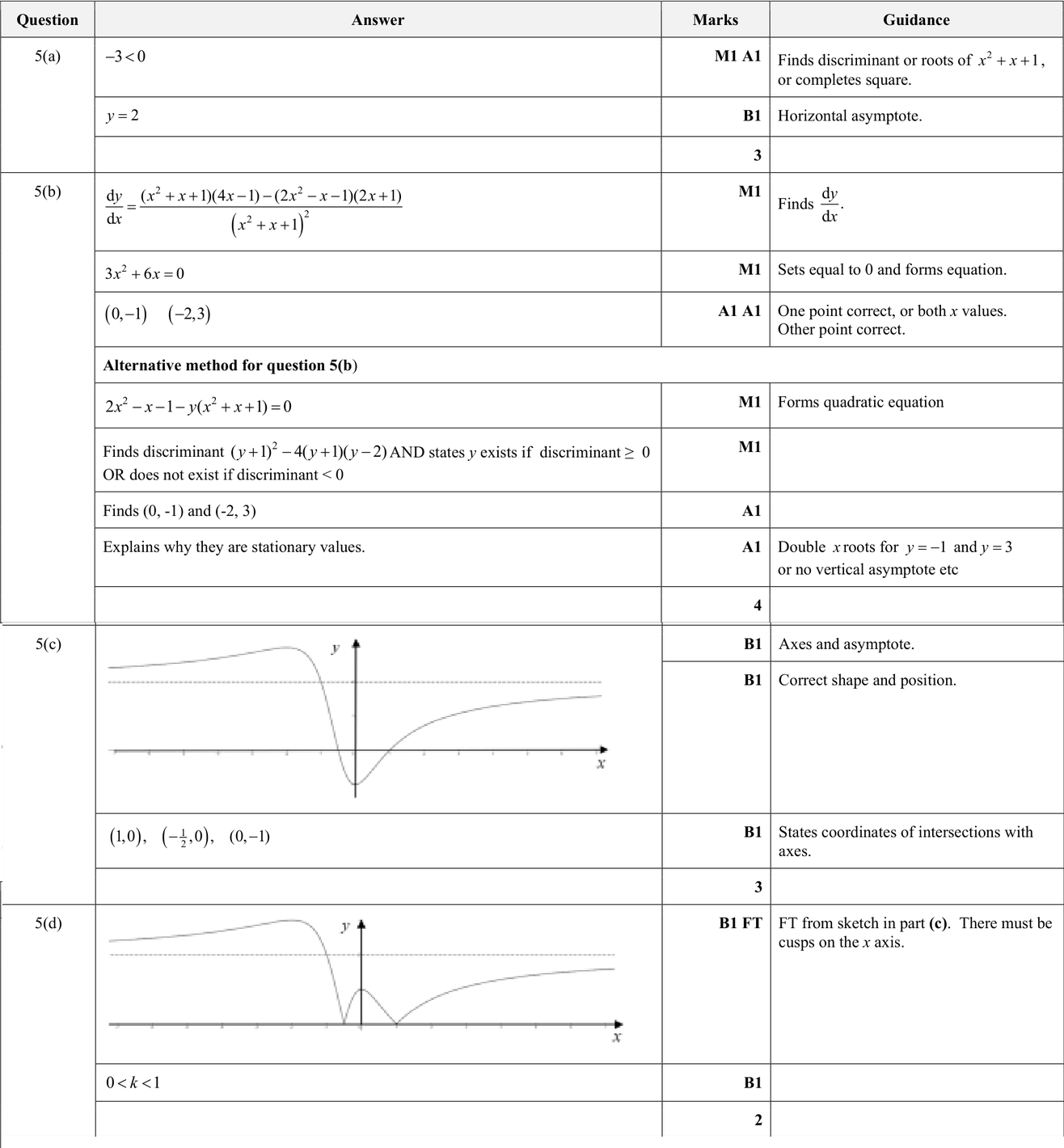
The curve C has equation \(y = \frac{2x^2 - x - 1}{x^2 + x + 1}\).
- Show that C has no vertical asymptotes and state the equation of the horizontal asymptote of C.
- Find the coordinates of the stationary points on C.
- Sketch C, stating the coordinates of the intersections with the axes.
- Sketch the curve with equation \(y = \left| \frac{2x^2 - x - 1}{x^2 + x + 1} \right|\) and state the set of values of \(k\) for which \(\left| \frac{2x^2 - x - 1}{x^2 + x + 1} \right| = k\) has 4 distinct real solutions.
FM June 2022 p12 q06
4237
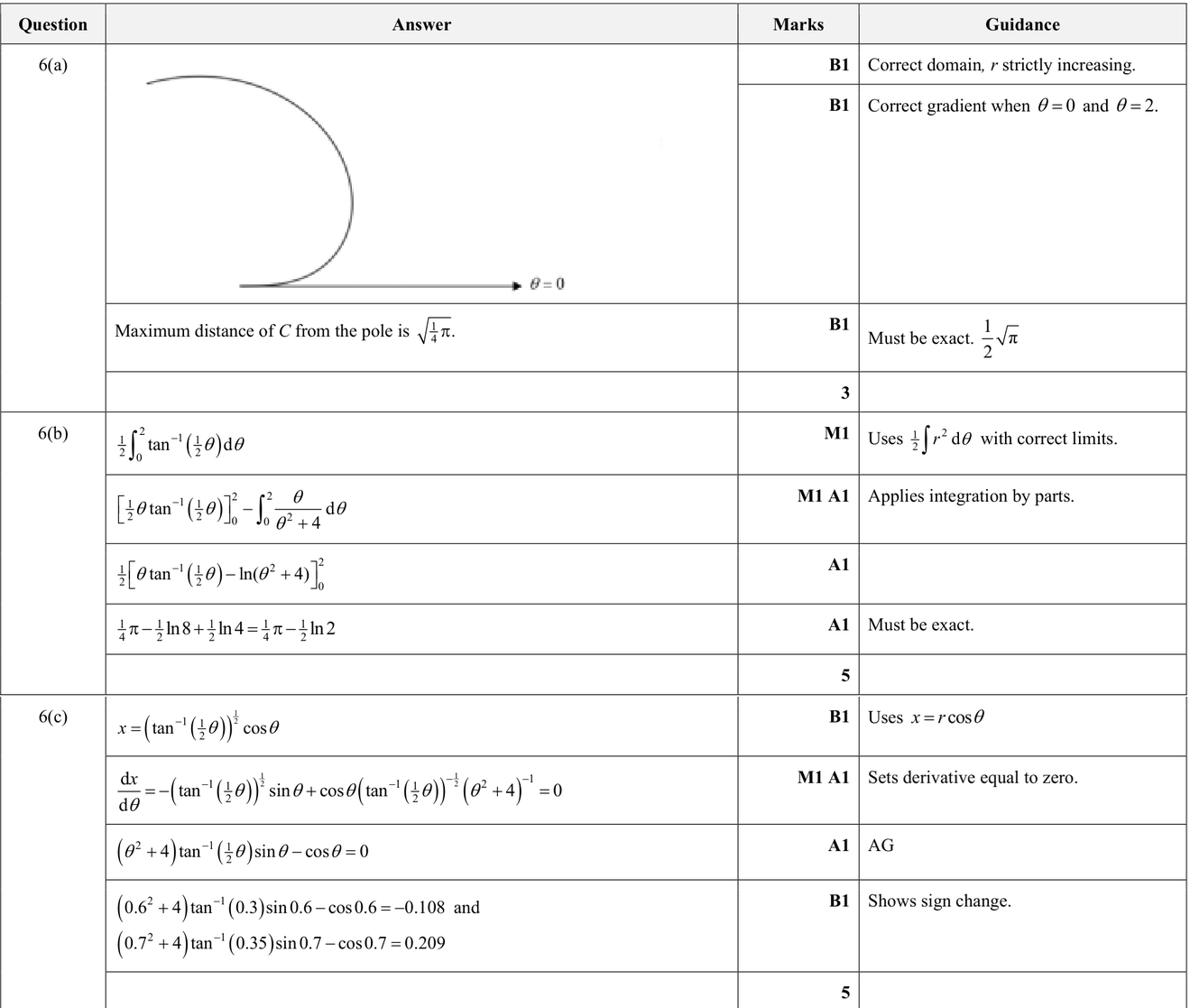
The curve C has polar equation \(r^2 = \arctan\left(\frac{1}{2}\theta\right)\), where \(0 \leq \theta \leq 2\).
(a) Sketch C and state, in exact form, the greatest distance of a point on C from the pole.
(b) Find the exact value of the area of the region bounded by C and the half-line \(\theta = 2\).
Now consider the part of C where \(0 \leq \theta \leq \frac{1}{2}\pi\).
(c) Show that, at the point furthest from the half-line \(\theta = \frac{1}{2}\pi\),
\((\theta^2 + 4)\arctan\left(\frac{1}{2}\theta\right)\sin\theta - \cos\theta = 0\)
and verify that this equation has a root between 0.6 and 0.7.
FM June 2022 p12 q07
4238
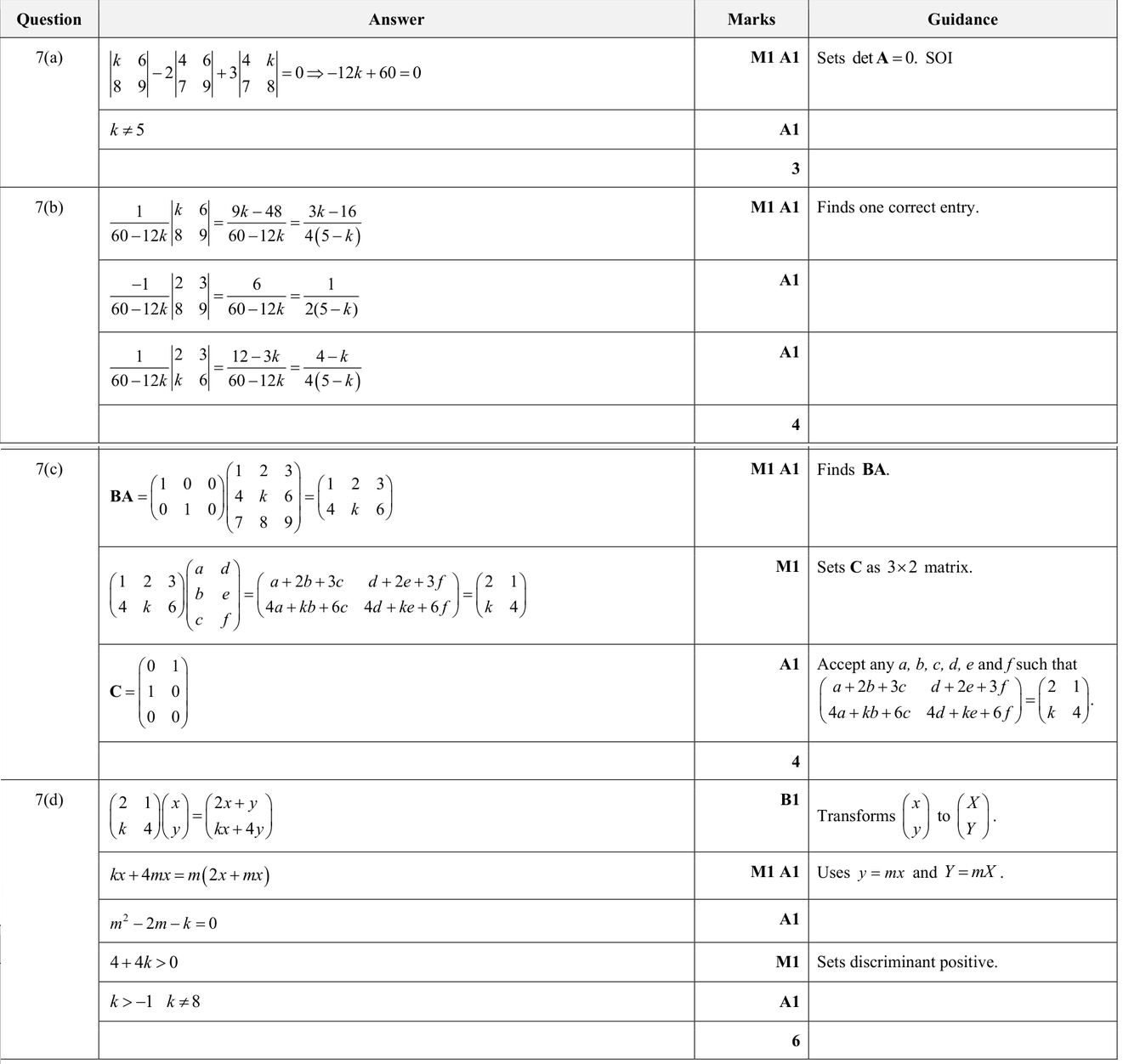
The matrix \(A\) is given by \(A = \begin{pmatrix} 1 & 2 & 3 \\ 4 & k & 6 \\ 7 & 8 & 9 \end{pmatrix}\).
- Find the set of values of \(k\) for which \(A\) is non-singular.
- Given that \(A\) is non-singular, find, in terms of \(k\), the entries in the top row of \(A^{-1}\).
- Given that \(B = \begin{pmatrix} 1 & 0 & 0 \\ 0 & 1 & 0 \end{pmatrix}\), give an example of a matrix \(C\) such that \(BAC = \begin{pmatrix} 2 & 1 \\ k & 4 \end{pmatrix}\).
- Find the set of values of \(k\) for which the transformation in the \(x-y\) plane represented by \(\begin{pmatrix} 2 & 1 \\ k & 4 \end{pmatrix}\) has two distinct invariant lines through the origin.
FM June 2022 p13 q01
4239
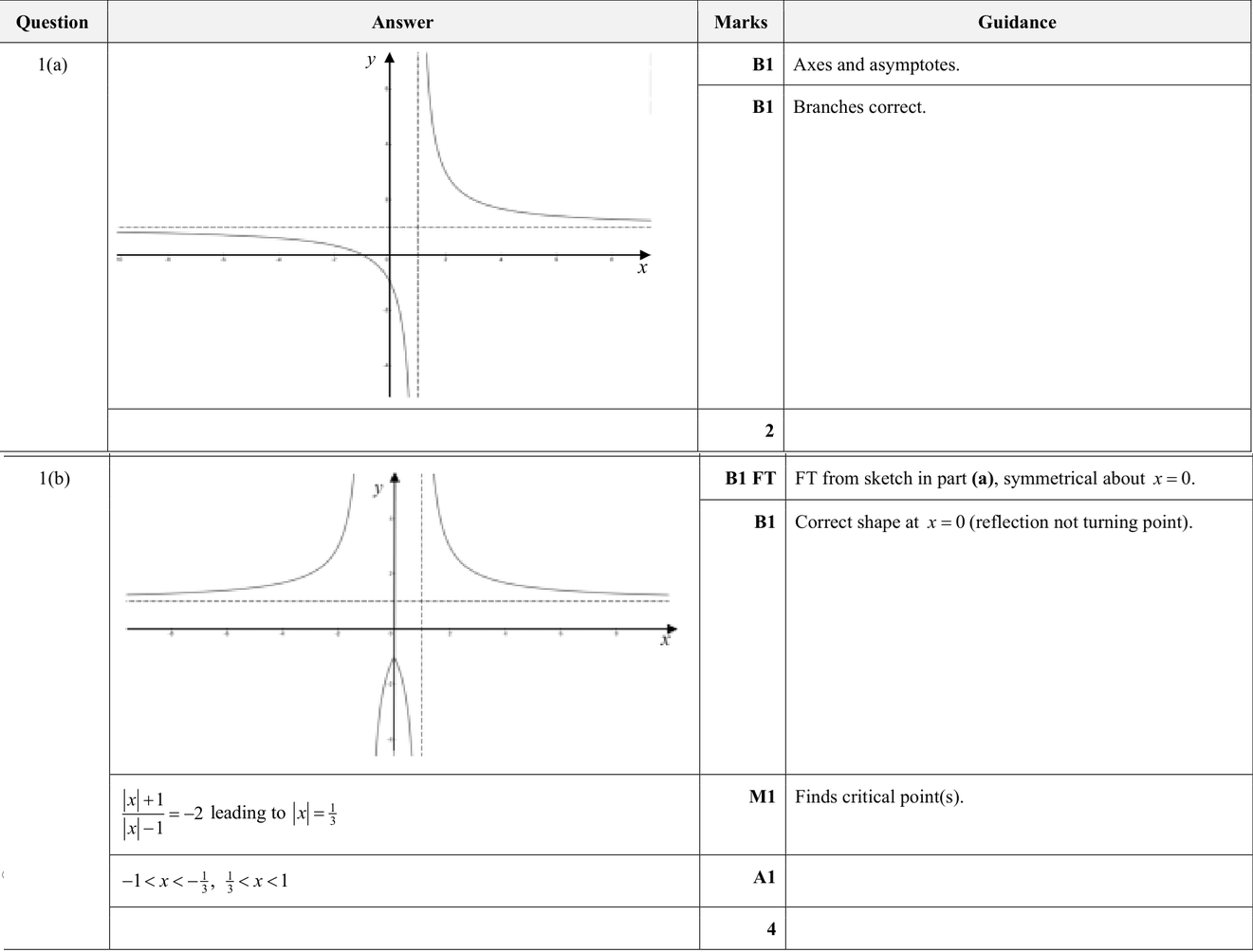
(a) Sketch the curve with equation \(y = \frac{x+1}{x-1}\).
(b) Sketch the curve with equation \(y = \frac{|x|+1}{|x|-1}\) and find the set of values of \(x\) for which \(\frac{|x|+1}{|x|-1} < -2\).
FM June 2022 p13 q02
4240
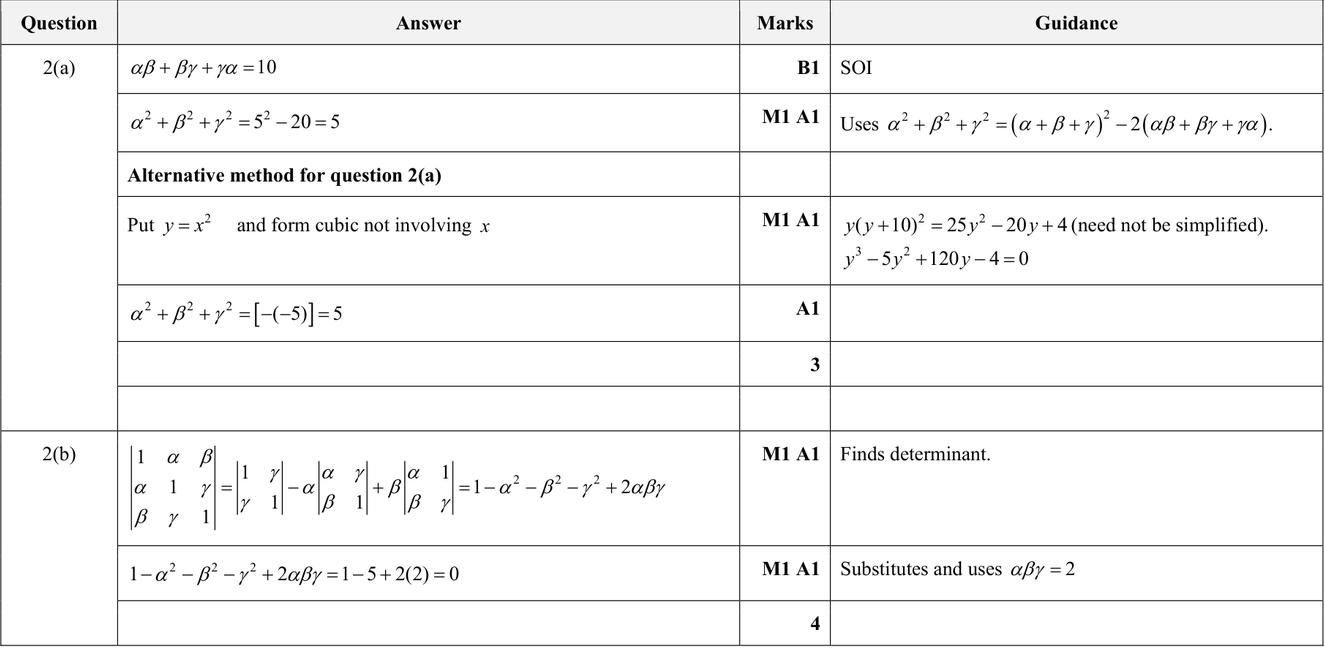
The cubic equation \(x^3 + 5x^2 + 10x - 2 = 0\) has roots \(\alpha, \beta, \gamma\).
(a) Find the value of \(\alpha^2 + \beta^2 + \gamma^2\).
(b) Show that the matrix \(\begin{pmatrix} 1 & \alpha & \beta \\ \alpha & 1 & \gamma \\ \beta & \gamma & 1 \end{pmatrix}\) is singular.
FM June 2022 p13 q03
4241
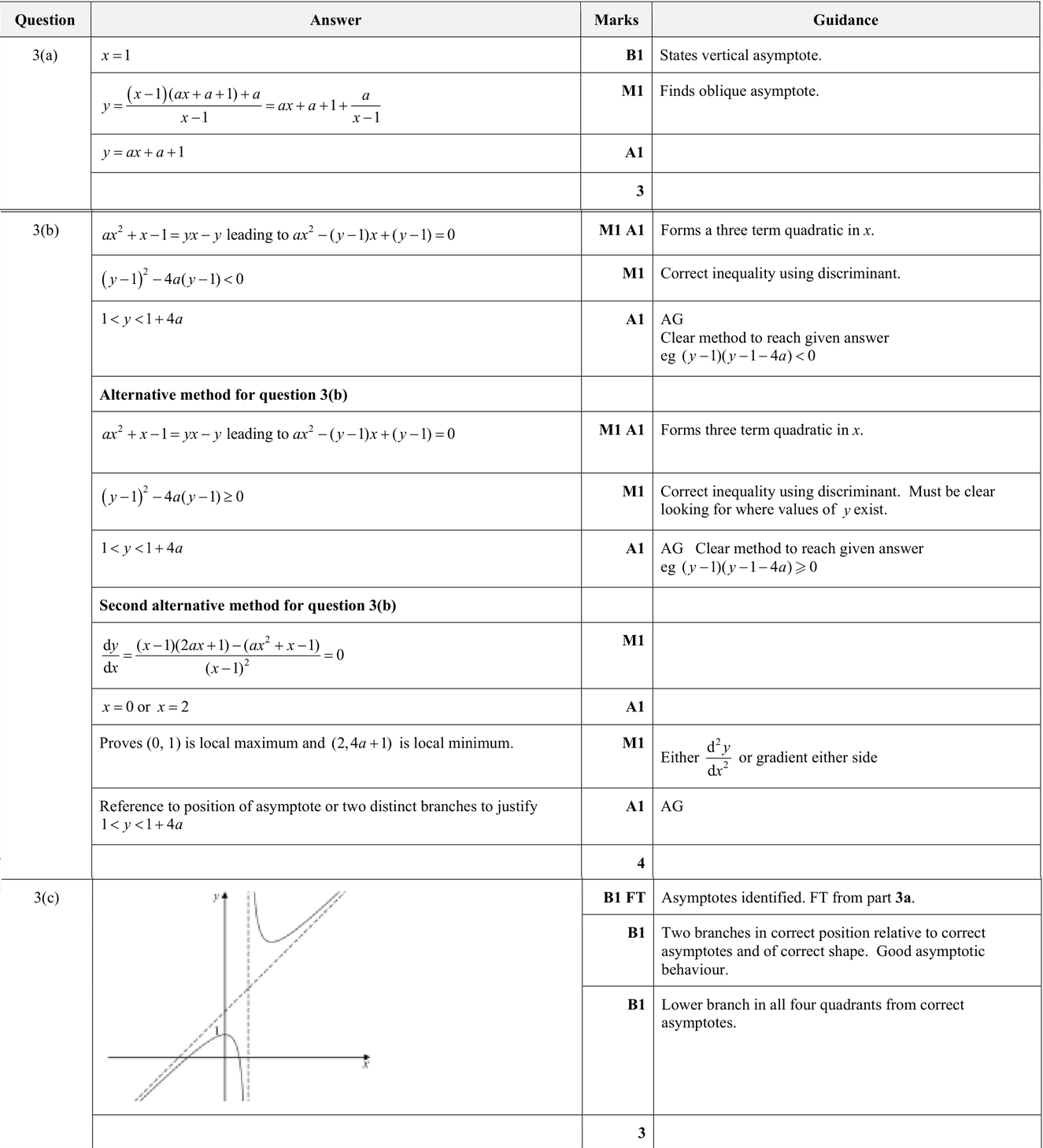
A curve \(C\) has equation \(y = \frac{ax^2 + x - 1}{x - 1}\), where \(a\) is a positive constant.
- Find the equations of the asymptotes of \(C\).
- Show that there is no point on \(C\) for which \(1 < y < 1 + 4a\).
- Sketch \(C\). You do not need to find the coordinates of the intersections with the axes.
FM June 2022 p13 q04
4242
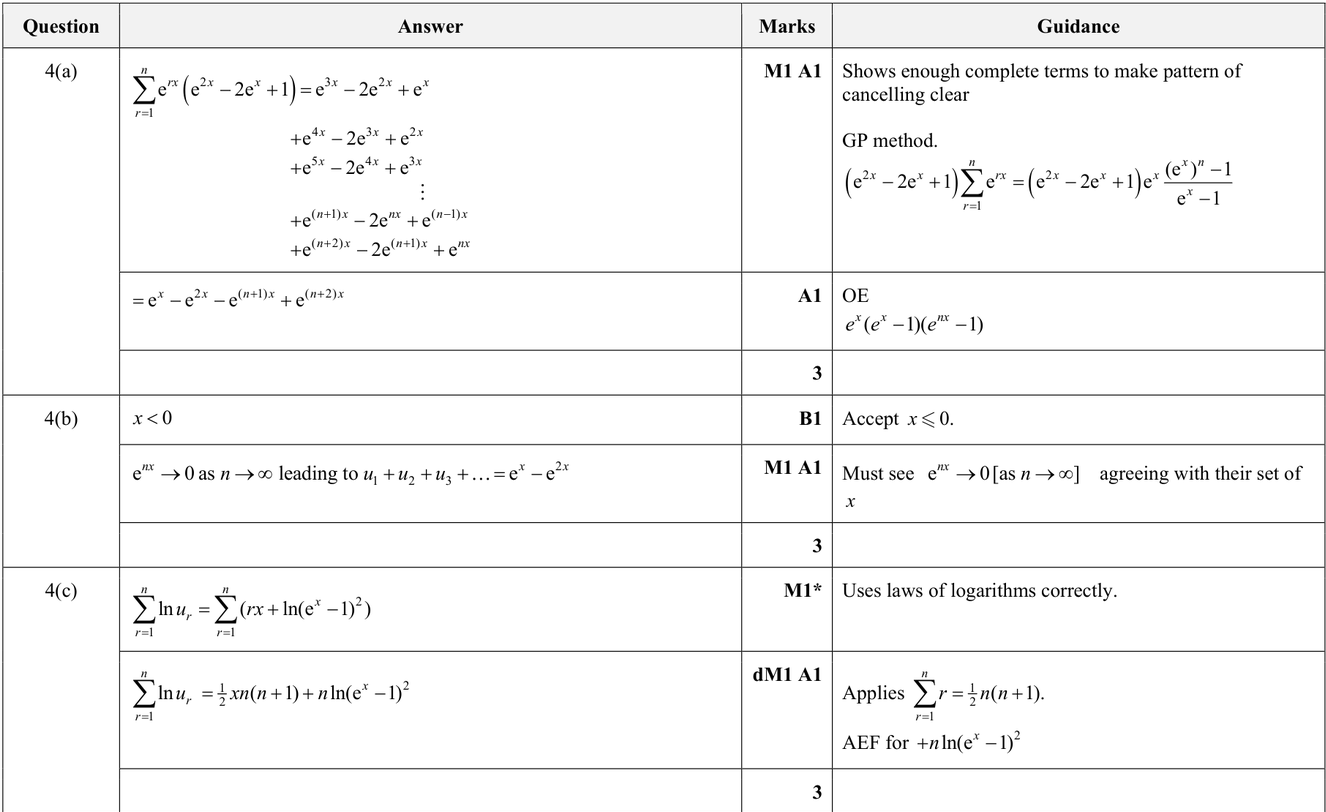
Let \(u_r = e^{rx}(e^{2x} - 2e^x + 1)\).
(a) Using the method of differences, or otherwise, find \(\sum_{r=1}^{n} u_r\) in terms of \(n\) and \(x\).
(b) Deduce the set of non-zero values of \(x\) for which the infinite series \(u_1 + u_2 + u_3 + \ldots\) is convergent and give the sum to infinity when this exists.
(c) Using a standard result from the list of formulae (MF19), find \(\sum_{r=1}^{n} \ln u_r\) in terms of \(n\) and \(x\).
FM June 2022 p13 q05
4243
Let \(\mathbf{A} = \begin{pmatrix} 1 & a \\ 0 & 1 \end{pmatrix}\), where \(a\) is a positive constant.
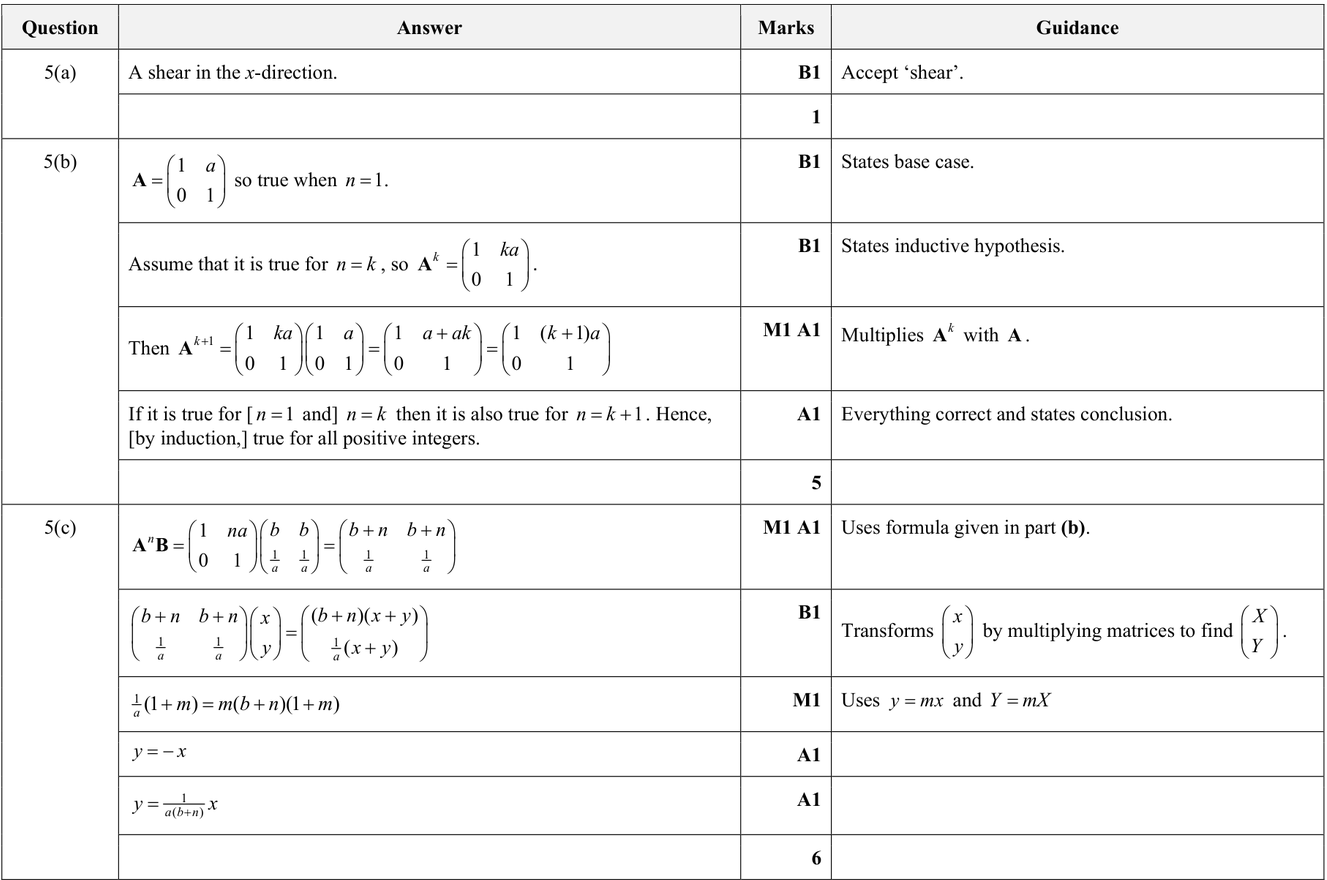
(a) State the type of the geometrical transformation in the \(x-y\) plane represented by \(\mathbf{A}\). [1]
(b) Prove by mathematical induction that, for all positive integers \(n\),
\(\mathbf{A}^n = \begin{pmatrix} 1 & na \\ 0 & 1 \end{pmatrix}.\) [5]
Let \(\mathbf{B} = \begin{pmatrix} b & b \\ a^{-1} & a^{-1} \end{pmatrix}\), where \(b\) is a positive constant.
(c) Find the equations of the invariant lines, through the origin, of the transformation in the \(x-y\) plane represented by \(\mathbf{A}^n \mathbf{B}\). [6]
FM June 2022 p13 q06
4244
The curve C has Cartesian equation \(x^2 + xy + y^2 = a\), where \(a\) is a positive constant.
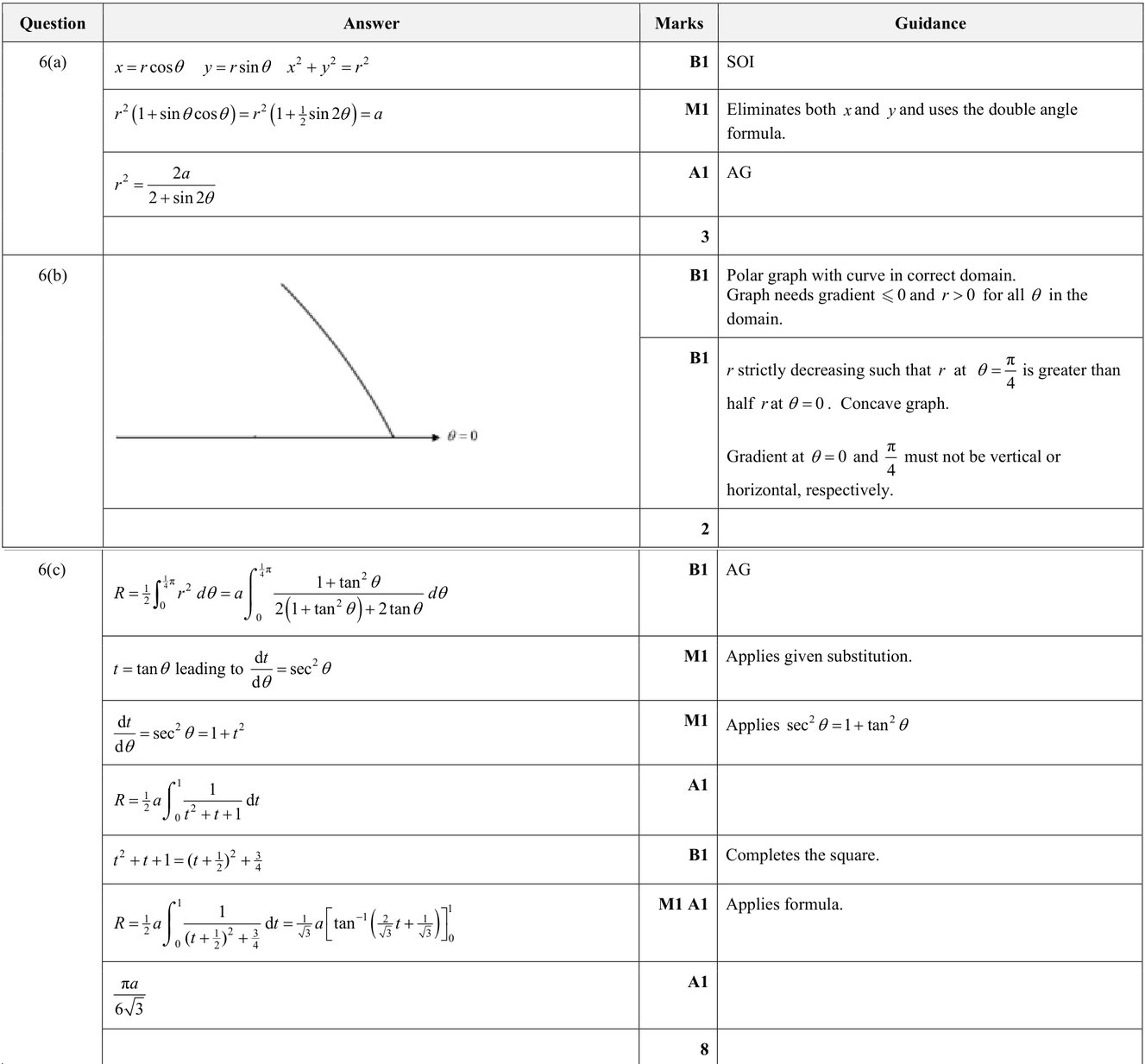
(a) Show that the polar equation of C is \(r^2 = \frac{2a}{2 + \sin 2\theta}\).
(b) Sketch the part of C for \(0 \leq \theta \leq \frac{1}{4}\pi\).
The region R is enclosed by this part of C, the initial line and the half-line \(\theta = \frac{1}{4}\pi\).
(c) It is given that \(\sin 2\theta\) may be expressed as \(\frac{2 \tan \theta}{1 + \tan^2 \theta}\). Use this result to show that the area of R is
\(\frac{1}{2} a \int_{0}^{\frac{1}{4}\pi} \frac{1 + \tan^2 \theta}{1 + \tan \theta + \tan^2 \theta} \, d\theta\)
and use the substitution \(t = \tan \theta\) to find the exact value of this area.
FM June 2022 p13 q07
4245
The position vectors of the points A, B, C, D are
\(7\mathbf{i} + 4\mathbf{j} - \mathbf{k}, \quad 11\mathbf{i} + 3\mathbf{j}, \quad 2\mathbf{i} + 6\mathbf{j} + 3\mathbf{k}, \quad 2\mathbf{i} + 7\mathbf{j} + \lambda \mathbf{k}\)
respectively.
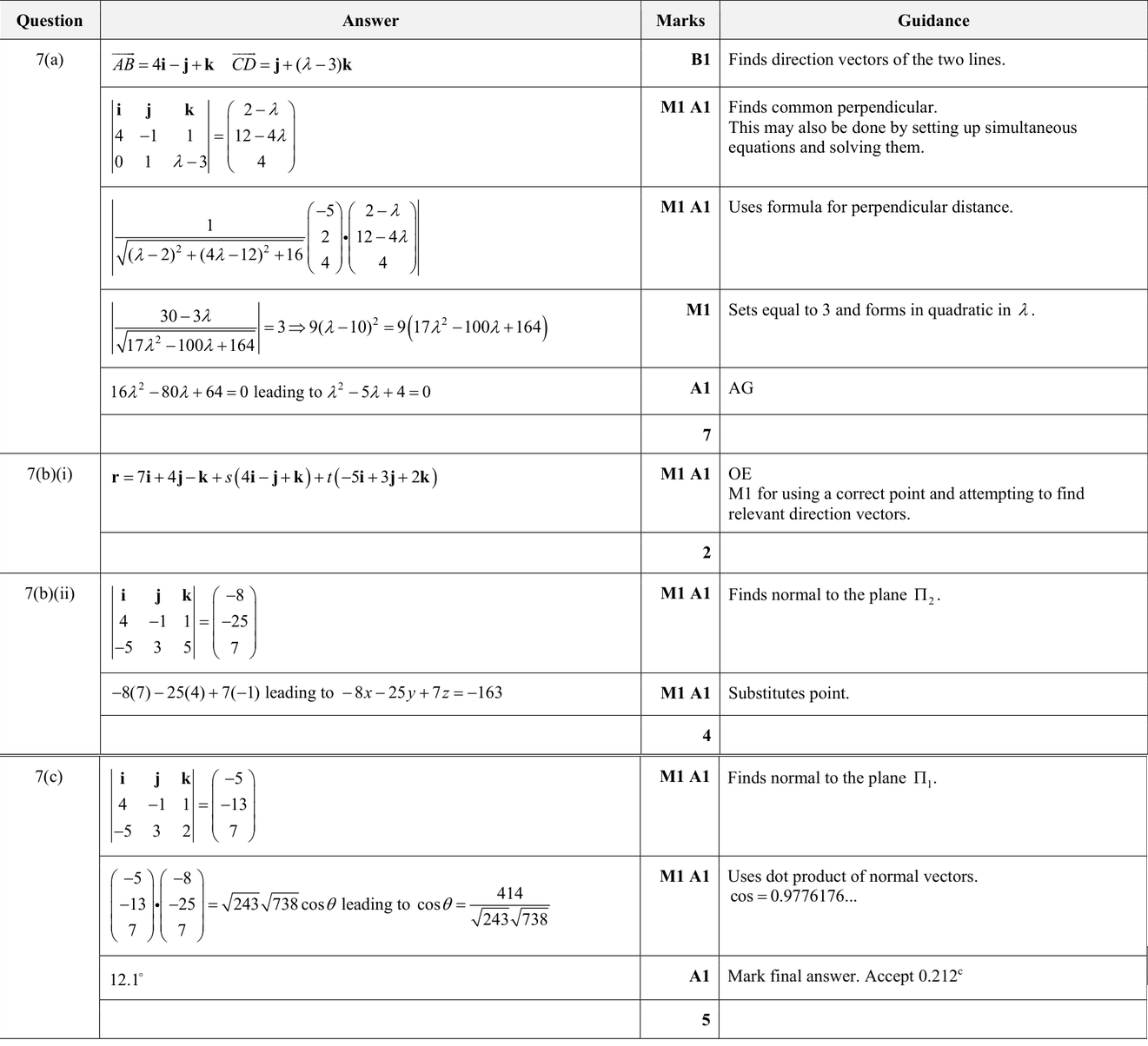
(a) Given that the shortest distance between the line AB and the line CD is 3, show that \(\lambda^2 - 5\lambda + 4 = 0\).
Let \(\Pi_1\) be the plane ABD when \(\lambda = 1\).
Let \(\Pi_2\) be the plane ABD when \(\lambda = 4\).
(b) (i) Write down an equation of \(\Pi_1\), giving your answer in the form \(\mathbf{r} = \mathbf{a} + s\mathbf{b} + t\mathbf{c}\).
(ii) Find an equation of \(\Pi_2\), giving your answer in the form \(ax + by + cz = d\).
(c) Find the acute angle between \(\Pi_1\) and \(\Pi_2\).
FM November 2022 p11 q01
4246
The cubic equation \(x^3 + bx^2 + d = 0\) has roots \(\alpha, \beta, \gamma\), where \(\alpha = \beta\) and \(d \neq 0\).
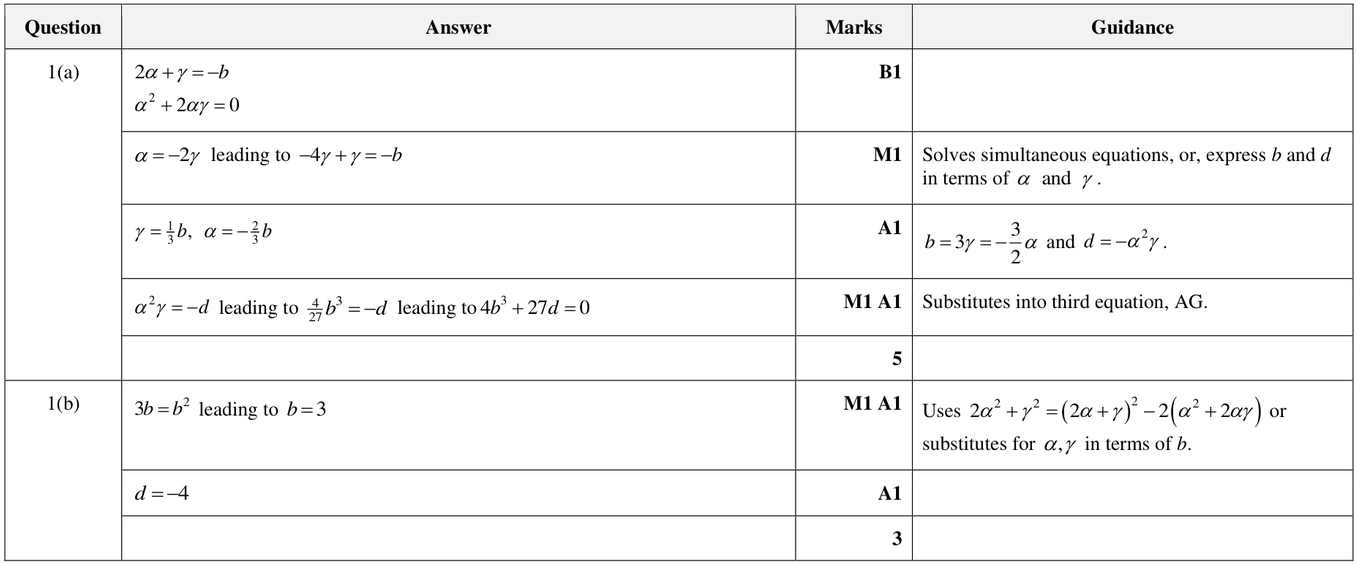
(a) Show that \(4b^3 + 27d = 0\).
(b) Given that \(2\alpha^2 + \gamma^2 = 3b\), find the values of \(b\) and \(d\).
FM November 2022 p11 q02
4247
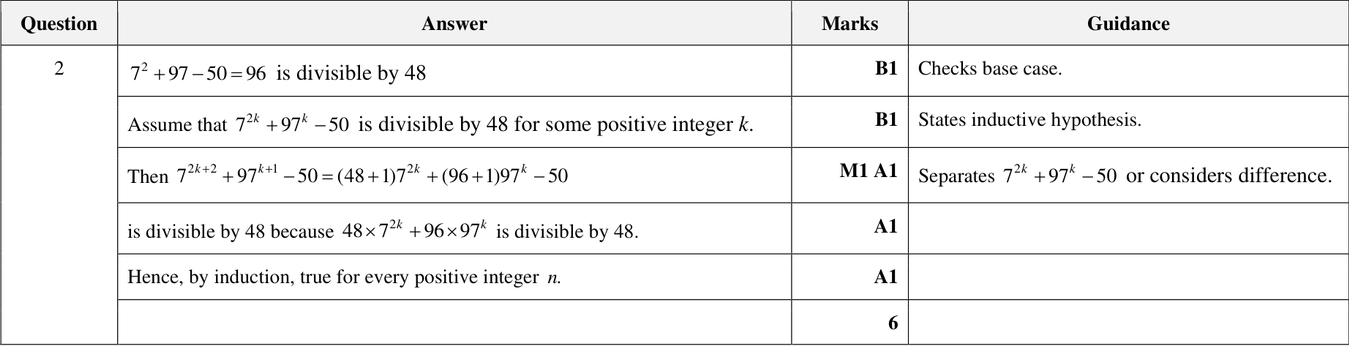
Prove by mathematical induction that, for all positive integers n, \(7^{2n} + 97^n - 50\) is divisible by 48. [6]
FM November 2022 p11 q03
4248
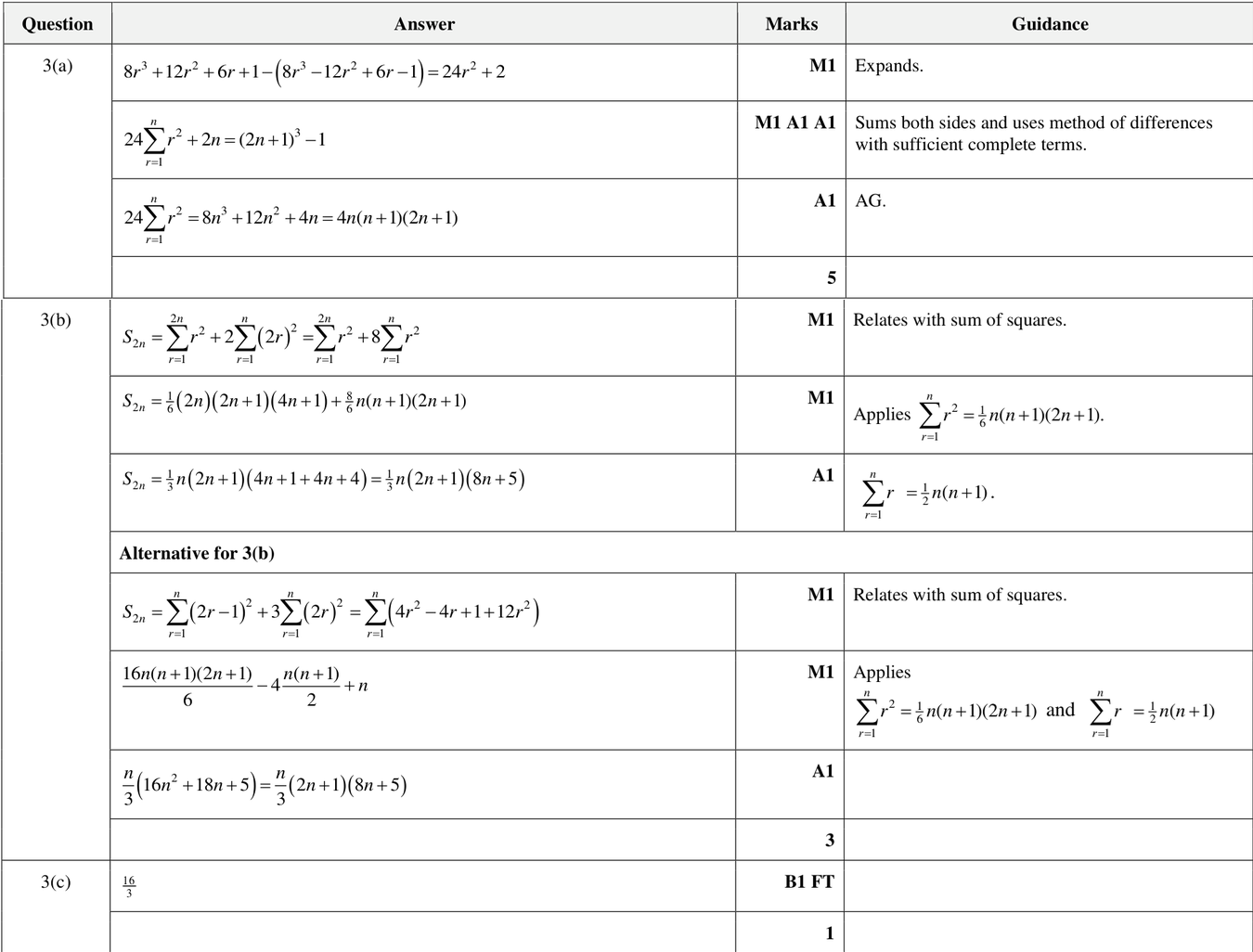
(a) By considering \((2r+1)^3 - (2r-1)^3\), use the method of differences to prove that \(\sum_{r=1}^{n} r^2 = \frac{1}{6}n(n+1)(2n+1)\).
Let \(S_n = 1^2 + 3 \times 2^2 + 3^2 + 3 \times 4^2 + 5^2 + 3 \times 6^2 + \ldots + \left(2 + (-1)^n\right)n^2\).
(b) Show that \(S_{2n} = \frac{1}{3}n(2n+1)(an+b)\), where \(a\) and \(b\) are integers to be determined.
(c) State the value of \(\lim_{n \to \infty} \frac{S_{2n}}{n^3}\).
FM November 2022 p11 q04
4249
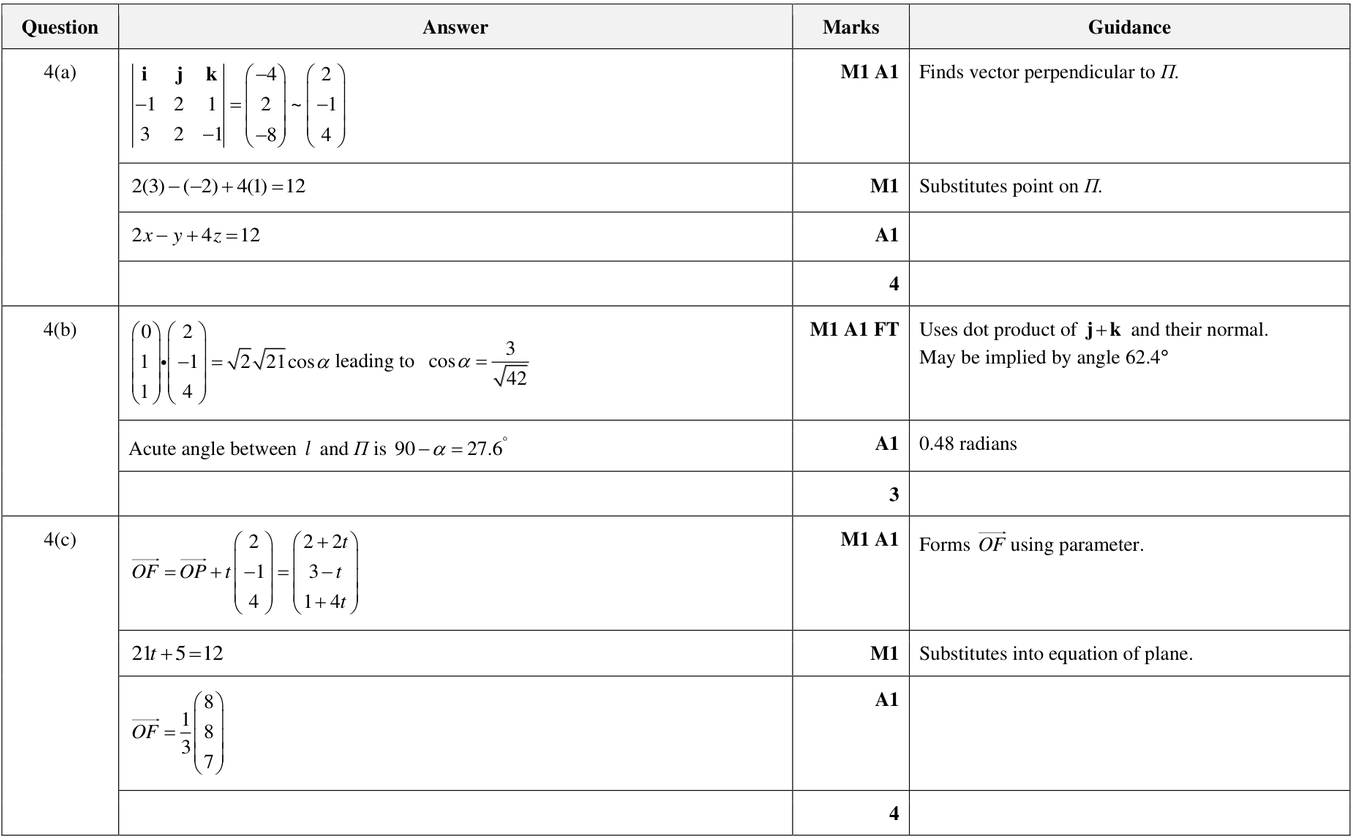
The plane \(\Pi\) contains the lines \(\mathbf{r} = 3\mathbf{i} - 2\mathbf{j} + \mathbf{k} + \lambda(-\mathbf{i} + 2\mathbf{j} + \mathbf{k})\) and \(\mathbf{r} = 4\mathbf{i} + 4\mathbf{j} + 2\mathbf{k} + \mu(3\mathbf{i} + 2\mathbf{j} - \mathbf{k})\).
(a) Find a Cartesian equation of \(\Pi\), giving your answer in the form \(ax + by + cz = d\). [4]
The line \(l\) passes through the point \(P\) with position vector \(2\mathbf{i} + 3\mathbf{j} + \mathbf{k}\) and is parallel to the vector \(\mathbf{j} + \mathbf{k}\).
(b) Find the acute angle between \(l\) and \(\Pi\). [3]
(c) Find the position vector of the foot of the perpendicular from \(P\) to \(\Pi\). [4]
FM November 2022 p11 q05
4250
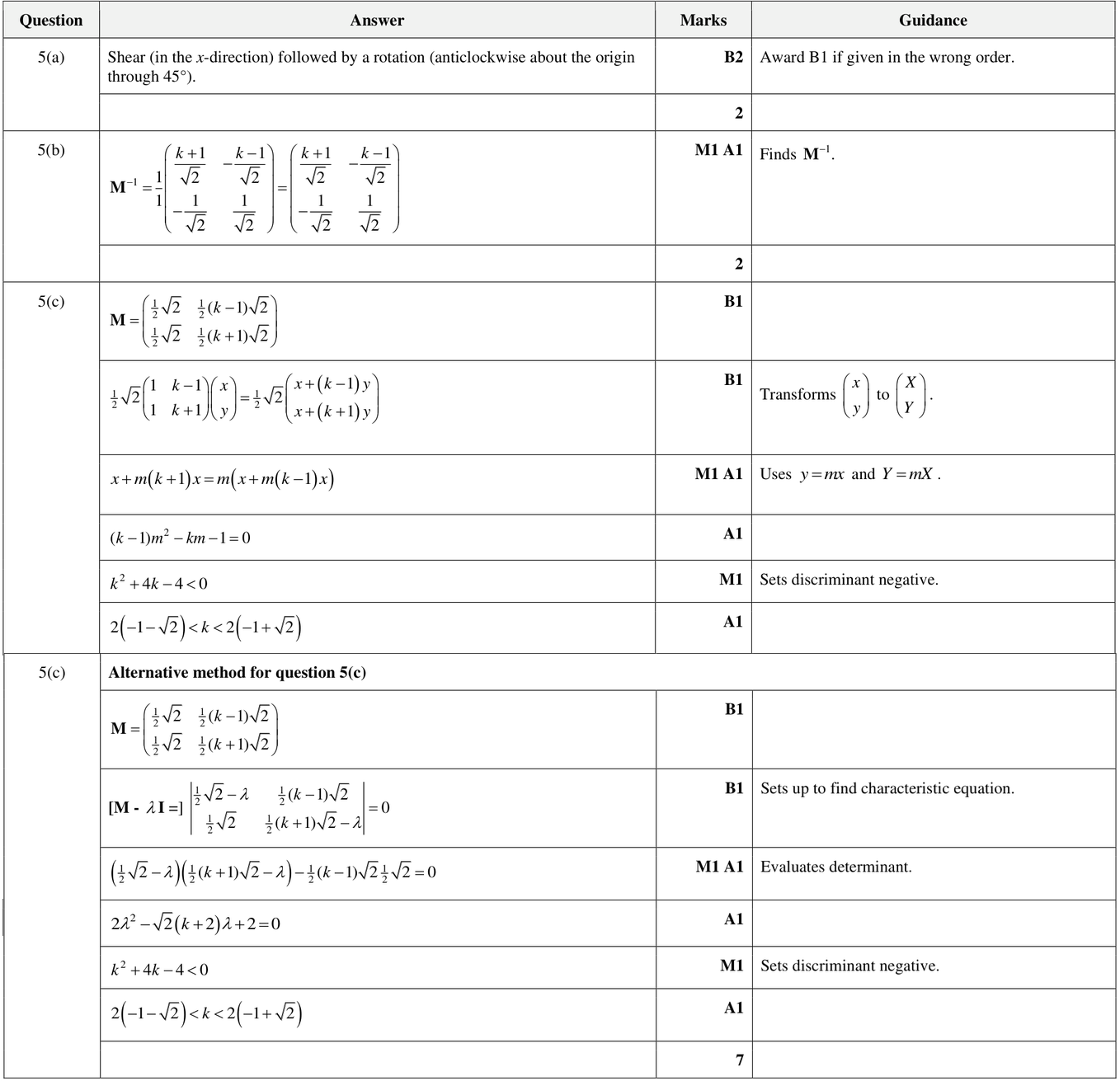
The matrix M is given by \(M = \begin{pmatrix} \frac{1}{2}\sqrt{2} & -\frac{1}{2}\sqrt{2} \\ \frac{1}{2} & \frac{1}{2}\sqrt{2} \end{pmatrix} \begin{pmatrix} 1 & k \\ 0 & 1 \end{pmatrix}\), where \(k\) is a constant.
(a) The matrix M represents a sequence of two geometrical transformations. State the type of each transformation, and make clear the order in which they are applied.
(b) The triangle ABC in the \(x-y\) plane is transformed by M onto triangle DEF. Find, in terms of \(k\), the single matrix which transforms triangle DEF onto triangle ABC.
(c) Find the set of values of \(k\) for which the transformation represented by M has no invariant lines through the origin.
FM November 2022 p11 q06
4251
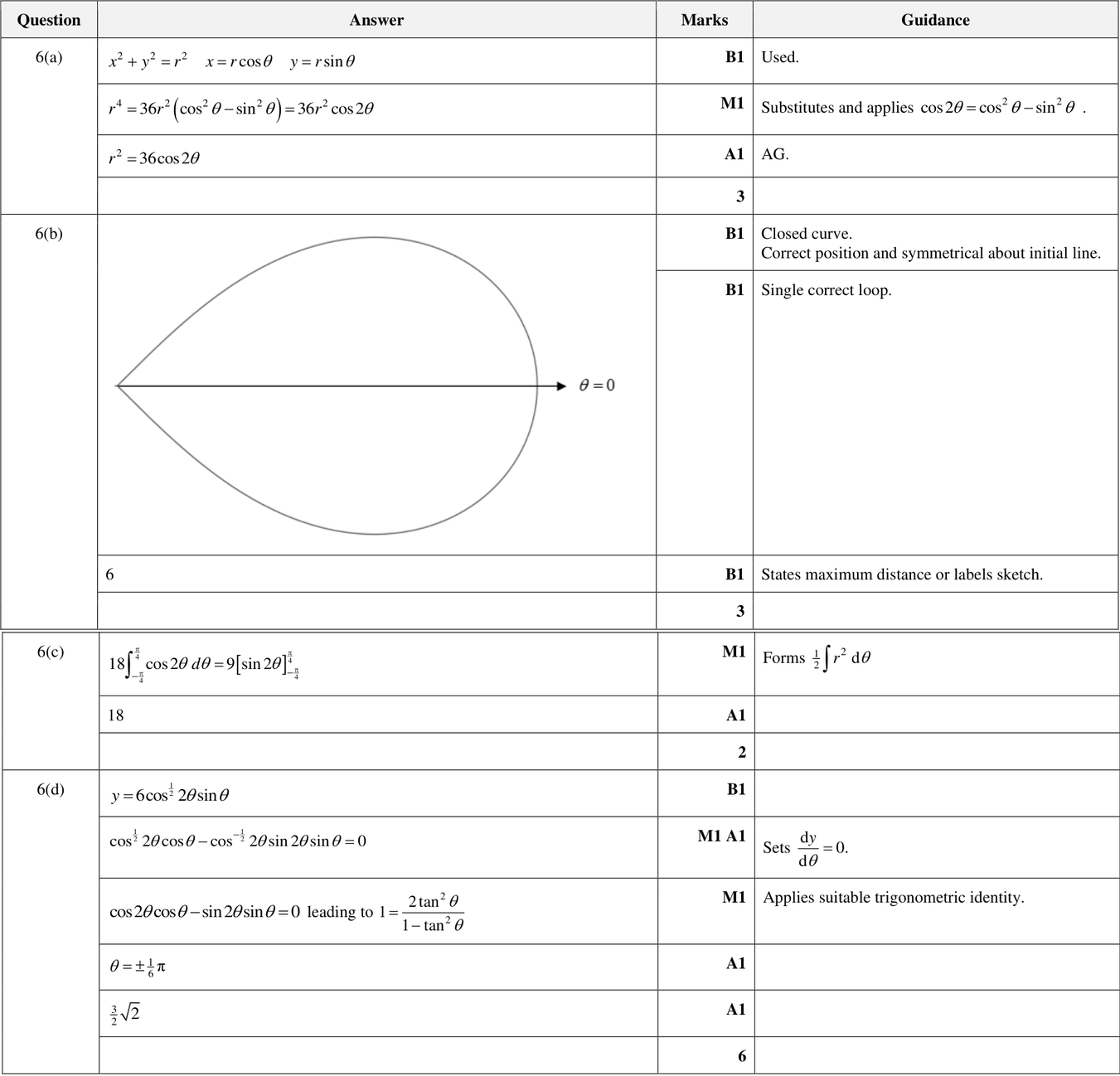
(a) Show that the curve with Cartesian equation \((x^2 + y^2)^2 = 36(x^2 - y^2)\) has polar equation \(r^2 = 36 \cos 2\theta\).
The curve \(C\) has polar equation \(r^2 = 36 \cos 2\theta\), for \(-\frac{1}{4}\pi \leq \theta \leq \frac{1}{4}\pi\).
(b) Sketch \(C\) and state the maximum distance of a point on \(C\) from the pole.
(c) Find the area of the region enclosed by \(C\).
(d) Find the maximum distance of a point on \(C\) from the initial line, giving the answer in exact form.
FM November 2022 p11 q07
4252
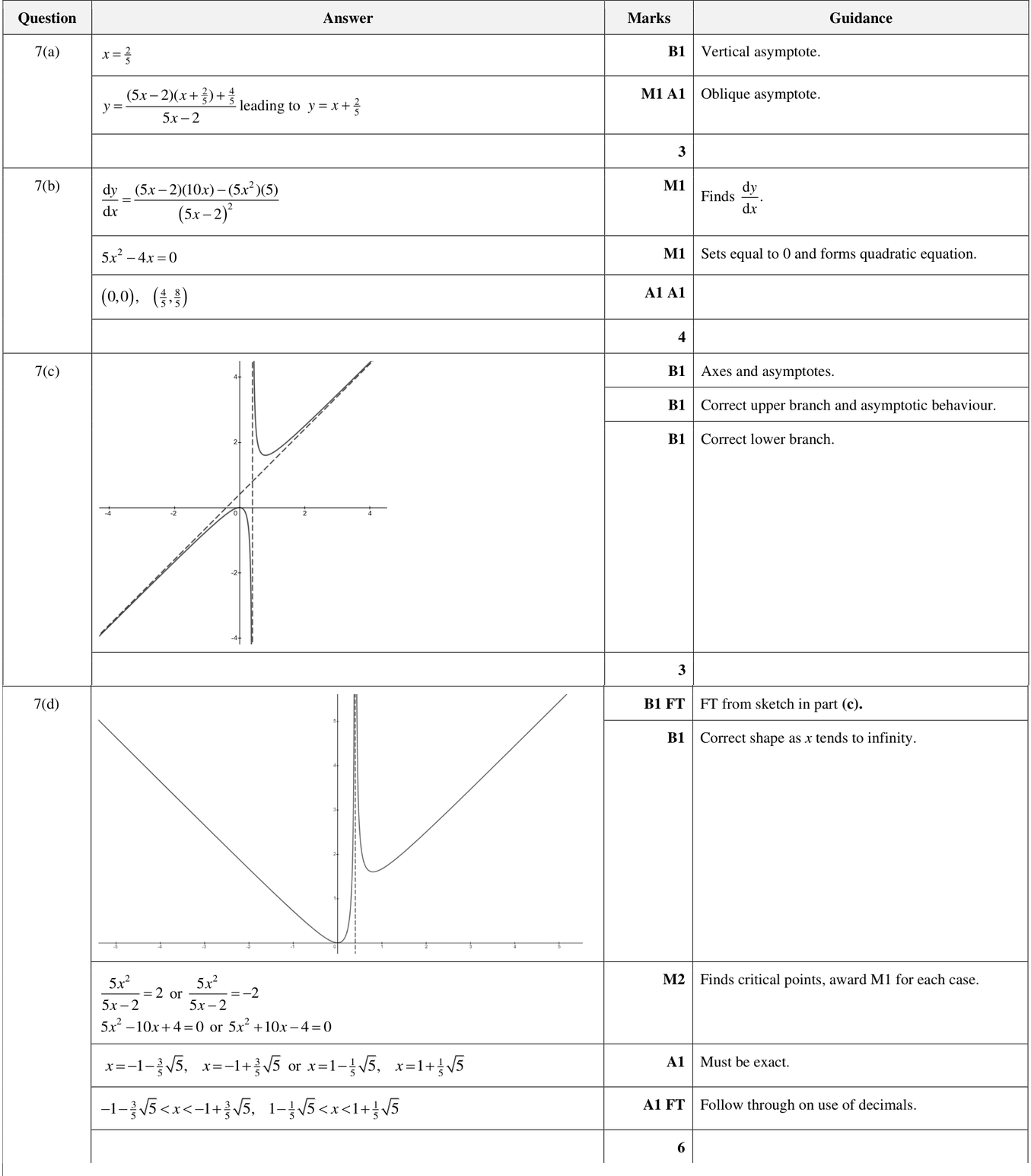
The curve \(C\) has equation \(y = \frac{5x^2}{5x-2}\).
- Find the equations of the asymptotes of \(C\).
- Find the coordinates of the stationary points on \(C\).
- Sketch \(C\).
- Sketch the curve with equation \(y = \left| \frac{5x^2}{5x-2} \right|\) and find in exact form the set of values of \(x\) for which \(\left| \frac{5x^2}{5x-2} \right| < 2\).
FM November 2022 p12 q01
4253
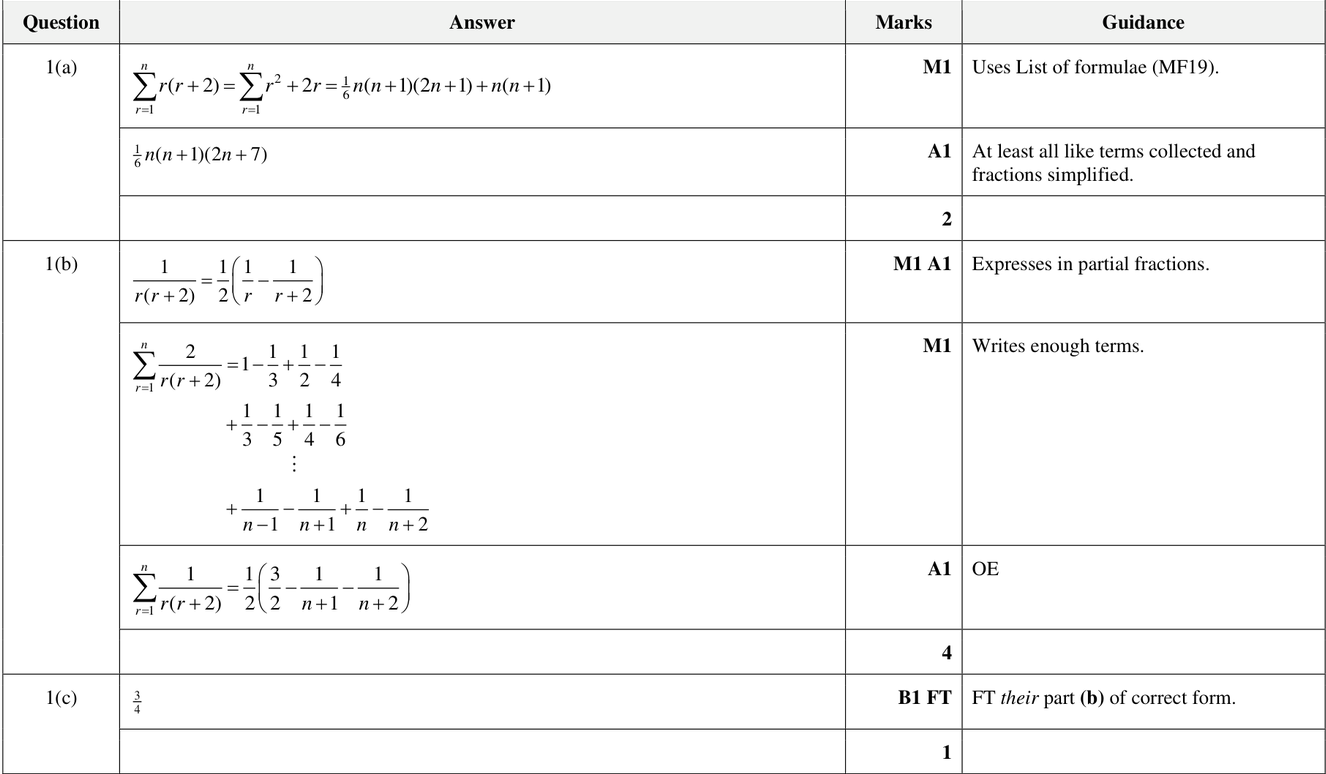
(a) Use the list of formulae (MF19) to find \(\sum_{r=1}^{n} r(r+2)\) in terms of \(n\), simplifying your answer.
(b) Express \(\frac{1}{r(r+2)}\) in partial fractions and hence find \(\sum_{r=1}^{n} \frac{1}{r(r+2)}\) in terms of \(n\).
(c) Deduce the value of \(\sum_{r=1}^{\infty} \frac{1}{r(r+2)}\).
FM November 2022 p12 q02
4254
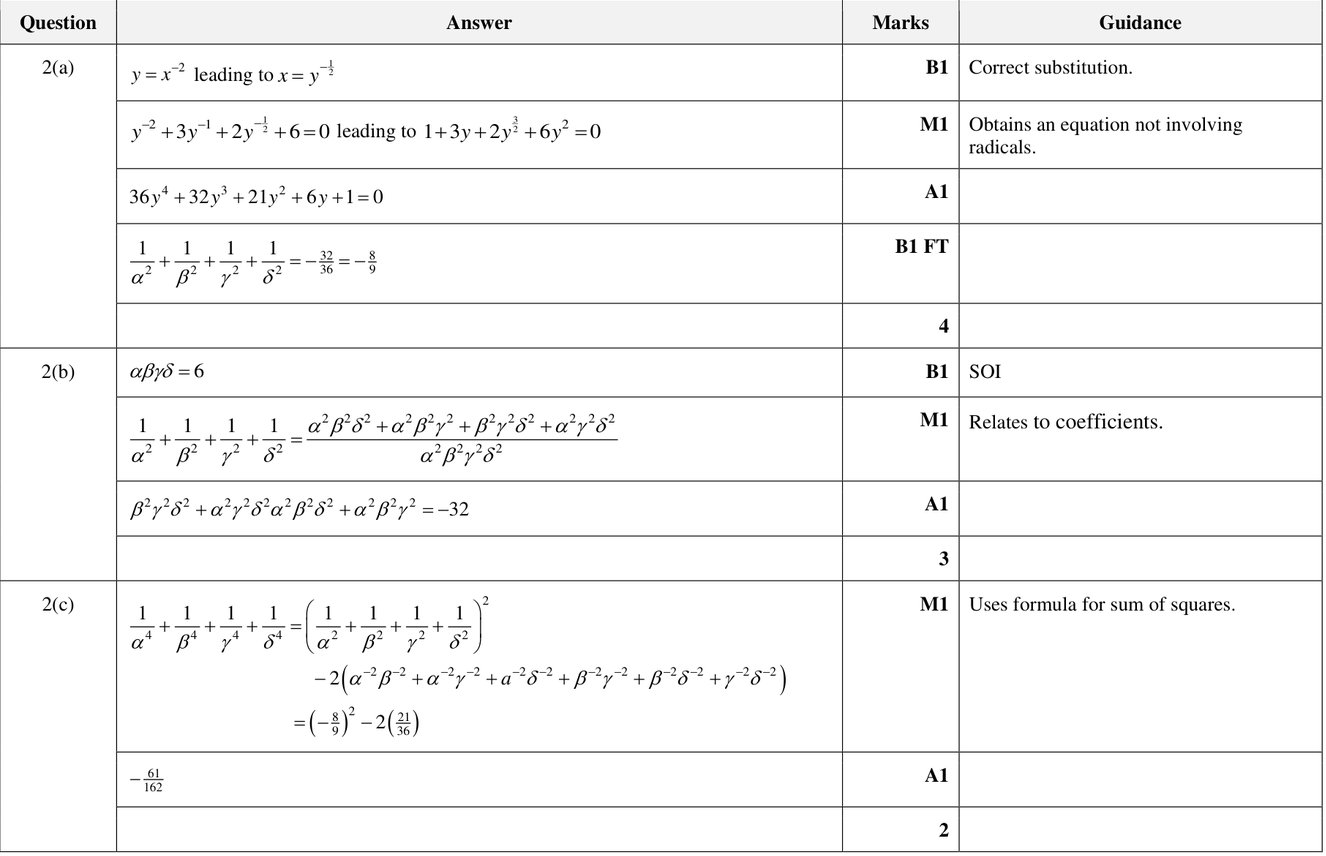
The equation \(x^4 + 3x^2 + 2x + 6 = 0\) has roots \(\alpha, \beta, \gamma, \delta\).
(a) Find a quartic equation whose roots are \(\frac{1}{\alpha^2}, \frac{1}{\beta^2}, \frac{1}{\gamma^2}, \frac{1}{\delta^2}\) and state the value of \(\frac{1}{\alpha^2} + \frac{1}{\beta^2} + \frac{1}{\gamma^2} + \frac{1}{\delta^2}\).
(b) Find the value of \(\beta^2 \gamma^2 \delta^2 + \alpha^2 \gamma^2 \delta^2 + \alpha^2 \beta^2 \delta^2 + \alpha^2 \beta^2 \gamma^2\).
(c) Find the value of \(\frac{1}{\alpha^4} + \frac{1}{\beta^4} + \frac{1}{\gamma^4} + \frac{1}{\delta^4}\).
FM November 2022 p12 q03
4255
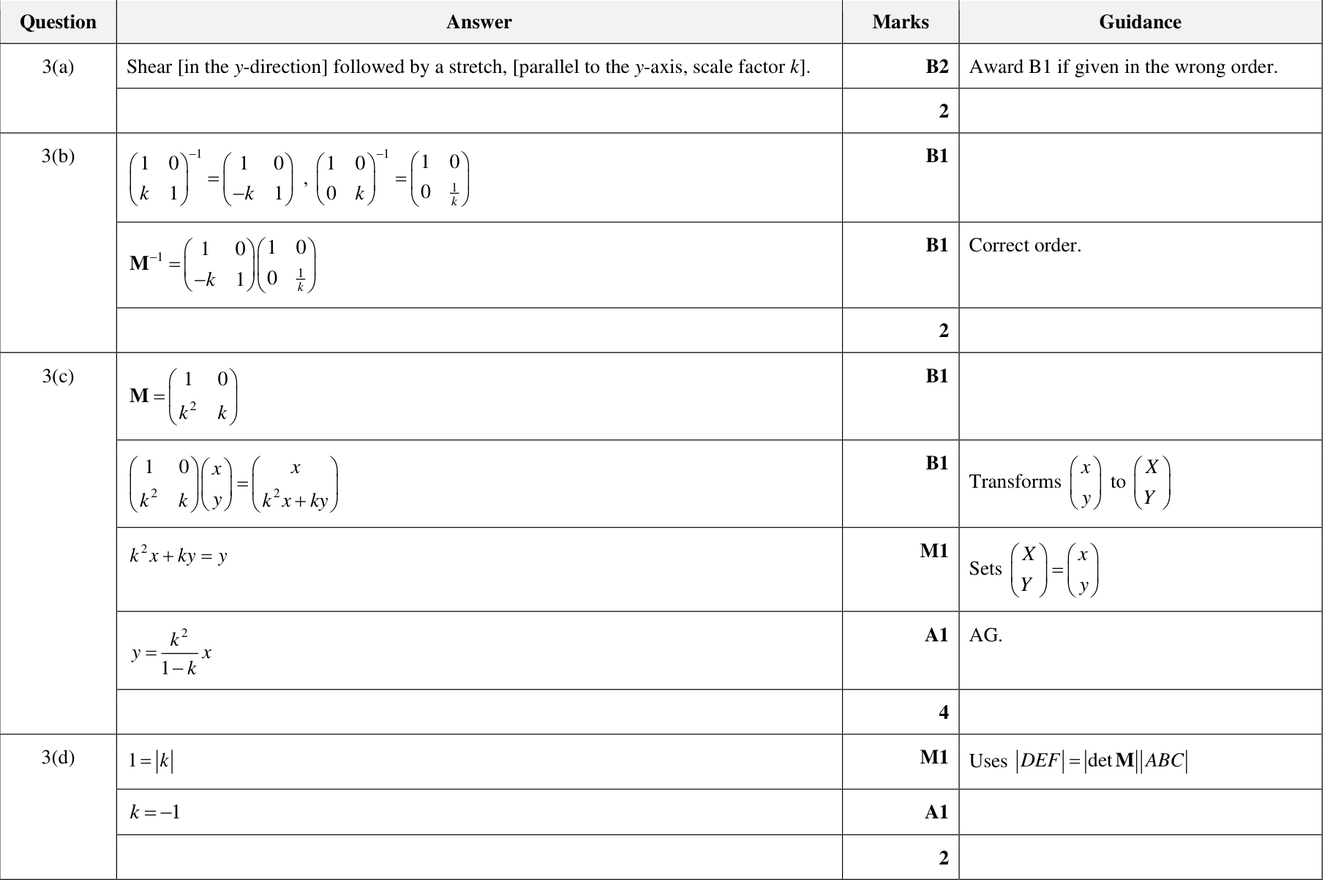
The matrix M is given by M = \(\begin{pmatrix} 1 & 0 \\ 0 & k \end{pmatrix} \begin{pmatrix} 1 & 0 \\ k & 1 \end{pmatrix}\), where \(k\) is a constant and \(k \neq 0\) or 1.
(a) The matrix M represents a sequence of two geometrical transformations. State the type of each transformation, and make clear the order in which they are applied. [2]
(b) Write M-1 as the product of two matrices, neither of which is I. [2]
(c) Show that the invariant points of the transformation represented by M lie on the line \(y = \frac{k^2}{1-k}x\). [4]
(d) The triangle ABC in the x-y plane is transformed by M onto triangle DEF. Find the value of \(k\) for which the area of triangle DEF is equal to the area of triangle ABC. [2]
FM November 2022 p12 q04
4256
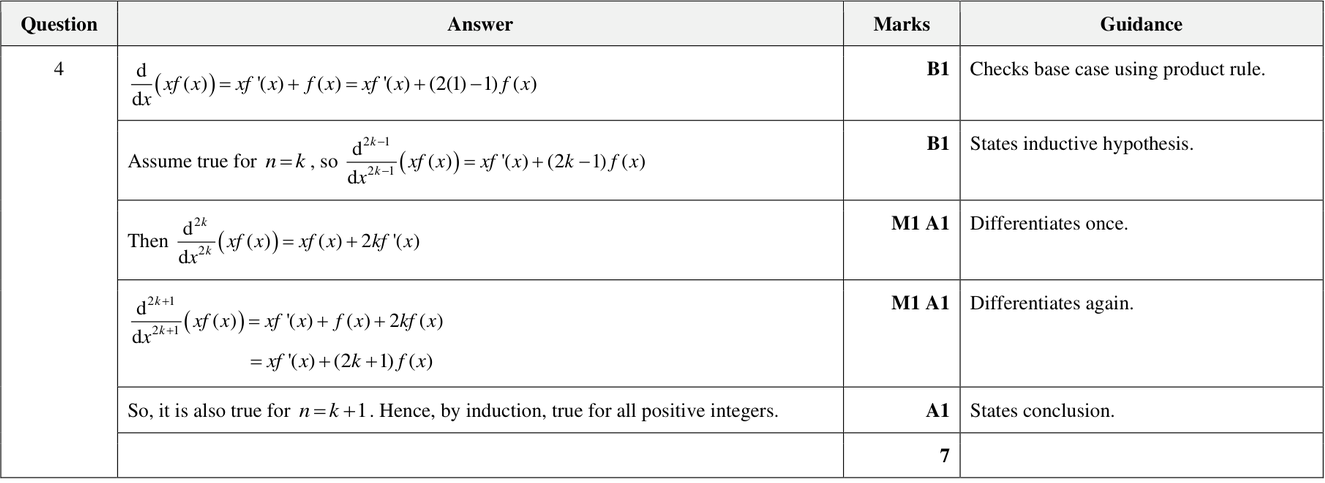
The function \(f\) is such that \(f''(x)= f(x)\)
Prove by mathematical induction that, for every positive integer n,
\(\frac{d^{2n-1}}{dx^{2n-1}}(xf(x)) = xf'(x) + (2n-1)f(x).\)
FM November 2022 p12 q05
4257
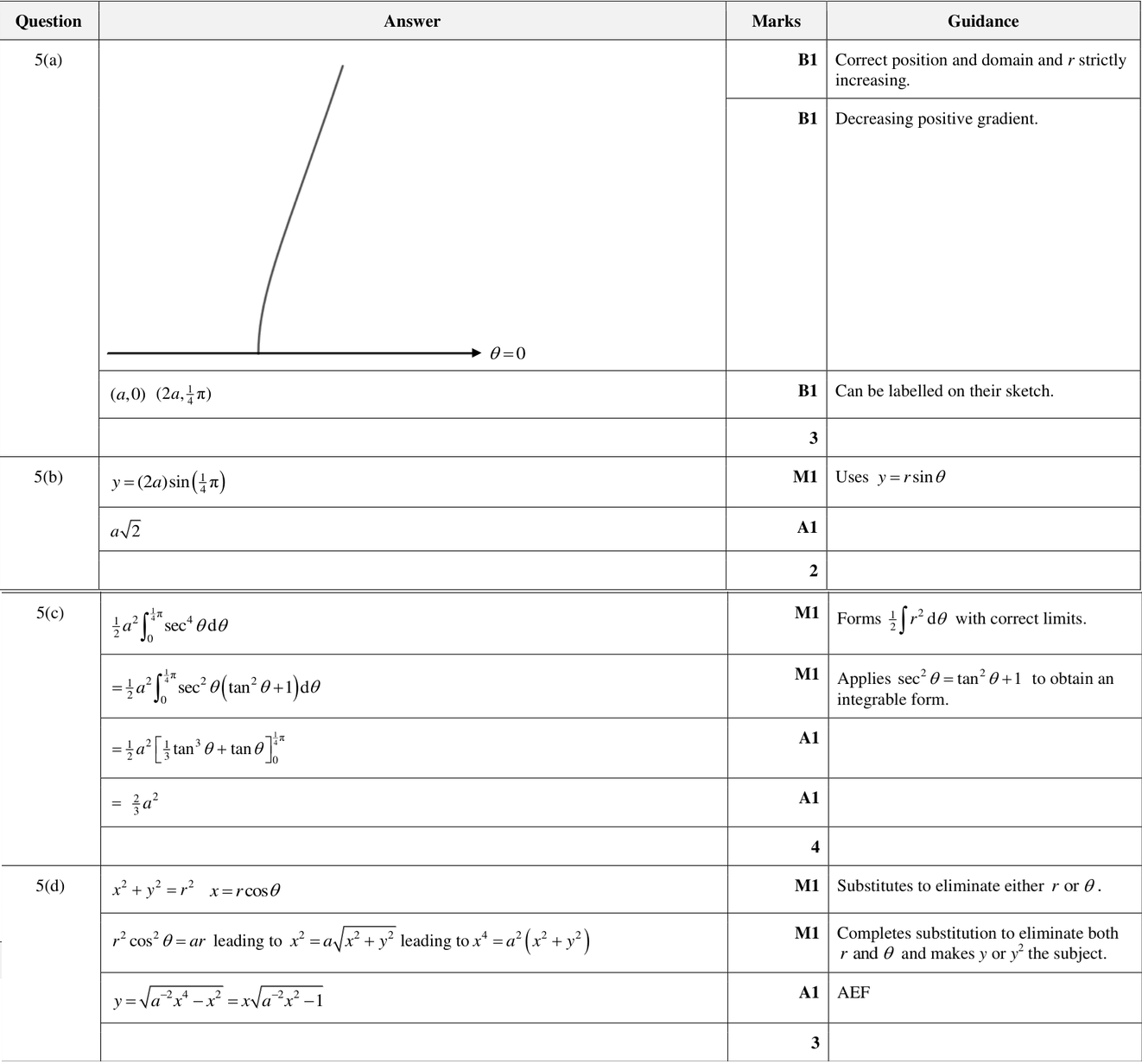
The curve C has polar equation \(r = a \sec^2 \theta\), where \(a\) is a positive constant and \(0 \leq \theta \leq \frac{1}{4} \pi\).
- Sketch C, stating the polar coordinates of the point of intersection of C with the initial line and also with the half-line \(\theta = \frac{1}{4} \pi\).
- Find the maximum distance of a point of C from the initial line.
- Find the area of the region enclosed by C, the initial line and the half-line \(\theta = \frac{1}{4} \pi\).
- Find, in the form \(y = f(x)\), the Cartesian equation of C.
FM November 2022 p12 q06
4258
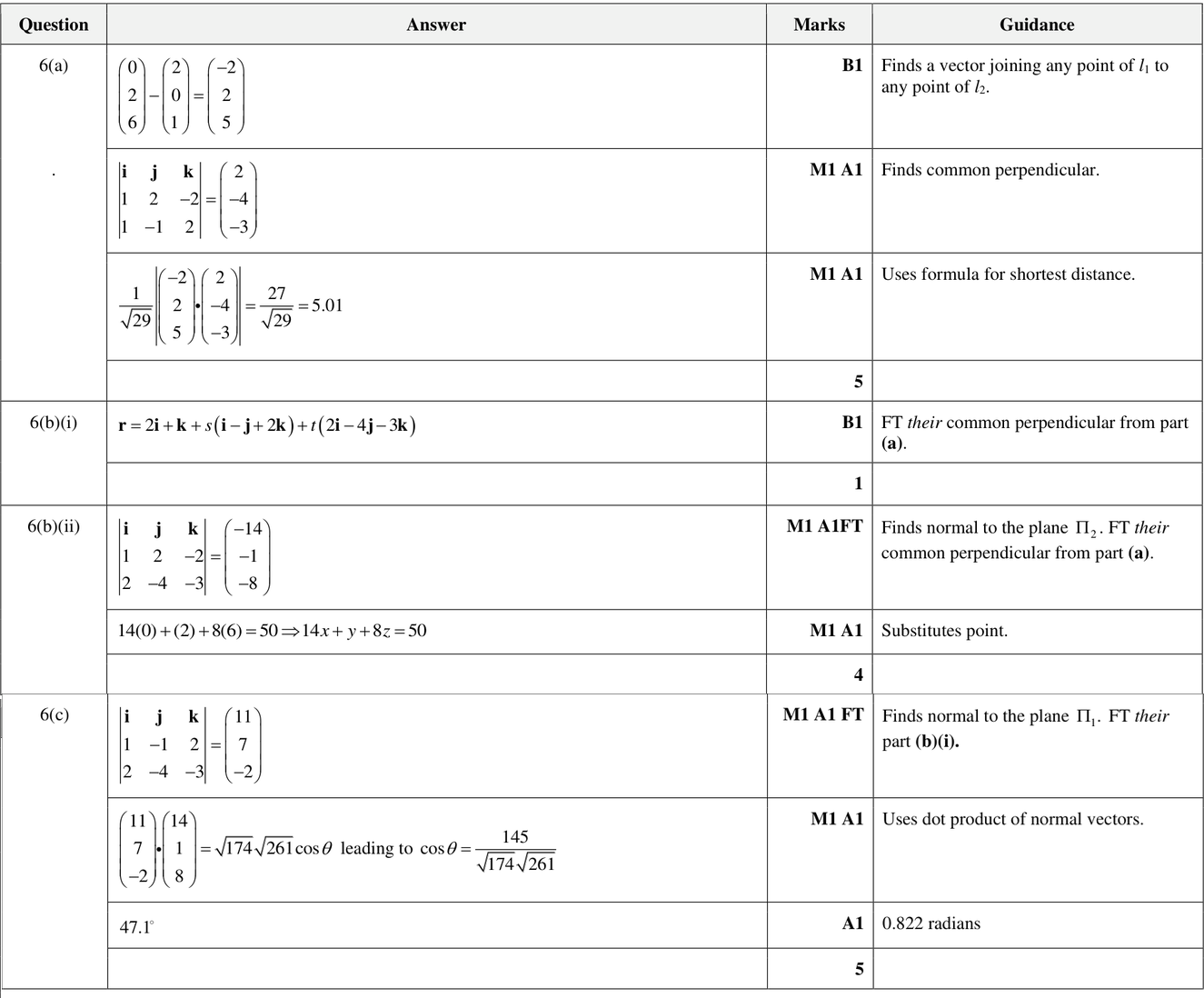
The lines \(l_1\) and \(l_2\) have equations \(\mathbf{r} = 2\mathbf{i} + \mathbf{k} + \lambda(\mathbf{i} - \mathbf{j} + 2\mathbf{k})\) and \(\mathbf{r} = 2\mathbf{j} + 6\mathbf{k} + \mu(\mathbf{i} + 2\mathbf{j} - 2\mathbf{k})\) respectively.
The point \(P\) on \(l_1\) and the point \(Q\) on \(l_2\) are such that \(PQ\) is perpendicular to both \(l_1\) and \(l_2\).
(a) Find the length \(PQ\). [5]
The plane \(\Pi_1\) contains \(PQ\) and \(l_1\).
The plane \(\Pi_2\) contains \(PQ\) and \(l_2\).
(b) (i) Write down an equation of \(\Pi_1\), giving your answer in the form \(\mathbf{r} = \mathbf{a} + s\mathbf{b} + t\mathbf{c}\). [1]
(ii) Find an equation of \(\Pi_2\), giving your answer in the form \(ax + by + cz = d\). [4]
(c) Find the acute angle between \(\Pi_1\) and \(\Pi_2\). [5]
FM November 2022 p12 q07
4259
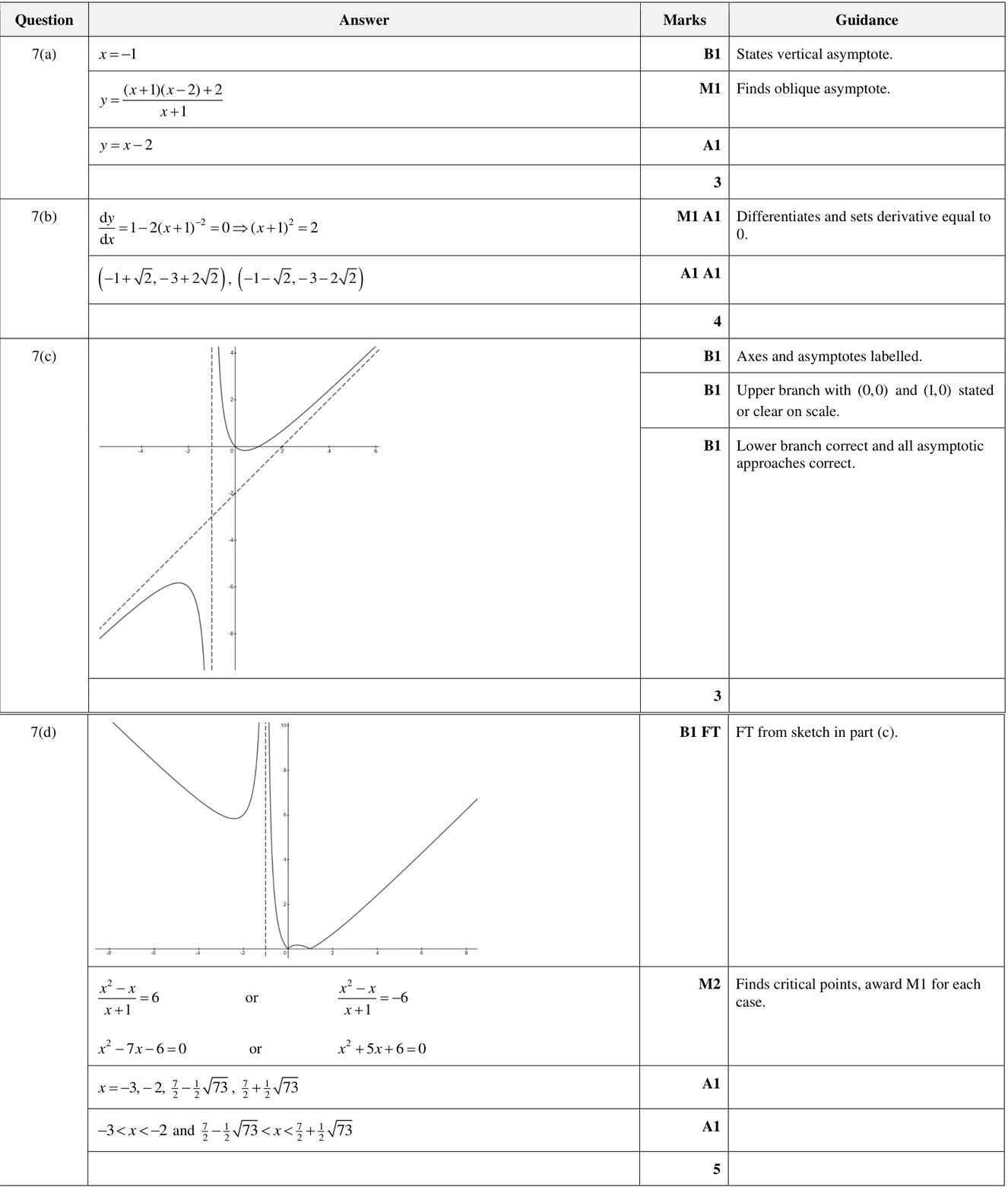
The curve C has equation \(y = \frac{x^2 - x}{x + 1}\).
- Find the equations of the asymptotes of C.
- Find the exact coordinates of the stationary points on C.
- Sketch C, stating the coordinates of any intersections with the axes.
- Sketch the curve with equation \(y = \left| \frac{x^2 - x}{x + 1} \right|\) and find in exact form the set of values of \(x\) for which \(\left| \frac{x^2 - x}{x + 1} \right| < 6\).