Exam-Style Problems
⬅ Back to SubchapterFM June 2025 p12 q01
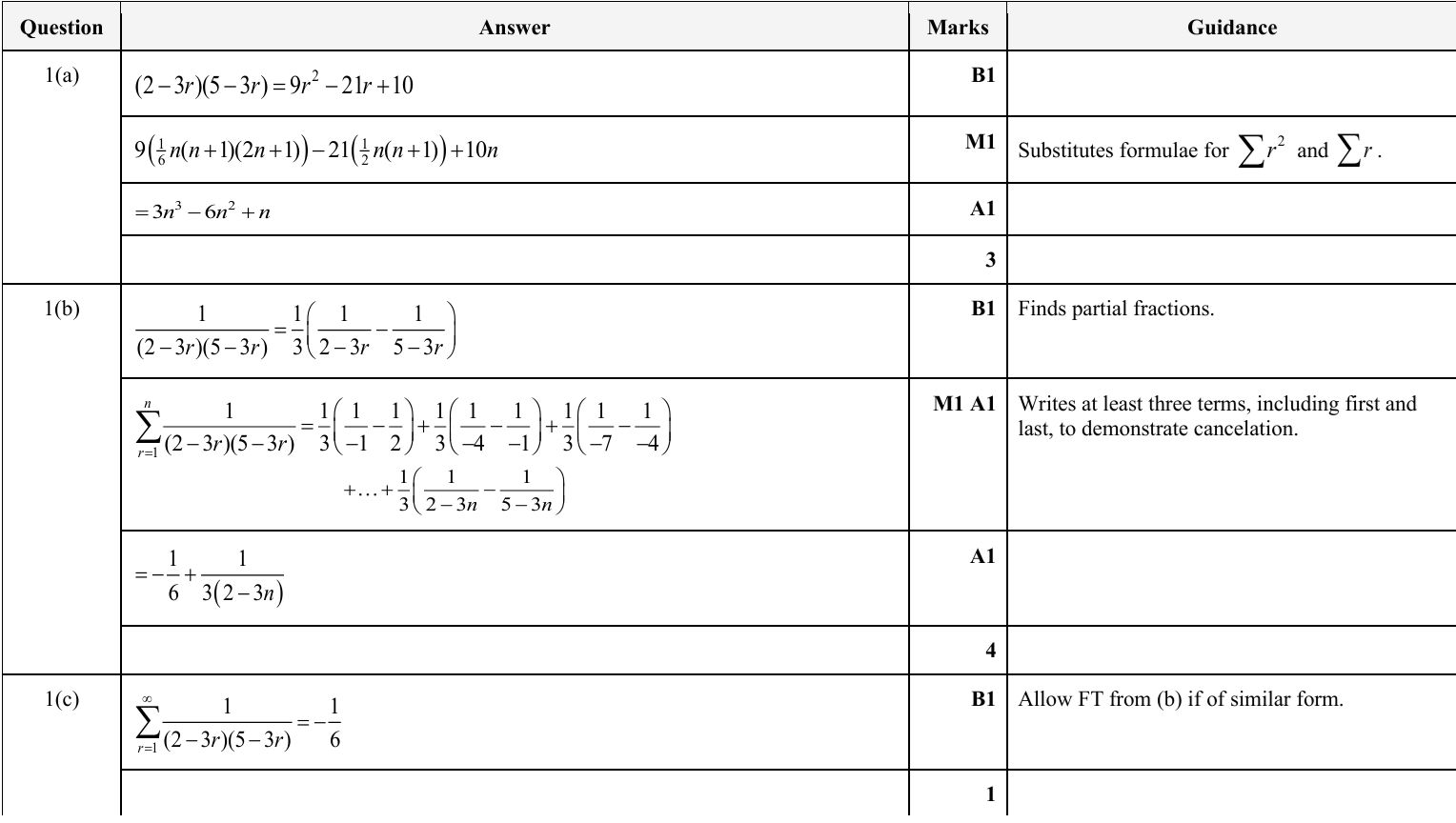
(a) Use standard results from the list of formulae (MF19) to show that
\(\sum_{r=1}^{n} (2-3r)(5-3r) = an^3 + bn^2 + cn,\)
where \(a, b\) and \(c\) are integers to be determined.
(b) Use the method of differences to find \(\sum_{r=1}^{n} \frac{1}{(2-3r)(5-3r)}\) in terms of \(n\).
(c) Deduce the value of \(\sum_{r=1}^{\infty} \frac{1}{(2-3r)(5-3r)}\).
FM June 2025 p12 q02
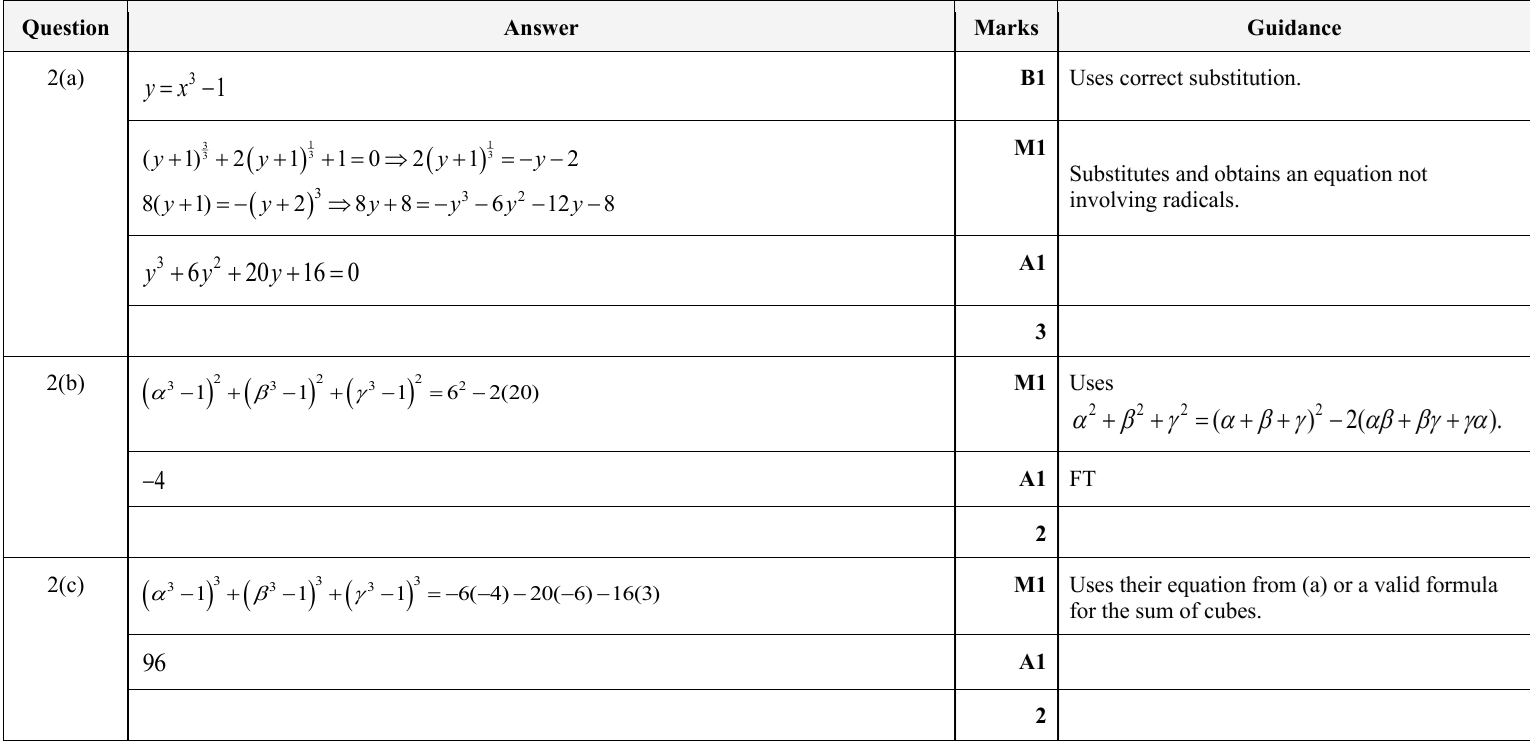
The cubic equation \(x^3 + 2x + 1 = 0\) has roots \(\alpha, \beta, \gamma\).
- Find a cubic equation whose roots are \(\alpha^3 - 1, \beta^3 - 1, \gamma^3 - 1\).
- Find the value of \((\alpha^3 - 1)^2 + (\beta^3 - 1)^2 + (\gamma^3 - 1)^2\).
- Find the value of \((\alpha^3 - 1)^3 + (\beta^3 - 1)^3 + (\gamma^3 - 1)^3\).
FM June 2025 p12 q03
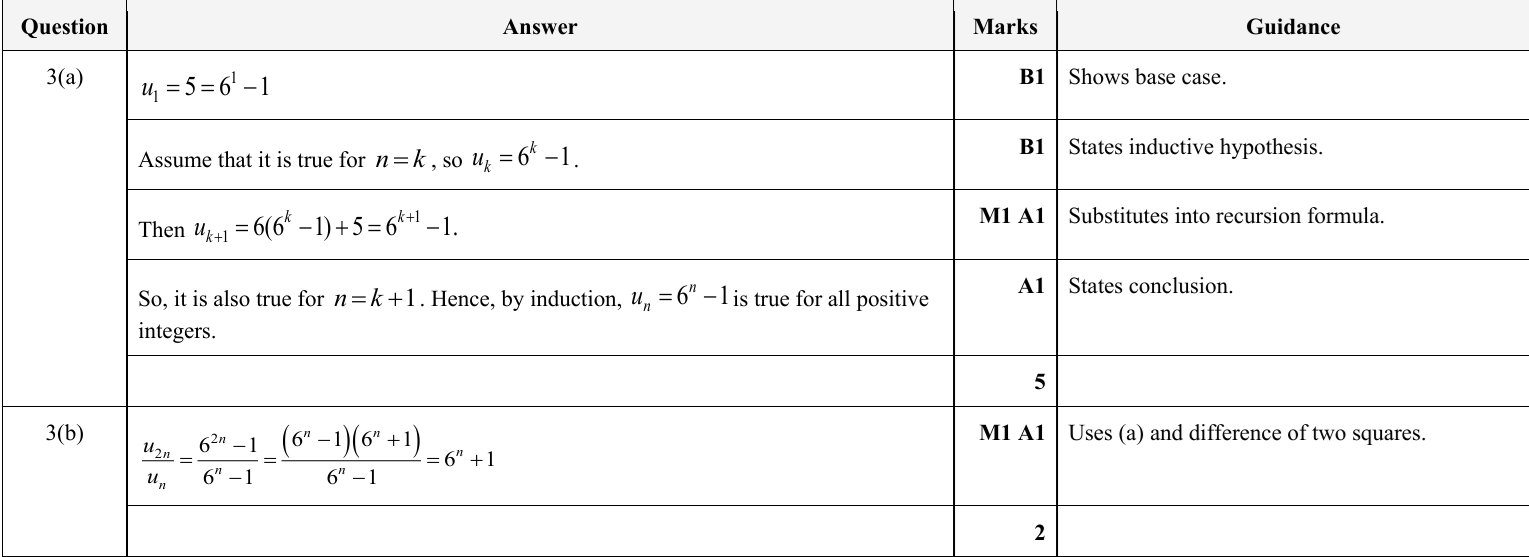
The sequence \(u_1, u_2, u_3, \ldots\) is such that \(u_1 = 5\) and \(u_{n+1} = 6u_n + 5\) for \(n \geq 1\).
(a) Prove by induction that \(u_n = 6^n - 1\) for all positive integers \(n\).
(b) Deduce that \(u_{2n}\) is divisible by \(u_n\) for \(n \geq 1\).
FM June 2025 p12 q04
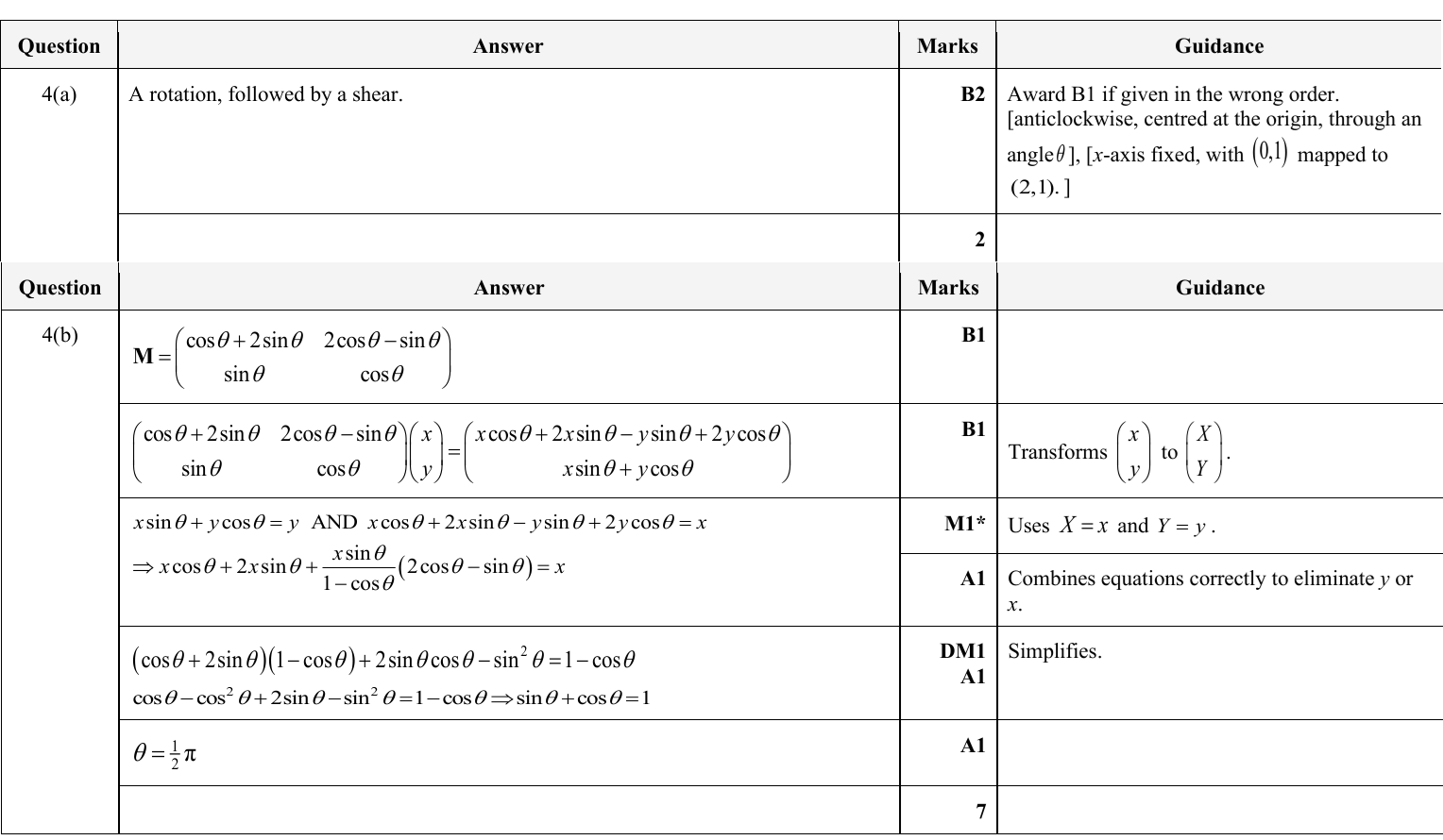
The matrix \(\mathbf{M}\) is given by \(\mathbf{M} = \begin{pmatrix} 1 & 2 \\ 0 & 1 \end{pmatrix} \begin{pmatrix} \cos \theta & -\sin \theta \\ \sin \theta & \cos \theta \end{pmatrix}\), where \(0 < \theta < 2\pi\).
(a) The matrix \(\mathbf{M}\) represents a sequence of two geometrical transformations in the \(x-y\) plane. State the type of each transformation, and make clear the order in which they are applied.
(b) Find the value of \(\theta\) for which the transformation represented by \(\mathbf{M}\) has a line of invariant points.
FM June 2025 p12 q05
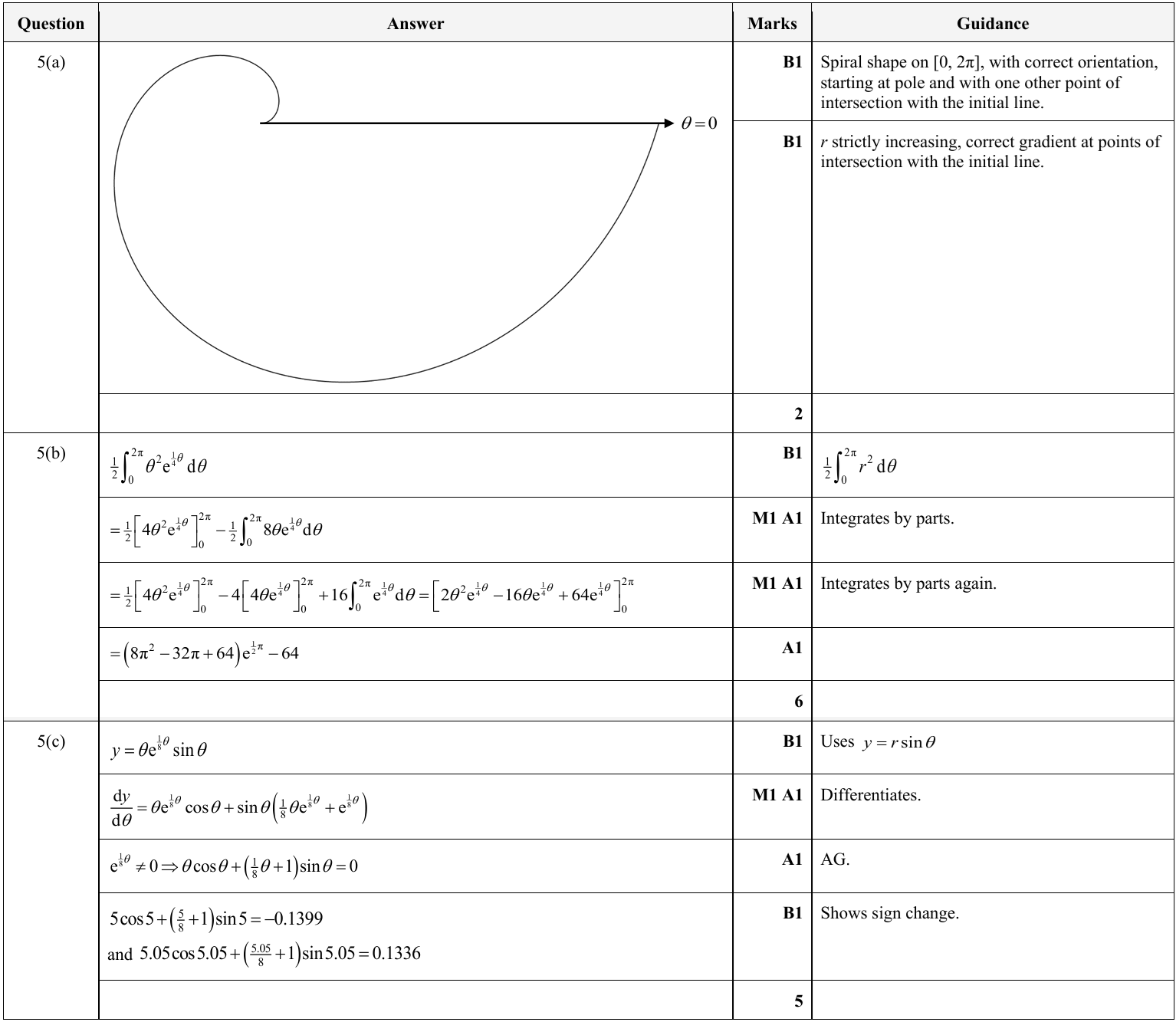
The curve C has polar equation \(r = \theta e^{\frac{1}{8}\theta}\), for \(0 \leq \theta \leq 2\pi\).
(a) Sketch C.
(b) Find the area of the region bounded by C and the initial line, giving your answer in the form \((p\pi^2 + q\pi + r)e^{\frac{1}{2}\pi} + s\), where \(p, q, r\) and \(s\) are integers to be determined.
(c) Show that, at the point of C furthest from the initial line,
\(\theta \cos \theta + \left( \frac{1}{8} \theta + 1 \right) \sin \theta = 0\)
and verify that this equation has a root between 5 and 5.05.
FM June 2025 p12 q06
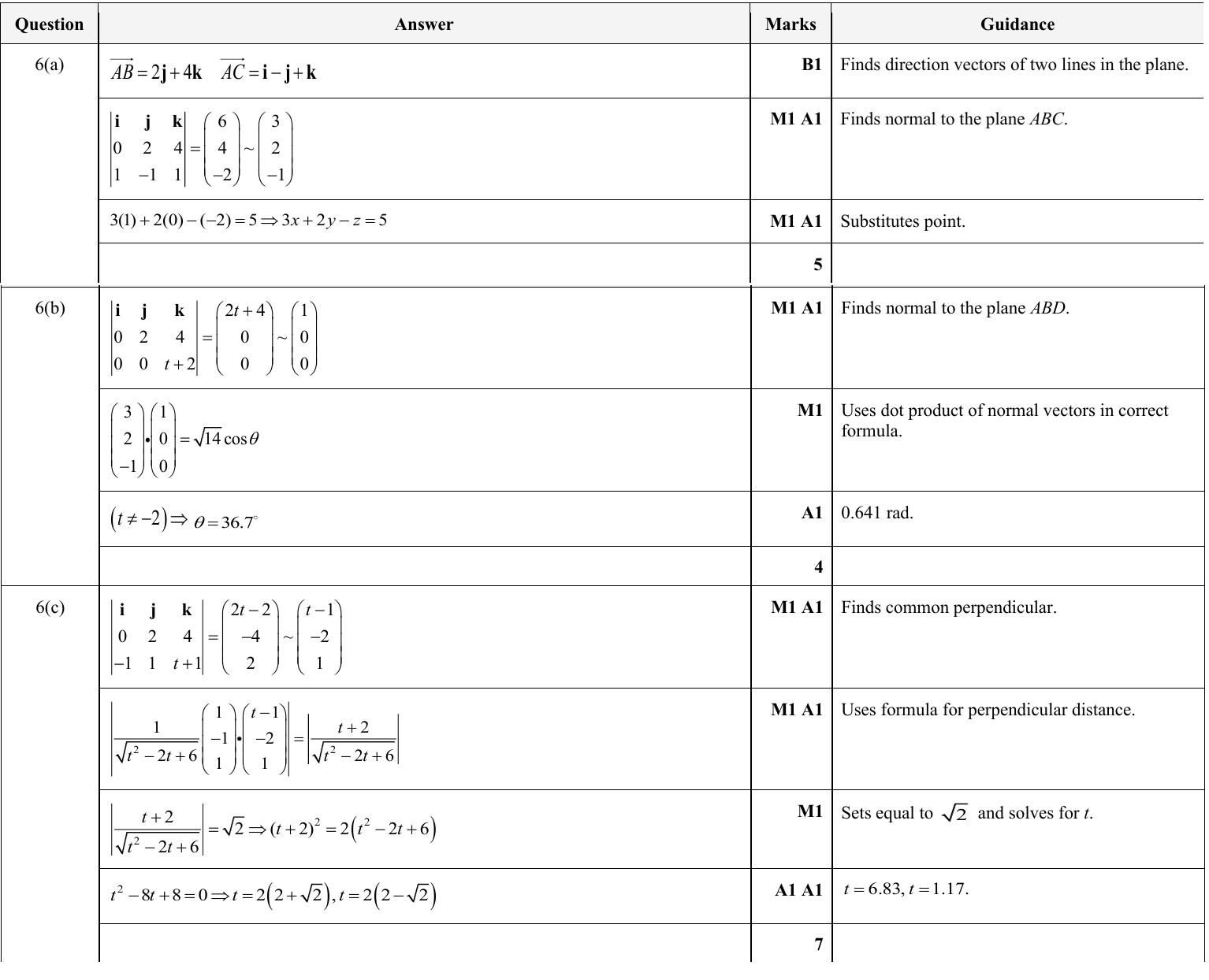
The points A, B, C have position vectors
\(\mathbf{i} - 2\mathbf{k}, \quad \mathbf{i} + 2\mathbf{j} + 2\mathbf{k}, \quad 2\mathbf{i} - \mathbf{j} - \mathbf{k},\)
respectively.
(a) Find the equation of the plane ABC, giving your answer in the form \(ax + by + cz = d\).
A point D has position vector \(\mathbf{i} + t\mathbf{k}\), where \(t \neq -2\).
(b) Find the acute angle between the planes ABC and ABD.
(c) Find the values of \(t\) such that the shortest distance between the lines AB and CD is \(\sqrt{2}\).
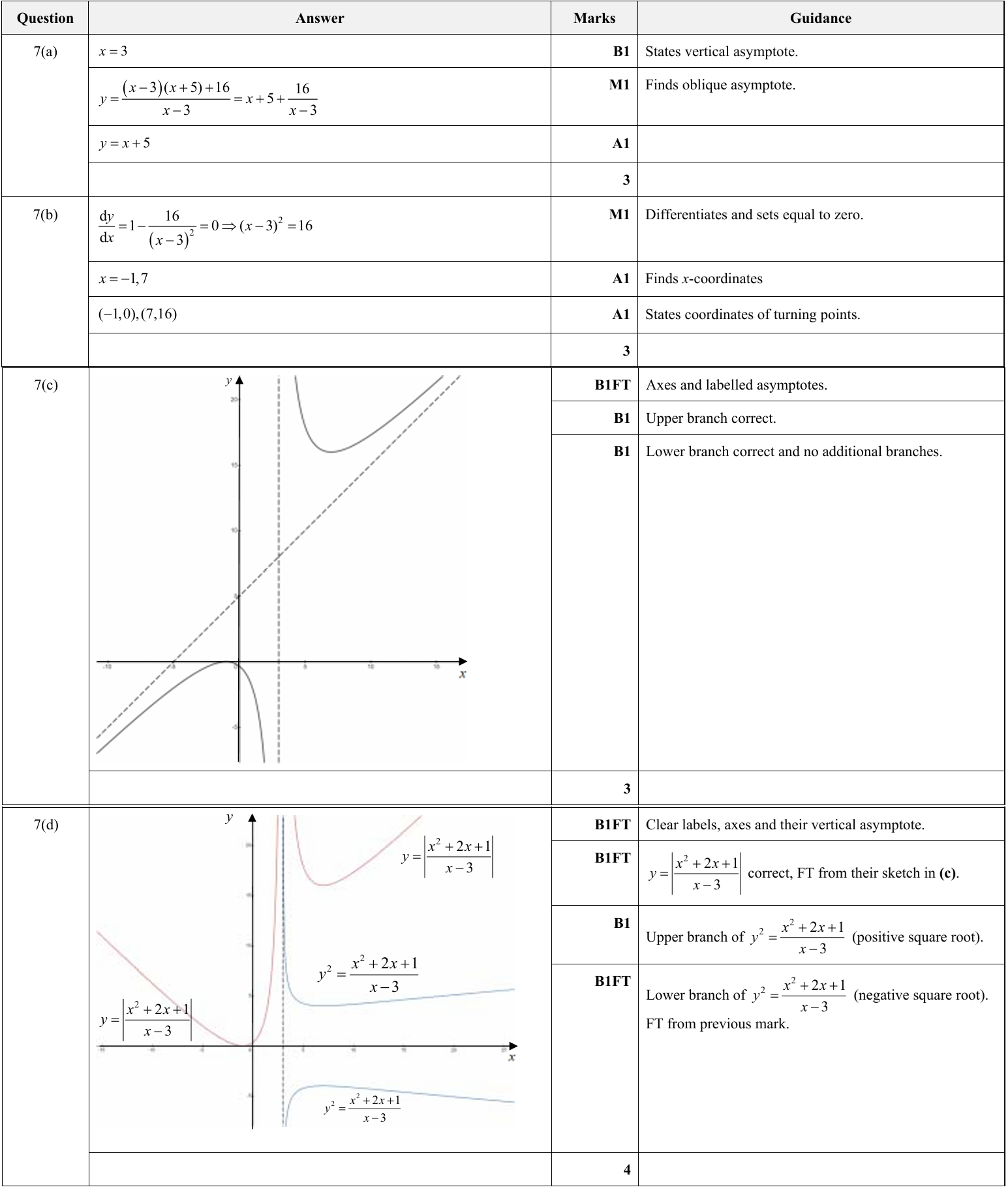
FM June 2025 p12 q07
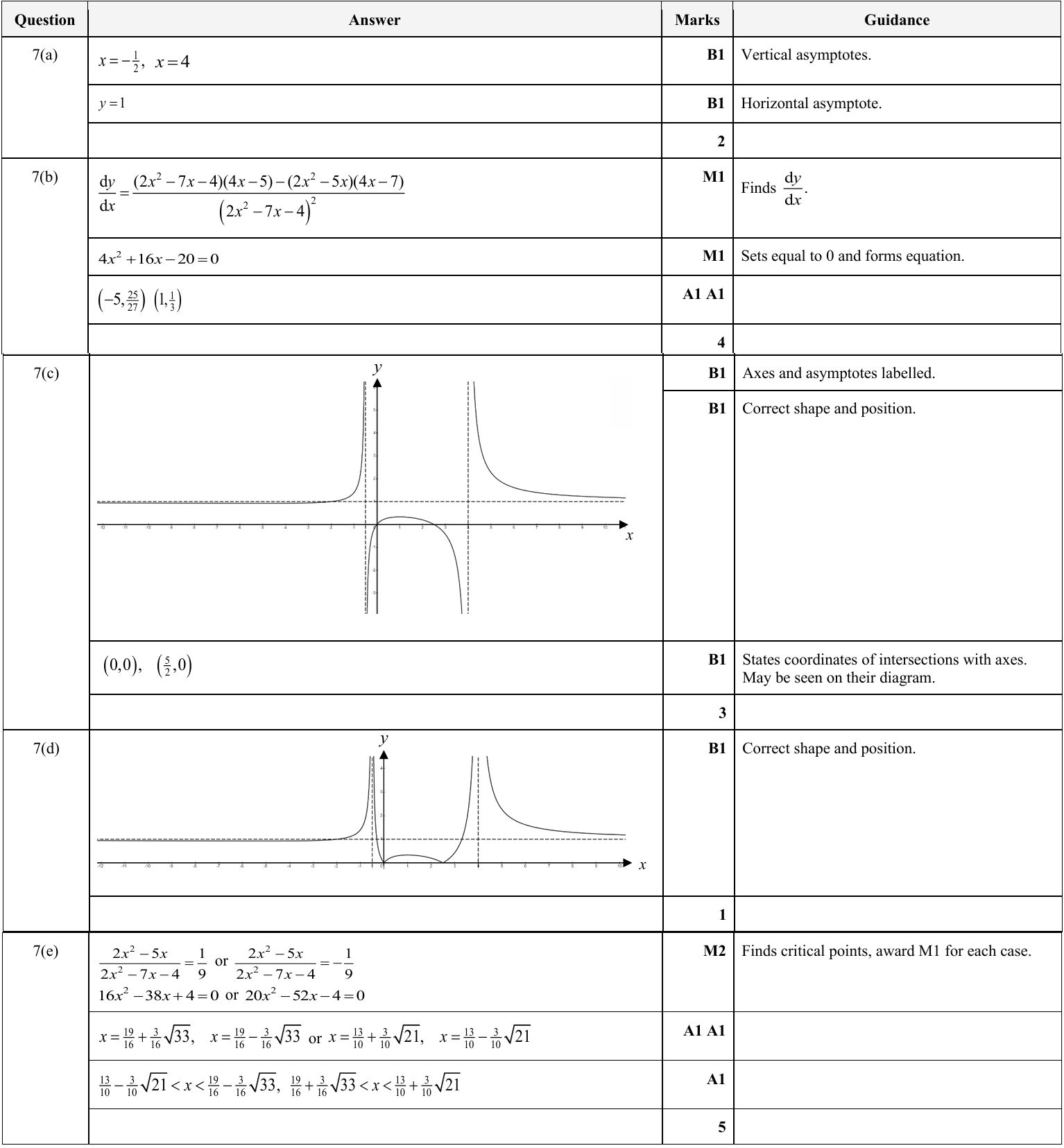
The curve \(C\) has equation \(y = \frac{2x^2 - 5x}{2x^2 - 7x - 4}\).
- Find the equations of the asymptotes of \(C\).
- Find the coordinates of any stationary points on \(C\).
- Sketch \(C\), stating the coordinates of the intersections with the axes.
- Sketch the curve with equation \(y = \left| \frac{2x^2 - 5x}{2x^2 - 7x - 4} \right|\).
- Find in exact form the set of values of \(x\) for which \(\left| \frac{2x^2 - 5x}{2x^2 - 7x - 4} \right| < \frac{1}{9}\).
FM June 2025 p11 q01
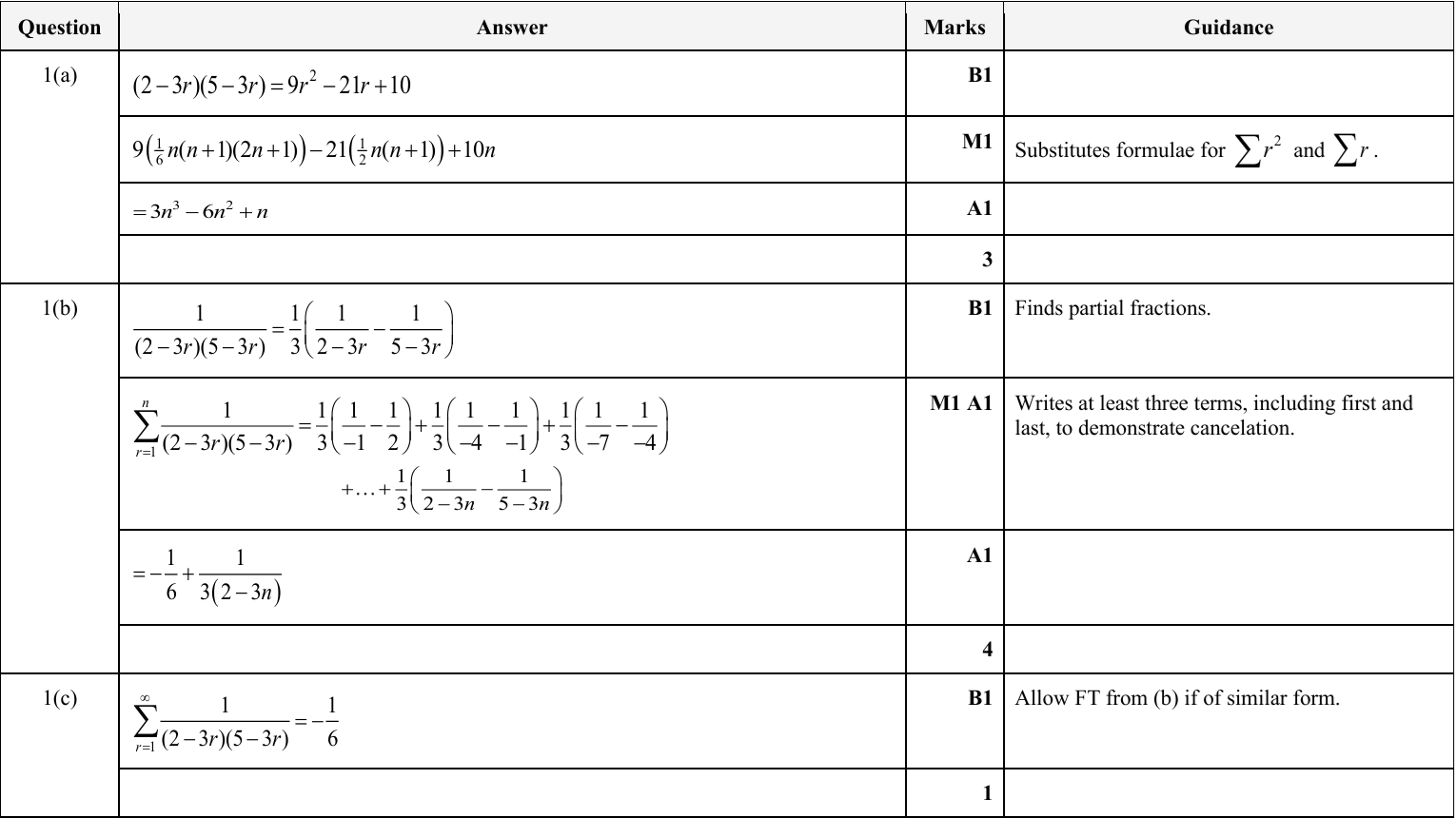
(a) Use standard results from the list of formulae (MF19) to show that
\(\sum_{r=1}^{n} (2-3r)(5-3r) = an^3 + bn^2 + cn,\)
where \(a, b\) and \(c\) are integers to be determined.
(b) Use the method of differences to find \(\sum_{r=1}^{n} \frac{1}{(2-3r)(5-3r)}\) in terms of \(n\).
(c) Deduce the value of \(\sum_{r=1}^{\infty} \frac{1}{(2-3r)(5-3r)}\).
FM June 2025 p11 q02
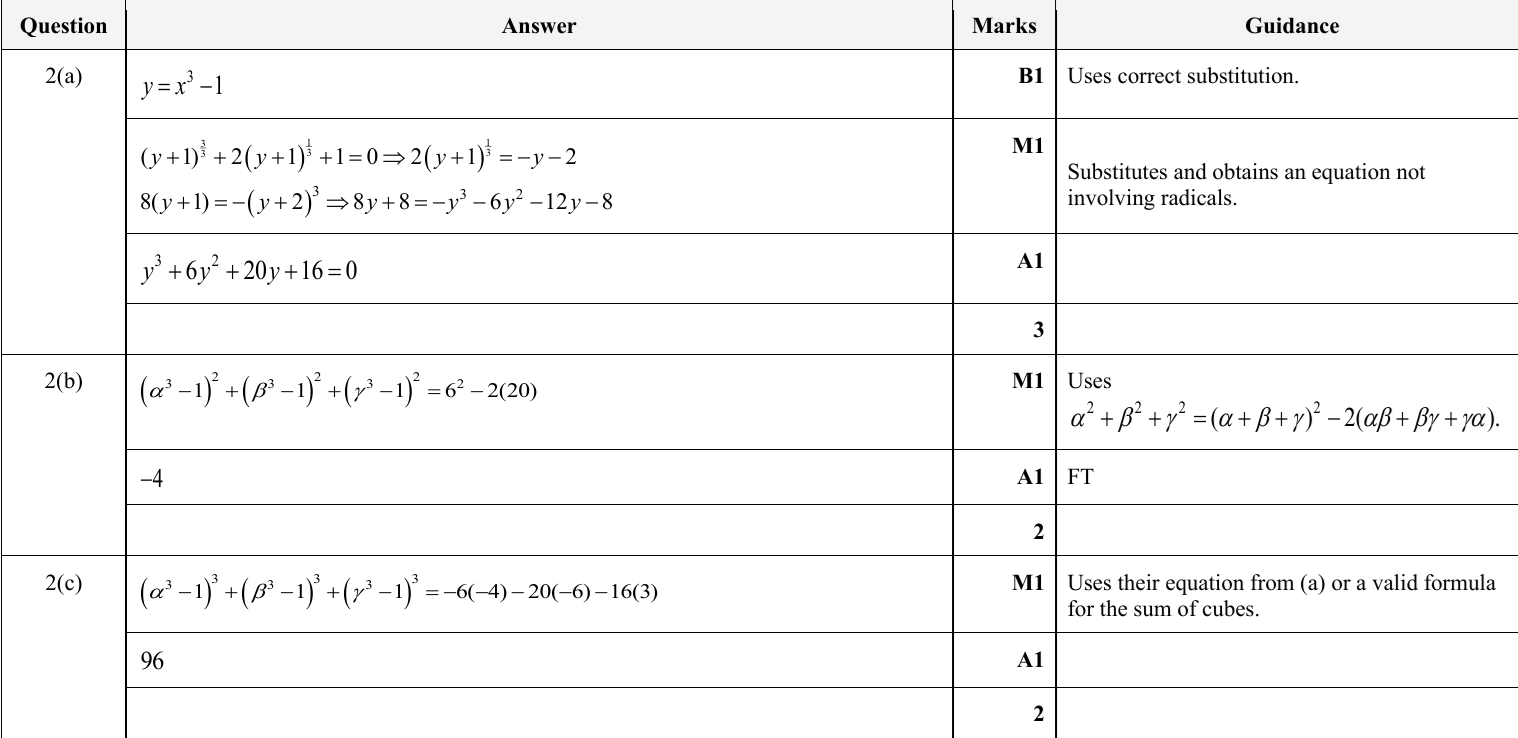
The cubic equation \(x^3 + 2x + 1 = 0\) has roots \(\alpha, \beta, \gamma\).
- Find a cubic equation whose roots are \(\alpha^3 - 1, \beta^3 - 1, \gamma^3 - 1\).
- Find the value of \((\alpha^3 - 1)^2 + (\beta^3 - 1)^2 + (\gamma^3 - 1)^2\).
- Find the value of \((\alpha^3 - 1)^3 + (\beta^3 - 1)^3 + (\gamma^3 - 1)^3\).
FM June 2025 p11 q03
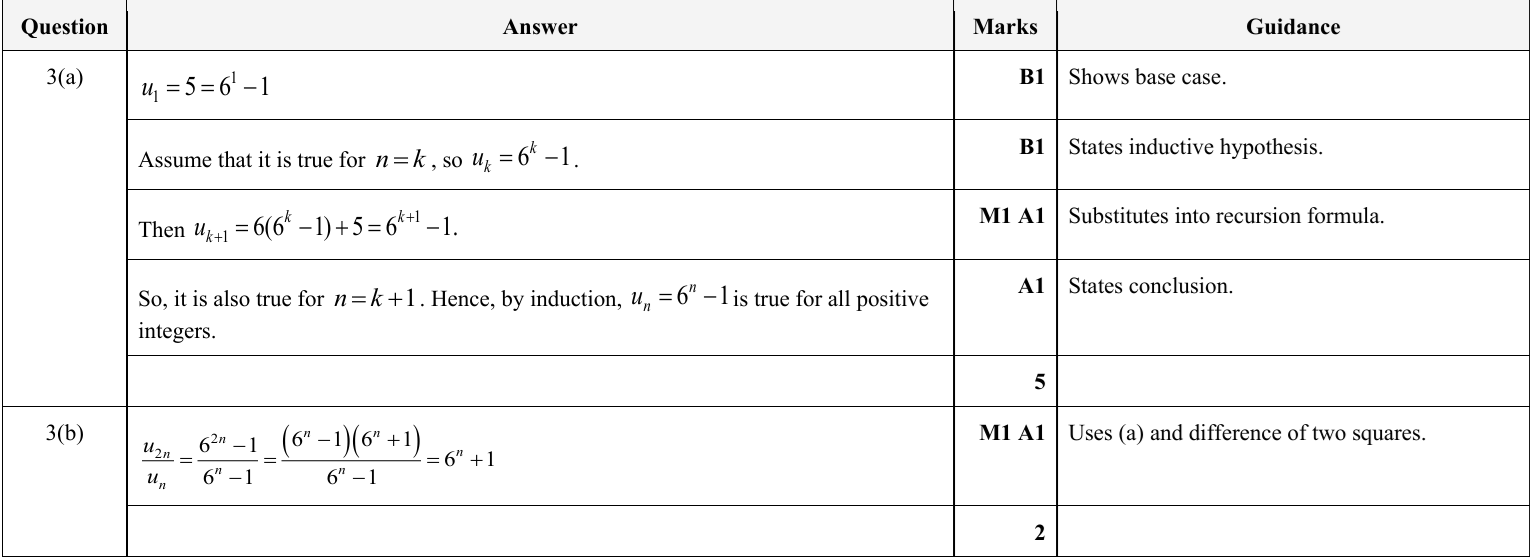
The sequence \(u_1, u_2, u_3, \ldots\) is such that \(u_1 = 5\) and \(u_{n+1} = 6u_n + 5\) for \(n \geq 1\).
(a) Prove by induction that \(u_n = 6^n - 1\) for all positive integers \(n\).
(b) Deduce that \(u_{2n}\) is divisible by \(u_n\) for \(n \geq 1\).
FM June 2025 p11 q04
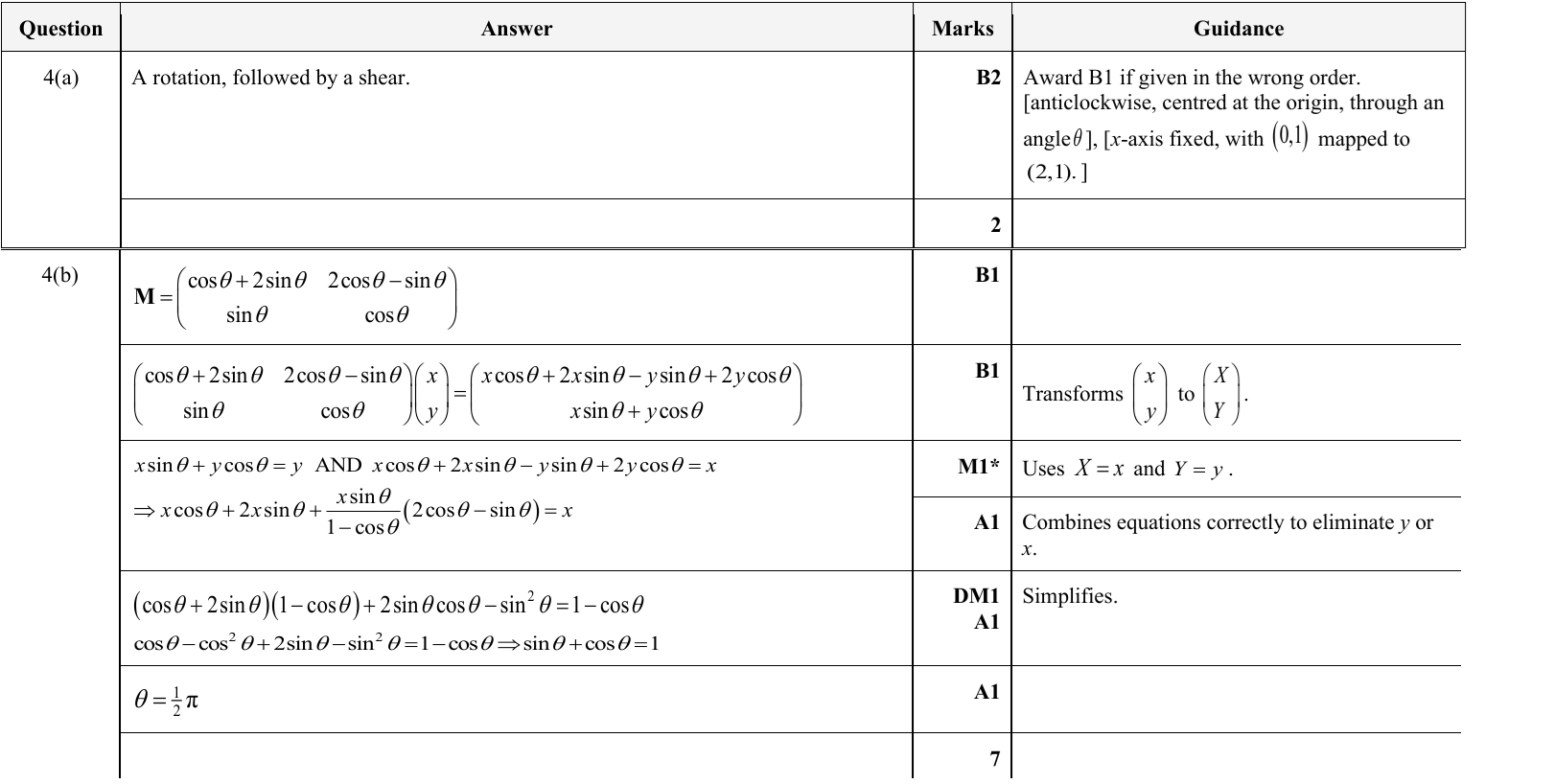
The matrix M is given by \(\mathbf{M} = \begin{pmatrix} 1 & 2 \\ 0 & 1 \end{pmatrix} \begin{pmatrix} \cos \theta & -\sin \theta \\ \sin \theta & \cos \theta \end{pmatrix}\), where \(0 < \theta < 2\pi\).
(a) The matrix M represents a sequence of two geometrical transformations in the x–y plane. State the type of each transformation, and make clear the order in which they are applied.
(b) Find the value of \(\theta\) for which the transformation represented by M has a line of invariant points.
FM June 2025 p11 q05
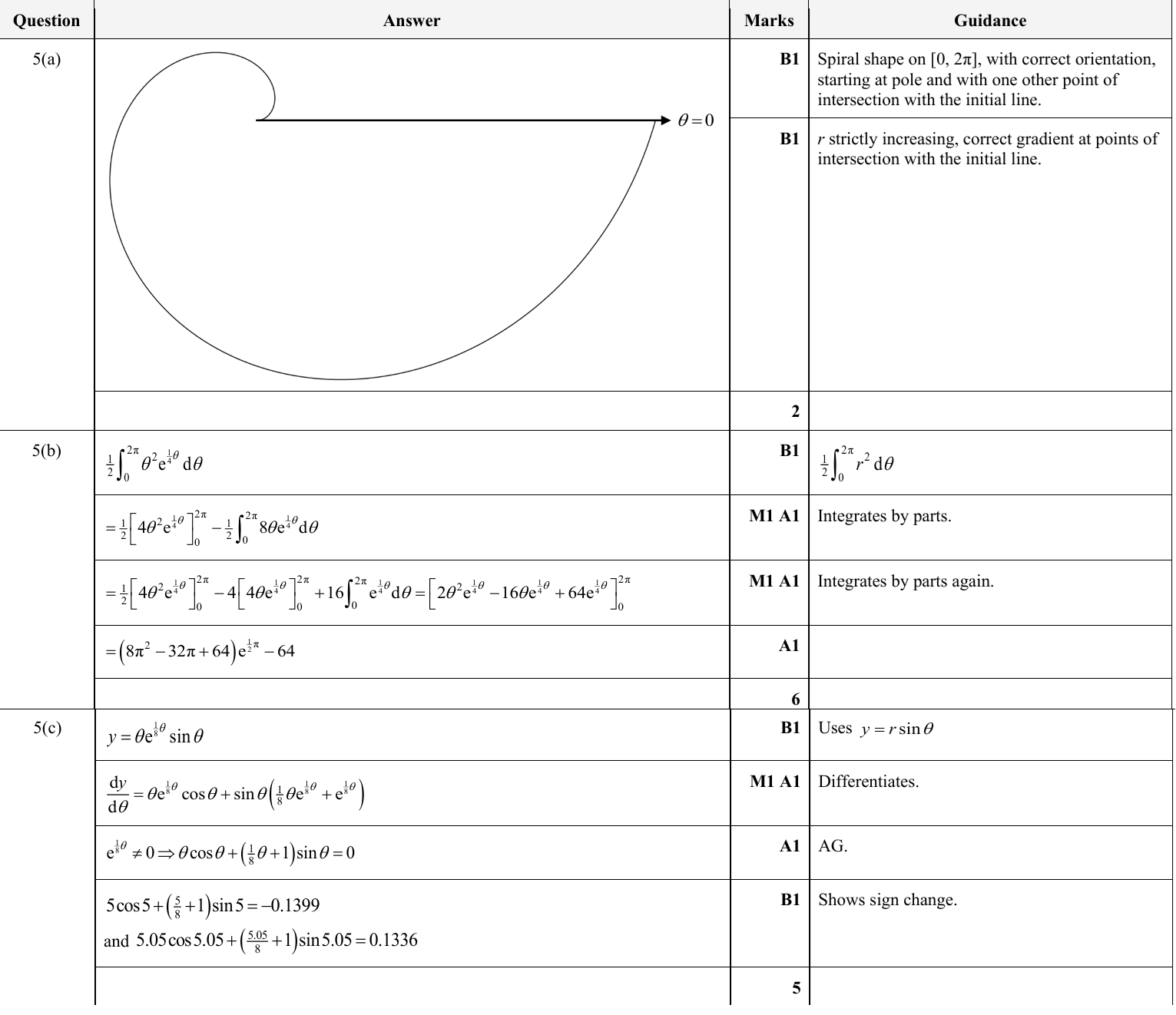
The curve C has polar equation \(r = \theta e^{\frac{1}{8} \theta}\), for \(0 \leq \theta \leq 2\pi\).
- Sketch C.
- Find the area of the region bounded by C and the initial line, giving your answer in the form \((p\pi^2 + q\pi + r)e^{\frac{1}{2}\pi} + s\), where \(p, q, r\) and \(s\) are integers to be determined.
- Show that, at the point of C furthest from the initial line, \(\theta \cos \theta + \left( \frac{1}{8} \theta + 1 \right) \sin \theta = 0\) and verify that this equation has a root between 5 and 5.05.
FM June 2025 p11 q06
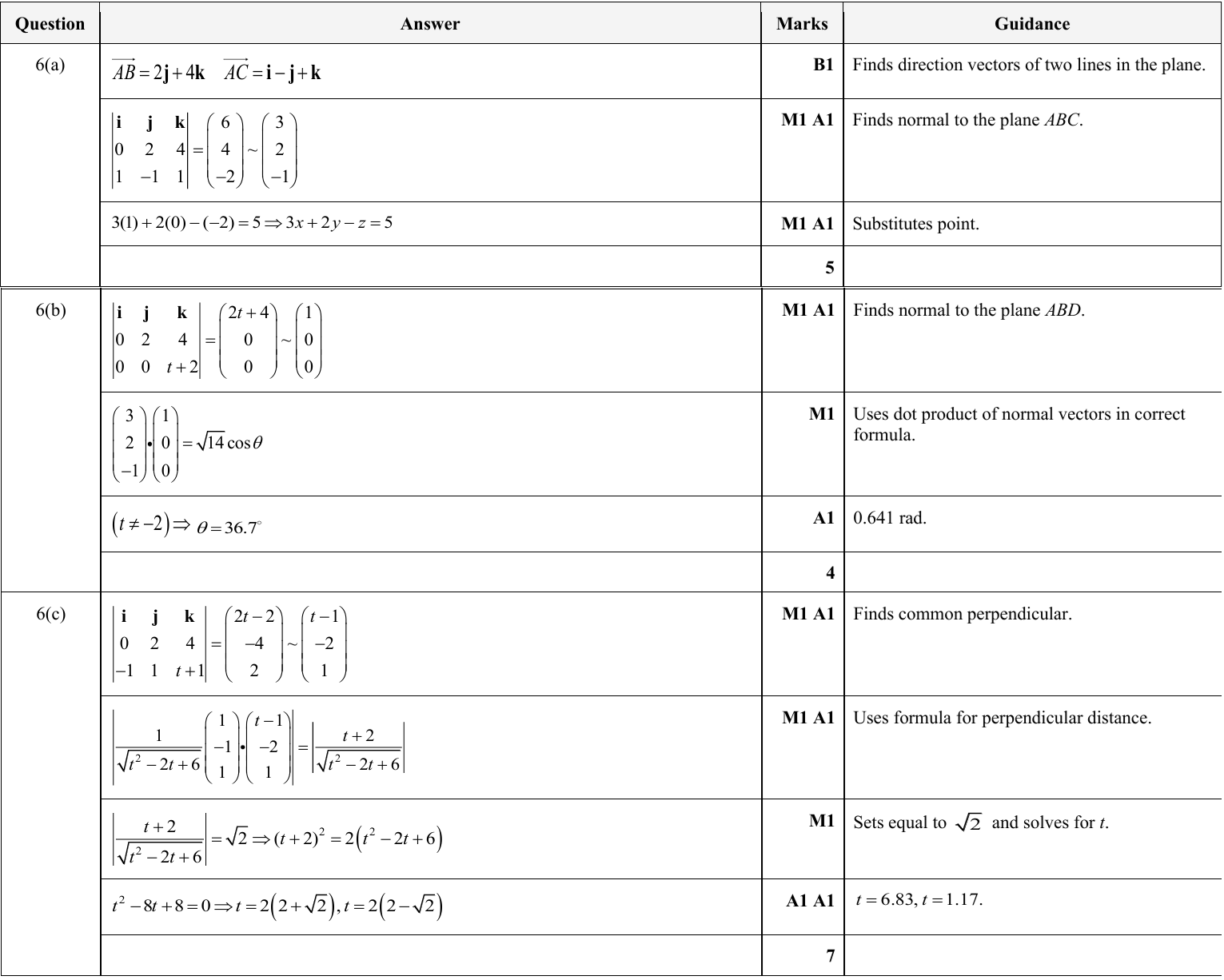
The points A, B, C have position vectors \(\mathbf{i} - 2\mathbf{k}, \mathbf{i} + 2\mathbf{j} + 2\mathbf{k}, 2\mathbf{i} - \mathbf{j} - \mathbf{k}\), respectively.
(a) Find the equation of the plane ABC, giving your answer in the form \(ax + by + cz = d\).
A point D has position vector \(\mathbf{i} + t\mathbf{k}\), where \(t \neq -2\).
(b) Find the acute angle between the planes ABC and ABD.
(c) Find the values of \(t\) such that the shortest distance between the lines AB and CD is \(\sqrt{2}\).
FM June 2025 p11 q07
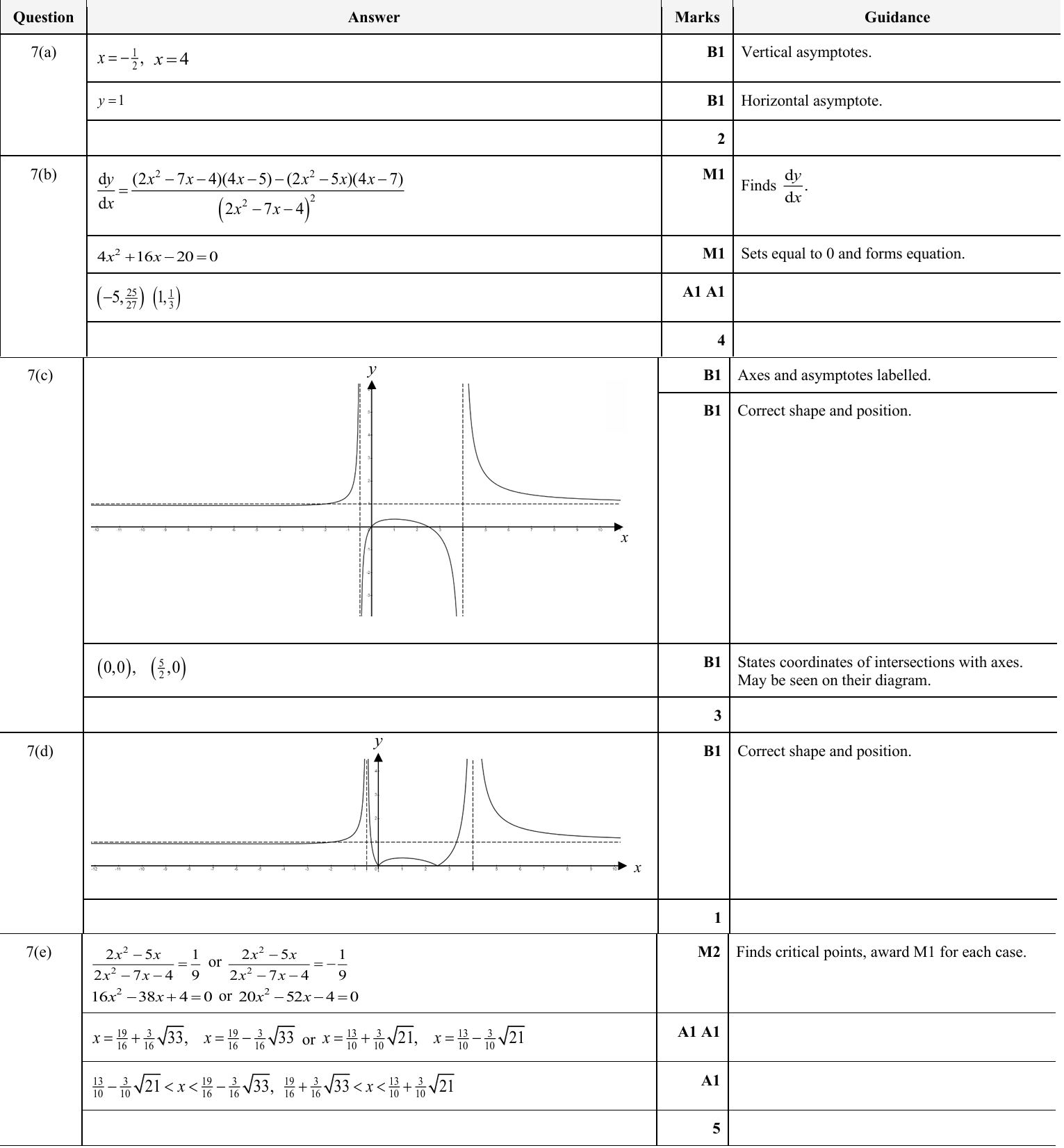
The curve C has equation \(y = \frac{2x^2 - 5x}{2x^2 - 7x - 4}\).
- Find the equations of the asymptotes of C.
- Find the coordinates of any stationary points on C.
- Sketch C, stating the coordinates of the intersections with the axes.
- Sketch the curve with equation \(y = \left| \frac{2x^2 - 5x}{2x^2 - 7x - 4} \right|\).
- Find in exact form the set of values of \(x\) for which \(\left| \frac{2x^2 - 5x}{2x^2 - 7x - 4} \right| < \frac{1}{9}\).
FM June 2025 p13 q01
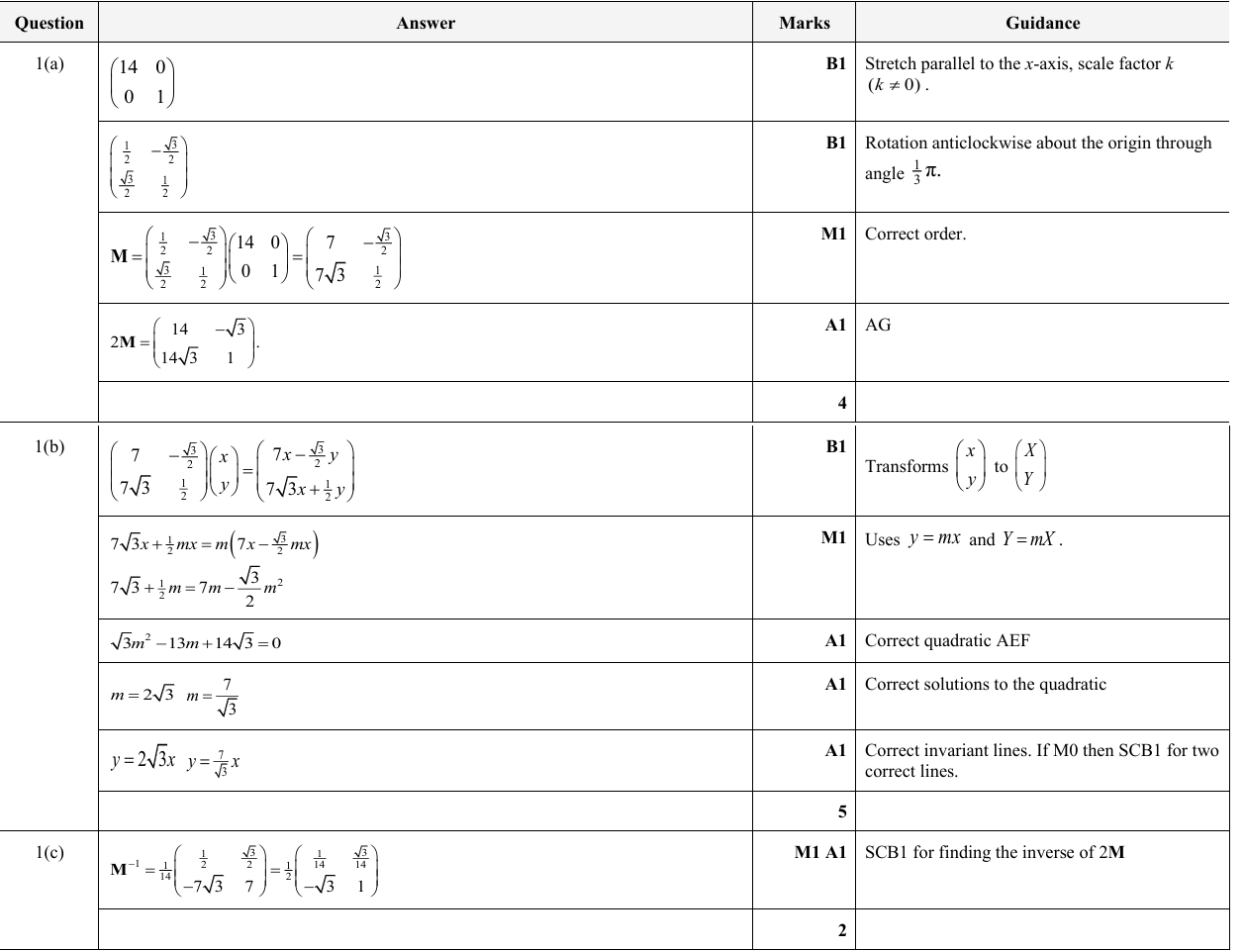
The matrix M represents the sequence of two transformations in the x-y plane given by a stretch parallel to the x-axis, scale factor 14, followed by a rotation anticlockwise about the origin through angle \(\frac{1}{3} \pi\).
(a) Show that \(2\mathbf{M} = \begin{pmatrix} 14 & -\sqrt{3} \\ 14\sqrt{3} & 1 \end{pmatrix}\).
(b) Find the equations of the invariant lines, through the origin, of the transformation in the x-y plane represented by M.
The unit square S in the x-y plane is transformed by M onto the rectangle P.
(c) Find the matrix which transforms P onto S.
FM June 2025 p13 q02
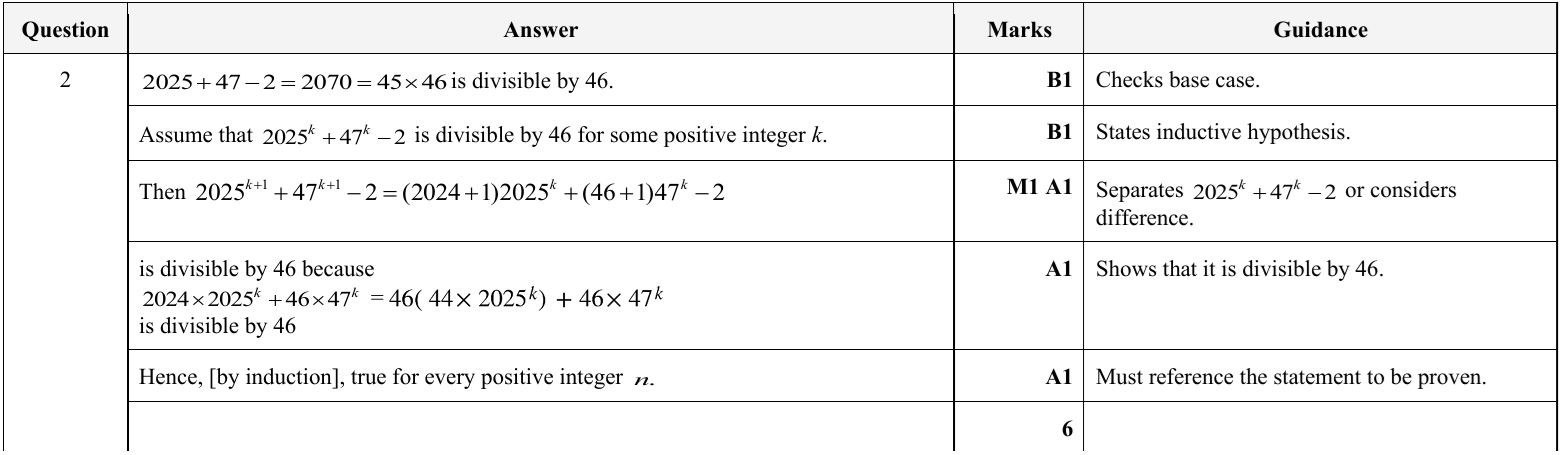
Prove by mathematical induction that \(2025^n + 47^n - 2\) is divisible by 46 for all positive integers \(n\).
FM June 2025 p13 q03
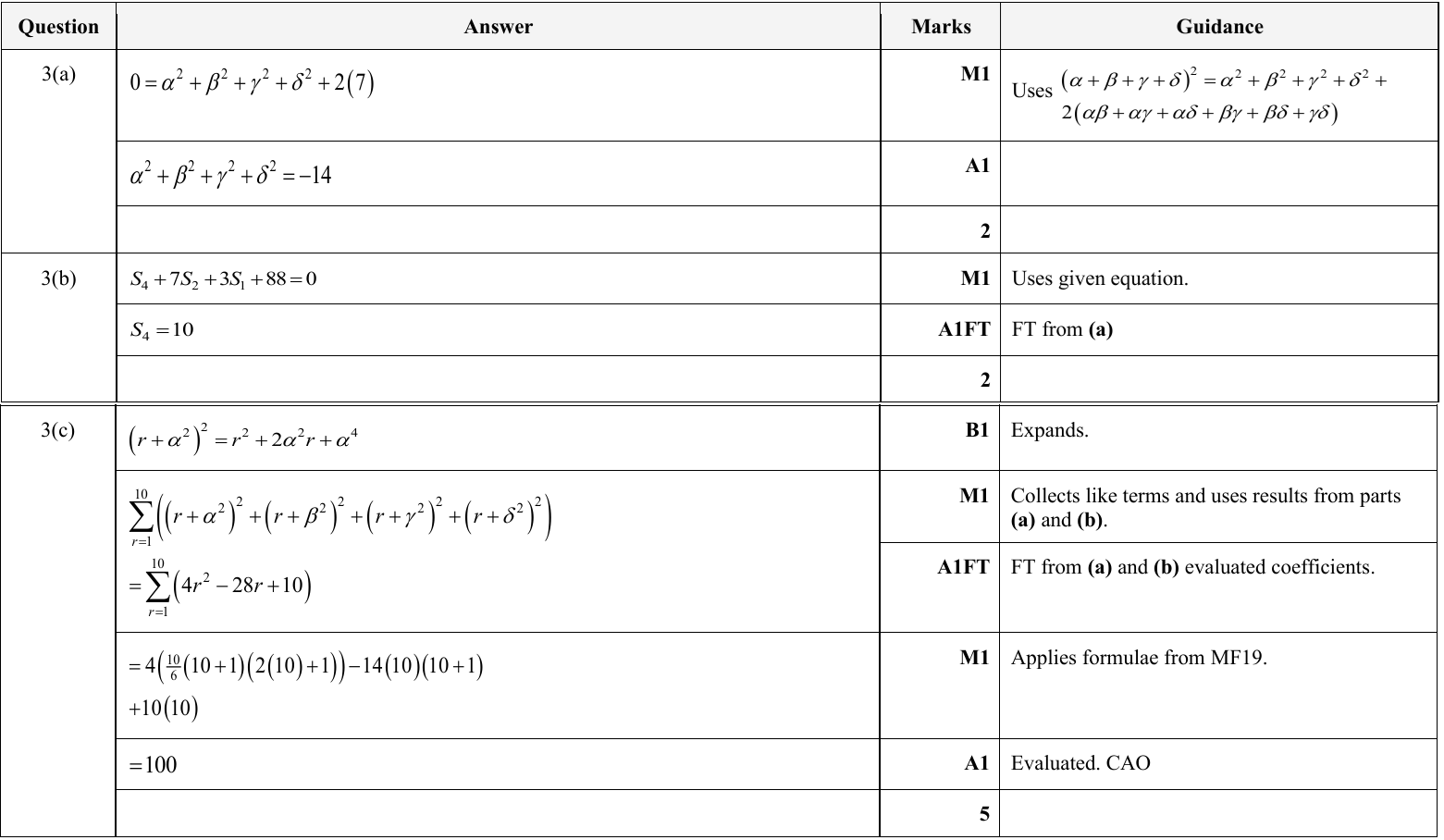
The quartic equation \(x^4 + 7x^2 + 3x + 22 = 0\) has roots \(\alpha, \beta, \gamma, \delta\).
(a) Find the value of \(\alpha^2 + \beta^2 + \gamma^2 + \delta^2\).
(b) Find the value of \(\alpha^4 + \beta^4 + \gamma^4 + \delta^4\).
(c) Use standard results from the list of formulae (MF19) to find the value of \(\sum_{r=1}^{10} ((\alpha^2 + r)^2 + (\beta^2 + r)^2 + (\gamma^2 + r)^2 + (\delta^2 + r)^2)\).
FM June 2025 p13 q04
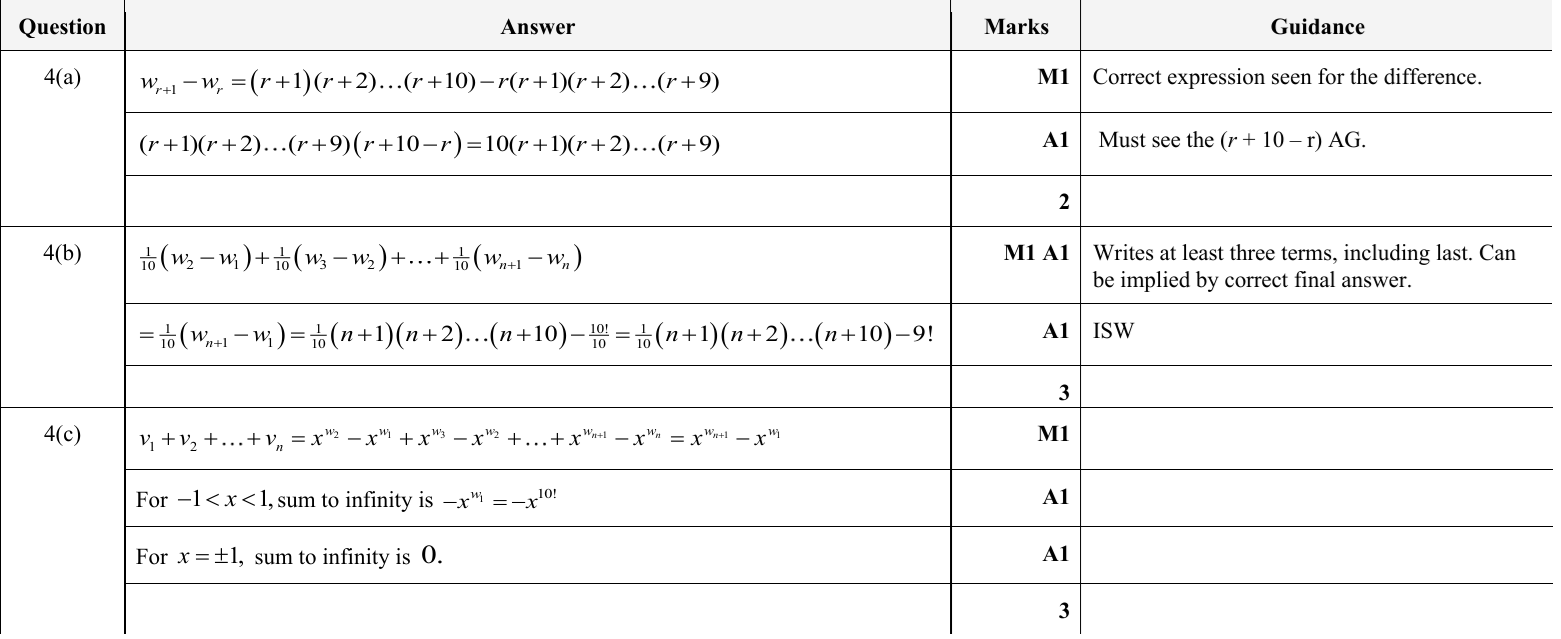
Let \(w_r = r(r+1)(r+2)\ldots(r+9)\).
(a) Show that \(w_{r+1} - w_r = 10(r+1)(r+2)\ldots(r+9)\).
(b) Given that \(u_r = (r+1)(r+2)\ldots(r+9)\), find \(\sum_{r=1}^{n} u_r\) in terms of \(n\).
(c) Given that \(v_r = x^{w_{r+1}} - x^{w_r}\), find the set of values of \(x\) for which the infinite series \(v_1 + v_2 + v_3 + \ldots\) is convergent and give the sum to infinity when this exists.
FM June 2025 p13 q05
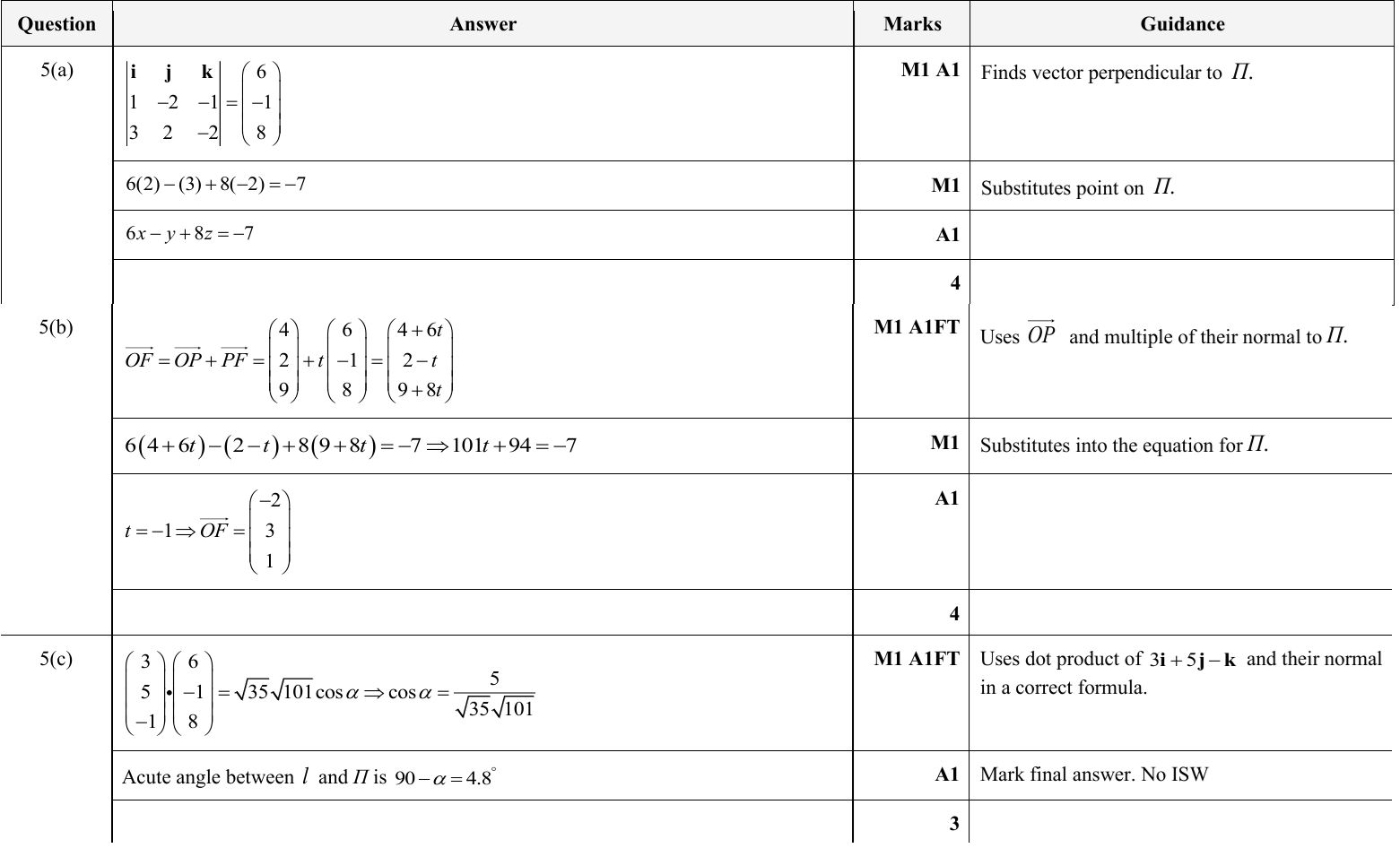
The plane \(\Pi\) has equation \(\mathbf{r} = 2\mathbf{i} + 3\mathbf{j} - 2\mathbf{k} + \lambda (\mathbf{i} - 2\mathbf{j} - \mathbf{k}) + \mu (3\mathbf{i} + 2\mathbf{j} - 2\mathbf{k})\).
(a) Find a Cartesian equation of \(\Pi\), giving your answer in the form \(ax + by + cz = d\).
The point \(P\) has position vector \(4\mathbf{i} + 2\mathbf{j} + 9\mathbf{k}\).
(b) Find the position vector of the foot of the perpendicular from \(P\) to \(\Pi\).
The line \(l\) is parallel to the vector \(3\mathbf{i} + 5\mathbf{j} - \mathbf{k}\).
(c) Find the acute angle between \(l\) and \(\Pi\).
FM June 2025 p13 q06
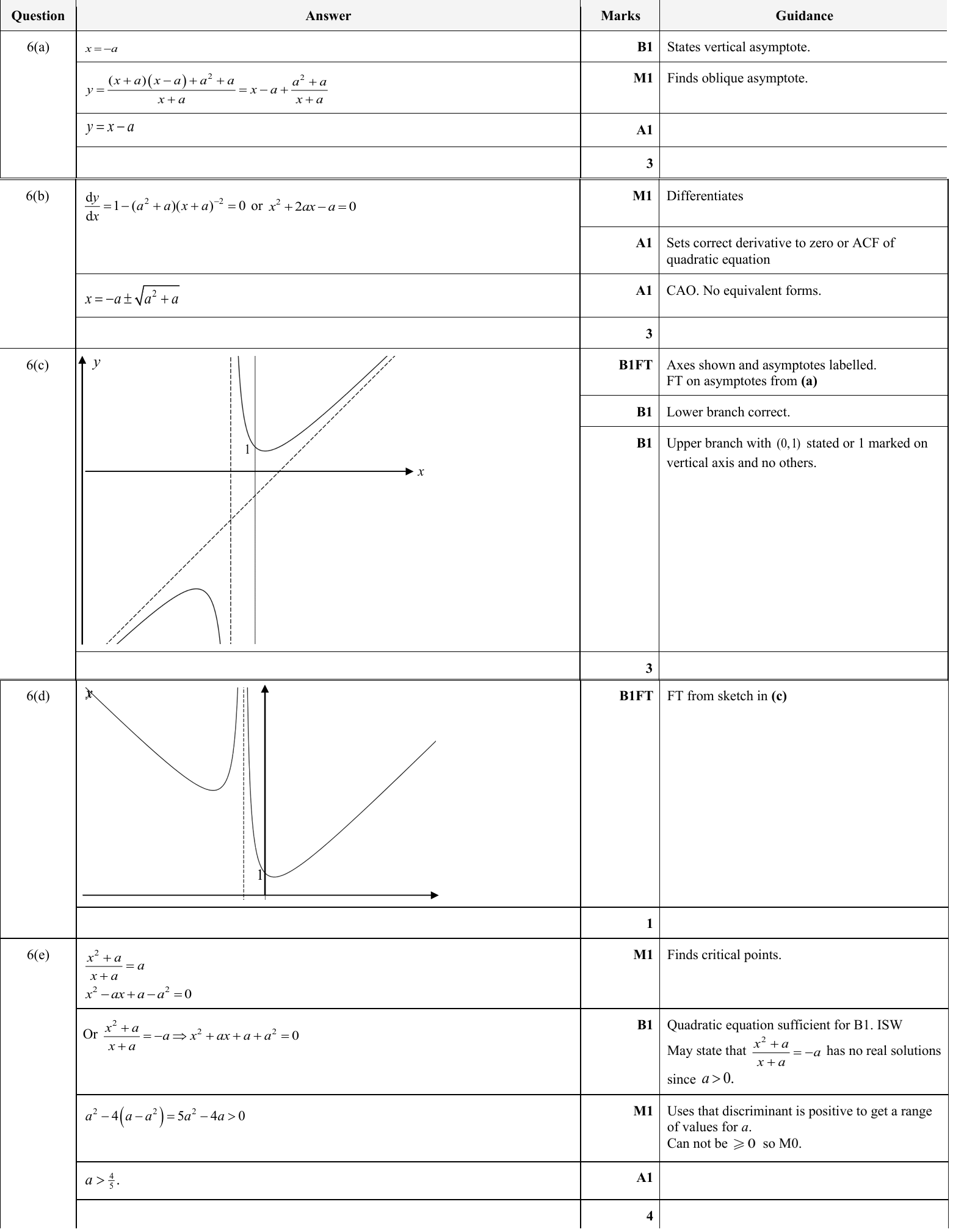
The curve C has equation \(y = \frac{x^2 + a}{x + a}\), where \(a\) is a positive constant.
- (a) Find the equations of the asymptotes of C.
- (b) Find, in terms of \(a\), the \(x\)-coordinates of the stationary points on C.
- (c) Sketch C, stating the coordinates of any intersections with the axes.
- (d) Sketch the curve with equation \(y = \left| \frac{x^2 + a}{x + a} \right|\).
- (e) Find the set of values of \(a\) for which \(\left| \frac{x^2 + a}{x + a} \right| = a\) has two real solutions.
FM June 2025 p13 q07
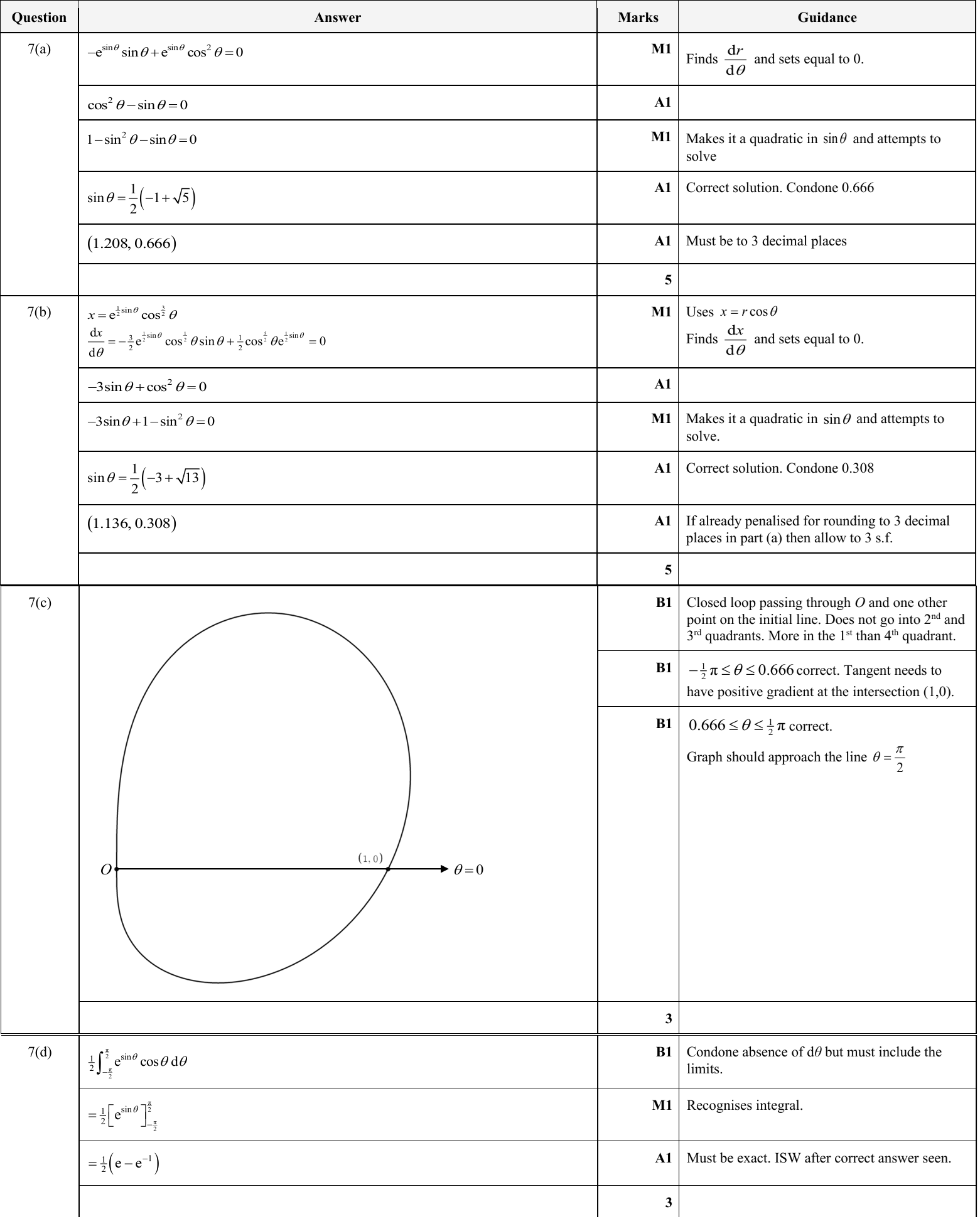
The curve C has polar equation \(r^2 = e^{\sin \theta} \cos \theta\), for \(-\frac{1}{2}\pi \leq \theta \leq \frac{1}{2}\pi\).
- Find the polar coordinates of the point on C that is furthest from the pole, giving your answers correct to 3 decimal places.
- Find the polar coordinates of the point on C that is furthest from the half-line \(\theta = \frac{1}{2}\pi\), giving your answers correct to 3 decimal places.
- Sketch C.
- Find the area of the region bounded by C, giving your answer in exact form.
FM June 2025 p14 q01
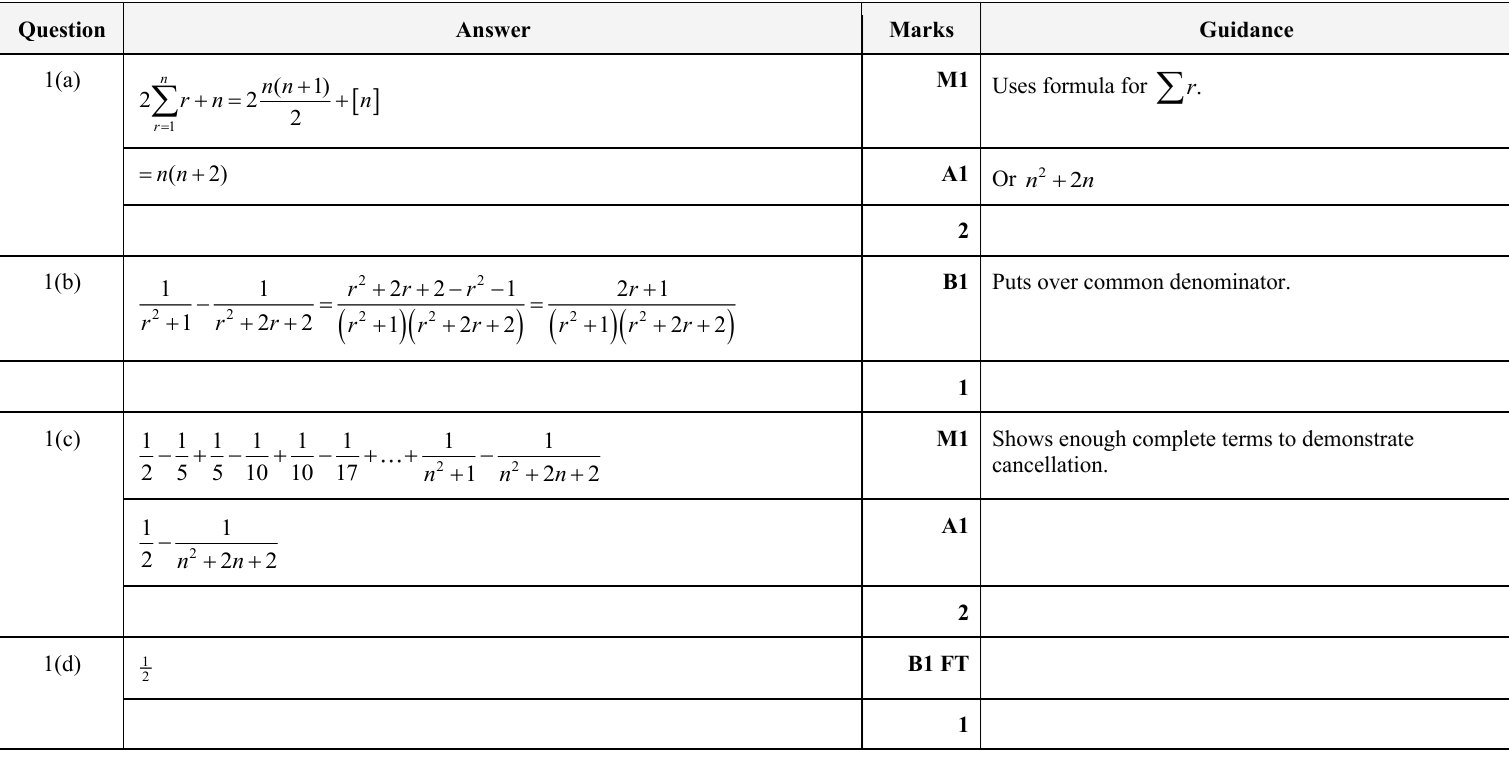
- Use the List of formulae (MF19) to find \(\sum_{r=1}^{n} (2r+1)\) in terms of \(n\), simplifying your answer.
- Show that \(\frac{2r+1}{(r^2+1)(r^2+2r+2)} = \frac{1}{r^2+1} - \frac{1}{r^2+2r+2}\).
- Use the method of differences to find \(\sum_{r=1}^{n} \frac{2r+1}{(r^2+1)(r^2+2r+2)}\).
- Deduce the value of \(\sum_{r=1}^{\infty} \frac{2r+1}{(r^2+1)(r^2+2r+2)}\).
FM June 2025 p14 q02
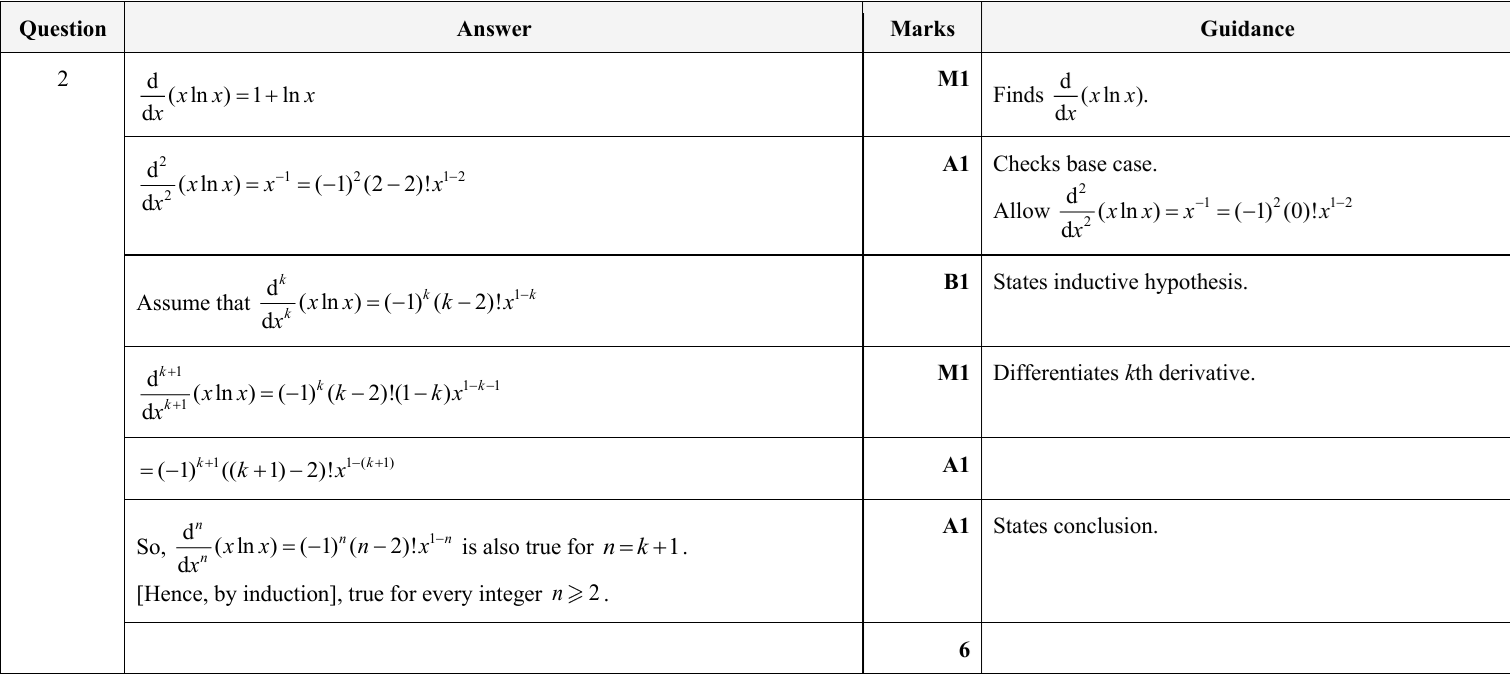
Prove by mathematical induction that, for every integer \(n \geq 2\),
\(\frac{d^n}{dx^n}(x \ln x) = (-1)^n (n-2)! x^{1-n}.\)
FM June 2025 p14 q03
The points A, B and C have position vectors
\(2\mathbf{j} + 3\mathbf{k}, \quad -5\mathbf{i} + 3\mathbf{j} + \mathbf{k} \quad \text{and} \quad \mathbf{i} + 2\mathbf{j} + 5\mathbf{k}\)
respectively, relative to the origin O.
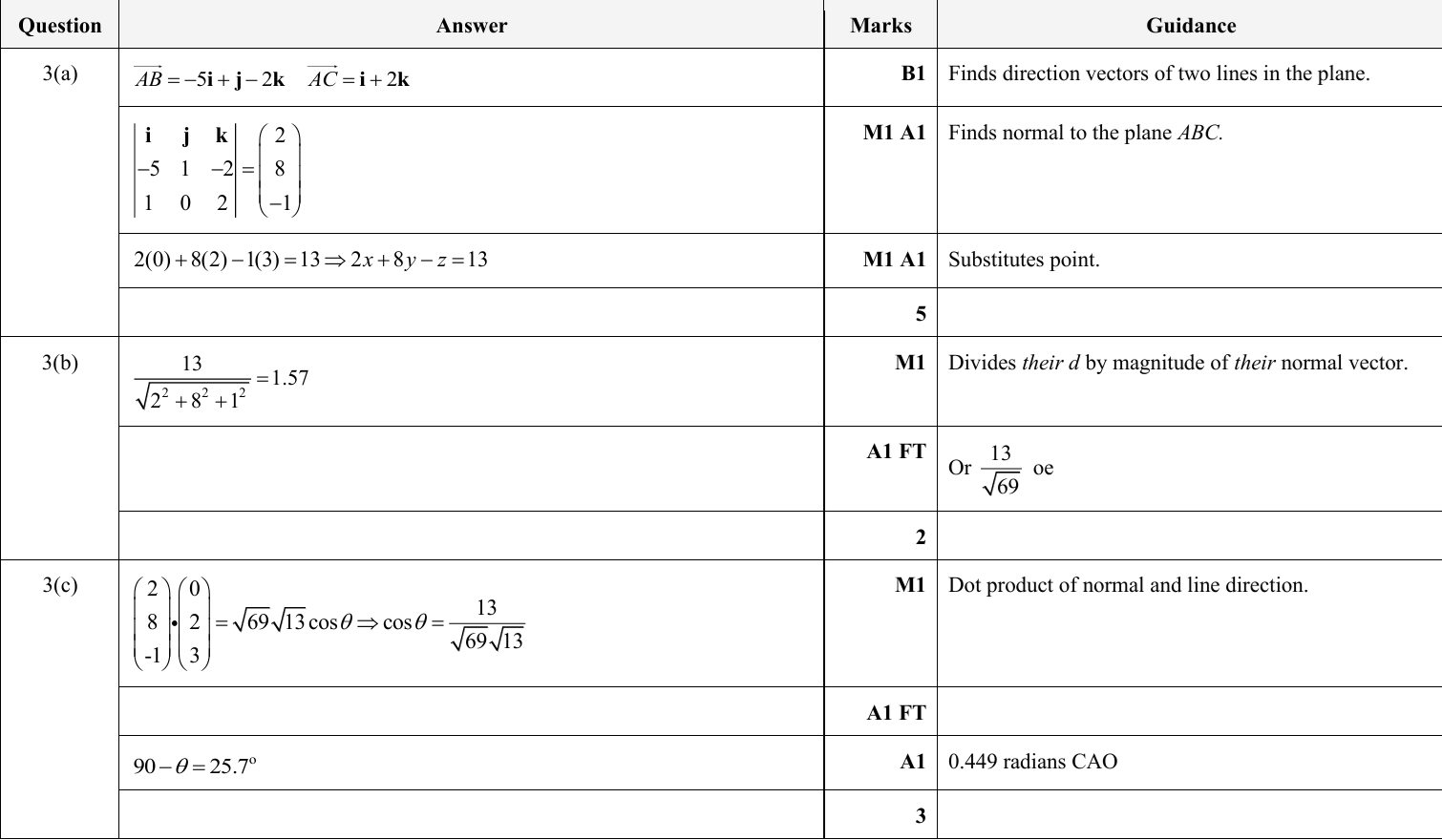
(a) Find the equation of the plane ABC, giving your answer in the form \(ax + by + cz = d\).
(b) Find the perpendicular distance from O to the plane ABC.
(c) Find the acute angle between the line OA and the plane ABC.
FM June 2025 p14 q04
The cubic equation \(x^3 + bx^2 + cx - 1 = 0\), where \(b\) and \(c\) are constants, has roots \(\alpha, \beta, \gamma\).
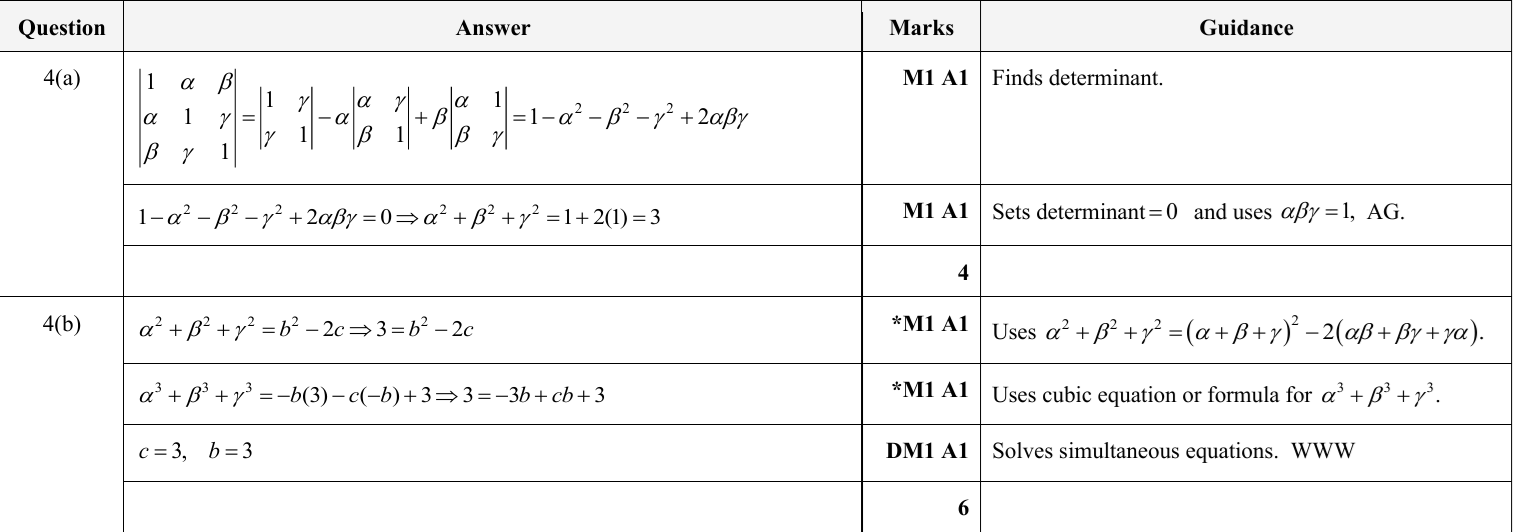
It is given that the matrix \(\begin{pmatrix} 1 & \alpha & \beta \\ \alpha & 1 & \gamma \\ \beta & \gamma & 1 \end{pmatrix}\) is singular.
(a) Show that \(\alpha^2 + \beta^2 + \gamma^2 = 3\).
(b) It is given that \(\alpha^3 + \beta^3 + \gamma^3 = 3\) and that the constants \(b\) and \(c\) are positive.
Find the values of \(b\) and \(c\).
FM June 2025 p14 q05
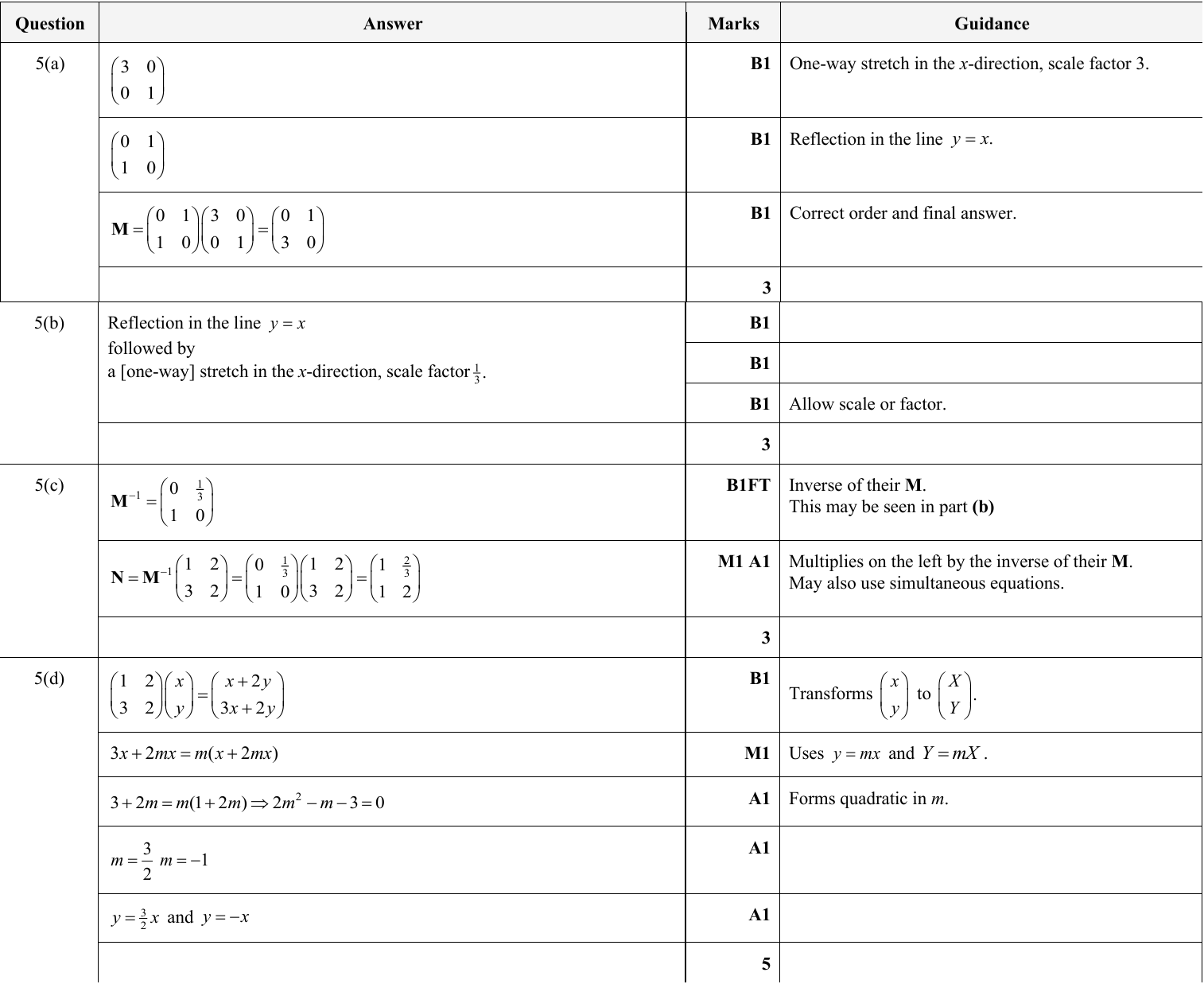
The matrix M represents a sequence of two transformations in the x-y plane given by a one-way stretch in the x-direction, scale factor 3, followed by a reflection in the line y = x.
(a) Find M.
(b) Give full details of the geometrical transformation in the x-y plane represented by M-1.
The matrix N is such that MN = \(\begin{pmatrix} 1 & 2 \\ 3 & 2 \end{pmatrix}\).
(c) Find N.
\((d) Find the equations of the invariant lines, through the origin, of the transformation in the x-y plane represented by MN.\)
FM June 2025 p14 q06
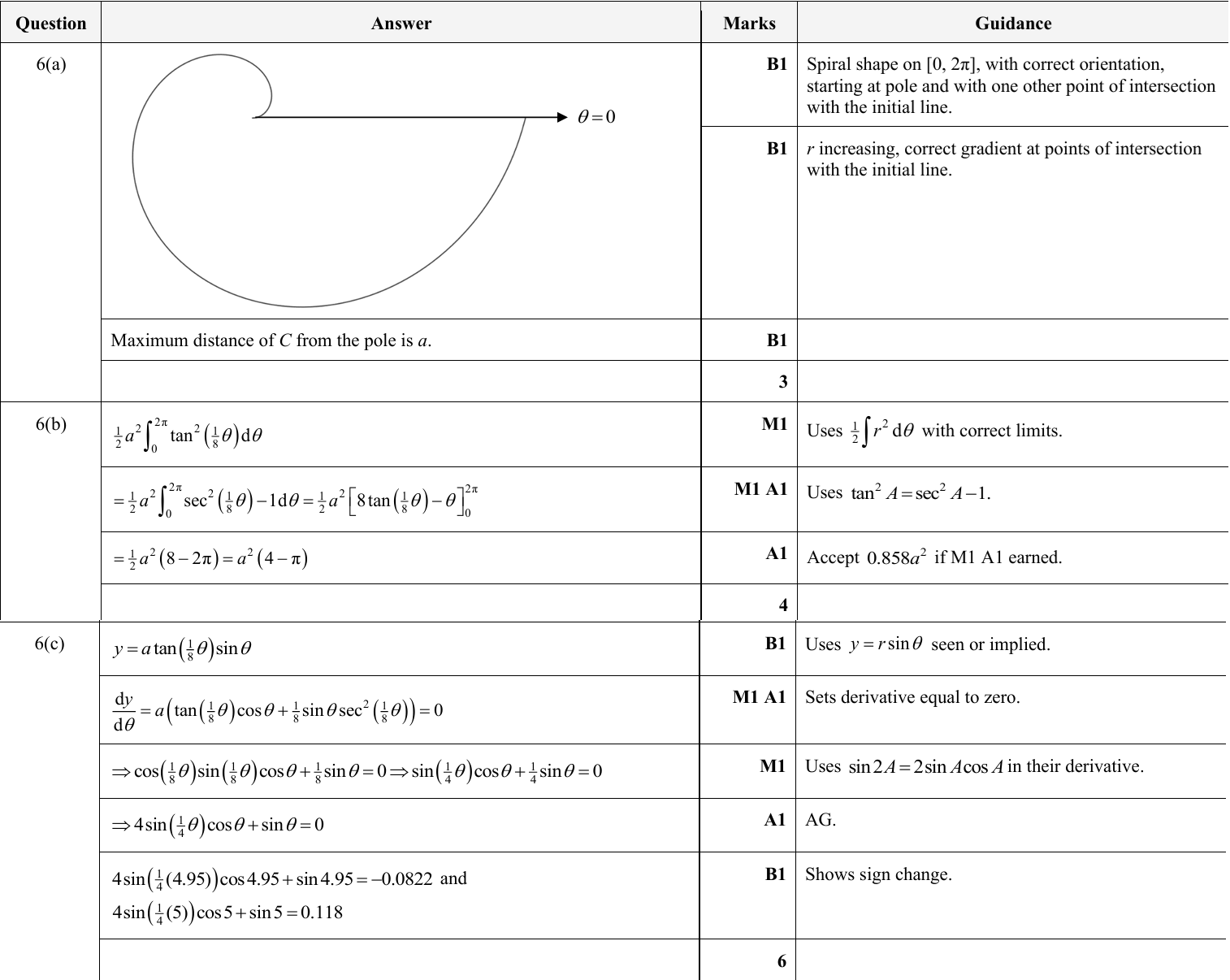
The curve C has polar equation \(r = a \tan\left(\frac{1}{8}\theta\right)\), where \(a\) is a positive constant and \(0 \leq \theta \leq 2\pi\).
(a) Sketch C and state, in terms of \(a\), the greatest distance of a point on C from the pole.
(b) Find, in terms of \(a\), the area of the region bounded by C and the initial line.
(c) Show that, at the point on C furthest from the initial line,
\(4 \sin\left(\frac{1}{4}\theta\right)\cos\theta + \sin\theta = 0\)
and verify that this equation has a root between 4.95 and 5.
FM June 2025 p14 q07
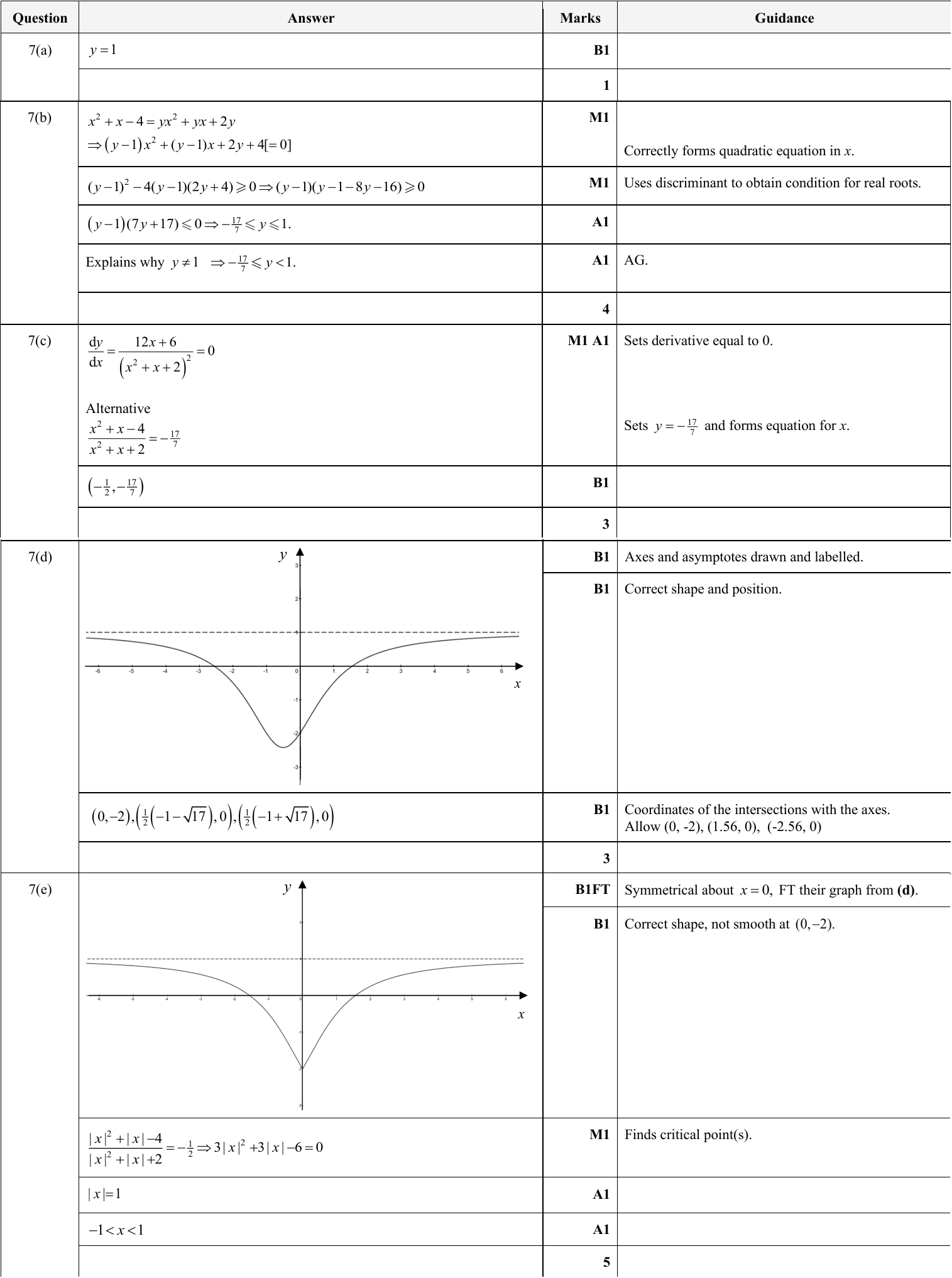
The curve \(C\) has equation \(y = \frac{x^2 + x - 4}{x^2 + x + 2}\).
- State the equation of the asymptote of \(C\).
- Show that, for all real values of \(x\), \(-\frac{17}{7} \leq y < 1\).
- Find the coordinates of any stationary points of \(C\).
- Sketch \(C\), stating the coordinates of the intersections with the axes.
- Sketch the graph with equation \(y = \frac{|x|^2 + |x| - 4}{|x|^2 + |x| + 2}\) and find the set of values of \(x\) for which \(\frac{|x|^2 + |x| - 4}{|x|^2 + |x| + 2} < -\frac{1}{2}\).
FM Nov 2024 p11 q01
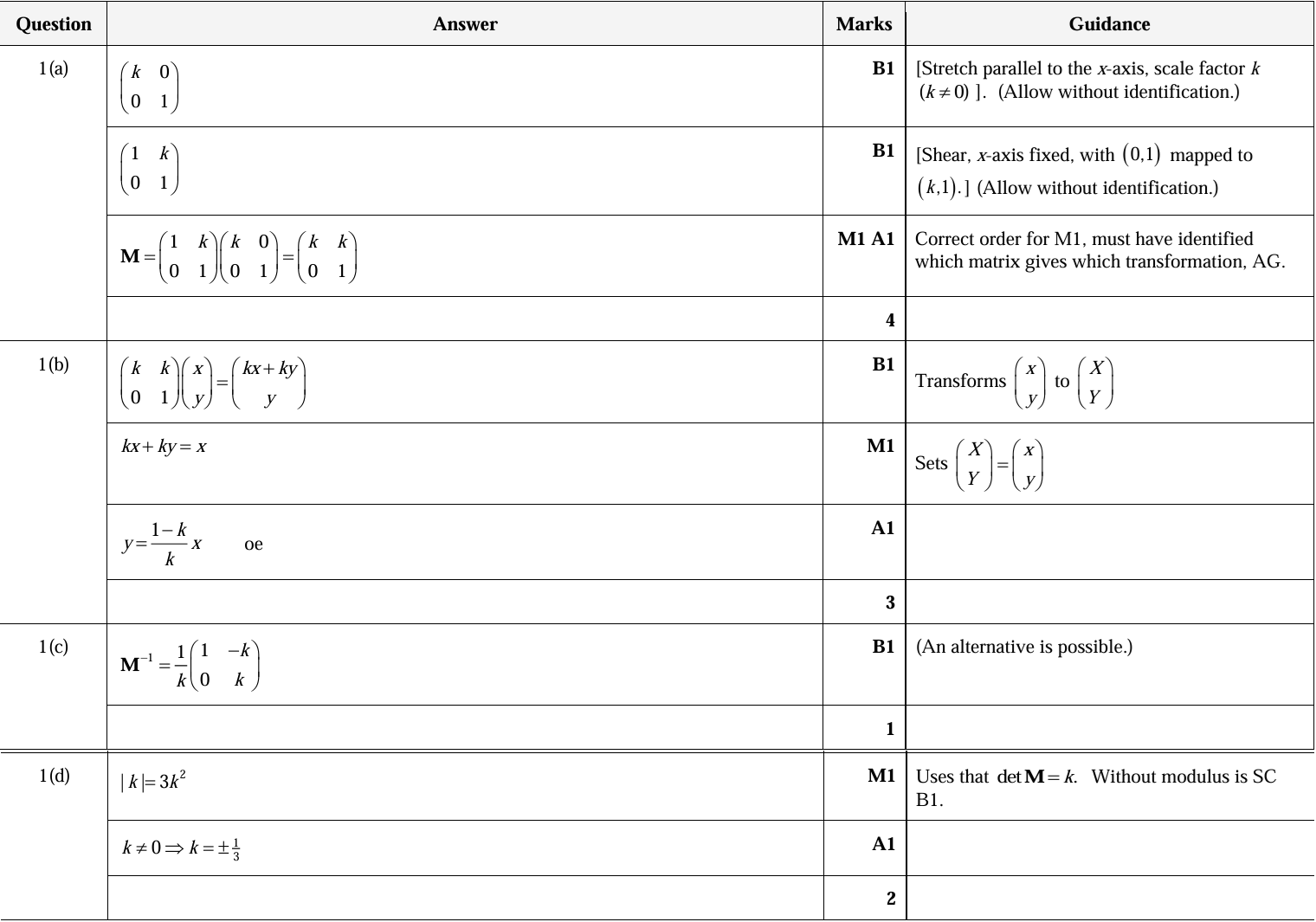
The matrix M represents the sequence of two transformations in the x-y plane given by a stretch parallel to the x-axis, scale factor k (k ≠ 0), followed by a shear, x-axis fixed, with (0, 1) mapped to (k, 1).
(a) Show that M = \(\begin{pmatrix} k & k \\ 0 & 1 \end{pmatrix}\).
\((b) The transformation represented by M has a line of invariant points. Find, in terms of k, the equation of this line.\)
The unit square S in the x-y plane is transformed by M onto the parallelogram P.
(c) Find, in terms of k, a matrix which transforms P onto S.
(d) Given that the area of P is \(3k^2\) units\(^2\), find the possible values of k.
FM Nov 2024 p11 q02
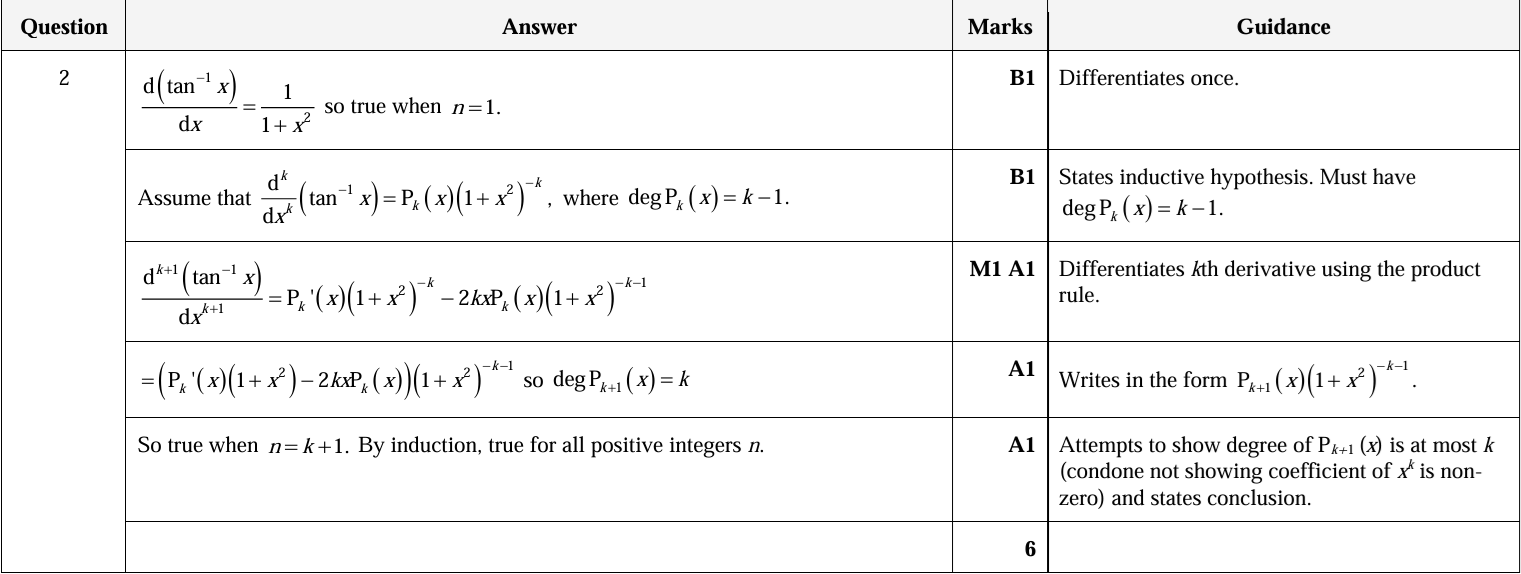
Prove by mathematical induction that, for all positive integers n,
\(\frac{d^n}{dx^n}(\arctan x) = P_n(x)(1+x^2)^{-n},\)
where \(P_n(x)\) is a polynomial of degree \(n-1\).
FM Nov 2024 p11 q03
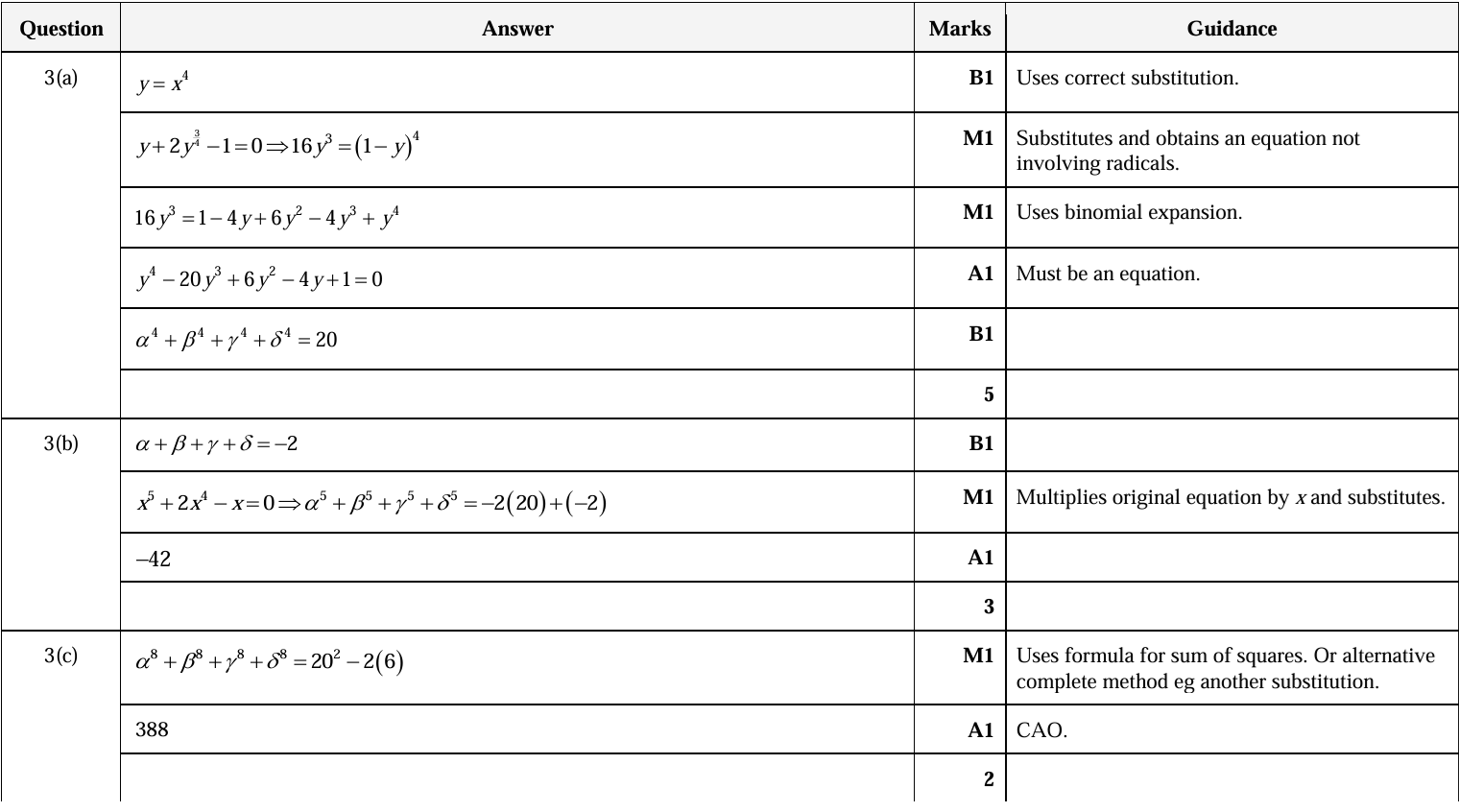
The quartic equation \(x^4 + 2x^3 - 1 = 0\) has roots \(\alpha, \beta, \gamma, \delta\).
(a) Find a quartic equation whose roots are \(\alpha^4, \beta^4, \gamma^4, \delta^4\) and state the value of \(\alpha^4 + \beta^4 + \gamma^4 + \delta^4\).
(b) Find the value of \(\alpha^5 + \beta^5 + \gamma^5 + \delta^5\).
(c) Find the value of \(\alpha^8 + \beta^8 + \gamma^8 + \delta^8\).
FM Nov 2024 p11 q04
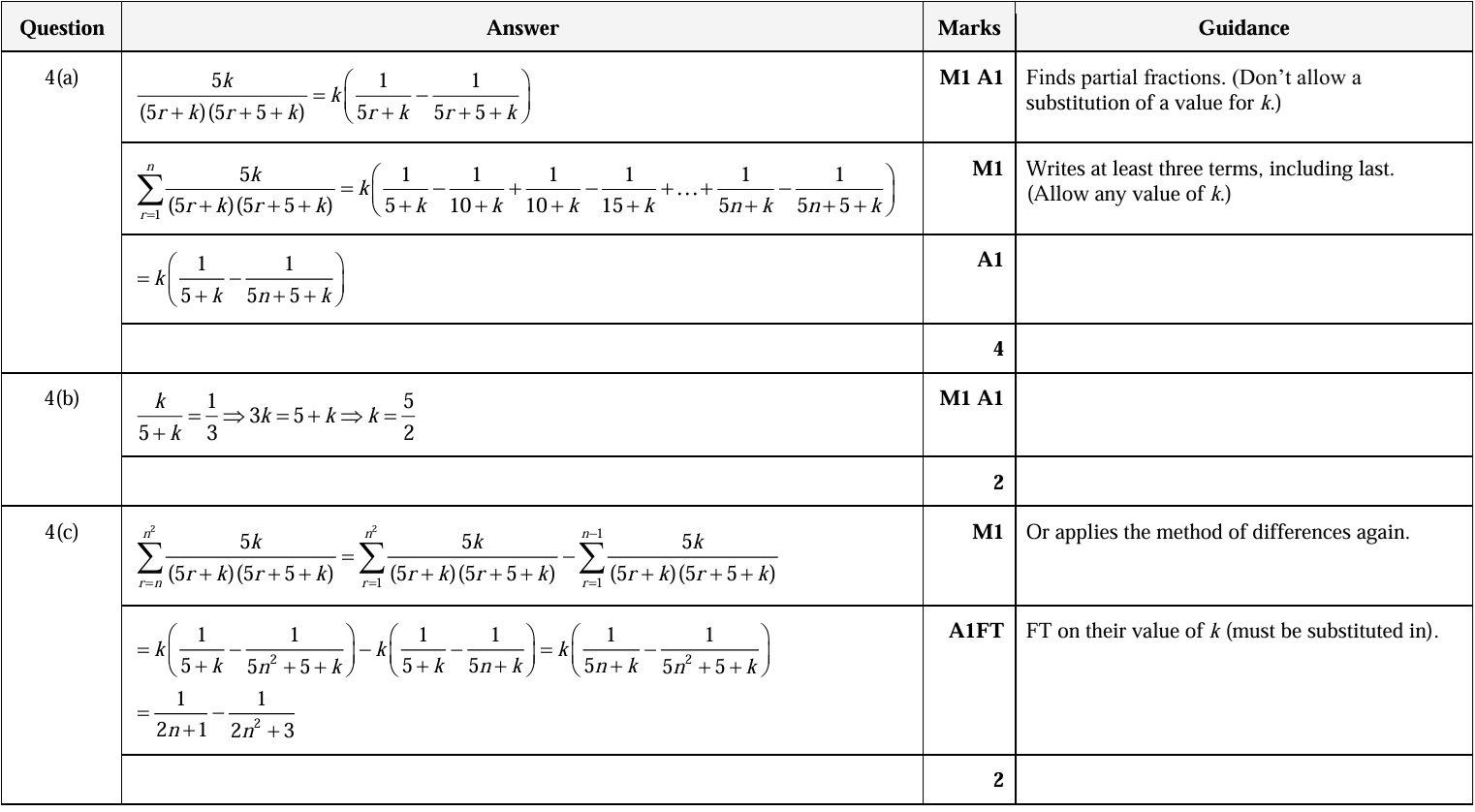
(a) Use the method of differences to find \(\sum_{r=1}^{n} \frac{5k}{(5r+k)(5r+5+k)}\) in terms of \(n\) and \(k\), where \(k\) is a positive constant.
It is given that \(\sum_{r=1}^{\infty} \frac{5k}{(5r+k)(5r+5+k)} = \frac{1}{3}\).
(b) Find the value of \(k\).
(c) Hence find \(\sum_{r=n}^{n^2} \frac{5k}{(5r+k)(5r+5+k)}\) in terms of \(n\).
FM Nov 2024 p11 q05
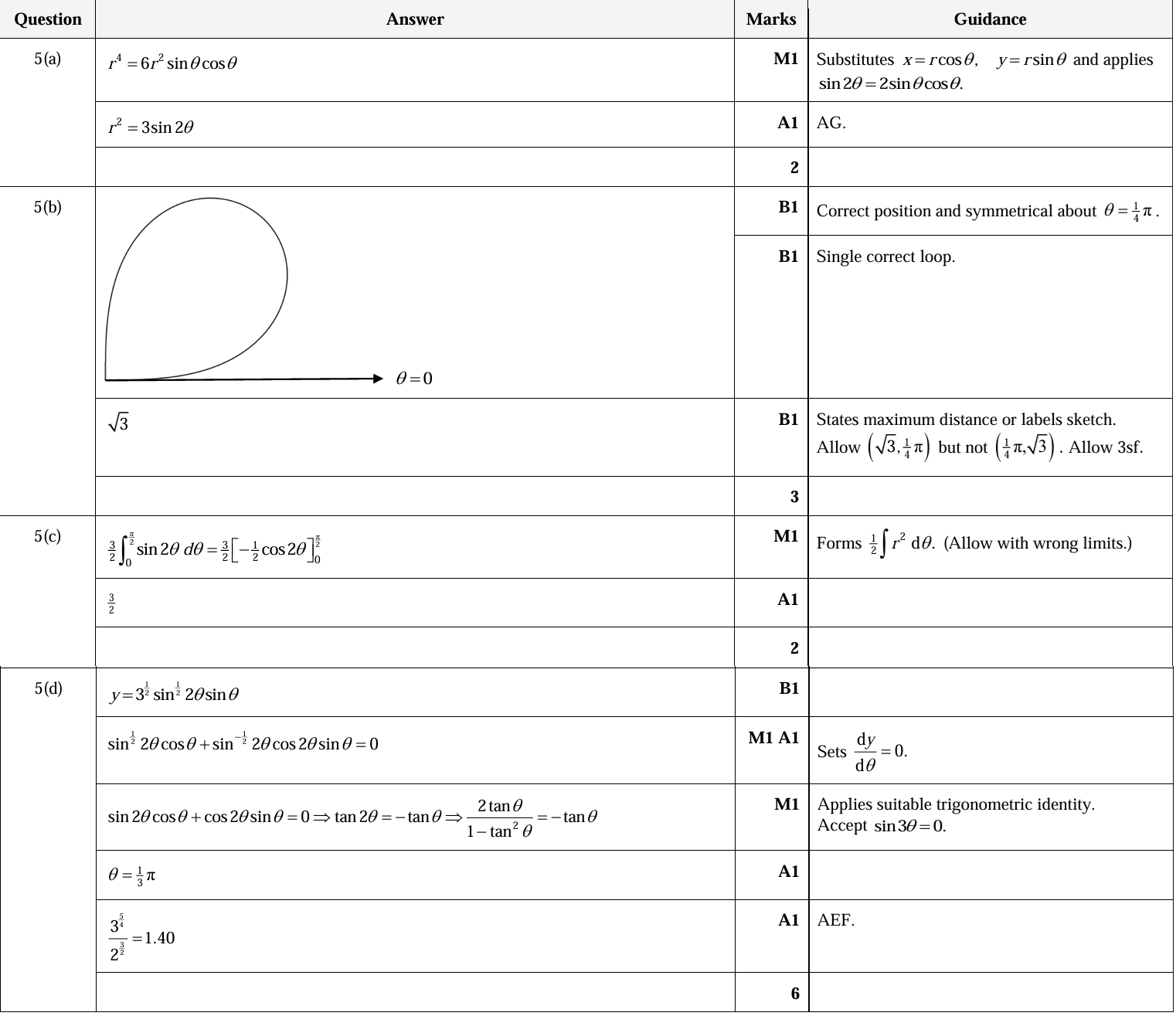
(a) Show that the curve with Cartesian equation \((x^2 + y^2)^2 = 6xy\) has polar equation \(r^2 = 3 \sin 2\theta\).
The curve \(C\) has polar equation \(r^2 = 3 \sin 2\theta\), for \(0 \leq \theta \leq \frac{1}{2}\pi\).
(b) Sketch \(C\) and state the maximum distance of a point on \(C\) from the pole.
(c) Find the area of the region enclosed by \(C\).
(d) Find the maximum distance of a point on \(C\) from the initial line.
FM Nov 2024 p11 q06
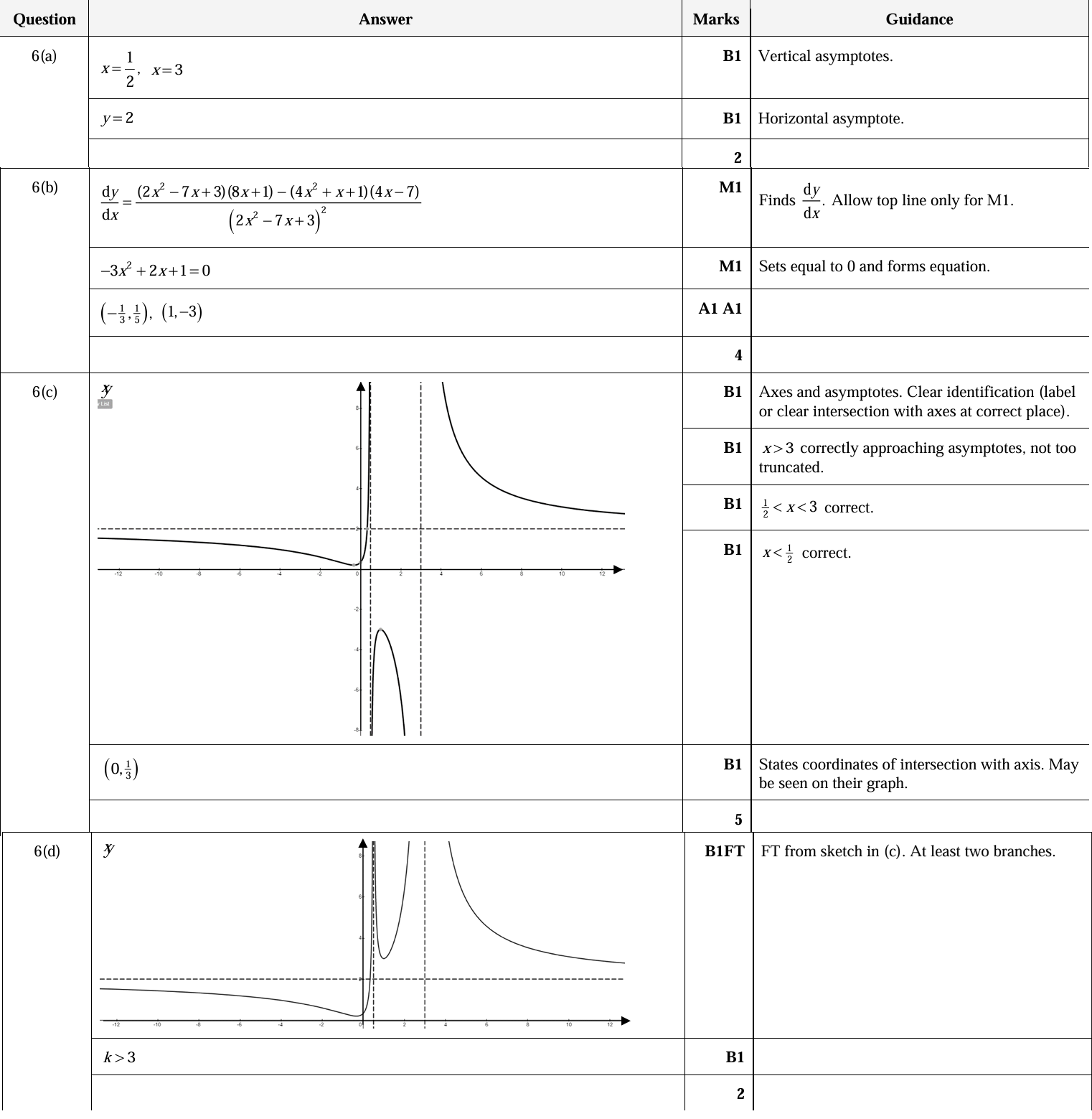
The curve C has equation \(y = \frac{4x^2 + x + 1}{2x^2 - 7x + 3}\).
- (a) Find the equations of the asymptotes of C.
- (b) Find the coordinates of any stationary points on C.
- (c) Sketch C, stating the coordinates of any intersections with the axes.
- (d) Sketch the curve with equation \(y = \left| \frac{4x^2 + x + 1}{2x^2 - 7x + 3} \right|\) and state the set of values of \(k\) for which \(\left| \frac{4x^2 + x + 1}{2x^2 - 7x + 3} \right| = k\) has 4 distinct real solutions.
FM Nov 2024 p11 q07
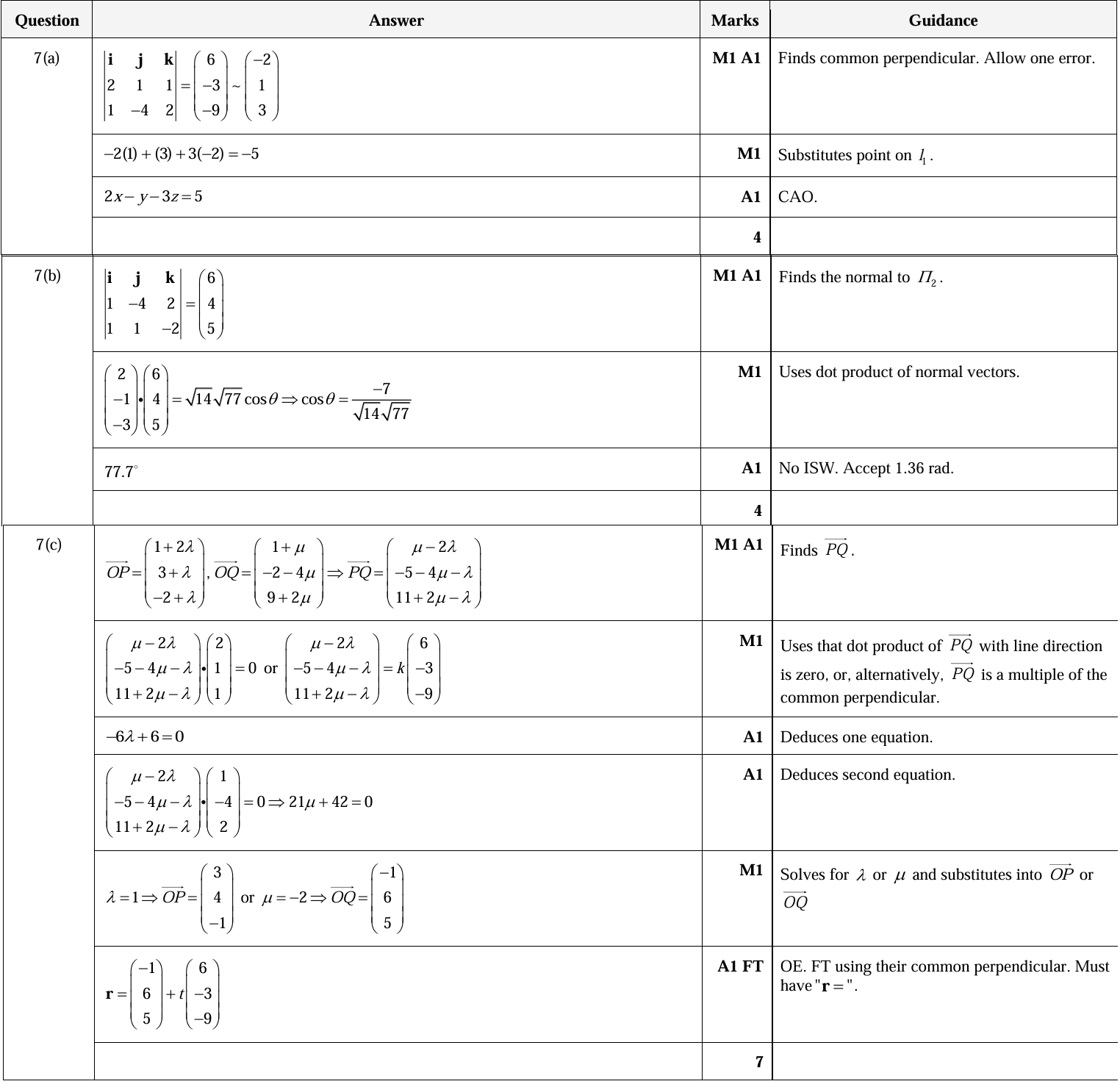
The lines \(l_1\) and \(l_2\) have equations \(\mathbf{r} = \mathbf{i} + 3\mathbf{j} - 2\mathbf{k} + \lambda(2\mathbf{i} + \mathbf{j} + \mathbf{k})\) and \(\mathbf{r} = \mathbf{i} - 2\mathbf{j} + 9\mathbf{k} + \mu(\mathbf{i} - 4\mathbf{j} + 2\mathbf{k})\) respectively. The plane \(\Pi_1\) contains \(l_1\) and is parallel to \(l_2\).
(a) Find the equation of \(\Pi_1\), giving your answer in the form \(ax + by + cz = d\).
The plane \(\Pi_2\) contains \(l_2\) and the point with coordinates \((2, -1, 7)\).
(b) Find the acute angle between \(\Pi_1\) and \(\Pi_2\).
The point \(P\) on \(l_1\) and the point \(Q\) on \(l_2\) are such that \(PQ\) is perpendicular to both \(l_1\) and \(l_2\).
(c) Find a vector equation for \(PQ\).
FM Nov 2024 p12 q01
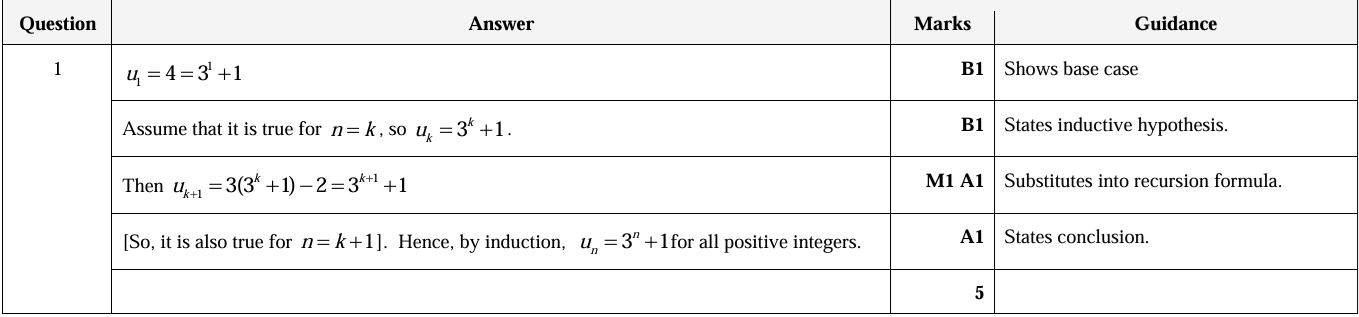
The sequence \(u_1, u_2, u_3, \ldots\) is such that \(u_1 = 4\) and \(u_{n+1} = 3u_n - 2\) for \(n \geq 1\).
Prove by induction that \(u_n = 3^n + 1\) for all positive integers \(n\).
FM Nov 2024 p12 q02
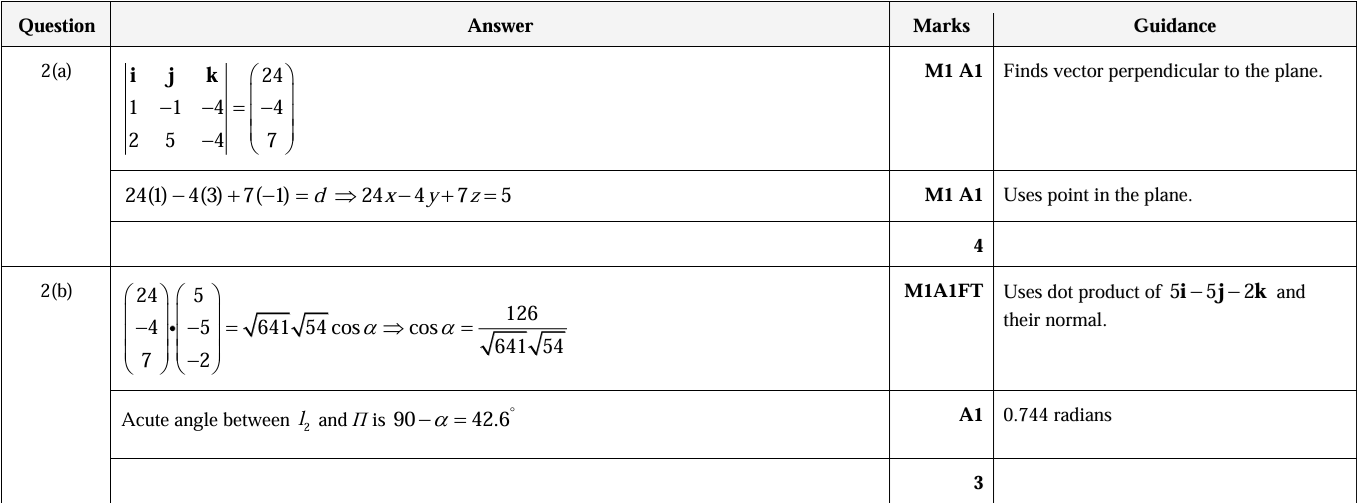
The line \(l_1\) has equation \(\mathbf{r} = \mathbf{i} + 3\mathbf{j} - \mathbf{k} + \lambda (\mathbf{i} - \mathbf{j} - 4\mathbf{k})\).
The plane \(\Pi\) contains \(l_1\) and is parallel to the vector \(2\mathbf{i} + 5\mathbf{j} - 4\mathbf{k}\).
(a) Find the equation of \(\Pi\), giving your answer in the form \(ax + by + cz = d\).
The line \(l_2\) is parallel to the vector \(5\mathbf{i} - 5\mathbf{j} - 2\mathbf{k}\).
(b) Find the acute angle between \(l_2\) and \(\Pi\).
FM Nov 2024 p12 q03
It is given that
\(\alpha + \beta + \gamma + \delta = 2,\)
\(\alpha^2 + \beta^2 + \gamma^2 + \delta^2 = 3,\)
\(\alpha^3 + \beta^3 + \gamma^3 + \delta^3 = 4.\)
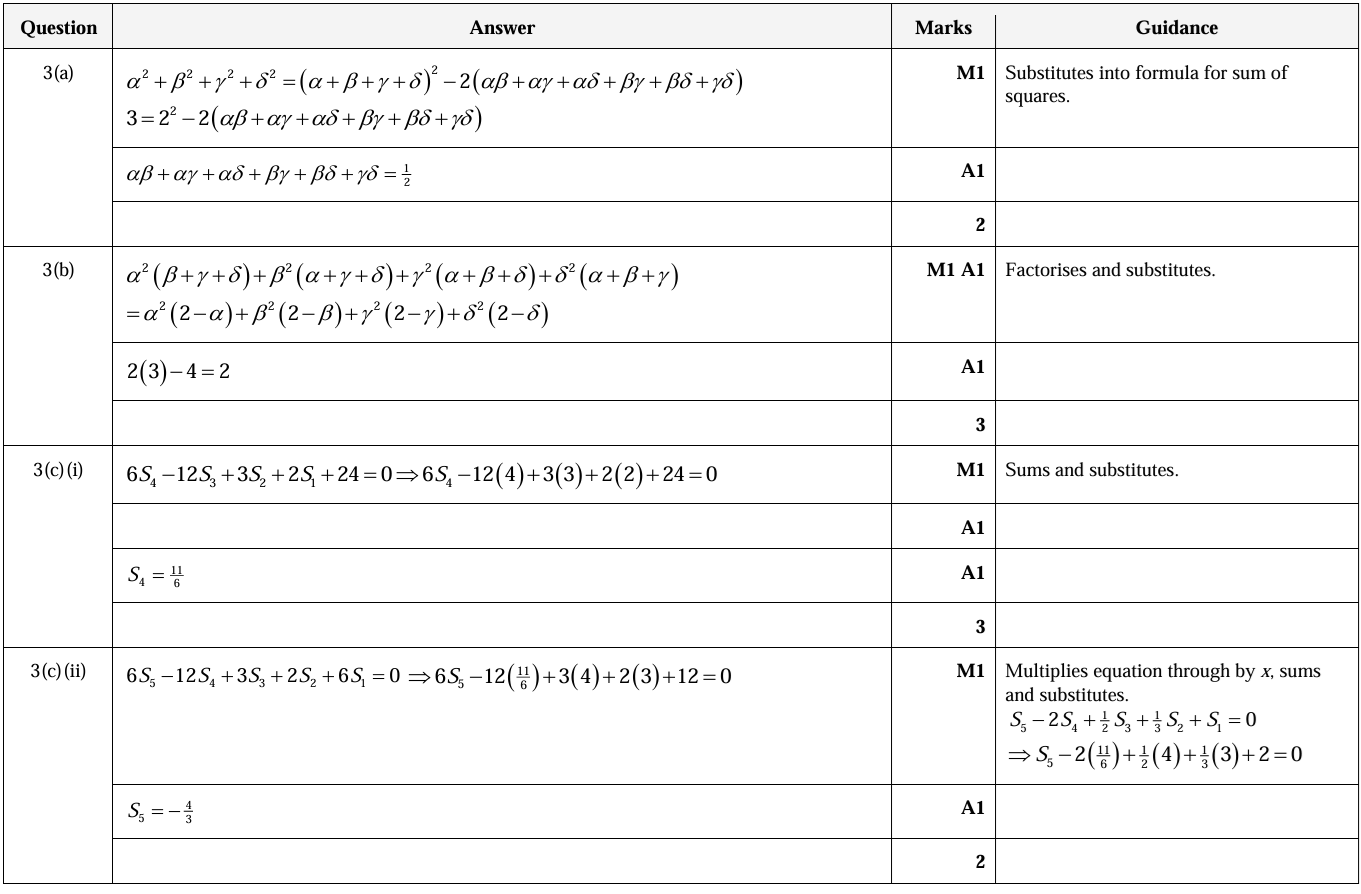
(a) Find the value of \(\alpha \beta + \alpha \gamma + \alpha \delta + \beta \gamma + \beta \delta + \gamma \delta.\)
(b) Find the value of \(\alpha^2 \beta + \alpha^2 \gamma + \alpha^2 \delta + \beta^2 \alpha + \beta^2 \gamma + \beta^2 \delta + \gamma^2 \alpha + \gamma^2 \beta + \gamma^2 \delta + \delta^2 \alpha + \delta^2 \beta + \delta^2 \gamma.\)
(c) It is given that \(\alpha, \beta, \gamma, \delta\) are the roots of the equation
\(6x^4 - 12x^3 + 3x^2 + 2x + 6 = 0.\)
(i) Find the value of \(\alpha^4 + \beta^4 + \gamma^4 + \delta^4.\)
(ii) Find the value of \(\alpha^5 + \beta^5 + \gamma^5 + \delta^5.\)
FM Nov 2024 p12 q04
The matrices A, B and C are given by
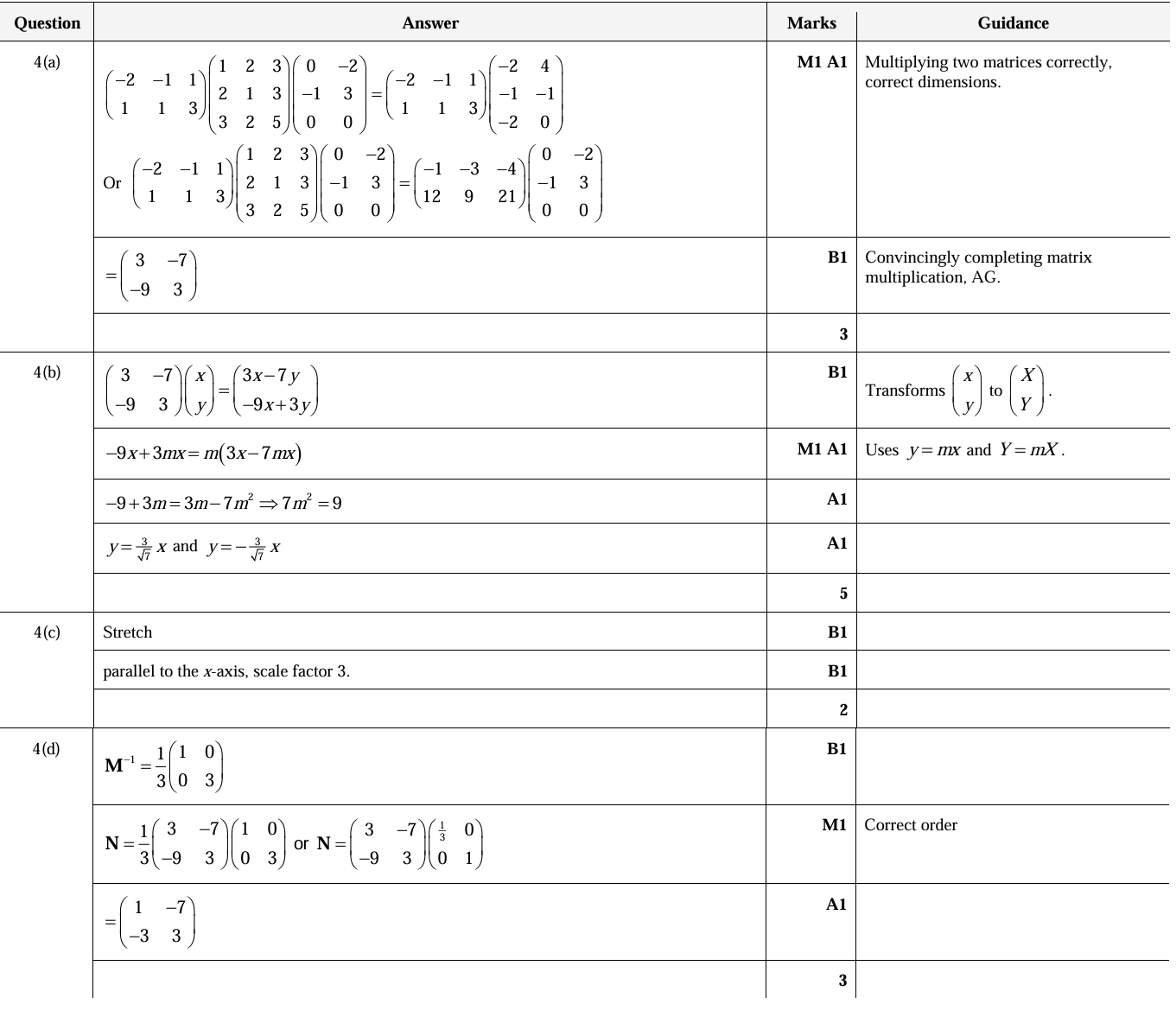
\(A = \begin{pmatrix} 1 & 2 & 3 \\ 2 & 1 & 3 \\ 3 & 2 & 5 \end{pmatrix}, \ B = \begin{pmatrix} 0 & -2 \\ -1 & 3 \\ 0 & 0 \end{pmatrix} \text{ and } C = \begin{pmatrix} -2 & -1 \\ 1 & 1 \end{pmatrix}.\)
(a) Show that \(CAB = \begin{pmatrix} 3 & -7 \\ -9 & 3 \end{pmatrix}.\) [3]
(b) Find the equations of the invariant lines, through the origin, of the transformation in the \(x-y\) plane represented by \(CAB.\) [5]
Let \(M = \begin{pmatrix} 3 & 0 \\ 0 & 1 \end{pmatrix}.\)
(c) Give full details of the transformation represented by \(M.\) [2]
(d) Find the matrix \(N\) such that \(NM = CAB.\) [3]
FM Nov 2024 p12 q05
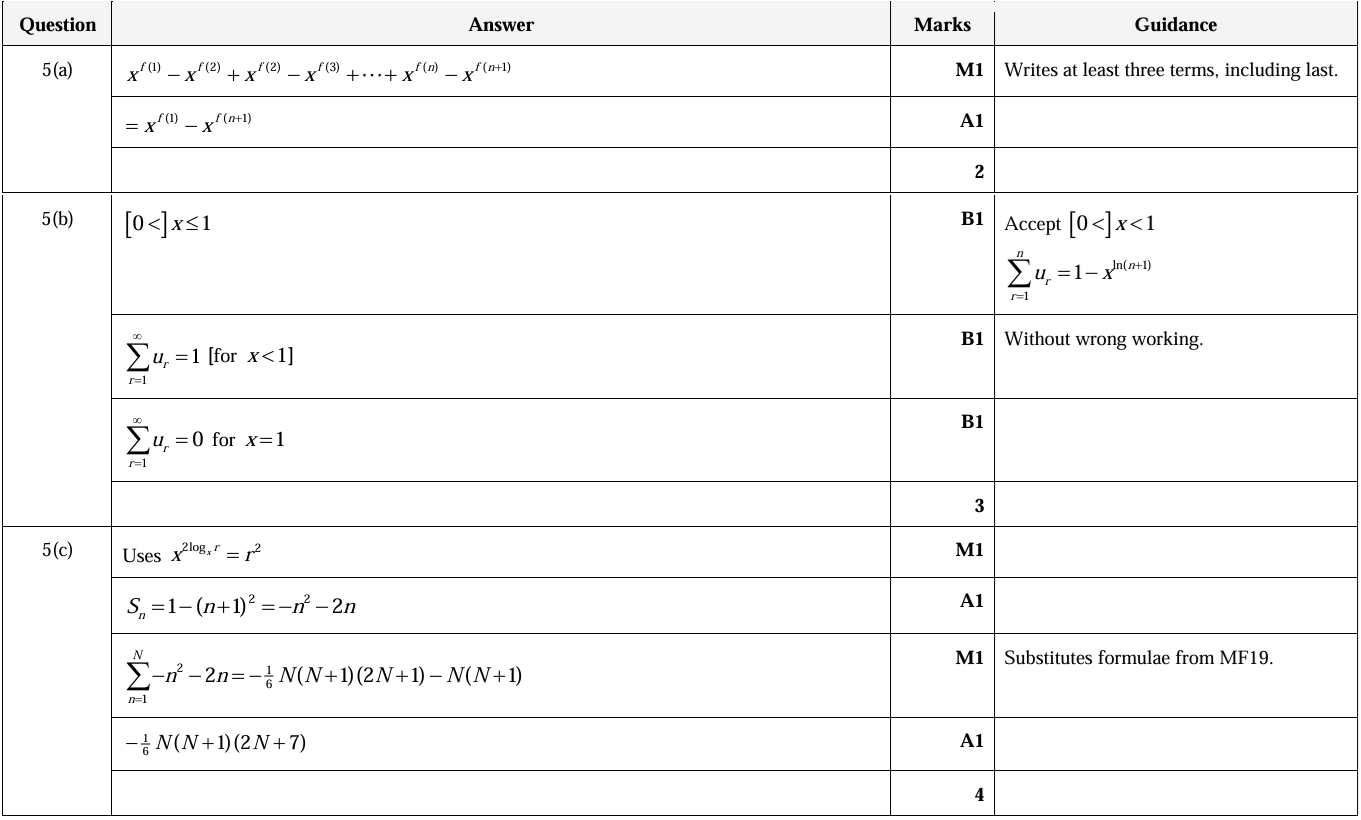
It is given that \(S_n = \sum_{r=1}^{n} u_r\), where \(u_r = x^{f(r)} - x^{f(r+1)}\) and \(x > 0\).
(a) Find \(S_n\) in terms of \(n, x\) and the function \(f\).
(b) Given that \(f(r) = \ln r\), find the set of values of \(x\) for which the infinite series \(u_1 + u_2 + u_3 + \ldots\) is convergent and give the sum to infinity when this exists.
(c) Given instead that \(f(r) = 2 \log_x r\) where \(x \neq 1\), use standard results from the List of formulae (MF19) to find \(\sum_{n=1}^{N} S_n\) in terms of \(N\). Fully factorise your answer.
FM Nov 2024 p12 q06
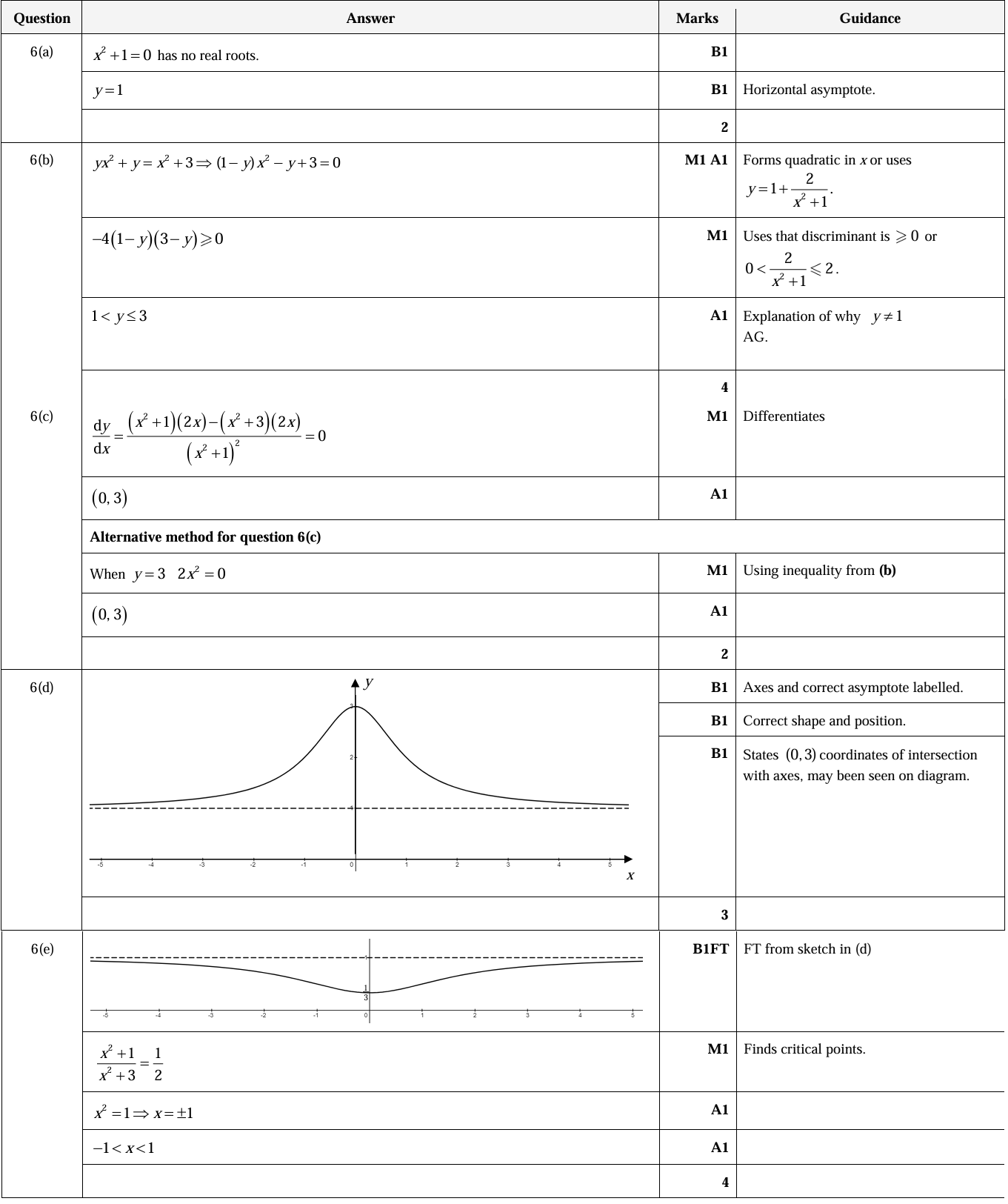
The curve C has equation \(y = \frac{x^2 + 3}{x^2 + 1}\).
- Show that C has no vertical asymptotes and state the equation of the horizontal asymptote. [2]
- Show that \(1 < y \leq 3\) for all real values of \(x\). [4]
- Find the coordinates of any stationary points on C. [2]
- Sketch C, stating the coordinates of any intersections with the axes and labelling the asymptote.
- Sketch the curve with equation \(y = \frac{x^2 + 1}{x^2 + 3}\) and find the set of values of \(x\) for which \(\frac{x^2 + 1}{x^2 + 3} < \frac{1}{2}\). [4]
FM Nov 2024 p12 q07
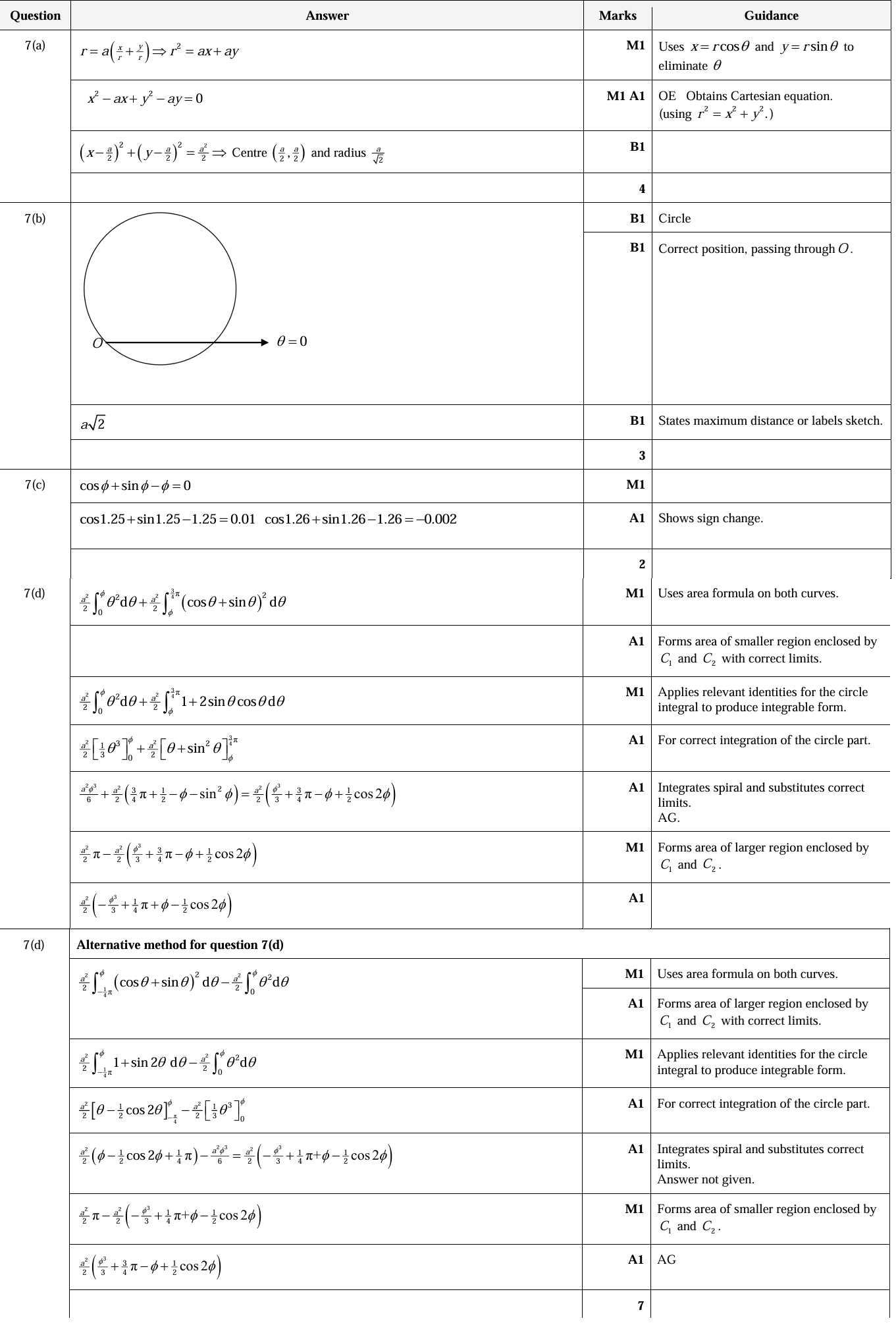
The curve \(C_1\) has polar equation \(r = a(\cos \theta + \sin \theta)\) for \(-\frac{1}{4}\pi \leq \theta \leq \frac{3}{4}\pi\), where \(a\) is a positive constant.
- Find a Cartesian equation for \(C_1\) and show that it represents a circle, stating its radius and the Cartesian coordinates of its centre.
- Sketch \(C_1\) and state the greatest distance of a point on \(C_1\) from the pole.
The curve \(C_2\) with polar equation \(r = a\theta\) intersects \(C_1\) at the pole and the point with polar coordinates \((a\phi, \phi)\).
- Verify that \(1.25 < \phi < 1.26\).
- Show that the area of the smaller region enclosed by \(C_1\) and \(C_2\) is equal to
\(\frac{1}{2}a^2 \left( \frac{3}{4}\pi + \frac{1}{3}\phi^3 - \phi + \frac{1}{2}\cos 2\phi \right)\)
and deduce, in terms of \(a\) and \(\phi\), the area of the larger region enclosed by \(C_1\) and \(C_2\).
FM Nov 2024 p13 q01
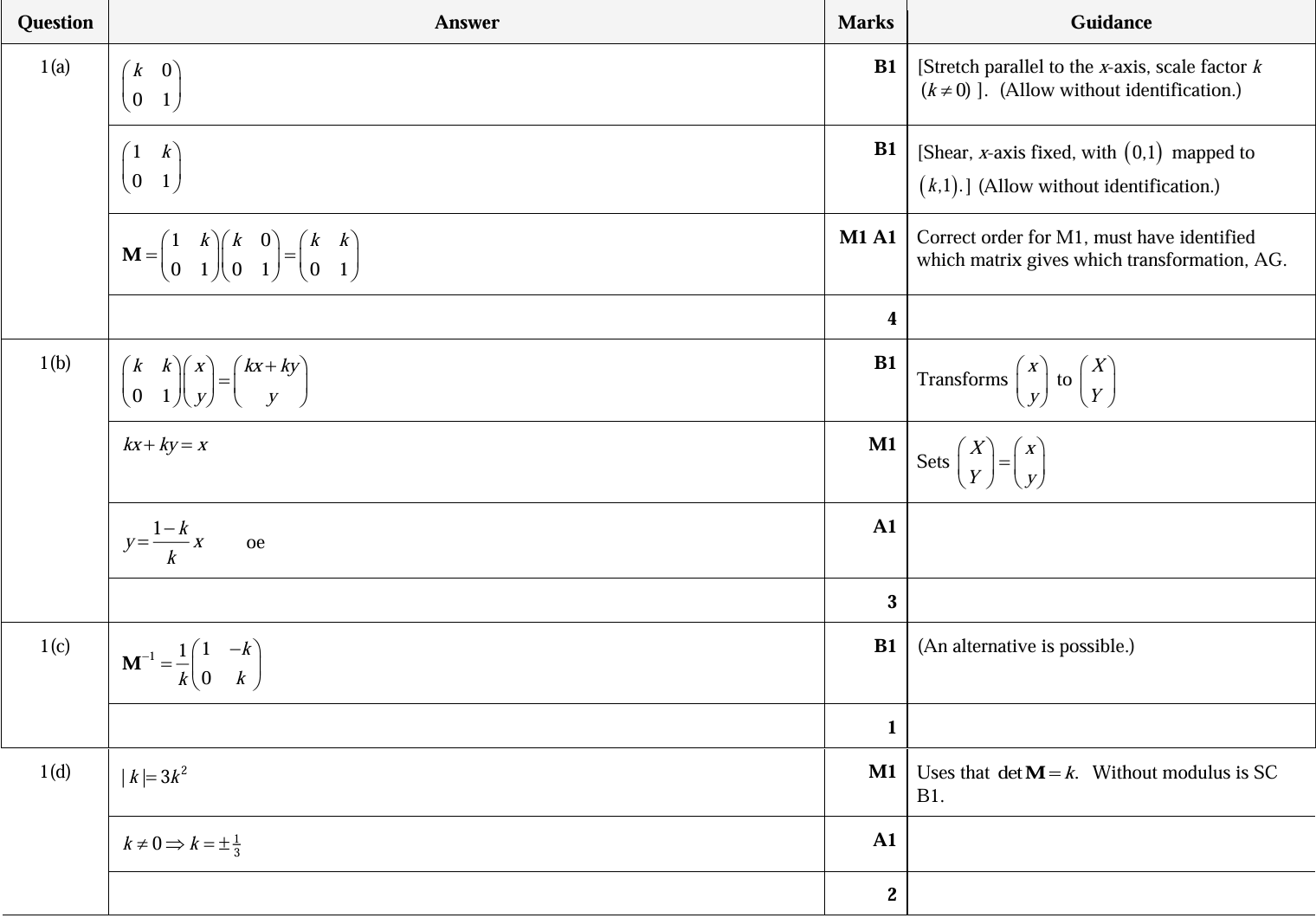
The matrix M represents the sequence of two transformations in the x-y plane given by a stretch parallel to the x-axis, scale factor k (k \neq 0), followed by a shear, x-axis fixed, with (0, 1) mapped to (k, 1).
(a) Show that M = \(\begin{pmatrix} k & k \\ 0 & 1 \end{pmatrix}\).
\((b) The transformation represented by M has a line of invariant points. Find, in terms of k, the equation of this line.\)
The unit square S in the x-y plane is transformed by M onto the parallelogram P.
(c) Find, in terms of k, a matrix which transforms P onto S.
(d) Given that the area of P is \(3k^2\) units\(^2\), find the possible values of k.
FM Nov 2024 p13 q02
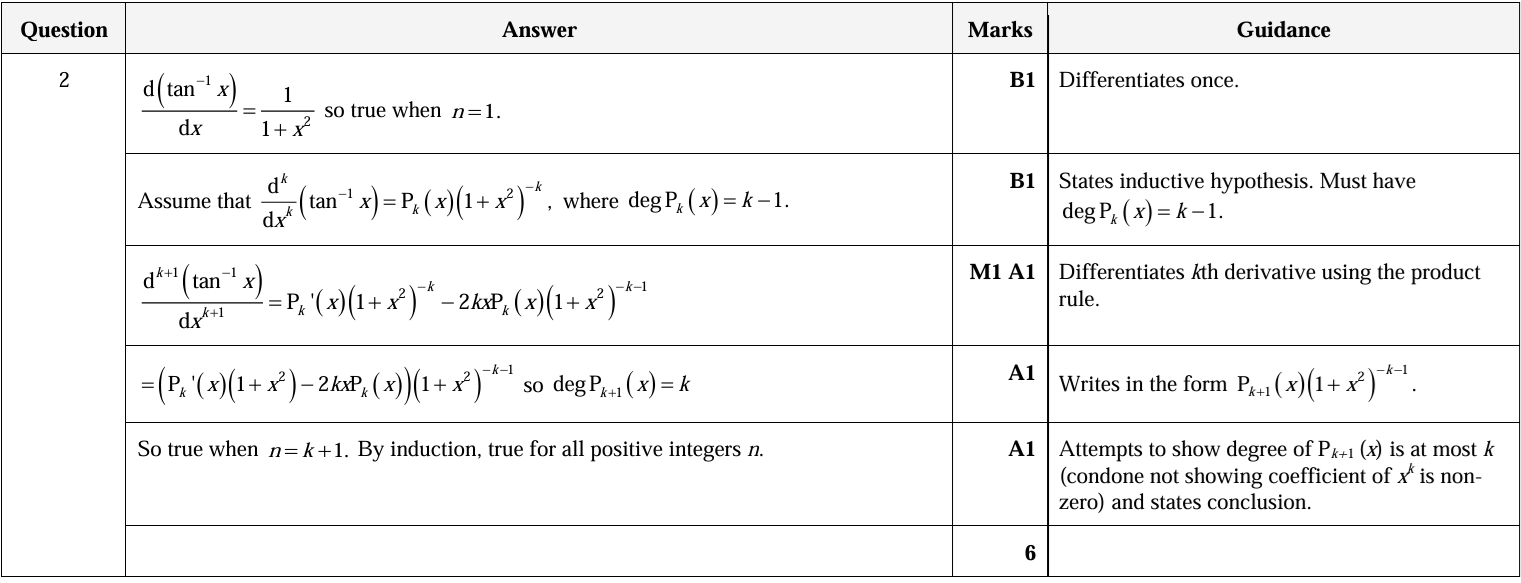
Prove by mathematical induction that, for all positive integers n,
\(\frac{d^n}{dx^n} \left( \arctan x \right) = P_n(x) (1 + x^2)^{-n},\)
where \(P_n(x)\) is a polynomial of degree \(n - 1\).
FM Nov 2024 p13 q03
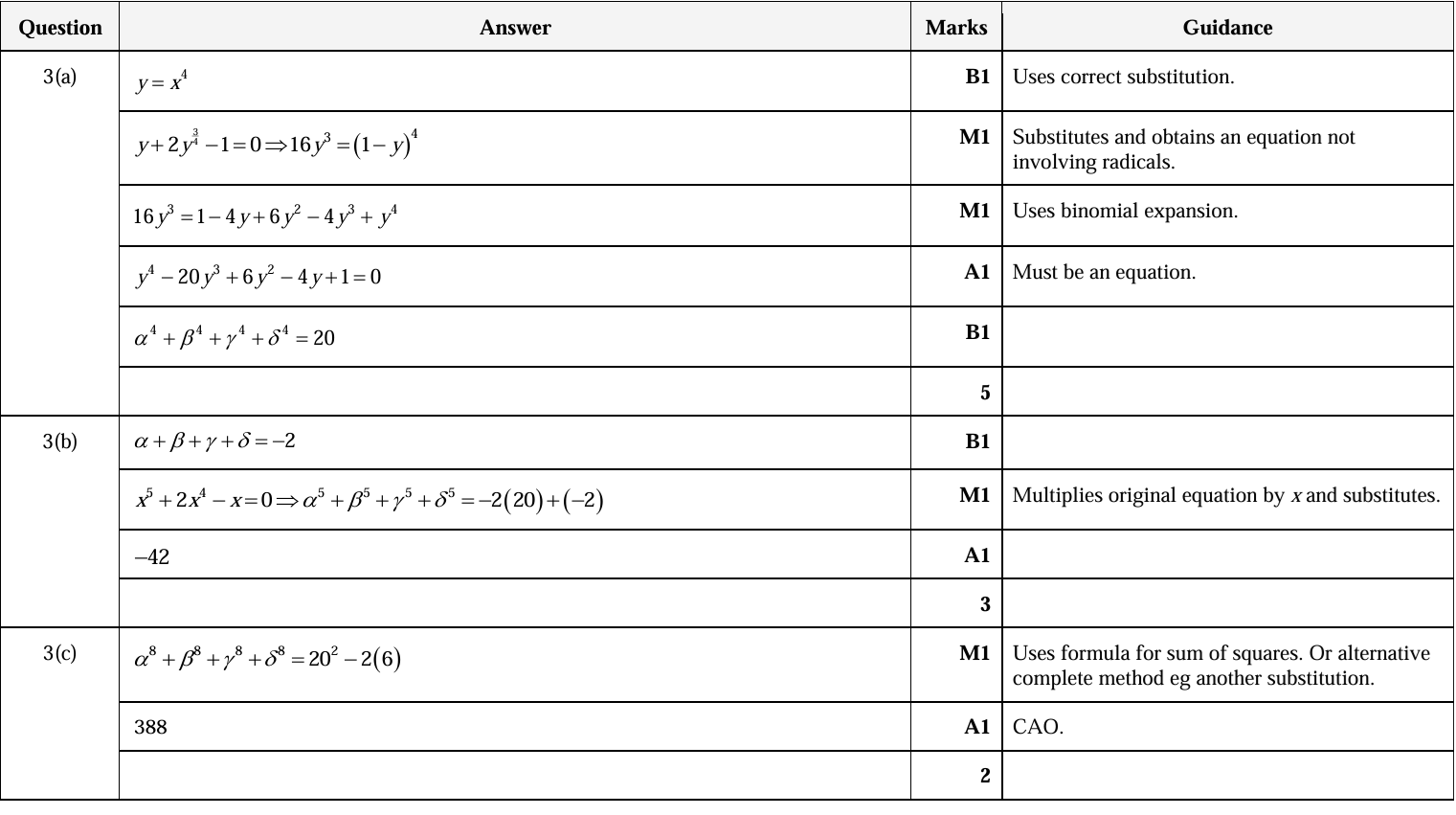
The quartic equation \(x^4 + 2x^3 - 1 = 0\) has roots \(\alpha, \beta, \gamma, \delta\).
(a) Find a quartic equation whose roots are \(\alpha^4, \beta^4, \gamma^4, \delta^4\) and state the value of \(\alpha^4 + \beta^4 + \gamma^4 + \delta^4\).
(b) Find the value of \(\alpha^5 + \beta^5 + \gamma^5 + \delta^5\).
(c) Find the value of \(\alpha^8 + \beta^8 + \gamma^8 + \delta^8\).
FM Nov 2024 p13 q04
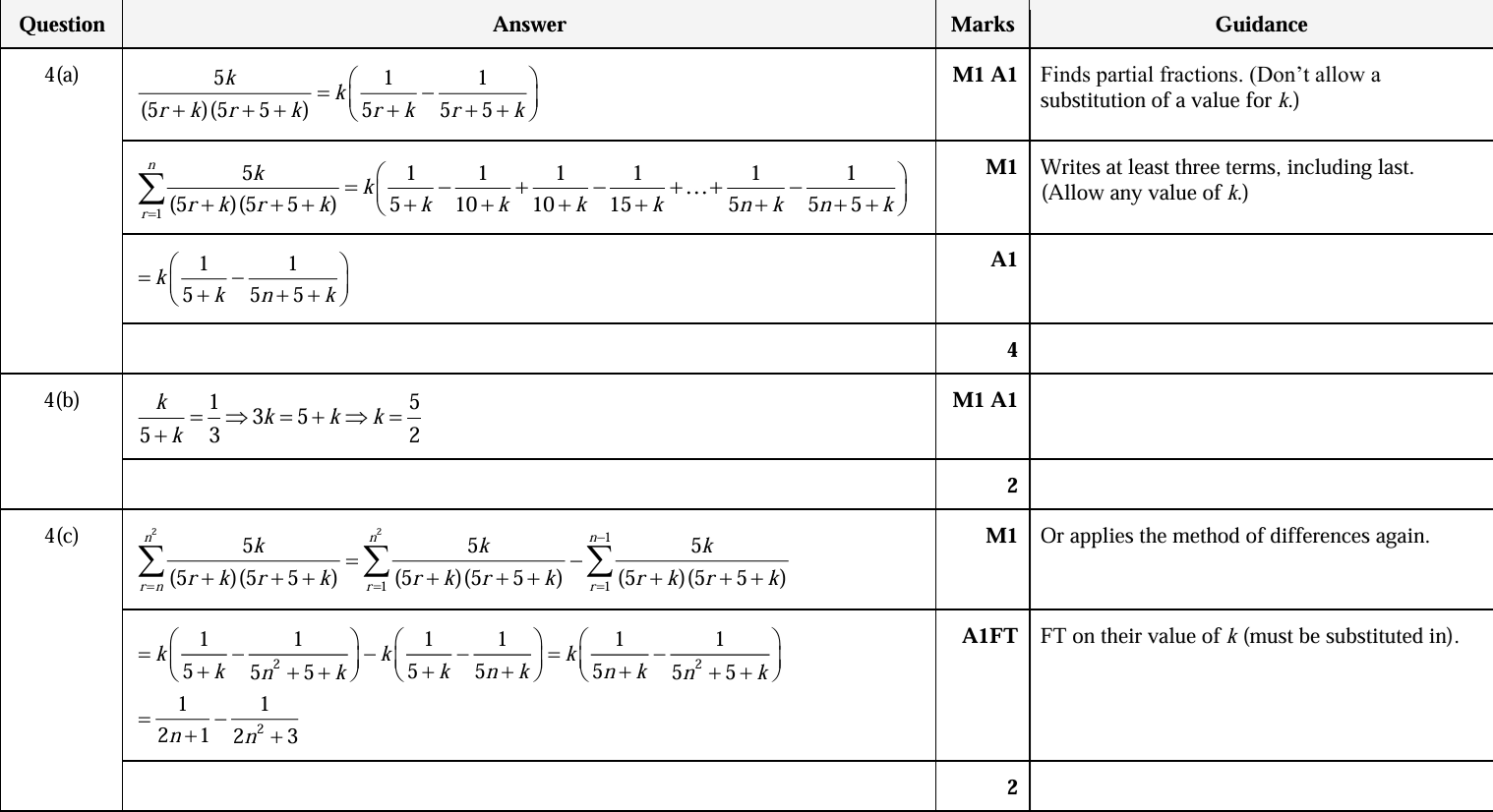
(a) Use the method of differences to find \(\sum_{r=1}^{n} \frac{5k}{(5r+k)(5r+5+k)}\) in terms of \(n\) and \(k\), where \(k\) is a positive constant.
It is given that \(\sum_{r=1}^{\infty} \frac{5k}{(5r+k)(5r+5+k)} = \frac{1}{3}\).
(b) Find the value of \(k\).
(c) Hence find \(\sum_{r=n}^{n^2} \frac{5k}{(5r+k)(5r+5+k)}\) in terms of \(n\).
FM Nov 2024 p13 q05
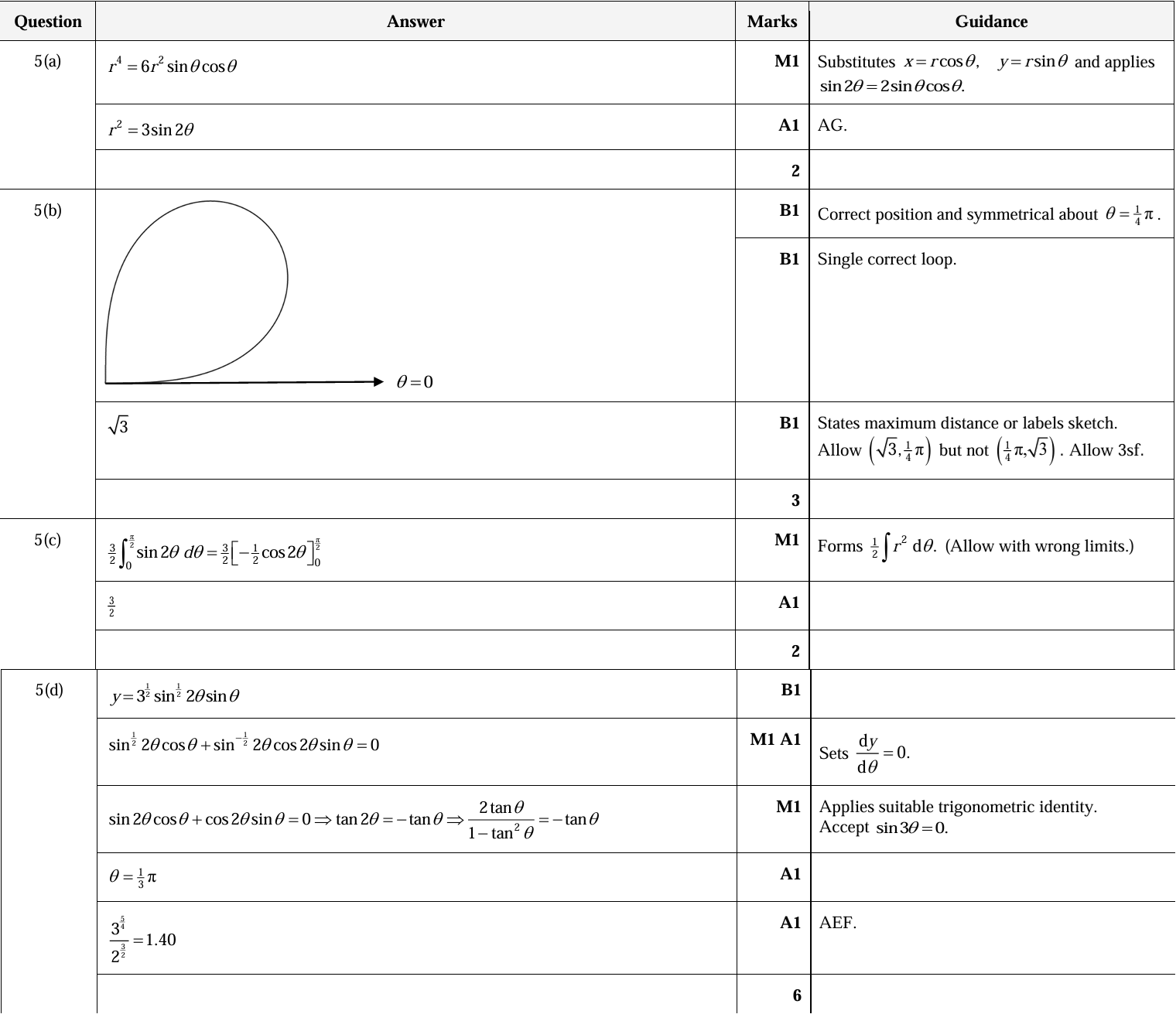
(a) Show that the curve with Cartesian equation \((x^2 + y^2)^2 = 6xy\) has polar equation \(r^2 = 3 \sin 2\theta\).
The curve \(C\) has polar equation \(r^2 = 3 \sin 2\theta\), for \(0 \leq \theta \leq \frac{1}{2}\pi\).
(b) Sketch \(C\) and state the maximum distance of a point on \(C\) from the pole.
(c) Find the area of the region enclosed by \(C\).
(d) Find the maximum distance of a point on \(C\) from the initial line.
FM Nov 2024 p13 q06
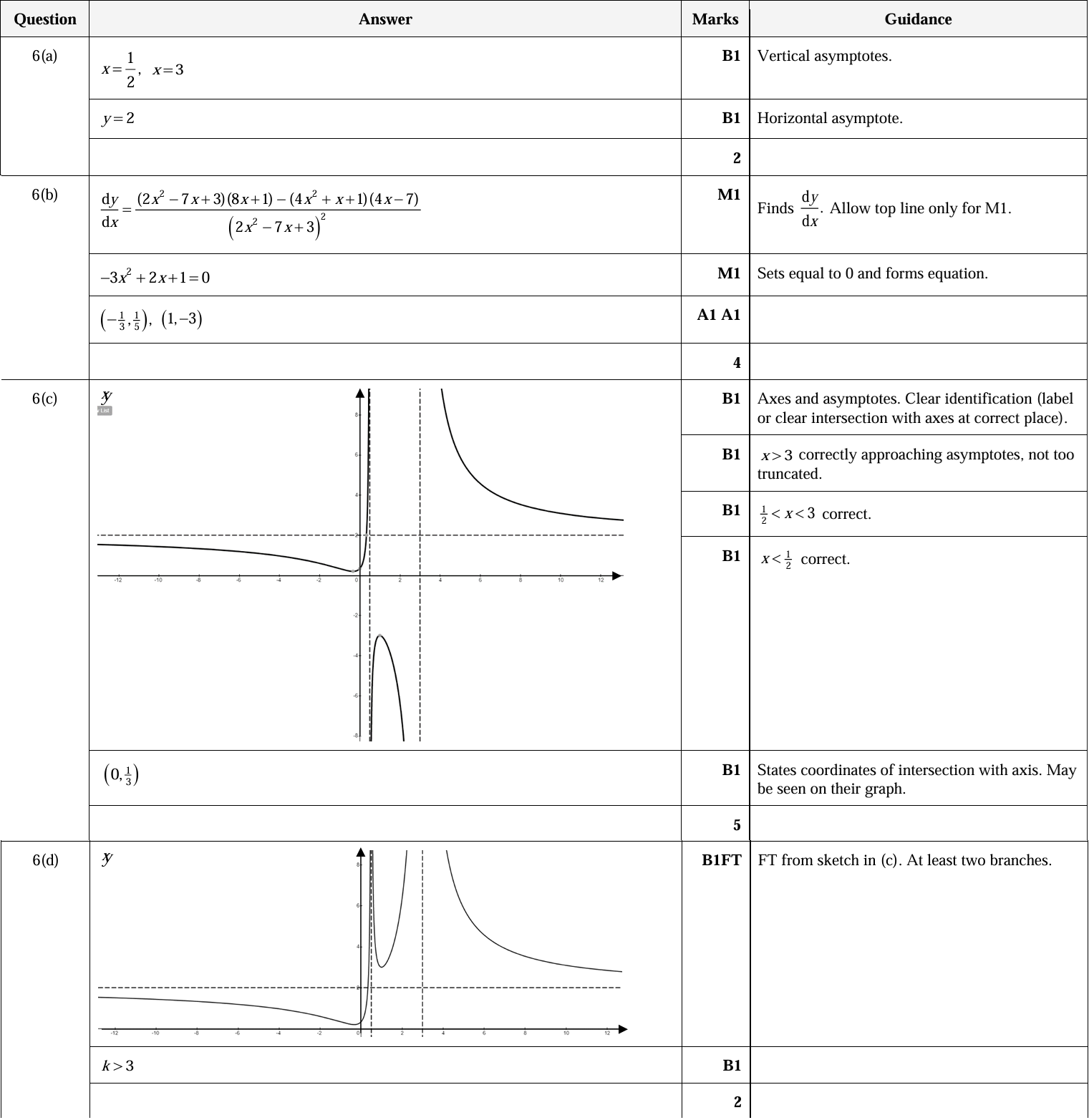
The curve C has equation \(y = \frac{4x^2 + x + 1}{2x^2 - 7x + 3}\).
- Find the equations of the asymptotes of C.
- Find the coordinates of any stationary points on C.
- Sketch C, stating the coordinates of any intersections with the axes.
- Sketch the curve with equation \(y = \left| \frac{4x^2 + x + 1}{2x^2 - 7x + 3} \right| = k\) and state the set of values of \(k\) for which it has 4 distinct real solutions.
FM Nov 2024 p13 q07
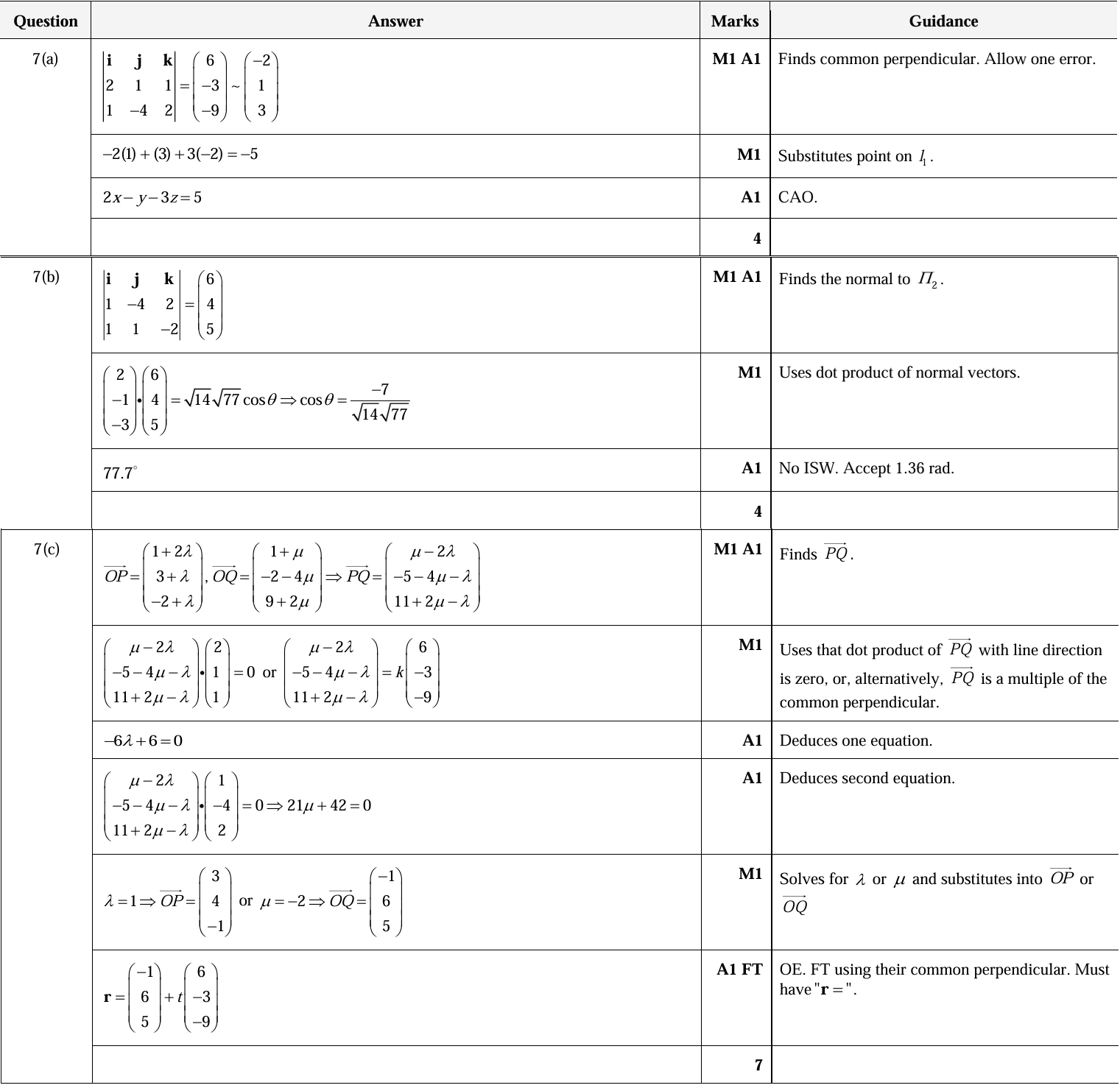
The lines \(l_1\) and \(l_2\) have equations \(\mathbf{r} = \mathbf{i} + 3\mathbf{j} - 2\mathbf{k} + \lambda (2\mathbf{i} + \mathbf{j} + \mathbf{k})\) and \(\mathbf{r} = \mathbf{i} - 2\mathbf{j} + 9\mathbf{k} + \mu (\mathbf{i} - 4\mathbf{j} + 2\mathbf{k})\) respectively. The plane \(\Pi_1\) contains \(l_1\) and is parallel to \(l_2\).
(a) Find the equation of \(\Pi_1\), giving your answer in the form \(ax + by + cz = d\).
The plane \(\Pi_2\) contains \(l_2\) and the point with coordinates \((2, -1, 7)\).
(b) Find the acute angle between \(\Pi_1\) and \(\Pi_2\).
The point \(P\) on \(l_1\) and the point \(Q\) on \(l_2\) are such that \(PQ\) is perpendicular to both \(l_1\) and \(l_2\).
(c) Find a vector equation for \(PQ\).
FM June 2024 p11 q01
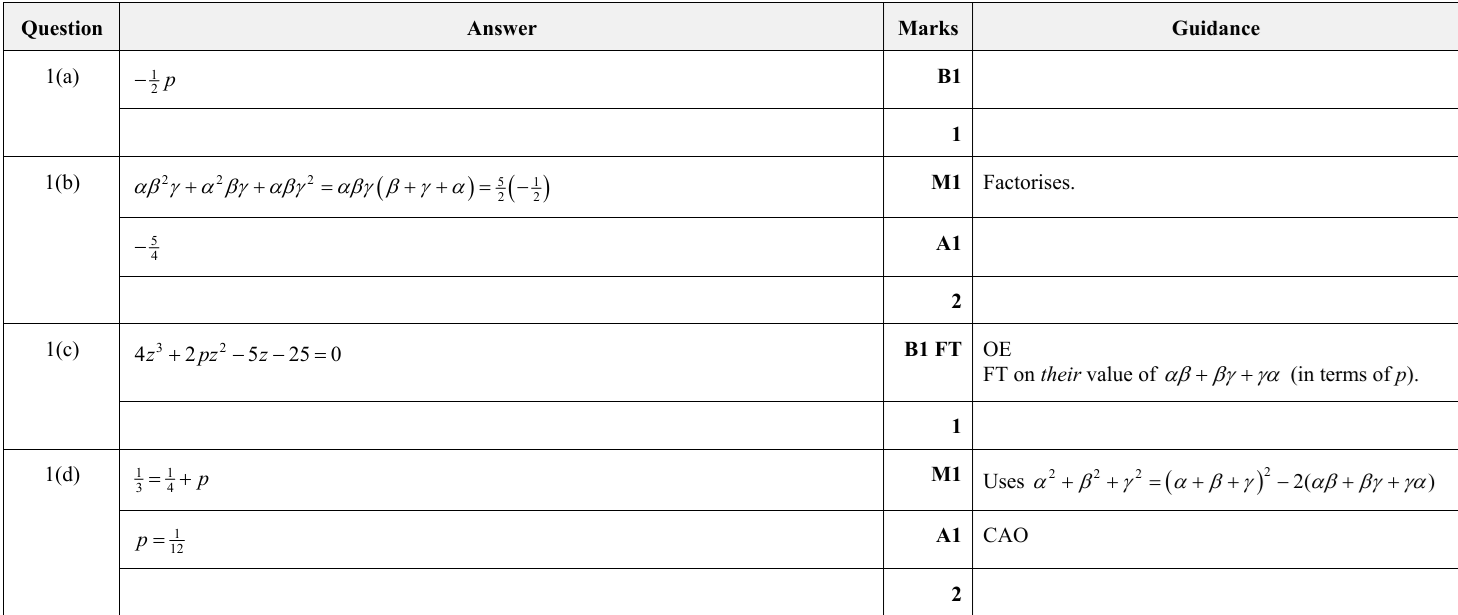
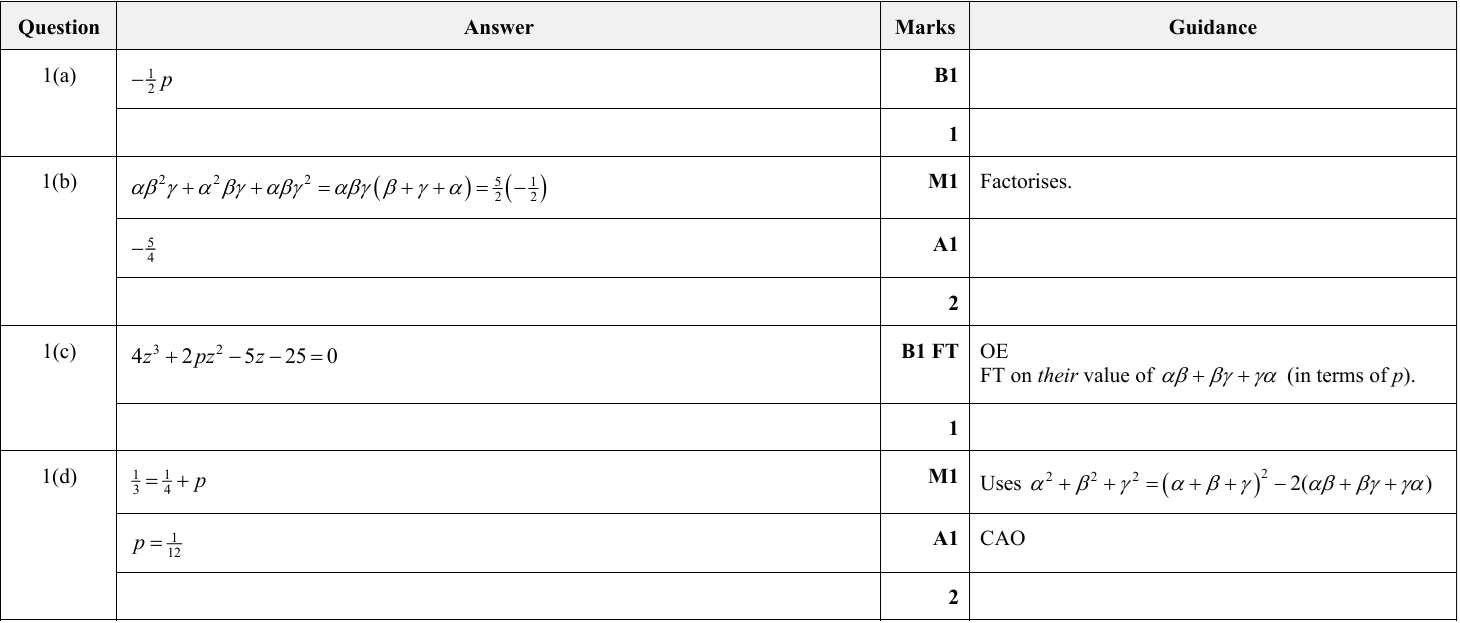
The cubic equation \(2x^3 + x^2 - px - 5 = 0\), where \(p\) is a positive constant, has roots \(\alpha, \beta, \gamma\).
(a) State, in terms of \(p\), the value of \(\alpha\beta + \beta\gamma + \gamma\alpha\).
(b) Find the value of \(\alpha^2\beta\gamma + \alpha\beta^2\gamma + \alpha\beta\gamma^2\).
(c) Deduce a cubic equation whose roots are \(\alpha\beta, \beta\gamma, \alpha\gamma\).
(d) Given that \(\alpha^2 + \beta^2 + \gamma^2 = \frac{1}{3}\), find the value of \(p\).
FM June 2024 p11 q02
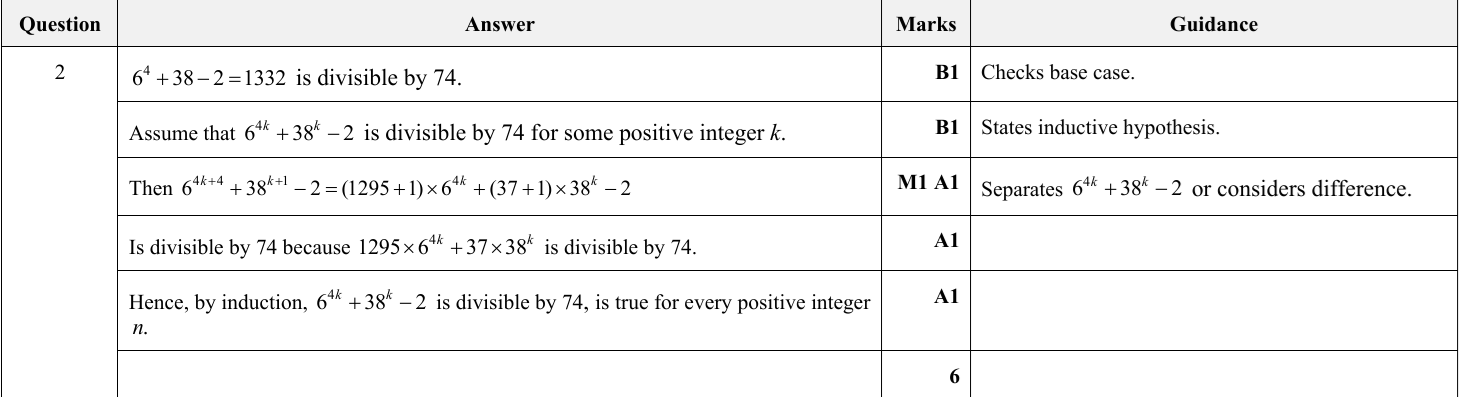
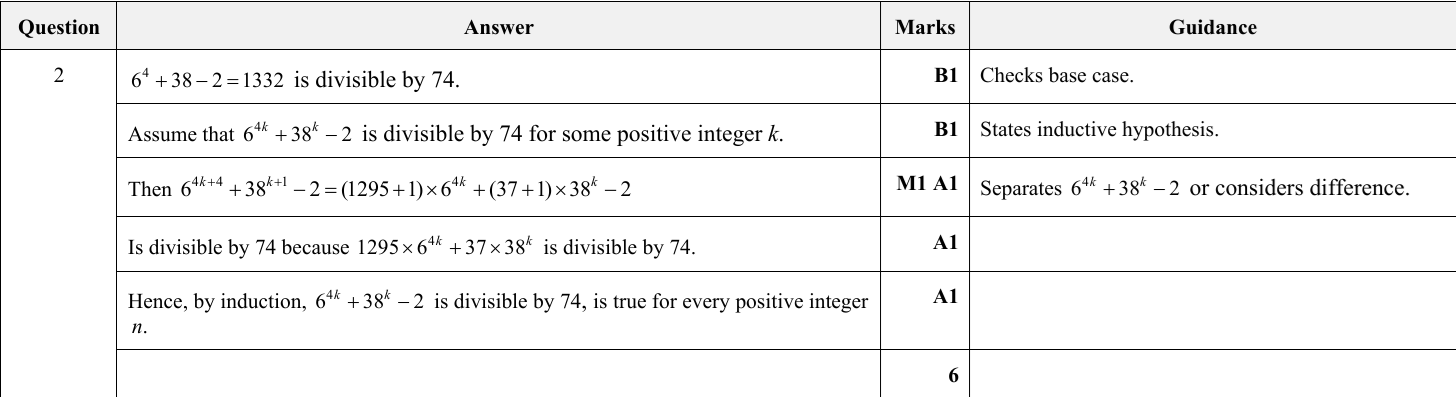
Prove by mathematical induction that \(6^{4n} + 38^n - 2\) is divisible by 74 for all positive integers \(n\). [6]
FM June 2024 p11 q03
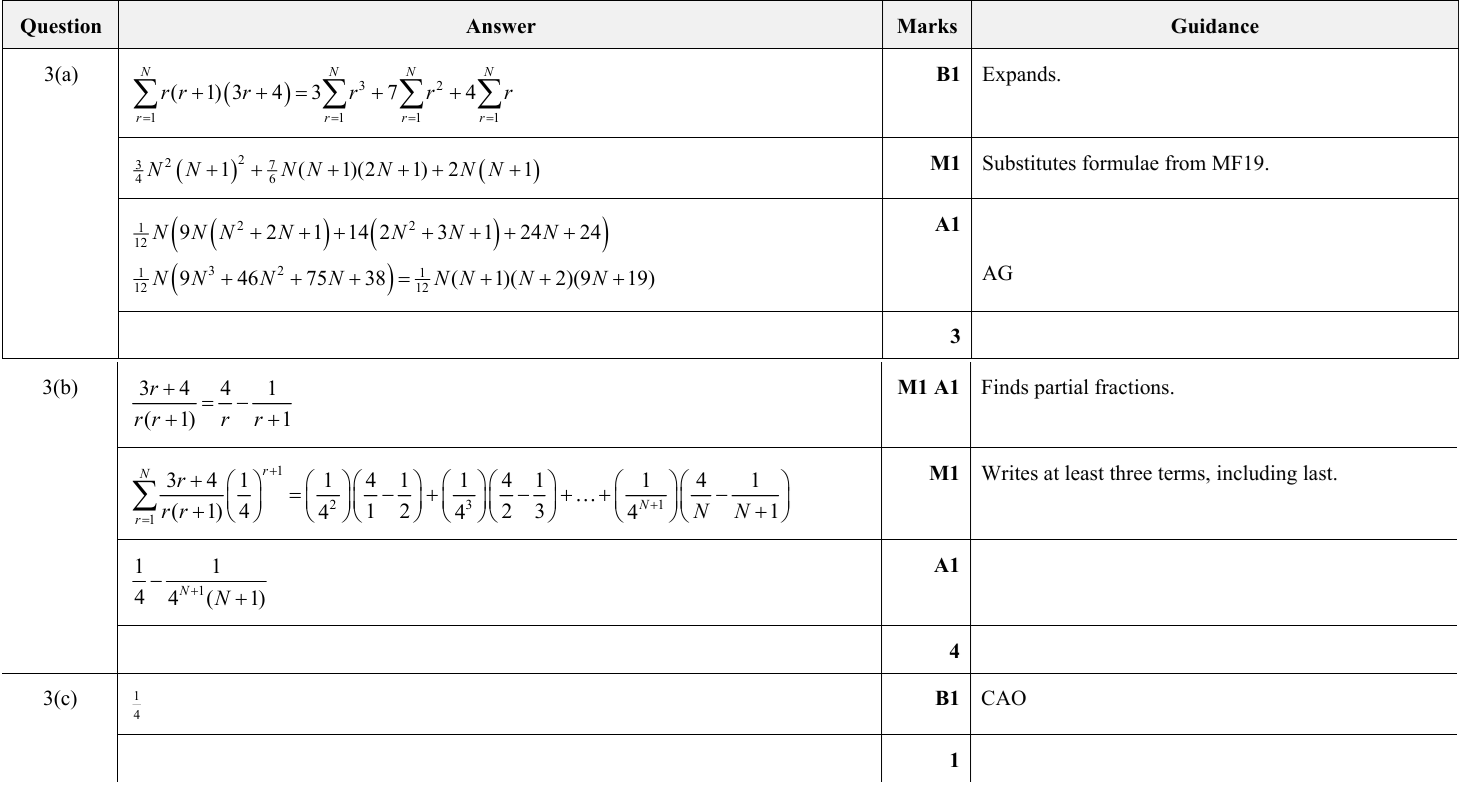
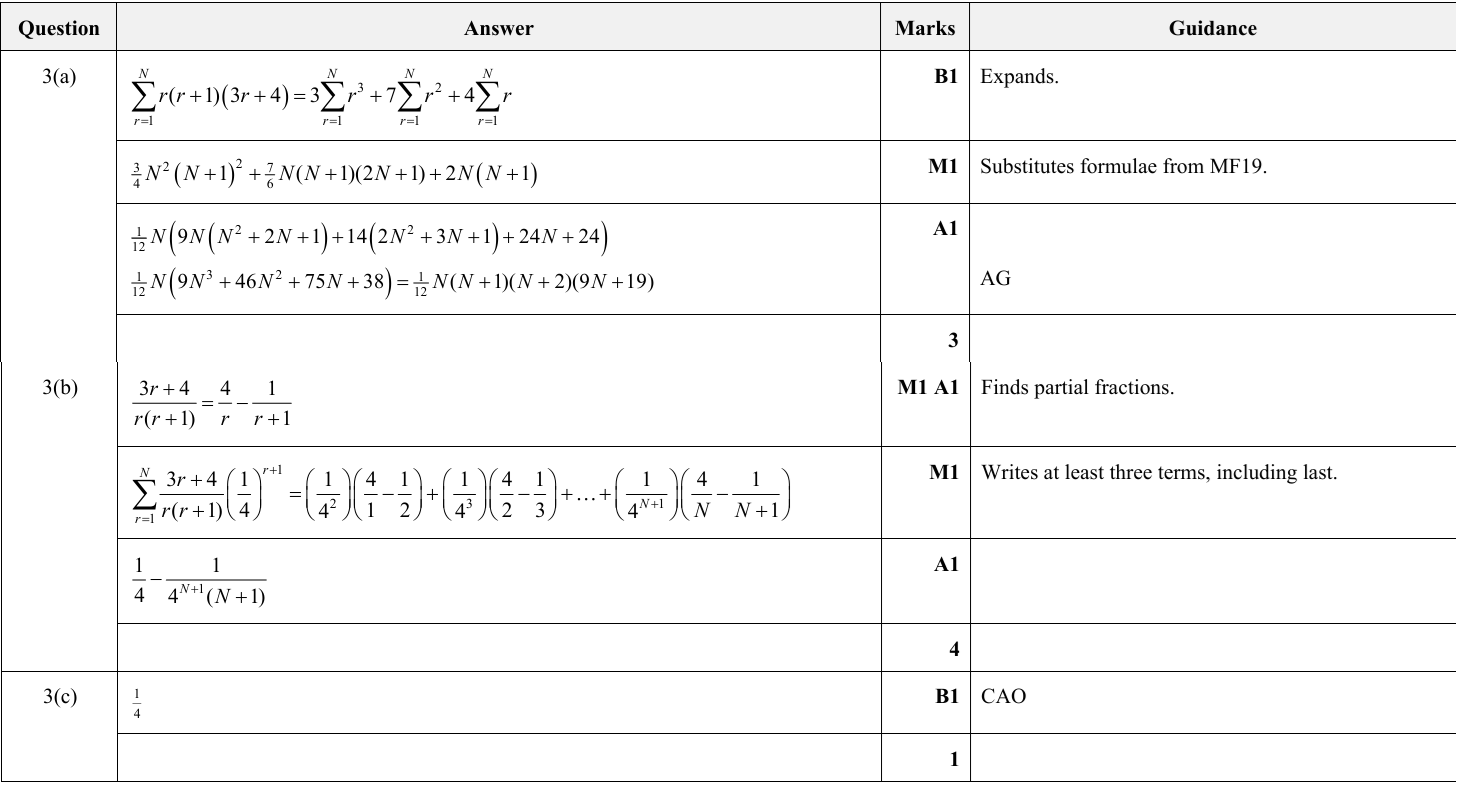
(a) Use standard results from the list of formulae (MF19) to show that
\(\sum_{r=1}^{N} r(r+1)(3r+4) = \frac{1}{12}N(N+1)(N+2)(9N+19).\)
(b) Express \(\frac{3r+4}{r(r+1)}\) in partial fractions and hence use the method of differences to find
\(\sum_{r=1}^{N} \frac{3r+4}{r(r+1)} \left( \frac{1}{4} \right)^{r+1}\)
in terms of \(N\).
(c) Deduce the value of
\(\sum_{r=1}^{\infty} \frac{3r+4}{r(r+1)} \left( \frac{1}{4} \right)^{r+1}.\)
FM June 2024 p11 q04
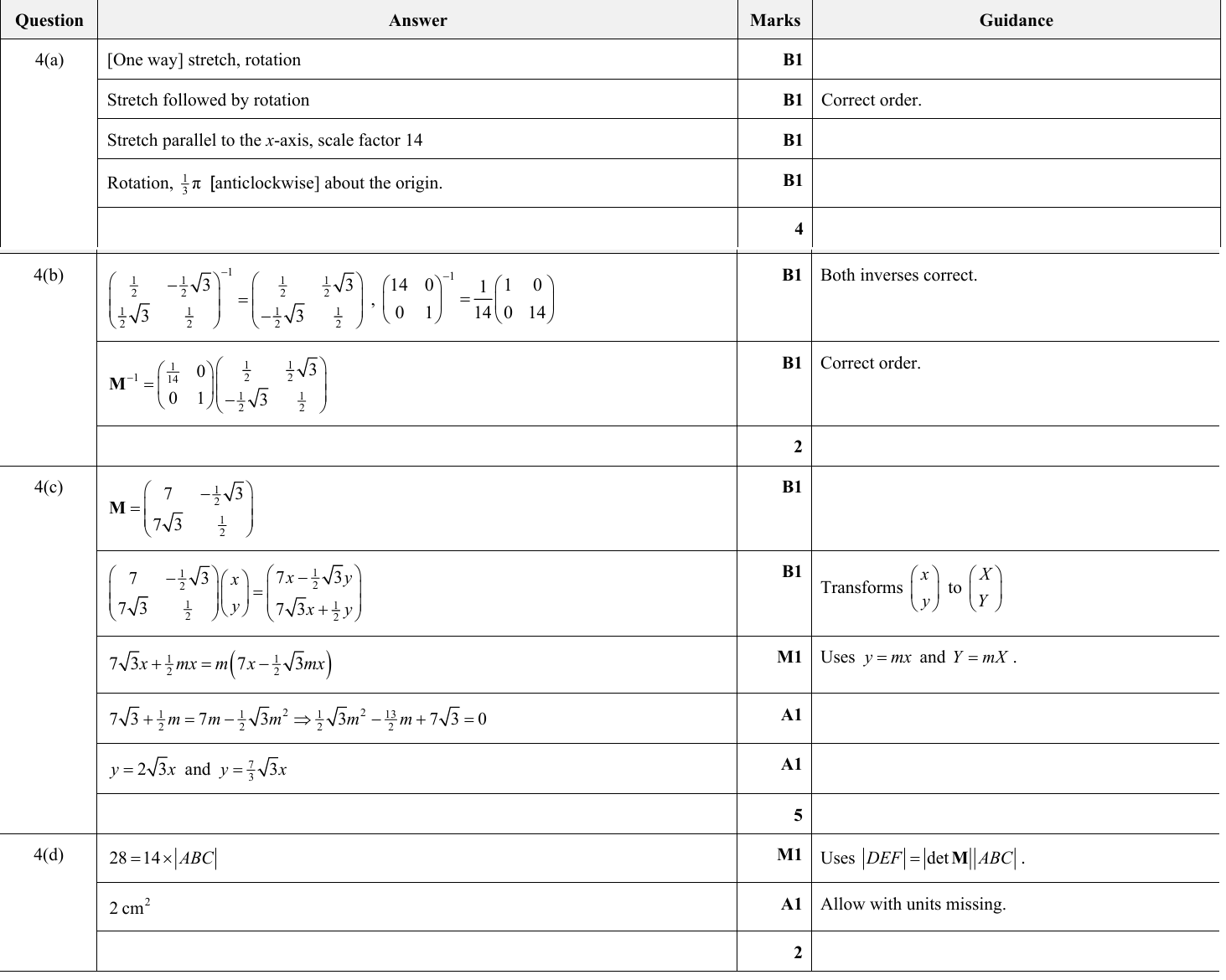
The matrix M is given by \(\mathbf{M} = \begin{pmatrix} \frac{1}{2} & -\frac{1}{2}\sqrt{3} & \begin{pmatrix} 14 & 0 \\ 0 & 1 \end{pmatrix} \\ \frac{1}{2}\sqrt{3} & \frac{1}{2} & \end{pmatrix}\).
- The matrix M represents a sequence of two geometrical transformations in the x-y plane. Give full details of each transformation, and make clear the order in which they are applied.
- Write \(\mathbf{M}^{-1}\) as the product of two matrices, neither of which is I.
- Find the equations of the invariant lines, through the origin, of the transformation represented by M.
- The triangle ABC in the x-y plane is transformed by M onto triangle DEF. Given that the area of triangle DEF is 28 cm2, find the area of triangle ABC.
FM June 2024 p11 q05
The points A, B, C have position vectors
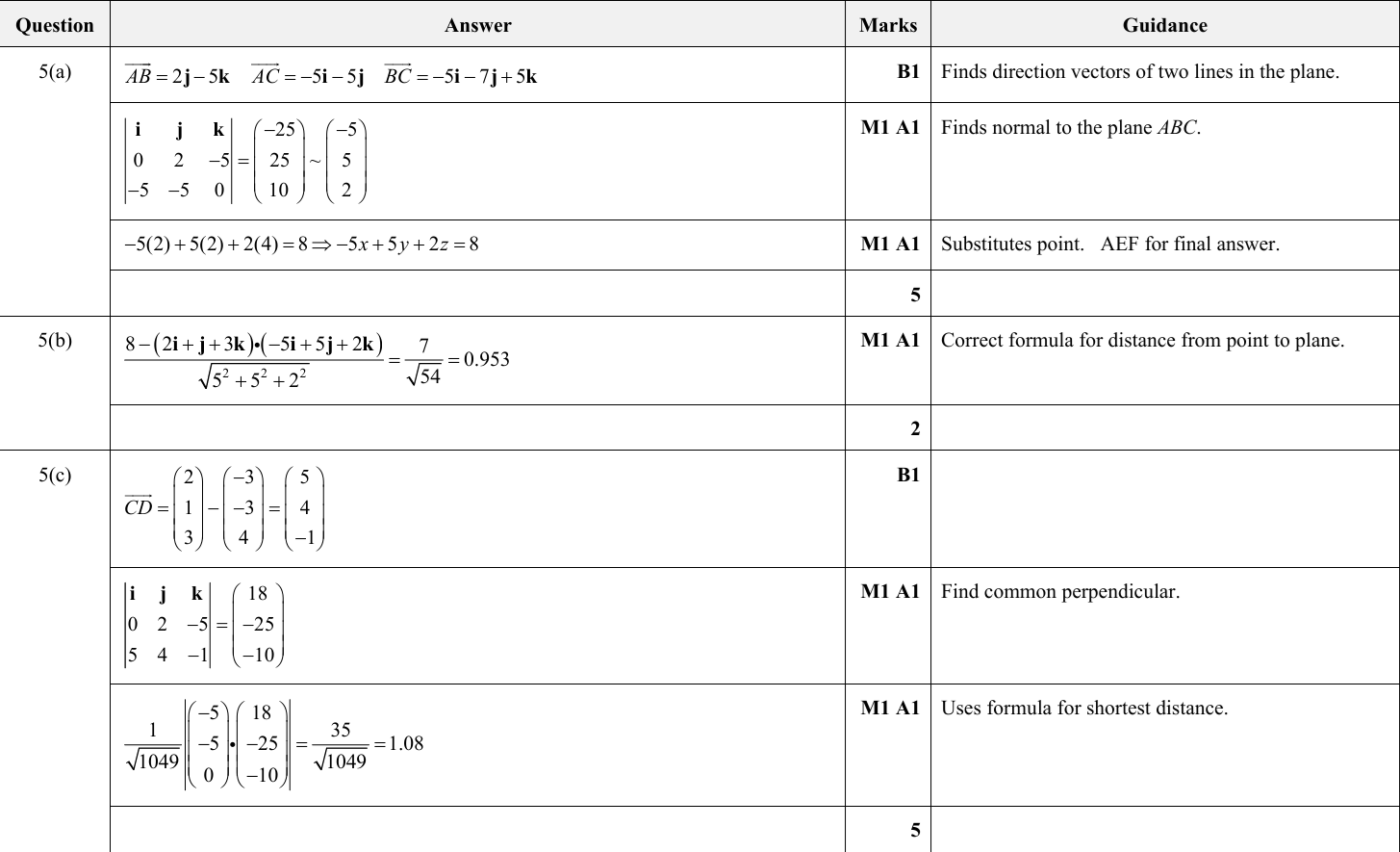
\(2\mathbf{i} + 2\mathbf{j} + 4\mathbf{k}, \quad 2\mathbf{i} + 4\mathbf{j} - \mathbf{k}, \quad -3\mathbf{i} - 3\mathbf{j} + 4\mathbf{k},\)
respectively, relative to the origin O.
(a) Find the equation of the plane ABC, giving your answer in the form \(ax + by + cz = d\).
The point D has position vector \(2\mathbf{i} + \mathbf{j} + 3\mathbf{k}\).
(b) Find the perpendicular distance from D to the plane ABC.
(c) Find the shortest distance between the lines AB and CD.
FM June 2024 p11 q06
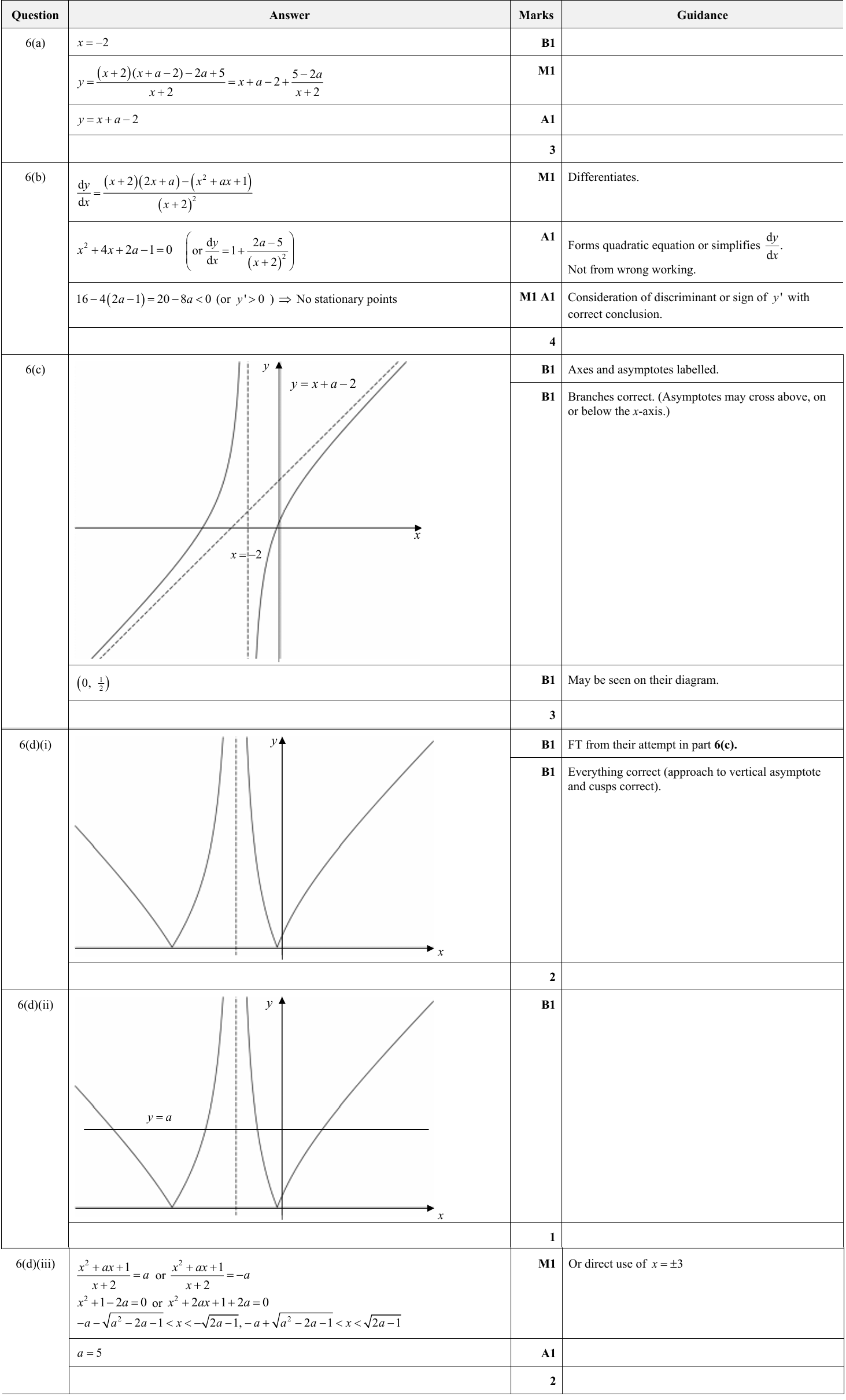
The curve C has equation \(y = \frac{x^2 + ax + 1}{x + 2}\), where \(a > \frac{5}{2}\).
- Find the equations of the asymptotes of C.
- Show that C has no stationary points.
- Sketch C, stating the coordinates of the point of intersection with the y-axis and labelling the asymptotes.
-
- Sketch the curve with equation \(y = \left| \frac{x^2 + ax + 1}{x + 2} \right|\).
- On your sketch in part (i), draw the line \(y = a\).
- It is given that \(\left| \frac{x^2 + ax + 1}{x + 2} \right| < a\) for \(-5 - \sqrt{14} < x < -3\) and \(-5 + \sqrt{14} < x < 3\). Find the value of \(a\).
FM June 2024 p11 q07
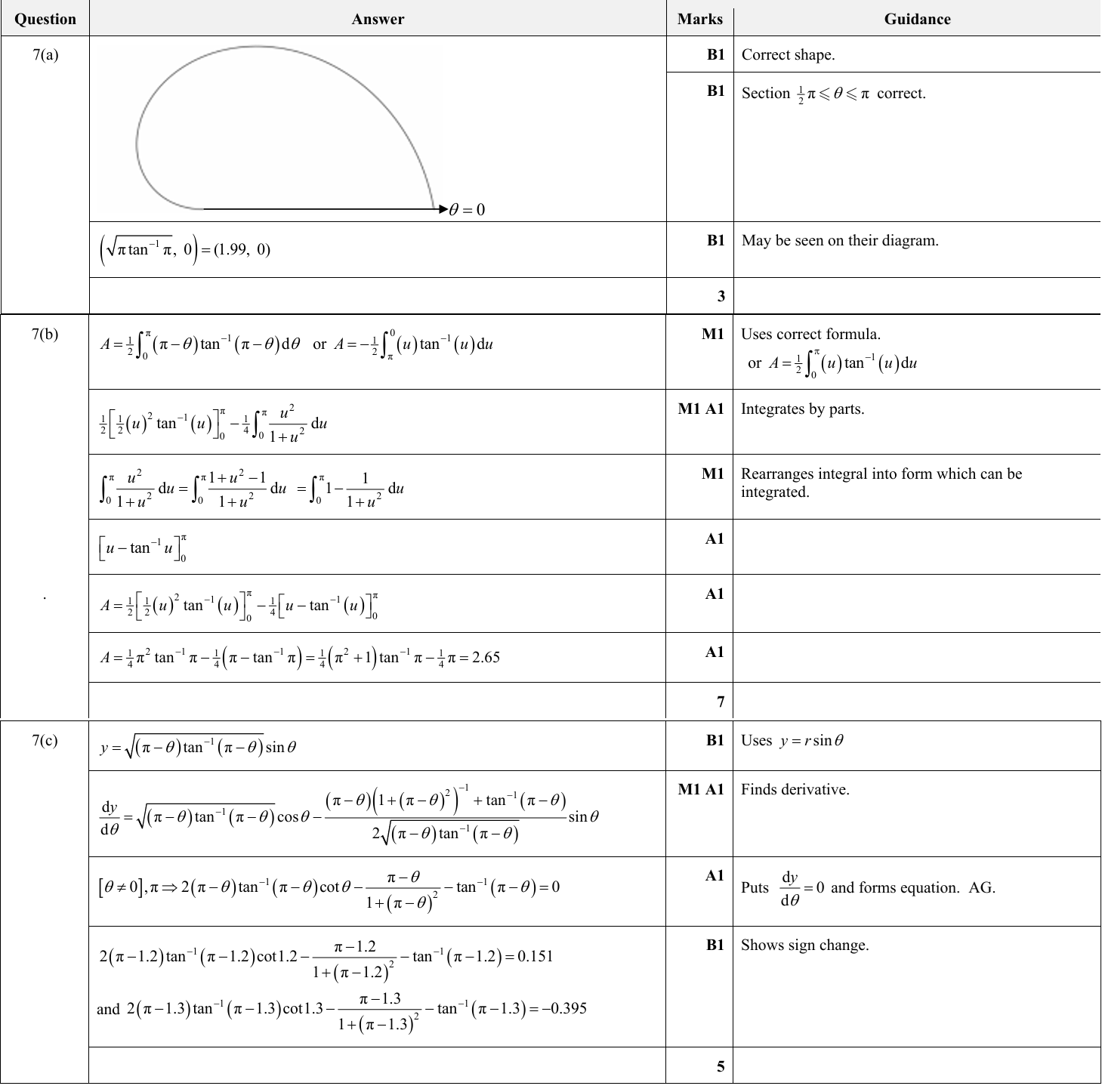
The curve C has polar equation \(r^2 = (\pi - \theta) \arctan(\pi - \theta)\), for \(0 \leq \theta \leq \pi\).
(a) Sketch C and state the polar coordinates of the point of C furthest from the pole. [3]
(b) Using the substitution \(u = \pi - \theta\), or otherwise, find the area of the region enclosed by C and the initial line. [7]
(c) Show that, at the point of C furthest from the initial line,
\(2(\pi - \theta) \arctan(\pi - \theta) \cot \theta - \frac{\pi - \theta}{1 + (\pi - \theta)^2} - \arctan(\pi - \theta) = 0\)
and verify that this equation has a root for \(\theta\) between 1.2 and 1.3. [5]
FM June 2024 p12 q01
The cubic equation \(2x^3 + x^2 - px - 5 = 0\), where \(p\) is a positive constant, has roots \(\alpha, \beta, \gamma\).
- State, in terms of \(p\), the value of \(\alpha\beta + \beta\gamma + \gamma\alpha\).
- Find the value of \(\alpha^2\beta\gamma + \alpha\beta^2\gamma + \alpha\beta\gamma^2\).
- Deduce a cubic equation whose roots are \(\alpha\beta, \beta\gamma, \alpha\gamma\).
- Given that \(\alpha^2 + \beta^2 + \gamma^2 = \frac{1}{3}\), find the value of \(p\).
FM June 2024 p12 q02
Prove by mathematical induction that \(6^{4n} + 38^n - 2\) is divisible by 74 for all positive integers \(n\).
FM June 2024 p12 q03
(a) Use standard results from the list of formulae (MF19) to show that
\(\sum_{r=1}^{N} r(r+1)(3r+4) = \frac{1}{12}N(N+1)(N+2)(9N+19).\)
(b) Express \(\frac{3r+4}{r(r+1)}\) in partial fractions and hence use the method of differences to find
\(\sum_{r=1}^{N} \frac{3r+4}{r(r+1)} \left( \frac{1}{4} \right)^{r+1}\)
in terms of \(N\).
(c) Deduce the value of
\(\sum_{r=1}^{\infty} \frac{3r+4}{r(r+1)} \left( \frac{1}{4} \right)^{r+1}.\)
FM June 2024 p12 q04
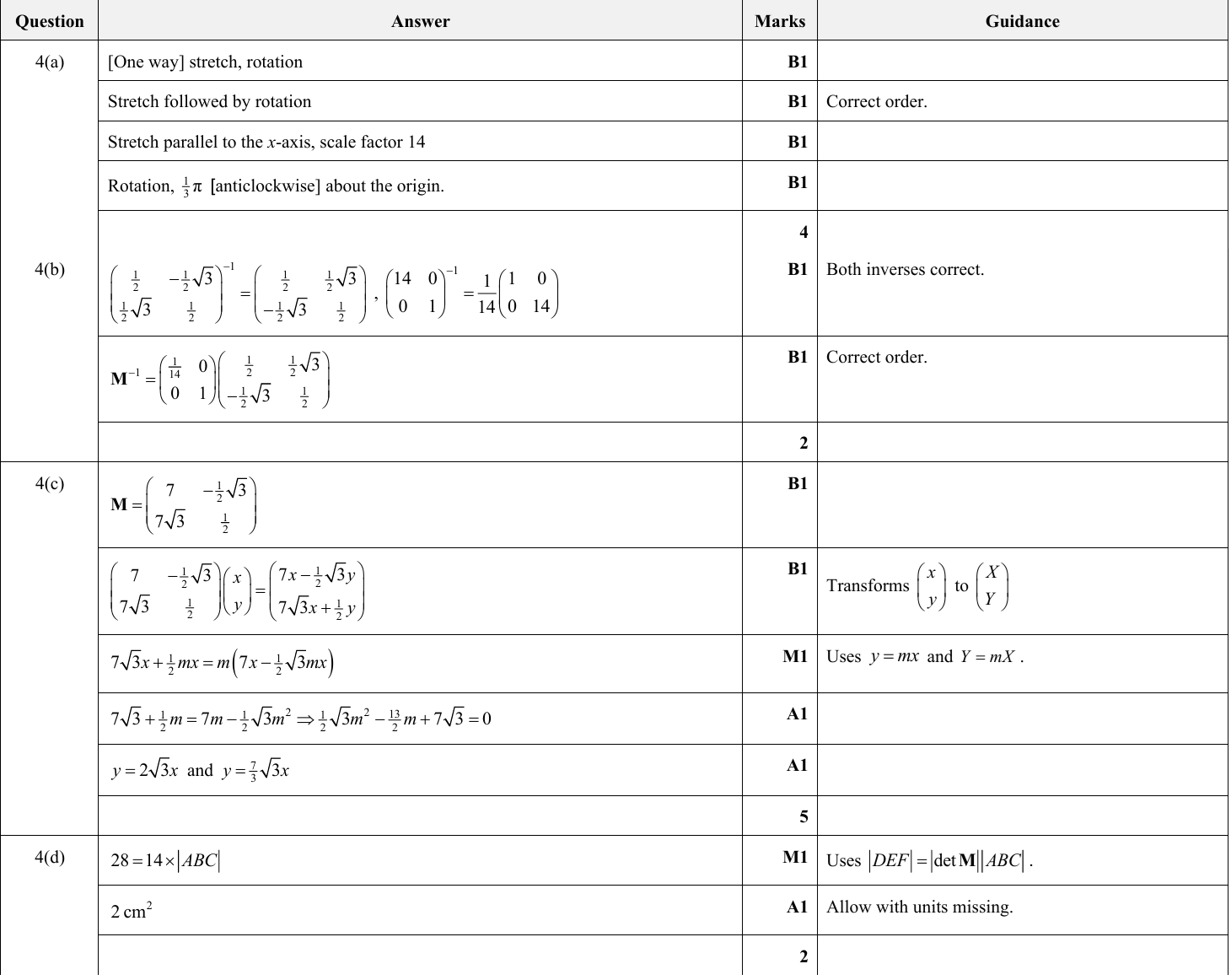
The matrix M is given by \(\mathbf{M} = \begin{pmatrix} \frac{1}{2} & -\frac{1}{2}\sqrt{3} \\ \frac{1}{2}\sqrt{3} & \frac{1}{2} \end{pmatrix} \begin{pmatrix} 14 & 0 \\ 0 & 1 \end{pmatrix}\).
(a) The matrix M represents a sequence of two geometrical transformations in the x-y plane. Give full details of each transformation, and make clear the order in which they are applied. [4]
(b) Write \(\mathbf{M}^{-1}\) as the product of two matrices, neither of which is I. [2]
\((c) Find the equations of the invariant lines, through the origin, of the transformation represented by M. [5]\)
(d) The triangle ABC in the x-y plane is transformed by M onto triangle DEF. Given that the area of triangle DEF is 28 cm2, find the area of triangle ABC. [2]
FM June 2024 p12 q05
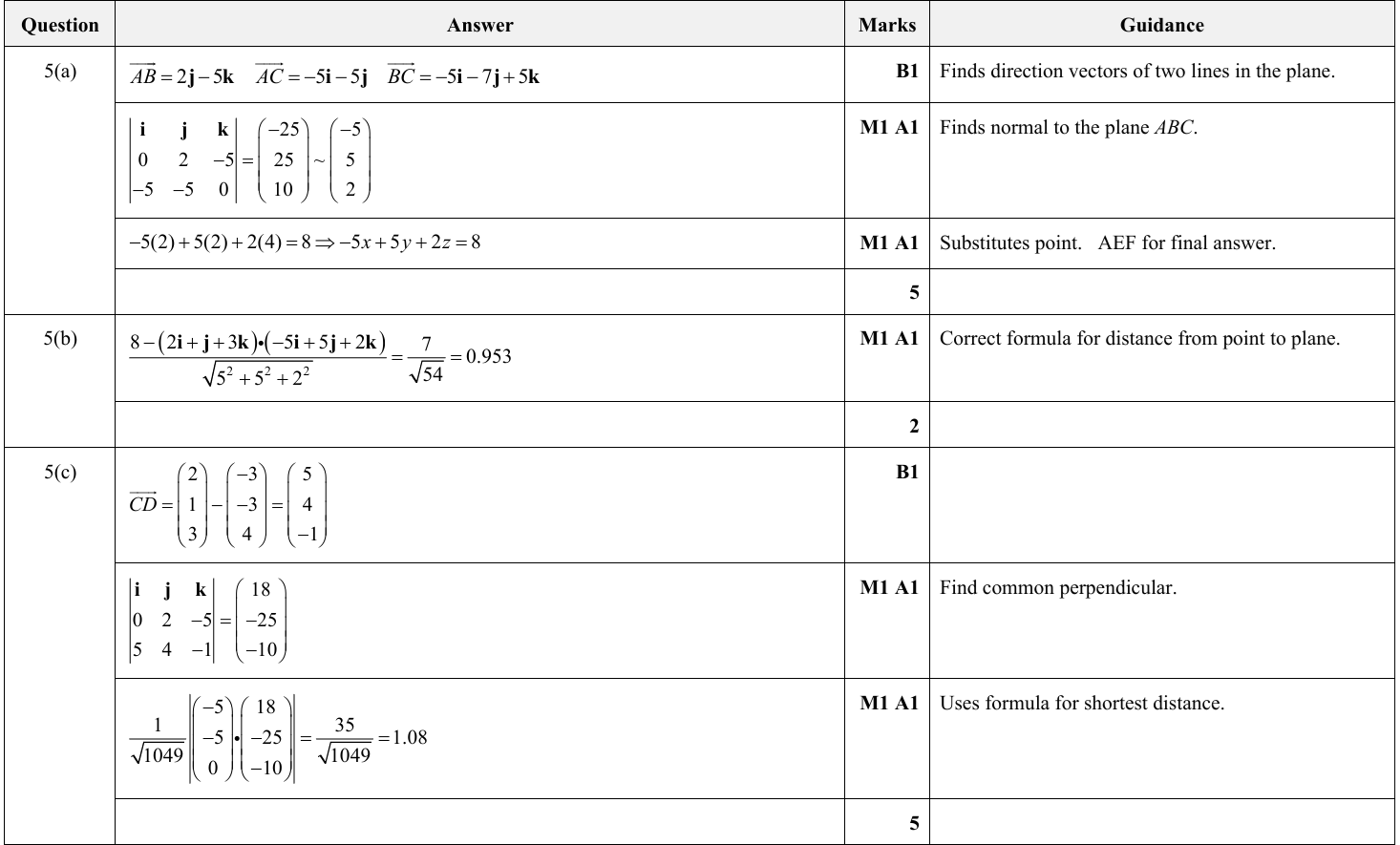
The points A, B, C have position vectors
\(2\mathbf{i} + 2\mathbf{j} + 4\mathbf{k}, \quad 2\mathbf{i} + 4\mathbf{j} - \mathbf{k}, \quad -3\mathbf{i} - 3\mathbf{j} + 4\mathbf{k},\)
respectively, relative to the origin O.
(a) Find the equation of the plane ABC, giving your answer in the form \(ax + by + cz = d\).
The point D has position vector \(2\mathbf{i} + \mathbf{j} + 3\mathbf{k}\).
(b) Find the perpendicular distance from D to the plane ABC.
(c) Find the shortest distance between the lines AB and CD.
FM June 2024 p12 q06
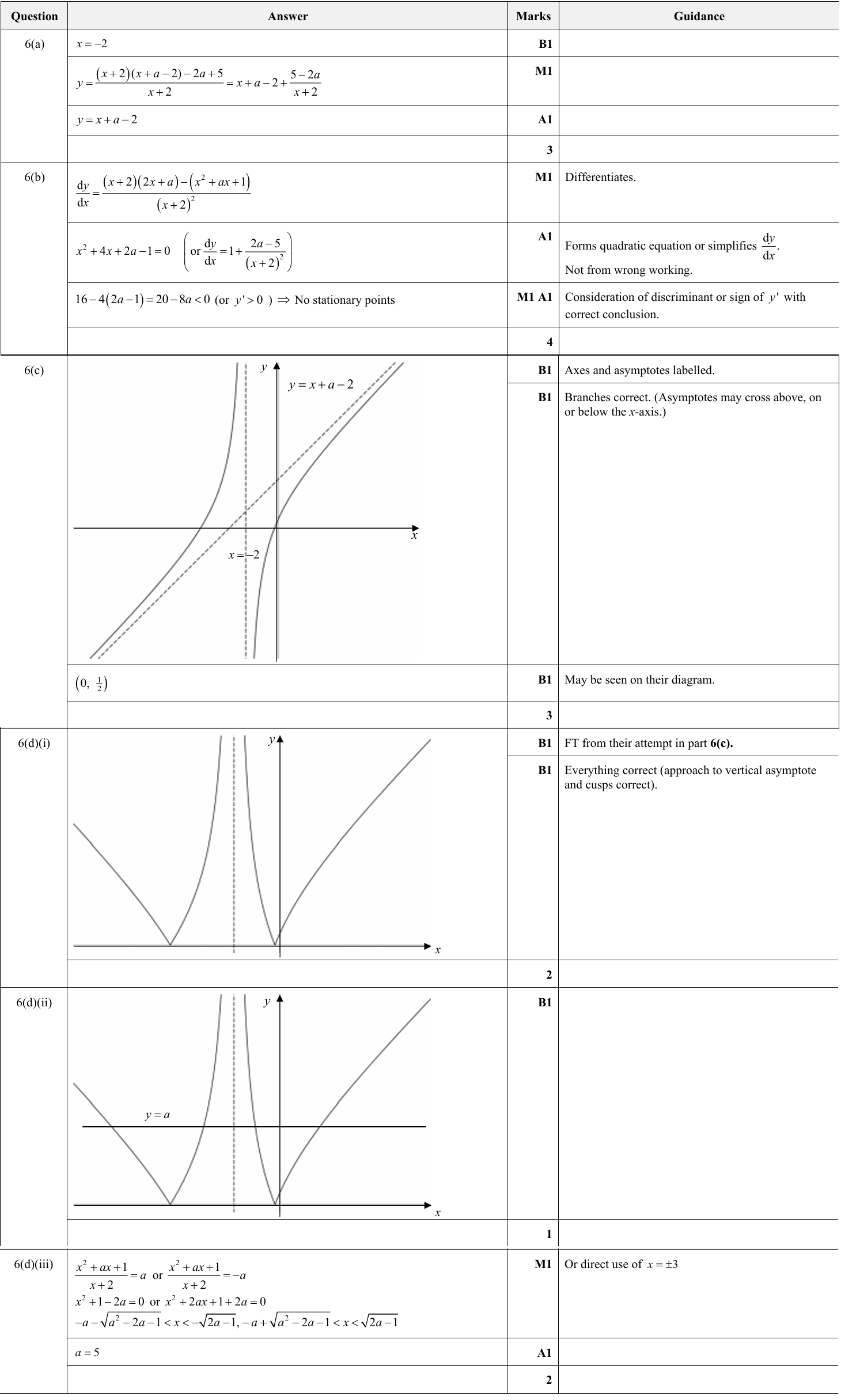
The curve \(C\) has equation \(y = \frac{x^2 + ax + 1}{x + 2}\), where \(a > \frac{5}{2}\).
- (a) Find the equations of the asymptotes of \(C\).
- (b) Show that \(C\) has no stationary points.
- (c) Sketch \(C\), stating the coordinates of the point of intersection with the \(y\)-axis and labelling the asymptotes.
- (d)
- Sketch the curve with equation \(y = \left| \frac{x^2 + ax + 1}{x + 2} \right|\).
- On your sketch in part (i), draw the line \(y = a\).
- It is given that \(\left| \frac{x^2 + ax + 1}{x + 2} \right| < a\) for \(-5 - \sqrt{14} < x < -3\) and \(-5 + \sqrt{14} < x < 3\). Find the value of \(a\).
FM June 2024 p12 q07
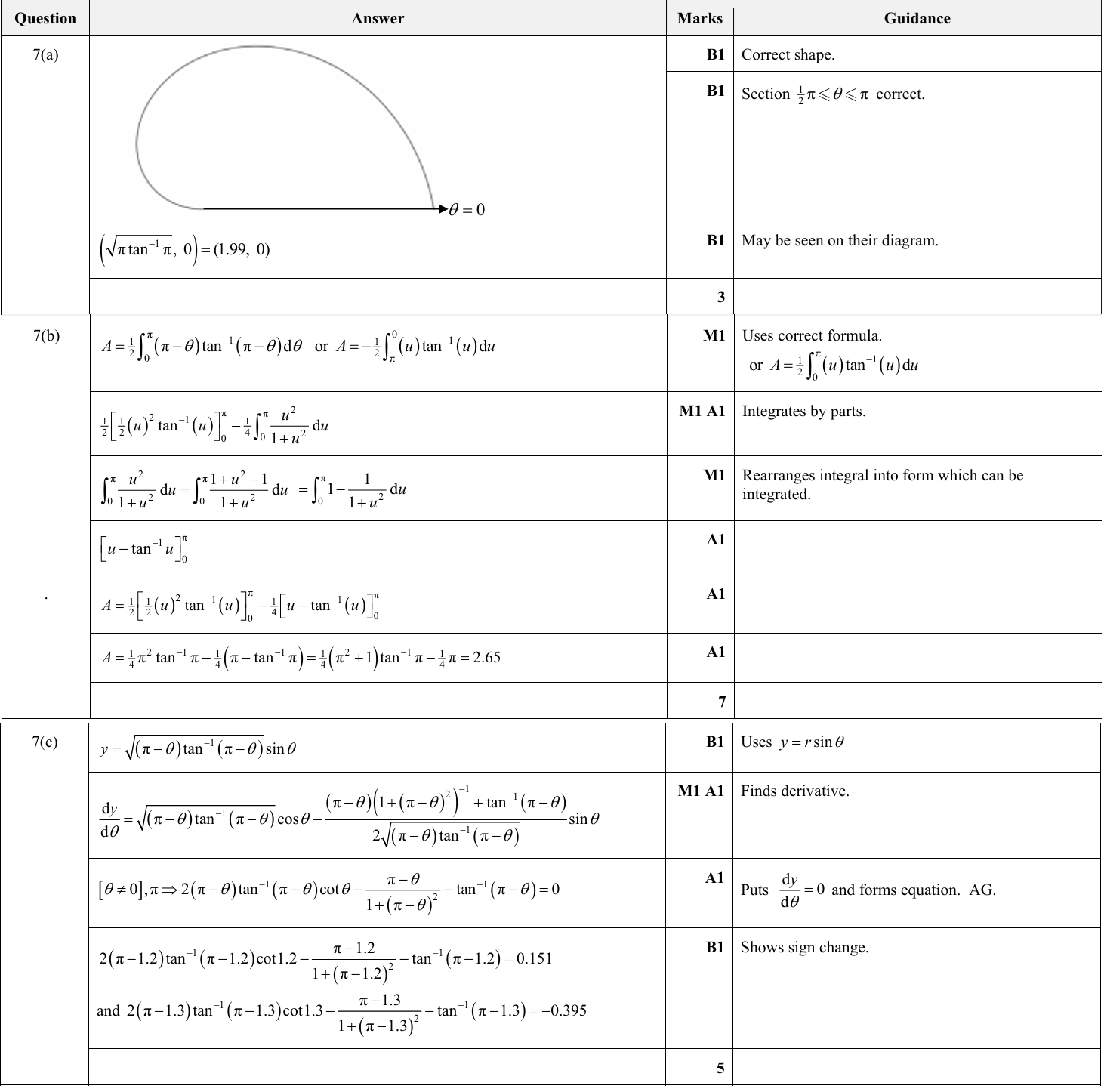
The curve C has polar equation \(r^2 = (\pi - \theta) \arctan(\pi - \theta)\), for \(0 \leq \theta \leq \pi\).
(a) Sketch C and state the polar coordinates of the point of C furthest from the pole. [3]
(b) Using the substitution \(u = \pi - \theta\), or otherwise, find the area of the region enclosed by C and the initial line. [7]
(c) Show that, at the point of C furthest from the initial line,
\(2(\pi - \theta) \arctan(\pi - \theta) \cot \theta - \frac{\pi - \theta}{1 + (\pi - \theta)^2} - \arctan(\pi - \theta) = 0\)
and verify that this equation has a root for \(\theta\) between 1.2 and 1.3. [5]
FM June 2024 p13 q01
The matrix A is given by
\(A = \begin{pmatrix} k & 1 & 0 \\ 6 & 5 & 2 \\ -1 & 3 & -k \end{pmatrix}\),
where \(k\) is a real constant.
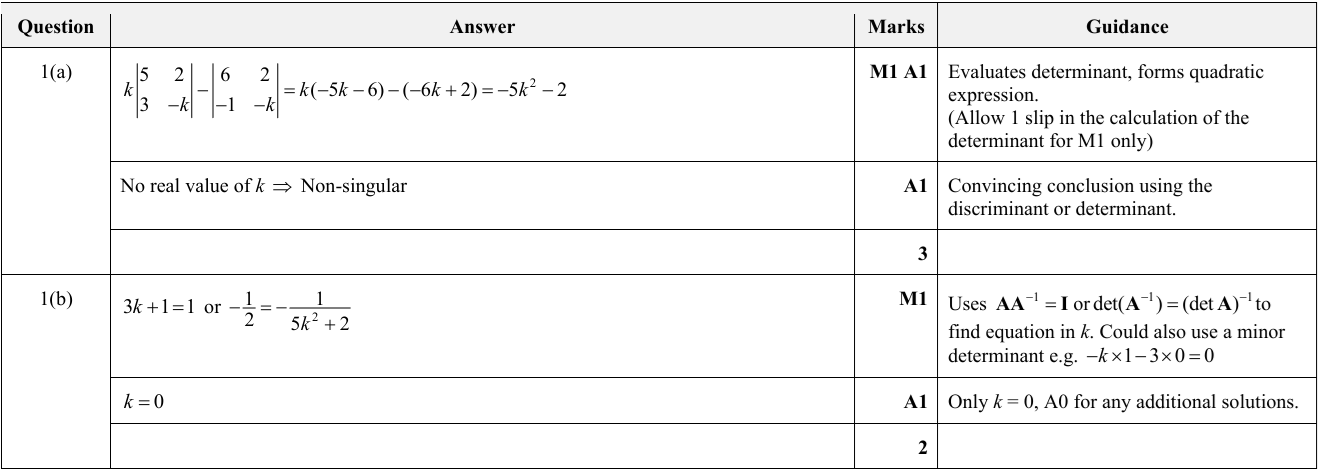
(a) Show that A is non-singular.
(b) Given that \(A^{-1} = \begin{pmatrix} 3 & 0 & -1 \\ 1 & 0 & 0 \\ -\frac{23}{2} & \frac{1}{2} & 3 \end{pmatrix}\), find the value of \(k\).
FM June 2024 p13 q02
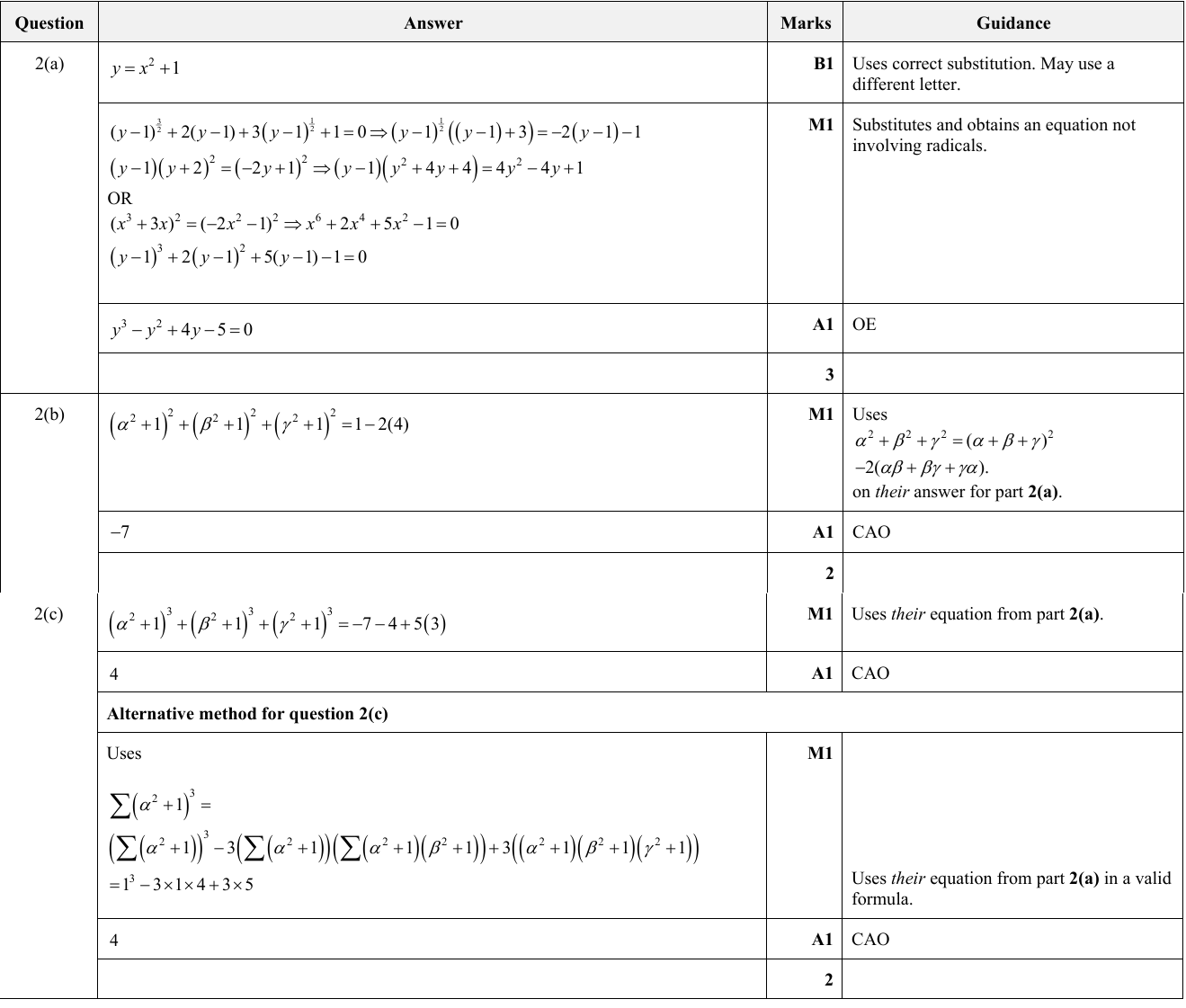
The cubic equation \(x^3 + 2x^2 + 3x + 1 = 0\) has roots \(\alpha, \beta, \gamma\).
(a) Find a cubic equation whose roots are \(\alpha^2 + 1, \beta^2 + 1, \gamma^2 + 1\).
(b) Find the value of \((\alpha^2 + 1)^2 + (\beta^2 + 1)^2 + (\gamma^2 + 1)^2\).
(c) Find the value of \((\alpha^2 + 1)^3 + (\beta^2 + 1)^3 + (\gamma^2 + 1)^3\).
FM June 2024 p13 q03
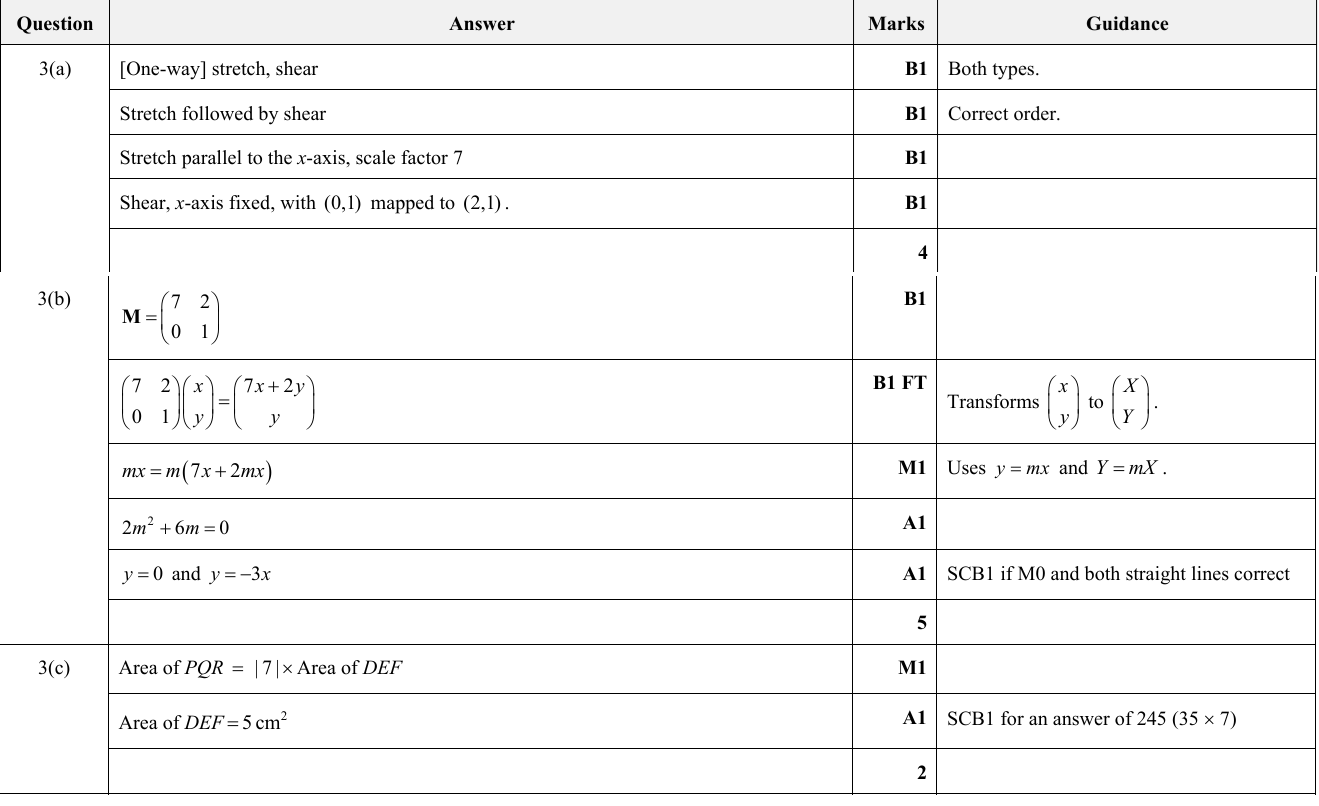
The matrix \(\mathbf{M}\) is given by \(\mathbf{M} = \begin{pmatrix} 1 & 2 \\ 0 & 1 \end{pmatrix} \begin{pmatrix} 7 & 0 \\ 0 & 1 \end{pmatrix}\).
(a) The matrix \(\mathbf{M}\) represents a sequence of two geometrical transformations in the \(x-y\) plane. Give full details of each transformation, and make clear the order in which they are applied.
(b) Find the equations of the invariant lines, through the origin, of the transformation represented by \(\mathbf{M}\).
The triangle \(DEF\) in the \(x-y\) plane is transformed by \(\mathbf{M}\) onto triangle \(PQR\).
(c) Given that the area of triangle \(PQR\) is \(35 \text{ cm}^2\), find the area of triangle \(DEF\).
FM June 2024 p13 q04
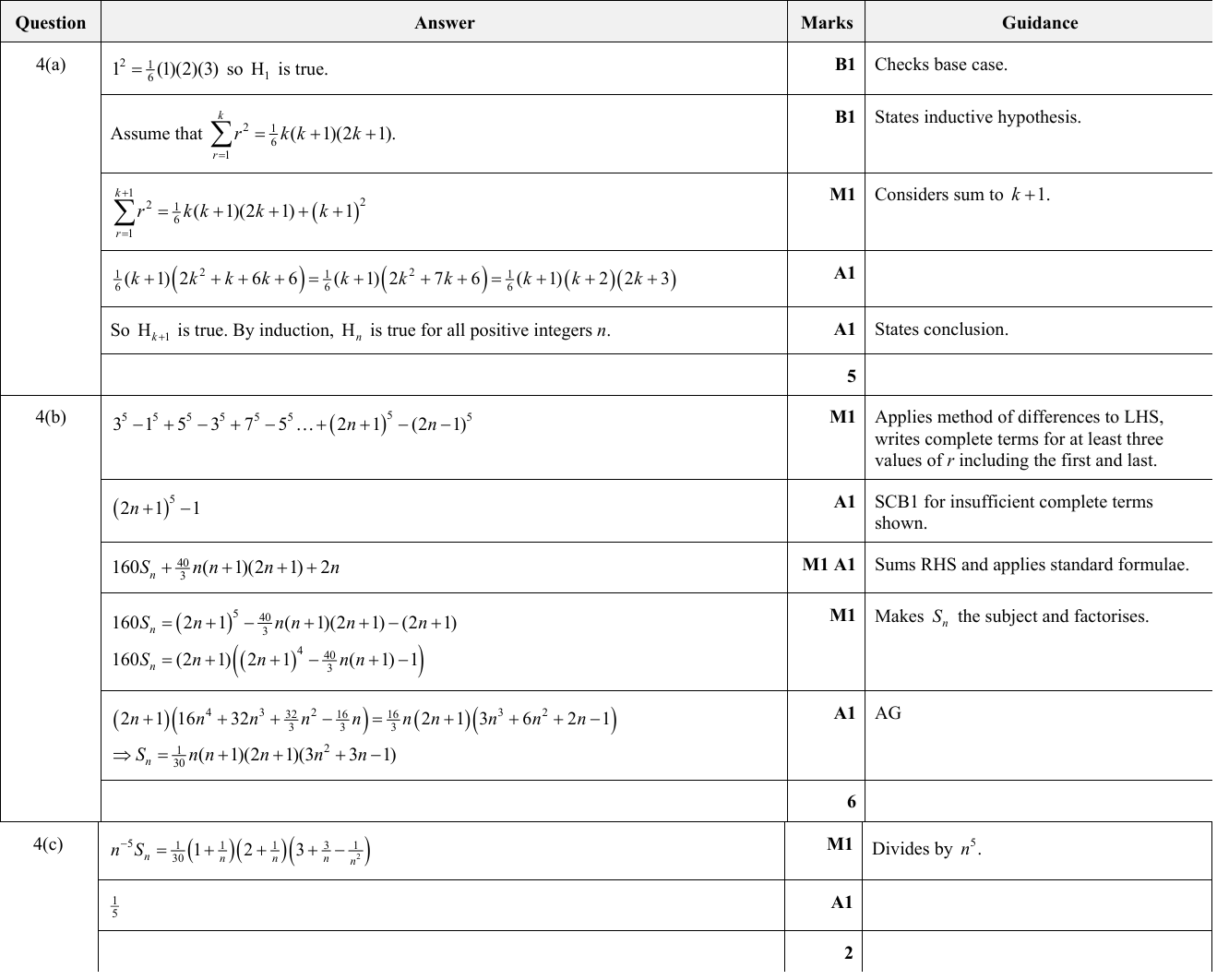
(a) Prove by mathematical induction that, for all positive integers \(n\),
\(\sum_{r=1}^{n} r^2 = \frac{1}{6}n(n+1)(2n+1).\)
The sum \(S_n\) is defined by \(S_n = \sum_{r=1}^{n} r^4\).
(b) Using the identity
\((2r+1)^5 - (2r-1)^5 \equiv 160r^4 + 80r^2 + 2,\)
show that \(S_n = \frac{1}{30}n(n+1)(2n+1)(3n^2 + 3n - 1).\)
(c) Find the value of \(\lim_{n \to \infty} \left( n^{-5}S_n \right).\)
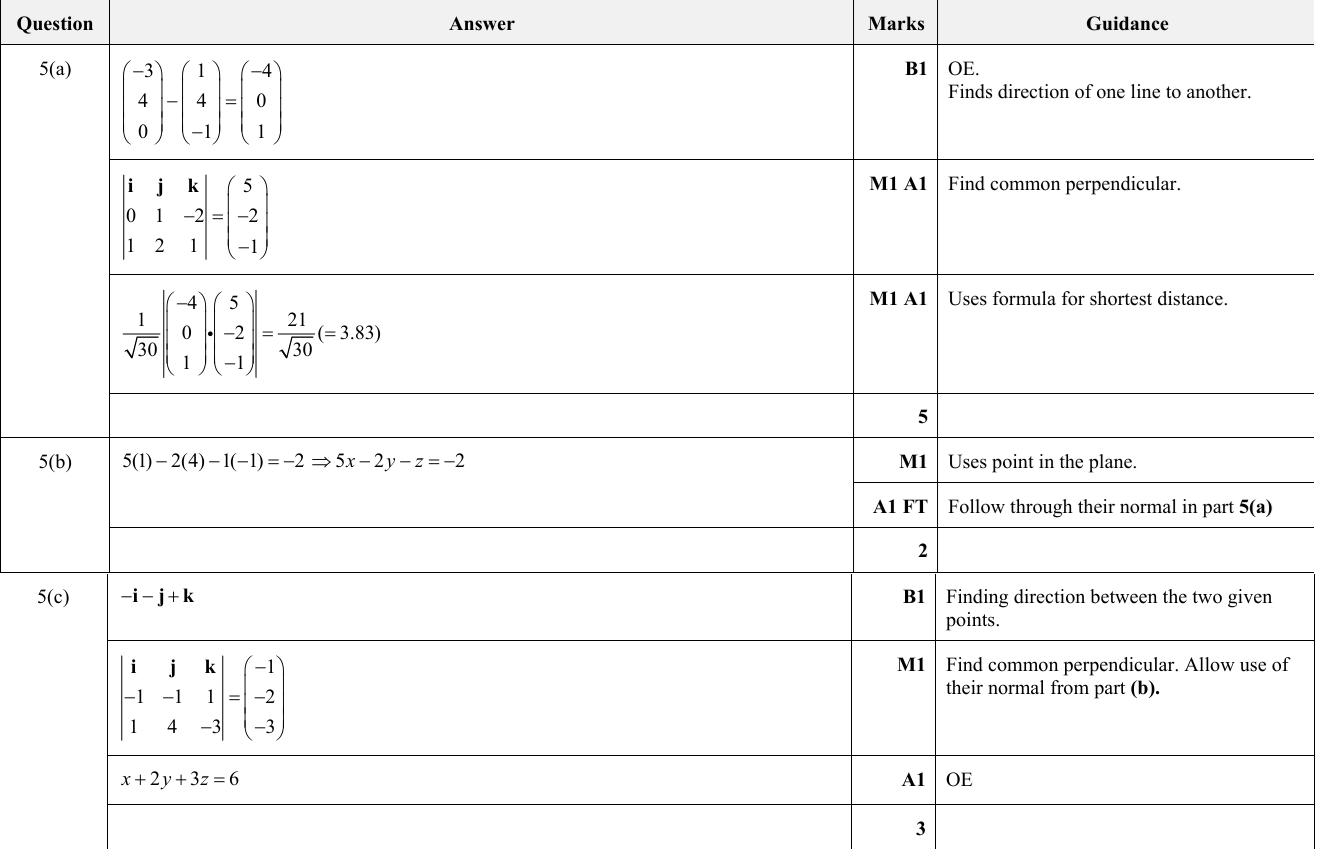
FM June 2024 p13 q05
The lines \(l_1\) and \(l_2\) have equations \(\mathbf{r} = \mathbf{i} + 4\mathbf{j} - \mathbf{k} + \lambda (\mathbf{j} - 2\mathbf{k})\) and \(\mathbf{r} = -3\mathbf{i} + 4\mathbf{j} + \mu (\mathbf{i} + 2\mathbf{j} + \mathbf{k})\) respectively.
(a) Find the shortest distance between \(l_1\) and \(l_2\).
The plane \(\Pi_1\) contains \(l_1\) and is parallel to \(l_2\).
(b) Obtain an equation of \(\Pi_1\) in the form \(px + qy + rz = s\).
(c) The point \((1, 1, 1)\) lies on the plane \(\Pi_2\).
It is given that the line of intersection of the planes \(\Pi_1\) and \(\Pi_2\) passes through the point \((0, 0, 2)\) and is parallel to the vector \(\mathbf{i} + 4\mathbf{j} - 3\mathbf{k}\).
Obtain an equation of \(\Pi_2\) in the form \(ax + by + cz = d\).
FM June 2024 p13 q06
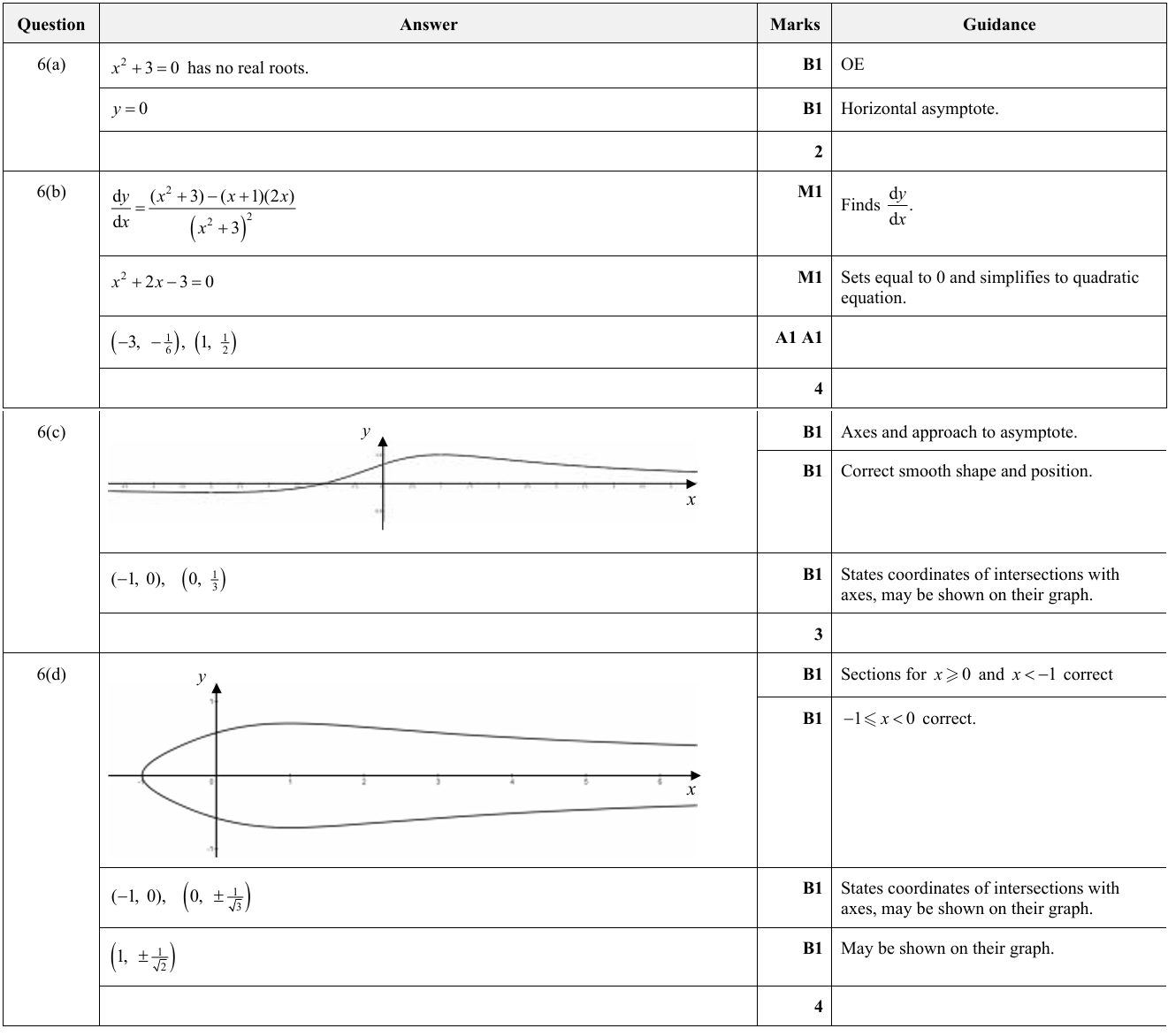
The curve \(C\) has equation \(y = \frac{x+1}{x^2+3}\).
- Show that \(C\) has no vertical asymptotes and state the equation of the horizontal asymptote. [2]
- Find the coordinates of any stationary points on \(C\). [4]
- Sketch \(C\), stating the coordinates of the intersections with the axes. [3]
- Sketch \(y^2 = \frac{x+1}{x^2+3}\), stating the coordinates of the stationary points and the intersections with the axes. [4]
FM June 2024 p13 q07
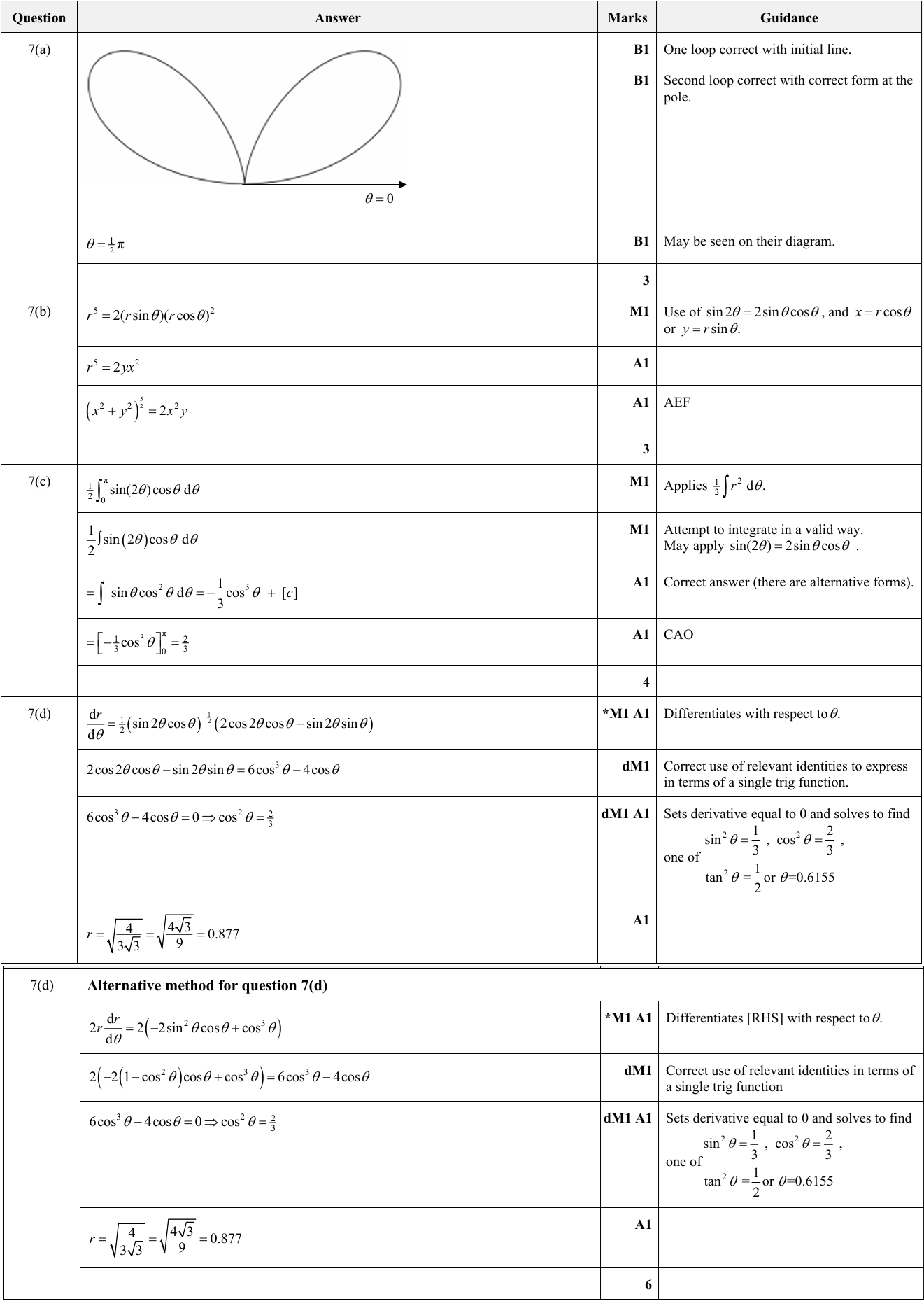
The curve C has polar equation \(r^2 = \sin 2\theta \cos \theta\), for \(0 \leq \theta \leq \pi\).
- Sketch C and state the equation of the line of symmetry.
- Find a Cartesian equation for C.
- Find the total area enclosed by C.
- Find the greatest distance of a point on C from the pole.
FM Nov 2023 p11 q01
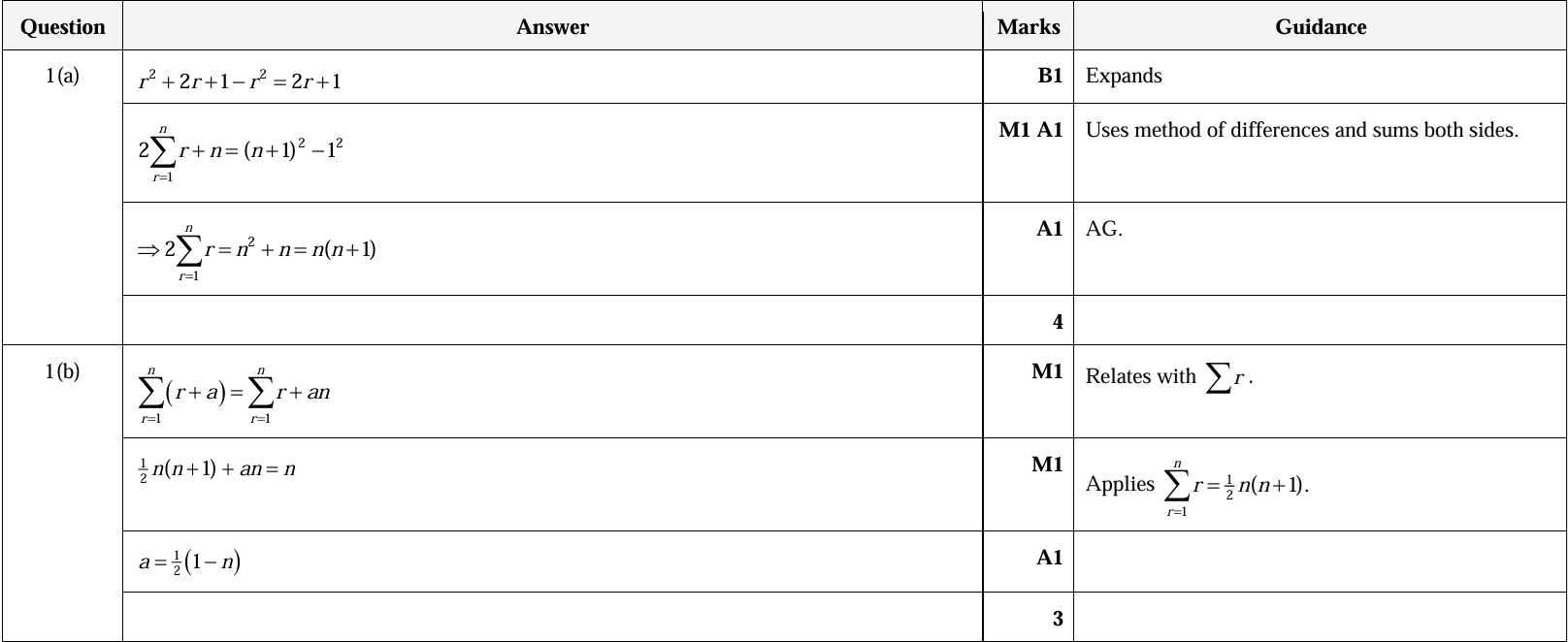
(a) By considering \((r+1)^2 - r^2\), use the method of differences to prove that
\(\sum_{r=1}^{n} r = \frac{1}{2} n(n+1).\)
(b) Given that \(\sum_{r=1}^{n} (r+a) = n\), find \(a\) in terms of \(n\).
FM Nov 2023 p11 q02
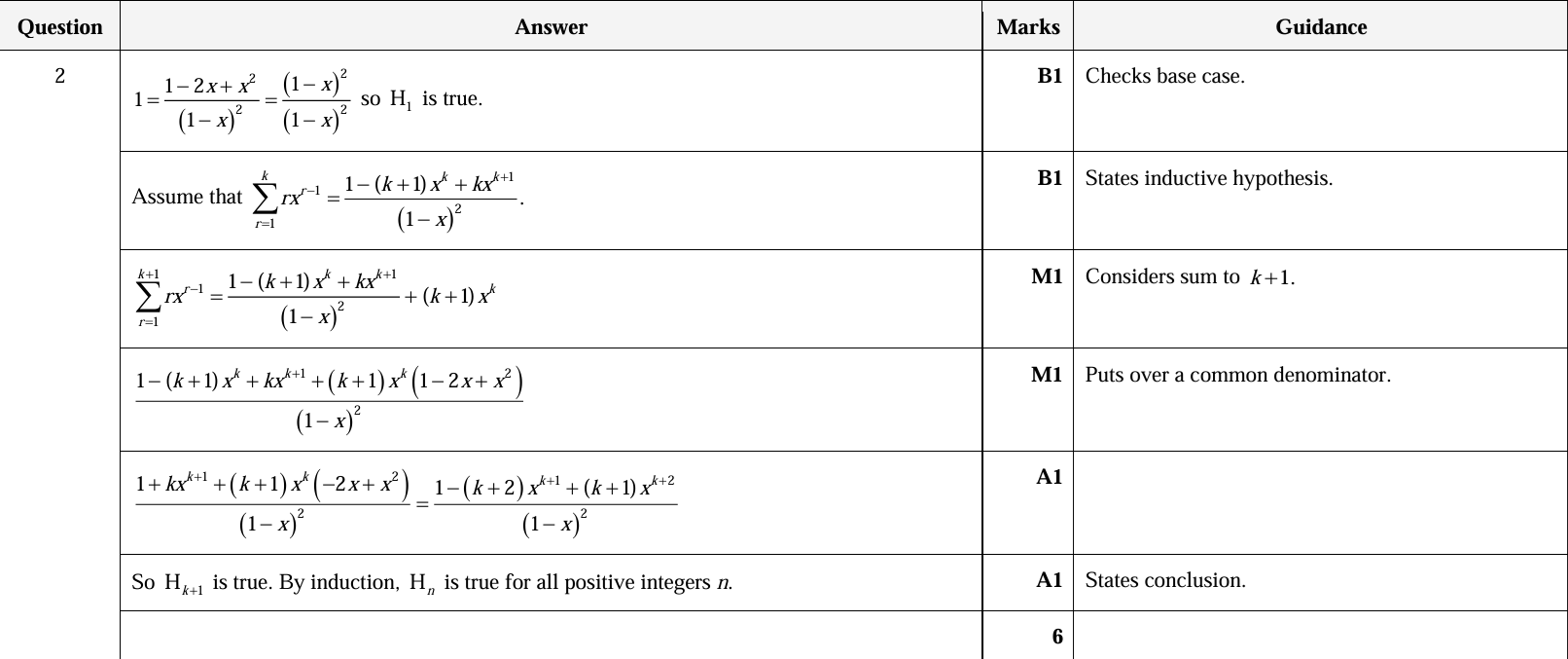
Prove by mathematical induction that, for all positive integers \(n\),
\(1 + 2x + 3x^2 + \ldots + nx^{n-1} = \frac{1 - (n+1)x^n + nx^{n+1}}{(1-x)^2}.\)
FM Nov 2023 p11 q03
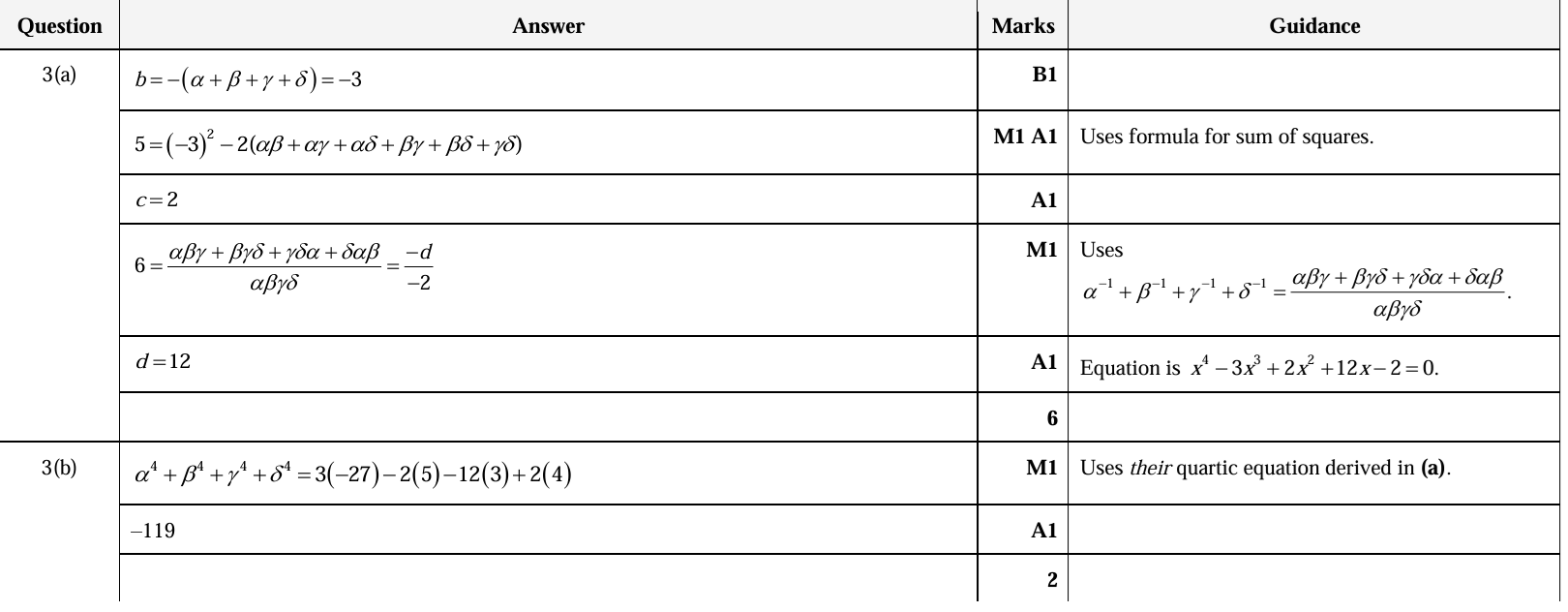
The quartic equation \(x^4 + bx^3 + cx^2 + dx - 2 = 0\) has roots \(\alpha, \beta, \gamma, \delta\). It is given that
\(\alpha + \beta + \gamma + \delta = 3,\)
\(\alpha^2 + \beta^2 + \gamma^2 + \delta^2 = 5,\)
\(\alpha^{-1} + \beta^{-1} + \gamma^{-1} + \delta^{-1} = 6.\)
(a) Find the values of \(b, c\) and \(d\).
(b) Given also that \(\alpha^3 + \beta^3 + \gamma^3 + \delta^3 = -27\), find the value of \(\alpha^4 + \beta^4 + \gamma^4 + \delta^4\).
FM Nov 2023 p11 q04
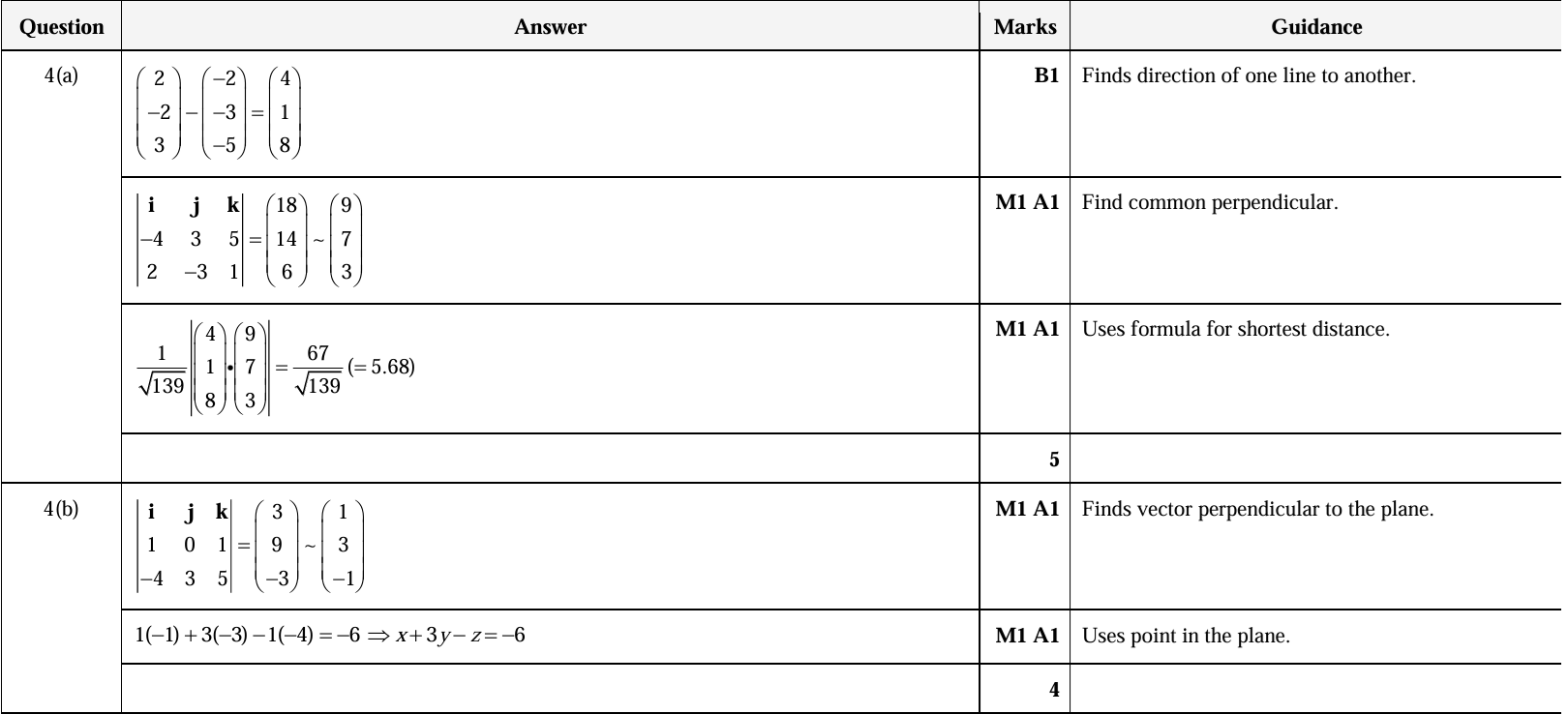
The lines \(l_1\) and \(l_2\) have equations
\(\mathbf{r} = -2\mathbf{i} - 3\mathbf{j} - 5\mathbf{k} + \lambda(-4\mathbf{i} + 3\mathbf{j} + 5\mathbf{k})\)
and
\(\mathbf{r} = 2\mathbf{i} - 2\mathbf{j} + 3\mathbf{k} + \mu(2\mathbf{i} - 3\mathbf{j} + \mathbf{k})\)
respectively.
(a) Find the shortest distance between \(l_1\) and \(l_2\).
The plane \(\Pi\) contains \(l_1\) and the point with position vector \(-\mathbf{i} - 3\mathbf{j} - 4\mathbf{k}\).
(b) Find an equation of \(\Pi\), giving your answer in the form \(ax + by + cz = d\).
FM Nov 2023 p11 q05
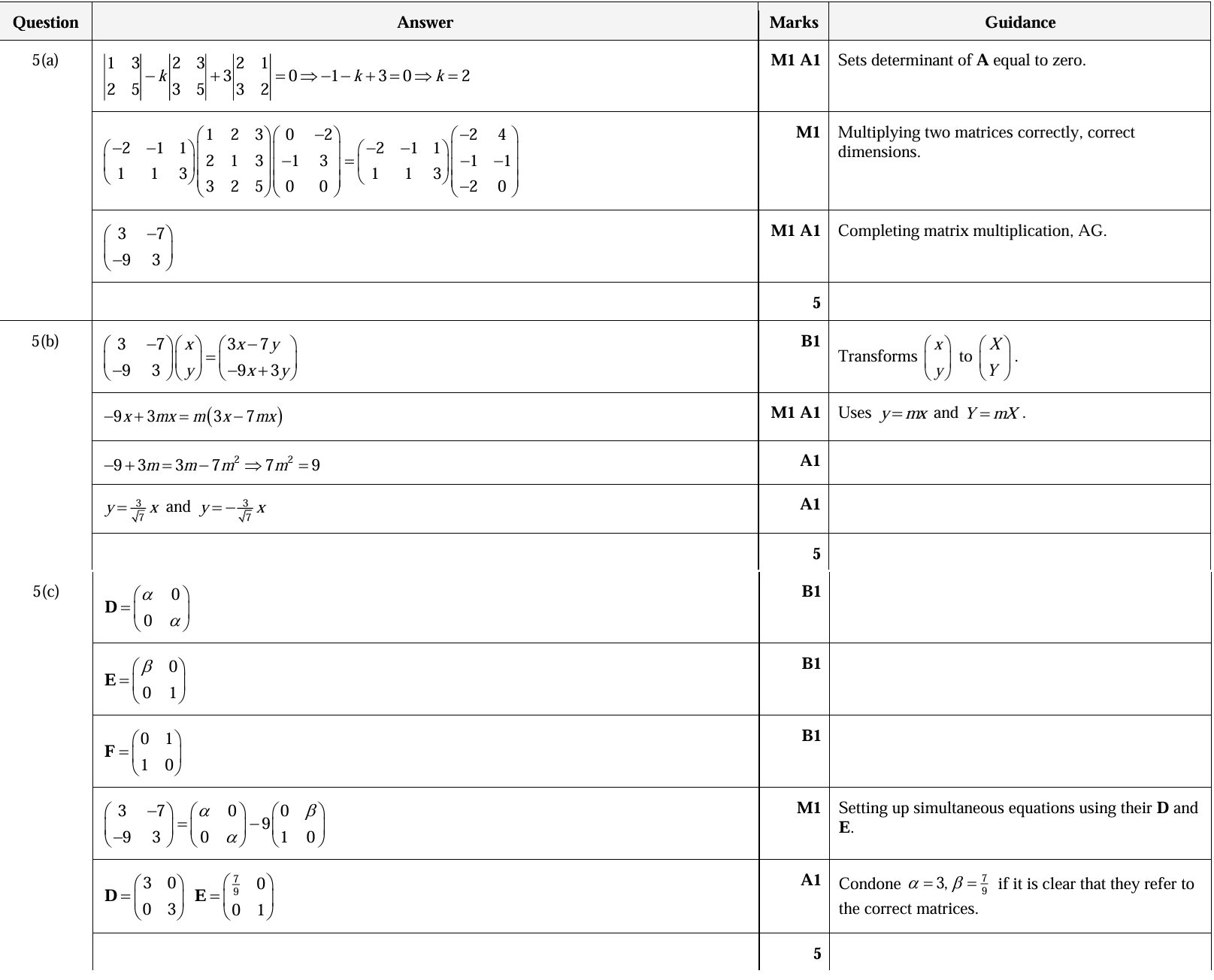
Let k be a constant. The matrices A, B and C are given by
\(\mathbf{A} = \begin{pmatrix} 1 & k & 3 \\ 2 & 1 & 3 \\ 3 & 2 & 5 \end{pmatrix}, \quad \mathbf{B} = \begin{pmatrix} 0 & -2 \\ -1 & 3 \\ 0 & 0 \end{pmatrix} \quad \text{and} \quad \mathbf{C} = \begin{pmatrix} -2 & -1 & 1 \\ 1 & 1 & 3 \end{pmatrix}.\)
It is given that A is singular.
(a) Show that \(\mathbf{CAB} = \begin{pmatrix} 3 & -7 \\ -9 & 3 \end{pmatrix}\).
(b) Find the equations of the invariant lines, through the origin, of the transformation in the x–y plane represented by CAB.
(c) The matrices D, E and F represent geometrical transformations in the x–y plane.
- D represents an enlargement, centre the origin.
- E represents a stretch parallel to the x-axis.
- F represents a reflection in the line y = x.
Given that \(\mathbf{CAB} = \mathbf{D} - 9\mathbf{EF}\), find D, E and F.
FM Nov 2023 p11 q06
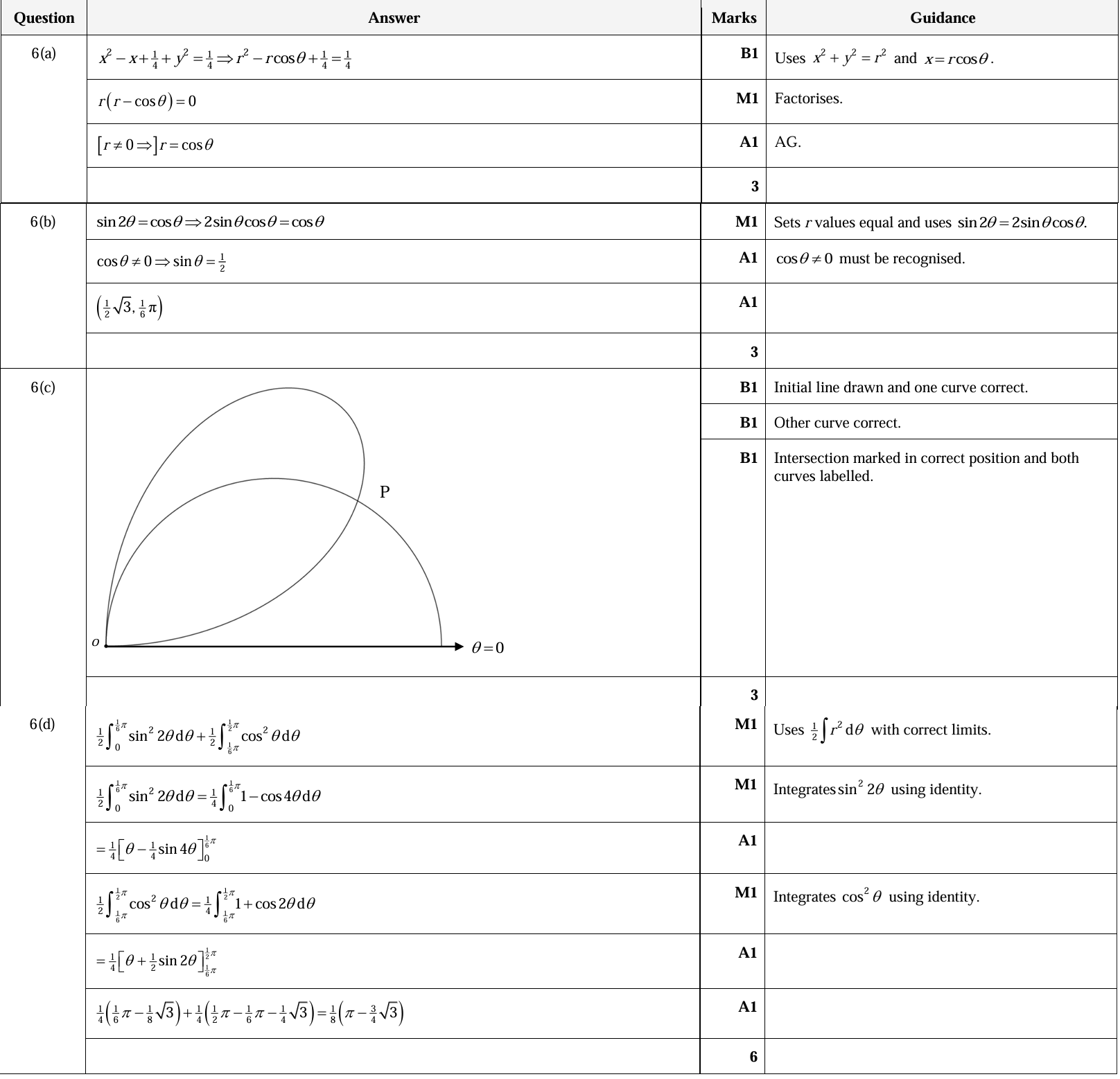
(a) Show that the curve with Cartesian equation \(\left( x - \frac{1}{2} \right)^2 + y^2 = \frac{1}{4}\) has polar equation \(r = \cos \theta\).
The curves \(C_1\) and \(C_2\) have polar equations \(r = \cos \theta\) and \(r = \sin 2\theta\) respectively, where \(0 \leq \theta \leq \frac{1}{2} \pi\). The curves \(C_1\) and \(C_2\) intersect at the pole and at another point \(P\).
(b) Find the polar coordinates of \(P\).
(c) In a single diagram sketch \(C_1\) and \(C_2\), clearly identifying each curve, and mark the point \(P\).
(d) The region \(R\) is enclosed by \(C_1\) and \(C_2\) and includes the line \(OP\). Find, in exact form, the area of \(R\).
FM Nov 2023 p11 q07
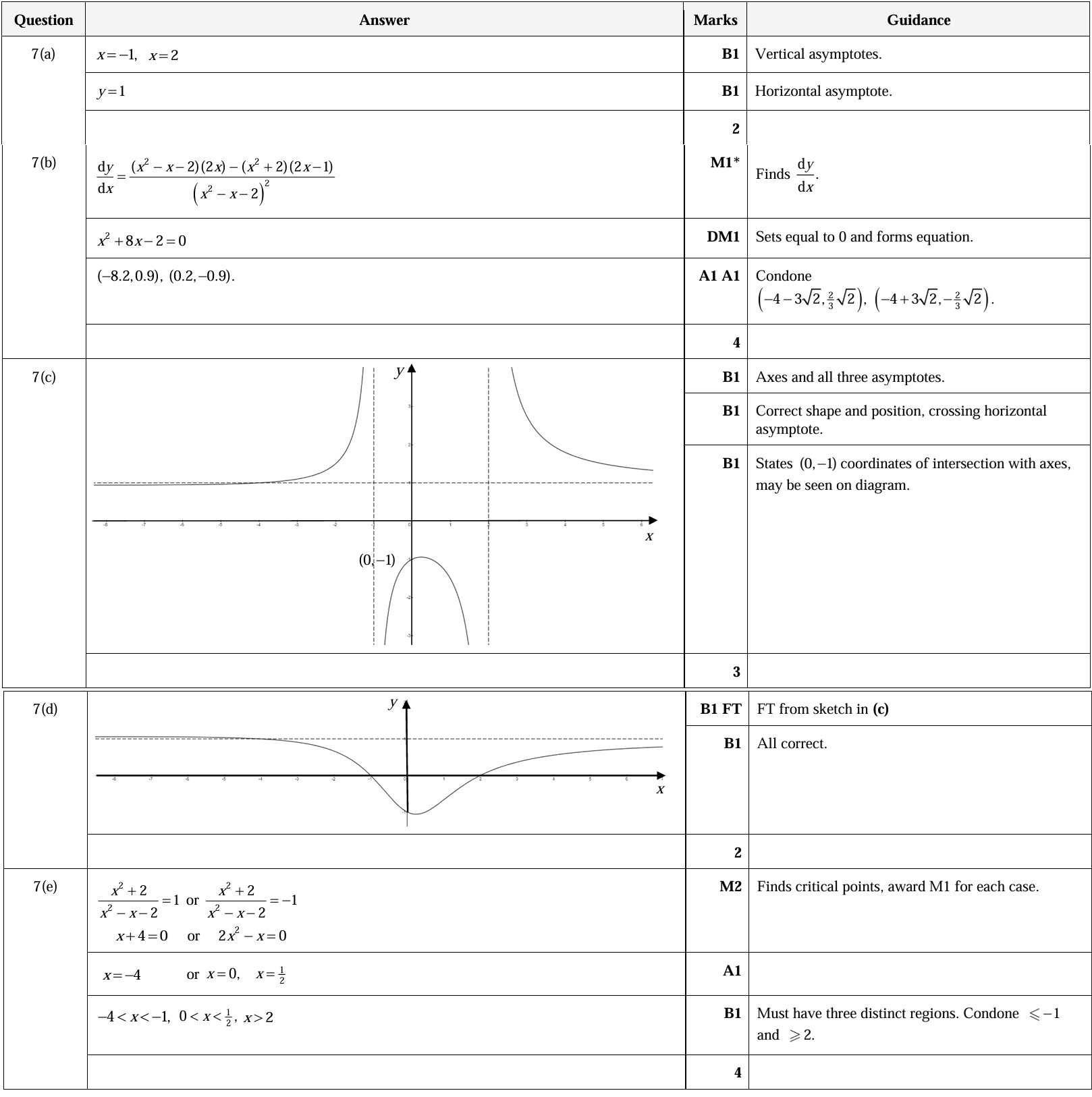
The curve C has equation \(y = f(x)\), where \(f(x) = \frac{x^2 + 2}{x^2 - x - 2}\).
- Find the equations of the asymptotes of C.
- Find the coordinates of any stationary points on C, giving your answers correct to 1 decimal place.
- Sketch C, stating the coordinates of any intersections with the axes.
- Sketch the curve with equation \(y = \frac{1}{f(x)}\).
- Find the set of values for which \(\frac{1}{f(x)} < f(x)\).
FM Nov 2023 p12 q01
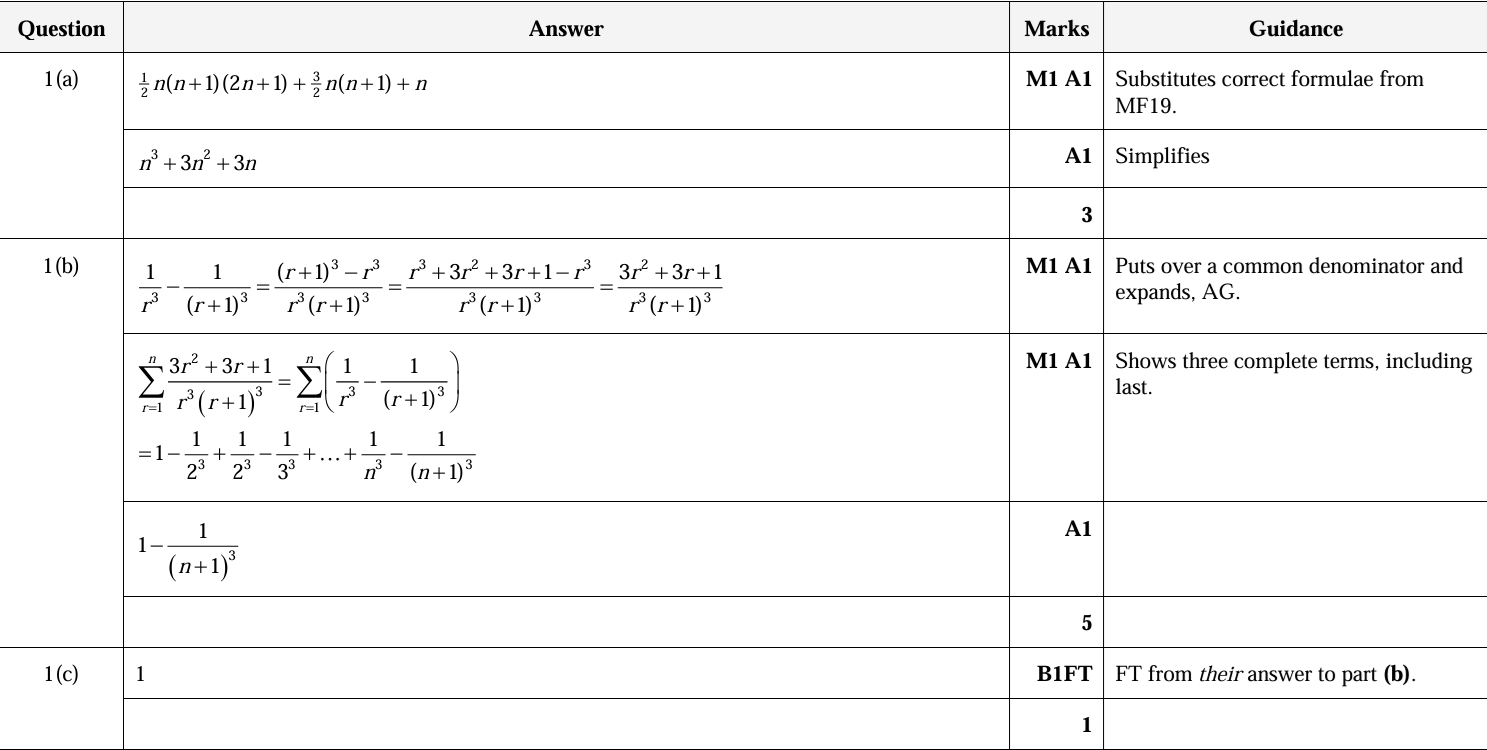
(a) Use standard results from the list of formulae (MF19) to find \(\sum_{r=1}^{n} (3r^2 + 3r + 1)\) in terms of \(n\), simplifying your answer.
(b) Show that \(\frac{1}{r^3} - \frac{1}{(r+1)^3} = \frac{3r^2 + 3r + 1}{r^3 (r+1)^3}\) and hence use the method of differences to find \(\sum_{r=1}^{n} \frac{3r^2 + 3r + 1}{r^3 (r+1)^3}\).
(c) Deduce the value of \(\sum_{r=1}^{\infty} \frac{3r^2 + 3r + 1}{r^3 (r+1)^3}\).
FM Nov 2023 p12 q02
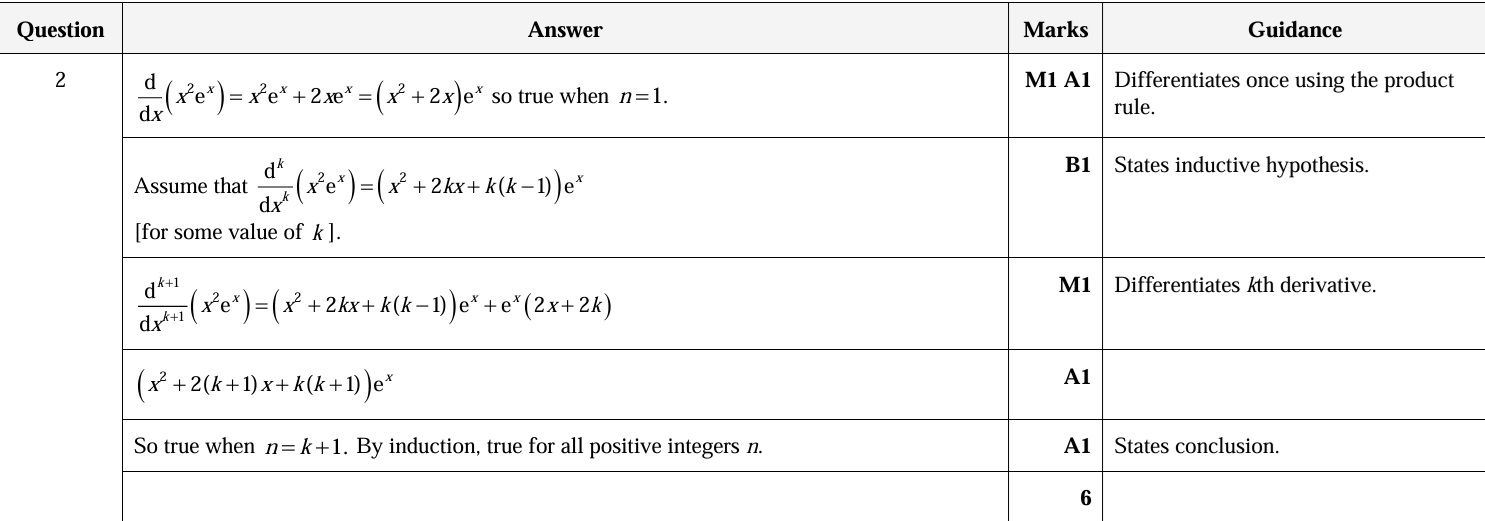
Prove by mathematical induction that, for all positive integers n,
\(\frac{d^n}{dx^n} \left( x^2 e^x \right) = \left( x^2 + 2nx + n(n-1) \right) e^x.\)
FM Nov 2023 p12 q03
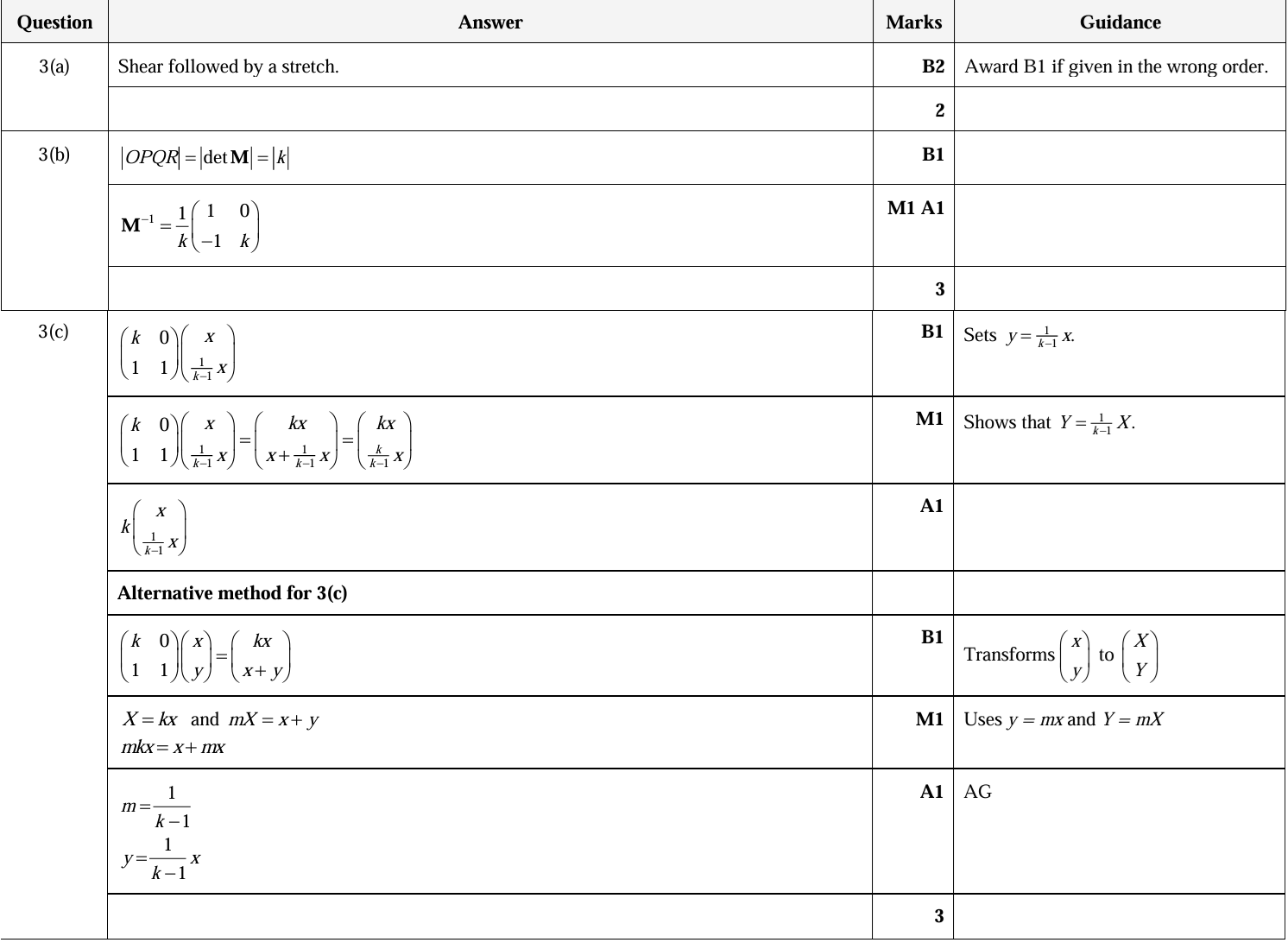
The matrix \(\mathbf{M}\) is given by \(\mathbf{M} = \begin{pmatrix} k & 0 \\ 0 & 1 \end{pmatrix} \begin{pmatrix} 1 & 0 \\ 1 & 1 \end{pmatrix}\), where \(k\) is a constant and \(k \neq 0\) and \(k \neq 1\).
(a) The matrix \(\mathbf{M}\) represents a sequence of two geometrical transformations. State the type of each transformation, and make clear the order in which they are applied. [2]
The unit square in the \(x-y\) plane is transformed by \(\mathbf{M}\) onto parallelogram \(OPQR\).
(b) Find, in terms of \(k\), the area of parallelogram \(OPQR\) and the matrix which transforms \(OPQR\) onto the unit square. [3]
(c) Show that the line through the origin with gradient \(\frac{1}{k-1}\) is invariant under the transformation in the \(x-y\) plane represented by \(\mathbf{M}\). [3]
FM Nov 2023 p12 q04
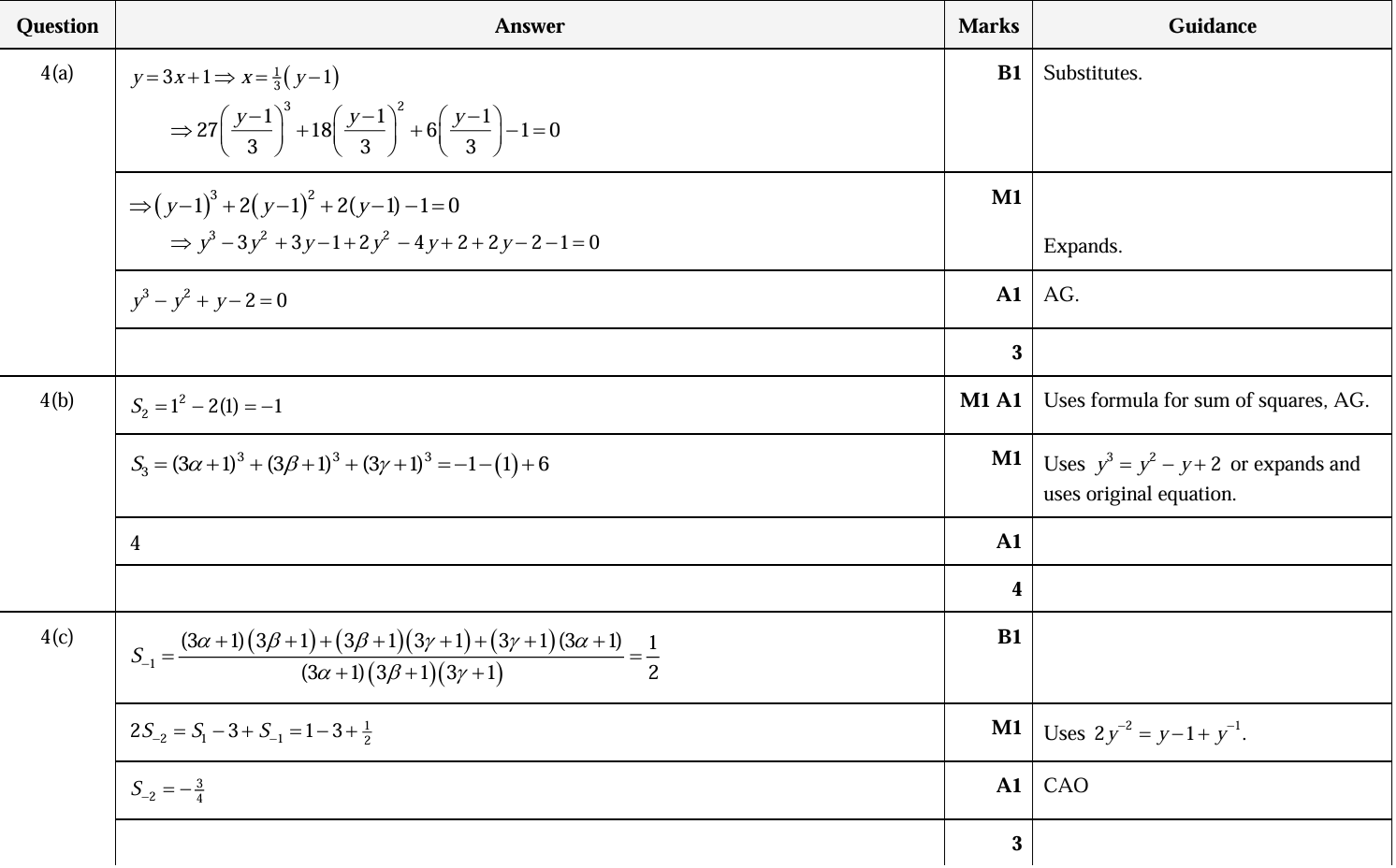
The cubic equation \(27x^3 + 18x^2 + 6x - 1 = 0\) has roots \(\alpha, \beta, \gamma\).
(a) Show that a cubic equation with roots \(3\alpha + 1, 3\beta + 1, 3\gamma + 1\) is \(y^3 - y^2 + y - 2 = 0\).
The sum \((3\alpha + 1)^n + (3\beta + 1)^n + (3\gamma + 1)^n\) is denoted by \(S_n\).
(b) Find the values of \(S_2\) and \(S_3\).
(c) Find the values of \(S_{-1}\) and \(S_{-2}\).
FM Nov 2023 p12 q05
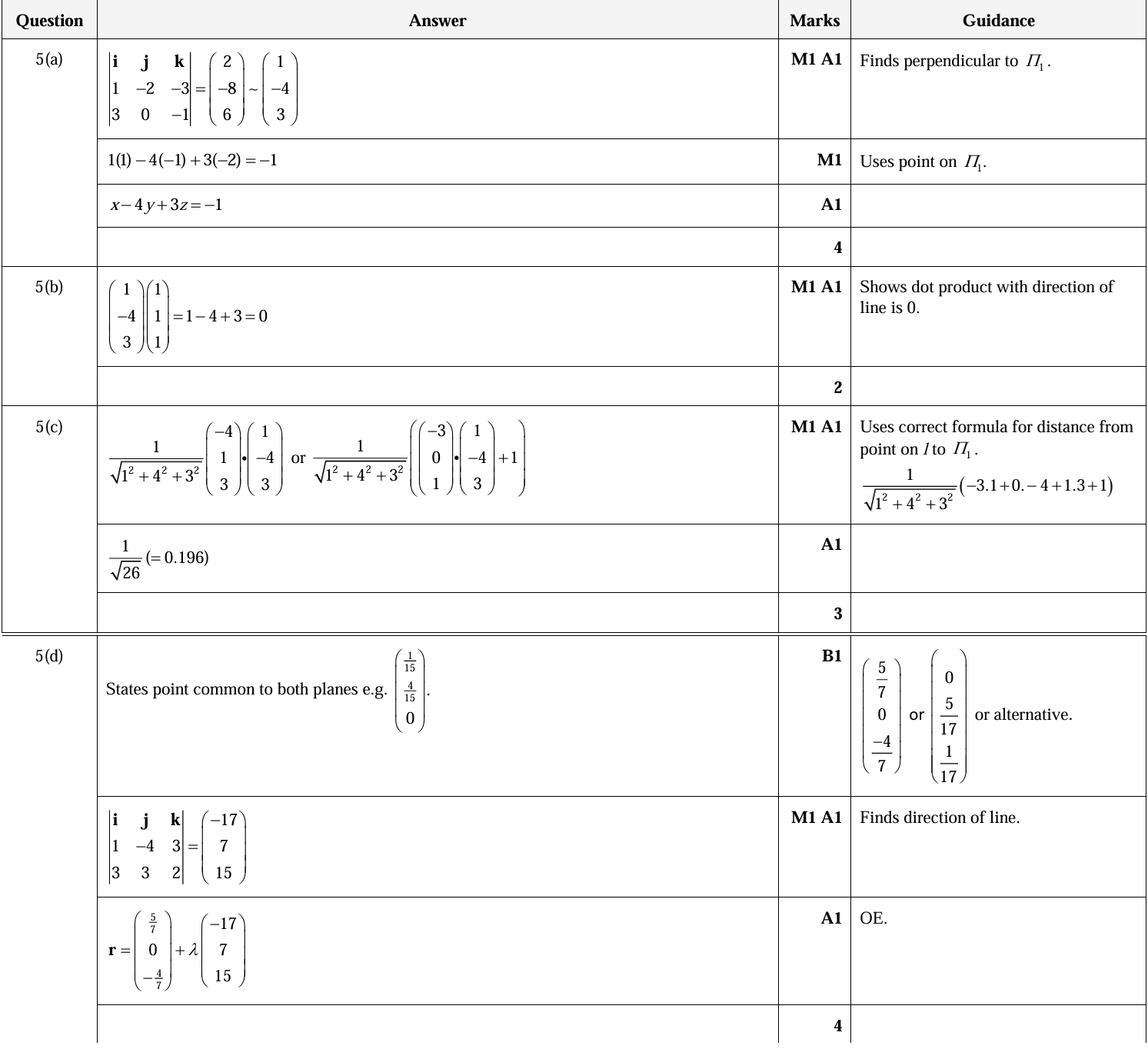
The plane \(\Pi_1\) has equation \(\mathbf{r} = \mathbf{i} - \mathbf{j} - 2\mathbf{k} + \lambda (\mathbf{i} - 2\mathbf{j} - 3\mathbf{k}) + \mu (3\mathbf{i} - \mathbf{k})\).
(a) Find an equation for \(\Pi_1\) in the form \(ax + by + cz = d\).
The line \(l\), which does not lie in \(\Pi_1\), has equation \(\mathbf{r} = -3\mathbf{i} + \mathbf{k} + t(\mathbf{i} + \mathbf{j} + \mathbf{k})\).
(b) Show that \(l\) is parallel to \(\Pi_1\).
(c) Find the distance between \(l\) and \(\Pi_1\).
(d) The plane \(\Pi_2\) has equation \(3x + 3y + 2z = 1\).
Find a vector equation of the line of intersection of \(\Pi_1\) and \(\Pi_2\).
FM Nov 2023 p12 q06
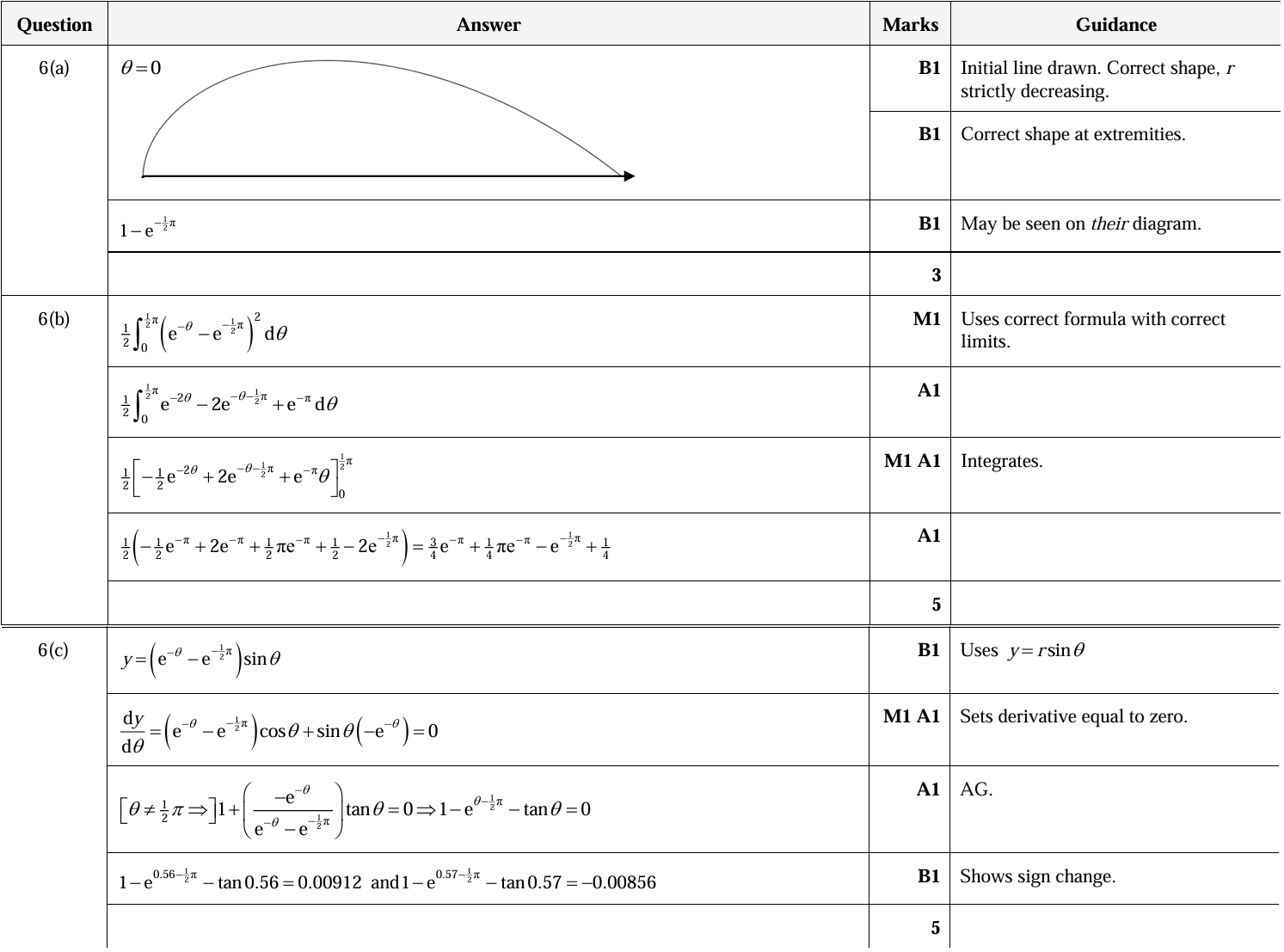
The curve C has polar equation \(r = e^{-\theta} - e^{-\frac{1}{2}\pi}\), where \(0 \leq \theta \leq \frac{1}{2}\pi\).
- Sketch C and state, in exact form, the greatest distance of a point on C from the pole.
- Find the exact value of the area of the region bounded by C and the initial line.
- Show that, at the point on C furthest from the initial line, \(1 - e^{\theta - \frac{1}{2}\pi} - \tan \theta = 0\) and verify that this equation has a root between 0.56 and 0.57.
FM Nov 2023 p12 q07
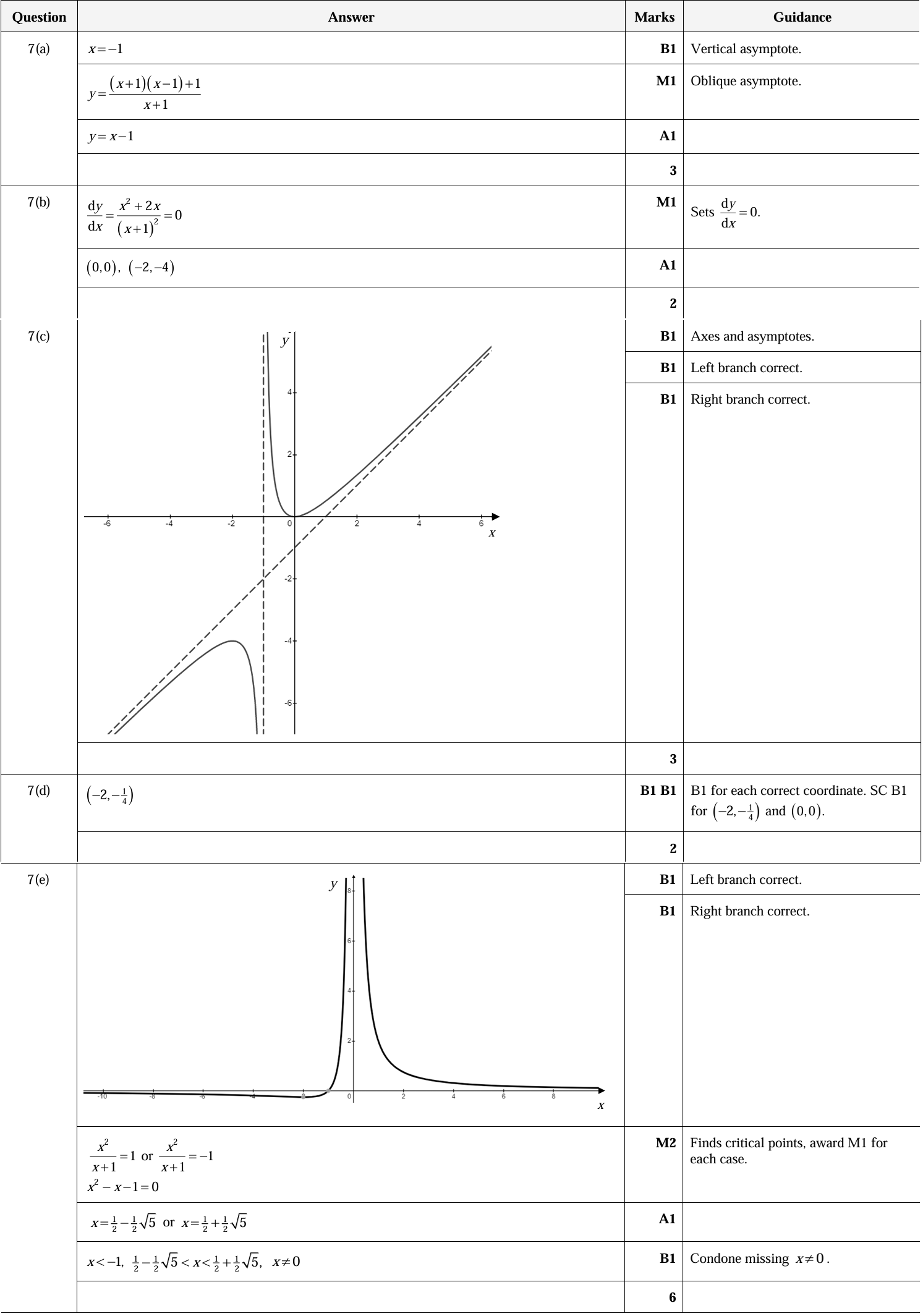
The curve C has equation \(y = f(x)\), where \(f(x) = \frac{x^2}{x+1}\).
- Find the equations of the asymptotes of C.
- Find the coordinates of any stationary points on C.
- Sketch C.
- Find the coordinates of any stationary points on the curve with equation \(y = \frac{1}{f(x)}\).
- Sketch the curve with equation \(y = \frac{1}{f(x)}\) and find, in exact form, the set of values for which \(\frac{1}{f(x)} > f(x)\).
FM Nov 2023 p13 q01
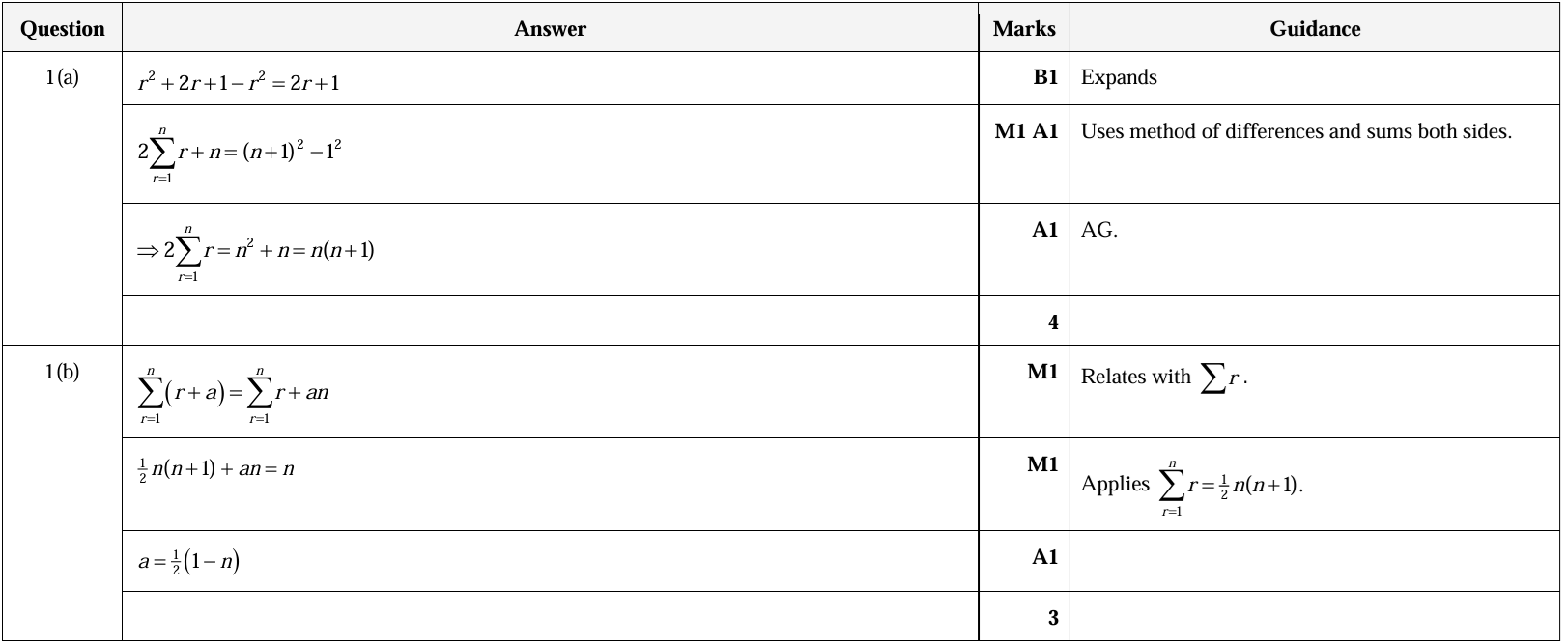
(a) By considering \((r+1)^2 - r^2\), use the method of differences to prove that
\(\sum_{r=1}^{n} r = \frac{1}{2} n(n+1).\)
(b) Given that \(\sum_{r=1}^{n} (r+a) = n\), find \(a\) in terms of \(n\).
FM Nov 2023 p13 q02
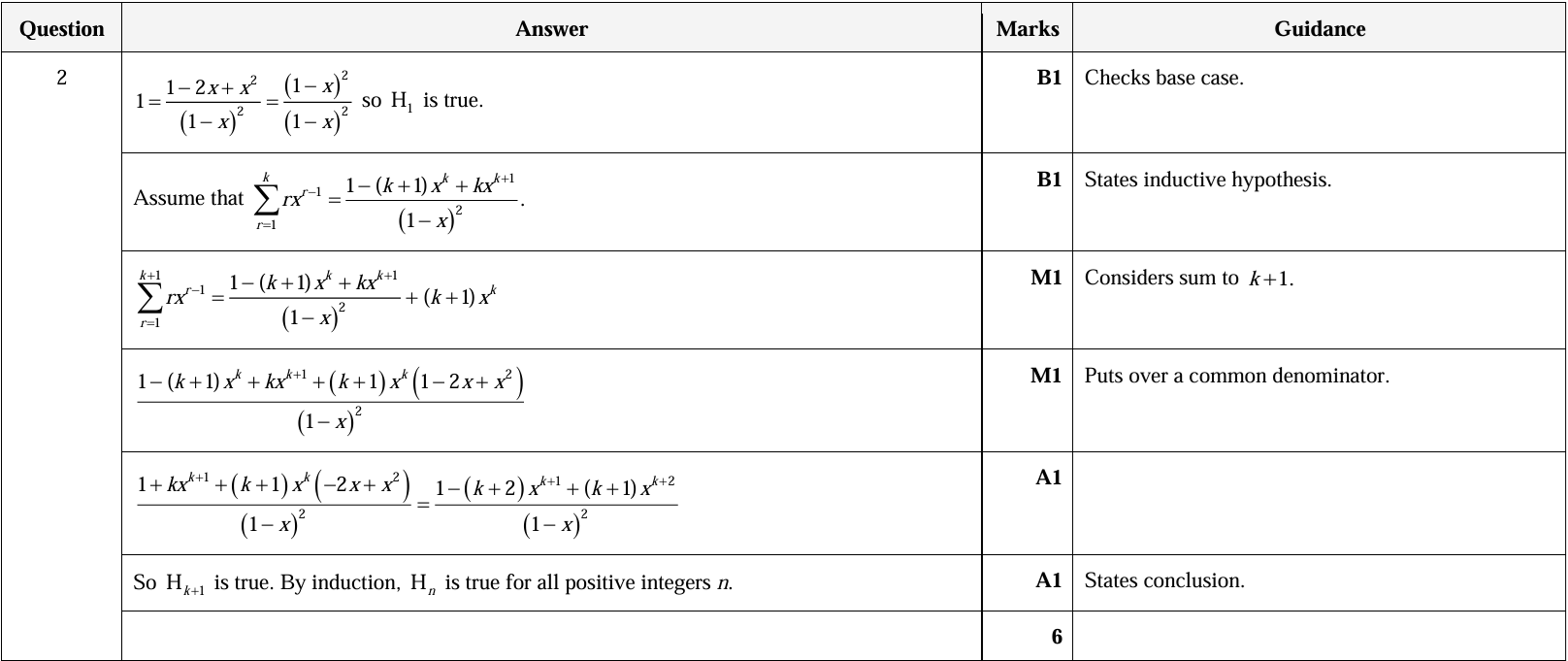
Prove by mathematical induction that, for all positive integers \(n\),
\(1 + 2x + 3x^2 + \ldots + nx^{n-1} = \frac{1 - (n+1)x^n + nx^{n+1}}{(1-x)^2}.\)
FM Nov 2023 p13 q03
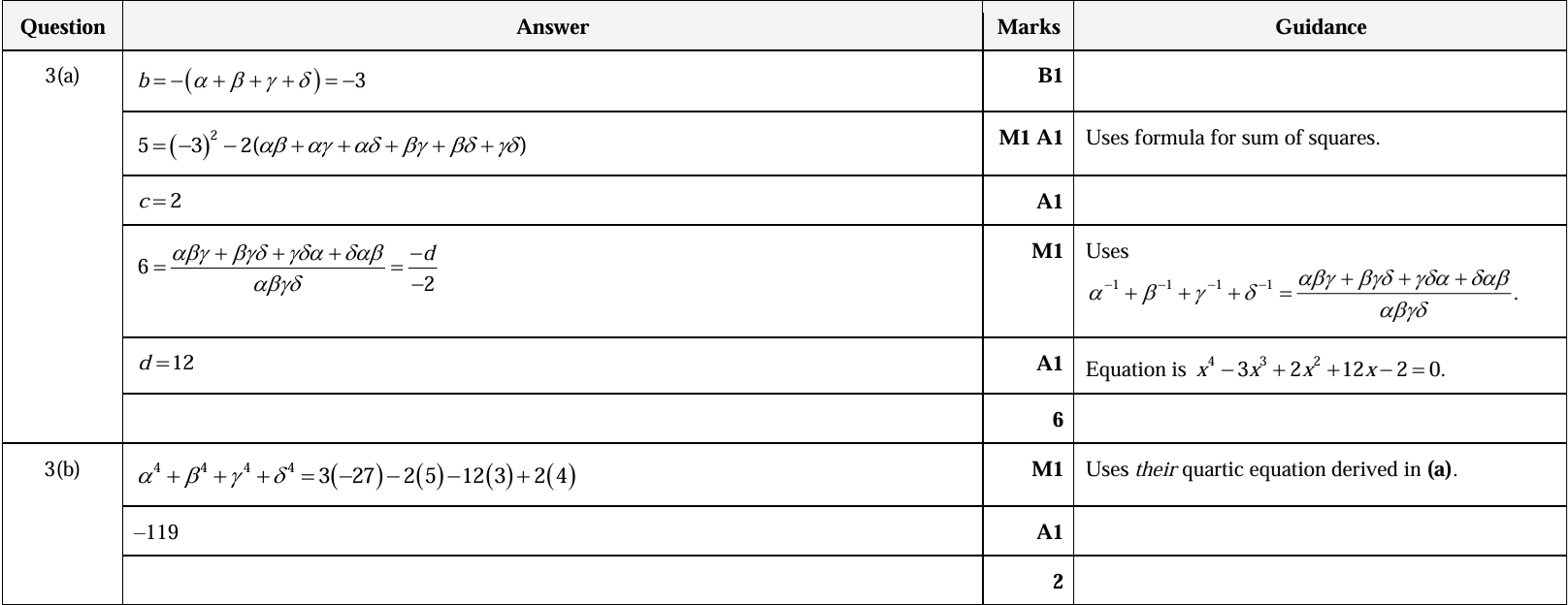
The quartic equation \(x^4 + bx^3 + cx^2 + dx - 2 = 0\) has roots \(\alpha, \beta, \gamma, \delta\). It is given that
\(\alpha + \beta + \gamma + \delta = 3\),
\(\alpha^2 + \beta^2 + \gamma^2 + \delta^2 = 5\),
\(\alpha^{-1} + \beta^{-1} + \gamma^{-1} + \delta^{-1} = 6\).
(a) Find the values of \(b, c\) and \(d\).
(b) Given also that \(\alpha^3 + \beta^3 + \gamma^3 + \delta^3 = -27\), find the value of \(\alpha^4 + \beta^4 + \gamma^4 + \delta^4\).
FM Nov 2023 p13 q04
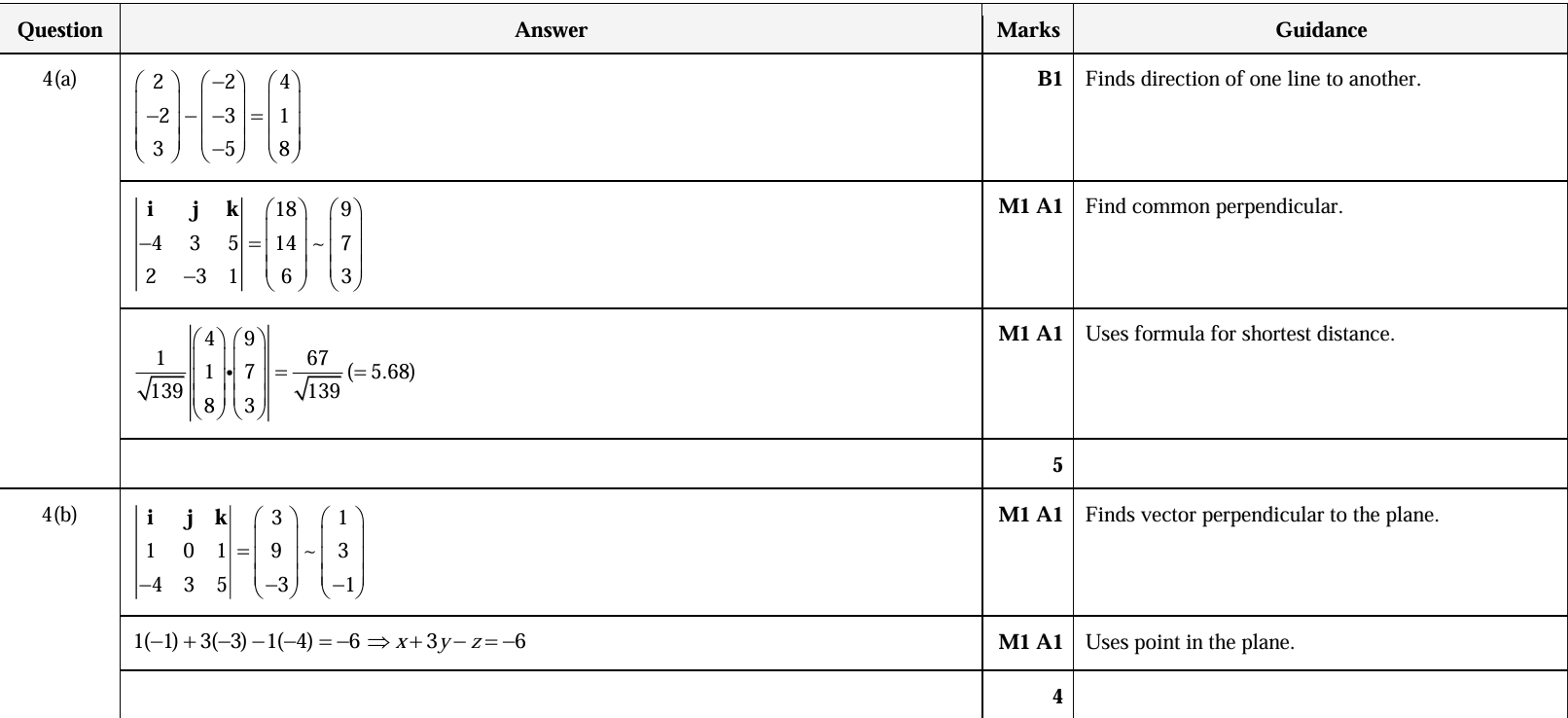
The lines \(l_1\) and \(l_2\) have equations
\(\mathbf{r} = -2\mathbf{i} - 3\mathbf{j} - 5\mathbf{k} + \lambda(-4\mathbf{i} + 3\mathbf{j} + 5\mathbf{k})\) and \(\mathbf{r} = 2\mathbf{i} - 2\mathbf{j} + 3\mathbf{k} + \mu(2\mathbf{i} - 3\mathbf{j} + \mathbf{k})\)
respectively.
(a) Find the shortest distance between \(l_1\) and \(l_2\).
The plane \(\Pi\) contains \(l_1\) and the point with position vector \(-\mathbf{i} - 3\mathbf{j} - 4\mathbf{k}\).
(b) Find an equation of \(\Pi\), giving your answer in the form \(ax + by + cz = d\).
FM Nov 2023 p13 q05
Let k be a constant. The matrices A, B and C are given by
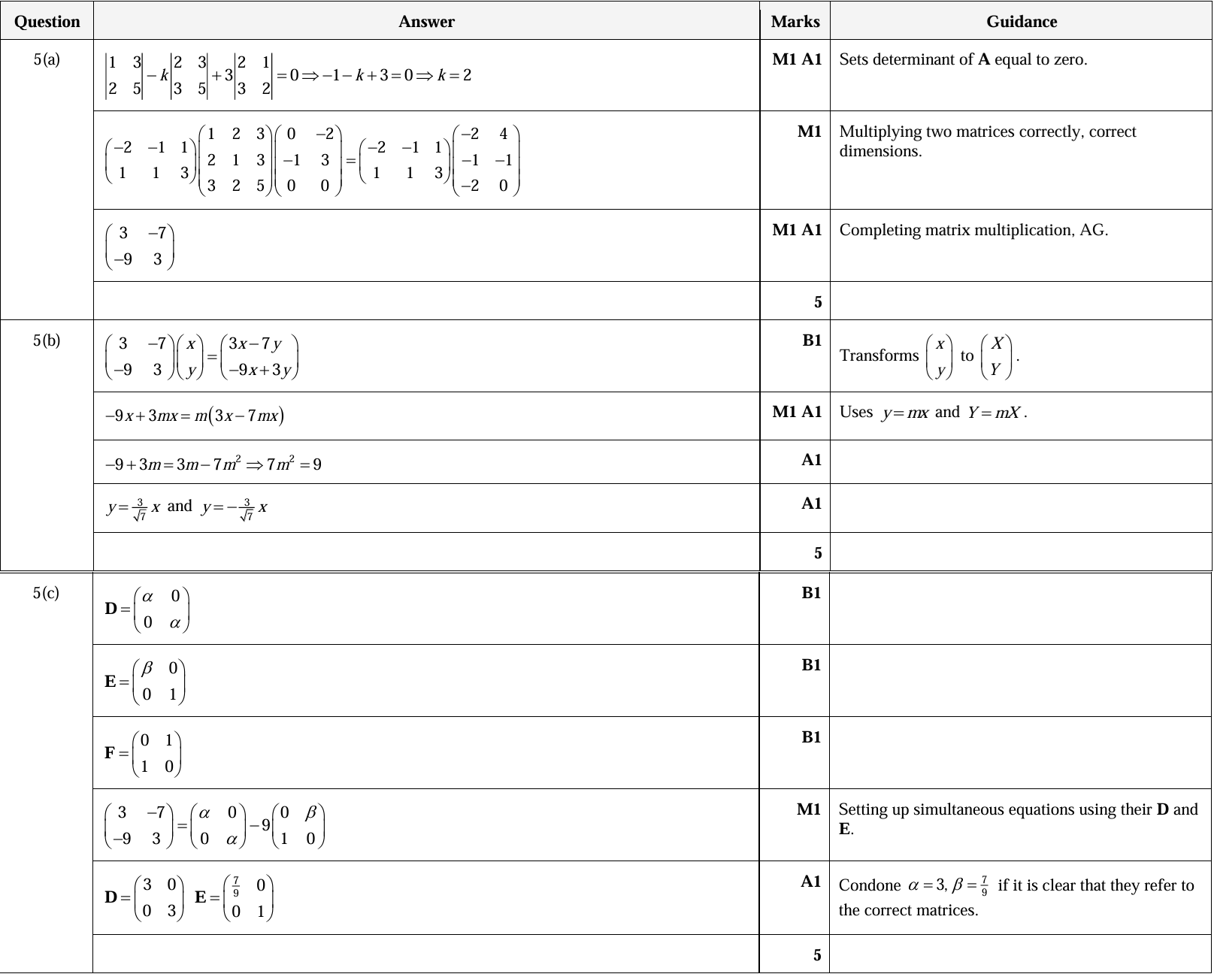
\(\mathbf{A} = \begin{pmatrix} 1 & k & 3 \\ 2 & 1 & 3 \\ 3 & 2 & 5 \end{pmatrix}, \quad \mathbf{B} = \begin{pmatrix} 0 & -2 \\ -1 & 3 \\ 0 & 0 \end{pmatrix} \text{ and } \mathbf{C} = \begin{pmatrix} -2 & -1 \\ 1 & 1 \\ 1 & 3 \end{pmatrix}.\)
It is given that A is singular.
(a) Show that \(\mathbf{CAB} = \begin{pmatrix} 3 & -7 \\ -9 & 3 \end{pmatrix}.\)
(b) Find the equations of the invariant lines, through the origin, of the transformation in the x–y plane represented by CAB.
(c) The matrices D, E and F represent geometrical transformations in the x–y plane.
- D represents an enlargement, centre the origin.
- E represents a stretch parallel to the x-axis.
- F represents a reflection in the line y = x.
Given that \(\mathbf{CAB} = \mathbf{D} - 9\mathbf{EF},\) find D, E and F.
FM Nov 2023 p13 q06
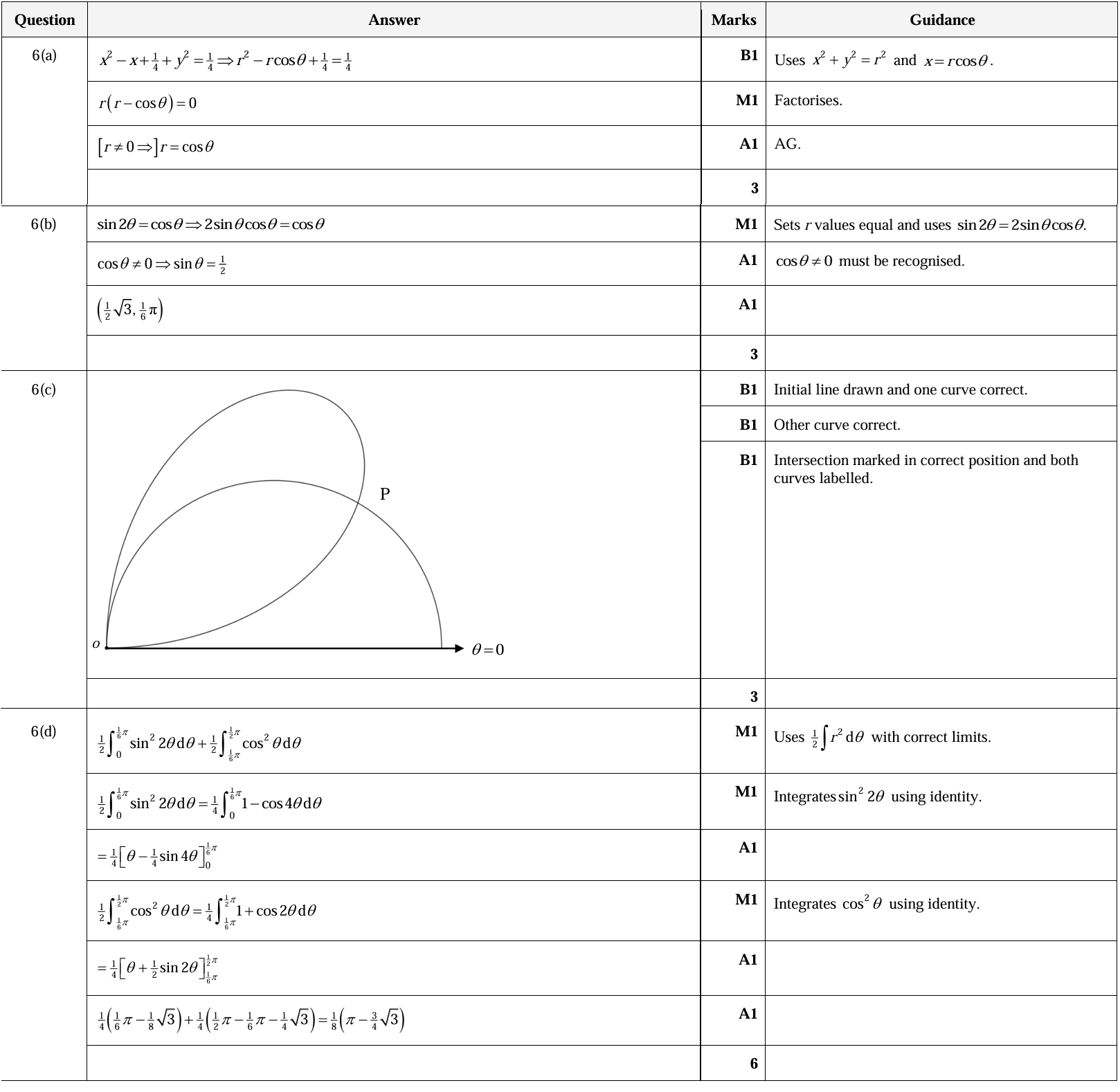
(a) Show that the curve with Cartesian equation \(\left( x - \frac{1}{2} \right)^2 + y^2 = \frac{1}{4}\) has polar equation \(r = \cos \theta\).
The curves \(C_1\) and \(C_2\) have polar equations \(r = \cos \theta\) and \(r = \sin 2\theta\) respectively, where \(0 \leq \theta \leq \frac{1}{2} \pi\). The curves \(C_1\) and \(C_2\) intersect at the pole and at another point \(P\).
(b) Find the polar coordinates of \(P\).
(c) In a single diagram sketch \(C_1\) and \(C_2\), clearly identifying each curve, and mark the point \(P\).
(d) The region \(R\) is enclosed by \(C_1\) and \(C_2\) and includes the line \(OP\). Find, in exact form, the area of \(R\).
FM Nov 2023 p13 q07
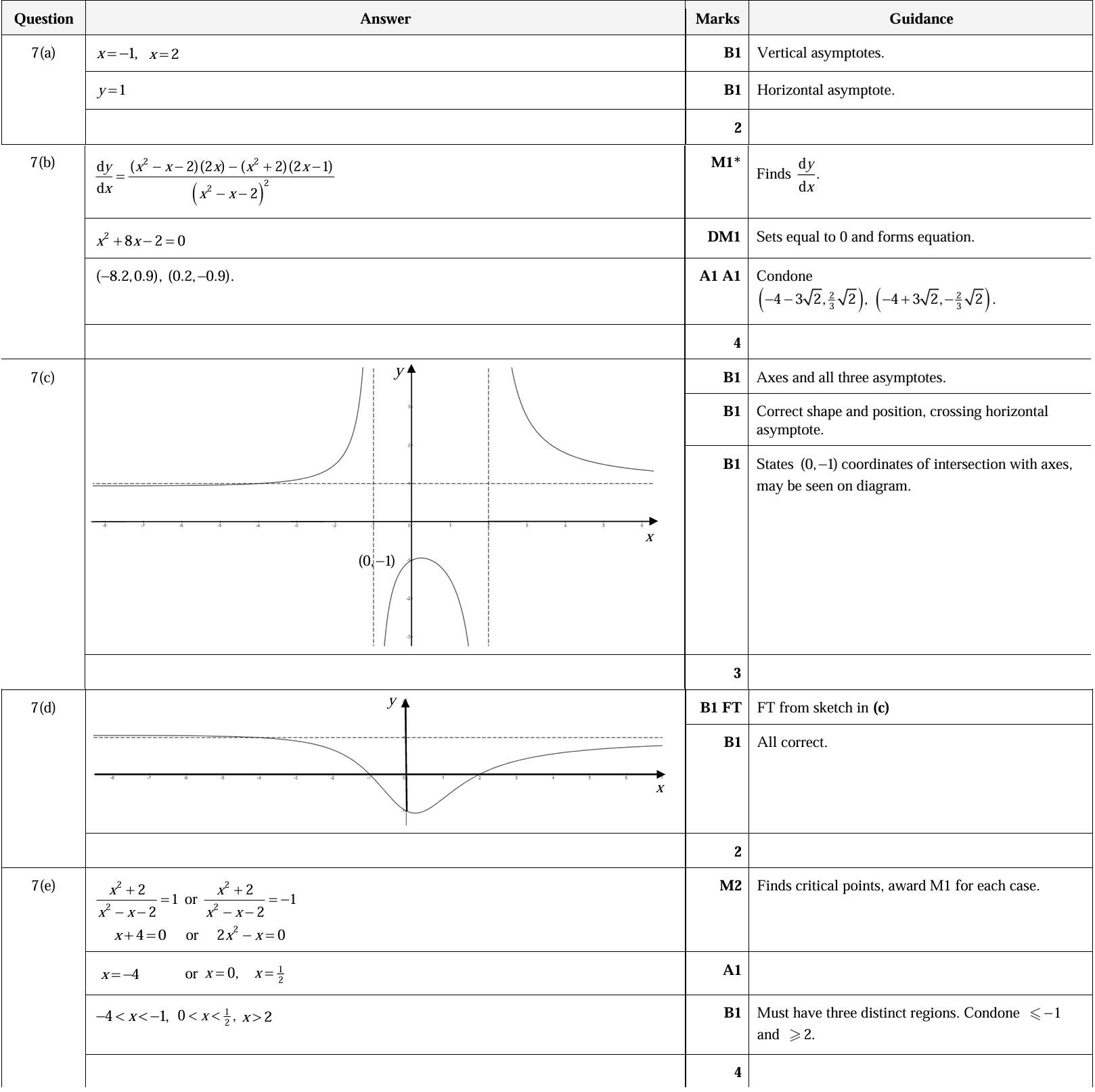
The curve C has equation \(y = f(x)\), where \(f(x) = \frac{x^2 + 2}{x^2 - x - 2}\).
- (a) Find the equations of the asymptotes of C.
- (b) Find the coordinates of any stationary points on C, giving your answers correct to 1 decimal place.
- (c) Sketch C, stating the coordinates of any intersections with the axes.
- (d) Sketch the curve with equation \(y = \frac{1}{f(x)}\).
- (e) Find the set of values for which \(\frac{1}{f(x)} < f(x)\).
FM June 2023 p11 q01
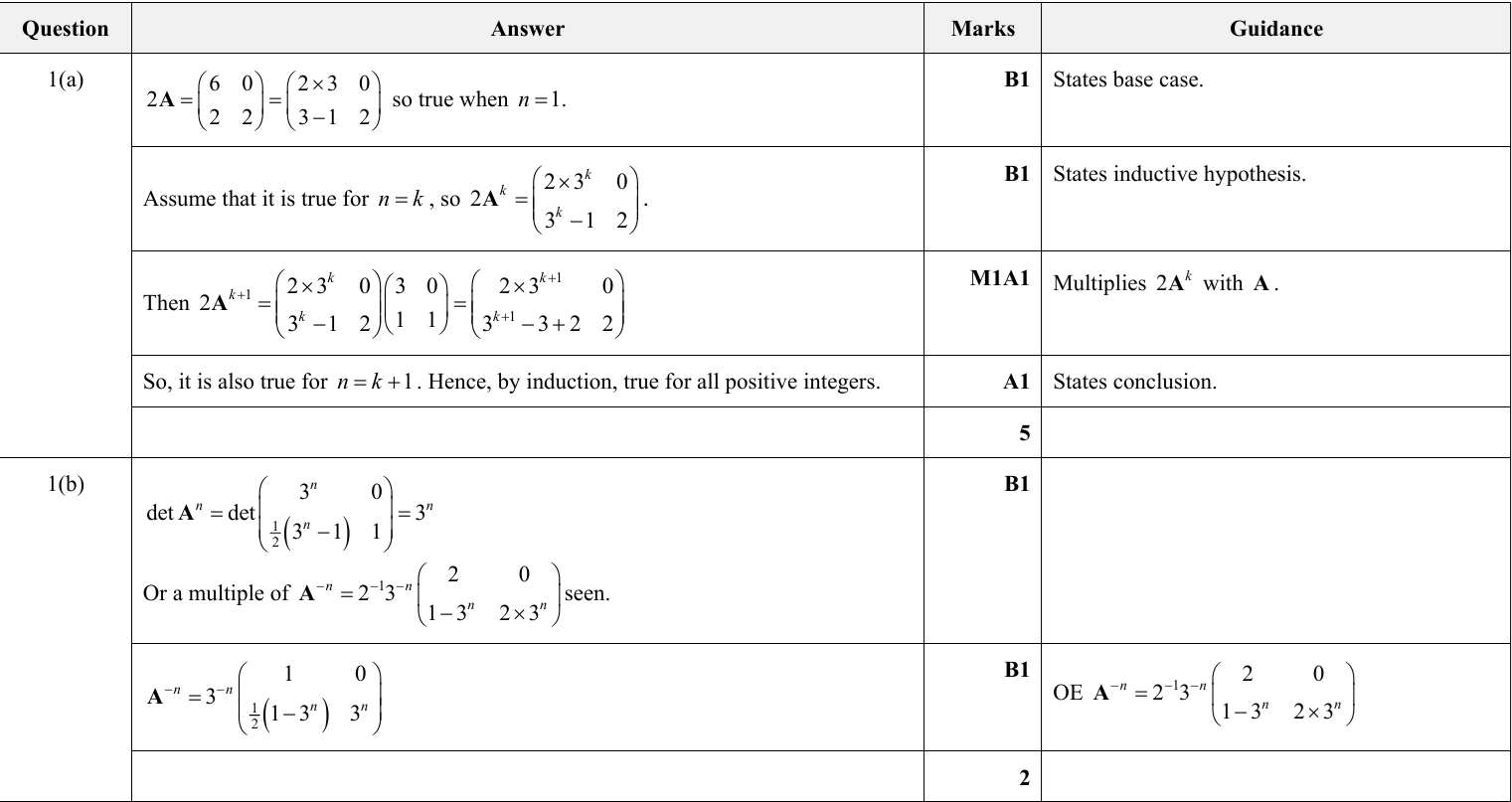
Let \(\mathbf{A} = \begin{pmatrix} 3 & 0 \\ 1 & 1 \end{pmatrix}\).
(a) Prove by mathematical induction that, for all positive integers \(n\),
\(2\mathbf{A}^n = \begin{pmatrix} 2 \times 3^n & 0 \\ 3^n - 1 & 2 \end{pmatrix}.\)
(b) Find, in terms of \(n\), the inverse of \(\mathbf{A}^n\).
FM June 2023 p11 q02
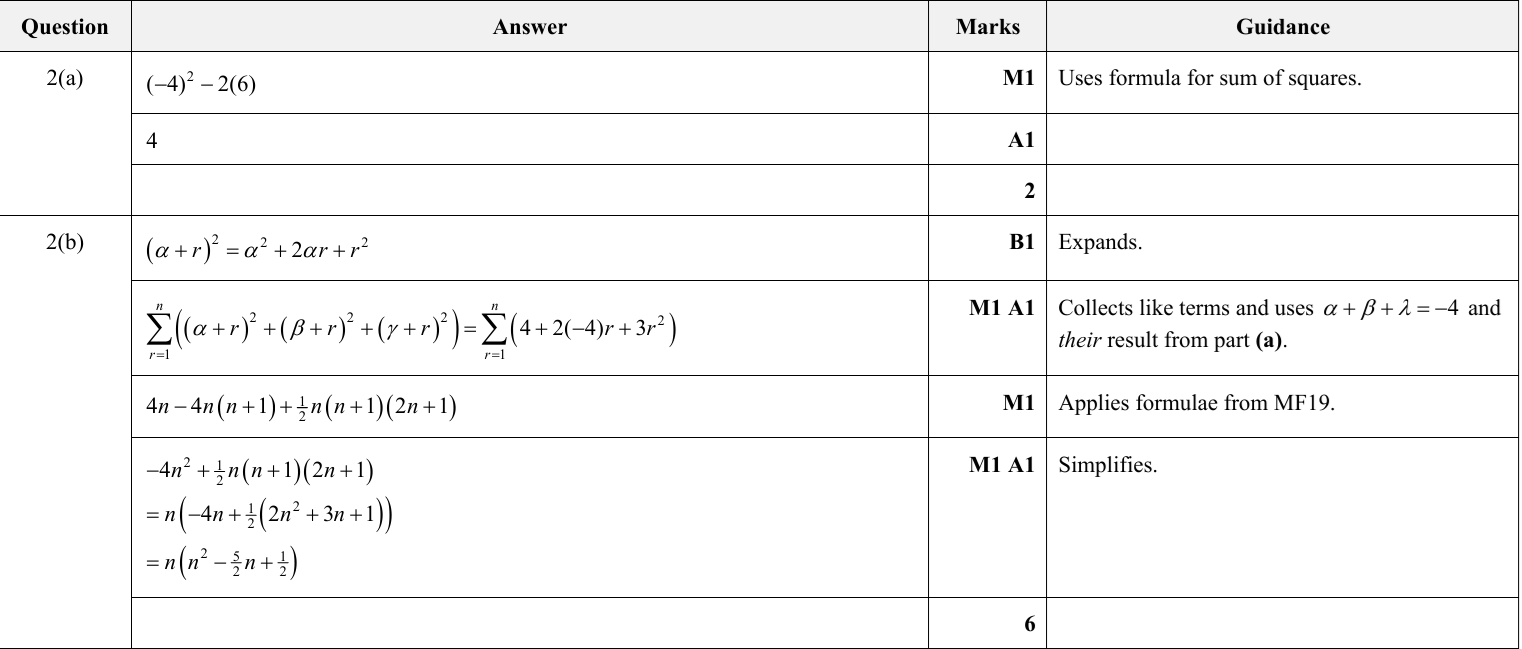
The cubic equation \(x^3 + 4x^2 + 6x + 1 = 0\) has roots \(\alpha, \beta, \gamma\).
(a) Find the value of \(\alpha^2 + \beta^2 + \gamma^2\).
(b) Use standard results from the list of formulae (MF19) to show that
\(\sum_{r=1}^{n} ((\alpha + r)^2 + (\beta + r)^2 + (\gamma + r)^2) = n(n^2 + an + b),\)
where \(a\) and \(b\) are constants to be determined.
FM June 2023 p11 q03
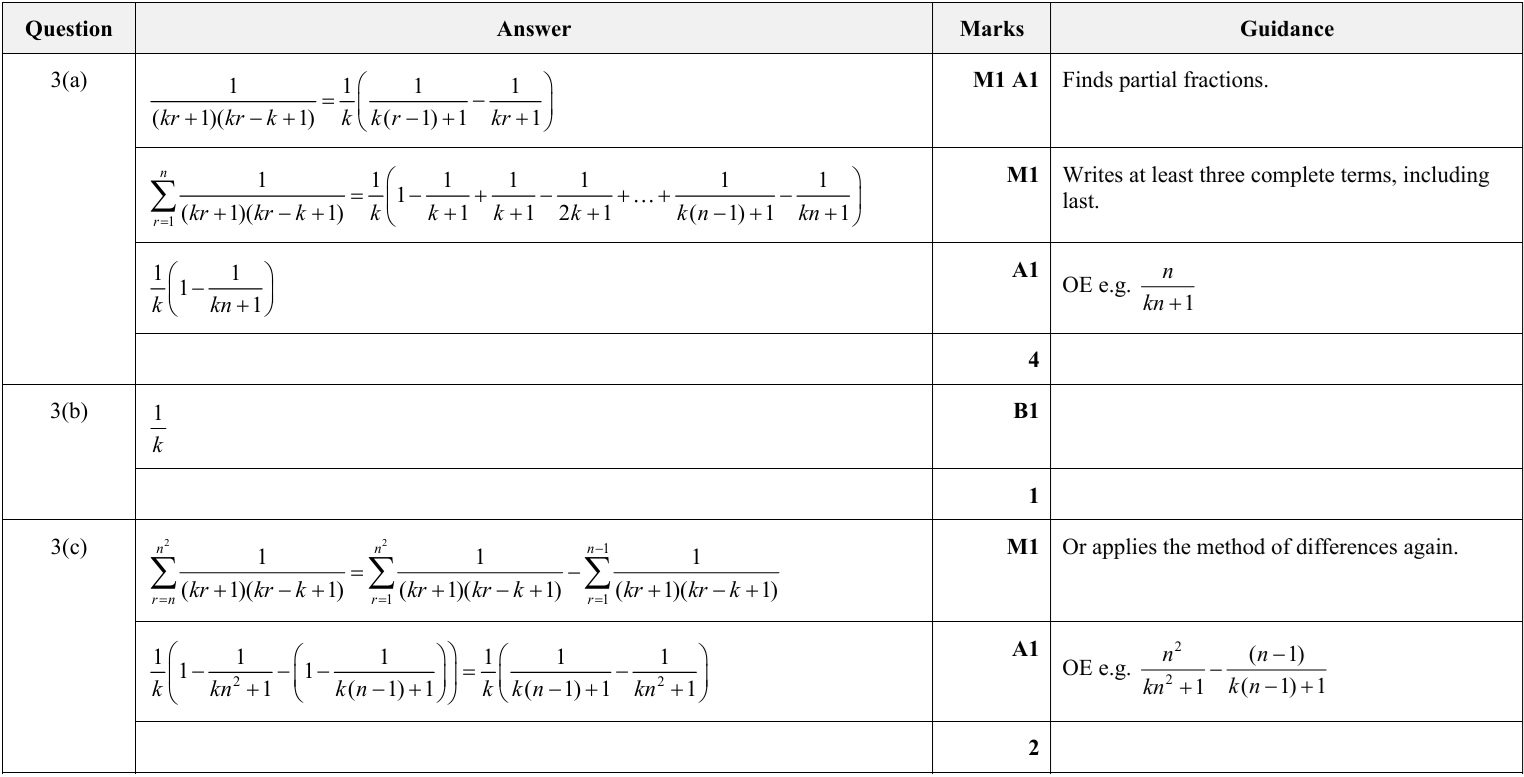
3 (a) Use the method of differences to find \(\sum_{r=1}^{n} \frac{1}{(kr+1)(kr-k+1)}\) in terms of \(n\) and \(k\), where \(k\) is a positive constant.
(b) Deduce the value of \(\sum_{r=1}^{\infty} \frac{1}{(kr+1)(kr-k+1)}\).
(c) Find also \(\sum_{r=n}^{n^2} \frac{1}{(kr+1)(kr-k+1)}\) in terms of \(n\) and \(k\).
FM June 2023 p11 q04
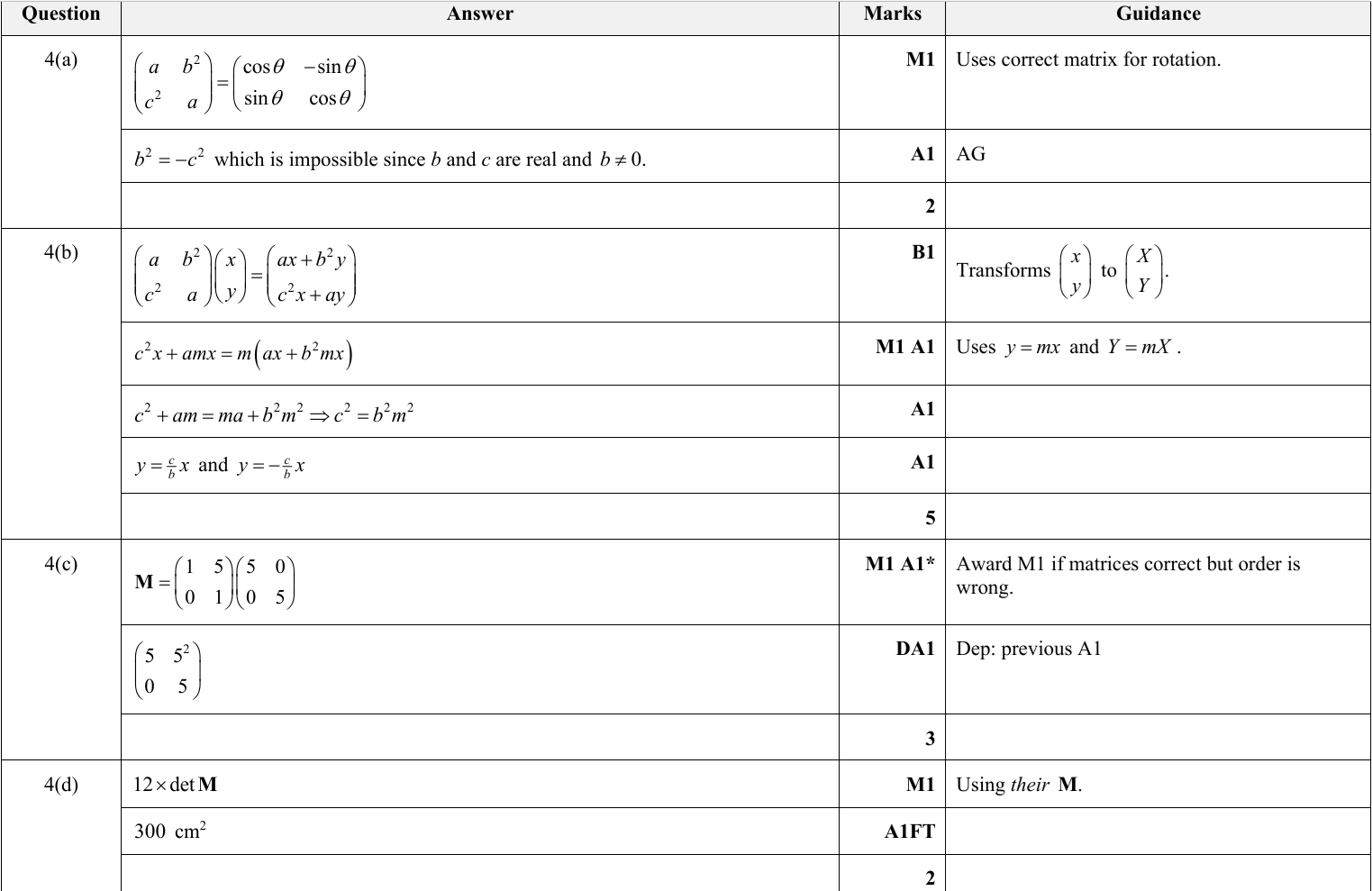
The matrix M is given by \(\mathbf{M} = \begin{pmatrix} a & b^2 \\ c^2 & a \end{pmatrix}\), where \(a, b, c\) are real constants and \(b \neq 0\).
- Show that M does not represent a rotation about the origin.
- Find the equations of the invariant lines, through the origin, of the transformation in the x–y plane represented by M.
It is given that M represents the sequence of two transformations in the x–y plane given by an enlargement, centre the origin, scale factor 5 followed by a shear, x-axis fixed, with (0, 1) mapped to (5, 1).
- Find M.
- The triangle DEF in the x–y plane is transformed by M onto triangle PQR. Given that the area of triangle DEF is 12 cm2, find the area of triangle PQR.
FM June 2023 p11 q05
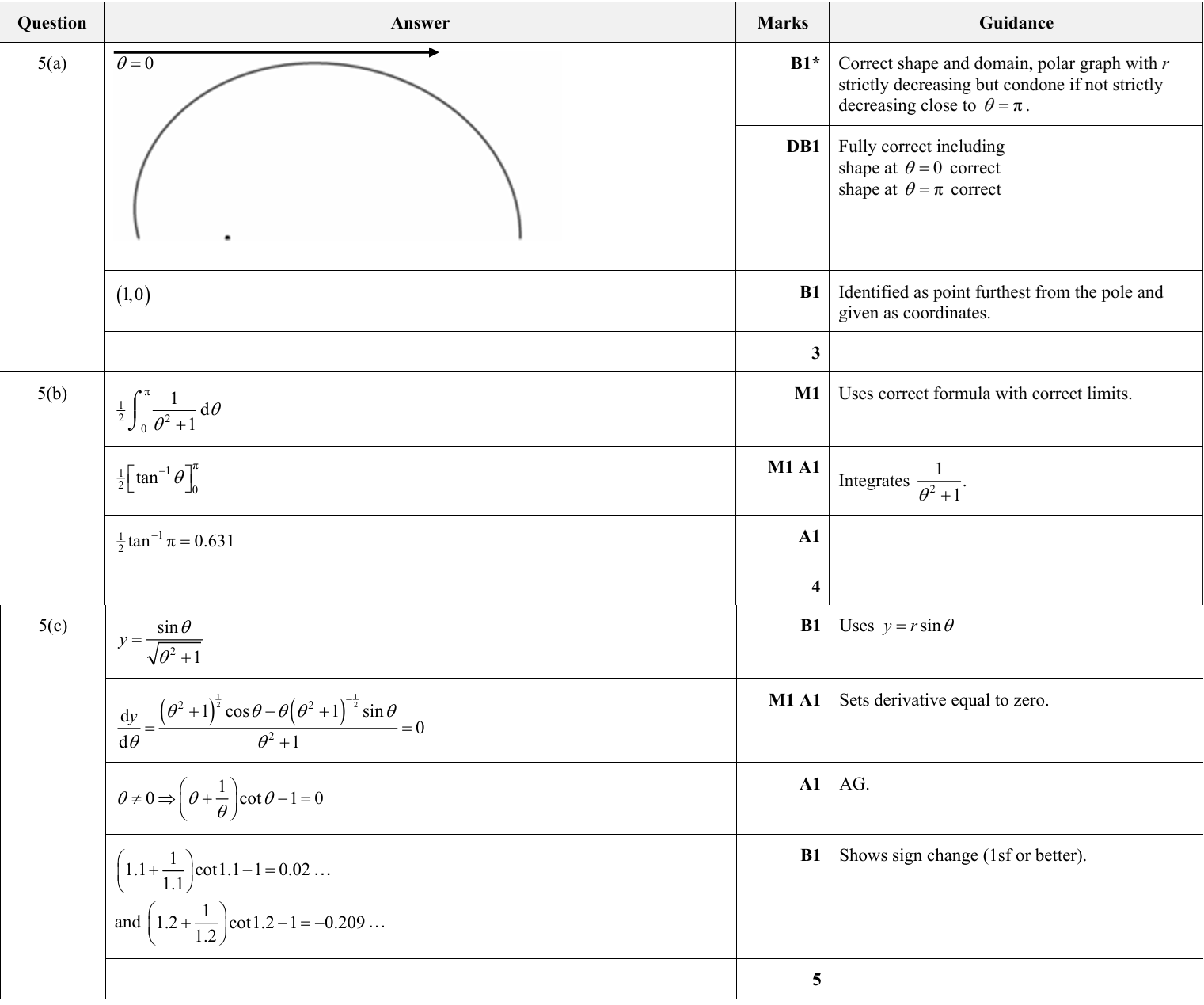
The curve \(C\) has polar equation \(r^2 = \frac{1}{\theta^2 + 1}\), for \(0 \leq \theta \leq \pi\).
- Sketch \(C\) and state the polar coordinates of the point of \(C\) furthest from the pole.
- Find the area of the region enclosed by \(C\), the initial line, and the half-line \(\theta = \pi\).
- Show that, at the point of \(C\) furthest from the initial line, \(\left( \theta + \frac{1}{\theta} \right) \cot \theta - 1 = 0\) and verify that this equation has a root between 1.1 and 1.2.
FM June 2023 p11 q06
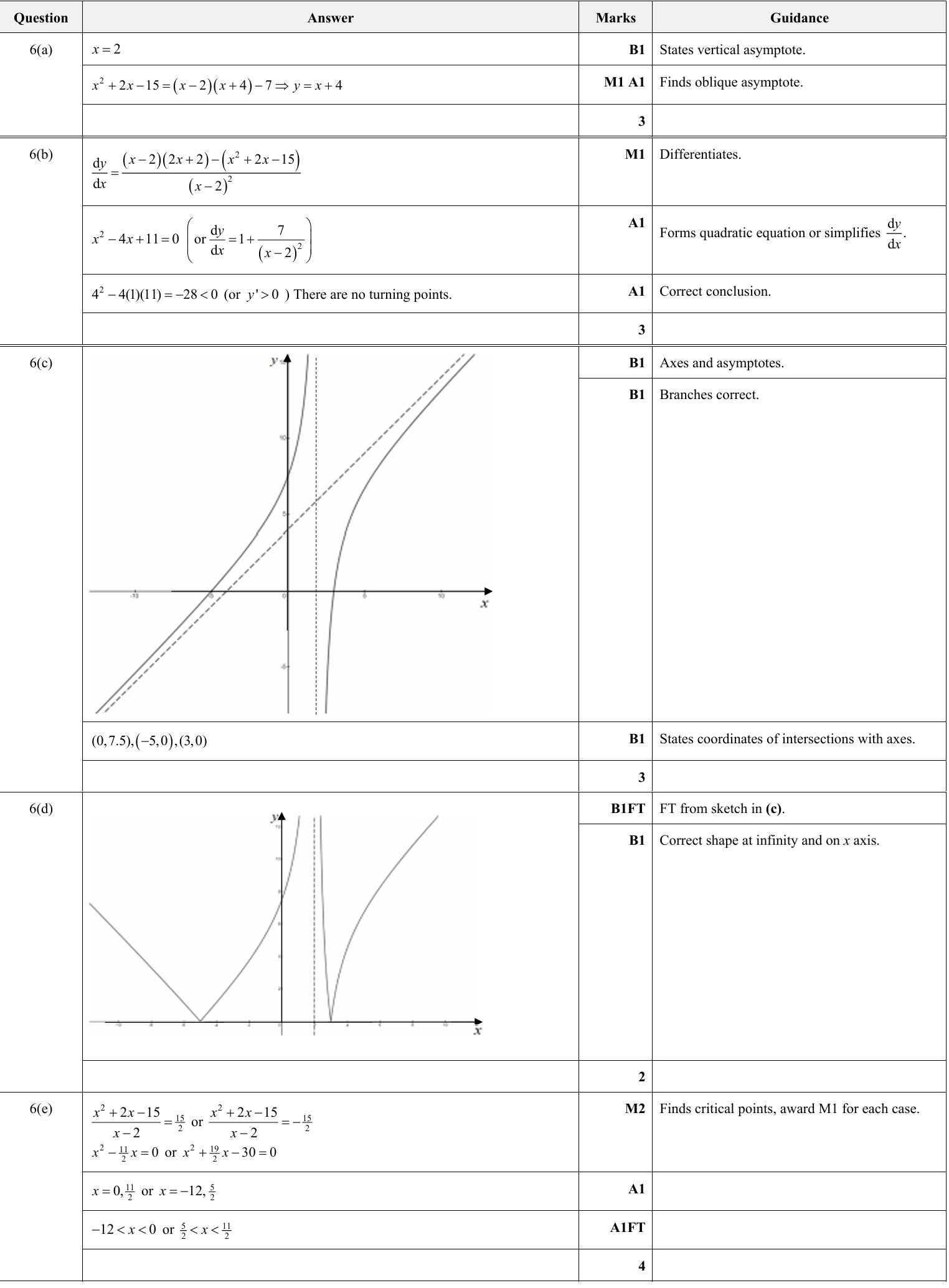
The curve C has equation \(y = \frac{x^2 + 2x - 15}{x - 2}\).
- Find the equations of the asymptotes of C.
- Show that C has no stationary points.
- Sketch C, stating the coordinates of the intersections with the axes.
- Sketch the curve with equation \(y = \left| \frac{x^2 - 2x - 15}{x - 2} \right|\).
- Find the set of values of \(x\) for which \(\left| \frac{2x^2 + 4x - 30}{x - 2} \right| < 15\).
FM June 2023 p11 q07
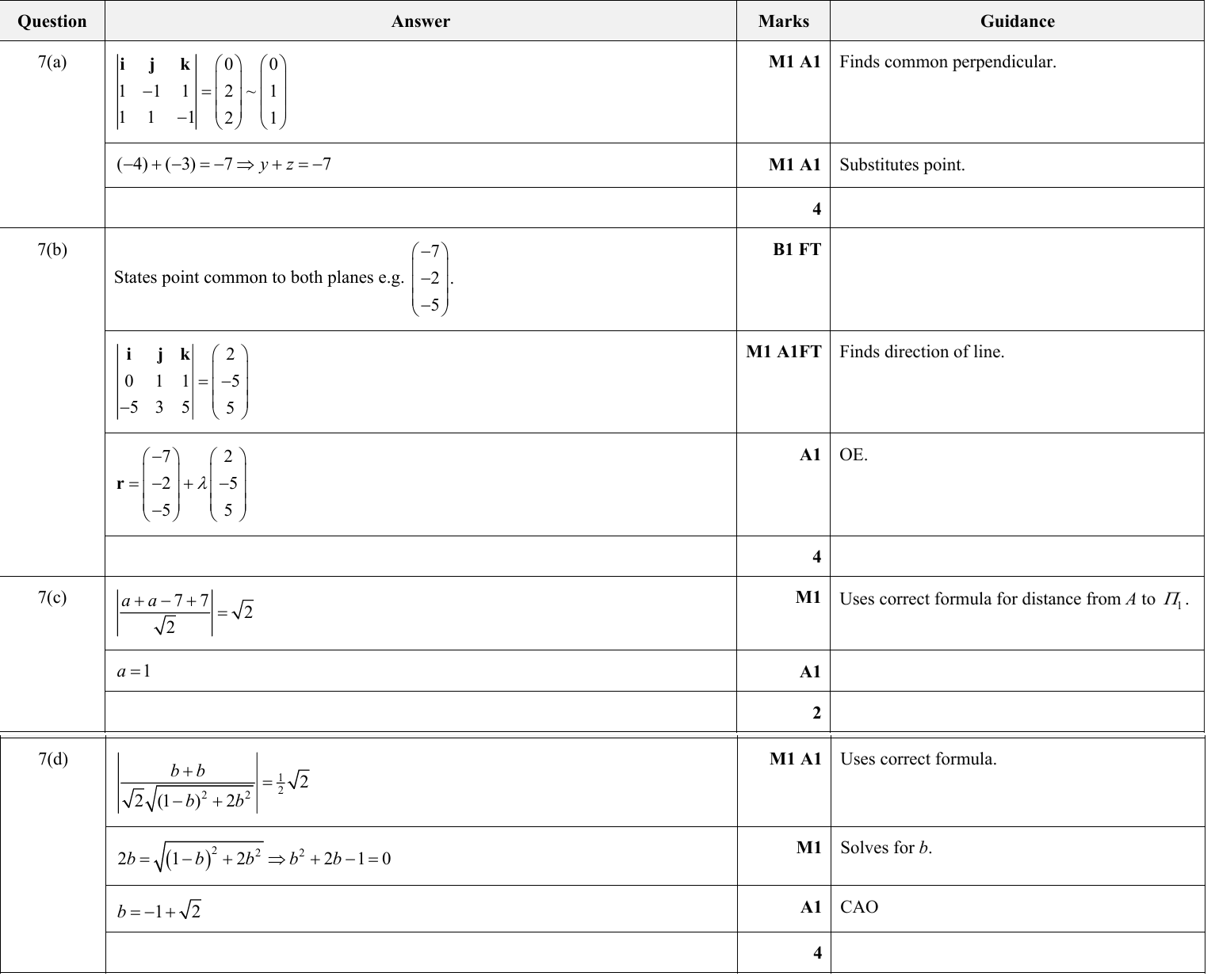
The plane \(\Pi_1\) has equation \(\mathbf{r} = -4\mathbf{j} - 3\mathbf{k} + \lambda (\mathbf{i} - \mathbf{j} + \mathbf{k}) + \mu (\mathbf{i} + \mathbf{j} - \mathbf{k})\).
- Obtain an equation of \(\Pi_1\) in the form \(px + qy + rz = d\).
- The plane \(\Pi_2\) has equation \(\mathbf{r} \cdot (-5\mathbf{i} + 3\mathbf{j} + 5\mathbf{k}) = 4\). Find a vector equation of the line of intersection of \(\Pi_1\) and \(\Pi_2\).
- The line \(l\) passes through the point \(A\) with position vector \(a\mathbf{i} + a\mathbf{j} + (a-7)\mathbf{k}\) and is parallel to \((1-b)\mathbf{i} + b\mathbf{j} + b\mathbf{k}\), where \(a\) and \(b\) are positive constants. Given that the perpendicular distance from \(A\) to \(\Pi_1\) is \(\sqrt{2}\), find the value of \(a\).
- Given that the obtuse angle between \(l\) and \(\Pi_1\) is \(\frac{3}{4}\pi\), find the exact value of \(b\).
FM June 2023 p12 q01
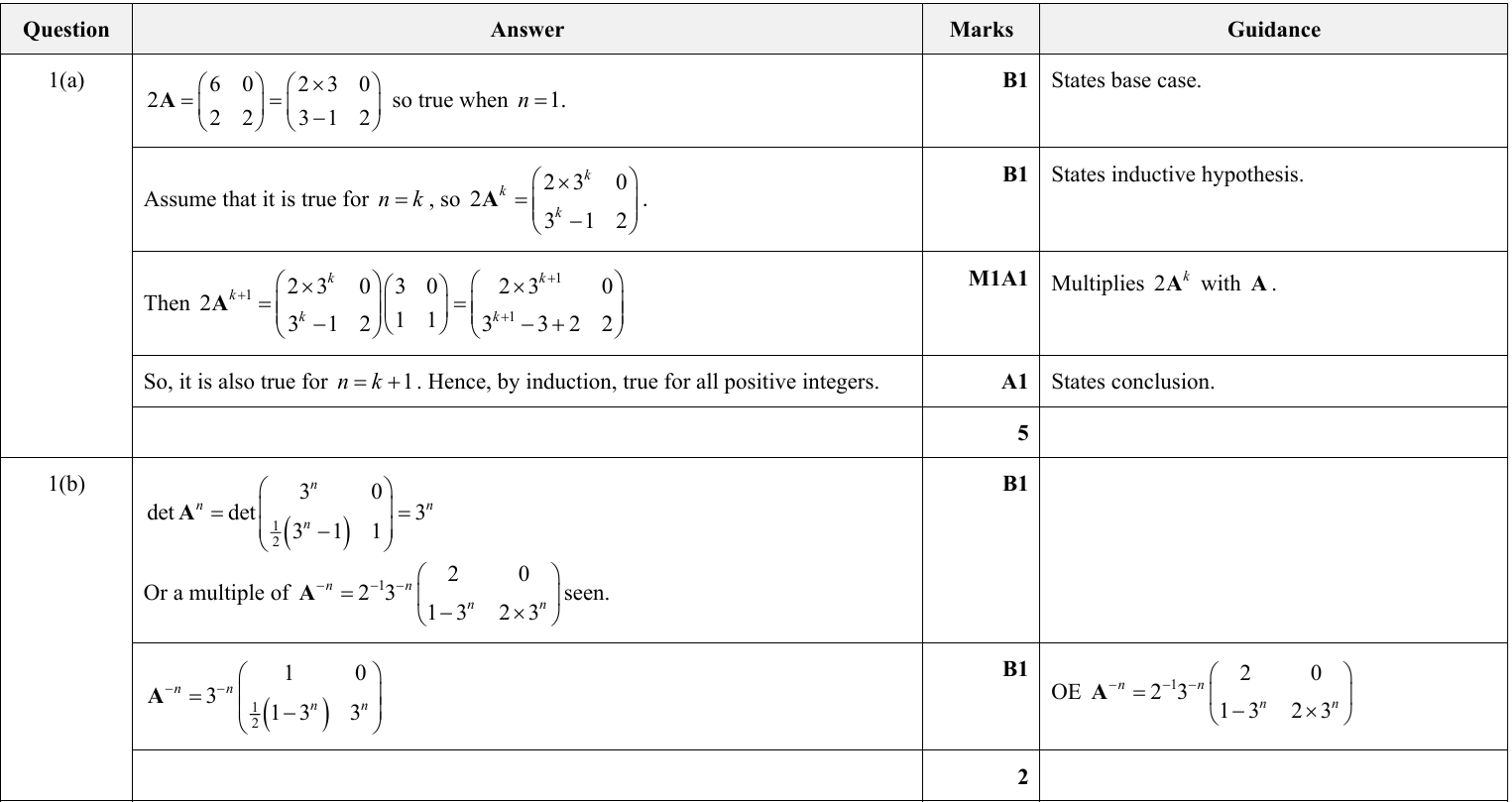
Let \(A = \begin{pmatrix} 3 & 0 \\ 1 & 1 \end{pmatrix}\).
(a) Prove by mathematical induction that, for all positive integers \(n\),
\(2A^n = \begin{pmatrix} 2 \times 3^n & 0 \\ 3^n - 1 & 2 \end{pmatrix}.\)
(b) Find, in terms of \(n\), the inverse of \(A^n\).
FM June 2023 p12 q02
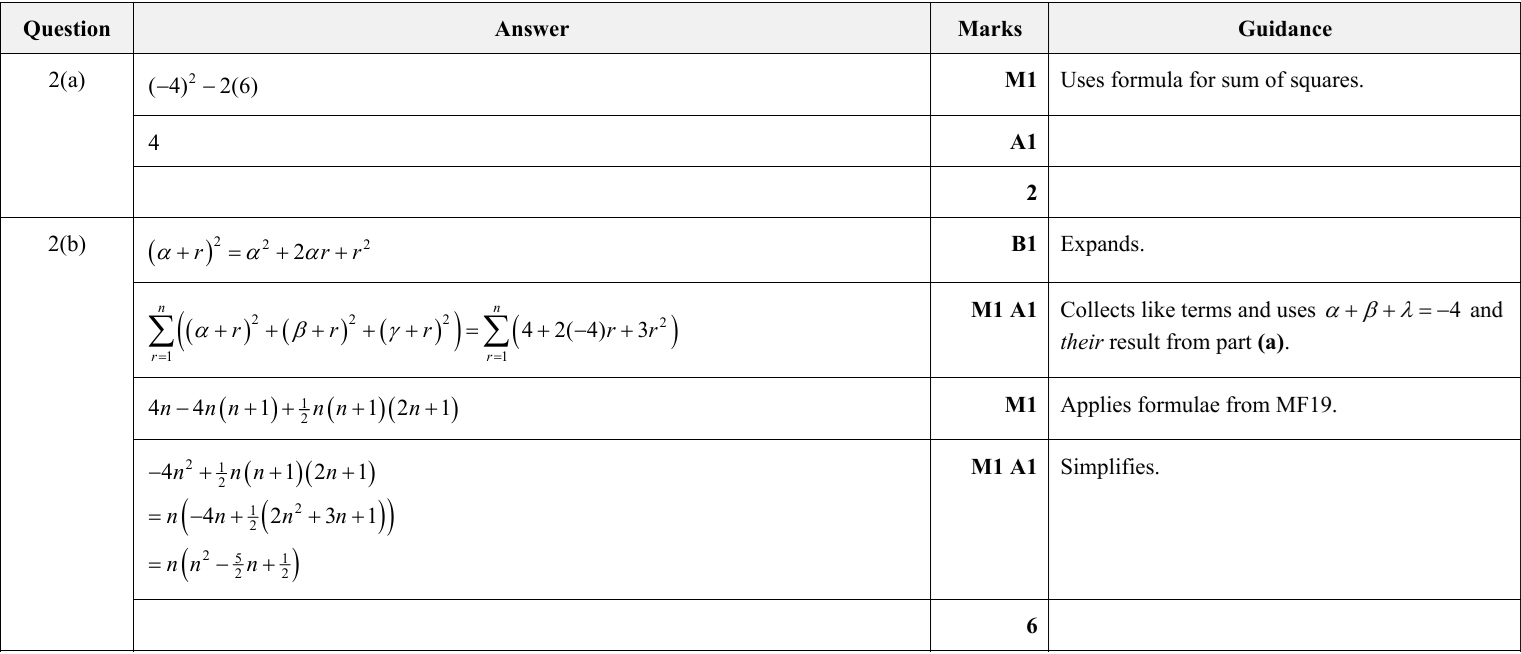
The cubic equation \(x^3 + 4x^2 + 6x + 1 = 0\) has roots \(\alpha, \beta, \gamma\).
(a) Find the value of \(\alpha^2 + \beta^2 + \gamma^2\).
(b) Use standard results from the list of formulae (MF19) to show that
\(\sum_{r=1}^{n} ((\alpha + r)^2 + (\beta + r)^2 + (\gamma + r)^2) = n(n^2 + an + b),\)
where \(a\) and \(b\) are constants to be determined.
FM June 2023 p12 q03
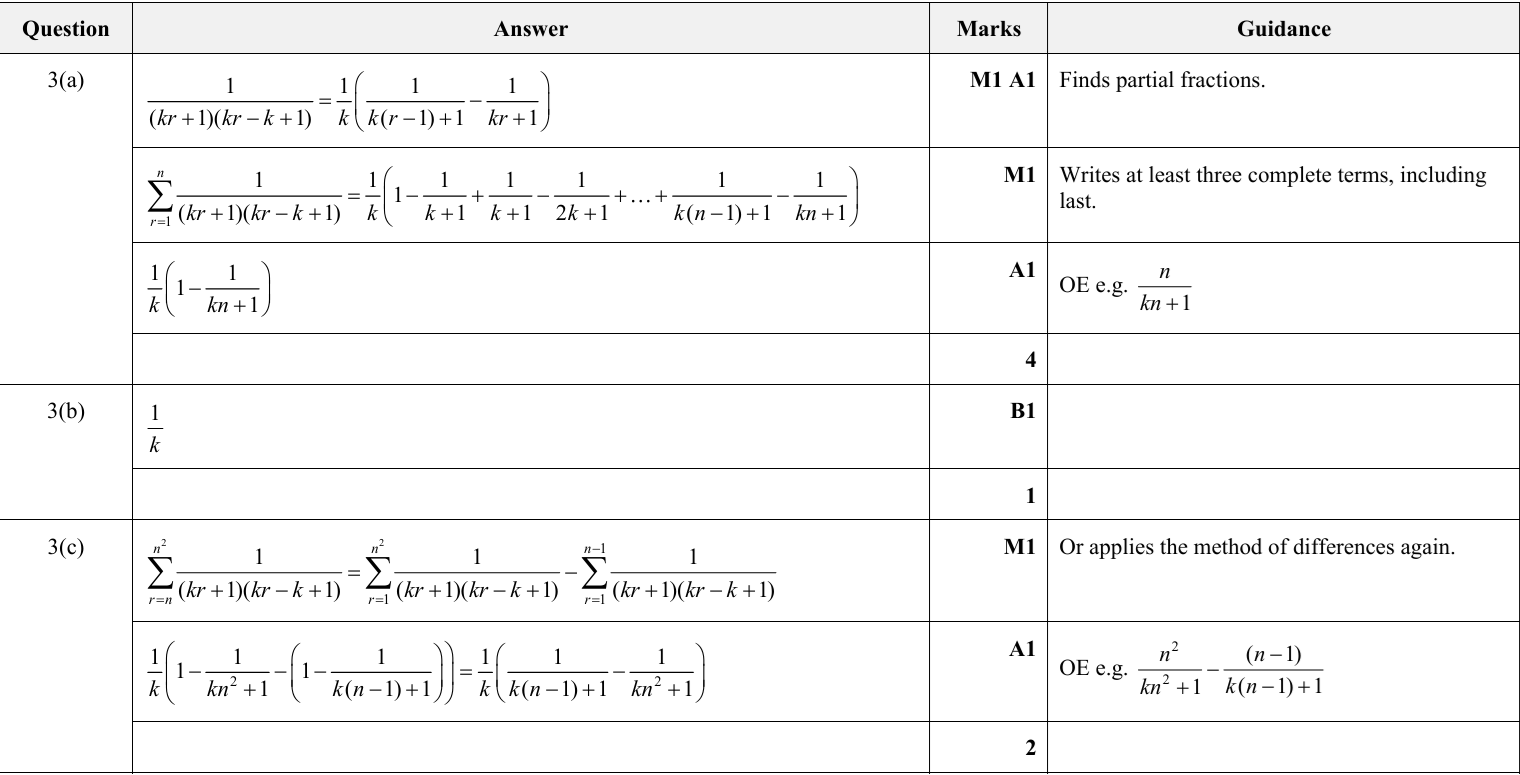
3 (a) Use the method of differences to find \(\sum_{r=1}^{n} \frac{1}{(kr+1)(kr-k+1)}\) in terms of \(n\) and \(k\), where \(k\) is a positive constant.
(b) Deduce the value of \(\sum_{r=1}^{\infty} \frac{1}{(kr+1)(kr-k+1)}\).
(c) Find also \(\sum_{r=n}^{n^2} \frac{1}{(kr+1)(kr-k+1)}\) in terms of \(n\) and \(k\).
FM June 2023 p12 q04
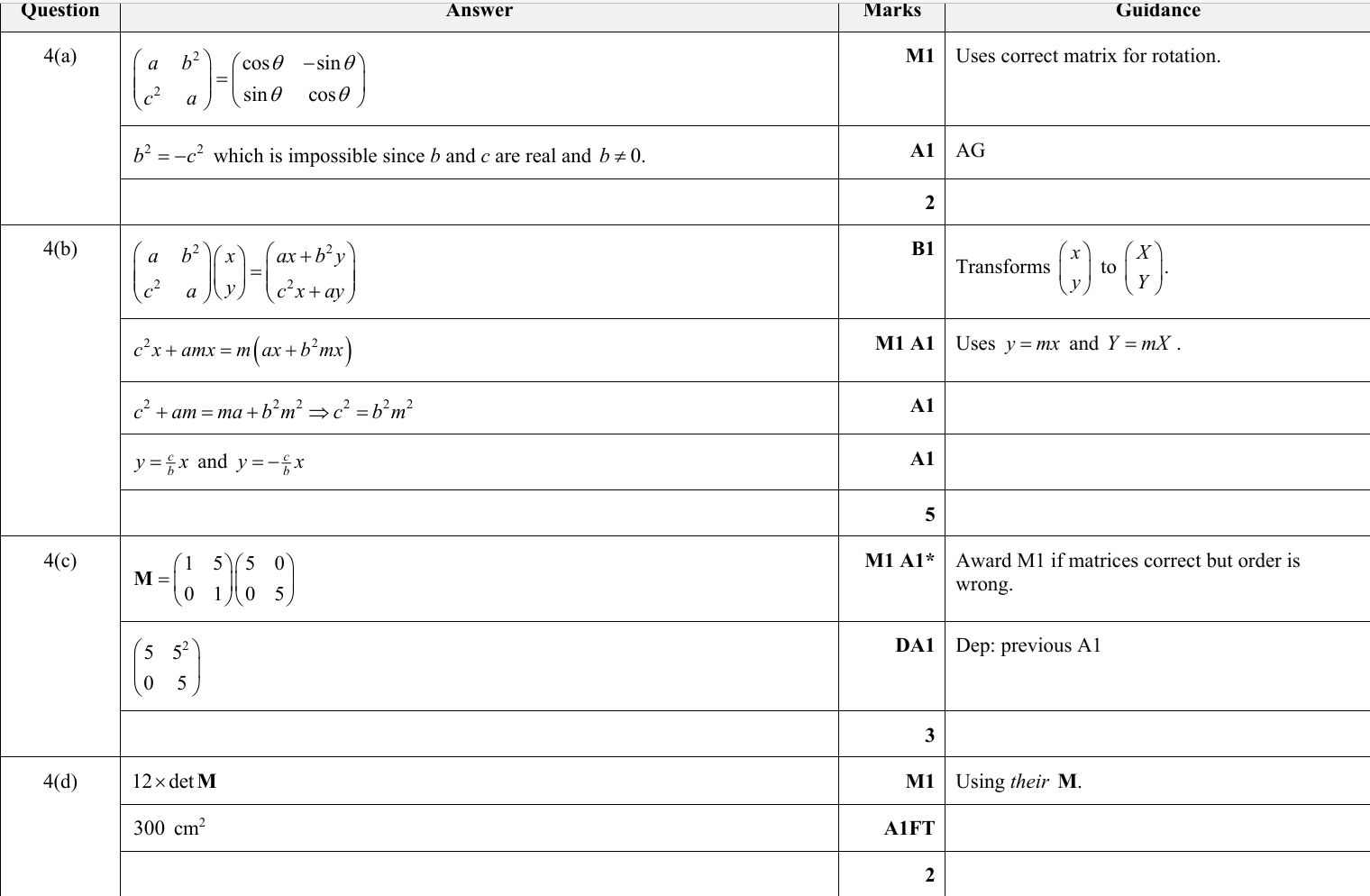
The matrix \(\mathbf{M}\) is given by \(\mathbf{M} = \begin{pmatrix} a & b^2 \\ c^2 & a \end{pmatrix}\), where \(a, b, c\) are real constants and \(b \neq 0\).
- Show that \(\mathbf{M}\) does not represent a rotation about the origin.
- Find the equations of the invariant lines, through the origin, of the transformation in the \(x-y\) plane represented by \(\mathbf{M}\).
- It is given that \(\mathbf{M}\) represents the sequence of two transformations in the \(x-y\) plane given by an enlargement, centre the origin, scale factor 5 followed by a shear, x-axis fixed, with \((0, 1)\) mapped to \((5, 1)\). Find \(\mathbf{M}\).
- The triangle \(DEF\) in the \(x-y\) plane is transformed by \(\mathbf{M}\) onto triangle \(PQR\). Given that the area of triangle \(DEF\) is \(12 \text{ cm}^2\), find the area of triangle \(PQR\).
FM June 2023 p12 q05
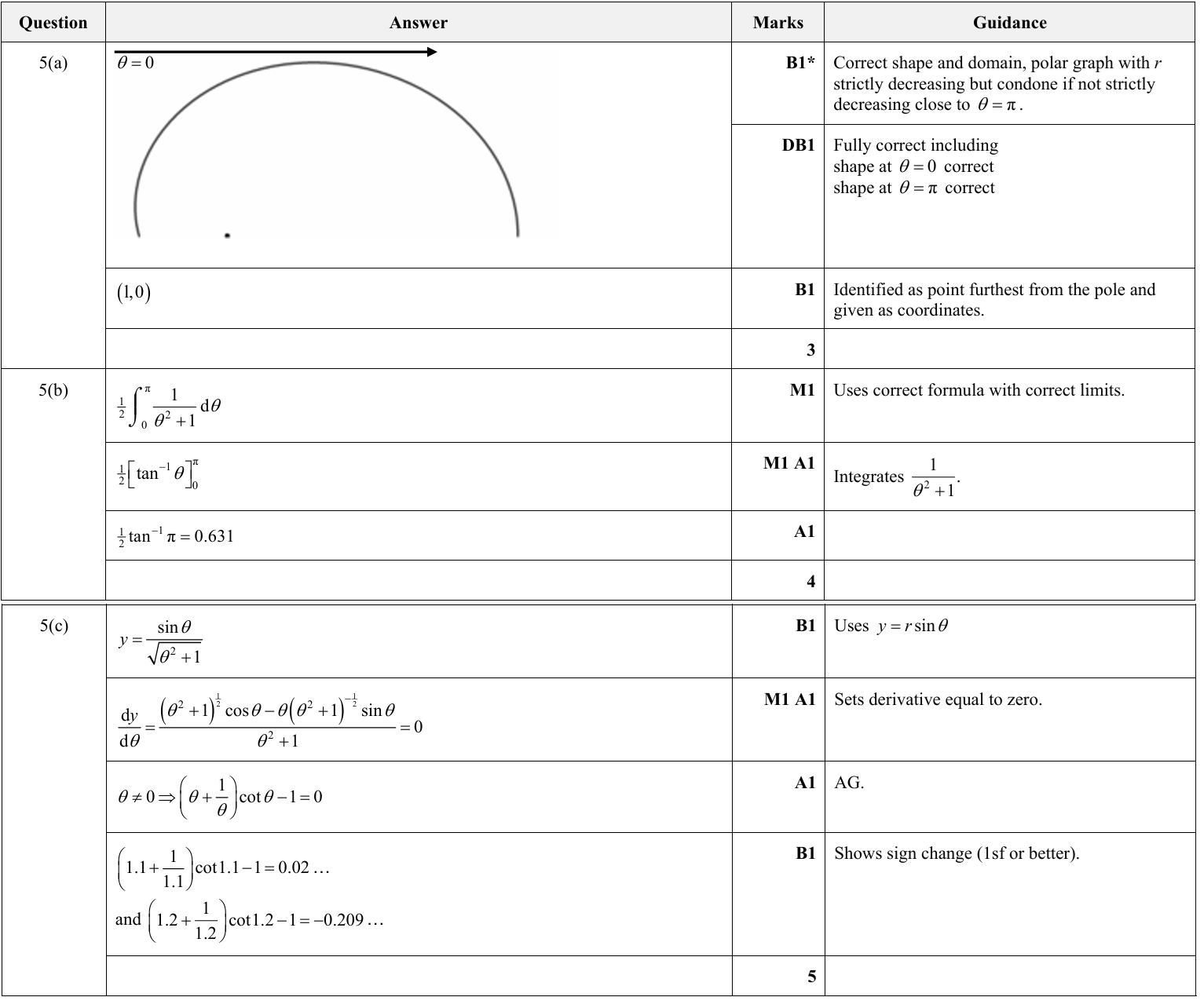
The curve C has polar equation \(r^2 = \frac{1}{\theta^2 + 1}\), for \(0 \leq \theta \leq \pi\).
- Sketch C and state the polar coordinates of the point of C furthest from the pole.
- Find the area of the region enclosed by C, the initial line, and the half-line \(\theta = \pi\).
- Show that, at the point of C furthest from the initial line, \(\left( \theta + \frac{1}{\theta} \right) \cot \theta - 1 = 0\) and verify that this equation has a root between 1.1 and 1.2.
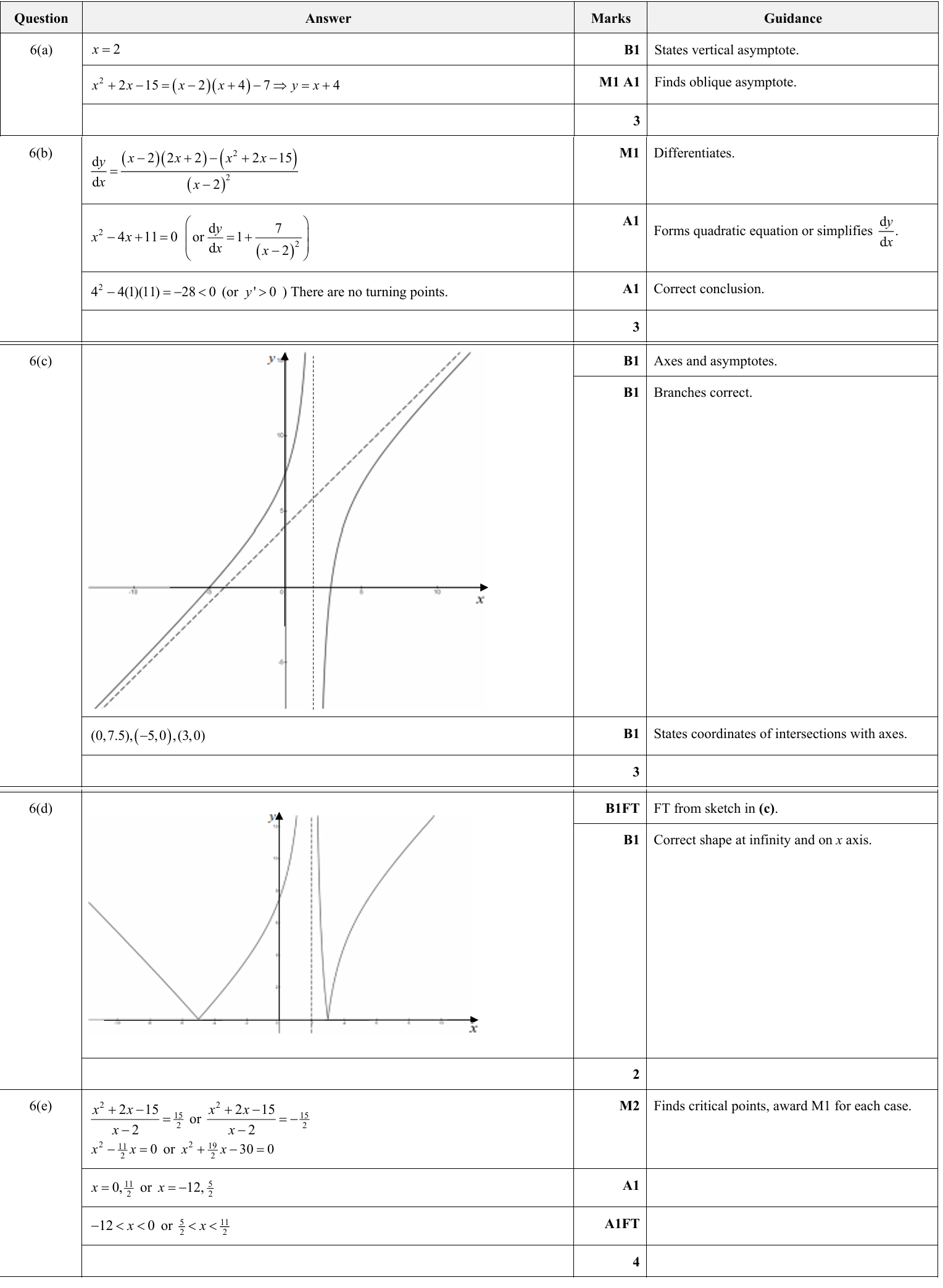
FM June 2023 p12 q06
The curve \(C\) has equation \(y = \frac{x^2 + 2x - 15}{x - 2}\).
- Find the equations of the asymptotes of \(C\).
- Show that \(C\) has no stationary points.
- Sketch \(C\), stating the coordinates of the intersections with the axes.
- Sketch the curve with equation \(y = \left| \frac{x^2 - 2x - 15}{x - 2} \right|\).
- Find the set of values of \(x\) for which \(\left| \frac{2x^2 + 4x - 30}{x - 2} \right| < 15\).
FM June 2023 p12 q07
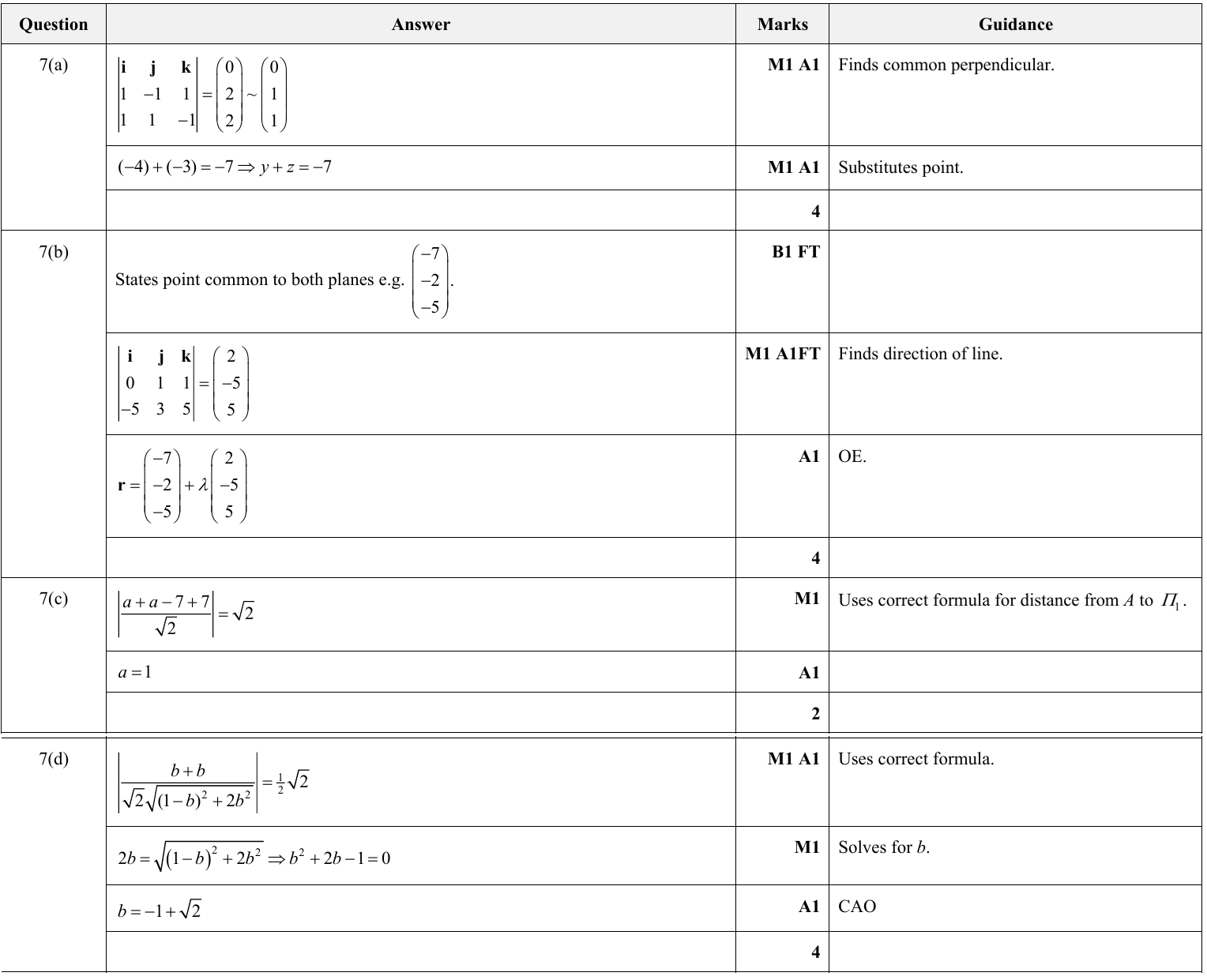
The plane \(\Pi_1\) has equation \(\mathbf{r} = -4\mathbf{j} - 3\mathbf{k} + \lambda (\mathbf{i} - \mathbf{j} + \mathbf{k}) + \mu (\mathbf{i} + \mathbf{j} - \mathbf{k})\).
(a) Obtain an equation of \(\Pi_1\) in the form \(px + qy + rz = d\).
(b) The plane \(\Pi_2\) has equation \(\mathbf{r} \cdot (-5\mathbf{i} + 3\mathbf{j} + 5\mathbf{k}) = 4\).
Find a vector equation of the line of intersection of \(\Pi_1\) and \(\Pi_2\).
The line \(l\) passes through the point \(A\) with position vector \(a\mathbf{i} + a\mathbf{j} + (a-7)\mathbf{k}\) and is parallel to \((1-b)\mathbf{i} + b\mathbf{j} + b\mathbf{k}\), where \(a\) and \(b\) are positive constants.
(c) Given that the perpendicular distance from \(A\) to \(\Pi_1\) is \(\sqrt{2}\), find the value of \(a\).
(d) Given that the obtuse angle between \(l\) and \(\Pi_1\) is \(\frac{3}{4}\pi\), find the exact value of \(b\).
FM June 2023 p13 q01
Prove by mathematical induction that, for all positive integers n, \(5^{3n} + 32^n - 33\) is divisible by 31.

FM June 2023 p13 q02
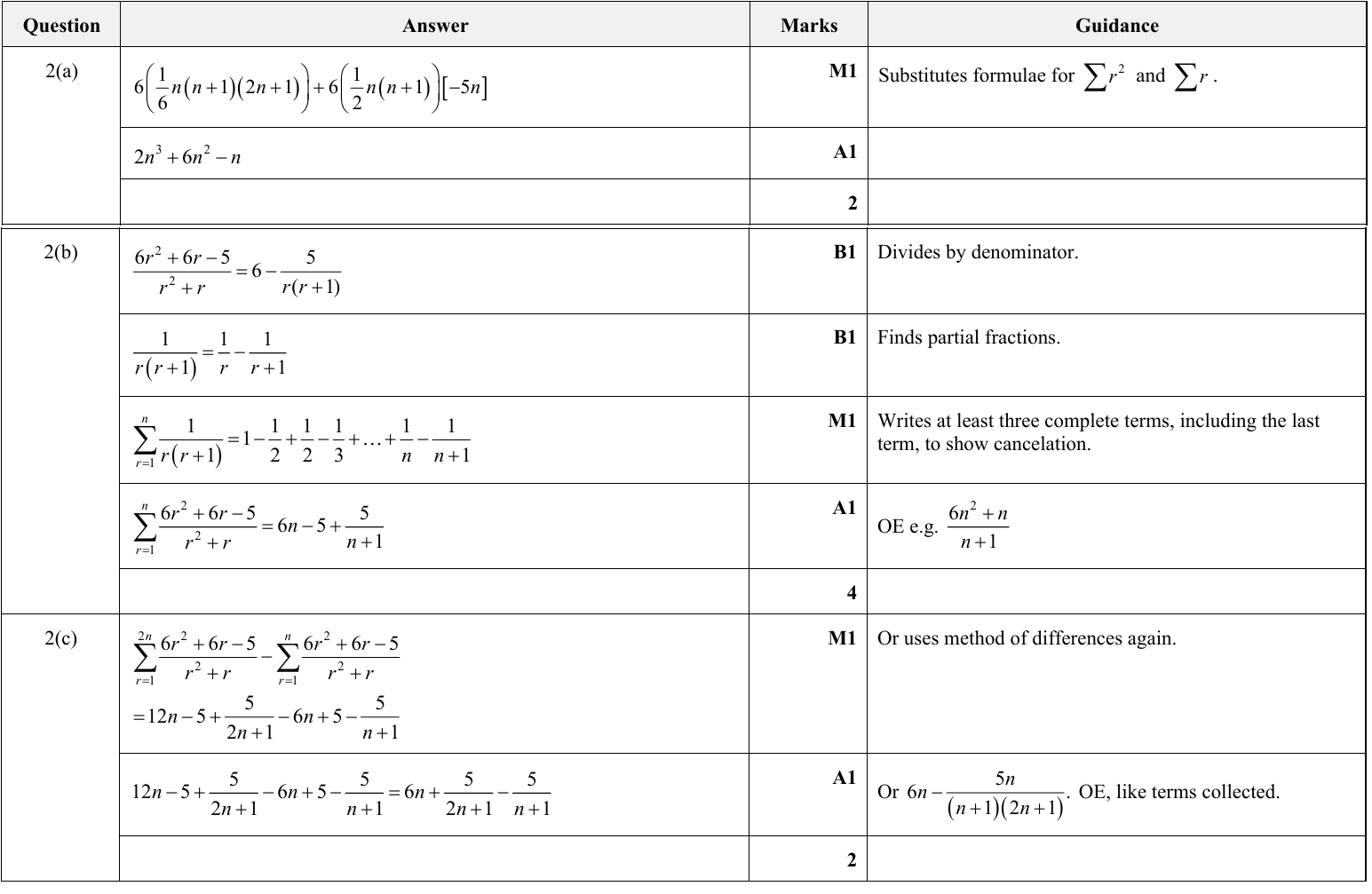
2 (a) Use standard results from the list of formulae (MF19) to show that
\(\sum_{r=1}^{n} (6r^2 + 6r - 5) = an^3 + bn^2 + cn\),
where \(a, b\) and \(c\) are integers to be determined.
(b) Use the method of differences to find \(\sum_{r=1}^{n} \frac{6r^2 + 6r - 5}{r^2 + r}\) in terms of \(n\).
(c) Find also \(\sum_{r=n+1}^{2n} \frac{6r^2 + 6r - 5}{r^2 + r}\) in terms of \(n\).
FM June 2023 p13 q03
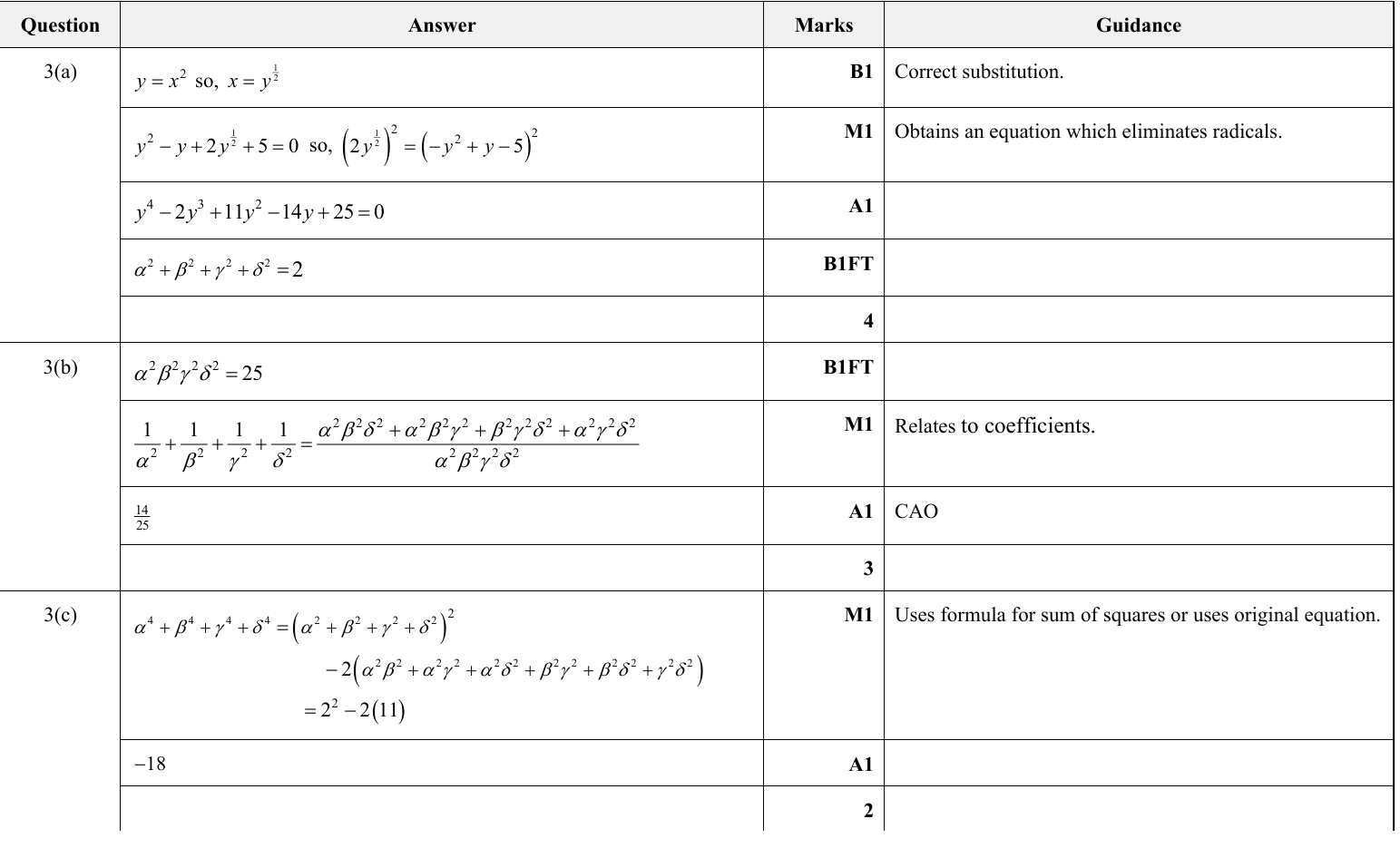
The equation \(x^4 - x^2 + 2x + 5 = 0\) has roots \(\alpha, \beta, \gamma, \delta\).
(a) Find a quartic equation whose roots are \(\alpha^2, \beta^2, \gamma^2, \delta^2\) and state the value of \(\alpha^2 + \beta^2 + \gamma^2 + \delta^2\).
(b) Find the value of \(\frac{1}{\alpha^2} + \frac{1}{\beta^2} + \frac{1}{\gamma^2} + \frac{1}{\delta^2}\).
(c) Find the value of \(\alpha^4 + \beta^4 + \gamma^4 + \delta^4\).
FM June 2023 p13 q04
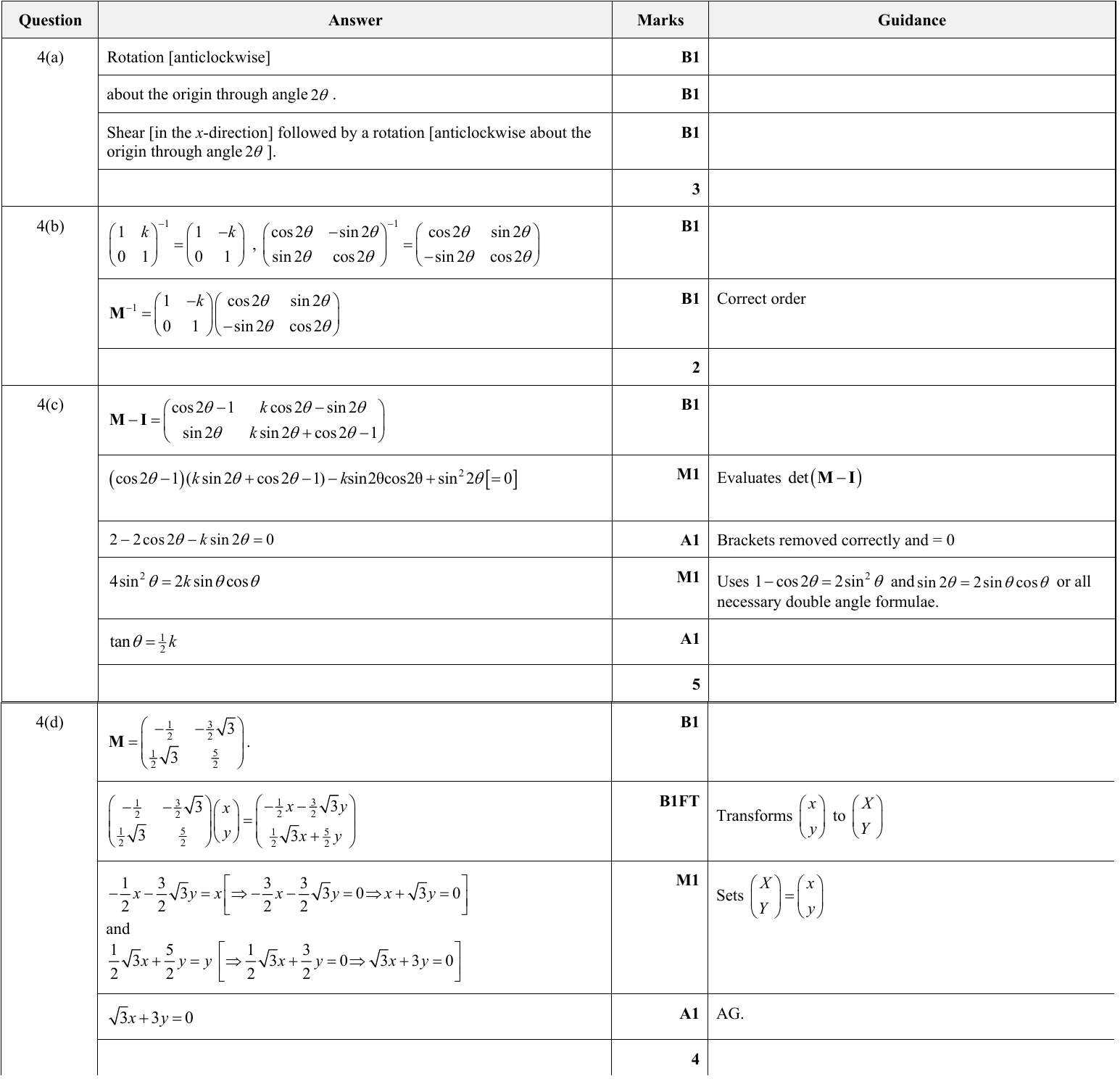
The matrix M is given by M = \(\begin{pmatrix} \cos 2\theta & -\sin 2\theta \\ \sin 2\theta & \cos 2\theta \end{pmatrix} \begin{pmatrix} 1 & k \\ 0 & 1 \end{pmatrix}\), where \(0 < \theta < \pi\) and \(k\) is a non-zero constant. The matrix M represents a sequence of two geometrical transformations, one of which is a shear.
- Describe fully the other transformation and state the order in which the transformations are applied. [3]
- Write M-1 as the product of two matrices, neither of which is I. [2]
- Find, in terms of \(k\), the value of \(\tan \theta\) for which M - I is singular. [5]
- Given that \(k = 2\sqrt{3}\) and \(\theta = \frac{1}{3}\pi\), show that the invariant points of the transformation represented by M lie on the line \(3y + \sqrt{3}x = 0\). [4]
FM June 2023 p13 q05
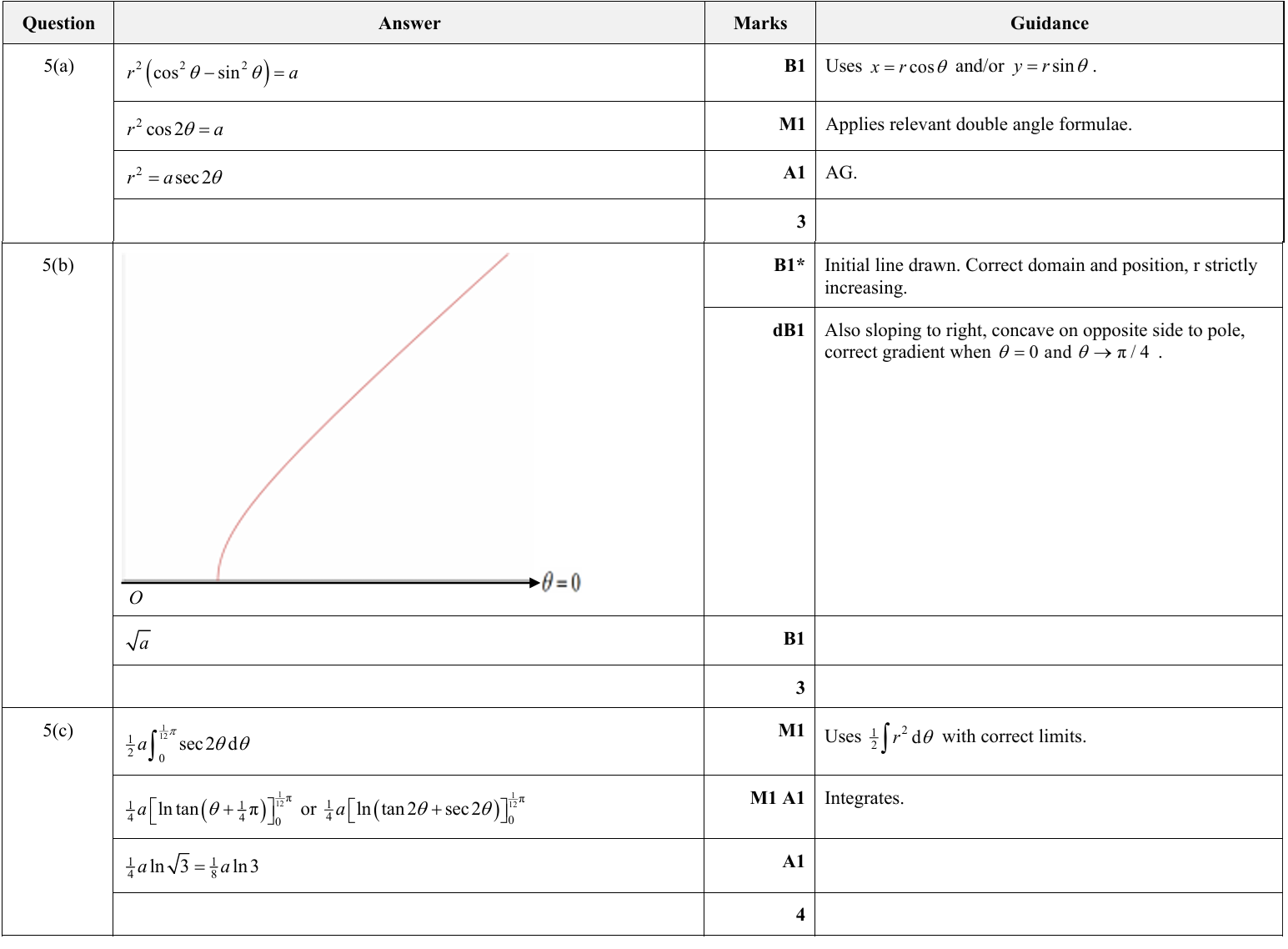
(a) Show that the curve with Cartesian equation \(x^2 - y^2 = a\), where \(a\) is a positive constant, has polar equation \(r^2 = a \sec 2\theta\).
The curve \(C\) has polar equation \(r^2 = a \sec 2\theta\), where \(a\) is a positive constant, for \(0 \leq \theta < \frac{1}{4}\pi\).
(b) Sketch \(C\) and state the minimum distance of \(C\) from the pole.
FM June 2023 p13 q06
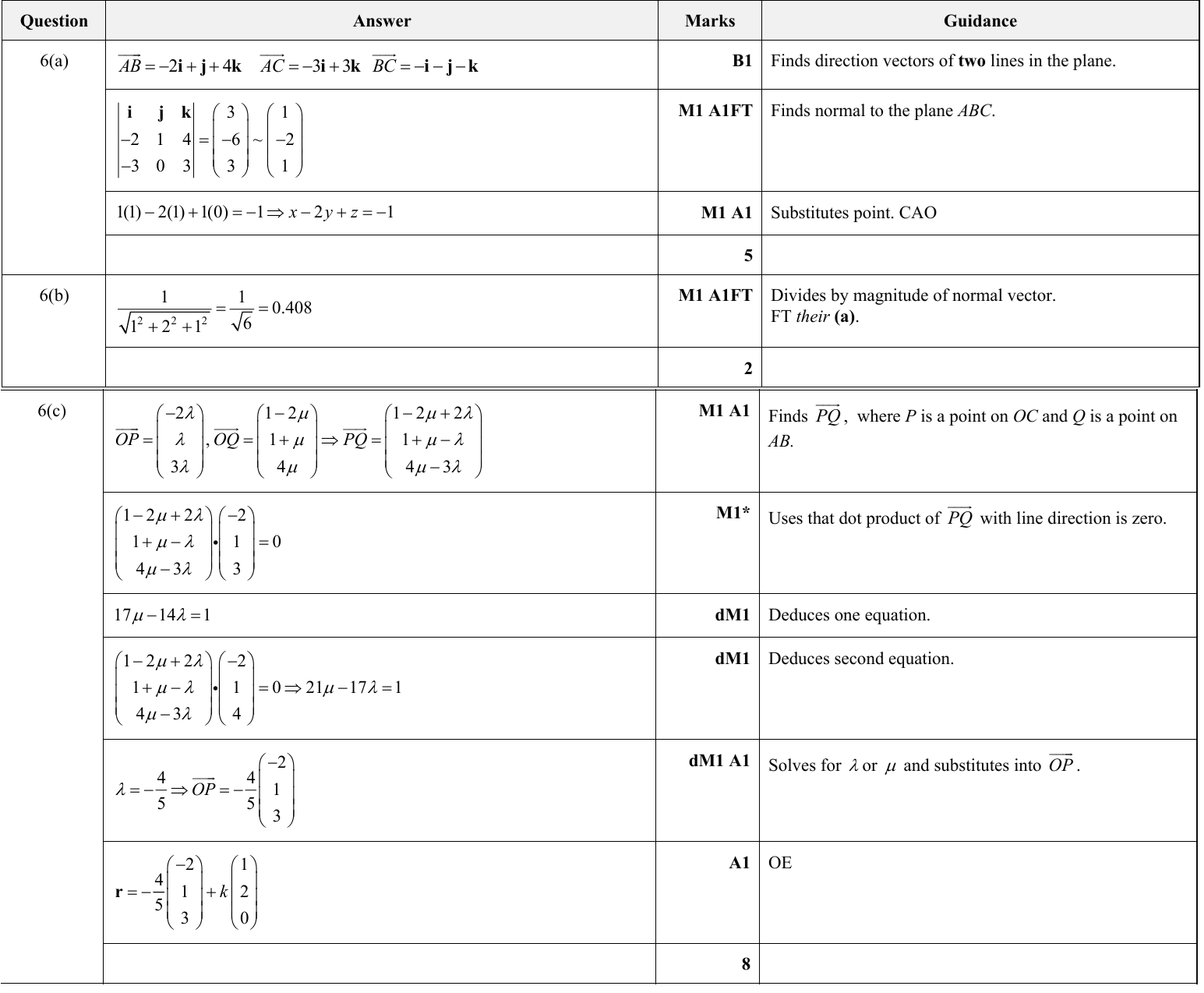
The points A, B, C have position vectors \(\mathbf{i} + \mathbf{j}, \ -\mathbf{i} + 2\mathbf{j} + 4\mathbf{k}, \ -2\mathbf{i} + \mathbf{j} + 3\mathbf{k}\), respectively, relative to the origin O.
(a) Find the equation of the plane ABC, giving your answer in the form \(ax + by + cz = d\).
(b) Find the perpendicular distance from O to the plane ABC.
(c) Find a vector equation of the common perpendicular to the lines OC and AB.
FM June 2023 p13 q07
The curve C has equation \(y = \frac{x^2 + 2x + 1}{x - 3}\).
- Find the equations of the asymptotes of C.
- Find the coordinates of the turning points on C.
- Sketch C.
- Sketch the curves with equations \(y = \left| \frac{x^2 + 2x + 1}{x - 3} \right|\) and \(y^2 = \frac{x^2 + 2x + 1}{x - 3}\) on a single diagram, clearly identifying each curve.