Exam-Style Problems
⬅ Back to SubchapterJune 2025 p12 q1
4096
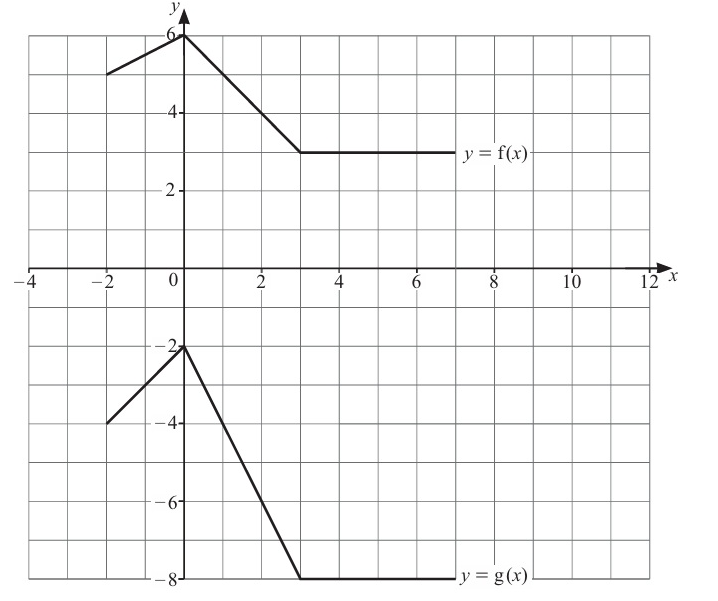
The diagram shows the graphs with equations \(y = f(x)\) and \(y = g(x)\).
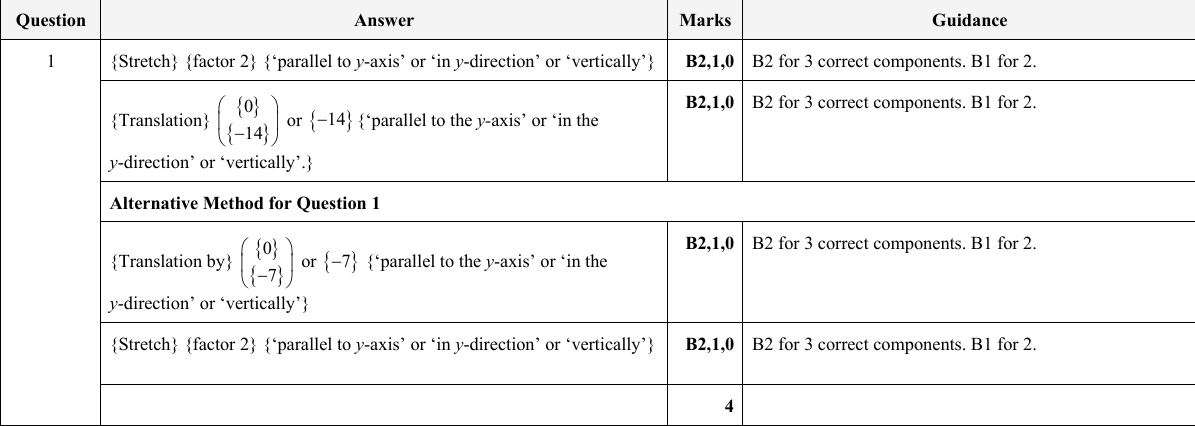
Describe fully a sequence of two transformations which transforms the graph of \(y = f(x)\) to the graph of \(y = g(x)\). Make clear the order in which the transformations should be applied.
June 2025 p12 q10
4097
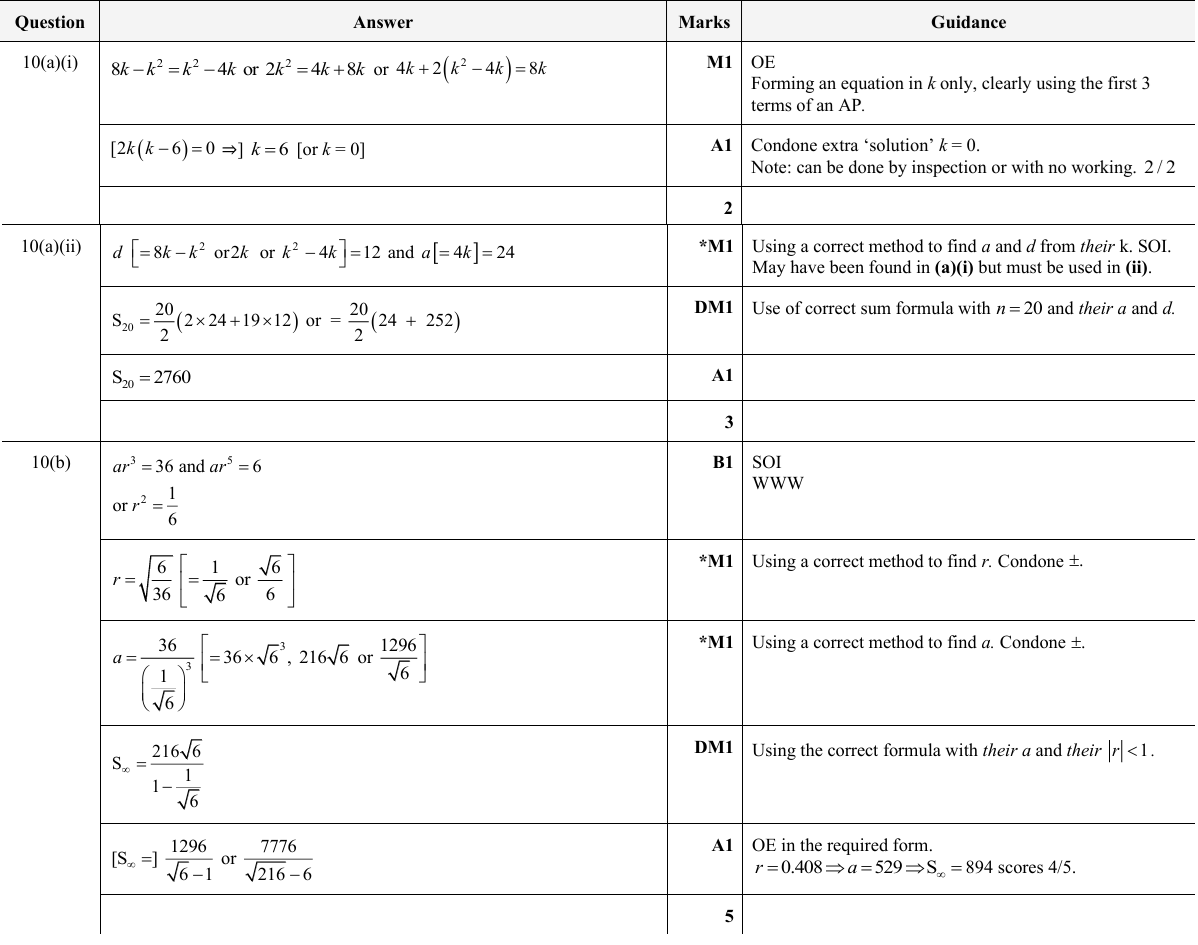
(a) The first, second and third terms of an arithmetic progression are \(4k\), \(k^2\) and \(8k\) respectively, where \(k\) is a non-zero constant.
- Find the value of \(k\).
- Find the sum of the first 20 terms of the progression.
(b) The fourth and sixth terms of a geometric progression are 36 and 6 respectively. The common ratio of the progression is positive.
Find the sum to infinity of the progression. Give your answer in the form \(\frac{a}{\sqrt{b} - c}\), where \(a\), \(b\) and \(c\) are integers.
June 2025 p12 q11
4098
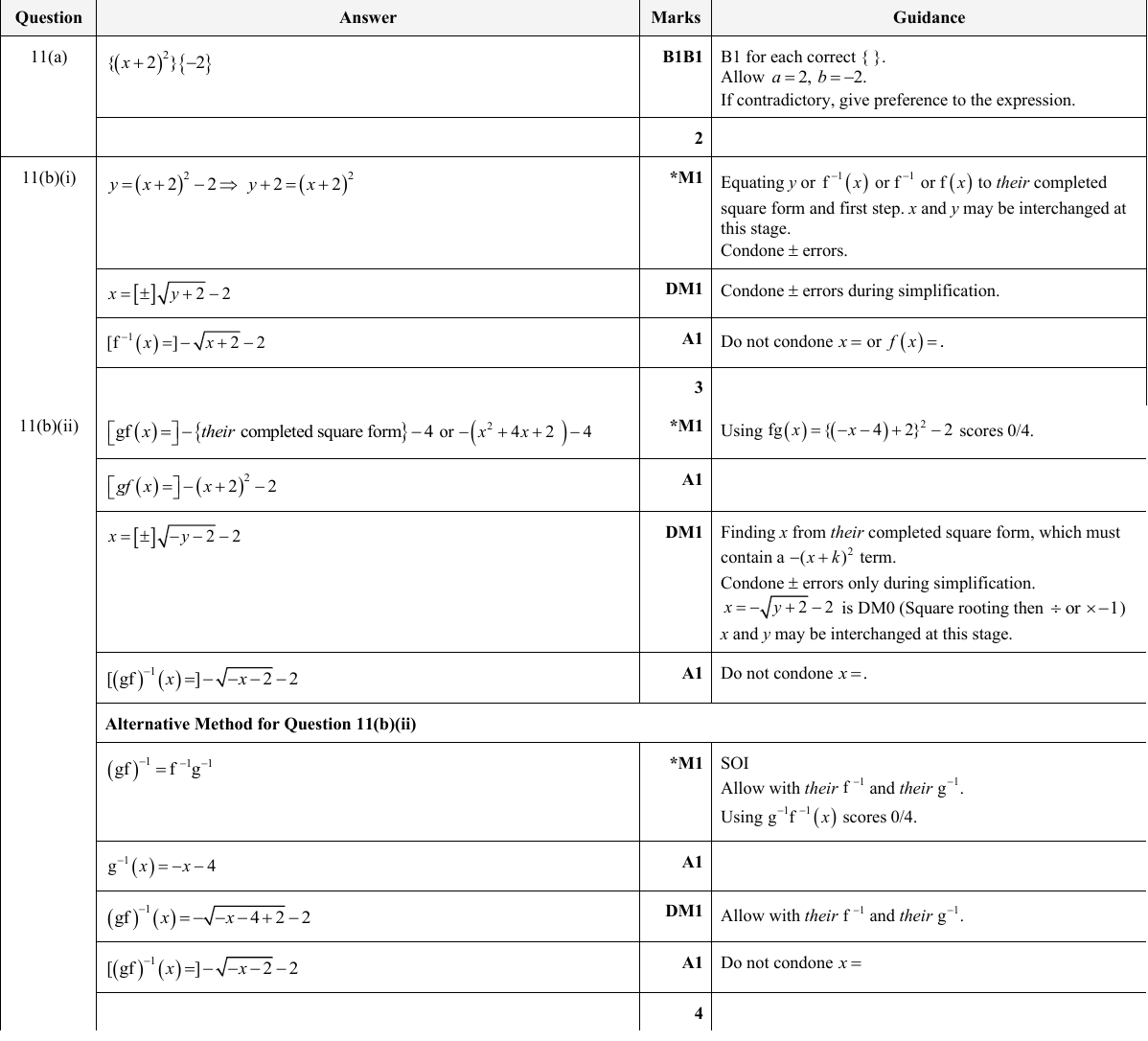
(a) Express \(x^2 + 4x + 2\) in the form \((x+a)^2 + b\), where \(a\) and \(b\) are integers.
The functions \(f\) and \(g\) are defined as follows.
\(f(x) = x^2 + 4x + 2\) for \(x \leq -2\)
\(g(x) = -x - 4\) for \(x \geq -2\)
(b) (i) Find an expression for \(f^{-1}(x)\).
(ii) Find an expression for \((gf)^{-1}(x)\).
June 2025 p12 q2
4099
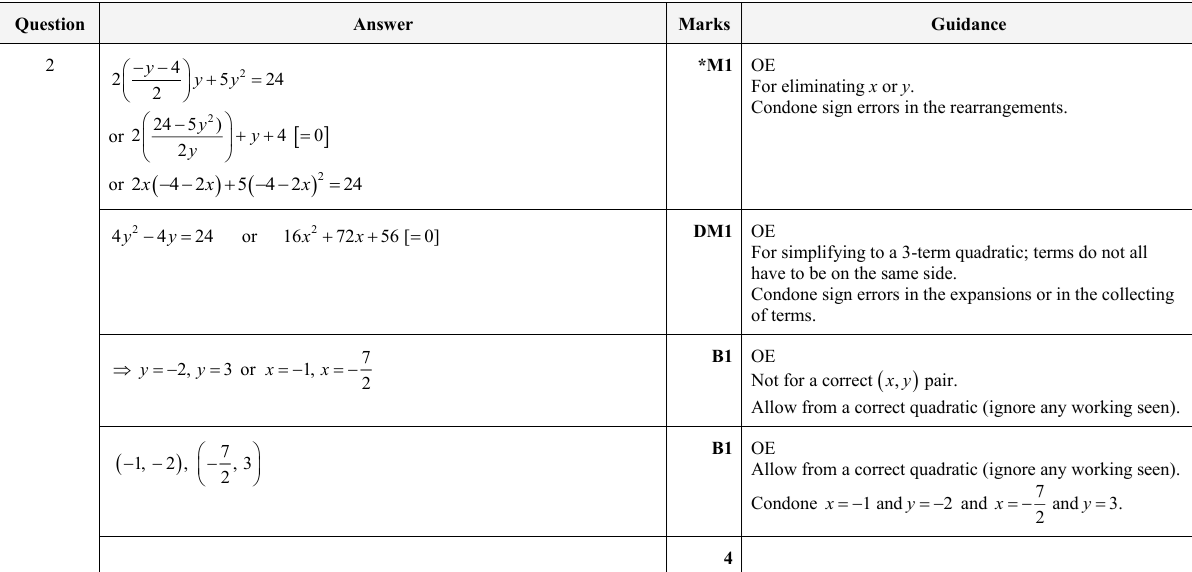
Find the coordinates of the points of intersection of the curve and the line with equations
\(2xy + 5y^2 = 24\) and \(2x + y + 4 = 0\).
June 2025 p12 q3
4100
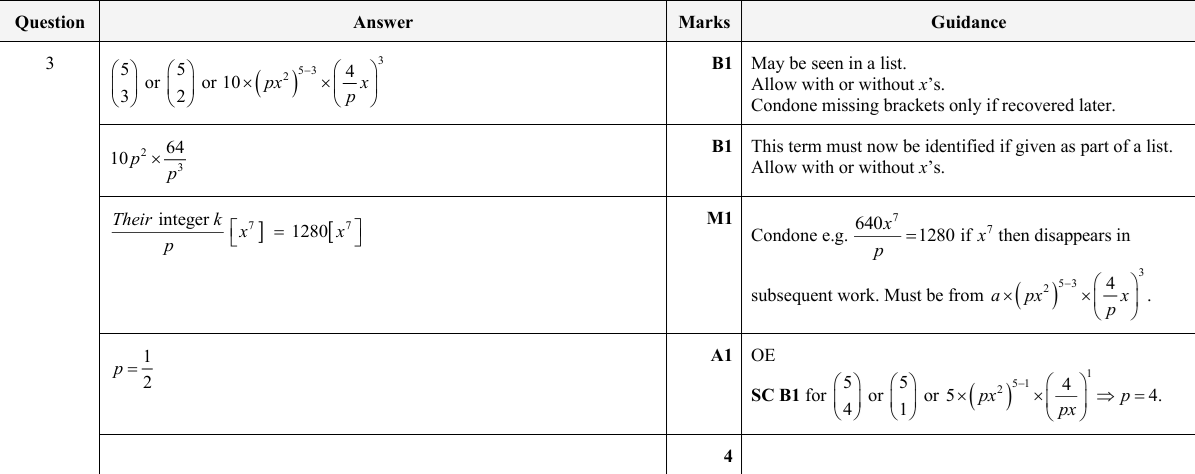
The coefficient of \(x^7\) in the expansion of \(\left( px^2 + \frac{4}{p}x \right)^5\) is 1280.
Find the value of the constant \(p\).
June 2025 p12 q4
4101
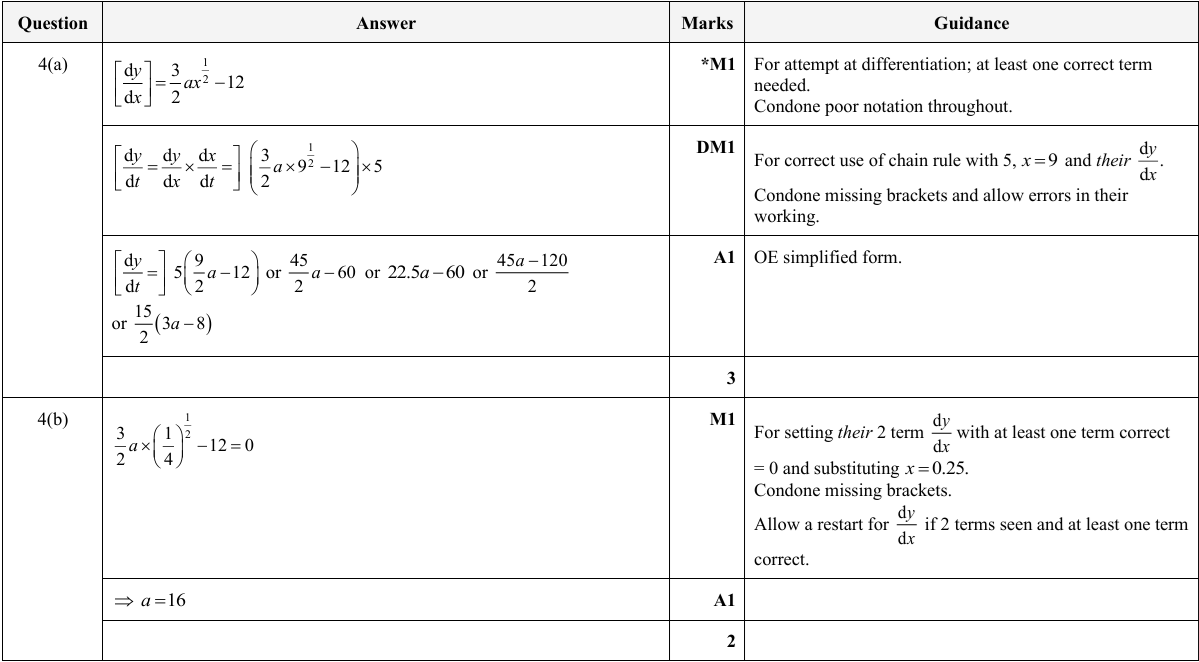
A point P is moving along the curve with equation \(y = ax^{\frac{3}{2}} - 12x\) in such a way that the x-coordinate of P is increasing at a constant rate of 5 units per second.
(a) Find the rate at which the y-coordinate of P is changing when \(x = 9\). Give your answer in terms of the constant \(a\).
(b) Given that the curve has a minimum point when \(x = \frac{1}{4}\), find the value of \(a\).
June 2025 p12 q5
4102
The equation of a curve is \(y = 4 \cos 2x + 3\) for \(0 \leq x \leq 2\pi\).
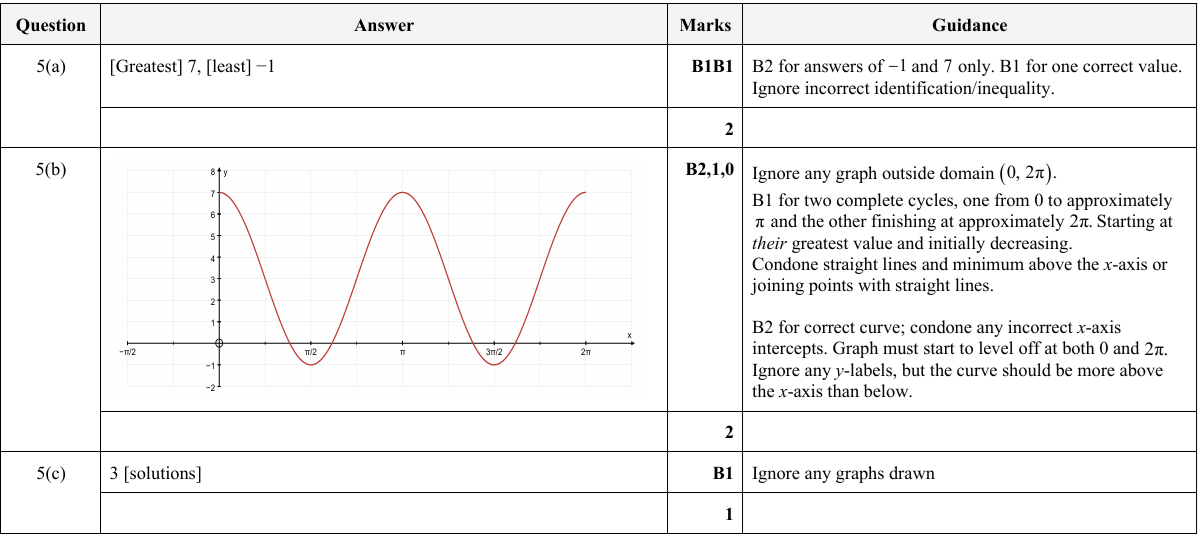
- State the greatest and least possible values of \(y\).
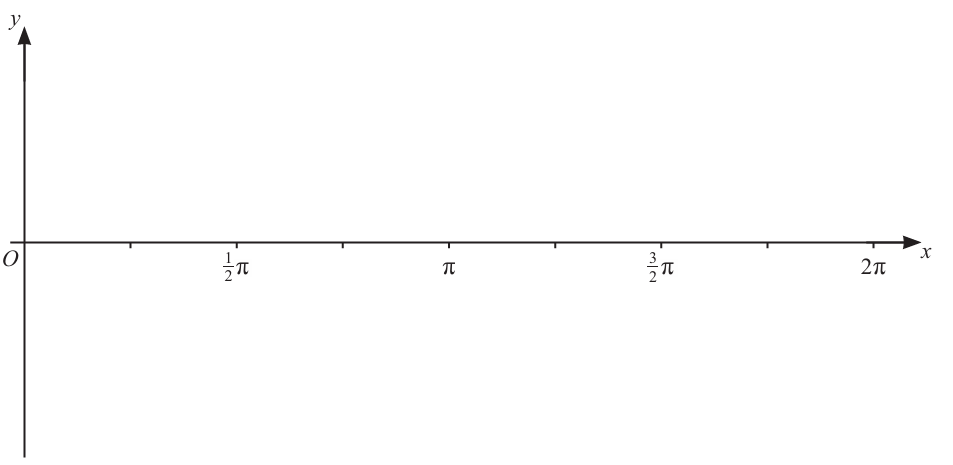
- Sketch the curve.
- Hence determine the number of solutions of the equation \(4 \cos 2x + 3 = 2x - 1\) for \(0 \leq x \leq 2\pi\).
June 2025 p12 q6
4103
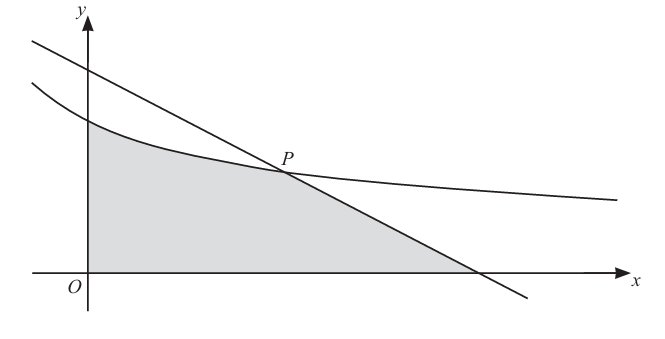
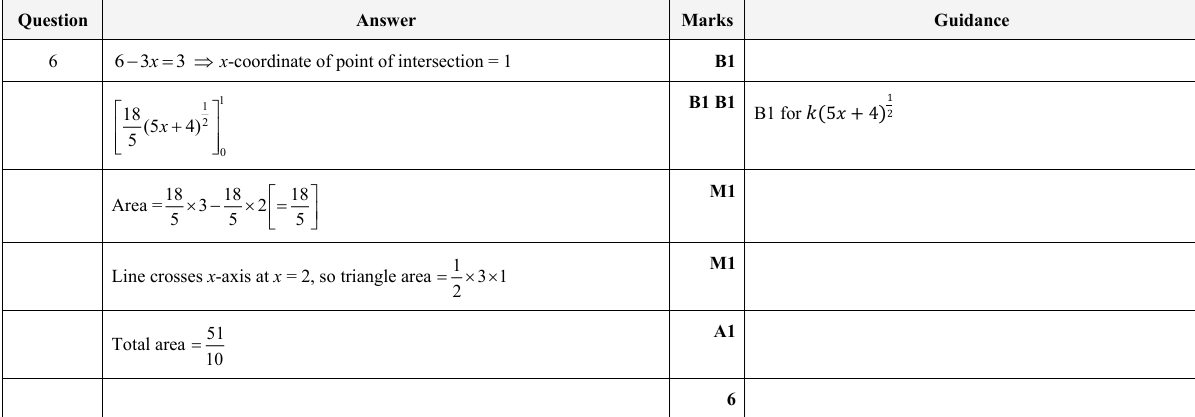
The diagram shows the curve with equation \(y = \frac{9}{(5x+4)^{\frac{1}{2}}}\) and the line \(y = 6 - 3x\). The line and the curve intersect at the point \(P\) which has y-coordinate 3.
Find the area of the shaded region.
June 2025 p12 q7
4104
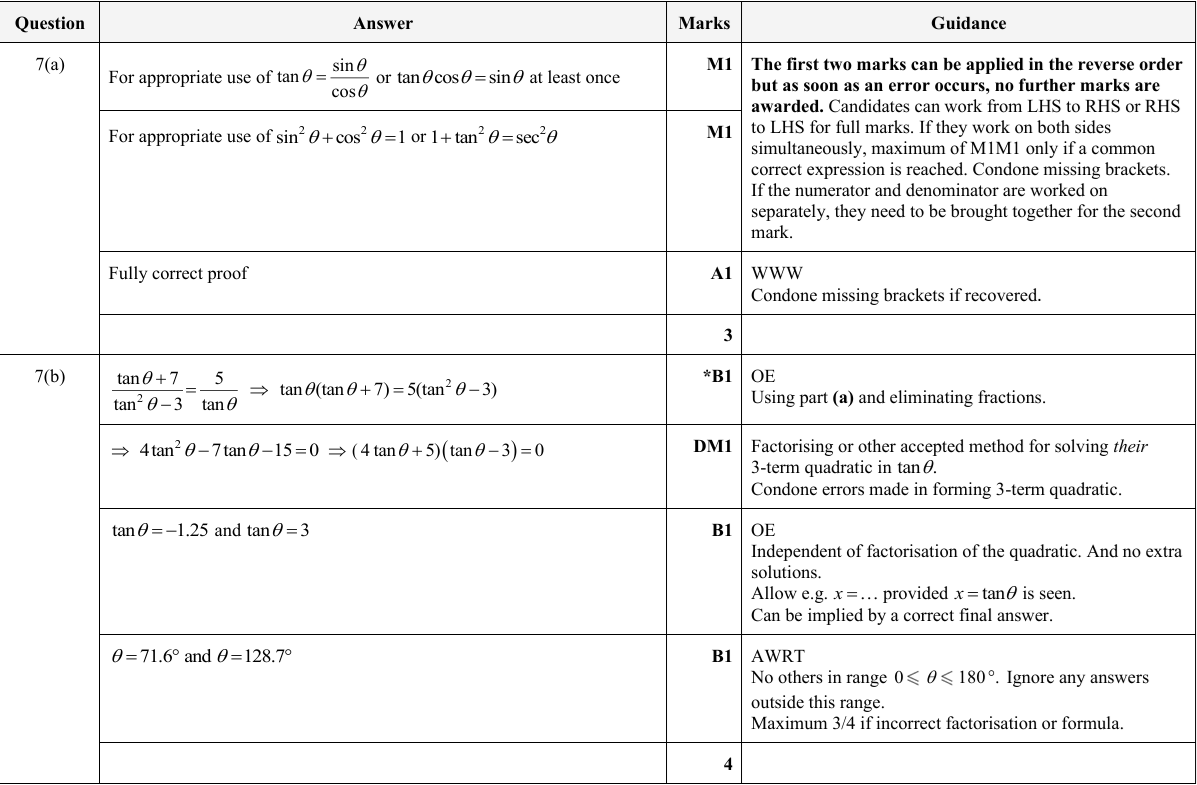
(a) Prove the identity \(\frac{\tan \theta + 7}{\tan^2 \theta - 3} \equiv \frac{\sin \theta \cos \theta + 7 \cos^2 \theta}{1 - 4 \cos^2 \theta}\).
(b) Hence solve the equation \(\frac{\sin \theta \cos \theta + 7 \cos^2 \theta}{1 - 4 \cos^2 \theta} = \frac{5}{\tan \theta}\) for \(0^\circ \leq \theta \leq 180^\circ\).
June 2025 p12 q8
4105
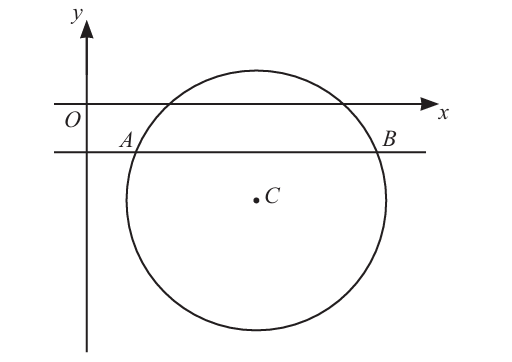
The diagram shows the circle with equation \(x^2 + y^2 - 14x + 8y + 36 = 0\) and the line \(y = -2\). The line intersects the circle at the points \(A\) and \(B\). The centre of the circle is \(C\).
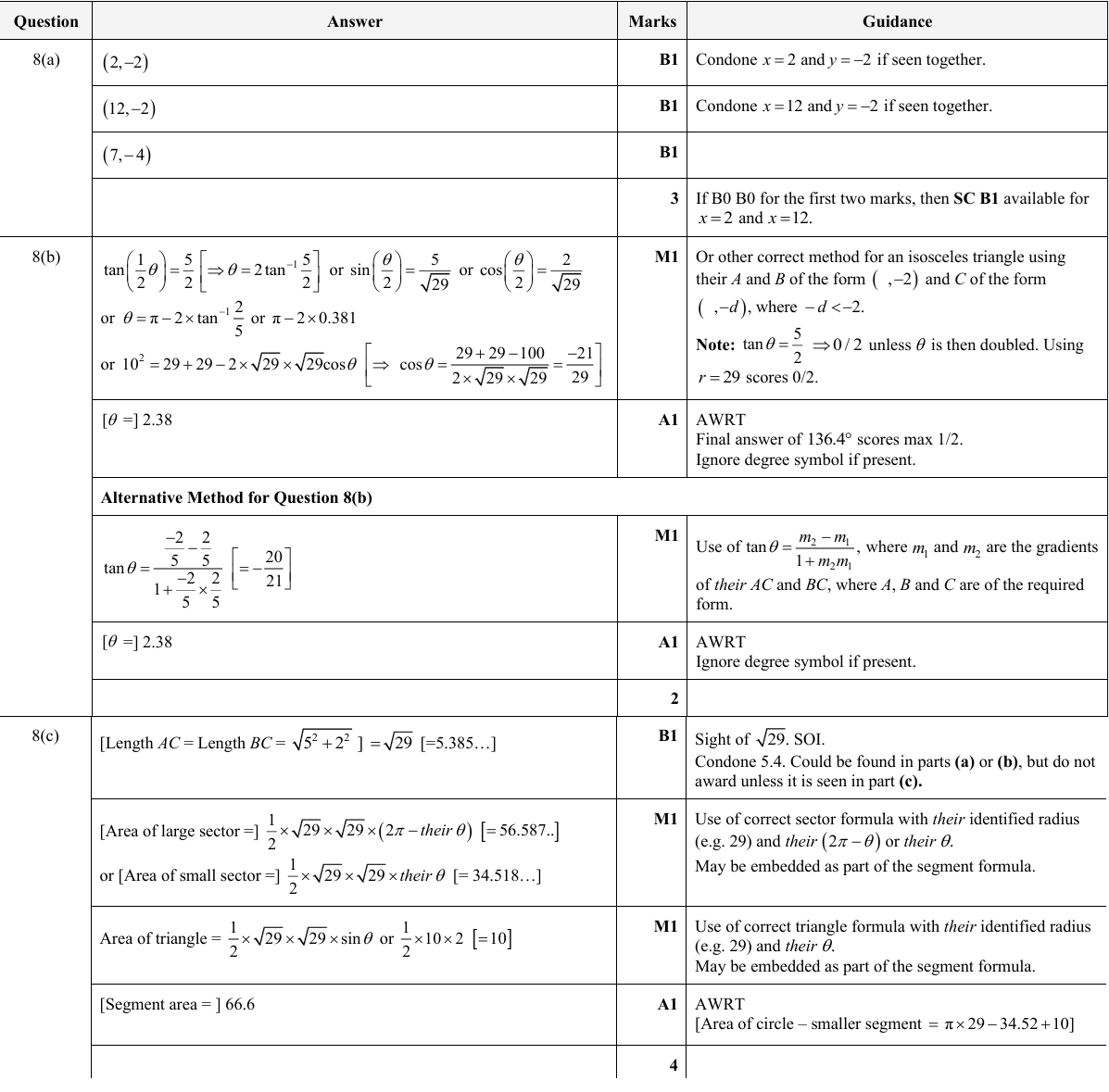
(a) Find the coordinates of \(A\), \(B\) and \(C\).
(b) Find the angle \(ACB\) in radians. Give your answer correct to 3 significant figures.
(c) The chord \(AB\) divides the circle into two segments. Find the area of the larger segment.
June 2025 p12 q9
4106
The equation of a curve is such that \(\frac{d^2y}{dx^2} = -\frac{24}{x^3}\). It is given that the curve has a stationary point at \((-2, 19)\).
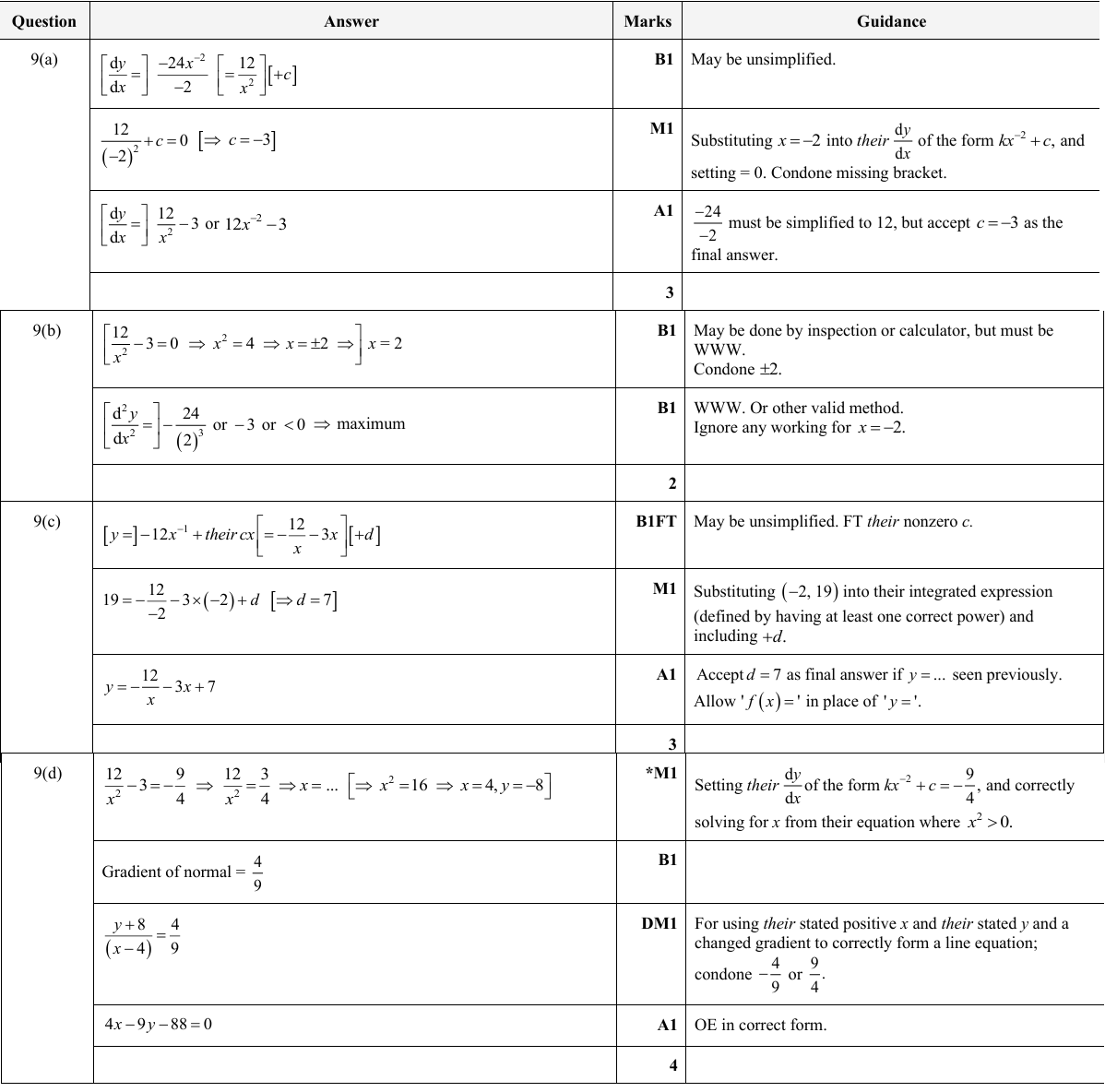
(a) Find an expression for \(\frac{dy}{dx}\).
(b) Find the \(x\)-coordinate of the other stationary point of the curve, and determine the nature of this stationary point.
(c) Find the equation of the curve.
(d) Find the equation of the normal to the curve at the point where \(\frac{dy}{dx} = -\frac{9}{4}\) and \(x\) is positive. Express your answer in the form \(px + qy + r = 0\), where \(p, q\) and \(r\) are integers.