Exam-Style Problems
⬅ Back to SubchapterNov 2023 p42 q5
3380
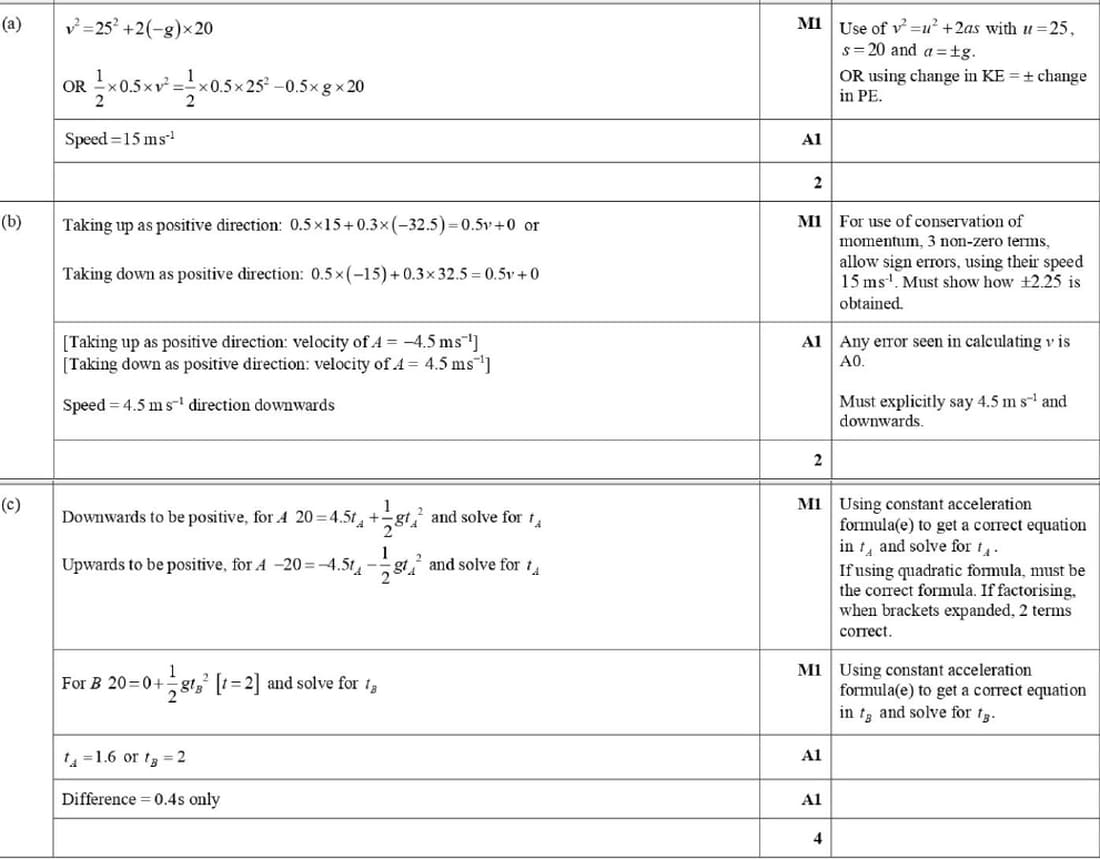
A particle A of mass 0.5 kg is projected vertically upwards from horizontal ground with speed 25 m s-1.
(a) Find the speed of A when it reaches a height of 20 m above the ground.
When A reaches a height of 20 m, it collides with a particle B of mass 0.3 kg which is moving downwards in the same vertical line as A with speed 32.5 m s-1. In the collision between the two particles, B is brought to instantaneous rest.
(b) Show that the velocity of A immediately after the collision is 4.5 m s-1 downwards.
(c) Find the time interval between A and B reaching the ground. You should assume that A does not bounce when it reaches the ground.
June 2022 p43 q1
3381
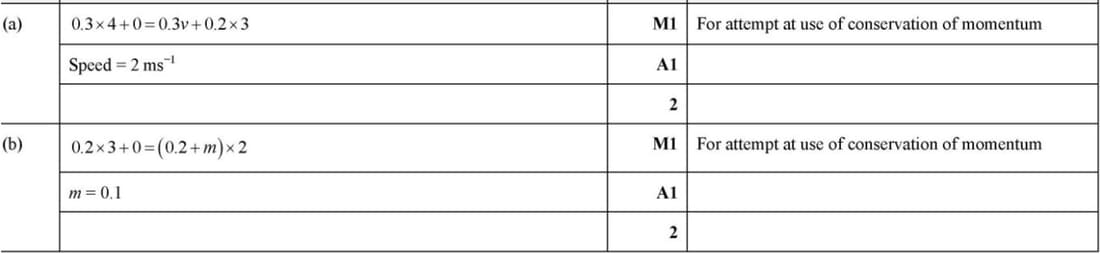
Two particles P and Q, of masses 0.3 kg and 0.2 kg respectively, are at rest on a smooth horizontal plane. P is projected at a speed of 4 m s-1 directly towards Q. After P and Q collide, Q begins to move with a speed of 3 m s-1.
(a) Find the speed of P after the collision.
After the collision, Q moves directly towards a third particle R, of mass m kg, which is at rest on the plane. The two particles Q and R coalesce on impact and move with a speed of 2 m s-1.
(b) Find m.
June 2022 p42 q1
3382
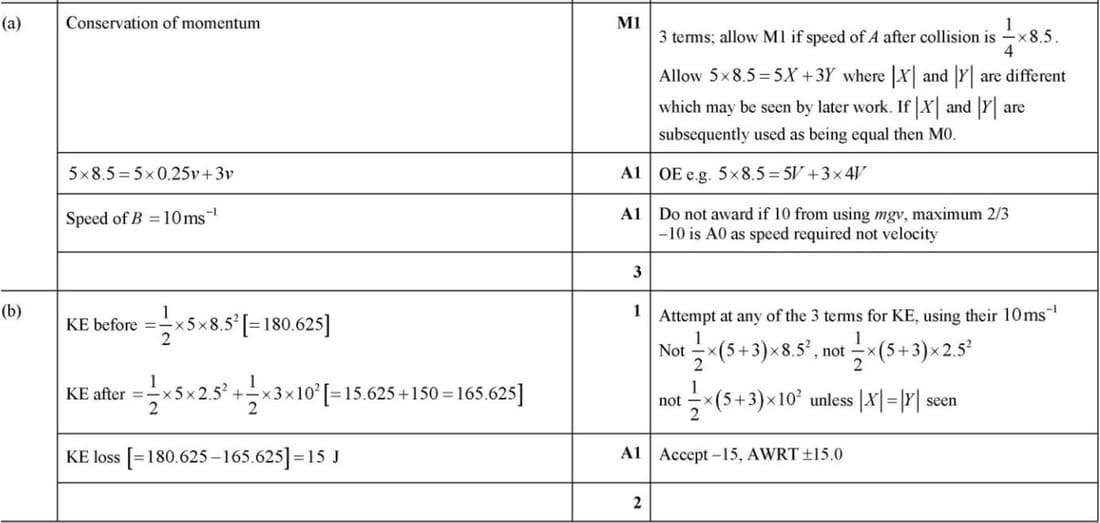
Small smooth spheres A and B, of equal radii and of masses 5 kg and 3 kg respectively, lie on a smooth horizontal plane. Initially B is at rest and A is moving towards B with speed 8.5 m/s. The spheres collide and after the collision A continues to move in the same direction but with a quarter of the speed of B.
(a) Find the speed of B after the collision.
(b) Find the loss of kinetic energy of the system due to the collision.
June 2022 p41 q7
3383
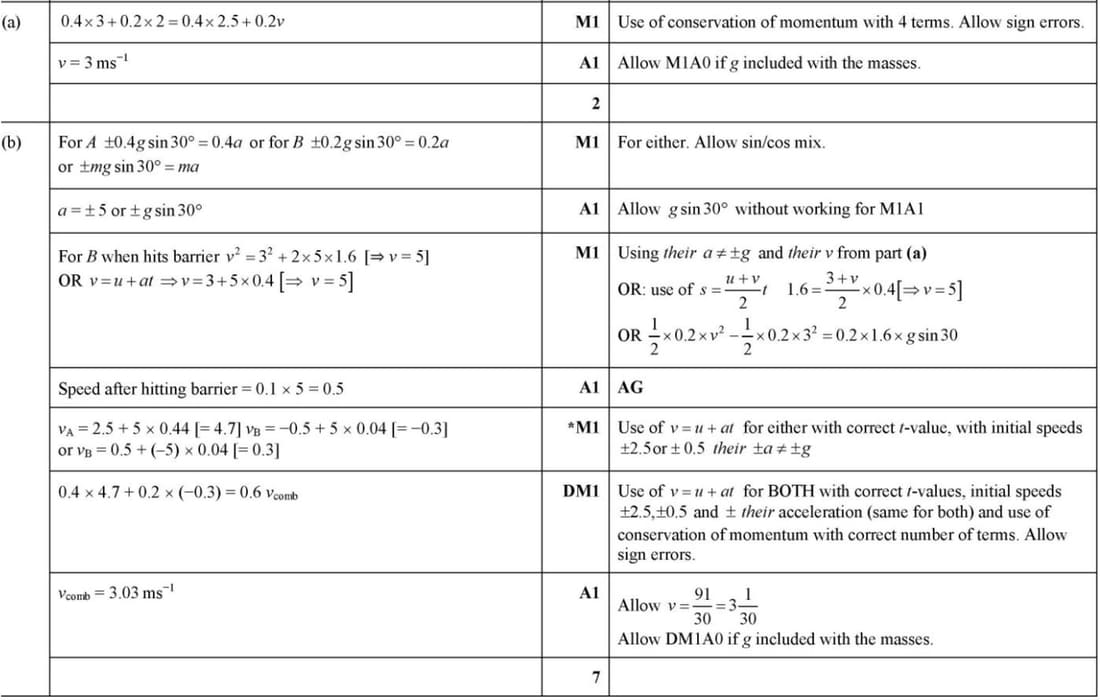
Two particles A and B, of masses 0.4 kg and 0.2 kg respectively, are moving down the same line of greatest slope of a smooth plane. The plane is inclined at 30° to the horizontal, and A is higher up the plane than B. When the particles collide, the speeds of A and B are 3 m/s and 2 m/s respectively. In the collision between the particles, the speed of A is reduced to 2.5 m/s.
(a) Find the speed of B immediately after the collision.
After the collision, when B has moved 1.6 m down the plane from the point of collision, it hits a barrier and returns back up the same line of greatest slope. B hits the barrier 0.4 s after the collision, and when it hits the barrier, its speed is reduced by 90%. The two particles collide again 0.44 s after their previous collision, and they then coalesce on impact.
(b) Show that the speed of B immediately after it hits the barrier is 0.5 m/s-1. Hence find the speed of the combined particle immediately after the second collision between A and B.
Feb/Mar 2022 p42 q7
3384
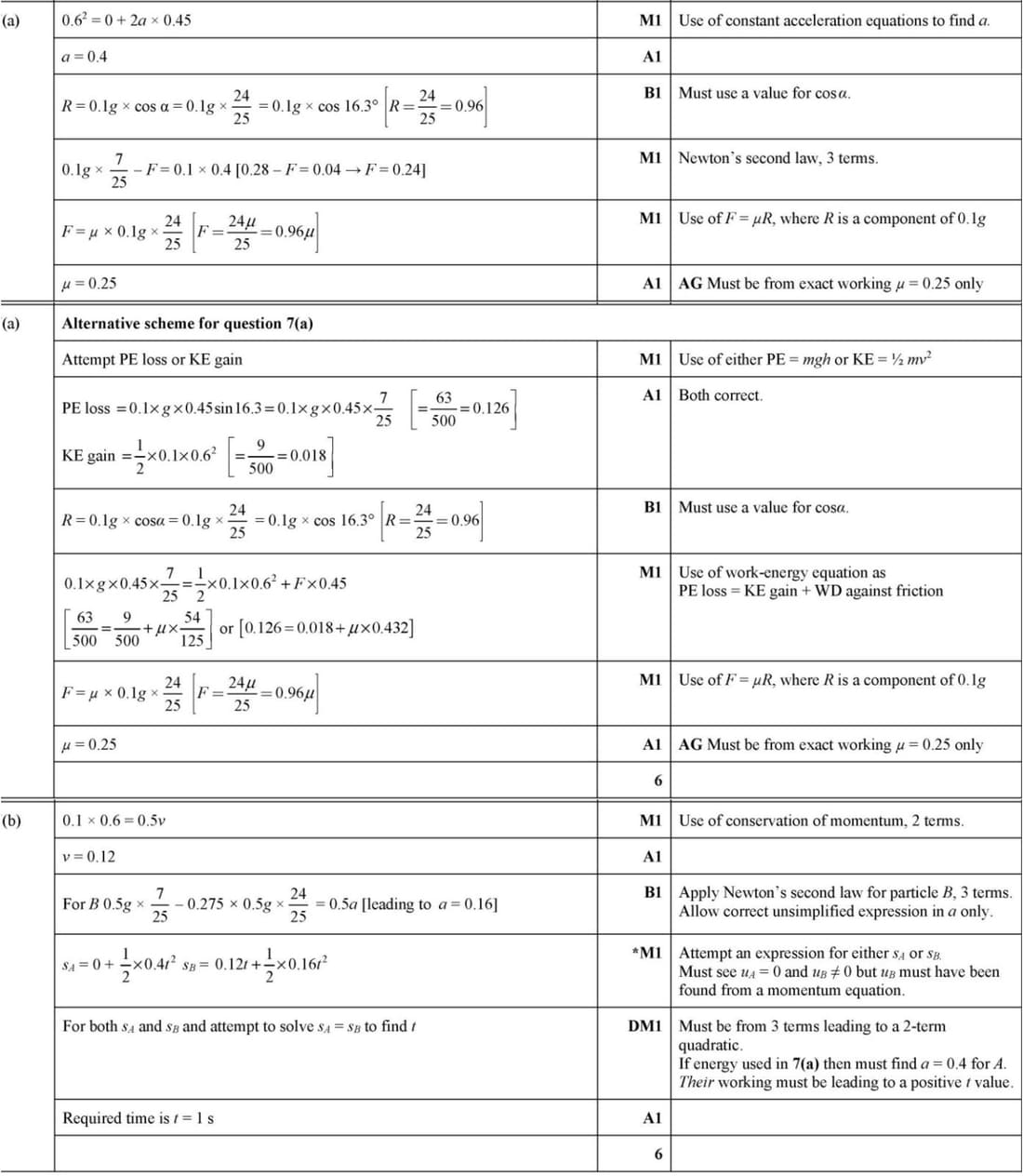
A bead, A, of mass 0.1 kg is threaded on a long straight rigid wire which is inclined at \(\sin^{-1}\left(\frac{7}{25}\right)\) to the horizontal. A is released from rest and moves down the wire. The coefficient of friction between A and the wire is \(\mu\). When A has travelled 0.45 m down the wire, its speed is 0.6 m s\(^{-1}\).
(a) Show that \(\mu = 0.25\).
Another bead, B, of mass 0.5 kg is also threaded on the wire. At the point where A has travelled 0.45 m down the wire, it hits B which is instantaneously at rest on the wire. A is brought to instantaneous rest in the collision. The coefficient of friction between B and the wire is 0.275.
(b) Find the time from when the collision occurs until A collides with B again.
Nov 2021 p43 q1
3385
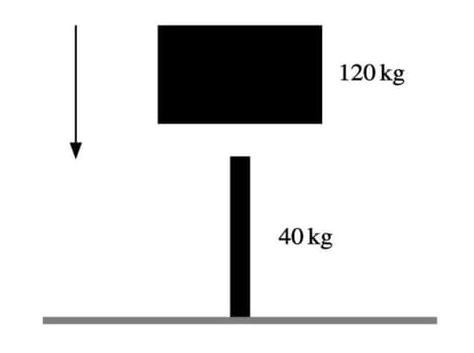
A metal post is driven vertically into the ground by dropping a heavy object onto it from above. The mass of the object is 120 kg and the mass of the post is 40 kg (see diagram). The object hits the post with speed 8 m/s and remains in contact with it after the impact.
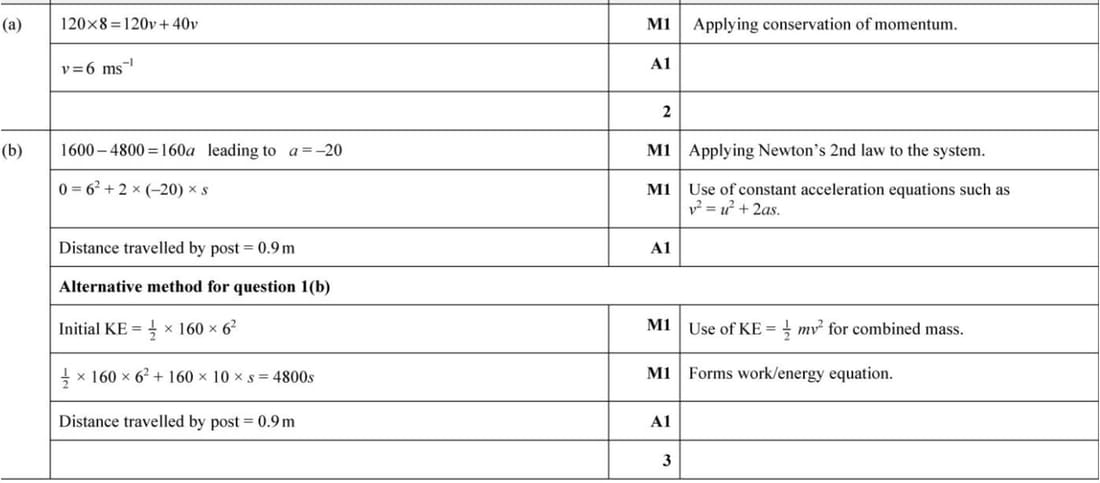
(a) Calculate the speed with which the combined post and object moves immediately after the impact.
(b) There is a constant force resisting the motion of magnitude 4800 N. Calculate the distance the post is driven into the ground.
Nov 2021 p42 q7
3386
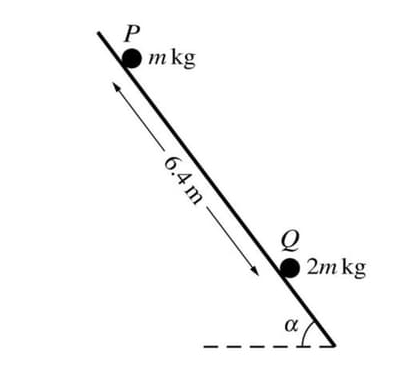
Particles P and Q have masses m kg and 2m kg respectively. The particles are initially held at rest 6.4 m apart on the same line of greatest slope of a rough plane inclined at an angle α to the horizontal, where \\sin α = 0.8\\ (see diagram). Particle P is released from rest and slides down the line of greatest slope. Simultaneously, particle Q is projected up the same line of greatest slope at a speed of 10 m s-1. The coefficient of friction between each particle and the plane is 0.6.
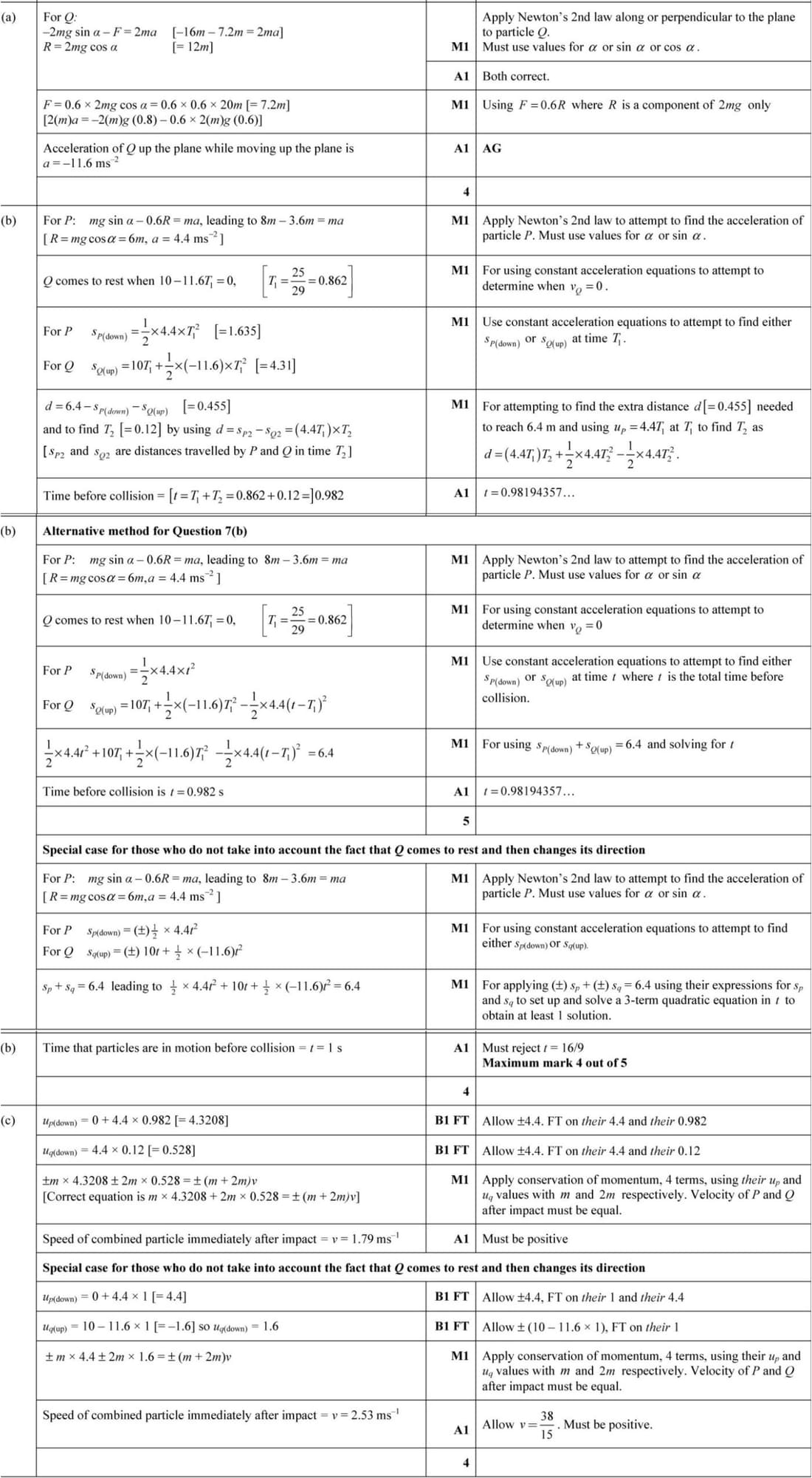
- Show that the acceleration of Q up the plane is \\-11.6\\ m s-2.
- Find the time for which the particles are in motion before they collide.
- The particles coalesce on impact. Find the speed of the combined particle immediately after the impact.
Nov 2021 p41 q2
3387
Two small smooth spheres A and B, of equal radii and of masses \(km\) kg and \(m\) kg respectively, where \(k > 1\), are free to move on a smooth horizontal plane. A is moving towards B with speed 6 m s-1 and B is moving towards A with speed 2 m s-1. After the collision A and B coalesce and move with speed 4 m s-1.
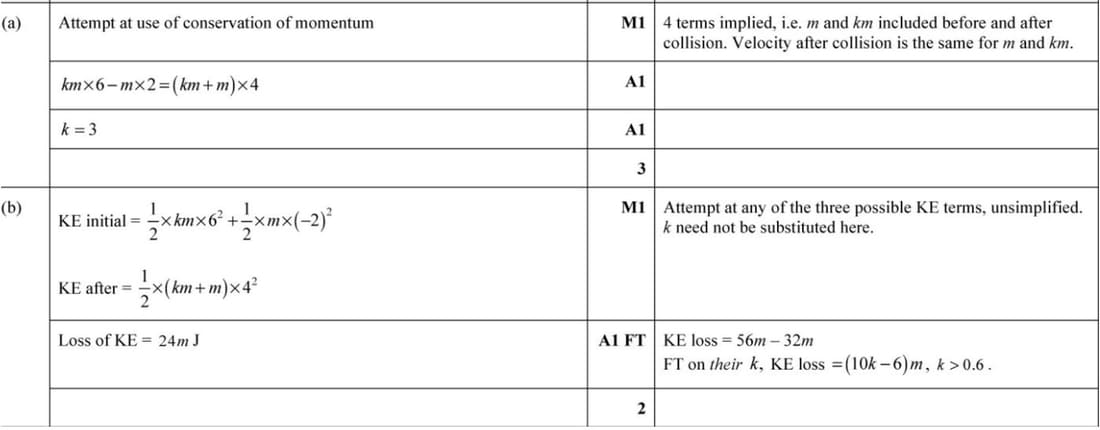
- Find \(k\).
- Find, in terms of \(m\), the loss of kinetic energy due to the collision.
June 2021 p43 q1
3388
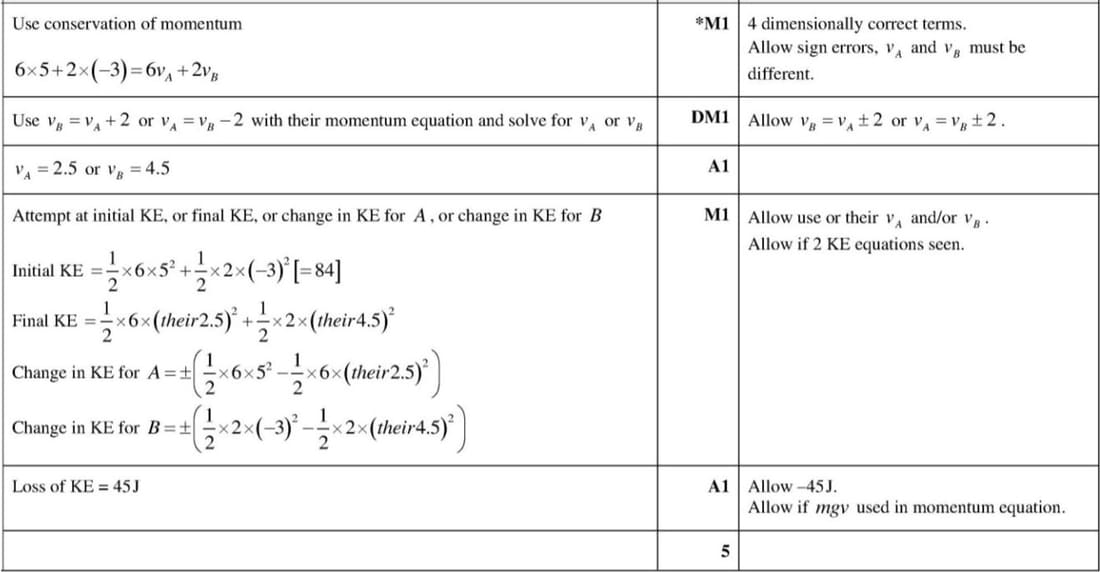
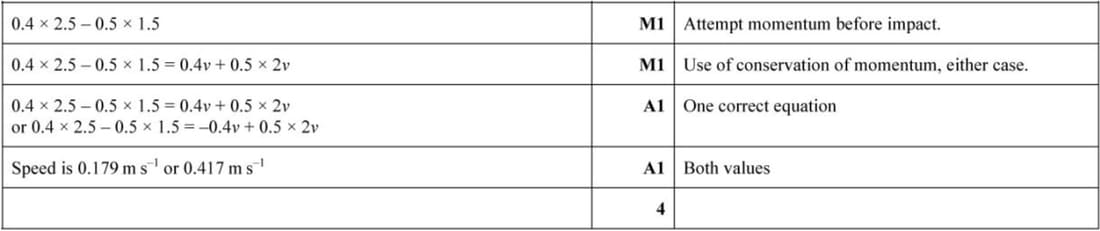
Particles P of mass 0.4 kg and Q of mass 0.5 kg are free to move on a smooth horizontal plane. P and Q are moving directly towards each other with speeds 2.5 m s-1 and 1.5 m s-1 respectively. After P and Q collide, the speed of Q is twice the speed of P.
Find the two possible values of the speed of P after the collision.
June 2021 p42 q6
3389
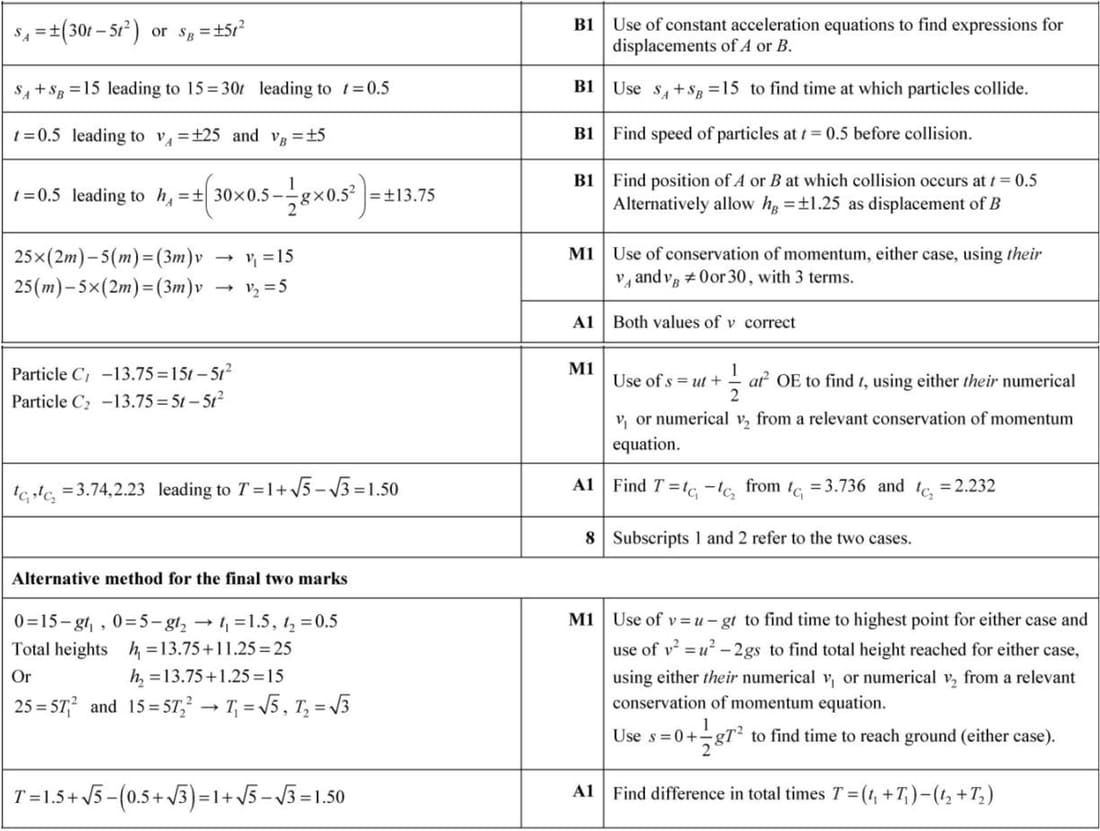
A particle A is projected vertically upwards from level ground with an initial speed of 30 m s-1. At the same instant a particle B is released from rest 15 m vertically above A. The mass of one of the particles is twice the mass of the other particle. During the subsequent motion A and B collide and coalesce to form particle C.
Find the difference between the two possible times at which C hits the ground.
June 2021 p41 q3
3390
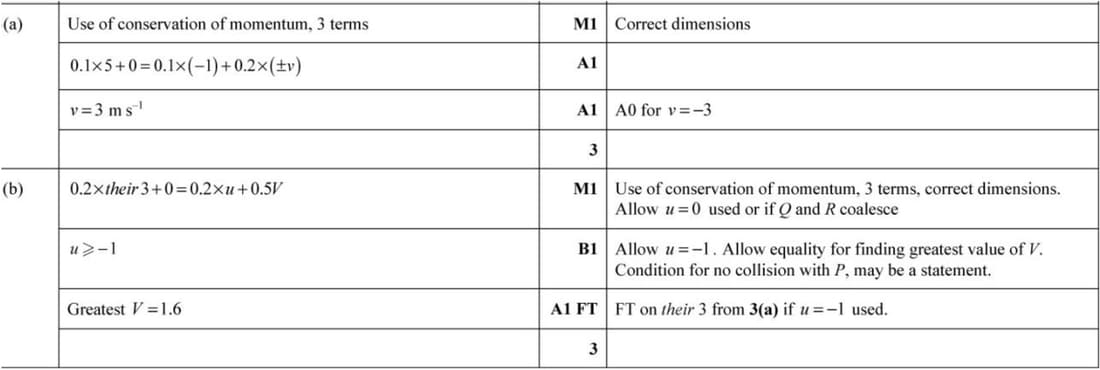
Three particles P, Q and R, of masses 0.1 kg, 0.2 kg and 0.5 kg respectively, are at rest in a straight line on a smooth horizontal plane. Particle P is projected towards Q at a speed of 5 m s-1. After P and Q collide, P rebounds with speed 1 m s-1.
- Find the speed of Q immediately after the collision with P.
- Q now collides with R. Immediately after the collision with Q, R begins to move with speed V m s-1.
- Given that there is no subsequent collision between P and Q, find the greatest possible value of V.
Nov 2023 p41 q4
3391
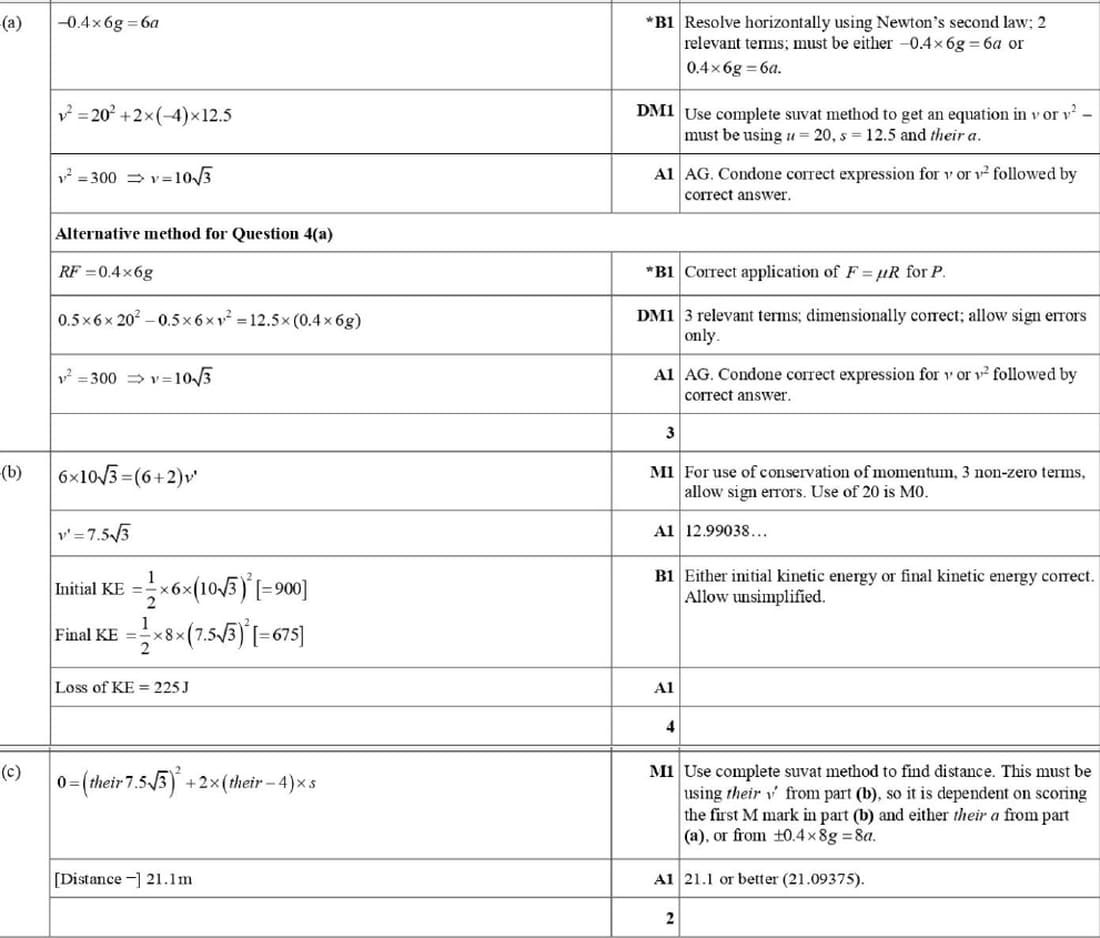
Two particles P and Q, of masses 6 kg and 2 kg respectively, lie at rest 12.5 m apart on a rough horizontal plane. The coefficient of friction between each particle and the plane is 0.4. Particle P is projected towards Q with speed 20 m/s-1.
(a) Show that the speed of P immediately before the collision with Q is 10\(\sqrt{3}\) m/s-1.
In the collision P and Q coalesce to form particle R.
(b) Find the loss of kinetic energy due to the collision.
The coefficient of friction between R and the plane is 0.4.
(c) Find the distance travelled by particle R before coming to rest.
Feb/Mar 2021 p42 q1
3392
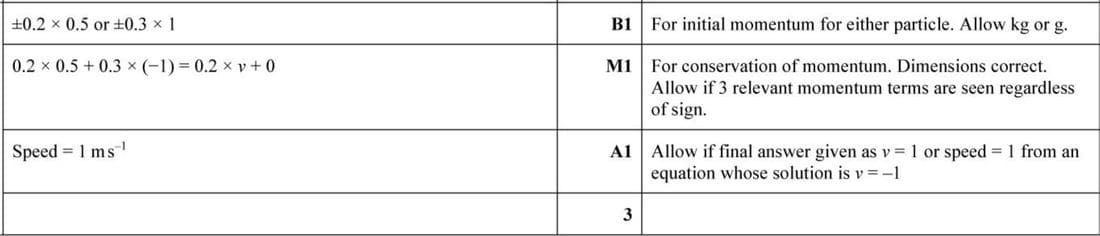
Two particles P and Q of masses 0.2 kg and 0.3 kg respectively are free to move in a horizontal straight line on a smooth horizontal plane. P is projected towards Q with speed 0.5 m s-1. At the same instant Q is projected towards P with speed 1 m s-1. Q comes to rest in the resulting collision.
Find the speed of P after the collision.
Nov 2020 p43 q4
3393
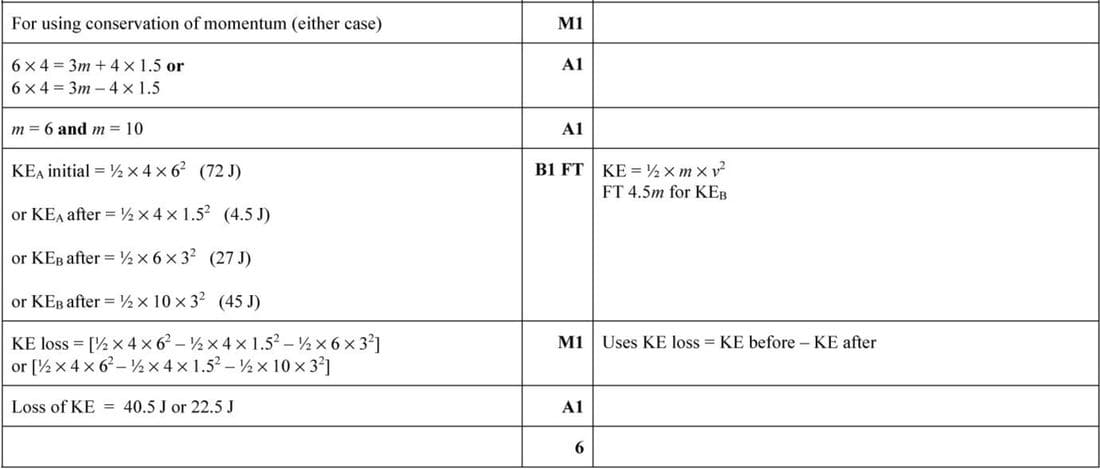
Two small smooth spheres A and B, of equal radii and of masses 4 kg and m kg respectively, lie on a smooth horizontal plane. Initially, sphere B is at rest and A is moving towards B with speed 6 m s-1. After the collision A moves with speed 1.5 m s-1 and B moves with speed 3 m s-1.
Find the two possible values of the loss of kinetic energy due to the collision.
Nov 2020 p42 q1
3394
Two particles P and Q, of masses 0.2 kg and 0.5 kg respectively, are at rest on a smooth horizontal plane. P is projected towards Q with speed 2 m s-1.
(a) Write down the momentum of P.
(b) After the collision P continues to move in the same direction with speed 0.3 m s-1. Find the speed of Q after the collision.

Nov 2020 p41 q1
3395
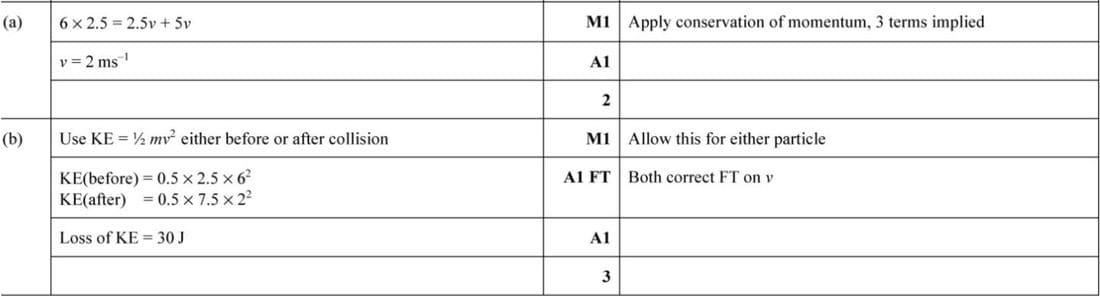
A particle B of mass 5 kg is at rest on a smooth horizontal table. A particle A of mass 2.5 kg moves on the table with a speed of 6 m s-1 and collides directly with B. In the collision, the two particles coalesce.
(a) Find the speed of the combined particle after the collision.
(b) Find the loss of kinetic energy of the system due to the collision.
June 2020 p43 q1
3396
Particles P of mass m kg and Q of mass 0.2 kg are free to move on a smooth horizontal plane. P is projected at a speed of 2 m s-1 towards Q which is stationary. After the collision P and Q move in opposite directions with speeds of 0.5 m s-1 and 1 m s-1 respectively.
Find m.

June 2020 p42 q4
3397
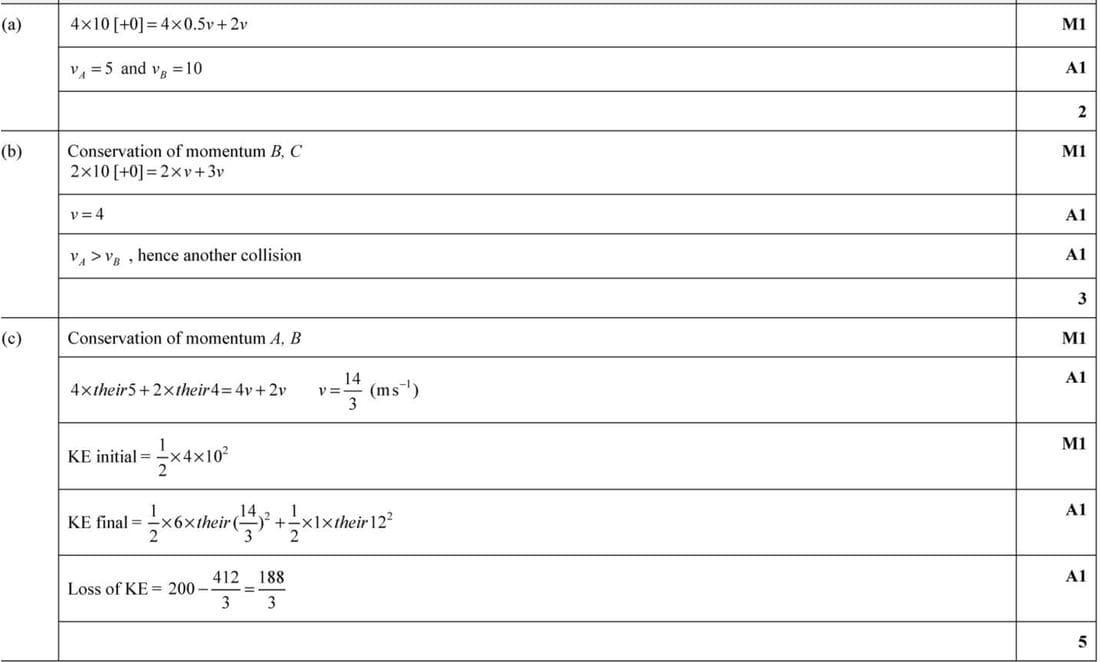
Small smooth spheres A and B, of equal radii and of masses 4 kg and 2 kg respectively, lie on a smooth horizontal plane. Initially B is at rest and A is moving towards B with speed 10 m/s. After the spheres collide A continues to move in the same direction but with half the speed of B.
(a) Find the speed of B after the collision. [2]
A third small smooth sphere C, of mass 1 kg and with the same radius as A and B, is at rest on the plane. B now collides directly with C. After this collision B continues to move in the same direction but with one third the speed of C.
(b) Show that there is another collision between A and B. [3]
(c) A and B coalesce during this collision. Find the total loss of kinetic energy in the system due to the three collisions. [5]
June 2020 p41 q7
3398
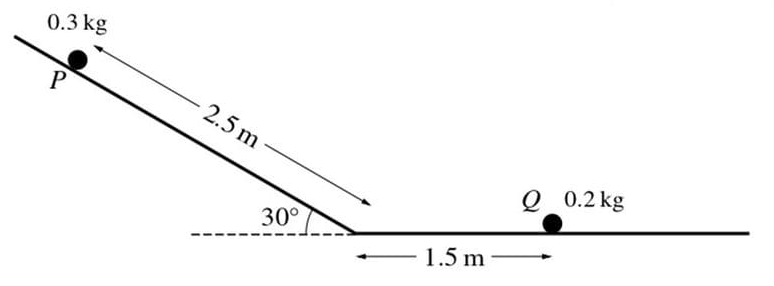
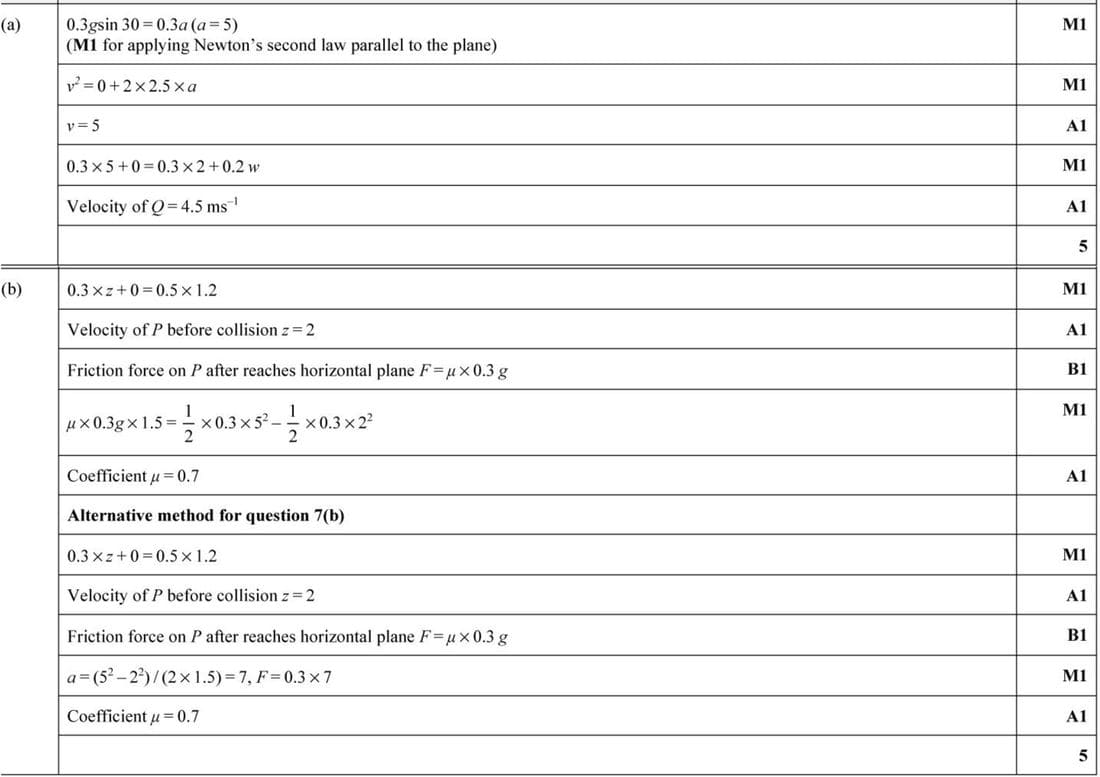
A particle P of mass 0.3 kg, lying on a smooth plane inclined at 30° to the horizontal, is released from rest. P slides down the plane for a distance of 2.5 m and then reaches a horizontal plane. There is no change in speed when P reaches the horizontal plane. A particle Q of mass 0.2 kg lies at rest on the horizontal plane 1.5 m from the end of the inclined plane (see diagram). P collides directly with Q.
(a) It is given that the horizontal plane is smooth and that, after the collision, P continues moving in the same direction, with speed 2 m s-1.
Find the speed of Q after the collision.
(b) It is given instead that the horizontal plane is rough and that when P and Q collide, they coalesce and move with speed 1.2 m s-1.
Find the coefficient of friction between P and the horizontal plane.
Feb/Mar 2020 p42 q6
3399
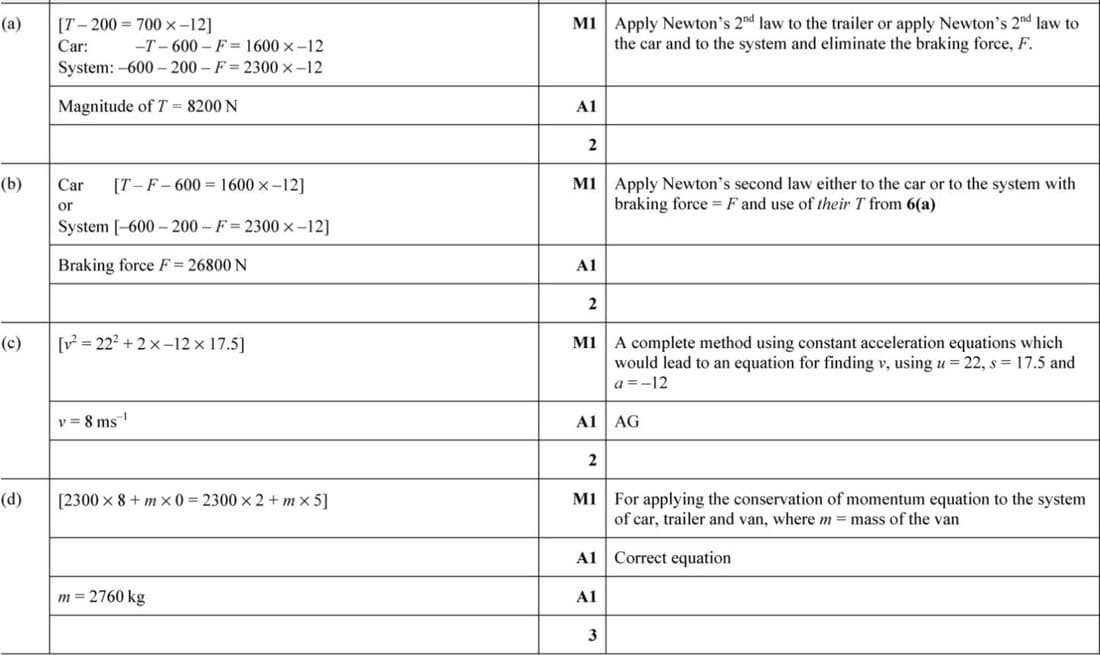
On a straight horizontal test track, driverless vehicles (with no passengers) are being tested. A car of mass 1600 kg is towing a trailer of mass 700 kg along the track. The brakes are applied, resulting in a deceleration of 12 m s-2. The braking force acts on the car only. In addition to the braking force there are constant resistance forces of 600 N on the car and of 200 N on the trailer.
(a) Find the magnitude of the force in the tow-bar. [2]
(b) Find the braking force. [2]
(c) At the instant when the brakes are applied, the car has speed 22 m s-1. At this instant the car is 17.5 m away from a stationary van, which is directly in front of the car. Show that the car hits the van at a speed of 8 m s-1. [2]
(d) After the collision, the van starts to move with speed 5 m s-1 and the car and trailer continue moving in the same direction with speed 2 m s-1. Find the mass of the van. [3]
June 2023 p43 q1
3400
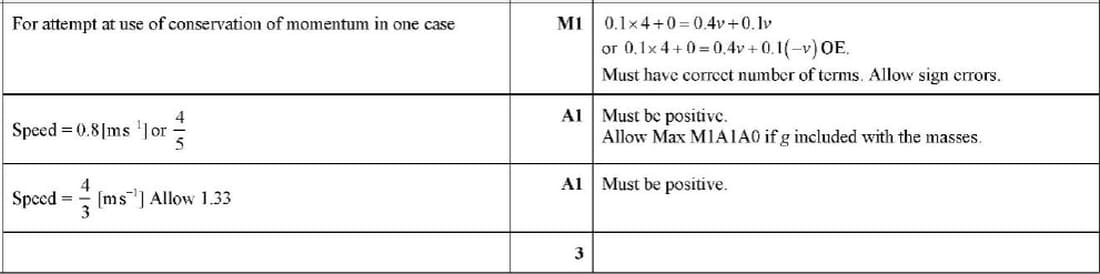
Two particles P and Q, of masses 0.1 kg and 0.4 kg respectively, are free to move on a smooth horizontal plane. Particle P is projected with speed 4 m/s-1 towards Q which is stationary. After P and Q collide, the speeds of P and Q are equal.
Find the two possible values of the speed of P after the collision.
June 2023 p42 q2
3401
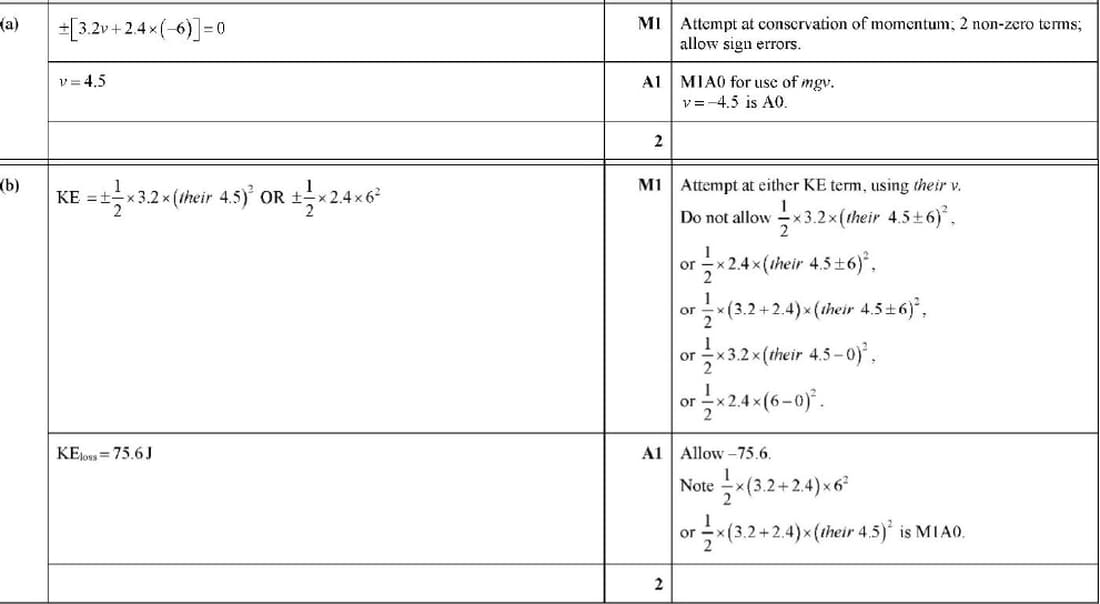
Two particles A and B, of masses 3.2 kg and 2.4 kg respectively, lie on a smooth horizontal table. A moves towards B with a speed of v m/s and collides with B, which is moving towards A with a speed of 6 m/s. In the collision the two particles come to rest.
(a) Find the value of v.
(b) Find the loss of kinetic energy of the system due to the collision.
June 2023 p41 q1
3402
Two particles P and Q, of masses m kg and 0.3 kg respectively, are at rest on a smooth horizontal plane. P is projected at a speed of 5 m s-1 directly towards Q. After P and Q collide, P moves with a speed of 2 m s-1 in the same direction as it was originally moving.
(a) Find, in terms of m, the speed of Q after the collision.
After this collision, Q moves directly towards a third particle R, of mass 0.6 kg, which is at rest on the plane. Q is brought to rest in the collision with R, and R begins to move with a speed of 1.5 m s-1.
(b) Find the value of m.
Feb/Mar 2023 p42 q7
3403
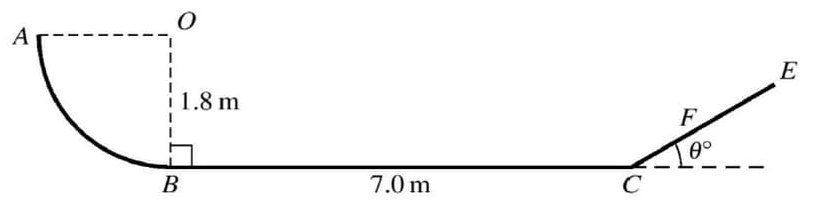
The diagram shows a smooth track which lies in a vertical plane. The section AB is a quarter circle of radius 1.8 m with centre O. The section BC is a horizontal straight line of length 7.0 m and OB is perpendicular to BC. The section CFE is a straight line inclined at an angle of \(\theta\) above the horizontal.
A particle P of mass 0.5 kg is released from rest at A. Particle P collides with a particle Q of mass 0.1 kg which is at rest at B. Immediately after the collision, the speed of P is 4 m/s in the direction BC. You should assume that P is moving horizontally when it collides with Q.
(a) Show that the speed of Q immediately after the collision is 10 m/s.
When Q reaches C, it collides with a particle R of mass 0.4 kg which is at rest at C. The two particles coalesce. The combined particle comes instantaneously to rest at F. You should assume that there is no instantaneous change in speed as the combined particle leaves C, nor when it passes through C again as it returns down the slope.
(b) Given that the distance CF is 0.4 m, find the value of \(\theta\).
(c) Find the distance from B at which P collides with the combined particle.
Nov 2022 p43 q7
3404
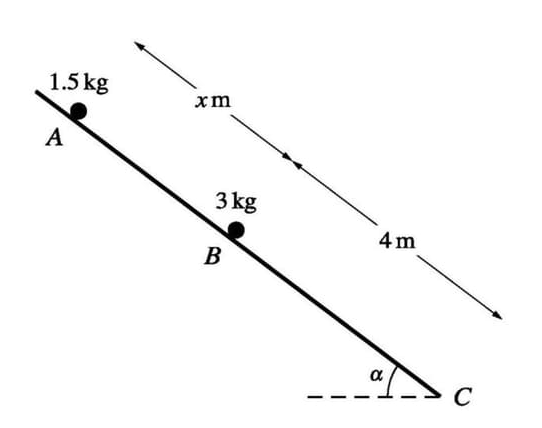
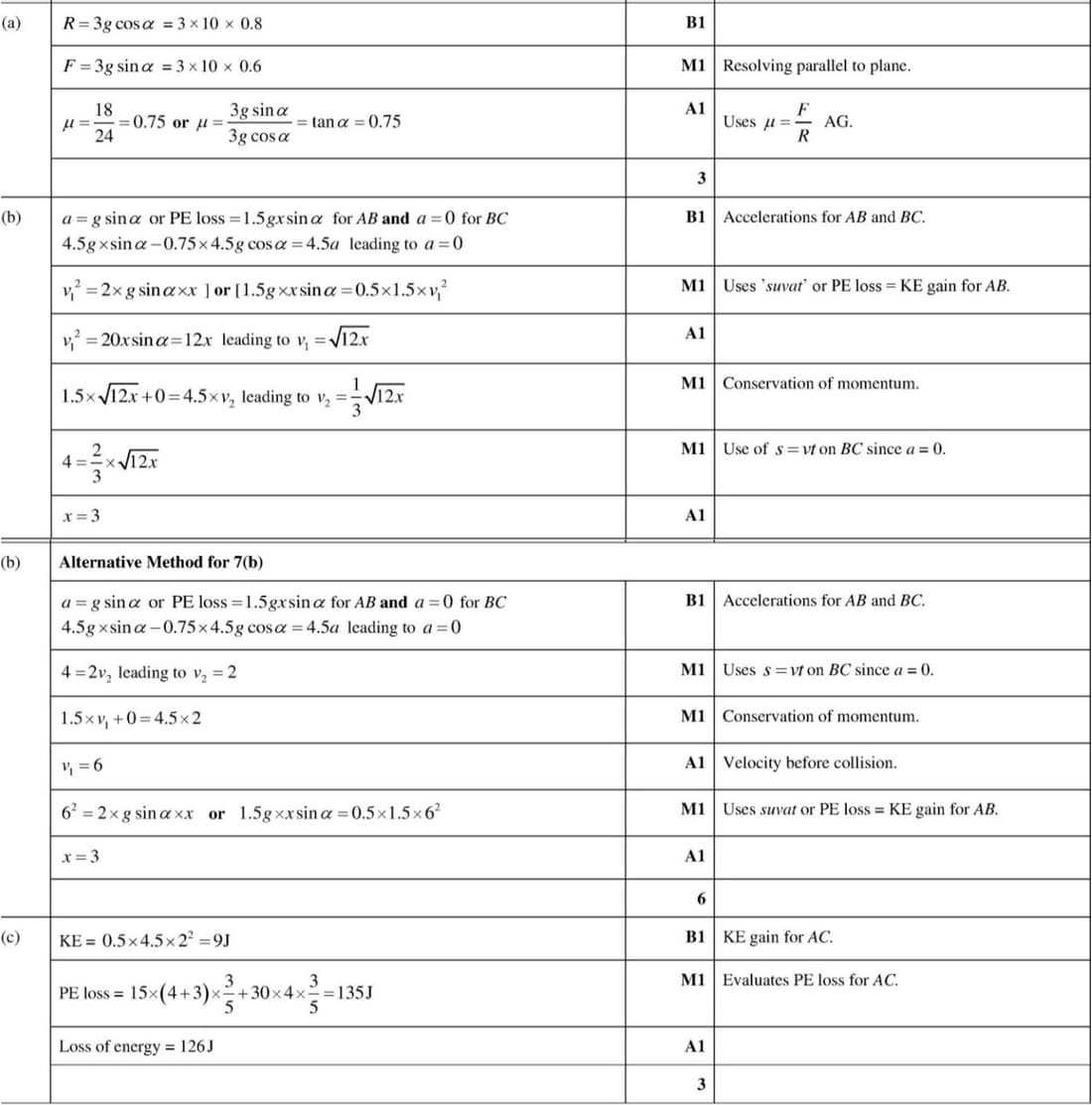
Particles of masses 1.5 kg and 3 kg lie on a plane which is inclined at an angle of \(\alpha\) to the horizontal, where \(\tan \alpha = \frac{3}{4}\). The section of the plane from \(A\) to \(B\) is smooth and the section of the plane from \(B\) to \(C\) is rough. The 1.5 kg particle is held at rest at \(A\) and the 3 kg particle is in limiting equilibrium at \(B\). The distance \(AB\) is \(x\) m and the distance \(BC\) is 4 m (see diagram).
(a) Show that the coefficient of friction between the particle at \(B\) and the plane is 0.75.
The 1.5 kg particle is released from rest. In the subsequent motion the two particles collide and coalesce. The time taken for the combined particle to travel from \(B\) to \(C\) is 2 s. The coefficient of friction between the combined particle and the plane is still 0.75.
(b) Find \(x\).
(c) Find the total loss of energy of the particles from the time the 1.5 kg particle is released until the combined particle reaches \(C\).
Nov 2022 p42 q6
3405
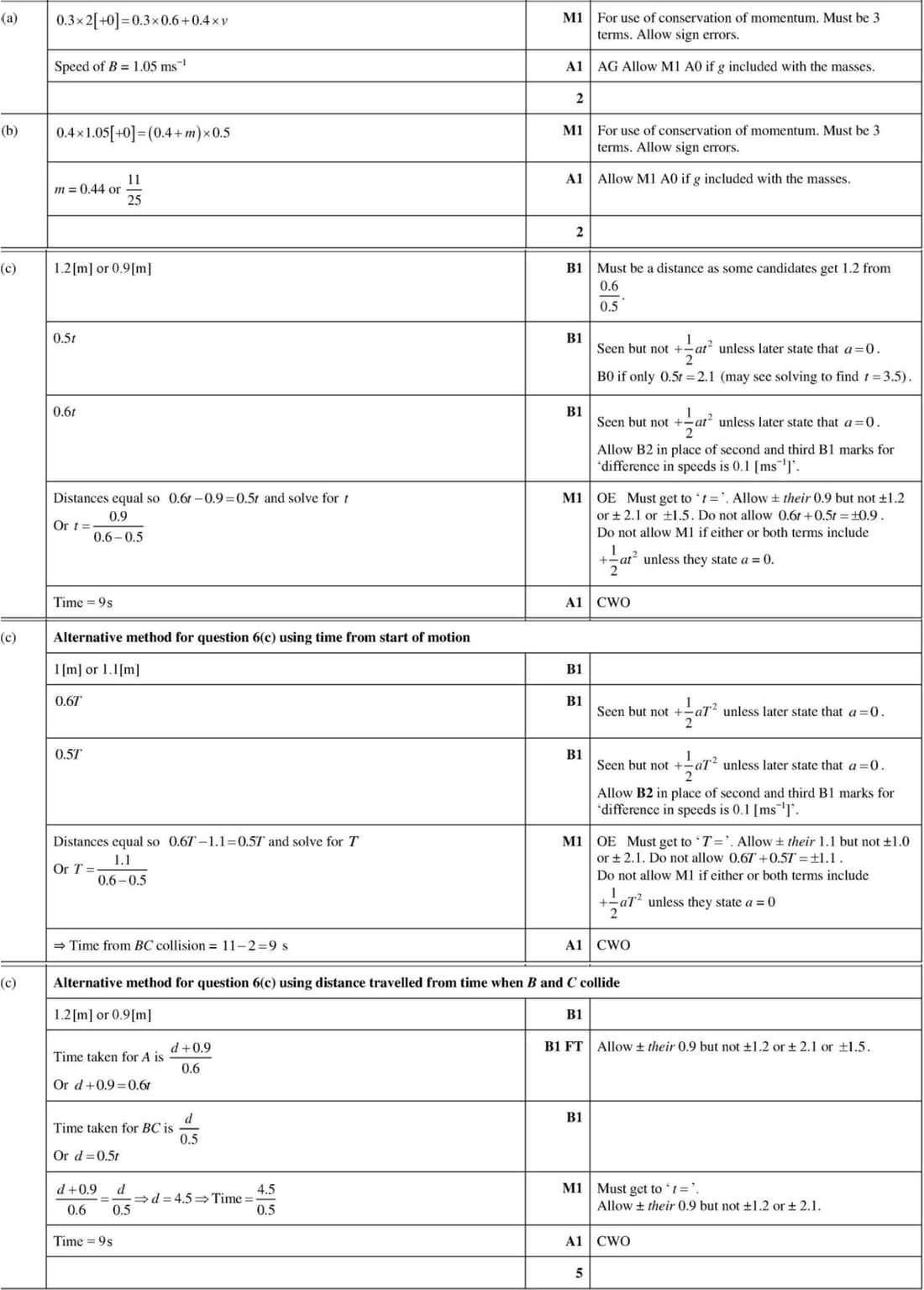
Three particles A, B and C of masses 0.3 kg, 0.4 kg and m kg respectively lie at rest in a straight line on a smooth horizontal plane. The distance between B and C is 2.1 m. A is projected directly towards B with speed 2 m/s. After A collides with B the speed of A is reduced to 0.6 m/s, still moving in the same direction.
- Show that the speed of B after the collision is 1.05 m/s.
- After the collision between A and B, B moves directly towards C. Particle B now collides with C. After this collision, the two particles coalesce and have a combined speed of 0.5 m/s.
- Find m.
- Find the time that it takes, from the instant when B and C collide, until A collides with the combined particle.
Nov 2022 p41 q2
3406
Small smooth spheres A and B, of equal radii and of masses 6 kg and 2 kg respectively, lie on a smooth horizontal plane. Initially A is moving towards B with speed 5 m s-1 and B is moving towards A with speed 3 m s-1. After the spheres collide, both A and B move in the same direction and the difference in the speeds of the spheres is 2 m s-1.
Find the loss of kinetic energy of the system due to the collision.