Exam-Style Problems
⬅ Back to SubchapterNov 2023 p43 q6
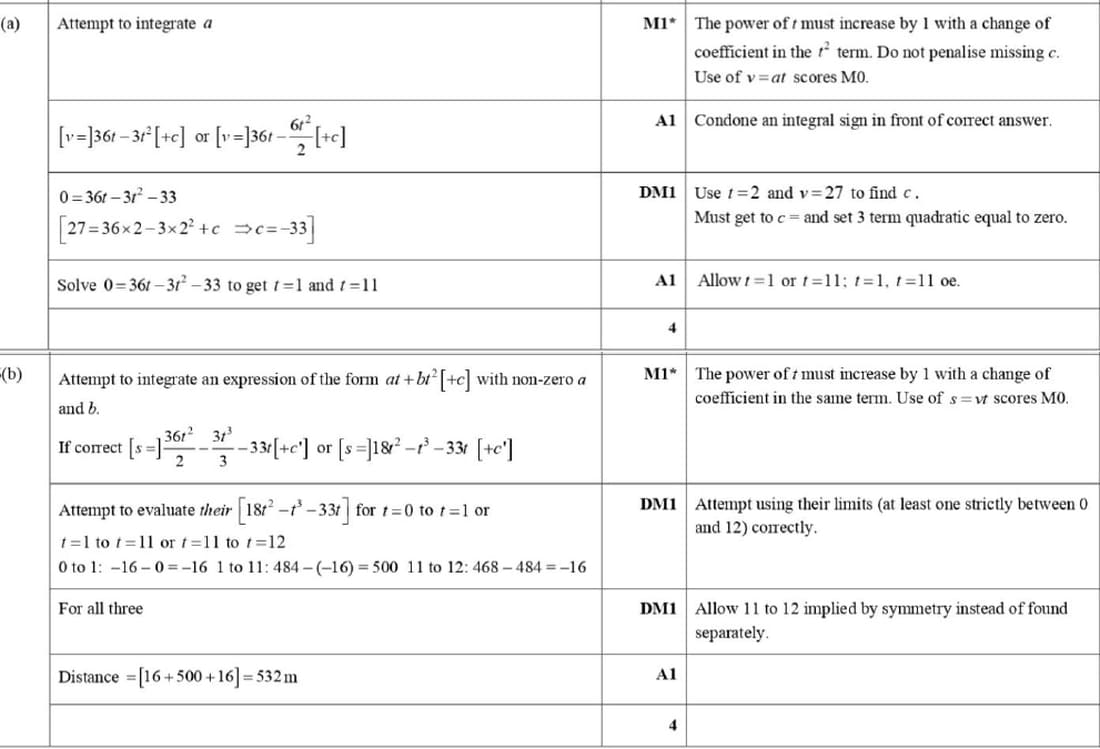
A particle moves in a straight line. At time \(t\) s, the acceleration, \(a \text{ ms}^{-2}\), of the particle is given by \(a = 36 - 6t\). The velocity of the particle is \(27 \text{ ms}^{-1}\) when \(t = 2\).
(a) Find the values of \(t\) when the particle is at instantaneous rest.
(b) Find the total distance the particle travels during the first 12 seconds.
June 2022 p41 q6
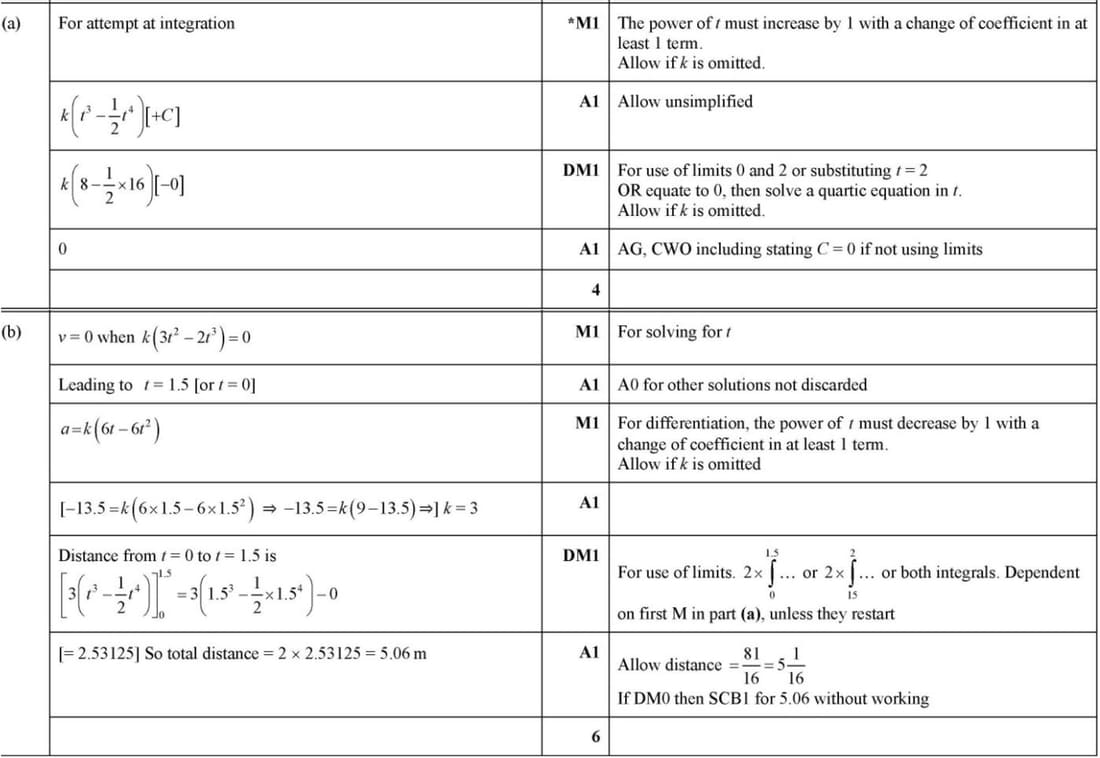
A particle starts from a point O and moves in a straight line. The velocity v m s-1 of the particle at time t s after leaving O is given by
\(v = k(3t^2 - 2t^3)\),
where k is a constant.
- Verify that the particle returns to O when t = 2.
- It is given that the acceleration of the particle is -13.5 m s-2 for the positive value of t at which v = 0.
Find k and hence find the total distance travelled in the first two seconds of motion.
Feb/Mar 2022 p42 q6
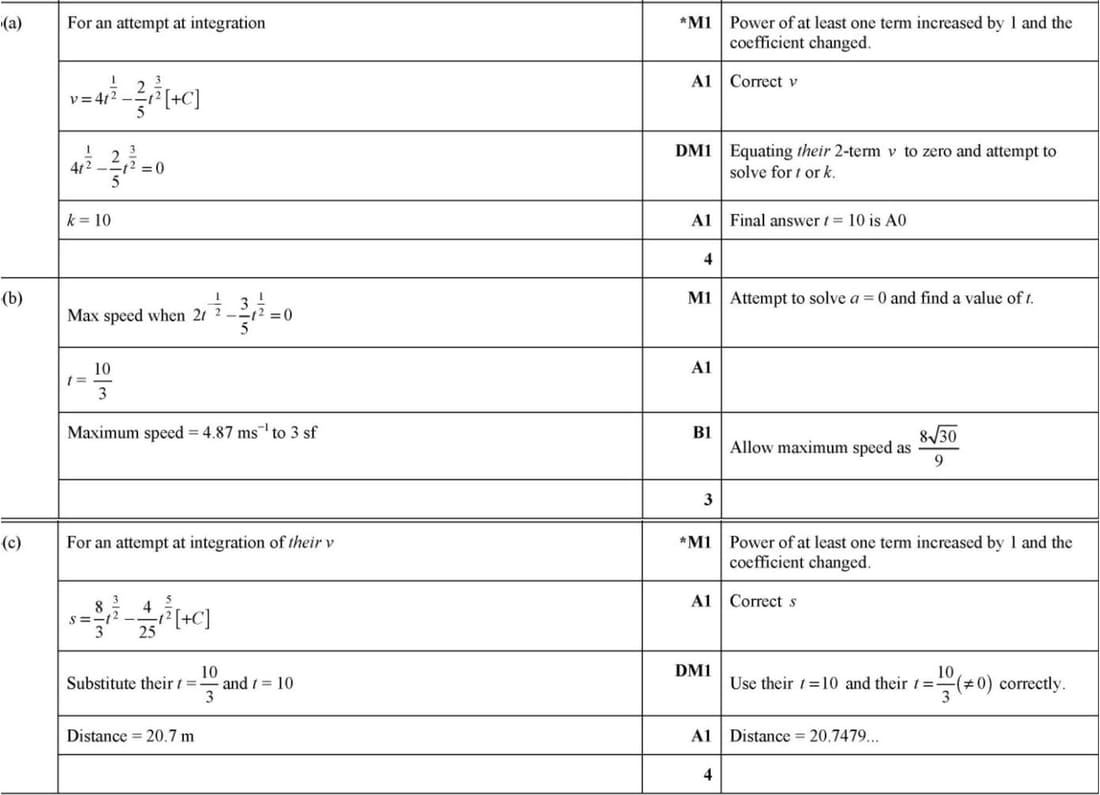
A cyclist starts from rest at a fixed point O and moves in a straight line, before coming to rest k seconds later. The acceleration of the cyclist at time t seconds after leaving O is a m/s2, where a = 2t - \frac{3}{5}t^2 for 0 < t \leq k.
- Find the value of k.
- Find the maximum speed of the cyclist.
- Find an expression for the displacement from O in terms of t. Hence find the total distance travelled by the cyclist from the time at which she reaches her maximum speed until she comes to rest.
Nov 2021 p43 q5
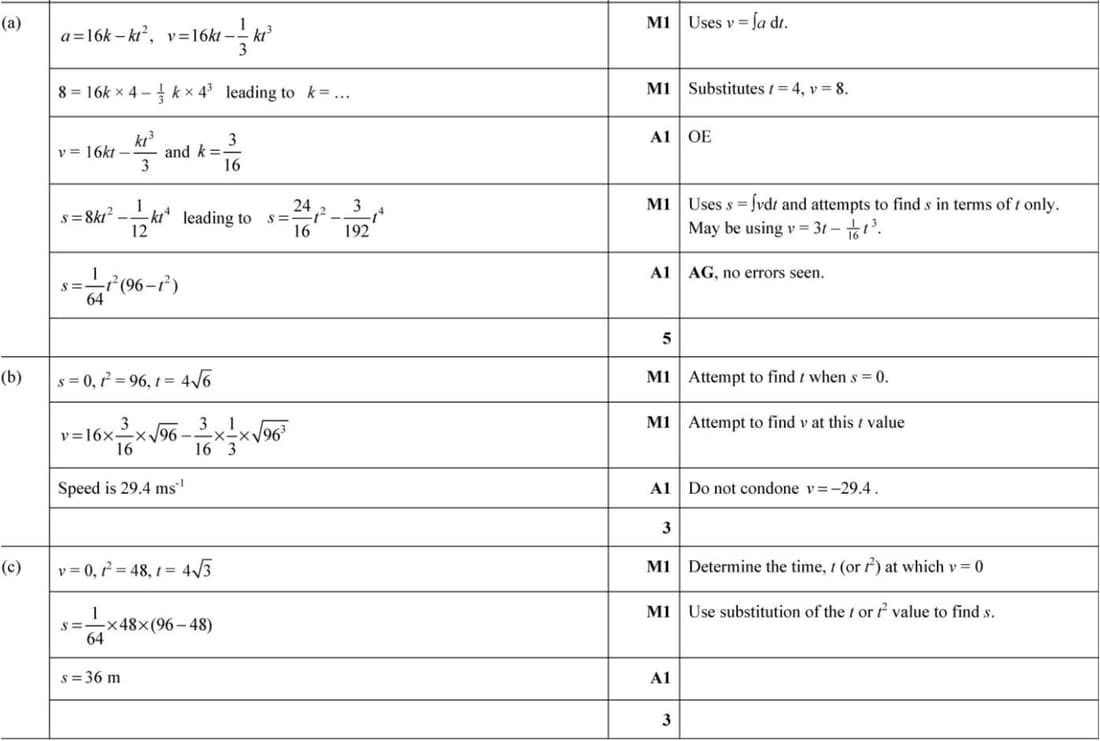
A particle P moves in a straight line, starting from rest at a point O on the line. At time t s after leaving O the acceleration of P is k(16 - t^2) m s-2, where k is a positive constant, and the displacement from O is s m. The velocity of P is 8 m s-1 when t = 4.
- Show that s = \frac{1}{64} t^2 (96 - t^2).
- Find the speed of P at the instant that it returns to O.
- Find the maximum displacement of the particle from O.
Nov 2021 p42 q4
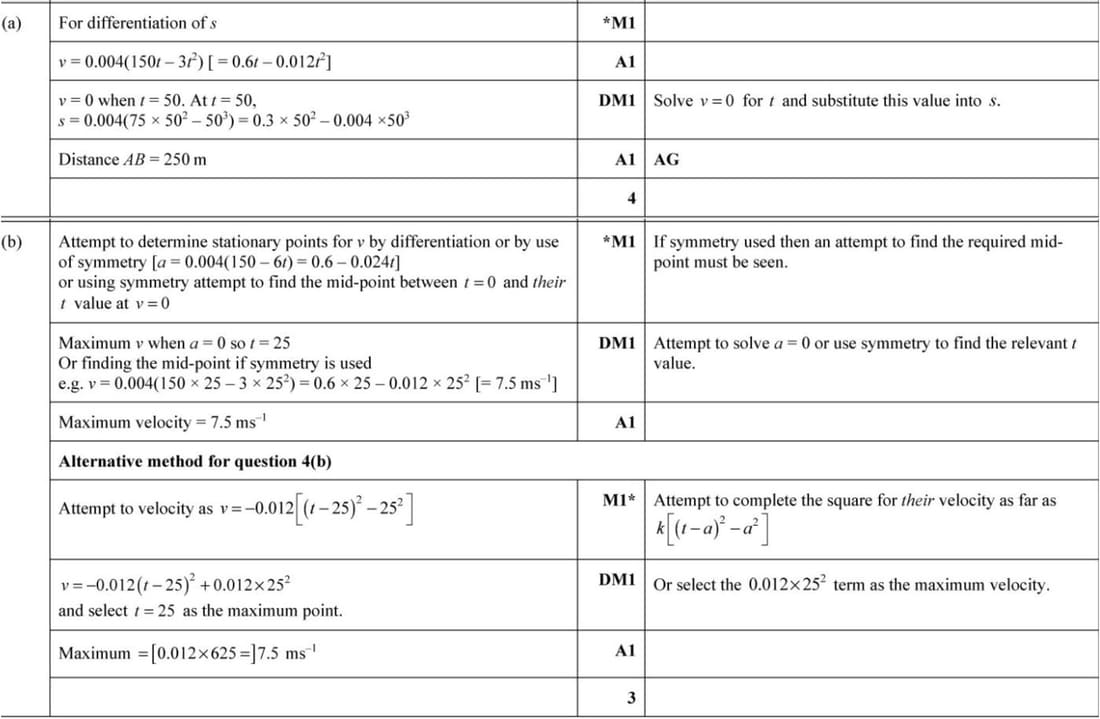
A cyclist starts from rest at a point A and travels along a straight road AB, coming to rest at B. The displacement of the cyclist from A at time t s after the start is s m, where
\(s = 0.004(75t^2 - t^3)\).
(a) Show that the distance AB is 250 m.
(b) Find the maximum velocity of the cyclist.
June 2021 p41 q5
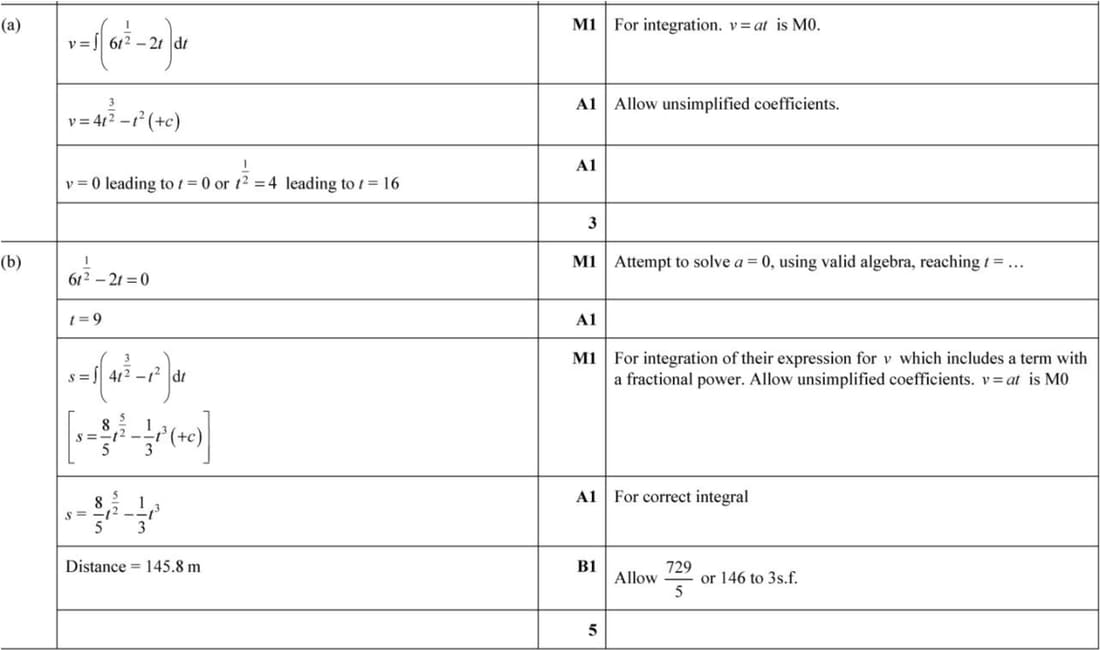
A particle moving in a straight line starts from rest at a point A and comes instantaneously to rest at a point B. The acceleration of the particle at time t s after leaving A is a m s-2, where
\(a = 6t^{\frac{1}{2}} - 2t\).
- Find the value of t at point B.
- Find the distance travelled from A to the point at which the acceleration of the particle is again zero.
Feb/Mar 2021 p42 q6
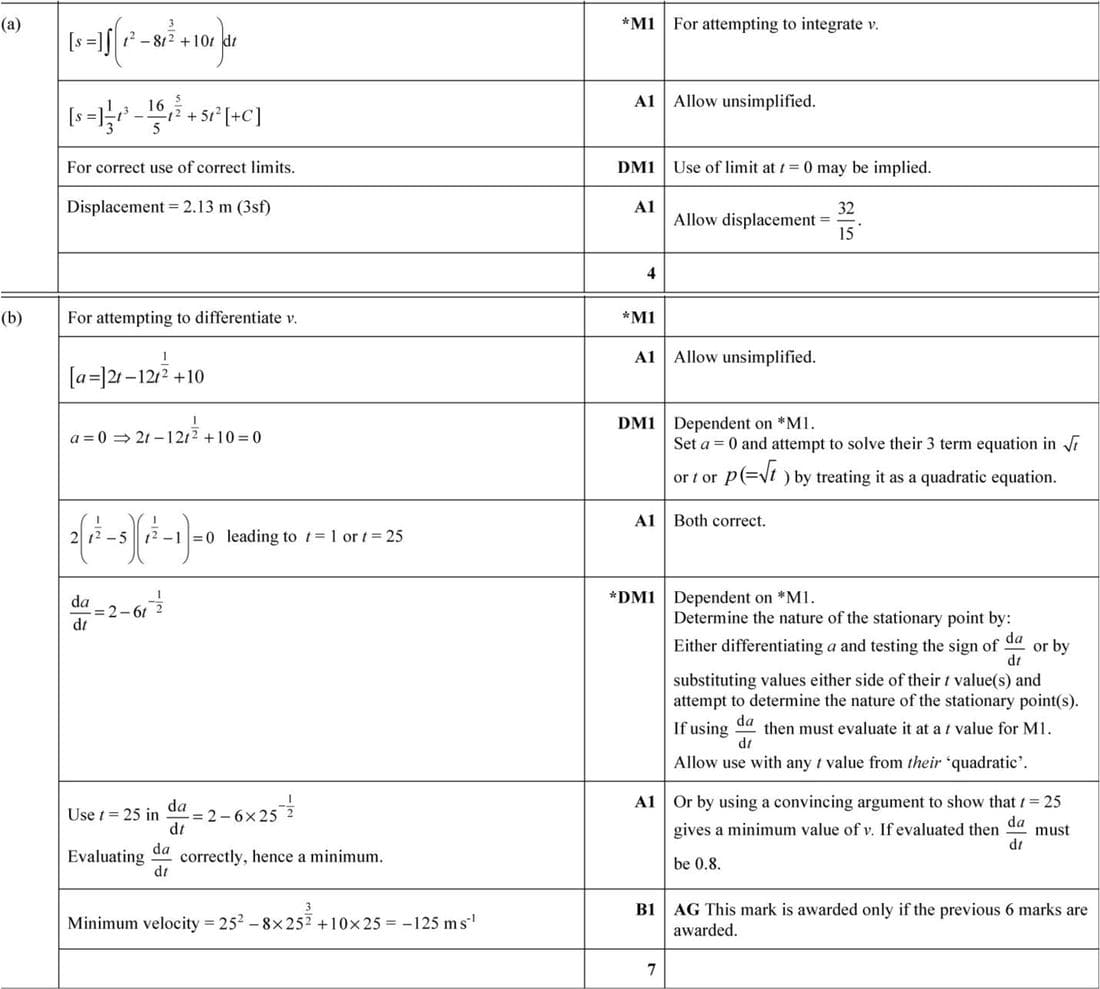
A particle moves in a straight line. It starts from rest from a fixed point O on the line. Its velocity at time t s after leaving O is v m s−1, where v = t2 − 8t3/2 + 10t.
\((a) Find the displacement of the particle from O when t = 1.\)
(b) Show that the minimum velocity of the particle is −125 m s−1.
Nov 2020 p43 q5
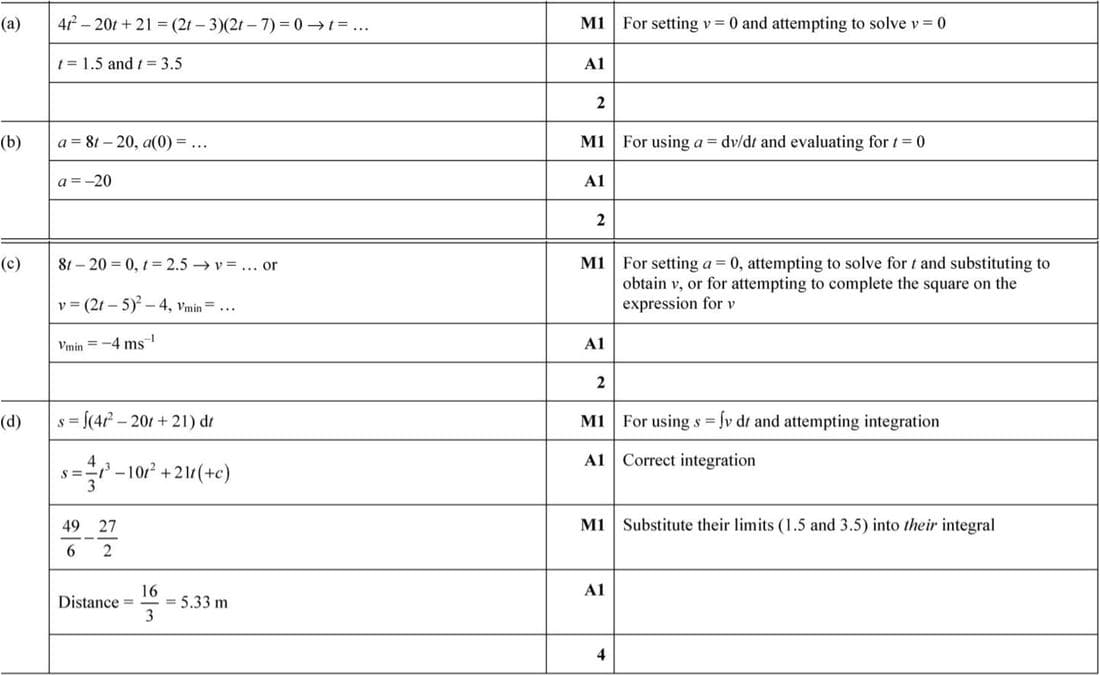
A particle P moves in a straight line. It starts at a point O on the line and at time t s after leaving O it has velocity v m s-1, where v = 4t^2 - 20t + 21.
(a) Find the values of t for which P is at instantaneous rest.
(b) Find the initial acceleration of P.
(c) Find the minimum velocity of P.
(d) Find the distance travelled by P during the time when its velocity is negative.
Nov 2020 p42 q7
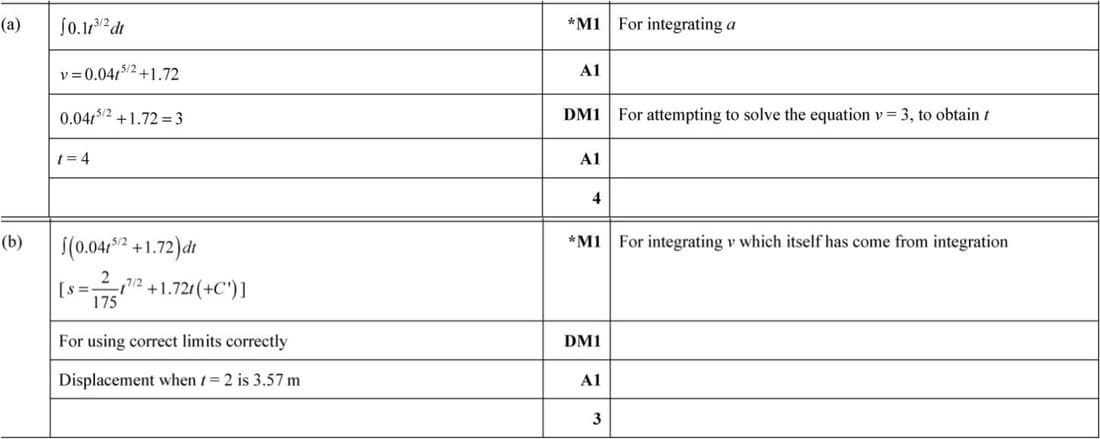
A particle P moves in a straight line, starting from a point O with velocity 1.72 m s-1. The acceleration a m s-2 of the particle, t s after leaving O, is given by a = 0.1t3/2.
(a) Find the value of t when the velocity of P is 3 m s-1.
\((b) Find the displacement of P from O when t = 2, giving your answer correct to 2 decimal places.\)
Nov 2020 p41 q4
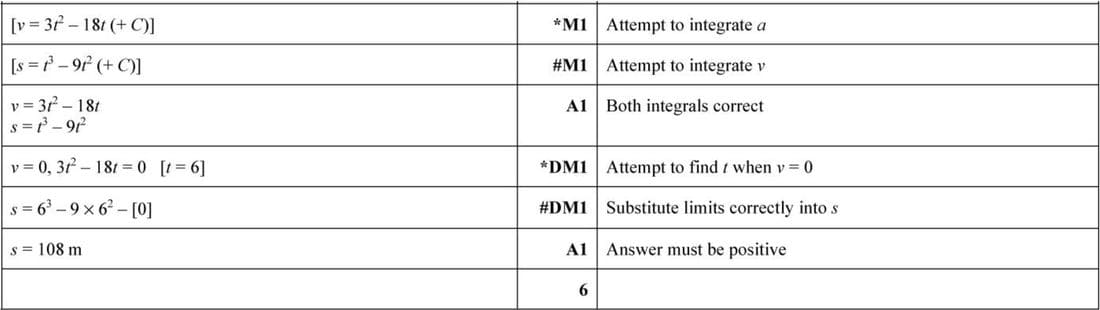
A particle P moves in a straight line. It starts from rest at a point O on the line and at time t s after leaving O it has acceleration a m s-2, where a = 6t - 18.
Find the distance P moves before it comes to instantaneous rest.
June 2020 p43 q6
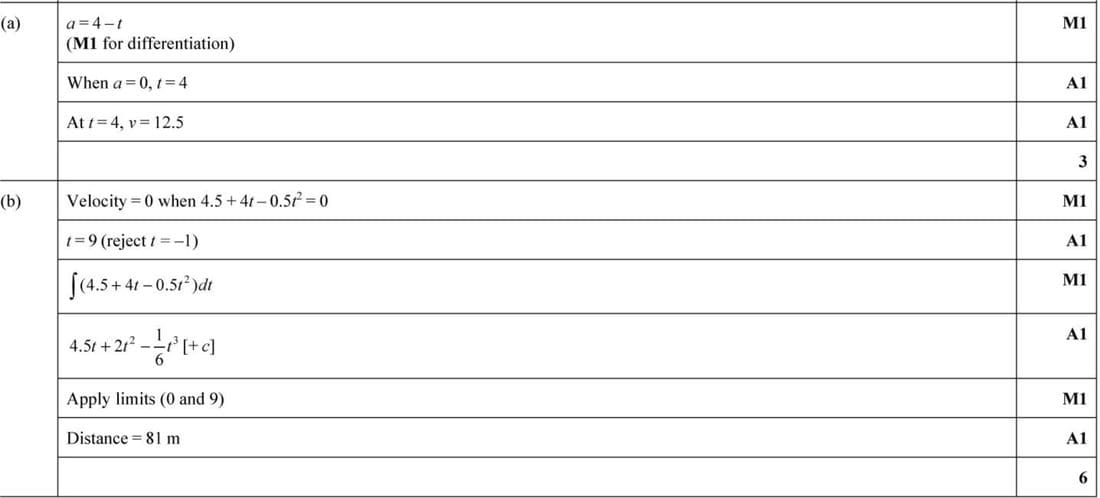
A particle travels in a straight line PQ. The velocity of the particle t s after leaving P is v m s-1, where
\(v = 4.5 + 4t - 0.5t^2\).
- Find the velocity of the particle at the instant when its acceleration is zero.
- The particle comes to instantaneous rest at Q.
- Find the distance PQ.
Nov 2023 p41 q7
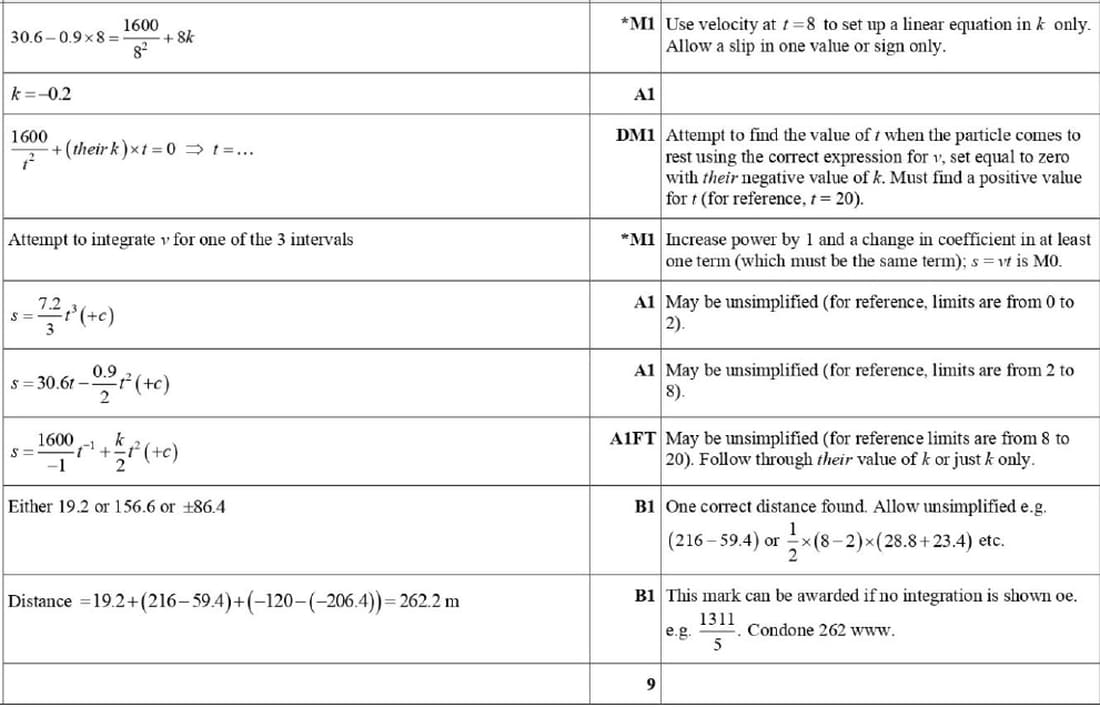
A particle moves in a straight line starting from a point O before coming to instantaneous rest at a point X. At time t s after leaving O, the velocity v ms-1 of the particle is given by
\(v = 7.2t^2 \quad 0 \leq t \leq 2,\)
\(v = 30.6 - 0.9t \quad 2 \leq t \leq 8,\)
\(v = \frac{1600}{t^2} + kt \quad 8 \leq t,\)
where k is a constant. It is given that there is no instantaneous change in velocity at \(t = 8\).
Find the distance OX.
June 2020 p41 q6
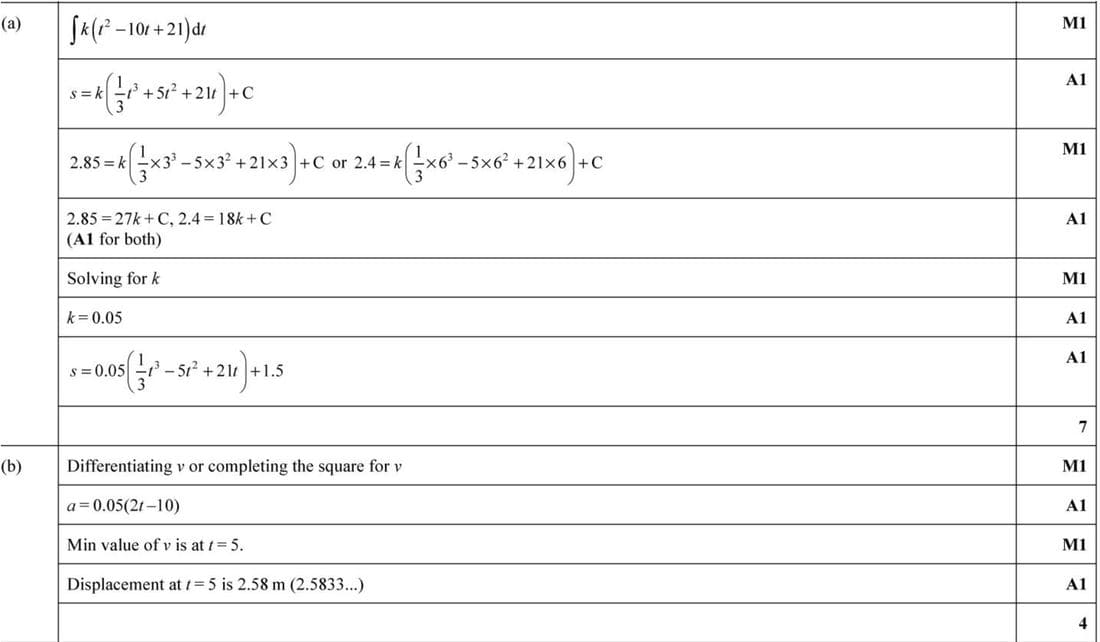
A particle moves in a straight line AB. The velocity \(v \text{ m s}^{-1}\) of the particle \(t\) s after leaving A is given by \(v = k(t^2 - 10t + 21)\), where \(k\) is a constant. The displacement of the particle from A, in the direction towards B, is 2.85 m when \(t = 3\) and is 2.4 m when \(t = 6\).
- Find the value of \(k\). Hence find an expression, in terms of \(t\), for the displacement of the particle from A.
- Find the displacement of the particle from A when its velocity is a minimum.
Feb/Mar 2020 p42 q7
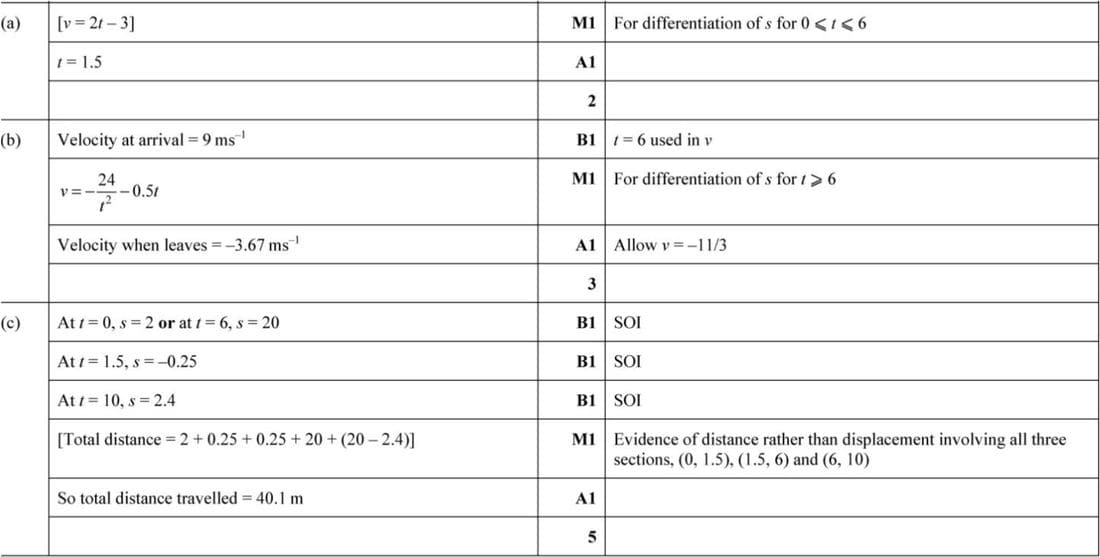
A particle moves in a straight line through the point O. The displacement of the particle from O at time t s is s m, where
\(s = t^2 - 3t + 2\) for \(0 \leq t \leq 6\),
\(s = \frac{24}{t} - \frac{t^2}{4} + 25\) for \(t \geq 6\).
- Find the value of t when the particle is instantaneously at rest during the first 6 seconds of its motion. [2]
- At t = 6, the particle hits a barrier at a point P and rebounds. Find the velocity with which the particle arrives at P and also the velocity with which the particle leaves P. [3]
- Find the total distance travelled by the particle in the first 10 seconds of its motion. [5]
Nov 2019 p43 q6
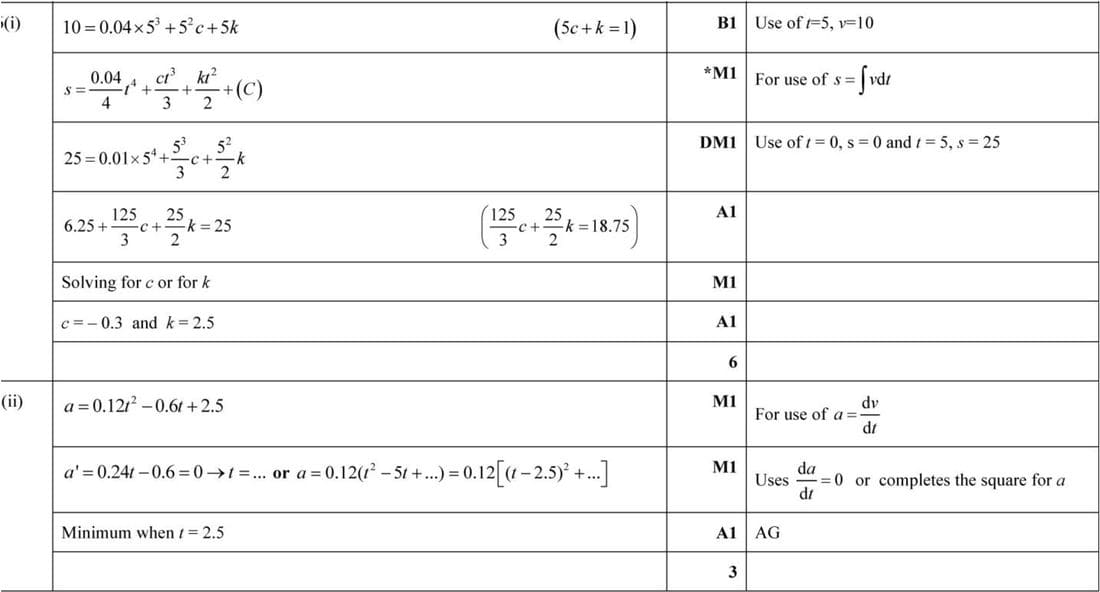
Particle P travels in a straight line from A to B. The velocity of P at time t s after leaving A is denoted by v m s-1, where
\(v = 0.04t^3 + ct^2 + kt\).
P takes 5 s to travel from A to B and it reaches B with speed 10 m s-1. The distance AB is 25 m.
- Find the values of the constants c and k.
- Show that the acceleration of P is a minimum when t = 2.5.
Nov 2019 p42 q1
A particle moves in a straight line. The displacement of the particle at time t s is s m, where
\(s = t^3 - 6t^2 + 4t\).
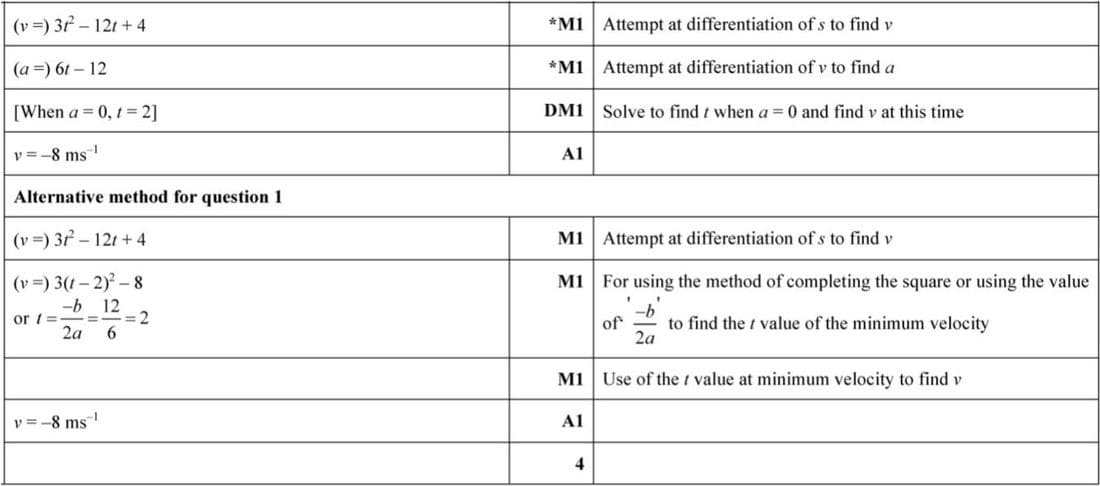
Find the velocity of the particle at the instant when its acceleration is zero.
June 2019 p43 q6
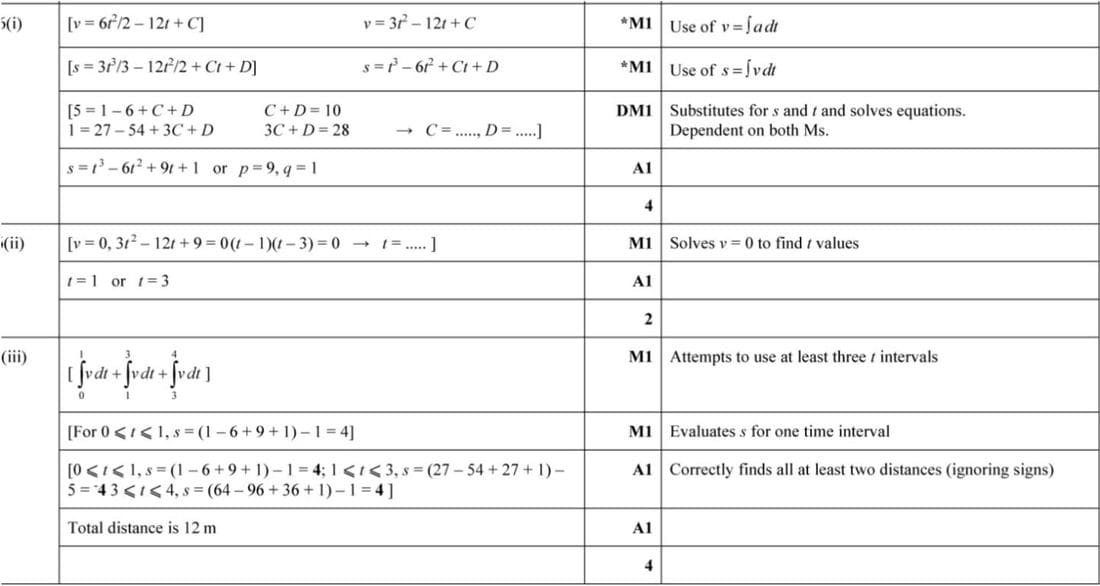
A particle P moves in a straight line. The acceleration \(a \text{ m s}^{-2}\) of P at time \(t\) s is given by \(a = 6t - 12\). The displacement of P from a fixed point O on the line is \(s\) m. It is given that \(s = 5\) when \(t = 1\) and \(s = 1\) when \(t = 3\).
- Show that \(s = t^3 - 6t^2 + pt + q\), where \(p\) and \(q\) are constants to be found.
- Find the values of \(t\) when P is at instantaneous rest.
- Find the total distance travelled by P in the interval \(0 \leq t \leq 4\).
June 2019 p41 q5
A particle P moves in a straight line from a fixed point O. The velocity v m s-1 of P at time t s is given by
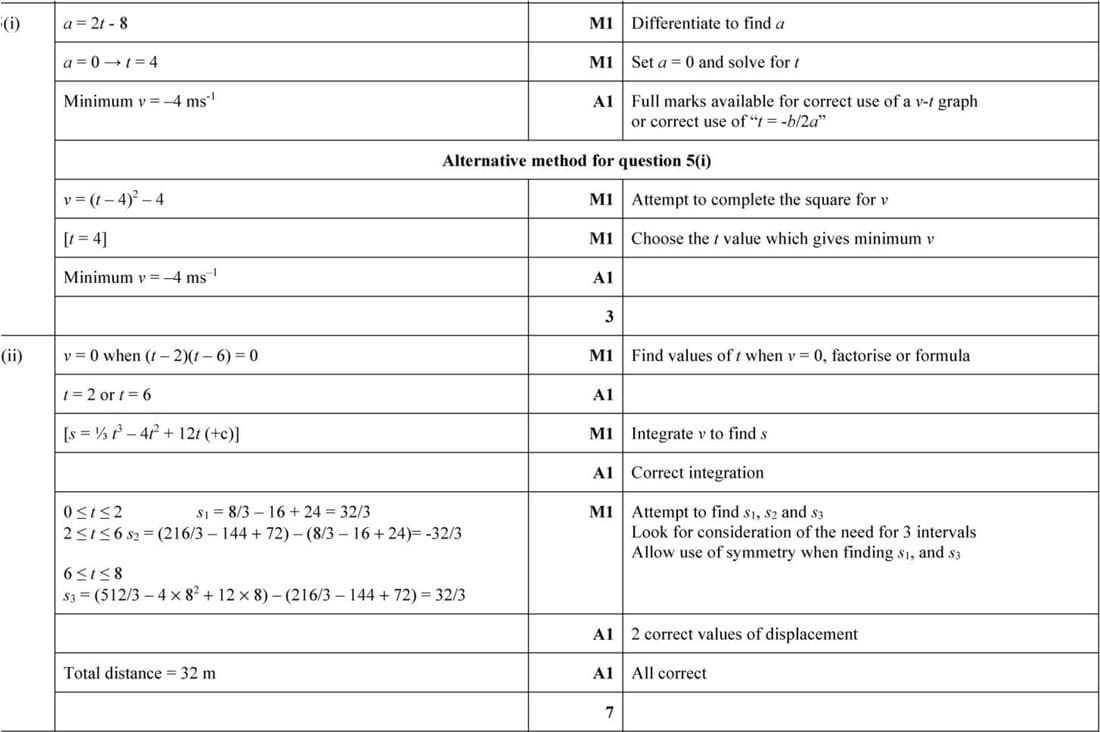
\(v = t^2 - 8t + 12\) for \(0 \leq t \leq 8\).
- Find the minimum velocity of P.
- Find the total distance travelled by P in the interval \(0 \leq t \leq 8\).
Feb/Mar 2019 p42 q6
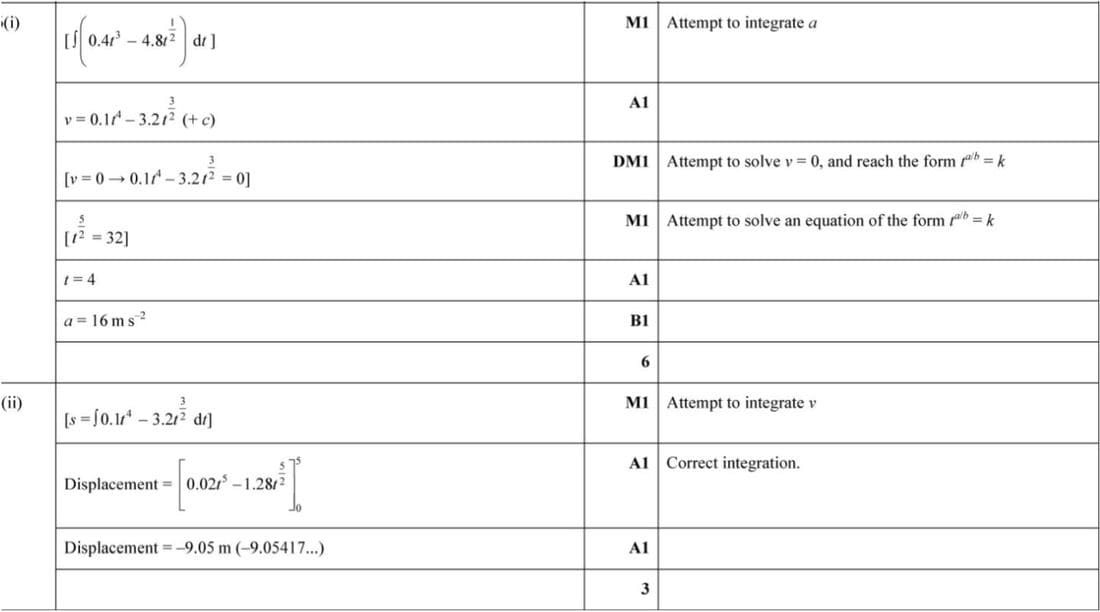
A particle moves in a straight line. It starts from rest at a fixed point O on the line. Its acceleration at time t s after leaving O is a m s-2, where a = 0.4t^3 - 4.8t^{1/2}.
- Show that, in the subsequent motion, the acceleration of the particle when it comes to instantaneous rest is 16 m s-2.
- Find the displacement of the particle from O at t = 5.
Nov 2018 p43 q7
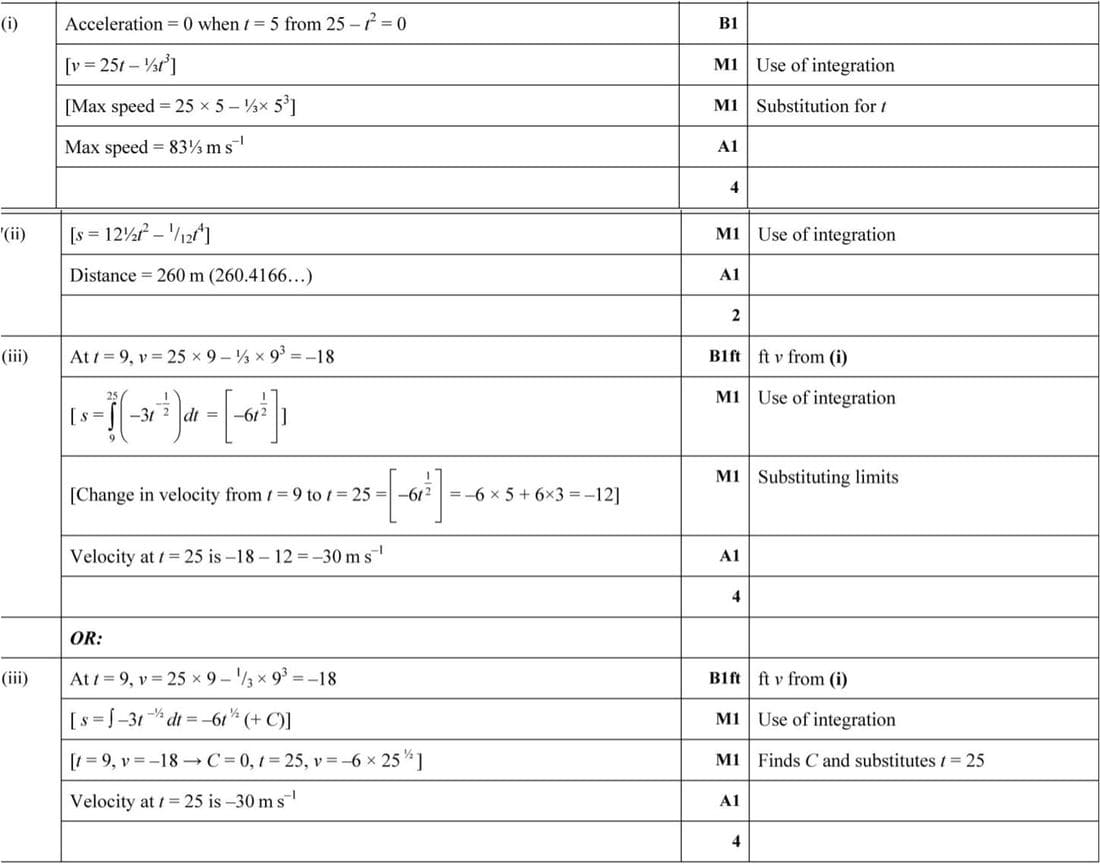
A particle moves in a straight line. The particle is initially at rest at a point O on the line. At time t s after leaving O, the acceleration a m s-2 of the particle is given by a = 25 - t2 for 0 ≤ t ≤ 9.
- Find the maximum velocity of the particle in this time period. [4]
- Find the total distance travelled until the maximum velocity is reached. [2]
\(The acceleration of the particle for t > 9 is given by a = -3t-1/2.\)
- Find the velocity of the particle when t = 25. [4]
Nov 2018 p42 q5
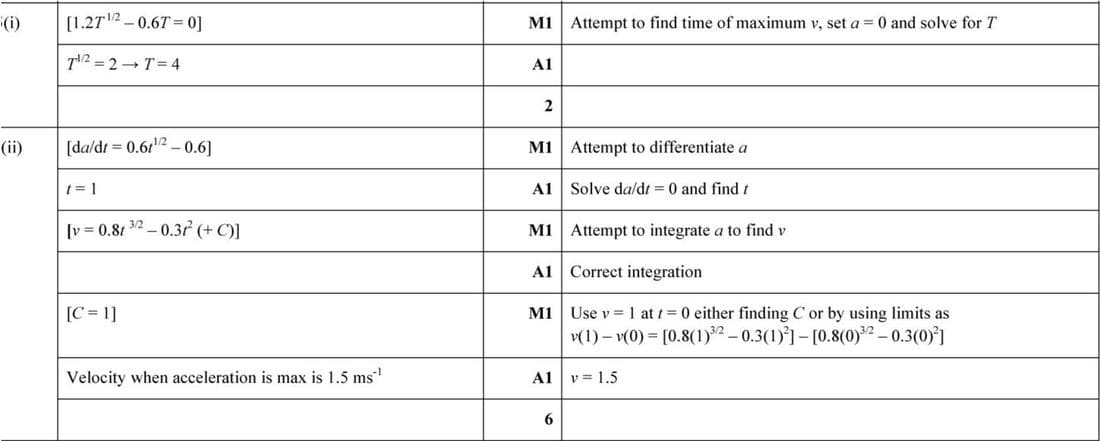
A particle moves in a straight line starting from a point O with initial velocity 1 m s-1. The acceleration of the particle at time t s after leaving O is a m s-2, where
\(a = 1.2t^{1/2} - 0.6t\).
- At time T s after leaving O the particle reaches its maximum velocity. Find the value of T. [2]
- Find the velocity of the particle when its acceleration is maximum (you do not need to verify that the acceleration is a maximum rather than a minimum). [6]
June 2018 p42 q6
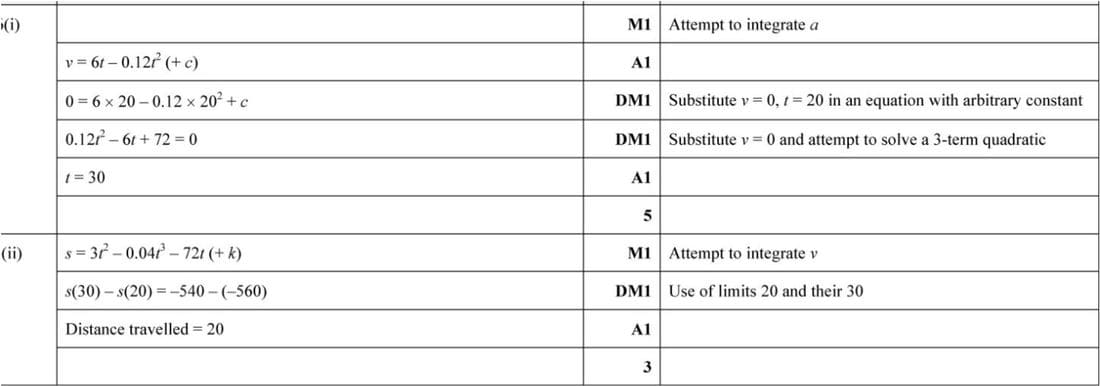
A particle P moves in a straight line passing through a point O. At time t s, the acceleration, a m s-2, of P is given by a = 6 - 0.24t. The particle comes to instantaneous rest at time t = 20.
- Find the value of t at which the particle is again at instantaneous rest.
- Find the distance the particle travels between the times of instantaneous rest.
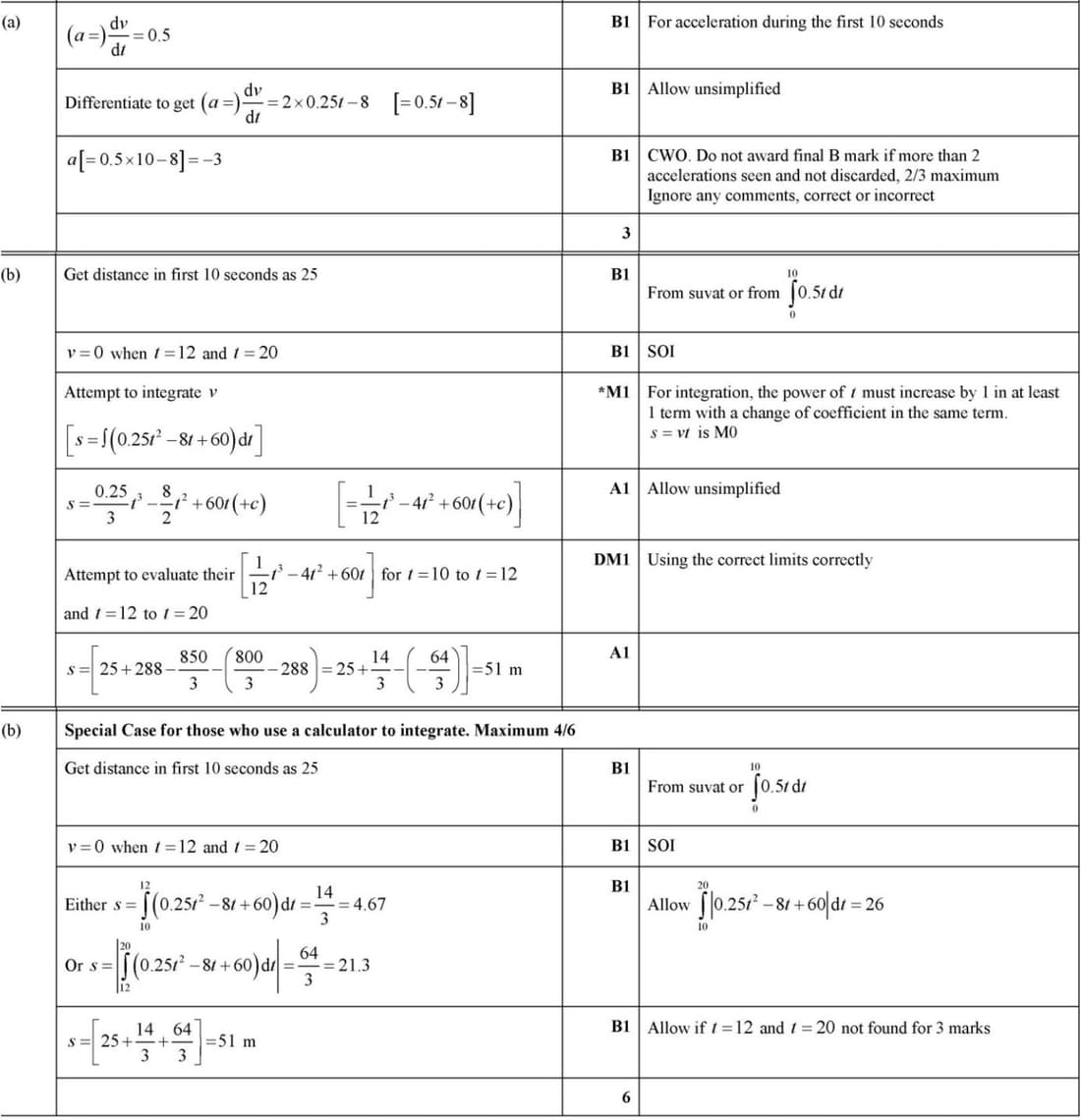
June 2023 p43 q5
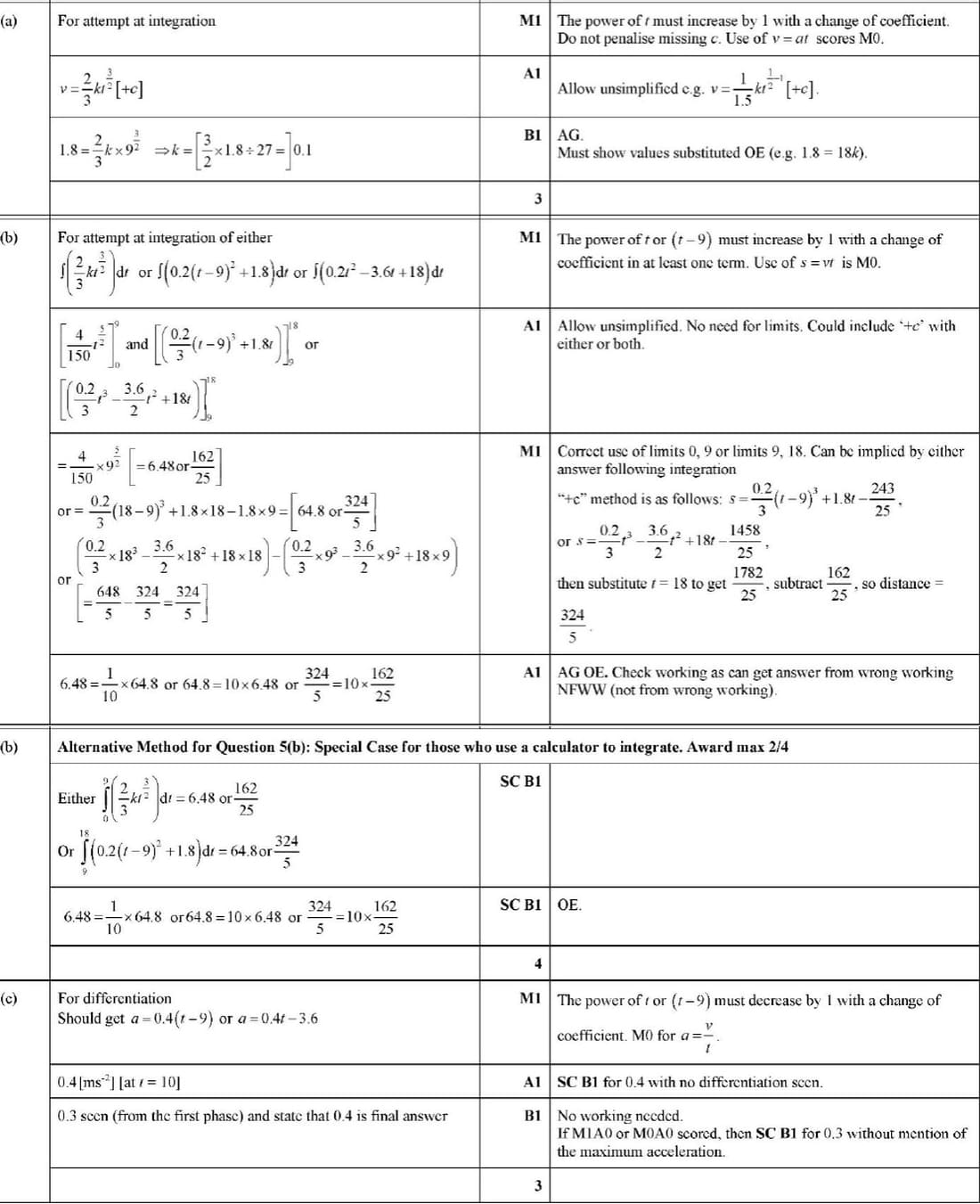
A particle starts from rest from a point O and moves in a straight line. The acceleration of the particle at time t after leaving O is a m s-2, where a = kt^{1/2} for 0 \leq t \leq 9 and where k is a constant. The velocity of the particle at t = 9 is 1.8 m s-1.
- Show that k = 0.1.
- For t > 9, the velocity v m s-1 of the particle is given by v = 0.2(t - 9)^2 + 1.8.
- Show that the distance travelled in the first 9 seconds is one tenth of the distance travelled between t = 9 and t = 18.
- Find the greatest acceleration of the particle during the first 10 seconds of its motion.
June 2018 p41 q4
A particle P moves in a straight line starting from a point O. At time t s after leaving O, the displacement s m from O is given by \(s = t^3 - 4t^2 + 4t\) and the velocity is \(v\) m s-1.
- Find an expression for \(v\) in terms of \(t\).
- Find the two values of \(t\) for which P is at instantaneous rest.
- Find the minimum velocity of P.
Nov 2017 p43 q5
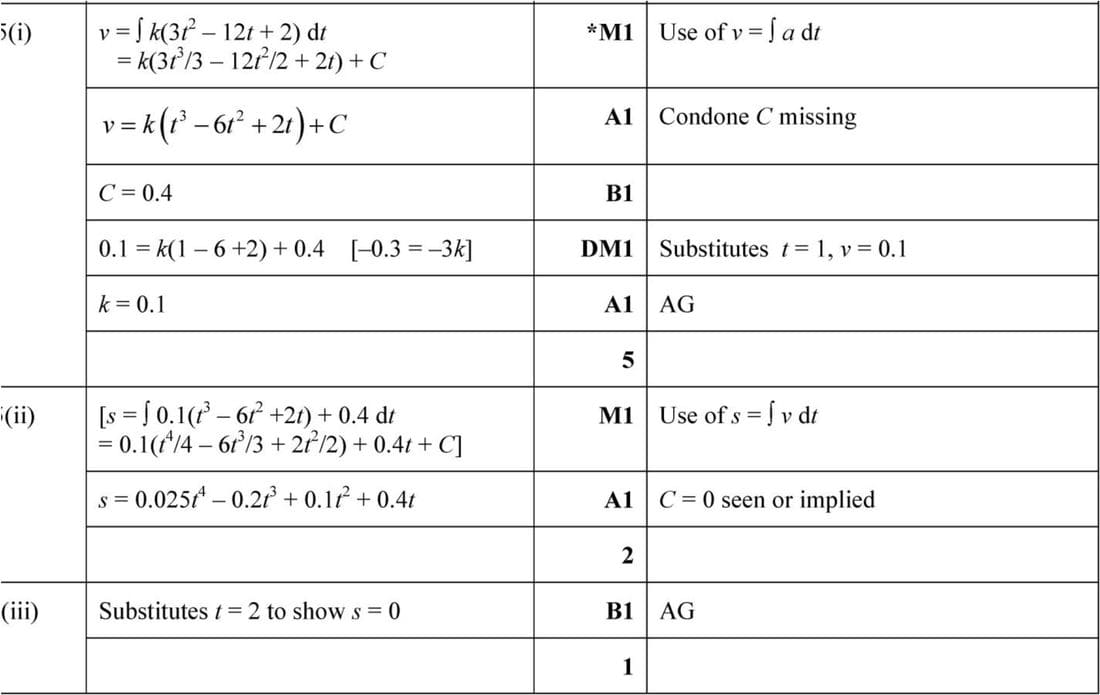
A particle starts from a fixed origin with velocity 0.4 m s-1 and moves in a straight line. The acceleration a m s-2 of the particle t s after it leaves the origin is given by a = k(3t2 - 12t + 2), where k is a constant. When t = 1, the velocity of P is 0.1 m s-1.
- Show that the value of k is 0.1.
- Find an expression for the displacement of the particle from the origin in terms of t.
- Hence verify that the particle is again at the origin at t = 2.
Nov 2017 p42 q7
A particle starts from rest and moves in a straight line. The velocity of the particle at time t s after the start is v m s-1, where
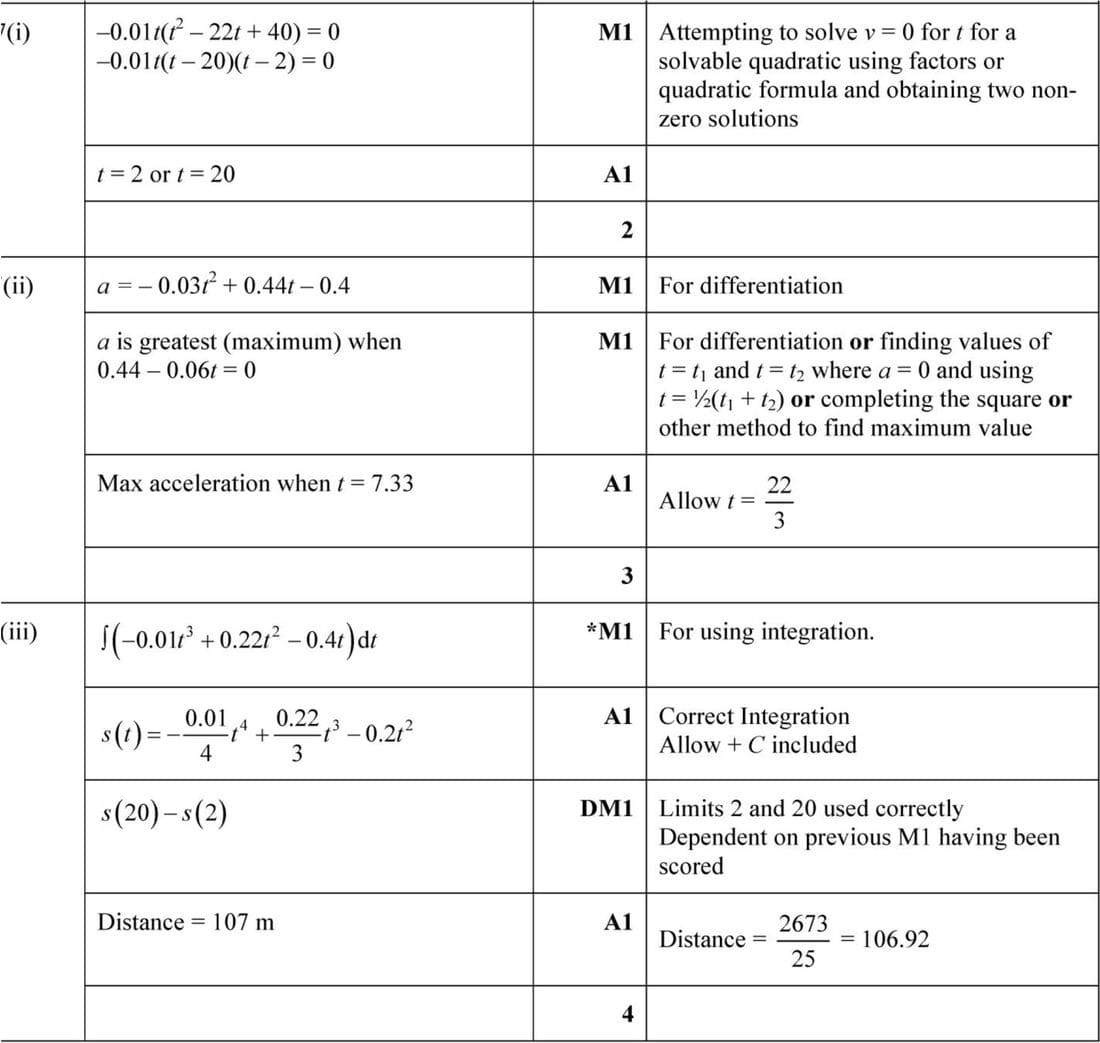
\(v = -0.01t^3 + 0.22t^2 - 0.4t\).
- Find the two positive values of t for which the particle is instantaneously at rest.
- Find the time at which the acceleration of the particle is greatest.
- Find the distance travelled by the particle while its velocity is positive.
Nov 2017 p41 q5
A particle starts from a point O and moves in a straight line. The velocity of the particle at time t s after leaving O is v m s-1, where
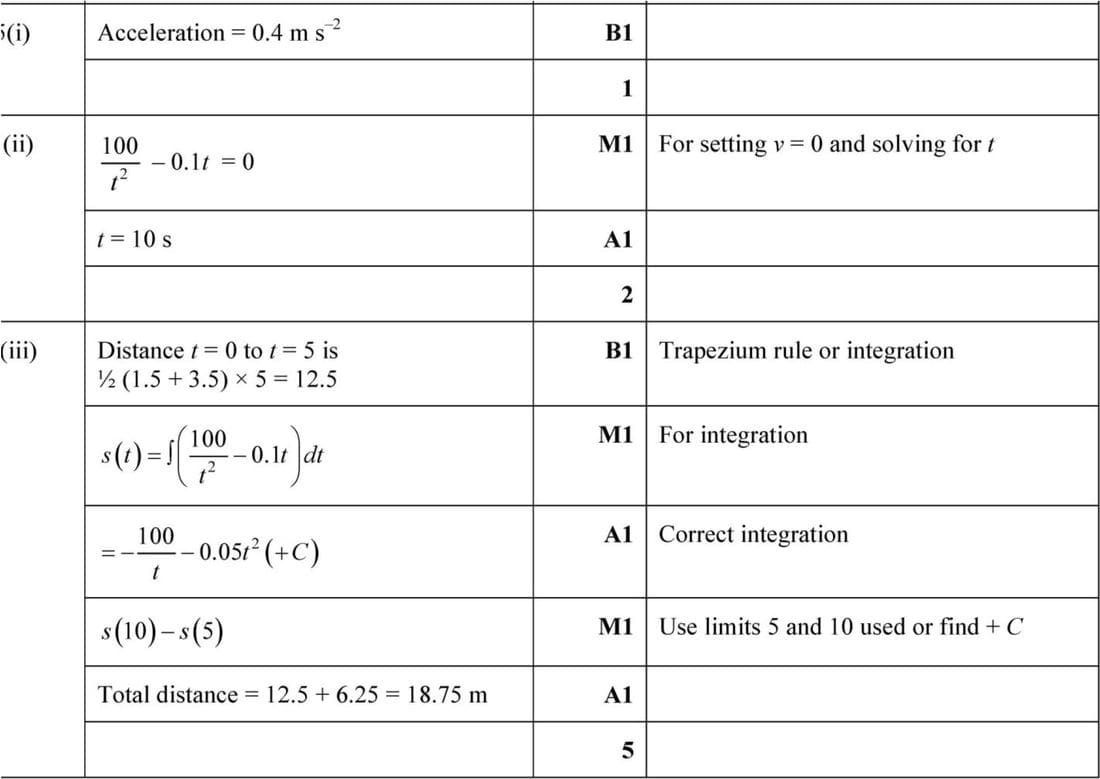
\(v = 1.5 + 0.4t \quad \text{for} \quad 0 \leq t \leq 5,\)
\(v = \frac{100}{t^2} - 0.1t \quad \text{for} \quad t \geq 5.\)
- Find the acceleration of the particle during the first 5 seconds of motion.
- Find the value of t when the particle is instantaneously at rest.
- Find the total distance travelled by the particle in the first 10 seconds of motion.
June 2017 p43 q4
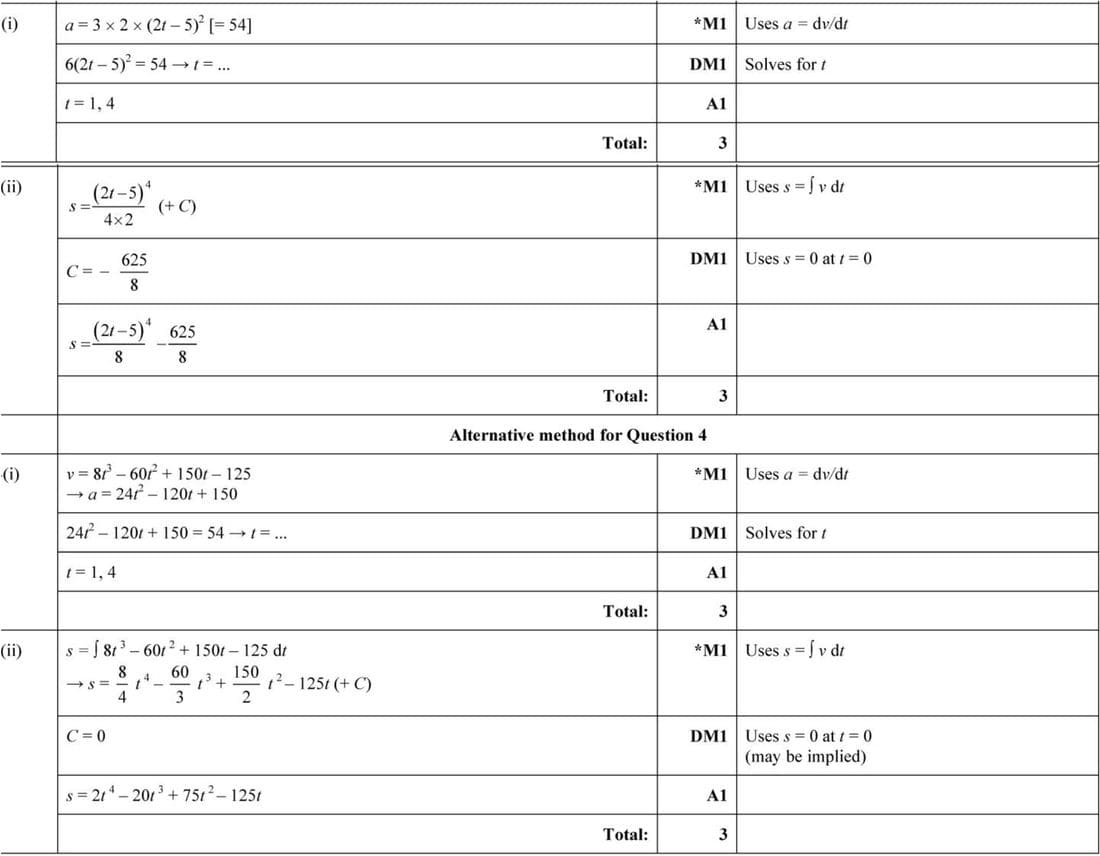
A particle P moves in a straight line starting from a point O. At time t s after leaving O, the velocity, v m s-1, of P is given by v = (2t - 5)^3.
- Find the values of t when the acceleration of P is 54 m s-2.
- Find an expression for the displacement of P from O at time t s.
June 2017 p41 q6
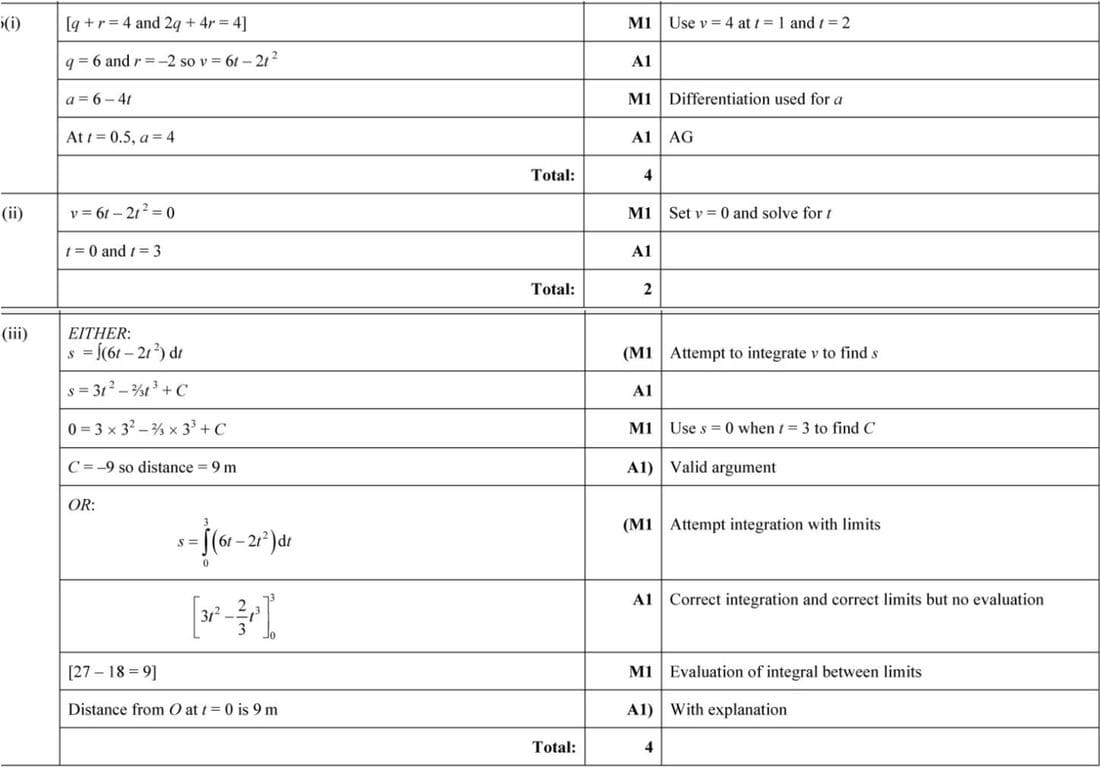
A particle P moves in a straight line passing through a point O. At time t s, the velocity of P, v m s-1, is given by v = qt + rt2, where q and r are constants. The particle has velocity 4 m s-1 when t = 1 and when t = 2.
- Show that, when t = 0.5, the acceleration of P is 4 m s-2.
- Find the values of t when P is at instantaneous rest.
- The particle is at O when t = 3. Find the distance of P from O when t = 0.
Nov 2016 p42 q2
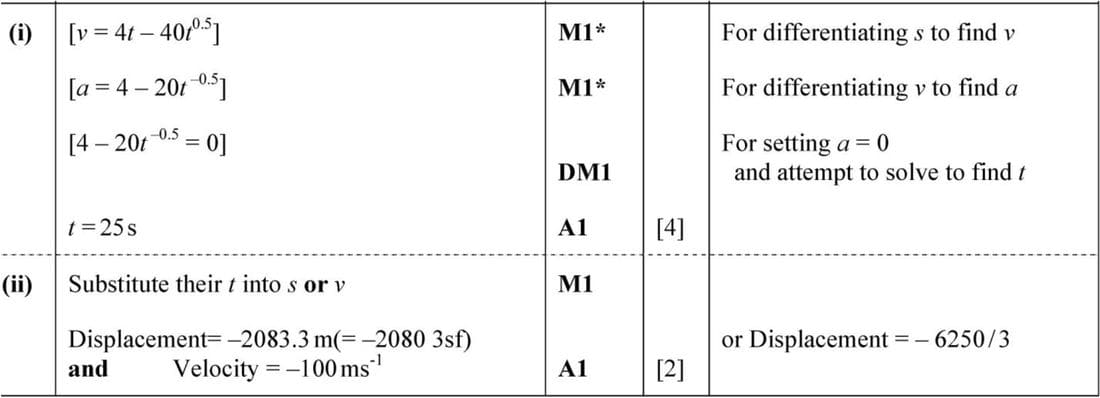
A particle moves in a straight line. Its displacement t s after leaving a fixed point O on the line is s m, where \(s = 2t^2 - \frac{80}{3}t^{3/2}\).
- Find the time at which the acceleration of the particle is zero.
- Find the displacement and velocity of the particle at this instant.
Nov 2016 p41 q7
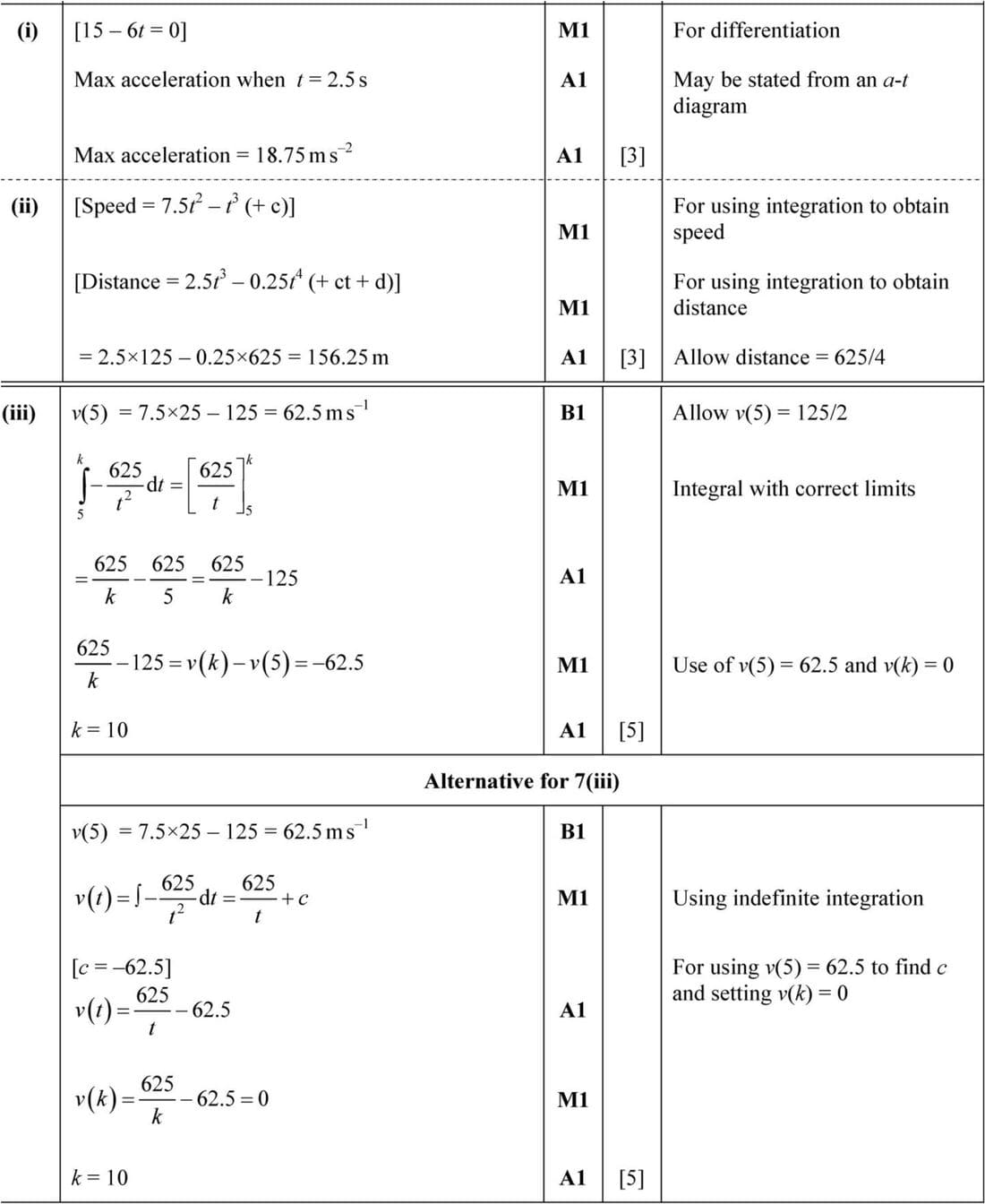
A racing car is moving in a straight line. The acceleration \(a\) m s\(^{-2}\) at time \(t\) s after the car starts from rest is given by
\(a = 15t - 3t^2 \quad \text{for} \; 0 \leq t \leq 5,\)
\(a = -\frac{625}{t^2} \quad \text{for} \; 5 < t \leq k,\)
where \(k\) is a constant.
- Find the maximum acceleration of the car in the first five seconds of its motion. [3]
- Find the distance of the car from its starting point when \(t = 5\). [3]
- The car comes to rest when \(t = k\). Find the value of \(k\). [5]
June 2016 p43 q7
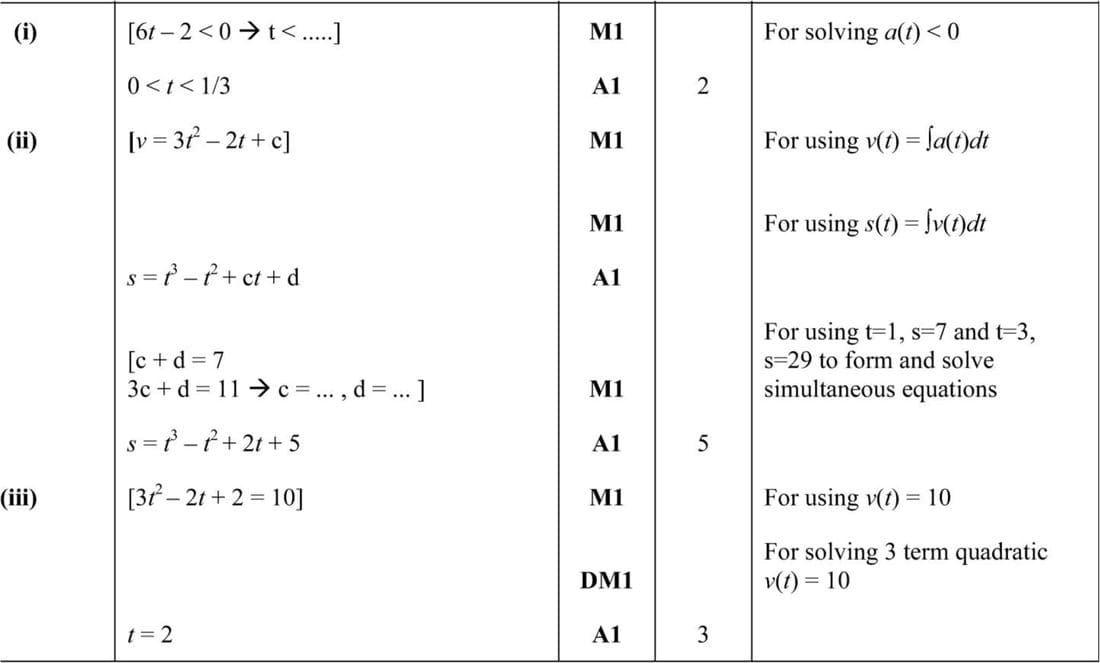
A particle P moves in a straight line. At time t s, the displacement of P from O is s m and the acceleration of P is a m s-2, where a = 6t - 2. When t = 1, s = 7 and when t = 3, s = 29.
- Find the set of values of t for which the particle is decelerating.
- Find s in terms of t.
- Find the time when the velocity of the particle is 10 m s-1.
June 2016 p42 q2
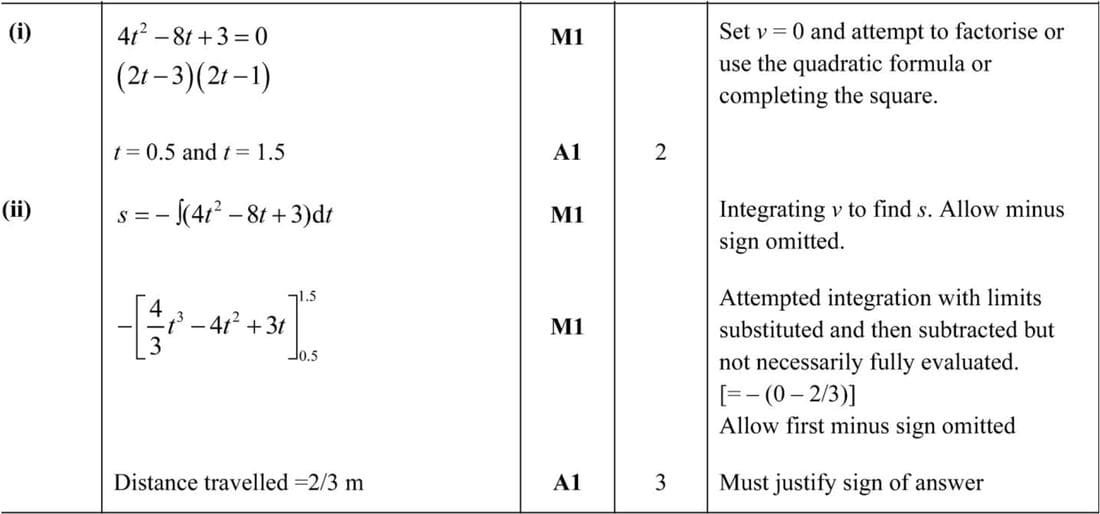
A particle P moves in a straight line, starting from a point O. At time t s after leaving O, the velocity of P, v m s-1, is given by v = 4t2 - 8t + 3.
- Find the two values of t at which P is at instantaneous rest.
- Find the distance travelled by P between these two times.
June 2023 p42 q6
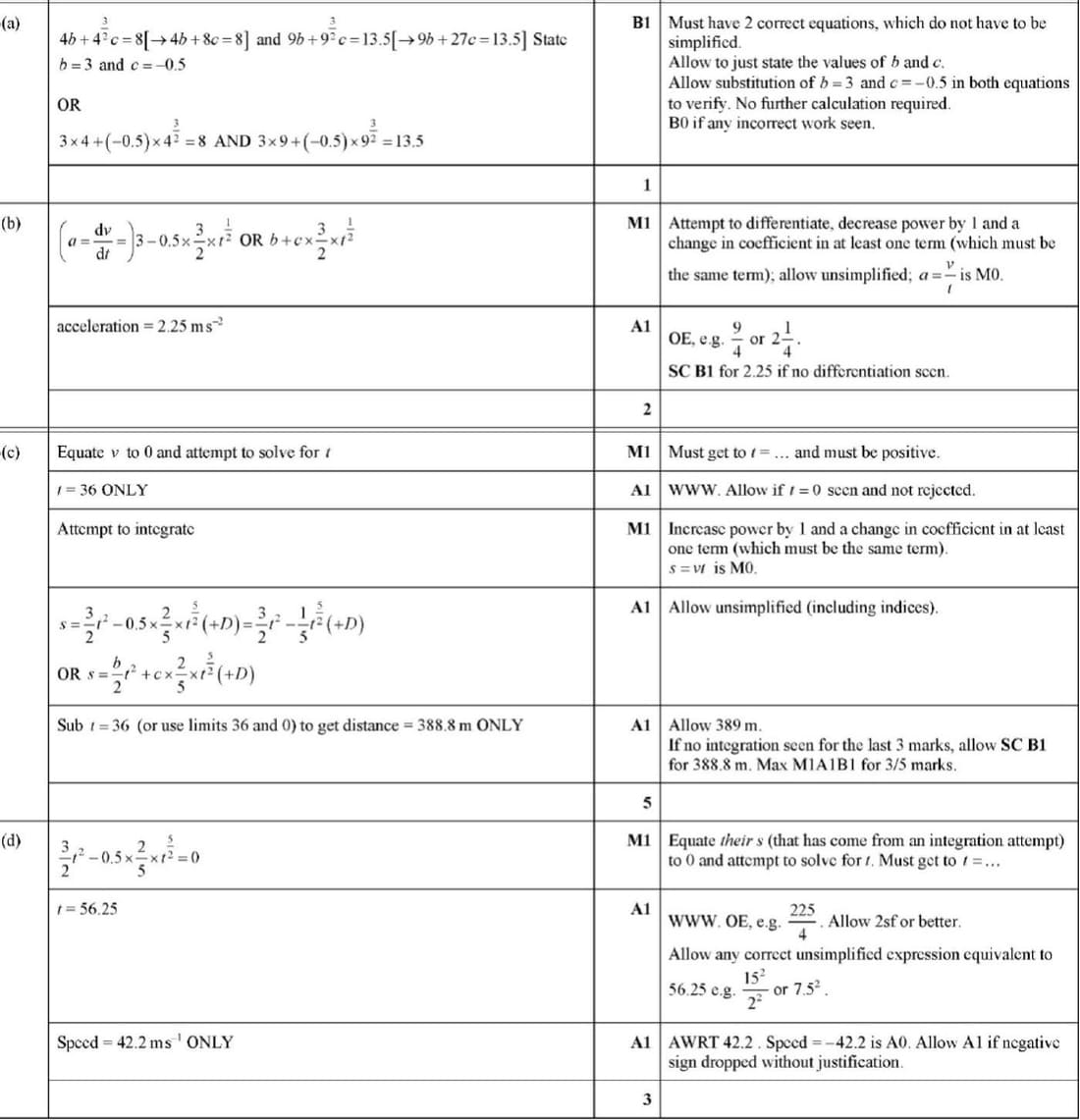
A particle P starts at rest and moves in a straight line from a point O. At time t s after leaving O, the velocity of P, v m/s, is given by \(v = bt + ct^{\frac{3}{2}}\), where b and c are constants. P has velocity 8 m/s when \(t = 4\) and has velocity 13.5 m/s when \(t = 9\).
- Show that \(b = 3\) and \(c = -0.5\).
- Find the acceleration of P when \(t = 1\).
- Find the positive value of t when P is at instantaneous rest and find the distance of P from O at this instant.
- Find the speed of P at the instant it returns to O.
June 2016 p41 q6
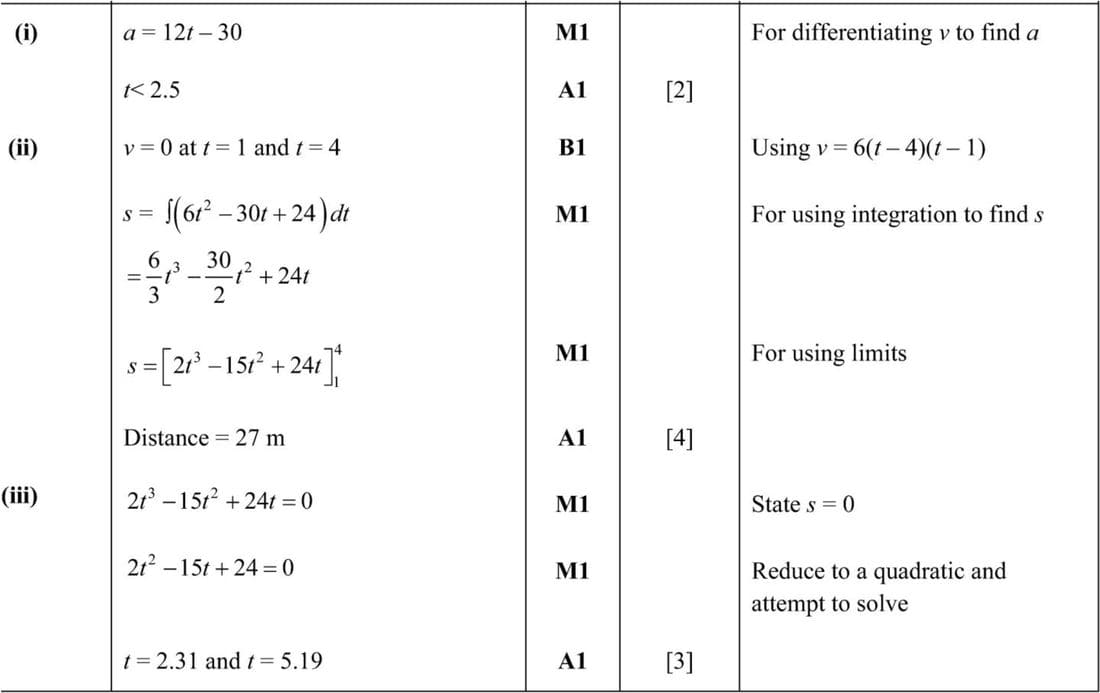
A particle P moves in a straight line. It starts at a point O on the line and at time t s after leaving O it has a velocity v m s-1, where v = 6t^2 - 30t + 24.
- Find the set of values of t for which the acceleration of the particle is negative.
- Find the distance between the two positions at which P is at instantaneous rest.
- Find the two positive values of t at which P passes through O.
Nov 2015 p43 q6
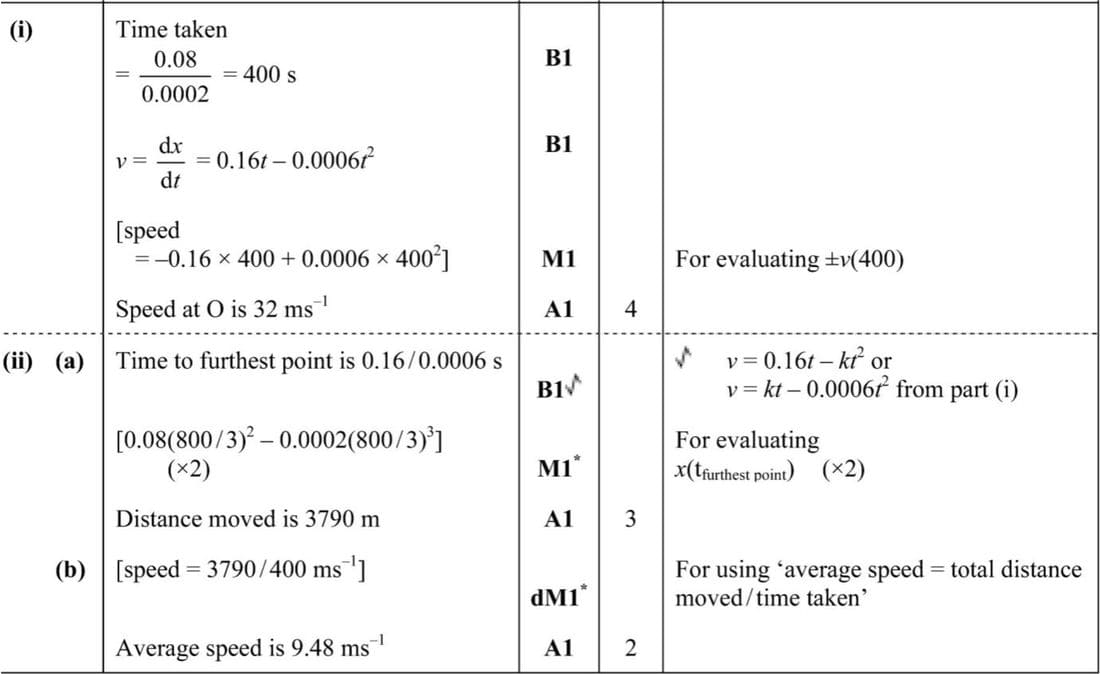
A particle P starts from rest at a point O of a straight line and moves along the line. The displacement of the particle at time t s after leaving O is x m, where
\(x = 0.08t^2 - 0.0002t^3\).
- Find the value of t when P returns to O and find the speed of P as it passes through O on its return.
- For the motion of P until the instant it returns to O, find
- the total distance travelled,
- the average speed.
Nov 2015 p42 q3
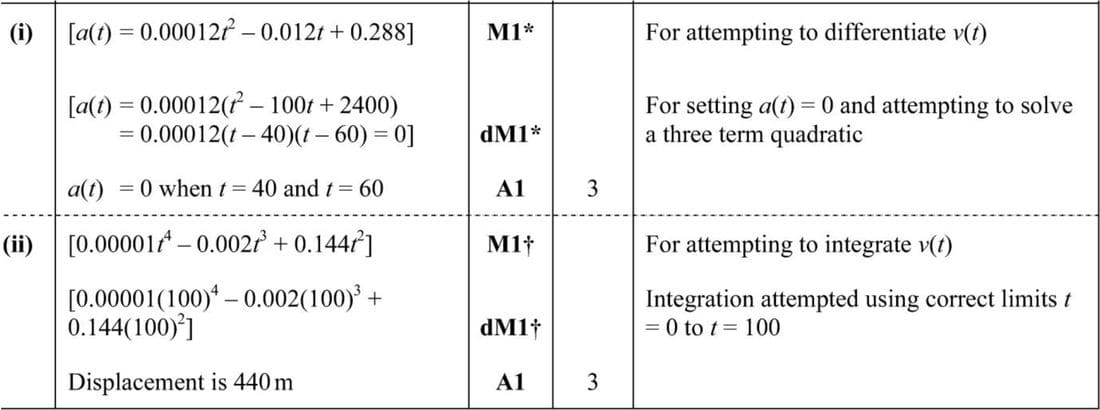
A particle P moves along a straight line for 100 s. It starts at a point O and at time t seconds after leaving O the velocity of P is v m/s, where
\(v = 0.00004t^3 - 0.006t^2 + 0.288t\).
- Find the values of t at which the acceleration of P is zero.
- Find the displacement of P from O when t = 100.
Nov 2015 p41 q6
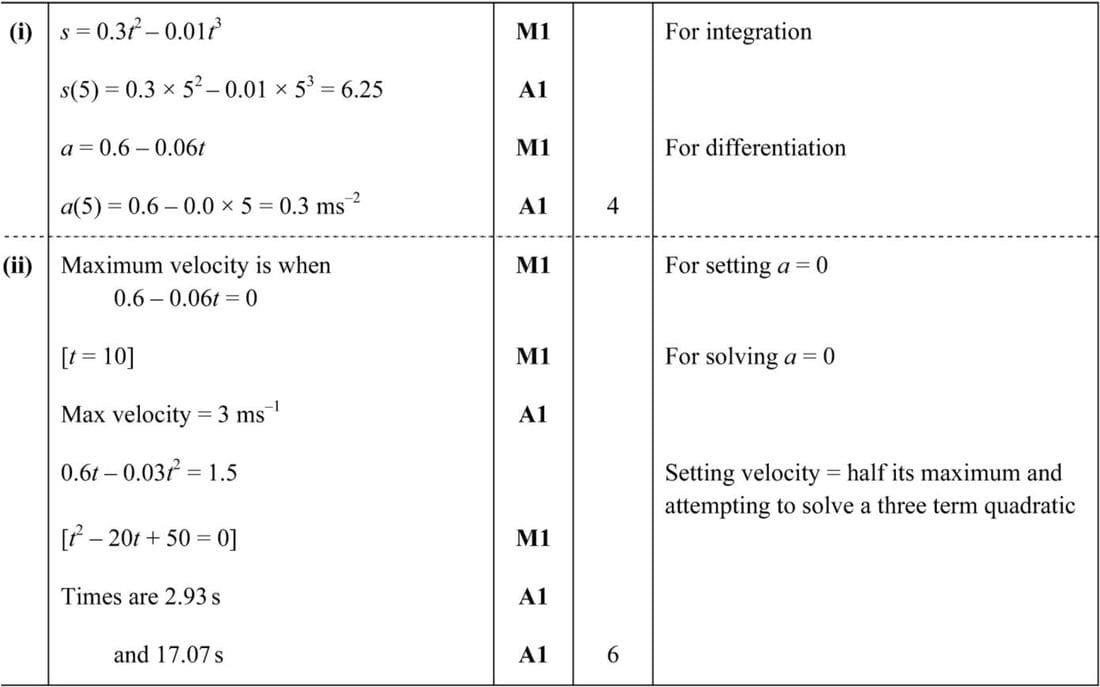
A particle P moves in a straight line, starting from a point O. The velocity of P, measured in m s-1, at time t s after leaving O is given by
\(v = 0.6t - 0.03t^2\).
- Verify that, when \(t = 5\), the particle is 6.25 m from O. Find the acceleration of the particle at this time.
- Find the values of \(t\) at which the particle is travelling at half of its maximum velocity.
June 2015 p42 q4
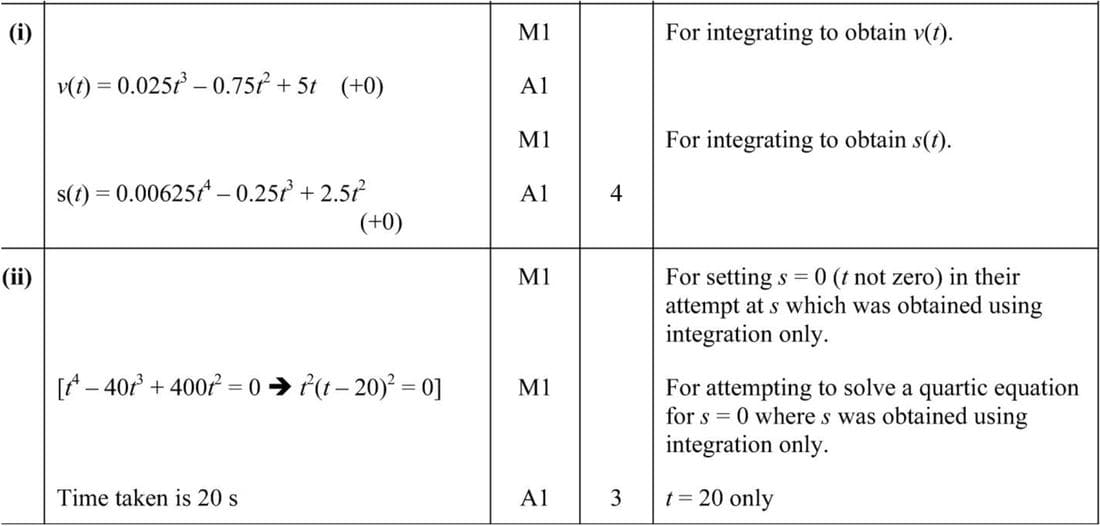
A particle P moves in a straight line. At time t seconds after starting from rest at the point O on the line, the acceleration of P is a m/s2, where a = 0.075t2 - 1.5t + 5.
- Find an expression for the displacement of P from O in terms of t.
- Hence find the time taken for P to return to the point O.
Nov 2014 p43 q4
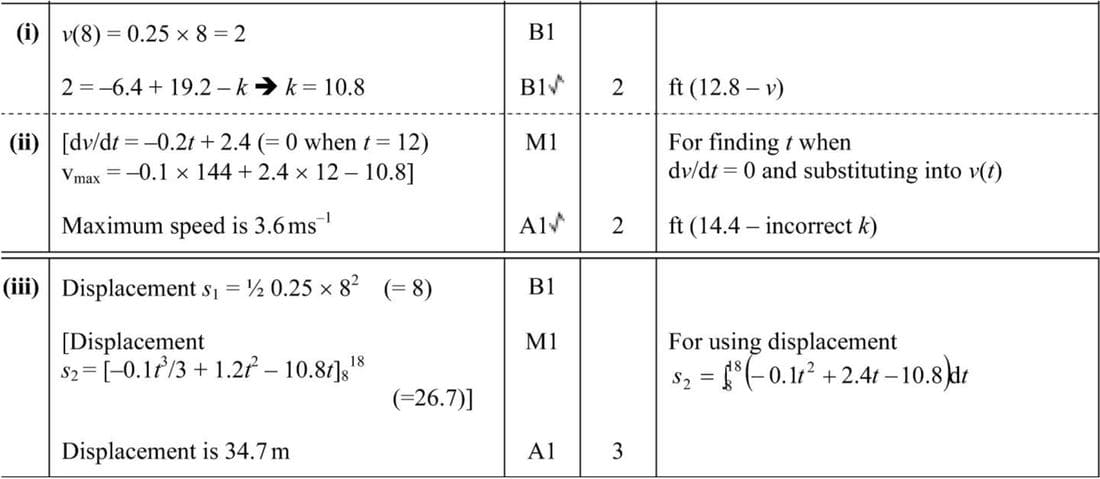
A particle P starts from rest and moves in a straight line for 18 seconds. For the first 8 seconds of the motion P has constant acceleration 0.25 m/s2. Subsequently P's velocity, v m/s-1 at time t seconds after the motion started, is given by
\(v = -0.1t^2 + 2.4t - k\),
where \(8 \leq t \leq 18\) and \(k\) is a constant.
- Find the value of \(v\) when \(t = 8\) and hence find the value of \(k\).
- Find the maximum velocity of P.
- Find the displacement of P from its initial position when \(t = 18\).
Nov 2014 p42 q7
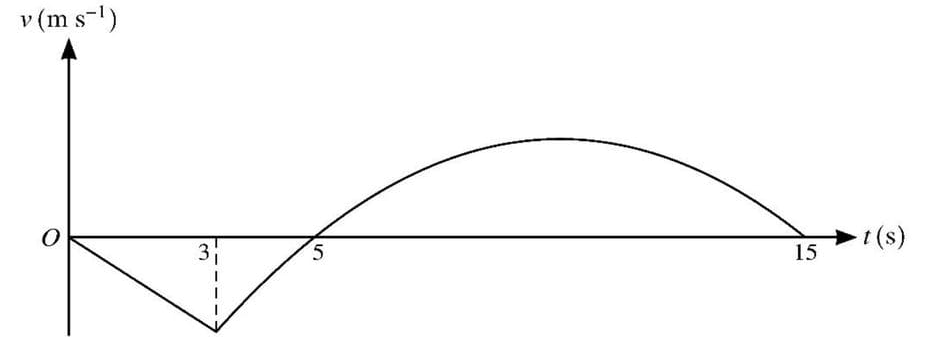
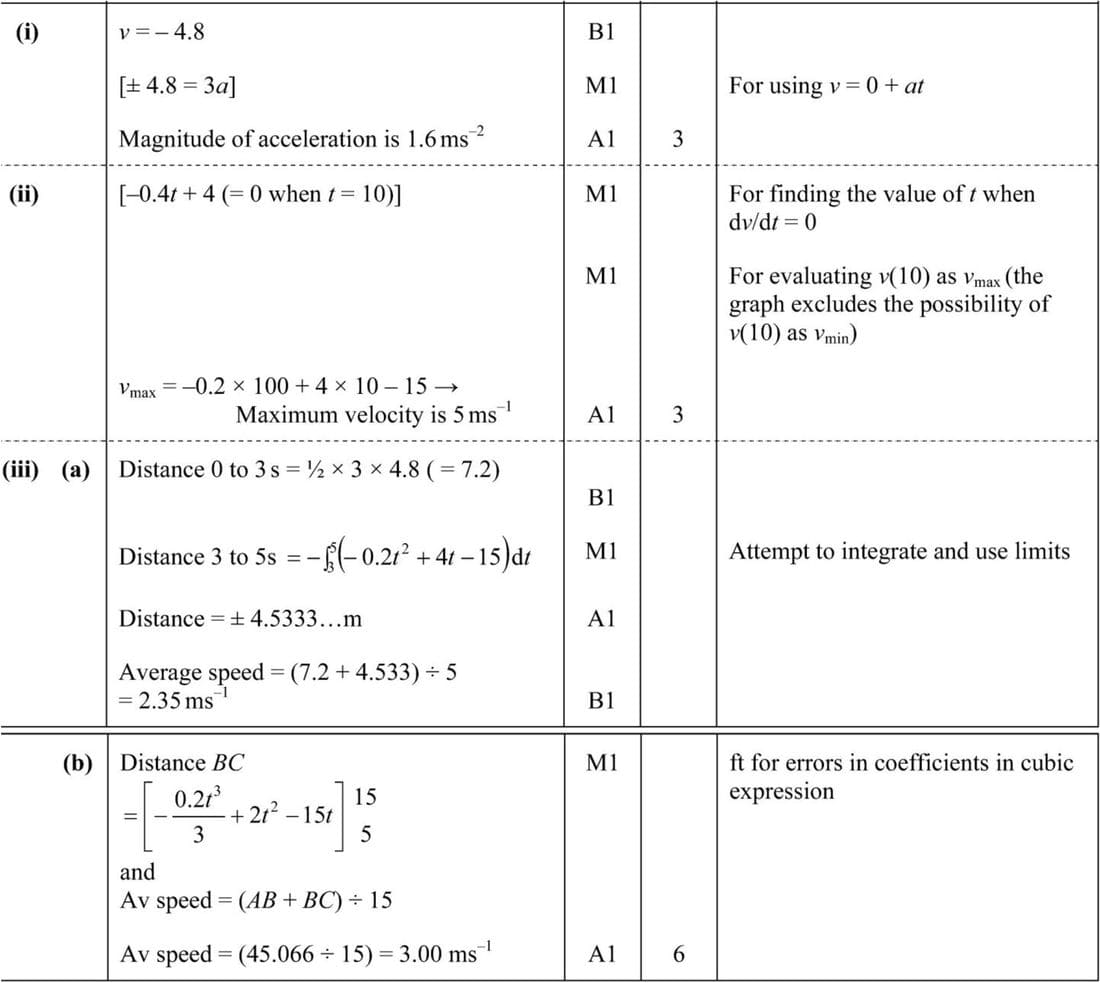
The diagram shows the velocity-time graph for the motion of a particle P which moves on a straight line BAC. It starts at A and travels to B taking 5 s. It then reverses direction and travels from B to C taking 10 s. For the first 3 s of P's motion its acceleration is constant. For the remaining 12 s the velocity of P is v m s-1 at time t s after leaving A, where
\(v = -0.2t^2 + 4t - 15\) for \(3 \leq t \leq 15\).
- Find the value of v when t = 3 and the magnitude of the acceleration of P for the first 3 s of its motion.
- Find the maximum velocity of P while it is moving from B to C.
- Find the average speed of P,
- while moving from A to B,
- for the whole journey.
June 2014 p42 q4
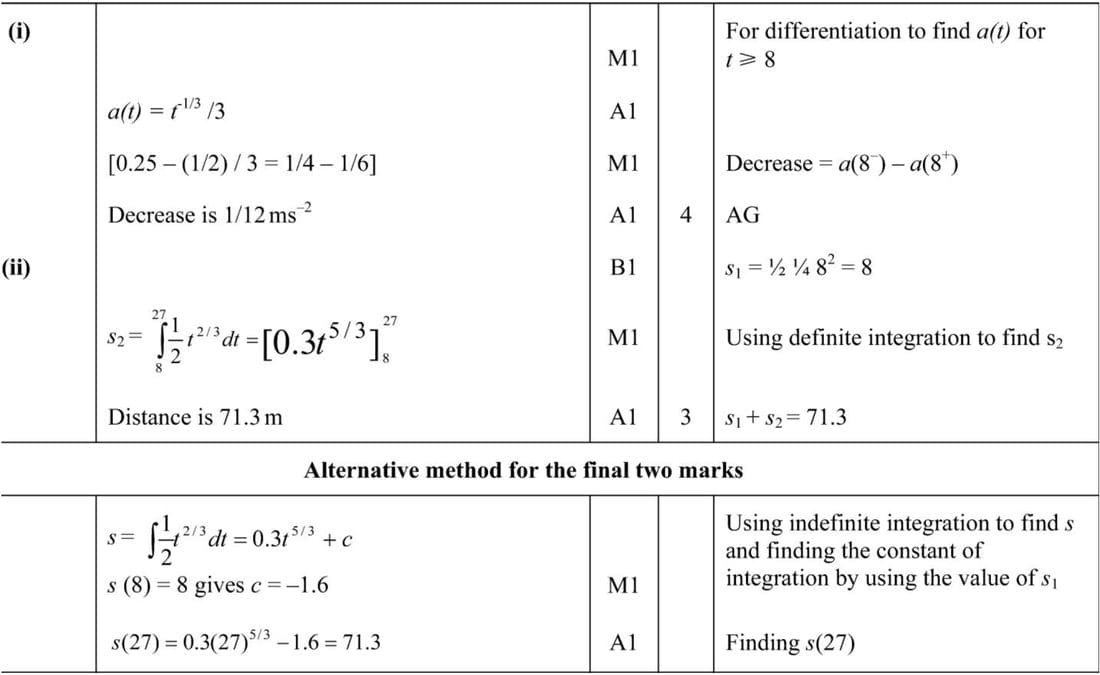
A particle P moves on a straight line, starting from rest at a point O of the line. The time after P starts to move is t s, and the particle moves along the line with constant acceleration \(\frac{1}{4} \text{ m s}^{-2}\) until it passes through a point A at time \(t = 8\). After passing through A the velocity of P is \(\frac{1}{2} t^{2/3} \text{ m s}^{-1}\).
- Find the acceleration of P immediately after it passes through A. Hence show that the acceleration of P decreases by \(\frac{1}{12} \text{ m s}^{-2}\) as it passes through A.
- Find the distance moved by P from \(t = 0\) to \(t = 27\).
Nov 2013 p43 q7
A vehicle starts from rest at a point O and moves in a straight line. Its speed \(v\) m s\(^{-1}\) at time \(t\) seconds after leaving O is defined as follows.
For \(0 \leq t \leq 60\), \(v = k_1 t - 0.005t^2\),
for \(t \geq 60\), \(v = \frac{k_2}{\sqrt{t}}\).
The distance travelled by the vehicle during the first 60 s is 540 m.
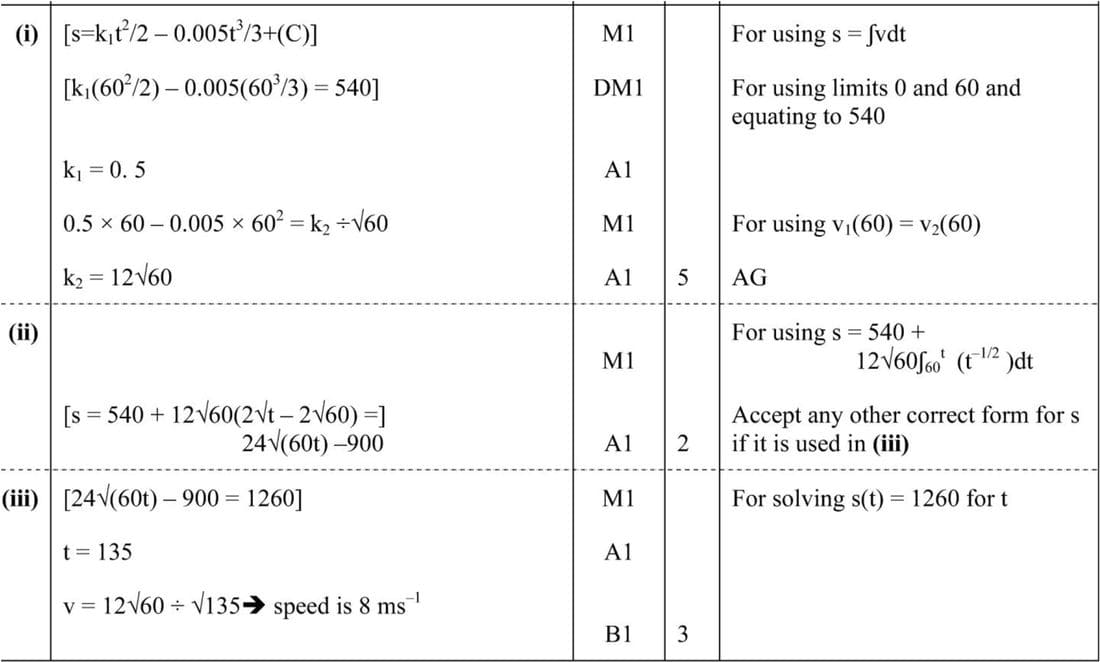
- Find the value of the constant \(k_1\) and show that \(k_2 = 12\sqrt{60}\).
- Find an expression in terms of \(t\) for the total distance travelled when \(t \geq 60\).
- Find the speed of the vehicle when it has travelled a total distance of 1260 m.
Nov 2013 p42 q5
A particle P moves in a straight line. P starts from rest at O and travels to A where it comes to rest, taking 50 seconds. The speed of P at time t seconds after leaving O is v m/s-1, where v is defined as follows.
\(For 0 ≤ t ≤ 5, v = t - 0.1t2,\)
for 5 ≤ t ≤ 45, v is constant,
\(for 45 ≤ t ≤ 50, v = 9t - 0.1t2 - 200.\)
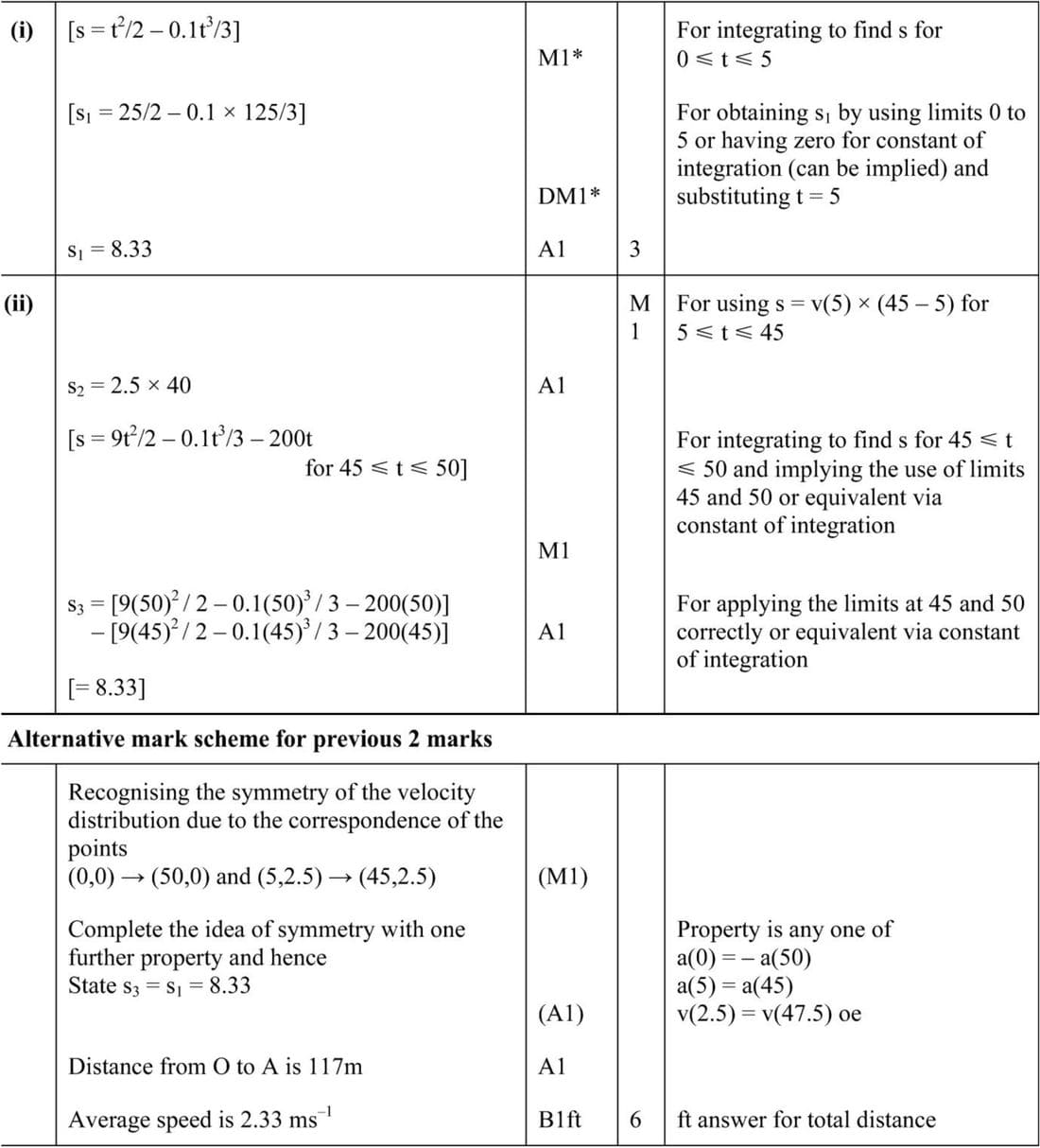
(i) Find the distance travelled by P in the first 5 seconds.
(ii) Find the total distance from O to A, and deduce the average speed of P for the whole journey from O to A.
June 2023 p41 q3
A particle moves in a straight line starting from rest. The displacement s m of the particle from a fixed point O on the line at time t s is given by
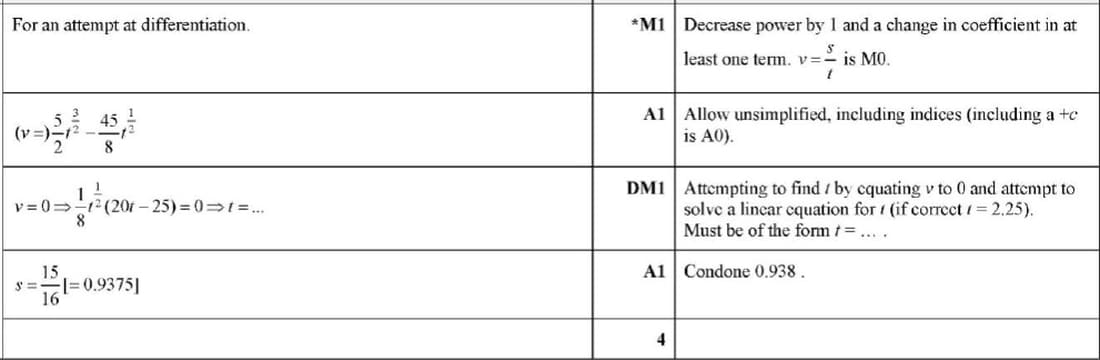
\(s = t^{\frac{5}{2}} - \frac{15}{4} t^{\frac{3}{2}} + 6\).
Find the value of s when the particle is again at rest.
Nov 2013 p41 q7
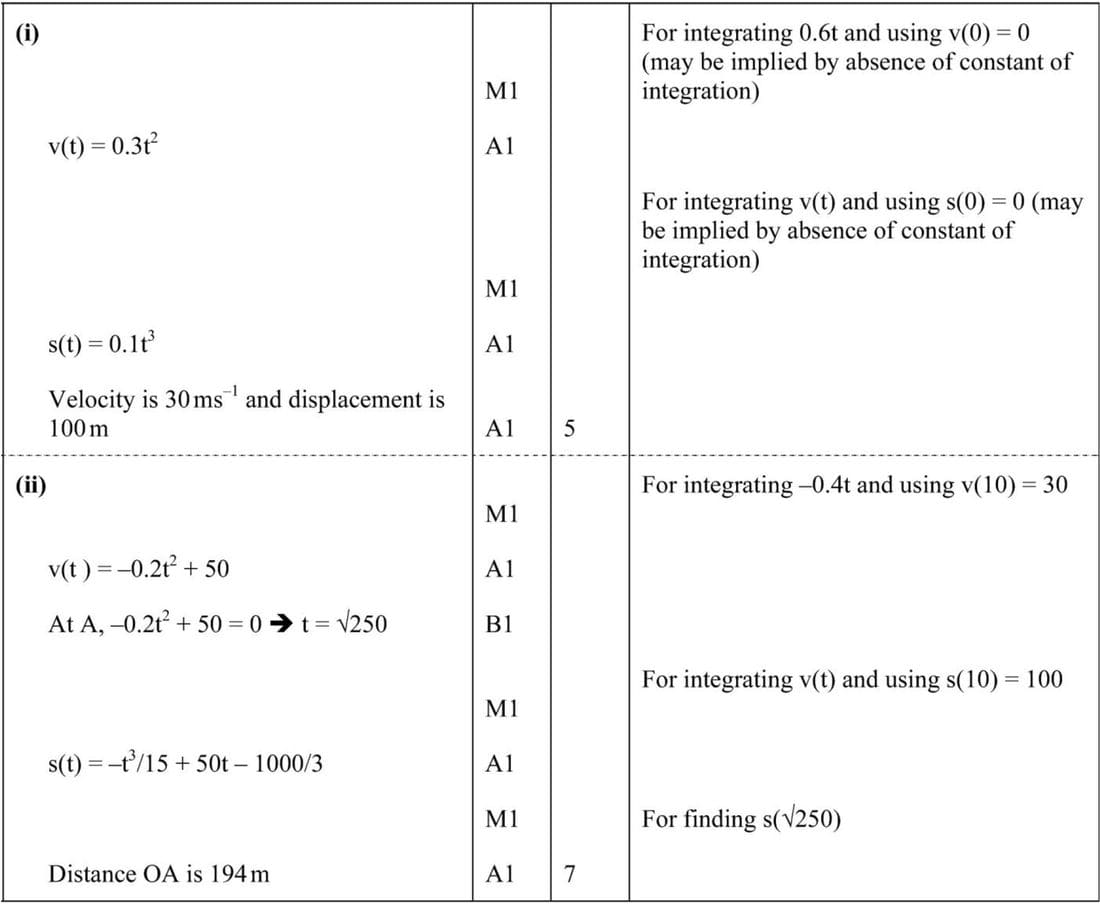
A particle P starts from rest at a point O and moves in a straight line. P has acceleration 0.6t m s−2 at time t seconds after leaving O, until t = 10.
- Find the velocity and displacement from O of P when t = 10.
\(After t = 10, P has acceleration −0.4t m s−2 until it comes to rest at a point A.\)
- Find the distance OA.
June 2013 p43 q4
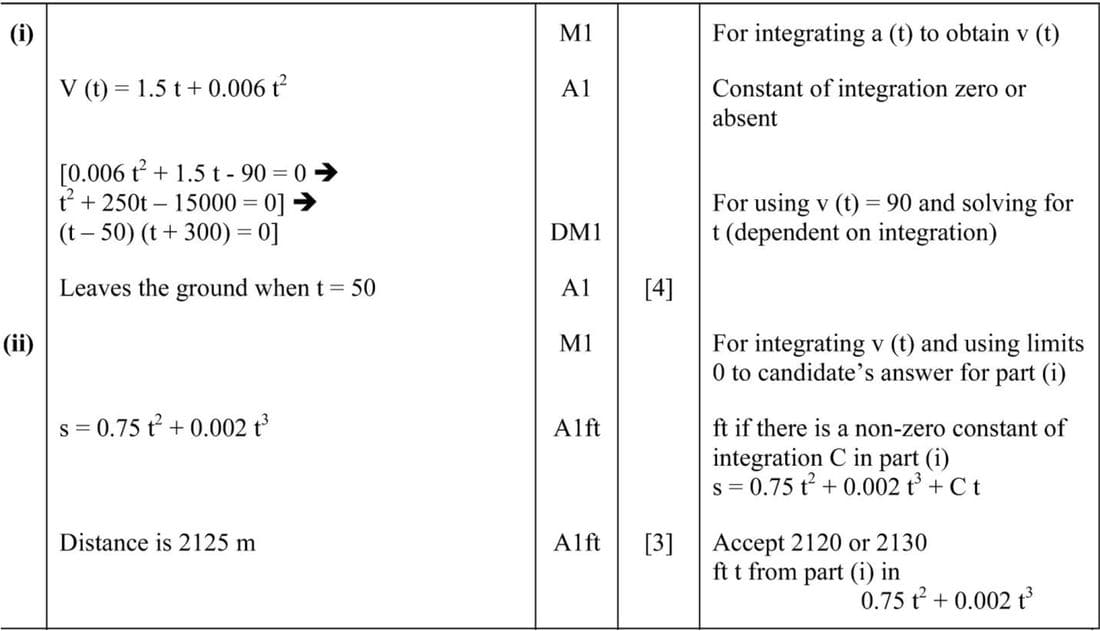
An aeroplane moves along a straight horizontal runway before taking off. It starts from rest at O and has speed 90 m s-1 at the instant it takes off. While the aeroplane is on the runway at time t seconds after leaving O, its acceleration is (1.5 + 0.012t) m s-2. Find
- the value of t at the instant the aeroplane takes off,
- the distance travelled by the aeroplane on the runway.
Nov 2012 p43 q2
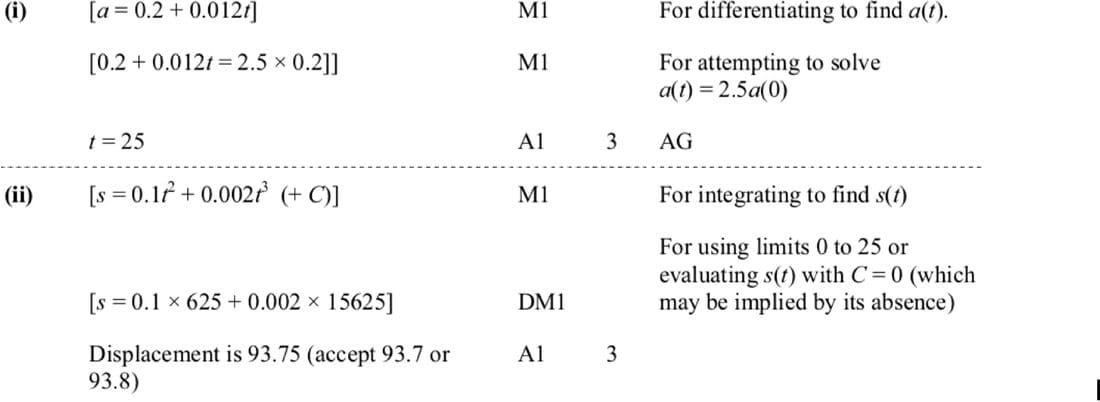
A particle moves in a straight line. Its velocity t seconds after leaving a fixed point O on the line is v m s-1, where v = 0.2t + 0.006t2. For the instant when the acceleration of the particle is 2.5 times its initial acceleration,
- show that t = 25,
- find the displacement of the particle from O.
Nov 2012 p42 q7
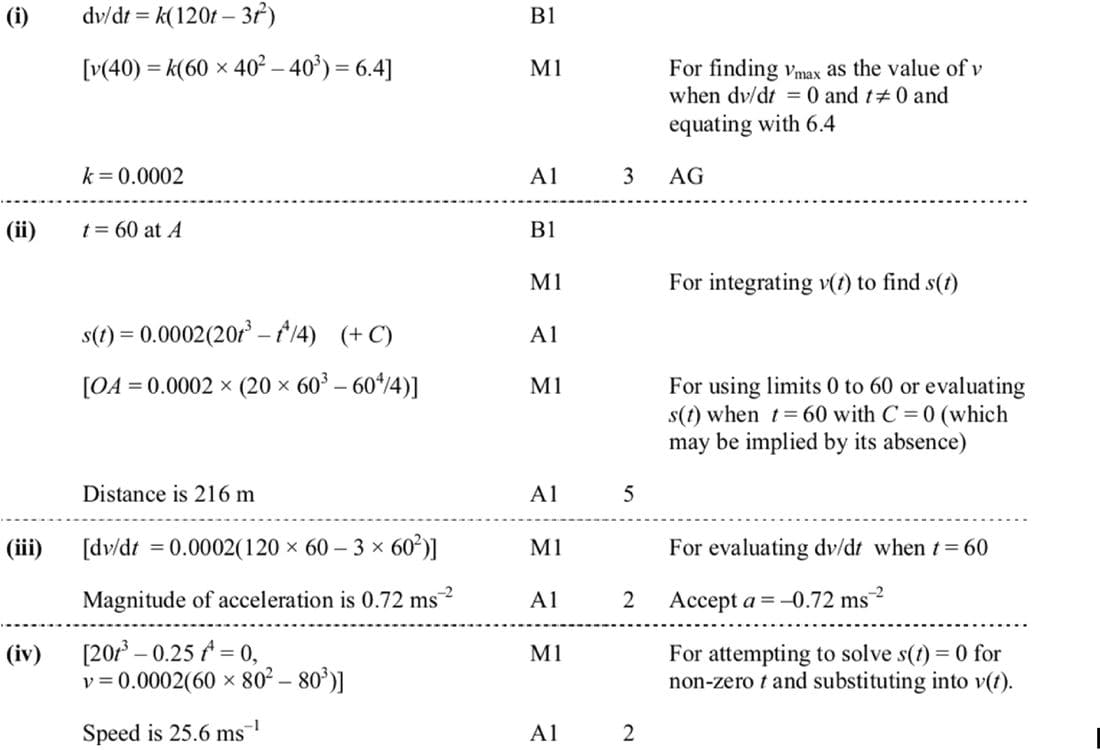
A particle P starts to move from a point O and travels in a straight line. The velocity of P is \(k(60t^2 - t^3)\) m s-1 at time t s after leaving O, where k is a constant. The maximum velocity of P is 6.4 m s-1.
- Show that \(k = 0.0002\).
P comes to instantaneous rest at a point A on the line. Find
- the distance OA,
- the magnitude of the acceleration of P at A,
- the speed of P when it subsequently passes through O.
Nov 2012 p42 q3
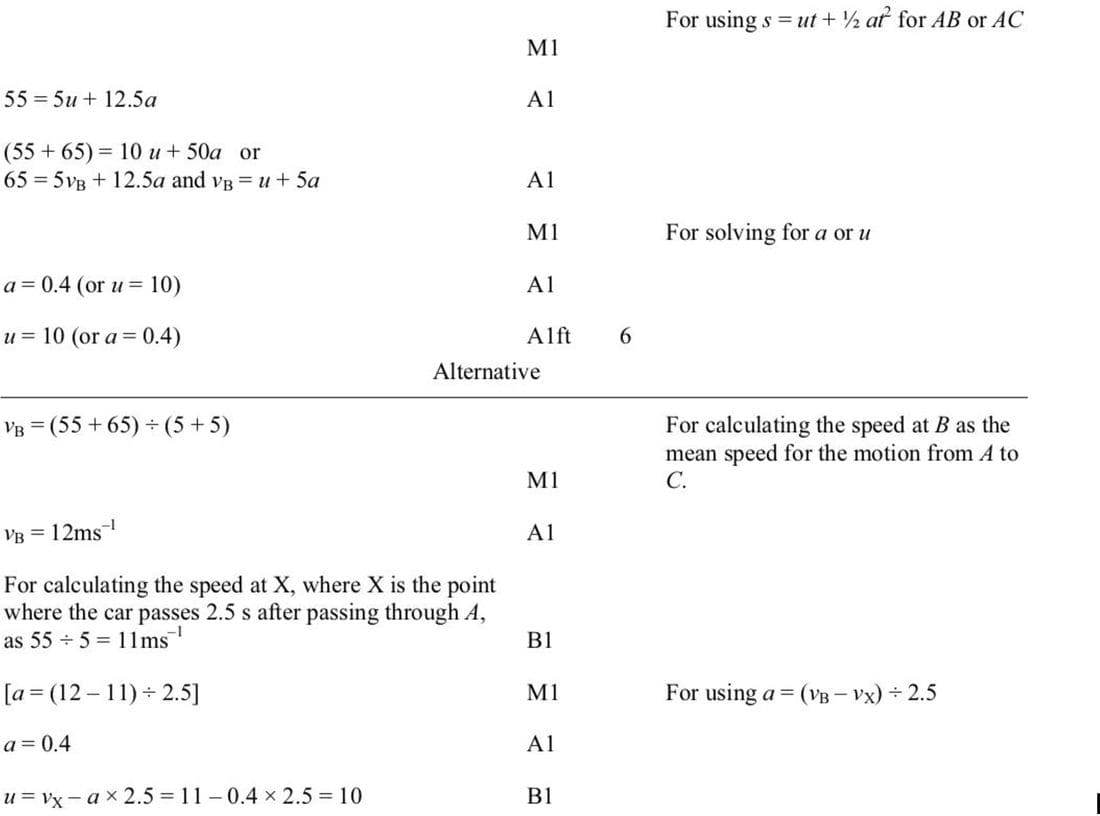
A car travels along a straight road with constant acceleration \(a \text{ m s}^{-2}\). It passes through points \(A, B\) and \(C\); the time taken from \(A\) to \(B\) and from \(B\) to \(C\) is 5 s in each case. The speed of the car at \(A\) is \(u \text{ m s}^{-1}\) and the distances \(AB\) and \(BC\) are 55 m and 65 m respectively. Find the values of \(a\) and \(u\).
June 2012 p43 q3
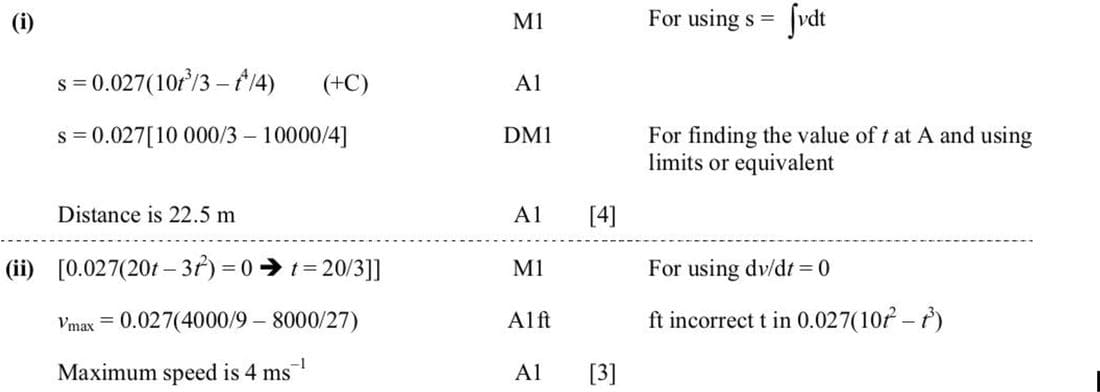
A particle P travels from a point O along a straight line and comes to instantaneous rest at a point A. The velocity of P at time t s after leaving O is v m s-1, where v = 0.027(10t2 - t3). Find
- the distance OA,
- the maximum velocity of P while moving from O to A.
June 2012 p42 q3
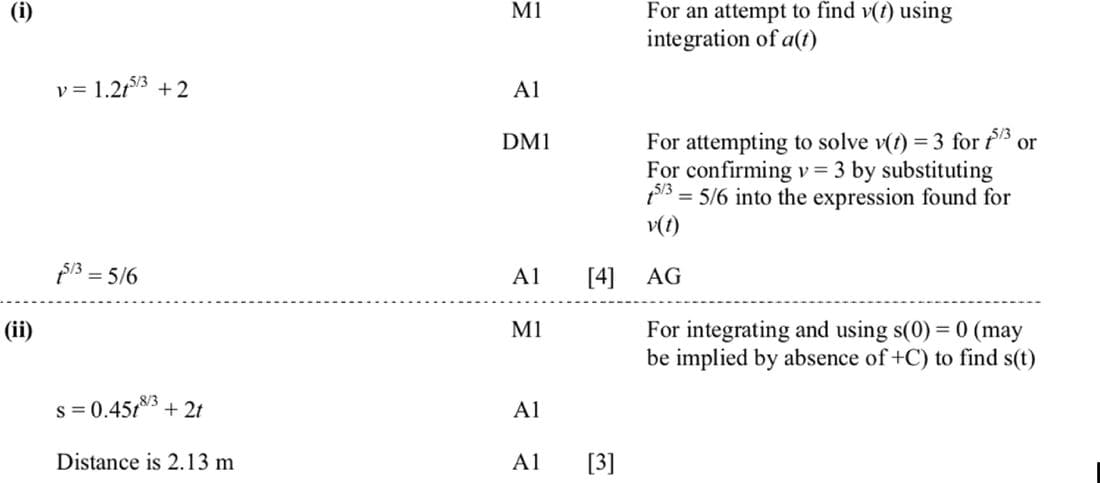
A particle P moves in a straight line, starting from the point O with velocity 2 m s-1. The acceleration of P at time t s after leaving O is 2t2/3 m s-2.
- Show that t5/3 = 5/6 when the velocity of P is 3 m s-1.
- Find the distance of P from O when the velocity of P is 3 m s-1.
June 2012 p41 q4
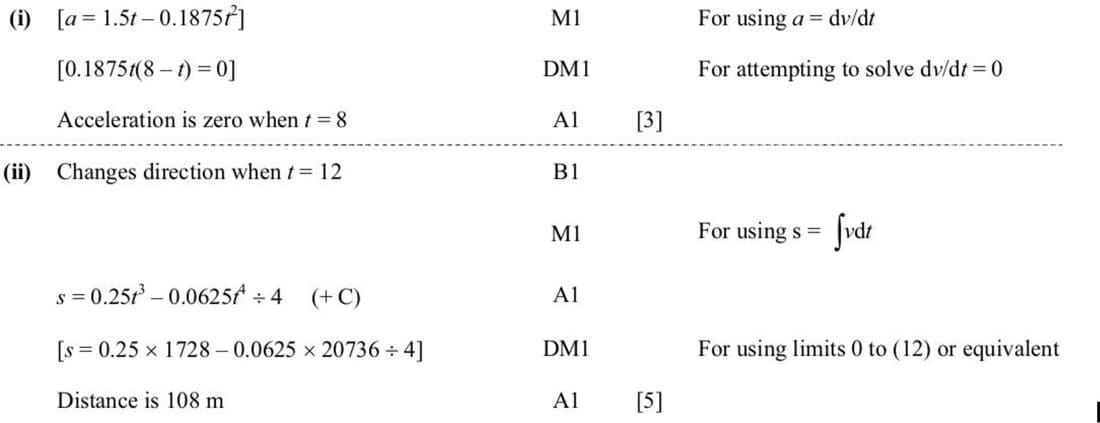
A particle P starts at the point O and travels in a straight line. At time t seconds after leaving O the velocity of P is v m s-1, where v = 0.75t2 - 0.0625t3. Find
- the positive value of t for which the acceleration is zero,
- the distance travelled by P before it changes its direction of motion.
Nov 2011 p43 q5
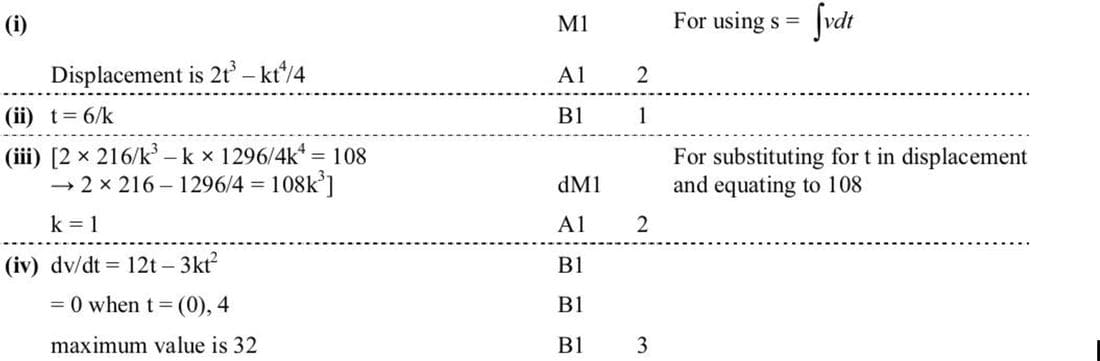
A particle P moves in a straight line. It starts from rest at A and comes to rest instantaneously at B. The velocity of P at time t seconds after leaving A is v m/s, where v = 6t^2 - kt^3 and k is a constant.
- Find an expression for the displacement of P from A in terms of t and k.
- Find an expression for t in terms of k when P is at B.
Given that the distance AB is 108 m, find
- the value of k,
- the maximum value of v when the particle is moving from A towards B.
Nov 2011 p42 q7
A tractor travels in a straight line from a point A to a point B. The velocity of the tractor is \(v \text{ m s}^{-1}\) at time \(t\) s after leaving A.
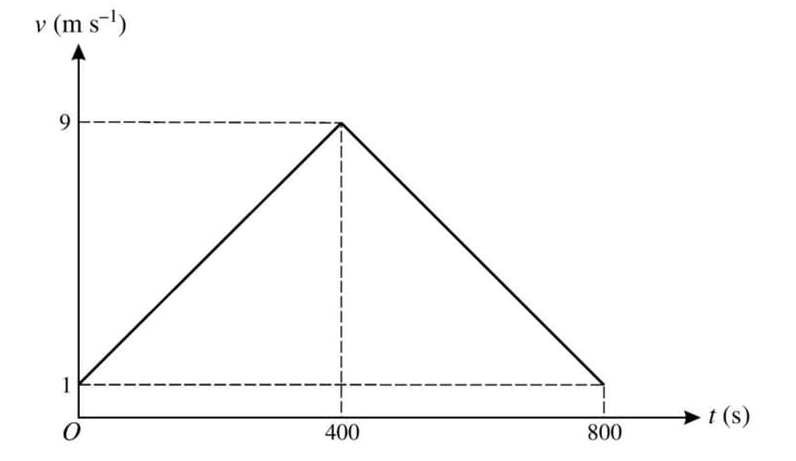
(i) The diagram shows an approximate velocity-time graph for the motion of the tractor. The graph consists of two straight line segments. Use the graph to find an approximation for
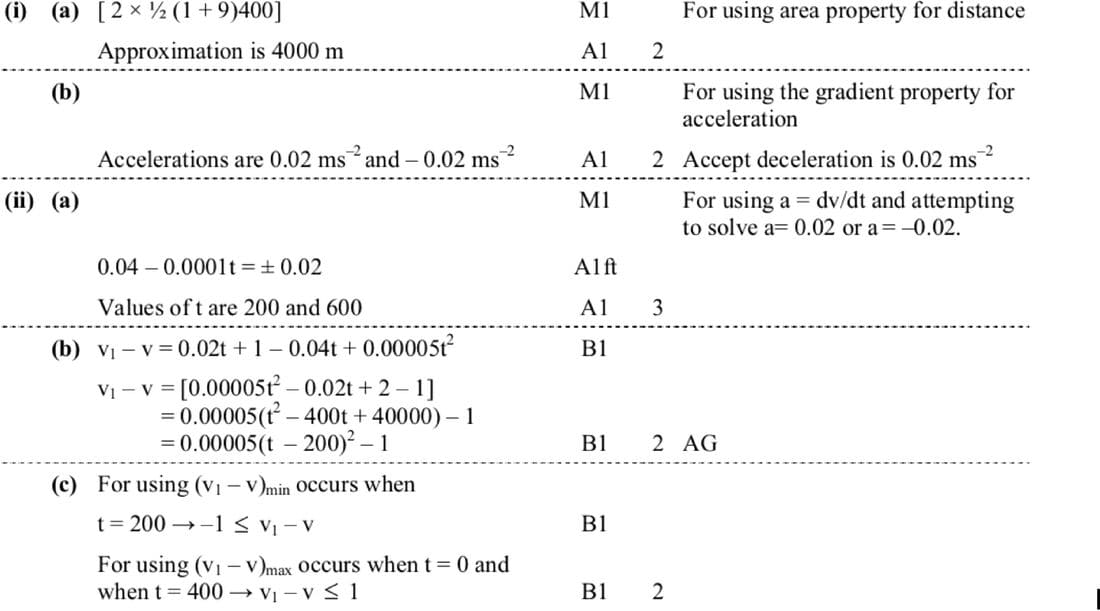
- the distance \(AB\),
- the acceleration of the tractor for \(0 < t < 400\) and for \(400 < t < 800\).
(ii) The actual velocity of the tractor is given by \(v = 0.04t - 0.00005t^2\) for \(0 \leq t \leq 800\).
- Find the values of \(t\) for which the actual acceleration of the tractor is given correctly by the approximate velocity-time graph in part (i).
For the interval \(0 \leq t \leq 400\), the approximate velocity of the tractor in part (i) is denoted by \(v_1 \text{ m s}^{-1}\).
- Express \(v_1\) in terms of \(t\) and hence show that \(v_1 - v = 0.00005(t - 200)^2 - 1\).
- Deduce that \(-1 \leq v_1 - v \leq 1\).
Feb/Mar 2023 p42 q3
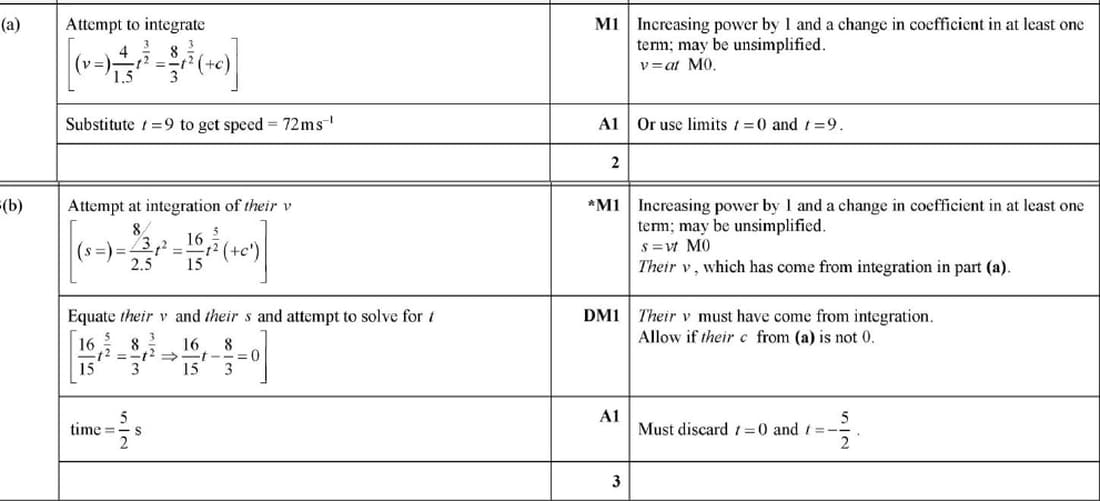
A particle moves in a straight line starting from rest from a point O. The acceleration of the particle at time t seconds after leaving O is a m/s2, where a = 4t^{\frac{1}{2}}.
\((a) Find the speed of the particle when t = 9.\)
(b) Find the time after leaving O at which the speed (in metres per second) and the distance travelled (in metres) are numerically equal.
Nov 2011 p42 q3
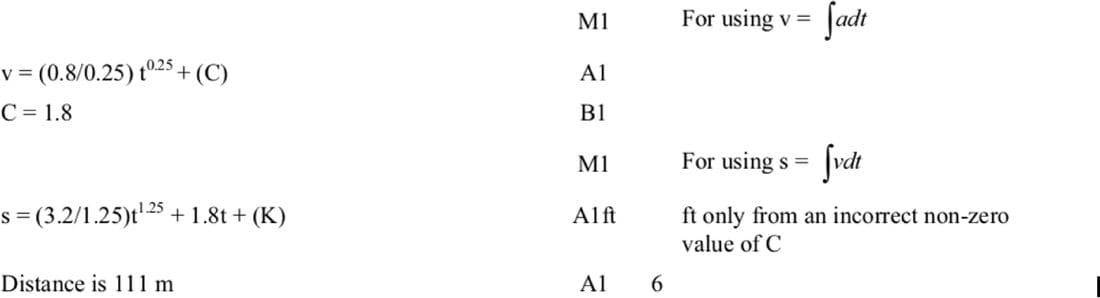
A particle P moves in a straight line. It starts from a point O on the line with velocity 1.8 m s-1. The acceleration of P at time t s after leaving O is 0.8t-0.75 m s-2. Find the displacement of P from O when t = 16.
Nov 2011 p41 q7
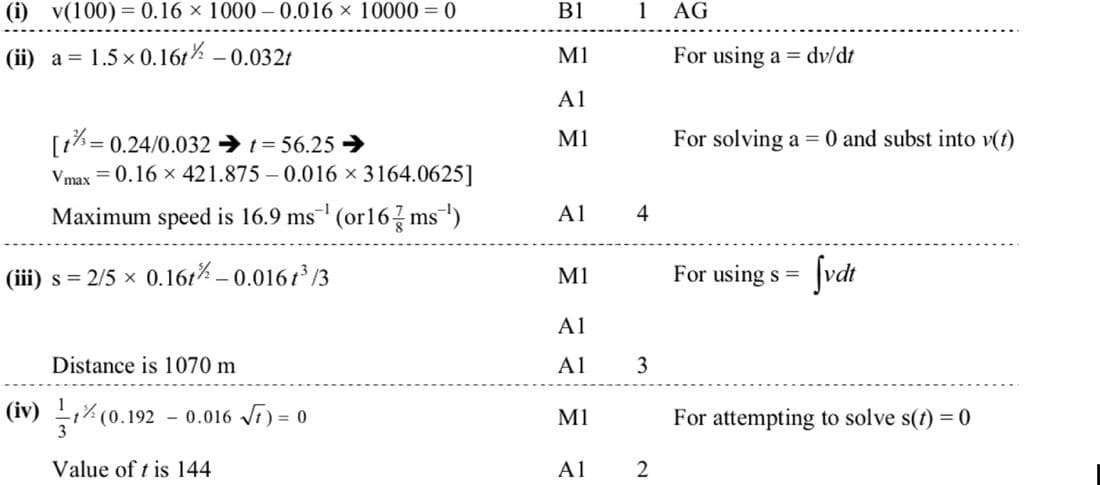
A particle P starts from a point O and moves along a straight line. P's velocity t s after leaving O is v m s-1, where
\(v = 0.16t^{\frac{3}{2}} - 0.016t^2\).
P comes to rest instantaneously at the point A.
- Verify that the value of t when P is at A is 100.
- Find the maximum speed of P in the interval \(0 < t < 100\).
- Find the distance OA.
- Find the value of t when P passes through O on returning from A.
June 2011 p43 q7
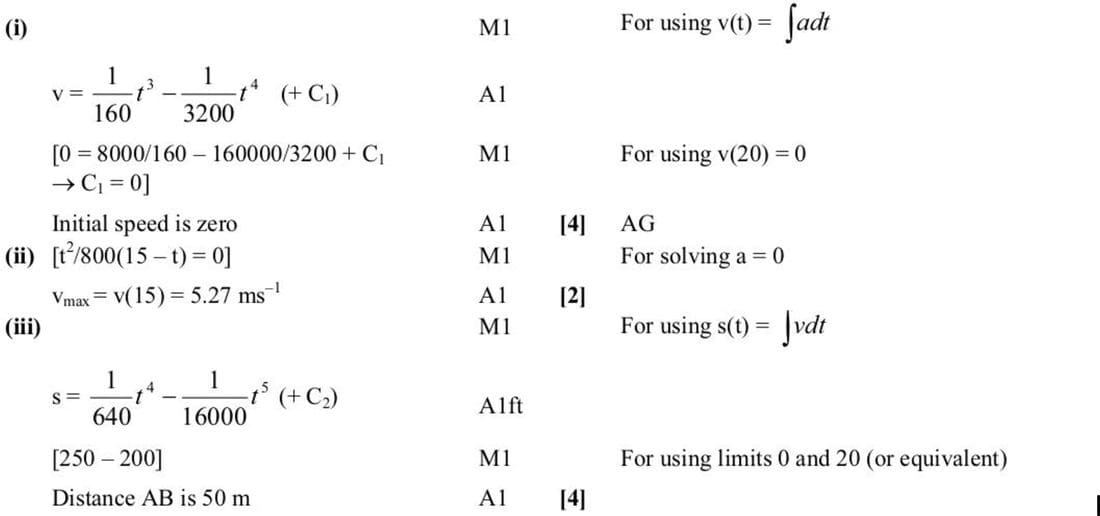
A particle travels in a straight line from A to B in 20 s. Its acceleration t seconds after leaving A is a m s-2, where a = \frac{3}{160}t^2 - \frac{1}{800}t^3. It is given that the particle comes to rest at B.
- Show that the initial speed of the particle is zero.
- Find the maximum speed of the particle.
- Find the distance AB.
June 2011 p41 q6
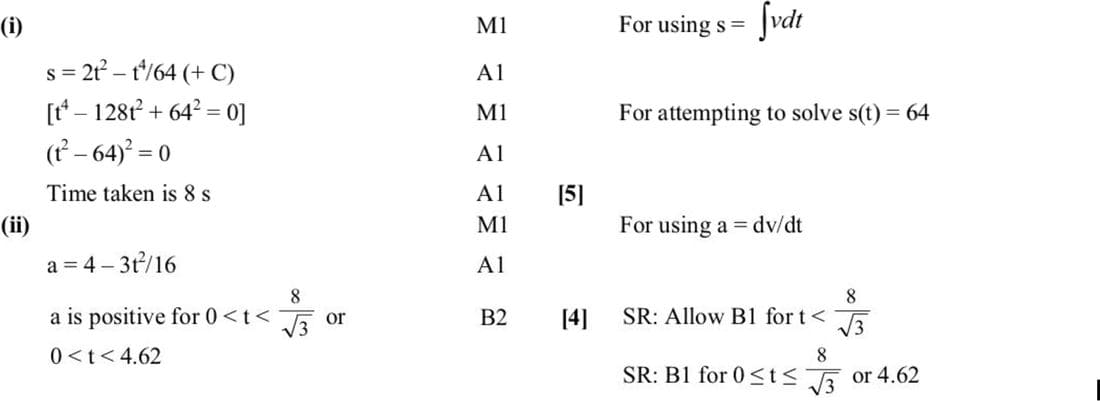
A particle travels in a straight line from a point P to a point Q. Its velocity t seconds after leaving P is v m s-1, where v = 4t - \frac{1}{16}t^3. The distance PQ is 64 m.
- Find the time taken for the particle to travel from P to Q.
- Find the set of values of t for which the acceleration of the particle is positive.
Nov 2010 p43 q6
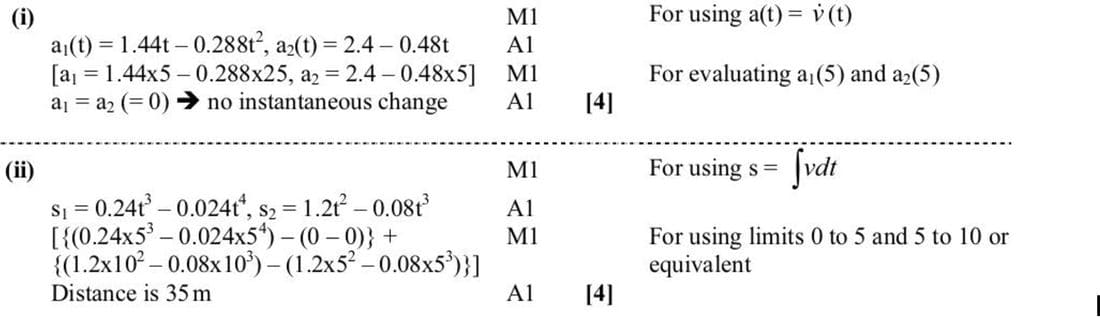
A particle travels along a straight line. It starts from rest at a point A on the line and comes to rest again, 10 seconds later, at another point B on the line. The velocity t seconds after leaving A is
\(0.72t^2 - 0.096t^3\) for \(0 \leq t \leq 5\),
\(2.4t - 0.24t^2\) for \(5 \leq t \leq 10\).
- Show that there is no instantaneous change in the acceleration of the particle when \(t = 5\).
- Find the distance \(AB\).
Nov 2010 p42 q7
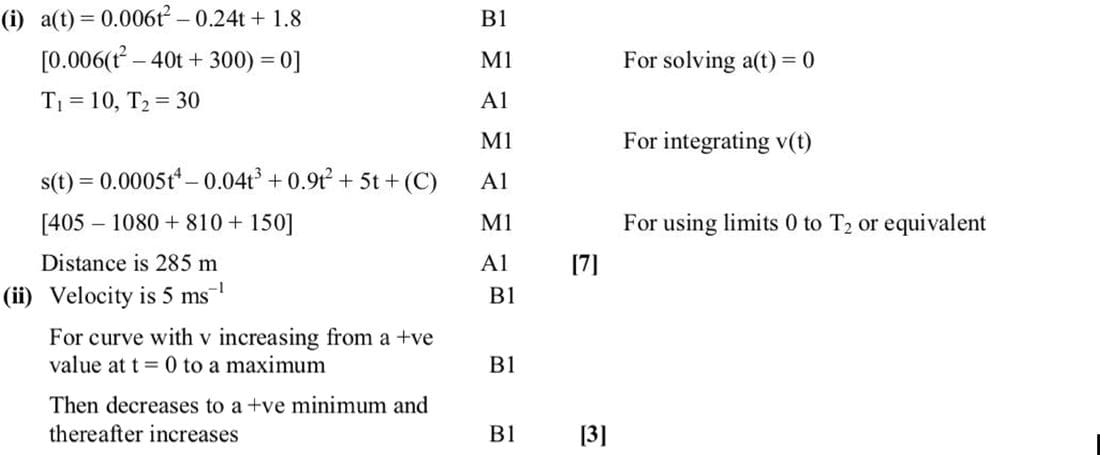
A particle P travels in a straight line. It passes through the point O of the line with velocity 5 m s-1 at time t = 0, where t is in seconds. P's velocity after leaving O is given by
(0.002t3 - 0.12t2 + 1.8t + 5) m s-1.
The velocity of P is increasing when 0 < t < T1 and when t > T2, and the velocity of P is decreasing when T1 < t < T2.
- Find the values of T1 and T2 and the distance OP when t = T2.
- Find the velocity of P when t = T2 and sketch the velocity-time graph for the motion of P.
June 2010 p43 q2
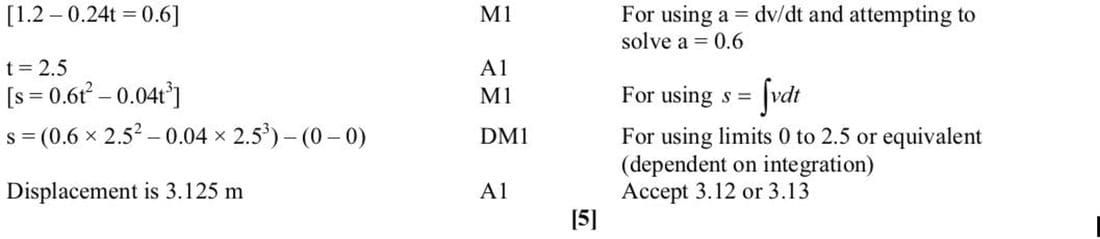
A particle starts at a point O and moves along a straight line. Its velocity t s after leaving O is \((1.2t - 0.12t^2)\) m s-1. Find the displacement of the particle from O when its acceleration is 0.6 m s-2.
June 2010 p41 q7
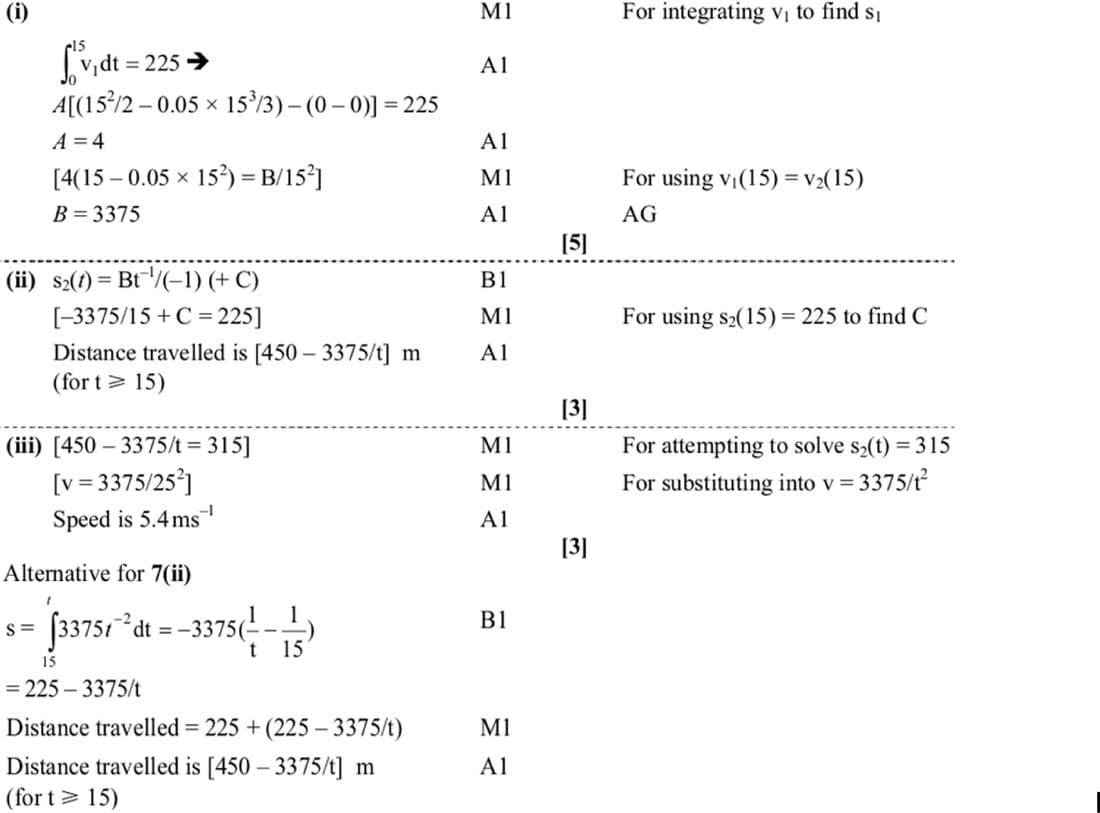
A vehicle is moving in a straight line. The velocity \(v\) m s-1 at time \(t\) s after the vehicle starts is given by
\(v = A(t - 0.05t^2) \quad \text{for} \; 0 \leq t \leq 15,\)
\(v = \frac{B}{t^2} \quad \text{for} \; t \geq 15,\)
where \(A\) and \(B\) are constants. The distance travelled by the vehicle between \(t = 0\) and \(t = 15\) is 225 m.
- Find the value of \(A\) and show that \(B = 3375\).
- Find an expression in terms of \(t\) for the total distance travelled by the vehicle when \(t \geq 15\).
- Find the speed of the vehicle when it has travelled a total distance of 315 m.
Nov 2009 p42 q7
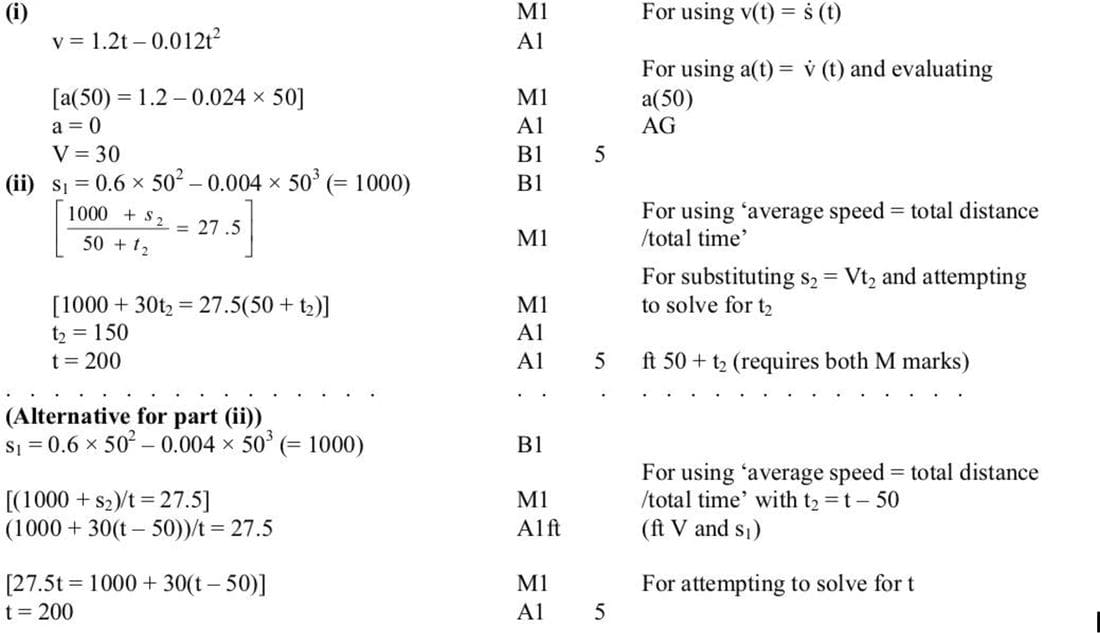
A motorcyclist starts from rest at A and travels in a straight line. For the first part of the motion, the motorcyclist’s displacement x metres from A after t seconds is given by x = 0.6t2 - 0.004t3.
- Show that the motorcyclist’s acceleration is zero when t = 50 and find the speed V m s-1 at this time.
- For t ≥ 50, the motorcyclist travels at constant speed V m s-1. Find the value of t for which the motorcyclist’s average speed is 27.5 m s-1.
Nov 2009 p41 q7
A particle P starts from rest at the point A at time t = 0, where t is in seconds, and moves in a straight line with constant acceleration a m s-2 for 10 s. For 10 ≤ t ≤ 20, P continues to move along the line with velocity v m s-1, where v = \(\frac{800}{t^2} - 2\). Find
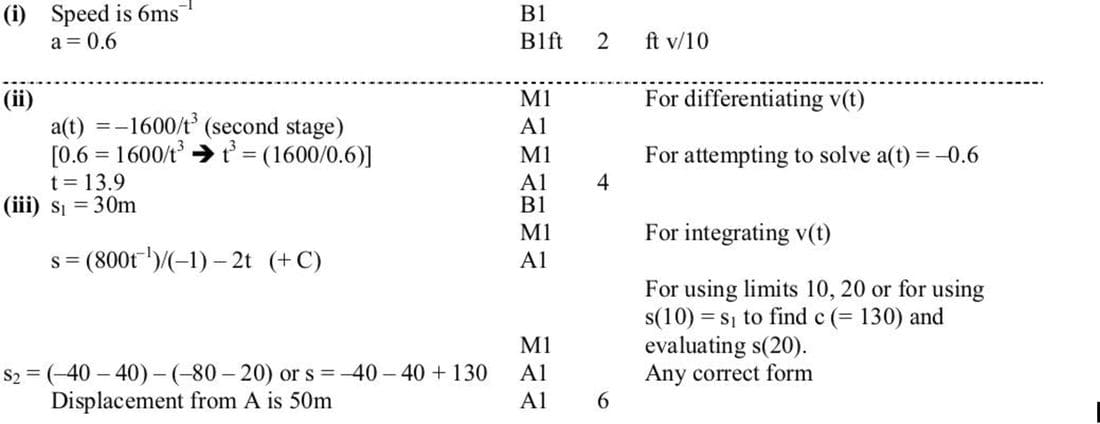
- the speed of P when t = 10, and the value of a,
- the value of t for which the acceleration of P is -a m s-2,
- the displacement of P from A when t = 20.
Nov 2022 p42 q7
A particle P travels in a straight line, starting at rest from a point O. The acceleration of P at time t s after leaving O is denoted by a m/s2, where
\(a = 0.3t^{\frac{1}{2}}\) for \(0 \leq t \leq 4\),
\(a = -kt^{-\frac{3}{2}}\) for \(4 < t \leq T\),
where k and T are constants.
- Find the velocity of P at \(t = 4\).
- It is given that there is no change in the velocity of P at \(t = 4\) and that the velocity of P at \(t = 16\) is \(0.3 \text{ m/s}\). Show that \(k = 2.6\) and find an expression, in terms of t, for the velocity of P for \(4 \leq t \leq T\).
- Given that P comes to instantaneous rest at \(t = T\), find the exact value of T.
- Find the total distance travelled between \(t = 0\) and \(t = T\).
June 2009 p4 q7
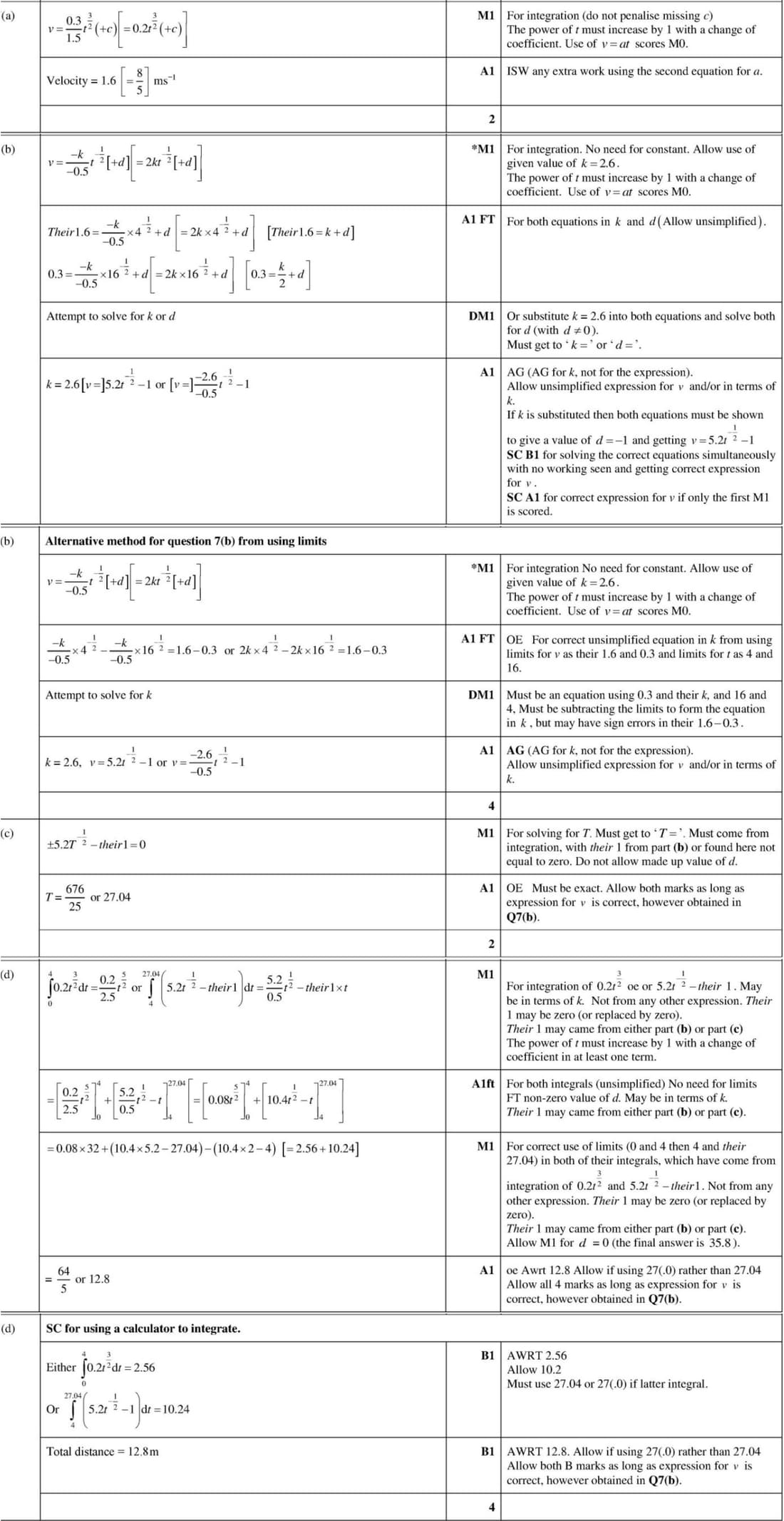
A particle P travels in a straight line from A to D, passing through the points B and C. For the section AB the velocity of the particle is \((0.5t - 0.01t^2)\) m s\(^{-1}\), where \(t\) is the time after leaving A.
- Given that the acceleration of P at B is 0.1 m s\(^{-2}\), find the time taken for P to travel from A to B.
- The acceleration of P from B to C is constant and equal to 0.1 m s\(^{-2}\). Given that P reaches C with speed 14 m s\(^{-1}\), find the time taken for P to travel from B to C.
- P travels with constant deceleration 0.3 m s\(^{-2}\) from C to D. Given that the distance CD is 300 m, find
- the speed with which P reaches D,
- the distance AD.
June 2008 p4 q7
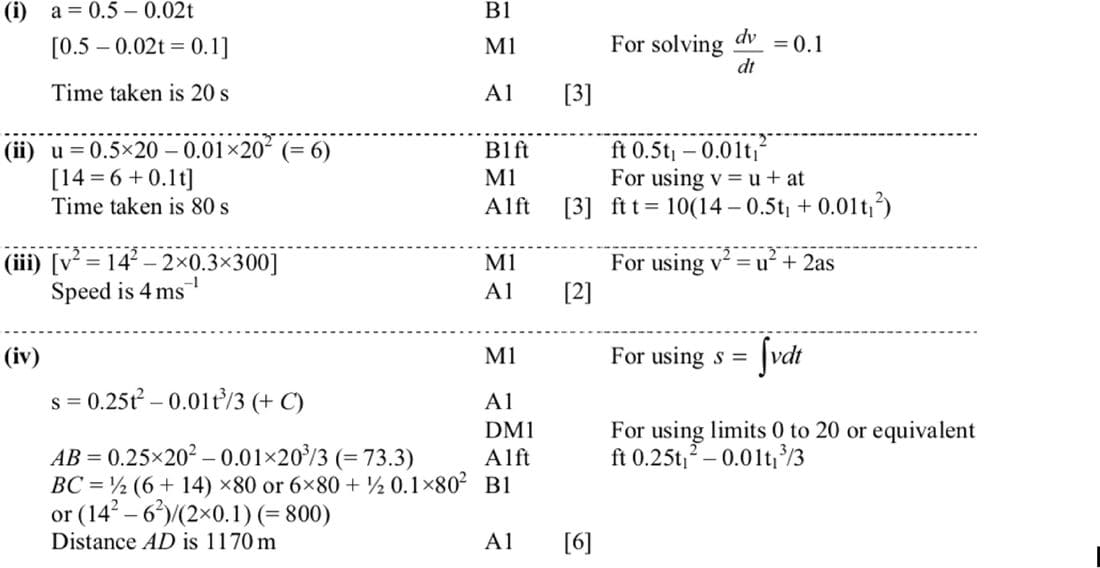
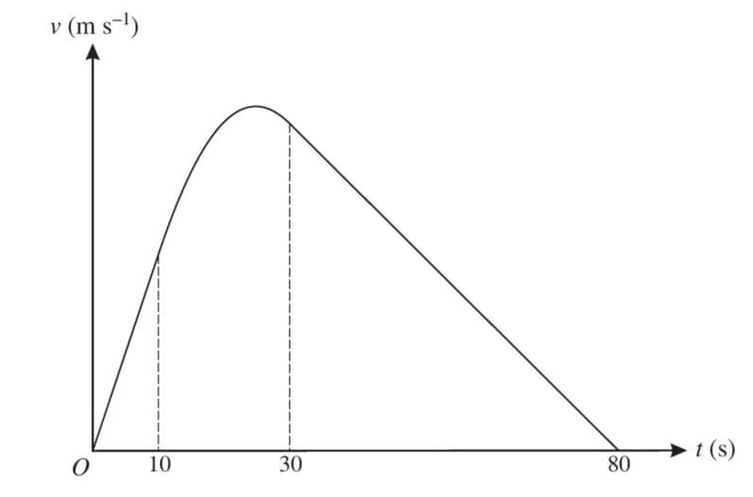
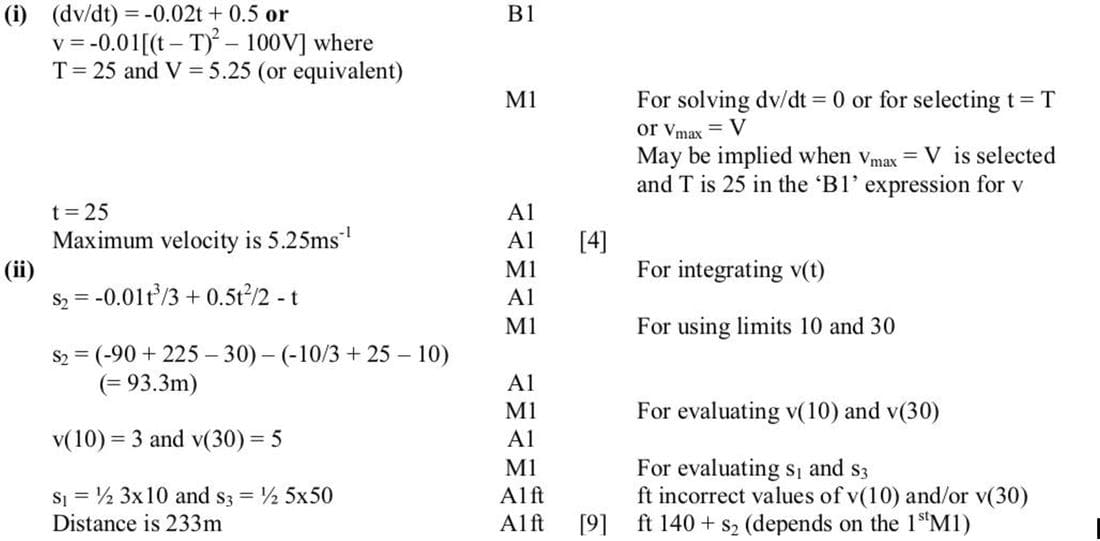
An object P travels from A to B in a time of 80 s. The diagram shows the graph of v against t, where v m s-1 is the velocity of P at time t s after leaving A. The graph consists of straight line segments for the intervals 0 ≤ t ≤ 10 and 30 ≤ t ≤ 80, and a curved section whose equation is v = -0.01t2 + 0.5t - 1 for 10 ≤ t ≤ 30. Find
- the maximum velocity of P,
- the distance AB.
Nov 2006 p4 q4
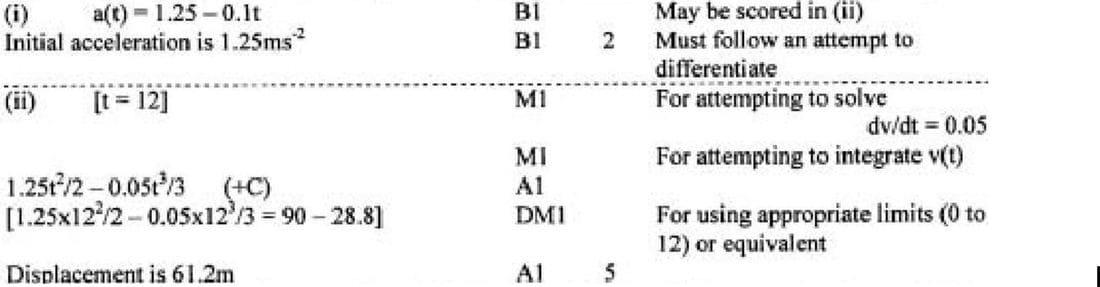
The velocity of a particle at time t seconds after it starts from rest is v m/s, where \(v = 1.25t - 0.05t^2\). Find
- the initial acceleration of the particle,
- the displacement of the particle from its starting point at the instant when its acceleration is \(0.05 \text{ m/s}^2\).
June 2006 p4 q2
A motorcyclist starts from rest at A and travels in a straight line until he comes to rest again at B. The velocity of the motorcyclist t seconds after leaving A is v m s-1, where v = t - 0.01t^2. Find
- the time taken for the motorcyclist to travel from A to B,
- the distance AB.

Nov 2005 p4 q6
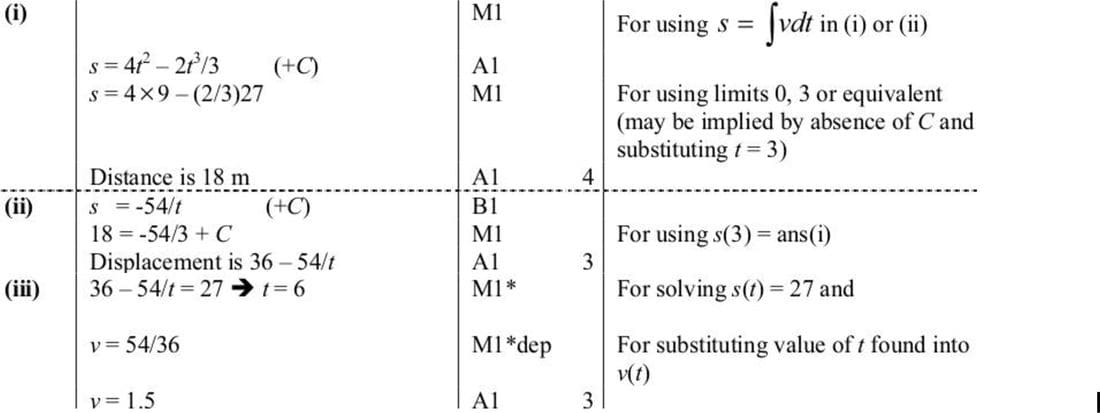
A particle P starts from rest at O and travels in a straight line. Its velocity v m s-1 at time t s is given by v = 8t - 2t^2 for 0 ≤ t ≤ 3, and v = \frac{54}{t^2} for t > 3. Find
- the distance travelled by P in the first 3 seconds,
- an expression in terms of t for the displacement of P from O, valid for t > 3,
- the value of v when the displacement of P from O is 27 m.
June 2005 p4 q5
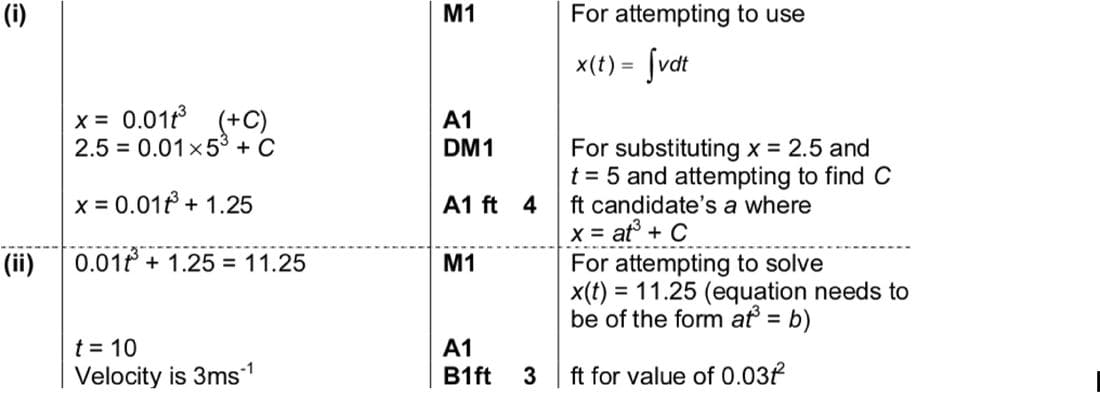
A particle P moves along the x-axis in the positive direction. The velocity of P at time t s is 0.03t2 m s−1. When t = 5 the displacement of P from the origin O is 2.5 m.
- Find an expression, in terms of t, for the displacement of P from O.
- Find the velocity of P when its displacement from O is 11.25 m.
Nov 2004 p4 q7
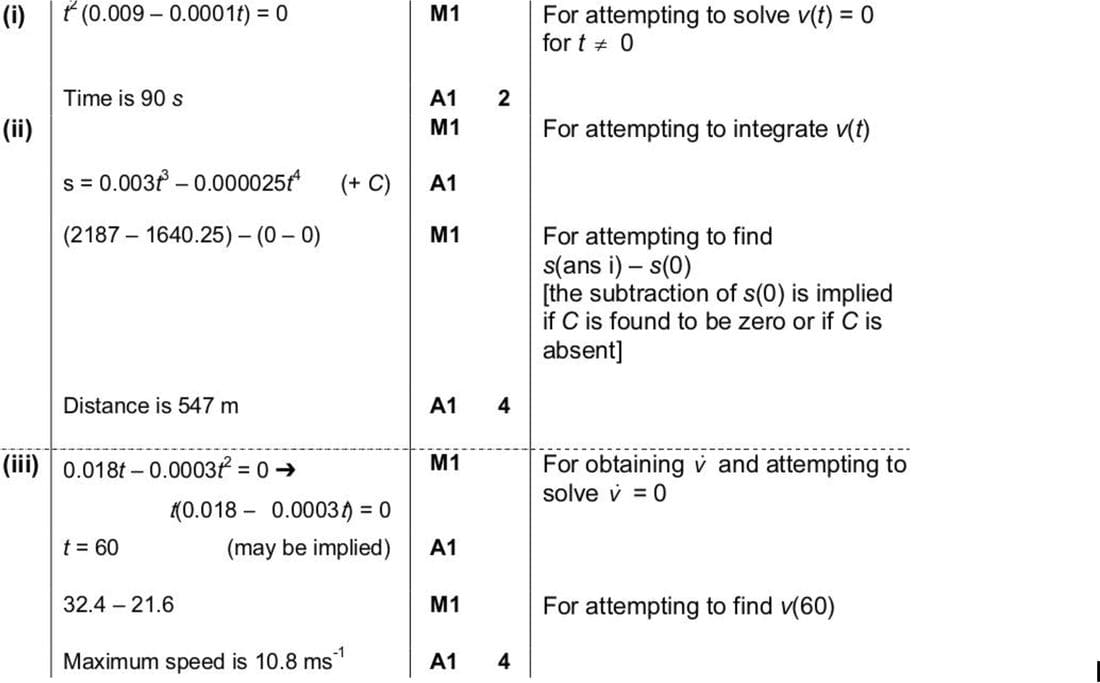
A particle starts from rest at the point A and travels in a straight line until it reaches the point B. The velocity of the particle t seconds after leaving A is v m s-1, where v = 0.009t^2 - 0.0001t^3. Given that the velocity of the particle when it reaches B is zero, find
- the time taken for the particle to travel from A to B,
- the distance AB,
- the maximum velocity of the particle.
June 2004 p4 q5
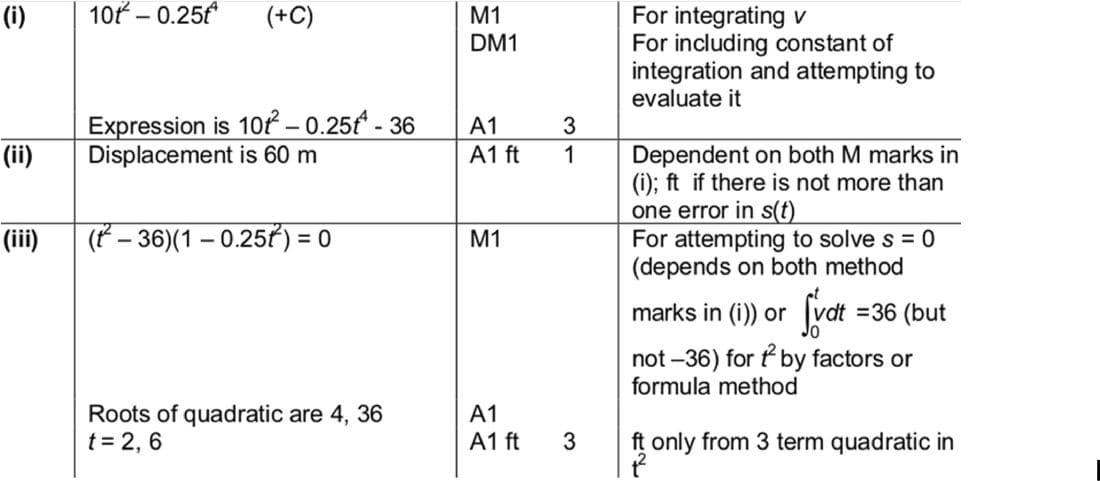
A particle P moves in a straight line that passes through the origin O. The velocity of P at time t seconds is v m s-1, where v = 20t - t^3. At time t = 0 the particle is at rest at a point whose displacement from O is -36 m.
- Find an expression for the displacement of P from O in terms of t.
- Find the displacement of P from O when t = 4.
- Find the values of t for which the particle is at O.
June 2003 p4 q4
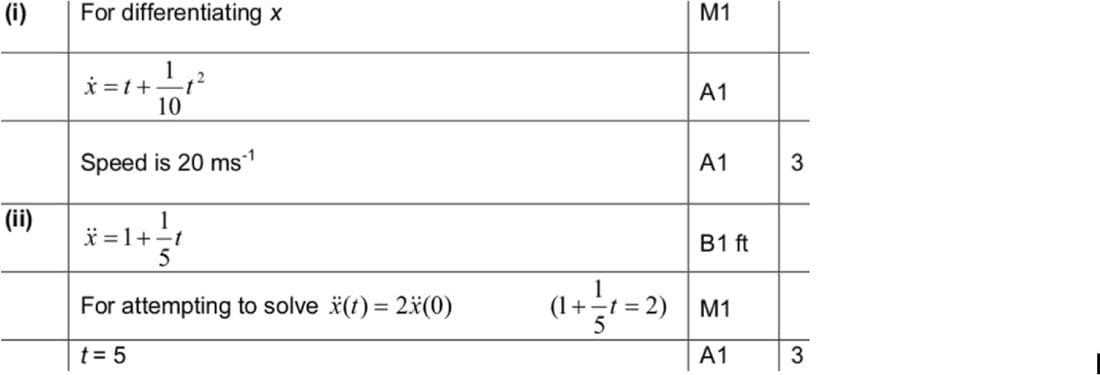
A particle moves in a straight line. Its displacement t seconds after leaving the fixed point O is x metres, where \(x = \frac{1}{2}t^2 + \frac{1}{30}t^3\). Find
- the speed of the particle when \(t = 10\),
- the value of \(t\) for which the acceleration of the particle is twice its initial acceleration.
Nov 2002 p4 q7
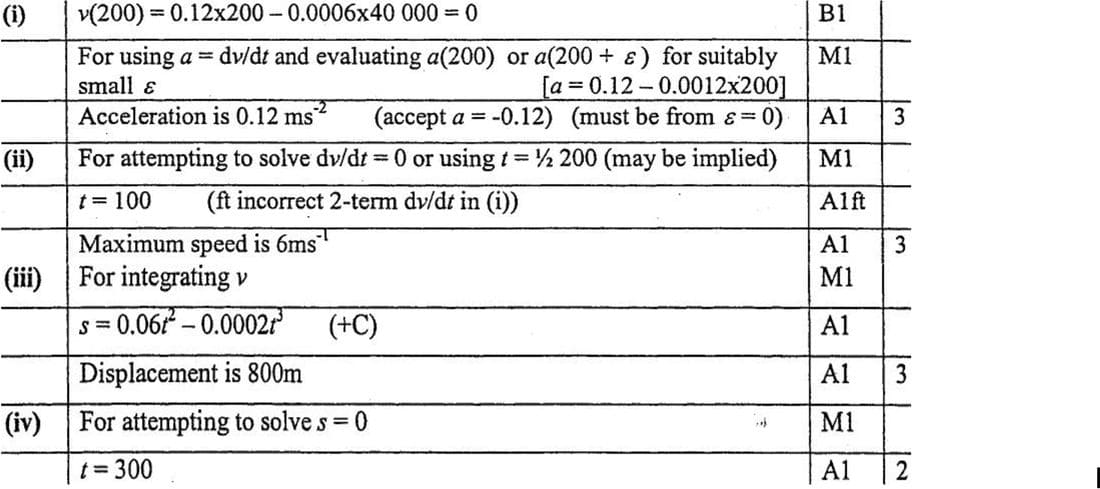
A particle P starts to move from a point O and travels in a straight line. At time t s after P starts to move its velocity is v m s-1, where v = 0.12t - 0.0006t2.
- Verify that P comes to instantaneous rest when t = 200, and find the acceleration with which it starts to return towards O.
- Find the maximum speed of P for 0 ≤ t ≤ 200.
- Find the displacement of P from O when t = 200.
- Find the value of t when P reaches O again.
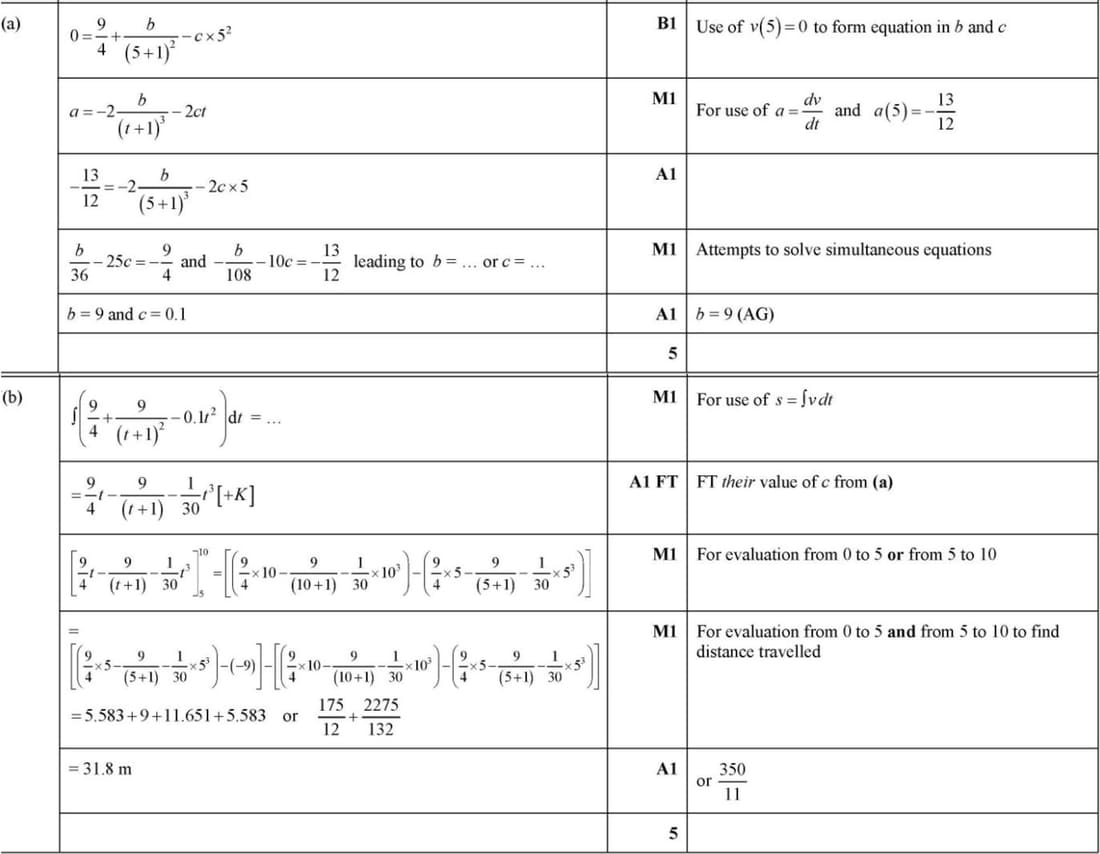
June 2022 p43 q7
A particle P moves in a straight line through a point O. The velocity v ms-1 of P, at time t s after passing O, is given by
\(v = \frac{9}{4} + \frac{b}{(t+1)^2} - ct^2,\)
where b and c are positive constants. At t = 5, the velocity of P is zero and its acceleration is \(-\frac{13}{12}\) ms-2.
\((a) Show that b = 9 and find the value of c.\)
\((b) Given that the velocity of P is zero only at t = 5, find the distance travelled in the first 10 seconds of motion.\)
June 2022 p42 q7
A particle P moves in a straight line. The velocity v m/s-1 at time t seconds is given by
\(v = 0.5t\) for \(0 \leq t \leq 10\),
\(v = 0.25t^2 - 8t + 60\) for \(10 \leq t \leq 20\).
(a) Show that there is an instantaneous change in the acceleration of the particle at \(t = 10\).
(b) Find the total distance covered by P in the interval \(0 \leq t \leq 20\).