Exam-Style Problems
⬅ Back to SubchapterNov 2023 p42 q7
3835
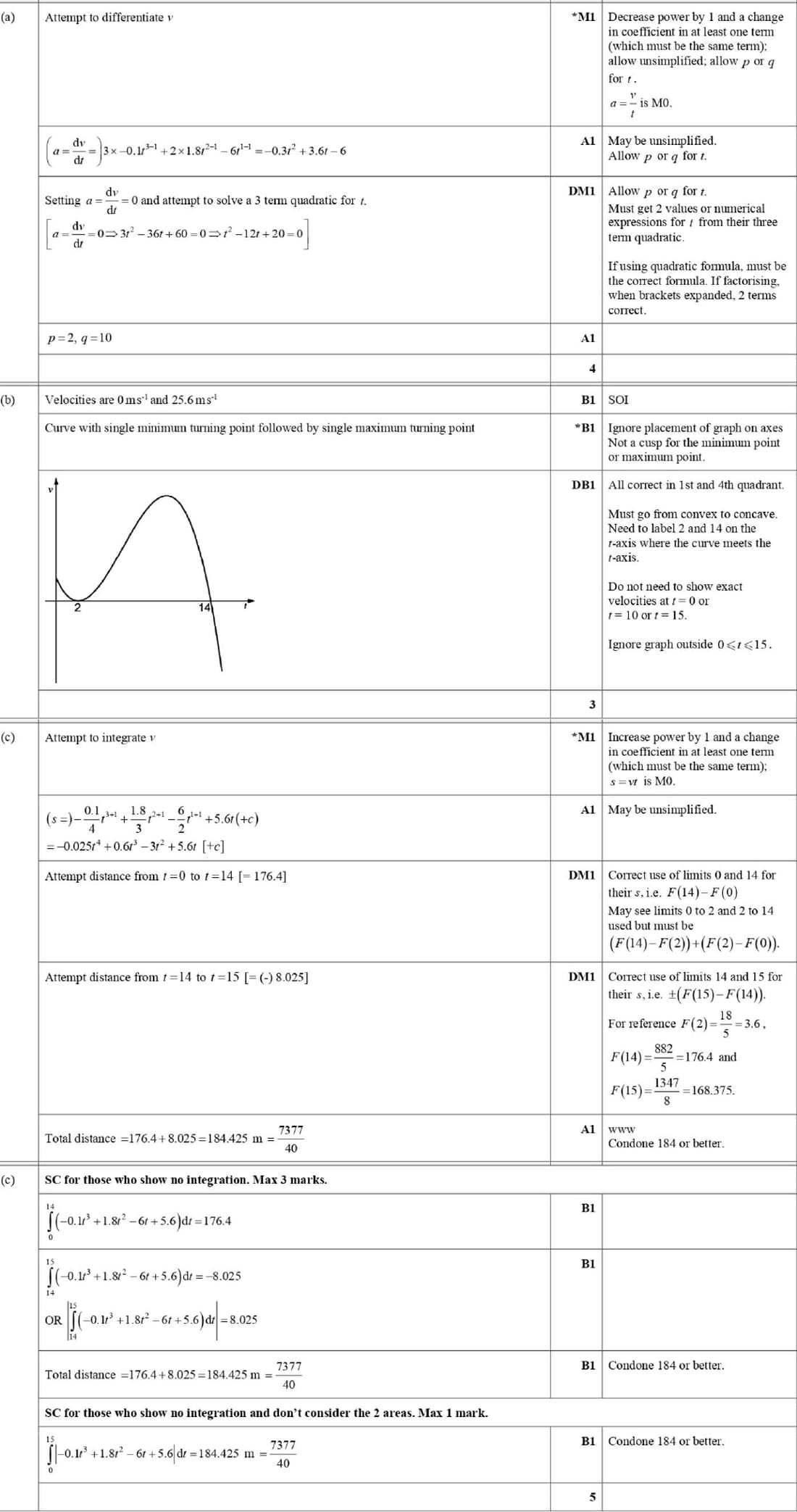
A particle X travels in a straight line. The velocity of X at time t s after leaving a fixed point O is denoted by v m/s-1, where
\(v = -0.1t^3 + 1.8t^2 - 6t + 5.6\).
\(The acceleration of X is zero at t = p and t = q, where p < q.\)
- Find the value of p and the value of q.
- It is given that the velocity of X is zero at t = 14.
- Find the velocities of X at t = p and at t = q, and hence sketch the velocity-time graph for the motion of X for 0 ≤ t ≤ 15.
- Find the total distance travelled by X between t = 0 and t = 15.

Feb/Mar 2017 p42 q5
3836
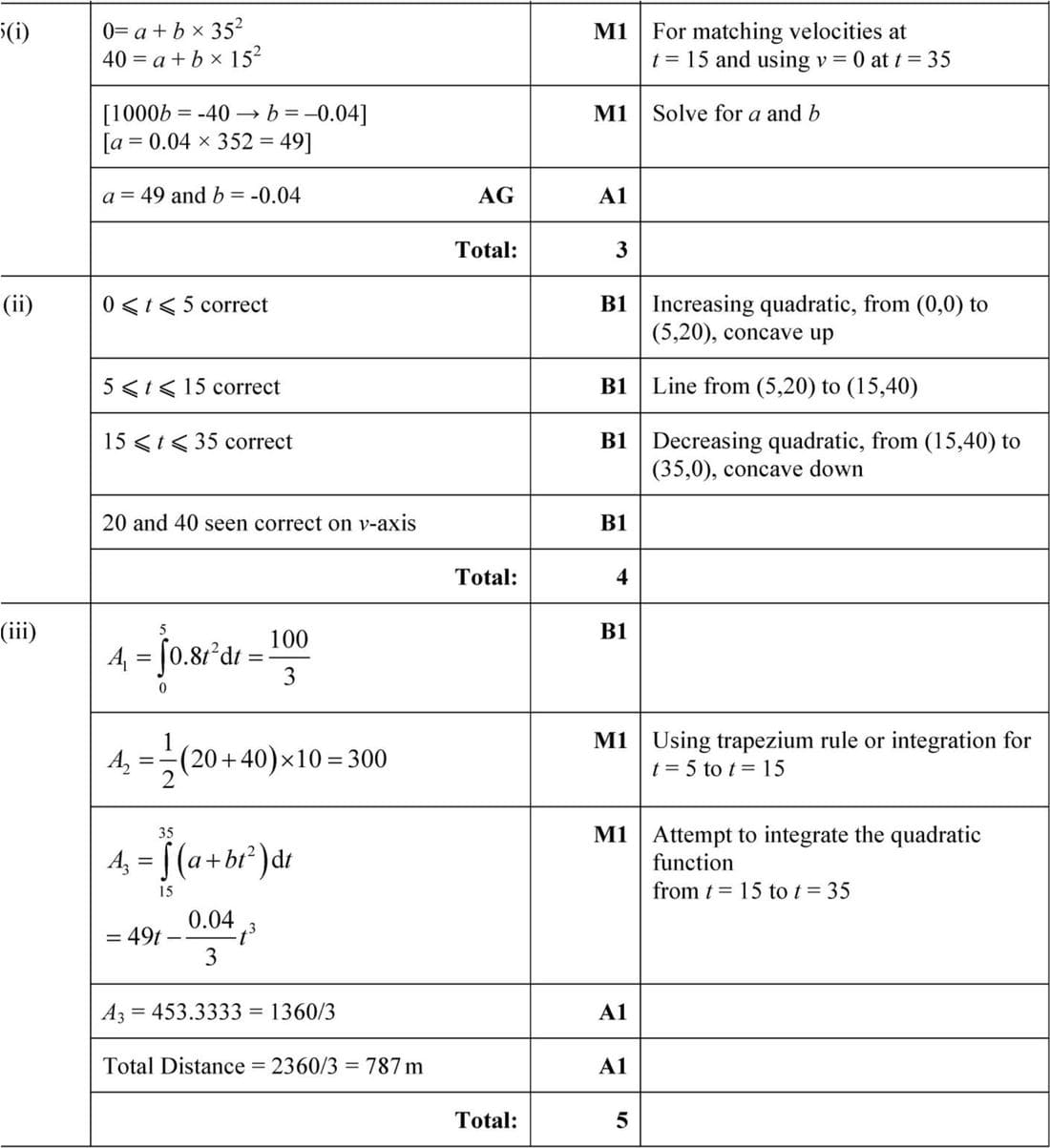
A particle P moves in a straight line starting from a point O and comes to rest 35 s later. At time t s after leaving O, the velocity v m s−1 of P is given by
\(v = \frac{4}{5}t^2 \quad 0 \leq t \leq 5,\)
\(v = 2t + 10 \quad 5 \leq t \leq 15,\)
\(v = a + bt^2 \quad 15 \leq t \leq 35,\)
where a and b are constants such that a > 0 and b < 0.
- Show that the values of a and b are 49 and −0.04 respectively.
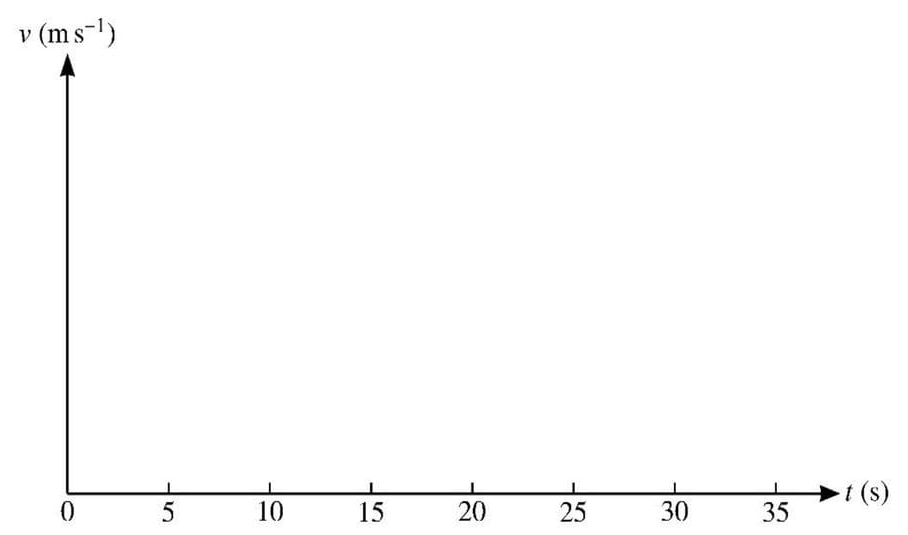
- Sketch the velocity-time graph.
- Find the total distance travelled by P during the 35 s.
Feb/Mar 2016 p42 q7
3837
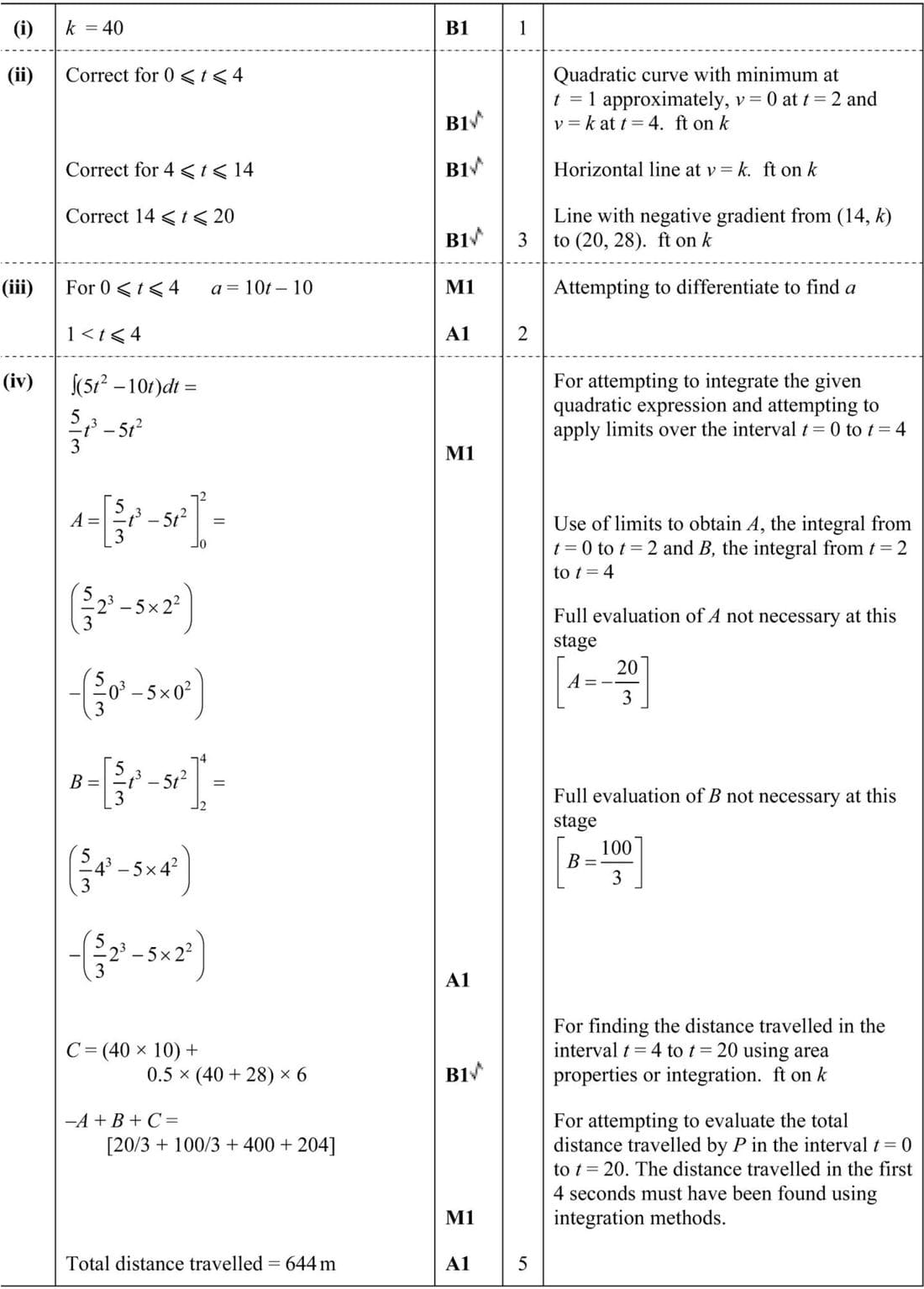
A particle P moves in a straight line. The velocity v m s-1 at time t s is given by
\(v = 5t(t - 2)\) for \(0 \leq t \leq 4\),
\(v = k\) for \(4 \leq t \leq 14\),
\(v = 68 - 2t\) for \(14 \leq t \leq 20\),
where \(k\) is a constant.
- Find \(k\).
- Sketch the velocity-time graph for \(0 \leq t \leq 20\).
- Find the set of values of \(t\) for which the acceleration of P is positive.
- Find the total distance travelled by P in the interval \(0 \leq t \leq 20\).
June 2015 p43 q7
3838
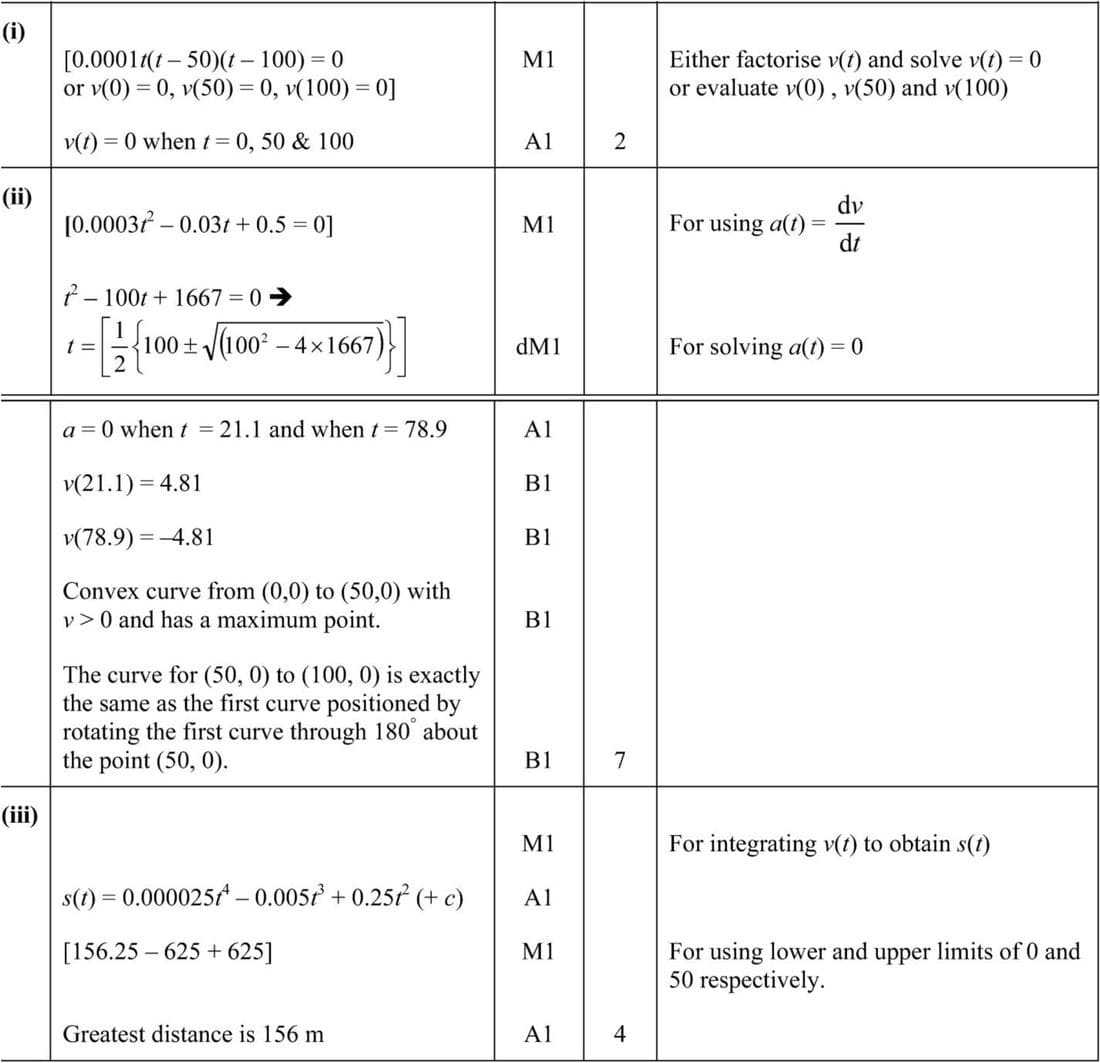
A particle P moves on a straight line. It starts at a point O on the line and returns to O 100 s later. The velocity of P is v m s-1 at time t s after leaving O, where
\(v = 0.0001t^3 - 0.015t^2 + 0.5t\).
- Show that P is instantaneously at rest when \(t = 0\), \(t = 50\) and \(t = 100\).
- Find the values of \(v\) at the times for which the acceleration of P is zero, and sketch the velocity-time graph for P's motion for \(0 \leq t \leq 100\).
- Find the greatest distance of P from O for \(0 \leq t \leq 100\).
June 2014 p43 q6
3839
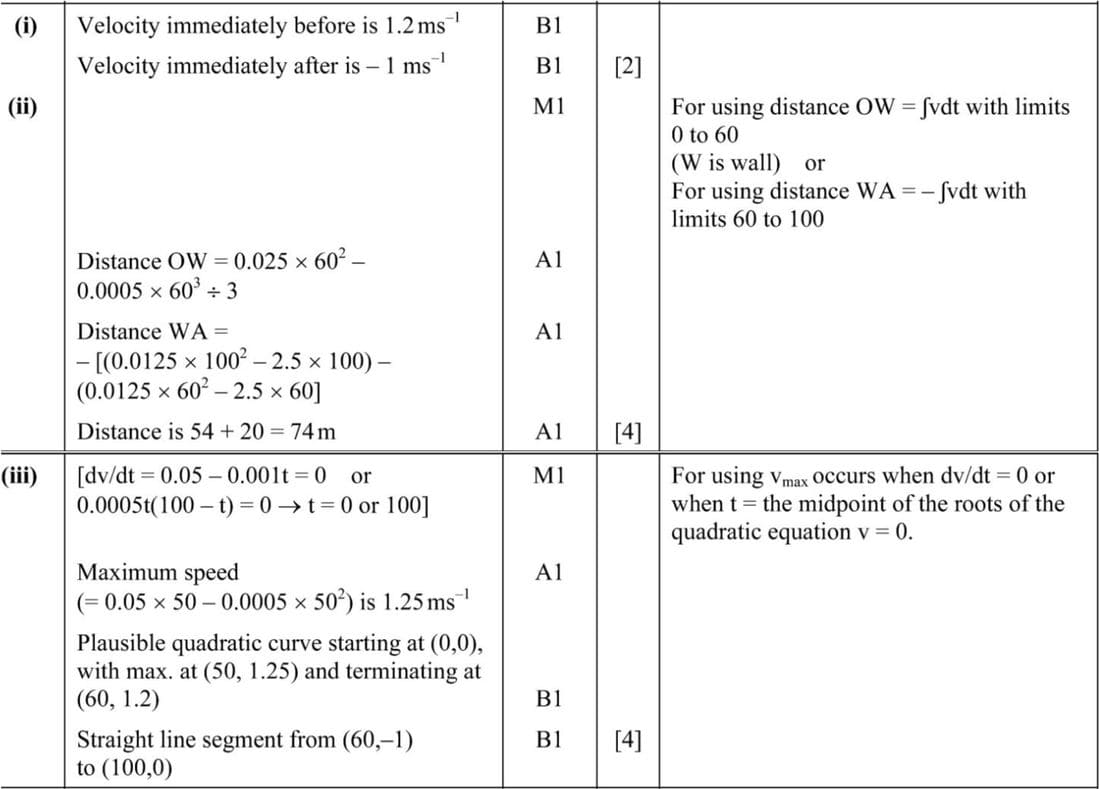
A particle starts from rest at a point O and moves in a horizontal straight line. The velocity of the particle is v ms-1 at time t s after leaving O. For 0 ≤ t < 60, the velocity is given by
\(v = 0.05t - 0.0005t^2\).
The particle hits a wall at the instant when t = 60, and reverses the direction of its motion. The particle subsequently comes to rest at the point A when t = 100, and for 60 < t ≤ 100 the velocity is given by
\(v = 0.025t - 2.5\).
- Find the velocity of the particle immediately before it hits the wall, and its velocity immediately after it hits the wall.
- Find the total distance travelled by the particle.
- Find the maximum speed of the particle and sketch the particle’s velocity-time graph for 0 ≤ t ≤ 100, showing the value of t for which the speed is greatest.
June 2013 p41 q7
3840
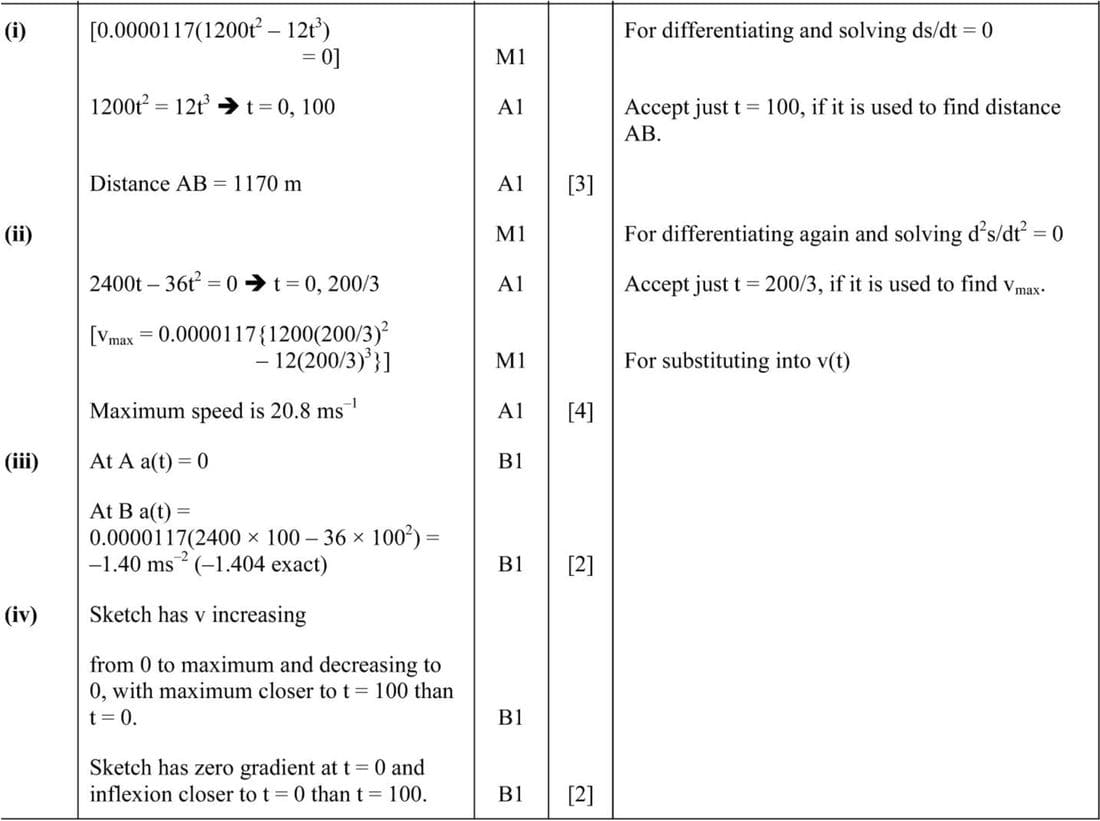
A car driver makes a journey in a straight line from A to B, starting from rest. The speed of the car increases to a maximum, then decreases until the car is at rest at B. The distance travelled by the car t seconds after leaving A is 0.0000117(400t3 - 3t4) metres.
- Find the distance AB.
- Find the maximum speed of the car.
- Find the acceleration of the car
- as it starts from A,
- as it arrives at B.
- Sketch the velocity-time graph for the journey.
Nov 2022 p41 q5
3841
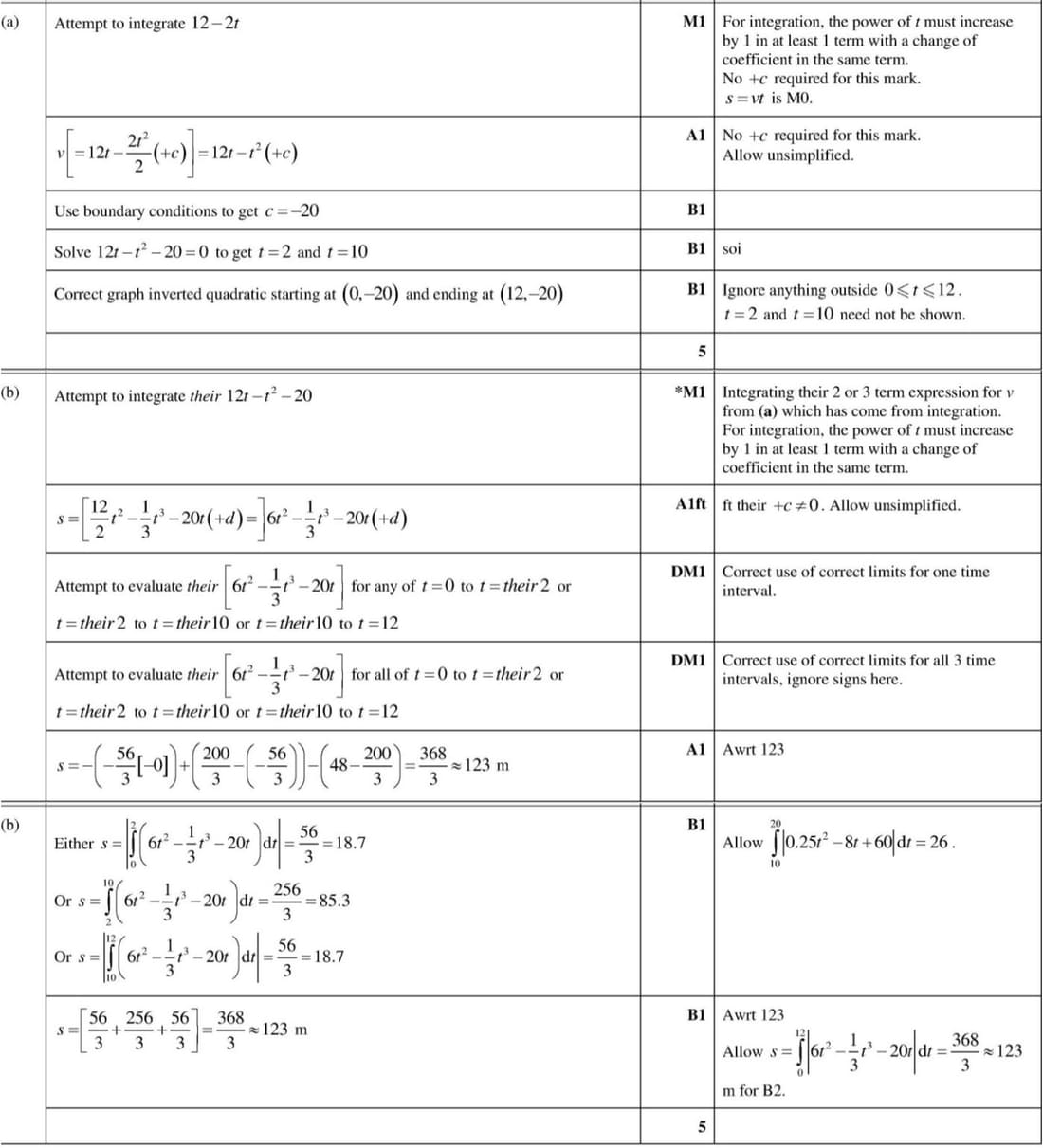
A particle P moves on the x-axis from the origin O with an initial velocity of \(-20 \text{ ms}^{-1}\). The acceleration \(a \text{ ms}^{-2}\) at time \(t\) s after leaving O is given by \(a = 12 - 2t\).
(a) Sketch a velocity-time graph for \(0 \leq t \leq 12\), indicating the times when P is at rest.
(b) Find the total distance travelled by P in the interval \(0 \leq t \leq 12\).
Nov 2021 p41 q6
3842
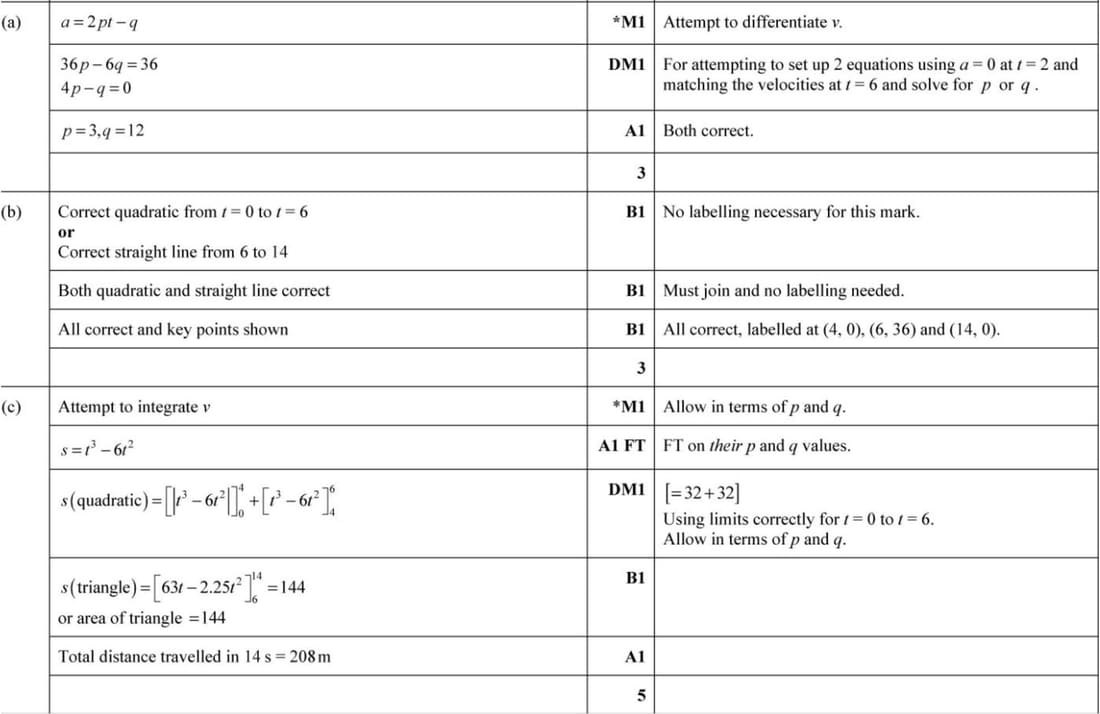
A particle P moves in a straight line starting from a point O and comes to rest 14 s later. At time t s after leaving O, the velocity v m s-1 of P is given by
\(v = pt^2 - qt \quad 0 \leq t \leq 6,\)
\(v = 63 - 4.5t \quad 6 \leq t \leq 14,\)
where p and q are positive constants.
\(The acceleration of P is zero when t = 2.\)
(a) Given that there are no instantaneous changes in velocity, find p and q.
(b) Sketch the velocity-time graph.
(c) Find the total distance travelled by P during the 14 s.

June 2021 p43 q6
3843
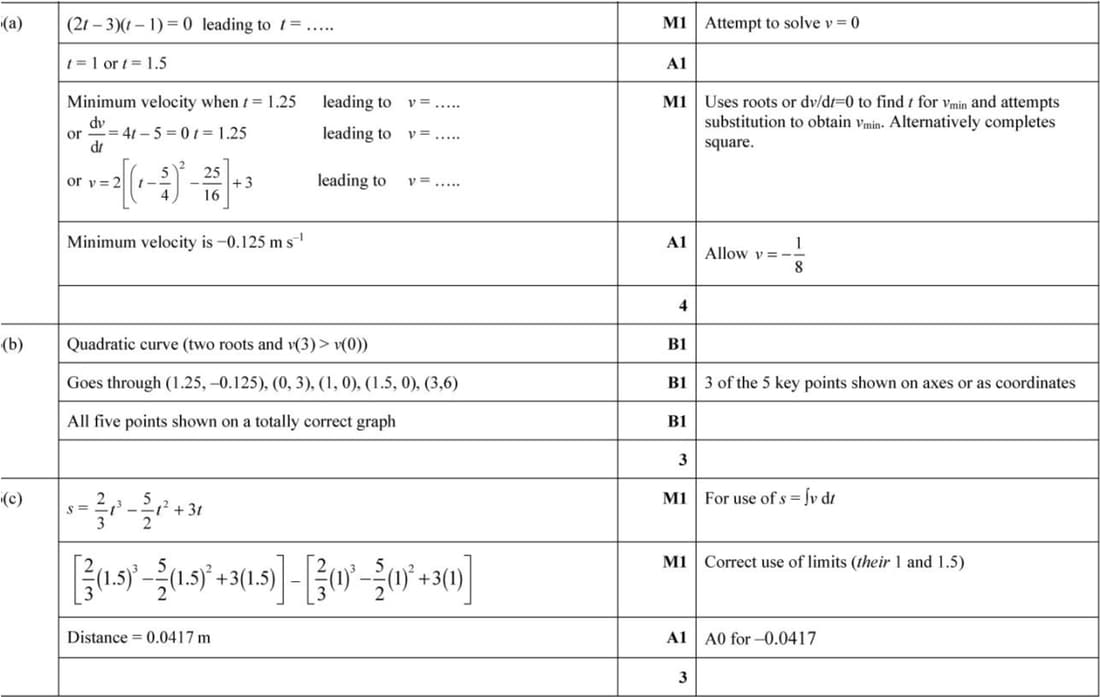
A particle moves in a straight line and passes through the point A at time \(t = 0\). The velocity of the particle at time \(t\) s after leaving A is \(v\) m s\(^{-1}\), where
\(v = 2t^2 - 5t + 3\).
- Find the times at which the particle is instantaneously at rest. Hence or otherwise find the minimum velocity of the particle.
- Sketch the velocity-time graph for the first 3 seconds of motion.
- Find the distance travelled between the two times when the particle is instantaneously at rest.
June 2021 p42 q7
3844
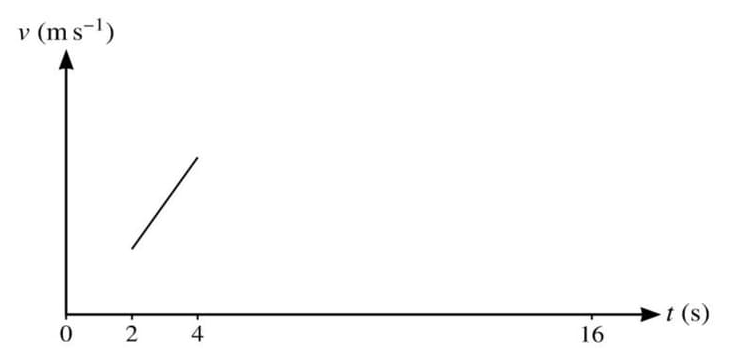
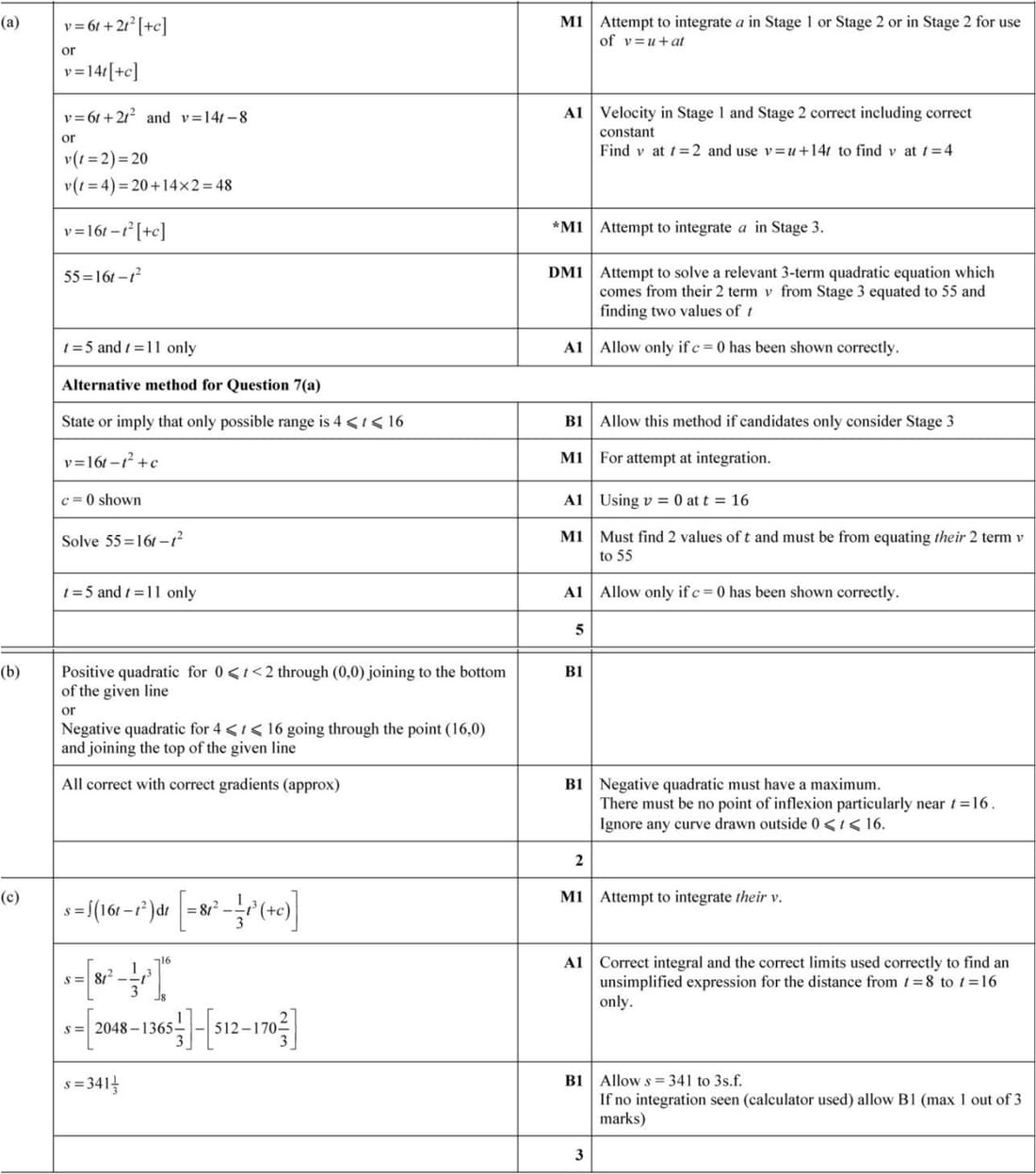
A particle P moving in a straight line starts from rest at a point O and comes to rest 16 s later. At time t s after leaving O, the acceleration a m s-2 of P is given by
\(a = 6 + 4t \quad 0 \leq t < 2,\) \(a = 14 \quad 2 \leq t < 4,\) \(a = 16 - 2t \quad 4 \leq t \leq 16.\)
There is no sudden change in velocity at any instant.
- Find the values of t when the velocity of P is 55 m s-1.
- Complete the sketch of the velocity-time diagram.
- Find the distance travelled by P when it is decelerating.
June 2020 p42 q6
3845
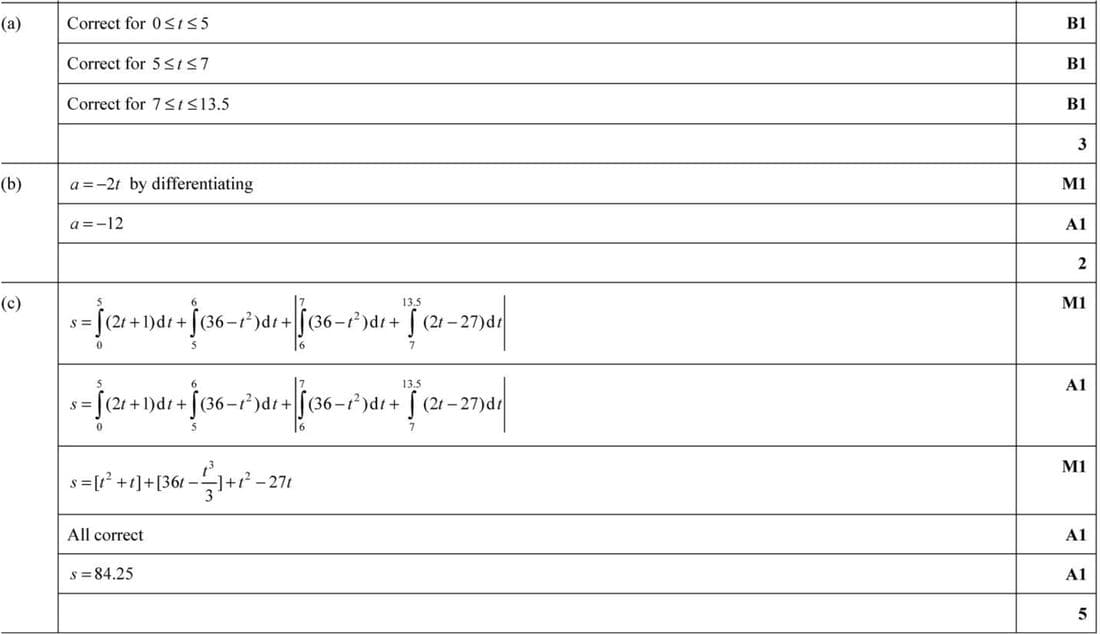
A particle P moves in a straight line. The velocity v m s-1 at time t s is given by
\(v = 2t + 1\) for \(0 \leq t \leq 5\),
\(v = 36 - t^2\) for \(5 \leq t \leq 7\),
\(v = 2t - 27\) for \(7 \leq t \leq 13.5\).
(a) Sketch the velocity-time graph for \(0 \leq t \leq 13.5\).
(b) Find the acceleration at the instant when \(t = 6\).
(c) Find the total distance travelled by P in the interval \(0 \leq t \leq 13.5\).

Nov 2018 p41 q7
3846
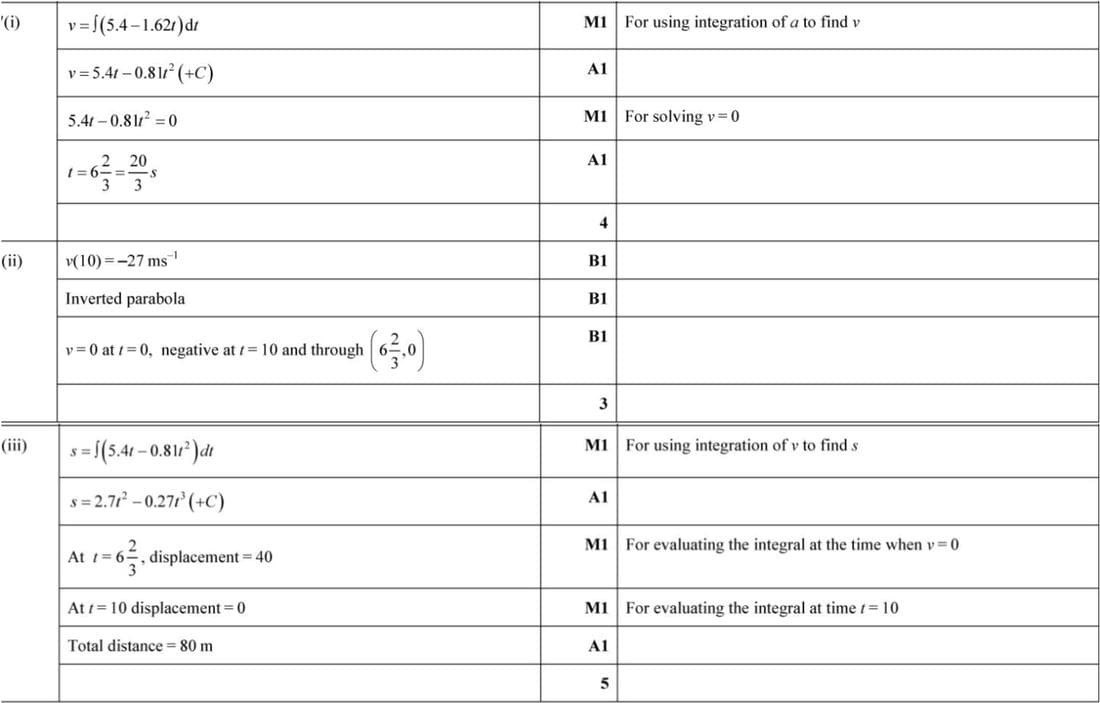
A particle moves in a straight line starting from rest from a point O. The acceleration of the particle at time t s after leaving O is a m/s2, where
\(a = 5.4 - 1.62t\).
- Find the positive value of t at which the velocity of the particle is zero, giving your answer as an exact fraction.
- Find the velocity of the particle at \(t = 10\) and sketch the velocity-time graph for the first ten seconds of the motion.
- Find the total distance travelled during the first ten seconds of the motion.
June 2018 p43 q7
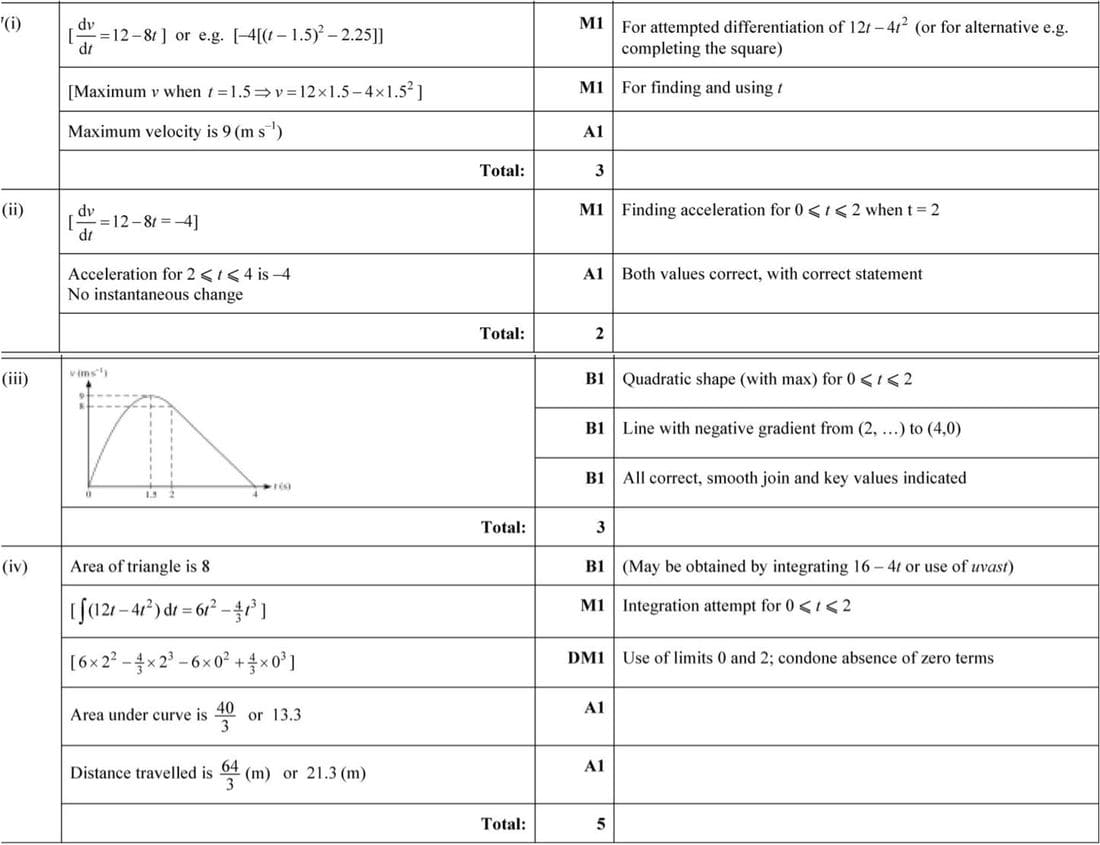
3847
A particle P moves in a straight line starting from a point O. The velocity v m s-1 of P at time t s is given by
\(v = 12t - 4t^2\) for \(0 \leq t \leq 2\),
\(v = 16 - 4t\) for \(2 \leq t \leq 4\).
- Find the maximum velocity of P during the first 2 s.
- Determine, with justification, whether there is any instantaneous change in the acceleration of P when \(t = 2\).
- Sketch the velocity-time graph for \(0 \leq t \leq 4\).
- Find the distance travelled by P in the interval \(0 \leq t \leq 4\).
Feb/Mar 2018 p42 q7
3848
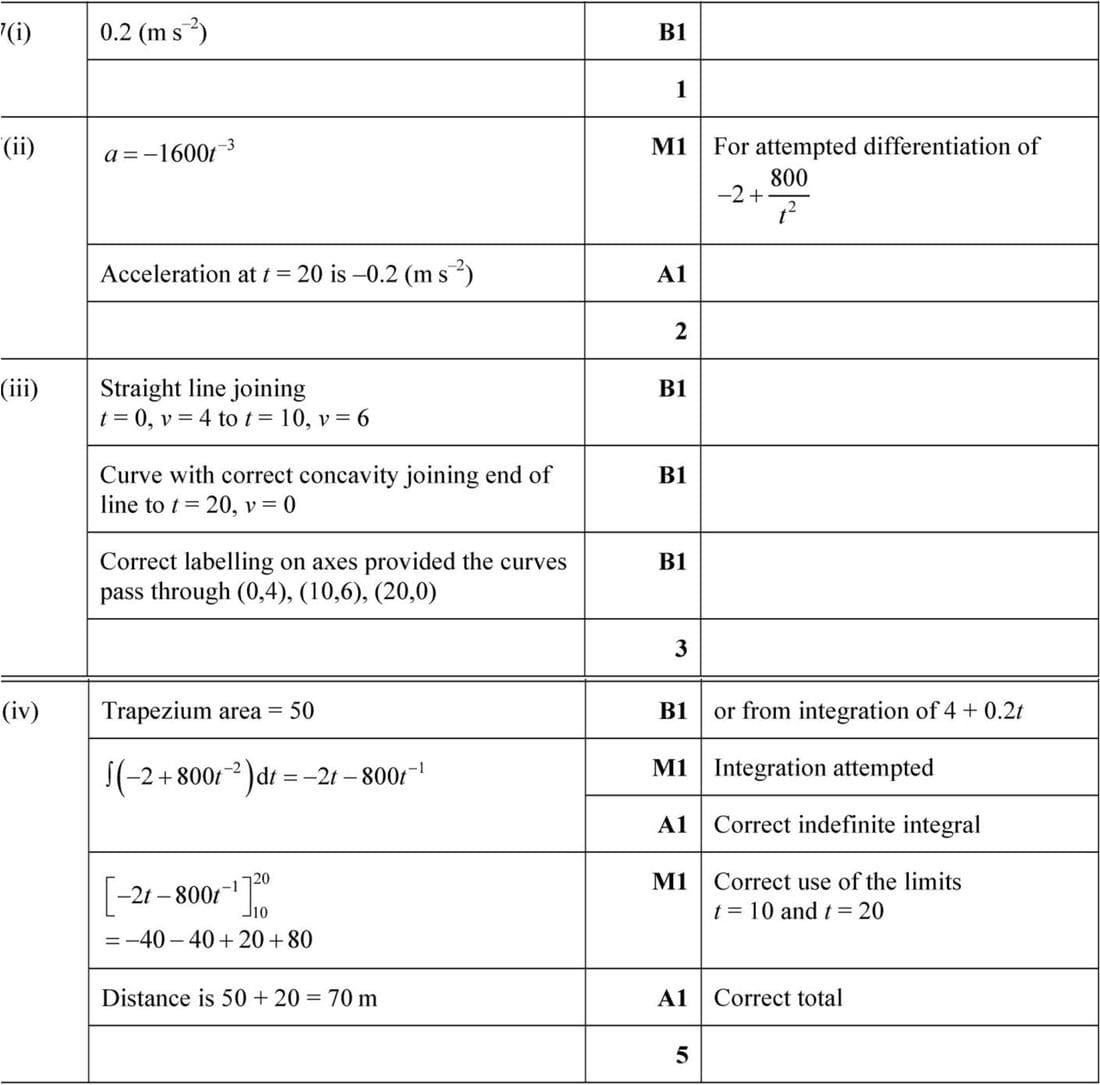
A particle P moves in a straight line. The velocity v m s-1 at time t s is given by
\(v = 4 + 0.2t\) for \(0 \leq t \leq 10\),
\(v = -2 + \frac{800}{t^2}\) for \(10 \leq t \leq 20\).
- Find the acceleration of P during the first 10 s.
- Find the acceleration of P when \(t = 20\).
- Sketch the velocity-time graph for \(0 \leq t \leq 20\).
- Find the total distance travelled by P in the interval \(0 \leq t \leq 20\).