Exam-Style Problems
⬅ Back to SubchapterNov 2023 p41 q5
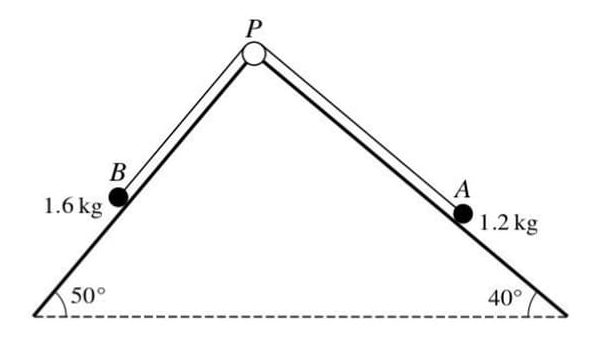
The diagram shows a particle A, of mass 1.2 kg, which lies on a plane inclined at an angle of 40° to the horizontal and a particle B, of mass 1.6 kg, which lies on a plane inclined at an angle of 50° to the horizontal. The particles are connected by a light inextensible string which passes over a small smooth pulley P fixed at the top of the planes. The parts AP and BP of the string are taut and parallel to lines of greatest slope of the respective planes. The two planes are rough, with the same coefficient of friction, μ, between the particles and the planes.
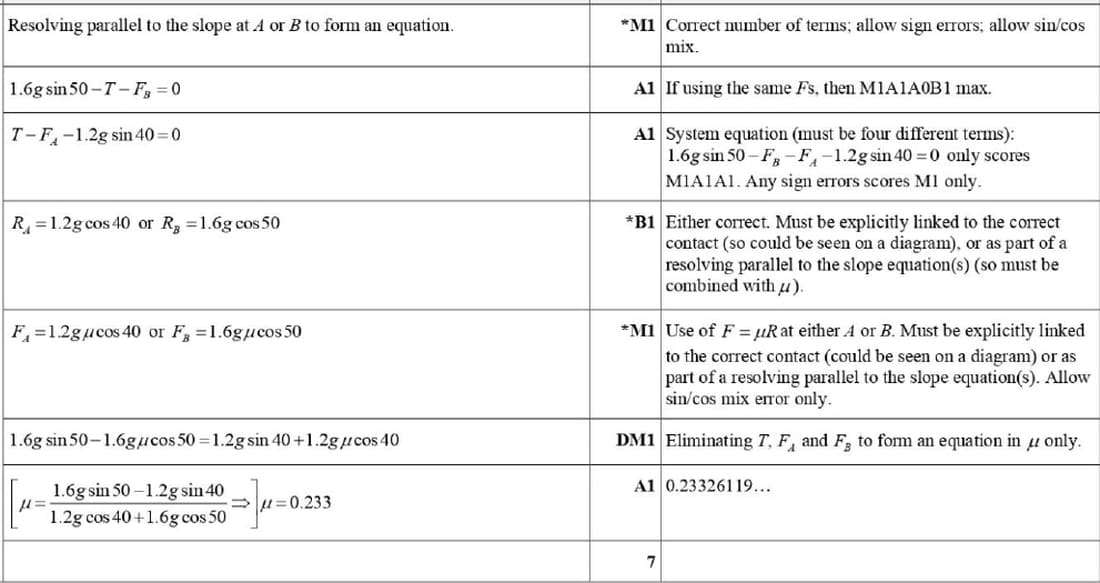
Find the value of μ for which the system is in limiting equilibrium.
June 2010 p43 q4
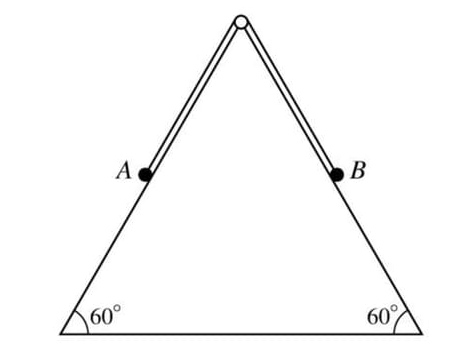
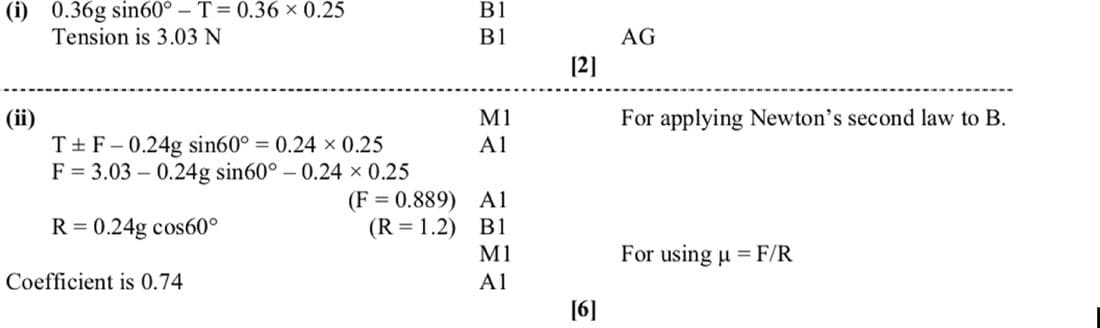
The diagram shows a vertical cross-section of a triangular prism which is fixed so that two of its faces are inclined at 60° to the horizontal. One of these faces is smooth and one is rough. Particles A and B, of masses 0.36 kg and 0.24 kg respectively, are attached to the ends of a light inextensible string which passes over a small smooth pulley fixed at the highest point of the cross-section. B is held at rest at a point of the cross-section on the rough face and A hangs freely in contact with the smooth face (see diagram). B is released and starts to move up the face with acceleration 0.25 m s-2.
- By considering the motion of A, show that the tension in the string is 3.03 N, correct to 3 significant figures.
- Find the coefficient of friction between B and the rough face, correct to 2 significant figures.
June 2023 p41 q6
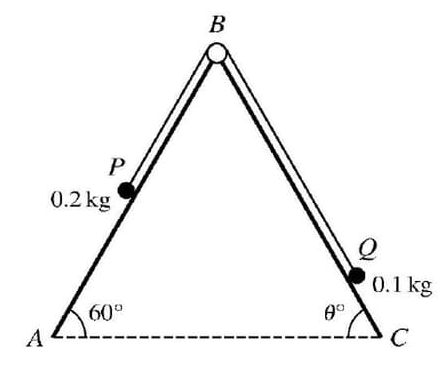
Two particles P and Q, of masses 0.2 kg and 0.1 kg respectively, are attached to the ends of a light inextensible string. The string passes over a fixed smooth pulley at B which is attached to two inclined planes. Particle P lies on a smooth plane AB which is inclined at 60° to the horizontal. Particle Q lies on a plane BC which is inclined at an angle of θ° to the horizontal. The string is taut and the particles can move on lines of greatest slope of the two planes (see diagram).
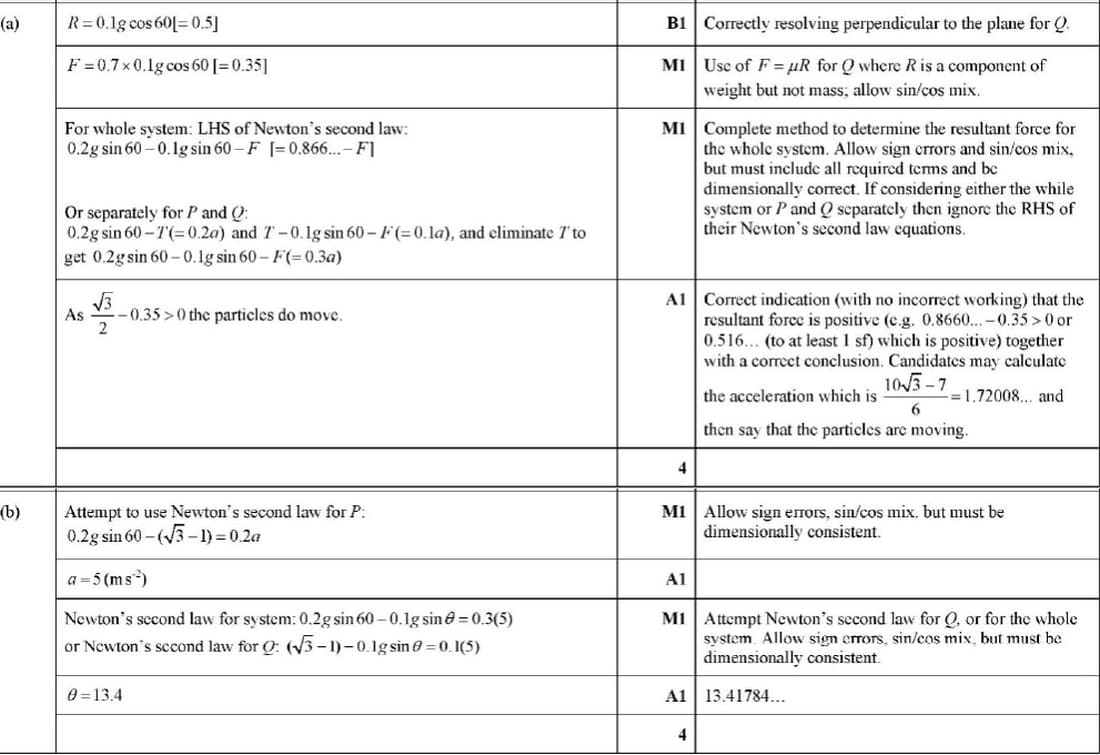
(a) It is given that θ = 60, the plane BC is rough and the coefficient of friction between Q and the plane BC is 0.7. The particles are released from rest. Determine whether the particles move.
(b) It is given instead that the plane BC is smooth. The particles are released from rest and in the subsequent motion the tension in the string is \\(\sqrt{3} - 1 \\\) N. Find the magnitude of the acceleration of P as it moves on the plane, and find the value of θ.
June 2022 p43 q6
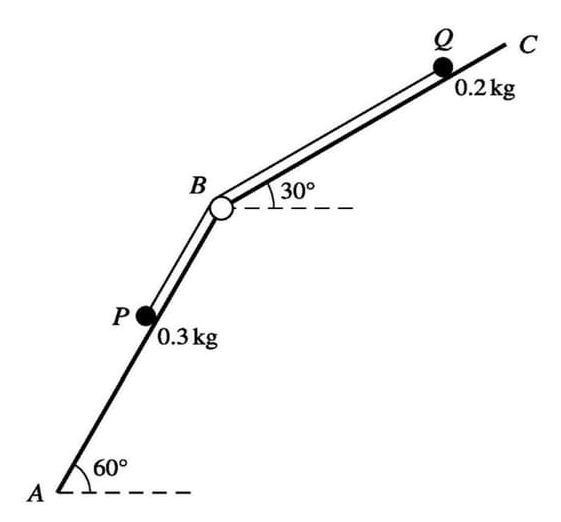
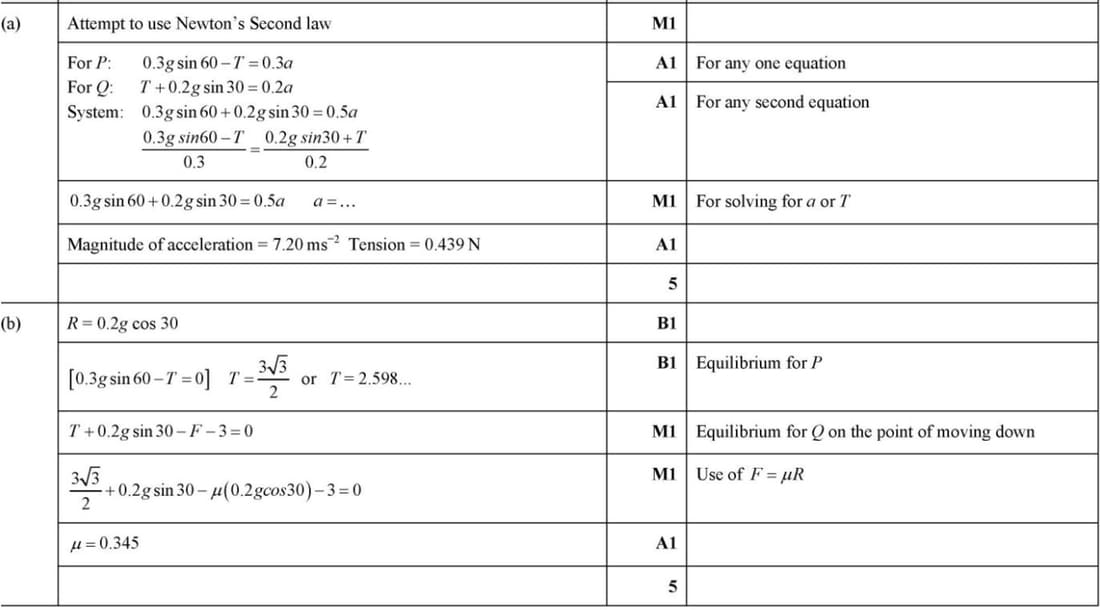
Two particles P and Q, of masses 0.3 kg and 0.2 kg respectively, are attached to the ends of a light inextensible string. The string passes over a fixed smooth pulley at B which is attached to two inclined planes. P lies on a smooth plane AB which is inclined at 60° to the horizontal. Q lies on a plane BC which is inclined at 30° to the horizontal. The string is taut and the particles can move on lines of greatest slope of the two planes (see diagram).
(a) It is given that the plane BC is smooth and that the particles are released from rest. Find the tension in the string and the magnitude of the acceleration of the particles. [5]
(b) It is given instead that the plane BC is rough. A force of magnitude 3 N is applied to Q directly up the plane along a line of greatest slope of the plane. Find the least value of the coefficient of friction between Q and the plane BC for which the particles remain at rest. [5]
Nov 2020 p43 q7
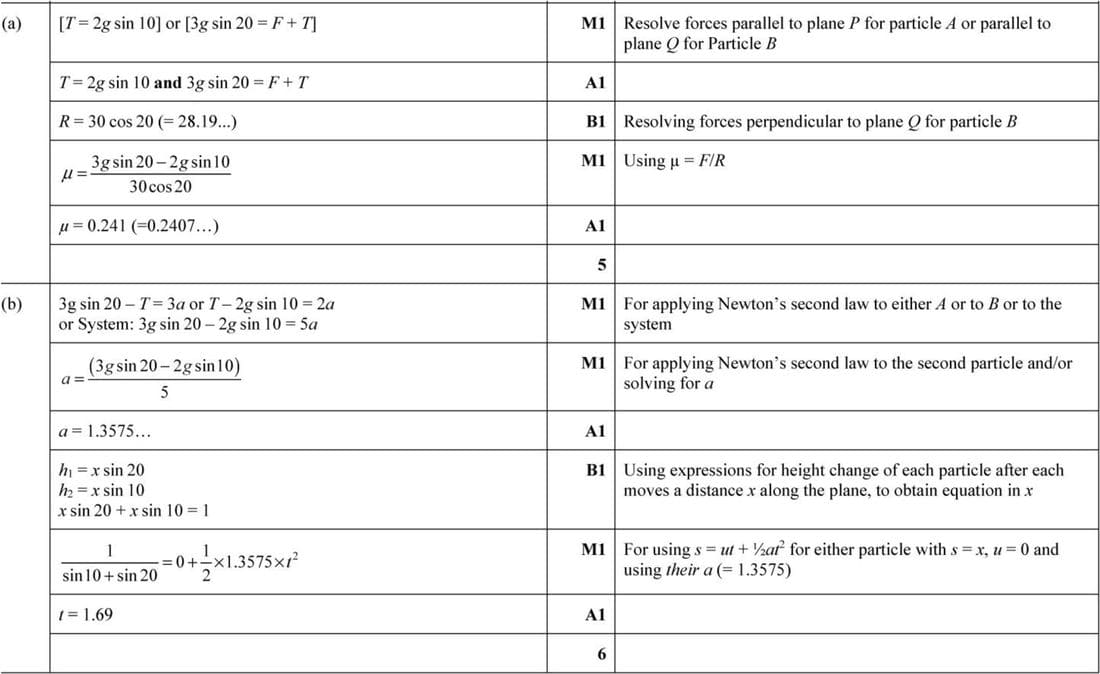
As shown in the diagram, particles A and B of masses 2 kg and 3 kg respectively are attached to the ends of a light inextensible string. The string passes over a small fixed smooth pulley which is attached to the top of two inclined planes. Particle A is on plane P, which is inclined at an angle of 10° to the horizontal. Particle B is on plane Q, which is inclined at an angle of 20° to the horizontal. The string is taut, and the two parts of the string are parallel to lines of greatest slope of their respective planes.
(a) It is given that plane P is smooth, plane Q is rough, and the particles are in limiting equilibrium. Find the coefficient of friction between particle B and plane Q.
(b) It is given instead that both planes are smooth and that the particles are released from rest at the same horizontal level. Find the time taken until the difference in the vertical height of the particles is 1 m. [You should assume that this occurs before A reaches the pulley or B reaches the bottom of plane Q.]

June 2018 p41 q7
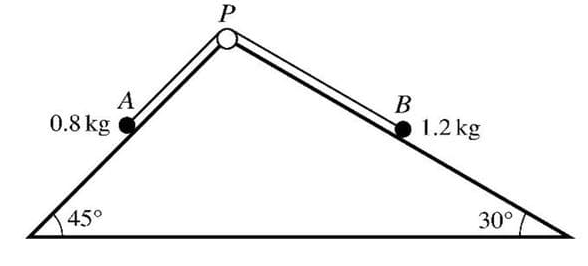
The diagram shows a triangular block with sloping faces inclined to the horizontal at 45° and 30°. Particle A of mass 0.8 kg lies on the face inclined at 45° and particle B of mass 1.2 kg lies on the face inclined at 30°. The particles are connected by a light inextensible string which passes over a small smooth pulley P fixed at the top of the faces. The parts AP and BP of the string are parallel to lines of greatest slope of the respective faces. The particles are released from rest with both parts of the string taut. In the subsequent motion neither particle reaches the pulley and neither particle reaches the bottom of a face.
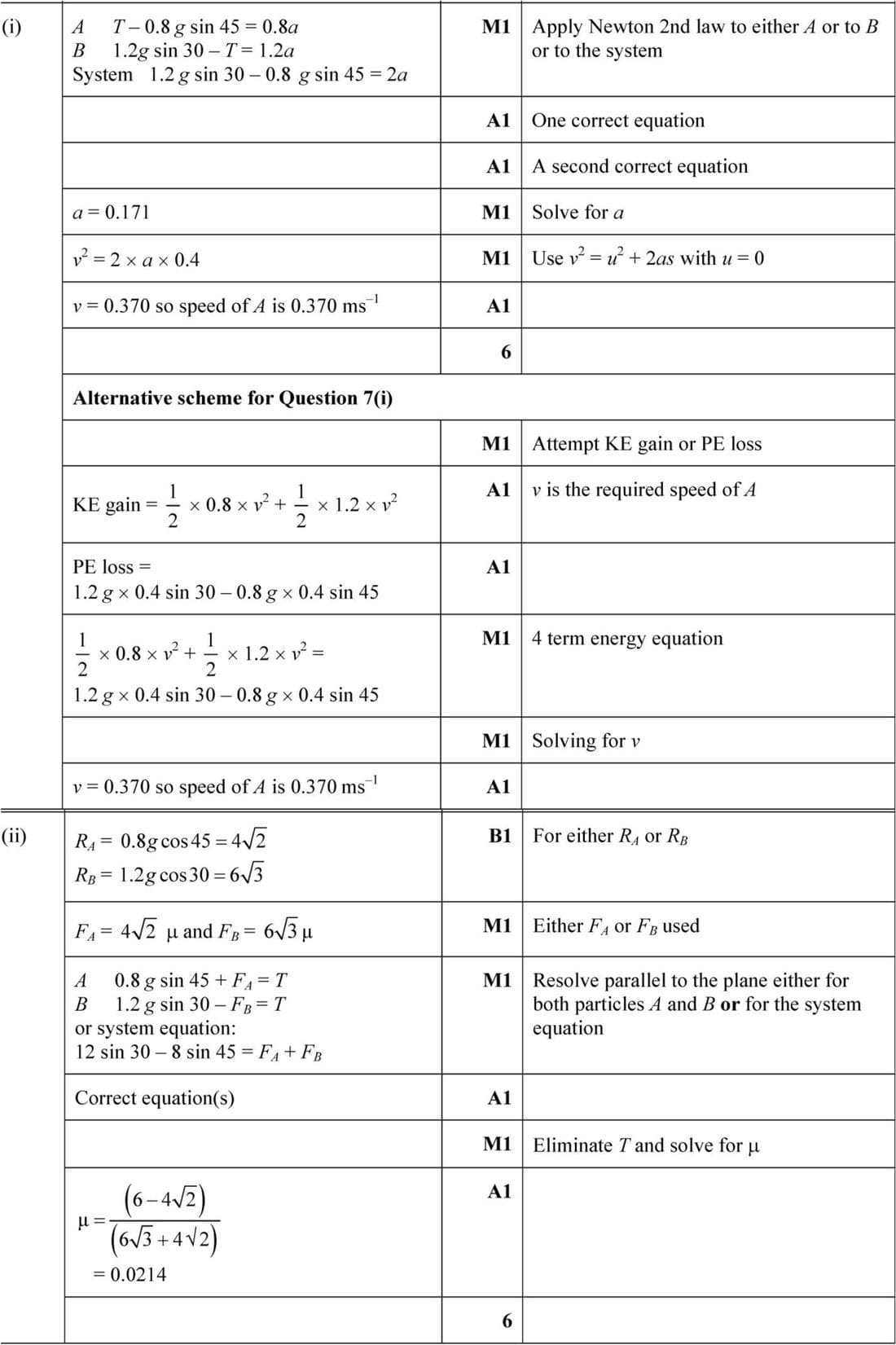
- Given that both faces are smooth, find the speed of A after each particle has travelled a distance of 0.4 m.
- It is given instead that both faces are rough. The coefficient of friction between each particle and a face of the block is \(\mu\). Find the value of \(\mu\) for which the system is in limiting equilibrium.
Nov 2017 p41 q7
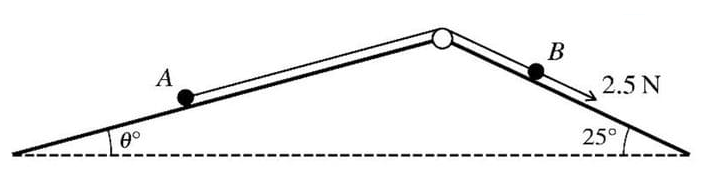
Two particles A and B of masses 0.9 kg and 0.4 kg respectively are attached to the ends of a light inextensible string. The string passes over a fixed smooth pulley which is attached to the top of two inclined planes. The particles are initially at rest with A on a smooth plane inclined at angle θ° to the horizontal and B on a plane inclined at angle 25° to the horizontal. The string is taut and the particles can move on lines of greatest slope of the two planes. A force of magnitude 2.5 N is applied to B acting down the plane (see diagram).
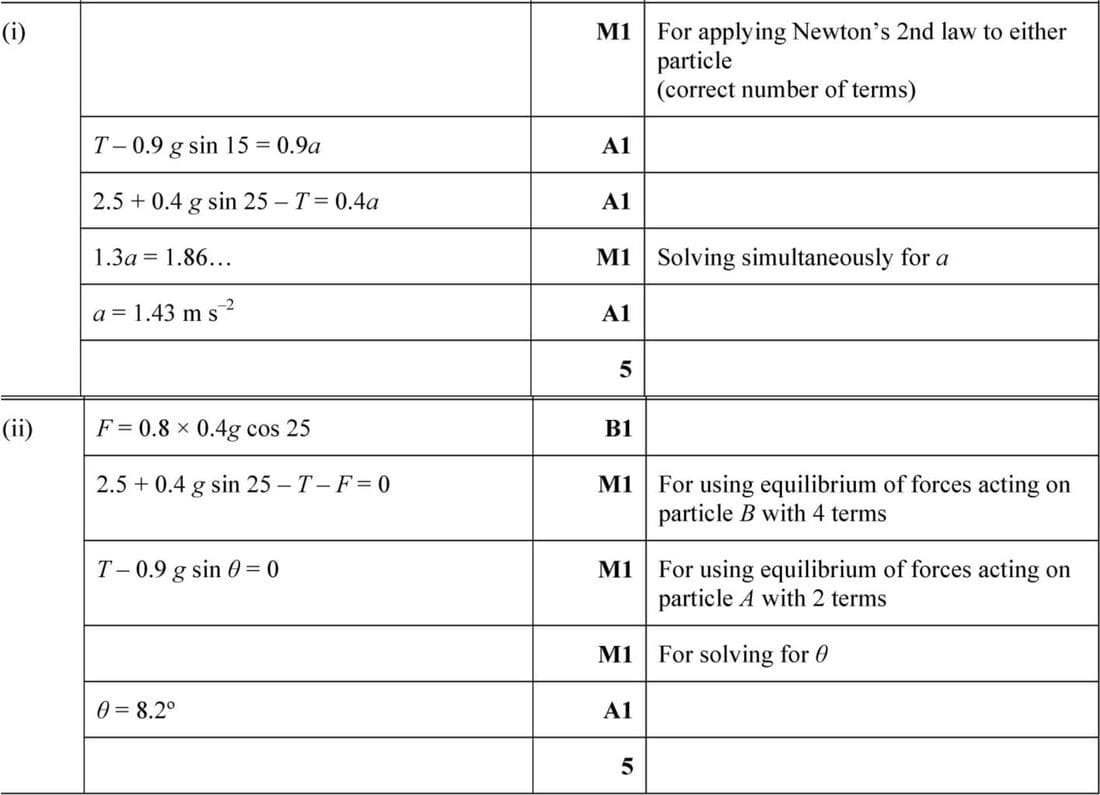
- For the case where θ = 15 and the plane on which B rests is smooth, find the acceleration of B.
- For a different value of θ, the plane on which B rests is rough with coefficient of friction between the plane and B of 0.8. The system is in limiting equilibrium with B on the point of moving in the direction of the 2.5 N force. Find the value of θ.
June 2017 p41 q7
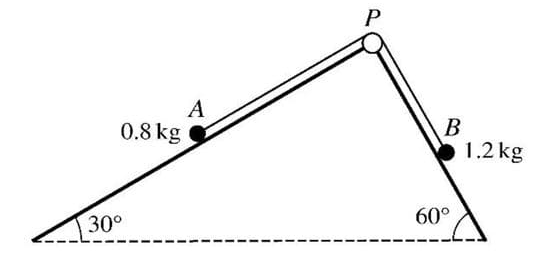
As shown in the diagram, a particle A of mass 0.8 kg lies on a plane inclined at an angle of 30° to the horizontal and a particle B of mass 1.2 kg lies on a plane inclined at an angle of 60° to the horizontal. The particles are connected by a light inextensible string which passes over a small smooth pulley P fixed at the top of the planes. The parts AP and BP of the string are parallel to lines of greatest slope of the respective planes. The particles are released from rest with both parts of the string taut.
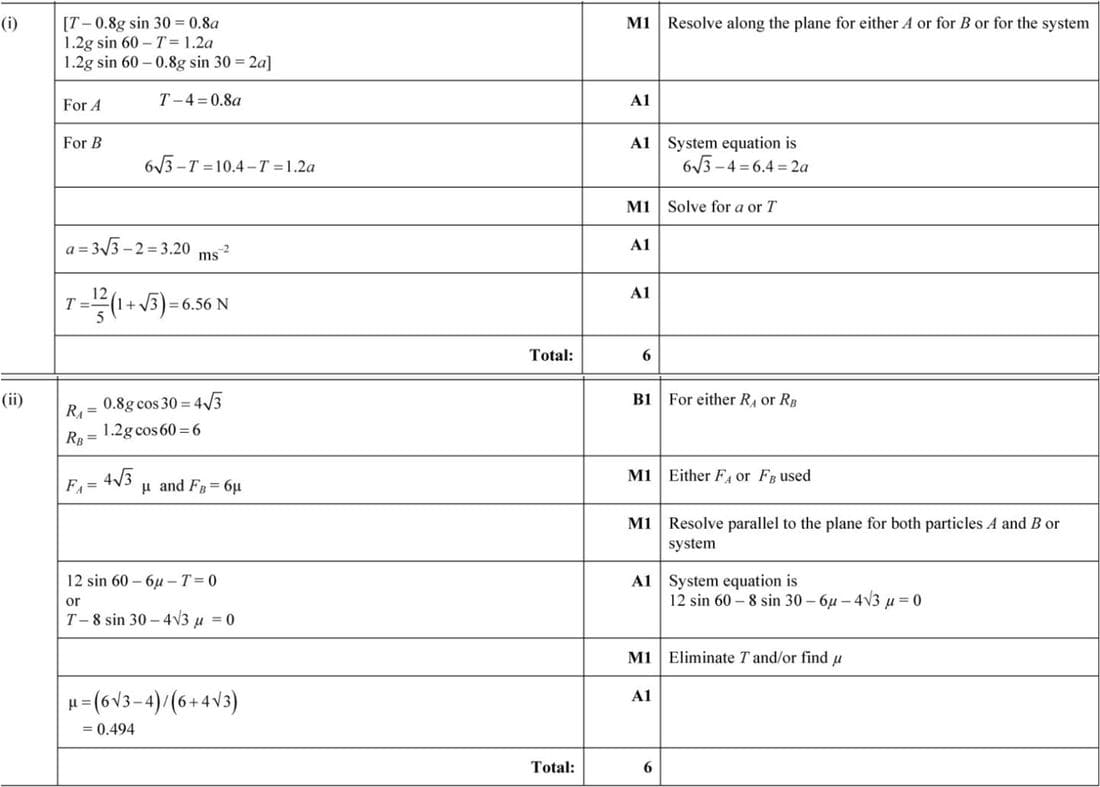
- Given that both planes are smooth, find the acceleration of A and the tension in the string. [6]
- It is given instead that both planes are rough, with the same coefficient of friction, μ, for both particles. Find the value of μ for which the system is in limiting equilibrium. [6]
Nov 2014 p43 q2
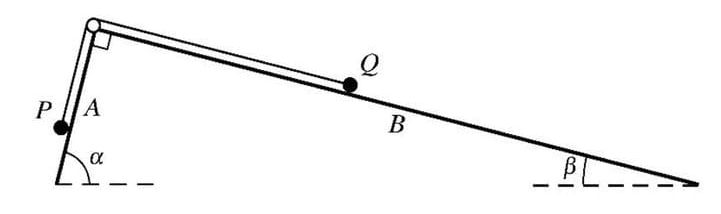
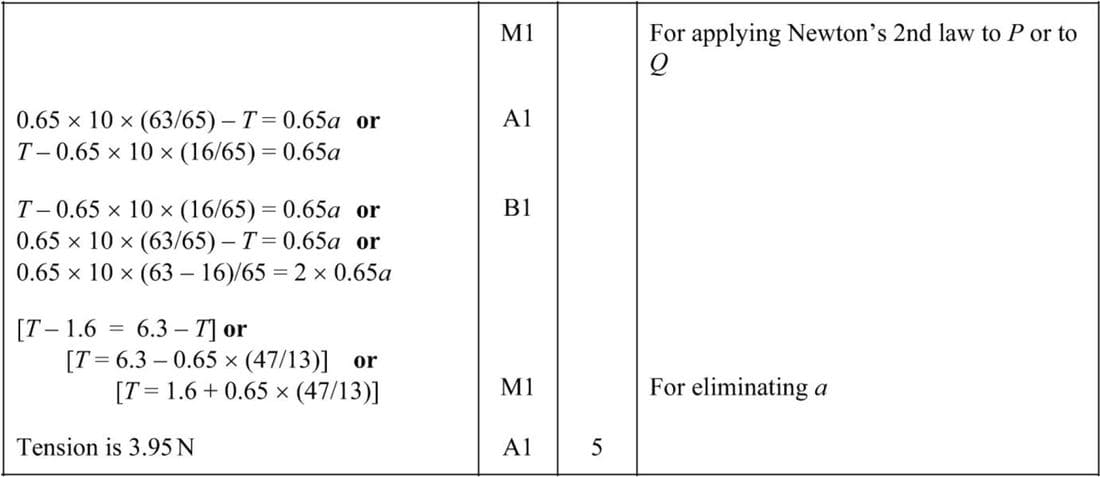
The tops of each of two smooth inclined planes A and B meet at a right angle. Plane A is inclined at angle \(\alpha\) to the horizontal and plane B is inclined at angle \(\beta\) to the horizontal, where \(\sin \alpha = \frac{63}{65}\) and \(\sin \beta = \frac{16}{65}\). A small smooth pulley is fixed at the top of the planes and a light inextensible string passes over the pulley. Two particles P and Q, each of mass 0.65 kg, are attached to the string, one at each end. Particle Q is held at rest at a point of the same line of greatest slope of the plane B as the pulley. Particle P rests freely below the pulley in contact with plane A (see diagram). Particle Q is released and the particles start to move with the string taut. Find the tension in the string.
June 2012 p41 q6
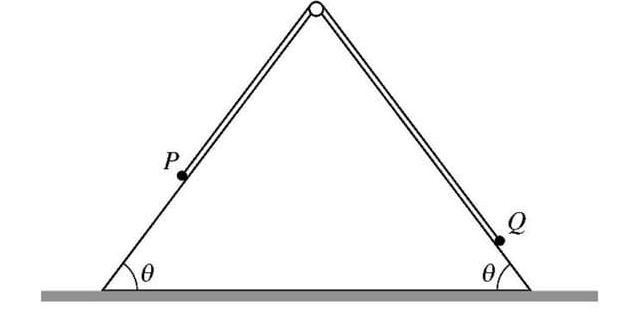
Particles P and Q, of masses 0.6 kg and 0.4 kg respectively, are attached to the ends of a light inextensible string. The string passes over a small smooth pulley which is fixed at the top of a vertical cross-section of a triangular prism. The base of the prism is fixed on horizontal ground and each of the sloping sides is smooth. Each sloping side makes an angle θ with the ground, where \\sin θ = 0.8\\. Initially the particles are held at rest on the sloping sides, with the string taut (see diagram). The particles are released and move along lines of greatest slope.
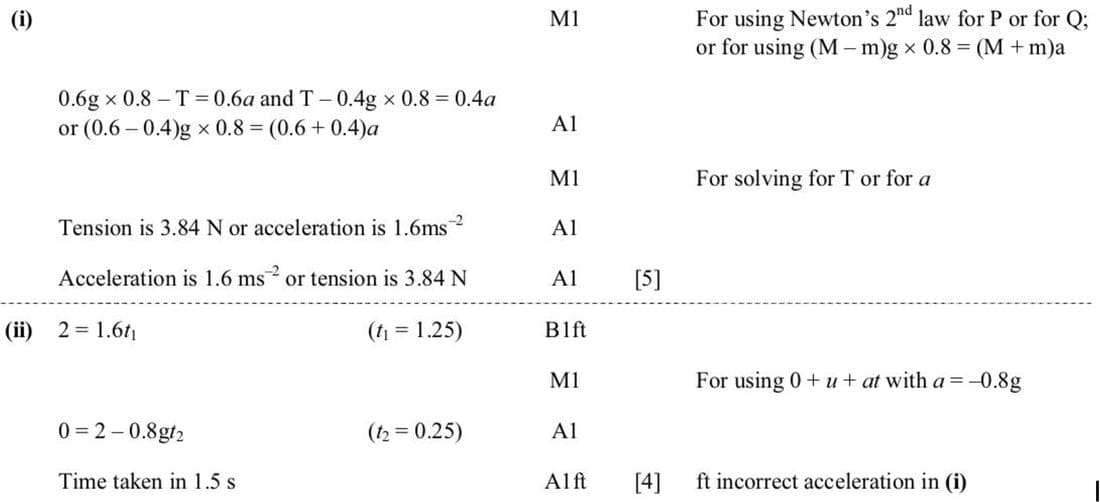
- Find the tension in the string and the acceleration of the particles while both are moving. [5]
The speed of P when it reaches the ground is 2 m s-1. On reaching the ground P comes to rest and remains at rest. Q continues to move up the slope but does not reach the pulley.
- Find the time taken from the instant that the particles are released until Q reaches its greatest height above the ground. [4]
Nov 2010 p43 q3
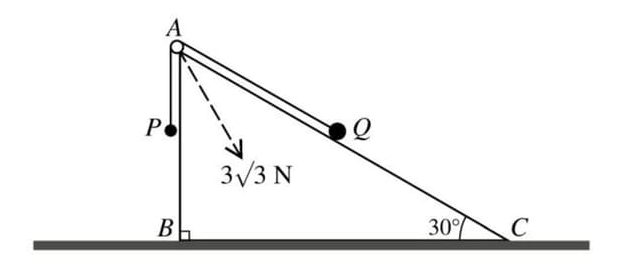
A small smooth pulley is fixed at the highest point A of a cross-section ABC of a triangular prism. Angle \(\angle ABC = 90^\circ\) and angle \(\angle BCA = 30^\circ\). The prism is fixed with the face containing BC in contact with a horizontal surface. Particles P and Q are attached to opposite ends of a light inextensible string, which passes over the pulley. The particles are in equilibrium with P hanging vertically below the pulley and Q in contact with AC. The resultant force exerted on the pulley by the string is \(3\sqrt{3} \text{ N}\) (see diagram).
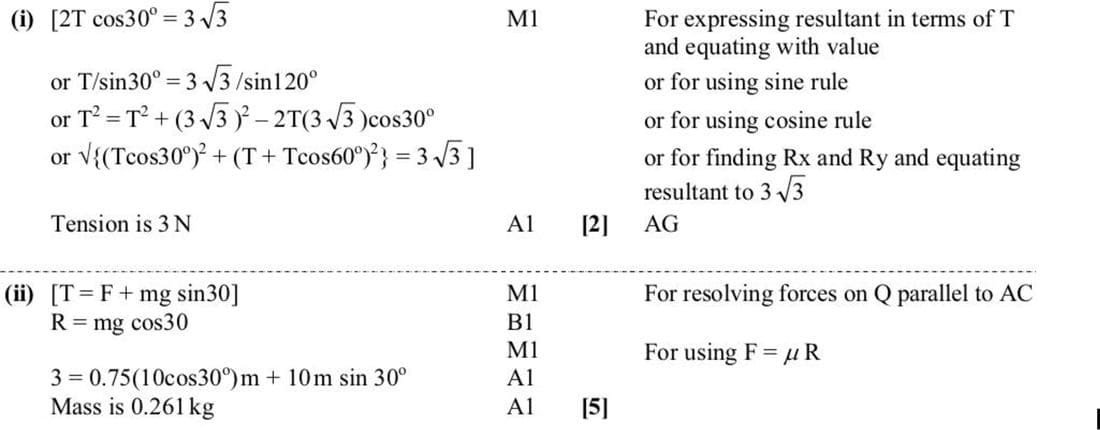
(i) Show that the tension in the string is 3 N.
The coefficient of friction between Q and the prism is 0.75.
(ii) Given that Q is in limiting equilibrium and on the point of moving upwards, find its mass.
June 2006 p4 q5
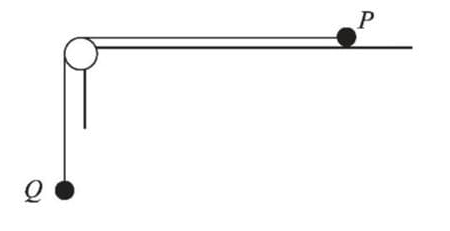
Particles P and Q are attached to opposite ends of a light inextensible string. P is at rest on a rough horizontal table. The string passes over a small smooth pulley which is fixed at the edge of the table. Q hangs vertically below the pulley (see diagram). The force exerted on the string by the pulley has magnitude \(4\sqrt{2}\) N. The coefficient of friction between P and the table is 0.8.
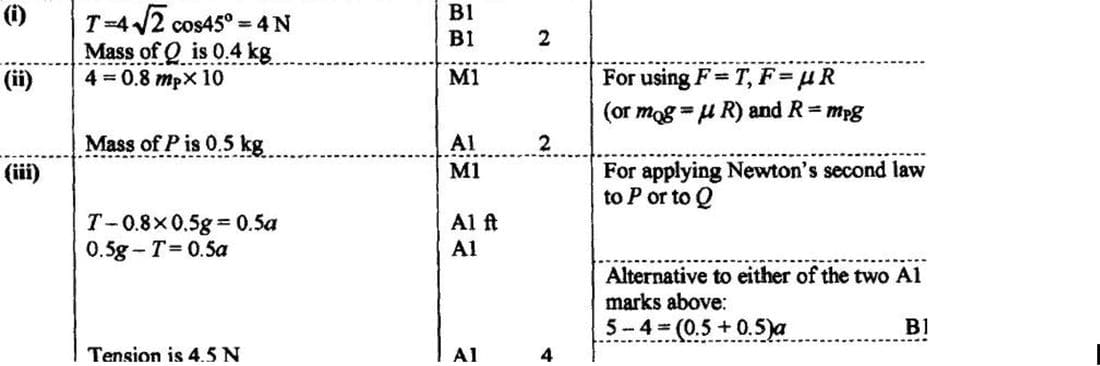
- Show that the tension in the string is 4 N and state the mass of Q.
- Given that P is on the point of slipping, find its mass.
- A particle of mass 0.1 kg is now attached to Q and the system starts to move. Find the tension in the string while the particles are in motion.
Nov 2021 p43 q6
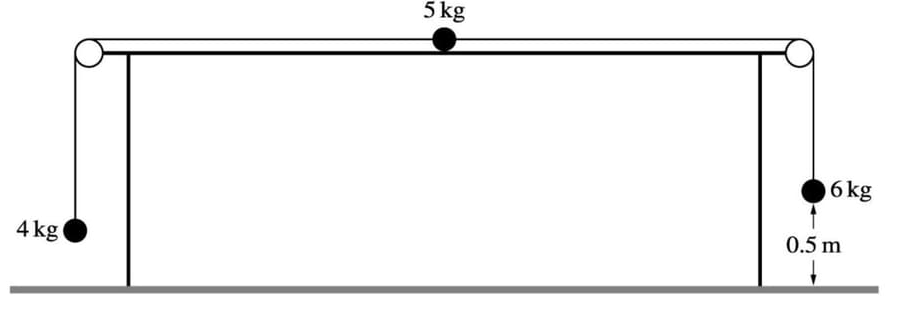
The diagram shows a particle of mass 5 kg on a rough horizontal table, and two light inextensible strings attached to it passing over smooth pulleys fixed at the edges of the table. Particles of masses 4 kg and 6 kg hang freely at the ends of the strings. The particle of mass 6 kg is 0.5 m above the ground. The system is in limiting equilibrium.
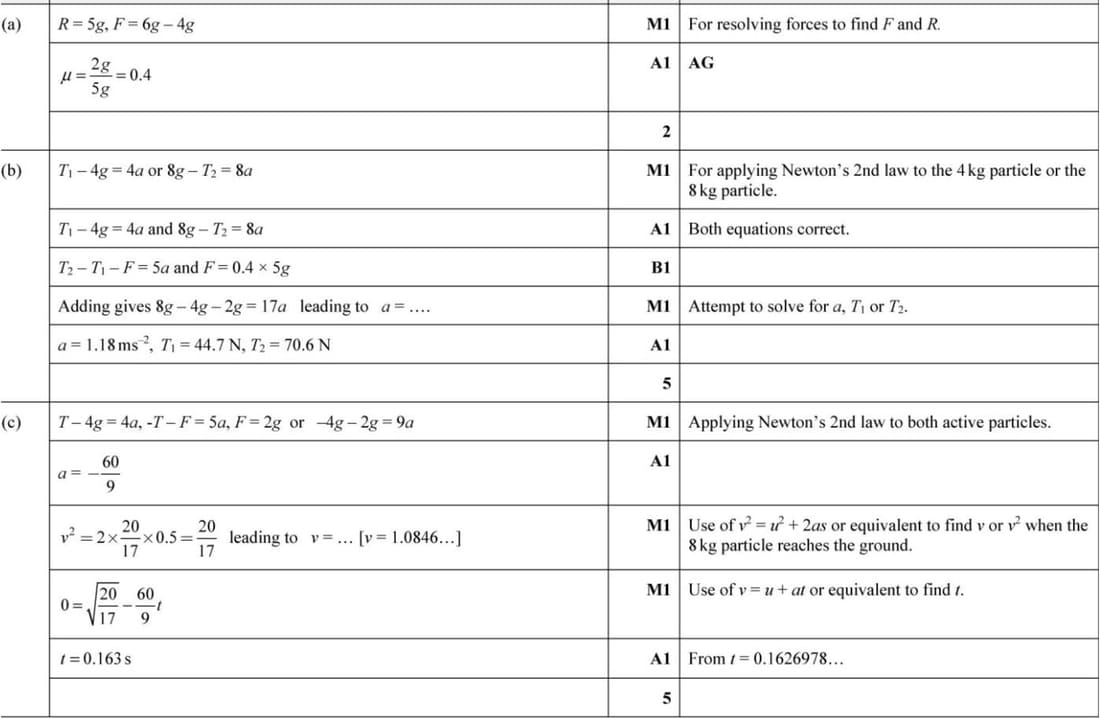
(a) Show that the coefficient of friction between the 5 kg particle and the table is 0.4.
The 6 kg particle is now replaced by a particle of mass 8 kg and the system is released from rest.
(b) Find the acceleration of the 4 kg particle and the tensions in the strings.
(c) In the subsequent motion the 8 kg particle hits the ground and does not rebound. Find the time that elapses after the 8 kg particle hits the ground before the other two particles come to instantaneous rest. (You may assume this occurs before either particle reaches a pulley.)
Nov 2016 p43 q3
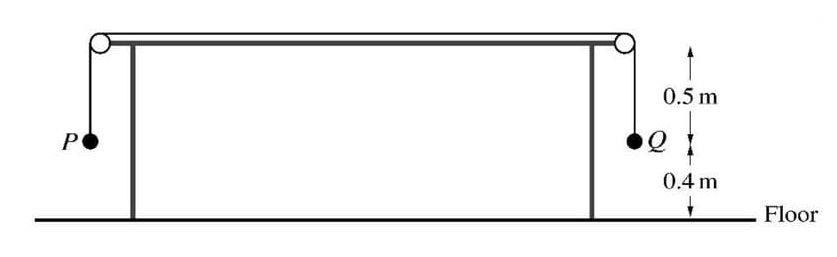
Particles P and Q, of masses 7 kg and 3 kg respectively, are attached to the two ends of a light inextensible string. The string passes over two small smooth pulleys attached to the two ends of a horizontal table. The two particles hang vertically below the two pulleys. The two particles are both initially at rest, 0.5 m below the level of the table, and 0.4 m above the horizontal floor (see diagram).
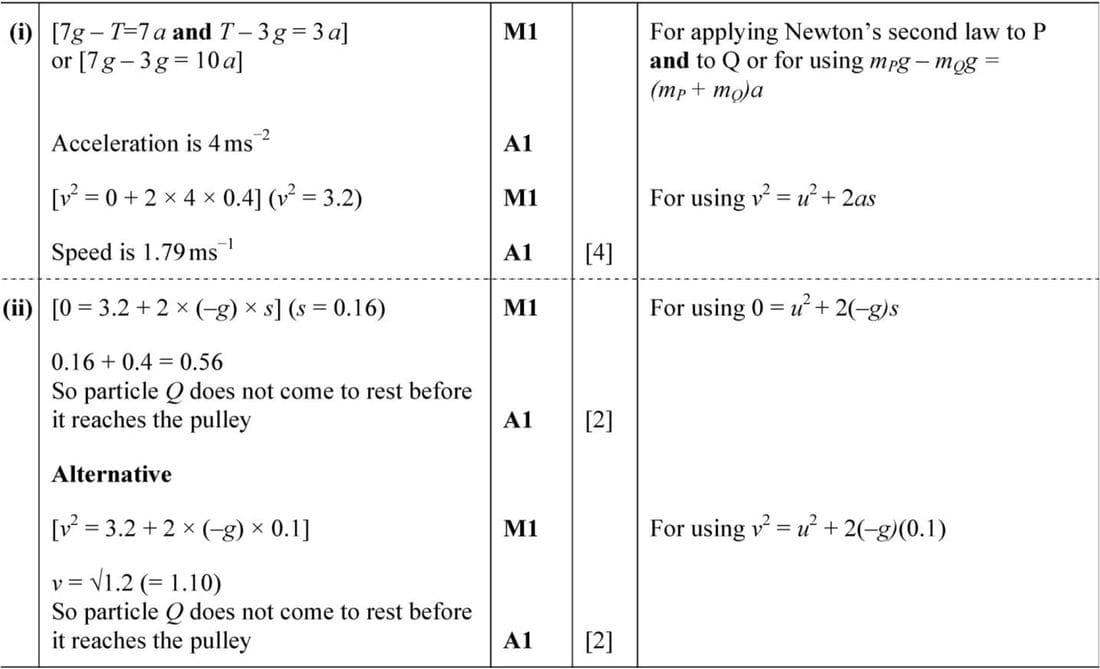
(i) Find the acceleration of the particles and the speed of P immediately before it reaches the floor.
(ii) Determine whether Q comes to instantaneous rest before it reaches the pulley directly above it.
Nov 2014 p41 q5
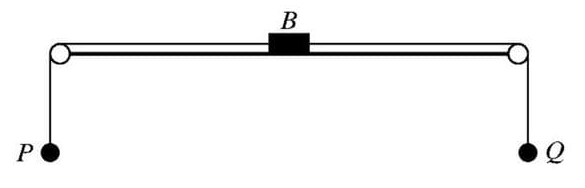
A small block B of mass 0.25 kg is attached to the mid-point of a light inextensible string. Particles P and Q, of masses 0.2 kg and 0.3 kg respectively, are attached to the ends of the string. The string passes over two smooth pulleys fixed at opposite sides of a rough table, with B resting in limiting equilibrium on the table between the pulleys and particles P and Q and block B are in the same vertical plane (see diagram).
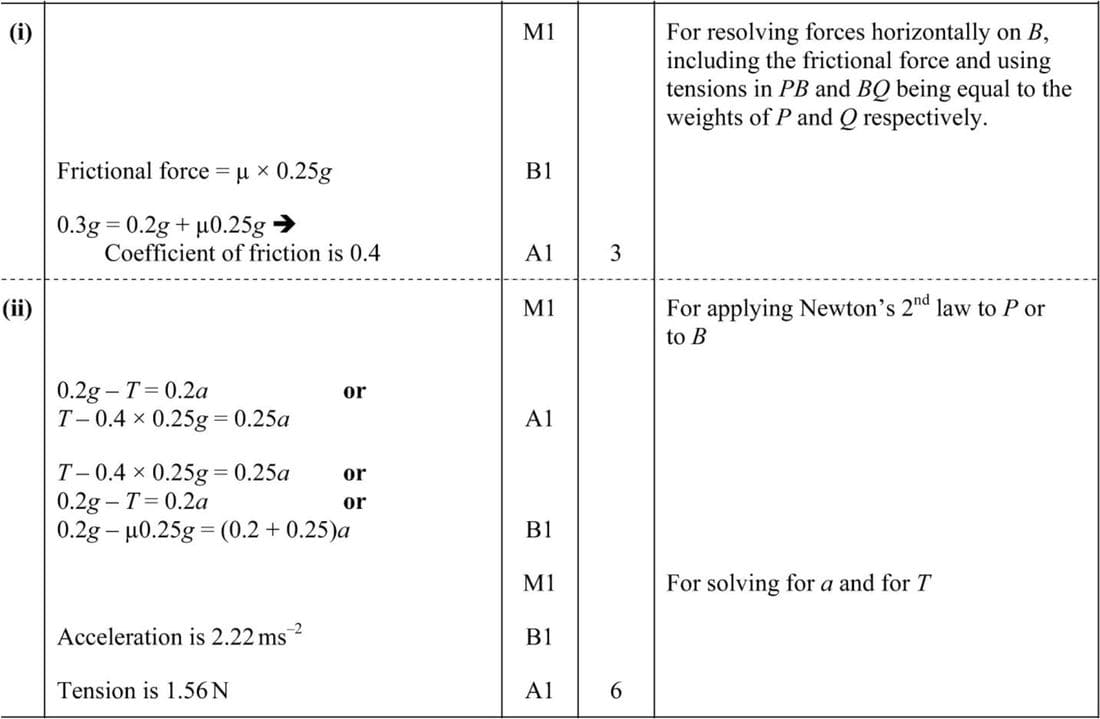
(i) Find the coefficient of friction between B and the table. [3]
Q is now removed so that P and B begin to move.
(ii) Find the acceleration of P and the tension in the part PB of the string. [6]
June 2014 p42 q7
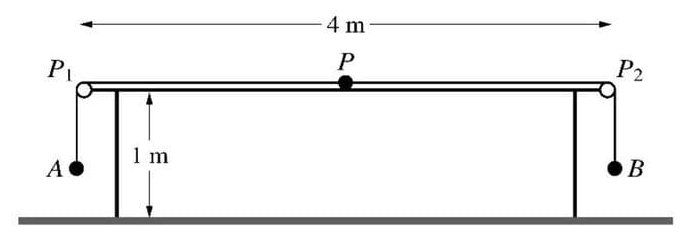
A light inextensible string of length 5.28 m has particles A and B, of masses 0.25 kg and 0.75 kg respectively, attached to its ends. Another particle P, of mass 0.5 kg, is attached to the mid-point of the string. Two small smooth pulleys P1 and P2 are fixed at opposite ends of a rough horizontal table of length 4 m and height 1 m. The string passes over P1 and P2 with particle A held at rest vertically below P1, the string taut and B hanging freely below P2. Particle P is in contact with the table halfway between P1 and P2 (see diagram). The coefficient of friction between P and the table is 0.4. Particle A is released and the system starts to move with constant acceleration of magnitude a m s-2. The tension in the part AP of the string is TA N and the tension in the part PB of the string is TB N.
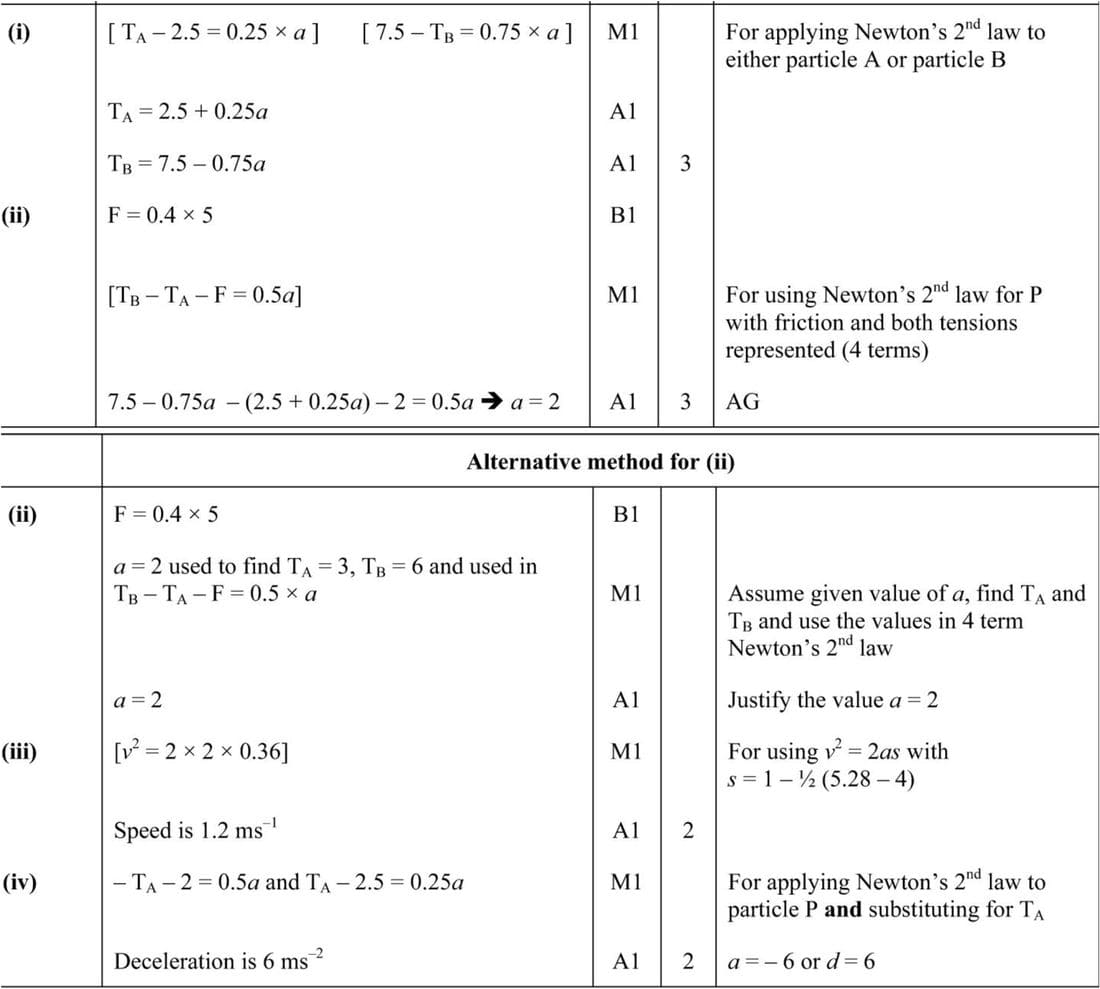
- Find TA and TB in terms of a.
- Show by considering the motion of P that a = 2.
- Find the speed of the particles immediately before B reaches the floor.
- Find the deceleration of P immediately after B reaches the floor.
June 2018 p42 q7
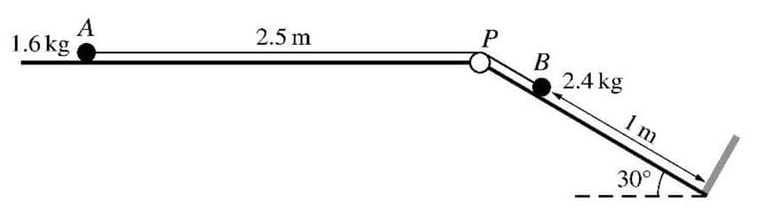
As shown in the diagram, a particle A of mass 1.6 kg lies on a horizontal plane and a particle B of mass 2.4 kg lies on a plane inclined at an angle of 30° to the horizontal. The particles are connected by a light inextensible string which passes over a small smooth pulley P fixed at the top of the inclined plane. The distance AP is 2.5 m and the distance of B from the bottom of the inclined plane is 1 m. There is a barrier at the bottom of the inclined plane preventing any further motion of B. The part BP of the string is parallel to a line of greatest slope of the inclined plane. The particles are released from rest with both parts of the string taut.
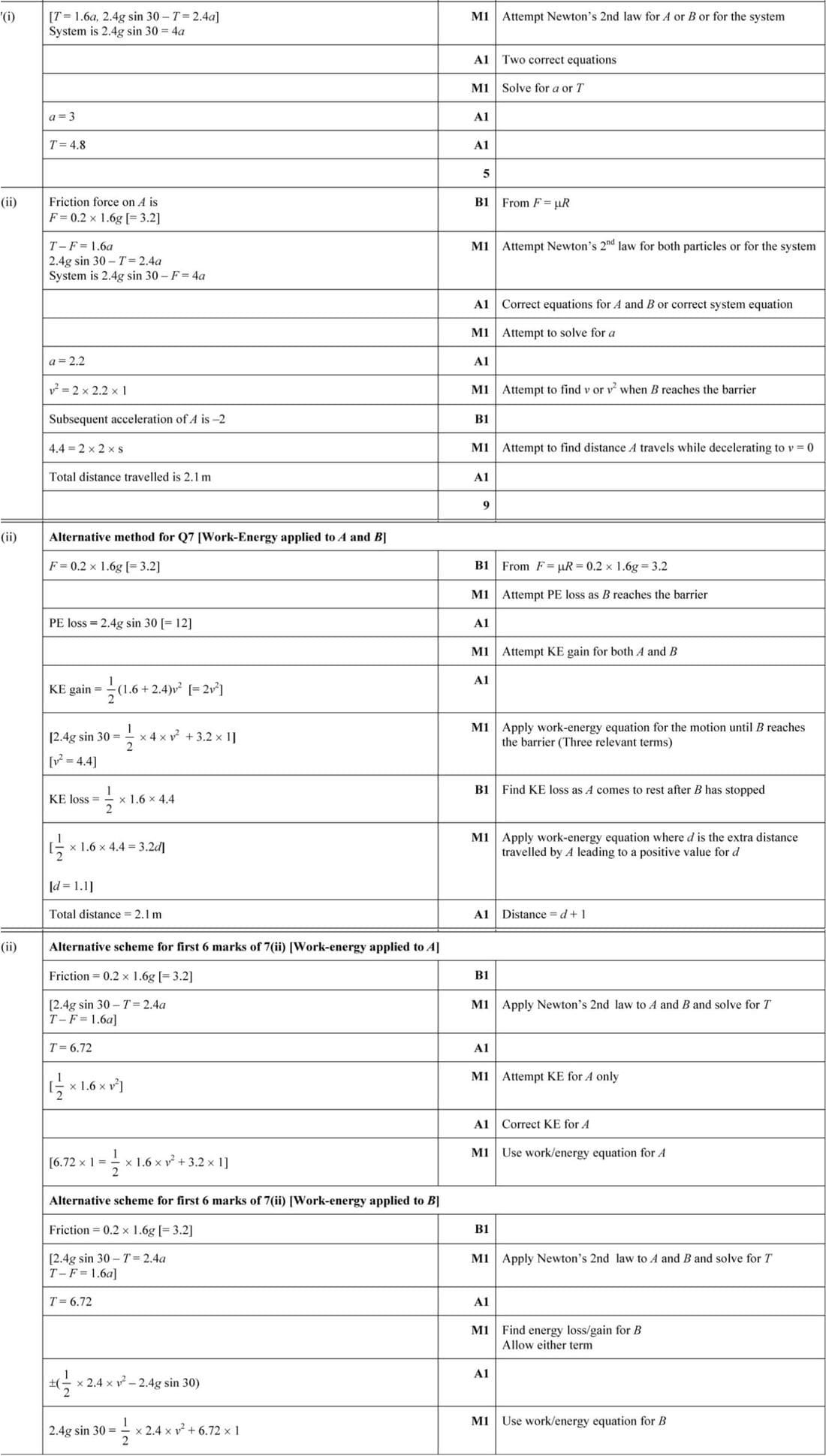
(i) Given that both planes are smooth, find the acceleration of A and the tension in the string. [5]
(ii) It is given instead that the horizontal plane is rough and that the coefficient of friction between A and the horizontal plane is 0.2. The inclined plane is smooth. Find the total distance travelled by A. [9]
June 2017 p42 q6
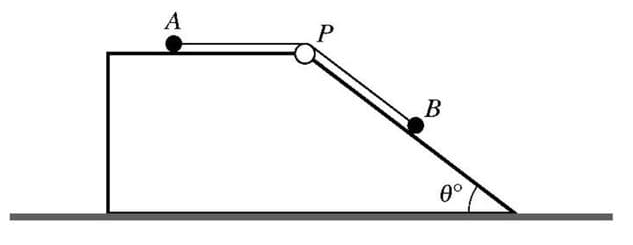
The diagram shows a fixed block with a horizontal top surface and a surface which is inclined at an angle of \(\theta^\circ\) to the horizontal, where \(\sin \theta = \frac{3}{5}\). A particle \(A\) of mass 0.3 kg rests on the horizontal surface and is attached to one end of a light inextensible string. The string passes over a small smooth pulley \(P\) fixed at the edge of the block. The other end of the string is attached to a particle \(B\) of mass 1.5 kg which rests on the sloping surface of the block. The system is released from rest with the string taut.
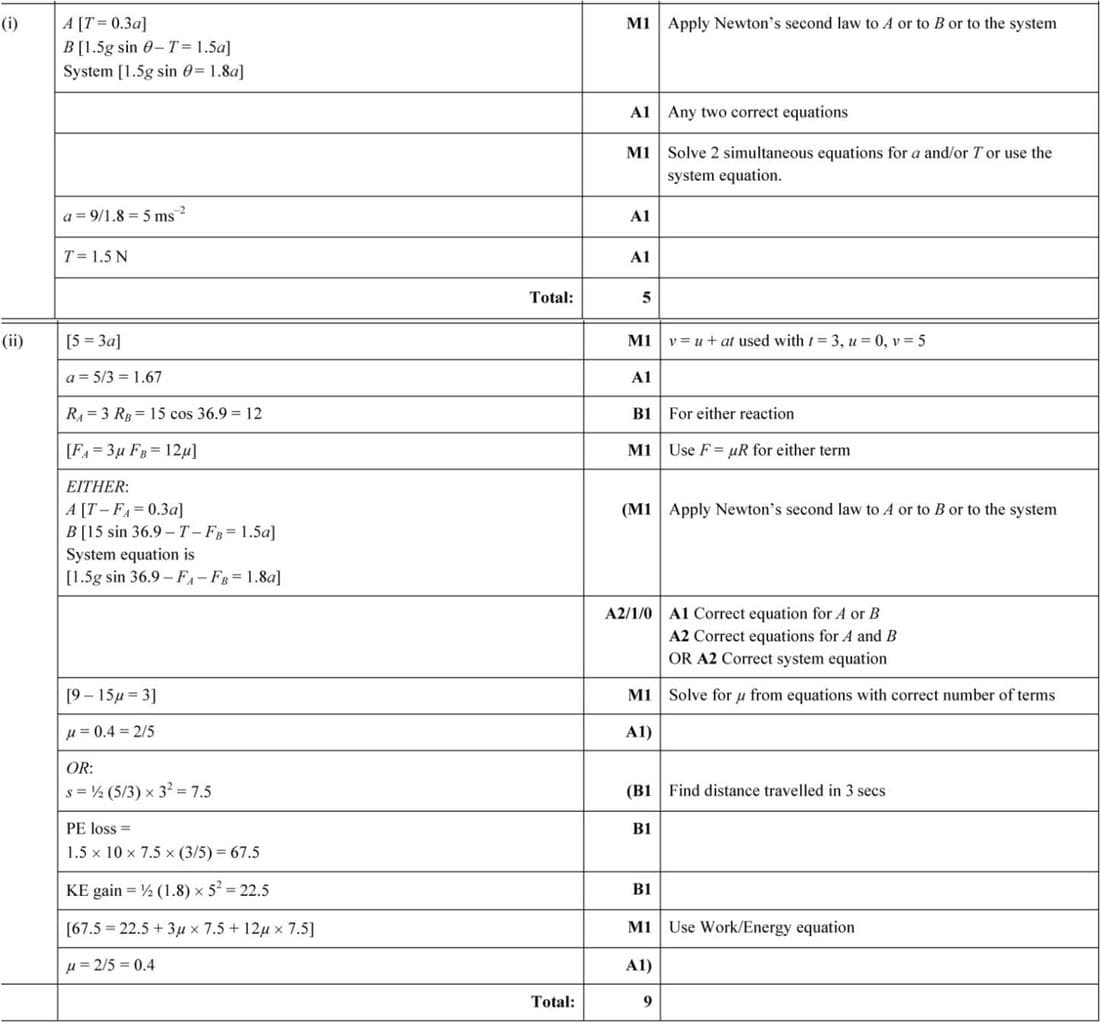
- Given that the block is smooth, find the acceleration of particle \(A\) and the tension in the string. [5]
- It is given instead that the block is rough. The coefficient of friction between \(A\) and the block is \(\mu\) and the coefficient of friction between \(B\) and the block is also \(\mu\). In the first 3 seconds of the motion, \(A\) does not reach \(P\) and \(B\) does not reach the bottom of the sloping surface. The speed of the particles after 3 s is 5 m s\(^{-1}\). Find the acceleration of particle \(A\) and the value of \(\mu\). [9]
Nov 2016 p41 q1
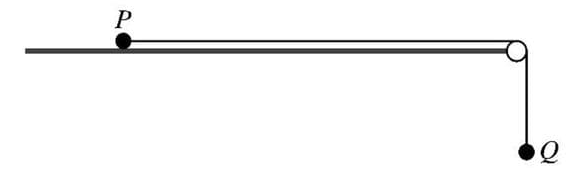
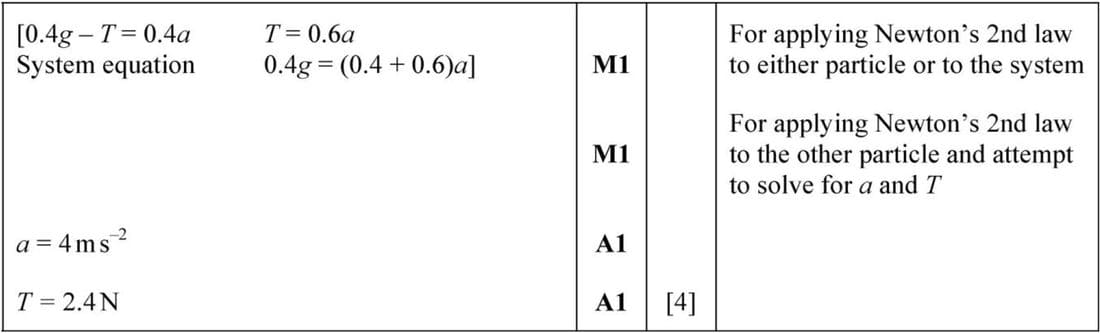
Two particles P and Q, of masses 0.6 kg and 0.4 kg respectively, are connected by a light inextensible string. The string passes over a small smooth light pulley fixed at the edge of a smooth horizontal table. Initially P is held at rest on the table and Q hangs vertically (see diagram). P is then released. Find the tension in the string and the acceleration of Q.
June 2010 p41 q6
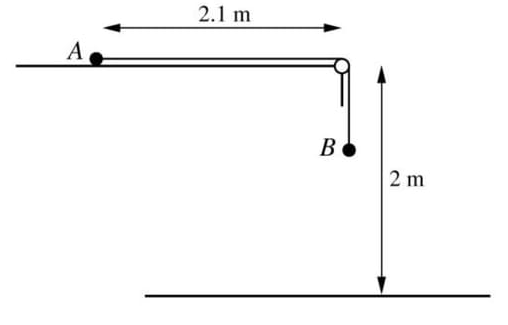
Particles A and B, of masses 0.2 kg and 0.45 kg respectively, are connected by a light inextensible string of length 2.8 m. The string passes over a small smooth pulley at the edge of a rough horizontal surface, which is 2 m above the floor. Particle A is held in contact with the surface at a distance of 2.1 m from the pulley and particle B hangs freely (see diagram). The coefficient of friction between A and the surface is 0.3. Particle A is released and the system begins to move.
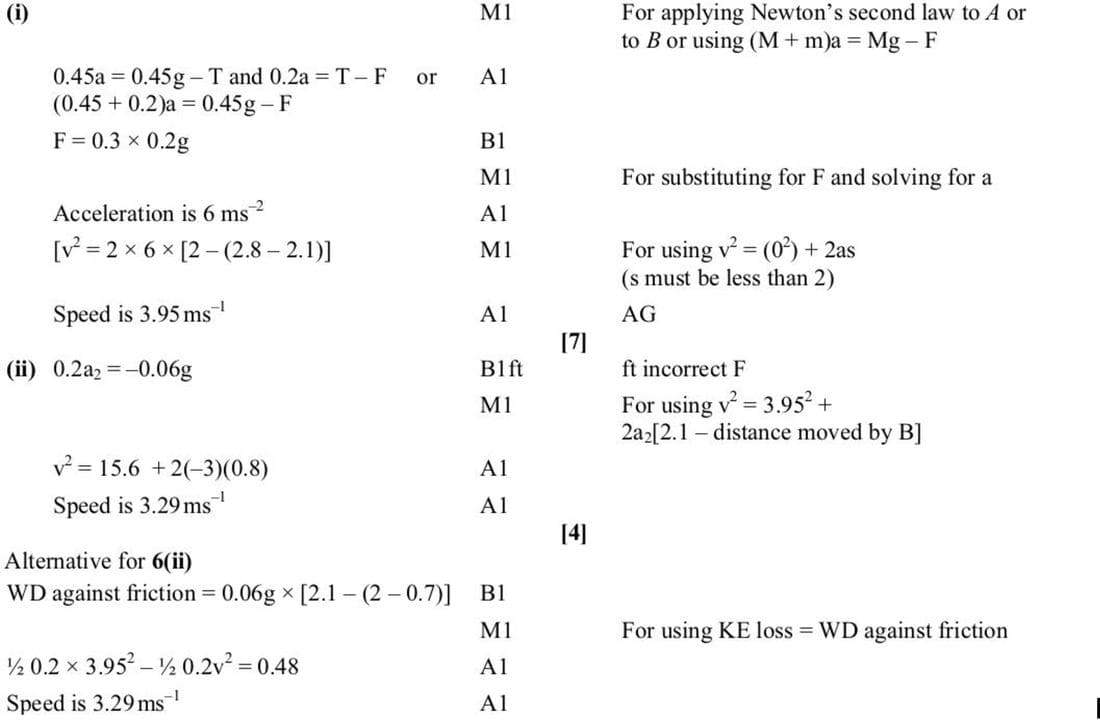
- Find the acceleration of the particles and show that the speed of B immediately before it hits the floor is 3.95 m s-1, correct to 3 significant figures.
- Given that B remains on the floor, find the speed with which A reaches the pulley.
June 2008 p4 q5
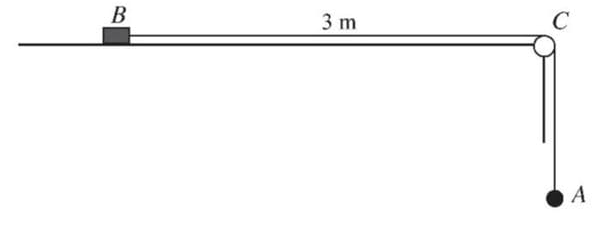
A block B of mass 0.6 kg and a particle A of mass 0.4 kg are attached to opposite ends of a light inextensible string. The block is held at rest on a rough horizontal table, and the coefficient of friction between the block and the table is 0.5. The string passes over a small smooth pulley C at the edge of the table and A hangs in equilibrium vertically below C. The part of the string between B and C is horizontal and the distance BC is 3 m (see diagram). B is released and the system starts to move.
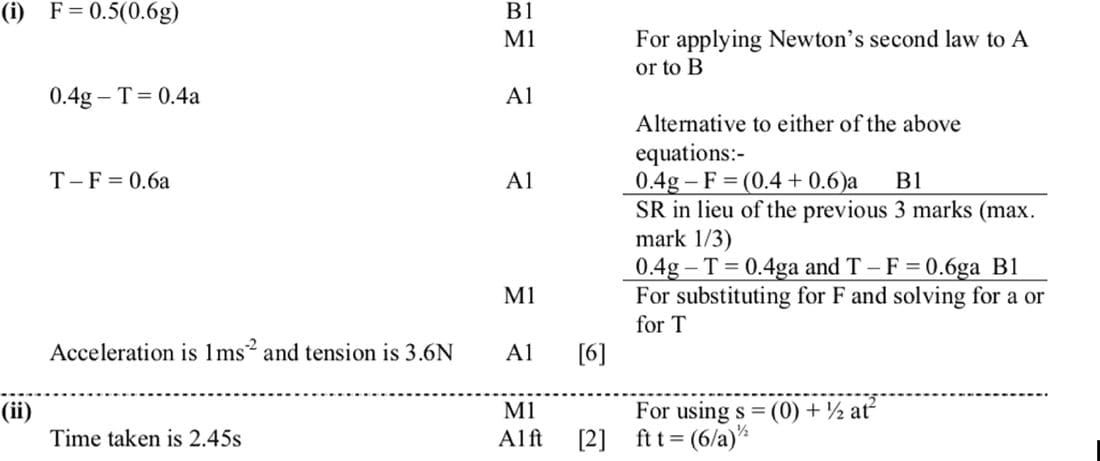
- Find the acceleration of B and the tension in the string.
- Find the time taken for B to reach the pulley.
June 2005 p4 q4
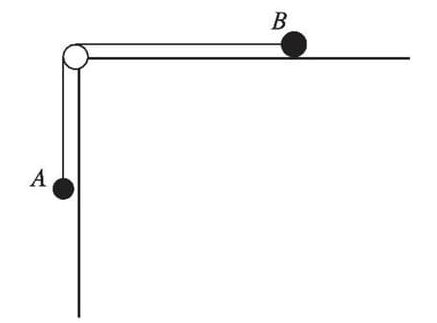
Particles A and B, of masses 0.2 kg and 0.3 kg respectively, are connected by a light inextensible string. The string passes over a smooth pulley at the edge of a rough horizontal table. Particle A hangs freely and particle B is in contact with the table (see diagram).
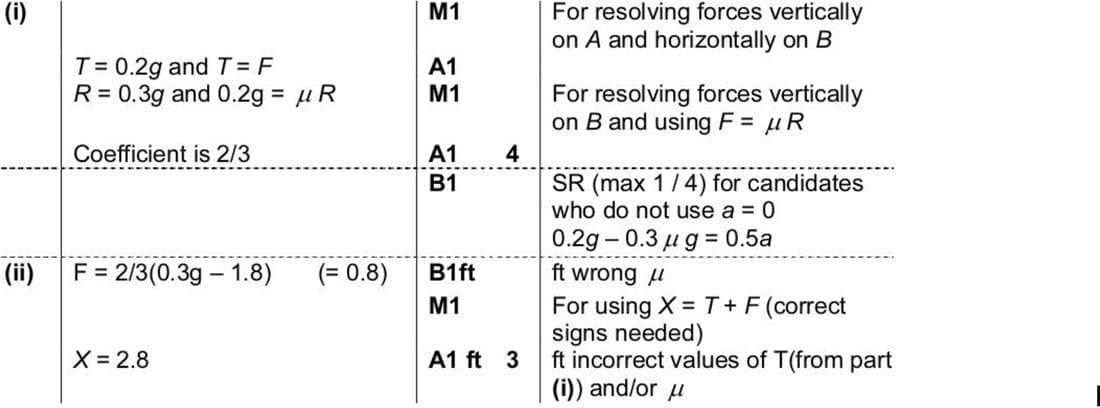
(i) The system is in limiting equilibrium with the string taut and A about to move downwards. Find the coefficient of friction between B and the table.
A force now acts on particle B. This force has a vertical component of 1.8 N upwards and a horizontal component of X N directed away from the pulley.
(ii) The system is now in limiting equilibrium with the string taut and A about to move upwards. Find X.
Nov 2004 p4 q1
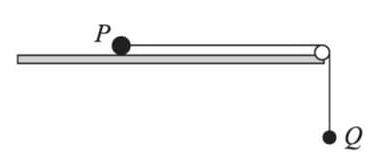
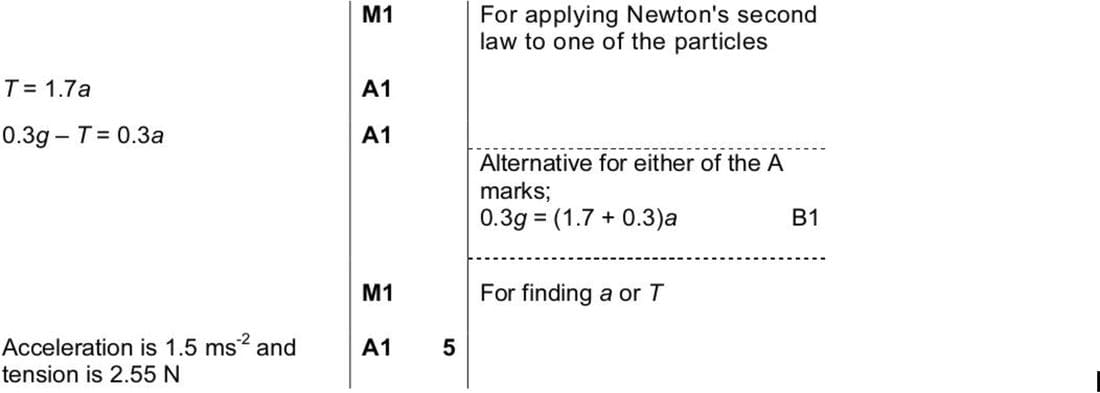
Two particles P and Q, of masses 1.7 kg and 0.3 kg respectively, are connected by a light inextensible string. P is held on a smooth horizontal table with the string taut and passing over a small smooth pulley fixed at the edge of the table. Q is at rest vertically below the pulley. P is released. Find the acceleration of the particles and the tension in the string.
Nov 2003 p4 q5
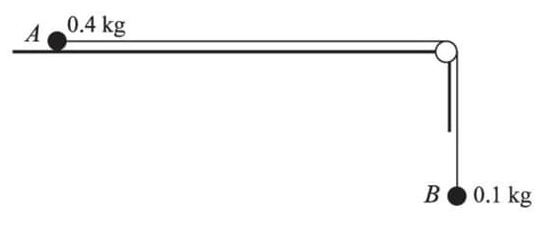
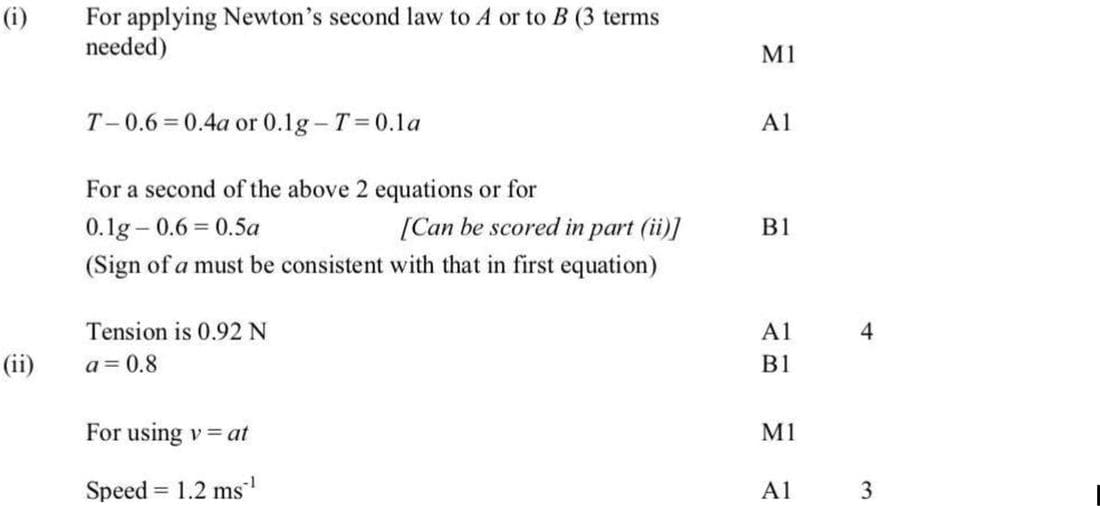
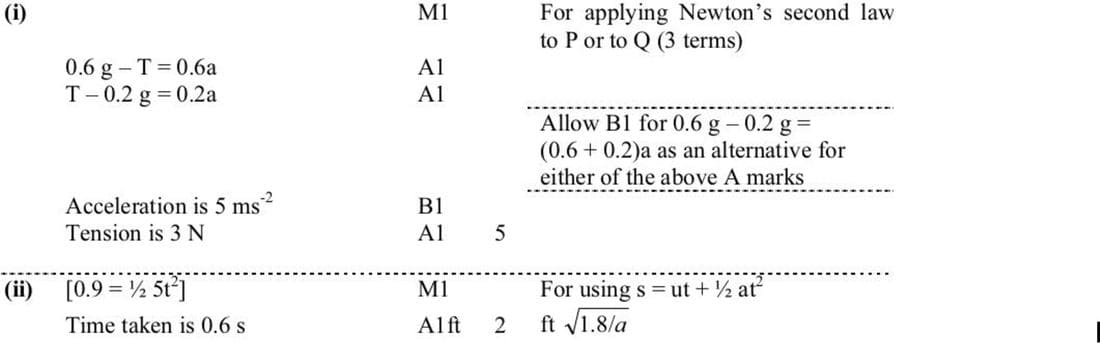
Particles A and B, of masses 0.4 kg and 0.1 kg respectively, are attached to the ends of a light inextensible string. Particle A is held at rest on a horizontal table with the string passing over a smooth pulley at the edge of the table. Particle B hangs vertically below the pulley (see diagram). The system is released from rest. In the subsequent motion a constant frictional force of magnitude 0.6 N acts on A. Find
- the tension in the string,
- the speed of B 1.5 s after it starts to move.
June 2016 p42 q7
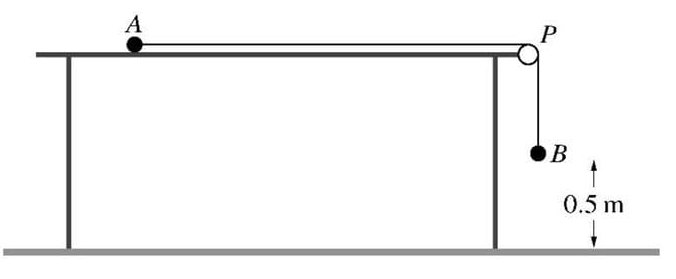
A particle A of mass 1.6 kg rests on a horizontal table and is attached to one end of a light inextensible string. The string passes over a small smooth pulley P fixed at the edge of the table. The other end of the string is attached to a particle B of mass 2.4 kg which hangs freely below the pulley. The system is released from rest with the string taut and with B at a height of 0.5 m above the ground, as shown in the diagram. In the subsequent motion A does not reach P before B reaches the ground.
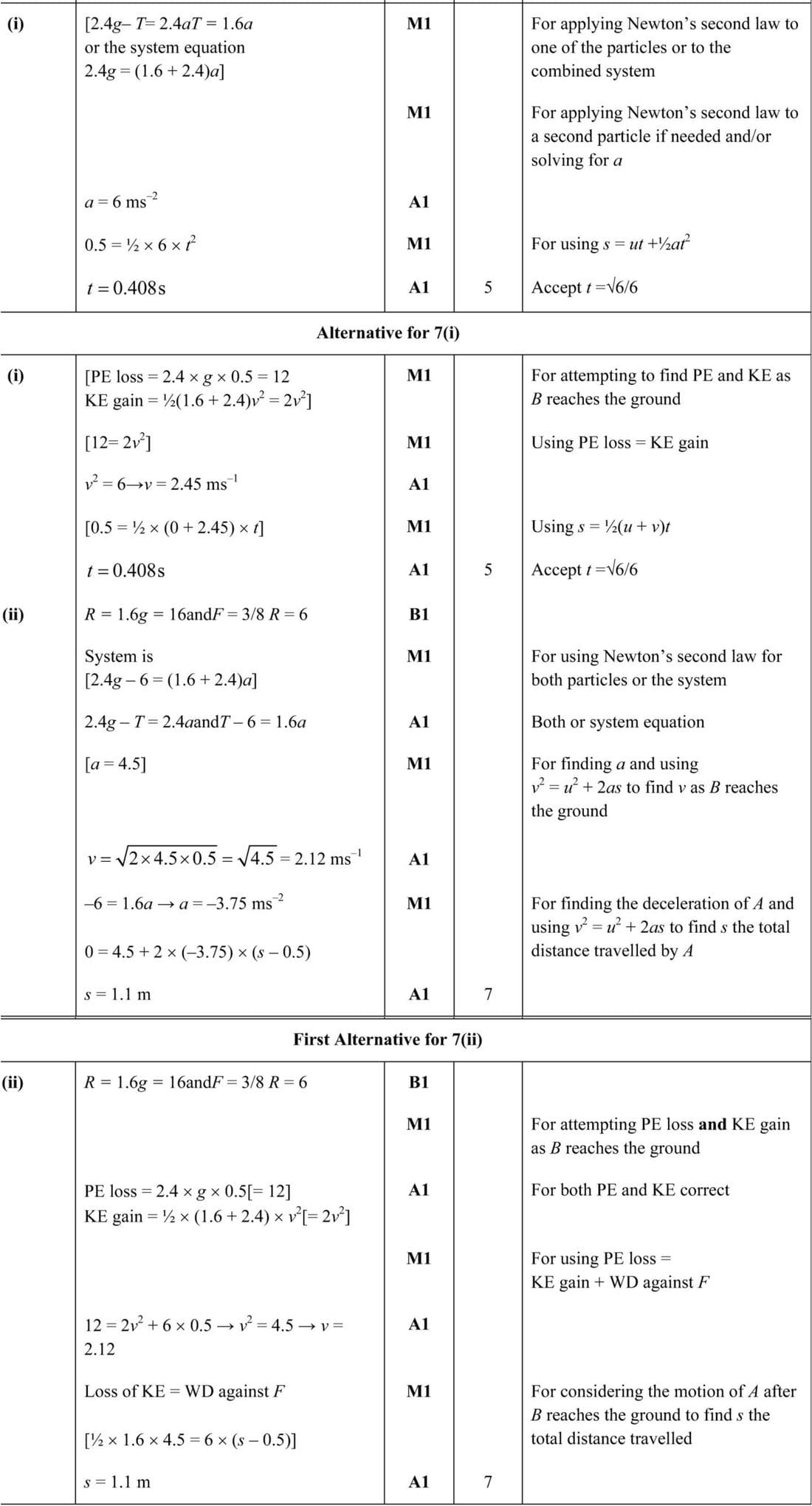
(i) Given that the table is smooth, find the time taken by B to reach the ground.
(ii) Given instead that the table is rough and that the coefficient of friction between A and the table is \(\frac{3}{8}\), find the total distance travelled by A. You may assume that A does not reach the pulley.
Feb/Mar 2016 p42 q6
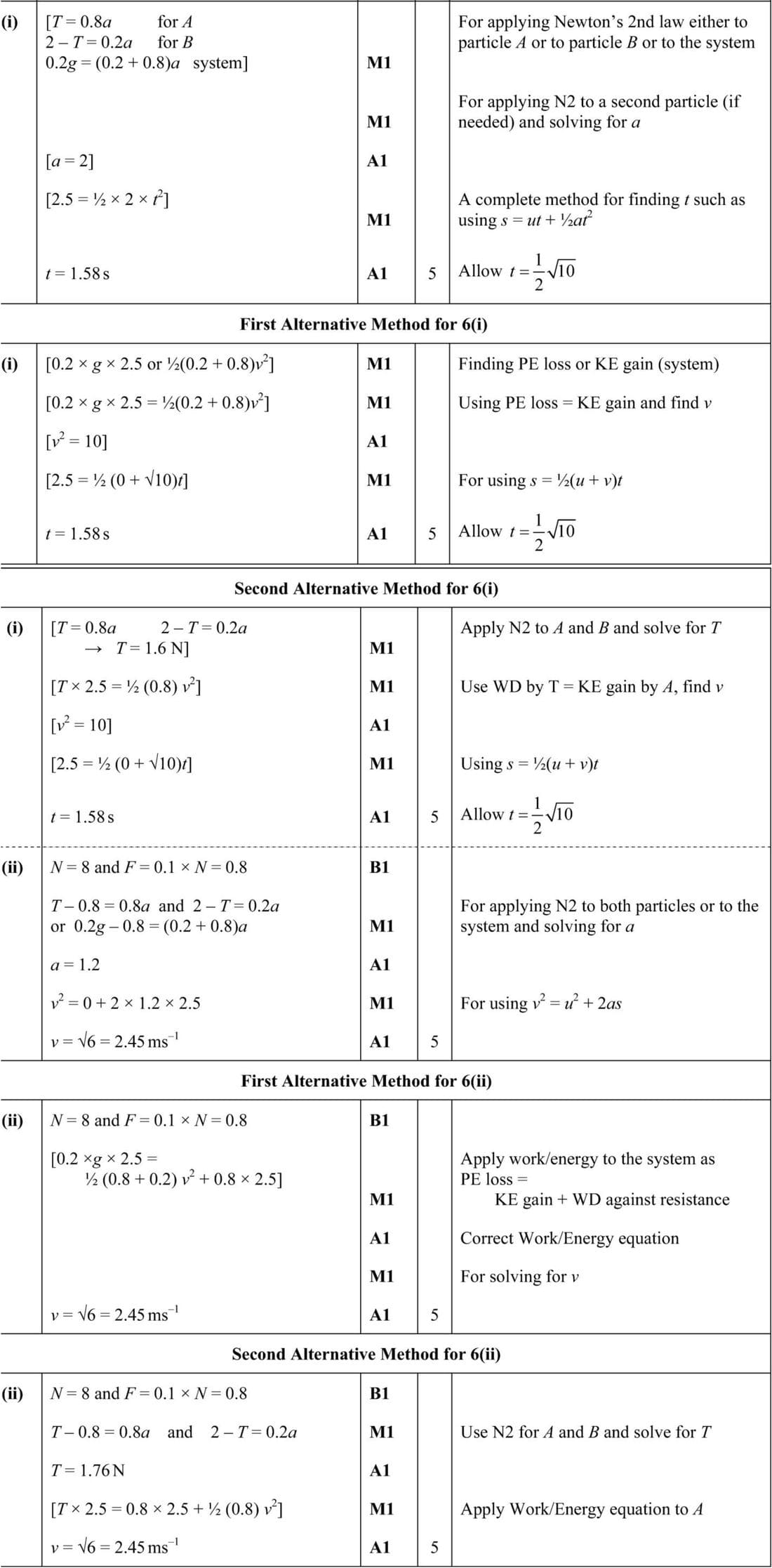
Two particles A and B, of masses 0.8 kg and 0.2 kg respectively, are connected by a light inextensible string. Particle A is placed on a horizontal surface. The string passes over a small smooth pulley P fixed at the edge of the surface, and B hangs freely. The horizontal section of the string, AP, is of length 2.5 m. The particles are released from rest with both sections of the string taut.
- Given that the surface is smooth, find the time taken for A to reach the pulley.
- Given instead that the surface is rough and the coefficient of friction between A and the surface is 0.1, find the speed of A immediately before it reaches the pulley.
June 2015 p43 q2
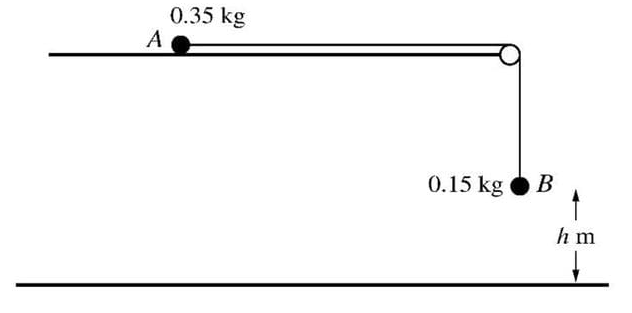
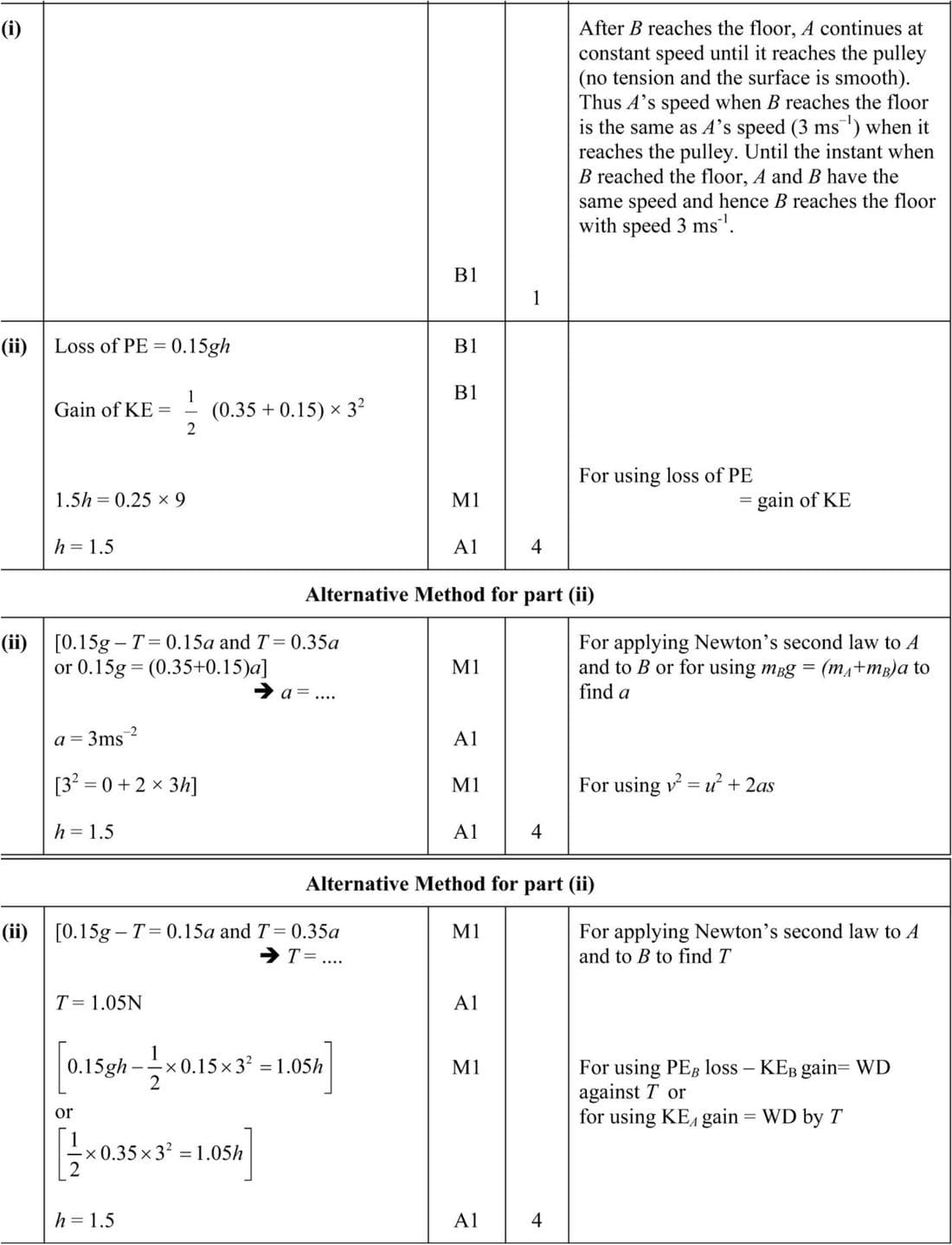
Particles A and B, of masses 0.35 kg and 0.15 kg respectively, are attached to the ends of a light inextensible string. A is held at rest on a smooth horizontal surface with the string passing over a small smooth pulley fixed at the edge of the surface. B hangs vertically below the pulley at a distance h m above the floor (see diagram). A is released and the particles move. B reaches the floor and A subsequently reaches the pulley with a speed of 3 m s-1.
- Explain briefly why the speed with which B reaches the floor is 3 m s-1.
- Find the value of h.
June 2015 p41 q7
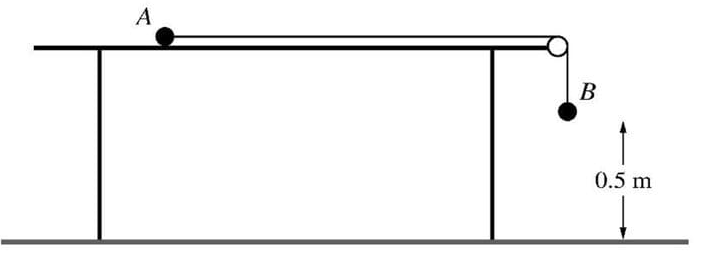
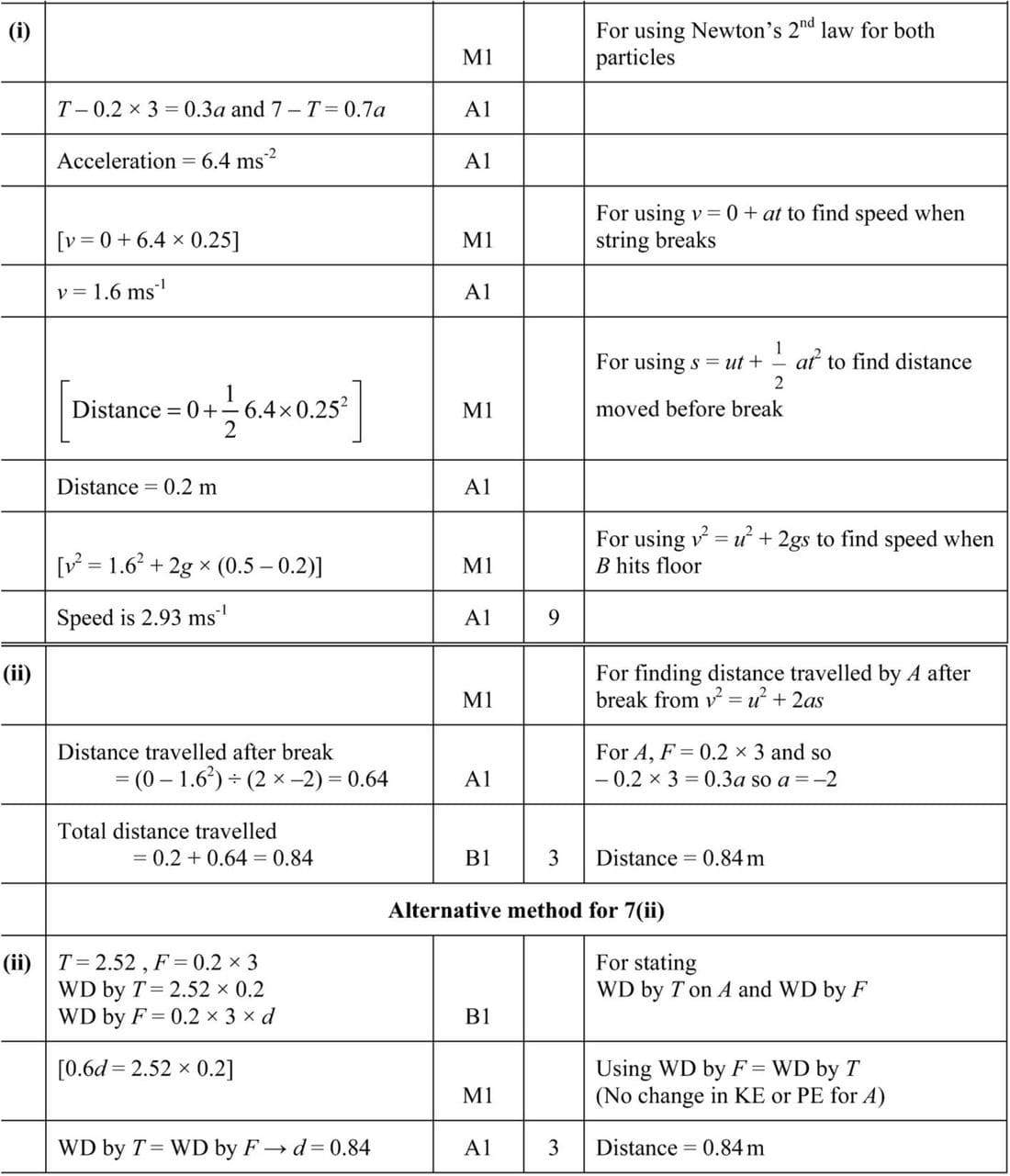
Particles A and B, of masses 0.3 kg and 0.7 kg respectively, are attached to the ends of a light inextensible string. Particle A is held at rest on a rough horizontal table with the string passing over a smooth pulley fixed at the edge of the table. The coefficient of friction between A and the table is 0.2. Particle B hangs vertically below the pulley at a height of 0.5 m above the floor (see diagram). The system is released from rest and 0.25 s later the string breaks. A does not reach the pulley in the subsequent motion. Find
- the speed of B immediately before it hits the floor,
- the total distance travelled by A.
June 2013 p43 q7
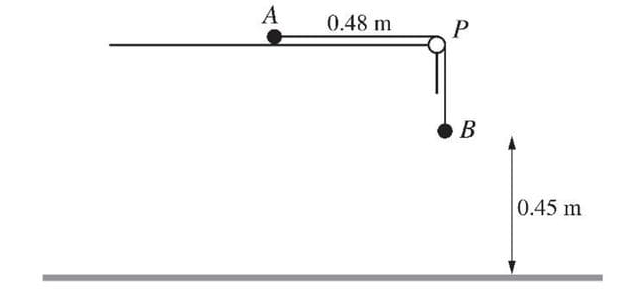
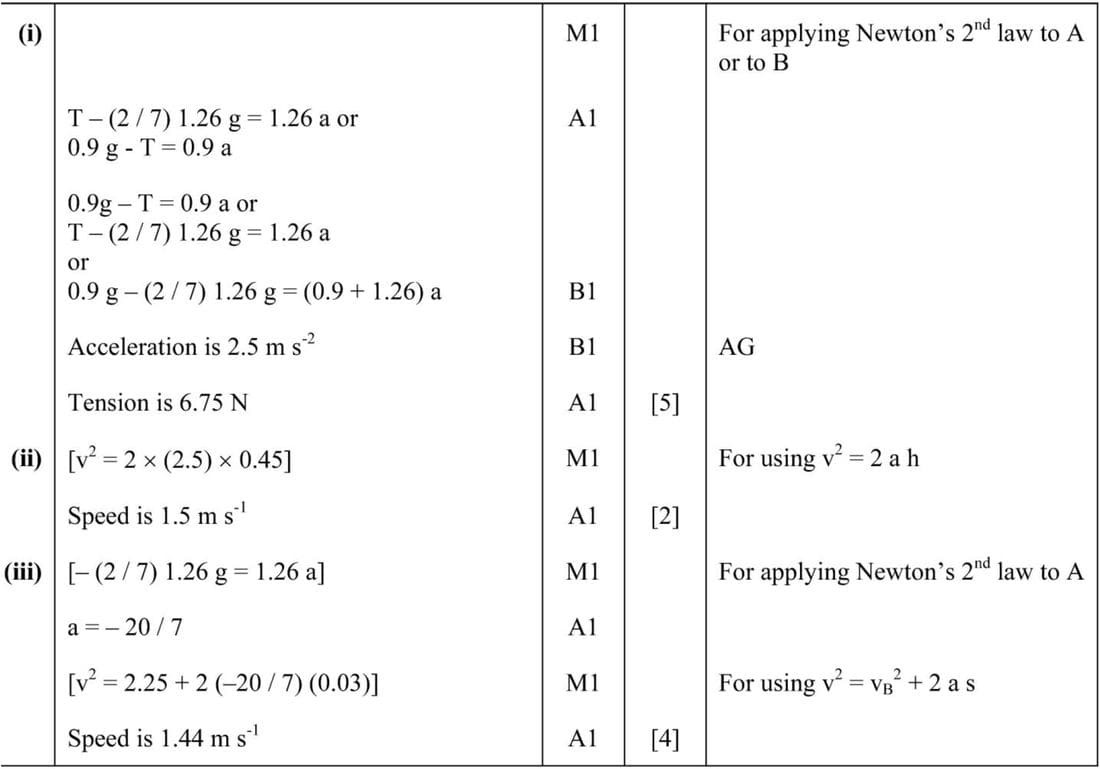
Particle A of mass 1.26 kg and particle B of mass 0.9 kg are attached to the ends of a light inextensible string. The string passes over a small smooth pulley P which is fixed at the edge of a rough horizontal table. A is held at rest at a point 0.48 m from P, and B hangs vertically below P, at a height of 0.45 m above the floor (see diagram). The coefficient of friction between A and the table is \(\frac{2}{7}\). A is released and the particles start to move.
- Show that the magnitude of the acceleration of the particles is 2.5 m s-2 and find the tension in the string.
- Find the speed with which B reaches the floor.
- Find the speed with which A reaches the pulley.
Nov 2012 p43 q7
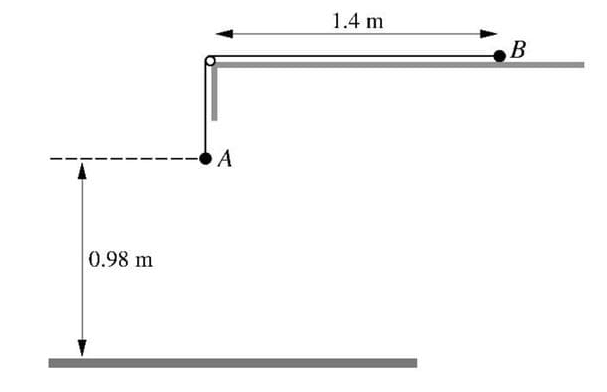
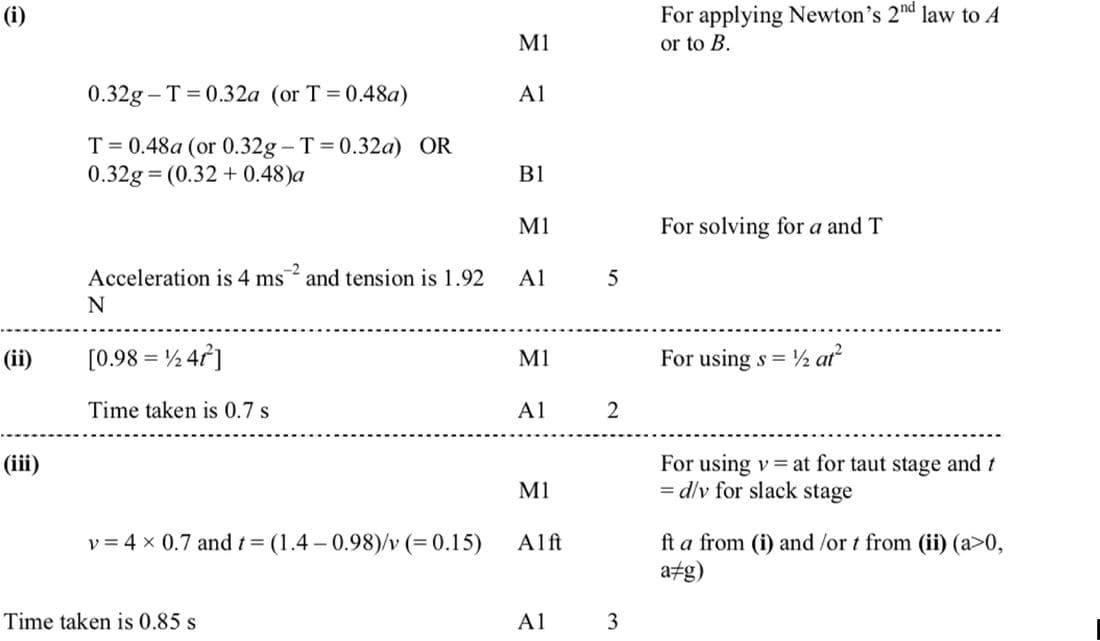
Particles A and B have masses 0.32 kg and 0.48 kg respectively. The particles are attached to the ends of a light inextensible string which passes over a small smooth pulley fixed at the edge of a smooth horizontal table. Particle B is held at rest on the table at a distance of 1.4 m from the pulley. A hangs vertically below the pulley at a height of 0.98 m above the floor (see diagram). A, B, the string and the pulley are all in the same vertical plane. B is released and A moves downwards.
(i) Find the acceleration of A and the tension in the string. [5]
A hits the floor and B continues to move towards the pulley. Find the time taken, from the instant that B is released, for
(ii) A to reach the floor, [2]
(iii) B to reach the pulley. [3]
Nov 2012 p41 q2
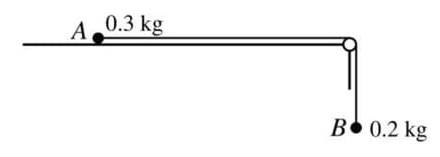
Particles A and B, of masses 0.3 kg and 0.2 kg respectively, are attached to the ends of a light inextensible string. A is held at rest on a rough horizontal table with the string passing over a small smooth pulley at the edge of the table. B hangs vertically below the pulley (see diagram). The system is released and B starts to move downwards with acceleration 1.6 m/s2. Find
- the tension in the string after the system is released,
- the frictional force acting on A.

Nov 2010 p41 q7
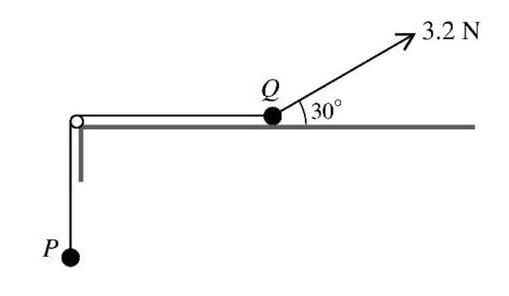
Particles P and Q, of masses 0.2 kg and 0.5 kg respectively, are connected by a light inextensible string. The string passes over a smooth pulley at the edge of a rough horizontal table. P hangs freely and Q is in contact with the table. A force of magnitude 3.2 N acts on Q, upwards and away from the pulley, at an angle of 30° to the horizontal (see diagram).
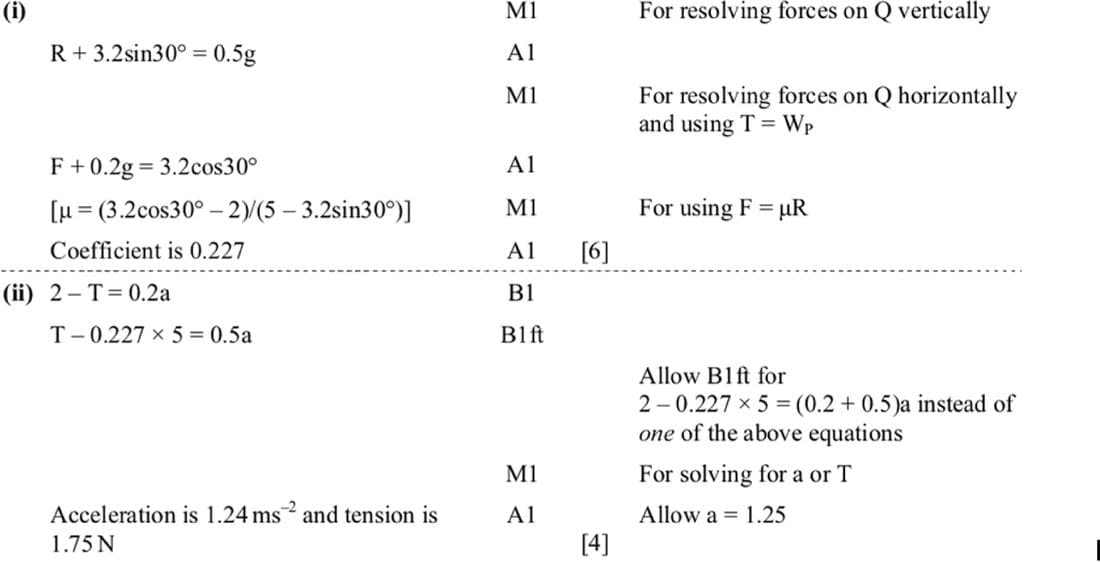
(i) The system is in limiting equilibrium with P about to move upwards. Find the coefficient of friction between Q and the table. [6]
The force of magnitude 3.2 N is now removed and P starts to move downwards.
(ii) Find the acceleration of the particles and the tension in the string. [4]
Nov 2023 p43 q7
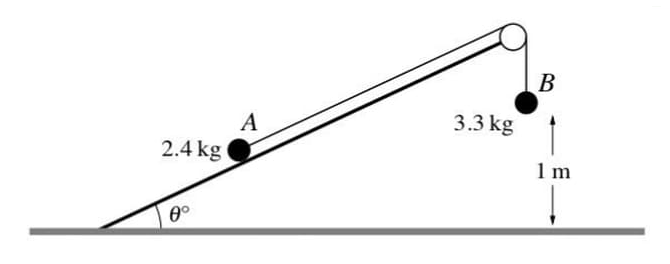
Particles A and B, of masses 2.4 kg and 3.3 kg respectively, are connected by a light inextensible string that passes over a smooth pulley which is fixed to the top of a rough plane. The plane makes an angle of θ with horizontal ground. Particle A is on the plane and the section of the string between A and the pulley is parallel to a line of greatest slope of the plane. Particle B hangs vertically below the pulley and is 1 m above the ground (see diagram). The coefficient of friction between the plane and A is μ.
\((a) It is given that θ = 30 and the system is in equilibrium with A on the point of moving directly up the plane.\)
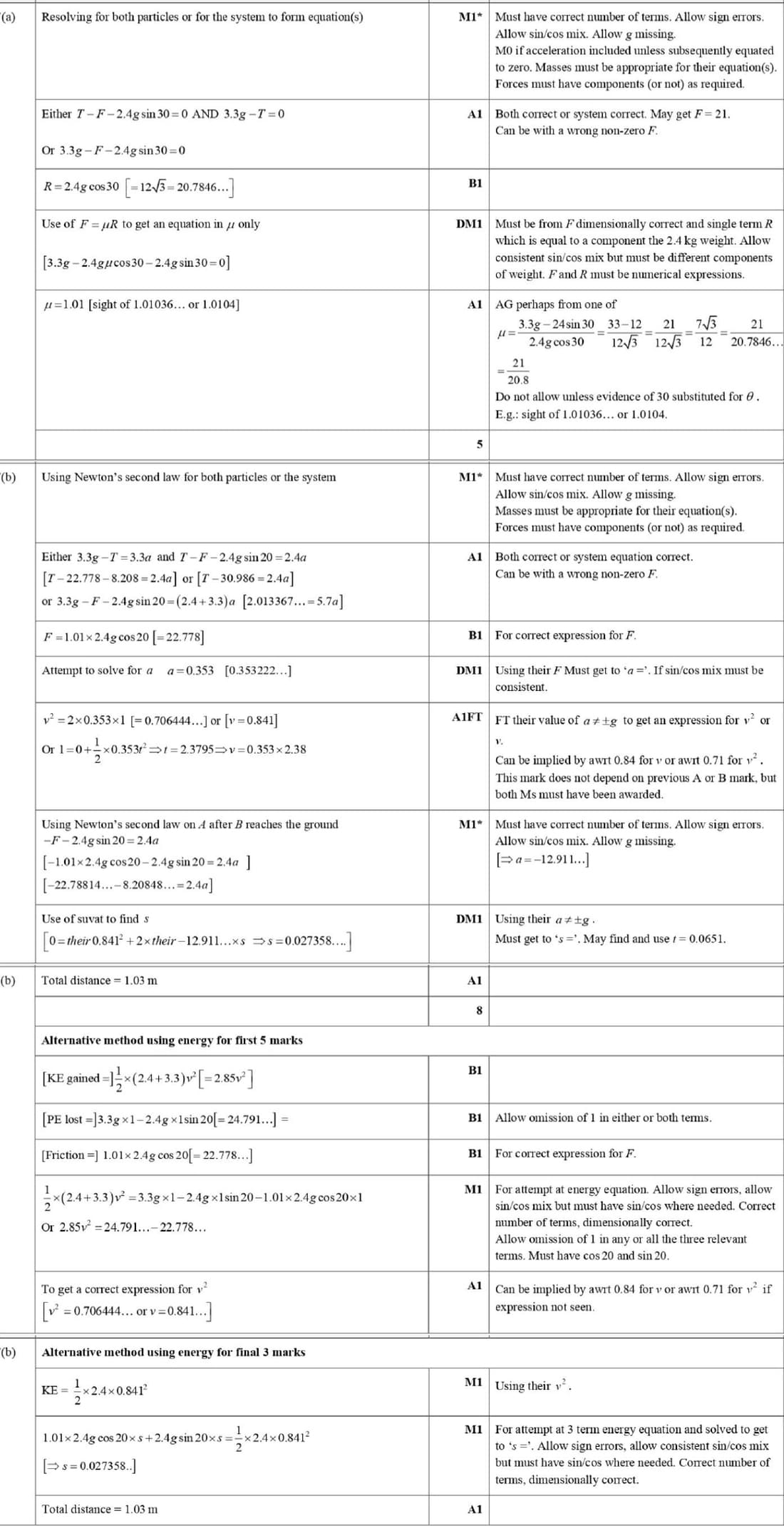
\(Show that μ = 1.01 correct to 3 significant figures.\)
\((b) It is given instead that θ = 20 and μ = 1.01. The system is released from rest with the string taut.\)
Find the total distance travelled by A before coming to instantaneous rest. You may assume that A does not reach the pulley and that B remains at rest after it hits the ground.
Nov 2015 p42 q5
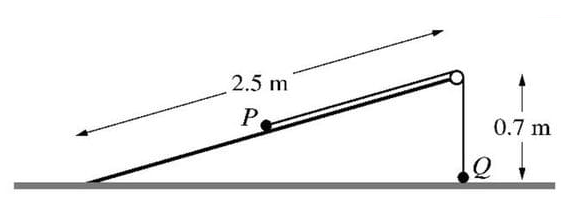
A smooth inclined plane of length 2.5 m is fixed with one end on the horizontal floor and the other end at a height of 0.7 m above the floor. Particles P and Q, of masses 0.5 kg and 0.1 kg respectively, are attached to the ends of a light inextensible string which passes over a small smooth pulley fixed at the top of the plane. Particle Q is held at rest on the floor vertically below the pulley. The string is taut and P is at rest on the plane (see diagram). Q is released and starts to move vertically upwards towards the pulley and P moves down the plane.
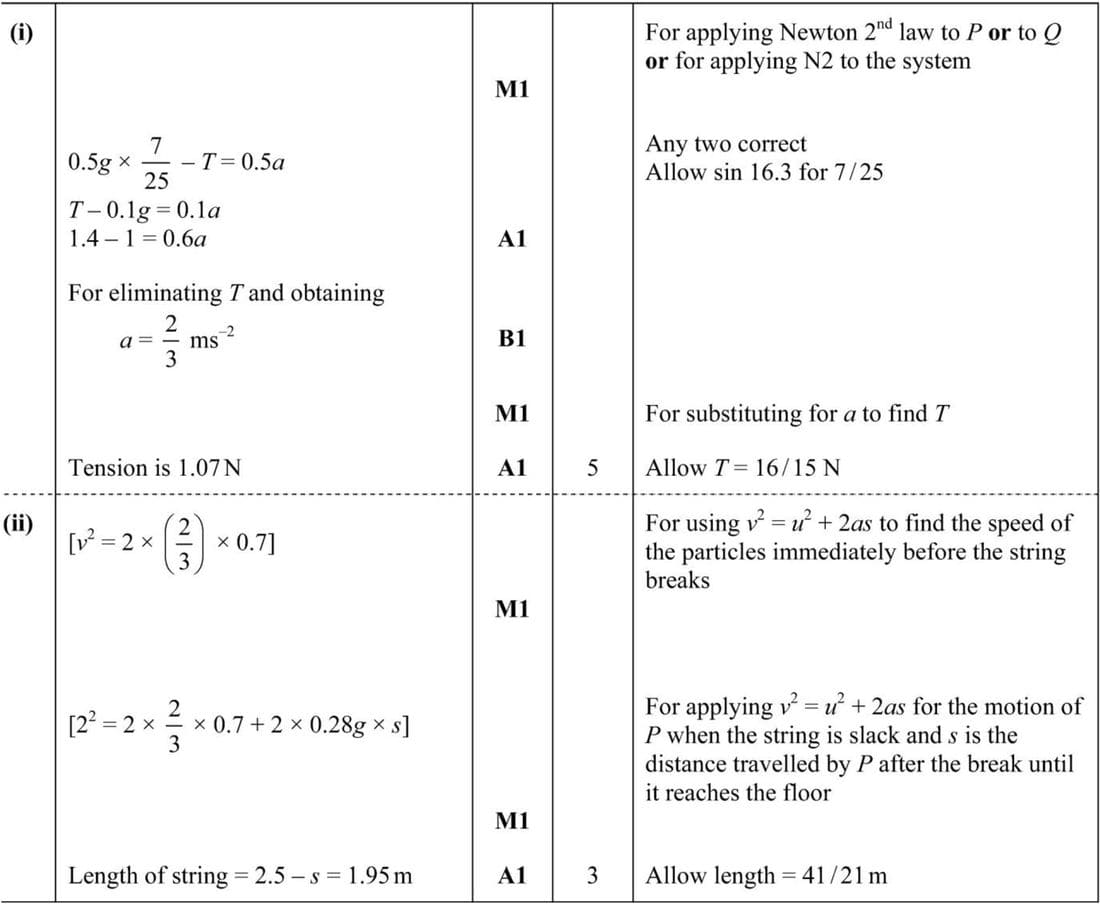
(i) Find the tension in the string and the magnitude of the acceleration of the particles before Q reaches the pulley.
At the instant just before Q reaches the pulley the string breaks; P continues to move down the plane and reaches the floor with a speed of 2 m s-1.
(ii) Find the length of the string.
Nov 2015 p41 q4
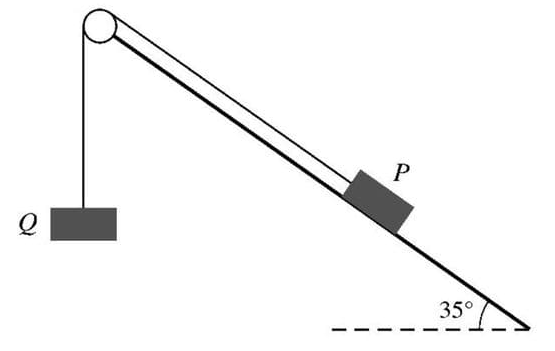
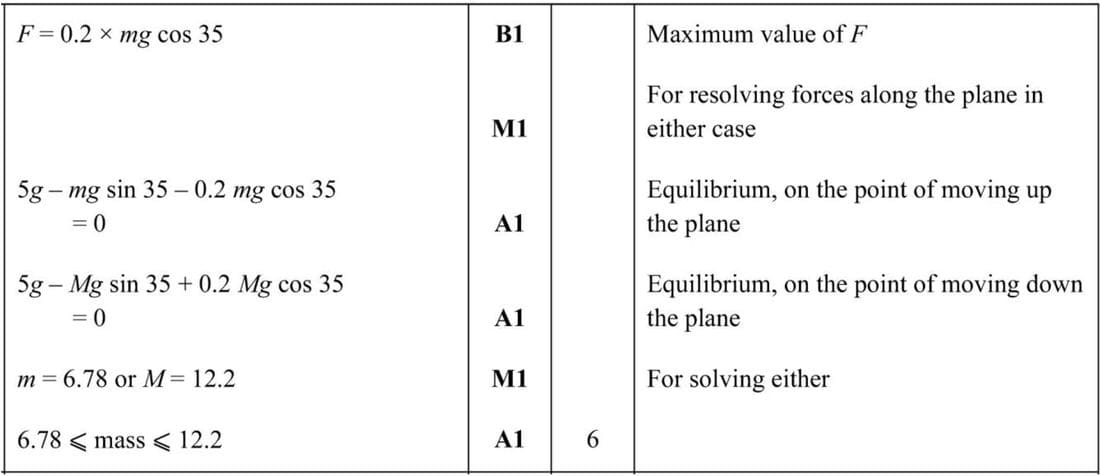
Blocks P and Q, of mass m kg and 5 kg respectively, are attached to the ends of a light inextensible string. The string passes over a small smooth pulley which is fixed at the top of a rough plane inclined at 35° to the horizontal. Block P is at rest on the plane and block Q hangs vertically below the pulley (see diagram). The coefficient of friction between block P and the plane is 0.2. Find the set of values of m for which the two blocks remain at rest.
June 2014 p43 q7
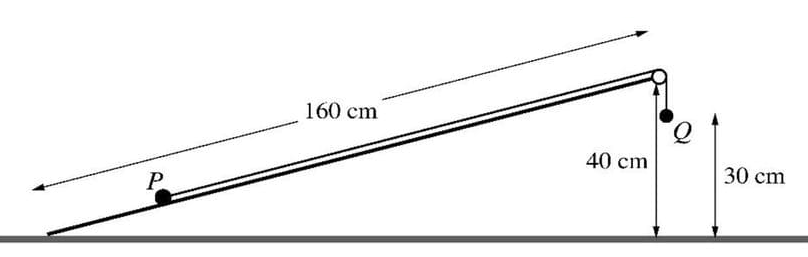
A smooth inclined plane of length 160 cm is fixed with one end at a height of 40 cm above the other end, which is on horizontal ground. Particles P and Q, of masses 0.76 kg and 0.49 kg respectively, are attached to the ends of a light inextensible string which passes over a small smooth pulley fixed at the top of the plane. Particle P is held at rest on the same line of greatest slope as the pulley and Q hangs vertically below the pulley at a height of 30 cm above the ground (see diagram). P is released from rest. It starts to move up the plane and does not reach the pulley. Find
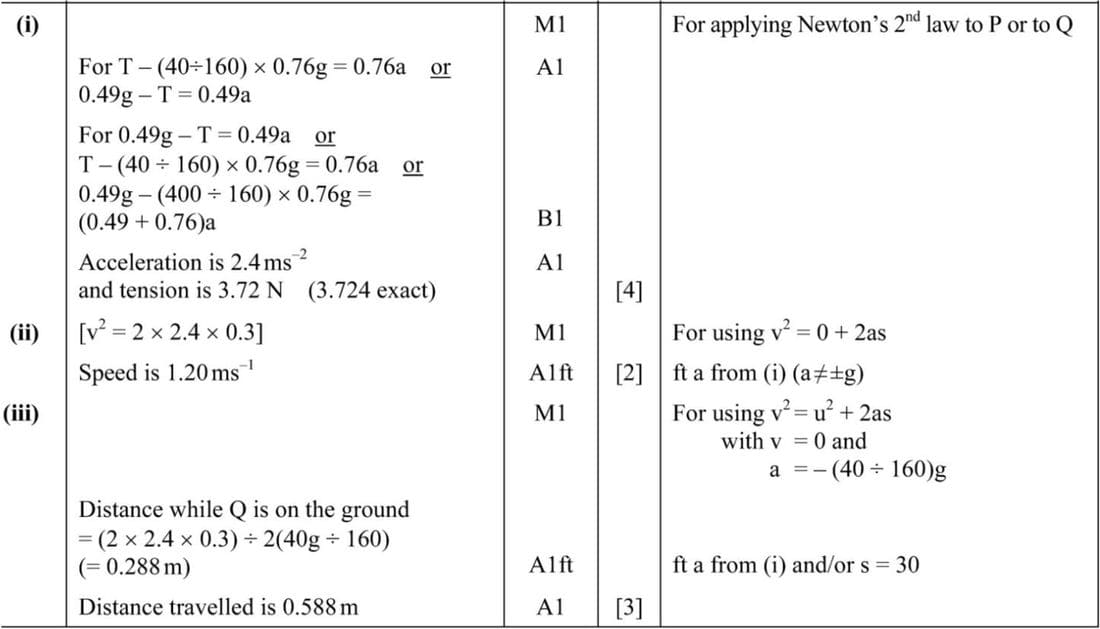
- the acceleration of the particles and the tension in the string before Q reaches the ground,
- the speed with which Q reaches the ground,
- the total distance travelled by P before it comes to instantaneous rest.
June 2013 p42 q7
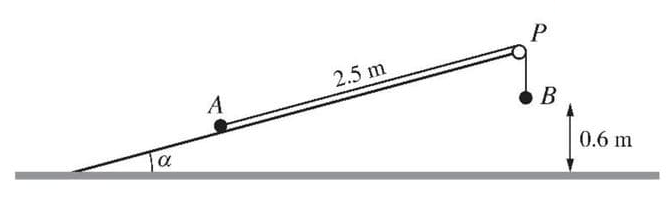
Particles A of mass 0.26 kg and B of mass 0.52 kg are attached to the ends of a light inextensible string. The string passes over a small smooth pulley P which is fixed at the top of a smooth plane. The plane is inclined at an angle \(\alpha\) to the horizontal, where \(\sin \alpha = \frac{16}{65}\) and \(\cos \alpha = \frac{63}{65}\). A is held at rest at a point 2.5 metres from P, with the part AP of the string parallel to a line of greatest slope of the plane. B hangs freely below P at a point 0.6 m above the floor (see diagram). A is released and the particles start to move. Find
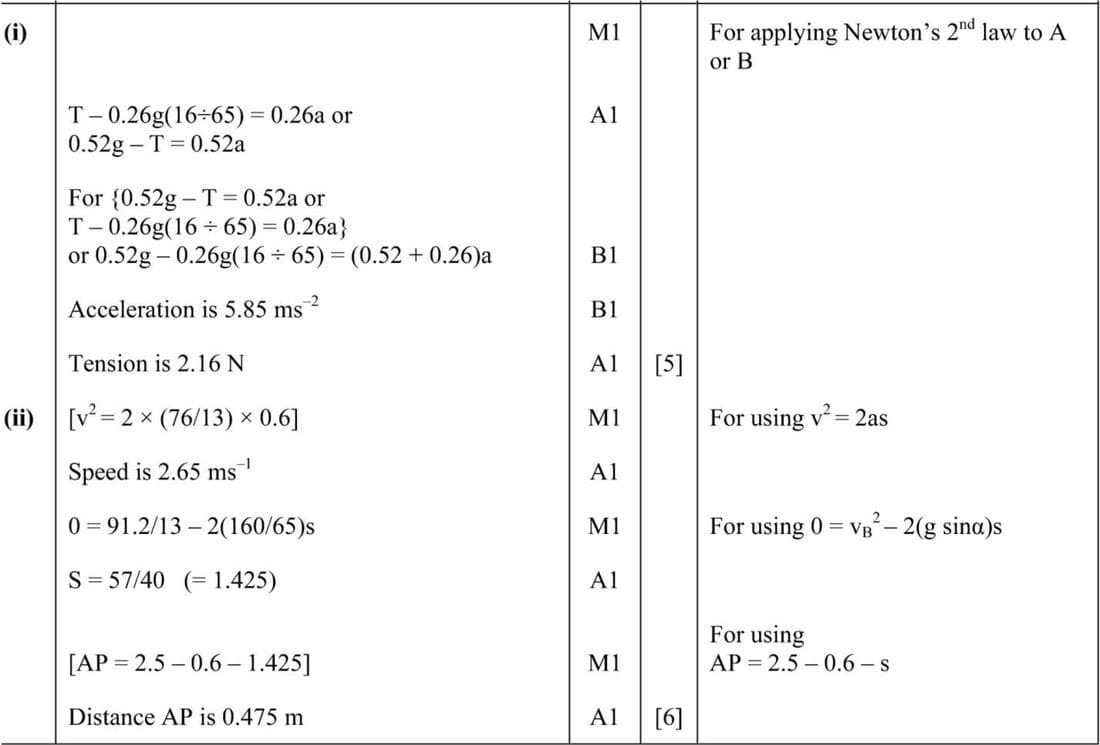
- the magnitude of the acceleration of the particles and the tension in the string,
- the speed with which B reaches the floor and the distance of A from P when A comes to instantaneous rest.
June 2013 p41 q5
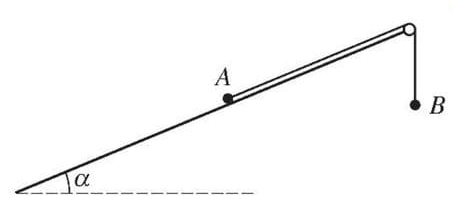
A light inextensible string has a particle A of mass 0.26 kg attached to one end and a particle B of mass 0.54 kg attached to the other end. The particle A is held at rest on a rough plane inclined at angle \(\alpha\) to the horizontal, where \(\sin \alpha = \frac{5}{13}\). The string is taut and parallel to a line of greatest slope of the plane. The string passes over a small smooth pulley at the top of the plane. Particle B hangs at rest vertically below the pulley (see diagram). The coefficient of friction between A and the plane is 0.2. Particle A is released and the particles start to move.
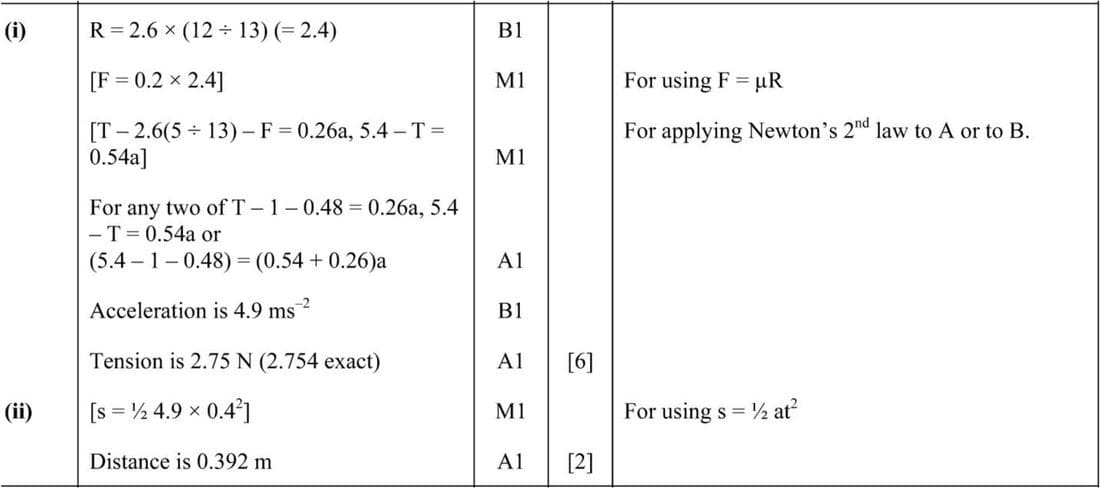
- Find the magnitude of the acceleration of the particles and the tension in the string.
- Particle A reaches the pulley 0.4 s after starting to move. Find the distance moved by each of the particles.
Nov 2007 p4 q7
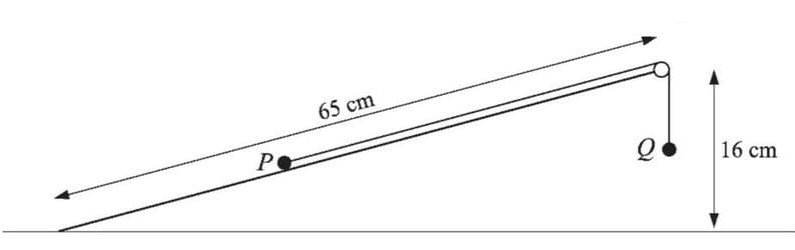
A rough inclined plane of length 65 cm is fixed with one end at a height of 16 cm above the other end. Particles P and Q, of masses 0.13 kg and 0.11 kg respectively, are attached to the ends of a light inextensible string which passes over a small smooth pulley at the top of the plane. Particle P is held at rest on the plane and particle Q hangs vertically below the pulley (see diagram). The system is released from rest and P starts to move up the plane.
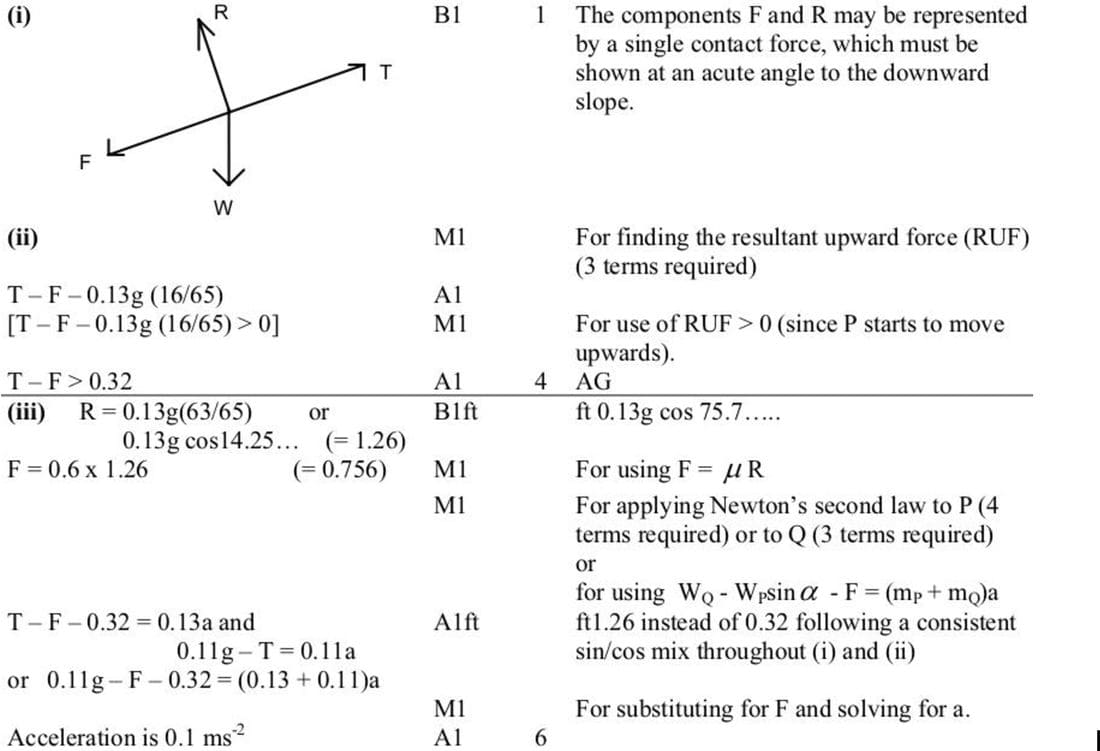
(i) Draw a diagram showing the forces acting on P during its motion up the plane. [1]
(ii) Show that \(T - F > 0.32\), where \(T\) is the tension in the string and \(F\) is the magnitude of the frictional force on P. [4]
The coefficient of friction between P and the plane is 0.6.
(iii) Find the acceleration of P. [6]
June 2023 p42 q7
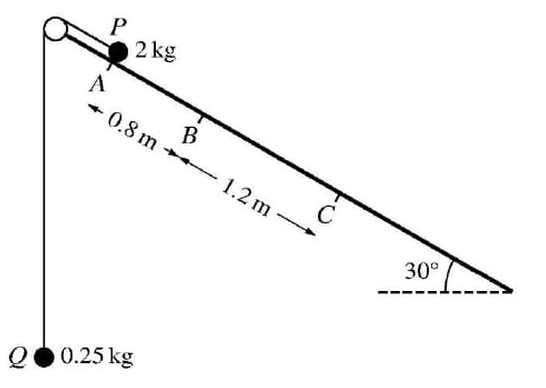
Two particles P and Q, of masses 2 kg and 0.25 kg respectively, are connected by a light inextensible string that passes over a fixed smooth pulley. Particle P is on an inclined plane at an angle of 30° to the horizontal. Particle Q hangs below the pulley. Three points A, B and C lie on a line of greatest slope of the plane with AB = 0.8 \, \text{m} and BC = 1.2 \, \text{m} (see diagram).
Particle P is released from rest at A with the string taut and slides down the plane. During the motion of P from A to C, Q does not reach the pulley. The part of the plane from A to B is rough, with coefficient of friction 0.3 between the plane and P. The part of the plane from B to C is smooth.
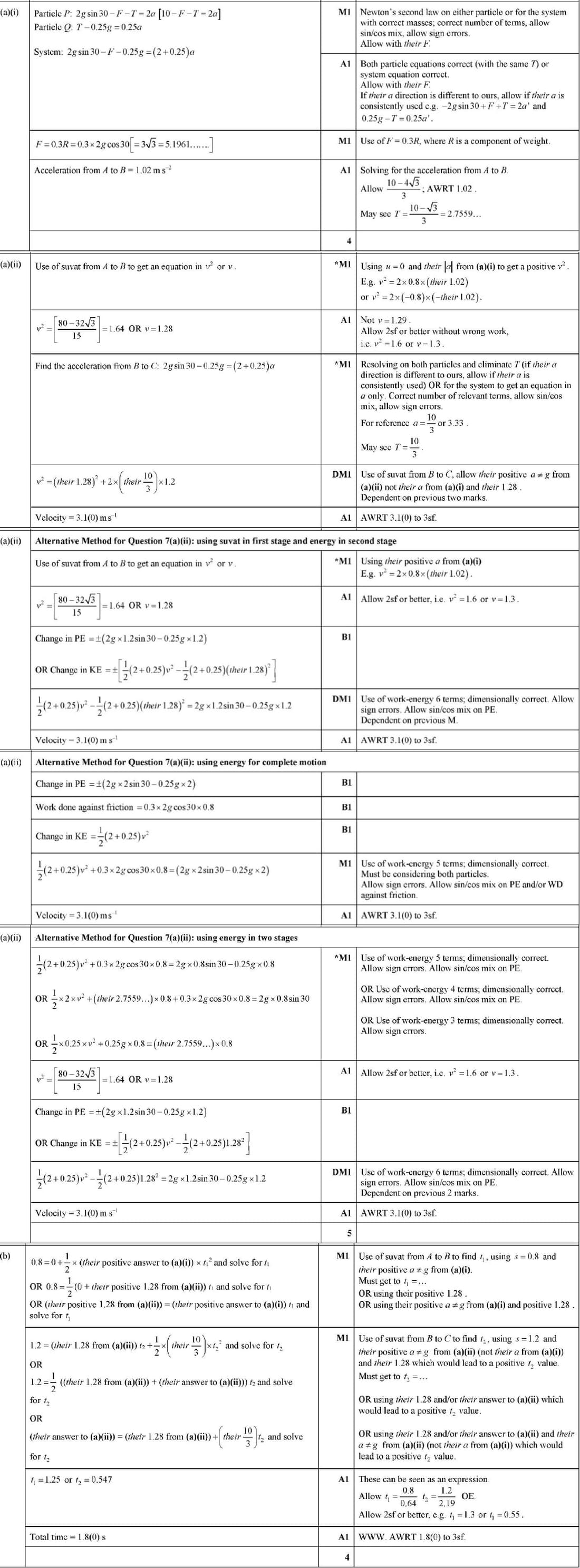
(a) (i) Find the acceleration of P between A and B. [4]
(ii) Hence, find the speed of P at C. [5]
(b) Find the time taken for P to travel from A to C. [4]
Nov 2021 p41 q7
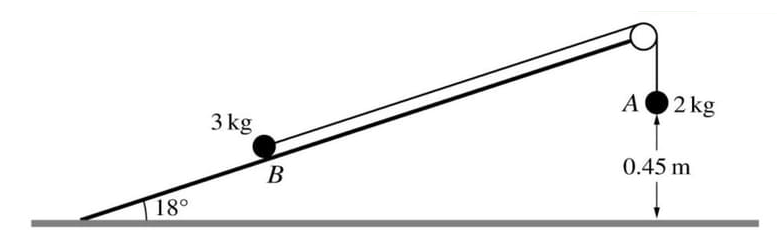
Two particles A and B of masses 2 kg and 3 kg respectively are connected by a light inextensible string. Particle B is on a smooth fixed plane which is at an angle of 18° to horizontal ground. The string passes over a fixed smooth pulley at the top of the plane. Particle A hangs vertically below the pulley and is 0.45 m above the ground (see diagram). The system is released from rest with the string taut. When A reaches the ground, the string breaks.
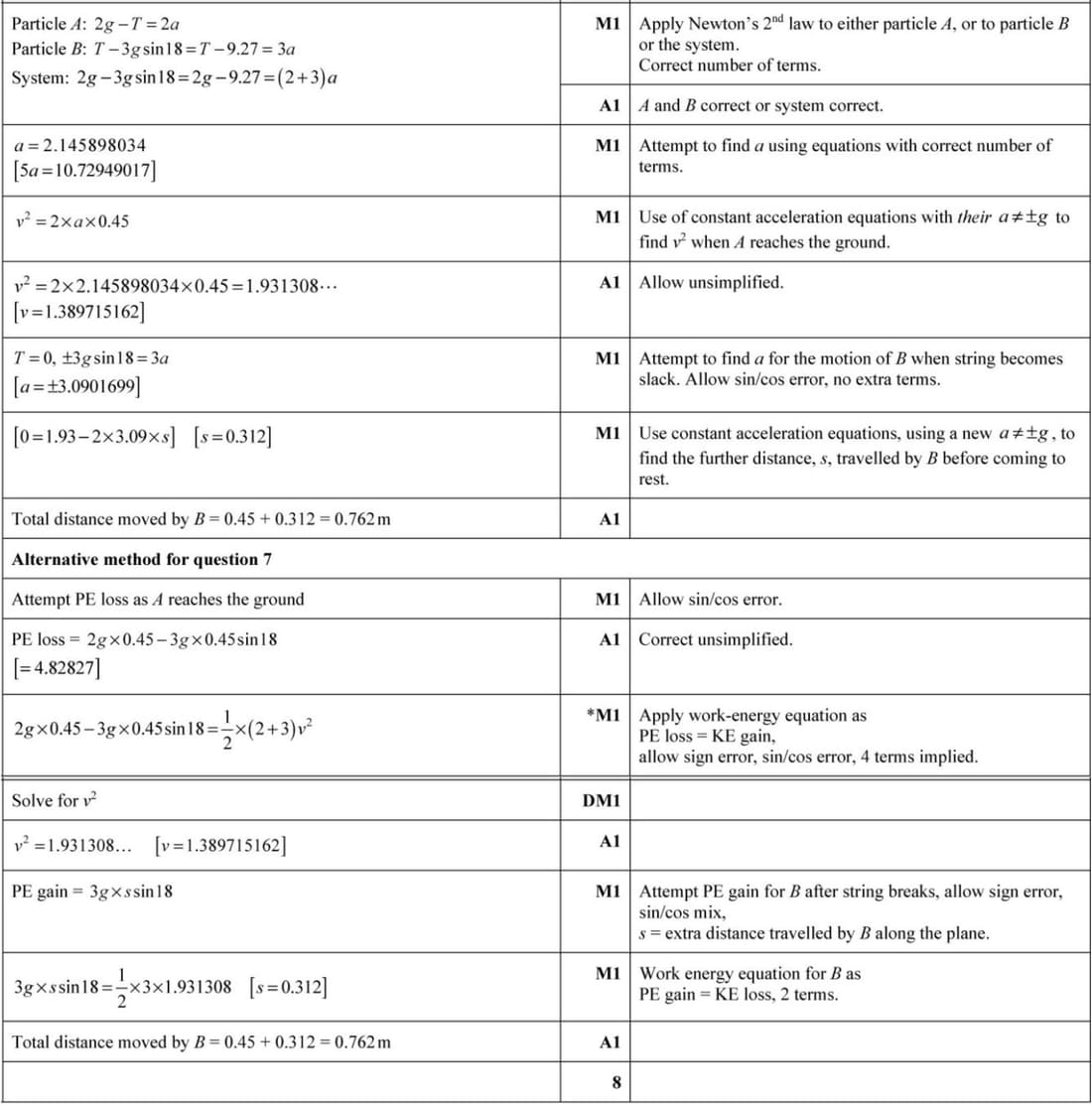
Find the total distance travelled by B before coming to instantaneous rest. You may assume that B does not reach the pulley.
June 2020 p43 q7
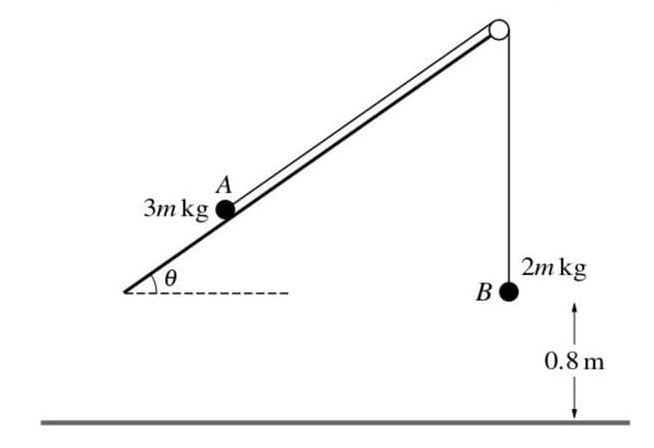
Two particles A and B, of masses 3m kg and 2m kg respectively, are attached to the ends of a light inextensible string. The string passes over a fixed smooth pulley which is attached to the edge of a plane. The plane is inclined at an angle θ to the horizontal. A lies on the plane and B hangs vertically, 0.8 m above the floor, which is horizontal. The string between A and the pulley is parallel to a line of greatest slope of the plane (see diagram). Initially A and B are at rest.
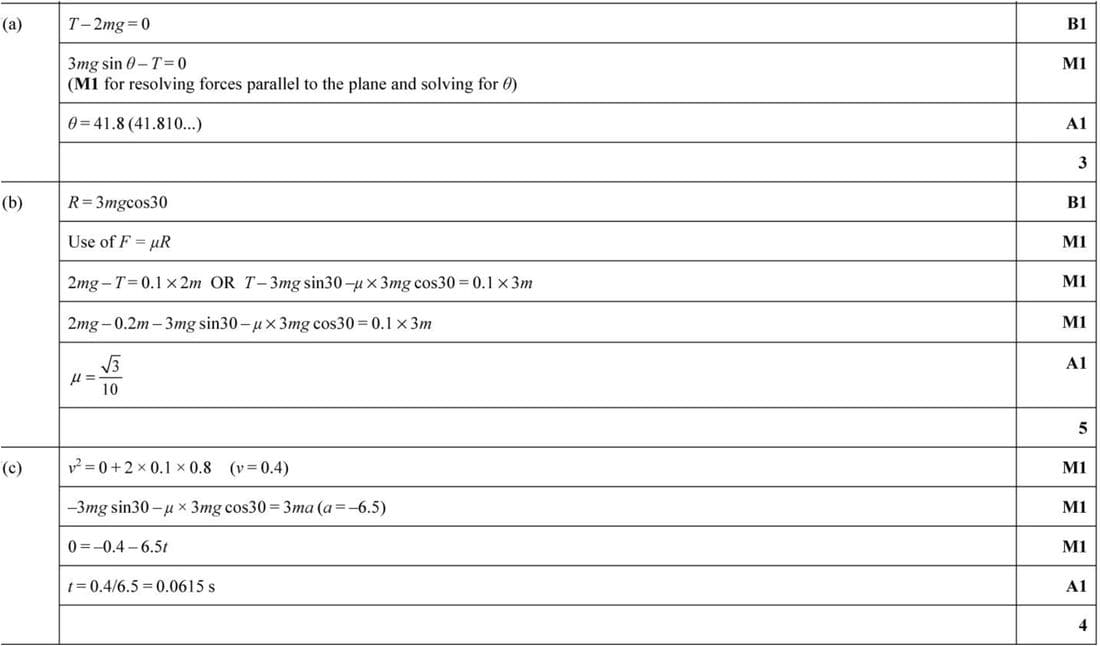
- Given that the plane is smooth, find the value of θ for which A remains at rest. [3]
- It is given instead that the plane is rough, θ = 30° and the acceleration of A up the plane is 0.1 m s-2.
- Show that the coefficient of friction between A and the plane is \(\frac{1}{10}\sqrt{3}\). [5]
- When B reaches the floor it comes to rest.
- Find the length of time after B reaches the floor for which A is moving up the plane. [You may assume that A does not reach the pulley.] [4]
Nov 2019 p42 q7
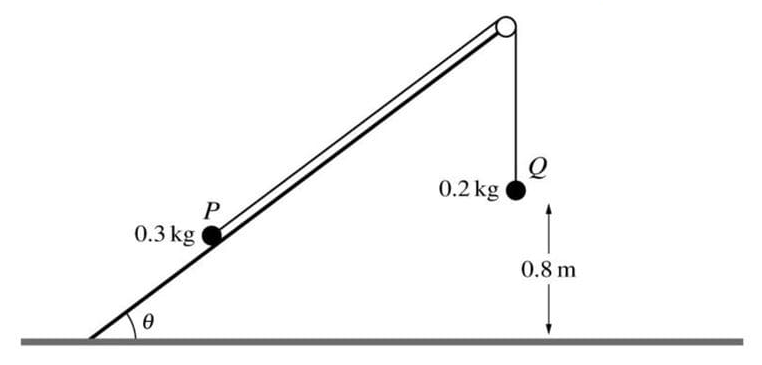
Two particles P and Q, of masses 0.3 kg and 0.2 kg respectively, are attached to the ends of a light inextensible string. The string passes over a fixed smooth pulley which is attached to the edge of a smooth plane. The plane is inclined at an angle \(\theta\) to the horizontal, where \(\sin \theta = \frac{3}{5}\). P lies on the plane and Q hangs vertically below the pulley at a height of 0.8 m above the floor (see diagram). The string between P and the pulley is parallel to a line of greatest slope of the plane. P is released from rest and Q moves vertically downwards.
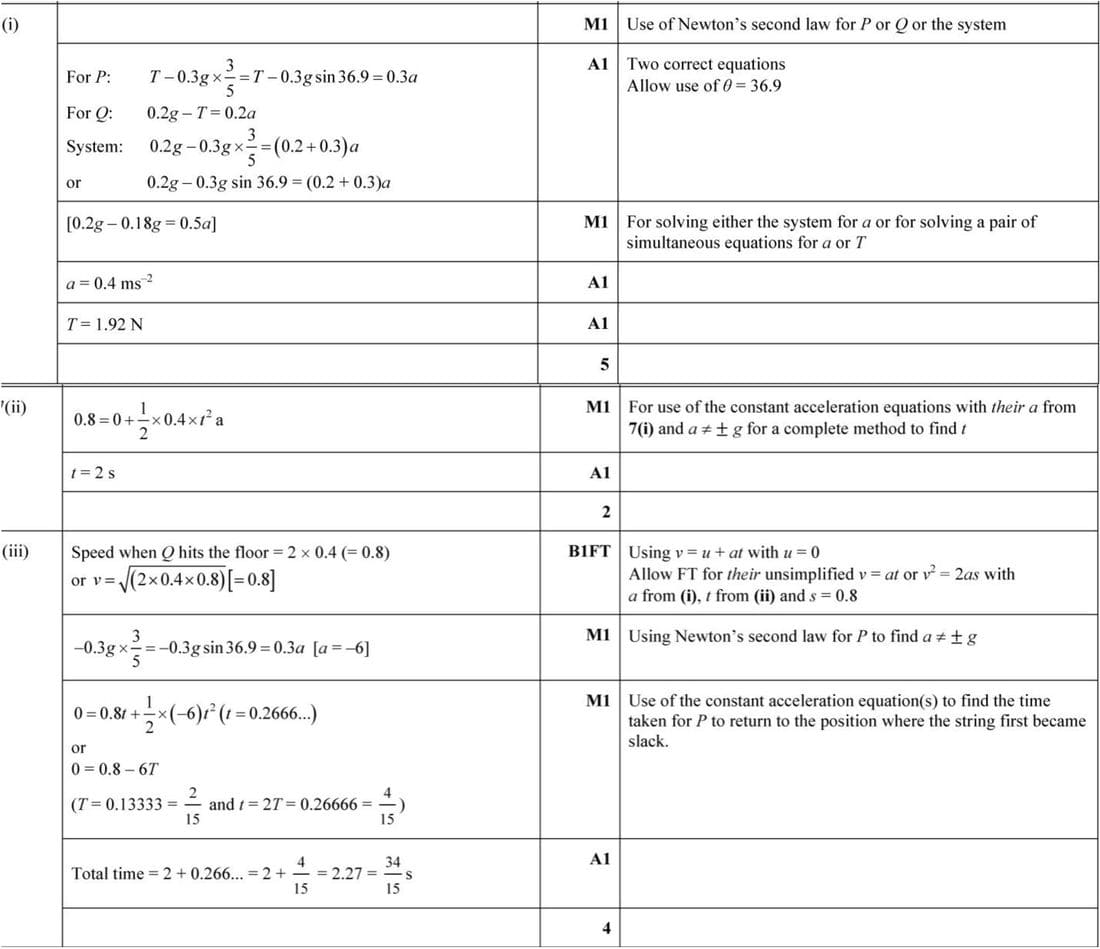
- Find the tension in the string and the magnitude of the acceleration of the particles. [5]
- Q hits the floor and does not bounce. It is given that P does not reach the pulley in the subsequent motion.
- Find the time, from the instant at which P is released, for Q to reach the floor. [2]
- When Q hits the floor the string becomes slack. Find the time, from the instant at which P is released, for the string to become taut again. [4]
Nov 2018 p42 q4
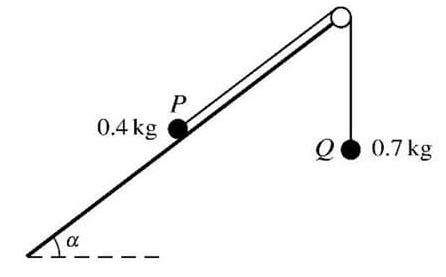
Two particles P and Q, of masses 0.4 kg and 0.7 kg respectively, are attached to the ends of a light inextensible string. The string passes over a fixed smooth pulley which is attached to the edge of a rough plane. The coefficient of friction between P and the plane is 0.5. The plane is inclined at an angle \(\alpha\) to the horizontal, where \(\tan \alpha = \frac{3}{4}\). Particle P lies on the plane and particle Q hangs vertically. The string between P and the pulley is parallel to a line of greatest slope of the plane (see diagram). A force of magnitude \(X\) N, acting directly down the plane, is applied to P.
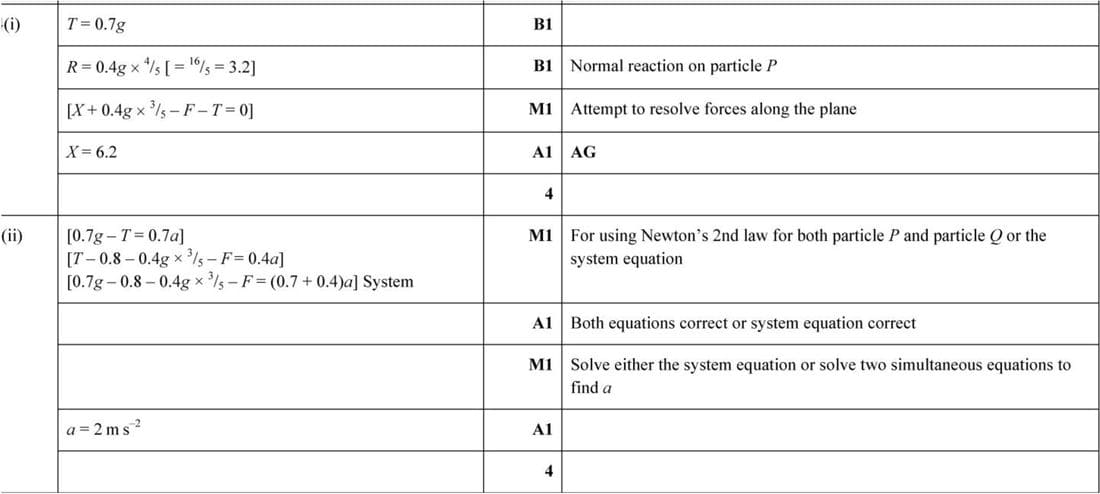
(i) Show that the greatest value of \(X\) for which P remains stationary is 6.2.
(ii) Given instead that \(X = 0.8\), find the acceleration of P.
Nov 2017 p42 q6
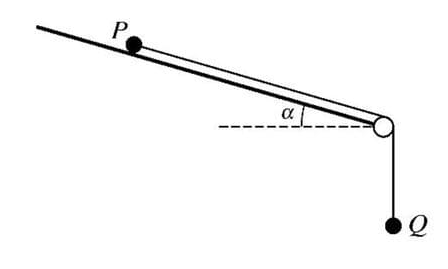
Two particles P and Q, each of mass m kg, are attached to the ends of a light inextensible string. The string passes over a fixed smooth pulley which is attached to the edge of a rough plane. The plane is inclined at an angle α to the horizontal, where \(\tan \alpha = \frac{7}{24}\). Particle P rests on the plane and particle Q hangs vertically, as shown in the diagram. The string between P and the pulley is parallel to a line of greatest slope of the plane. The system is in limiting equilibrium.
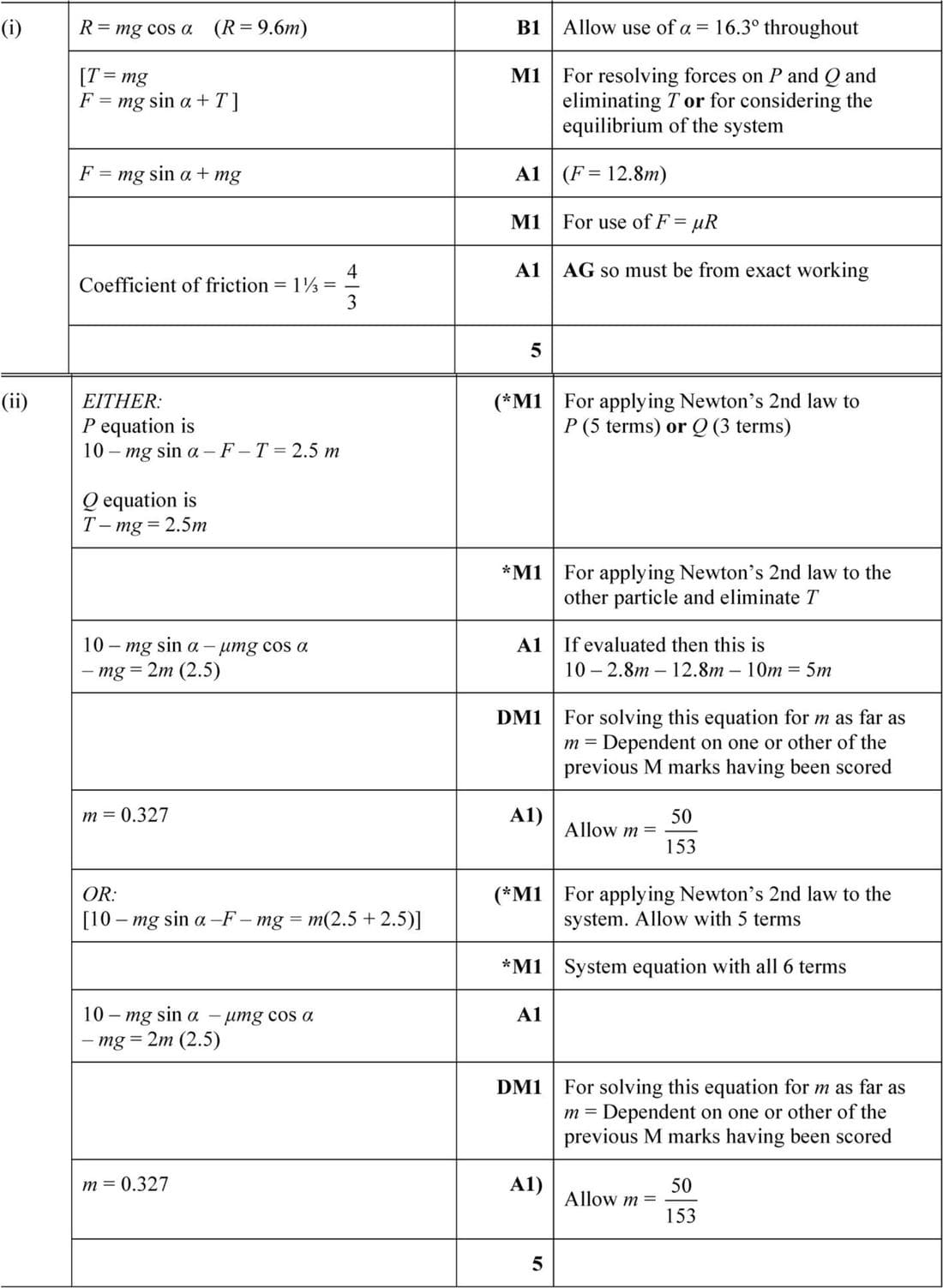
- Show that the coefficient of friction between P and the plane is \(\frac{4}{3}\).
- A force of magnitude 10N is applied to P, acting up a line of greatest slope of the plane, and P accelerates at \(2.5 \, \text{m/s}^2\). Find the value of m.
June 2017 p43 q7
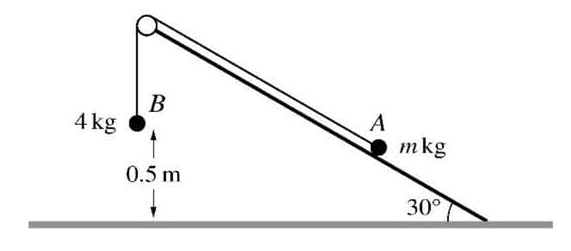
Two particles A and B of masses m kg and 4 kg respectively are connected by a light inextensible string that passes over a fixed smooth pulley. Particle A is on a rough fixed slope which is at an angle of 30° to the horizontal ground. Particle B hangs vertically below the pulley and is 0.5 m above the ground (see diagram). The coefficient of friction between the slope and particle A is 0.2.
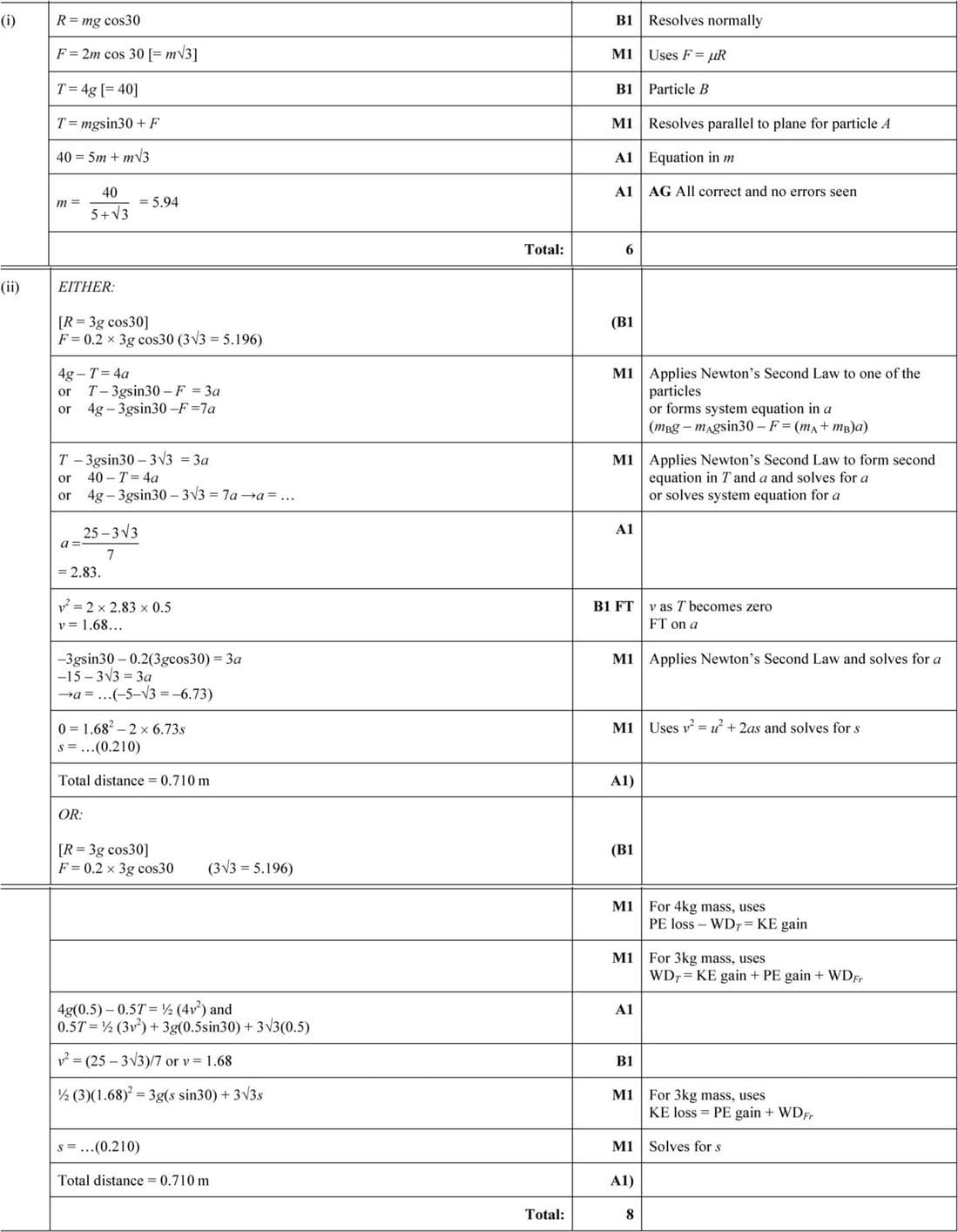
(i) In the case where the system is in equilibrium with particle A on the point of moving directly up the slope, show that m = 5.94, correct to 3 significant figures.
(ii) In the case where m = 3, the system is released from rest with the string taut. Find the total distance travelled by A before coming to instantaneous rest. You may assume that A does not reach the pulley.
June 2016 p41 q5
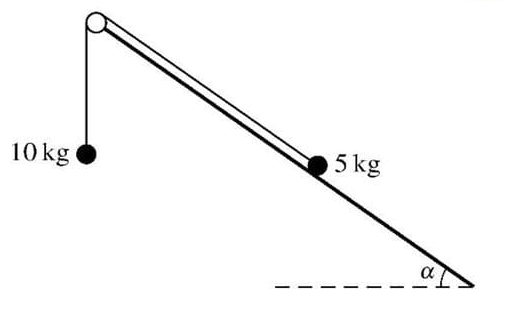
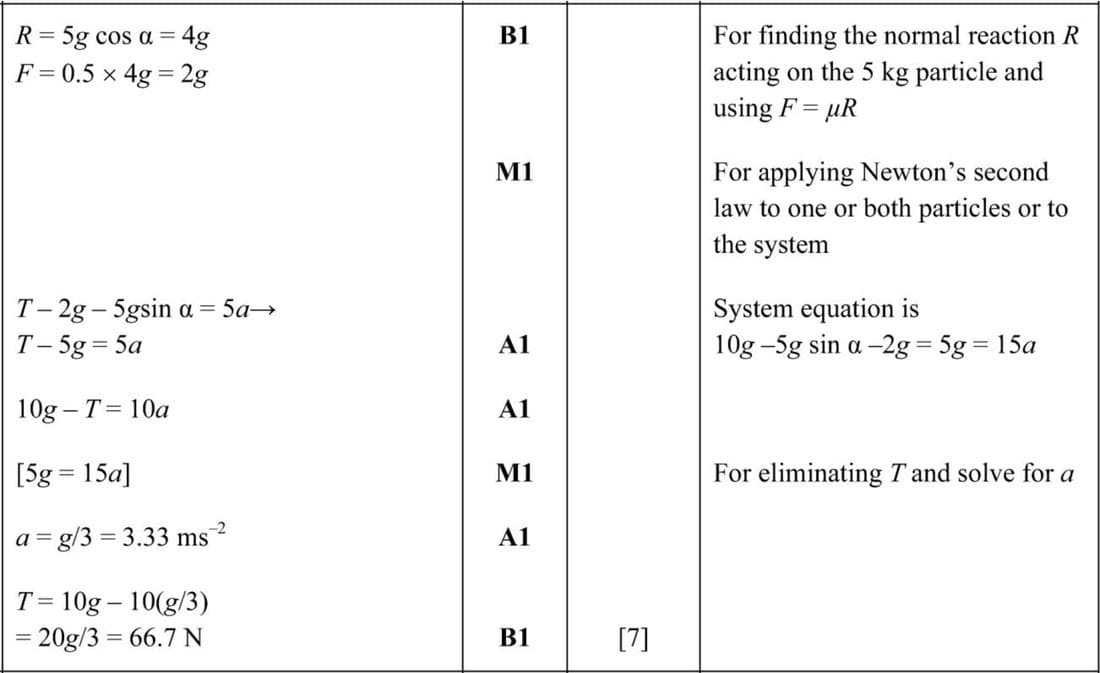
Two particles of masses 5 kg and 10 kg are connected by a light inextensible string that passes over a fixed smooth pulley. The 5 kg particle is on a rough fixed slope which is at an angle of \(\alpha\) to the horizontal, where \(\tan \alpha = \frac{3}{4}\). The 10 kg particle hangs below the pulley (see diagram). The coefficient of friction between the slope and the 5 kg particle is \(\frac{1}{2}\). The particles are released from rest. Find the acceleration of the particles and the tension in the string.
June 2022 p41 q2
Two particles P and Q, of masses 0.5 kg and 0.3 kg respectively, are connected by a light inextensible string. The string is taut and P is vertically above Q. A force of magnitude 10 N is applied to P vertically upwards.
Find the acceleration of the particles and the tension in the string connecting them.
June 2012 p42 q5
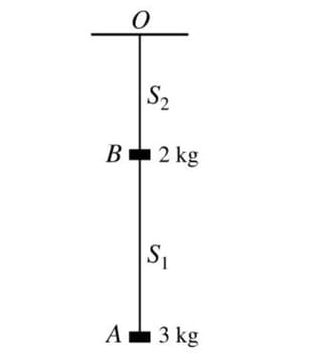
A block A of mass 3 kg is attached to one end of a light inextensible string S1. Another block B of mass 2 kg is attached to the other end of S1, and is also attached to one end of another light inextensible string S2. The other end of S2 is attached to a fixed point O and the blocks hang in equilibrium below O (see diagram).
- Find the tension in S1 and the tension in S2.
The string S2 breaks and the particles fall. The air resistance on A is 1.6 N and the air resistance on B is 4 N.
- Find the acceleration of the particles and the tension in S1.
June 2003 p4 q5
O
S1
A
S2
B
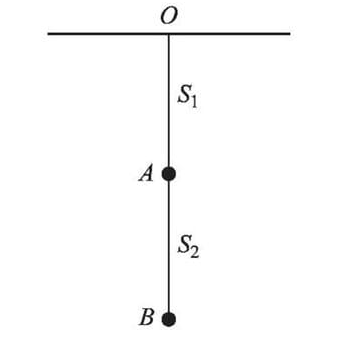
S1 and S2 are light inextensible strings, and A and B are particles each of mass 0.2 kg. Particle A is suspended from a fixed point O by the string S1, and particle B is suspended from A by the string S2. The particles hang in equilibrium as shown in the diagram.
(i) Find the tensions in S1 and S2.
The string S1 is cut and the particles fall. The air resistance acting on A is 0.4 N and the air resistance acting on B is 0.2 N.
(ii) Find the acceleration of the particles and the tension in S2.
June 2022 p42 q3
Two particles A and B, of masses 2.4 kg and 1.2 kg respectively, are connected by a light inextensible string which passes over a fixed smooth pulley. A is held at a distance of 2.1 m above a horizontal plane and B is 1.5 m above the plane. The particles hang vertically and are released from rest. In the subsequent motion A reaches the plane and does not rebound and B does not reach the pulley.
(a) Show that the tension in the string before A reaches the plane is 16 N and find the magnitude of the acceleration of the particles before A reaches the plane.
(b) Find the greatest height of B above the plane.
Nov 2017 p43 q4
Two particles A and B have masses 0.35 kg and 0.45 kg respectively. The particles are attached to the ends of a light inextensible string which passes over a small fixed smooth pulley which is 1 m above horizontal ground. Initially particle A is held at rest on the ground vertically below the pulley, with the string taut. Particle B hangs vertically below the pulley at a height of 0.64 m above the ground. Particle A is released.
(i) Find the speed of A at the instant that B reaches the ground.
(ii) Assuming that B does not bounce after it reaches the ground, find the total distance travelled by A between the instant that B reaches the ground and the instant when the string becomes taut again.
Feb/Mar 2017 p42 q6
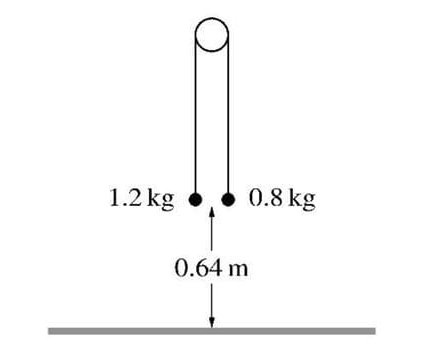
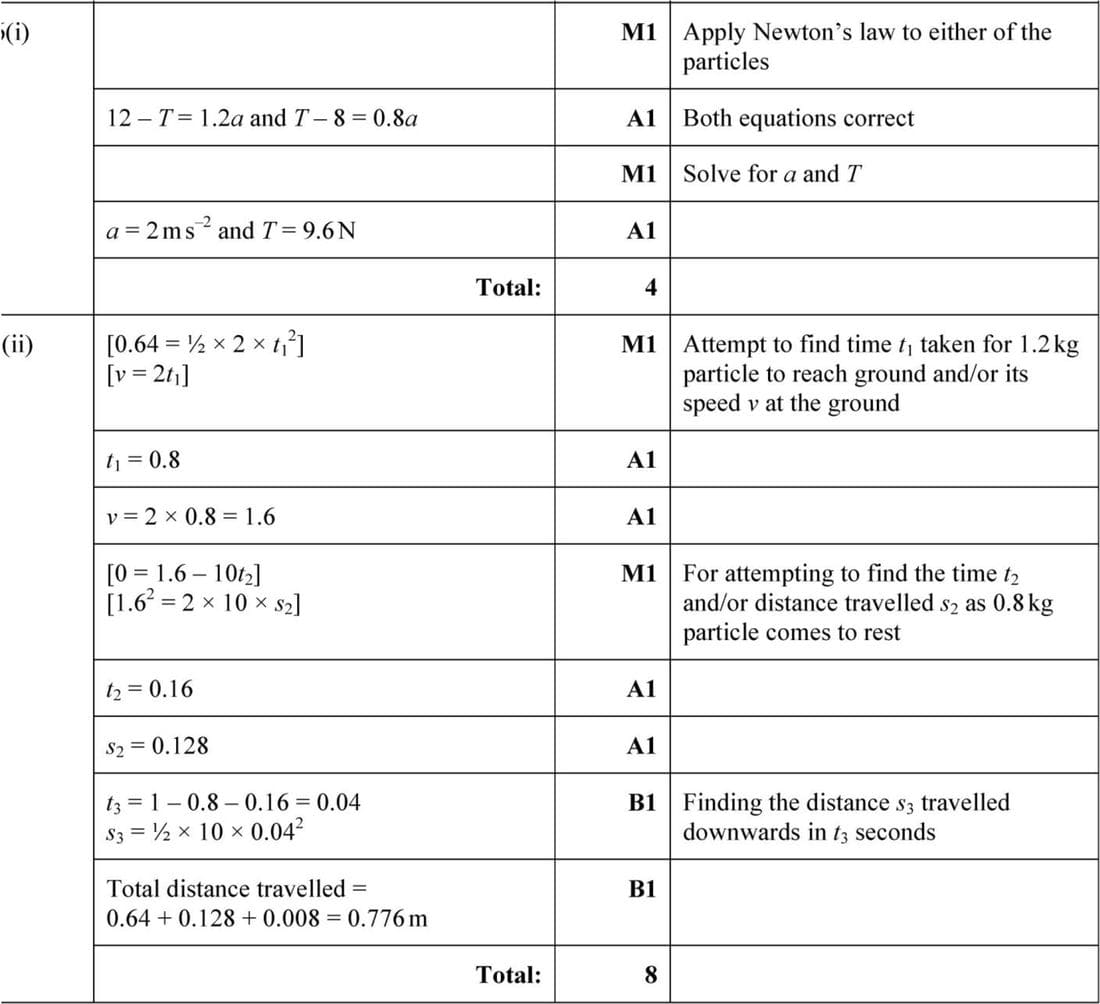
Two particles of masses 1.2 kg and 0.8 kg are connected by a light inextensible string that passes over a fixed smooth pulley. The particles hang vertically. The system is released from rest with both particles 0.64 m above the floor (see diagram). In the subsequent motion the 0.8 kg particle does not reach the pulley.
(i) Show that the acceleration of the particles is 2 m/s2 and find the tension in the string.
(ii) Find the total distance travelled by the 0.8 kg particle during the first second after the particles are released.
June 2016 p43 q6
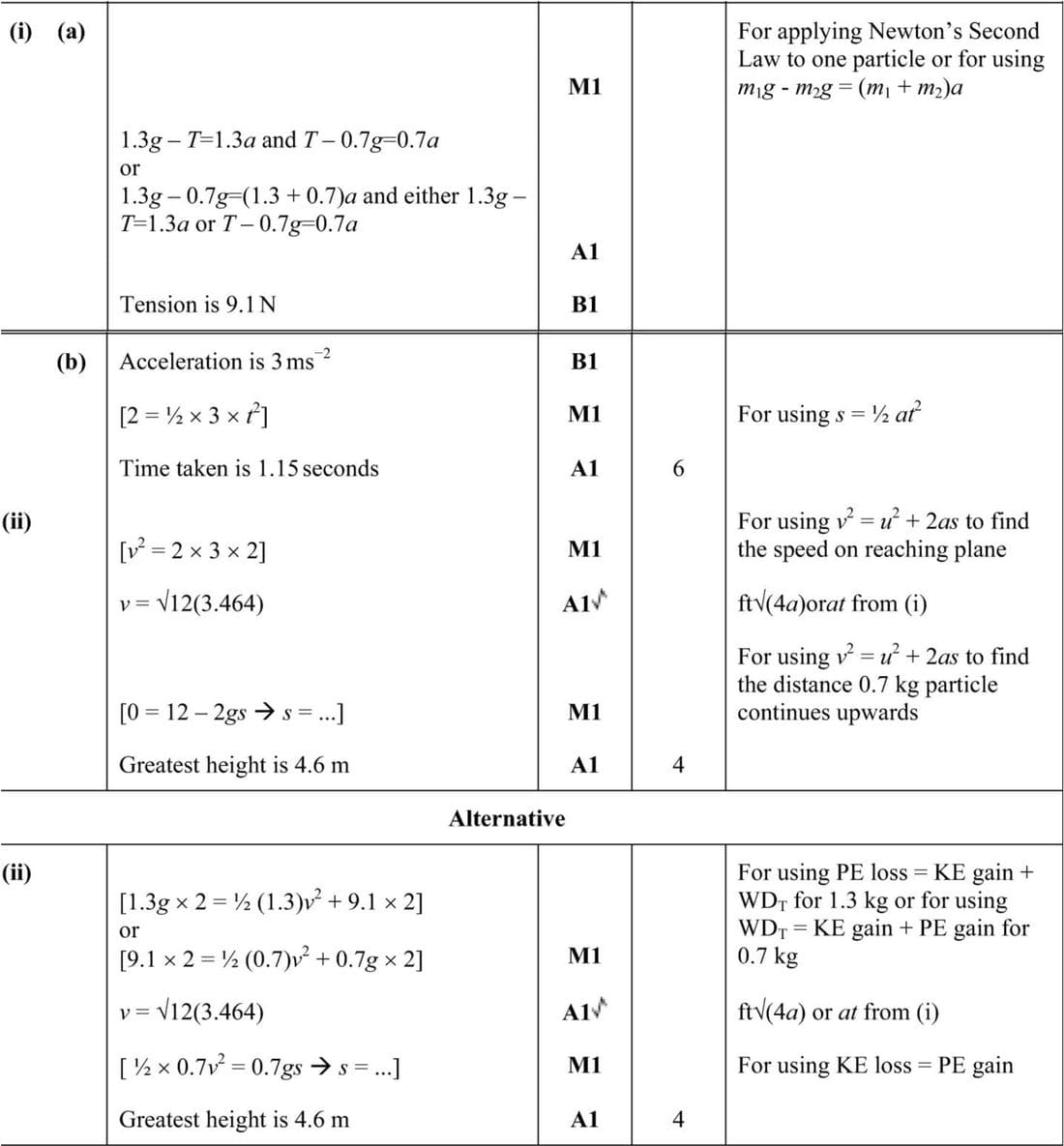
Two particles of masses 1.3 kg and 0.7 kg are connected by a light inextensible string that passes over a fixed smooth pulley. The particles are held at the same vertical height with the string taut. The distance of each particle above a horizontal plane is 2 m, and the distance of each particle below the pulley is 4 m. The particles are released from rest.
- Find
- the tension in the string before the particle of mass 1.3 kg reaches the plane,
- the time taken for the particle of mass 1.3 kg to reach the plane.
- Find the greatest height of the particle of mass 0.7 kg above the plane.
Nov 2015 p43 q4
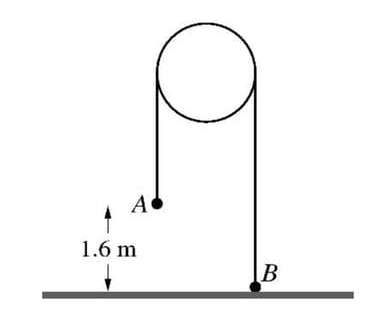
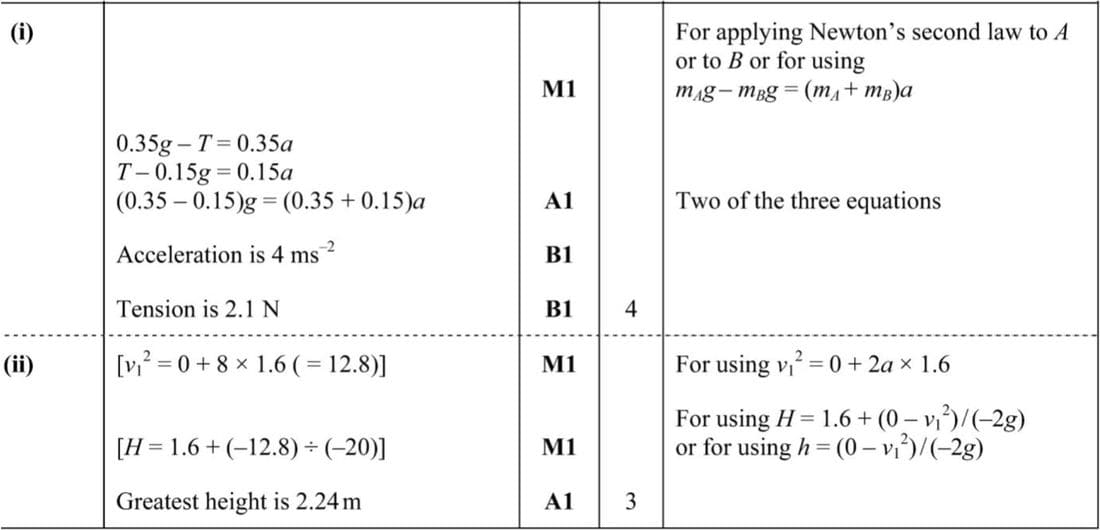
Particles A and B, of masses 0.35 kg and 0.15 kg respectively, are attached to the ends of a light inextensible string which passes over a fixed smooth pulley. The system is at rest with B held on the horizontal floor, the string taut and its straight parts vertical. A is at a height of 1.6 m above the floor (see diagram). B is released and the system begins to move; B does not reach the pulley. Find
- the acceleration of the particles and the tension in the string before A reaches the floor,
- the greatest height above the floor reached by B.
Nov 2015 p43 q1
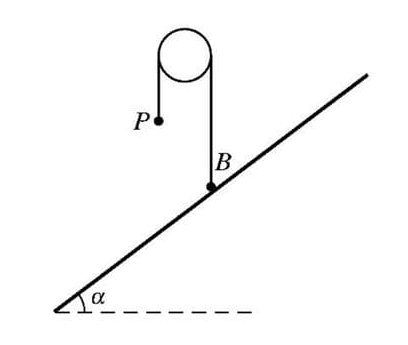
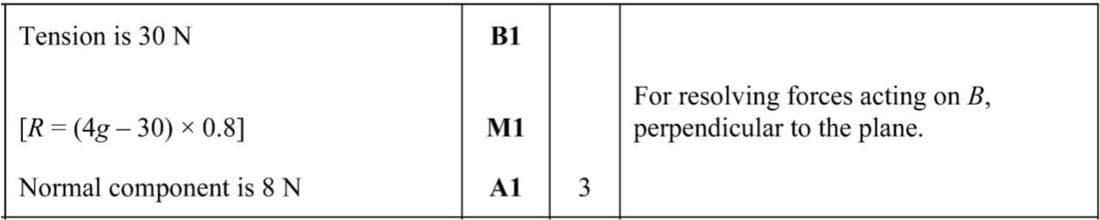
A small ball B of mass 4 kg is attached to one end of a light inextensible string. A particle P of mass 3 kg is attached to the other end of the string. The string passes over a fixed smooth pulley. The system is in equilibrium with the string taut and its straight parts vertical. B is at rest on a rough plane inclined to the horizontal at an angle of \(\alpha\), where \(\cos \alpha = 0.8\) (see diagram). State the tension in the string and find the normal component of the contact force exerted on B by the plane.
June 2015 p42 q6
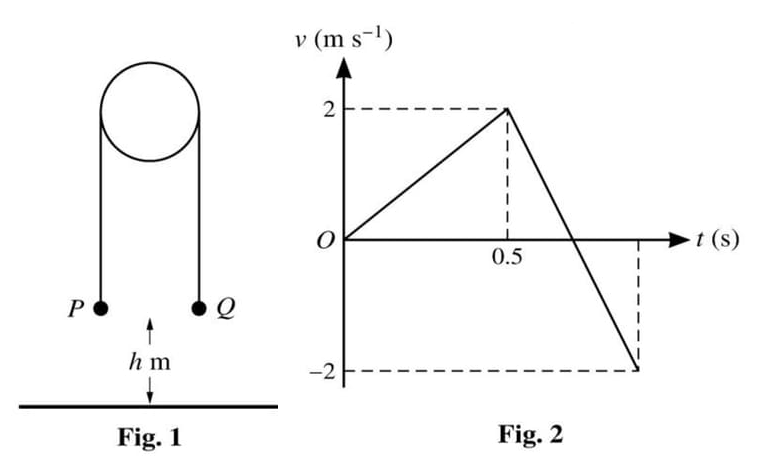
Two particles P and Q have masses m kg and (1 − m) kg respectively. The particles are attached to the ends of a light inextensible string which passes over a smooth fixed pulley. P is held at rest with the string taut and both straight parts of the string vertical. P and Q are each at a height of h m above horizontal ground (see Fig. 1). P is released and Q moves downwards. Subsequently Q hits the ground and comes to rest. Fig. 2 shows the velocity-time graph for P while Q is moving downwards or is at rest on the ground.
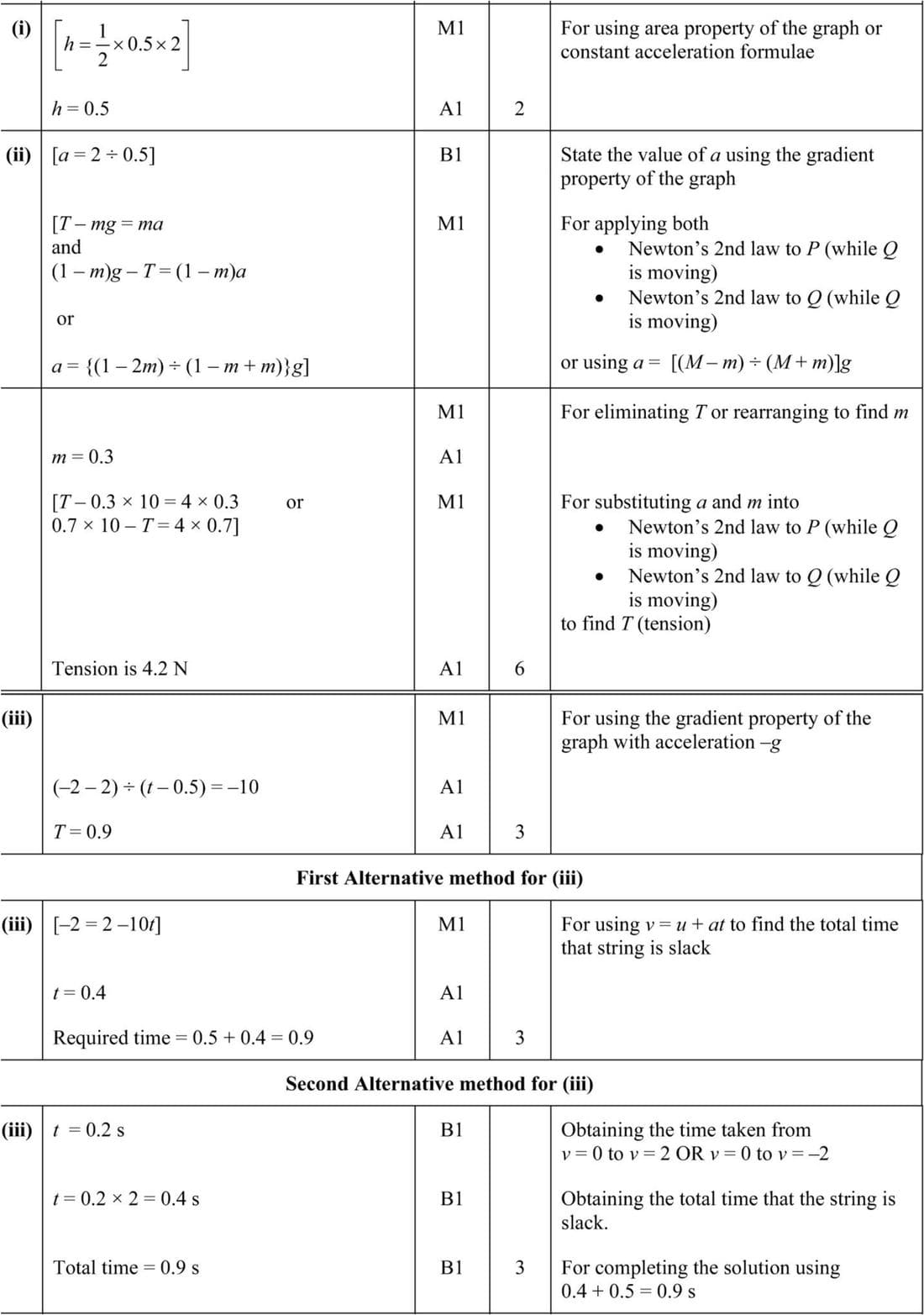
- Find the value of h. [2]
- Find the value of m, and find also the tension in the string while Q is moving. [6]
- The string is slack while Q is at rest on the ground. Find the total time from the instant that P is released until the string becomes taut again. [3]
Nov 2014 p43 q6
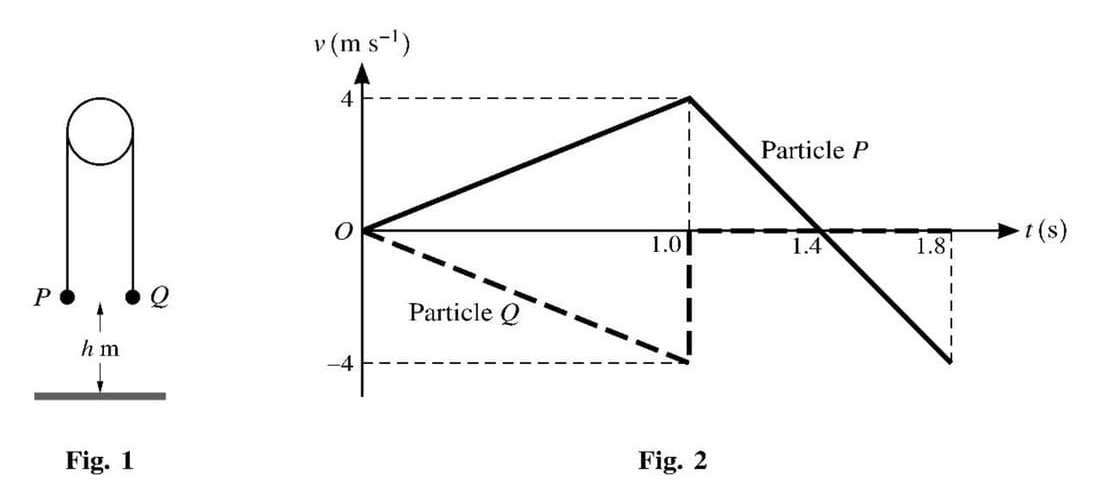
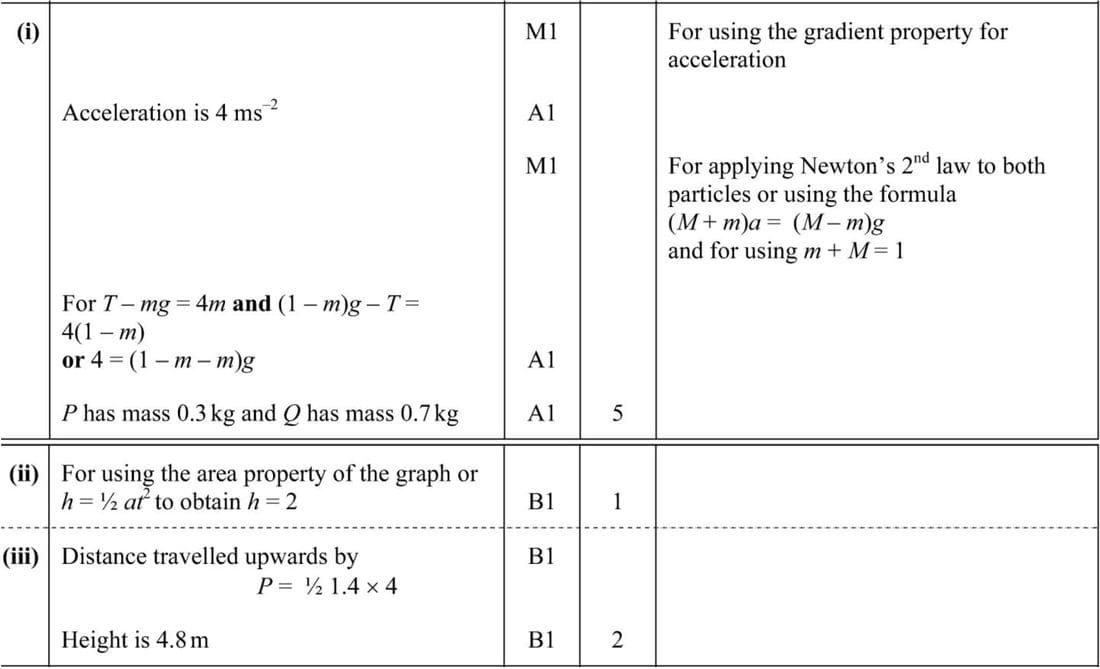
Particles P and Q have a total mass of 1 kg. The particles are attached to opposite ends of a light inextensible string which passes over a smooth fixed pulley. P is held at rest and Q hangs freely, with both straight parts of the string vertical. Both particles are at a height of h m above the floor (see Fig. 1). P is released from rest and the particles start to move with the string taut. Fig. 2 shows the velocity-time graphs for P's motion and for Q's motion, where the positive direction for velocity is vertically upwards. Find
- the magnitude of the acceleration with which the particles start to move and the mass of each of the particles,
- the value of h,
- the greatest height above the floor reached by particle P.
June 2014 p41 q6
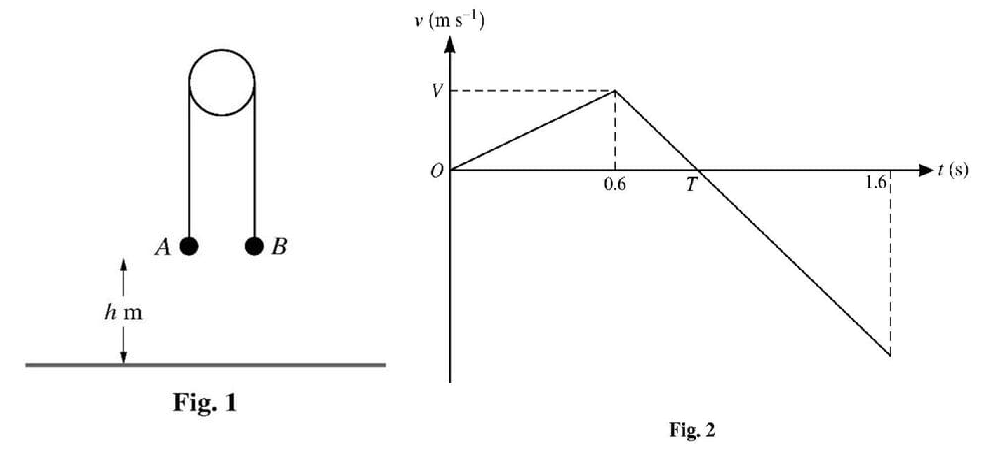
Particles A of mass 0.25 kg and B of mass 0.75 kg are attached to opposite ends of a light inextensible string which passes over a fixed smooth pulley. The system is held at rest with the string taut and its straight parts vertical. Both particles are at a height of h m above the floor (see Fig. 1). The system is released from rest, and 0.6 s later, when both particles are in motion, the string breaks. The particle A does not reach the pulley in the subsequent motion.
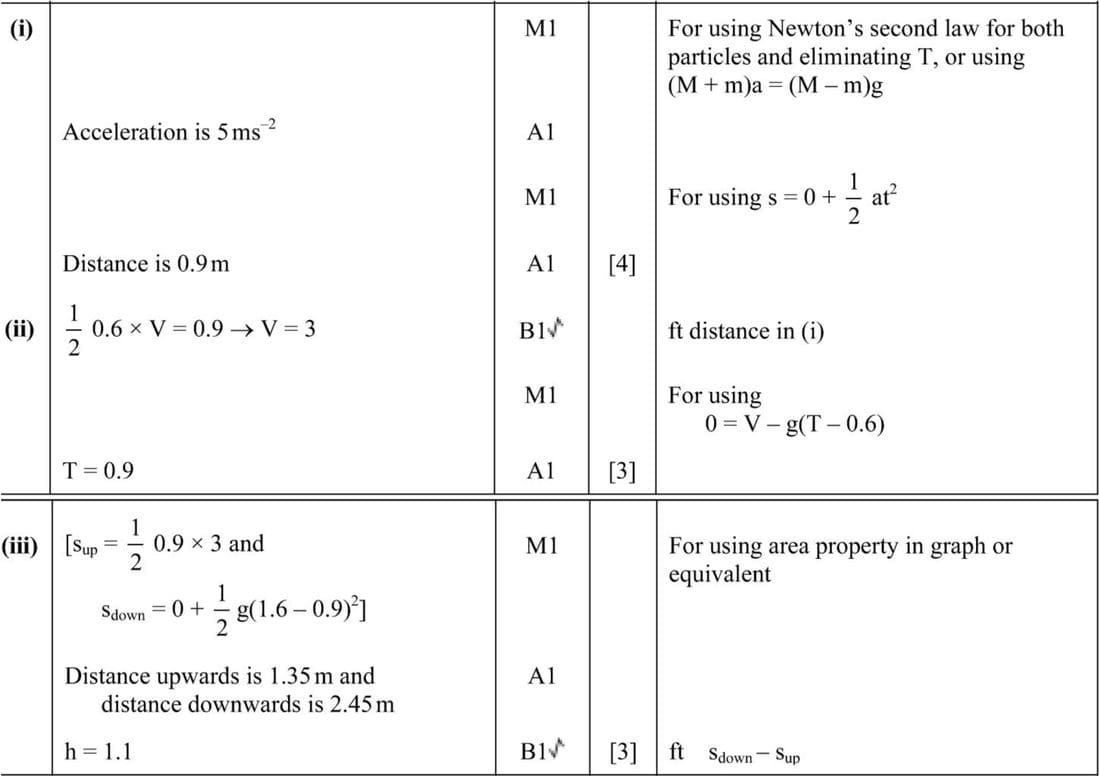
(i) Find the acceleration of A and the distance travelled by A before the string breaks.
The velocity-time graph shown in Fig. 2 is for the motion of particle A until it hits the floor. The velocity of A when the string breaks is V m s-1 and T s is the time taken for A to reach its greatest height.
(ii) Find the value of V and the value of T.
(iii) Find the distance travelled by A upwards and the distance travelled by A downwards and hence find h.
Nov 2013 p43 q2
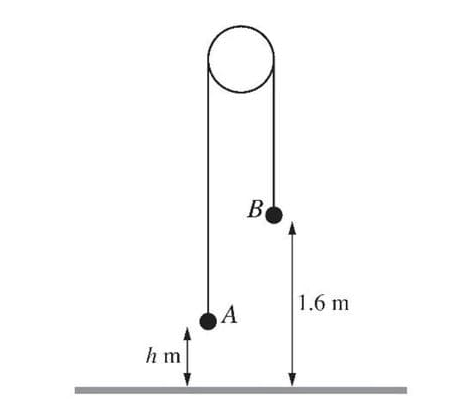
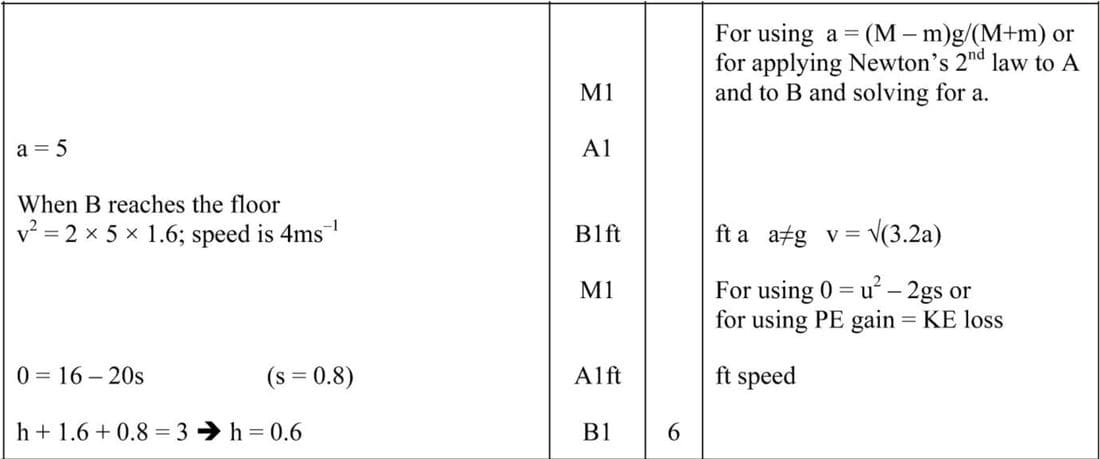
Particle A of mass 0.2 kg and particle B of mass 0.6 kg are attached to the ends of a light inextensible string. The string passes over a fixed smooth pulley. B is held at rest at a height of 1.6 m above the floor. A hangs freely at a height of h m above the floor. Both straight parts of the string are vertical (see diagram). B is released and both particles start to move. When B reaches the floor it remains at rest, but A continues to move vertically upwards until it reaches a height of 3 m above the floor. Find the speed of B immediately before it hits the floor, and hence find the value of h.
Nov 2013 p41 q6
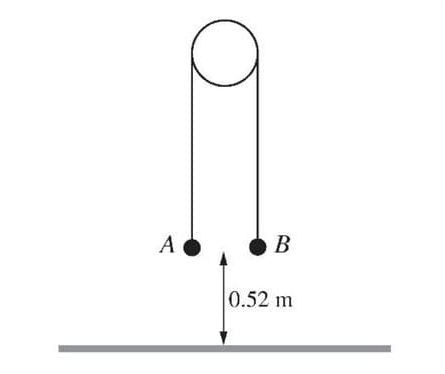
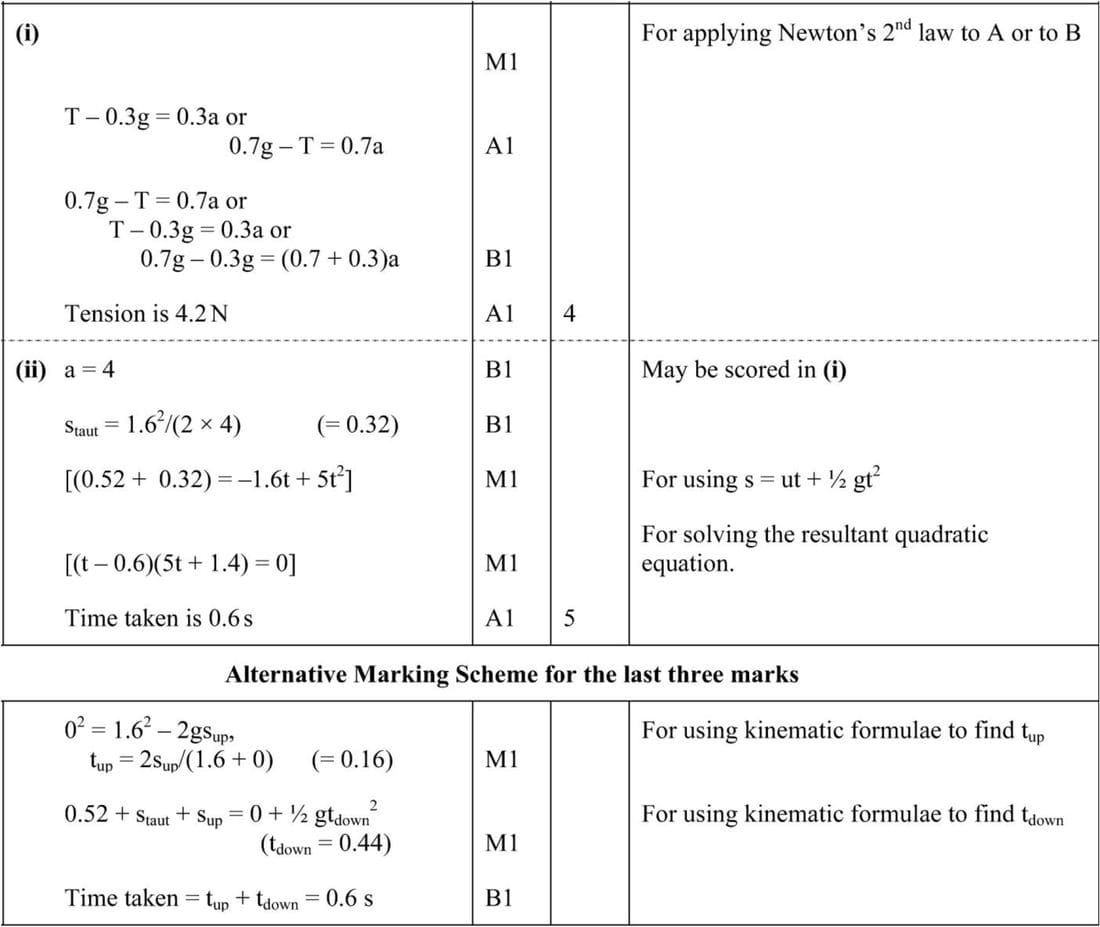
Particles A and B, of masses 0.3 kg and 0.7 kg respectively, are attached to the ends of a light inextensible string. The string passes over a fixed smooth pulley. A is held at rest and B hangs freely, with both straight parts of the string vertical and both particles at a height of 0.52 m above the floor (see diagram). A is released and both particles start to move.
(i) Find the tension in the string.
When both particles are moving with speed 1.6 m s-1 the string breaks.
(ii) Find the time taken, from the instant that the string breaks, for A to reach the floor.
June 2021 p41 q2
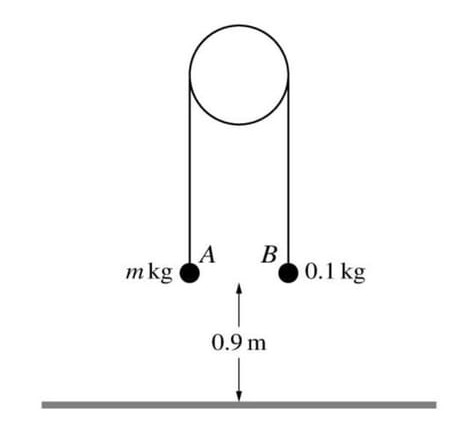
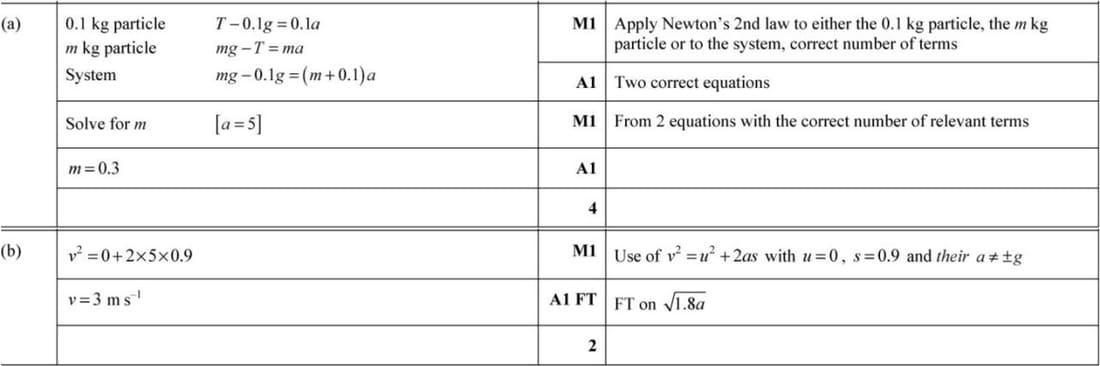
Two particles A and B have masses m kg and 0.1 kg respectively, where m > 0.1. The particles are attached to the ends of a light inextensible string. The string passes over a fixed smooth pulley and the particles hang vertically below it. Both particles are at a height of 0.9 m above horizontal ground (see diagram). The system is released from rest, and while both particles are in motion the tension in the string is 1.5 N. Particle B does not reach the pulley.
(a) Find m.
(b) Find the speed at which A reaches the ground.
Nov 2012 p42 q2
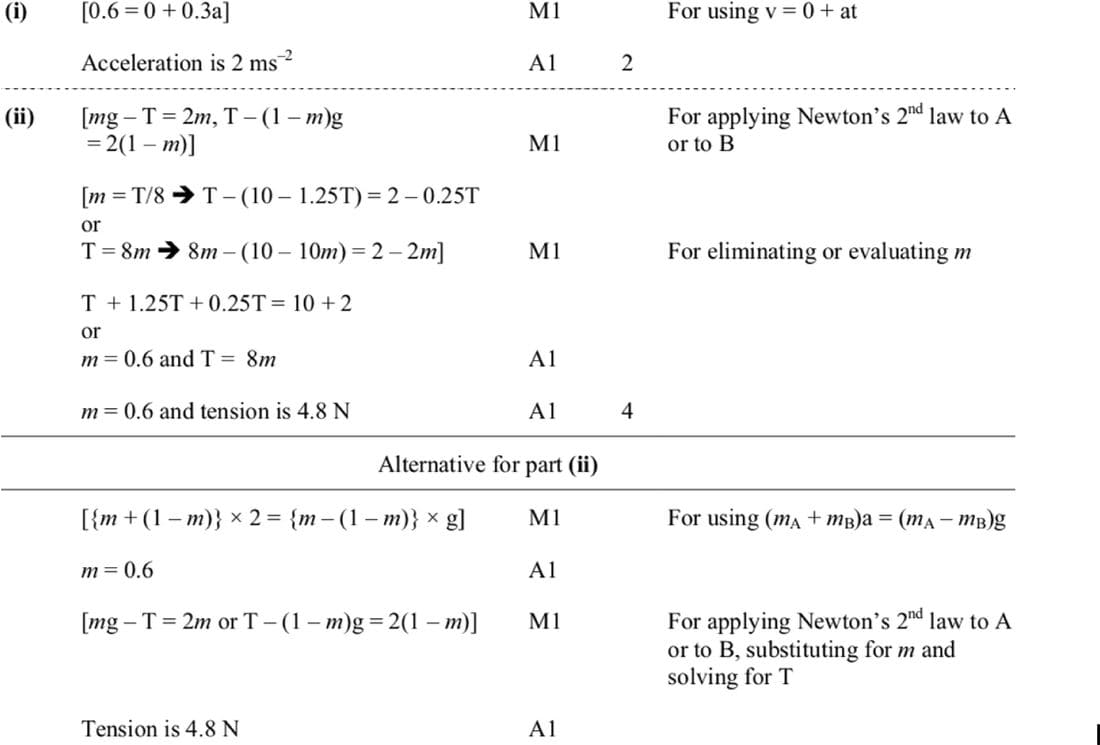
Particles A and B of masses m kg and (1 - m) kg respectively are attached to the ends of a light inextensible string which passes over a fixed smooth pulley. The system is released from rest with the straight parts of the string vertical. A moves vertically downwards and 0.3 seconds later it has speed 0.6 m s-1. Find
- the acceleration of A,
- the value of m and the tension in the string.
June 2012 p43 q7
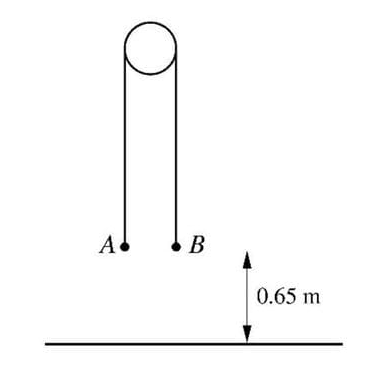
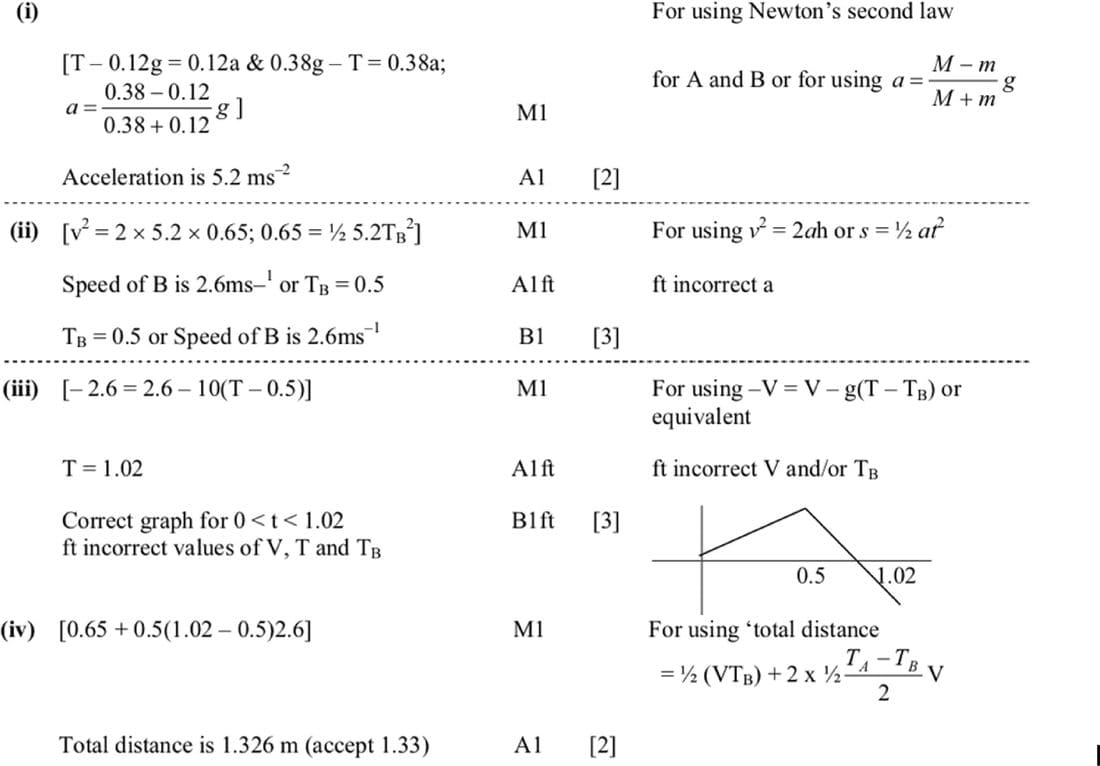
Two particles A and B have masses 0.12 kg and 0.38 kg respectively. The particles are attached to the ends of a light inextensible string which passes over a fixed smooth pulley. A is held at rest with the string taut and both straight parts of the string vertical. A and B are each at a height of 0.65 m above horizontal ground (see diagram). A is released and B moves downwards. Find
- the acceleration of B while it is moving downwards,
- the speed with which B reaches the ground and the time taken for it to reach the ground.
B remains on the ground while A continues to move with the string slack, without reaching the pulley. The string remains slack until A is at a height of 1.3 m above the ground for a second time. At this instant A has been in motion for a total time of T s.
- Find the value of T and sketch the velocity-time graph for A for the first T s of its motion.
- Find the total distance travelled by A in the first T s of its motion.
Nov 2011 p43 q3
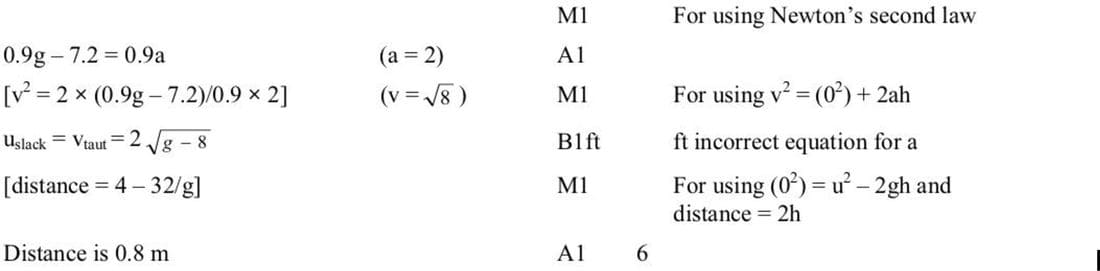
Particles P and Q are attached to opposite ends of a light inextensible string which passes over a fixed smooth pulley. The system is released from rest with the string taut, with its straight parts vertical, and with both particles at a height of 2 m above horizontal ground. P moves vertically downwards and does not rebound when it hits the ground. At the instant that P hits the ground, Q is at the point X, from where it continues to move vertically upwards without reaching the pulley. Given that P has mass 0.9 kg and that the tension in the string is 7.2 N while P is moving, find the total distance travelled by Q from the instant it first reaches X until it returns to X.
Nov 2011 p42 q5
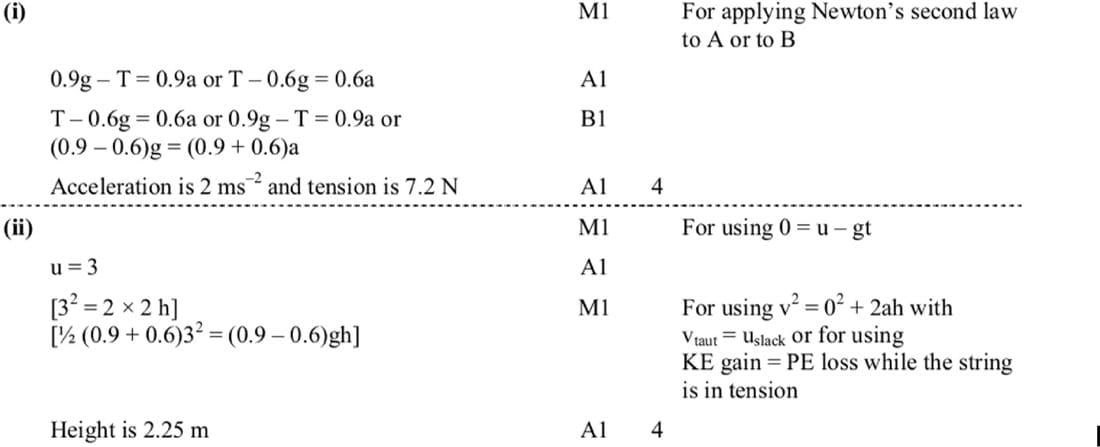
Particles A and B, of masses 0.9 kg and 0.6 kg respectively, are attached to the ends of a light inextensible string. The string passes over a fixed smooth pulley. The system is released from rest with the string taut, with its straight parts vertical and with the particles at the same height above the horizontal floor. In the subsequent motion, B does not reach the pulley.
(i) Find the acceleration of A and the tension in the string during the motion before A hits the floor.
After A hits the floor, B continues to move vertically upwards for a further 0.3 s.
(ii) Find the height of the particles above the floor at the instant that they started to move.
Nov 2011 p41 q2
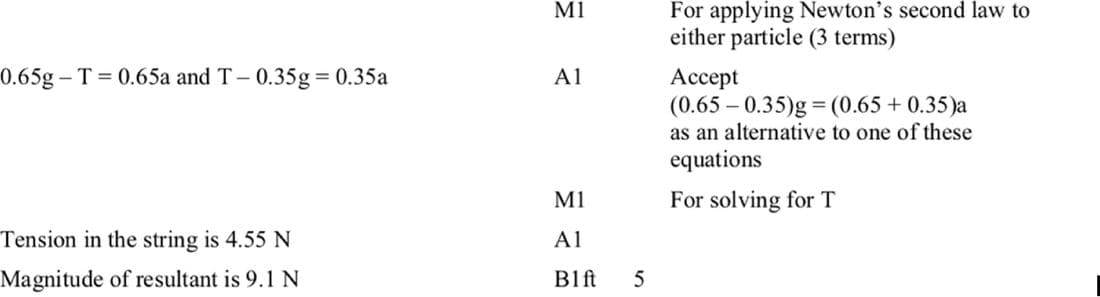
Particles A of mass 0.65 kg and B of mass 0.35 kg are attached to the ends of a light inextensible string which passes over a fixed smooth pulley. B is held at rest with the string taut and both of its straight parts vertical. The system is released from rest and the particles move vertically. Find the tension in the string and the magnitude of the resultant force exerted on the pulley by the string.
Nov 2009 p42 q6
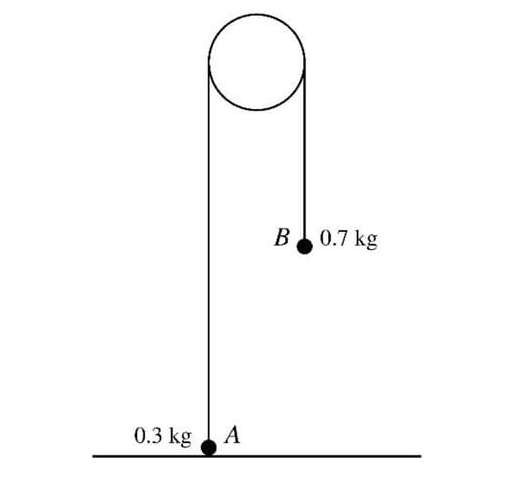
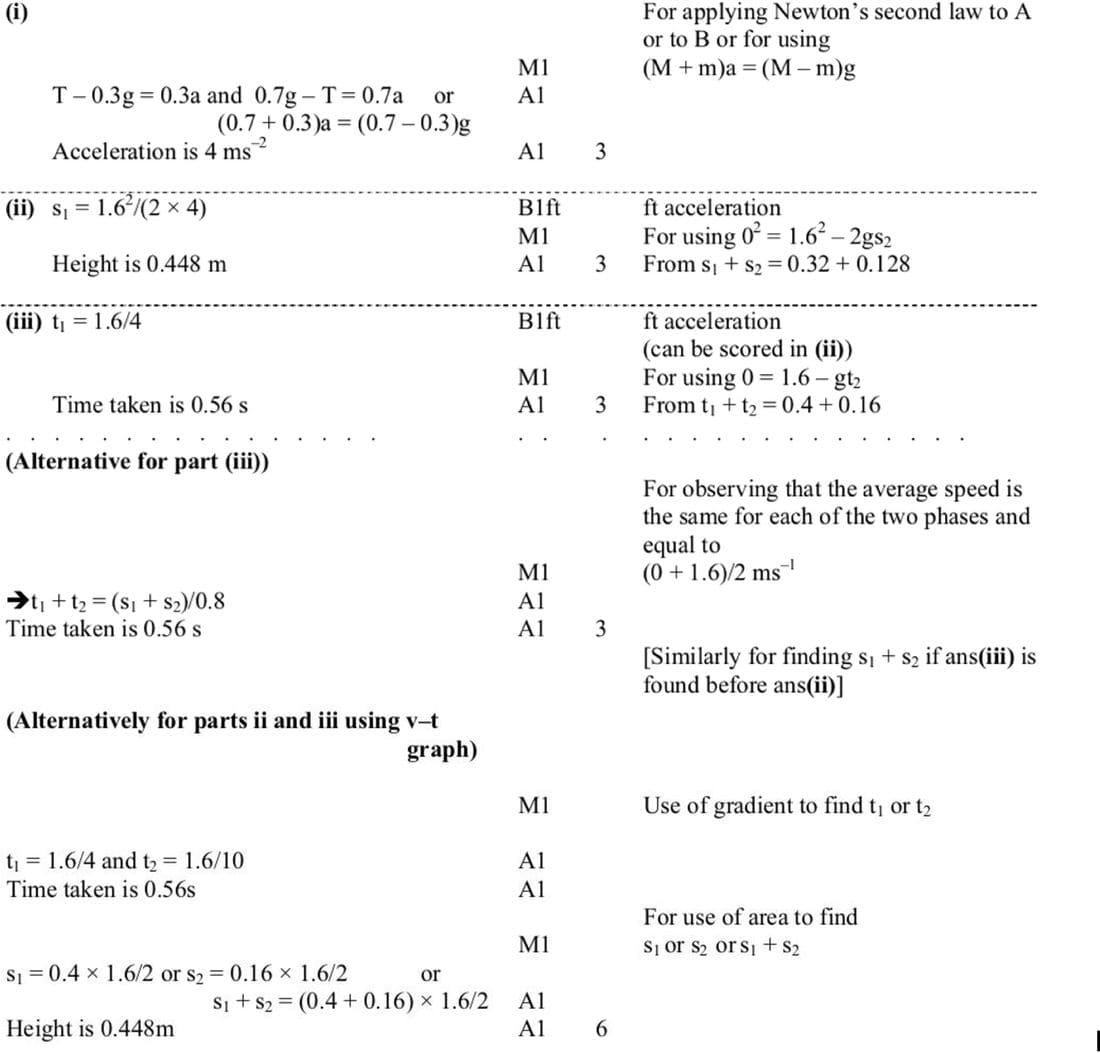
Particles A and B, of masses 0.3 kg and 0.7 kg respectively, are attached to the ends of a light inextensible string which passes over a smooth fixed pulley. Particle A is held on the horizontal floor and particle B hangs in equilibrium. Particle A is released and both particles start to move vertically.
- Find the acceleration of the particles.
The speed of the particles immediately before B hits the floor is 1.6 m s-1. Given that B does not rebound upwards, find
- the maximum height above the floor reached by A,
- the time taken by A, from leaving the floor, to reach this maximum height.
Nov 2009 p41 q6
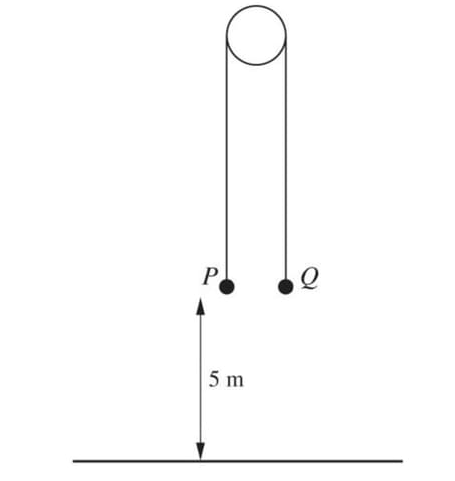
Particles P and Q, of masses 0.55 kg and 0.45 kg respectively, are attached to the ends of a light inextensible string which passes over a smooth fixed pulley. The particles are held at rest with the string taut and its straight parts vertical. Both particles are at a height of 5 m above the ground (see diagram). The system is released.
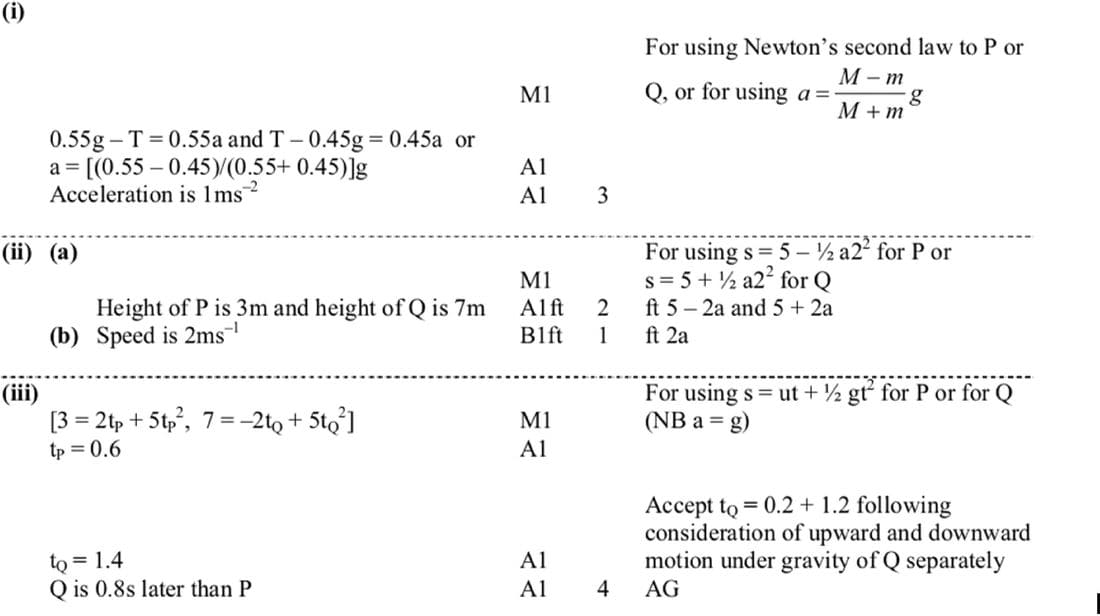
(i) Find the acceleration with which P starts to move. [3]
The string breaks after 2 s and in the subsequent motion P and Q move vertically under gravity.
(ii) At the instant that the string breaks, find
- the height above the ground of P and of Q,
- the speed of the particles.
(iii) Show that Q reaches the ground 0.8 s later than P. [4]
June 2009 p4 q6
Particles A and B are attached to the ends of a light inextensible string which passes over a smooth pulley. The system is held at rest with the string taut and its straight parts vertical. Both particles are at a height of 0.36 m above the floor (see diagram). The system is released and A begins to fall, reaching the floor after 0.6 s.
- Find the acceleration of A as it falls. [2]
The mass of A is 0.45 kg. Find
- the tension in the string while A is falling, [2]
- the mass of B, [3]
- the maximum height above the floor reached by B. [3]
June 2009 p4 q1
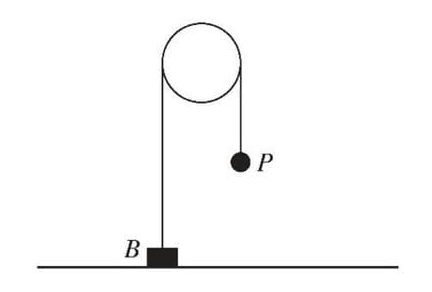
A block B of mass 5 kg is attached to one end of a light inextensible string. A particle P of mass 4 kg is attached to the other end of the string. The string passes over a smooth pulley. The system is in equilibrium with the string taut and its straight parts vertical. B is at rest on the ground (see diagram). State the tension in the string and find the force exerted on B by the ground.

Nov 2008 p4 q5
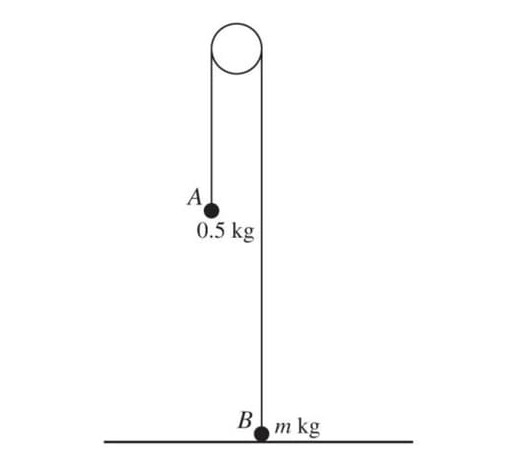
Particles A and B, of masses 0.5 kg and m kg respectively, are attached to the ends of a light inextensible string which passes over a smooth fixed pulley. Particle B is held at rest on the horizontal floor and particle A hangs in equilibrium (see diagram). B is released and each particle starts to move vertically. A hits the floor 2 s after B is released. The speed of each particle when A hits the floor is 5 m s-1.
- For the motion while A is moving downwards, find
- the acceleration of A,
- the tension in the string.
- Find the value of m.
Nov 2020 p41 q5
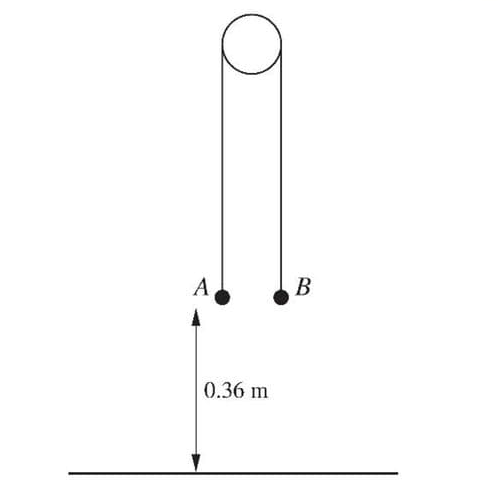
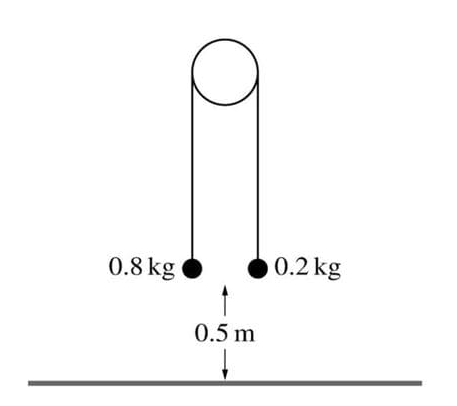
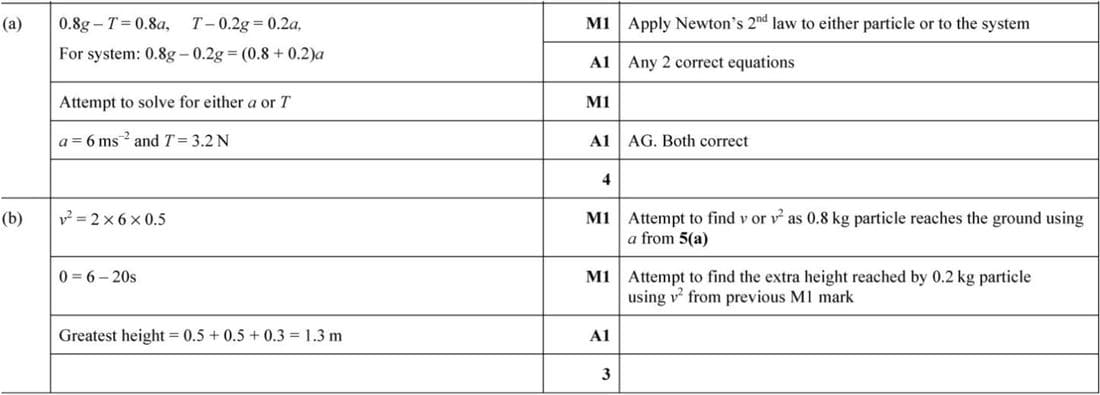
Two particles of masses 0.8 kg and 0.2 kg are connected by a light inextensible string that passes over a fixed smooth pulley. The system is released from rest with both particles 0.5 m above a horizontal floor (see diagram). In the subsequent motion the 0.2 kg particle does not reach the pulley.
(a) Show that the magnitude of the acceleration of the particles is 6 m s-2 and find the tension in the string.
(b) When the 0.8 kg particle reaches the floor it comes to rest. Find the greatest height of the 0.2 kg particle above the floor.
June 2007 p4 q4
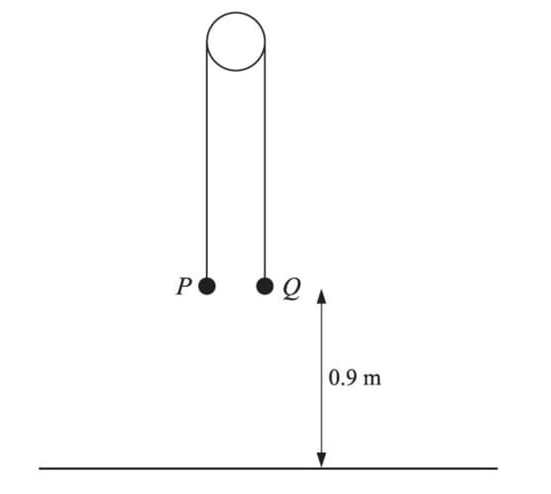
Particles P and Q, of masses 0.6 kg and 0.2 kg respectively, are attached to the ends of a light inextensible string which passes over a smooth fixed peg. The particles are held at rest with the string taut. Both particles are at a height of 0.9 m above the ground (see diagram). The system is released and each of the particles moves vertically. Find
- the acceleration of P and the tension in the string before P reaches the ground,
- the time taken for P to reach the ground.
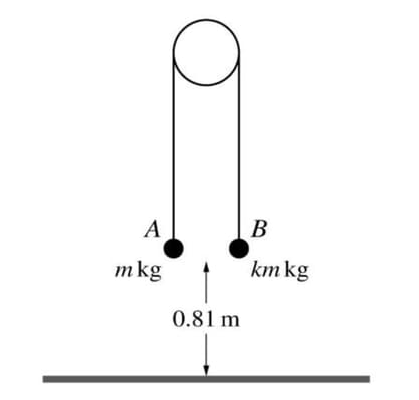
Nov 2019 p43 q7
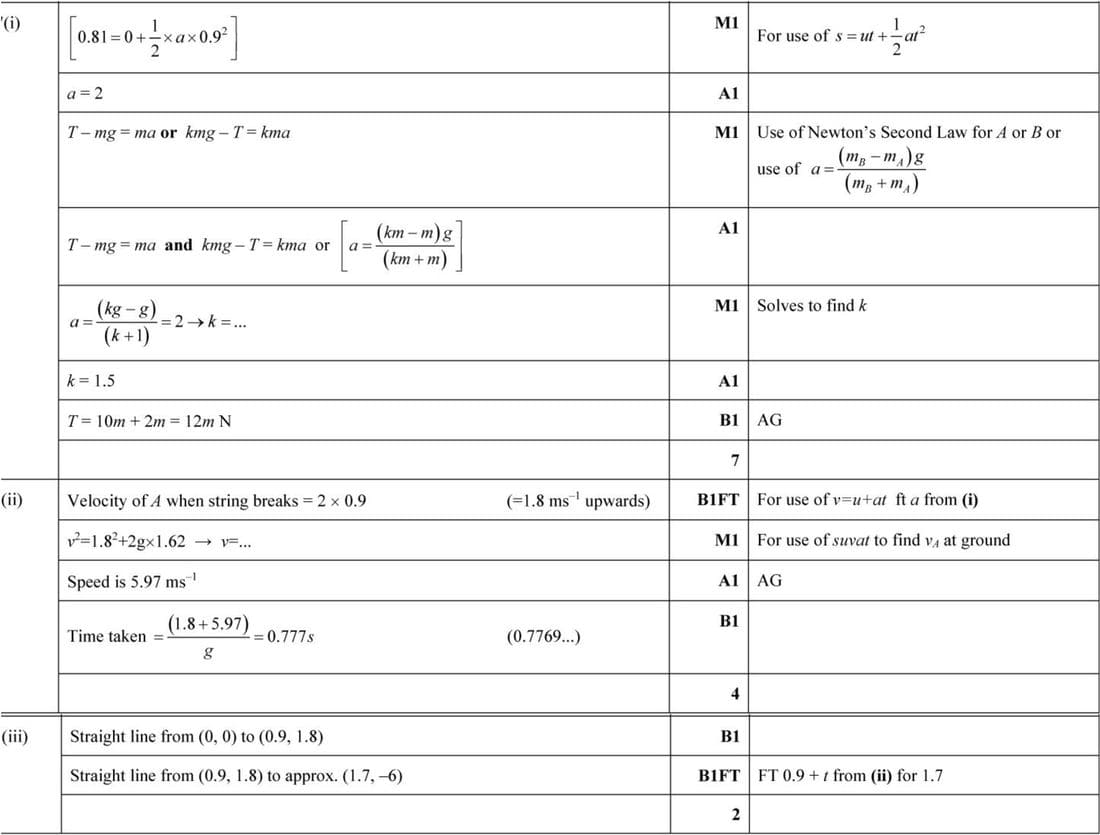
Two particles A and B have masses \(m \text{ kg}\) and \(km \text{ kg}\) respectively, where \(k > 1\). The particles are attached to the ends of a light inextensible string. The string passes over a fixed smooth pulley and the particles hang vertically below it. Both particles are at a height of 0.81 m above horizontal ground (see diagram). The system is released from rest and particle B reaches the ground 0.9 s later. The particle A does not reach the pulley in its subsequent motion.
(i) Find the value of \(k\) and show that the tension in the string before B reaches the ground is equal to \(12m \text{ N}\).
At the instant when B reaches the ground, the string breaks.
(ii) Show that the speed of A when it reaches the ground is \(5.97 \text{ m s}^{-1}\), correct to 3 significant figures, and find the time taken, after the string breaks, for A to reach the ground.
(iii) Sketch a velocity-time graph for the motion of particle A from the instant when the system is released until A reaches the ground.
June 2019 p43 q4
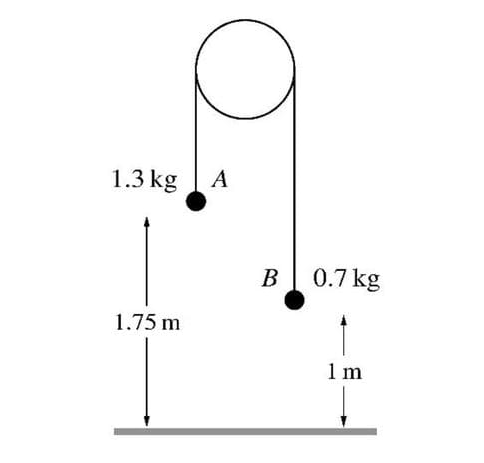
Two particles A and B, of masses 1.3 kg and 0.7 kg respectively, are connected by a light inextensible string which passes over a smooth fixed pulley. Particle A is 1.75 m above the floor and particle B is 1 m above the floor (see diagram). The system is released from rest with the string taut, and the particles move vertically. When the particles are at the same height the string breaks.
(i) Show that, before the string breaks, the magnitude of the acceleration of each particle is 3 m s-2 and find the tension in the string.
(ii) Find the difference in the times that it takes the particles to hit the ground.

June 2019 p42 q5
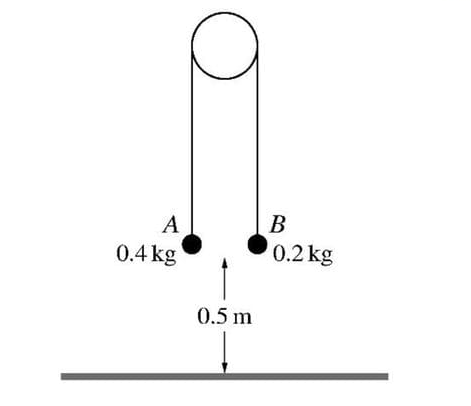
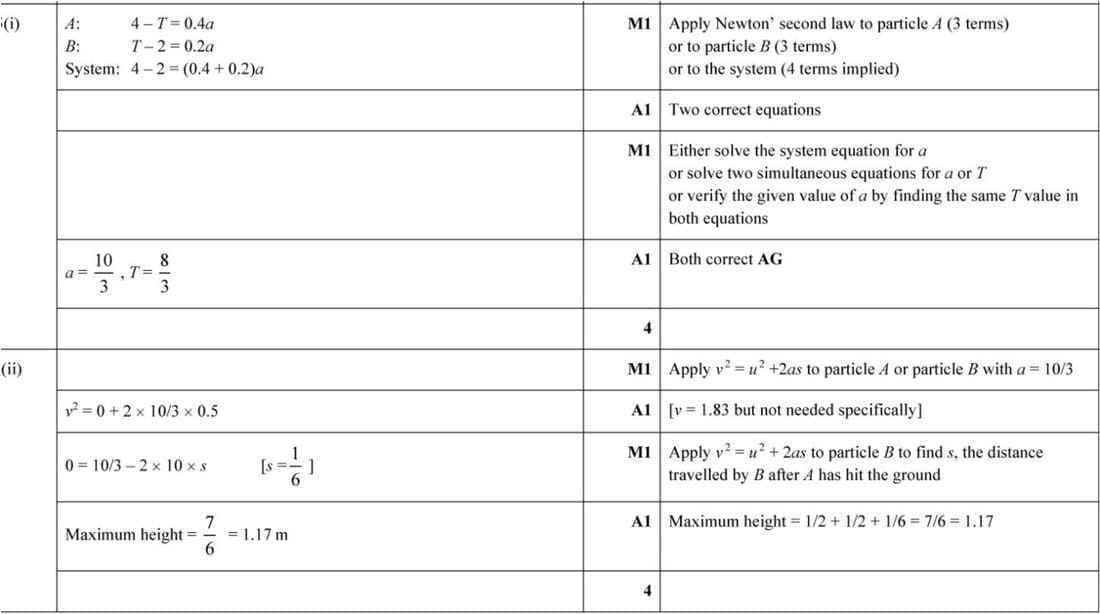
Two particles A and B, of masses 0.4 kg and 0.2 kg respectively, are connected by a light inextensible string which passes over a fixed smooth pulley. Both A and B are 0.5 m above the ground. The particles hang vertically (see diagram). The particles are released from rest. In the subsequent motion B does not reach the pulley and A remains at rest after reaching the ground.
(i) For the motion before A reaches the ground, show that the magnitude of the acceleration of each particle is \(\frac{10}{3} \text{ m s}^{-2}\) and find the tension in the string. [4]
(ii) Find the maximum height of B above the ground. [4]
Nov 2018 p43 q5
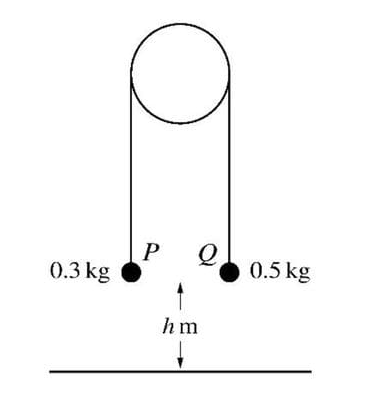
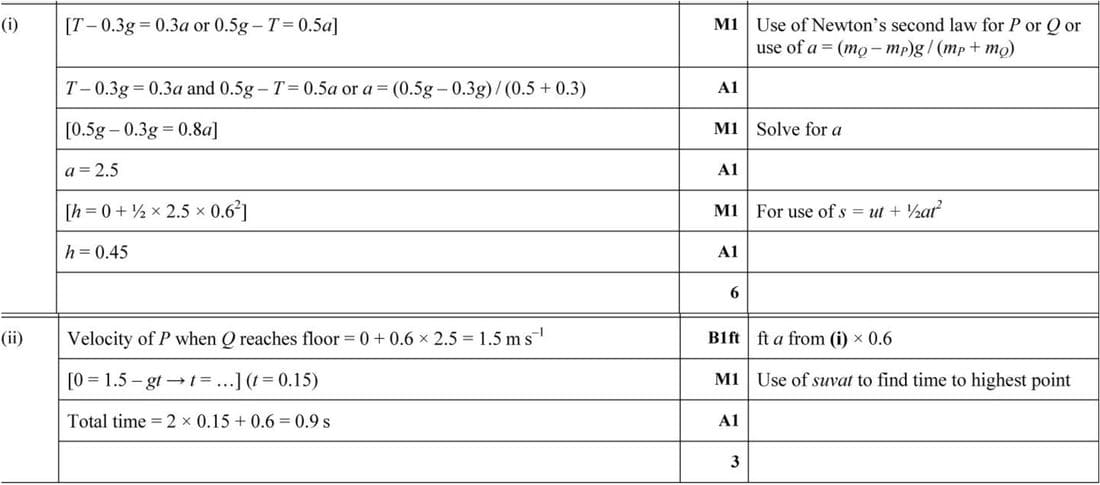
Two particles P and Q, of masses 0.3 kg and 0.5 kg respectively, are attached to the ends of a light inextensible string. The string passes over a fixed smooth pulley with the particles hanging freely below it. Q is held at rest with the string taut at a height of h m above a horizontal floor (see diagram). Q is now released and both particles start to move. The pulley is sufficiently high so that P does not reach it at any stage. The time taken for Q to reach the floor is 0.6 s.
(i) Find the acceleration of Q before it reaches the floor and hence find the value of h.
Q remains at rest when it reaches the floor, and P continues to move upwards.
(ii) Find the velocity of P at the instant when Q reaches the floor and the total time taken from the instant at which Q is released until the string becomes taut again.
Nov 2018 p41 q4
Two particles A and B, of masses m kg and 0.3 kg respectively, are attached to the ends of a light inextensible string. The string passes over a fixed smooth pulley and the particles hang freely below it. The system is released from rest, with both particles 0.8 m above horizontal ground. Particle A reaches the ground with a speed of 0.6 m s-1.
(i) Find the tension in the string during the motion before A reaches the ground.
(ii) Find the value of m.
Feb/Mar 2018 p42 q1
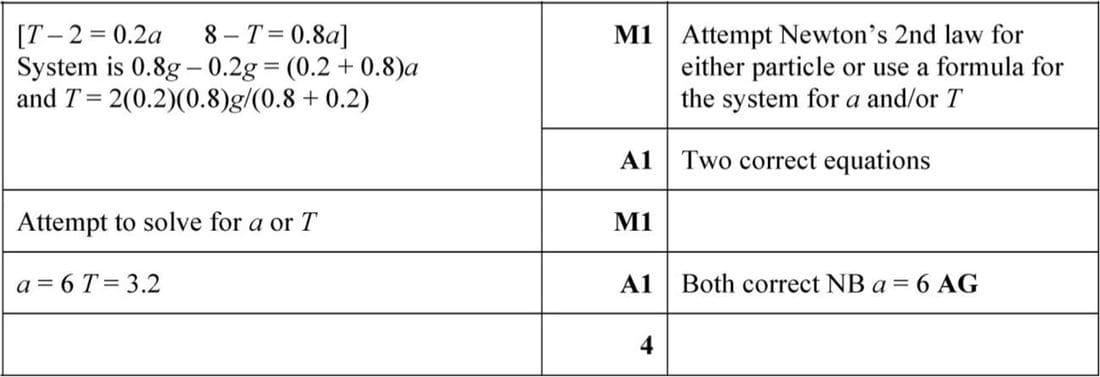
Two particles A and B, of masses 0.8 kg and 0.2 kg respectively, are connected by a light inextensible string that passes over a fixed smooth pulley. The particles hang vertically. The system is released from rest. Show that the acceleration of A has magnitude 6 m s-2 and find the tension in the string.