Exam-Style Problems
⬅ Back to SubchapterNov 2023 p43 q5
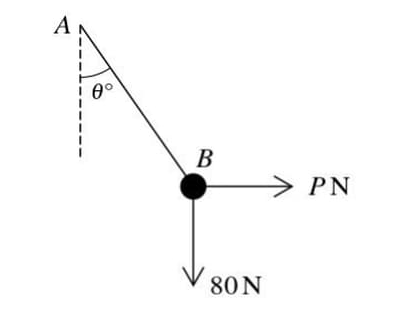
A light string AB is fixed at A and has a particle of weight 80 N attached at B. A horizontal force of magnitude P N is applied at B such that the string makes an angle θ° to the vertical (see diagram).
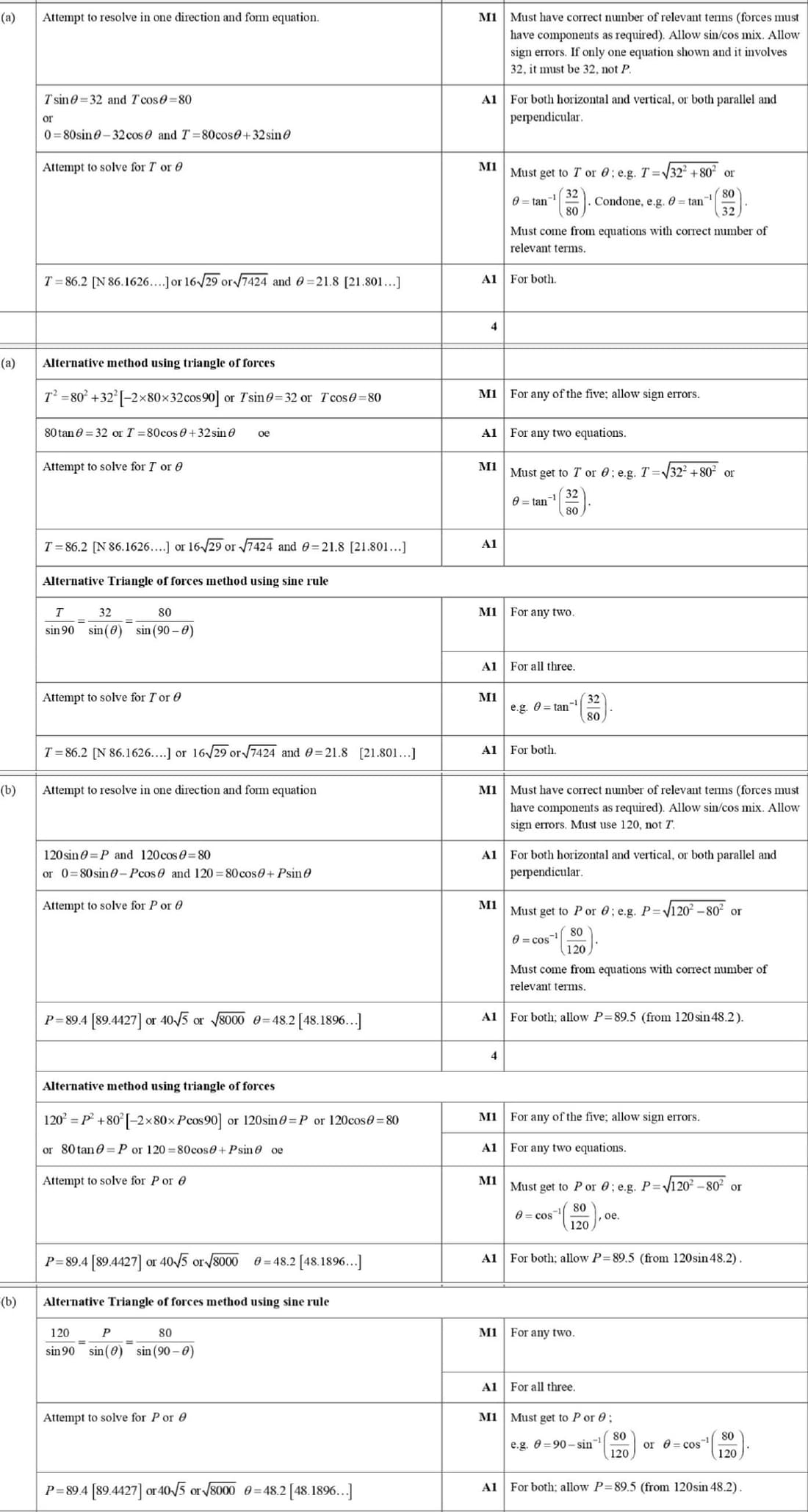
\((a) It is given that P = 32 and the system is in equilibrium. Find the tension in the string and the value of θ.\)
(b) It is given instead that the tension in the string is 120 N and that the particle attached at B still has weight 80 N. Find the value of P and the value of θ.
Nov 2017 p42 q2
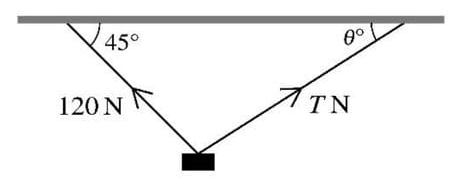
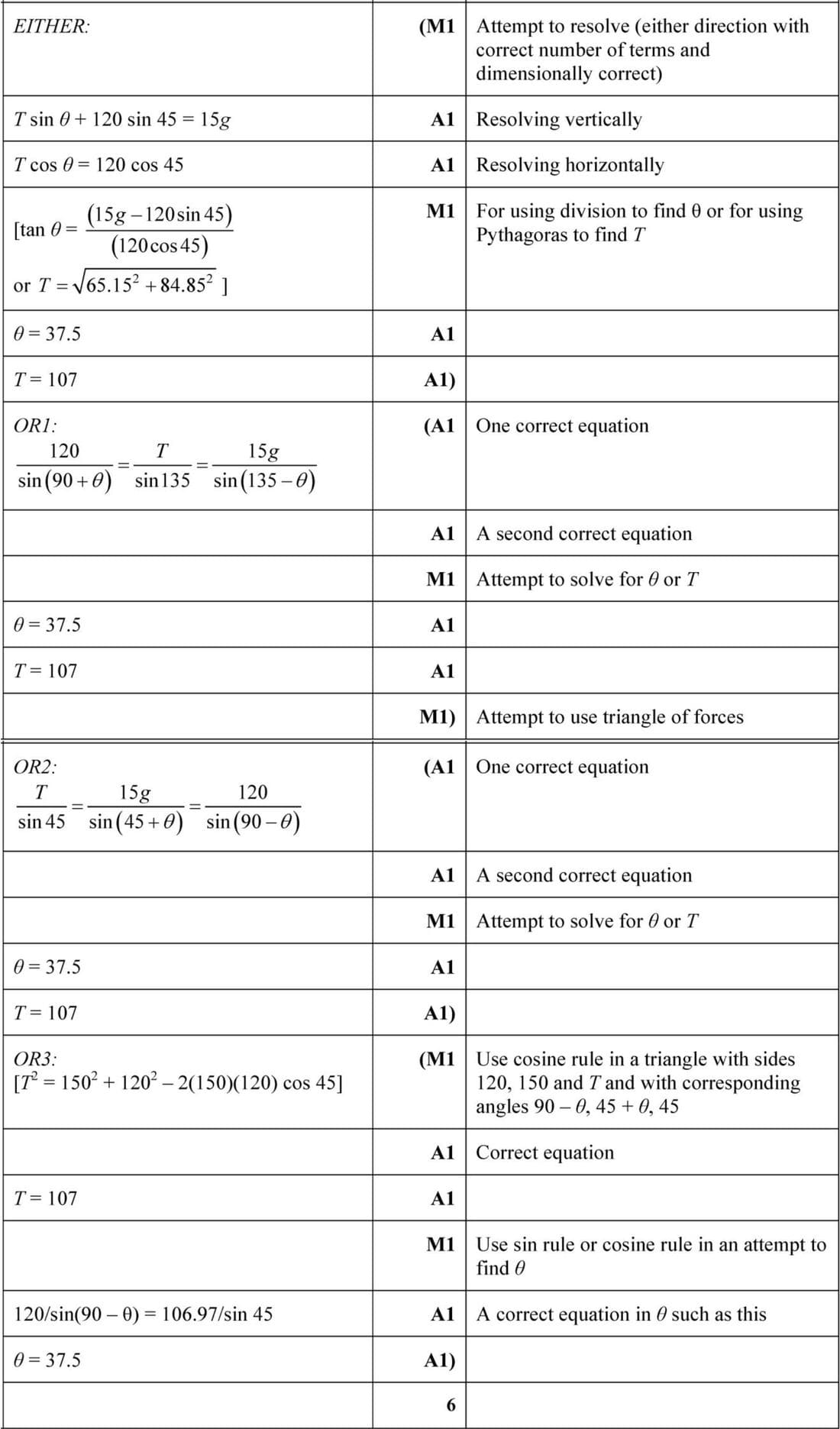
A block of mass 15 kg hangs in equilibrium below a horizontal ceiling attached to two strings as shown in the diagram. One of the strings is inclined at 45° to the horizontal and the tension in this string is 120 N. The other string is inclined at θ° to the horizontal and the tension in this string is T N. Find the values of T and θ.
June 2017 p41 q3
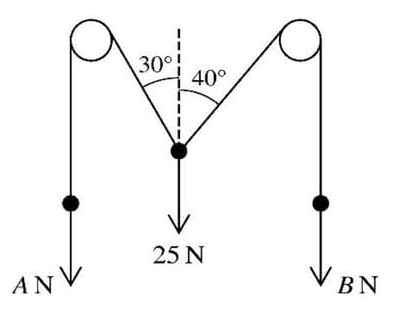
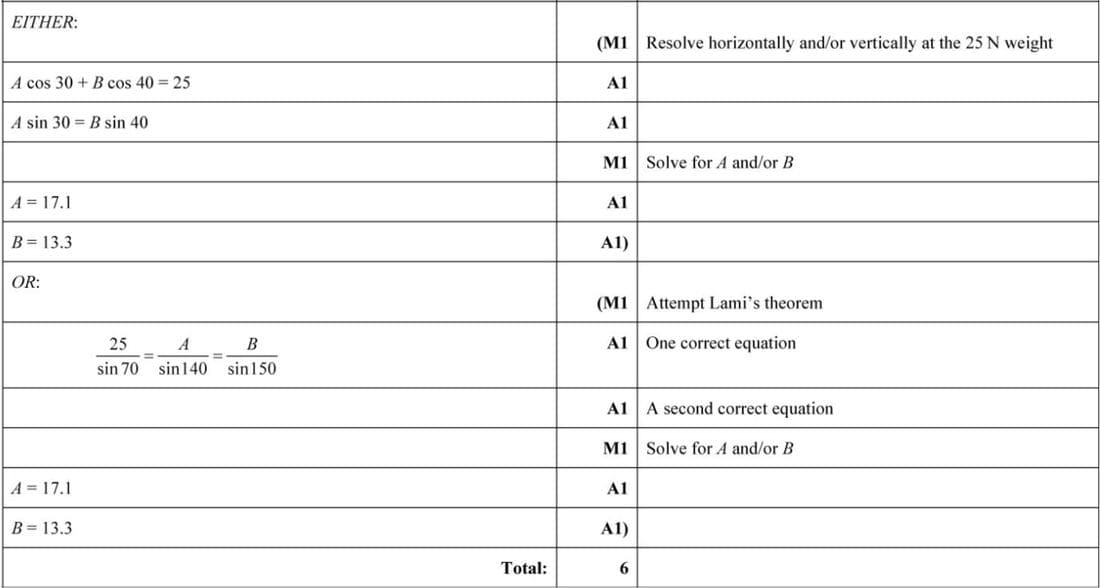
Two light inextensible strings are attached to a particle of weight 25 N. The strings pass over two smooth fixed pulleys and have particles of weights \(A N\) and \(B N\) hanging vertically at their ends. The sloping parts of the strings make angles of \(30^\circ\) and \(40^\circ\) respectively with the vertical (see diagram). The system is in equilibrium. Find the values of \(A\) and \(B\).
Feb/Mar 2017 p42 q2
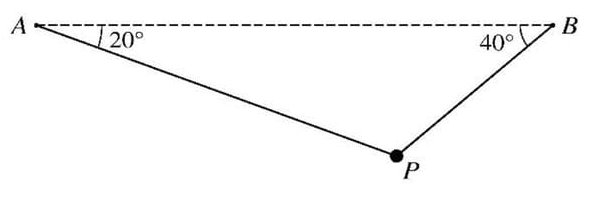
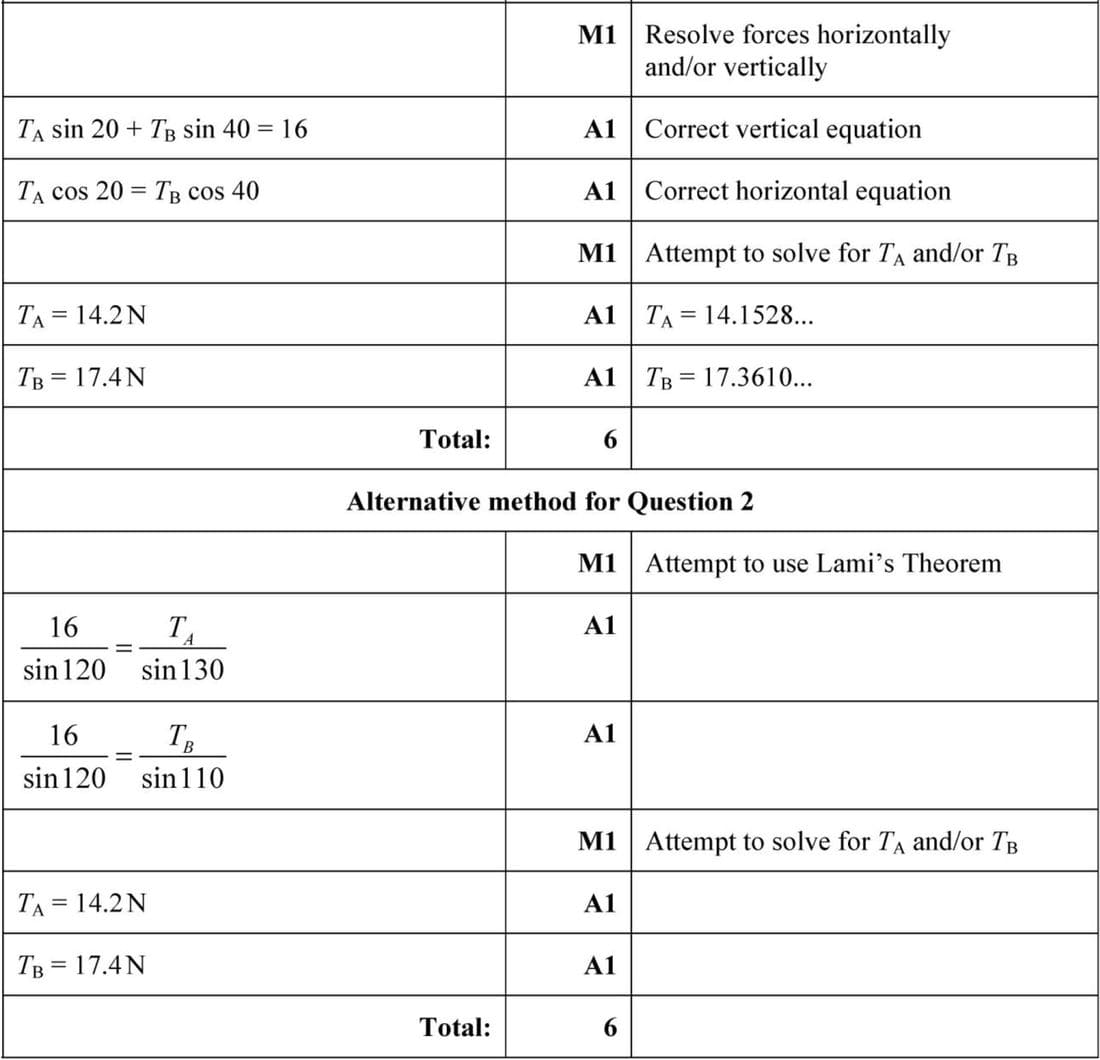
A particle P of mass 1.6 kg is suspended in equilibrium by two light inextensible strings attached to points A and B. The strings make angles of 20° and 40° respectively with the horizontal (see diagram). Find the tensions in the two strings.
Nov 2016 p43 q2
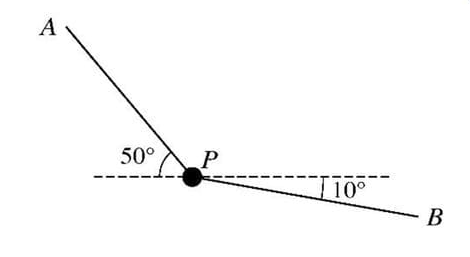
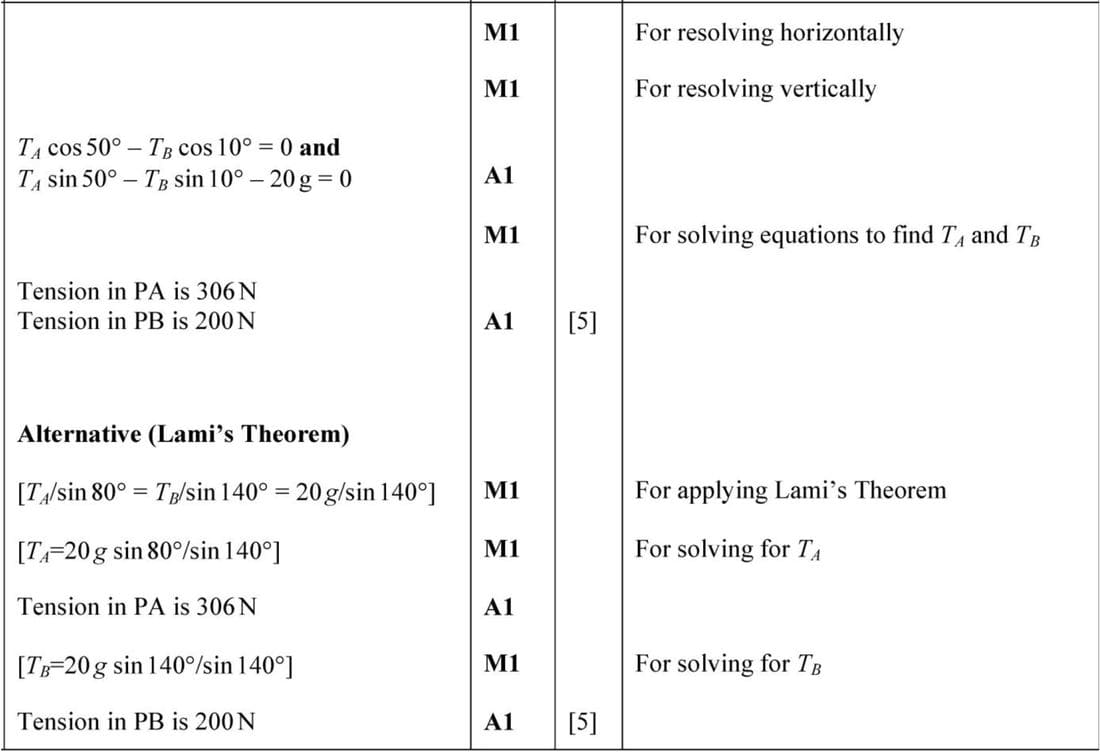
The diagram shows a small object P of mass 20 kg held in equilibrium by light ropes attached to fixed points A and B. The rope PA is inclined at an angle of 50° above the horizontal, the rope PB is inclined at an angle of 10° below the horizontal, and both ropes are in the same vertical plane. Find the tension in the rope PA and the tension in the rope PB.
Nov 2014 p43 q3
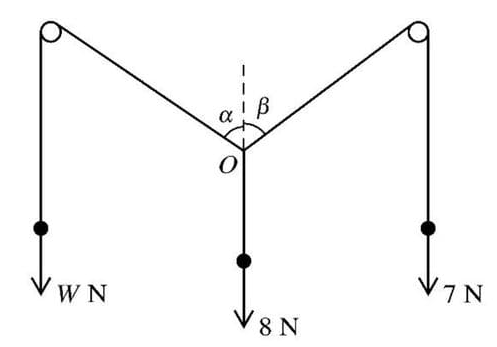
Each of three light inextensible strings has a particle attached to one of its ends. The other ends of the strings are tied together at a point O. Two of the strings pass over fixed smooth pegs and the particles hang freely in equilibrium. The weights of the particles and the angles between the sloping parts of the strings and the vertical are as shown in the diagram. It is given that \(\sin \beta = 0.8\) and \(\cos \beta = 0.6\).
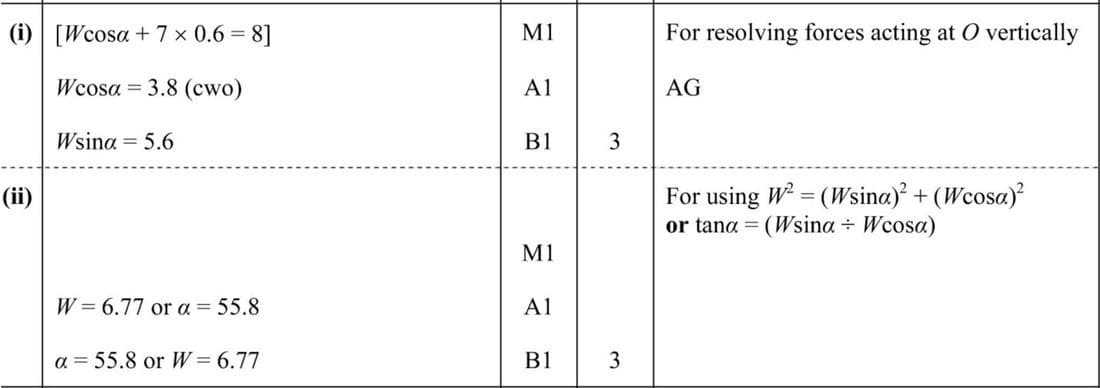
(i) Show that \(W \cos \alpha = 3.8\) and find the value of \(W \sin \alpha\).
(ii) Hence find the values of \(W\) and \(\alpha\).
June 2014 p43 q3
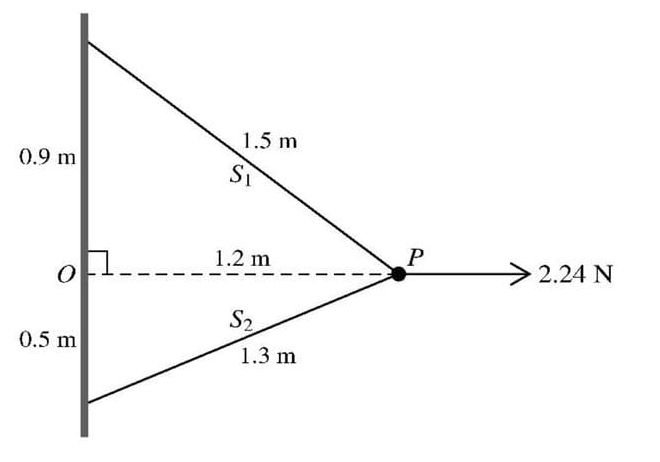
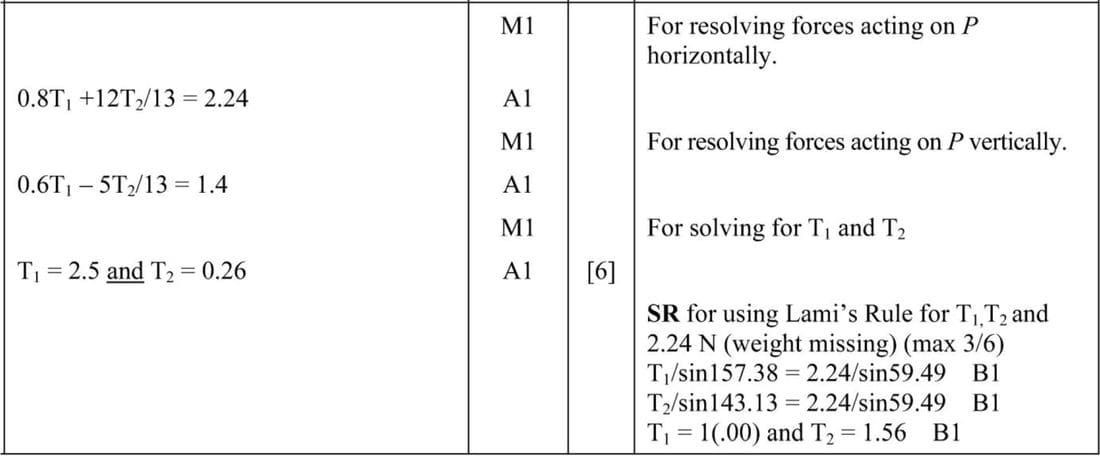
A particle P of weight 1.4 N is attached to one end of a light inextensible string S1 of length 1.5 m, and to one end of another light inextensible string S2 of length 1.3 m. The other end of S1 is attached to a wall at the point 0.9 m vertically above a point O of the wall. The other end of S2 is attached to the wall at the point 0.5 m vertically below O. The particle is held in equilibrium, at the same horizontal level as O, by a horizontal force of magnitude 2.24 N acting away from the wall and perpendicular to it (see diagram). Find the tensions in the strings.
June 2014 p42 q3
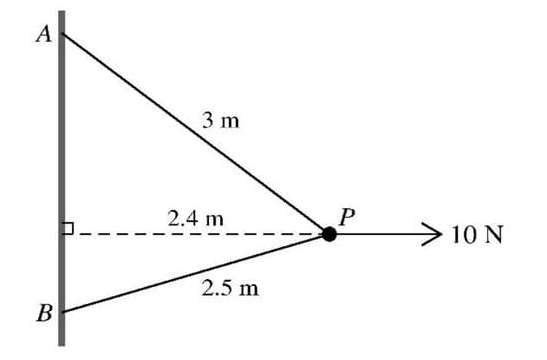
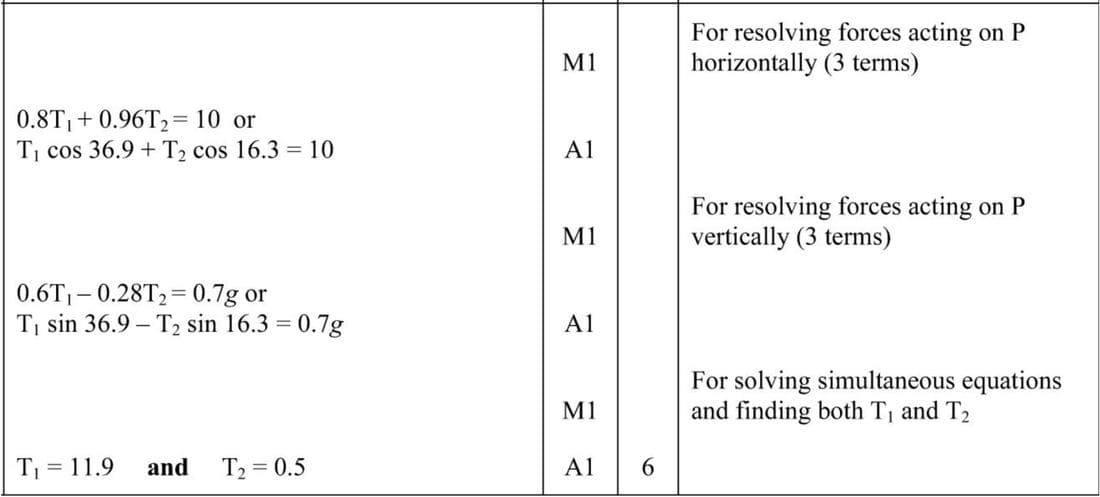
A and B are fixed points of a vertical wall with A vertically above B. A particle P of mass 0.7 kg is attached to A by a light inextensible string of length 3 m. P is also attached to B by a light inextensible string of length 2.5 m. P is maintained in equilibrium at a distance of 2.4 m from the wall by a horizontal force of magnitude 10 N acting on P (see diagram). Both strings are taut, and the 10 N force acts in the plane APB which is perpendicular to the wall. Find the tensions in the strings.
Nov 2013 p43 q3
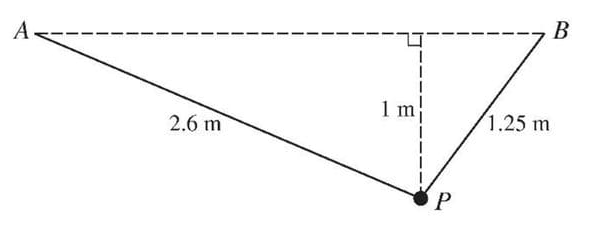
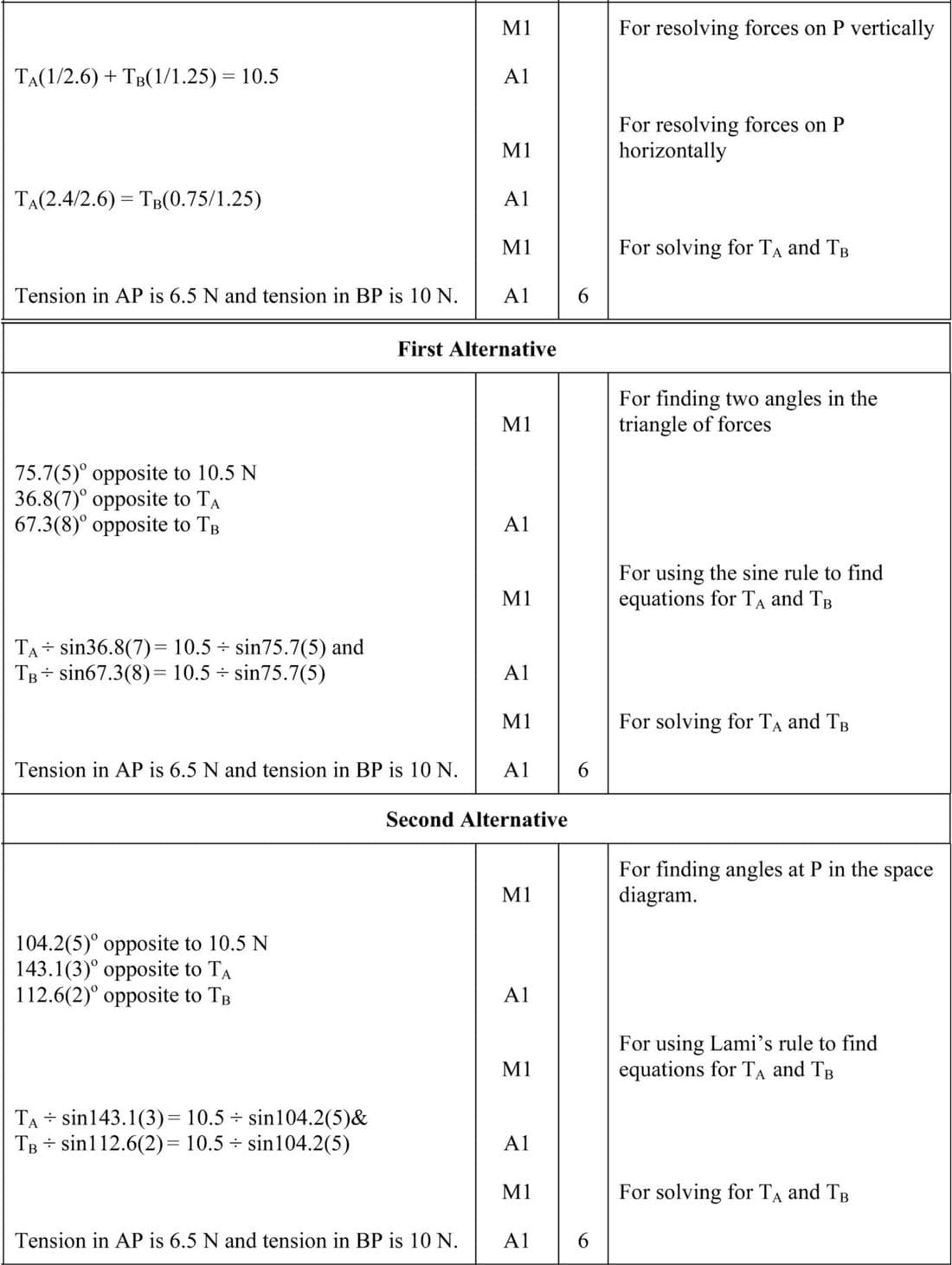
A particle P of mass 1.05 kg is attached to one end of each of two light inextensible strings, of lengths 2.6 m and 1.25 m. The other ends of the strings are attached to fixed points A and B, which are at the same horizontal level. P hangs in equilibrium at a point 1 m below the level of A and B (see diagram). Find the tensions in the strings.
Nov 2013 p41 q1
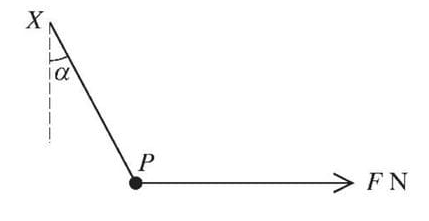
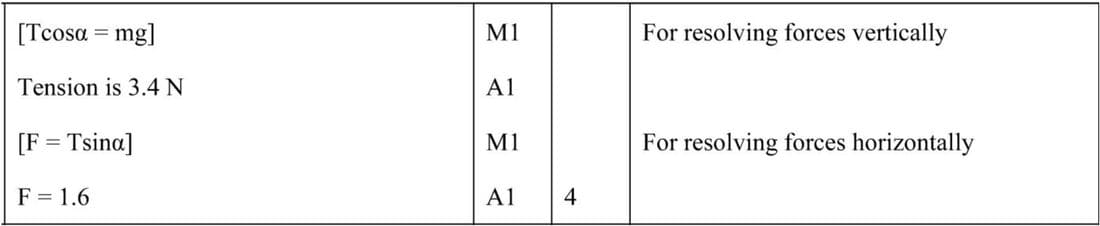
A particle P of mass 0.3 kg is attached to one end of a light inextensible string. The other end of the string is attached to a fixed point X. A horizontal force of magnitude F N is applied to the particle, which is in equilibrium when the string is at an angle α to the vertical, where \(\tan \alpha = \frac{8}{15}\) (see diagram). Find the tension in the string and the value of F.
June 2013 p42 q3
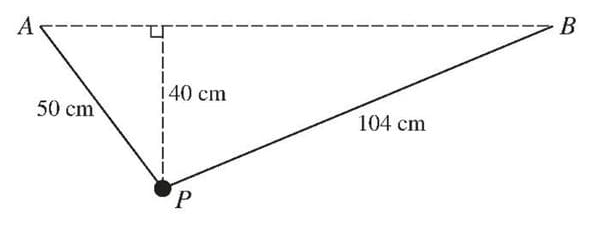
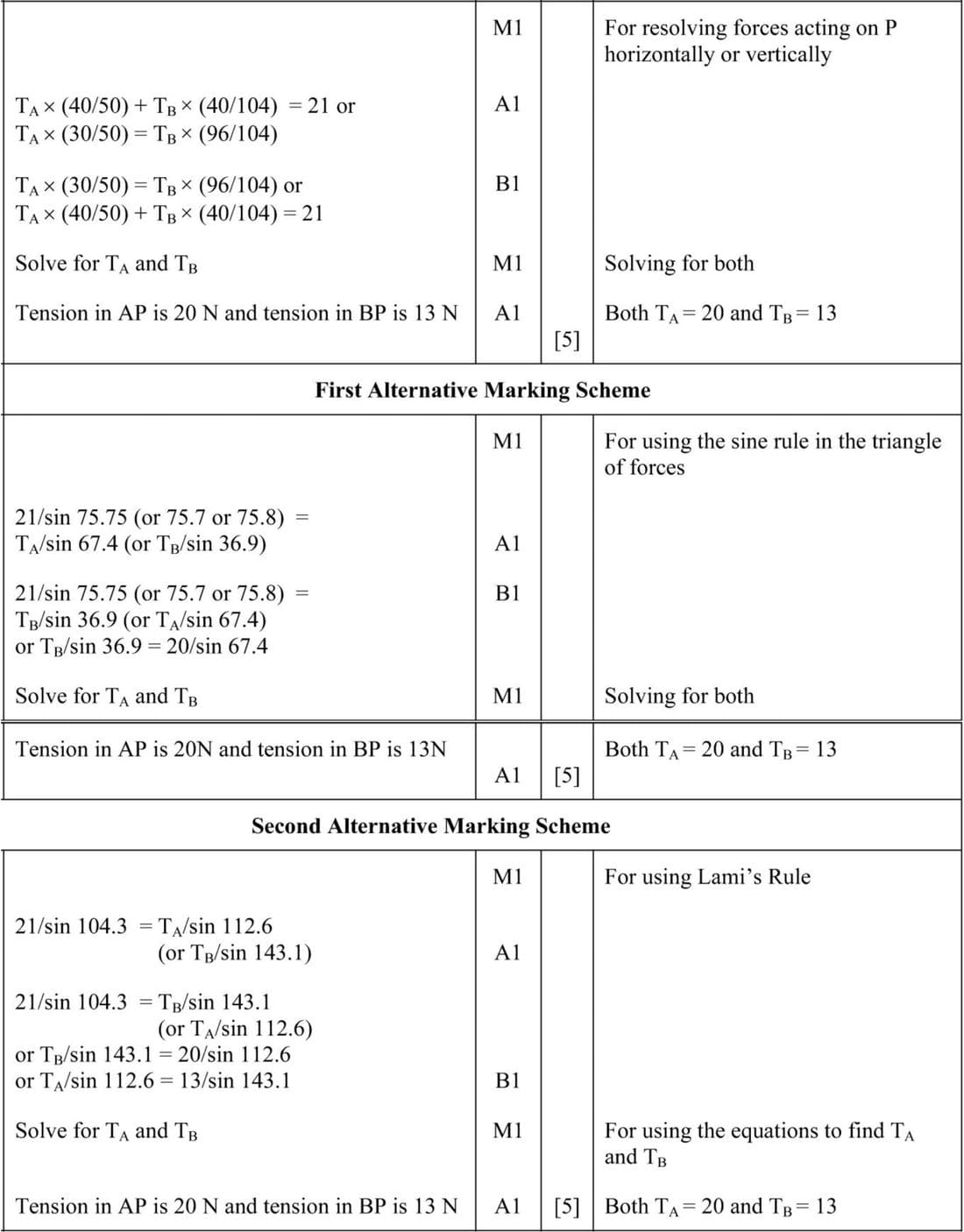
A particle P of mass 2.1 kg is attached to one end of each of two light inextensible strings. The other ends of the strings are attached to points A and B which are at the same horizontal level. P hangs in equilibrium at a point 40 cm below the level of A and B, and the strings PA and PB have lengths 50 cm and 104 cm respectively (see diagram). Show that the tension in the string PA is 20 N, and find the tension in the string PB.
Nov 2023 p41 q2
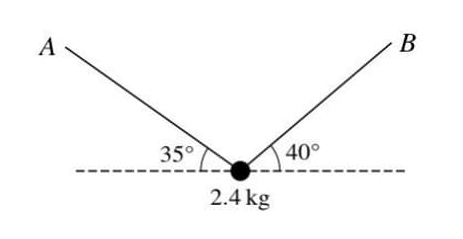
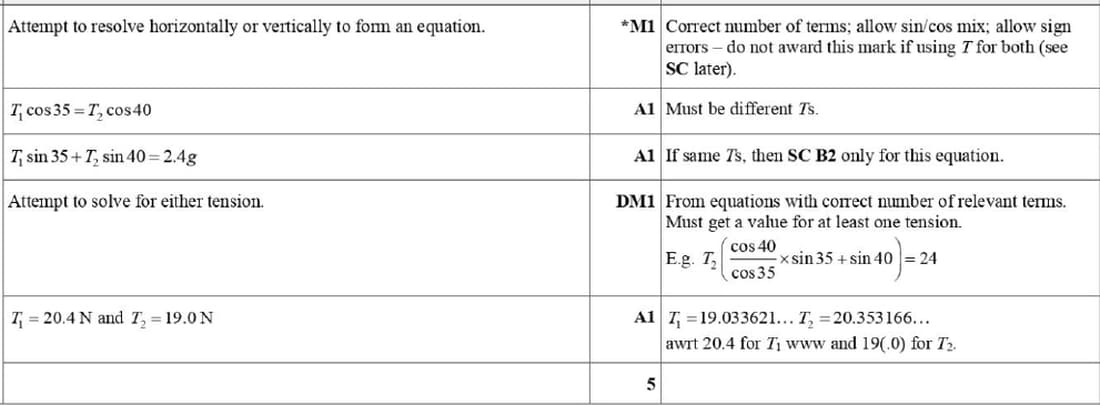
A particle of mass 2.4 kg is held in equilibrium by two light inextensible strings, one of which is attached to point A and the other attached to point B. The strings make angles of 35° and 40° with the horizontal (see diagram).
Find the tension in each of the two strings.
Nov 2012 p43 q4
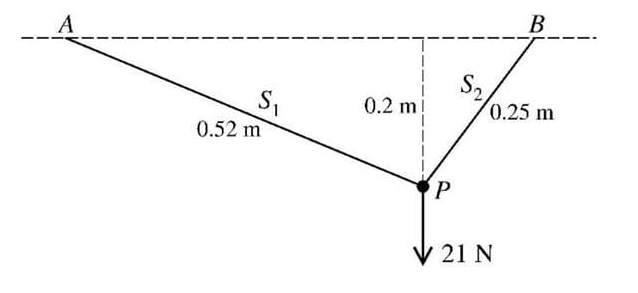
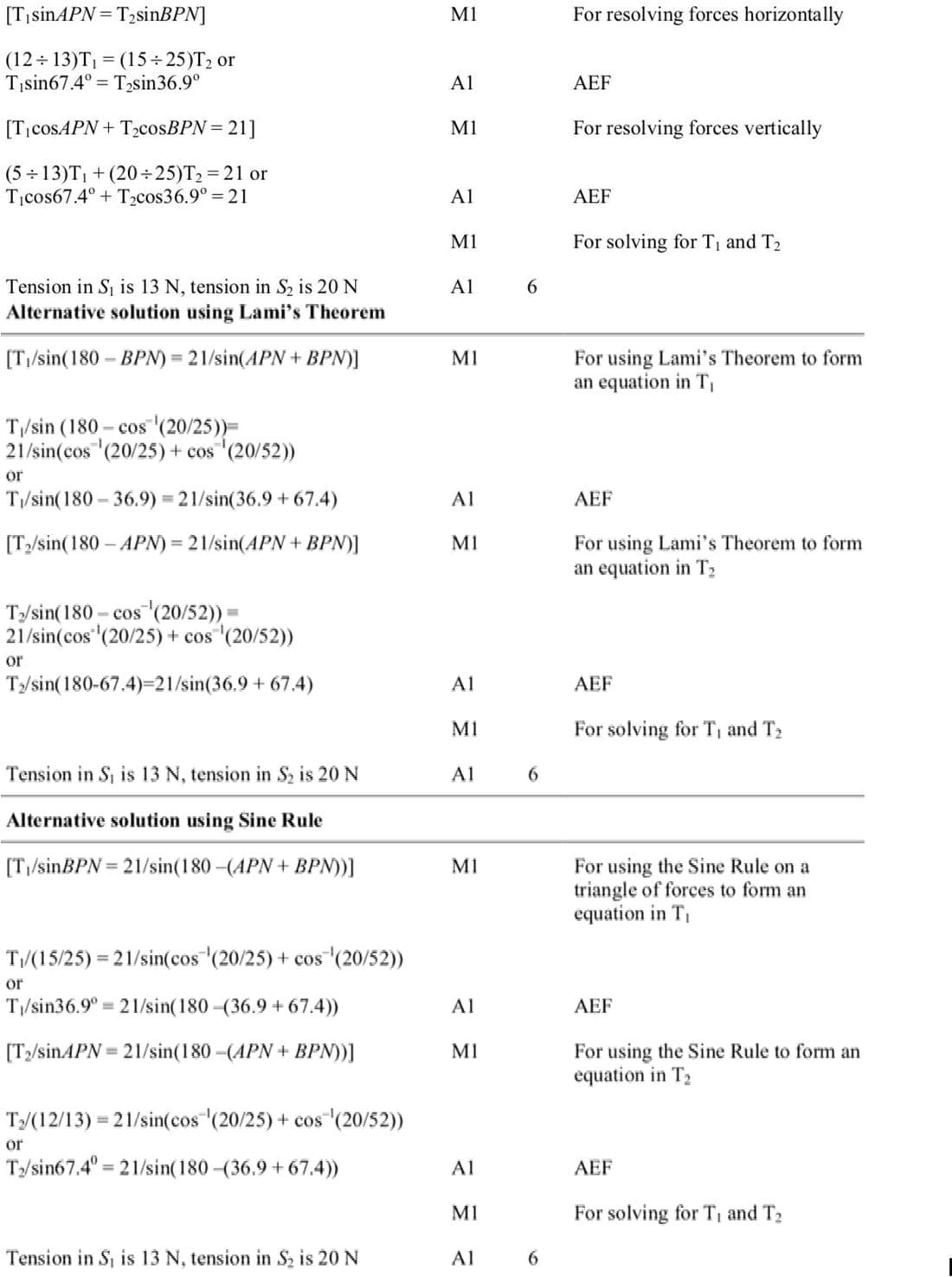
A particle P of weight 21 N is attached to one end of each of two light inextensible strings, S1 and S2, of lengths 0.52 m and 0.25 m respectively. The other end of S1 is attached to a fixed point A, and the other end of S2 is attached to a fixed point B at the same horizontal level as A. The particle P hangs in equilibrium at a point 0.2 m below the level of AB with both strings taut (see diagram). Find the tension in S1 and the tension in S2.
Nov 2010 p41 q3
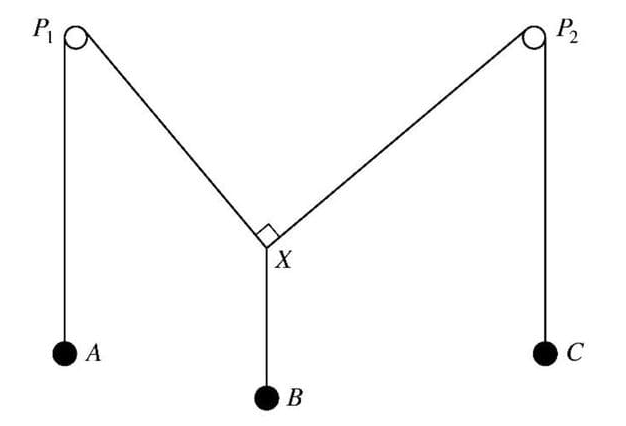
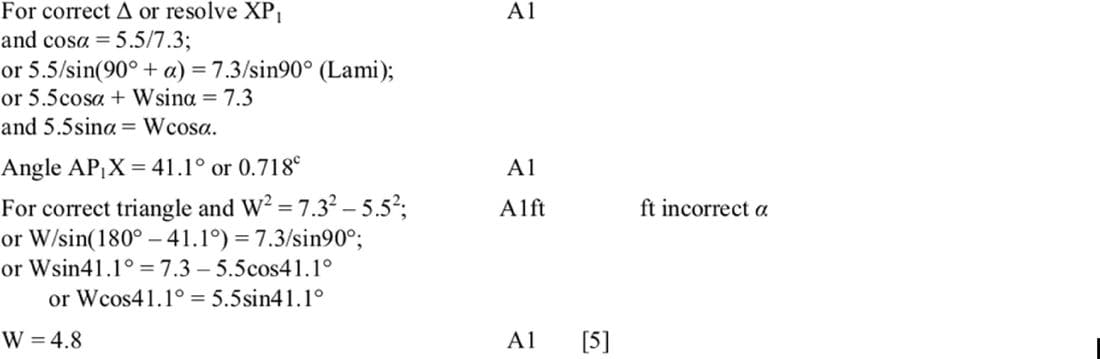
The diagram shows three particles A, B, and C hanging freely in equilibrium, each being attached to the end of a string. The other ends of the three strings are tied together and are at the point X. The strings carrying A and C pass over smooth fixed horizontal pegs P1 and P2 respectively. The weights of A, B, and C are 5.5 N, 7.3 N, and W N respectively, and the angle P1XP2 is a right angle. Find the angle AP1X and the value of W.
Nov 2005 p4 q3
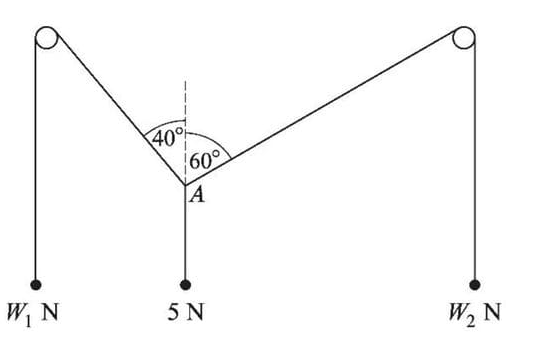
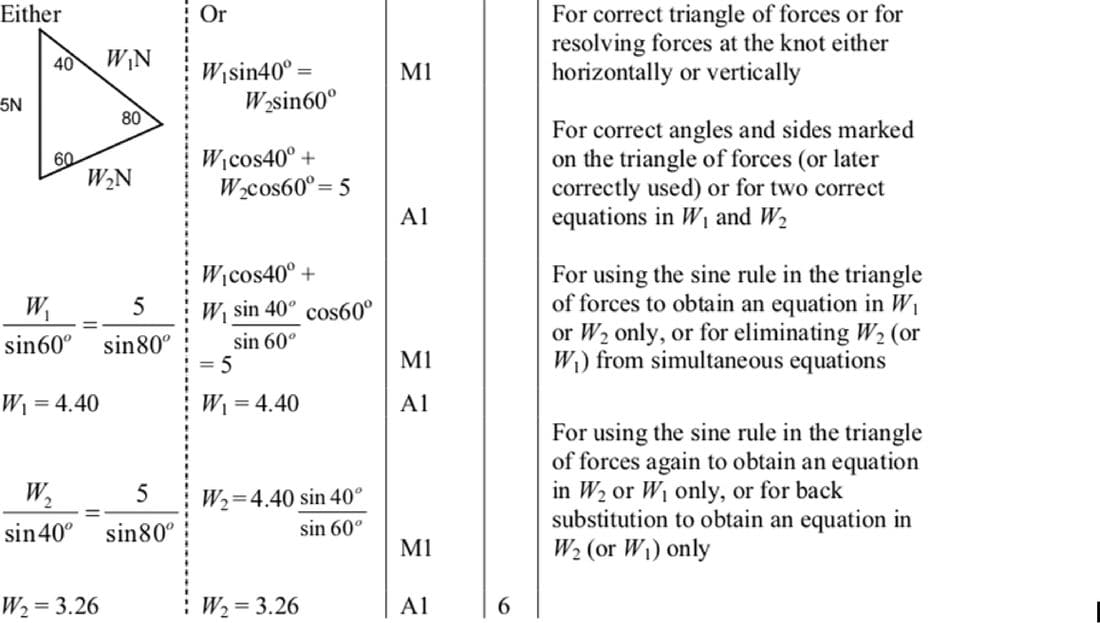
Each of three light strings has a particle attached to one of its ends. The other ends of the strings are tied together at a point A. The strings are in equilibrium with two of them passing over fixed smooth horizontal pegs, and with the particles hanging freely. The weights of the particles, and the angles between the sloping parts of the strings and the vertical, are as shown in the diagram. Find the values of \(W_1\) and \(W_2\).
Feb/Mar 2023 p42 q5
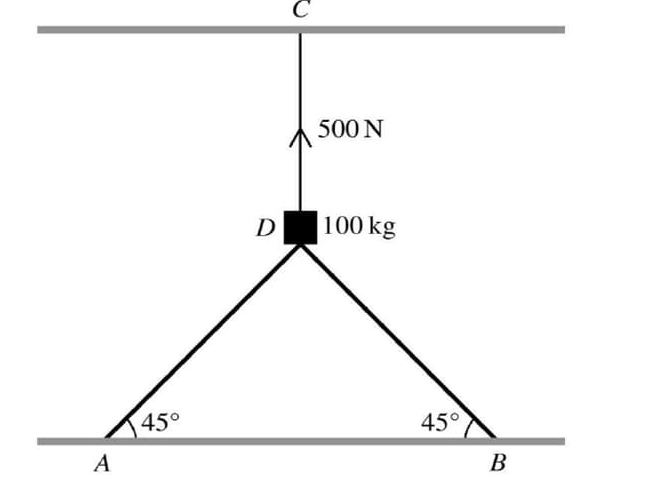
The diagram shows a block D of mass 100 kg supported by two sloping struts AD and BD, each attached at an angle of 45° to fixed points A and B respectively on a horizontal floor. The block is also held in place by a vertical rope CD attached to a fixed point C on a horizontal ceiling. The tension in the rope CD is 500 N and the block rests in equilibrium.
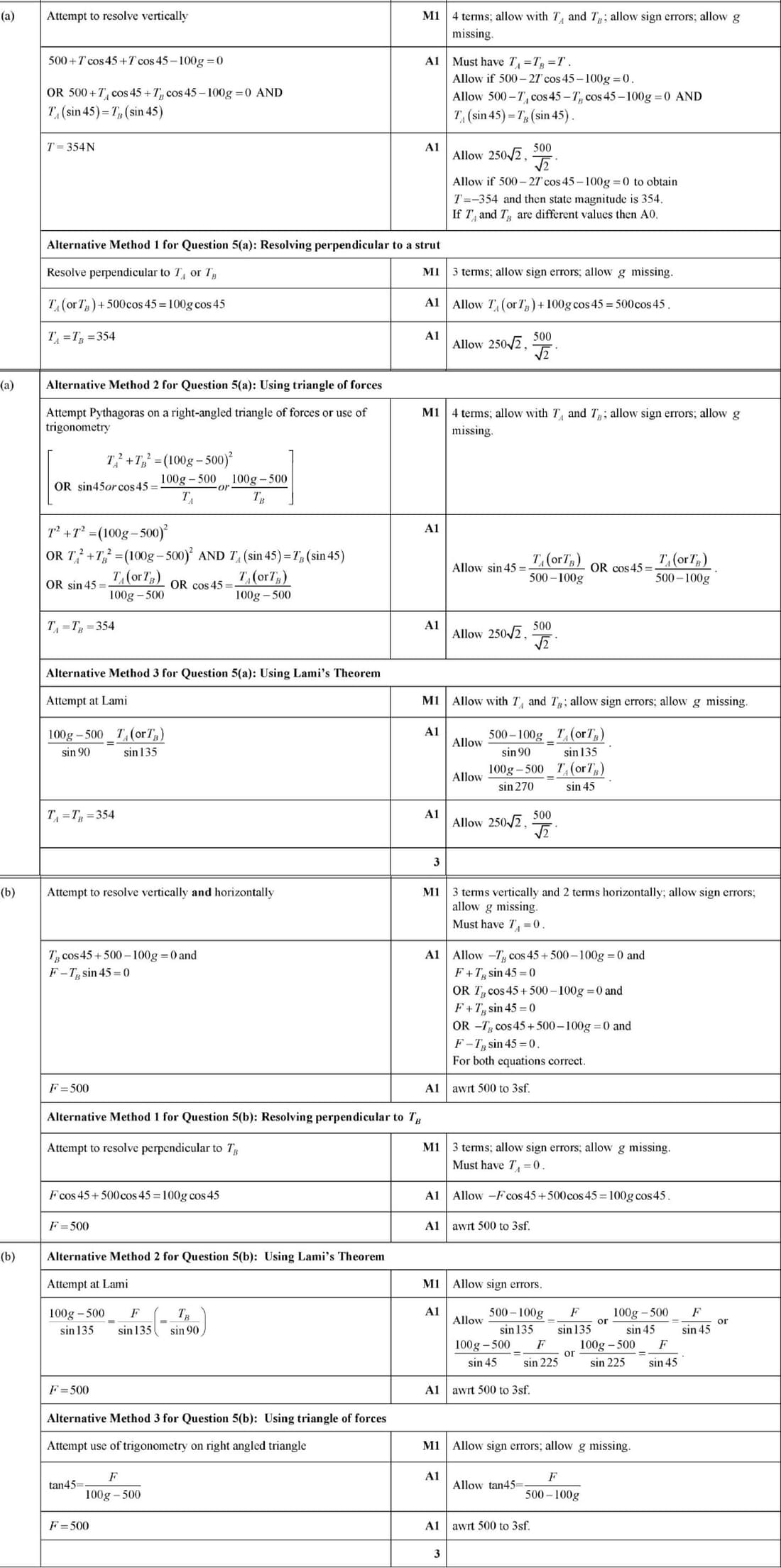
(a) Find the magnitude of the force in each of the struts AD and BD.
A horizontal force of magnitude F N is applied to the block in a direction parallel to AB.
(b) Find the value of F for which the magnitude of the force in the strut AD is zero.
Nov 2022 p42 q3
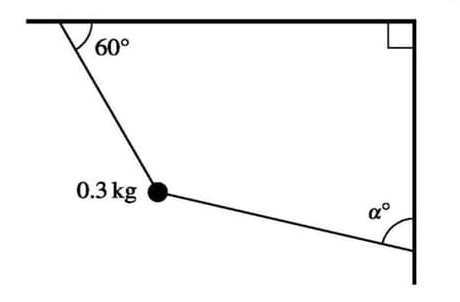
A particle of mass 0.3 kg is held at rest by two light inextensible strings. One string is attached at an angle of 60° to a horizontal ceiling. The other string is attached at an angle \(\alpha\)° to a vertical wall (see diagram). The tension in the string attached to the ceiling is 4 N.
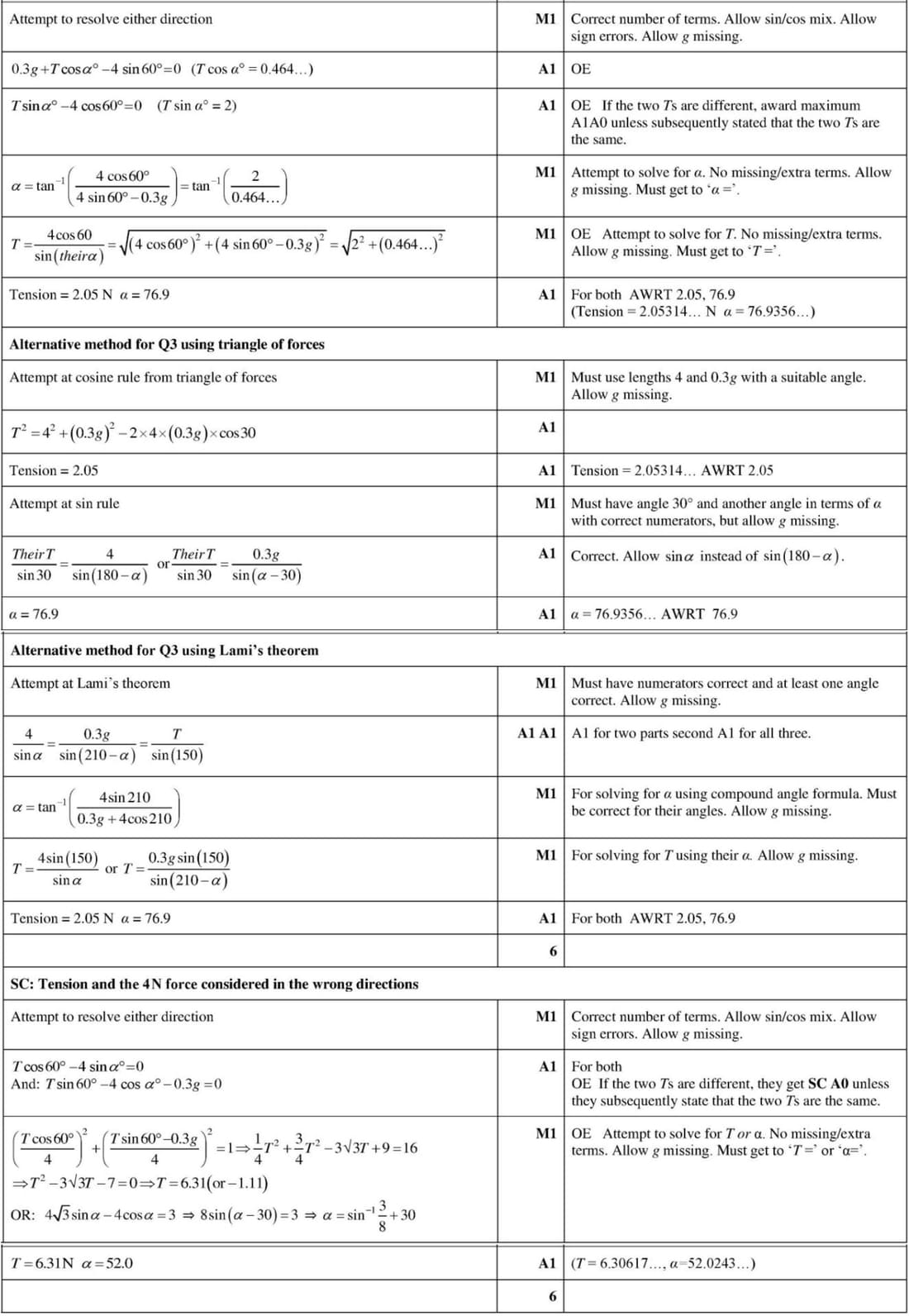
Find the tension in the string which is attached to the wall and find the value of \(\alpha\).
Nov 2021 p43 q2
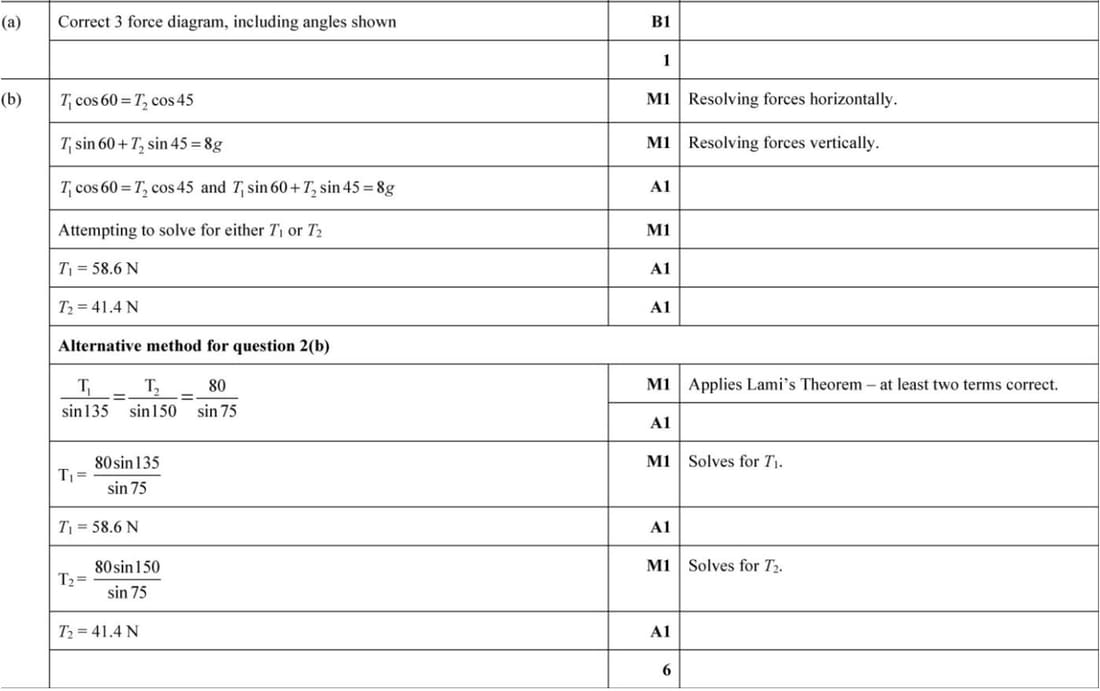
A particle of mass 8 kg is suspended in equilibrium by two light inextensible strings which make angles of 60° and 45° above the horizontal.
(a) Draw a diagram showing the forces acting on the particle.
(b) Find the tensions in the strings.

Nov 2021 p42 q6
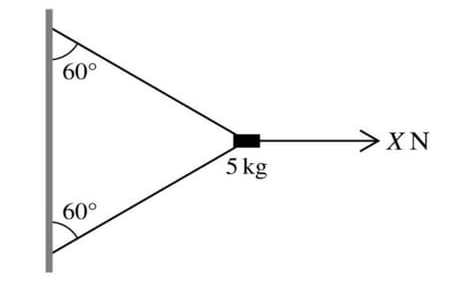
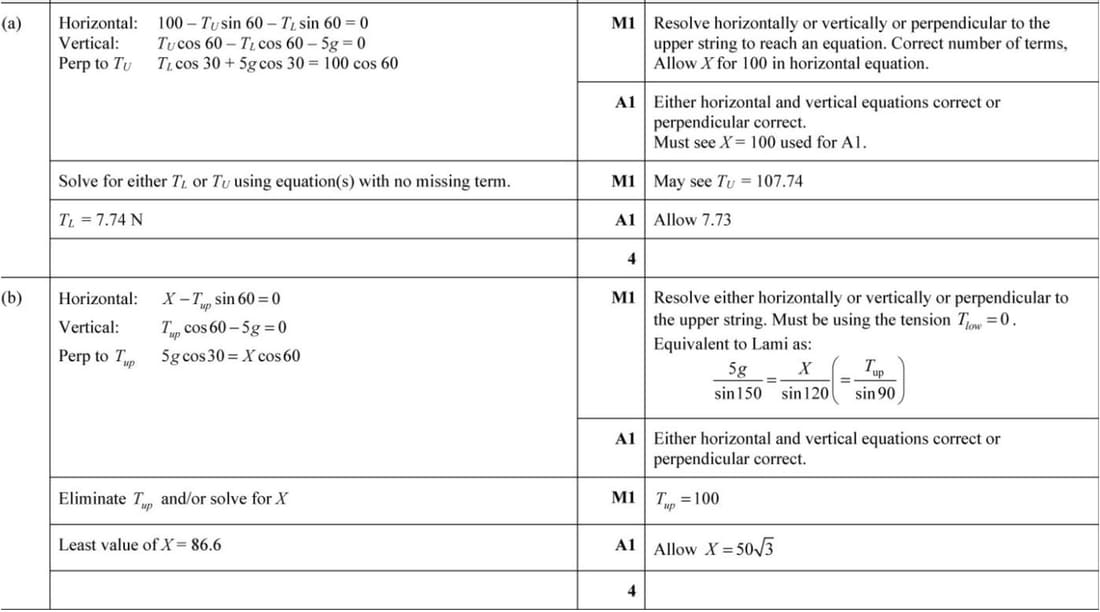
A block of mass 5 kg is held in equilibrium near a vertical wall by two light strings and a horizontal force of magnitude \(X\) N, as shown in the diagram. The two strings are both inclined at 60° to the vertical.
(a) Given that \(X = 100\), find the tension in the lower string.
(b) Find the least value of \(X\) for which the block remains in equilibrium in the position shown.
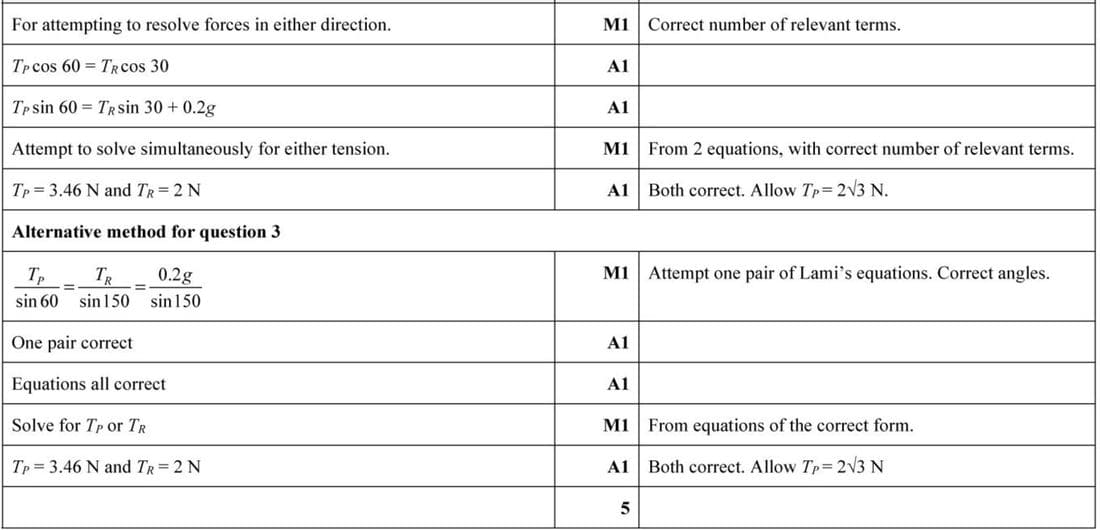
Feb/Mar 2021 p42 q3
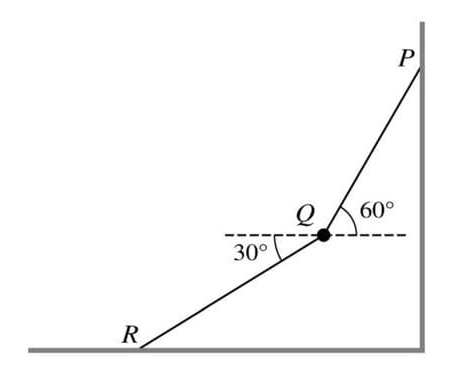
A particle Q of mass 0.2 kg is held in equilibrium by two light inextensible strings PQ and QR. P is a fixed point on a vertical wall and R is a fixed point on a horizontal floor. The angles which strings PQ and QR make with the horizontal are 60° and 30° respectively (see diagram).
Find the tensions in the two strings.
Nov 2020 p42 q3
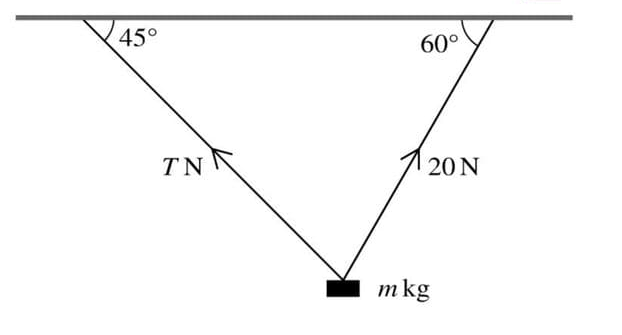
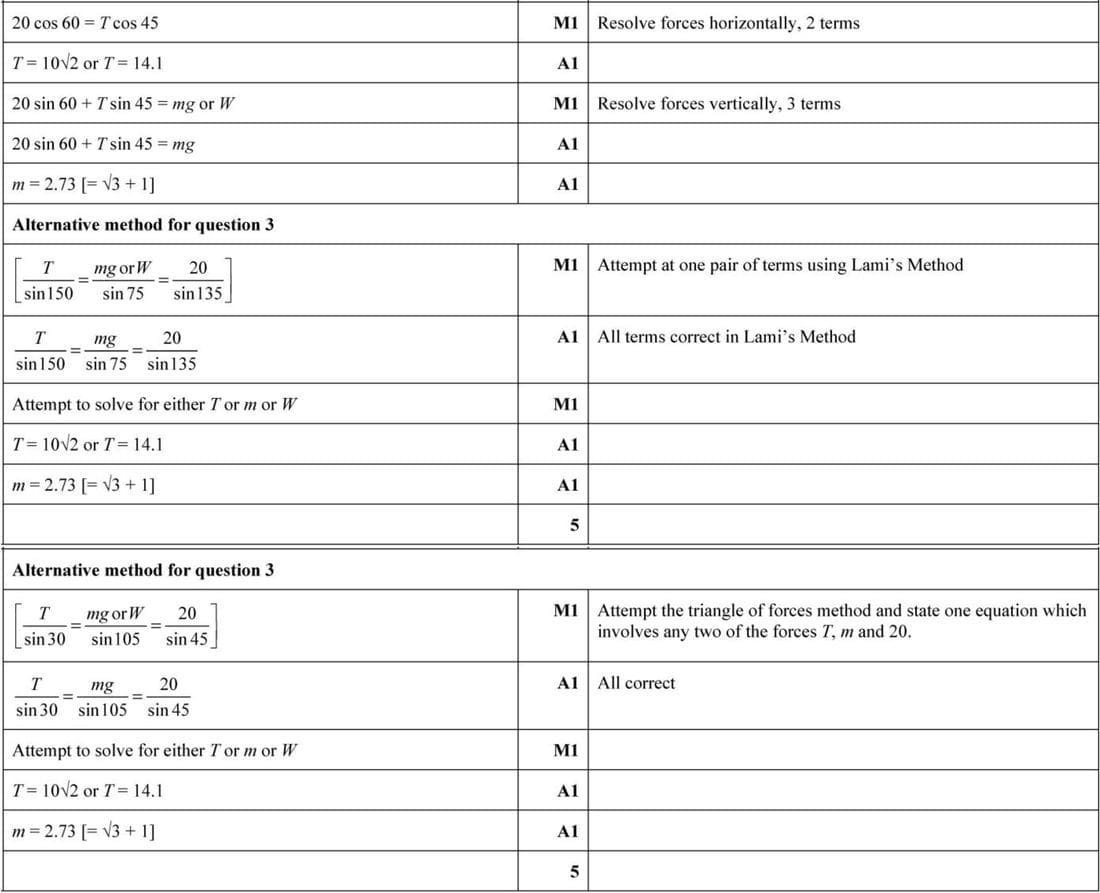
A block of mass m kg is held in equilibrium below a horizontal ceiling by two strings, as shown in the diagram. One of the strings is inclined at 45° to the horizontal and the tension in this string is T N. The other string is inclined at 60° to the horizontal and the tension in this string is 20 N.
Find T and m.
Nov 2019 p42 q3
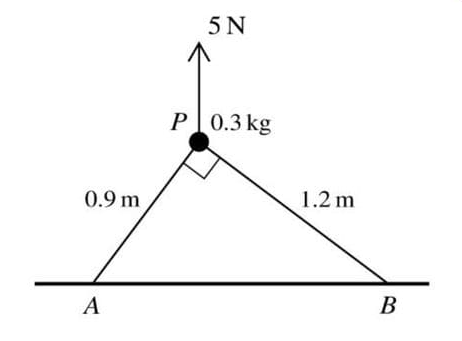
A particle P of mass 0.3 kg is held in equilibrium above a horizontal plane by a force of magnitude 5 N, acting vertically upwards. The particle is attached to two strings PA and PB of lengths 0.9 m and 1.2 m respectively. The points A and B lie on the plane and angle APB = 90° (see diagram). Find the tension in each of the strings.
Nov 2023 p42 q2
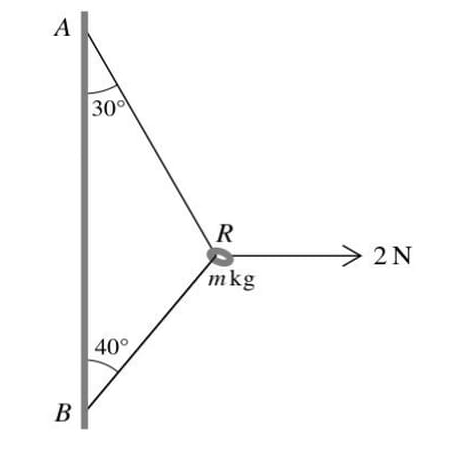
The diagram shows a smooth ring R, of mass m kg, threaded on a light inextensible string. A horizontal force of magnitude 2 N acts on R. The ends of the string are attached to fixed points A and B on a vertical wall. The part AR of the string makes an angle of 30° with the vertical, the part BR makes an angle of 40° with the vertical and the string is taut. The ring is in equilibrium.
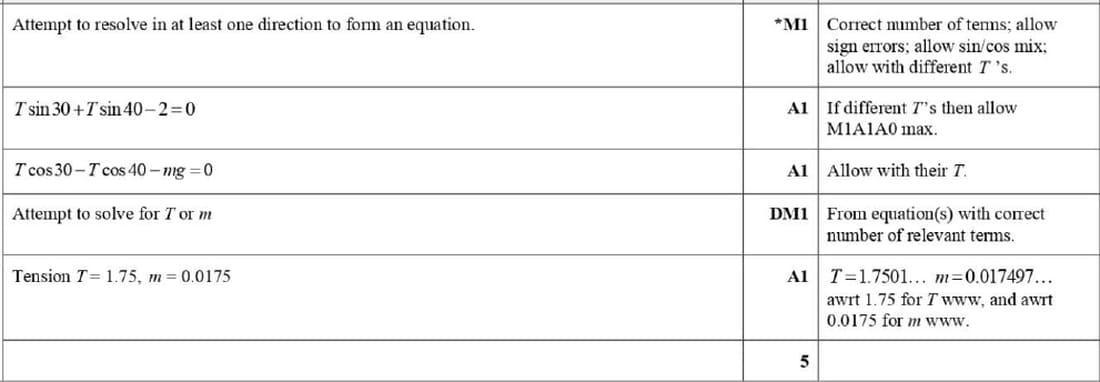
Find the tension in the string and find the value of m.
June 2023 p43 q3
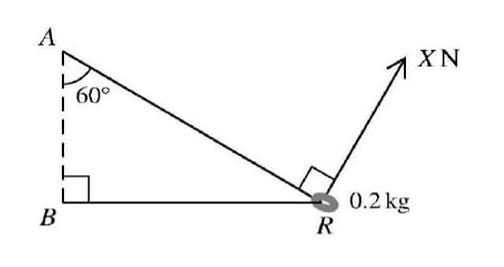
A smooth ring R of mass 0.2 kg is threaded on a light string ARB. The ends of the string are attached to fixed points A and B with A vertically above B. The string is taut and angle ABR = 90°. The angle between the part AR of the string and the vertical is 60°. The ring is held in equilibrium by a force of magnitude X N, acting on the ring in a direction perpendicular to AR (see diagram).
Calculate the tension in the string and the value of X.
Nov 2018 p43 q1
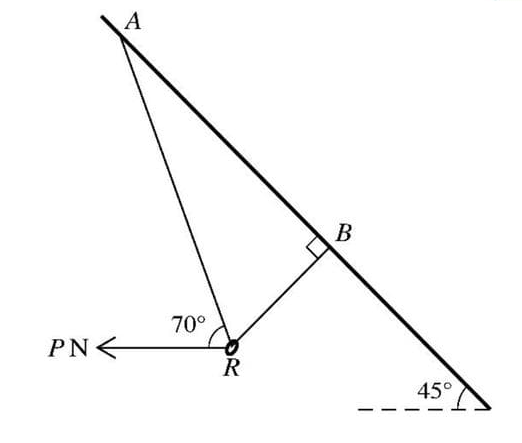
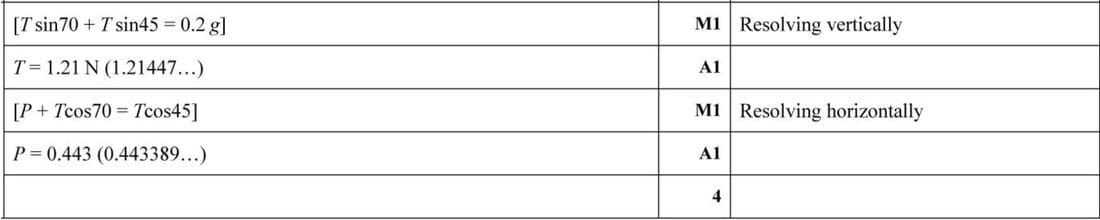
A small smooth ring R of mass 0.2 kg is threaded onto a light inextensible string ARB. The two ends of the string are attached to points A and B on a sloping roof inclined at 45° to the horizontal. A horizontal force of magnitude P N, acting in the plane ARB, is applied to the ring. The section BR of the string is perpendicular to the roof and the section AR of the string is inclined at 70° to the horizontal (see diagram). The system is in equilibrium. Find the tension in the string and the value of P.
Nov 2018 p42 q1
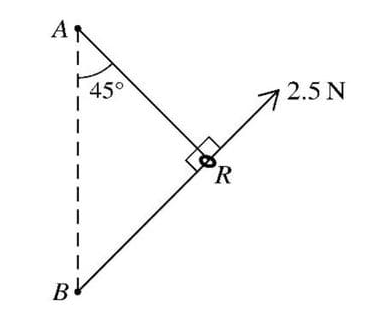
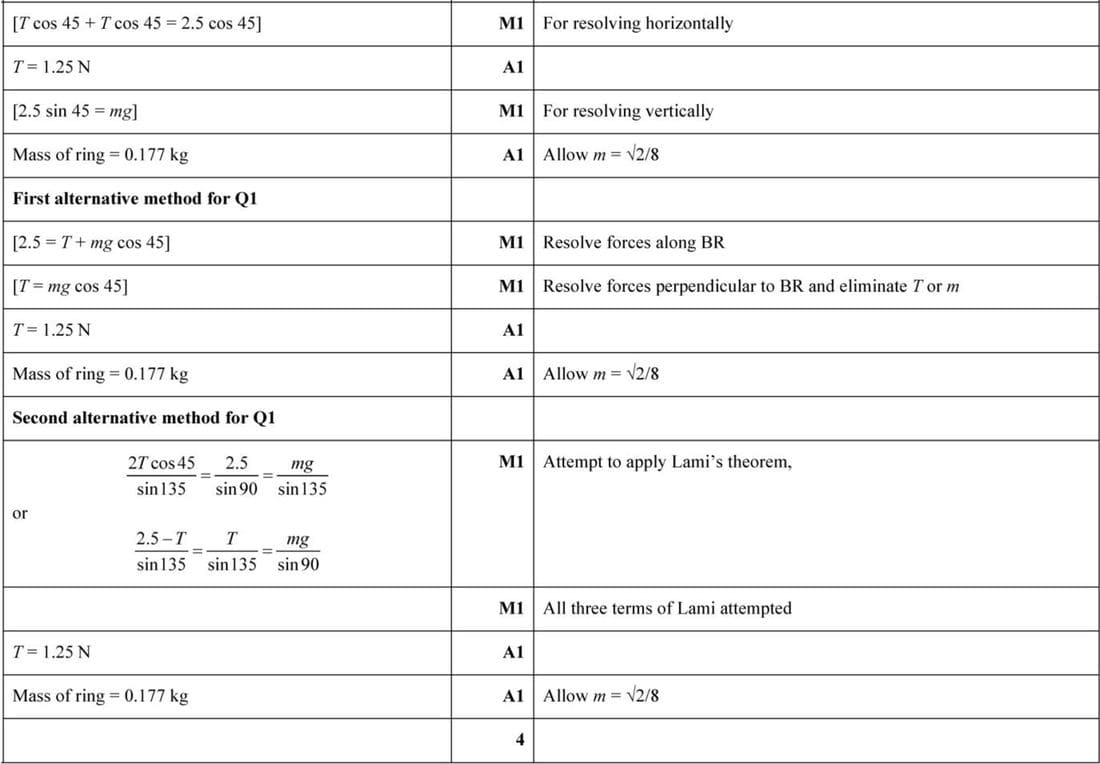
A smooth ring R of mass m kg is threaded on a light inextensible string ARB. The ends of the string are attached to fixed points A and B with A vertically above B. The string is taut and angle ARB = 90°. The angle between the part AR of the string and the vertical is 45°. The ring is held in equilibrium in this position by a force of magnitude 2.5 N, acting on the ring in the direction BR (see diagram). Calculate the tension in the string and the mass of the ring.
June 2012 p43 q2
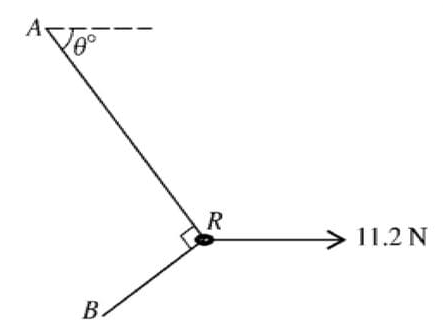
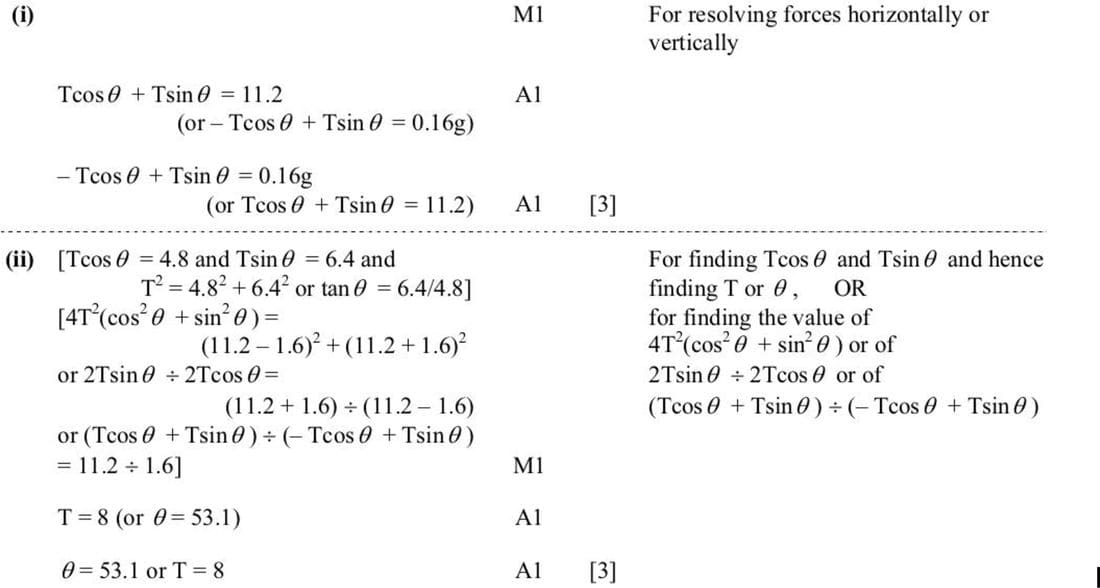
A smooth ring R of mass 0.16 kg is threaded on a light inextensible string. The ends of the string are attached to fixed points A and B. A horizontal force of magnitude 11.2 N acts on R, in the same vertical plane as A and B. The ring is in equilibrium. The string is taut with angle ARB = 90°, and the part AR of the string makes an angle of θ° with the horizontal (see diagram). The tension in the string is T N.
- Find two simultaneous equations involving T \sin \theta and T \cos \theta.
- Hence find T and θ.
June 2011 p41 q3
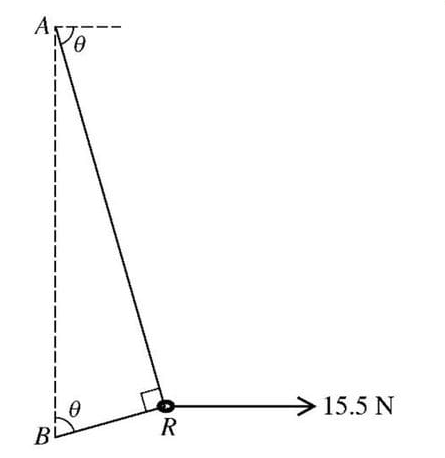
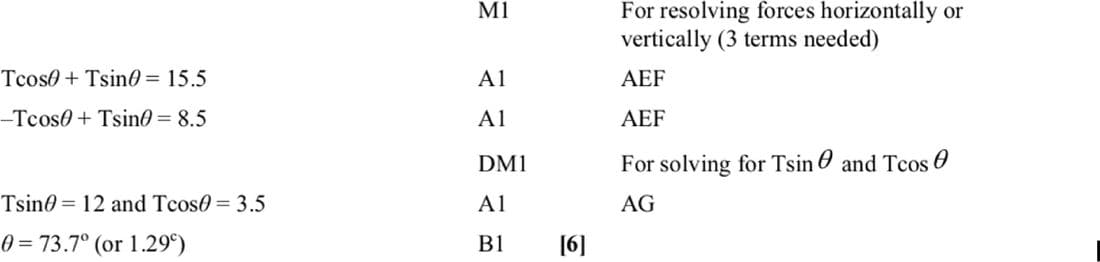
A small smooth ring R of weight 8.5 N is threaded on a light inextensible string. The ends of the string are attached to fixed points A and B, with A vertically above B. A horizontal force of magnitude 15.5 N acts on R so that the ring is in equilibrium with angle ARB = 90°. The part AR of the string makes an angle \(\theta\) with the horizontal and the part BR makes an angle \(\theta\) with the vertical (see diagram). The tension in the string is \(T\) N. Show that \(T \sin \theta = 12\) and \(T \cos \theta = 3.5\) and hence find \(\theta\).
Nov 2002 p4 q3
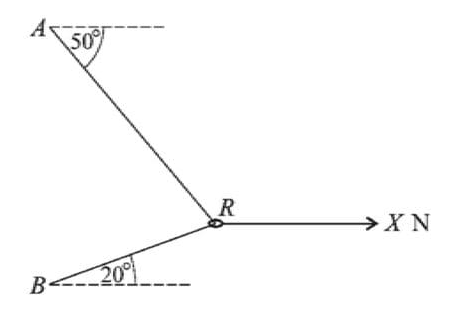
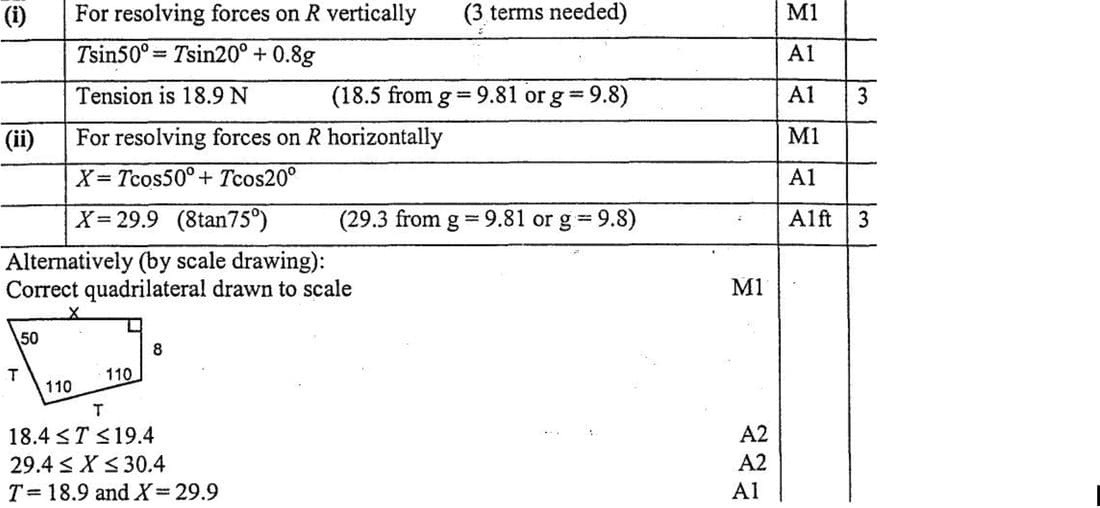
A light inextensible string has its ends attached to two fixed points A and B, with A vertically above B. A smooth ring R, of mass 0.8 kg, is threaded on the string and is pulled by a horizontal force of magnitude X newtons. The sections AR and BR of the string make angles of 50° and 20° respectively with the horizontal, as shown in the diagram. The ring rests in equilibrium with the string taut. Find
- the tension in the string,
- the value of X.