Exam-Style Problems
⬅ Back to SubchapterNov 2022 p43 q4
3353
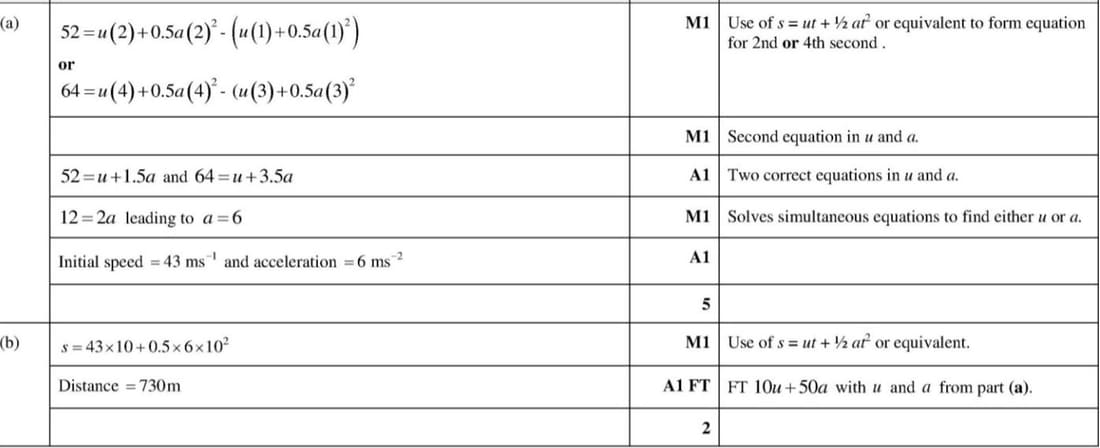
A particle P travels in the positive direction along a straight line with constant acceleration. P travels a distance of 52 m during the 2nd second of its motion and a distance of 64 m during the 4th second of its motion.
(a) Find the initial speed and the acceleration of P.
(b) Find the distance travelled by P during the first 10 seconds of its motion.
Nov 2021 p41 q1
3354
A bus moves from rest with constant acceleration for 12 s. It then moves with constant speed for 30 s before decelerating uniformly to rest in a further 6 s. The total distance travelled is 585 m.
(a) Find the constant speed of the bus.
(b) Find the magnitude of the deceleration.

Feb/Mar 2020 p42 q4
3355
A cyclist travels along a straight road with constant acceleration. He passes through points A, B and C. The cyclist takes 2 seconds to travel along each of the sections AB and BC and passes through B with speed 4.5 m s-1. The distance AB is \(\frac{4}{5}\) of the distance BC.
(a) Find the acceleration of the cyclist.
(b) Find AC.

Nov 2019 p43 q4
3356
A car travels along a straight road with constant acceleration. It passes through points P, Q, R and S. The times taken for the car to travel from P to Q, Q to R and R to S are each equal to 10 s. The distance QR is 1.5 times the distance PQ. At point Q the speed of the car is 20 m s-1.
(i) Show that the acceleration of the car is 0.8 m s-2.
(ii) Find the distance QS and hence find the average speed of the car between Q and S.

June 2019 p42 q2
3357
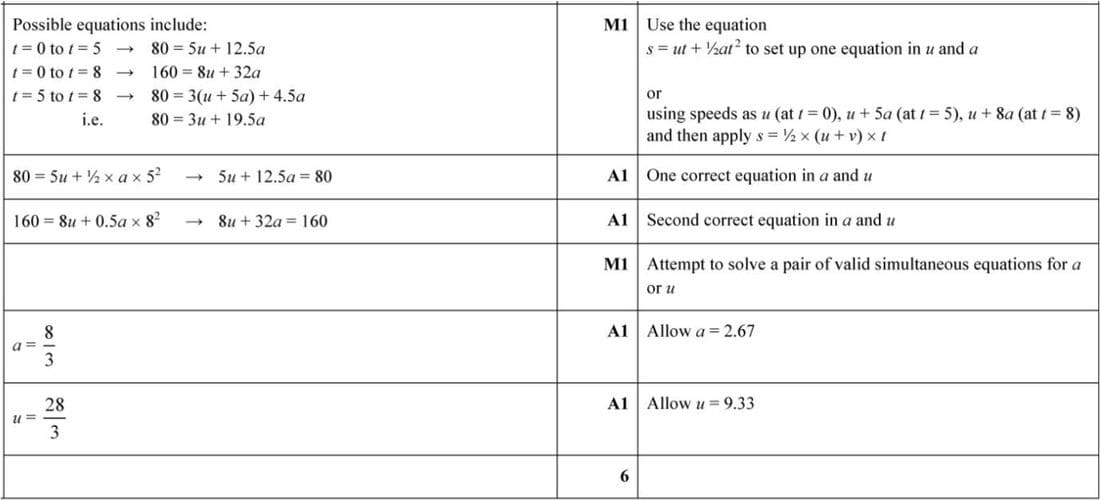
A car moves in a straight line with initial speed \(u \text{ m s}^{-1}\) and constant acceleration \(a \text{ m s}^{-2}\). The car takes 5 s to travel the first 80 m and it takes 8 s to travel the first 160 m. Find \(a\) and \(u\).
June 2018 p42 q4
3358
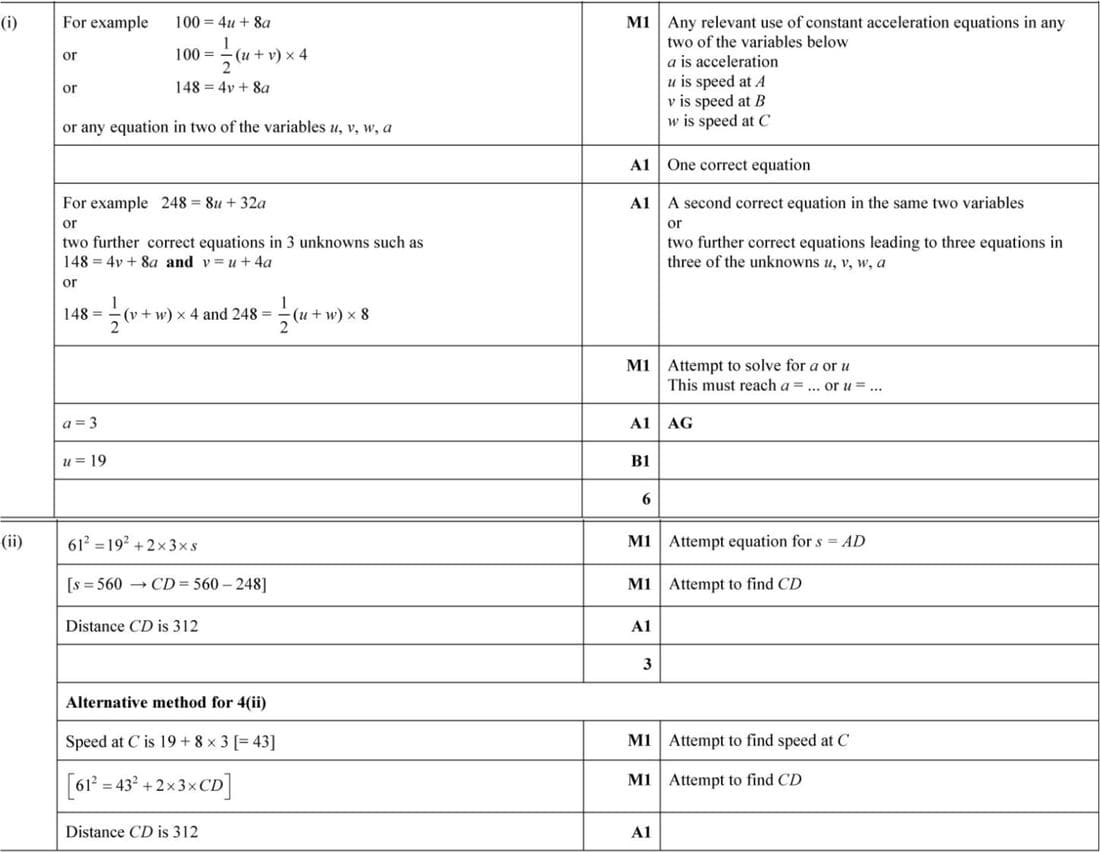
A particle P moves in a straight line ABCD with constant acceleration. The distances AB and BC are 100 m and 148 m respectively. The particle takes 4 s to travel from A to B and also takes 4 s to travel from B to C.
- Show that the acceleration of P is 3 m s-2 and find the speed of P at A.
- P reaches D with a speed of 61 m s-1. Find the distance CD.
Nov 2017 p42 q3
3359
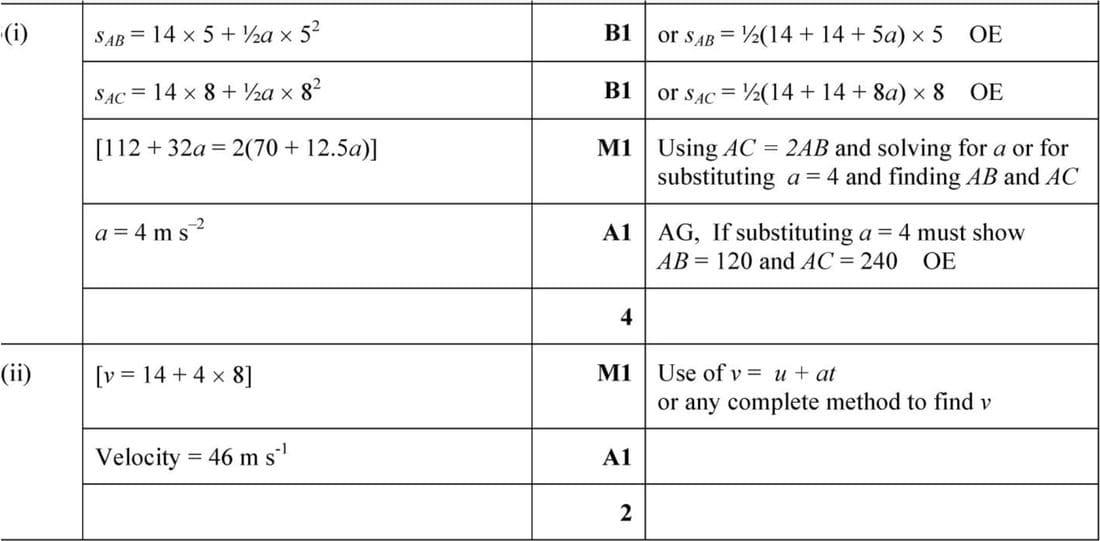
A car travels along a straight road with constant acceleration. It passes through points A, B, and C. The car passes point A with velocity 14 m s-1. The two sections AB and BC are of equal length. The times taken to travel along AB and BC are 5 s and 3 s respectively.
(i) Write down an expression for the distance AB in terms of the acceleration of the car. Write down a similar expression for the distance AC. Hence show that the acceleration of the car is 4 m s-2.
(ii) Find the speed of the car as it passes point C.
June 2017 p41 q5
3360
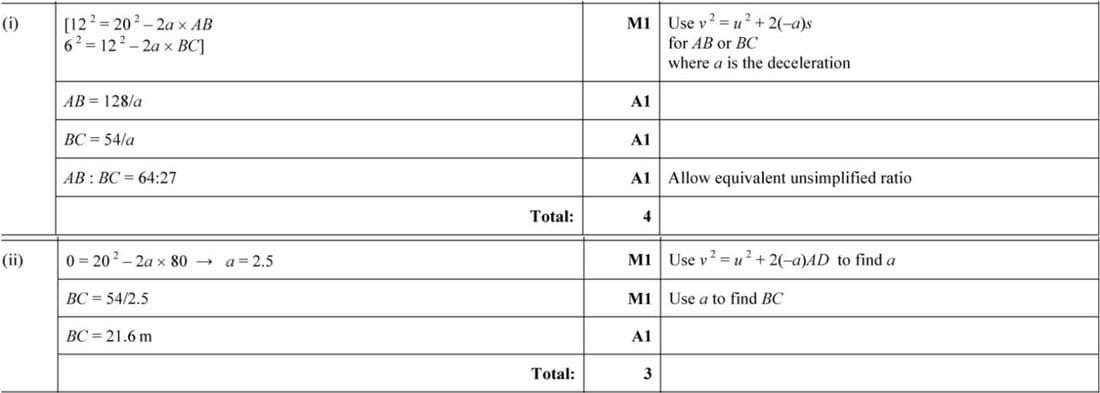
A particle P moves in a straight line ABCD with constant deceleration. The velocities of P at A, B, and C are 20 m/s, 12 m/s, and 6 m/s respectively.
- Find the ratio of distances AB : BC.
- The particle comes to rest at D. Given that the distance AD is 80 m, find the distance BC.
Nov 2005 p4 q1
3361
A car travels in a straight line with constant acceleration \(a \text{ m s}^{-2}\). It passes the points \(A, B\) and \(C\), in this order, with speeds \(5 \text{ m s}^{-1}\), \(7 \text{ m s}^{-1}\) and \(8 \text{ m s}^{-1}\) respectively. The distances \(AB\) and \(BC\) are \(d_1 \text{ m}\) and \(d_2 \text{ m}\) respectively.
- Write down an equation connecting
- \(d_1\) and \(a\),
- \(d_2\) and \(a\).
- Hence find \(d_1\) in terms of \(d_2\).
