Exam-Style Problems
⬅ Back to SubchapterNov 2023 p53 q1
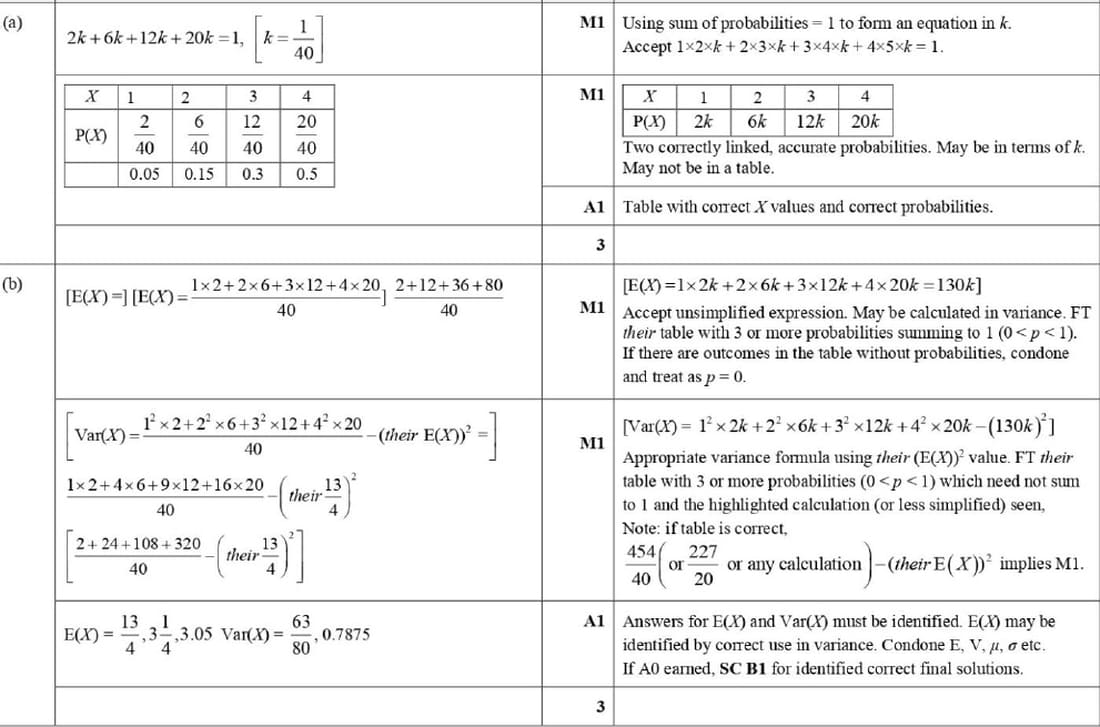
Becky sometimes works in an office and sometimes works at home. The random variable \(X\) denotes the number of days that she works at home in any given week. It is given that
\(P(X = x) = kx(x+1)\),
where \(k\) is a constant and \(x = 1, 2, 3\) or \(4\) only.
(a) Draw up the probability distribution table for \(X\), giving the probabilities as numerical fractions.
(b) Find \(E(X)\) and \(\text{Var}(X)\).
Nov 2021 p51 q4
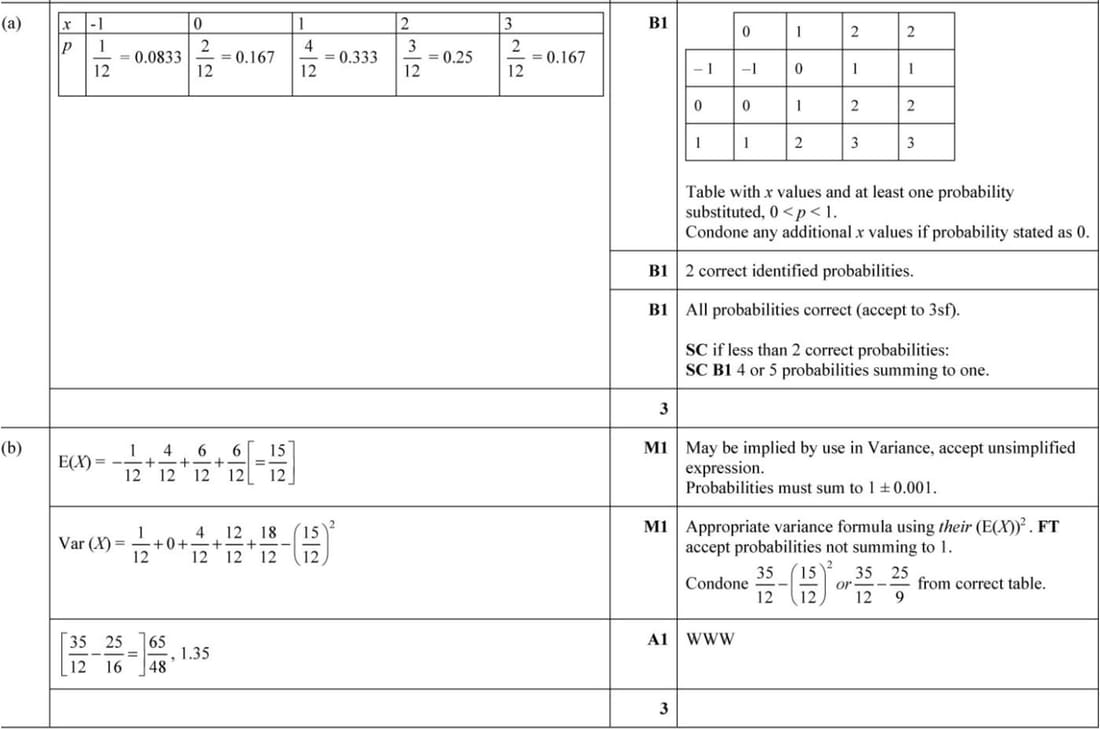
A fair spinner has edges numbered 0, 1, 2, 2. Another fair spinner has edges numbered -1, 0, 1. Each spinner is spun. The number on the edge on which a spinner comes to rest is noted. The random variable X is the sum of the numbers for the two spinners.
(a) Draw up the probability distribution table for X.
(b) Find \(\text{Var}(X)\).
June 2021 p52 q4
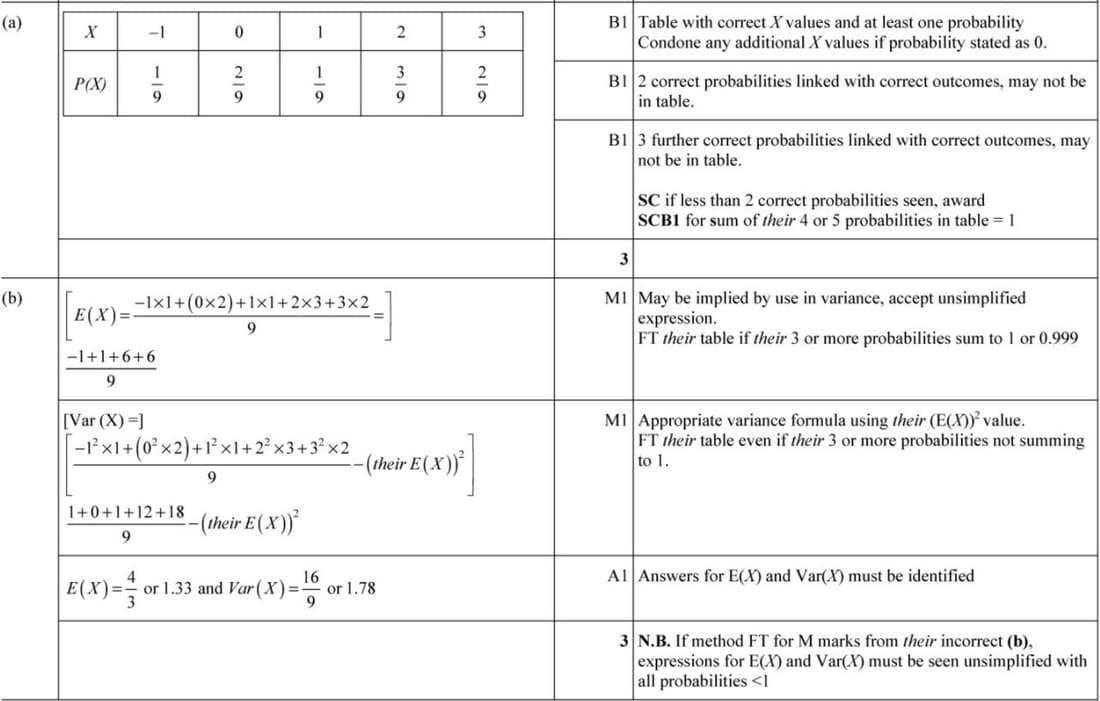
A fair spinner has sides numbered 1, 2, 2. Another fair spinner has sides numbered -2, 0, 1. Each spinner is spun. The number on the side on which a spinner comes to rest is noted. The random variable X is the sum of the numbers for the two spinners.
(a) Draw up the probability distribution table for X.
(b) Find E(X) and Var(X).
June 2021 p51 q7
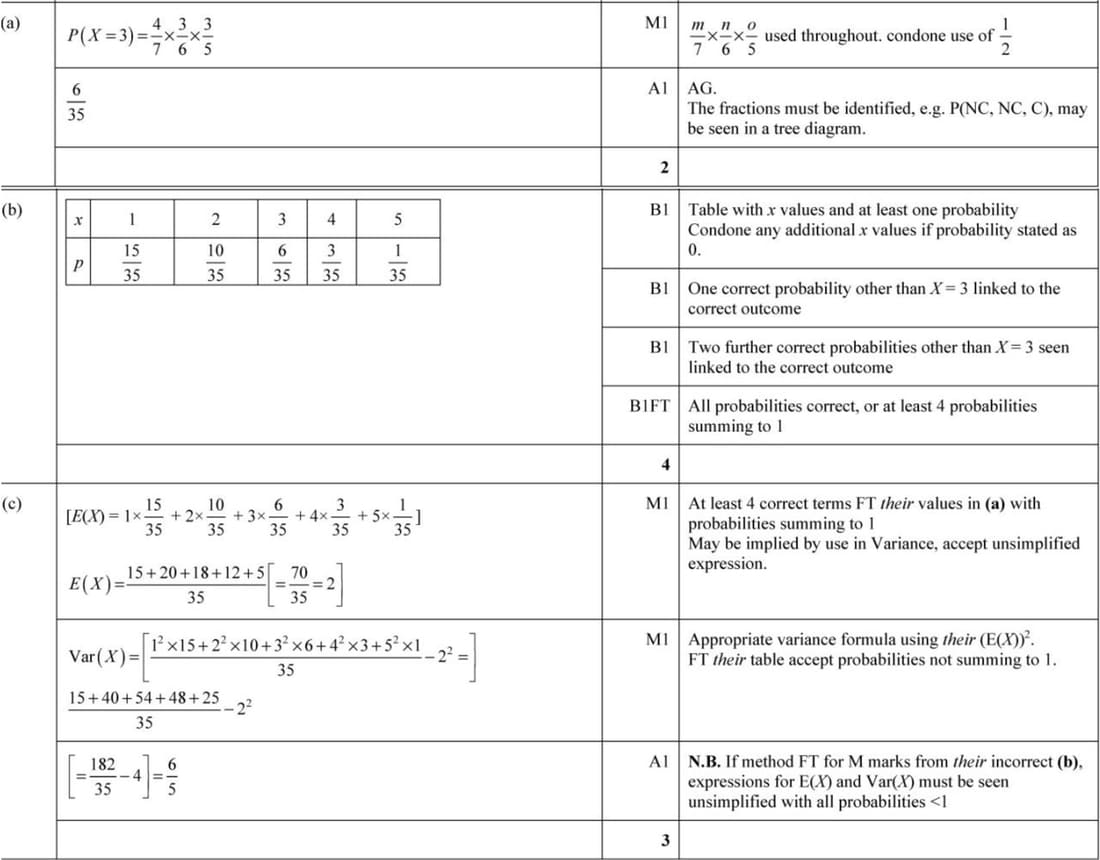
Sharma knows that she has 3 tins of carrots, 2 tins of peas and 2 tins of sweetcorn in her cupboard. All the tins are the same shape and size, but the labels have all been removed, so Sharma does not know what each tin contains.
Sharma wants carrots for her meal, and she starts opening the tins one at a time, chosen randomly, until she opens a tin of carrots. The random variable \(X\) is the number of tins that she needs to open.
(a) Show that \(P(X = 3) = \frac{6}{35}\).
(b) Draw up the probability distribution table for \(X\).
(c) Find \(\text{Var}(X)\).
Feb/Mar 2021 p52 q4
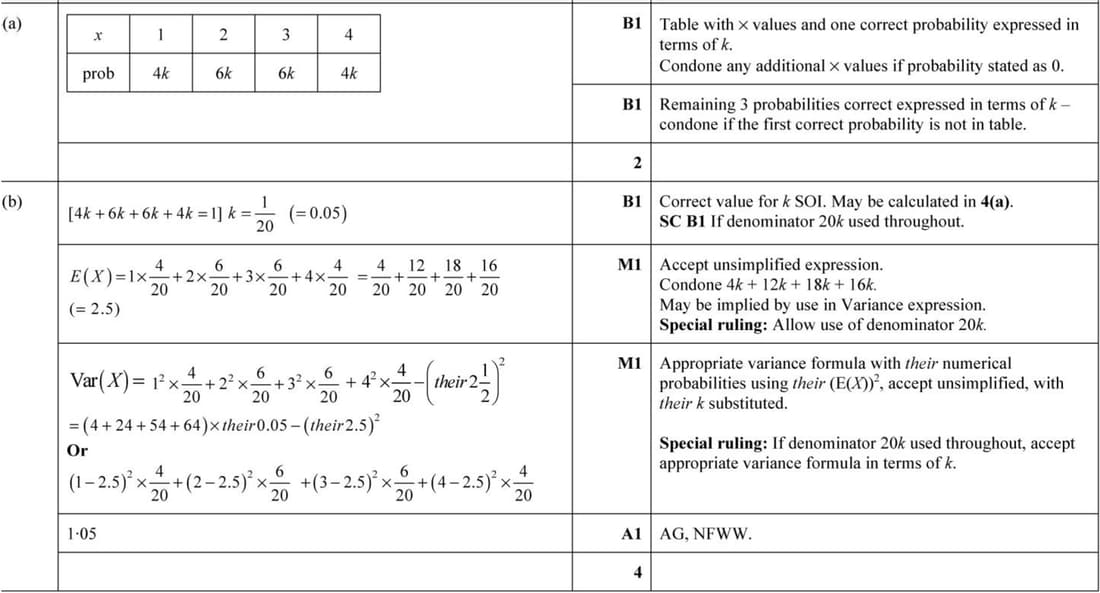
The random variable X takes the values 1, 2, 3, 4 only. The probability that X takes the value x is k(5 − x), where k is a constant.
(a) Draw up the probability distribution table for X, in terms of k.
\((b) Show that Var(X) = 1.05.\)
Nov 2020 p53 q6
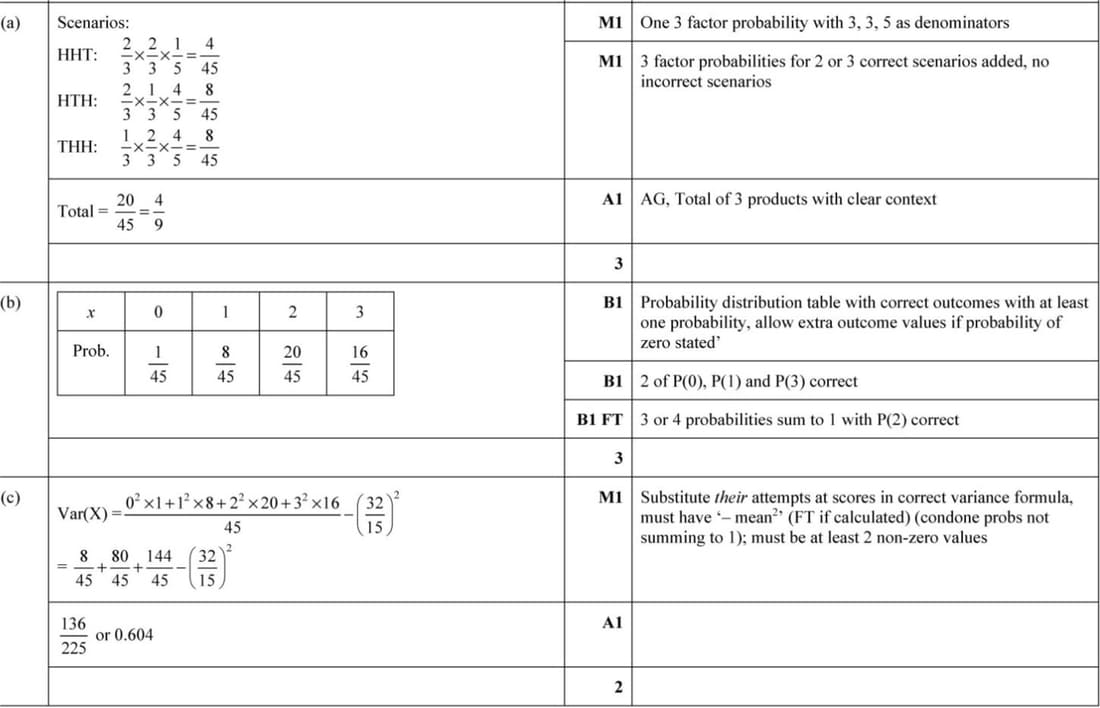
Three coins A, B and C are each thrown once.
- Coins A and B are each biased so that the probability of obtaining a head is \(\frac{2}{3}\).
- Coin C is biased so that the probability of obtaining a head is \(\frac{4}{5}\).
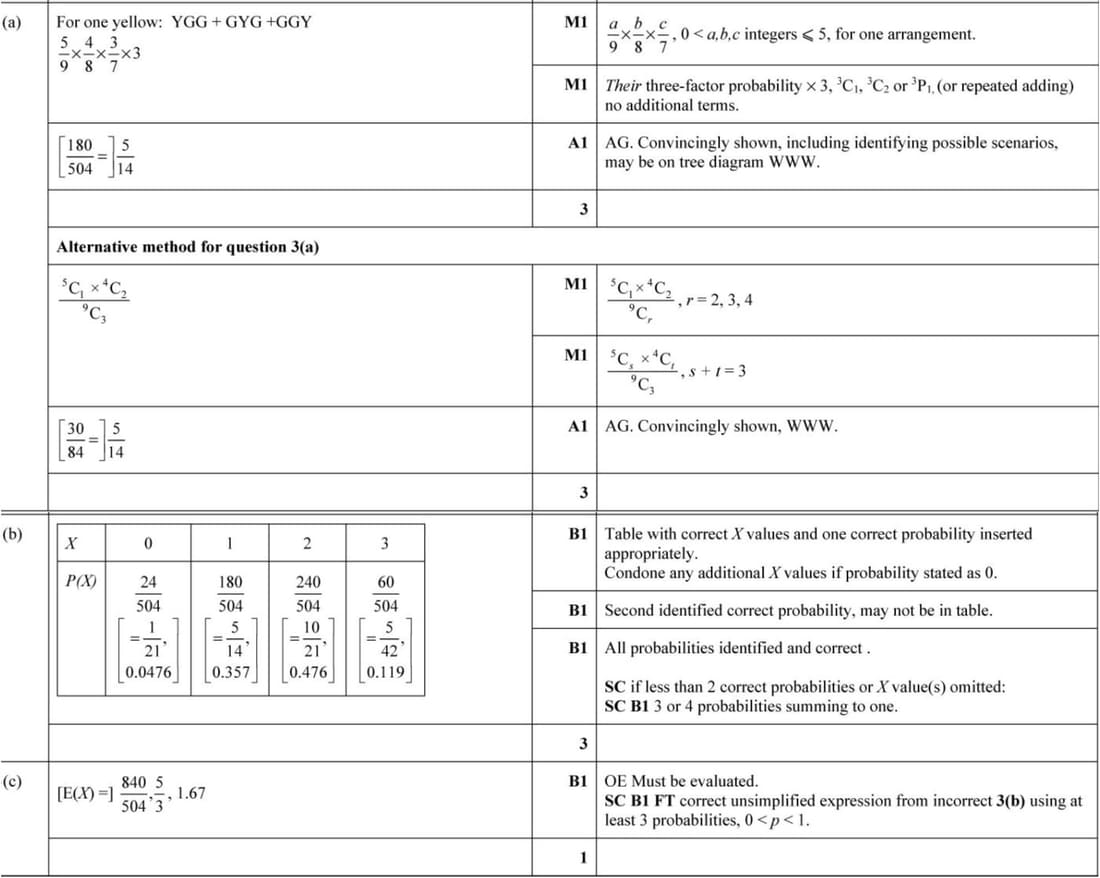
(a) Show that the probability of obtaining exactly 2 heads and 1 tail is \(\frac{4}{9}\).
The random variable \(X\) is the number of heads obtained when the three coins are thrown.
(b) Draw up the probability distribution table for \(X\).
(c) Given that \(\text{E}(X) = \frac{32}{15}\), find \(\text{Var}(X)\).
Nov 2020 p52 q2
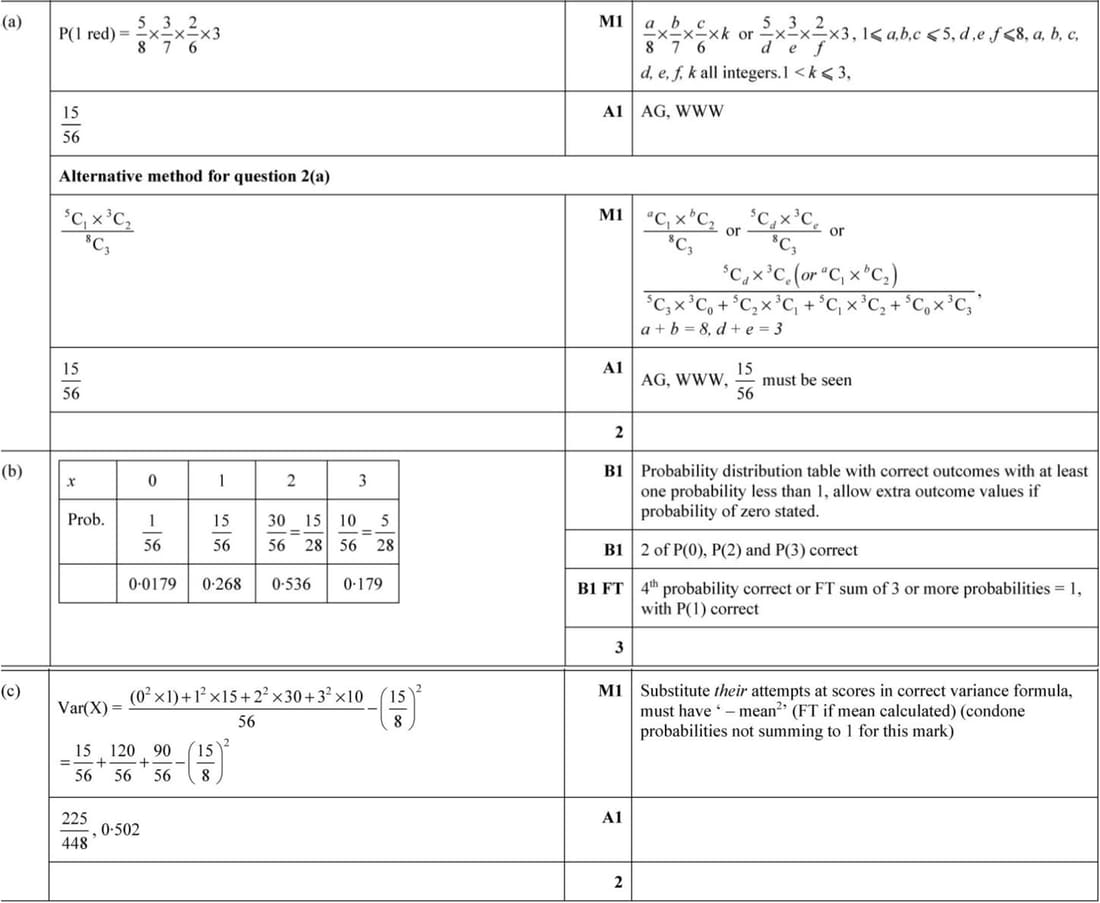
A bag contains 5 red balls and 3 blue balls. Sadie takes 3 balls at random from the bag, without replacement. The random variable X represents the number of red balls that she takes.
(a) Show that the probability that Sadie takes exactly 1 red ball is \(\frac{15}{56}\).
(b) Draw up the probability distribution table for X.
(c) Given that \(E(X) = \frac{15}{8}\), find \(\text{Var}(X)\).
Nov 2020 p51 q4
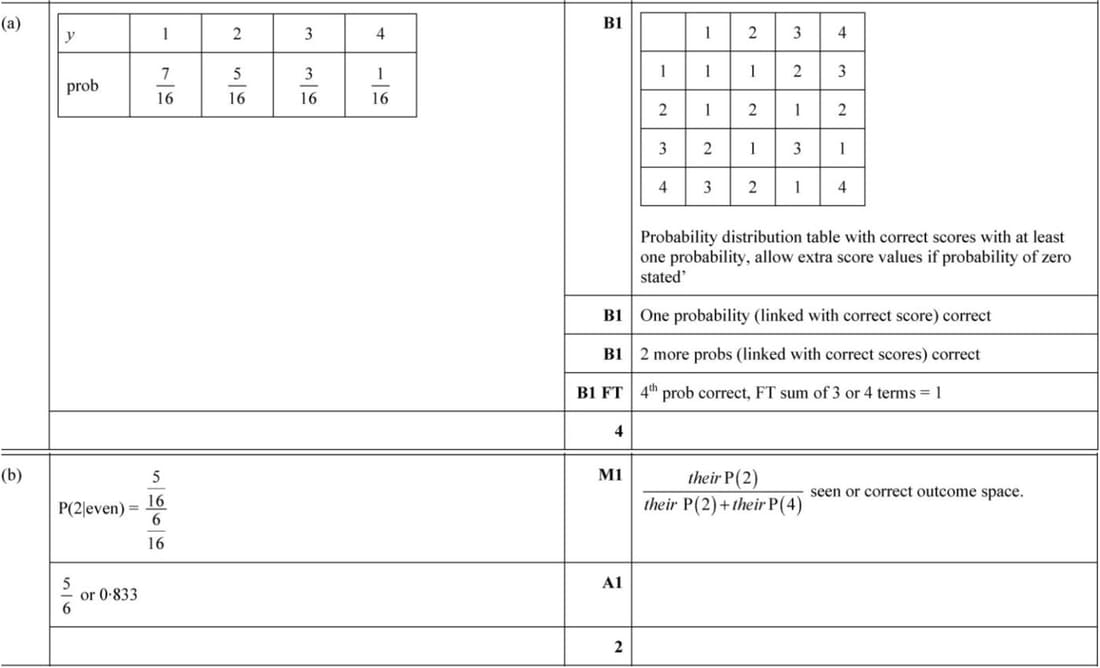
The random variable X takes each of the values 1, 2, 3, 4 with probability \(\frac{1}{4}\). Two independent values of X are chosen at random. If the two values of X are the same, the random variable Y takes that value. Otherwise, the value of Y is the larger value of X minus the smaller value of X.
(a) Draw up the probability distribution table for Y.
\((b) Find the probability that Y = 2 given that Y is even.\)
June 2020 p53 q4
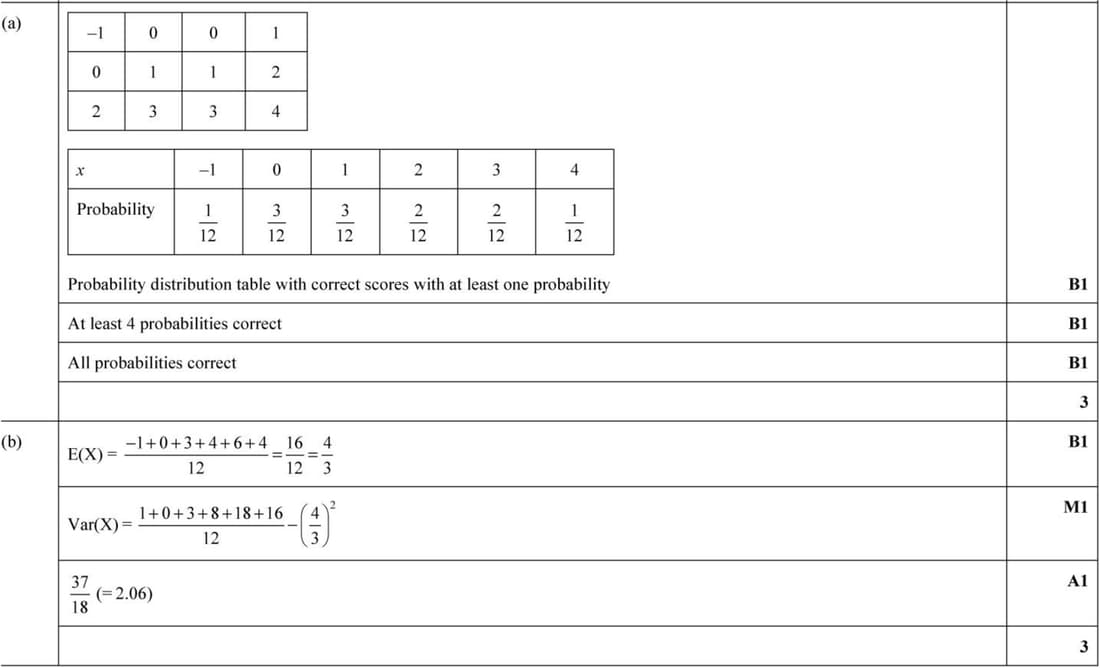
A fair four-sided spinner has edges numbered 1, 2, 2, 3. A fair three-sided spinner has edges numbered -2, -1, 1. Each spinner is spun and the number on the edge on which it comes to rest is noted. The random variable X is the sum of the two numbers that have been noted.
(a) Draw up the probability distribution table for X.
(b) Find Var(X).
June 2020 p52 q5
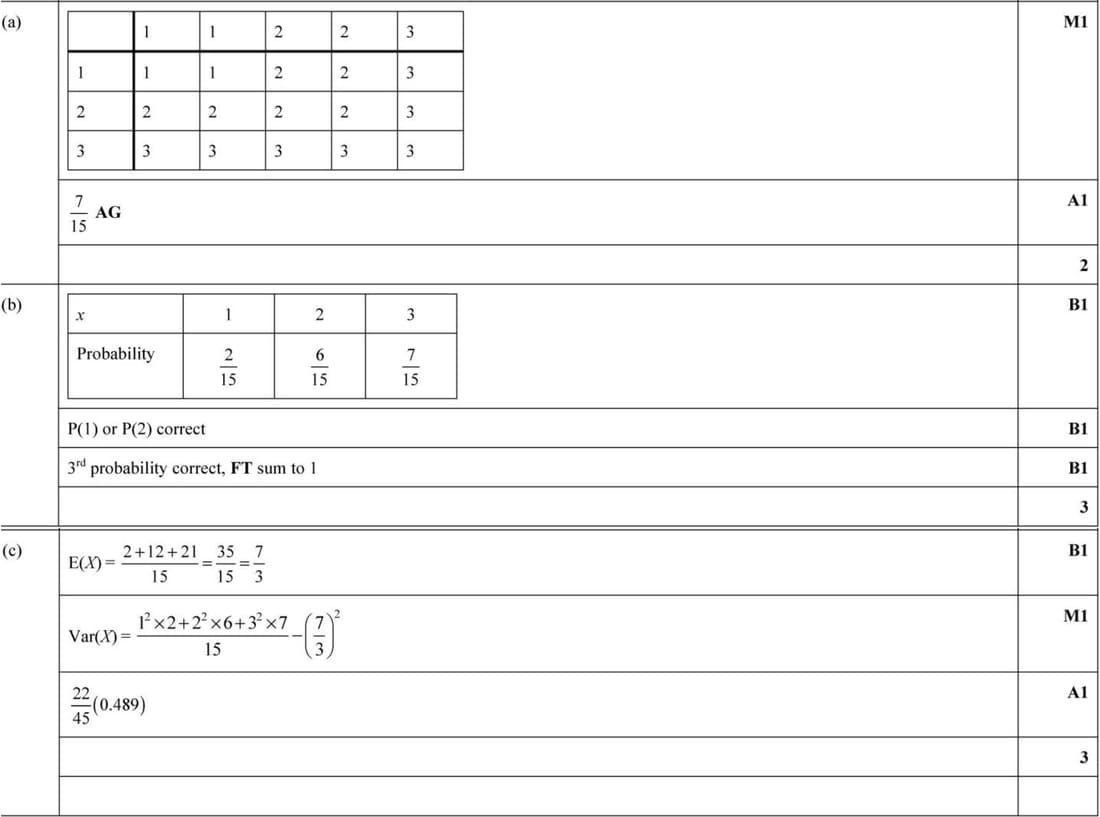
A fair three-sided spinner has sides numbered 1, 2, 3. A fair five-sided spinner has sides numbered 1, 1, 2, 2, 3. Both spinners are spun once. For each spinner, the number on the side on which it lands is noted. The random variable X is the larger of the two numbers if they are different, and their common value if they are the same.
(a) Show that P(X = 3) = \(\frac{7}{15}\).
(b) Draw up the probability distribution table for X.
(c) Find E(X) and Var(X).
June 2020 p51 q3
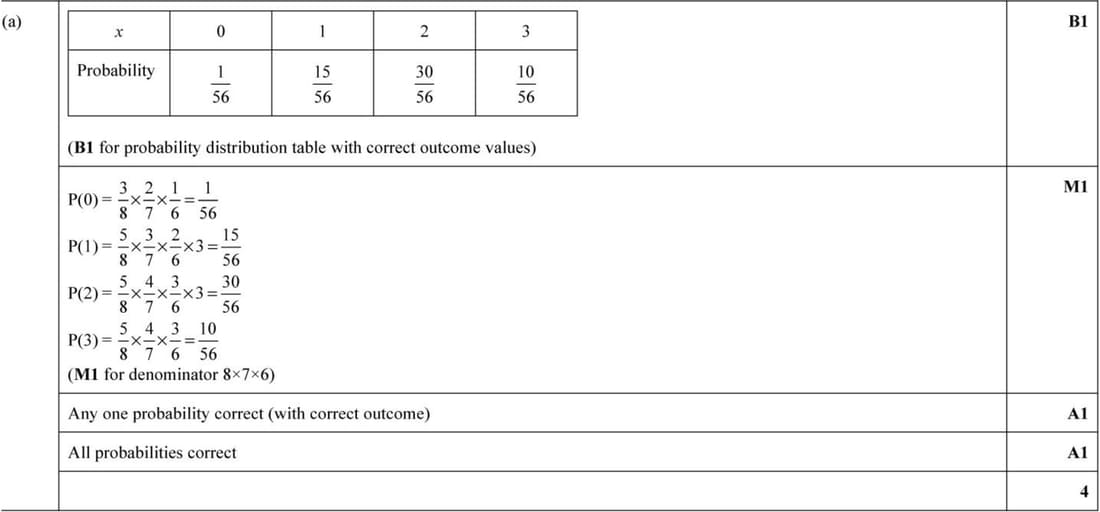
A company produces small boxes of sweets that contain 5 jellies and 3 chocolates. Jemeel chooses 3 sweets at random from a box.
Draw up the probability distribution table for the number of jellies that Jemeel chooses.
June 2023 p53 q3
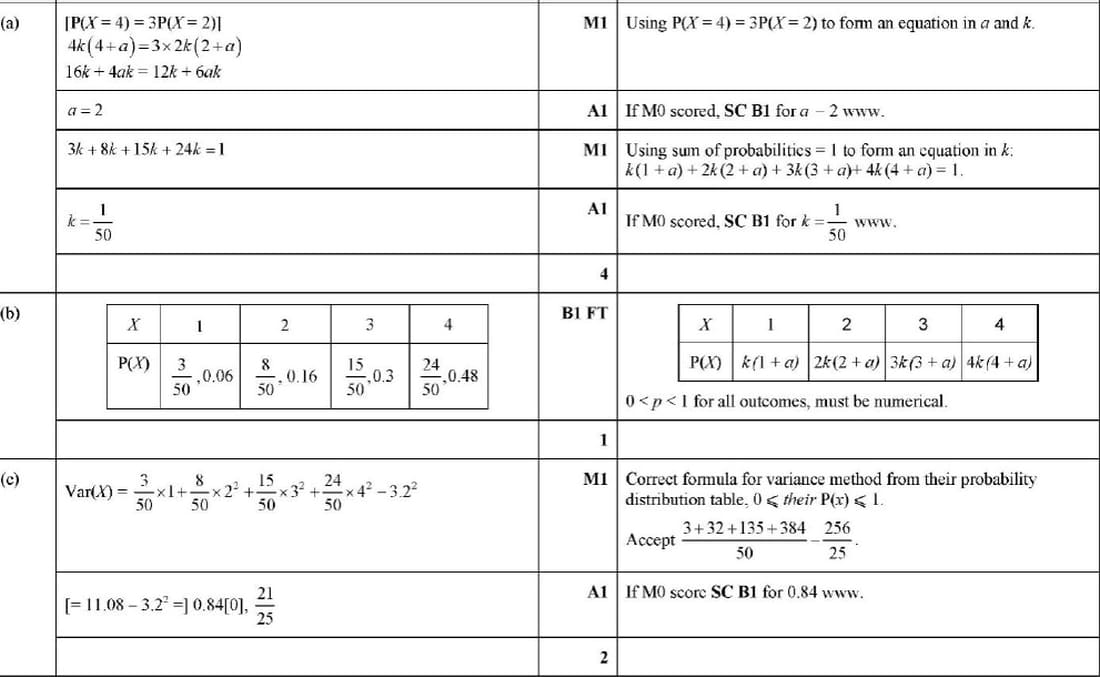
The random variable X takes the values 1, 2, 3, 4. It is given that \(P(X = x) = kx(x + a)\), where \(k\) and \(a\) are constants.
- Given that \(P(X = 4) = 3P(X = 2)\), find the value of \(a\) and the value of \(k\).
- Draw up the probability distribution table for X, giving the probabilities as numerical fractions.
- Given that \(E(X) = 3.2\), find \(\text{Var}(X)\).
Feb/Mar 2020 p52 q2
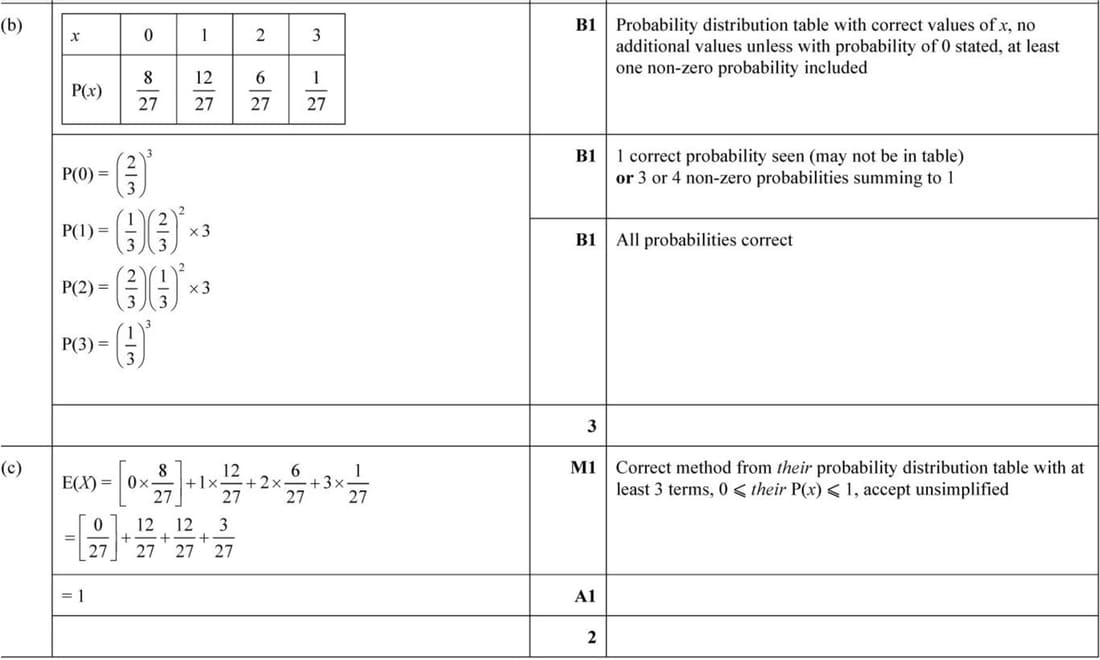
An ordinary fair die is thrown 3 times. The random variable X is the number of times that a 1 or a 6 is obtained.
(b) Draw up the probability distribution table for X.
(c) Find E(X).
Nov 2019 p63 q6
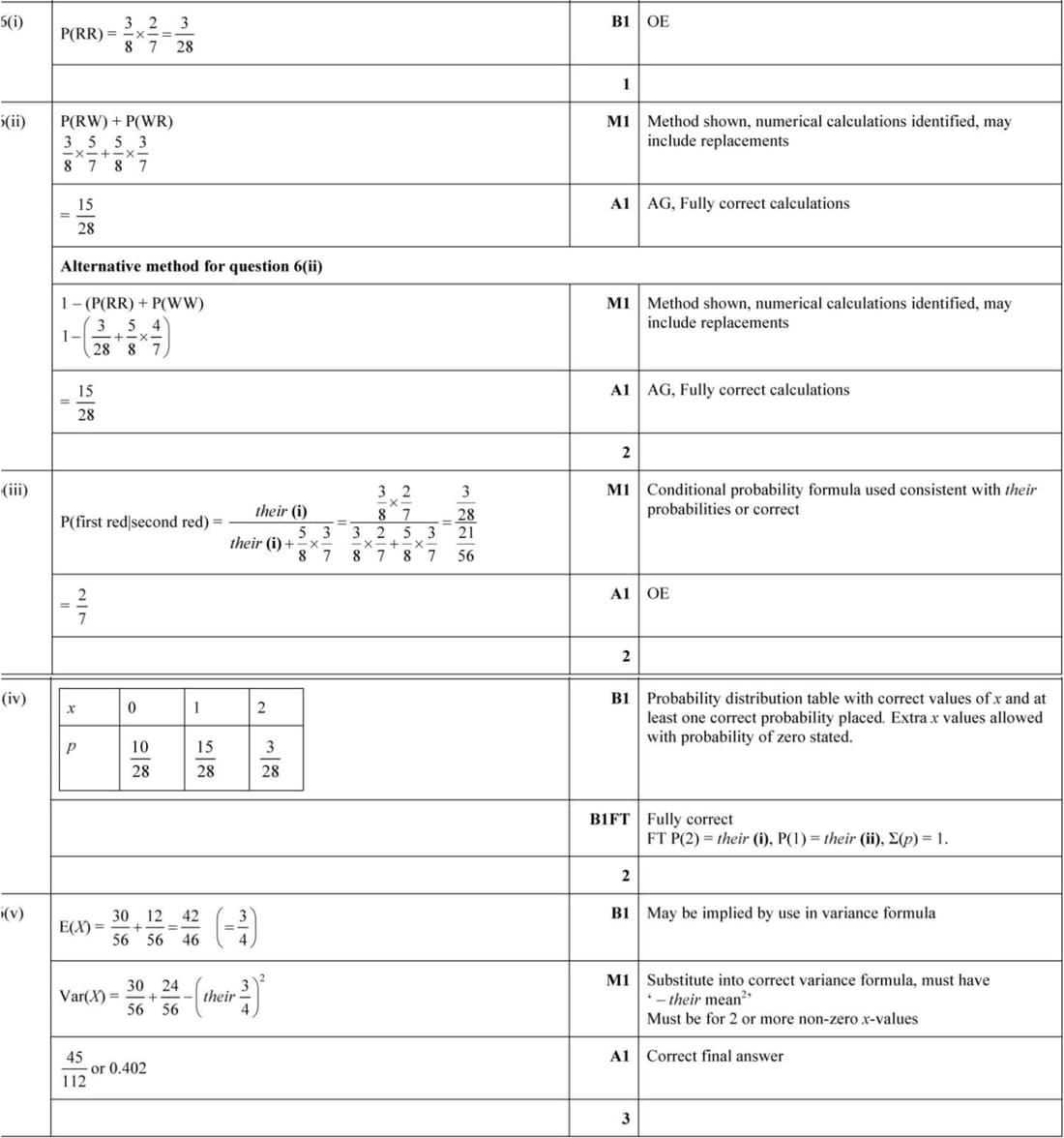
A box contains 3 red balls and 5 white balls. One ball is chosen at random from the box and is not returned to the box. A second ball is now chosen at random from the box.
- Find the probability that both balls chosen are red.
- Show that the probability that the balls chosen are of different colours is \(\frac{15}{28}\).
- Given that the second ball chosen is red, find the probability that the first ball chosen is red.
The random variable \(X\) denotes the number of red balls chosen.
- Draw up the probability distribution table for \(X\).
- Find \(\text{Var}(X)\).
Nov 2019 p62 q5
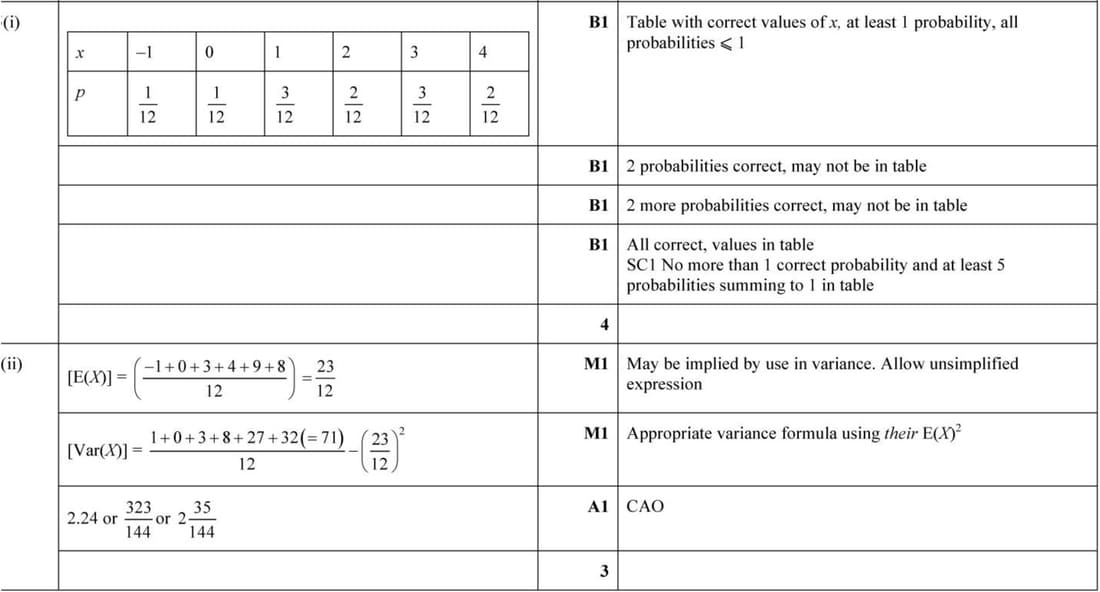
A fair red spinner has four sides, numbered 1, 2, 3, 3. A fair blue spinner has three sides, numbered -1, 0, 2. When a spinner is spun, the score is the number on the side on which it lands. The spinners are spun at the same time. The random variable X denotes the score on the red spinner minus the score on the blue spinner.
(i) Draw up the probability distribution table for X.
(ii) Find \(\text{Var}(X)\).
June 2019 p63 q6
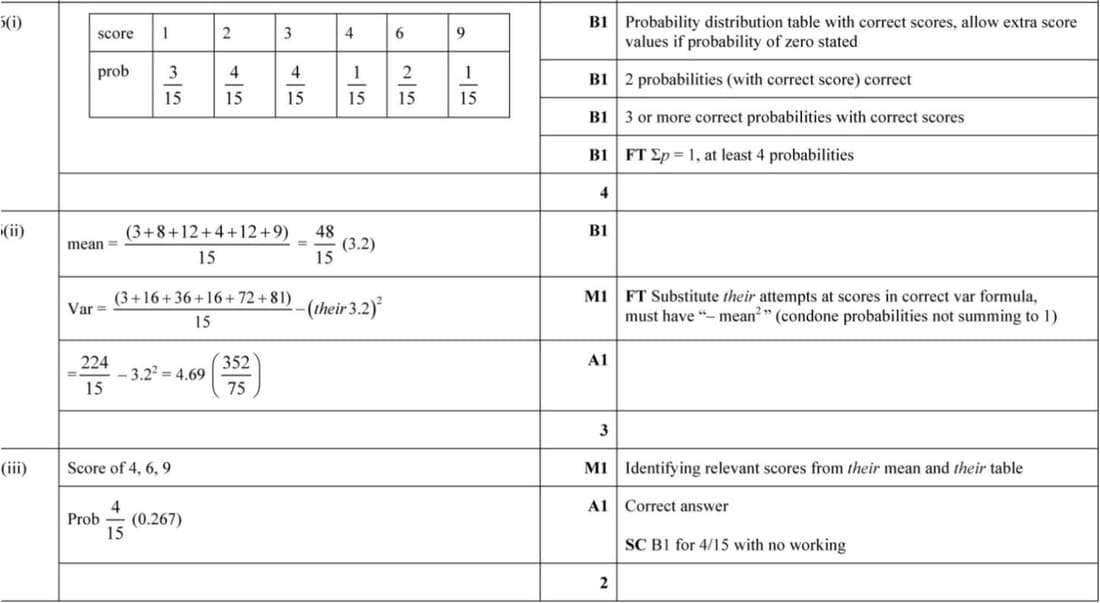
A fair five-sided spinner has sides numbered 1, 1, 1, 2, 3. A fair three-sided spinner has sides numbered 1, 2, 3. Both spinners are spun once and the score is the product of the numbers on the sides the spinners land on.
- Draw up the probability distribution table for the score.
- Find the mean and the variance of the score.
- Find the probability that the score is greater than the mean score.
June 2019 p62 q5
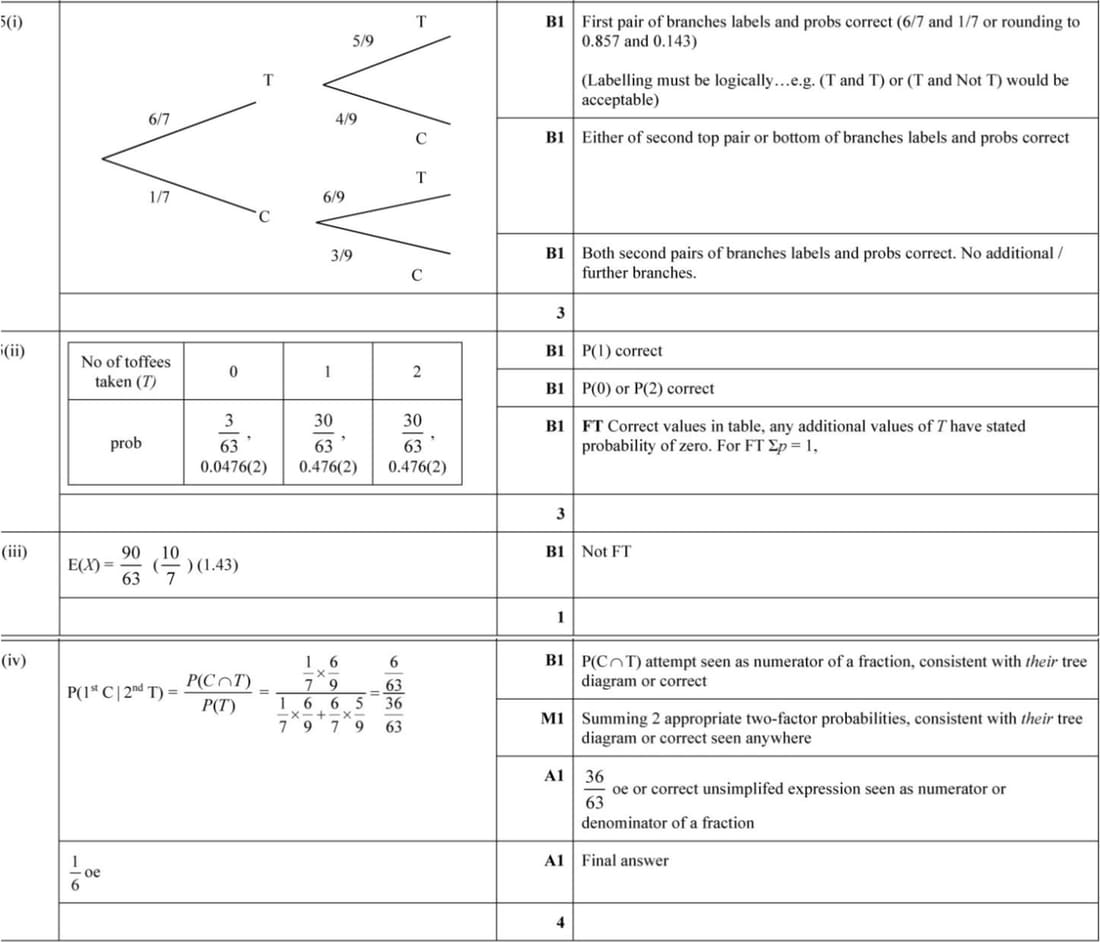
Maryam has 7 sweets in a tin; 6 are toffees and 1 is a chocolate. She chooses one sweet at random and takes it out. Her friend adds 3 chocolates to the tin. Then Maryam takes another sweet at random out of the tin.
- Draw a fully labelled tree diagram to illustrate this situation.
- Draw up the probability distribution table for the number of toffees taken.
- Find the mean number of toffees taken.
- Find the probability that the first sweet taken is a chocolate, given that the second sweet taken is a toffee.
June 2019 p61 q6
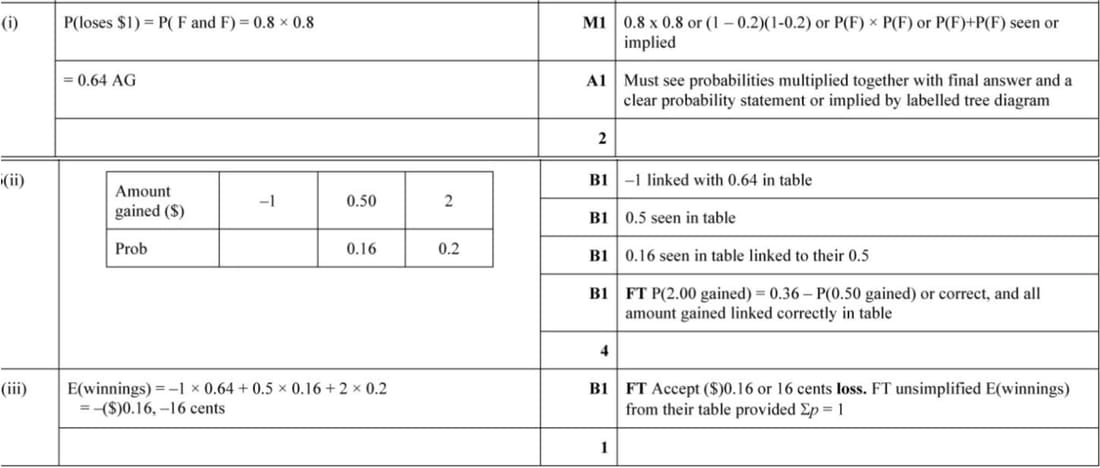
At a funfair, Amy pays $1 for two attempts to make a bell ring by shooting at it with a water pistol.
- If she makes the bell ring on her first attempt, she receives $3 and stops playing. This means that overall she has gained $2.
- If she makes the bell ring on her second attempt, she receives $1.50 and stops playing. This means that overall she has gained $0.50.
- If she does not make the bell ring in the two attempts, she has lost her original $1.
The probability that Amy makes the bell ring on any attempt is 0.2, independently of other attempts.
- Show that the probability that Amy loses her original $1 is 0.64. [2]
- Complete the probability distribution table for the amount that Amy gains. [4]
- Calculate Amy’s expected gain. [1]
Feb/Mar 2019 p62 q4
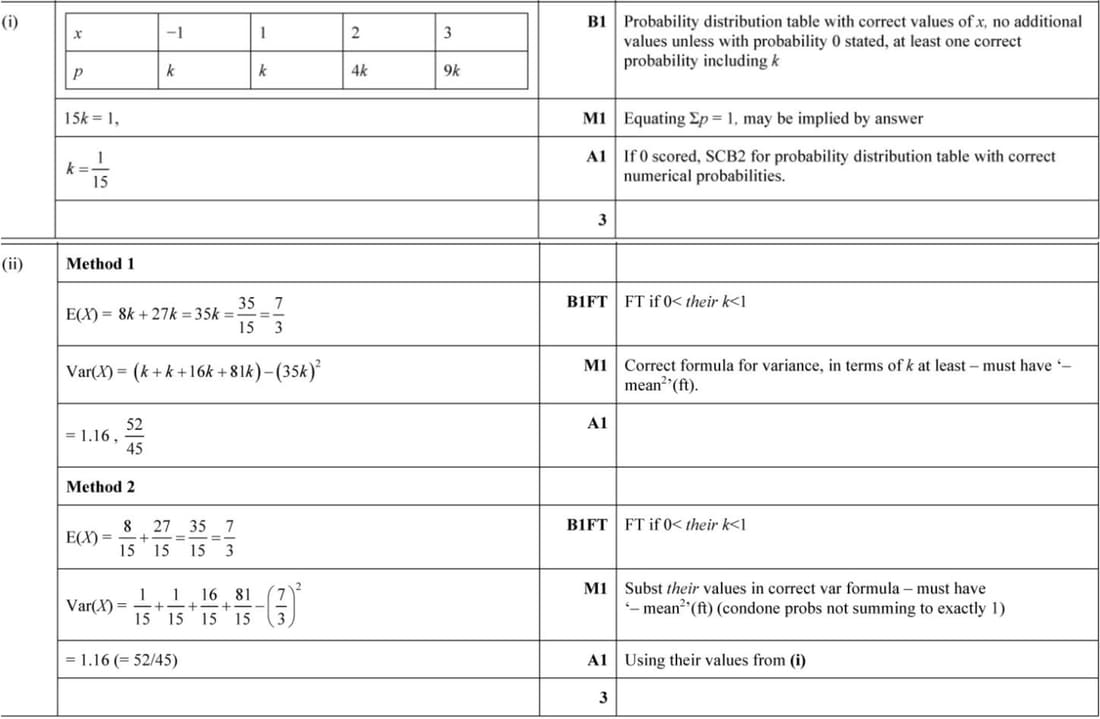
The random variable X takes the values -1, 1, 2, 3 only. The probability that X takes the value x is kx2, where k is a constant.
- Draw up the probability distribution table for X, in terms of k, and find the value of k.
- Find E(X) and Var(X).
Nov 2018 p63 q2
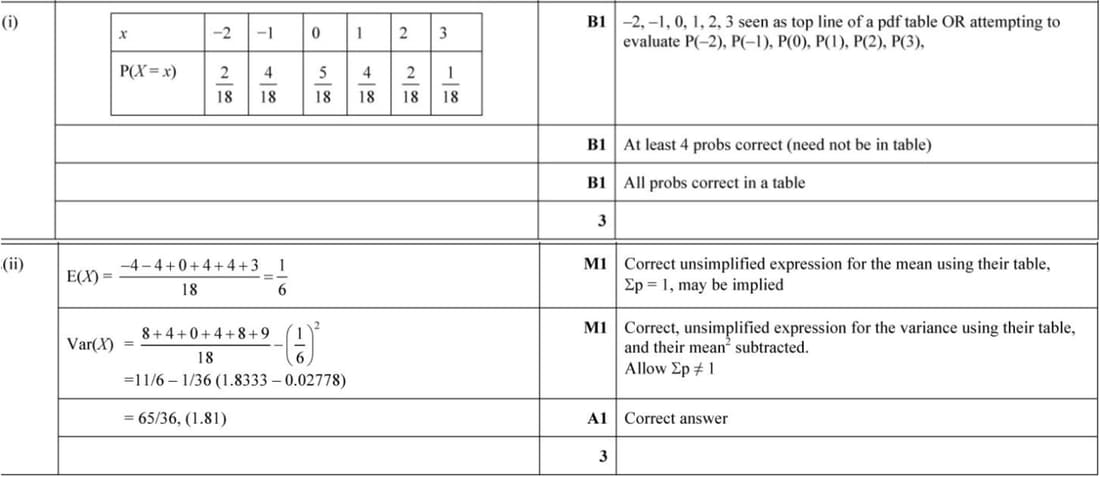
A fair 6-sided die has the numbers -1, -1, 0, 0, 1, 2 on its faces. A fair 3-sided spinner has edges numbered -1, 0, 1. The die is thrown and the spinner is spun. The number on the uppermost face of the die and the number on the edge on which the spinner comes to rest are noted. The sum of these two numbers is denoted by X.
- Draw up a table showing the probability distribution of X.
- Find \(\text{Var}(X)\).
Nov 2018 p62 q6
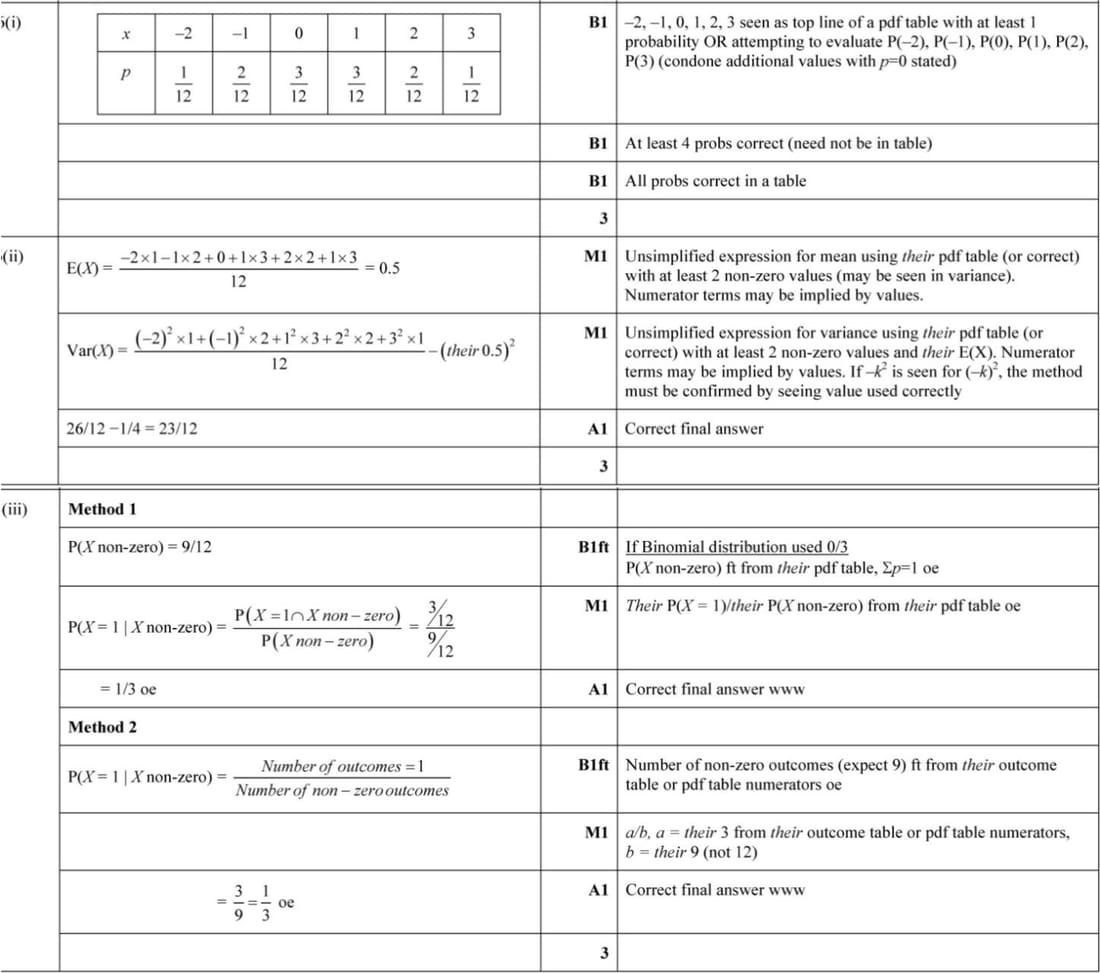
A fair red spinner has 4 sides, numbered 1, 2, 3, 4. A fair blue spinner has 3 sides, numbered 1, 2, 3. When a spinner is spun, the score is the number on the side on which it lands. The spinners are spun at the same time. The random variable X denotes the score on the red spinner minus the score on the blue spinner.
- Draw up the probability distribution table for X.
- Find \(\text{Var}(X)\).
- Find the probability that \(X\) is equal to 1, given that \(X\) is non-zero.
Nov 2018 p61 q2
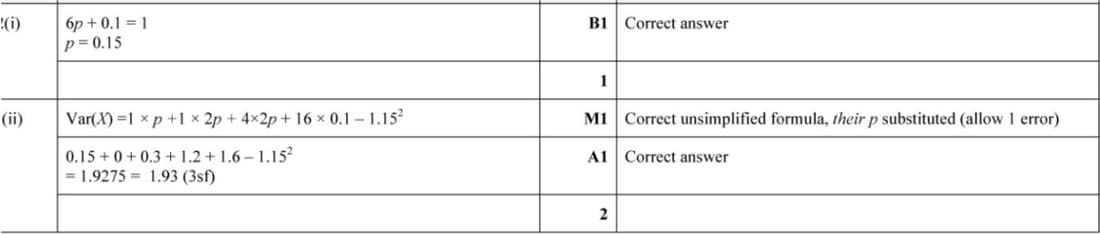
A random variable X has the probability distribution shown in the following table, where p is a constant.
| x | -1 | 0 | 1 | 2 | 4 |
|---|---|---|---|---|---|
| P(X = x) | p | p | 2p | 2p | 0.1 |
- Find the value of p.
- Given that \(E(X) = 1.15\), find \(\text{Var}(X)\).
June 2023 p52 q1
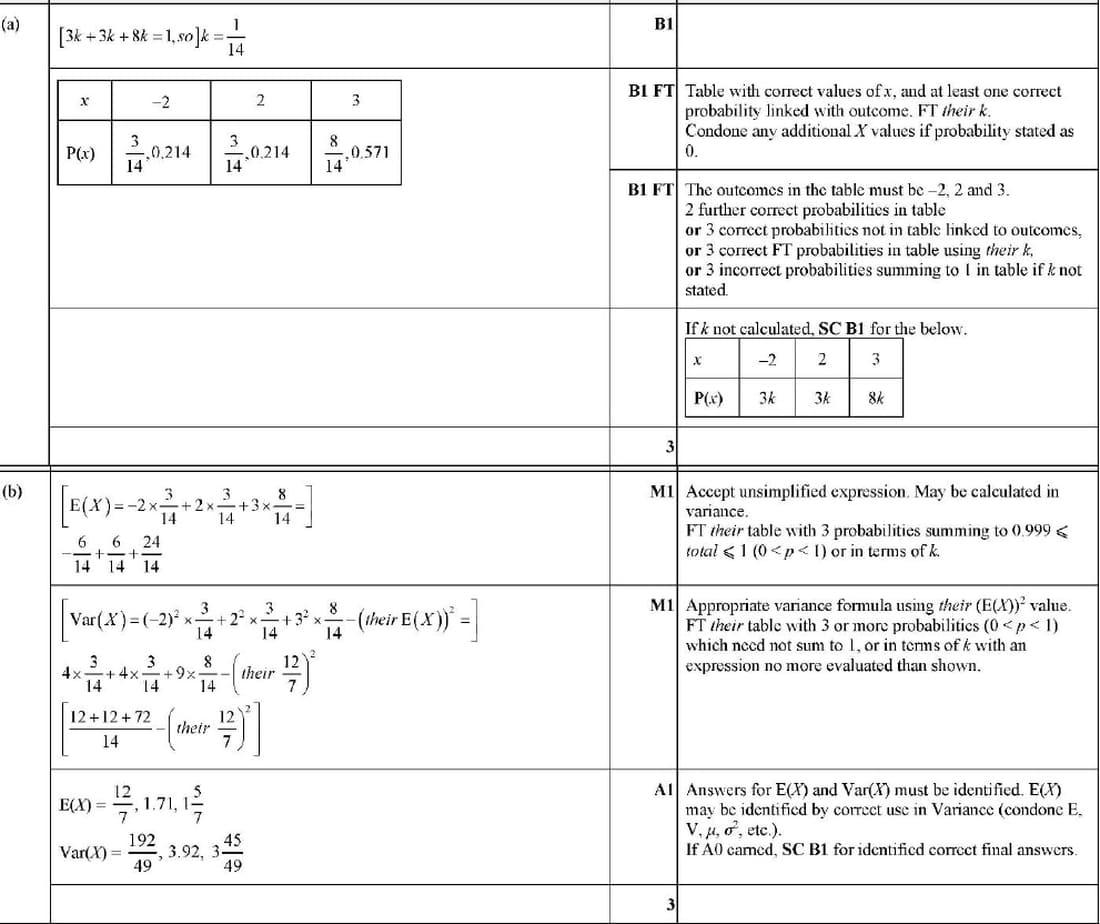
The random variable X takes the values −2, 2 and 3. It is given that
\(P(X = x) = k(x^2 - 1)\),
where k is a constant.
(a) Draw up the probability distribution table for X, giving the probabilities as numerical fractions.
(b) Find \(E(X)\) and \(\text{Var}(X)\).
June 2018 p63 q5
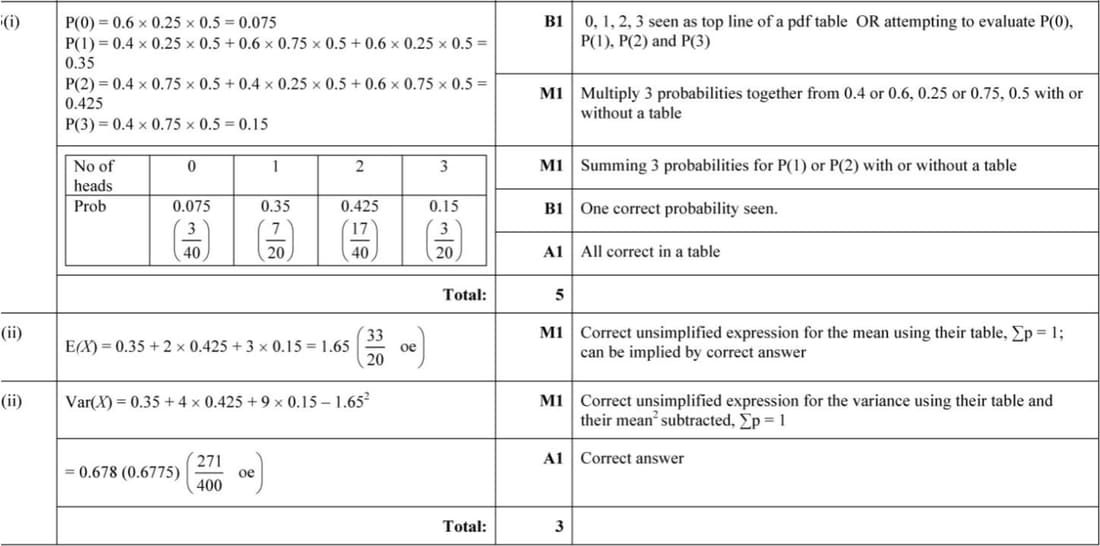
A game is played with 3 coins, A, B and C. Coins A and B are biased so that the probability of obtaining a head is 0.4 for coin A and 0.75 for coin B. Coin C is not biased. The 3 coins are thrown once.
- Draw up the probability distribution table for the number of heads obtained.
- Hence calculate the mean and variance of the number of heads obtained.
June 2018 p62 q4
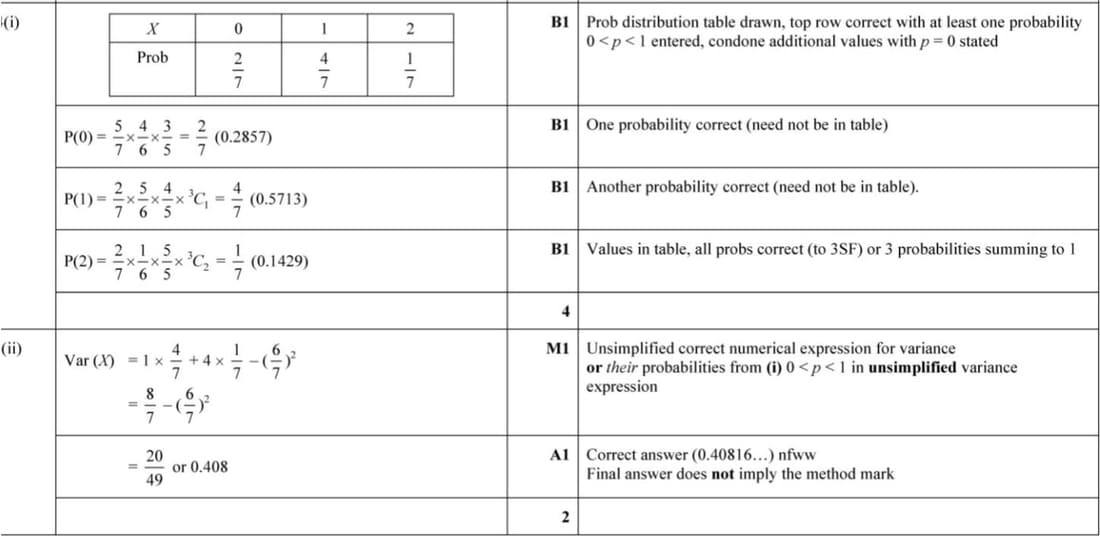
Mrs Rupal chooses 3 animals at random from 5 dogs and 2 cats. The random variable X is the number of cats chosen.
- Draw up the probability distribution table for X.
- You are given that E(X) = \(\frac{6}{7}\). Find the value of Var(X).
June 2018 p61 q3
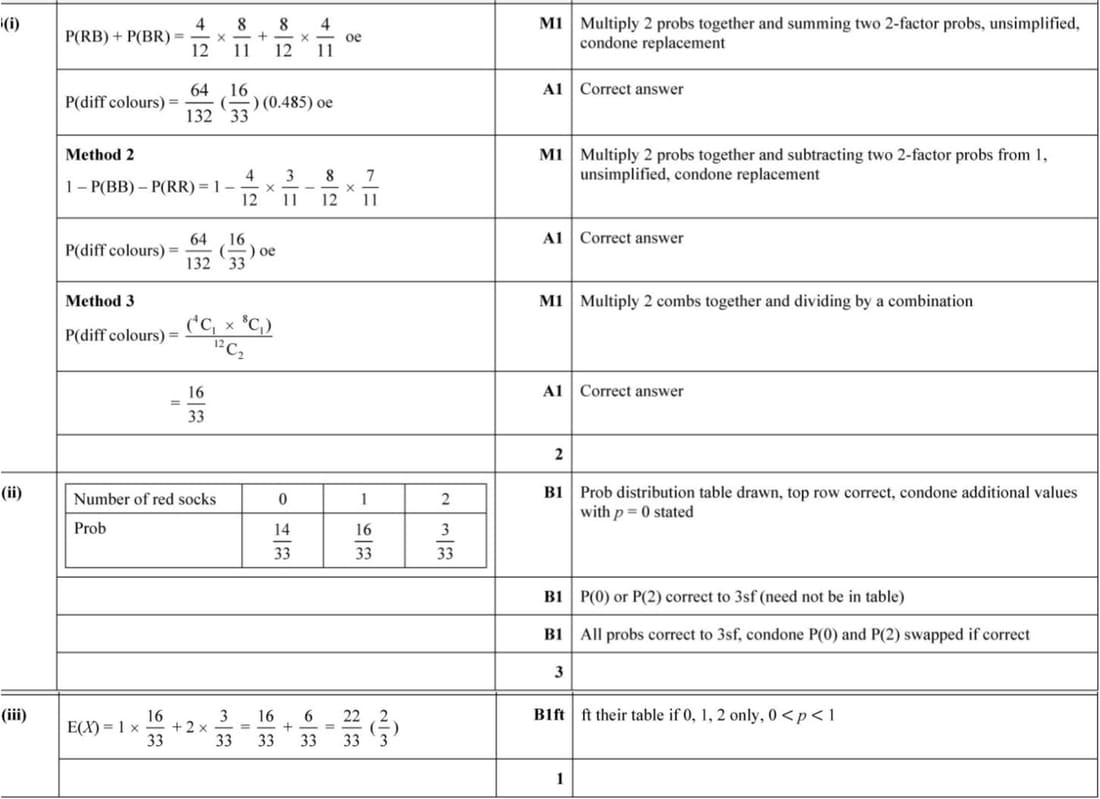
Andy has 4 red socks and 8 black socks in his drawer. He takes 2 socks at random from his drawer.
- Find the probability that the socks taken are of different colours.
- Draw up the probability distribution table for X.
- Find E(X).
The random variable X is the number of red socks taken.
Nov 2017 p63 q4
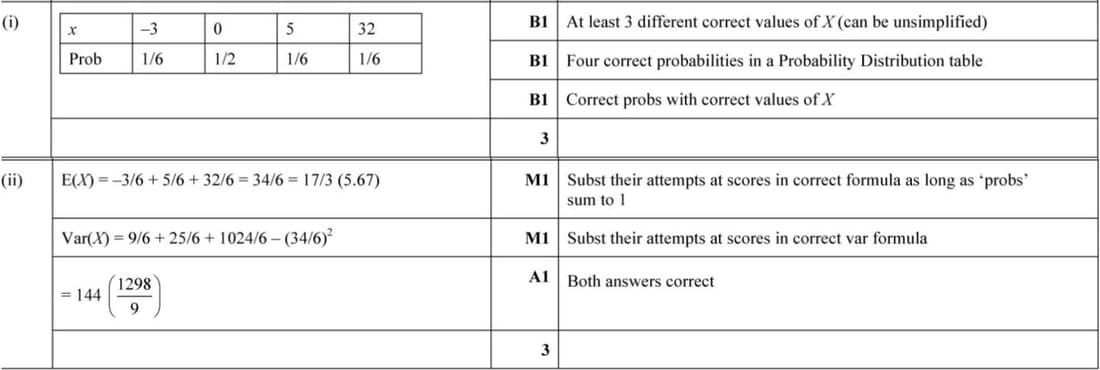
A fair die with faces numbered 1, 2, 2, 2, 3, 6 is thrown. The score, X, is found by squaring the number on the face the die shows and then subtracting 4.
- Draw up a table to show the probability distribution of X.
- Find E(X) and Var(X).
Nov 2017 p62 q3
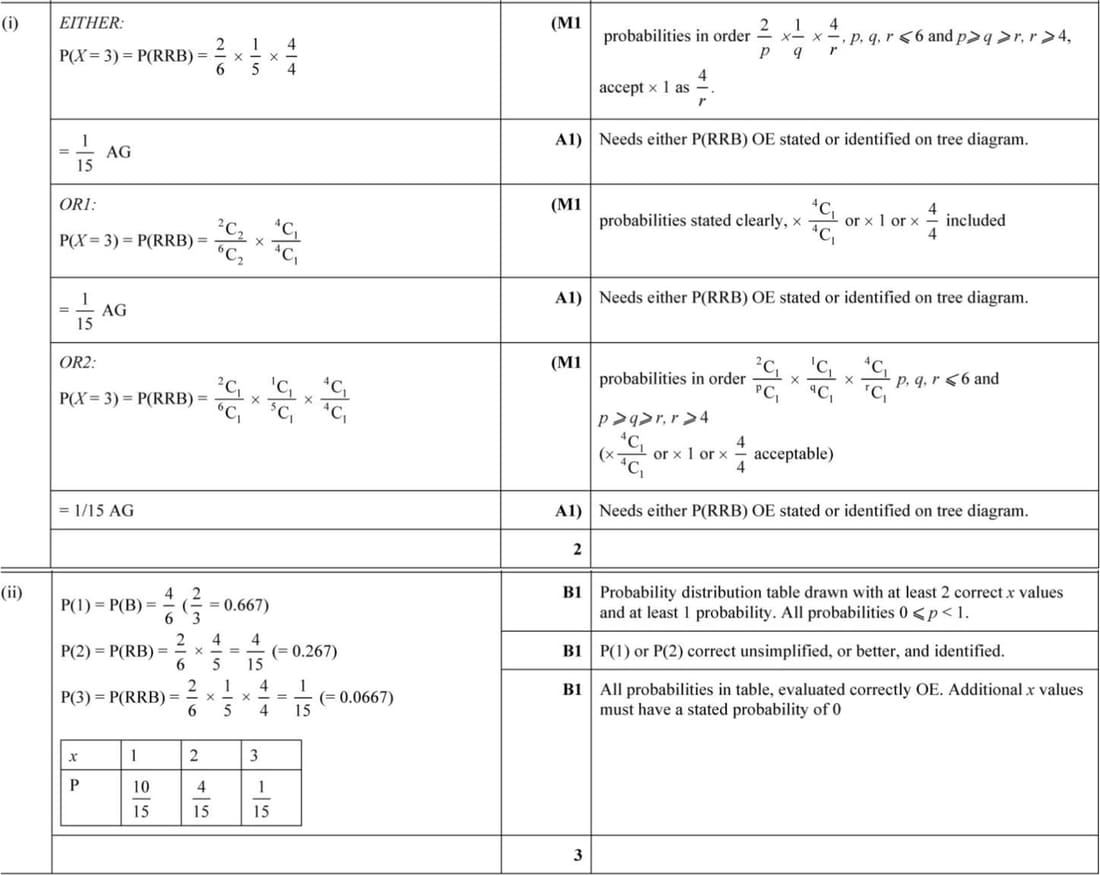
A box contains 6 identical-sized discs, of which 4 are blue and 2 are red. Discs are taken at random from the box in turn and not replaced. Let X be the number of discs taken, up to and including the first blue one.
(i) Show that \(P(X = 3) = \frac{1}{15}\).
(ii) Draw up the probability distribution table for \(X\).
June 2017 p62 q3
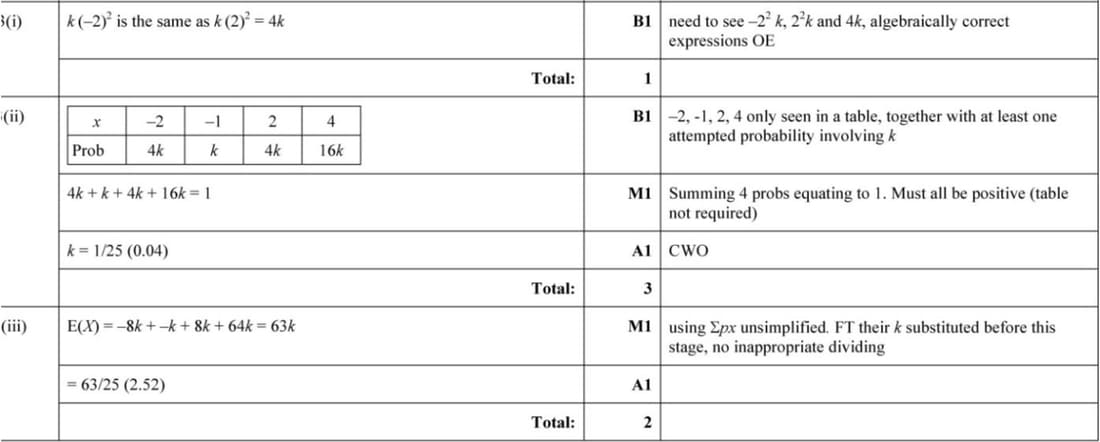
In a probability distribution the random variable \(X\) takes the value \(x\) with probability \(kx^2\), where \(k\) is a constant and \(x\) takes values \(-2, -1, 2, 4\) only.
- Show that \(P(X = -2)\) has the same value as \(P(X = 2)\).
- Draw up the probability distribution table for \(X\), in terms of \(k\), and find the value of \(k\).
- Find \(E(X)\).
Feb/Mar 2017 p62 q6
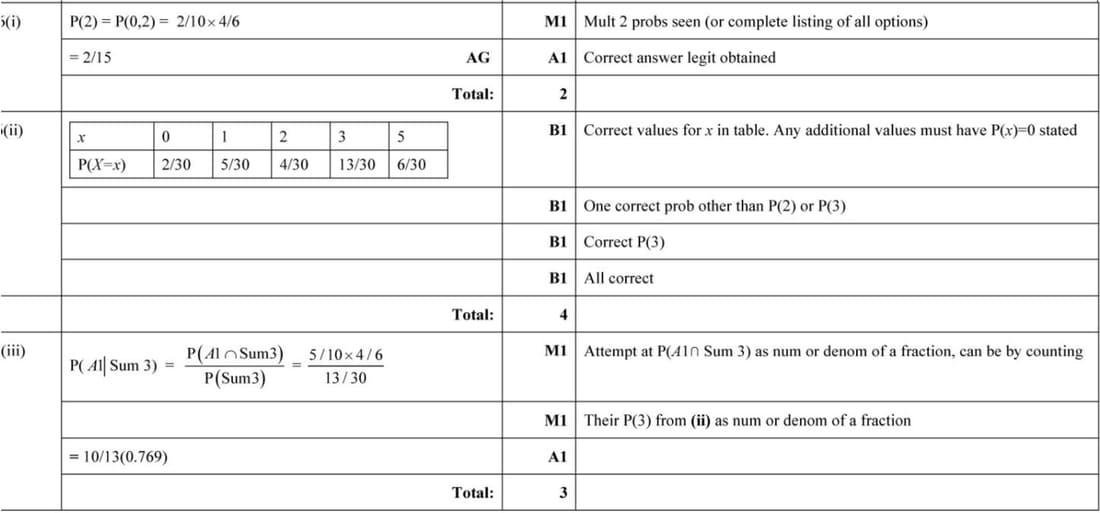
Pack A consists of ten cards numbered 0, 0, 1, 1, 1, 1, 3, 3, 3, 3. Pack B consists of six cards numbered 0, 0, 2, 2, 2, 2. One card is chosen at random from each pack. The random variable X is defined as the sum of the two numbers on the cards.
- Show that \(P(X = 2) = \frac{2}{15}\).
- Draw up the probability distribution table for \(X\).
- Given that \(X = 3\), find the probability that the card chosen from pack A is a 1.
Nov 2016 p62 q2
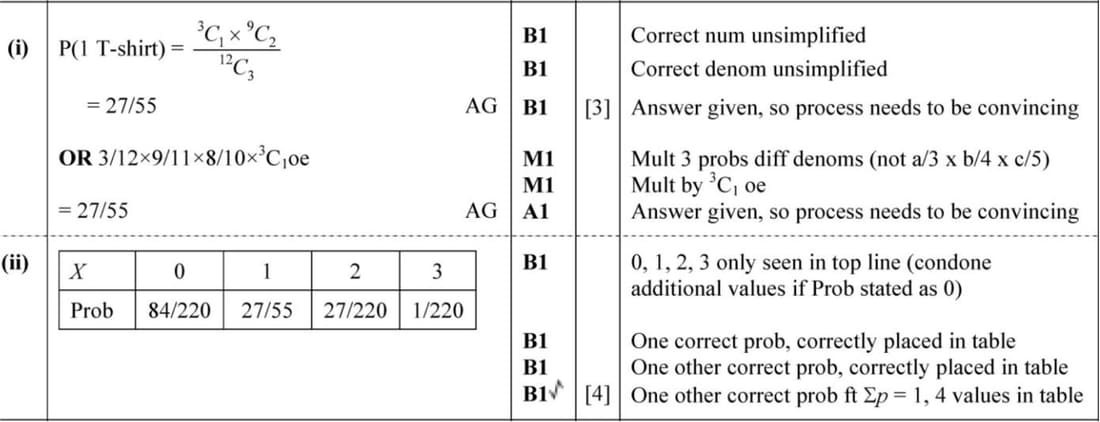
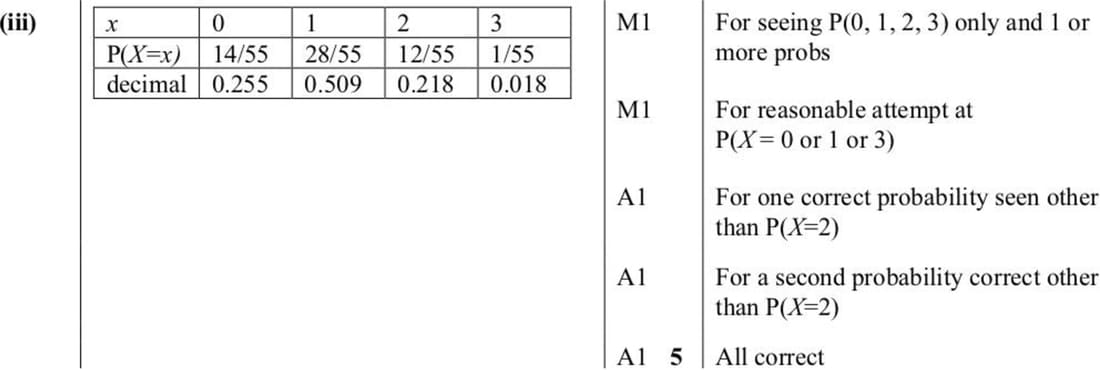
Noor has 3 T-shirts, 4 blouses and 5 jumpers. She chooses 3 items at random. The random variable X is the number of T-shirts chosen.
- Show that the probability that Noor chooses exactly one T-shirt is \(\frac{27}{55}\).
- Draw up the probability distribution table for X.
Nov 2016 p61 q2
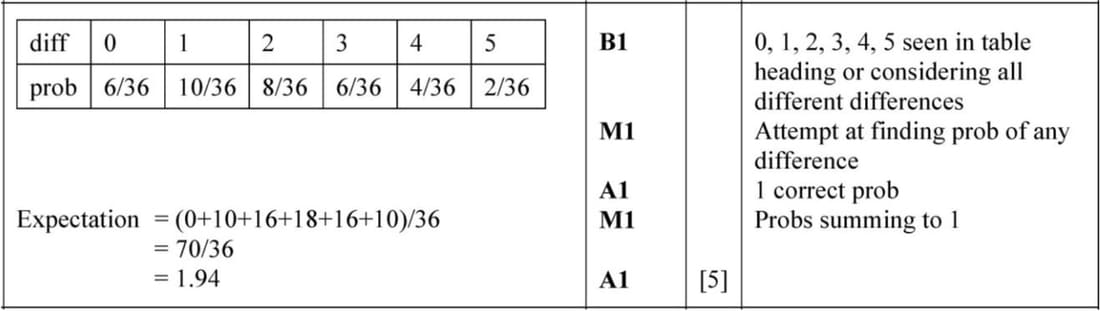
Two fair six-sided dice with faces numbered 1, 2, 3, 4, 5, 6 are thrown and the two scores are noted. The difference between the two scores is defined as follows.
- If the scores are equal the difference is zero.
- If the scores are not equal the difference is the larger score minus the smaller score.
Find the expectation of the difference between the two scores.
June 2016 p63 q3
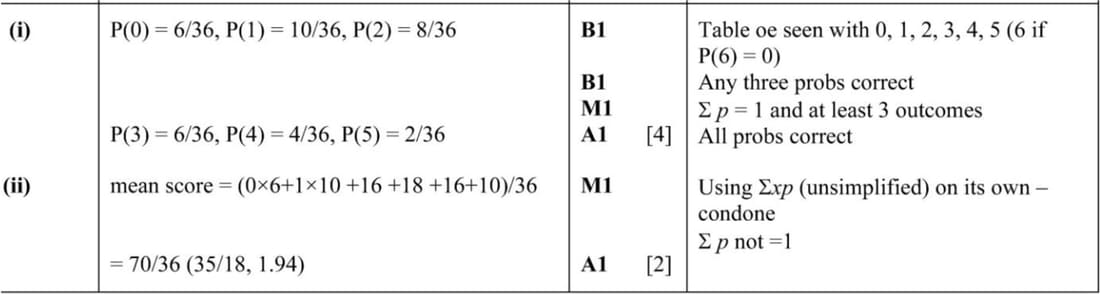
Two ordinary fair dice are thrown. The resulting score is found as follows.
- If the two dice show different numbers, the score is the smaller of the two numbers.
- If the two dice show equal numbers, the score is 0.
(i) Draw up the probability distribution table for the score.
(ii) Calculate the expected score.
Nov 2022 p53 q4
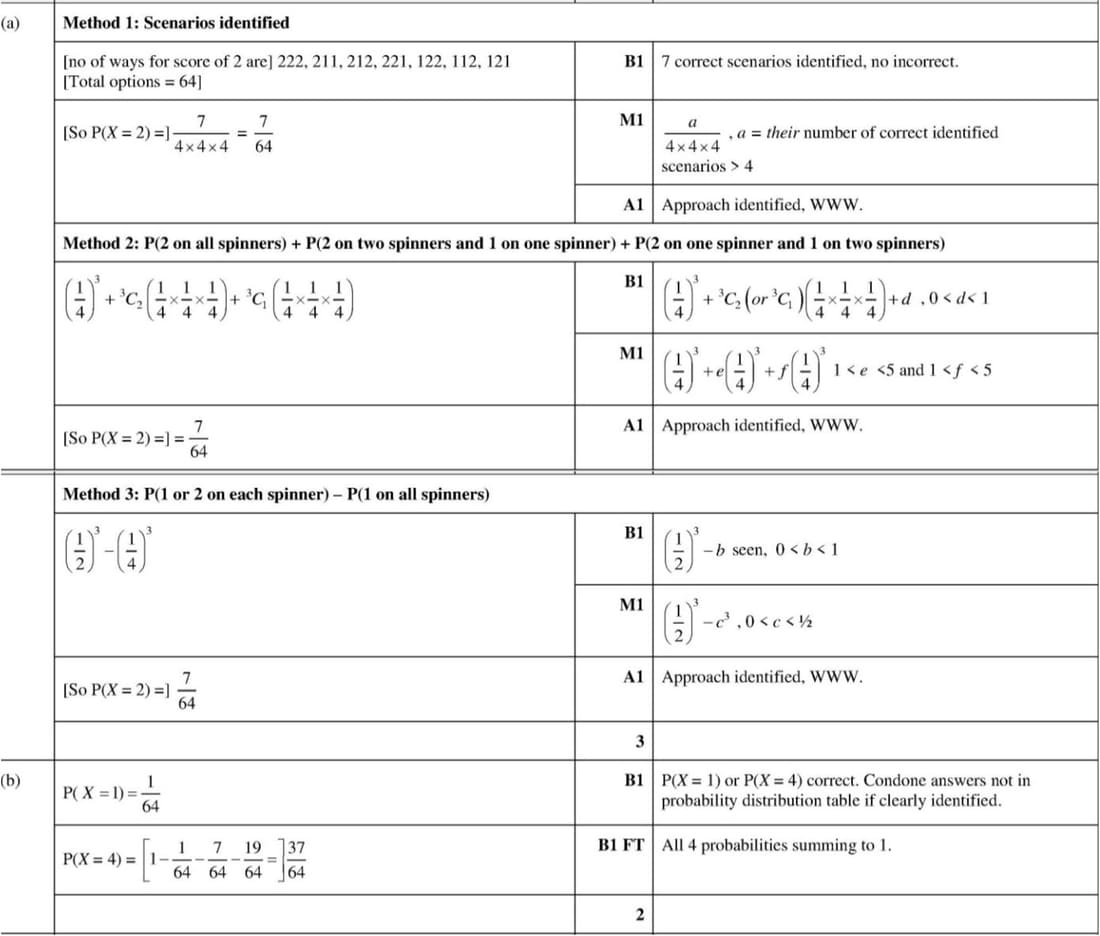
Three fair 4-sided spinners each have sides labelled 1, 2, 3, 4. The spinners are spun at the same time and the number on the side on which each spinner lands is recorded. The random variable X denotes the highest number recorded.
(a) Show that \(P(X = 2) = \frac{7}{64}\).
(b) Complete the probability distribution table for \(X\).
| x | 1 | 2 | 3 | 4 |
|---|---|---|---|---|
| \(P(X = x)\) | \(\frac{7}{64}\) | \(\frac{19}{64}\) |
June 2016 p62 q3
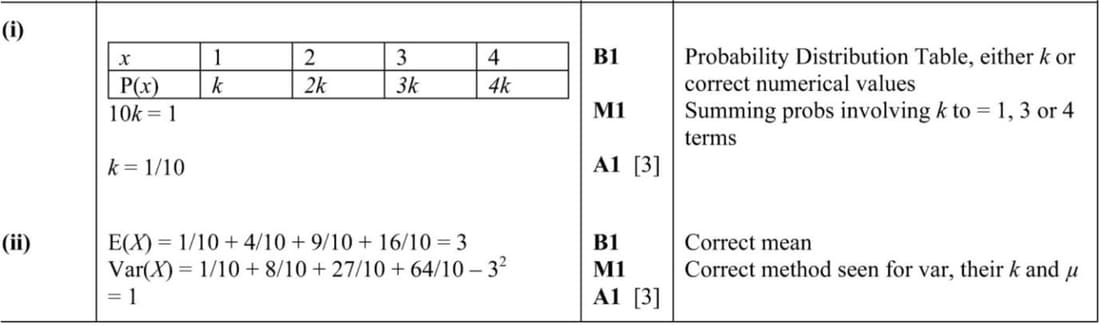
A particular type of bird lays 1, 2, 3 or 4 eggs in a nest each year. The probability of x eggs is equal to kx, where k is a constant.
- Draw up a probability distribution table, in terms of k, for the number of eggs laid in a year and find the value of k.
- Find the mean and variance of the number of eggs laid in a year by this type of bird.
June 2016 p61 q4
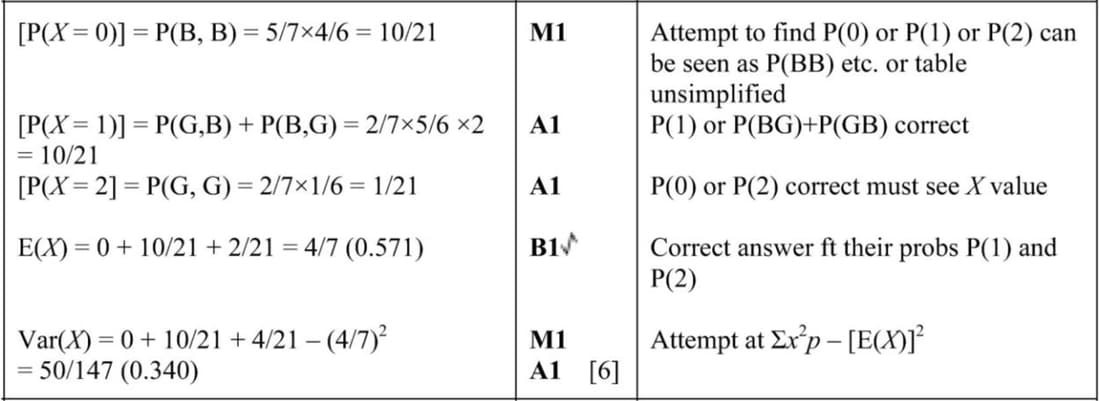
A box contains 2 green sweets and 5 blue sweets. Two sweets are taken at random from the box, without replacement. The random variable X is the number of green sweets taken. Find E(X) and Var(X).
Feb/Mar 2016 p62 q2
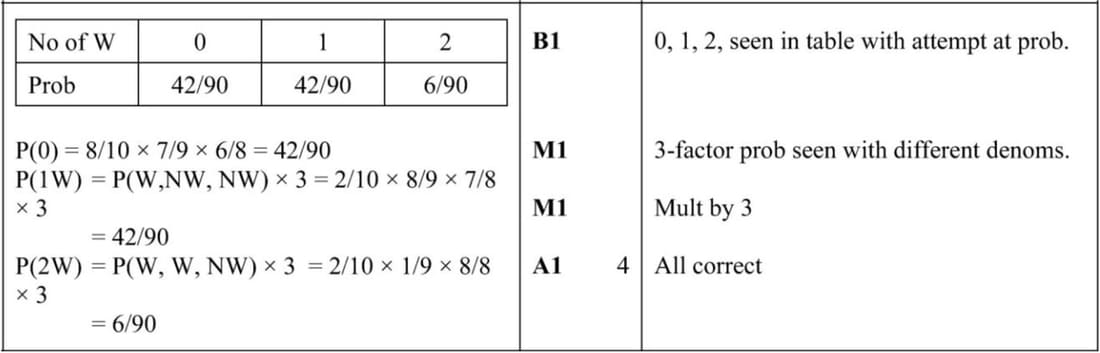
A flower shop has 5 yellow roses, 3 red roses and 2 white roses. Martin chooses 3 roses at random. Draw up the probability distribution table for the number of white roses Martin chooses.
Nov 2015 p62 q6
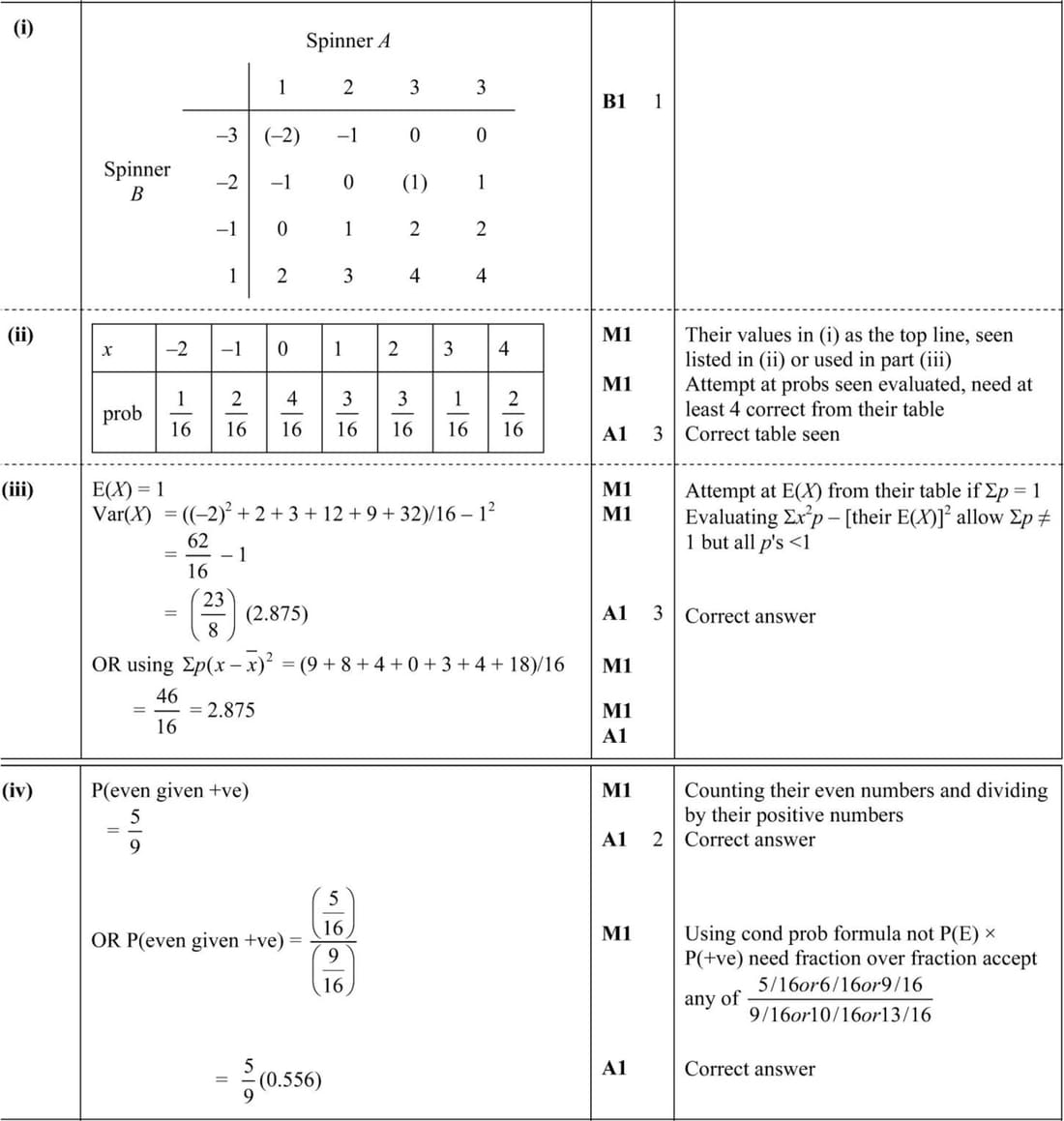
A fair spinner A has edges numbered 1, 2, 3, 3. A fair spinner B has edges numbered -3, -2, -1, 1. Each spinner is spun. The number on the edge that the spinner comes to rest on is noted. Let X be the sum of the numbers for the two spinners.
- Copy and complete the table showing the possible values of X.
| Spinner A | ||||
|---|---|---|---|---|
| Spinner B | 1 | 2 | 3 | 3 |
| -3 | -2 | |||
| -2 | 1 | |||
| -1 | ||||
| 1 | ||||
- Draw up a table showing the probability distribution of X.
- Find Var(X).
- Find the probability that X is even, given that X is positive.
Nov 2015 p61 q6
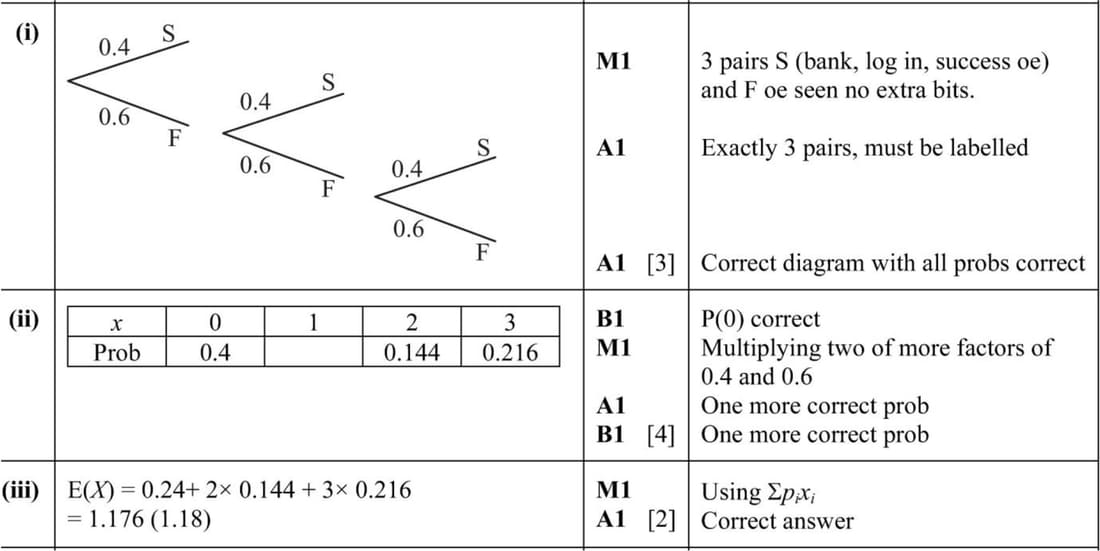
Nadia is very forgetful. Every time she logs in to her online bank she only has a 40% chance of remembering her password correctly. She is allowed 3 unsuccessful attempts on any one day and then the bank will not let her try again until the next day.
- Draw a fully labelled tree diagram to illustrate this situation. [3]
- Let \(X\) be the number of unsuccessful attempts Nadia makes on any day that she tries to log in to her bank. Copy and complete the following table to show the probability distribution of \(X\). [4]
| \(x\) | 0 | 1 | 2 | 3 |
|---|---|---|---|---|
| \(P(X = x)\) | 0.24 |
- Calculate the expected number of unsuccessful attempts made by Nadia on any day that she tries to log in. [2]
June 2015 p63 q4
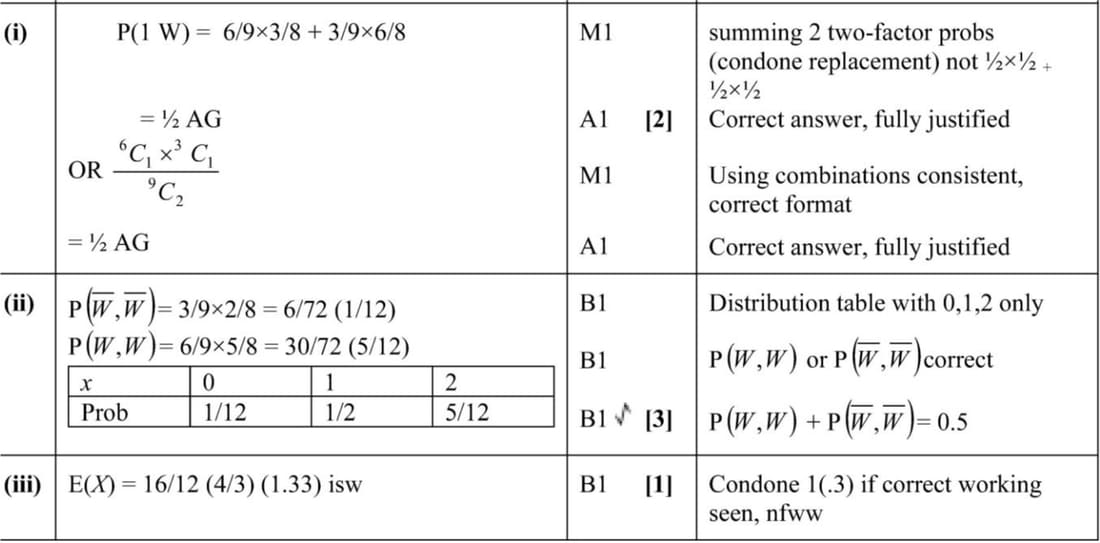
A pet shop has 9 rabbits for sale, 6 of which are white. A random sample of two rabbits is chosen without replacement.
- Show that the probability that exactly one of the two rabbits in the sample is white is \(\frac{1}{2}\).
- Construct the probability distribution table for the number of white rabbits in the sample.
- Find the expected value of the number of white rabbits in the sample.
June 2015 p62 q5
A box contains 5 discs, numbered 1, 2, 4, 6, 7. William takes 3 discs at random, without replacement, and notes the numbers on the discs.
The smallest of the numbers on the 3 discs taken is denoted by the random variable \(S\).
By listing all possible selections (126, 246 and so on) draw up the probability distribution table for \(S\).

Nov 2014 p63 q7
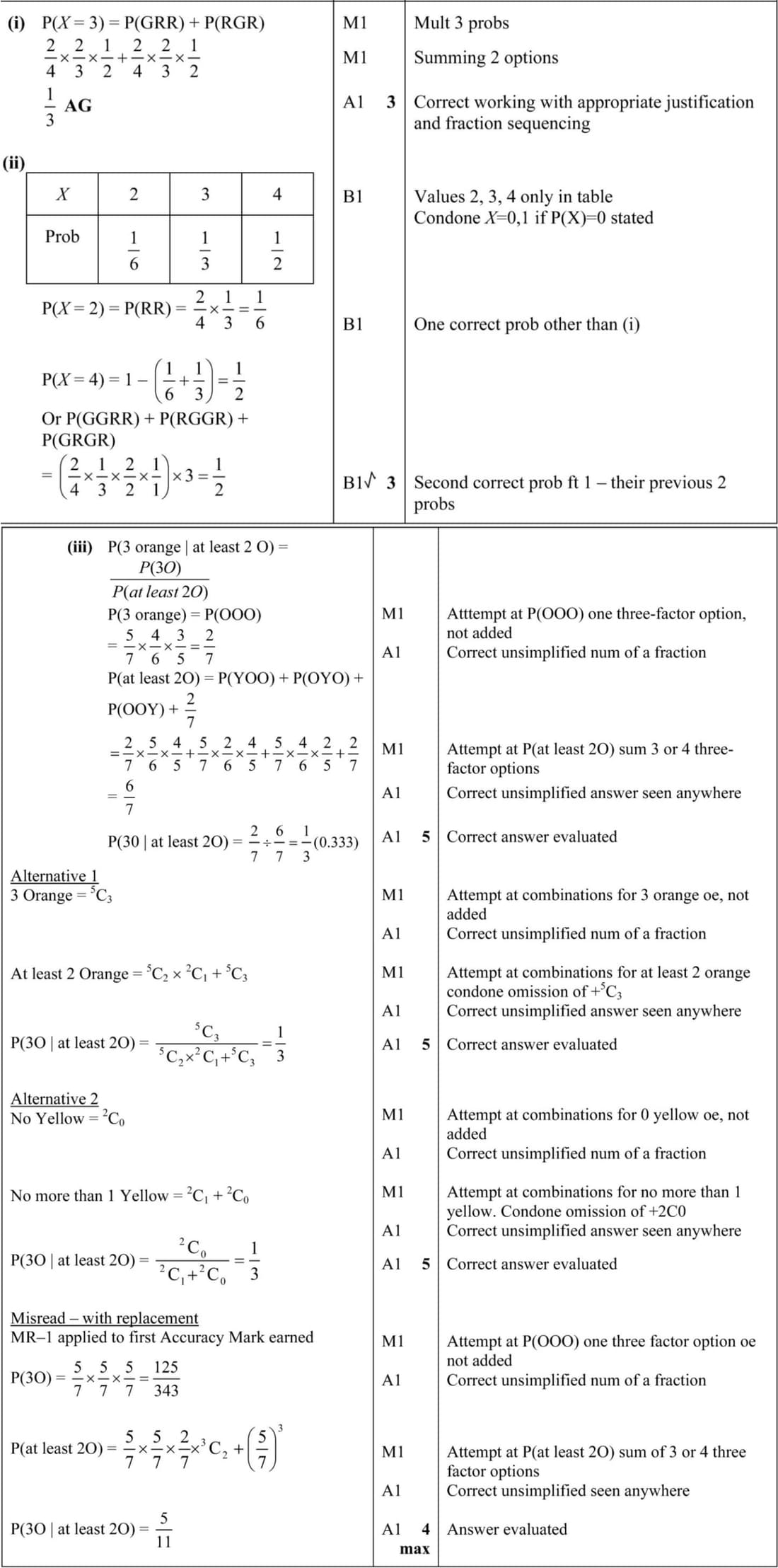
A box contains 2 green apples and 2 red apples. Apples are taken from the box, one at a time, without replacement. When both red apples have been taken, the process stops. The random variable X is the number of apples which have been taken when the process stops.
- Show that \(P(X = 3) = \frac{1}{3}\).
- Draw up the probability distribution table for \(X\).
Another box contains 2 yellow peppers and 5 orange peppers. Three peppers are taken at random from the box without replacement.
- Given that at least 2 of the peppers taken from the box are orange, find the probability that all 3 peppers are orange.
Nov 2014 p62 q4
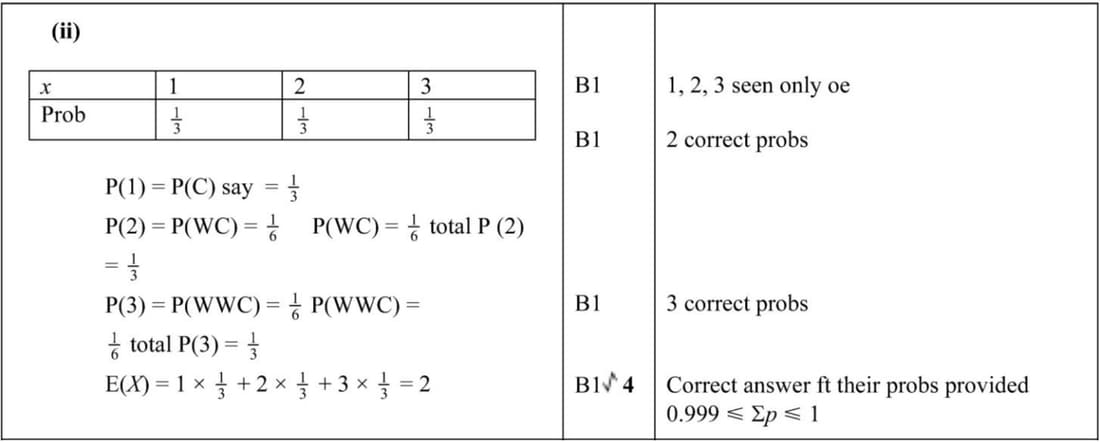
Sharik attempts a multiple choice revision question on-line. There are 3 suggested answers, one of which is correct. When Sharik chooses an answer the computer indicates whether the answer is right or wrong. Sharik first chooses one of the three suggested answers at random. If this answer is wrong, he has a second try, choosing an answer at random from the remaining 2. If this answer is also wrong Sharik then chooses the remaining answer, which must be correct.
The random variable \(X\) is the number of attempts that Sharik makes up to and including the one that the computer indicates is correct. Draw up the probability distribution table for \(X\) and find \(E(X)\).
June 2014 p63 q3
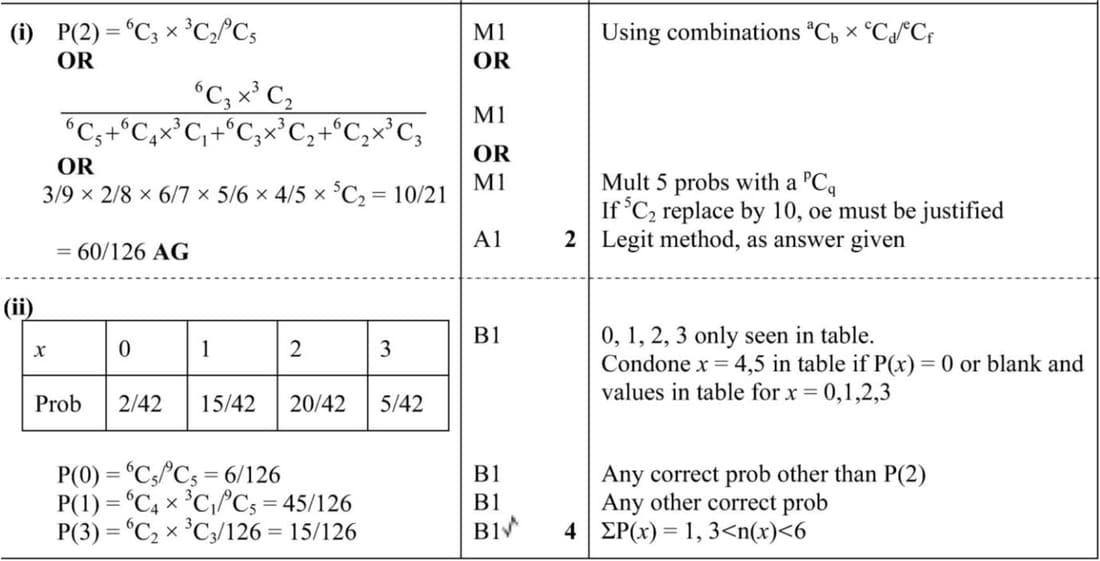
A pet shop has 6 rabbits and 3 hamsters. 5 of these pets are chosen at random. The random variable X represents the number of hamsters chosen.
- Show that the probability that exactly 2 hamsters are chosen is \(\frac{10}{21}\).
- Draw up the probability distribution table for X.
Nov 2022 p52 q5
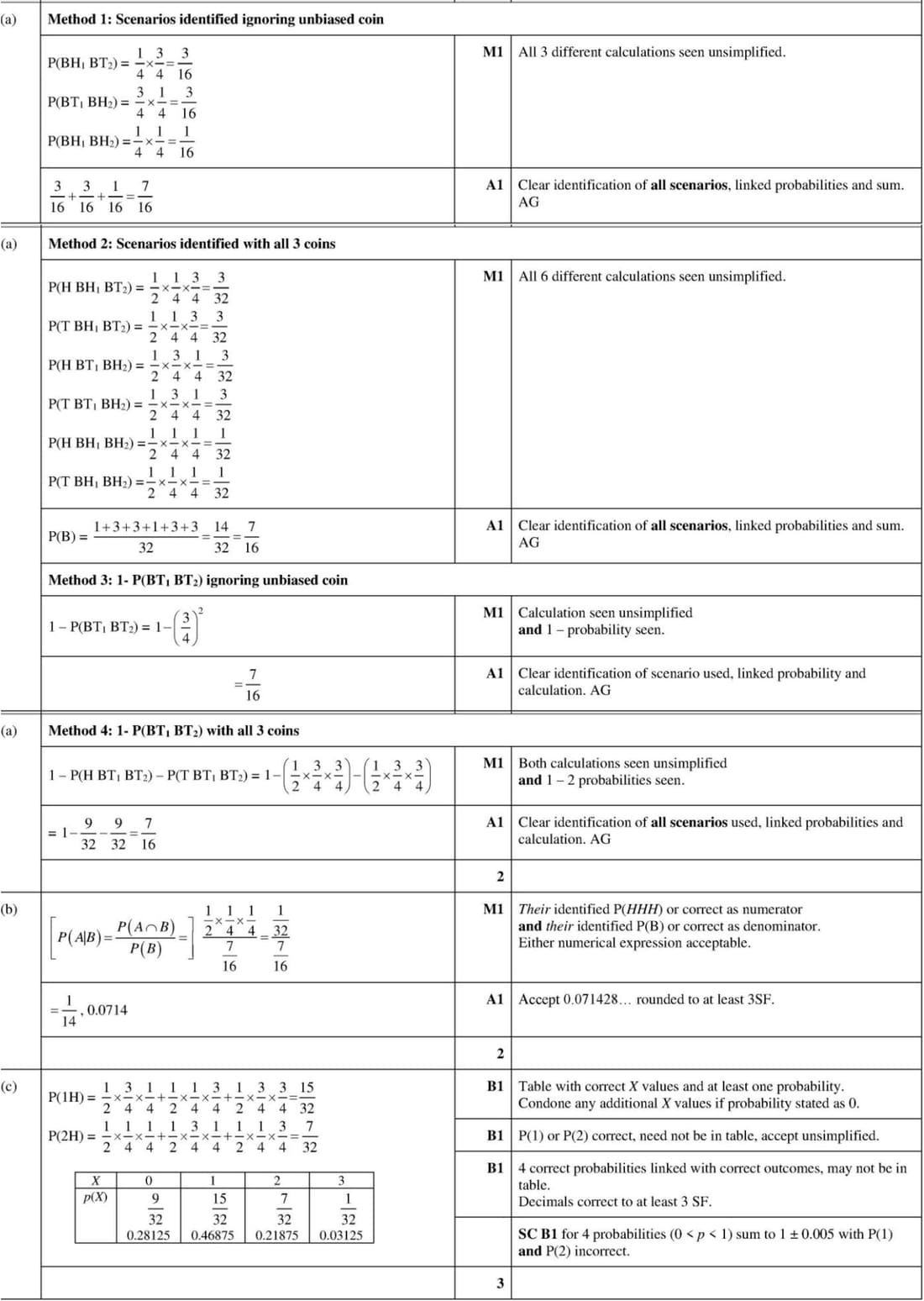
Eric has three coins. One of the coins is fair. The other two coins are each biased so that the probability of obtaining a head on any throw is \(\frac{1}{4}\), independently of all other throws. Eric throws all three coins at the same time.
Events \(A\) and \(B\) are defined as follows.
\(A\): all three coins show the same result
\(B\): at least one of the biased coins shows a head
(a) Show that \(P(B) = \frac{7}{16}\).
(b) Find \(P(A \mid B)\).
The random variable \(X\) is the number of heads obtained when Eric throws the three coins.
(c) Draw up the probability distribution table for \(X\).
June 2014 p62 q4
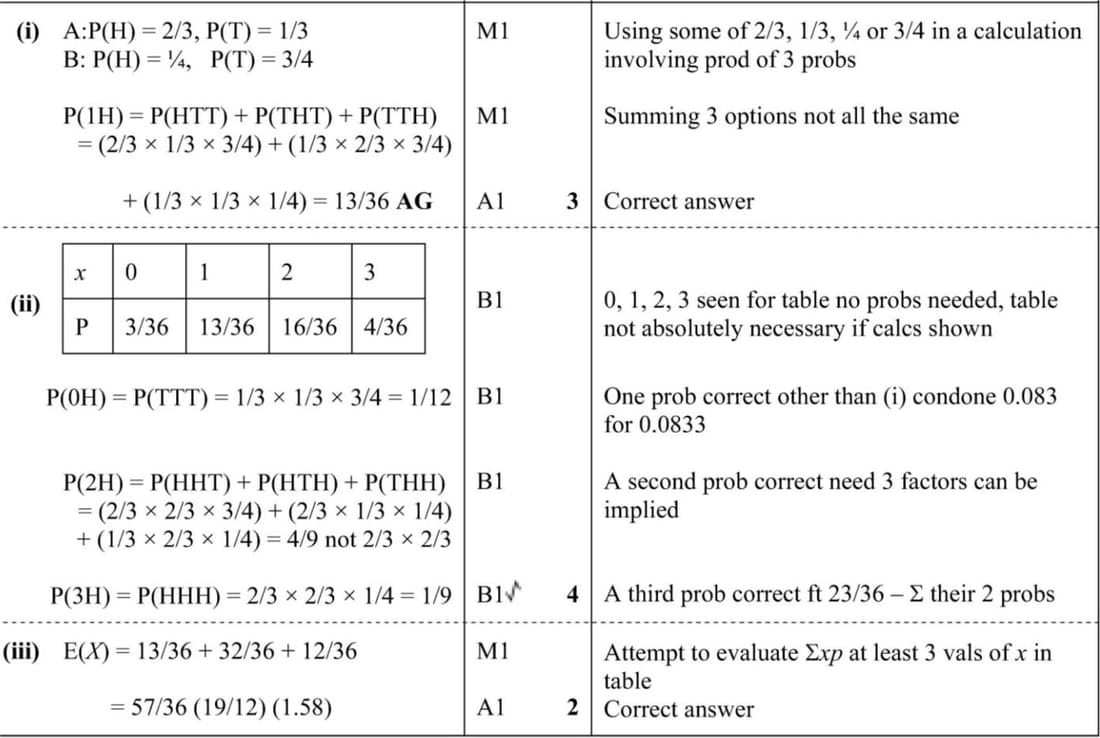
Coin A is weighted so that the probability of throwing a head is \(\frac{2}{3}\). Coin B is weighted so that the probability of throwing a head is \(\frac{1}{4}\). Coin A is thrown twice and coin B is thrown once.
- Show that the probability of obtaining exactly 1 head and 2 tails is \(\frac{13}{36}\).
- Draw up the probability distribution table for the number of heads obtained.
- Find the expectation of the number of heads obtained.
June 2014 p61 q4
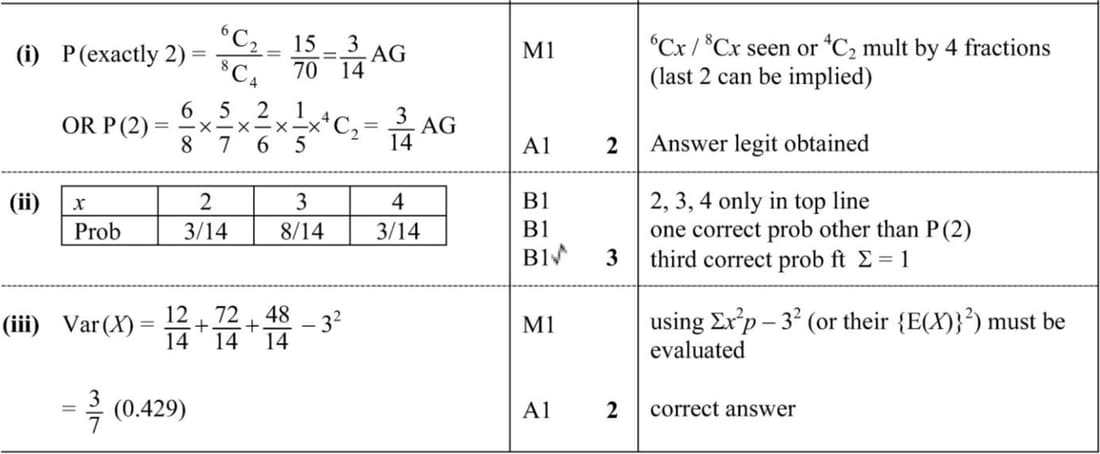
A book club sends 6 paperback and 2 hardback books to Mrs Hunt. She chooses 4 of these books at random to take with her on holiday. The random variable X represents the number of paperback books she chooses.
- Show that the probability that she chooses exactly 2 paperback books is \(\frac{3}{14}\).
- Draw up the probability distribution table for X.
- You are given that \(E(X) = 3\). Find \(\text{Var}(X)\).
Nov 2013 p63 q7
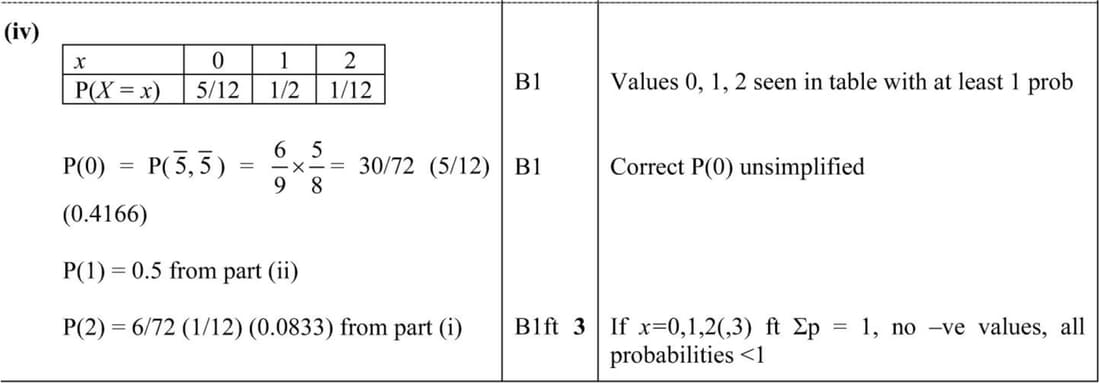
Dayo chooses two digits at random, without replacement, from the 9-digit number 113 333 555.
The random variable \(X\) is the number of 5s that Dayo chooses. Draw up a table to show the probability distribution of \(X\).
Nov 2013 p62 q7
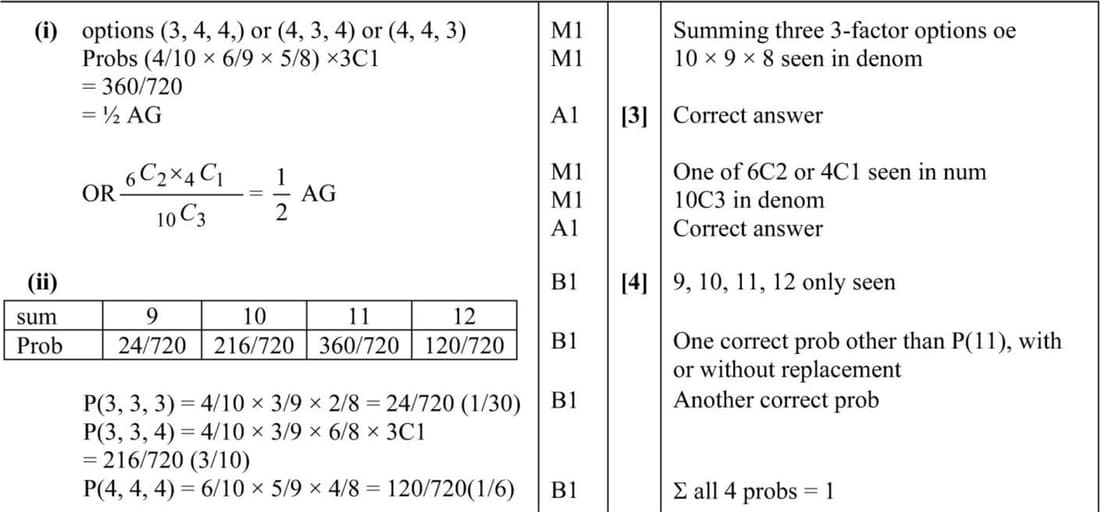
Rory has 10 cards. Four of the cards have a 3 printed on them and six of the cards have a 4 printed on them. He takes three cards at random, without replacement, and adds up the numbers on the cards.
- Show that P(the sum of the numbers on the three cards is 11) = \(\frac{1}{2}\).
- Draw up a probability distribution table for the sum of the numbers on the three cards.
Nov 2013 p61 q7
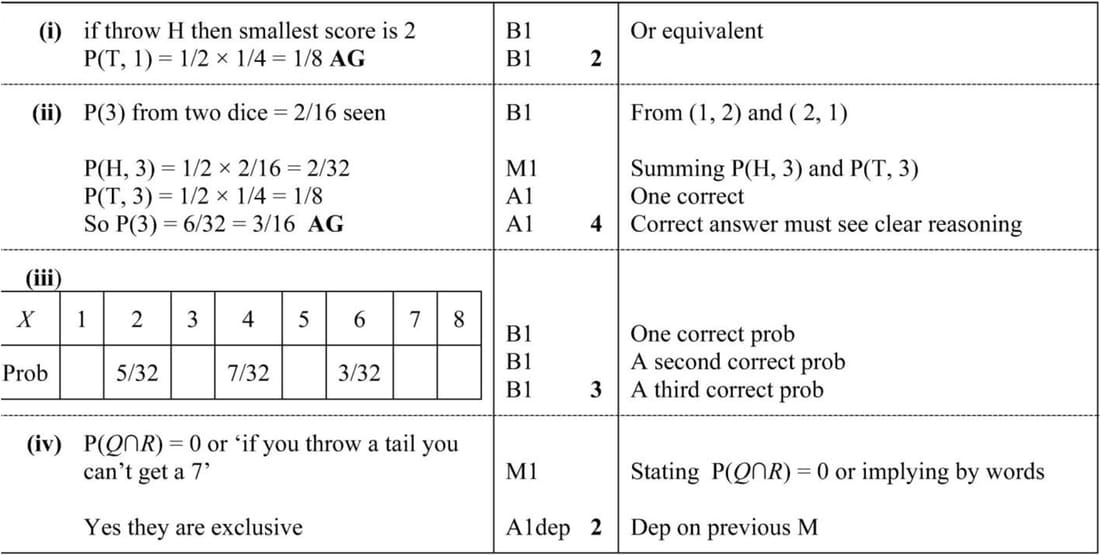
James has a fair coin and a fair tetrahedral die with four faces numbered 1, 2, 3, 4. He tosses the coin once and the die twice. The random variable X is defined as follows.
- If the coin shows a head then X is the sum of the scores on the two throws of the die.
- If the coin shows a tail then X is the score on the first throw of the die only.
(i) Explain why X = 1 can only be obtained by throwing a tail, and show that P(X = 1) = \(\frac{1}{8}\).
(ii) Show that P(X = 3) = \(\frac{3}{16}\).
(iii) Copy and complete the probability distribution table for X.
| x | 1 | 2 | 3 | 4 | 5 | 6 | 7 | 8 |
|---|---|---|---|---|---|---|---|---|
| P(X = x) | \(\frac{1}{8}\) | \(\frac{3}{16}\) | \(\frac{1}{8}\) |
Event Q is ‘James throws a tail’. Event R is ‘the value of X is 7’.
(iv) Determine whether events Q and R are exclusive. Justify your answer.
June 2013 p62 q7
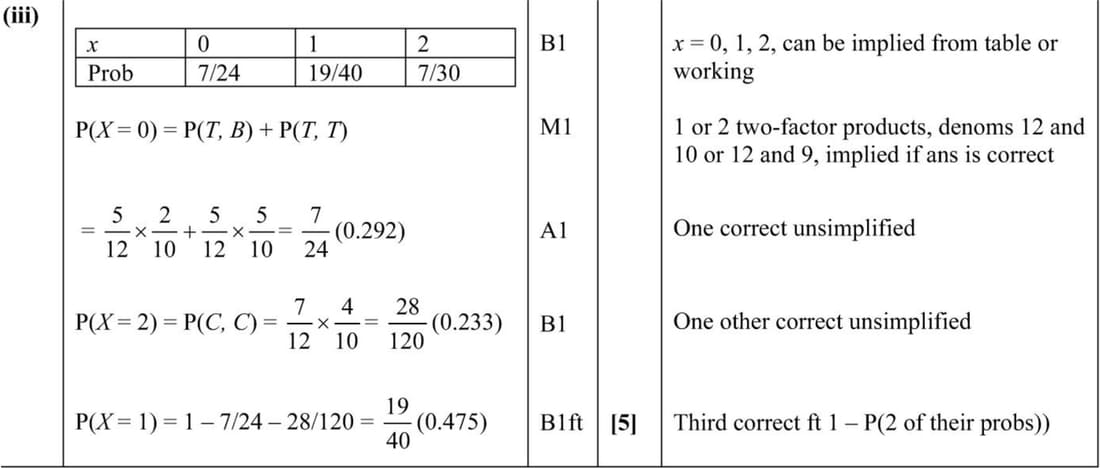
Susan has a bag of sweets containing 7 chocolates and 5 toffees. Ahmad has a bag of sweets containing 3 chocolates, 4 toffees and 2 boiled sweets. A sweet is taken at random from Susan’s bag and put in Ahmad’s bag. A sweet is then taken at random from Ahmad’s bag.
The random variable X is the number of times a chocolate is taken. State the possible values of X and draw up a table to show the probability distribution of X.
Nov 2012 p62 q6
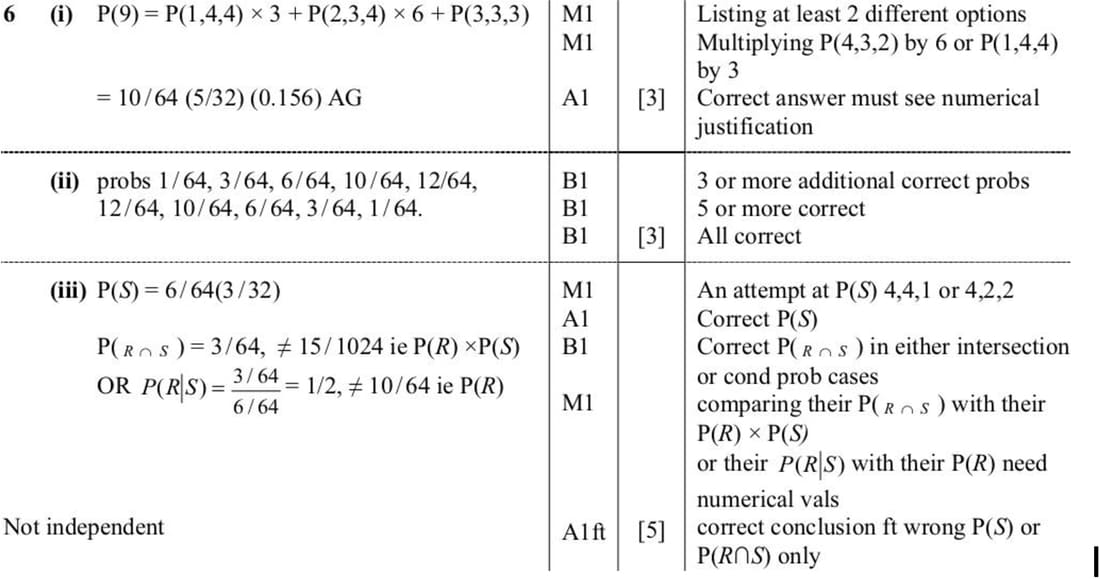
A fair tetrahedral die has four triangular faces, numbered 1, 2, 3, and 4. The score when this die is thrown is the number on the face that the die lands on. This die is thrown three times. The random variable X is the sum of the three scores.
(i) Show that \(P(X = 9) = \frac{10}{64}\).
(ii) Copy and complete the probability distribution table for \(X\).
| x | 3 | 4 | 5 | 6 | 7 | 8 | 9 | 10 | 11 | 12 |
|---|---|---|---|---|---|---|---|---|---|---|
| \(P(X = x)\) | \(\frac{1}{64}\) | \(\frac{3}{64}\) | \(\frac{12}{64}\) |
(iii) Event \(R\) is ‘the sum of the three scores is 9’. Event \(S\) is ‘the product of the three scores is 16’. Determine whether events \(R\) and \(S\) are independent, showing your working.
Nov 2012 p61 q1
Ashok has 3 green pens and 7 red pens. His friend Rod takes 3 of these pens at random, without replacement. Draw up a probability distribution table for the number of green pens Rod takes.

June 2012 p63 q4
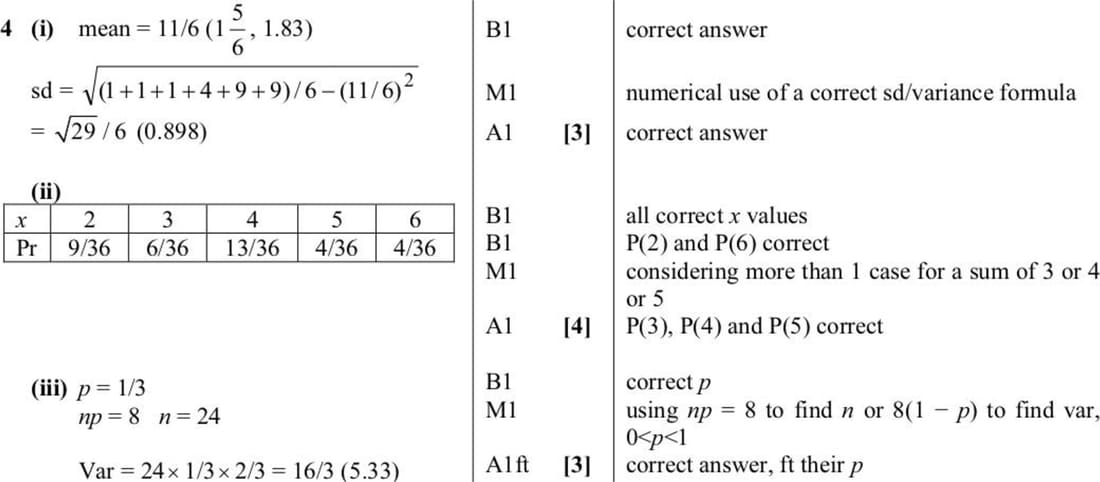
The six faces of a fair die are numbered 1, 1, 1, 2, 3, 3. The score for a throw of the die, denoted by the random variable W, is the number on the top face after the die has landed.
- Find the mean and standard deviation of W. [3]
- The die is thrown twice and the random variable X is the sum of the two scores. Draw up a probability distribution table for X. [4]
- The die is thrown n times. The random variable Y is the number of times that the score is 3. Given that E(Y) = 8, find Var(Y). [3]
June 2012 p62 q2
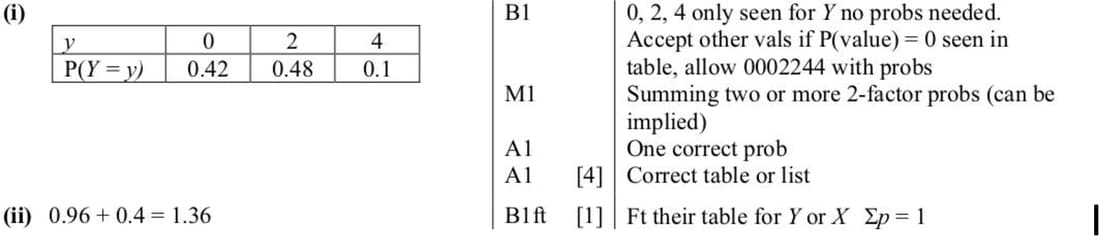
The random variable X has the probability distribution shown in the table.
| x | 2 | 4 | 6 |
|---|---|---|---|
| P(X = x) | 0.5 | 0.4 | 0.1 |
Two independent values of X are chosen at random. The random variable Y takes the value 0 if the two values of X are the same. Otherwise the value of Y is the larger value of X minus the smaller value of X.
- Draw up the probability distribution table for Y.
- Find the expected value of Y.
June 2022 p53 q3
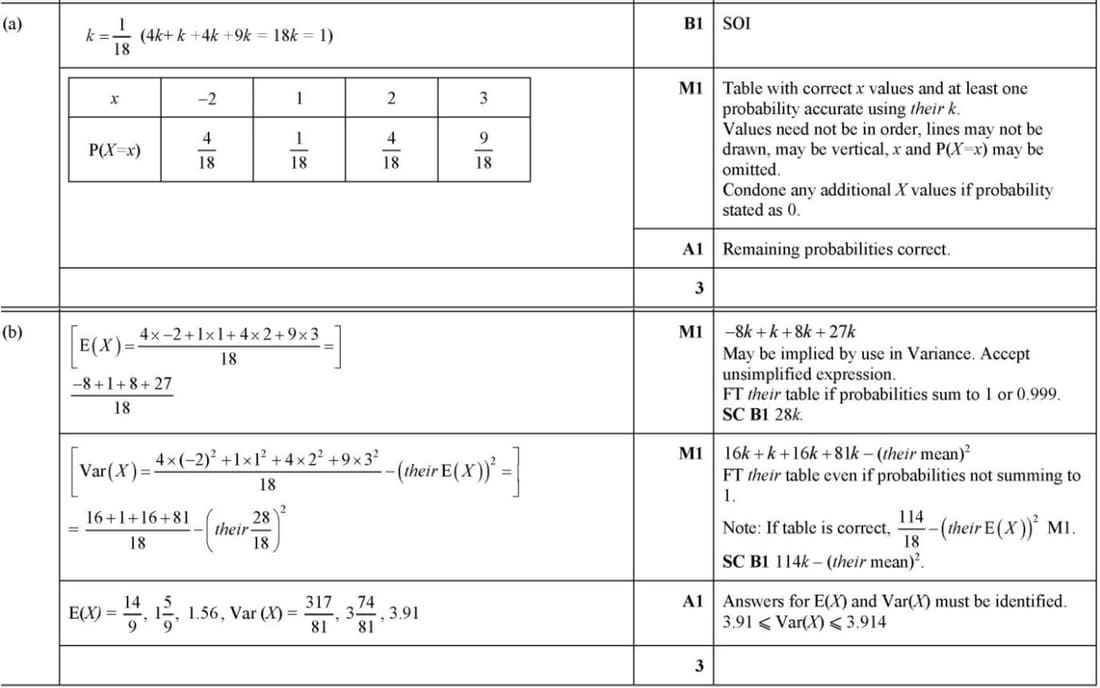
The random variable X takes the values −2, 1, 2, 3. It is given that \(P(X = x) = kx^2\), where \(k\) is a constant.
- Draw up the probability distribution table for X, giving the probabilities as numerical fractions.
- Find \(E(X)\) and \(\text{Var}(X)\).
Nov 2011 p63 q3
A factory makes a large number of ropes with lengths either 3 m or 5 m. There are four times as many ropes of length 3 m as there are ropes of length 5 m.
One rope is chosen at random. Find the expectation and variance of its length.

Nov 2011 p61 q3
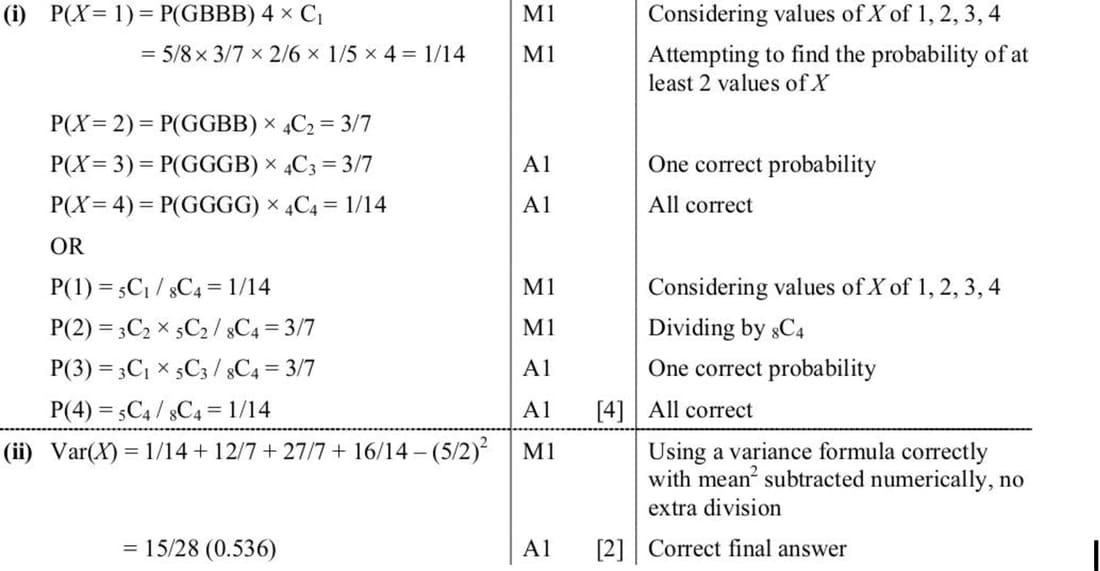
A team of 4 is to be randomly chosen from 3 boys and 5 girls. The random variable \(X\) is the number of girls in the team.
- Draw up a probability distribution table for \(X\).
- Given that \(E(X) = \frac{5}{2}\), calculate \(\text{Var}(X)\).
June 2011 p62 q7
Judy and Steve play a game using five cards numbered 3, 4, 5, 8, 9. Judy chooses a card at random, looks at the number on it and replaces the card. Then Steve chooses a card at random, looks at the number on it and replaces the card. If their two numbers are equal the score is 0. Otherwise, the smaller number is subtracted from the larger number to give the score.
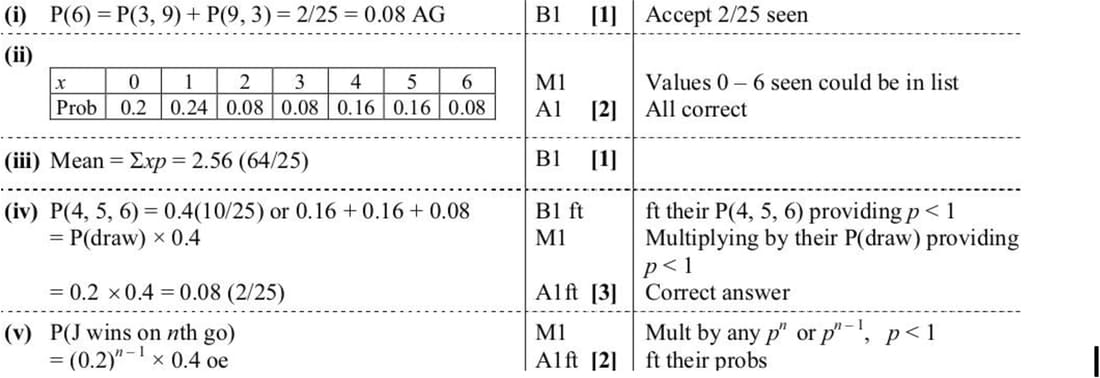
(i) Show that the probability that the score is 6 is 0.08.
(ii) Draw up a probability distribution table for the score.
(iii) Calculate the mean score.
If the score is 0 they play again. If the score is 4 or more Judy wins. Otherwise Steve wins. They continue playing until one of the players wins.
(iv) Find the probability that Judy wins with the second choice of cards.
(v) Find an expression for the probability that Judy wins with the nth choice of cards.
Nov 2010 p63 q2
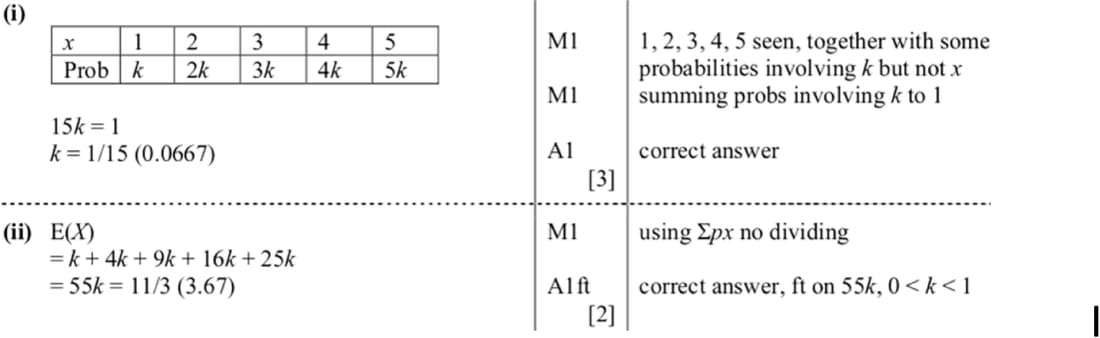
In a probability distribution the random variable \(X\) takes the value \(x\) with probability \(kx\), where \(x\) takes values 1, 2, 3, 4, 5 only.
- Draw up a probability distribution table for \(X\), in terms of \(k\), and find the value of \(k\).
- Find \(E(X)\).
June 2010 p63 q5
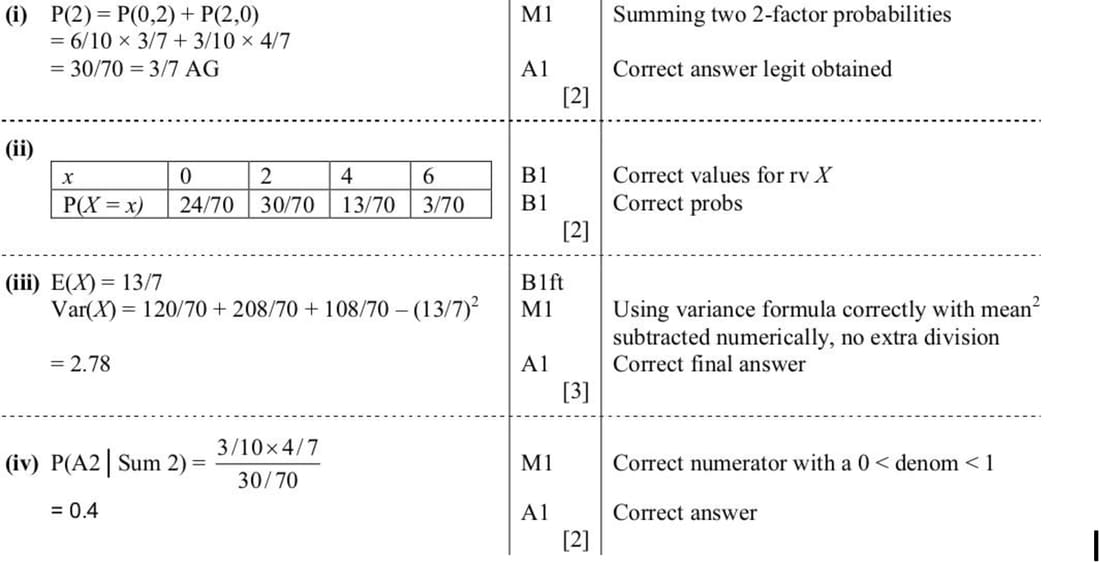
Set A consists of the ten digits 0, 0, 0, 0, 0, 0, 2, 2, 2, 4.
Set B consists of the seven digits 0, 0, 0, 0, 2, 2, 2.
One digit is chosen at random from each set. The random variable X is defined as the sum of these two digits.
- Show that \(P(X = 2) = \frac{3}{7}\).
- Tabulate the probability distribution of X.
- Find \(E(X)\) and \(\text{Var}(X)\).
- Given that \(X = 2\), find the probability that the digit chosen from set A was 2.
June 2010 p62 q6
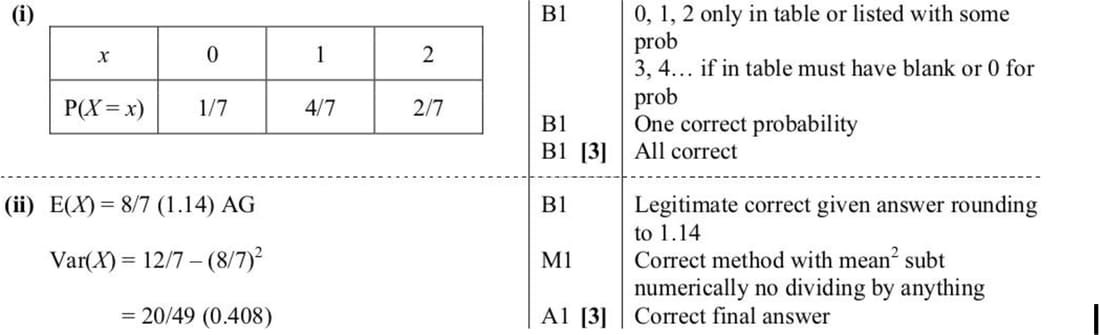
A small farm has 5 ducks and 2 geese. Four of these birds are to be chosen at random. The random variable \(X\) represents the number of geese chosen.
- Draw up the probability distribution of \(X\).
- Show that \(E(X) = \frac{8}{7}\) and calculate \(\text{Var}(X)\).
Nov 2009 p62 q5
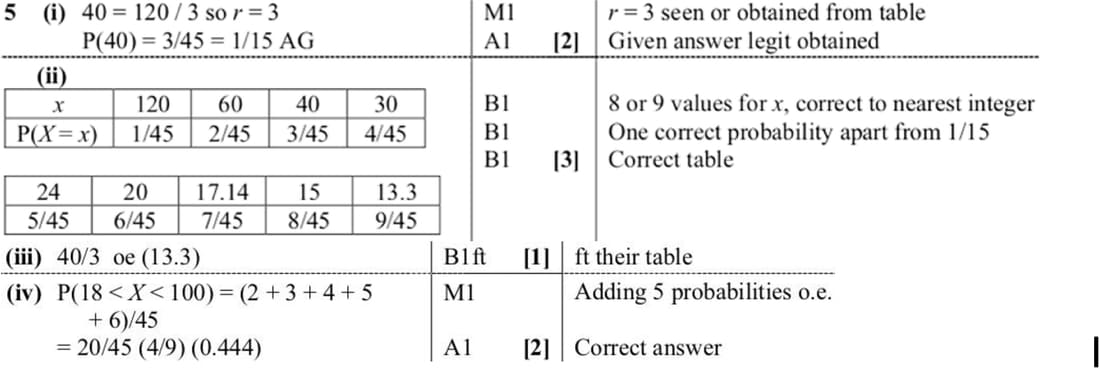
In a particular discrete probability distribution the random variable \(X\) takes the value \(\frac{120}{r}\) with probability \(\frac{r}{45}\), where \(r\) takes all integer values from 1 to 9 inclusive.
- Show that \(P(X = 40) = \frac{1}{15}\).
- Construct the probability distribution table for \(X\).
- Which is the modal value of \(X\)?
- Find the probability that \(X\) lies between 18 and 100.
Nov 2008 p6 q7
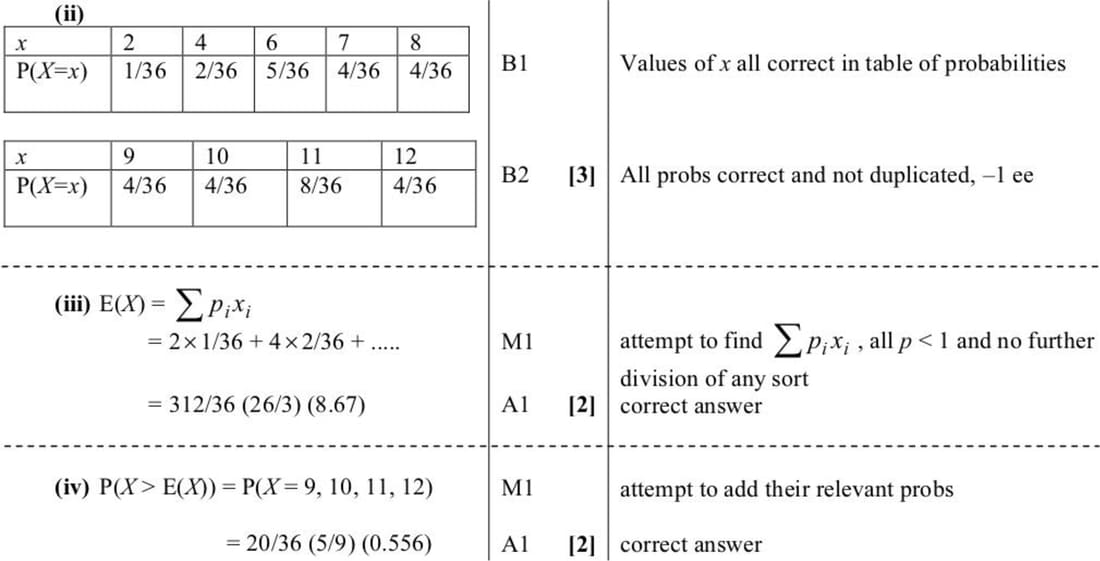
A fair die has one face numbered 1, one face numbered 3, two faces numbered 5 and two faces numbered 6.
The die is thrown twice. Let \(X\) be the sum of the two scores. The following table shows the possible values of \(X\).
| Second throw | ||||||
|---|---|---|---|---|---|---|
| First throw | 1 | 3 | 5 | 5 | 6 | 6 |
| 1 | 2 | 4 | 6 | 6 | 7 | 7 |
| 3 | 4 | 6 | 8 | 8 | 9 | 9 |
| 5 | 6 | 8 | 10 | 10 | 11 | 11 |
| 5 | 6 | 8 | 10 | 10 | 11 | 11 |
| 6 | 7 | 9 | 11 | 11 | 12 | 12 |
| 6 | 7 | 9 | 11 | 11 | 12 | 12 |
- Draw up a table showing the probability distribution of \(X\).
- Calculate \(E(X)\).
- Find the probability that \(X\) is greater than \(E(X)\).
June 2008 p6 q6
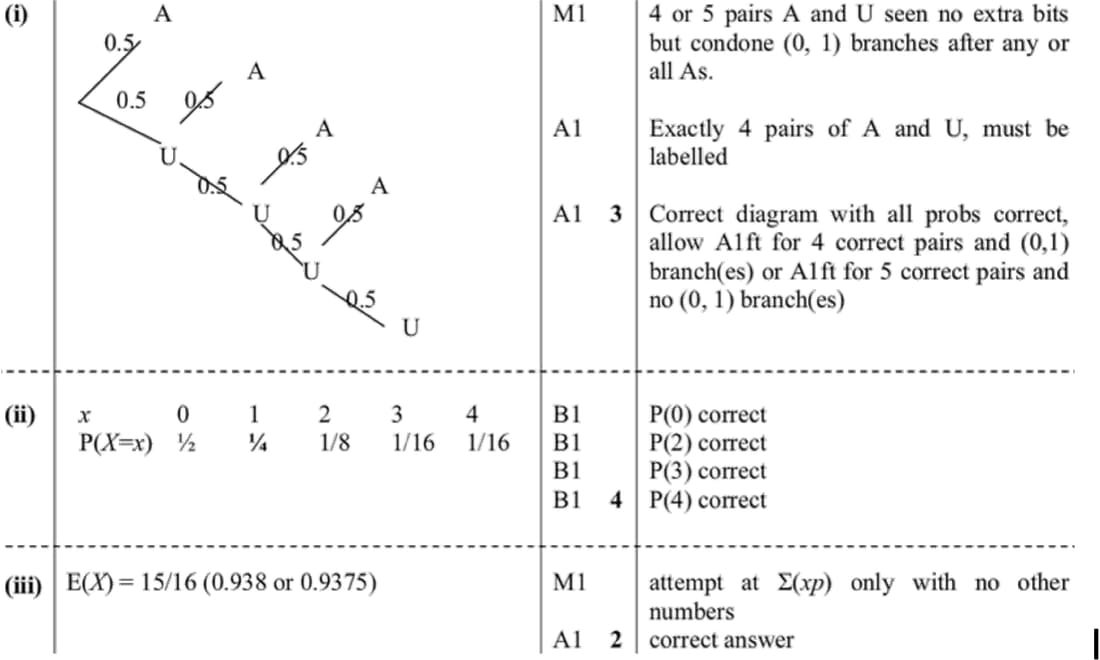
Every day Eduardo tries to phone his friend. Every time he phones there is a 50% chance that his friend will answer. If his friend answers, Eduardo does not phone again on that day. If his friend does not answer, Eduardo tries again in a few minutes’ time. If his friend has not answered after 4 attempts, Eduardo does not try again on that day.
(i) Draw a tree diagram to illustrate this situation.
(ii) Let \(X\) be the number of unanswered phone calls made by Eduardo on a day. Copy and complete the table showing the probability distribution of \(X\).
| \(x\) | 0 | 1 | 2 | 3 | 4 |
|---|---|---|---|---|---|
| \(P(X = x)\) | \(\frac{1}{4}\) |
(iii) Calculate the expected number of unanswered phone calls on a day.
Nov 2007 p6 q7
Box A contains 5 red paper clips and 1 white paper clip. Box B contains 7 red paper clips and 2 white paper clips. One paper clip is taken at random from box A and transferred to box B. One paper clip is then taken at random from box B.
The random variable X denotes the number of times that a red paper clip is taken. Draw up a table to show the probability distribution of X.

June 2022 p52 q2
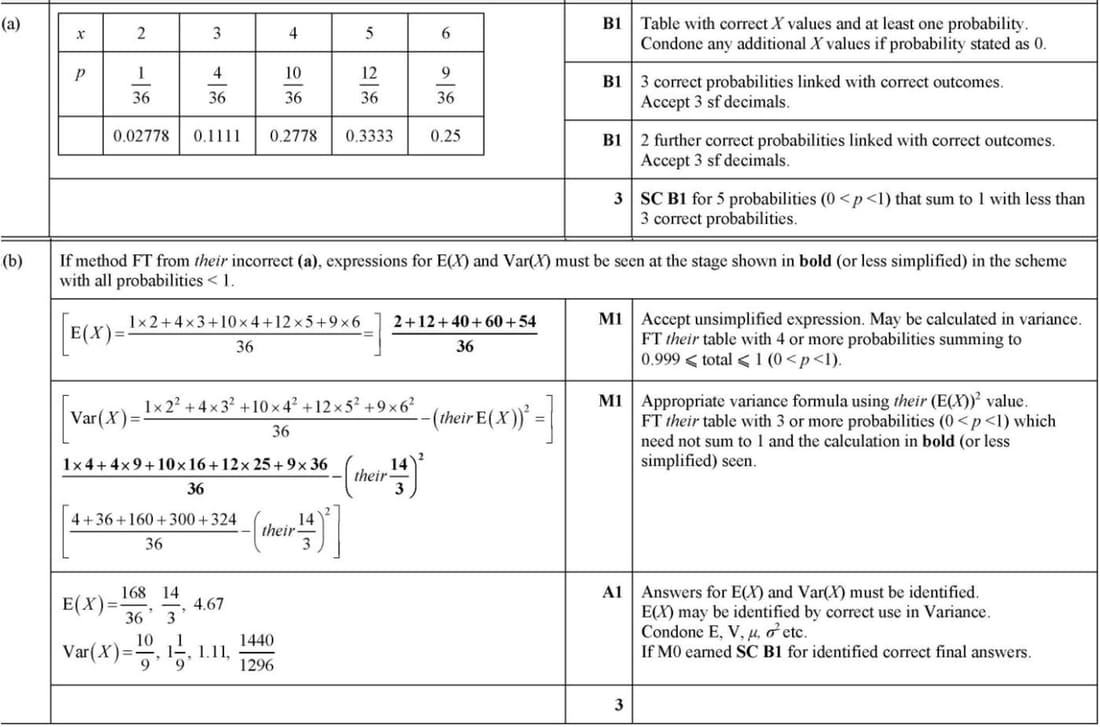
A fair 6-sided die has the numbers 1, 2, 2, 3, 3, 3 on its faces. The die is rolled twice. The random variable X denotes the sum of the two numbers obtained.
(a) Draw up the probability distribution table for X.
(b) Find E(X) and Var(X).
June 2007 p6 q7
A vegetable basket contains 12 peppers, of which 3 are red, 4 are green and 5 are yellow. Three peppers are taken, at random and without replacement, from the basket.
The number of green peppers taken is denoted by the discrete random variable X. Draw up a probability distribution table for X.
Nov 2005 p6 q6
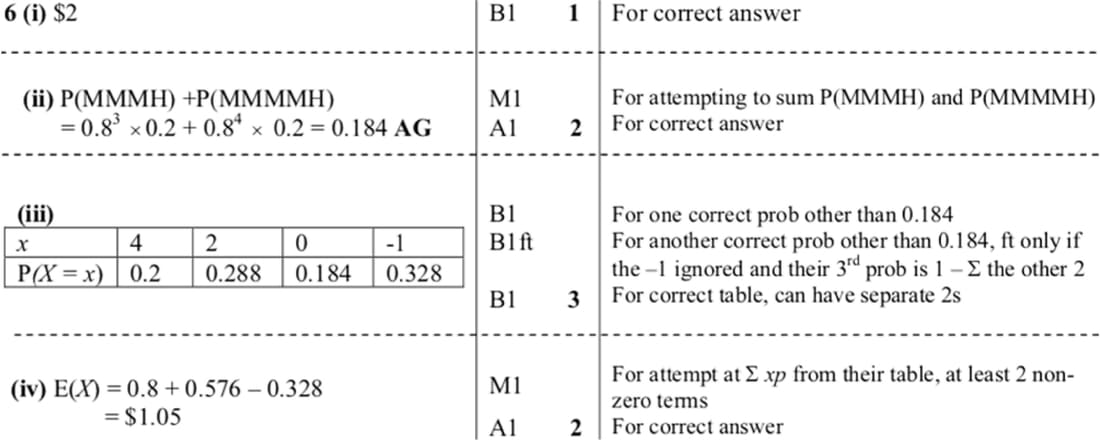
In a competition, people pay $1 to throw a ball at a target. If they hit the target on the first throw they receive $5. If they hit it on the second or third throw they receive $3, and if they hit it on the fourth or fifth throw they receive $1. People stop throwing after the first hit, or after 5 throws if no hit is made. Mario has a constant probability of \(\frac{1}{5}\) of hitting the target on any throw, independently of the results of other throws.
- Mario misses with his first and second throws and hits the target with his third throw. State how much profit he has made.
- Show that the probability that Mario’s profit is $0 is 0.184, correct to 3 significant figures.
- Draw up a probability distribution table for Mario’s profit.
- Calculate his expected profit.
June 2005 p6 q3
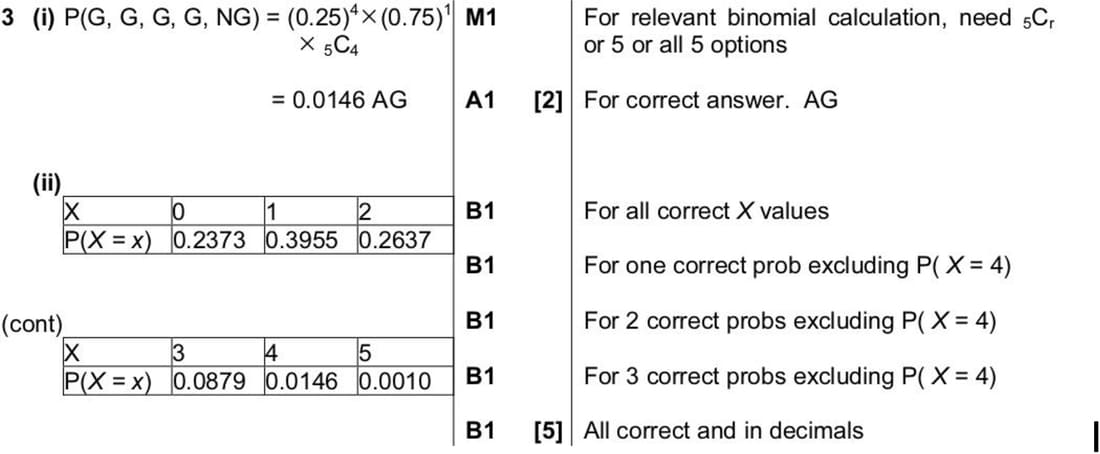
A fair dice has four faces. One face is coloured pink, one is coloured orange, one is coloured green and one is coloured black. Five such dice are thrown and the number that fall on a green face are counted. The random variable \(X\) is the number of dice that fall on a green face.
(i) Show that the probability of 4 dice landing on a green face is 0.0146, correct to 4 decimal places.
(ii) Draw up a table for the probability distribution of \(X\), giving your answers correct to 4 decimal places.
Nov 2004 p6 q6
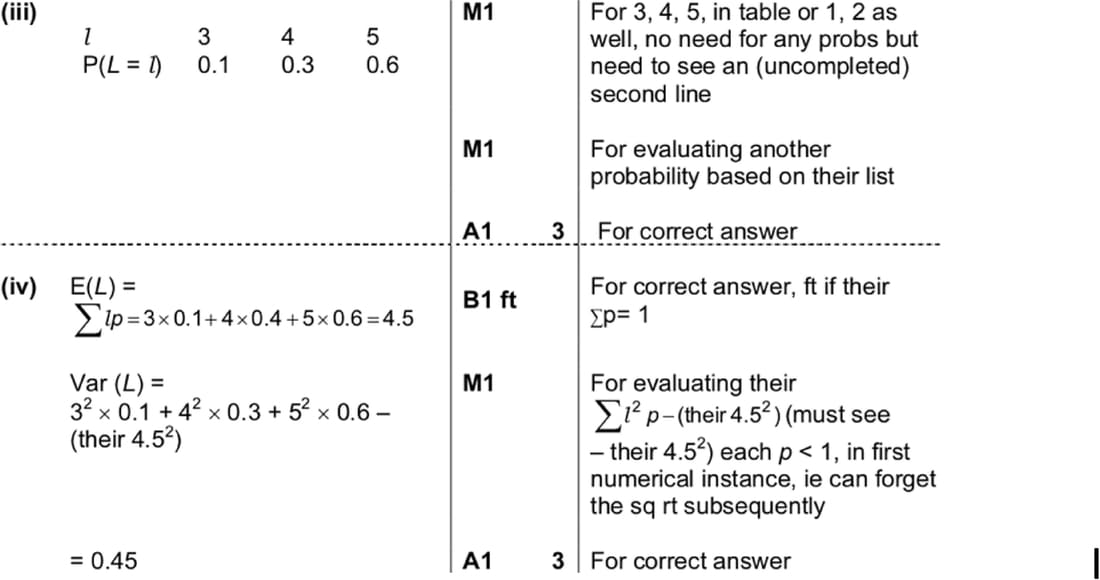
A box contains five balls numbered 1, 2, 3, 4, 5. Three balls are drawn randomly at the same time from the box.
The random variable L denotes the largest of the three numbers drawn.
(iii) Draw up a table to show the probability distribution of L.
(iv) Calculate the expectation and variance of L.
June 2004 p6 q3
Two fair dice are thrown. Let the random variable \(X\) be the smaller of the two scores if the scores are different, or the score on one of the dice if the scores are the same.
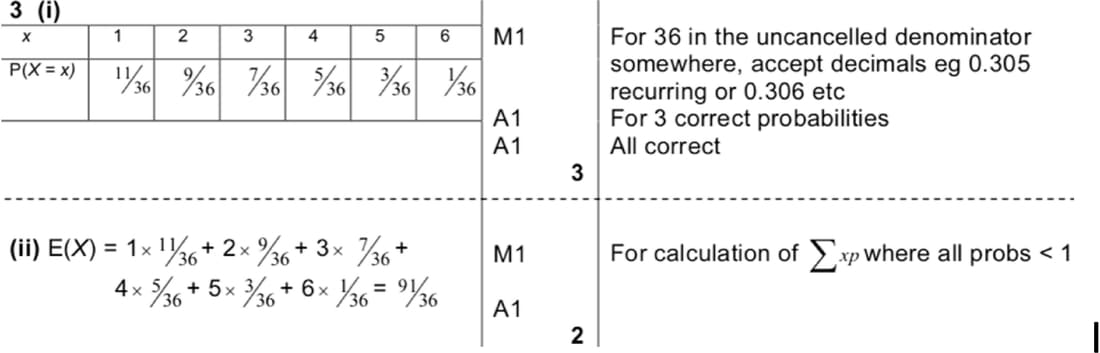
(i) Copy and complete the following table to show the probability distribution of \(X\).
| \(x\) | 1 | 2 | 3 | 4 | 5 | 6 |
|---|---|---|---|---|---|---|
| \(P(X = x)\) |
(ii) Find \(\mathbb{E}(X)\).
June 2003 p6 q2
A box contains 10 pens of which 3 are new. A random sample of two pens is taken.
(ii) Construct a probability distribution table for the number of new pens in the sample.
(iii) Calculate the expected number of new pens in the sample.

June 2002 p6 q3
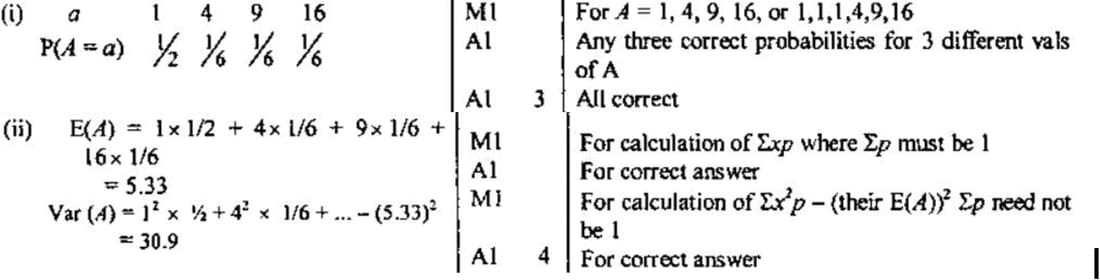
A fair cubical die with faces numbered 1, 1, 1, 2, 3, 4 is thrown and the score noted. The area A of a square of side equal to the score is calculated, so, for example, when the score on the die is 3, the value of A is 9.
(i) Draw up a table to show the probability distribution of A.
(ii) Find E(A) and Var(A).
Feb/Mar 2022 p52 q1
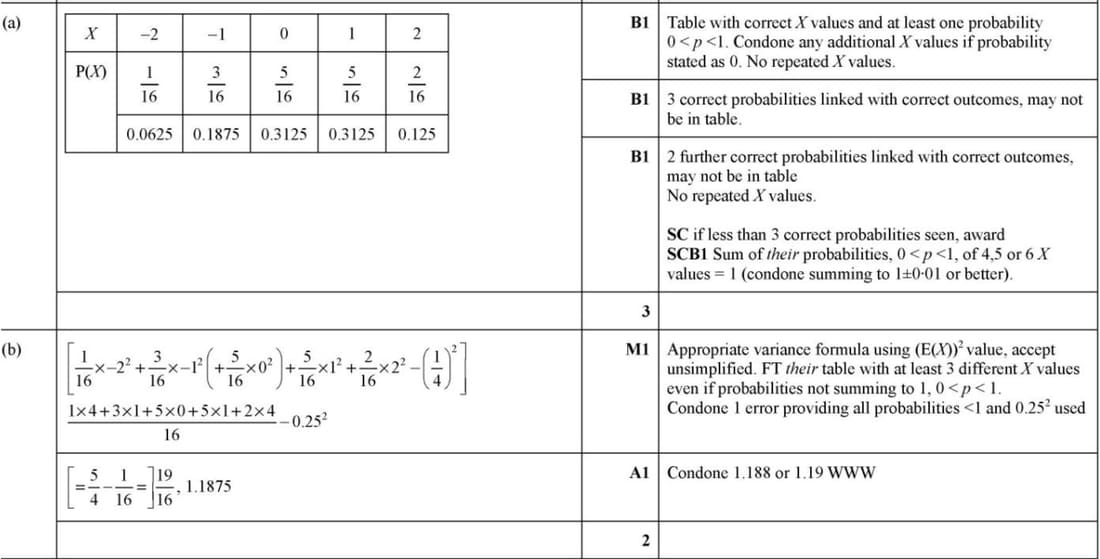
A fair red spinner has edges numbered 1, 2, 2, 3. A fair blue spinner has edges numbered -3, -2, -1, -1. Each spinner is spun once and the number on the edge on which each spinner lands is noted. The random variable X denotes the sum of the resulting two numbers.
(a) Draw up the probability distribution table for X.
(b) Given that \(E(X) = 0.25\), find the value of \(\text{Var}(X)\).
Nov 2021 p52 q3
A bag contains 5 yellow and 4 green marbles. Three marbles are selected at random from the bag, without replacement.
(a) Show that the probability that exactly one of the marbles is yellow is \(\frac{5}{14}\).
The random variable \(X\) is the number of yellow marbles selected.
(b) Draw up the probability distribution table for \(X\).
(c) Find \(E(X)\).