Exam-Style Problems
⬅ Back to SubchapterJune 2022 p31 q6
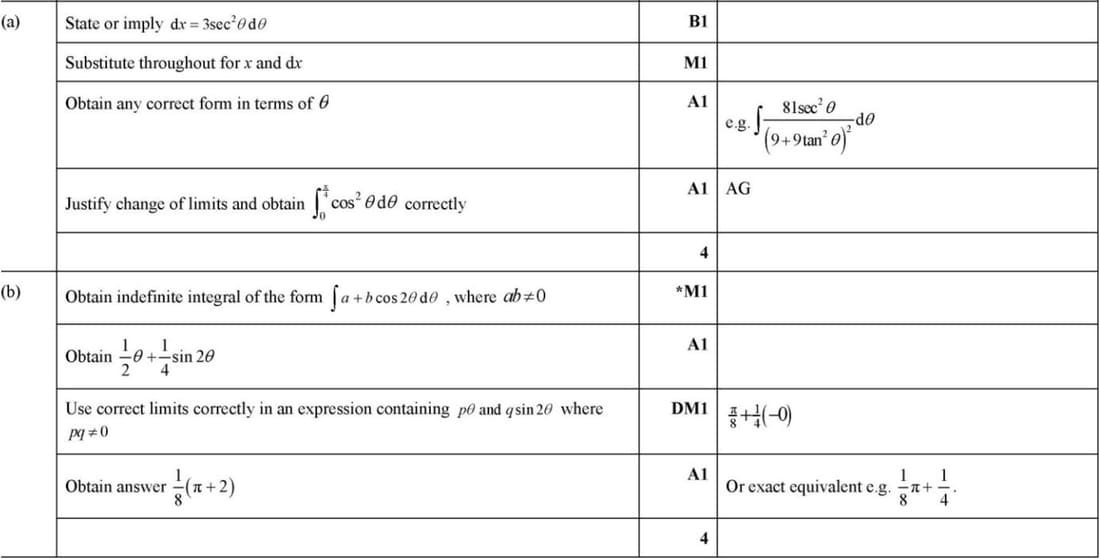
Let \(I = \int_0^3 \frac{27}{(9 + x^2)^2} \, dx\).
(a) Using the substitution \(x = 3 \tan \theta\), show that \(I = \int_0^{\frac{\pi}{4}} \cos^2 \theta \, d\theta\).
(b) Hence find the exact value of \(I\).
June 2014 p31 q2
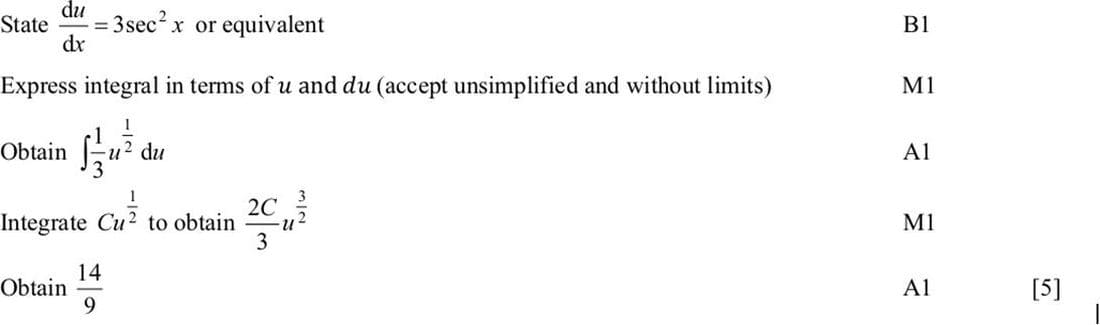
Use the substitution \(u = 1 + 3 \tan x\) to find the exact value of
\(\int_{0}^{\frac{\pi}{4}} \frac{\sqrt{1 + 3 \tan x}}{\cos^2 x} \, dx.\)
Nov 2013 p33 q2
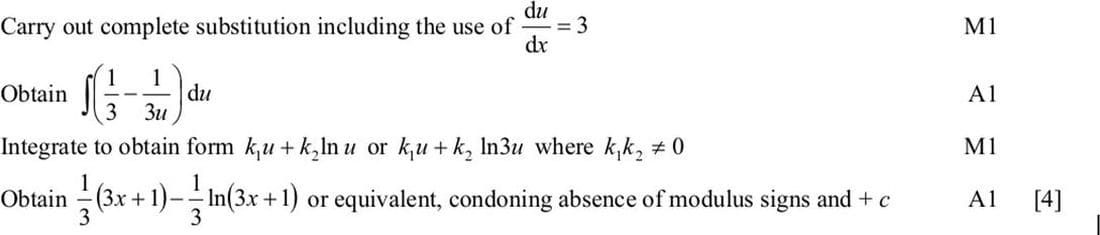
Use the substitution \(u = 3x + 1\) to find \(\int \frac{3x}{3x+1} \, dx\).
Problem 1695
Using the substitution \(x = (\sqrt{3}) \tan \theta\), find the exact value of
\(\int_{1}^{3} \frac{1}{\sqrt{3 + x^2}} \, dx,\)
expressing your answer as a single logarithm.

June 2013 p31 q8
Use the substitution \(u = \\sin 4x\) to find the exact value of \(\int_{0}^{\frac{1}{24}\pi} \cos^3 4x \, dx\).

Nov 2010 p31 q5
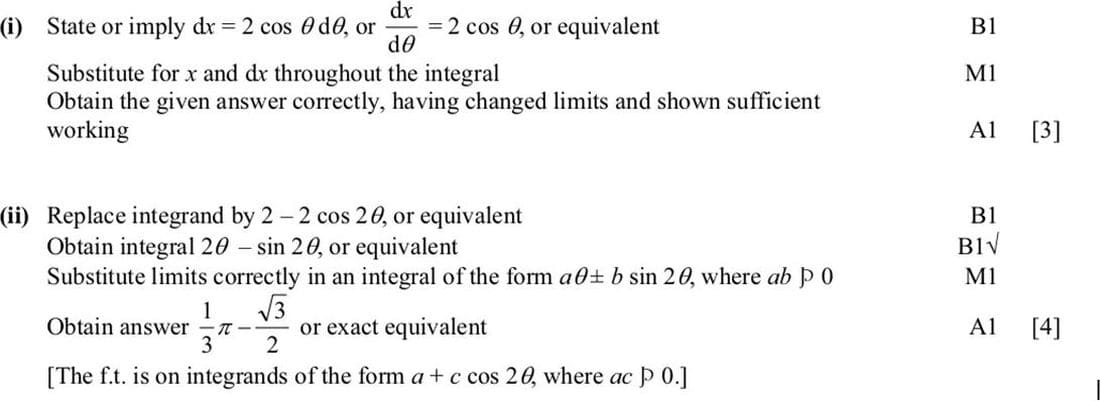
Let \(I = \int_0^1 \frac{x^2}{\sqrt{(4-x^2)}} \, dx\).
(i) Using the substitution \(x = 2 \sin \theta\), show that \(I = \int_0^{\frac{\pi}{6}} 4 \sin^2 \theta \, d\theta\).
(ii) Hence find the exact value of \(I\).
Nov 2009 p32 q6
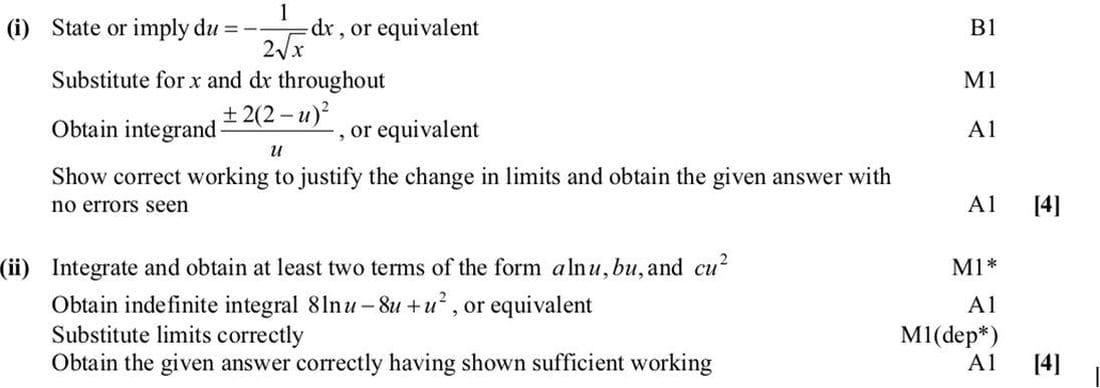
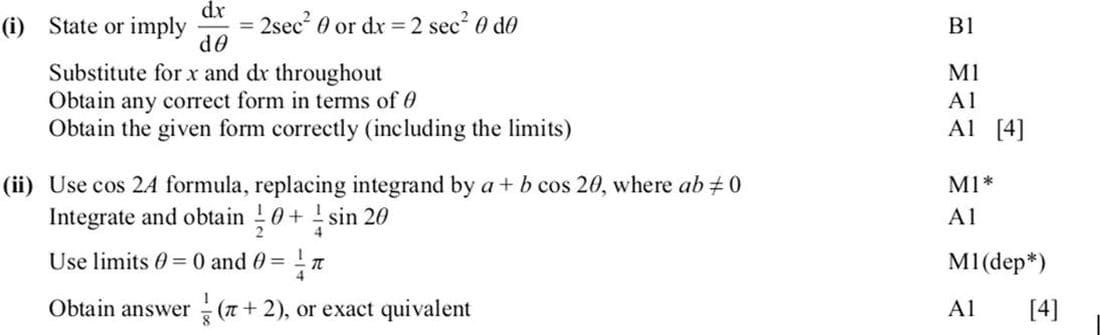
(i) Use the substitution \(x = 2 \tan \theta\) to show that
\(\int_0^2 \frac{8}{(4+x^2)^2} \, dx = \int_0^{\frac{\pi}{4}} \cos^2 \theta \, d\theta.\)
(ii) Hence find the exact value of
\(\int_0^2 \frac{8}{(4+x^2)^2} \, dx.\)
Problem 1699
Let \(I = \int_1^4 \frac{1}{x(4 - \sqrt{x})} \, dx\).
Use the substitution \(u = \sqrt{x}\) to show that \(I = \int_1^2 \frac{2}{u(4-u)} \, du\).

Nov 2005 p3 q6
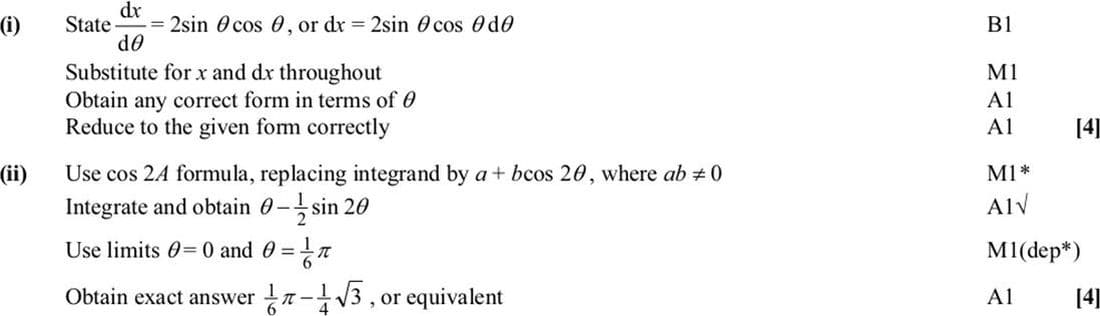
(i) Use the substitution \(x = \sin^2 \theta\) to show that \(\int \sqrt{\left( \frac{x}{1-x} \right)} \, dx = \int 2 \sin^2 \theta \, d\theta\).
(ii) Hence find the exact value of \(\int_0^{\frac{1}{4}} \sqrt{\left( \frac{x}{1-x} \right)} \, dx\).
June 2005 p3 q4
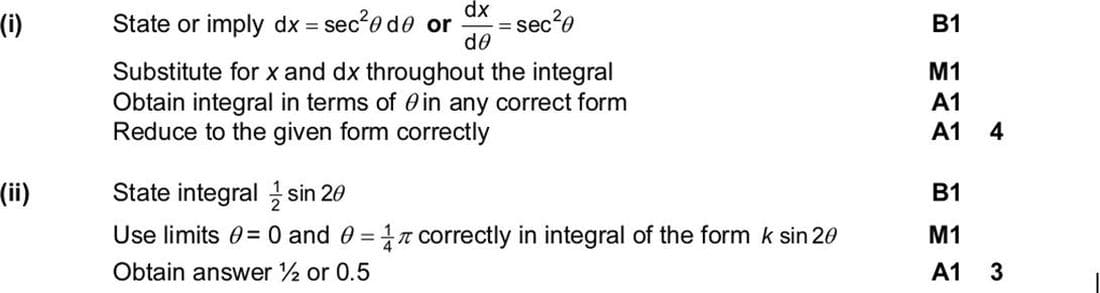
(i) Use the substitution \(x = \tan \theta\) to show that
\(\int \frac{1-x^2}{(1+x^2)^2} \, dx = \int \cos 2\theta \, d\theta.\)
(ii) Hence find the value of
\(\int_0^1 \frac{1-x^2}{(1+x^2)^2} \, dx.\)
Nov 2021 p33 q9
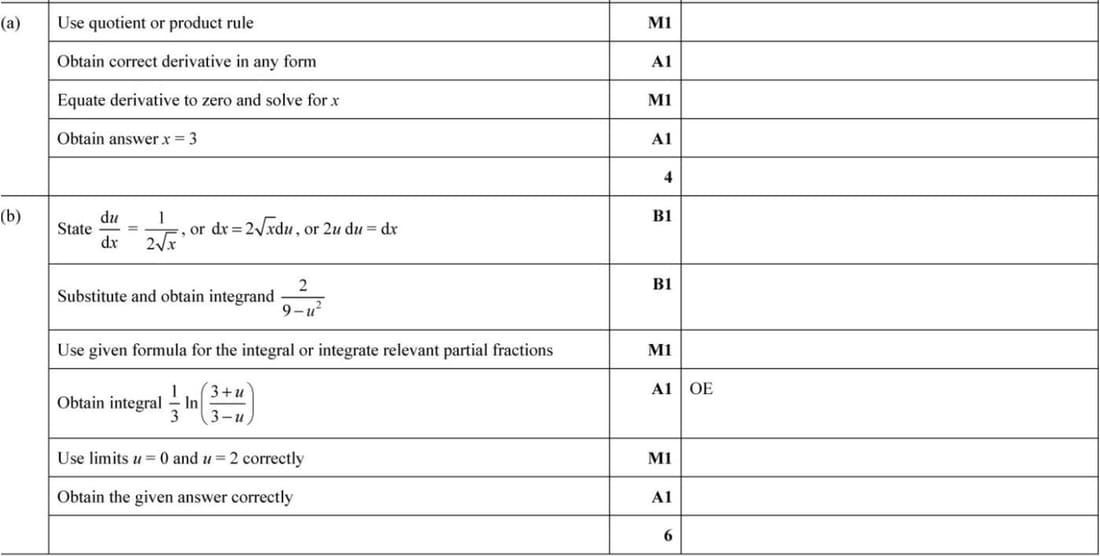
Let \(f(x) = \frac{1}{(9-x)\sqrt{x}}\).
(a) Find the \(x\)-coordinate of the stationary point of the curve with equation \(y = f(x)\).
(b) Using the substitution \(u = \sqrt{x}\), show that \(\int_0^4 f(x) \, dx = \frac{1}{3} \ln 5\).
Nov 2021 p31 q4
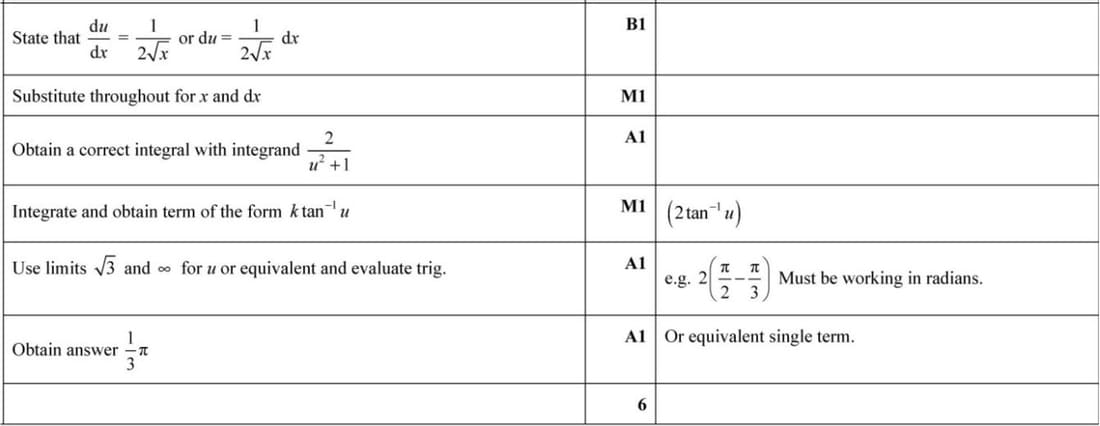
Using the substitution \(u = \sqrt{x}\), find the exact value of \(\int_{3}^{\infty} \frac{1}{(x+1)\sqrt{x}} \, dx\).
June 2018 p31 q5
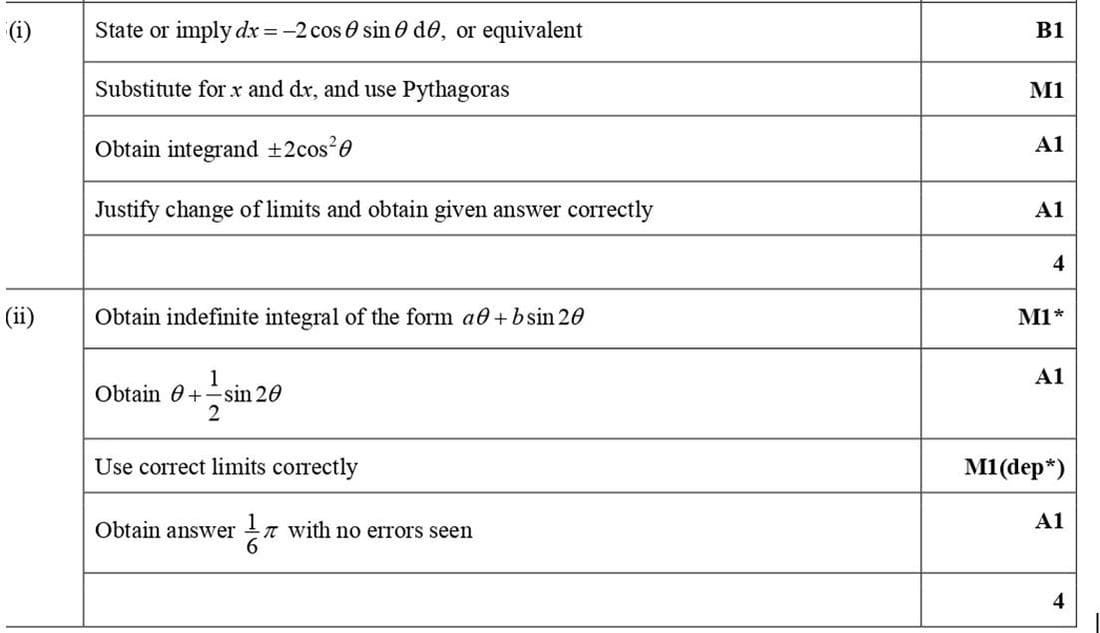
Let \(I = \int_{\frac{1}{4}}^{\frac{3}{4}} \sqrt{\left( \frac{x}{1-x} \right)} \, dx\).
(i) Using the substitution \(x = \cos^2 \theta\), show that \(I = \int_{\frac{1}{6}\pi}^{\frac{1}{3}\pi} 2 \cos^2 \theta \, d\theta\).
(ii) Hence find the exact value of \(I\).
Nov 2016 p33 q6
Let \(I = \int_{1}^{4} \frac{(\sqrt{x}) - 1}{2(x + \sqrt{x})} \, dx\).
Using the substitution \(u = \sqrt{x}\), show that \(I = \int_{1}^{2} \frac{u - 1}{u + 1} \, du\).

June 2016 p33 q7
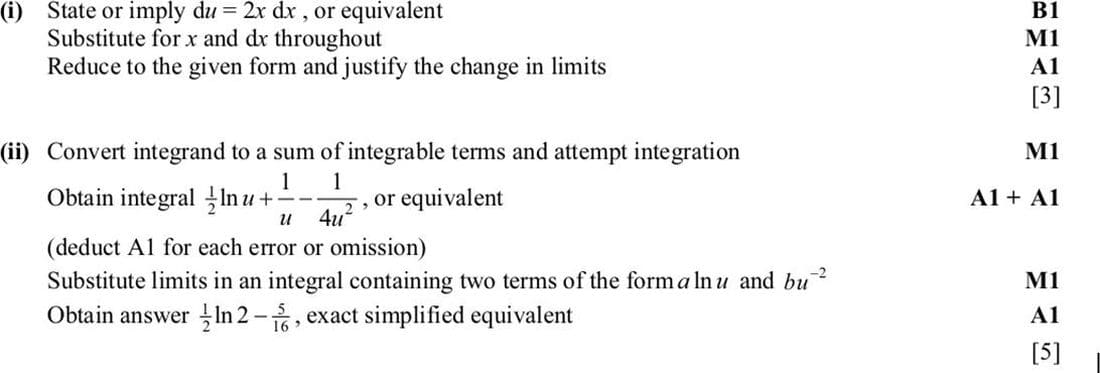
Let \(I = \int_0^1 \frac{x^5}{(1+x^2)^3} \, dx\).
(i) Using the substitution \(u = 1 + x^2\), show that \(I = \int_1^2 \frac{(u-1)^2}{2u^3} \, du\).
(ii) Hence find the exact value of \(I\).
Feb/Mar 2016 p32 q5
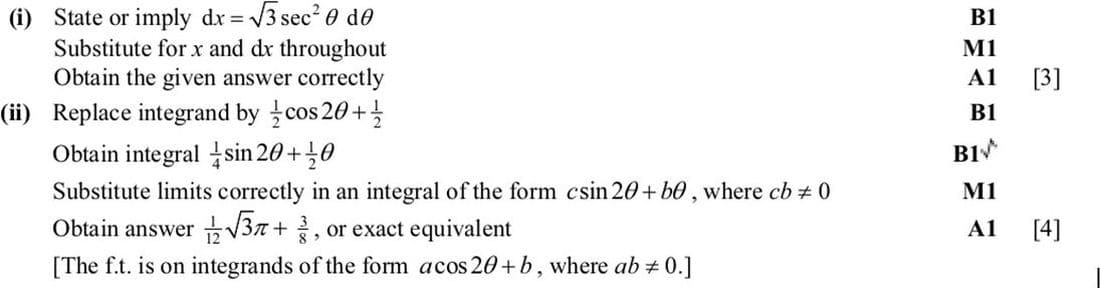
Let \(I = \int_0^1 \frac{9}{(3 + x^2)^2} \, dx\).
(i) Using the substitution \(x = (\sqrt{3}) \tan \theta\), show that \(I = \sqrt{3} \int_0^{\frac{\pi}{6}} \cos^2 \theta \, d\theta\).
(ii) Hence find the exact value of \(I\).
Nov 2015 p33 q5
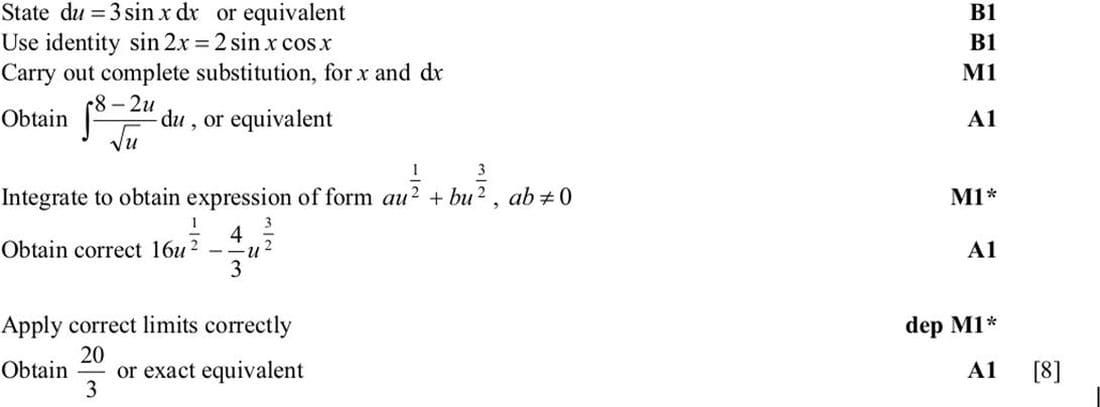
Use the substitution \(u = 4 - 3 \cos x\) to find the exact value of \(\int_{0}^{\frac{1}{2}\pi} \frac{9 \sin 2x}{\sqrt{(4 - 3 \cos x)}} \, dx.\)
June 2015 p32 q6
Let \(I = \int_0^1 \frac{\sqrt{x}}{2 - \sqrt{x}} \, dx\).
(i) Using the substitution \(u = 2 - \sqrt{x}\), show that \(I = \int_1^2 \frac{2(2-u)^2}{u} \, du\).
(ii) Hence show that \(I = 8 \ln 2 - 5\).