Exam-Style Problems
⬅ Back to SubchapterFM June 2023 p11 q05
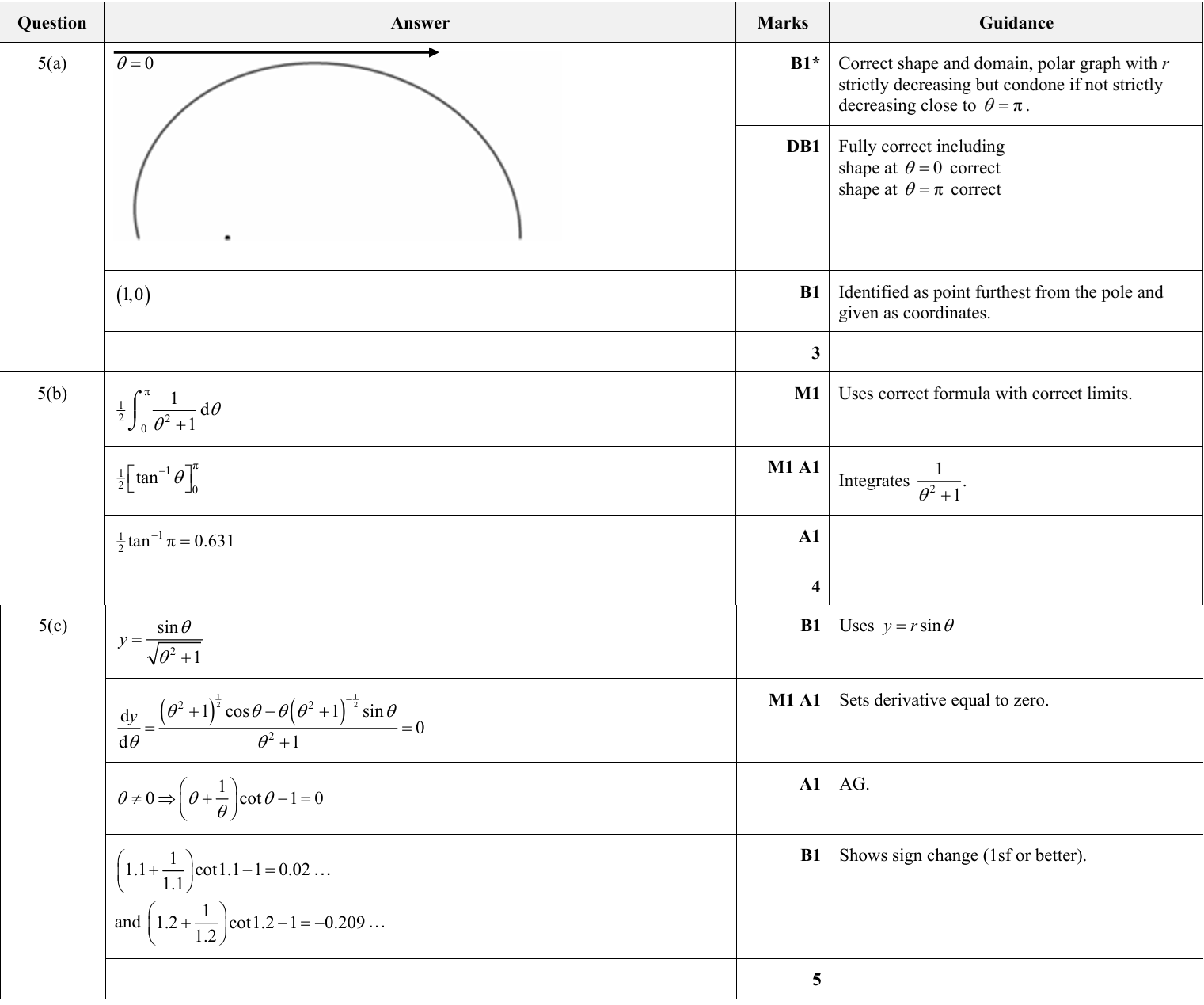
The curve \(C\) has polar equation \(r^2 = \frac{1}{\theta^2 + 1}\), for \(0 \leq \theta \leq \pi\).
- Sketch \(C\) and state the polar coordinates of the point of \(C\) furthest from the pole.
- Find the area of the region enclosed by \(C\), the initial line, and the half-line \(\theta = \pi\).
- Show that, at the point of \(C\) furthest from the initial line, \(\left( \theta + \frac{1}{\theta} \right) \cot \theta - 1 = 0\) and verify that this equation has a root between 1.1 and 1.2.
FM June 2023 p11 q06
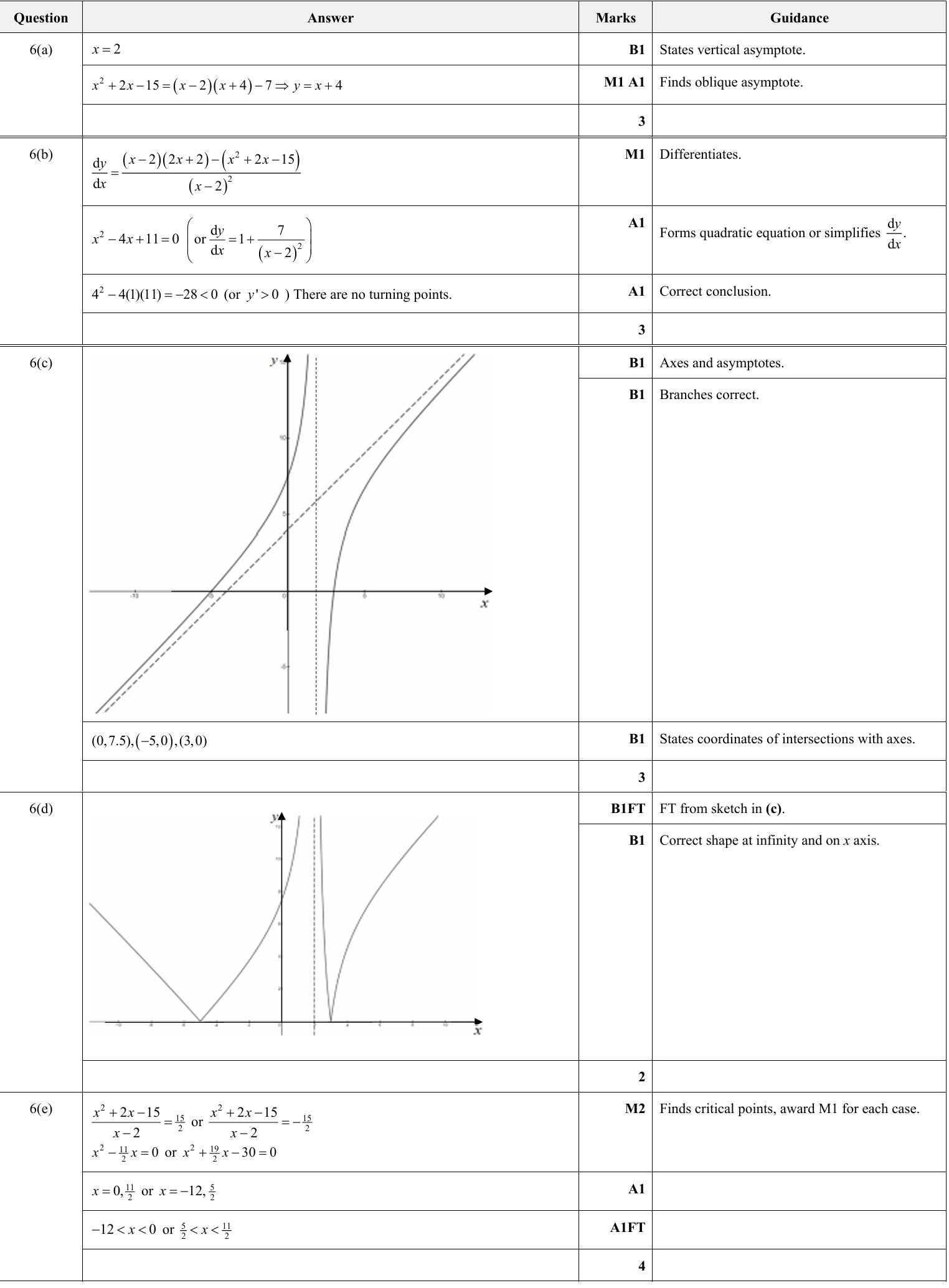
The curve C has equation \(y = \frac{x^2 + 2x - 15}{x - 2}\).
- Find the equations of the asymptotes of C.
- Show that C has no stationary points.
- Sketch C, stating the coordinates of the intersections with the axes.
- Sketch the curve with equation \(y = \left| \frac{x^2 - 2x - 15}{x - 2} \right|\).
- Find the set of values of \(x\) for which \(\left| \frac{2x^2 + 4x - 30}{x - 2} \right| < 15\).
FM June 2023 p11 q07
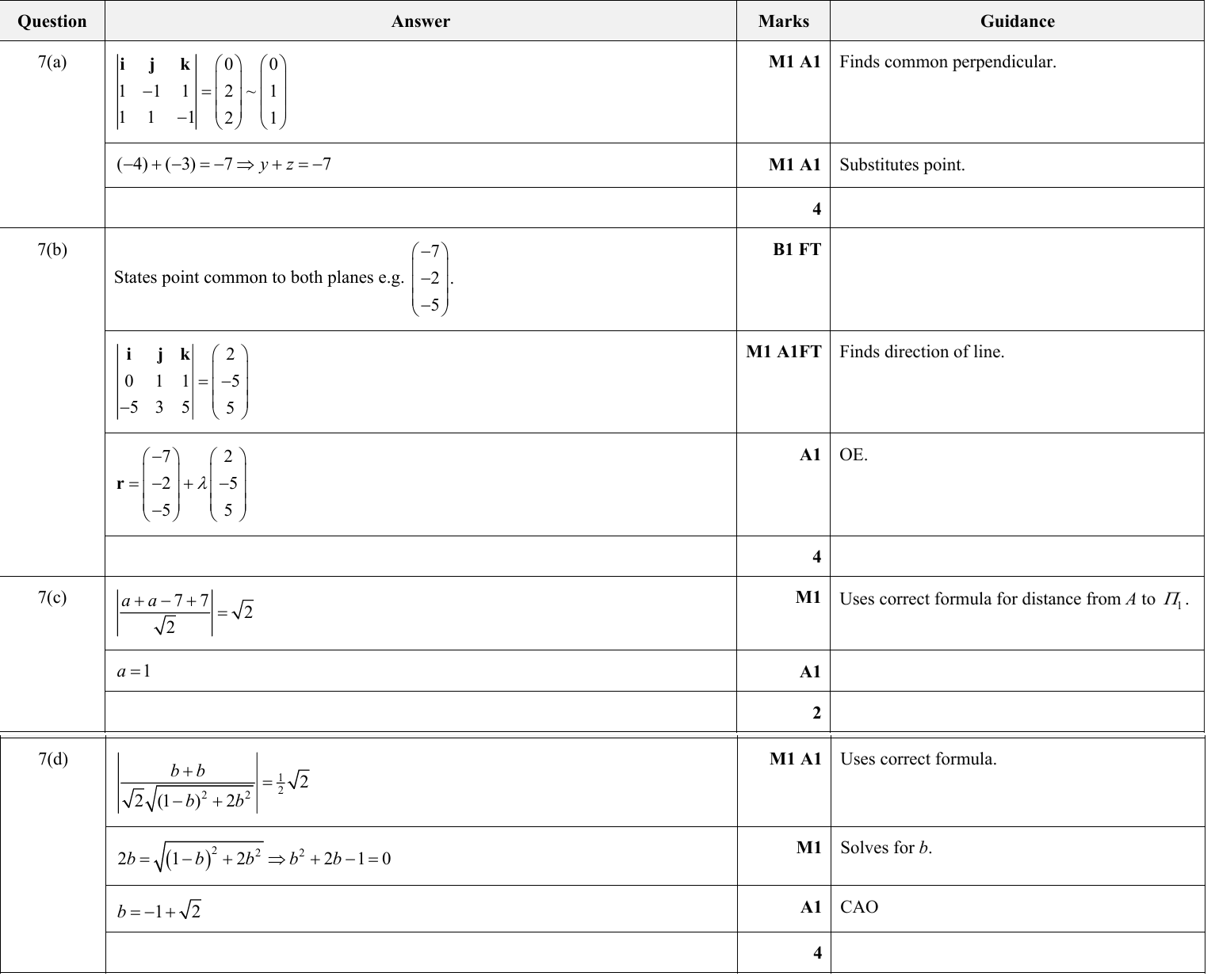
The plane \(\Pi_1\) has equation \(\mathbf{r} = -4\mathbf{j} - 3\mathbf{k} + \lambda (\mathbf{i} - \mathbf{j} + \mathbf{k}) + \mu (\mathbf{i} + \mathbf{j} - \mathbf{k})\).
- Obtain an equation of \(\Pi_1\) in the form \(px + qy + rz = d\).
- The plane \(\Pi_2\) has equation \(\mathbf{r} \cdot (-5\mathbf{i} + 3\mathbf{j} + 5\mathbf{k}) = 4\). Find a vector equation of the line of intersection of \(\Pi_1\) and \(\Pi_2\).
- The line \(l\) passes through the point \(A\) with position vector \(a\mathbf{i} + a\mathbf{j} + (a-7)\mathbf{k}\) and is parallel to \((1-b)\mathbf{i} + b\mathbf{j} + b\mathbf{k}\), where \(a\) and \(b\) are positive constants. Given that the perpendicular distance from \(A\) to \(\Pi_1\) is \(\sqrt{2}\), find the value of \(a\).
- Given that the obtuse angle between \(l\) and \(\Pi_1\) is \(\frac{3}{4}\pi\), find the exact value of \(b\).
FM June 2023 p12 q01
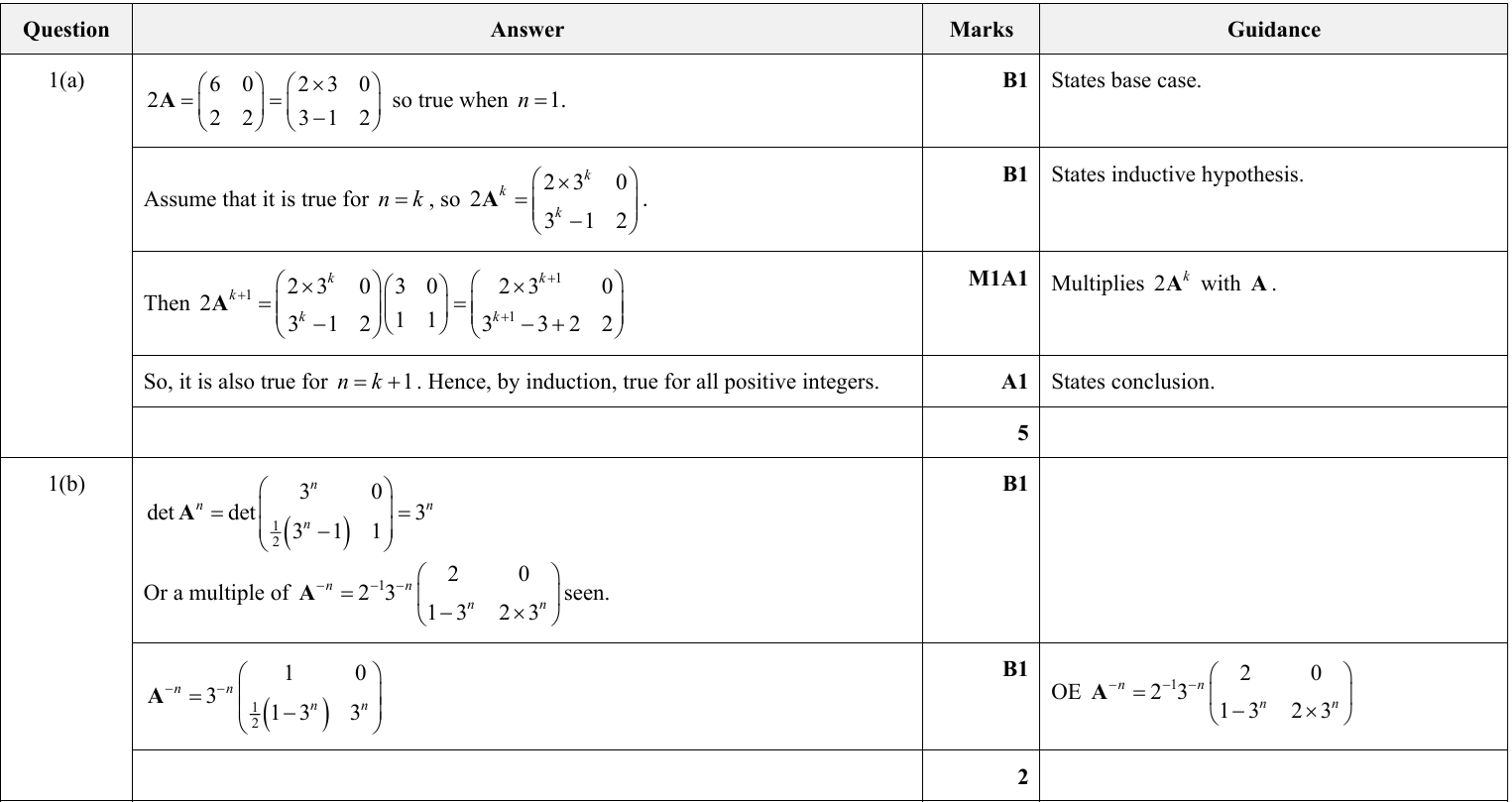
Let \(A = \begin{pmatrix} 3 & 0 \\ 1 & 1 \end{pmatrix}\).
(a) Prove by mathematical induction that, for all positive integers \(n\),
\(2A^n = \begin{pmatrix} 2 \times 3^n & 0 \\ 3^n - 1 & 2 \end{pmatrix}.\)
(b) Find, in terms of \(n\), the inverse of \(A^n\).
FM June 2023 p12 q02
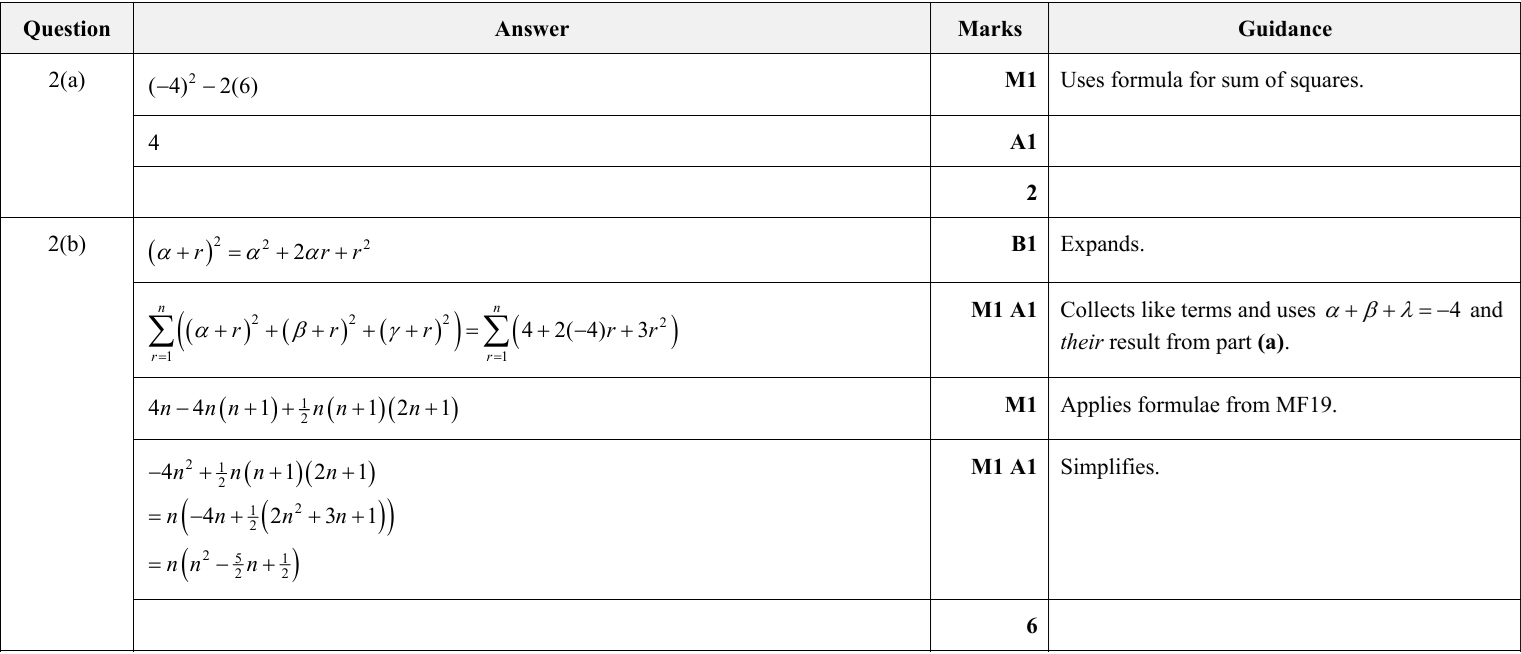
The cubic equation \(x^3 + 4x^2 + 6x + 1 = 0\) has roots \(\alpha, \beta, \gamma\).
(a) Find the value of \(\alpha^2 + \beta^2 + \gamma^2\).
(b) Use standard results from the list of formulae (MF19) to show that
\(\sum_{r=1}^{n} ((\alpha + r)^2 + (\beta + r)^2 + (\gamma + r)^2) = n(n^2 + an + b),\)
where \(a\) and \(b\) are constants to be determined.