Exam-Style Problems
⬅ Back to SubchapterNov 2004 p4 q4
3588
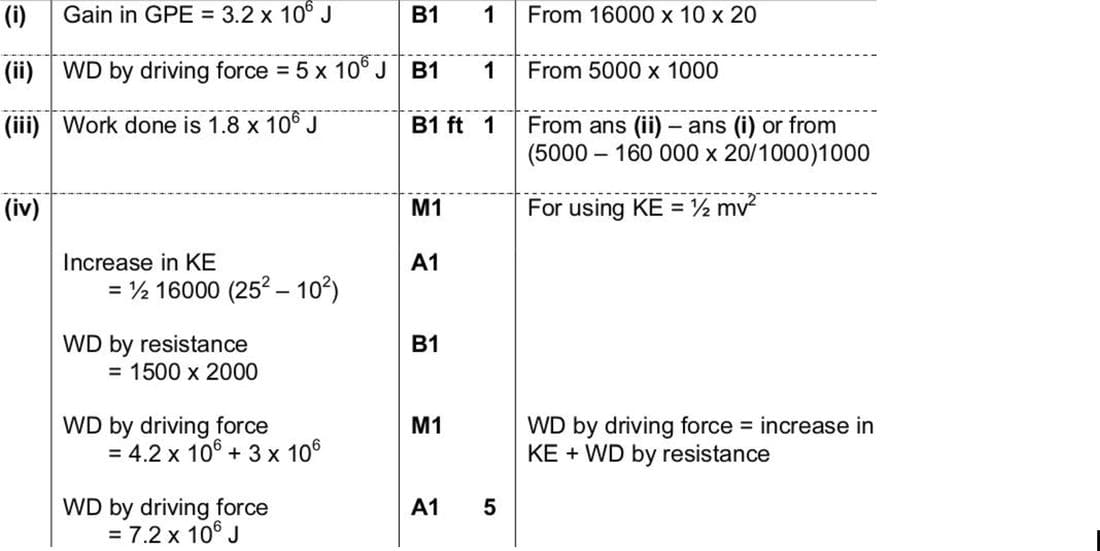
A lorry of mass 16000 kg climbs from the bottom to the top of a straight hill of length 1000 m at a constant speed of 10 m s-1. The top of the hill is 20 m above the level of the bottom of the hill. The driving force of the lorry is constant and equal to 5000 N. Find
- the gain in gravitational potential energy of the lorry,
- the work done by the driving force,
- the work done against the force resisting the motion of the lorry.
On reaching the top of the hill the lorry continues along a straight horizontal road against a constant resistance of 1500 N. The driving force of the lorry is not now constant, and the speed of the lorry increases from 10 m s-1 at the top of the hill to 25 m s-1 at the point P. The distance of P from the top of the hill is 2000 m.
- Find the work done by the driving force of the lorry while the lorry travels from the top of the hill to P.
June 2004 p4 q4
3589
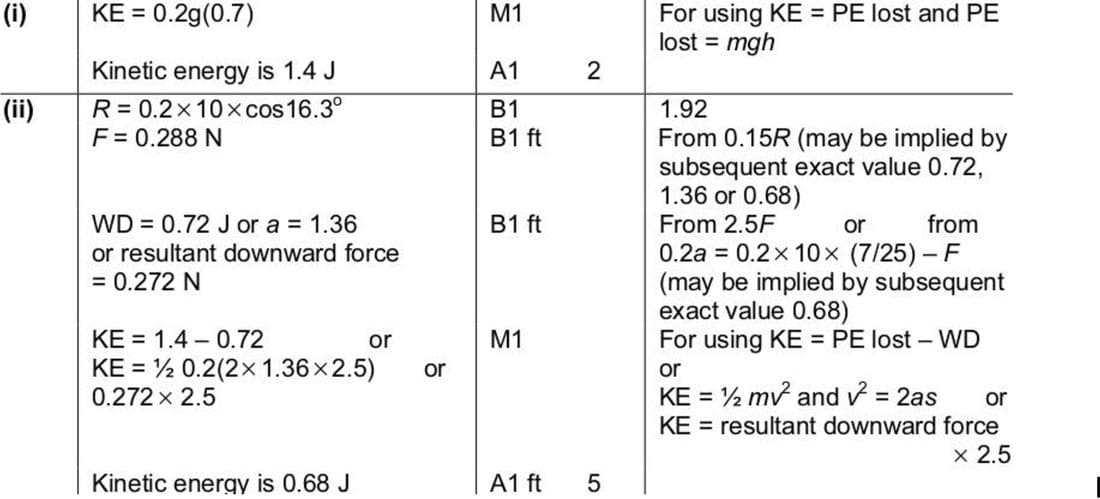
The top of an inclined plane is at a height of 0.7 m above the bottom. A block of mass 0.2 kg is released from rest at the top of the plane and slides a distance of 2.5 m to the bottom. Find the kinetic energy of the block when it reaches the bottom of the plane in each of the following cases:
- the plane is smooth,
- the coefficient of friction between the plane and the block is 0.15.
Nov 2003 p4 q4
3590
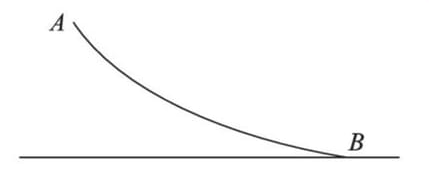
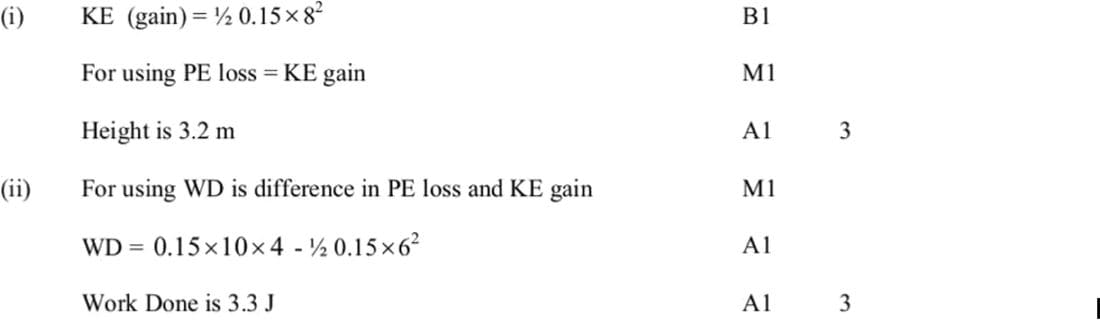
The diagram shows a vertical cross-section of a surface. A and B are two points on the cross-section. A particle of mass 0.15 kg is released from rest at A.
- Assuming that the particle reaches B with a speed of 8 m s-1 and that there are no resistances to motion, find the height of A above B.
- Assuming instead that the particle reaches B with a speed of 6 m s-1 and that the height of A above B is 4 m, find the work done against the resistances to motion.
Nov 2002 p4 q6
3591
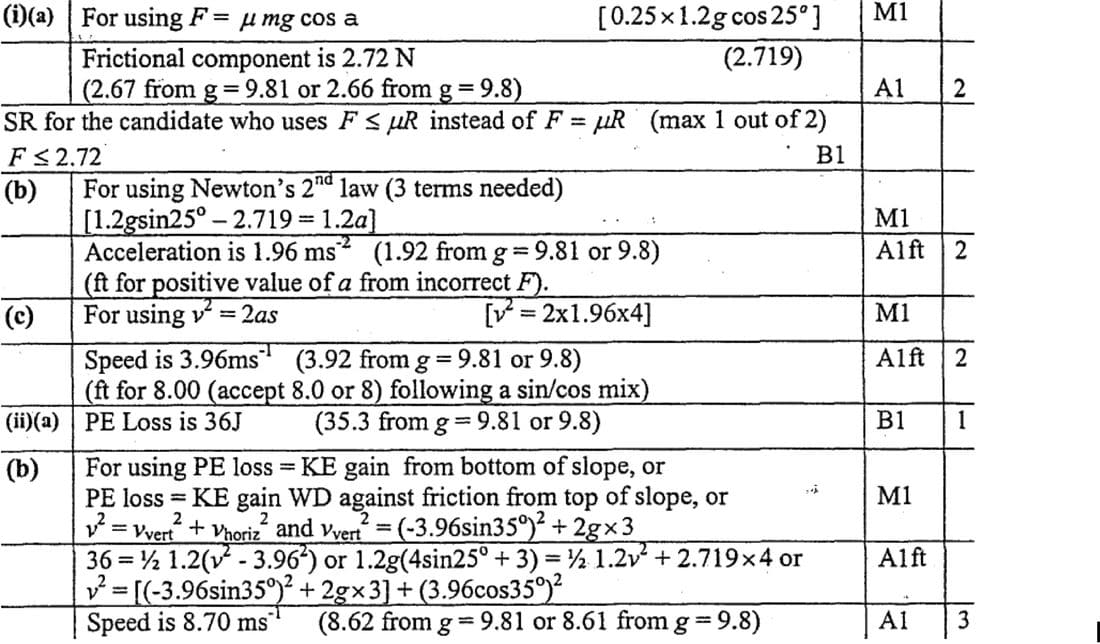
(i) A particle P of mass 1.2 kg is released from rest at the top of a slope and starts to move. The slope has length 4 m and is inclined at 25° to the horizontal. The coefficient of friction between P and the slope is \(\frac{1}{4}\). Find
- the frictional component of the contact force on P,
- the acceleration of P,
- the speed with which P reaches the bottom of the slope.
(ii) After reaching the bottom of the slope, P moves freely under gravity and subsequently hits a horizontal floor which is 3 m below the bottom of the slope.
- Find the loss in gravitational potential energy of P during its motion from the bottom of the slope until it hits the floor.
- Find the speed with which P hits the floor.