Exam-Style Problems
⬅ Back to SubchapterNov 2011 p33 q6
2000
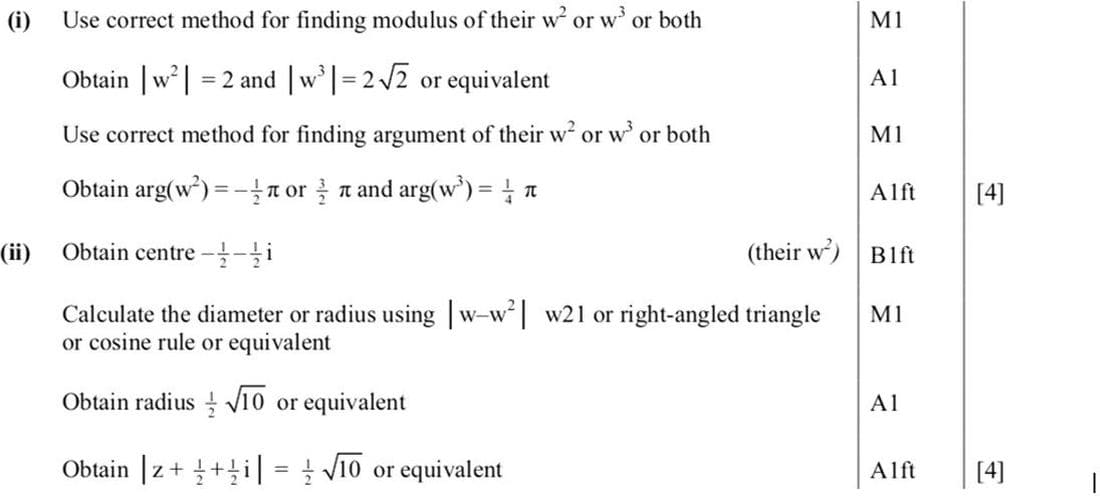
\(The complex number w is defined by w = -1 + i.\)
(i) Find the modulus and argument of w2 and w3, showing your working.
(ii) The points in an Argand diagram representing w and w2 are the ends of a diameter of a circle. Find the equation of the circle, giving your answer in the form |z - (a + bi)| = k.
Nov 2011 p31 q10
2001
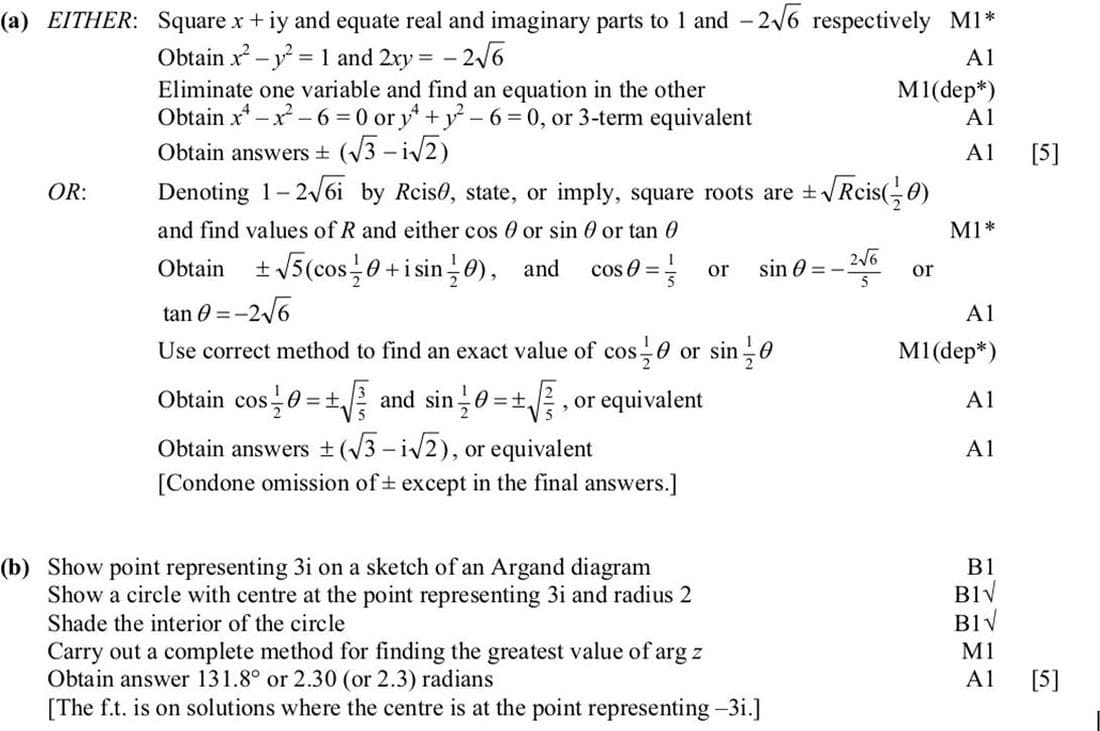
(a) Showing your working, find the two square roots of the complex number \(1 - (2\sqrt{6})i\). Give your answers in the form \(x + iy\), where \(x\) and \(y\) are exact.
(b) On a sketch of an Argand diagram, shade the region whose points represent the complex numbers \(z\) which satisfy the inequality \(|z - 3i| \leq 2\). Find the greatest value of \(\arg z\) for points in this region.
June 2011 p33 q7
2002
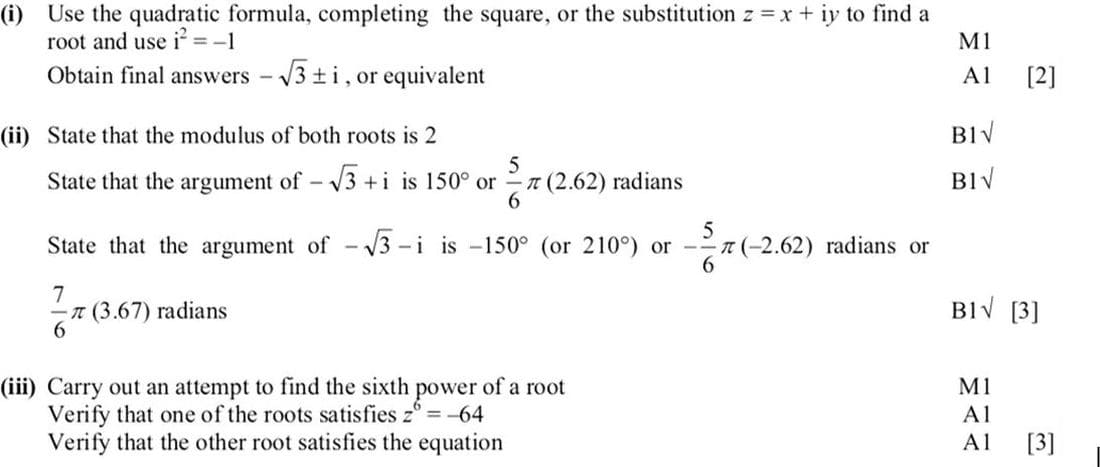
(i) Find the roots of the equation
\(z^2 + (2\sqrt{3})z + 4 = 0\),
giving your answers in the form \(x + iy\), where \(x\) and \(y\) are real.
(ii) State the modulus and argument of each root.
(iii) Showing all your working, verify that each root also satisfies the equation
\(z^6 = -64\).
June 2011 p32 q7
2003
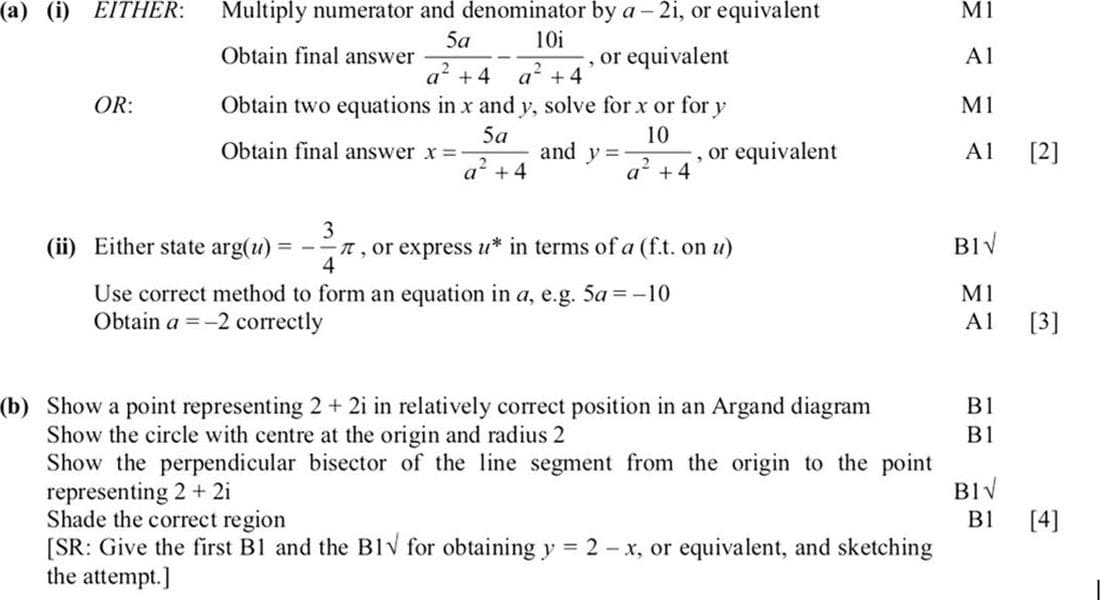
(a) The complex number u is defined by \(u = \frac{5}{a + 2i}\), where the constant a is real.
- Express u in the form x + iy, where x and y are real.
- Find the value of a for which \(\arg(u^*) = \frac{3}{4}\pi\), where u* denotes the complex conjugate of u.
(b) On a sketch of an Argand diagram, shade the region whose points represent complex numbers z which satisfy both the inequalities \(|z| < 2\) and \(|z| < |z - 2 - 2i|\).
June 2011 p31 q8
2004
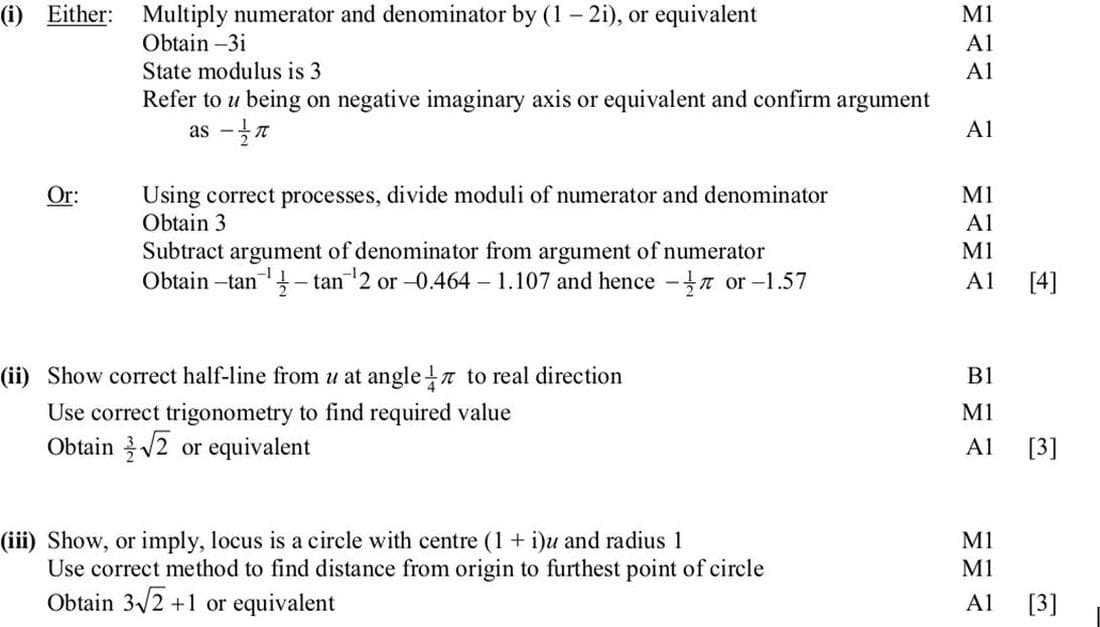
The complex number u is defined by \(u = \frac{6 - 3i}{1 + 2i}\).
- Showing all your working, find the modulus of u and show that the argument of u is \(-\frac{1}{2}\pi\).
- For complex numbers z satisfying \(\text{arg}(z - u) = \frac{1}{4}\pi\), find the least possible value of \(|z|\).
- For complex numbers z satisfying \(|z - (1 + i)u| = 1\), find the greatest possible value of \(|z|\).