Exam-Style Problems
⬅ Back to SubchapterNov 2006 p4 q1
3583
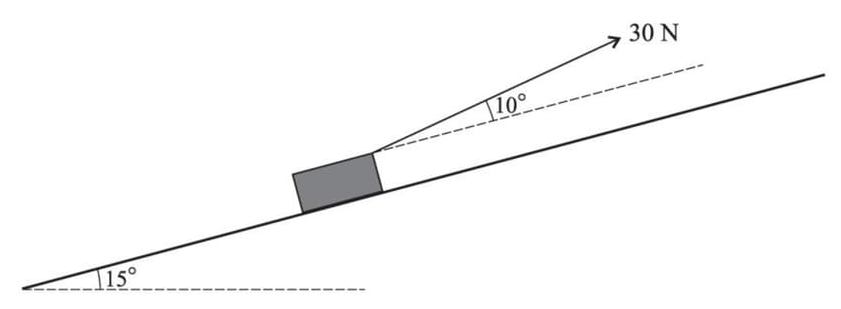
A box of mass 8 kg is pulled, at constant speed, up a straight path which is inclined at an angle of 15° to the horizontal. The pulling force is constant, of magnitude 30 N, and acts upwards at an angle of 10° from the path (see diagram). The box passes through the points A and B, where AB = 20 m and B is above the level of A. For the motion from A to B, find
- the work done by the pulling force,
- the gain in potential energy of the box,
- the work done against the resistance to motion of the box.

June 2006 p4 q6
3584
A block of mass 50 kg is pulled up a straight hill and passes through points A and B with speeds 7 m s-1 and 3 m s-1 respectively. The distance AB is 200 m and B is 15 m higher than A. For the motion of the block from A to B, find
- the loss in kinetic energy of the block,
- the gain in potential energy of the block.
The resistance to motion of the block has magnitude 7.5 N.
- Find the work done by the pulling force acting on the block.
The pulling force acting on the block has constant magnitude 45 N and acts at an angle \(\alpha \degree\) upwards from the hill.
- Find the value of \(\alpha\).
Nov 2005 p4 q7
3585
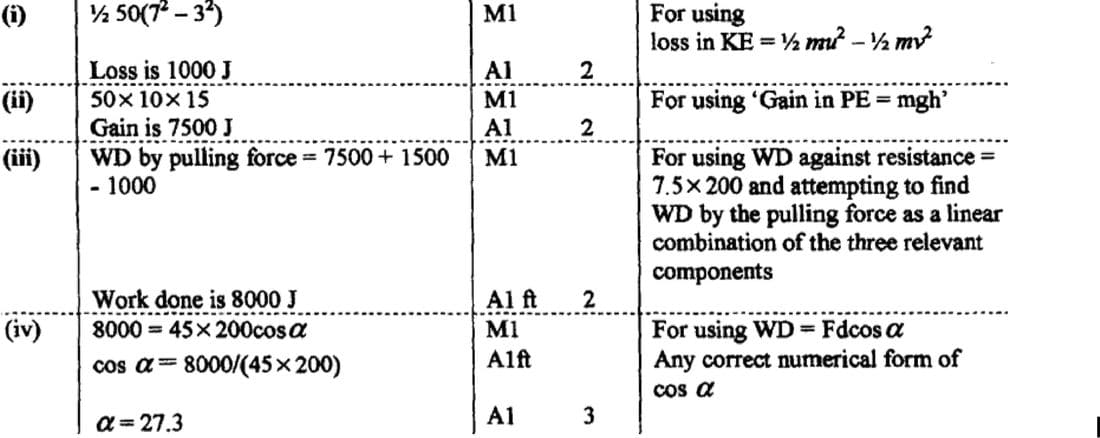
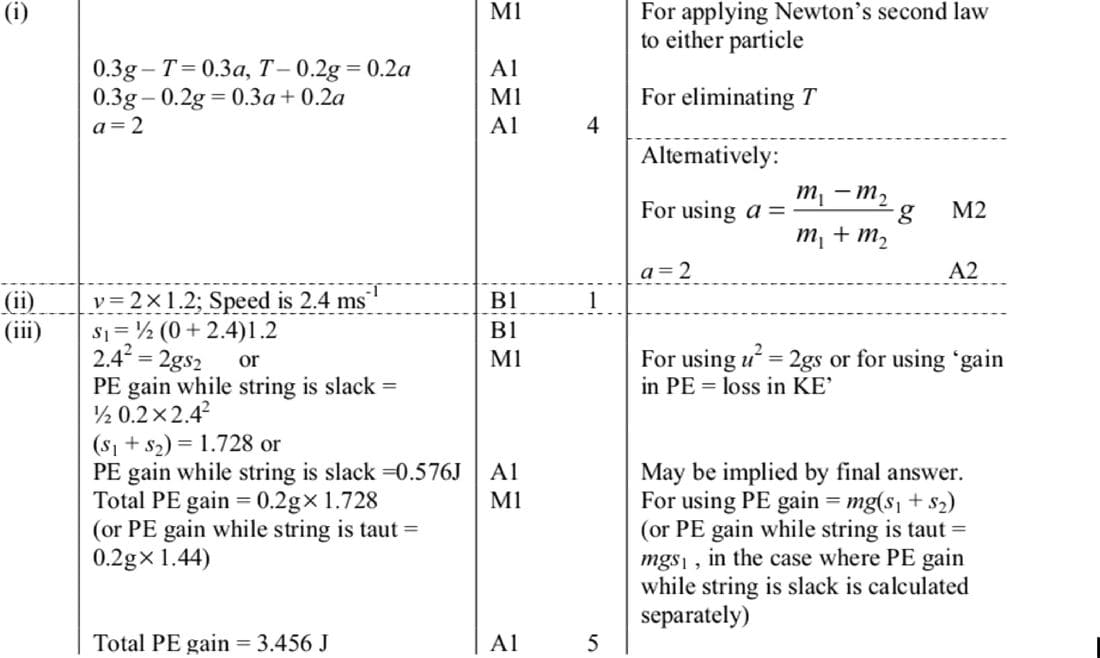
Two particles A and B, of masses 0.3 kg and 0.2 kg respectively, are attached to the ends of a light inextensible string which passes over a smooth fixed pulley. Particle B is held on the horizontal floor and particle A hangs in equilibrium. Particle B is released and each particle starts to move vertically with constant acceleration of magnitude a m s-2.
- Find the value of a.
- Show that A hits the floor with a speed of 2.4 m s-1.
- Find the gain in gravitational potential energy by B, from leaving the floor until reaching its greatest height.
Particle A hits the floor 1.2 s after it starts to move, and does not rebound upwards.
Nov 2005 p4 q2
3586
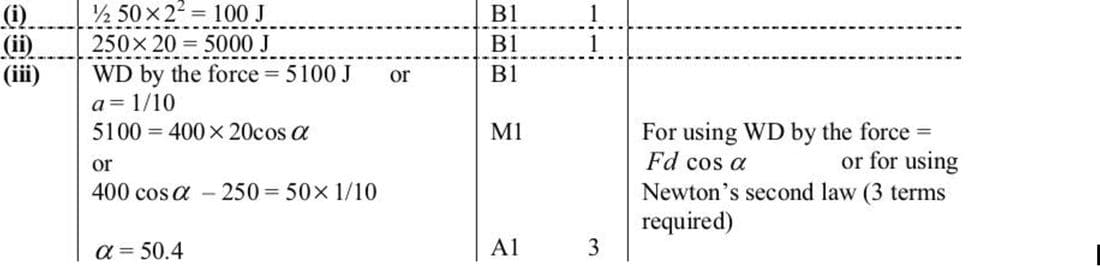
A crate of mass 50 kg is dragged along a horizontal floor by a constant force of magnitude 400 N acting at an angle \(\alpha^\circ\) upwards from the horizontal. The total resistance to motion of the crate has constant magnitude 250 N. The crate starts from rest at the point \(O\) and passes the point \(P\) with a speed of 2 m s\(^{-1}\). The distance \(OP\) is 20 m. For the crate’s motion from \(O\) to \(P\), find
- the increase in kinetic energy of the crate,
- the work done against the resistance to the motion of the crate,
- the value of \(\alpha\).
June 2005 p4 q7
3587
A car of mass 1200 kg travels along a horizontal straight road. The power provided by the car’s engine is constant and equal to 20 kW. The resistance to the car’s motion is constant and equal to 500 N. The car passes through the points A and B with speeds 10 m/s and 25 m/s respectively. The car takes 30.5 s to travel from A to B.
(i) Find the acceleration of the car at A.
(ii) By considering work and energy, find the distance AB.