Exam-Style Problems
⬅ Back to SubchapterFM Nov 2023 p13 q02
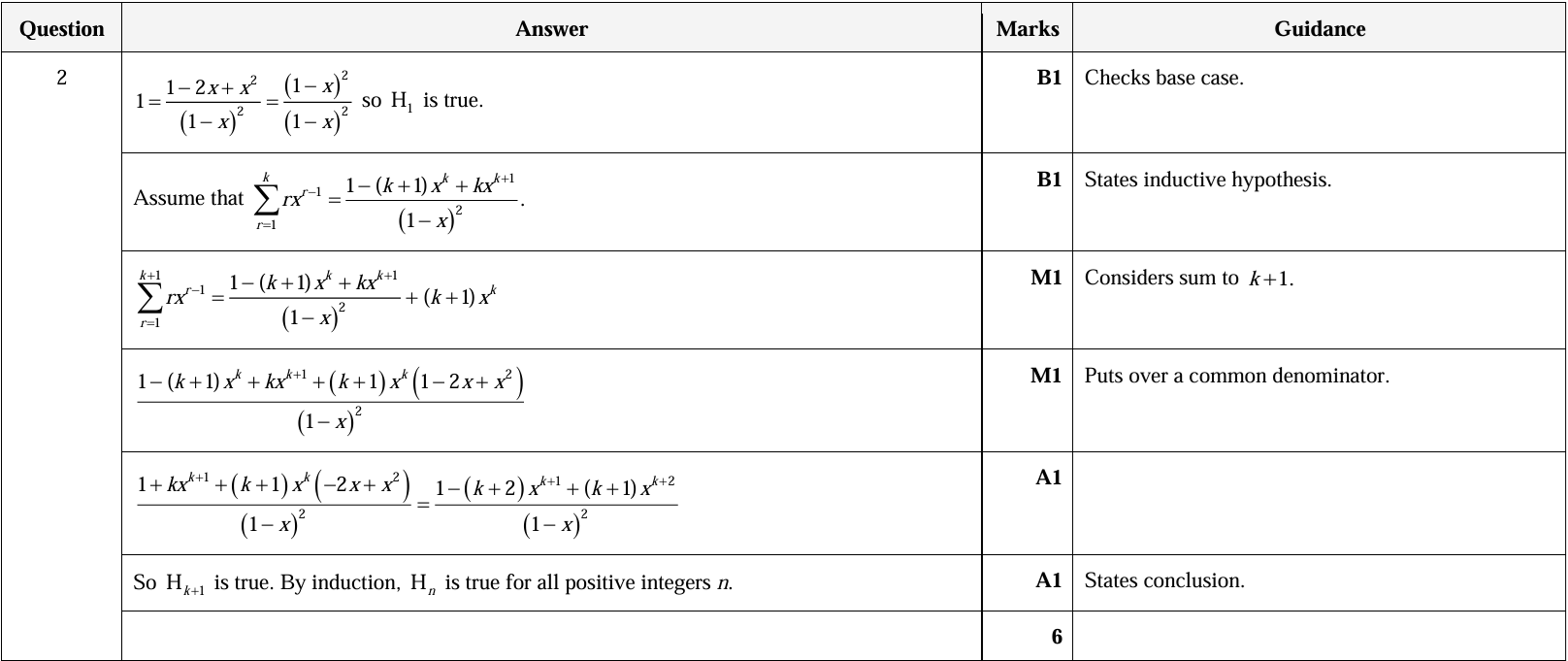
Prove by mathematical induction that, for all positive integers \(n\),
\(1 + 2x + 3x^2 + \ldots + nx^{n-1} = \frac{1 - (n+1)x^n + nx^{n+1}}{(1-x)^2}.\)
FM Nov 2023 p13 q03
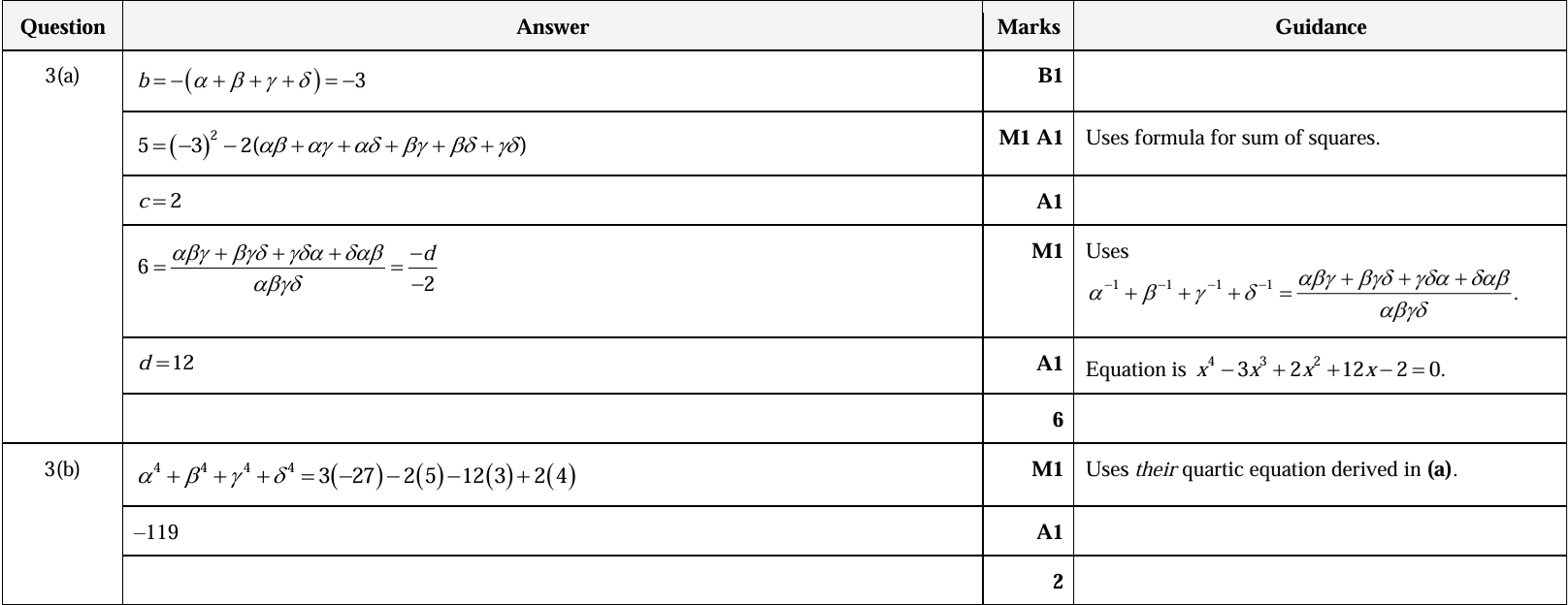
The quartic equation \(x^4 + bx^3 + cx^2 + dx - 2 = 0\) has roots \(\alpha, \beta, \gamma, \delta\). It is given that
\(\alpha + \beta + \gamma + \delta = 3\),
\(\alpha^2 + \beta^2 + \gamma^2 + \delta^2 = 5\),
\(\alpha^{-1} + \beta^{-1} + \gamma^{-1} + \delta^{-1} = 6\).
(a) Find the values of \(b, c\) and \(d\).
(b) Given also that \(\alpha^3 + \beta^3 + \gamma^3 + \delta^3 = -27\), find the value of \(\alpha^4 + \beta^4 + \gamma^4 + \delta^4\).
FM Nov 2023 p13 q04
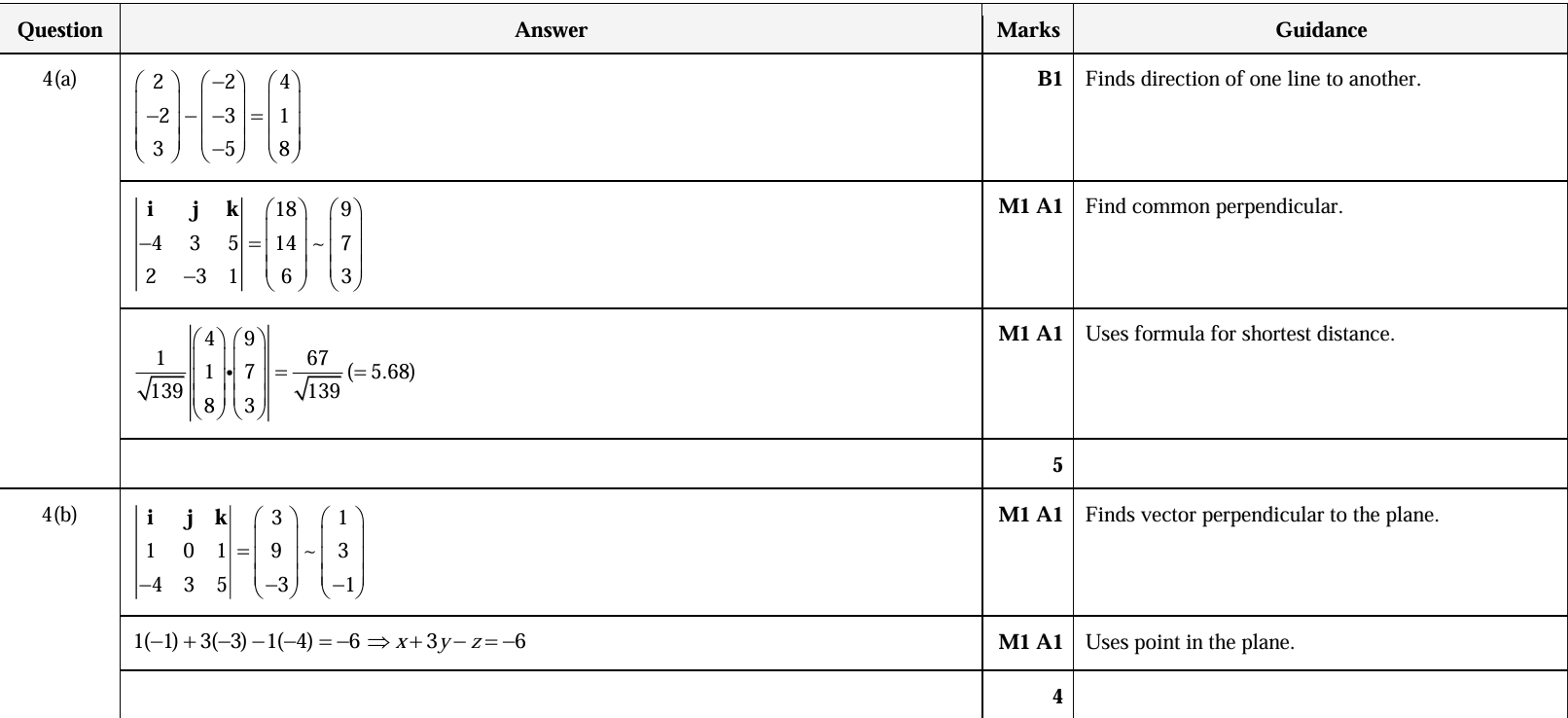
The lines \(l_1\) and \(l_2\) have equations
\(\mathbf{r} = -2\mathbf{i} - 3\mathbf{j} - 5\mathbf{k} + \lambda(-4\mathbf{i} + 3\mathbf{j} + 5\mathbf{k})\) and \(\mathbf{r} = 2\mathbf{i} - 2\mathbf{j} + 3\mathbf{k} + \mu(2\mathbf{i} - 3\mathbf{j} + \mathbf{k})\)
respectively.
(a) Find the shortest distance between \(l_1\) and \(l_2\).
The plane \(\Pi\) contains \(l_1\) and the point with position vector \(-\mathbf{i} - 3\mathbf{j} - 4\mathbf{k}\).
(b) Find an equation of \(\Pi\), giving your answer in the form \(ax + by + cz = d\).
FM Nov 2023 p13 q05
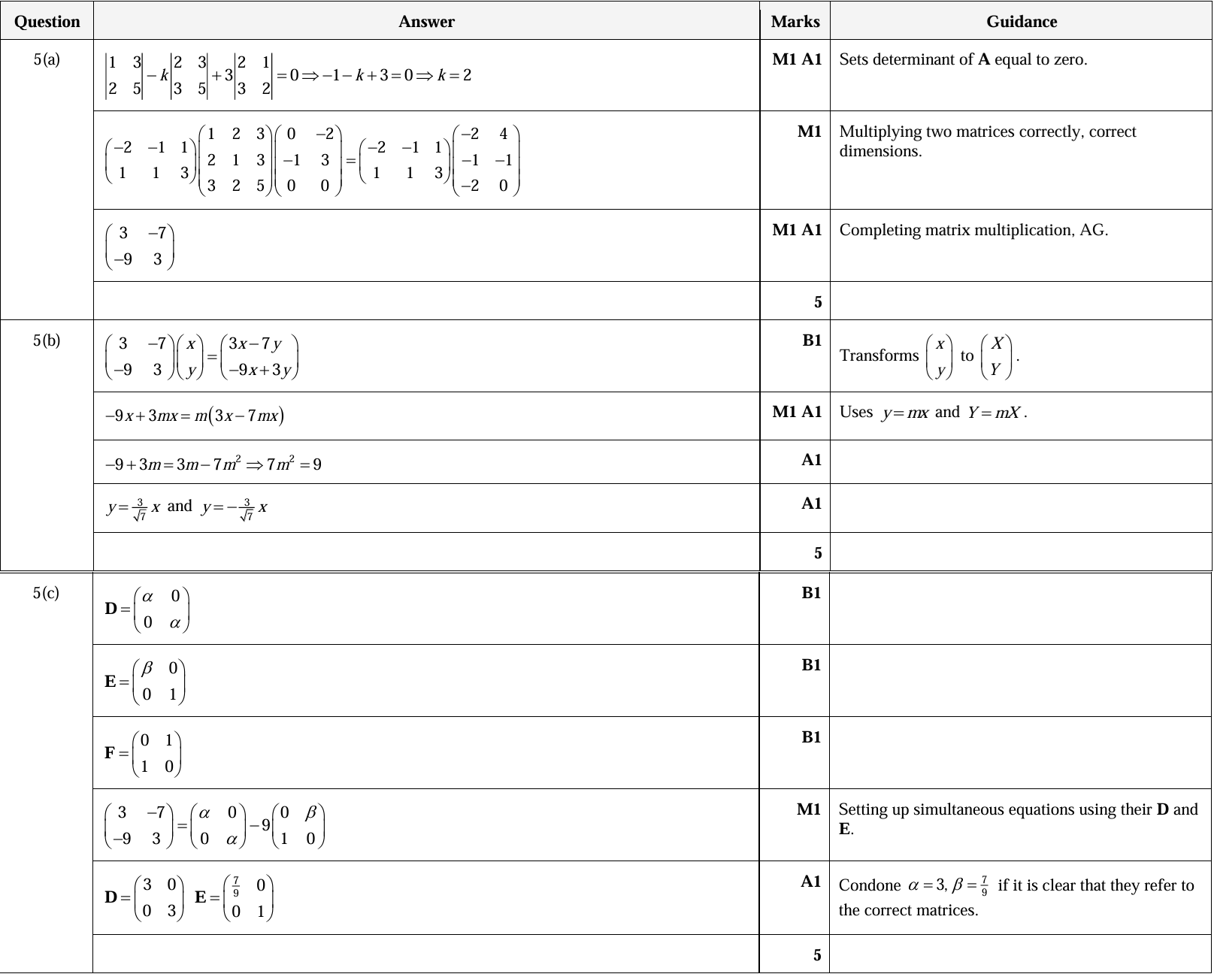
Let k be a constant. The matrices A, B and C are given by
\(\mathbf{A} = \begin{pmatrix} 1 & k & 3 \\ 2 & 1 & 3 \\ 3 & 2 & 5 \end{pmatrix}, \quad \mathbf{B} = \begin{pmatrix} 0 & -2 \\ -1 & 3 \\ 0 & 0 \end{pmatrix} \text{ and } \mathbf{C} = \begin{pmatrix} -2 & -1 \\ 1 & 1 \\ 1 & 3 \end{pmatrix}.\)
It is given that A is singular.
(a) Show that \(\mathbf{CAB} = \begin{pmatrix} 3 & -7 \\ -9 & 3 \end{pmatrix}.\)
(b) Find the equations of the invariant lines, through the origin, of the transformation in the x–y plane represented by CAB.
(c) The matrices D, E and F represent geometrical transformations in the x–y plane.
- D represents an enlargement, centre the origin.
- E represents a stretch parallel to the x-axis.
- F represents a reflection in the line y = x.
Given that \(\mathbf{CAB} = \mathbf{D} - 9\mathbf{EF},\) find D, E and F.
FM Nov 2023 p13 q06
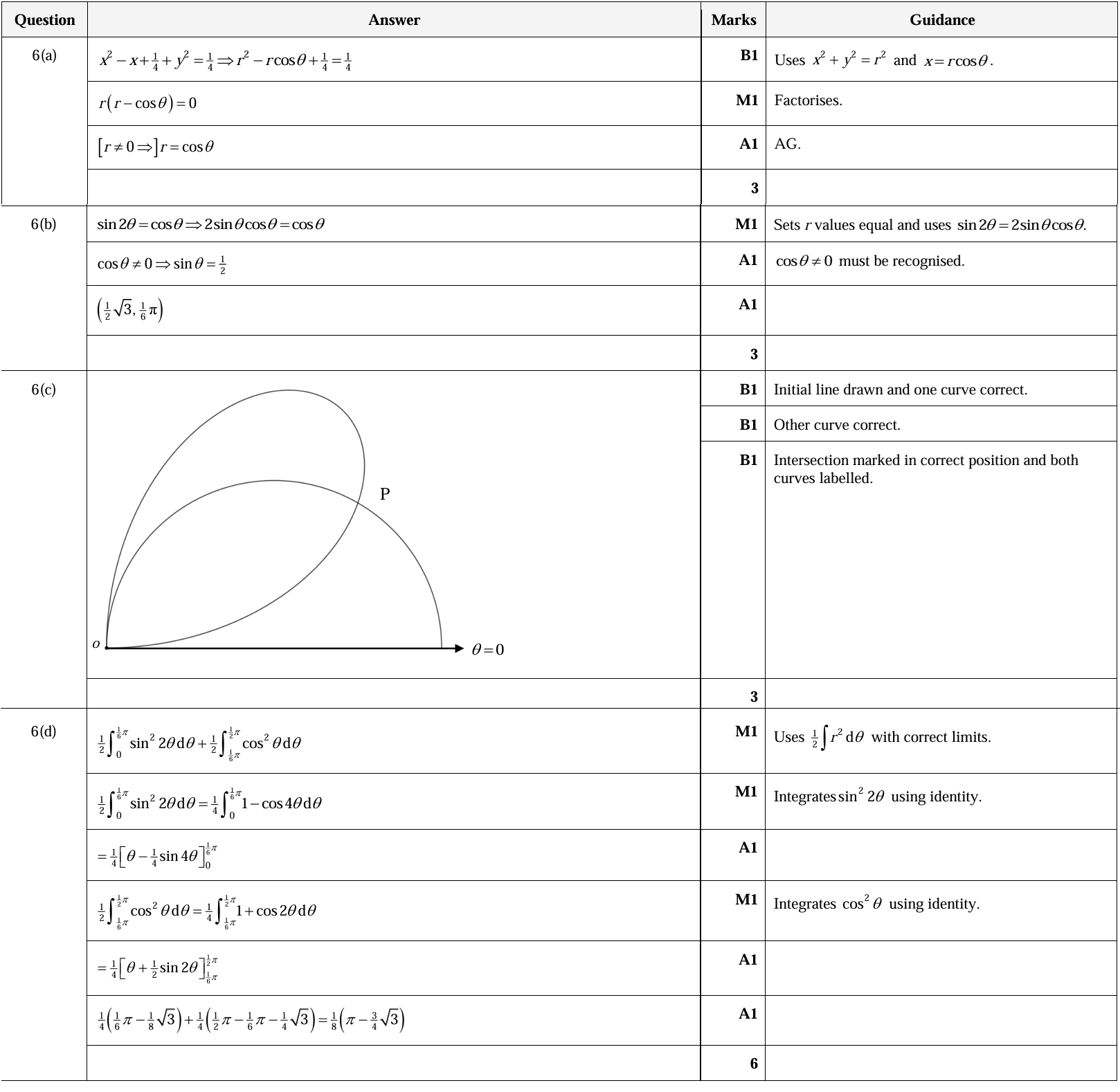
(a) Show that the curve with Cartesian equation \(\left( x - \frac{1}{2} \right)^2 + y^2 = \frac{1}{4}\) has polar equation \(r = \cos \theta\).
The curves \(C_1\) and \(C_2\) have polar equations \(r = \cos \theta\) and \(r = \sin 2\theta\) respectively, where \(0 \leq \theta \leq \frac{1}{2} \pi\). The curves \(C_1\) and \(C_2\) intersect at the pole and at another point \(P\).
(b) Find the polar coordinates of \(P\).
(c) In a single diagram sketch \(C_1\) and \(C_2\), clearly identifying each curve, and mark the point \(P\).
(d) The region \(R\) is enclosed by \(C_1\) and \(C_2\) and includes the line \(OP\). Find, in exact form, the area of \(R\).