Exam-Style Problems
⬅ Back to SubchapterJune 2008 p4 q4
3578
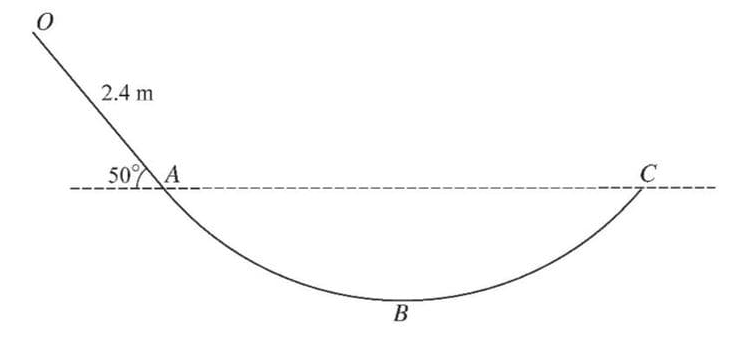
OABC is a vertical cross-section of a smooth surface. The straight part OA has length 2.4 m and makes an angle of 50° with the horizontal. A and C are at the same horizontal level and B is the lowest point of the cross-section (see diagram). A particle P of mass 0.8 kg is released from rest at O and moves on the surface. P remains in contact with the surface until it leaves the surface at C. Find
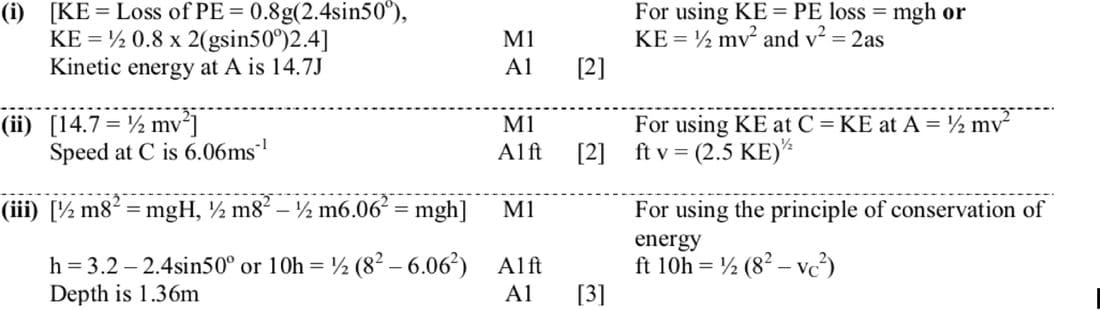
- the kinetic energy of P at A,
- the speed of P at C.
The greatest speed of P is 8 m s-1.
- Find the depth of B below the horizontal through A and C.
Nov 2007 p4 q4
3579
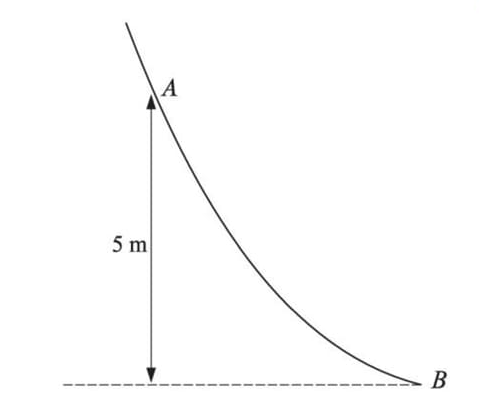
The diagram shows the vertical cross-section of a surface. A and B are two points on the cross-section, and A is 5 m higher than B. A particle of mass 0.35 kg passes through A with speed 7 m/s, moving on the surface towards B.
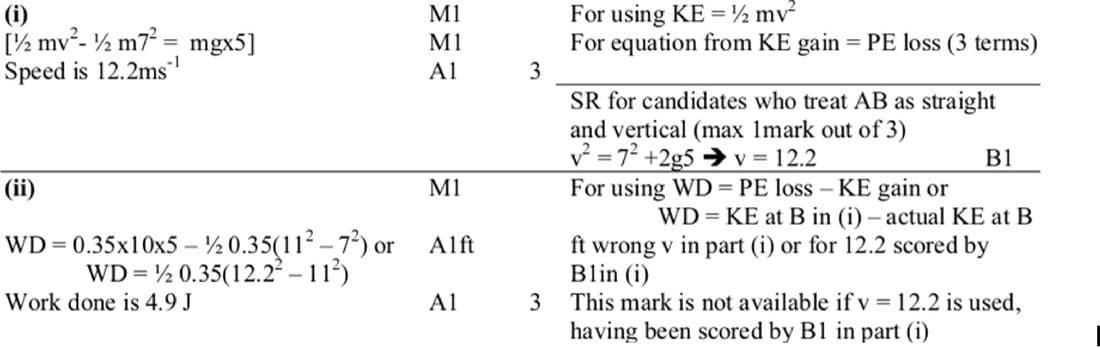
(i) Assuming that there is no resistance to motion, find the speed with which the particle reaches B.
(ii) Assuming instead that there is a resistance to motion, and that the particle reaches B with speed 11 m/s, find the work done against this resistance as the particle moves from A to B.
June 2007 p4 q5
3580
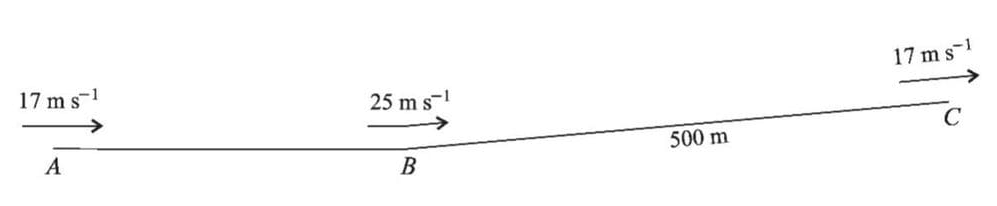
A lorry of mass 12,500 kg travels along a road that has a straight horizontal section AB and a straight inclined section BC. The length of BC is 500 m. The speeds of the lorry at A, B, and C are 17 m/s, 25 m/s, and 17 m/s respectively (see diagram).
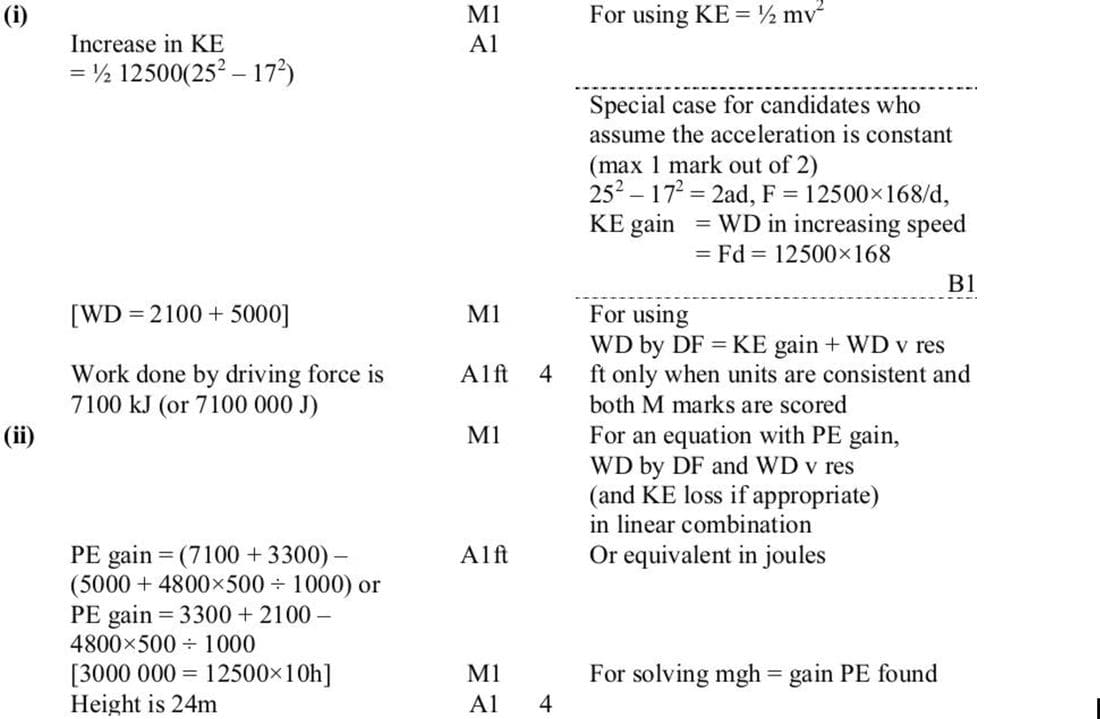
(i) The work done against the resistance to motion of the lorry, as it travels from A to B, is 5000 kJ. Find the work done by the driving force as the lorry travels from A to B.
(ii) As the lorry travels from B to C, the resistance to motion is 4800 N and the work done by the driving force is 3300 kJ. Find the height C above the level of AB.
June 2022 p43 q5
3581
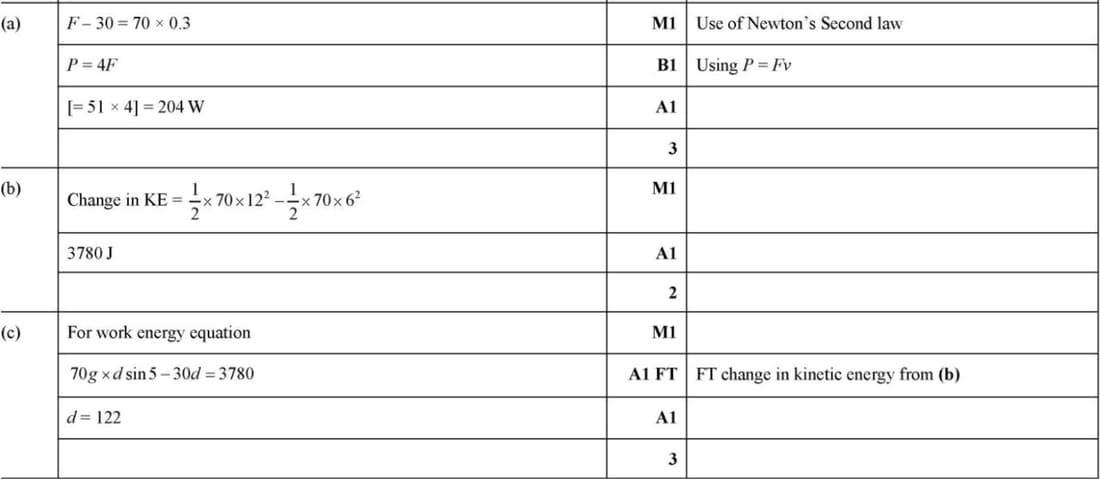
A cyclist is riding along a straight horizontal road. The total mass of the cyclist and her bicycle is 70 kg. At an instant when the cyclist’s speed is 4 m/s, her acceleration is 0.3 m/s². There is a constant resistance to motion of magnitude 30 N.
(a) Find the power developed by the cyclist.
The cyclist comes to the top of a hill inclined at 5° to the horizontal. The cyclist stops pedalling and freewheels down the hill (so that the cyclist is no longer supplying any power). The magnitude of the resistance force remains at 30 N. Over a distance of d m, the speed of the cyclist increases from 6 m/s to 12 m/s.
(b) Find the change in kinetic energy.
(c) Use an energy method to find d.
Nov 2006 p4 q5
3582
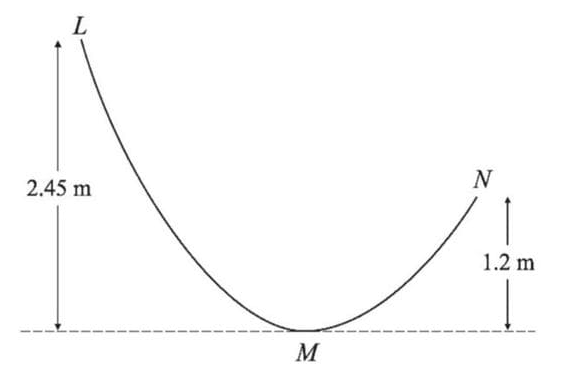
The diagram shows the vertical cross-section LMN of a fixed smooth surface. M is the lowest point of the cross-section. L is 2.45 m above the level of M, and N is 1.2 m above the level of M. A particle of mass 0.5 kg is released from rest at L and moves on the surface until it leaves it at N. Find
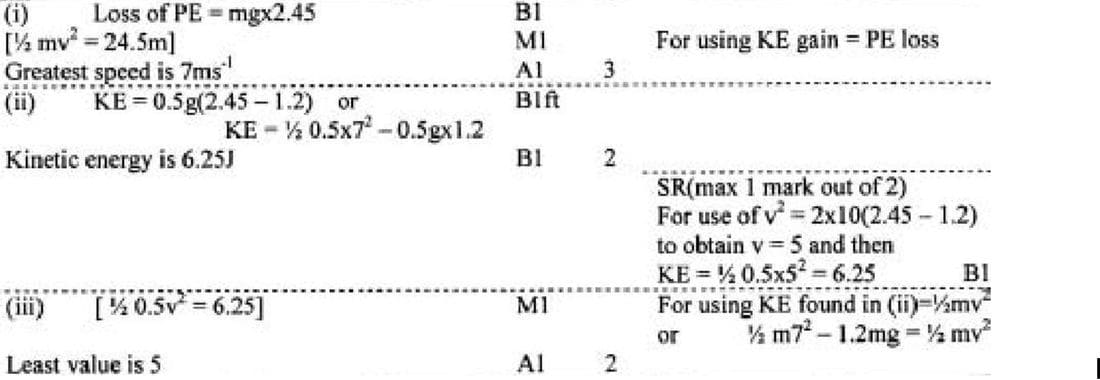
- the greatest speed of the particle,
- the kinetic energy of the particle at N.
The particle is now projected from N, with speed v m s-1, along the surface towards M.
- Find the least value of v for which the particle will reach L.