Exam-Style Problems
⬅ Back to SubchapterJune 2012 p61 q6
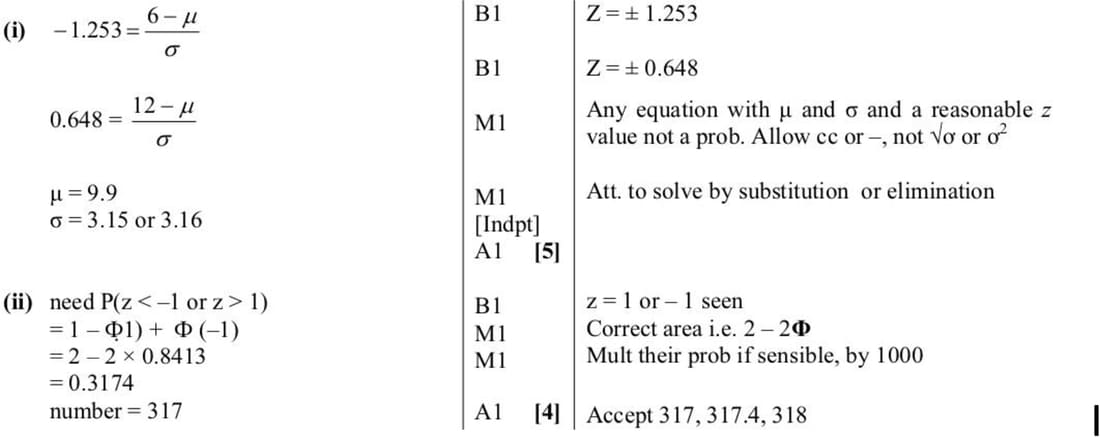
The lengths of body feathers of a particular species of bird are modelled by a normal distribution. A researcher measures the lengths of a random sample of 600 body feathers from birds of this species and finds that 63 are less than 6 cm long and 155 are more than 12 cm long.
(i) Find estimates of the mean and standard deviation of the lengths of body feathers of birds of this species.
(ii) In a random sample of 1000 body feathers from birds of this species, how many would the researcher expect to find with lengths more than 1 standard deviation from the mean?
Nov 2011 p63 q1
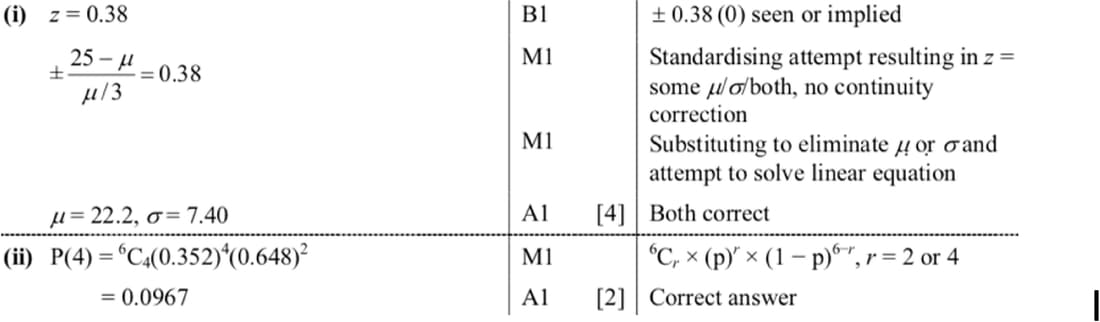
The random variable X is normally distributed and is such that the mean μ is three times the standard deviation σ. It is given that P(X < 25) = 0.648.
- Find the values of μ and σ.
- Find the probability that, from 6 random values of X, exactly 4 are greater than 25.
Nov 2011 p62 q7
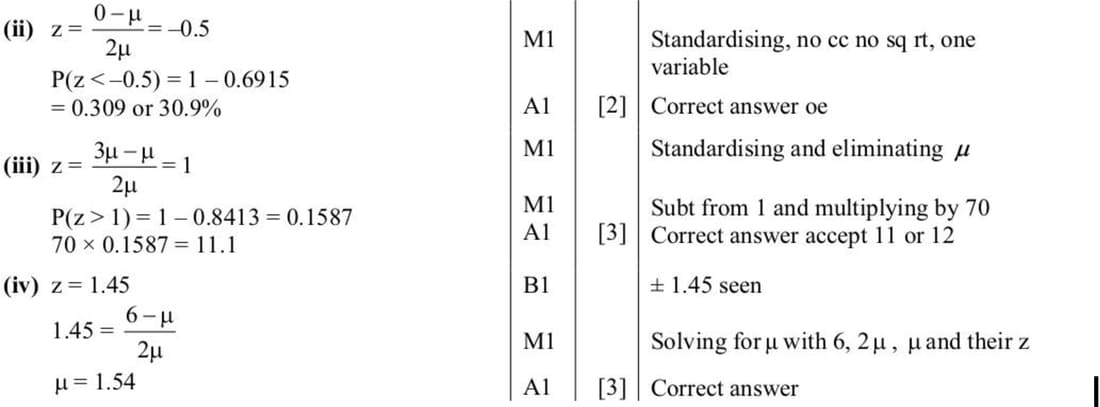
The daily minimum temperature, in °C, in another country in winter has a normal distribution with mean \(\mu\) and standard deviation \(2\mu\).
(ii) Find the proportion of winter days on which the minimum temperature is below zero.
(iii) 70 winter days are chosen at random. Find how many of these would be expected to have a minimum temperature which is more than three times the mean.
(iv) The probability of the minimum temperature being above 6 °C on any winter day is 0.0735. Find the value of \(\mu\).
Nov 2011 p61 q5
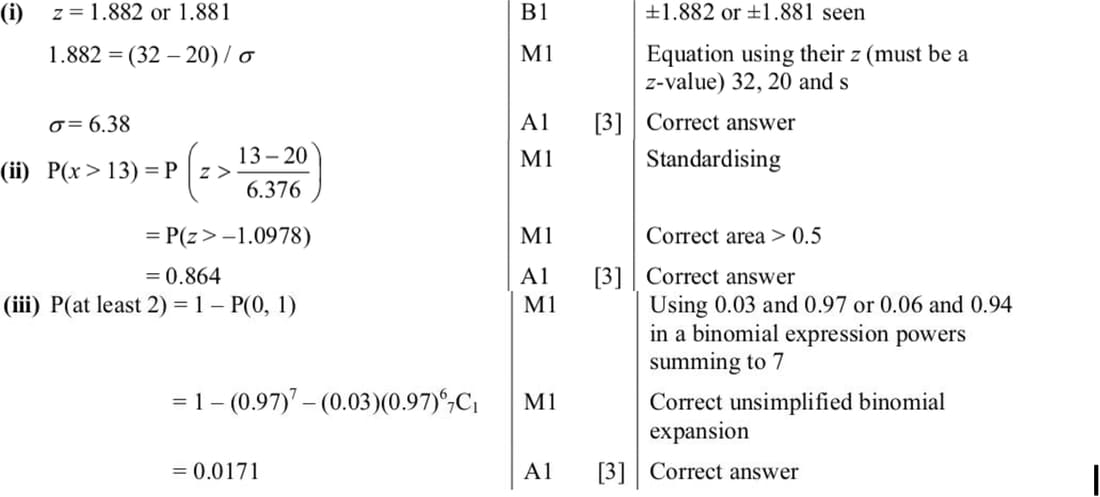
The weights of letters posted by a certain business are normally distributed with mean 20 g. It is found that the weights of 94% of the letters are within 12 g of the mean.
- Find the standard deviation of the weights of the letters.
- Find the probability that a randomly chosen letter weighs more than 13 g.
- Find the probability that at least 2 of a random sample of 7 letters have weights which are more than 12 g above the mean.
June 2011 p62 q6
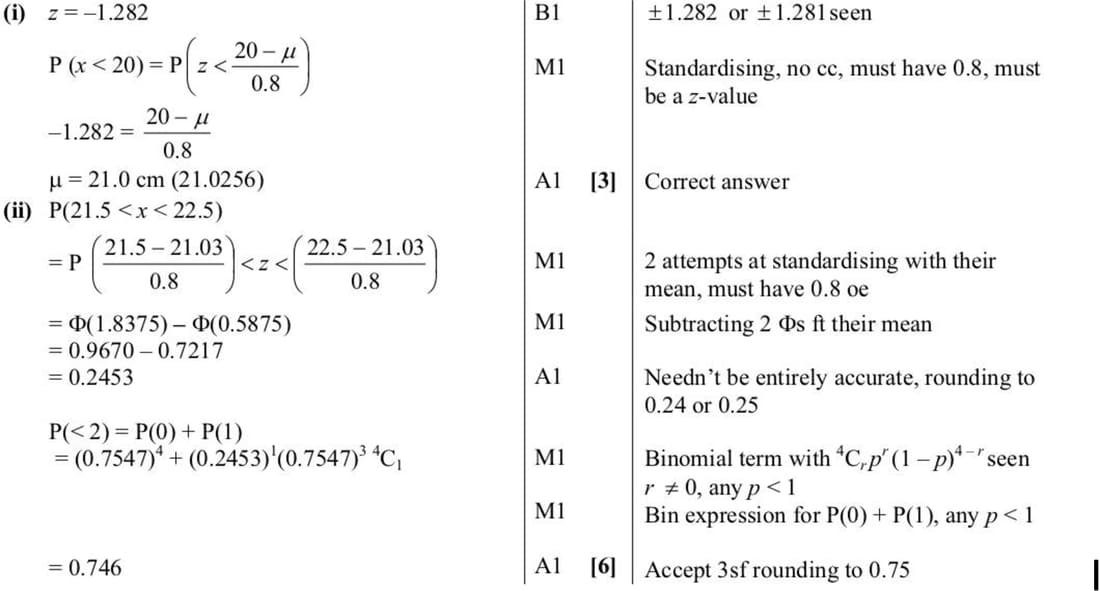
The lengths, in centimetres, of drinking straws produced in a factory have a normal distribution with mean \(\mu\) and variance 0.64. It is given that 10% of the straws are shorter than 20 cm.
- Find the value of \(\mu\).
- Find the probability that, of 4 straws chosen at random, fewer than 2 will have a length between 21.5 cm and 22.5 cm.