Exam-Style Problems
⬅ Back to SubchapterNov 2013 p31 q8
1990
(a) The complex numbers u and v satisfy the equations
\(u + 2v = 2i\) and \(iu + v = 3\).
Solve the equations for u and v, giving both answers in the form x + iy, where x and y are real.
(b) On an Argand diagram, sketch the locus representing complex numbers z satisfying \(|z + i| = 1\) and the locus representing complex numbers w satisfying \(\text{arg}(w - 2) = \frac{3}{4}\pi\). Find the least value of \(|z - w|\) for points on these loci.

June 2013 p33 q7
1991
The complex number z is defined by z = a + ib, where a and b are real. The complex conjugate of z is denoted by z*.
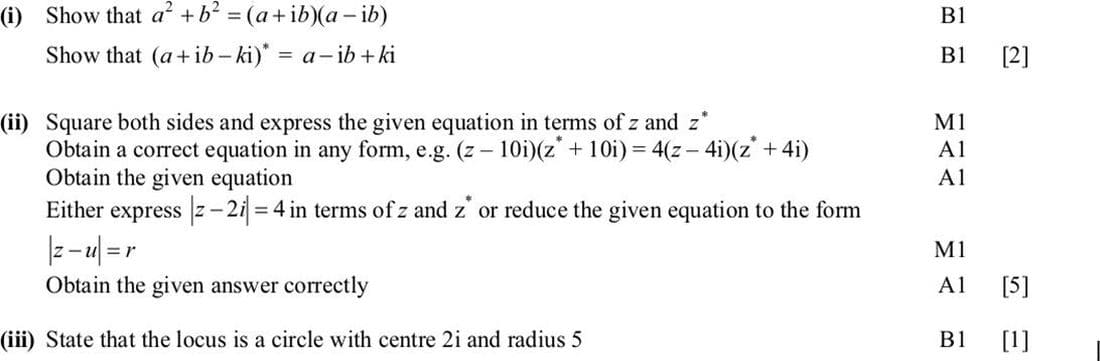
- Show that |z|2 = zz* and that (z - ki)* = z* + ki, where k is real.
\(In an Argand diagram a set of points representing complex numbers z is defined by the equation |z - 10i| = 2|z - 4i|.\)
- Show, by squaring both sides, that zz* - 2iz* + 2iz - 12 = 0. Hence show that |z - 2i| = 4.
- Describe the set of points geometrically.
June 2013 p32 q9
1992
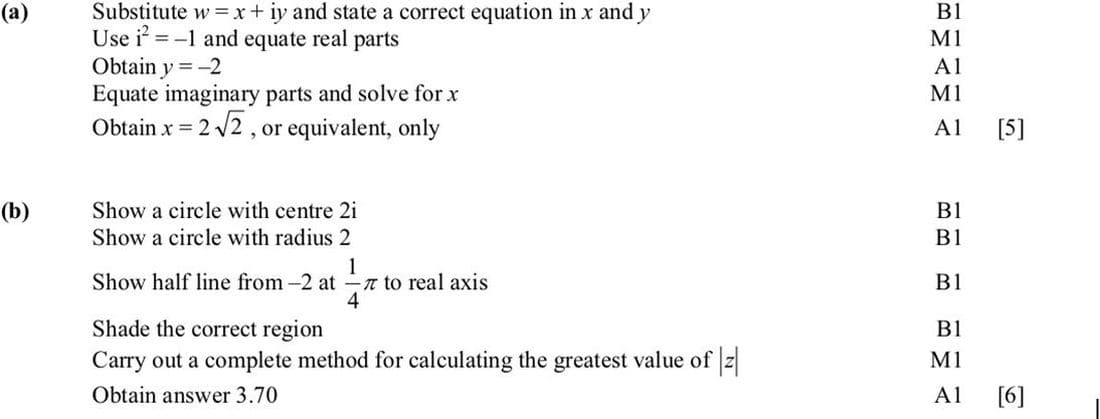
(a) The complex number \(w\) is such that \(\text{Re} \, w > 0\) and \(w + 3w^* = iw^2\), where \(w^*\) denotes the complex conjugate of \(w\). Find \(w\), giving your answer in the form \(x + iy\), where \(x\) and \(y\) are real.
(b) On a sketch of an Argand diagram, shade the region whose points represent complex numbers \(z\) which satisfy both the inequalities \(|z - 2i| \leq 2\) and \(0 \leq \arg(z + 2) \leq \frac{1}{4}\pi\). Calculate the greatest value of \(|z|\) for points in this region, giving your answer correct to 2 decimal places.
June 2013 p31 q7
1993
(a) Without using a calculator, solve the equation
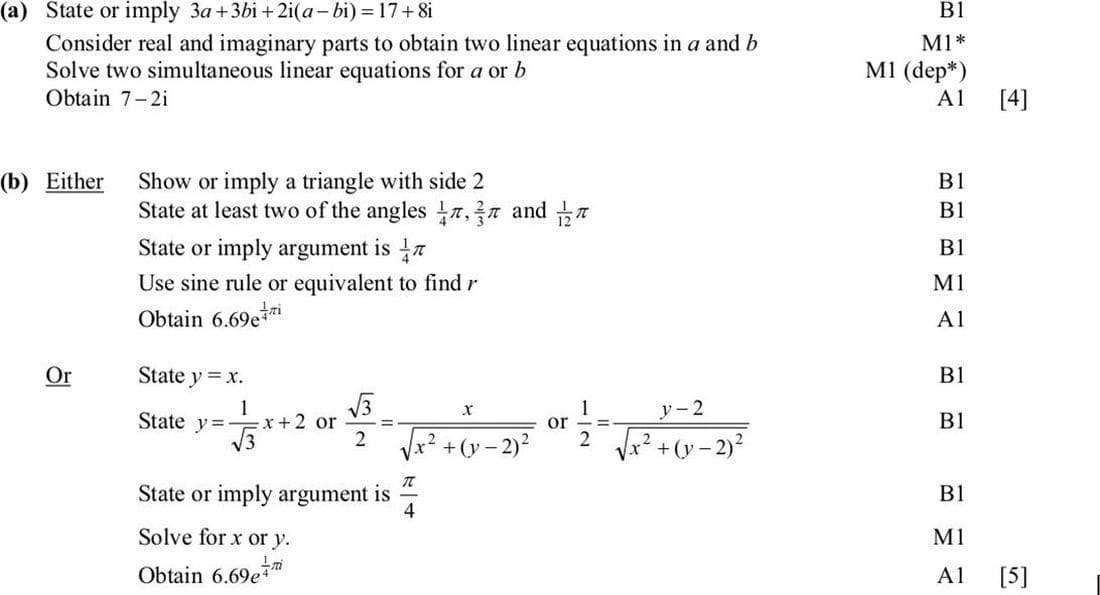
\(3w + 2iw^* = 17 + 8i\),
where \(w^*\) denotes the complex conjugate of \(w\). Give your answer in the form \(a + bi\).
(b) In an Argand diagram, the loci
\(\arg(z - 2i) = \frac{1}{6}\pi\) and \(|z - 3| = |z - 3i|\)
intersect at the point \(P\). Express the complex number represented by \(P\) in the form \(re^{i\theta}\), giving the exact value of \(\theta\) and the value of \(r\) correct to 3 significant figures.
June 2023 p23 q3
1994
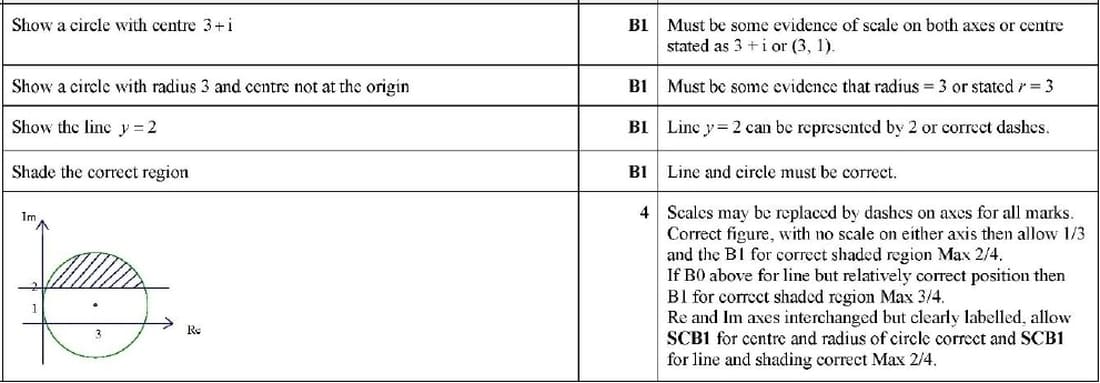
On a sketch of an Argand diagram, shade the region whose points represent complex numbers \(z\) satisfying the inequalities \(|z - 3 - i| \leq 3\) and \(|z| \geq |z - 4i|\).