Exam-Style Problems
⬅ Back to SubchapterJune 2006 p3 q6
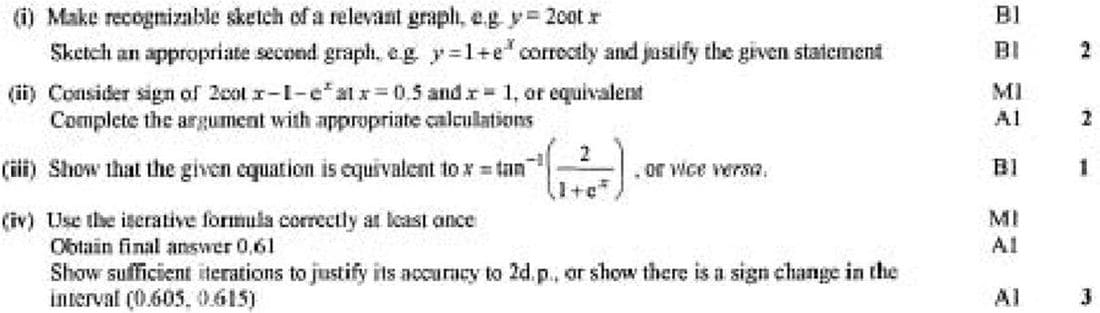
(i) By sketching a suitable pair of graphs, show that the equation \(2 \cot x = 1 + e^x\), where \(x\) is in radians, has only one root in the interval \(0 < x < \frac{1}{2} \pi\).
(ii) Verify by calculation that this root lies between 0.5 and 1.0.
(iii) Show that this root also satisfies the equation \(x = \arctan\left(\frac{2}{1 + e^x}\right)\).
(iv) Use the iterative formula \(x_{n+1} = \arctan\left(\frac{2}{1 + e^{x_n}}\right)\), with initial value \(x_1 = 0.7\), to determine this root correct to 2 decimal places. Give the result of each iteration to 4 decimal places.
June 2005 p3 q7
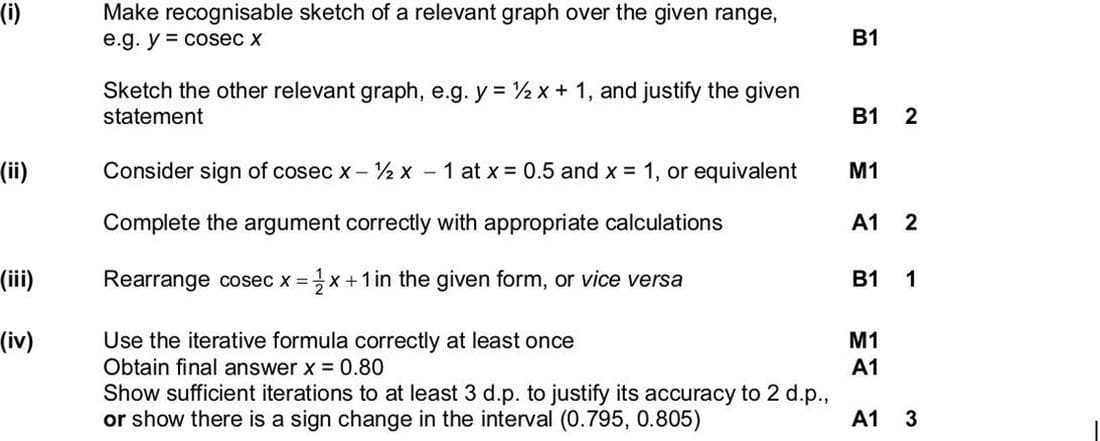
(i) By sketching a suitable pair of graphs, show that the equation \(\csc x = \frac{1}{2}x + 1\), where \(x\) is in radians, has a root in the interval \(0 < x < \frac{1}{2}\pi\).
(ii) Verify, by calculation, that this root lies between 0.5 and 1.
(iii) Show that this root also satisfies the equation \(x = \sin^{-1} \left( \frac{2}{x+2} \right)\).
(iv) Use the iterative formula \(x_{n+1} = \sin^{-1} \left( \frac{2}{x_n+2} \right)\), with initial value \(x_1 = 0.75\), to determine this root correct to 2 decimal places. Give the result of each iteration to 4 decimal places.
Nov 2004 p3 q5
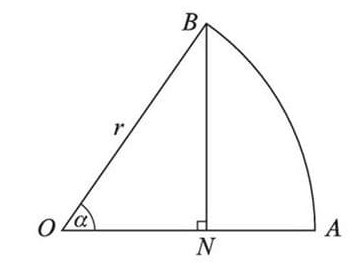
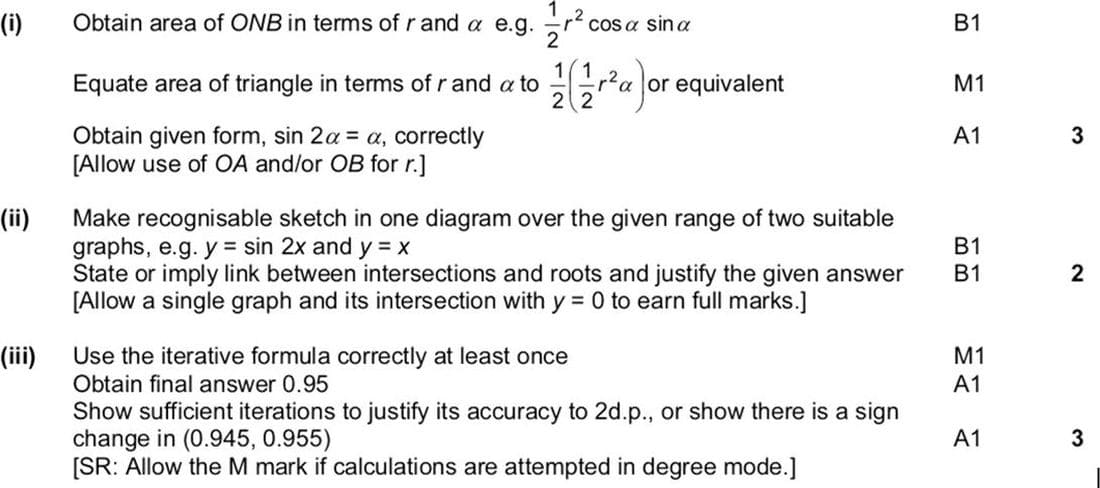
The diagram shows a sector OAB of a circle with centre O and radius r. The angle AOB is \(\alpha\) radians, where \(0 < \alpha < \frac{1}{2}\pi\). The point N on OA is such that BN is perpendicular to OA. The area of the triangle ONB is half the area of the sector OAB.
- Show that \(\alpha\) satisfies the equation \(\sin 2x = x\).
- By sketching a suitable pair of graphs, show that this equation has exactly one root in the interval \(0 < x < \frac{1}{2}\pi\).
- Use the iterative formula \(x_{n+1} = \sin(2x_n)\), with initial value \(x_1 = 1\), to find \(\alpha\) correct to 2 decimal places, showing the result of each iteration.
Nov 2003 p3 q5
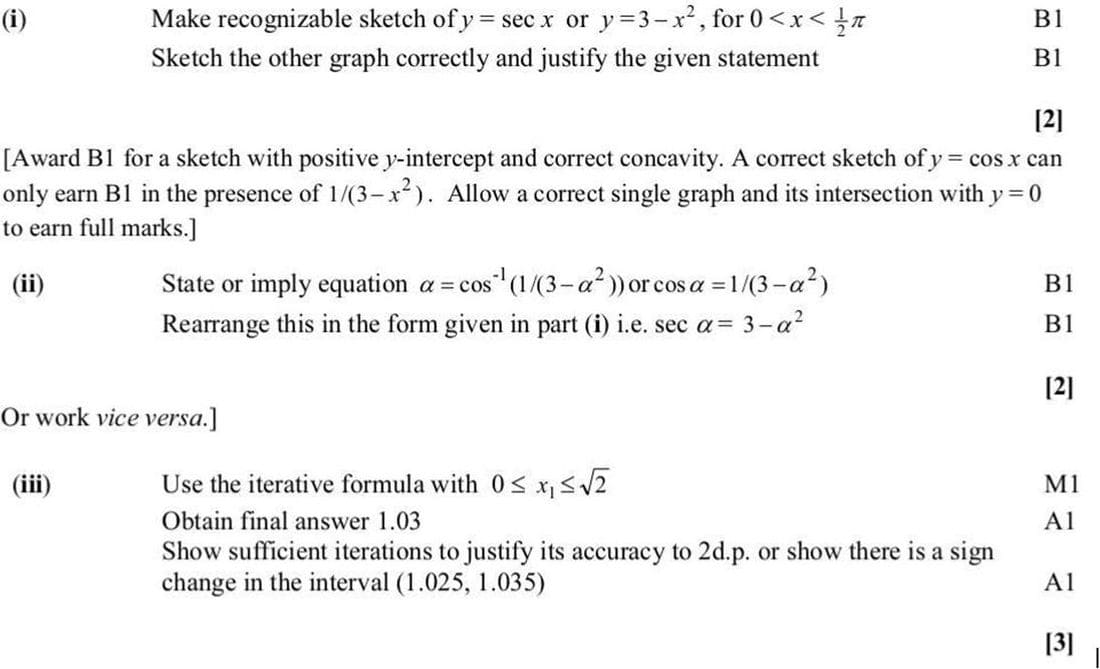
(i) By sketching suitable graphs, show that the equation \(\sec x = 3 - x^2\) has exactly one root in the interval \(0 < x < \frac{1}{2}\pi\).
(ii) Show that, if a sequence of values given by the iterative formula \(x_{n+1} = \cos^{-1} \left( \frac{1}{3-x_n^2} \right)\) converges, then it converges to a root of the equation given in part (i).
(iii) Use this iterative formula, with initial value \(x_1 = 1\), to determine the root in the interval \(0 < x < \frac{1}{2}\pi\) correct to 2 decimal places, showing the result of each iteration.
June 2022 p32 q5
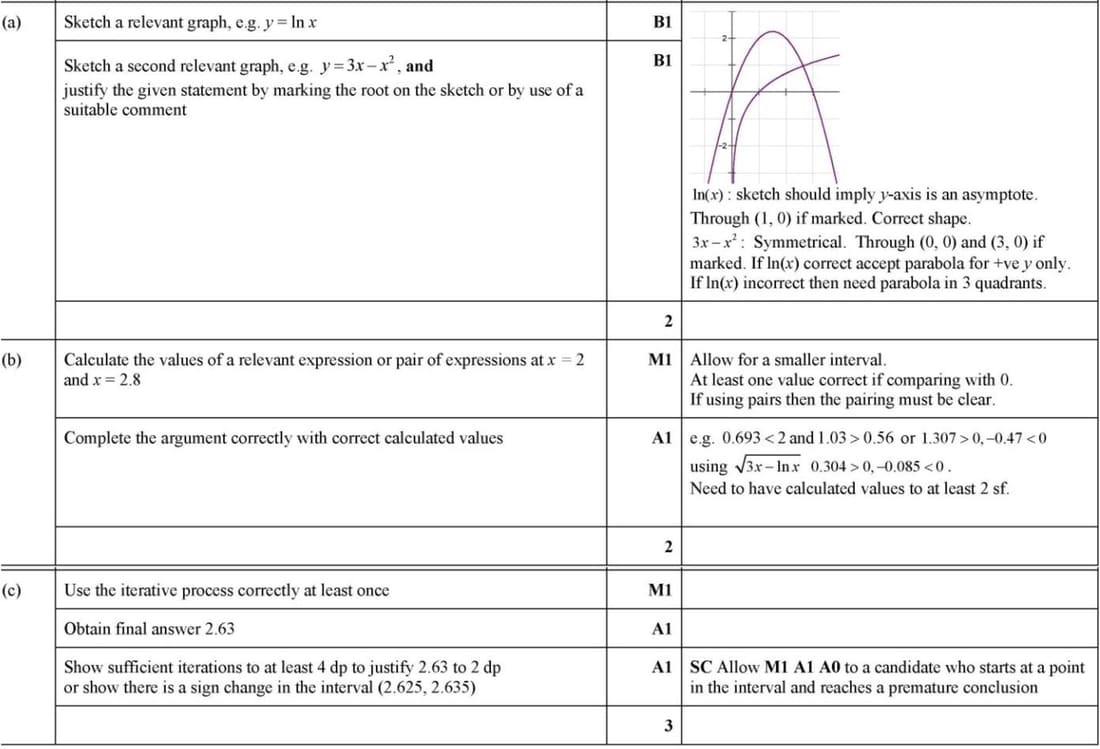
(a) By sketching a suitable pair of graphs, show that the equation \(\ln x = 3x - x^2\) has one real root.
(b) Verify by calculation that the root lies between 2 and 2.8.
(c) Use the iterative formula \(x_{n+1} = \sqrt{3x_n - \ln x_n}\) to determine the root correct to 2 decimal places. Give the result of each iteration to 4 decimal places.