Exam-Style Problems
⬅ Back to SubchapterFM Nov 2023 p12 q04
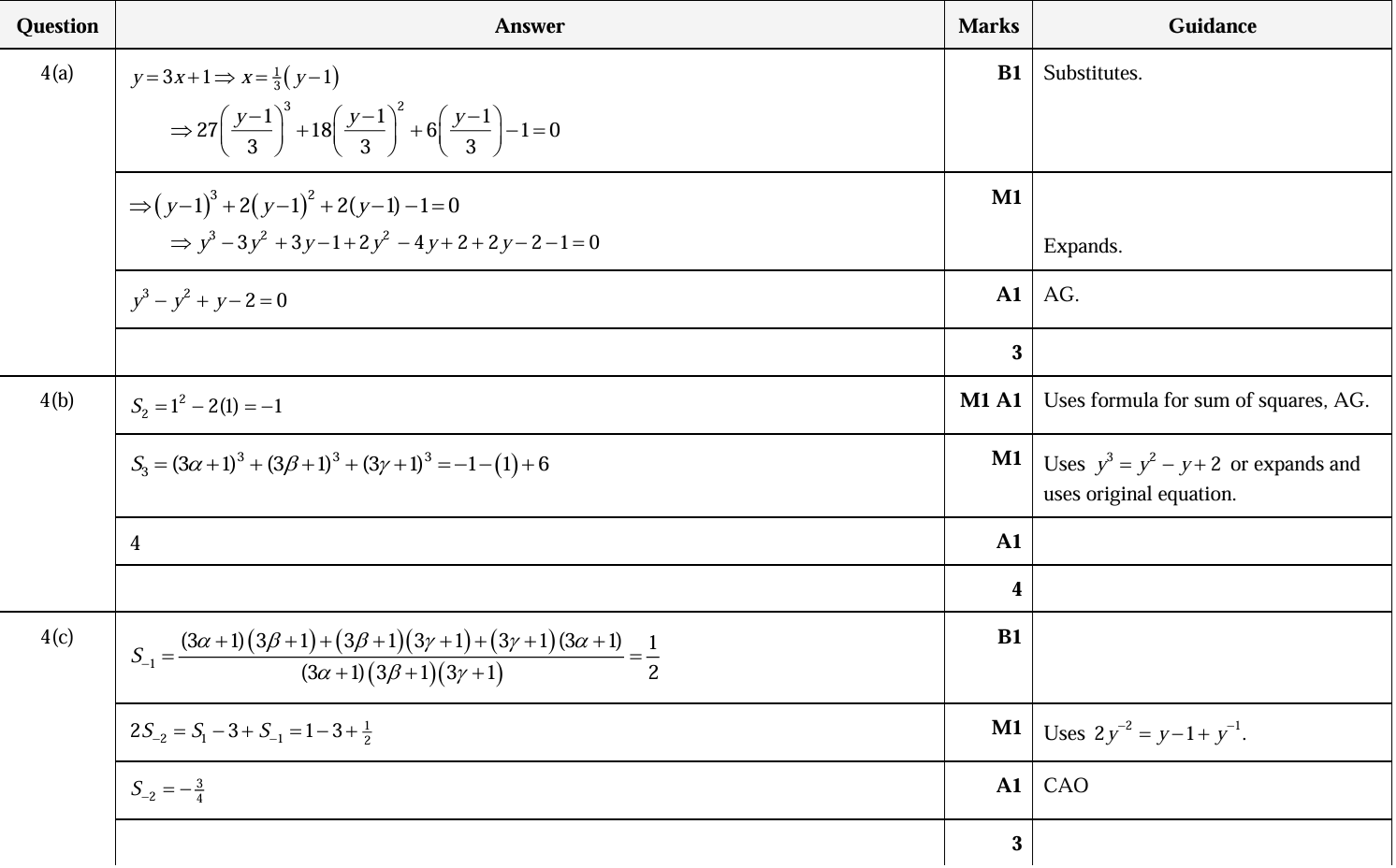
The cubic equation \(27x^3 + 18x^2 + 6x - 1 = 0\) has roots \(\alpha, \beta, \gamma\).
(a) Show that a cubic equation with roots \(3\alpha + 1, 3\beta + 1, 3\gamma + 1\) is \(y^3 - y^2 + y - 2 = 0\).
The sum \((3\alpha + 1)^n + (3\beta + 1)^n + (3\gamma + 1)^n\) is denoted by \(S_n\).
(b) Find the values of \(S_2\) and \(S_3\).
(c) Find the values of \(S_{-1}\) and \(S_{-2}\).
FM Nov 2023 p12 q05
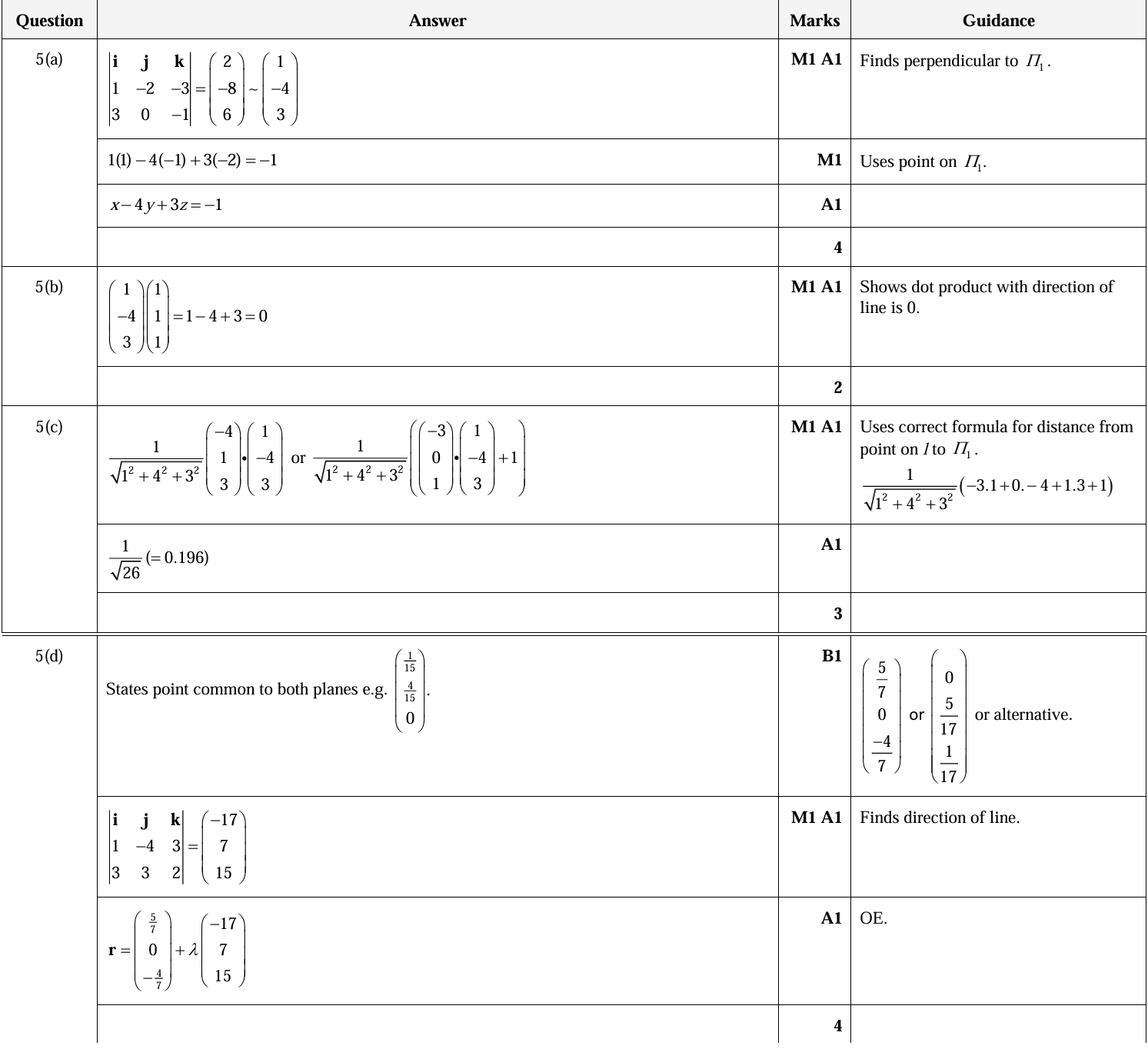
The plane \(\Pi_1\) has equation \(\mathbf{r} = \mathbf{i} - \mathbf{j} - 2\mathbf{k} + \lambda (\mathbf{i} - 2\mathbf{j} - 3\mathbf{k}) + \mu (3\mathbf{i} - \mathbf{k})\).
(a) Find an equation for \(\Pi_1\) in the form \(ax + by + cz = d\).
The line \(l\), which does not lie in \(\Pi_1\), has equation \(\mathbf{r} = -3\mathbf{i} + \mathbf{k} + t(\mathbf{i} + \mathbf{j} + \mathbf{k})\).
(b) Show that \(l\) is parallel to \(\Pi_1\).
(c) Find the distance between \(l\) and \(\Pi_1\).
(d) The plane \(\Pi_2\) has equation \(3x + 3y + 2z = 1\).
Find a vector equation of the line of intersection of \(\Pi_1\) and \(\Pi_2\).
FM Nov 2023 p12 q06
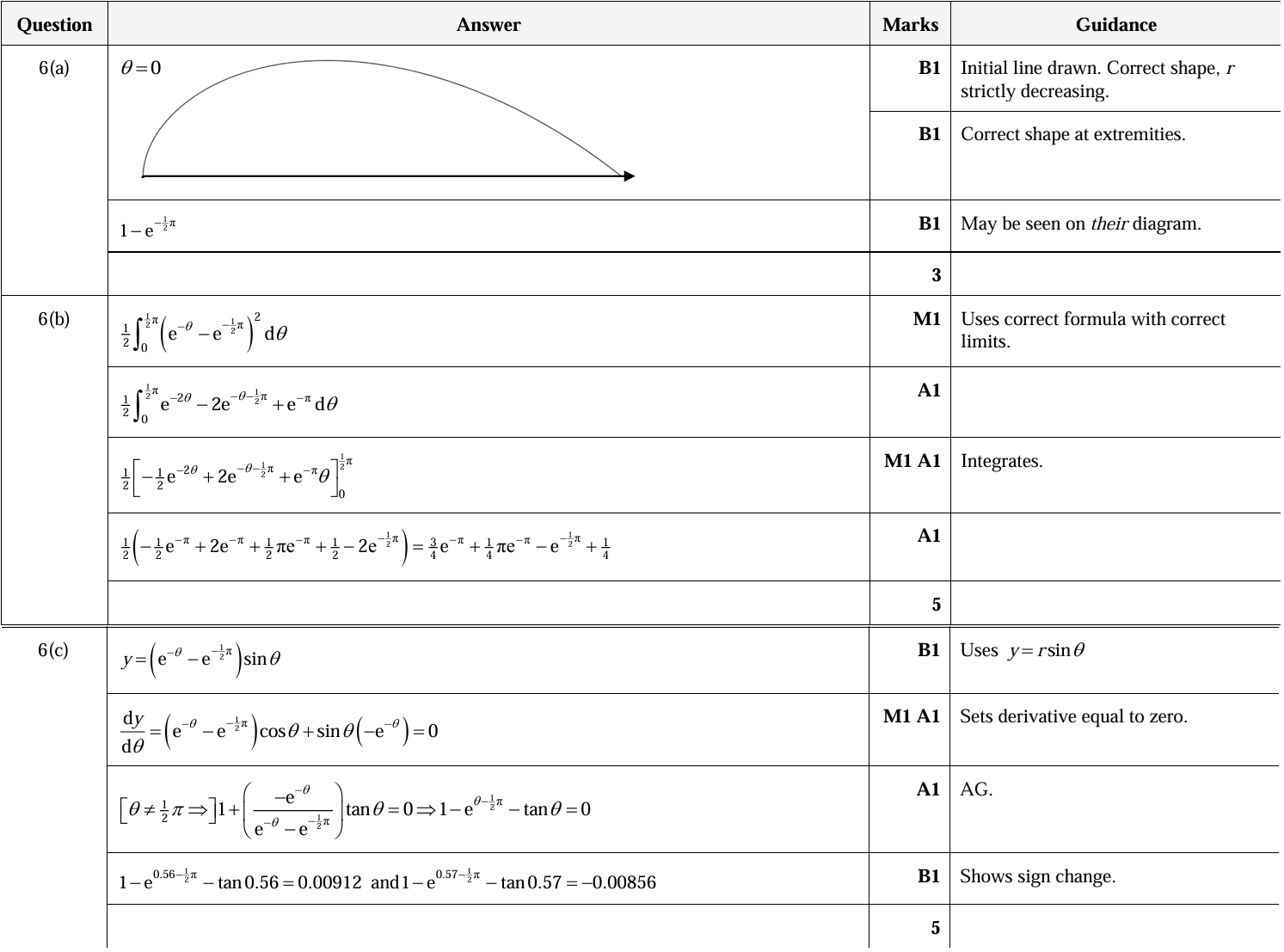
The curve C has polar equation \(r = e^{-\theta} - e^{-\frac{1}{2}\pi}\), where \(0 \leq \theta \leq \frac{1}{2}\pi\).
- Sketch C and state, in exact form, the greatest distance of a point on C from the pole.
- Find the exact value of the area of the region bounded by C and the initial line.
- Show that, at the point on C furthest from the initial line, \(1 - e^{\theta - \frac{1}{2}\pi} - \tan \theta = 0\) and verify that this equation has a root between 0.56 and 0.57.
FM Nov 2023 p12 q07
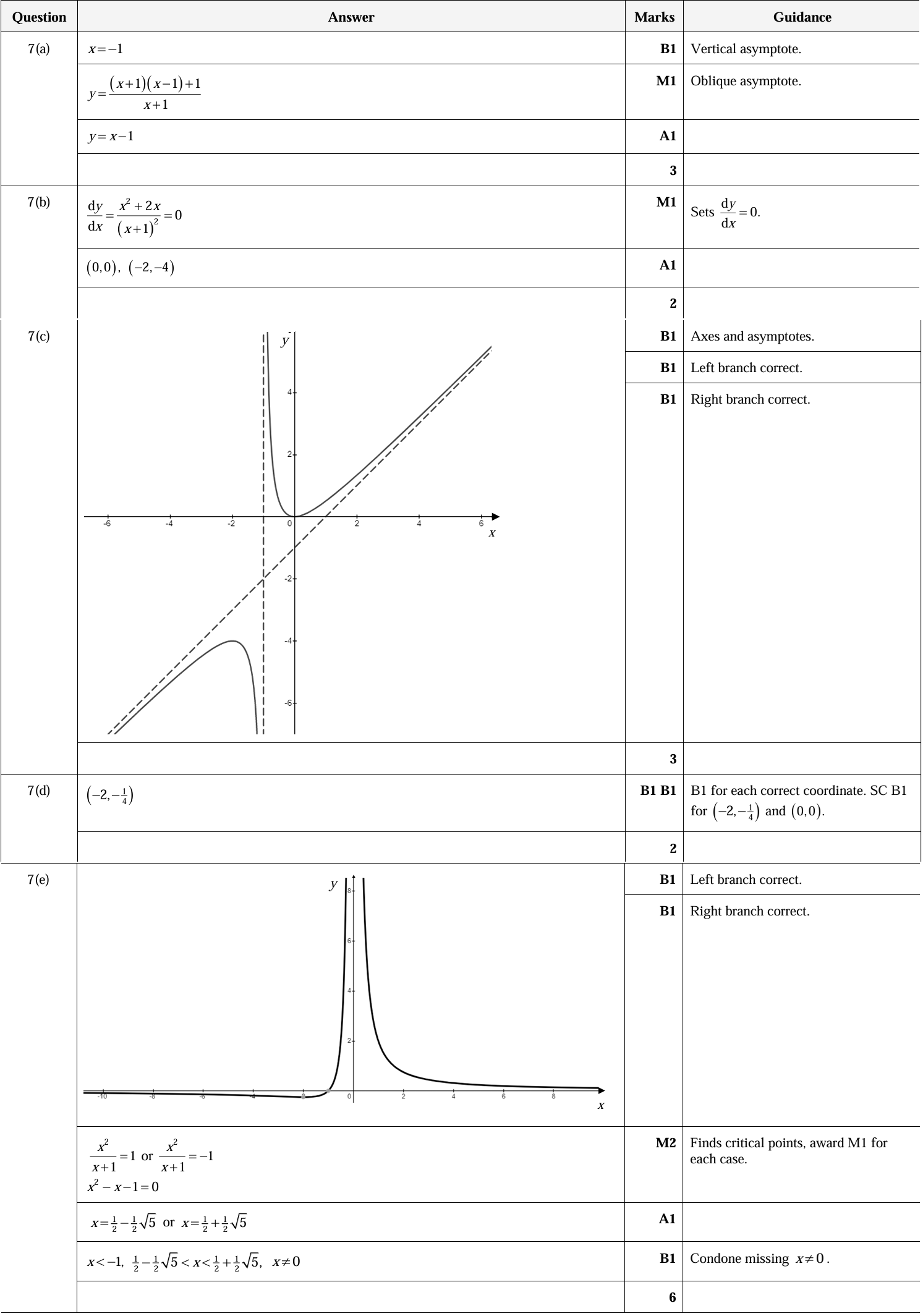
The curve C has equation \(y = f(x)\), where \(f(x) = \frac{x^2}{x+1}\).
- Find the equations of the asymptotes of C.
- Find the coordinates of any stationary points on C.
- Sketch C.
- Find the coordinates of any stationary points on the curve with equation \(y = \frac{1}{f(x)}\).
- Sketch the curve with equation \(y = \frac{1}{f(x)}\) and find, in exact form, the set of values for which \(\frac{1}{f(x)} > f(x)\).
FM Nov 2023 p13 q01
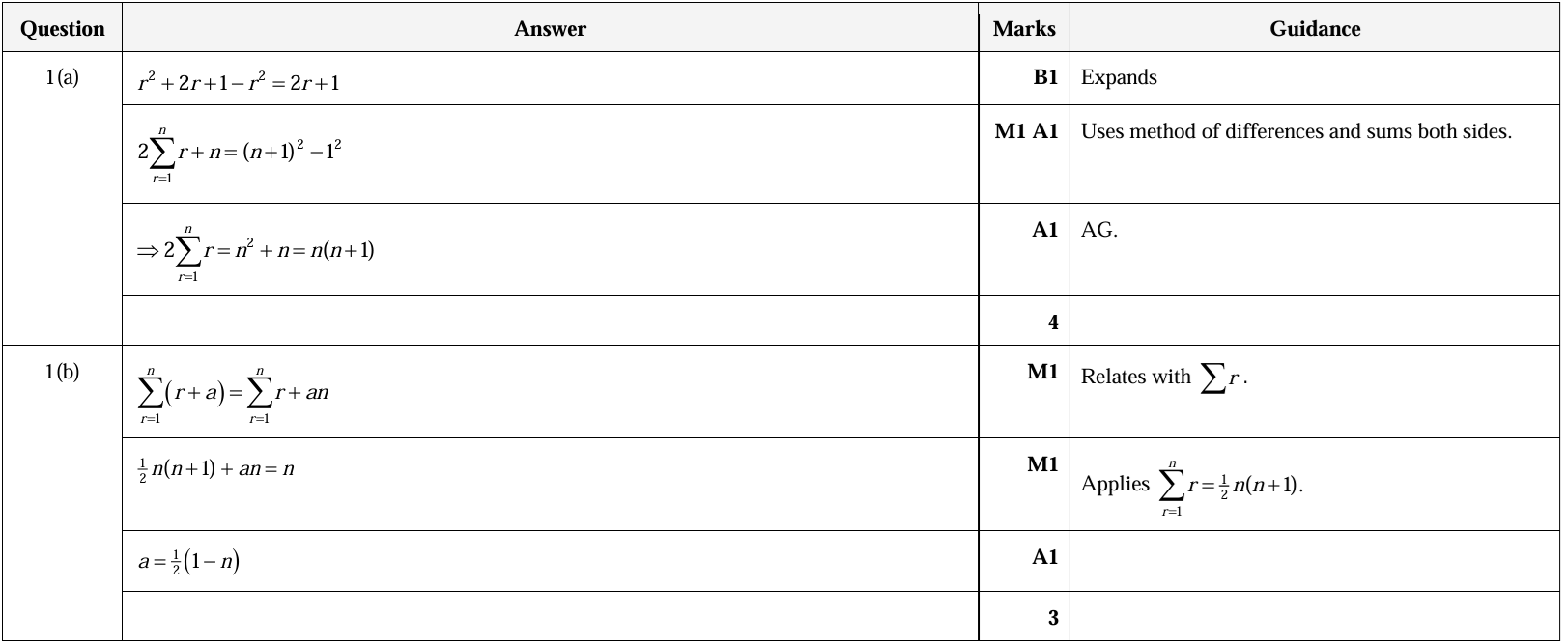
(a) By considering \((r+1)^2 - r^2\), use the method of differences to prove that
\(\sum_{r=1}^{n} r = \frac{1}{2} n(n+1).\)
(b) Given that \(\sum_{r=1}^{n} (r+a) = n\), find \(a\) in terms of \(n\).