Exam-Style Problems
⬅ Back to SubchapterNov 2011 p42 q2
A block of mass 6 kg is sliding down a line of greatest slope of a plane inclined at 8° to the horizontal. The coefficient of friction between the block and the plane is 0.2.
- Find the deceleration of the block.
- Given that the initial speed of the block is 3 m s-1, find how far the block travels.

Nov 2020 p41 q7
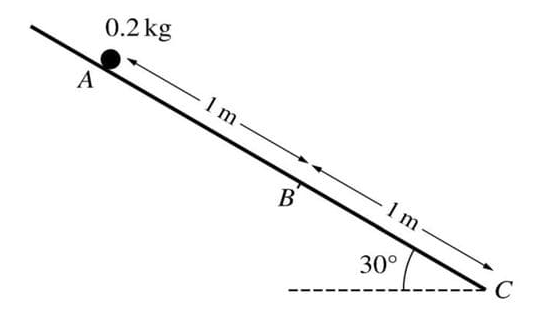
Three points A, B and C lie on a line of greatest slope of a plane inclined at an angle of 30° to the horizontal, with AB = 1 m and BC = 1 m, as shown in the diagram. A particle of mass 0.2 kg is released from rest at A and slides down the plane. The part of the plane from A to B is smooth. The part of the plane from B to C is rough, with coefficient of friction μ between the plane and the particle.
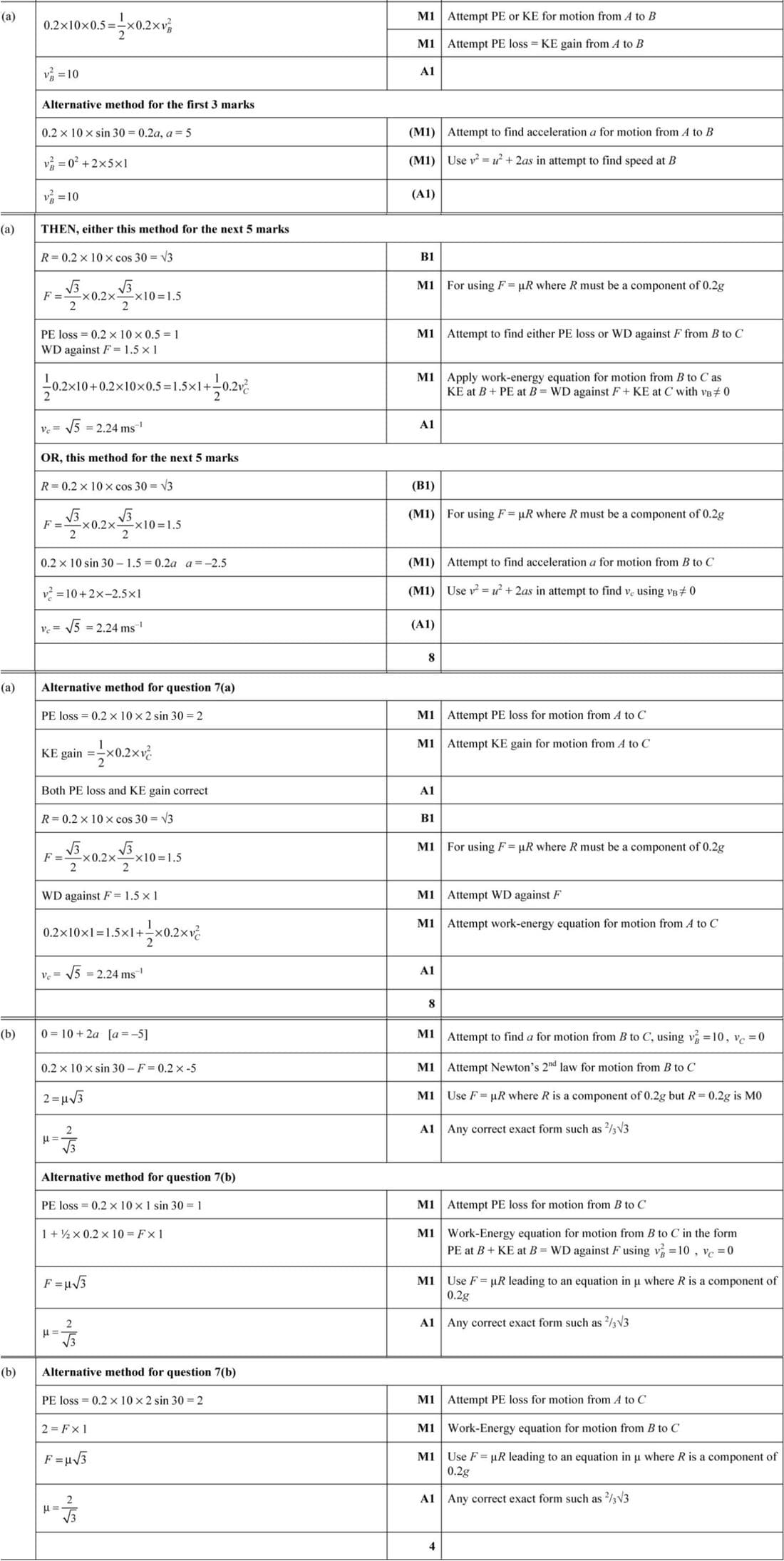
\((a) Given that μ = \frac{1}{2}\sqrt{3}, find the speed of the particle at C.\)
(b) Given instead that the particle comes to rest at C, find the exact value of μ.
Nov 2018 p41 q6
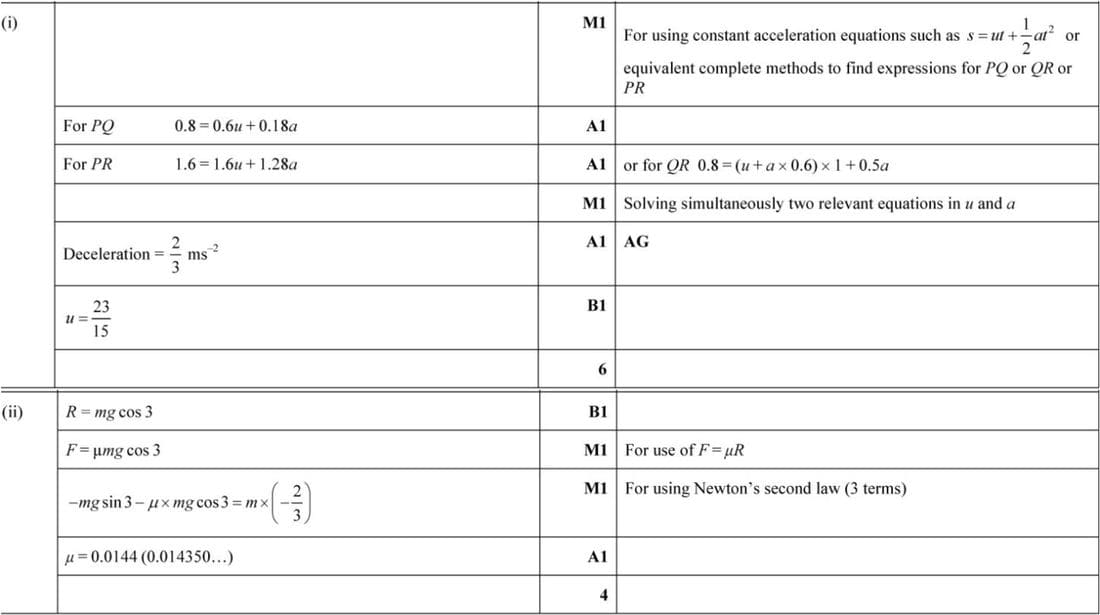
A particle is projected from a point P with initial speed u m s-1 up a line of greatest slope PQR of a rough inclined plane. The distances PQ and QR are both equal to 0.8 m. The particle takes 0.6 s to travel from P to Q and 1 s to travel from Q to R.
- Show that the deceleration of the particle is \(\frac{2}{3}\) m s-2 and hence find u, giving your answer as an exact fraction.
- Given that the plane is inclined at 3° to the horizontal, find the value of the coefficient of friction between the particle and the plane.
Nov 2017 p43 q3
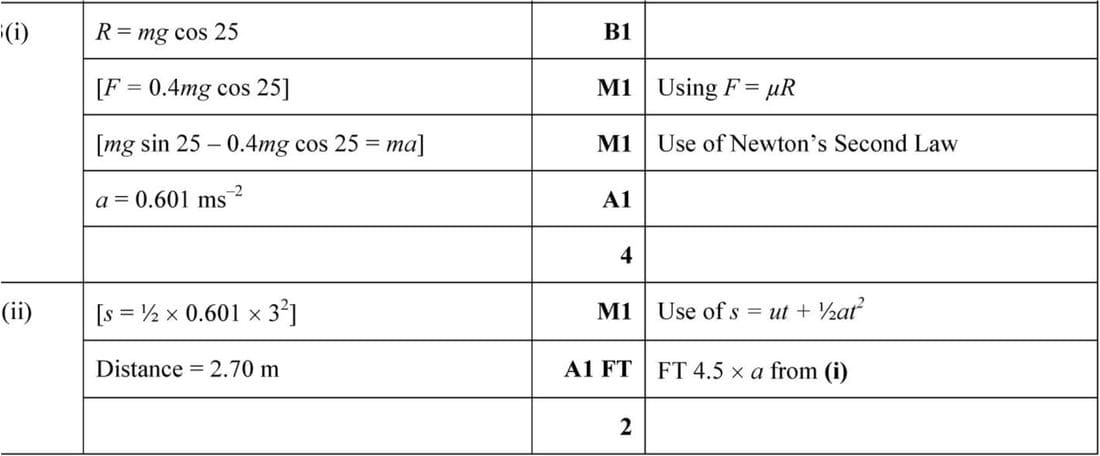
A particle is released from rest and slides down a line of greatest slope of a rough plane which is inclined at 25° to the horizontal. The coefficient of friction between the particle and the plane is 0.4.
- Find the acceleration of the particle.
- Find the distance travelled by the particle in the first 3 s after it is released.
Nov 2016 p41 q2
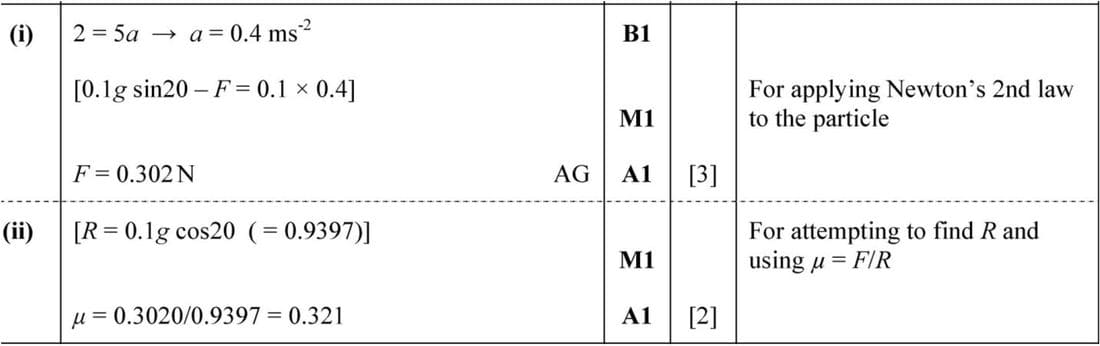
A particle of mass 0.1 kg is released from rest on a rough plane inclined at 20° to the horizontal. It is given that, 5 seconds after release, the particle has a speed of 2 m/s-1.
- Find the acceleration of the particle and hence show that the magnitude of the frictional force acting on the particle is 0.302 N, correct to 3 significant figures.
- Find the coefficient of friction between the particle and the plane.