Exam-Style Problems
⬅ Back to SubchapterNov 2010 p42 q4
3568
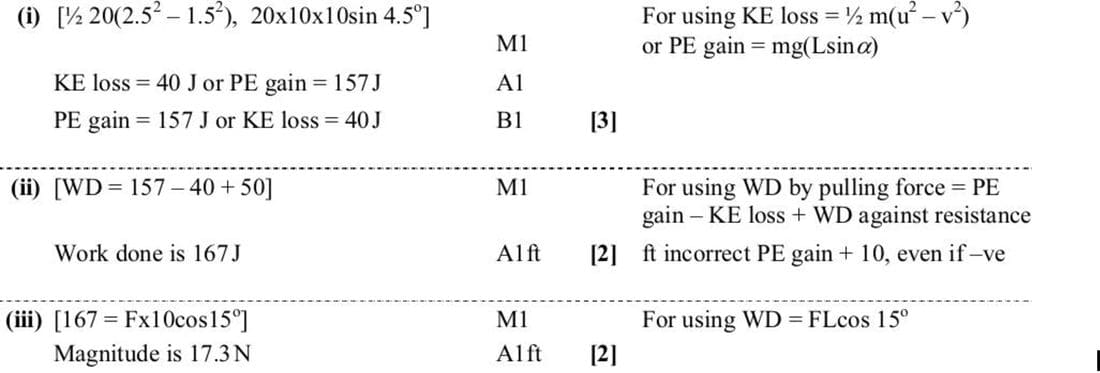
A block of mass 20 kg is pulled from the bottom to the top of a slope. The slope has length 10 m and is inclined at 4.5° to the horizontal. The speed of the block is 2.5 m/s at the bottom of the slope and 1.5 m/s at the top of the slope.
- Find the loss of kinetic energy and the gain in potential energy of the block.
- Given that the work done against the resistance to motion is 50 J, find the work done by the pulling force acting on the block.
- Given also that the pulling force is constant and acts at an angle of 15° upwards from the slope, find its magnitude.
Nov 2010 p41 q6
3569
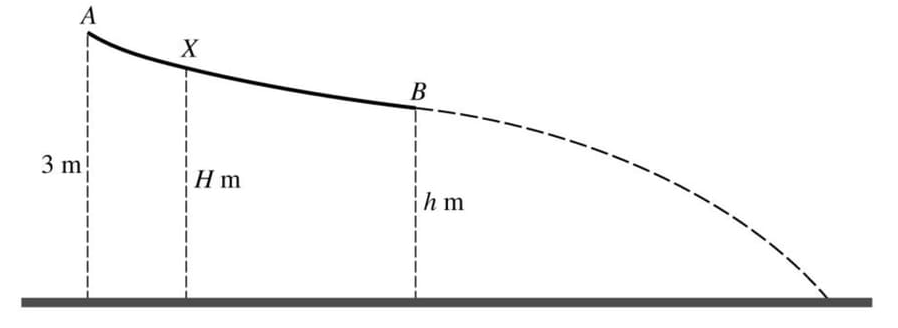
A smooth slide AB is fixed so that its highest point A is 3 m above horizontal ground. B is h m above the ground. A particle P of mass 0.2 kg is released from rest at a point on the slide. The particle moves down the slide and, after passing B, continues moving until it hits the ground (see diagram). The speed of P at B is vB and the speed at which P hits the ground is vG.
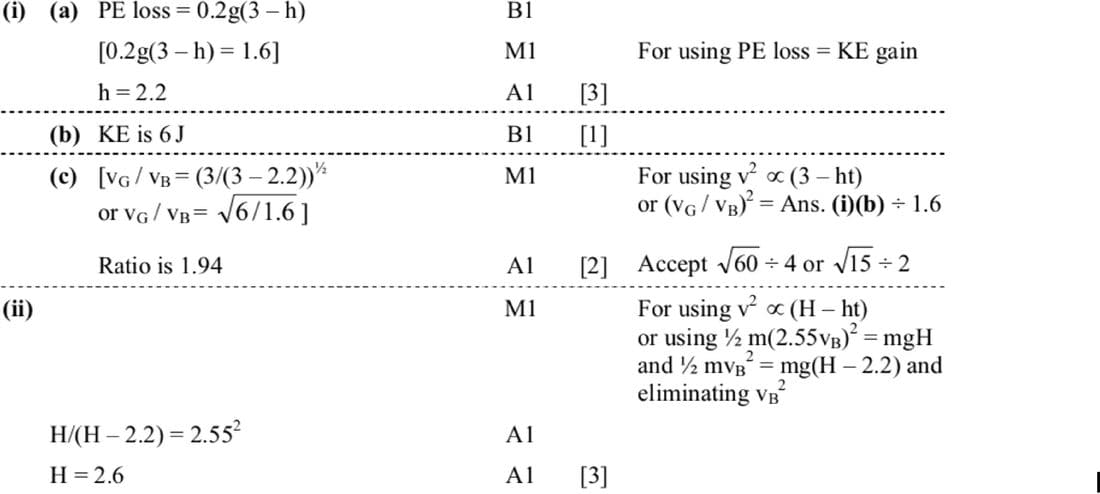
(i) In the case that P is released at A, it is given that the kinetic energy of P at B is 1.6 J. Find
- the value of h,
- the kinetic energy of the particle immediately before it reaches the ground,
- the ratio vG : vB.
(ii) In the case that P is released at the point X of the slide, which is H m above the ground (see diagram), it is given that vG : vB = 2.55. Find the value of H correct to 2 significant figures.
Nov 2022 p41 q6
3570
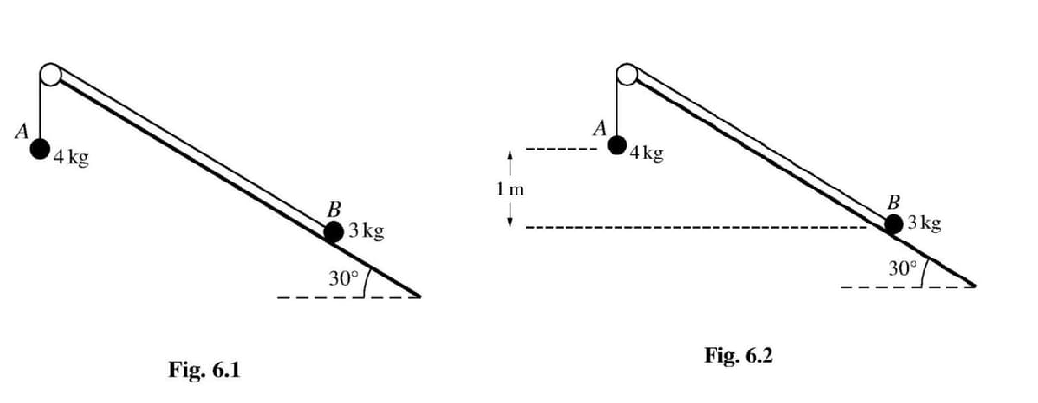
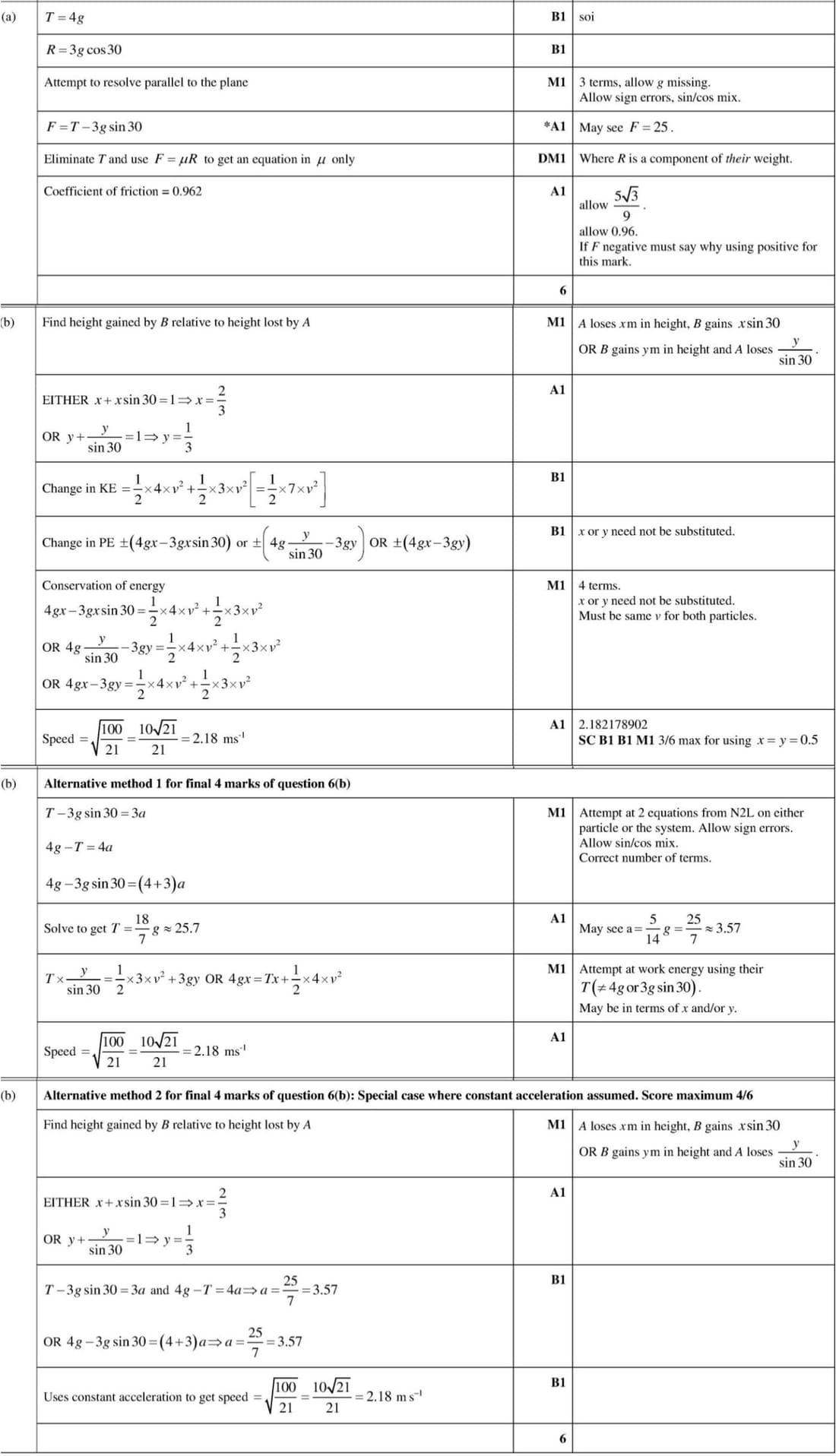
Fig. 6.1 shows particles A and B, of masses 4 kg and 3 kg respectively, attached to the ends of a light inextensible string that passes over a small smooth pulley. The pulley is fixed at the top of a plane which is inclined at an angle of 30° to the horizontal. A hangs freely below the pulley and B is on the inclined plane. The string is taut and the section of the string between B and the pulley is parallel to a line of greatest slope of the plane.
(a) It is given that the plane is rough and the particles are in limiting equilibrium.
Find the coefficient of friction between B and the plane.
(b) It is given instead that the plane is smooth and the particles are released from rest when the difference in the vertical heights of the particles is 1 m (see Fig. 6.2).
Use an energy method to find the speed of the particles at the instant when the particles are at the same horizontal level.
June 2010 p43 q3
3571
A load is pulled along a horizontal straight track, from A to B, by a force of magnitude P N which acts at an angle of 30° upwards from the horizontal. The distance AB is 80 m. The speed of the load is constant and equal to 1.2 m s-1 as it moves from A to the mid-point M of AB.
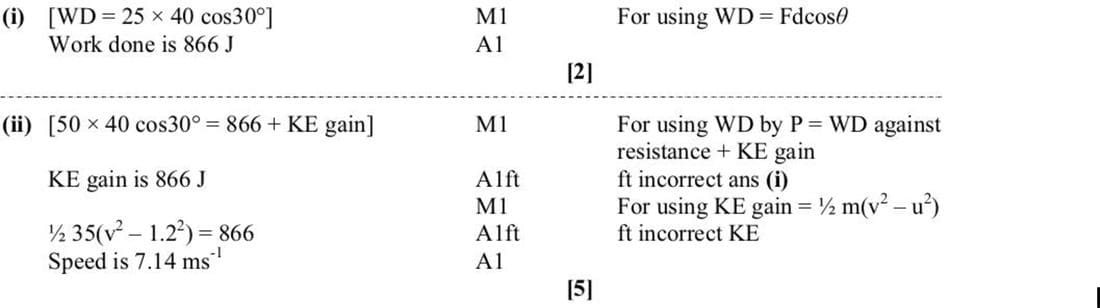
- For the motion from A to M the value of P is 25. Calculate the work done by the force as the load moves from A to M.
The speed of the load increases from 1.2 m s-1 as it moves from M towards B. For the motion from M to B the value of P is 50 and the work done against resistance is the same as that for the motion from A to M. The mass of the load is 35 kg.
- Find the gain in kinetic energy of the load as it moves from M to B and hence find the speed with which it reaches B.
June 2010 p41 q5
3572
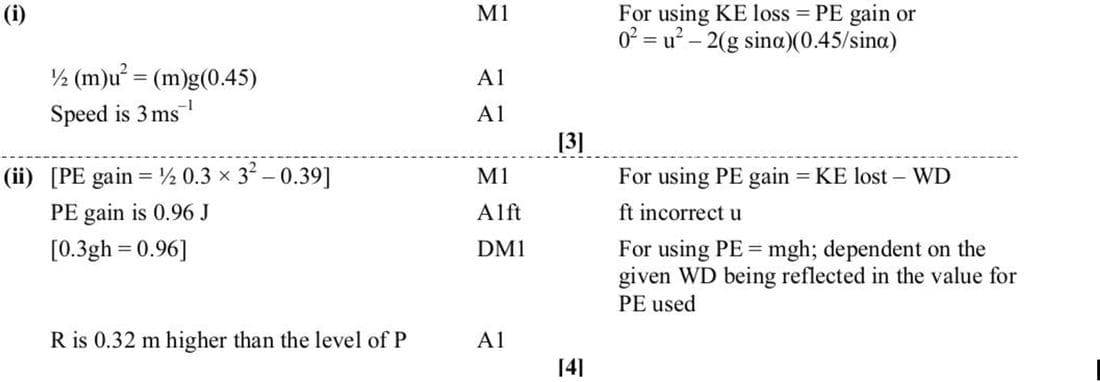
P and Q are fixed points on a line of greatest slope of an inclined plane. The point Q is at a height of 0.45 m above the level of P. A particle of mass 0.3 kg moves upwards along the line PQ.
- Given that the plane is smooth and that the particle just reaches Q, find the speed with which it passes through P.
- It is given instead that the plane is rough. The particle passes through P with the same speed as that found in part (i), and just reaches a point R which is between P and Q. The work done against the frictional force in moving from P to R is 0.39 J. Find the potential energy gained by the particle in moving from P to R and hence find the height of R above the level of P.