Exam-Style Problems
⬅ Back to SubchapterJune 2015 p33 q8
1980
The complex number 1 - i is denoted by u.
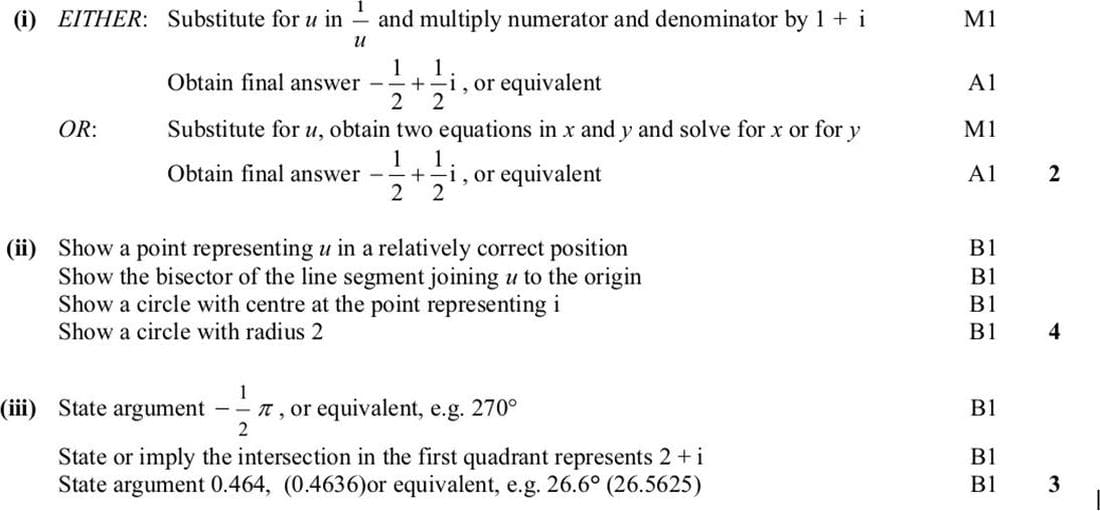
(i) Showing your working and without using a calculator, express \(\frac{i}{u}\) in the form \(x + iy\), where \(x\) and \(y\) are real.
(ii) On an Argand diagram, sketch the loci representing complex numbers \(z\) satisfying the equations \(|z - u| = |z|\) and \(|z - i| = 2\).
(iii) Find the argument of each of the complex numbers represented by the points of intersection of the two loci in part (ii).
June 2015 p32 q7
1981
\(The complex number u is given by u = -1 + (4\sqrt{3})i.\)
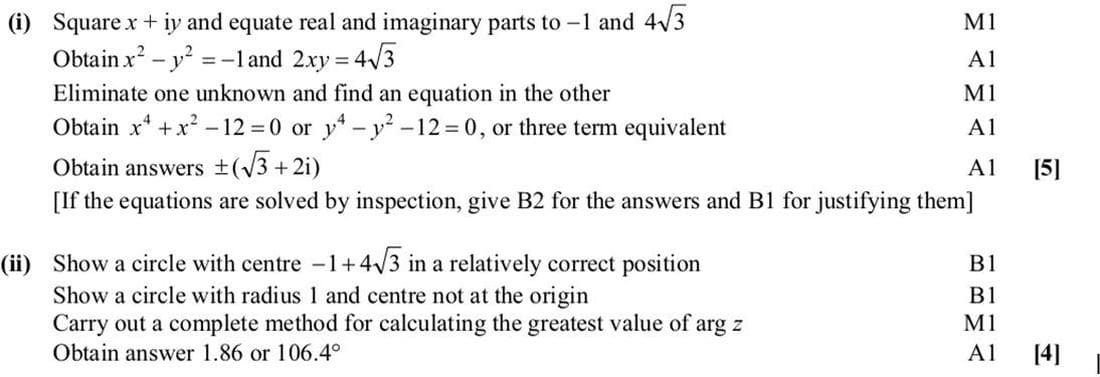
- Without using a calculator and showing all your working, find the two square roots of u. Give your answers in the form a + ib, where the real numbers a and b are exact. [5]
- On an Argand diagram, sketch the locus of points representing complex numbers z satisfying the relation |z - u| = 1. Determine the greatest value of arg z for points on this locus. [4]
June 2015 p31 q8
1982
The complex number w is defined by \(w = \frac{22 + 4i}{(2 - i)^2}\).
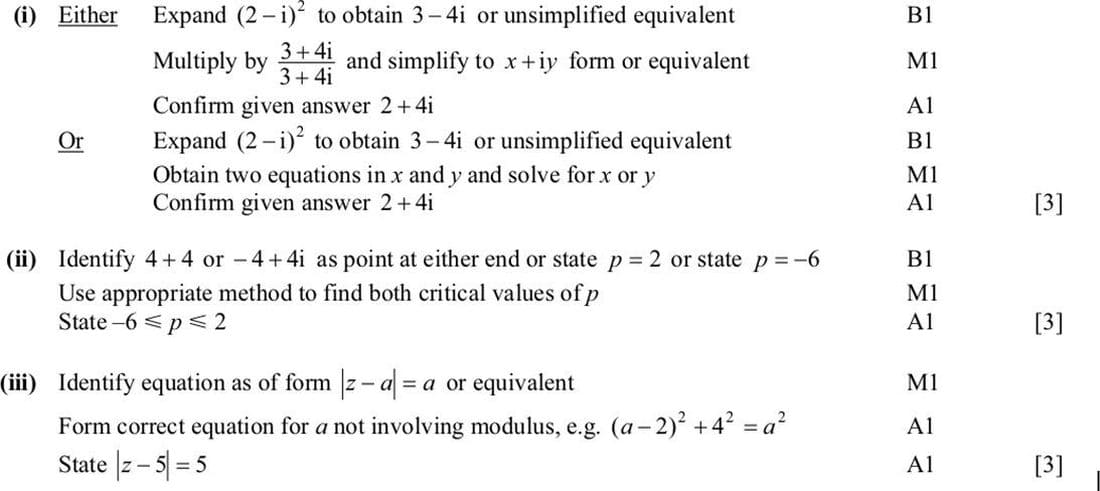
- Without using a calculator, show that \(w = 2 + 4i\). [3]
- It is given that p is a real number such that \(\frac{1}{4}\pi \leq \text{arg}(w + p) \leq \frac{3}{4}\pi\). Find the set of possible values of p. [3]
- The complex conjugate of w is denoted by w*. The complex numbers w and w* are represented in an Argand diagram by the points S and T respectively. Find, in the form \(|z - a| = k\), the equation of the circle passing through S, T and the origin. [3]
June 2023 p33 q11
1983
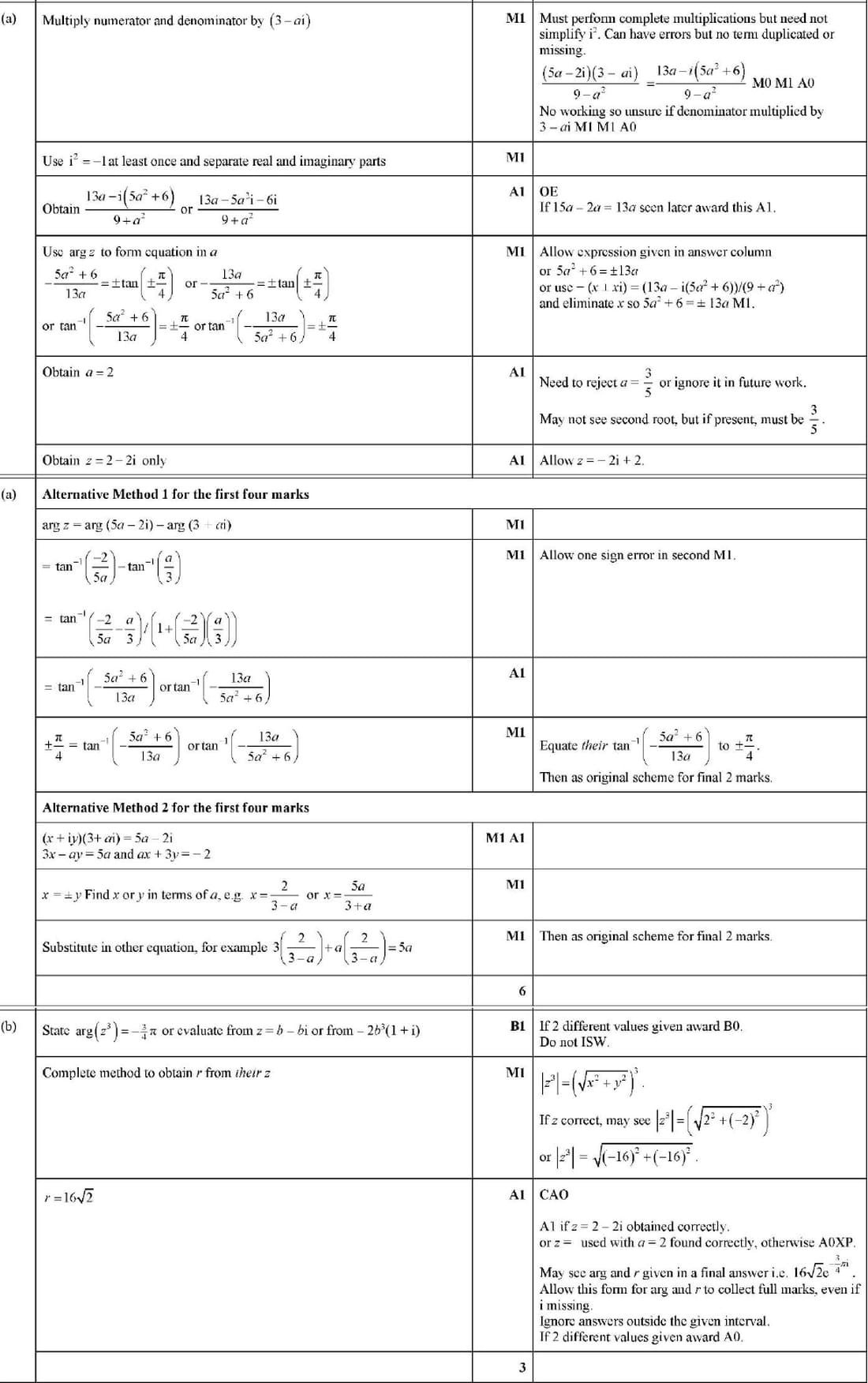
The complex number \(z\) is defined by \(z = \frac{5a - 2i}{3 + ai}\), where \(a\) is an integer. It is given that \(\arg z = -\frac{1}{4}\pi\).
(a) Find the value of \(a\) and hence express \(z\) in the form \(x + iy\), where \(x\) and \(y\) are real. [6]
(b) Express \(z^3\) in the form \(re^{i\theta}\), where \(r > 0\) and \(-\pi < \theta \leq \pi\). Give the simplified exact values of \(r\) and \(\theta\). [3]
Nov 2014 p33 q5
1984
\(The complex numbers w and z are defined by w = 5 + 3i and z = 4 + i.\)
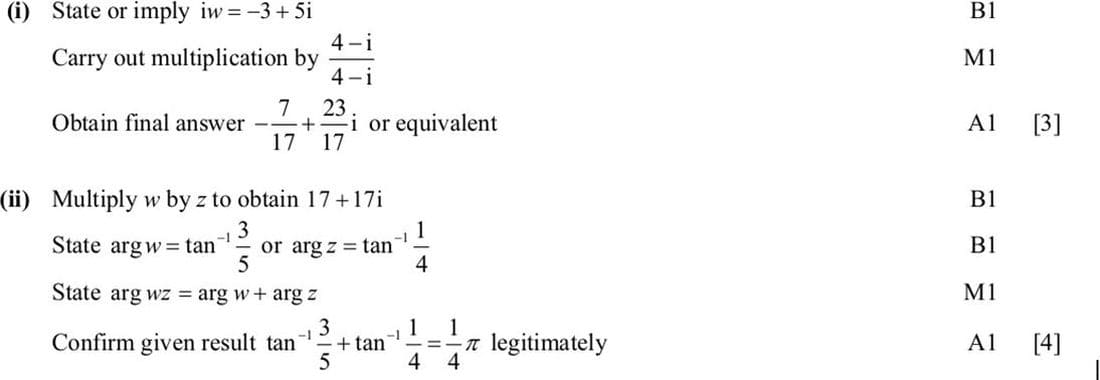
(i) Express \(\frac{i w}{z}\) in the form x + iy, showing all your working and giving the exact values of x and y. [3]
(ii) Find wz and hence, by considering arguments, show that \(\arctan \left( \frac{3}{5} \right) + \arctan \left( \frac{1}{4} \right) = \frac{1}{4} \pi\). [4]