Exam-Style Problems
⬅ Back to SubchapterNov 2011 p41 q6
3563
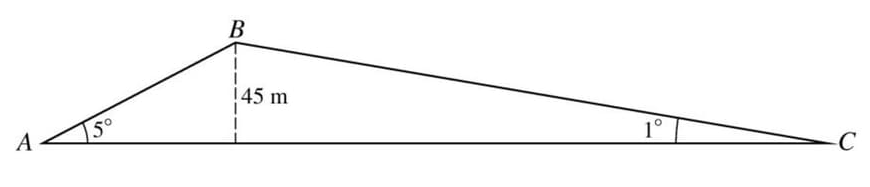
AB and BC are straight roads inclined at 5° to the horizontal and 1° to the horizontal respectively. A and C are at the same horizontal level and B is 45 m above the level of A and C (see diagram, which is not to scale). A car of mass 1200 kg travels from A to C passing through B.
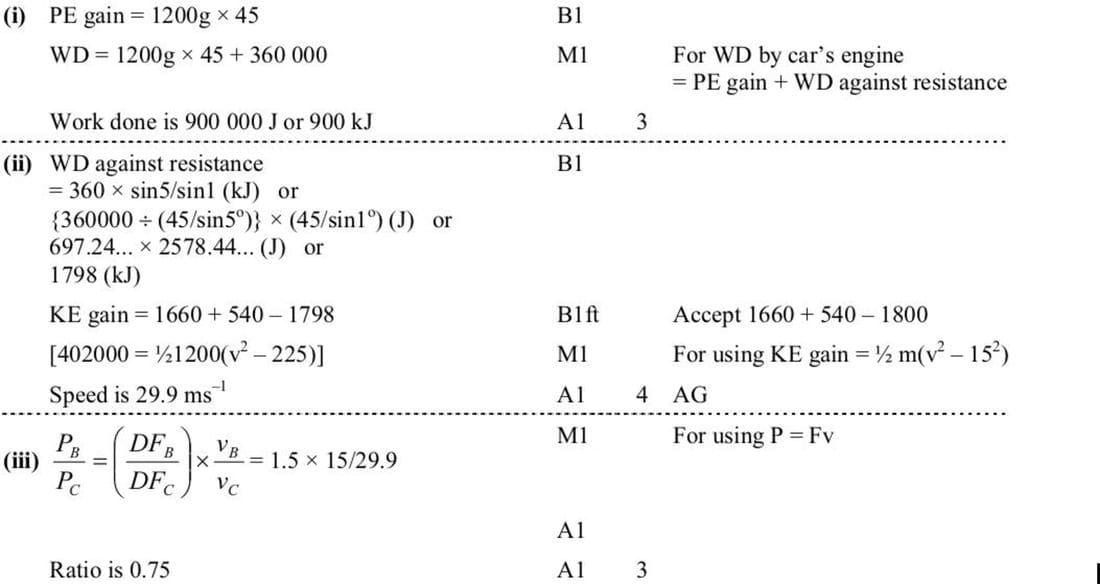
(i) For the motion from A to B, the speed of the car is constant and the work done against the resistance to motion is 360 kJ. Find the work done by the car’s engine from A to B.
The resistance to motion is constant throughout the whole journey.
(ii) For the motion from B to C the work done by the driving force is 1660 kJ. Given that the speed of the car at B is 15 m s−1, show that its speed at C is 29.9 m s−1, correct to 3 significant figures.
(iii) The car’s driving force immediately after leaving B is 1.5 times the driving force immediately before reaching C. Find, correct to 2 significant figures, the ratio of the power developed by the car’s engine immediately after leaving B to the power developed immediately before reaching C.
June 2011 p43 q6
3564
A lorry of mass 15,000 kg climbs a hill of length 500 m at a constant speed. The hill is inclined at 2.5° to the horizontal. The resistance to the lorry’s motion is constant and equal to 800 N.
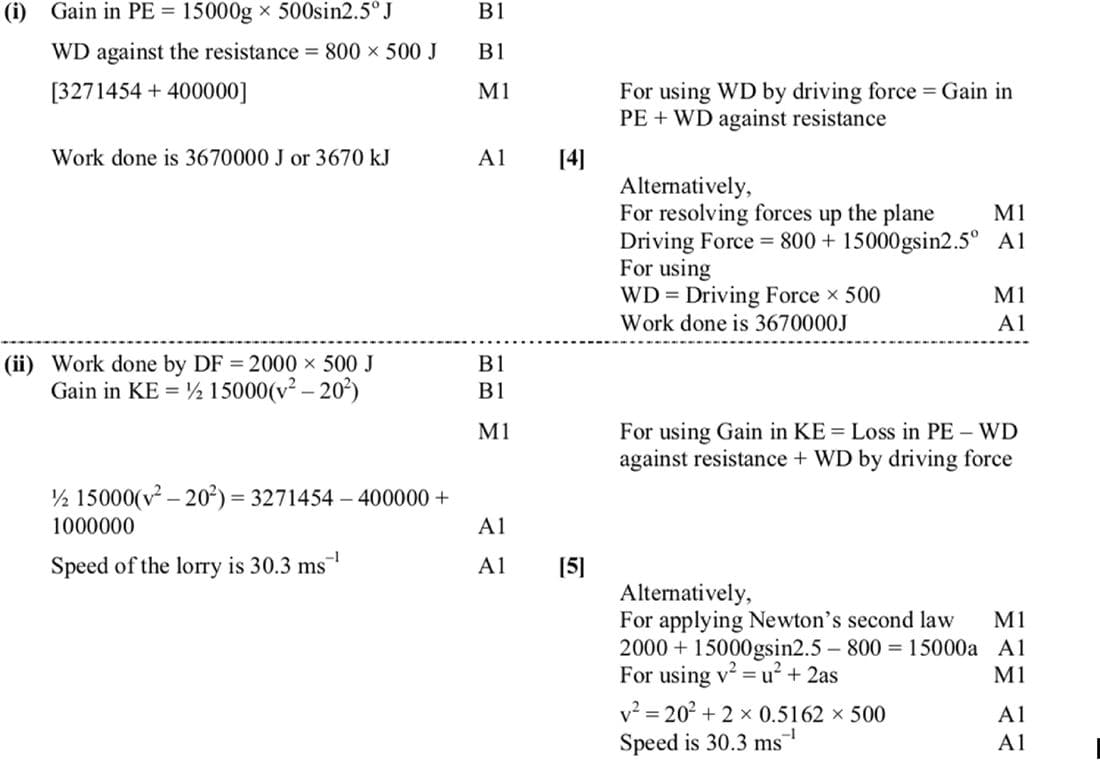
- Find the work done by the lorry’s driving force.
On its return journey the lorry reaches the top of the hill with speed 20 m/s and continues down the hill with a constant driving force of 2000 N. The resistance to the lorry’s motion is again constant and equal to 800 N.
- Find the speed of the lorry when it reaches the bottom of the hill.
June 2011 p42 q2
3565
An object of mass 8 kg slides down a line of greatest slope of an inclined plane. Its initial speed at the top of the plane is 3 m s-1 and its speed at the bottom of the plane is 8 m s-1. The work done against the resistance to motion of the object is 120 J. Find the height of the top of the plane above the level of the bottom.

June 2011 p41 q7
3566
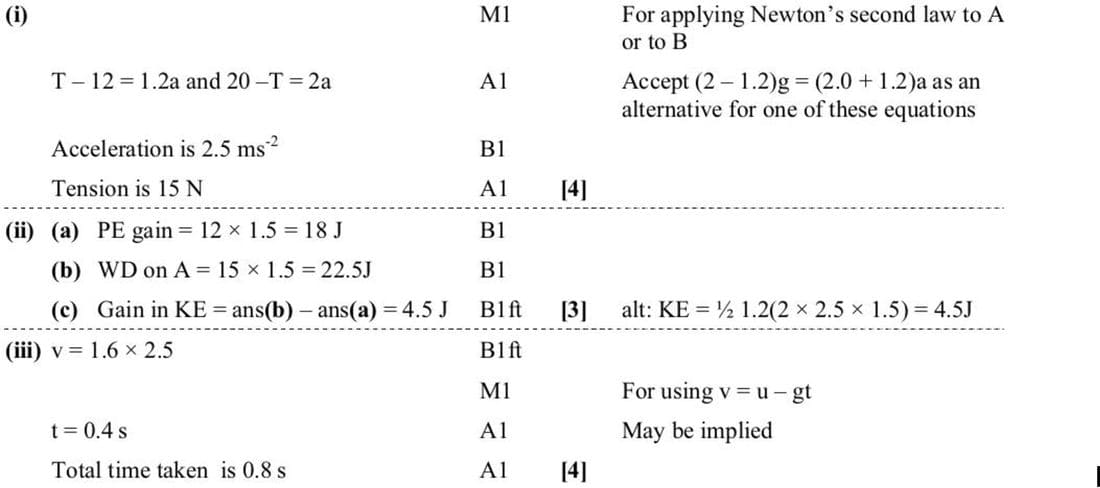
Loads A and B, of masses 1.2 kg and 2.0 kg respectively, are attached to the ends of a light inextensible string which passes over a fixed smooth pulley. A is held at rest and B hangs freely, with both straight parts of the string vertical. A is released and starts to move upwards. It does not reach the pulley in the subsequent motion.
- Find the acceleration of A and the tension in the string.
- Find, for the first 1.5 metres of A’s motion,
- A’s gain in potential energy,
- the work done on A by the tension in the string,
- A’s gain in kinetic energy.
- B hits the floor 1.6 seconds after A is released. B comes to rest without rebounding and the string becomes slack.
- Find the time from the instant the string becomes slack until it becomes taut again.
Nov 2010 p43 q2
3567
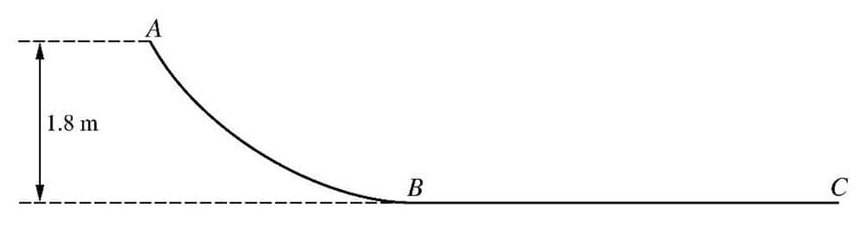
The diagram shows the vertical cross-section ABC of a fixed surface. AB is a curve and BC is a horizontal straight line. The part of the surface containing AB is smooth and the part containing BC is rough. A is at a height of 1.8 m above BC. A particle of mass 0.5 kg is released from rest at A and travels along the surface to C.
- Find the speed of the particle at B.
- Given that the particle reaches C with a speed of 5 m s-1, find the work done against the resistance to motion as the particle moves from B to C.