Exam-Style Problems
⬅ Back to SubchapterNov 2022 p41 q4
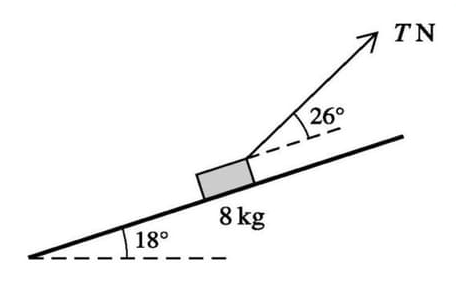
A block of mass 8 kg is placed on a rough plane which is inclined at an angle of 18° to the horizontal. The block is pulled up the plane by a light string that makes an angle of 26° above a line of greatest slope. The tension in the string is \(T\) N (see diagram). The coefficient of friction between the block and plane is 0.65.
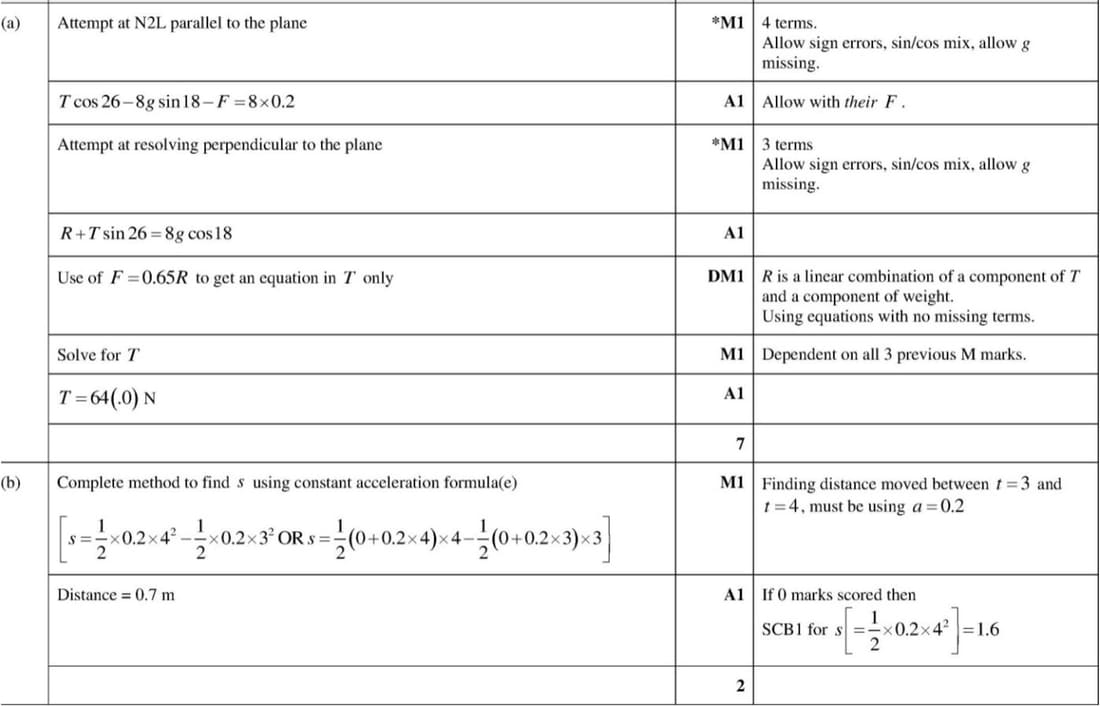
(a) The acceleration of the block is 0.2 m/s². Find \(T\).
(b) The block is initially at rest. Find the distance travelled by the block during the fourth second of motion.
June 2021 p43 q7
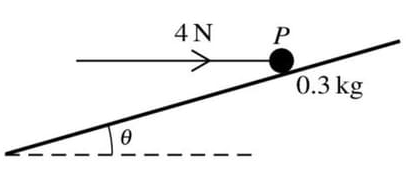
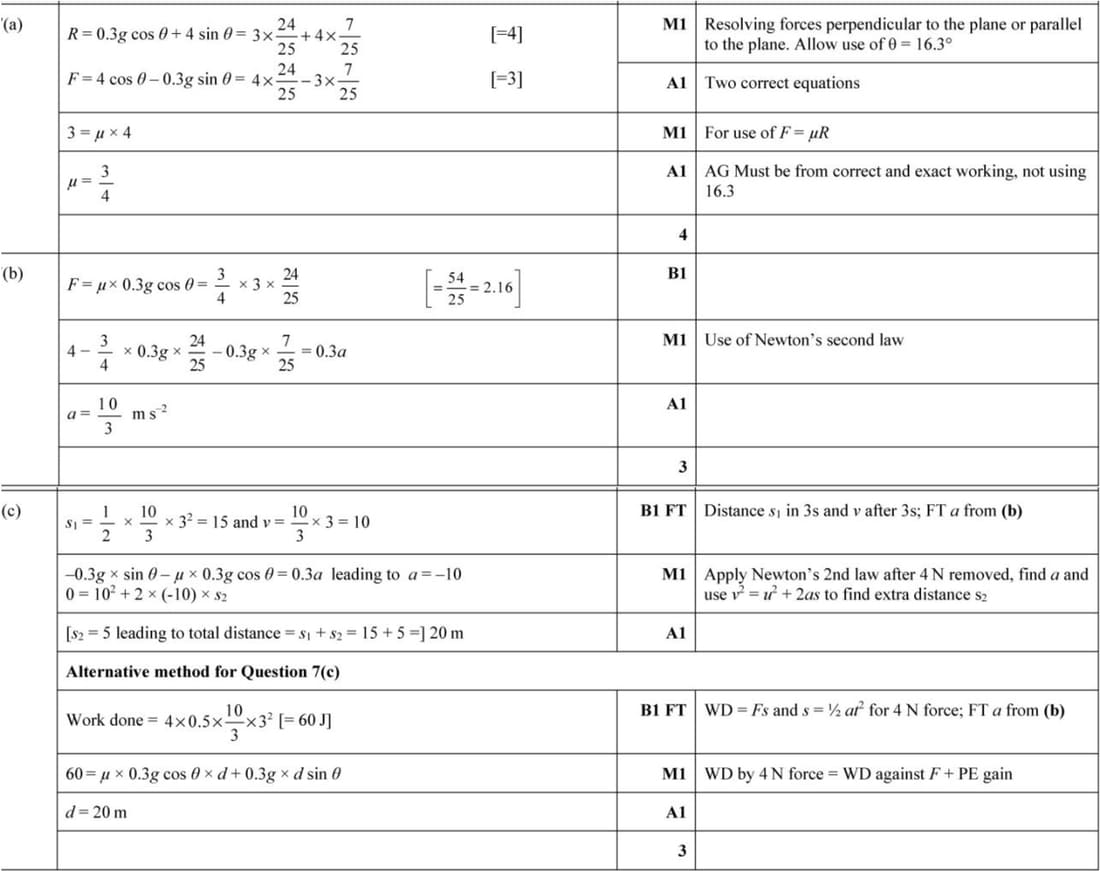
A particle P of mass 0.3 kg rests on a rough plane inclined at an angle \(\theta\) to the horizontal, where \(\sin \theta = \frac{7}{25}\). A horizontal force of magnitude 4 N, acting in the vertical plane containing a line of greatest slope of the plane, is applied to P (see diagram). The particle is on the point of sliding up the plane.
(a) Show that the coefficient of friction between the particle and the plane is \(\frac{3}{4}\).
The force acting horizontally is replaced by a force of magnitude 4 N acting up the plane parallel to a line of greatest slope.
(b) Find the acceleration of P.
(c) Starting with P at rest, the force of 4 N parallel to the plane acts for 3 seconds and is then removed. Find the total distance travelled until P comes to instantaneous rest.
June 2019 p42 q4
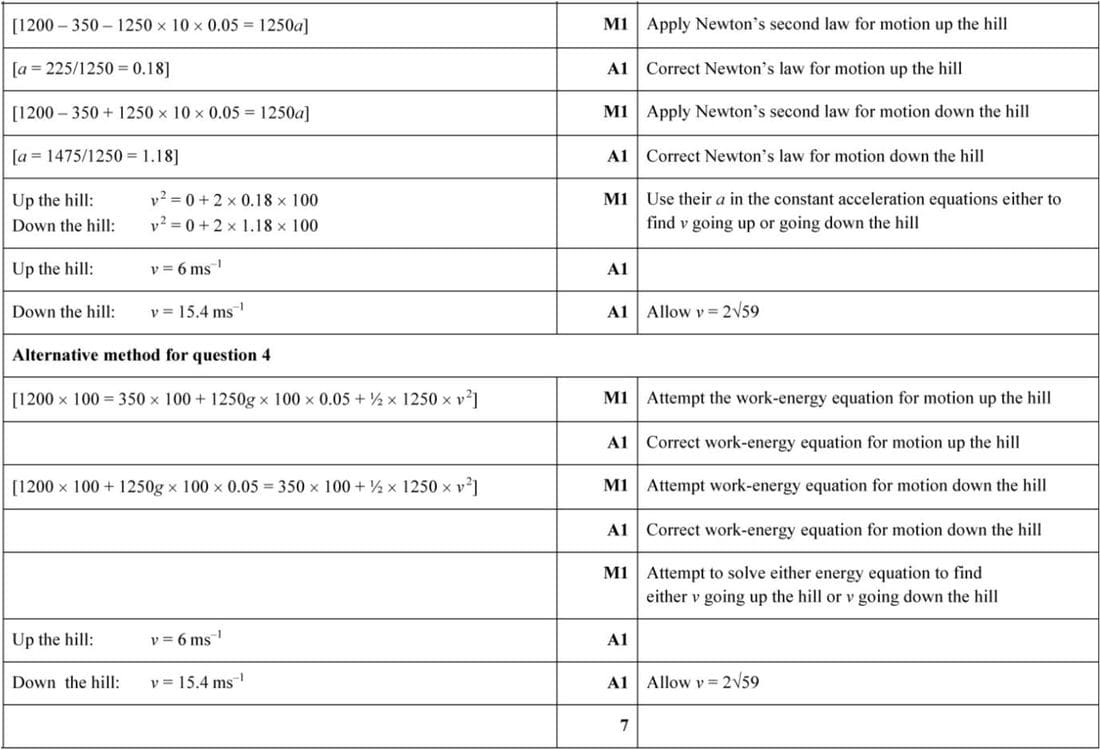
A constant resistance to motion of magnitude 350 N acts on a car of mass 1250 kg. The engine of the car exerts a constant driving force of 1200 N. The car travels along a road inclined at an angle of \(\theta\) to the horizontal, where \(\sin \theta = 0.05\). Find the speed of the car when it has moved 100 m from rest in each of the following cases:
- The car is moving up the hill.
- The car is moving down the hill.
Nov 2018 p42 q2
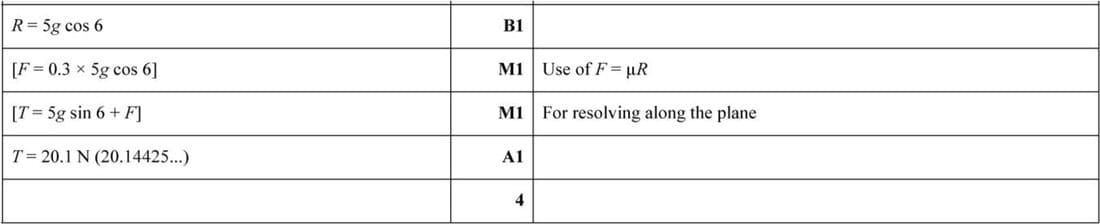
A block of mass 5 kg is being pulled by a rope up a rough plane inclined at 6° to the horizontal. The rope is parallel to a line of greatest slope of the plane and the block is moving at constant speed. The coefficient of friction between the block and the plane is 0.3. Find the tension in the rope.
Nov 2017 p42 q1
A particle of mass 0.2 kg is resting in equilibrium on a rough plane inclined at 20° to the horizontal.
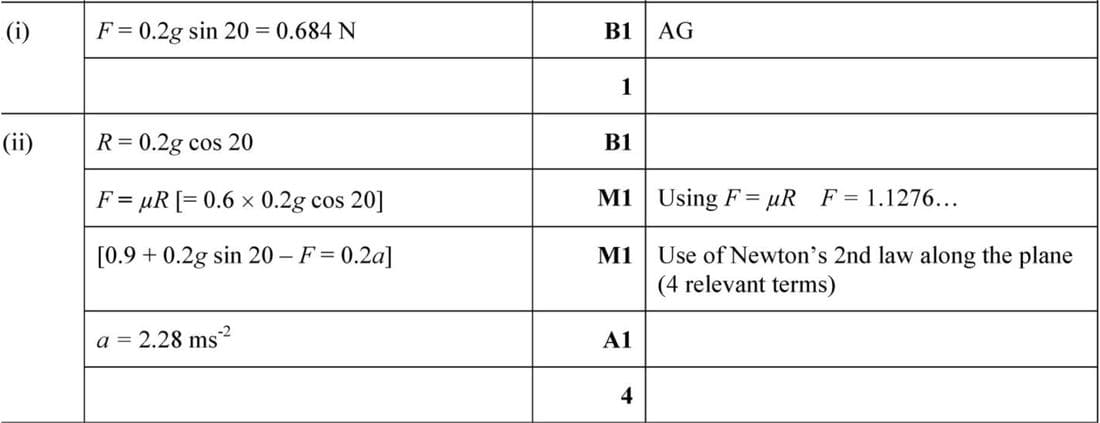
- Show that the friction force acting on the particle is 0.684 N, correct to 3 significant figures.
The coefficient of friction between the particle and the plane is 0.6. A force of magnitude 0.9 N is applied to the particle down a line of greatest slope of the plane. The particle accelerates down the plane.
- Find this acceleration.