Exam-Style Problems
⬅ Back to SubchapterNov 2004 p6 q6
A box contains five balls numbered 1, 2, 3, 4, 5. Three balls are drawn randomly at the same time from the box.
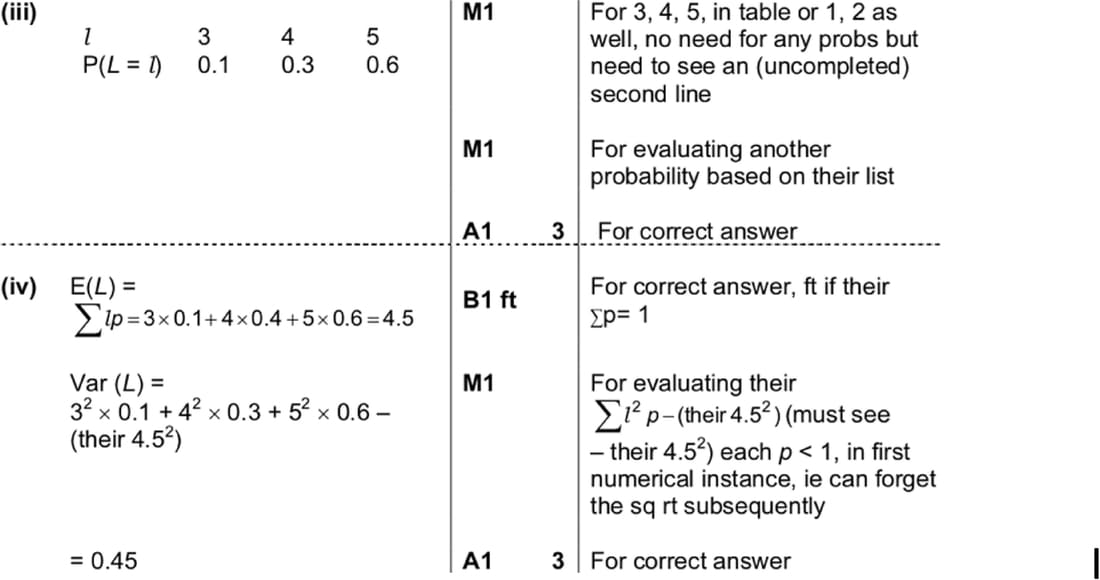
The random variable L denotes the largest of the three numbers drawn.
(iii) Draw up a table to show the probability distribution of L.
(iv) Calculate the expectation and variance of L.
June 2004 p6 q3
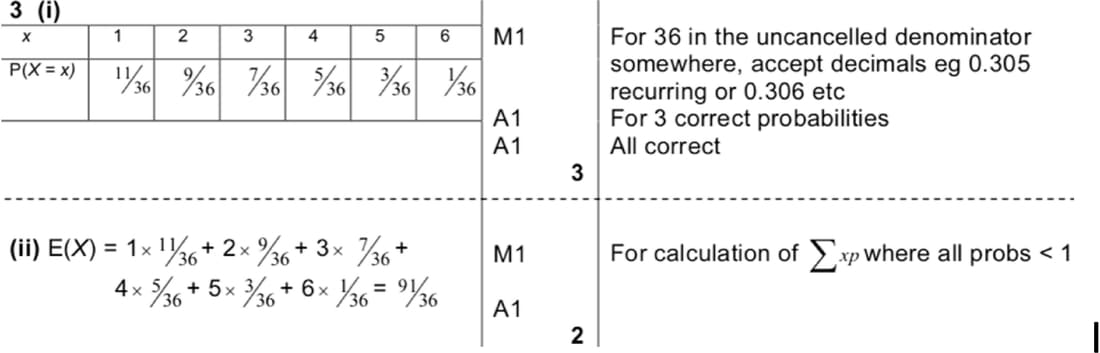
Two fair dice are thrown. Let the random variable \(X\) be the smaller of the two scores if the scores are different, or the score on one of the dice if the scores are the same.
(i) Copy and complete the following table to show the probability distribution of \(X\).
| \(x\) | 1 | 2 | 3 | 4 | 5 | 6 |
|---|---|---|---|---|---|---|
| \(P(X = x)\) |
(ii) Find \(\mathbb{E}(X)\).
June 2003 p6 q2
A box contains 10 pens of which 3 are new. A random sample of two pens is taken.
(ii) Construct a probability distribution table for the number of new pens in the sample.
(iii) Calculate the expected number of new pens in the sample.

June 2002 p6 q3
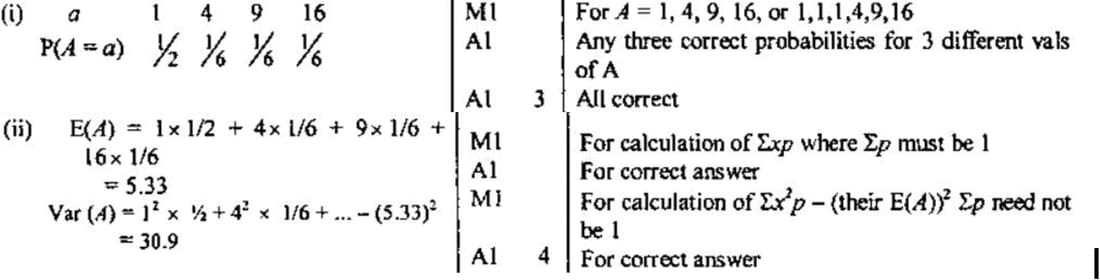
A fair cubical die with faces numbered 1, 1, 1, 2, 3, 4 is thrown and the score noted. The area A of a square of side equal to the score is calculated, so, for example, when the score on the die is 3, the value of A is 9.
(i) Draw up a table to show the probability distribution of A.
(ii) Find E(A) and Var(A).
Feb/Mar 2022 p52 q1
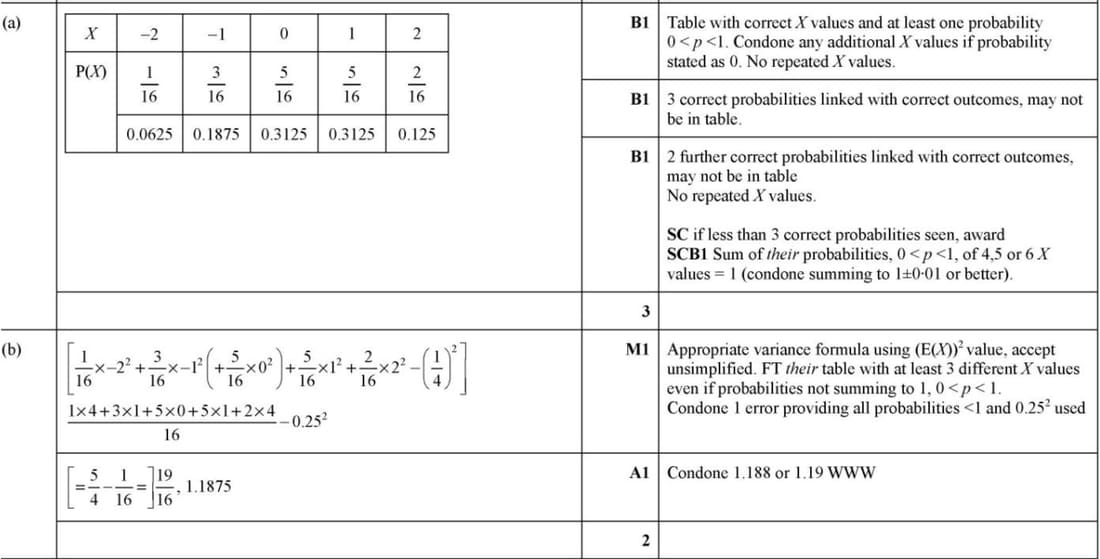
A fair red spinner has edges numbered 1, 2, 2, 3. A fair blue spinner has edges numbered -3, -2, -1, -1. Each spinner is spun once and the number on the edge on which each spinner lands is noted. The random variable X denotes the sum of the resulting two numbers.
(a) Draw up the probability distribution table for X.
(b) Given that \(E(X) = 0.25\), find the value of \(\text{Var}(X)\).