Exam-Style Problems
⬅ Back to SubchapterFM June 2024 p13 q03
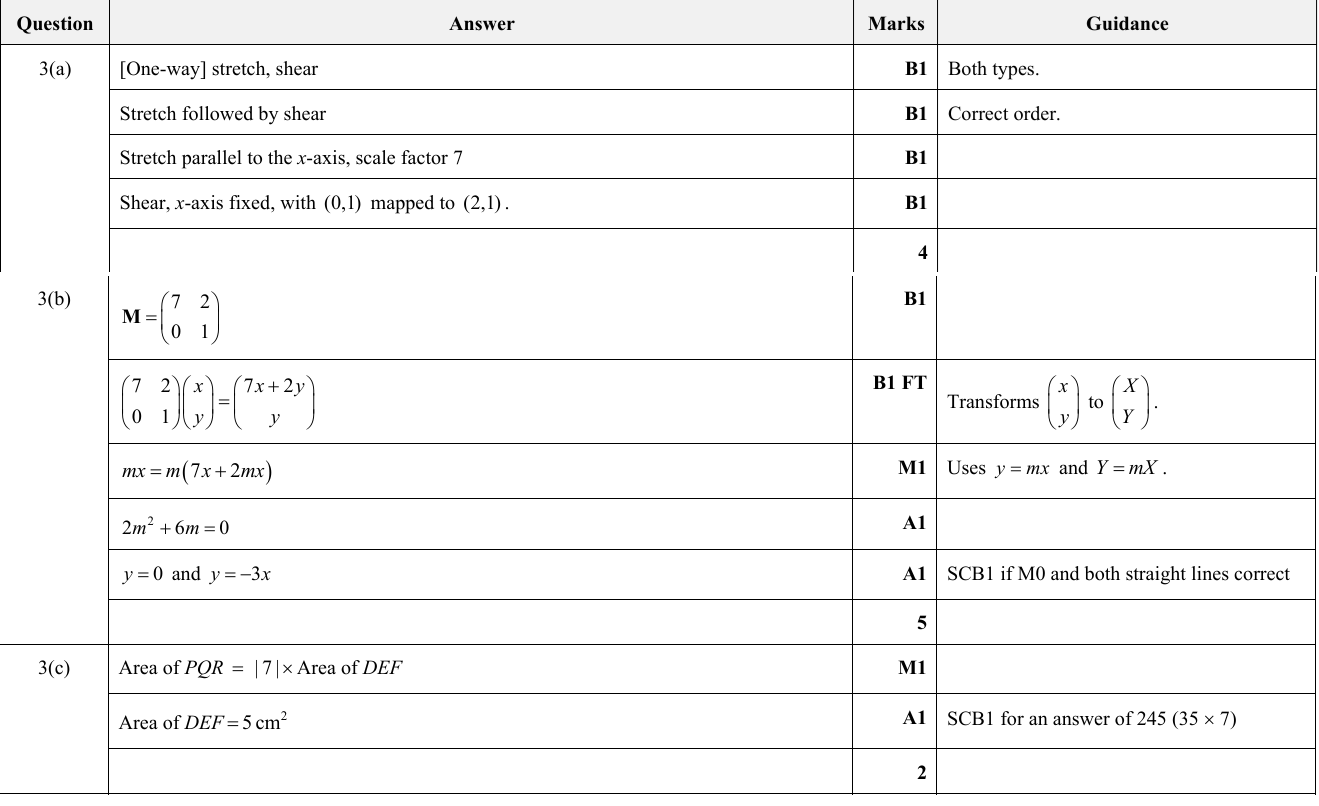
The matrix \(\mathbf{M}\) is given by \(\mathbf{M} = \begin{pmatrix} 1 & 2 \\ 0 & 1 \end{pmatrix} \begin{pmatrix} 7 & 0 \\ 0 & 1 \end{pmatrix}\).
(a) The matrix \(\mathbf{M}\) represents a sequence of two geometrical transformations in the \(x-y\) plane. Give full details of each transformation, and make clear the order in which they are applied.
(b) Find the equations of the invariant lines, through the origin, of the transformation represented by \(\mathbf{M}\).
The triangle \(DEF\) in the \(x-y\) plane is transformed by \(\mathbf{M}\) onto triangle \(PQR\).
(c) Given that the area of triangle \(PQR\) is \(35 \text{ cm}^2\), find the area of triangle \(DEF\).
FM June 2024 p13 q04
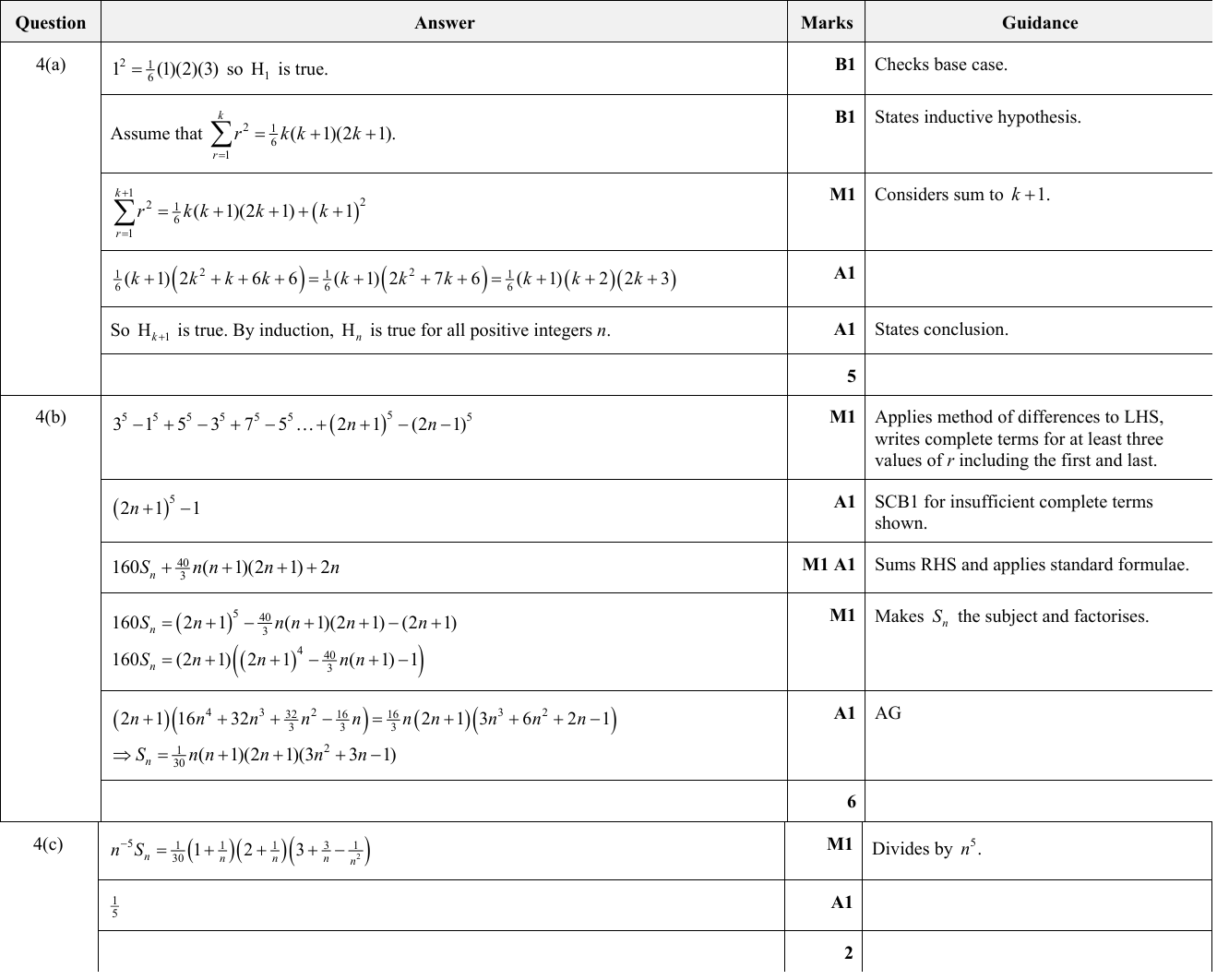
(a) Prove by mathematical induction that, for all positive integers \(n\),
\(\sum_{r=1}^{n} r^2 = \frac{1}{6}n(n+1)(2n+1).\)
The sum \(S_n\) is defined by \(S_n = \sum_{r=1}^{n} r^4\).
(b) Using the identity
\((2r+1)^5 - (2r-1)^5 \equiv 160r^4 + 80r^2 + 2,\)
show that \(S_n = \frac{1}{30}n(n+1)(2n+1)(3n^2 + 3n - 1).\)
(c) Find the value of \(\lim_{n \to \infty} \left( n^{-5}S_n \right).\)
FM June 2024 p13 q05
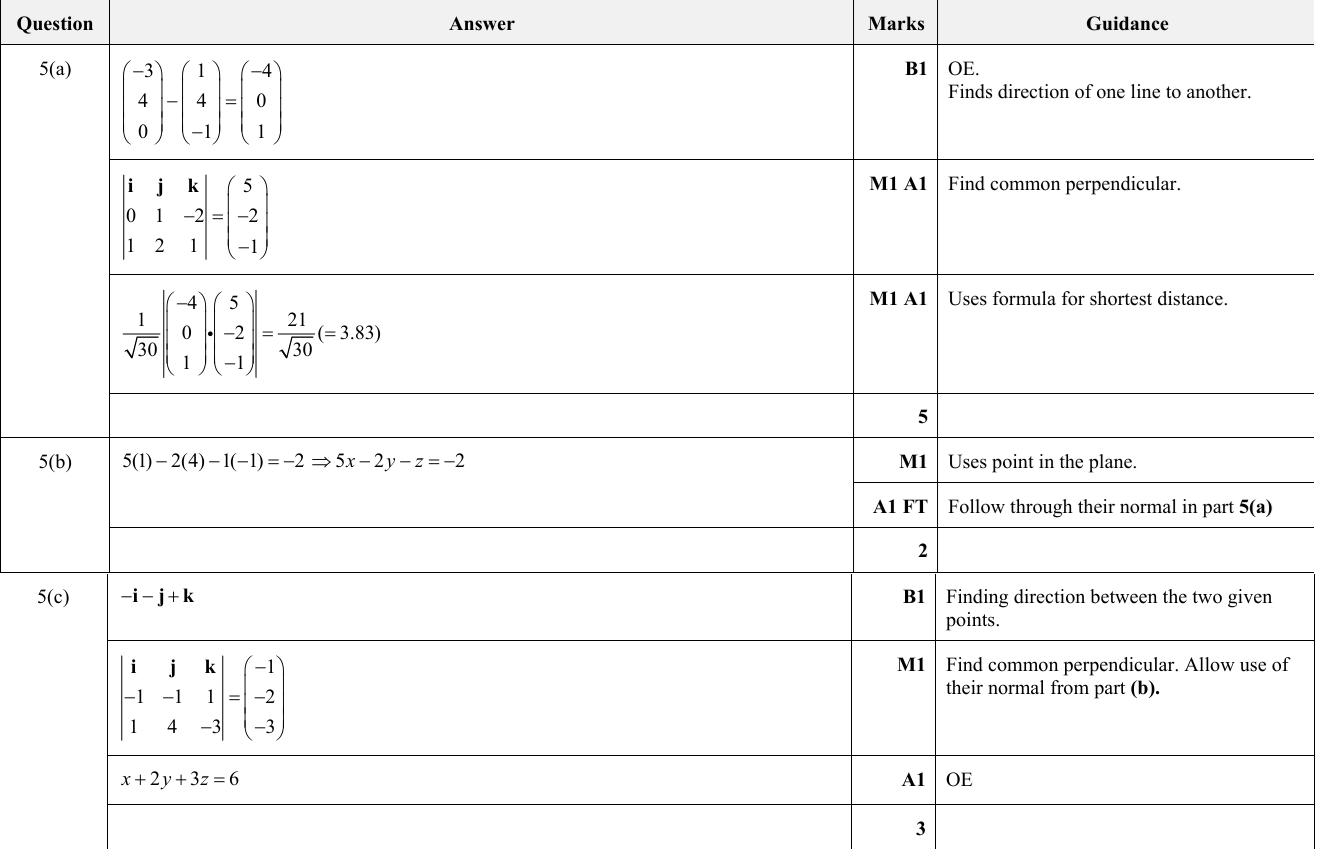
The lines \(l_1\) and \(l_2\) have equations \(\mathbf{r} = \mathbf{i} + 4\mathbf{j} - \mathbf{k} + \lambda (\mathbf{j} - 2\mathbf{k})\) and \(\mathbf{r} = -3\mathbf{i} + 4\mathbf{j} + \mu (\mathbf{i} + 2\mathbf{j} + \mathbf{k})\) respectively.
(a) Find the shortest distance between \(l_1\) and \(l_2\).
The plane \(\Pi_1\) contains \(l_1\) and is parallel to \(l_2\).
(b) Obtain an equation of \(\Pi_1\) in the form \(px + qy + rz = s\).
(c) The point \((1, 1, 1)\) lies on the plane \(\Pi_2\).
It is given that the line of intersection of the planes \(\Pi_1\) and \(\Pi_2\) passes through the point \((0, 0, 2)\) and is parallel to the vector \(\mathbf{i} + 4\mathbf{j} - 3\mathbf{k}\).
Obtain an equation of \(\Pi_2\) in the form \(ax + by + cz = d\).
FM June 2024 p13 q06
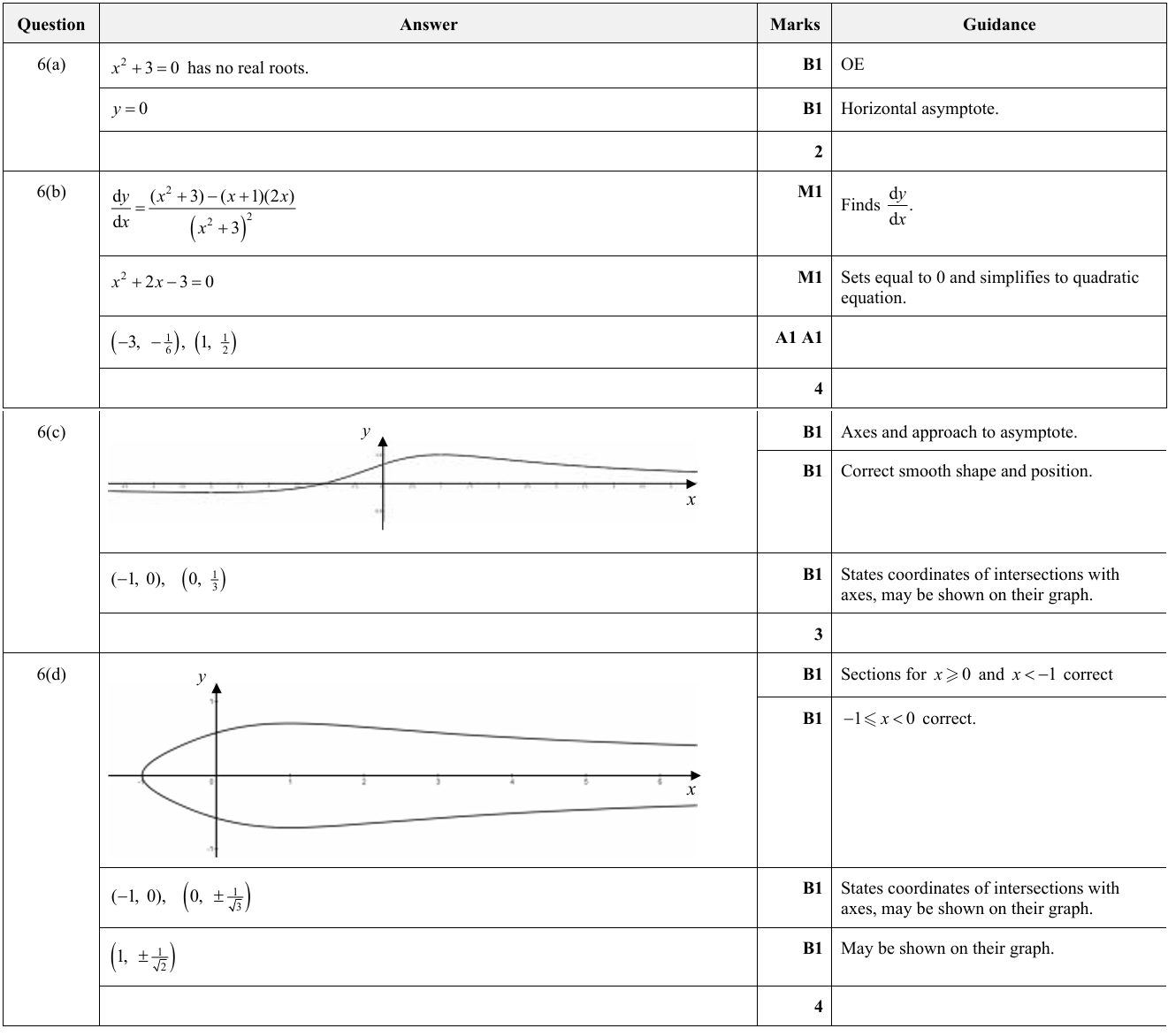
The curve \(C\) has equation \(y = \frac{x+1}{x^2+3}\).
- Show that \(C\) has no vertical asymptotes and state the equation of the horizontal asymptote. [2]
- Find the coordinates of any stationary points on \(C\). [4]
- Sketch \(C\), stating the coordinates of the intersections with the axes. [3]
- Sketch \(y^2 = \frac{x+1}{x^2+3}\), stating the coordinates of the stationary points and the intersections with the axes. [4]
FM June 2024 p13 q07
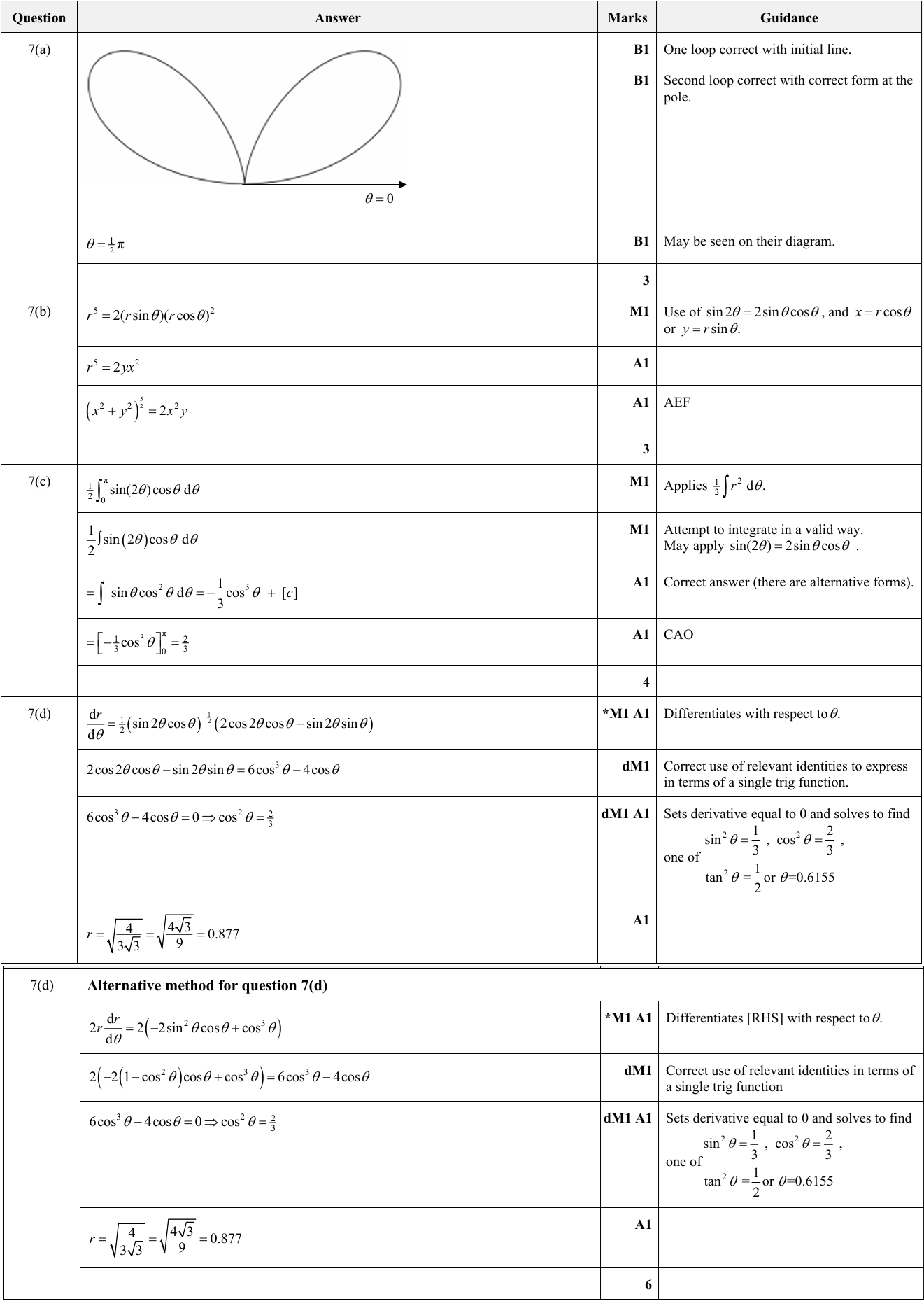
The curve C has polar equation \(r^2 = \sin 2\theta \cos \theta\), for \(0 \leq \theta \leq \pi\).
- Sketch C and state the equation of the line of symmetry.
- Find a Cartesian equation for C.
- Find the total area enclosed by C.
- Find the greatest distance of a point on C from the pole.