Exam-Style Problems
⬅ Back to SubchapterJune 2011 p42 q1
A load is pulled along horizontal ground for a distance of 76 m, using a rope. The rope is inclined at 5° above the horizontal and the tension in the rope is 65 N.
(i) Find the work done by the tension.
At an instant during the motion the velocity of the load is 1.5 m s-1.
(ii) Find the rate of working of the tension at this instant.

Nov 2022 p42 q4
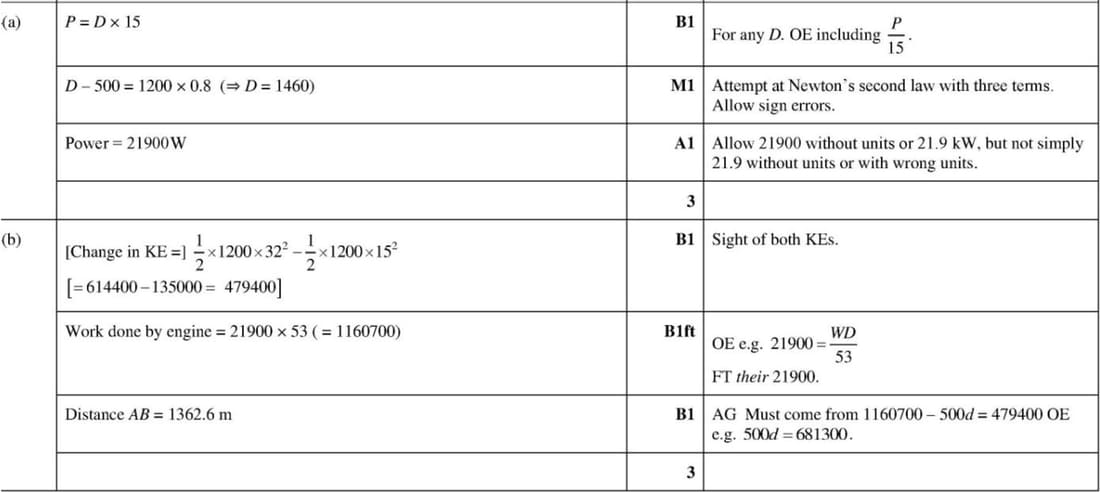
A car of mass 1200 kg is travelling along a straight horizontal road AB. There is a constant resistance force of magnitude 500 N. When the car passes point A, it has a speed of 15 m/s and an acceleration of 0.8 m/s2.
(a) Find the power of the car’s engine at the point A.
The car continues to work with this power as it travels from A to B. The car takes 53 seconds to travel from A to B and the speed of the car at B is 32 m/s-1.
(b) Show that the distance AB is 1362.6 m.
June 2011 p41 q2
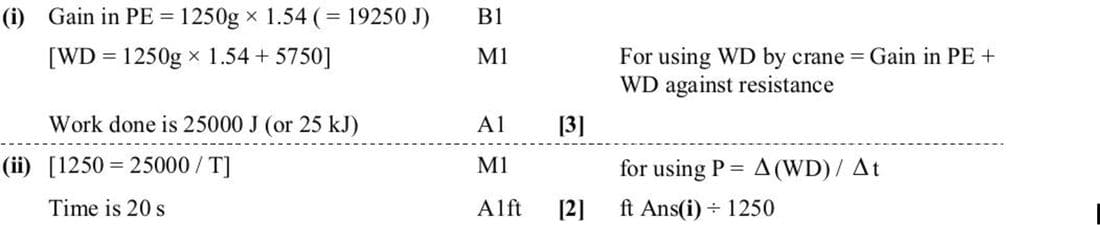
A load of mass 1250 kg is raised by a crane from rest on horizontal ground, to rest at a height of 1.54 m above the ground. The work done against the resistance to motion is 5750 J.
- Find the work done by the crane.
- Assuming the power output of the crane is constant and equal to 1.25 kW, find the time taken to raise the load.
June 2011 p41 q1
A car of mass 700 kg is travelling along a straight horizontal road. The resistance to motion is constant and equal to 600 N.
- Find the driving force of the car’s engine at an instant when the acceleration is 2 m s-2.
- Given that the car’s speed at this instant is 15 m s-1, find the rate at which the car’s engine is working.

Nov 2010 p43 q7
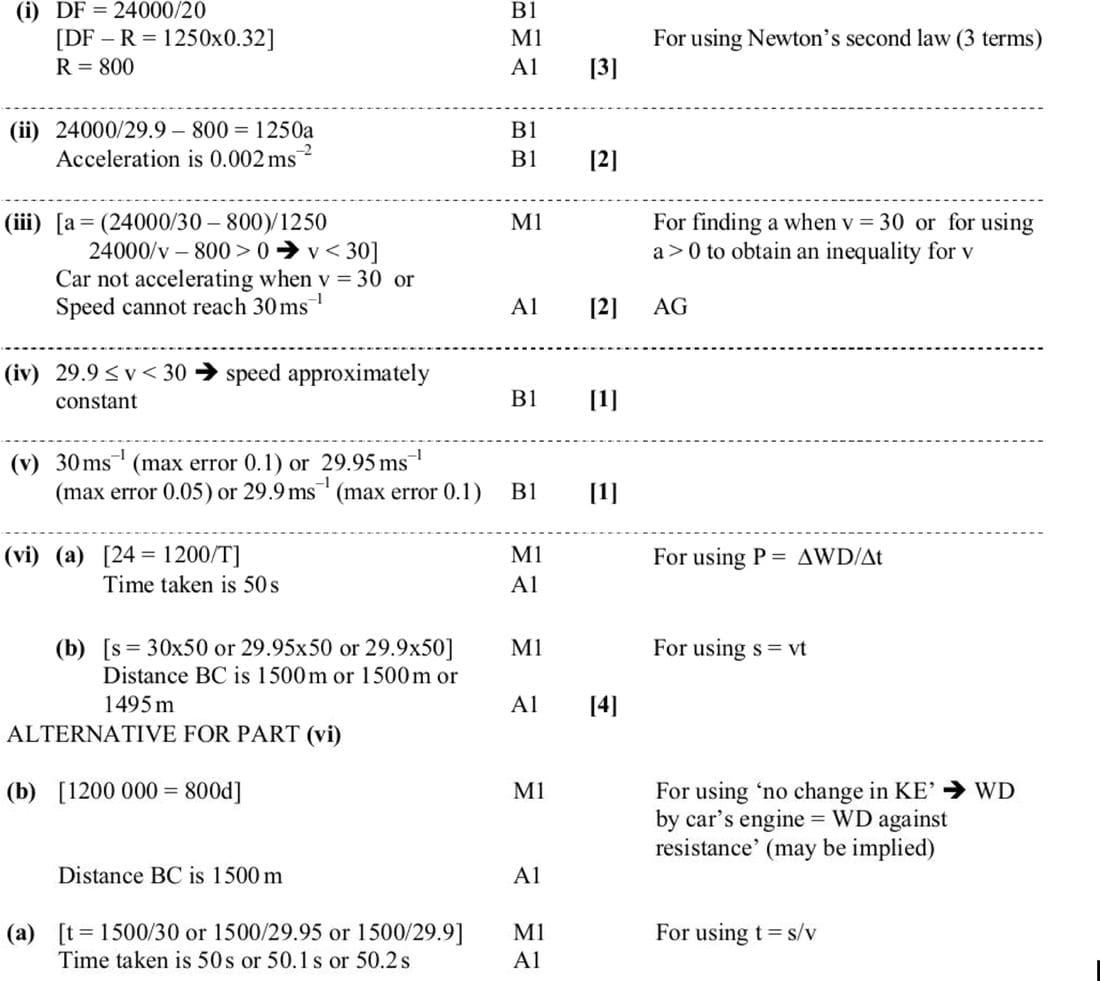
A car of mass 1250 kg travels along a horizontal straight road. The power of the car’s engine is constant and equal to 24 kW and the resistance to the car’s motion is constant and equal to \(R\) N. The car passes through the point \(A\) on the road with speed 20 m/s and acceleration 0.32 m/s2.
- Find the value of \(R\).
The car continues with increasing speed, passing through the point \(B\) on the road with speed 29.9 m/s. The car subsequently passes through the point \(C\).
- Find the acceleration of the car at \(B\), giving the answer in m/s2 correct to 3 decimal places.
- Show that, while the car’s speed is increasing, it cannot reach 30 m/s.
- Explain why the speed of the car is approximately constant between \(B\) and \(C\).
- State a value of the approximately constant speed, and the maximum possible error in this value at any point between \(B\) and \(C\).
The work done by the car’s engine during the motion from \(B\) to \(C\) is 1200 kJ.
- By assuming the speed of the car is constant from \(B\) to \(C\), find, in either order,
- the approximate time taken for the car to travel from \(B\) to \(C\),
- an approximation for the distance \(BC\).