Exam-Style Problems
⬅ Back to SubchapterNov 2009 p41 q7
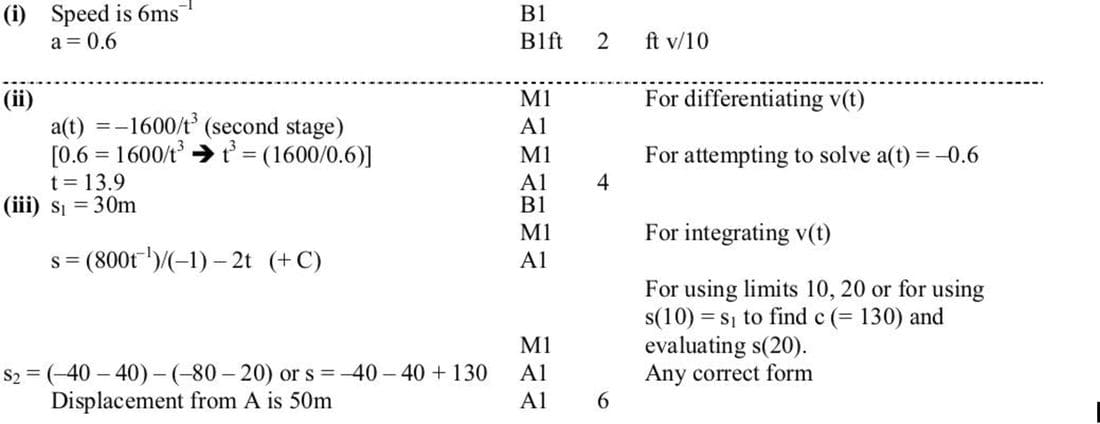
A particle P starts from rest at the point A at time t = 0, where t is in seconds, and moves in a straight line with constant acceleration a m s-2 for 10 s. For 10 ≤ t ≤ 20, P continues to move along the line with velocity v m s-1, where v = \(\frac{800}{t^2} - 2\). Find
- the speed of P when t = 10, and the value of a,
- the value of t for which the acceleration of P is -a m s-2,
- the displacement of P from A when t = 20.
Nov 2022 p42 q7
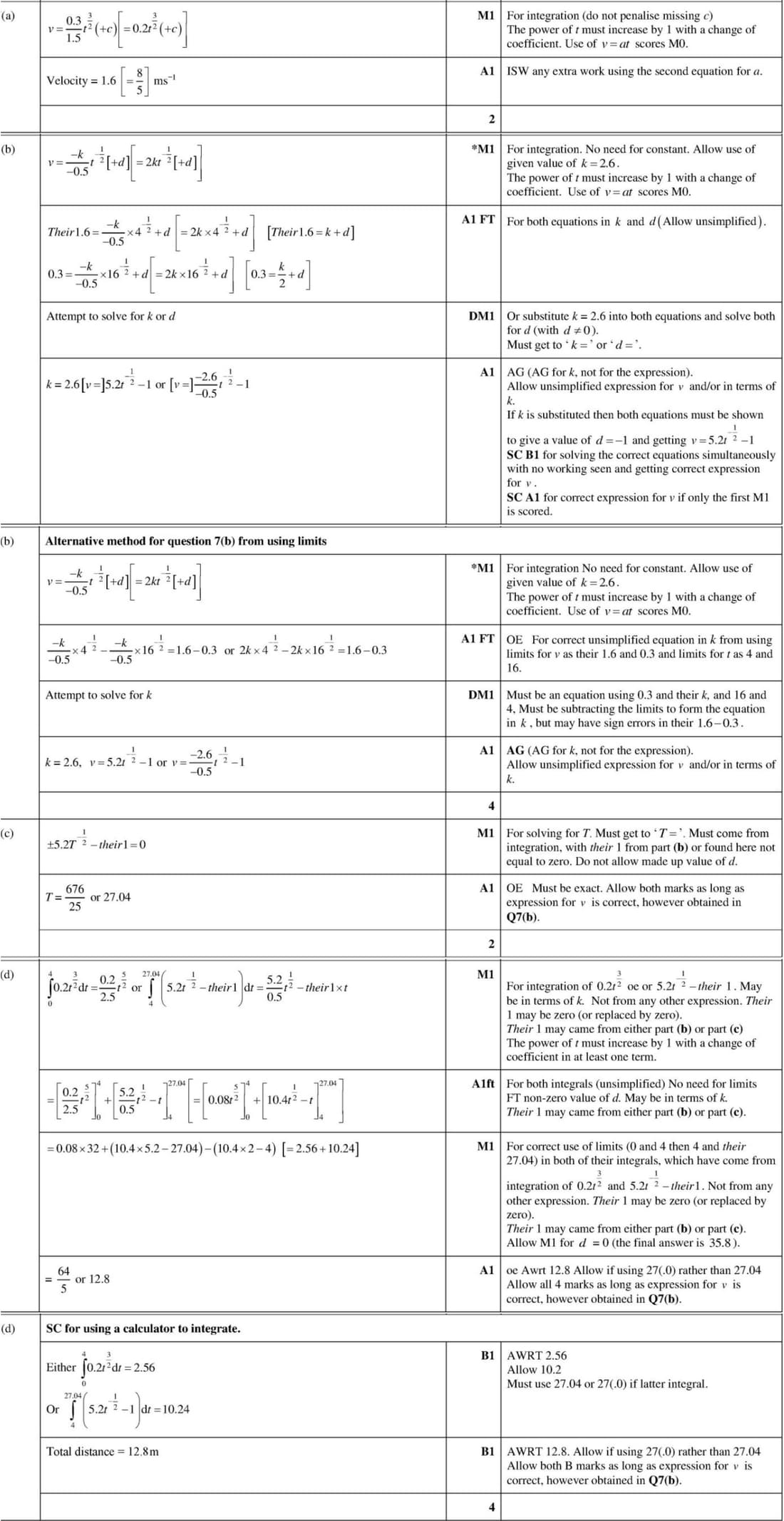
A particle P travels in a straight line, starting at rest from a point O. The acceleration of P at time t s after leaving O is denoted by a m/s2, where
\(a = 0.3t^{\frac{1}{2}}\) for \(0 \leq t \leq 4\),
\(a = -kt^{-\frac{3}{2}}\) for \(4 < t \leq T\),
where k and T are constants.
- Find the velocity of P at \(t = 4\).
- It is given that there is no change in the velocity of P at \(t = 4\) and that the velocity of P at \(t = 16\) is \(0.3 \text{ m/s}\). Show that \(k = 2.6\) and find an expression, in terms of t, for the velocity of P for \(4 \leq t \leq T\).
- Given that P comes to instantaneous rest at \(t = T\), find the exact value of T.
- Find the total distance travelled between \(t = 0\) and \(t = T\).
June 2009 p4 q7
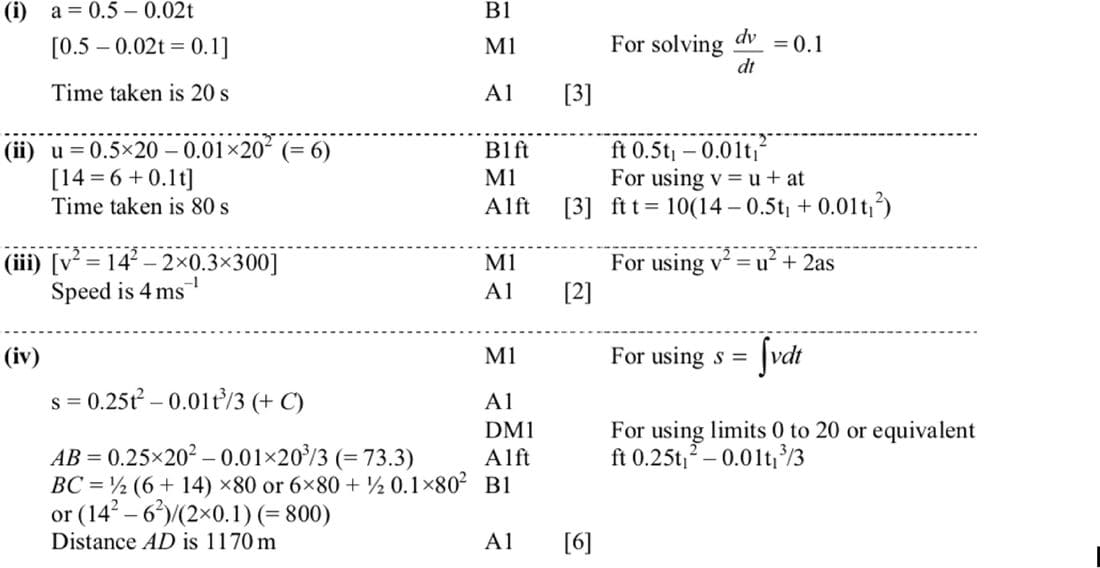
A particle P travels in a straight line from A to D, passing through the points B and C. For the section AB the velocity of the particle is \((0.5t - 0.01t^2)\) m s\(^{-1}\), where \(t\) is the time after leaving A.
- Given that the acceleration of P at B is 0.1 m s\(^{-2}\), find the time taken for P to travel from A to B.
- The acceleration of P from B to C is constant and equal to 0.1 m s\(^{-2}\). Given that P reaches C with speed 14 m s\(^{-1}\), find the time taken for P to travel from B to C.
- P travels with constant deceleration 0.3 m s\(^{-2}\) from C to D. Given that the distance CD is 300 m, find
- the speed with which P reaches D,
- the distance AD.
June 2008 p4 q7
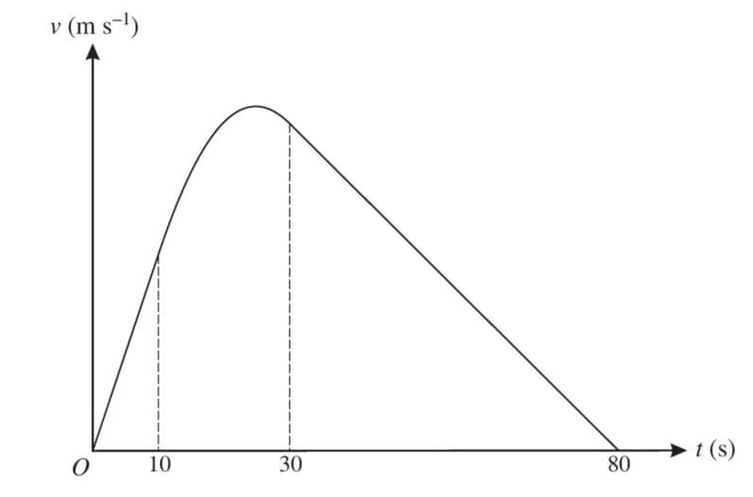
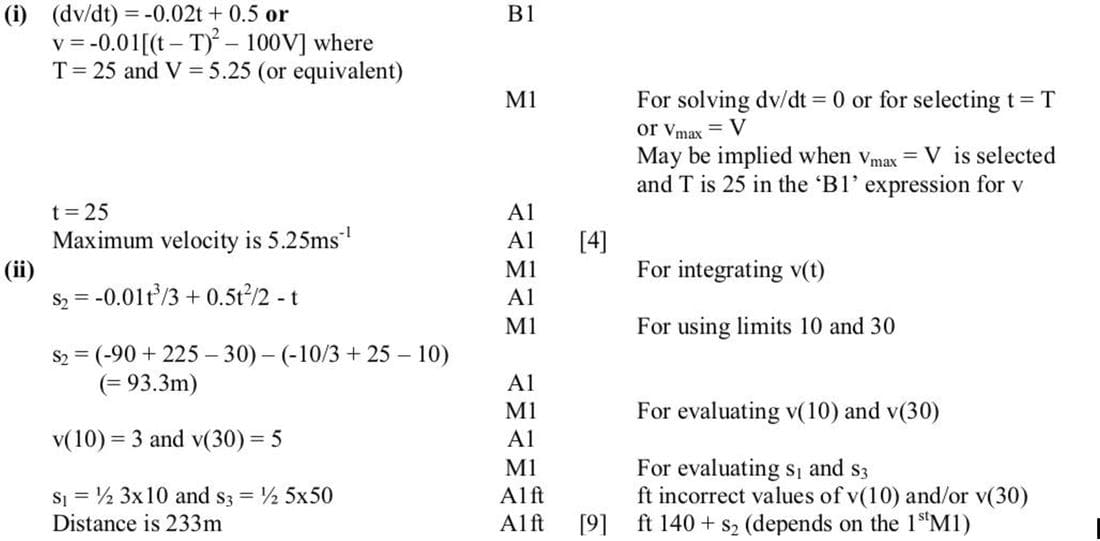
An object P travels from A to B in a time of 80 s. The diagram shows the graph of v against t, where v m s-1 is the velocity of P at time t s after leaving A. The graph consists of straight line segments for the intervals 0 ≤ t ≤ 10 and 30 ≤ t ≤ 80, and a curved section whose equation is v = -0.01t2 + 0.5t - 1 for 10 ≤ t ≤ 30. Find
- the maximum velocity of P,
- the distance AB.
Nov 2006 p4 q4
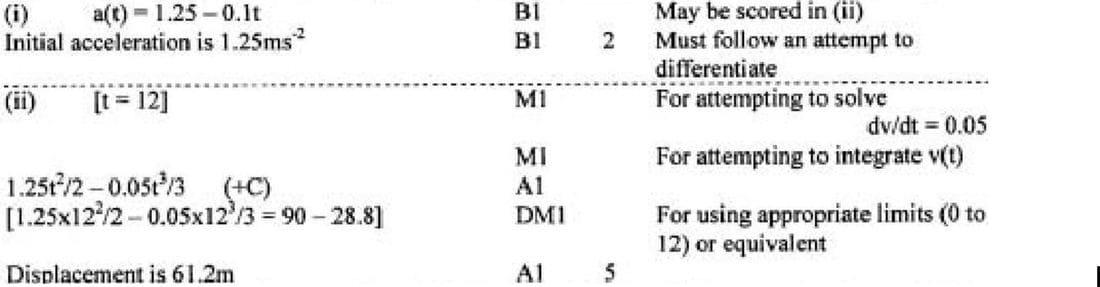
The velocity of a particle at time t seconds after it starts from rest is v m/s, where \(v = 1.25t - 0.05t^2\). Find
- the initial acceleration of the particle,
- the displacement of the particle from its starting point at the instant when its acceleration is \(0.05 \text{ m/s}^2\).