Exam-Style Problems
⬅ Back to SubchapterNov 2009 p41 q5
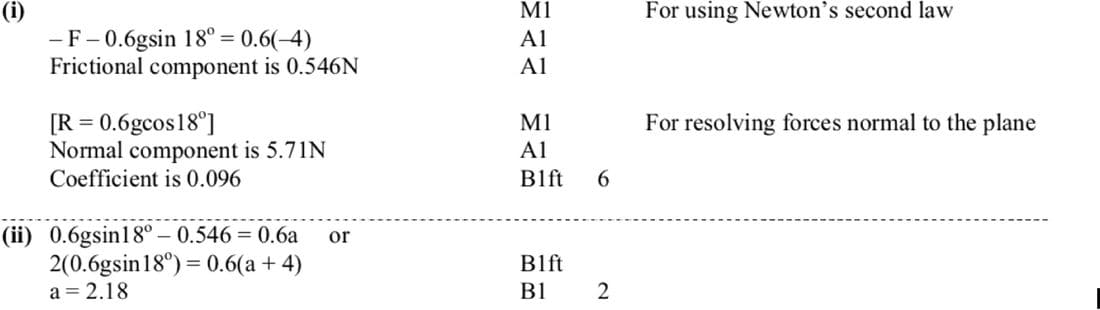
A particle P of mass 0.6 kg moves upwards along a line of greatest slope of a plane inclined at 18° to the horizontal. The deceleration of P is 4 m s-2.
(i) Find the frictional and normal components of the force exerted on P by the plane. Hence find the coefficient of friction between P and the plane, correct to 2 significant figures.
After P comes to instantaneous rest it starts to move down the plane with acceleration a m s-2.
(ii) Find the value of a.
Nov 2006 p4 q7
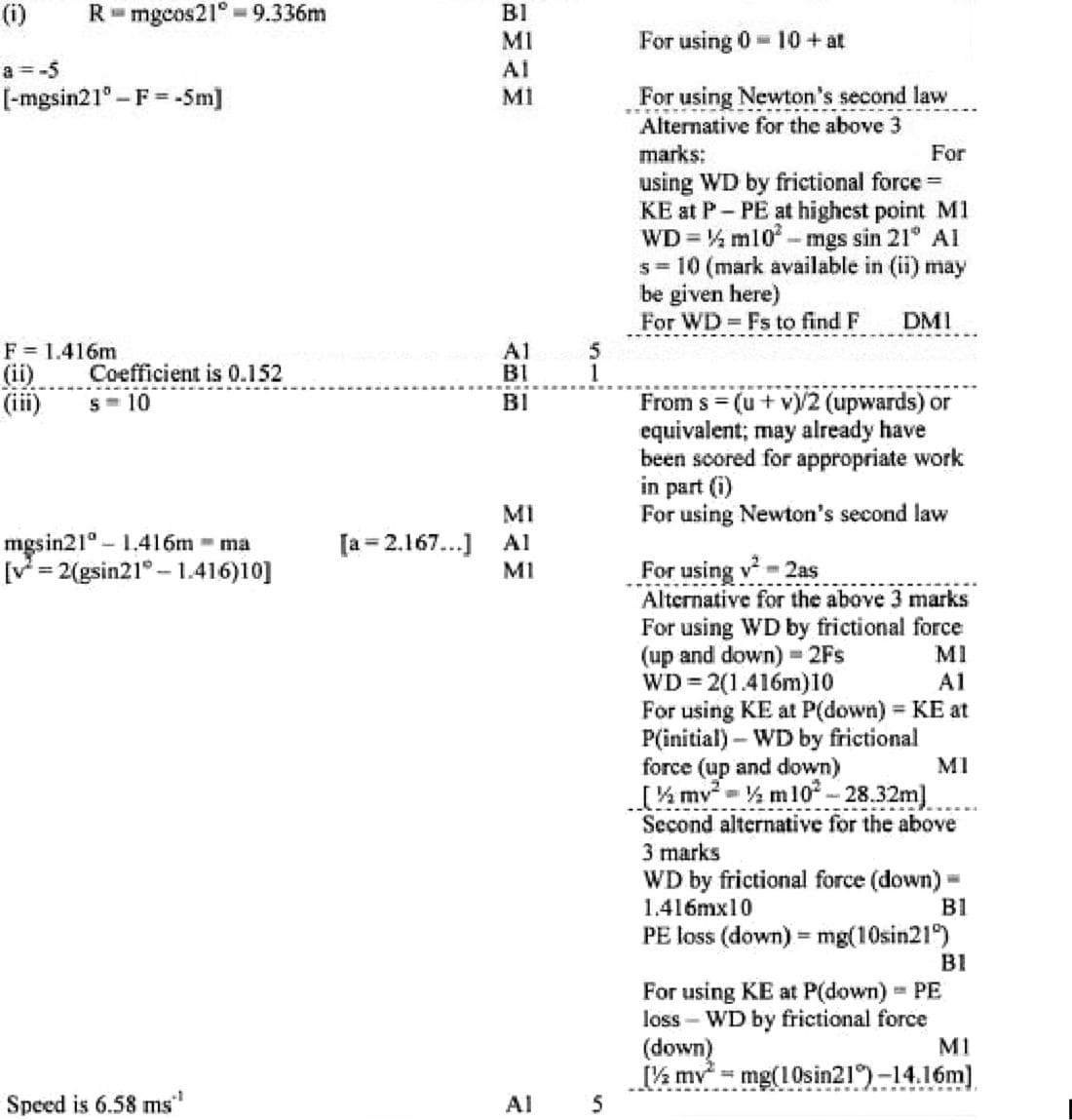
A particle of mass m kg moves up a line of greatest slope of a rough plane inclined at 21° to the horizontal. The frictional and normal components of the contact force on the particle have magnitudes F N and R N respectively. The particle passes through the point P with speed 10 m s-1, and 2 s later it reaches its highest point on the plane.
- Show that R = 9.336m and F = 1.416m, each correct to 4 significant figures.
- Find the coefficient of friction between the particle and the plane.
- After the particle reaches its highest point it starts to move down the plane. Find the speed with which the particle returns to P.
Nov 2022 p42 q2
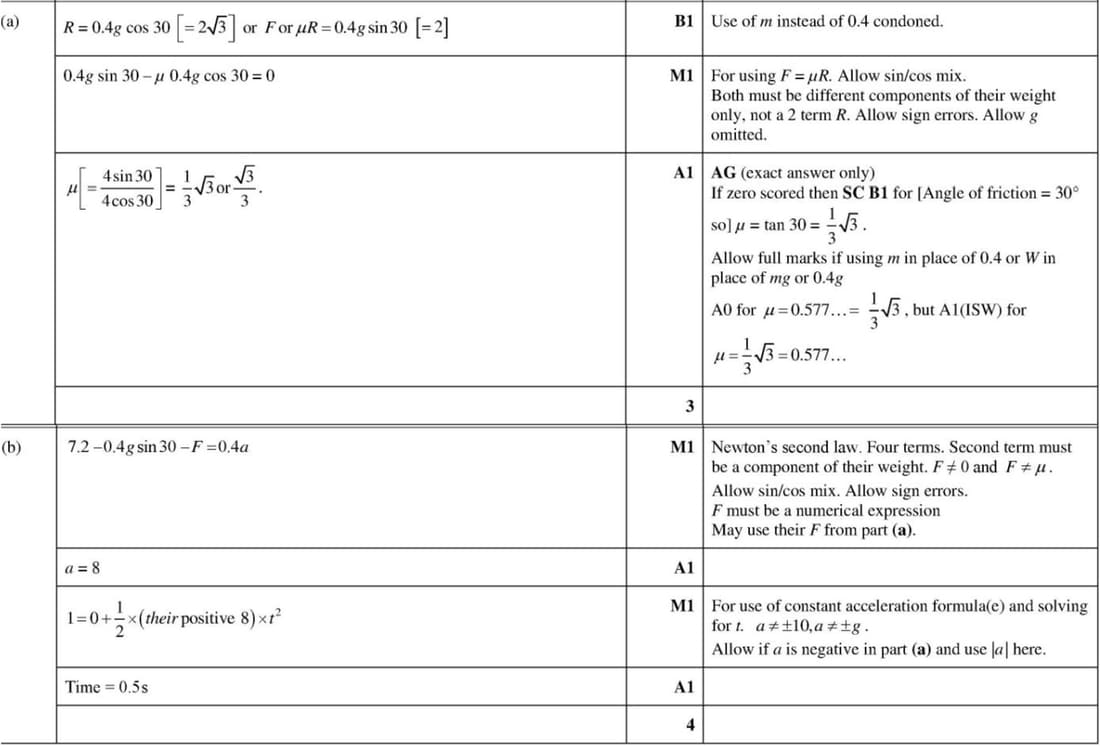
A particle P of mass 0.4 kg is in limiting equilibrium on a plane inclined at 30° to the horizontal.
(a) Show that the coefficient of friction between the particle and the plane is \(\frac{1}{3} \sqrt{3}\).
A force of magnitude 7.2 N is now applied to P directly up a line of greatest slope of the plane.
(b) Given that P starts from rest, find the time that it takes for P to move 1 m up the plane.
June 2005 p4 q3
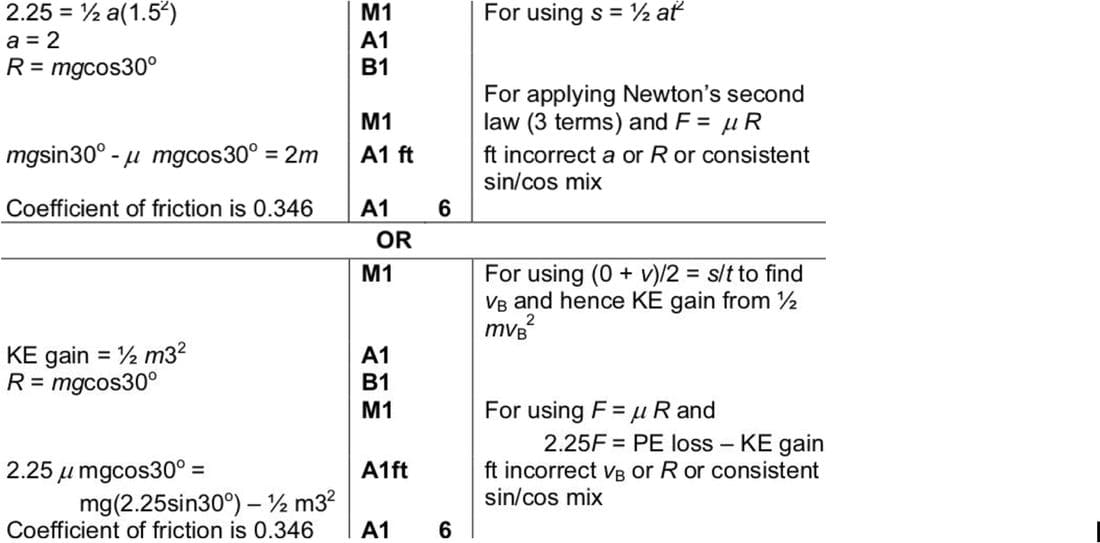
A and B are points on the same line of greatest slope of a rough plane inclined at 30° to the horizontal. A is higher up the plane than B and the distance AB is 2.25 m. A particle P, of mass m kg, is released from rest at A and reaches B 1.5 s later. Find the coefficient of friction between P and the plane.
June 2003 p4 q7
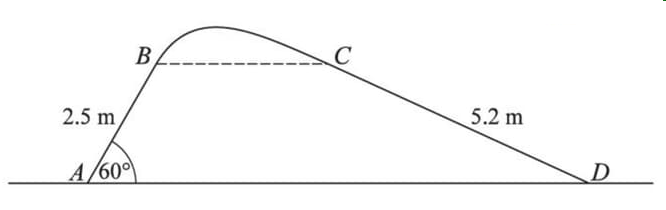
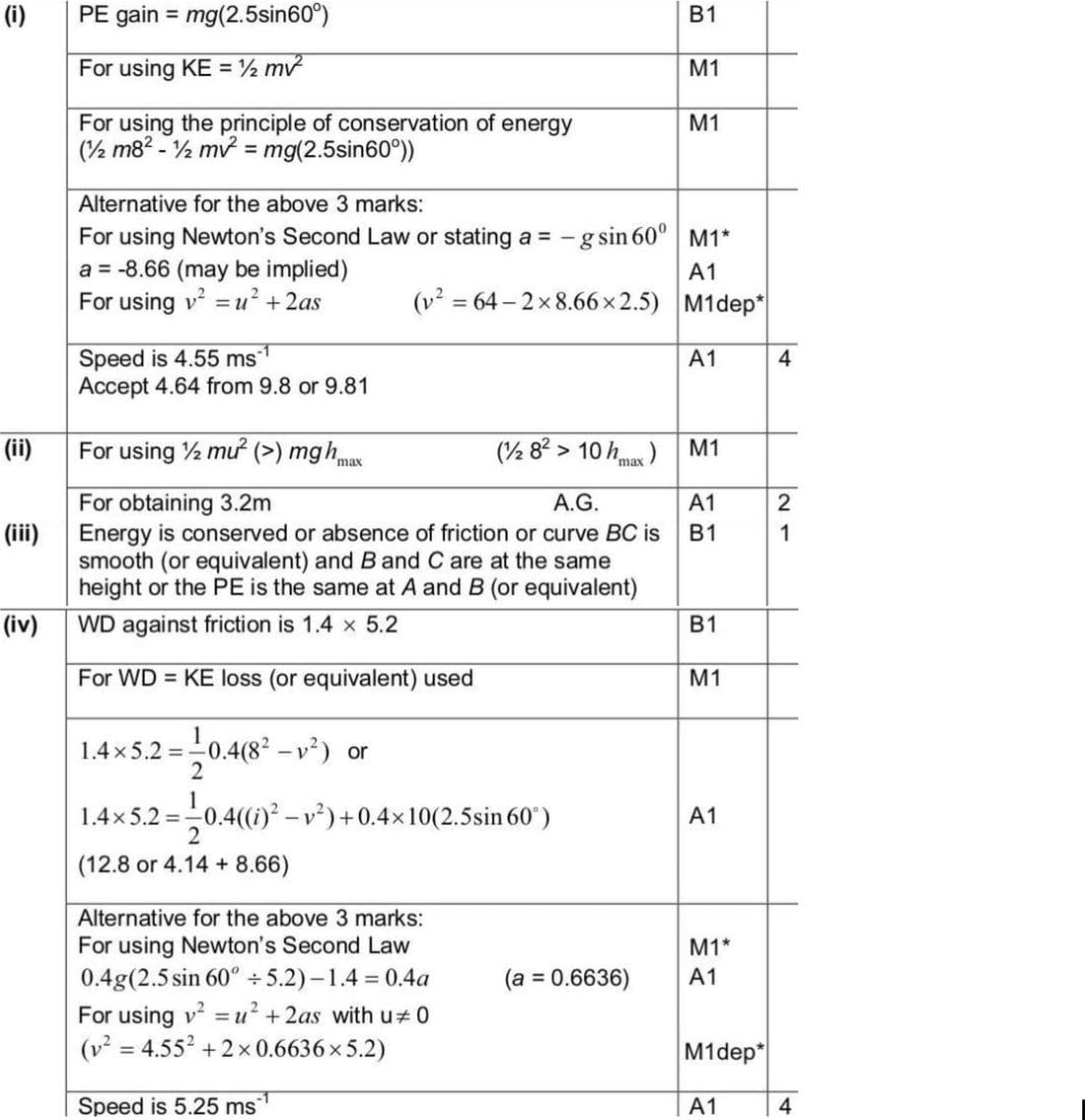
The diagram shows a vertical cross-section ABCD of a surface. The parts AB and CD are straight and have lengths 2.5 m and 5.2 m respectively. AD is horizontal, and AB is inclined at 60° to the horizontal. The points B and C are at the same height above AD. The parts of the surface containing AB and BC are smooth. A particle P is given a velocity of 8 m s-1 at A, in the direction AB, and it subsequently reaches D. The particle does not lose contact with the surface during this motion.
- Find the speed of P at B.
- Show that the maximum height of the cross-section, above AD, is less than 3.2 m.
- State briefly why P’s speed at C is the same as its speed at B.
- The frictional force acting on the particle as it travels from C to D is 1.4 N. Given that the mass of P is 0.4 kg, find the speed with which P reaches D.