Exam-Style Problems
⬅ Back to SubchapterFeb/Mar 2017 p32 q8
1970
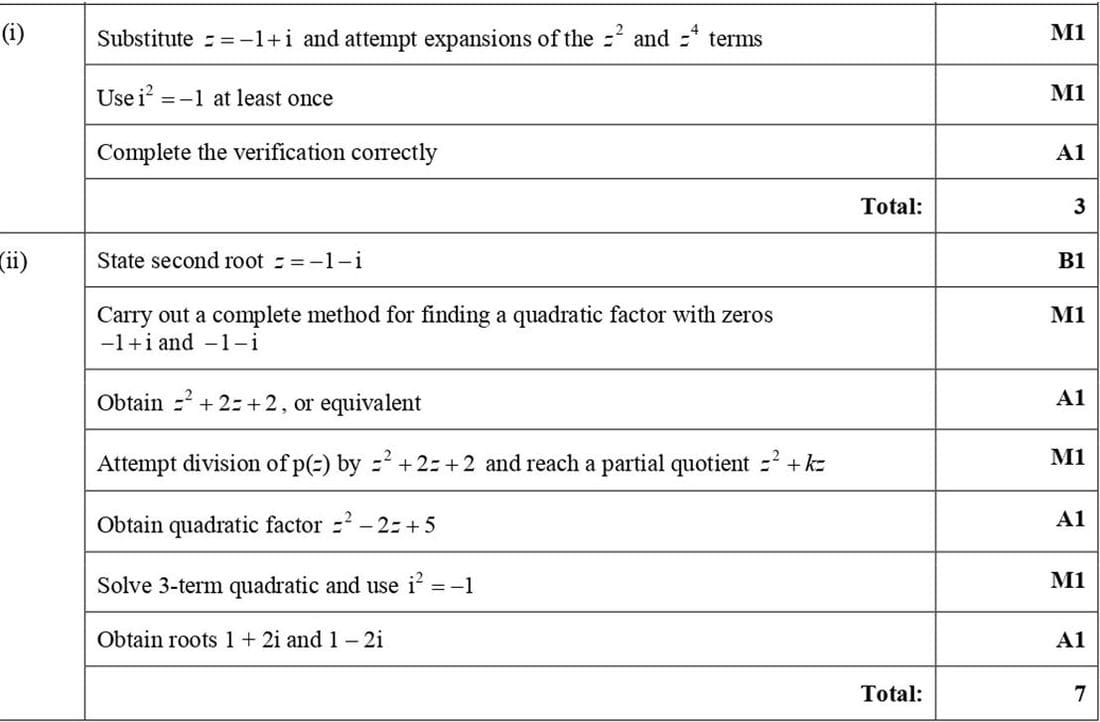
The polynomial \(z^4 + 3z^2 + 6z + 10\) is denoted by \(p(z)\). The complex number \(-1 + i\) is denoted by \(u\).
(i) Showing all your working, verify that \(u\) is a root of the equation \(p(z) = 0\).
(ii) Find the other three roots of the equation \(p(z) = 0\).
Nov 2016 p33 q7
1971
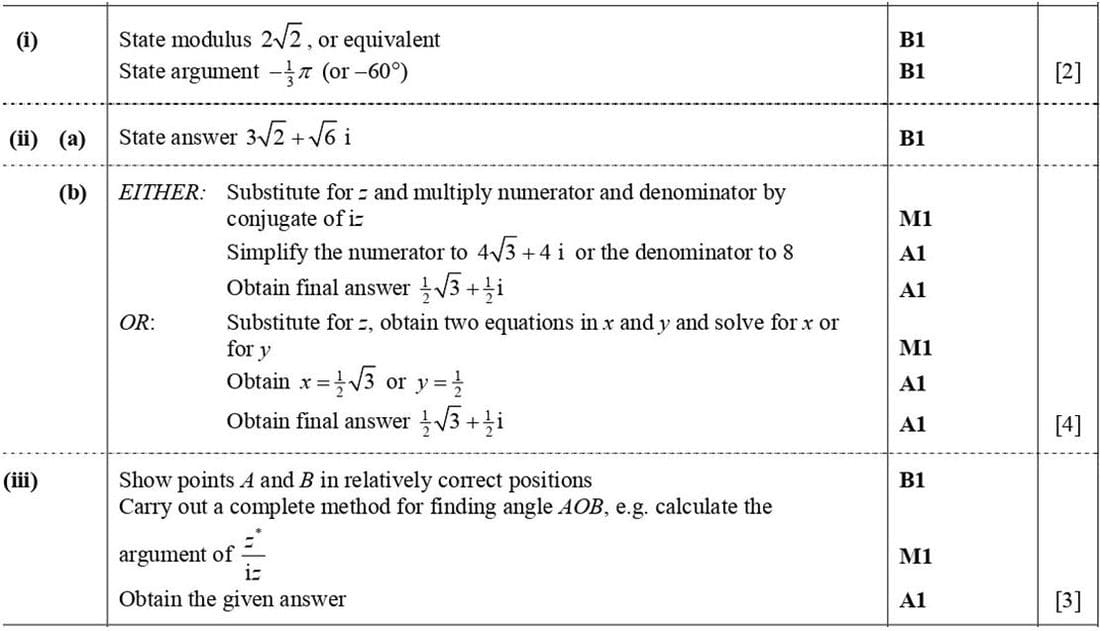
The complex number \(z\) is defined by \(z = (\sqrt{2}) - (\sqrt{6})i\). The complex conjugate of \(z\) is denoted by \(z^*\).
- Find the modulus and argument of \(z\).
- Express each of the following in the form \(x + iy\), where \(x\) and \(y\) are real and exact:
- \(z + 2z^*\);
- \(\frac{z^*}{iz}\).
- On a sketch of an Argand diagram with origin \(O\), show the points \(A\) and \(B\) representing the complex numbers \(z^*\) and \(iz\) respectively. Prove that angle \(AOB\) is equal to \(\frac{1}{6}\pi\).
Nov 2023 p31 q2
1972
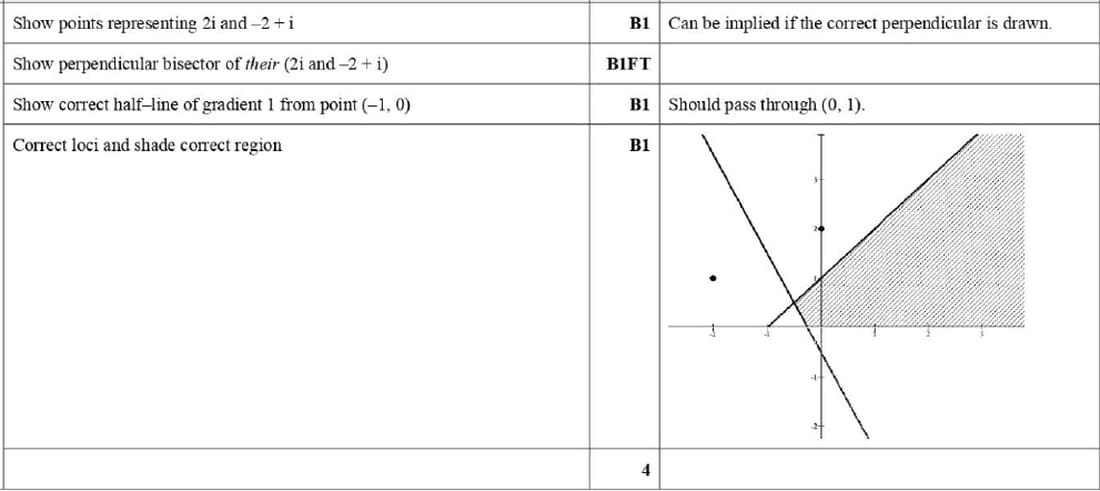
On an Argand diagram, shade the region whose points represent complex numbers \(z\) satisfying the inequalities \(|z - 2i| \leq |z + 2 - i|\) and \(0 \leq \arg(z + 1) \leq \frac{1}{4}\pi\).
Nov 2016 p31 q9
1973
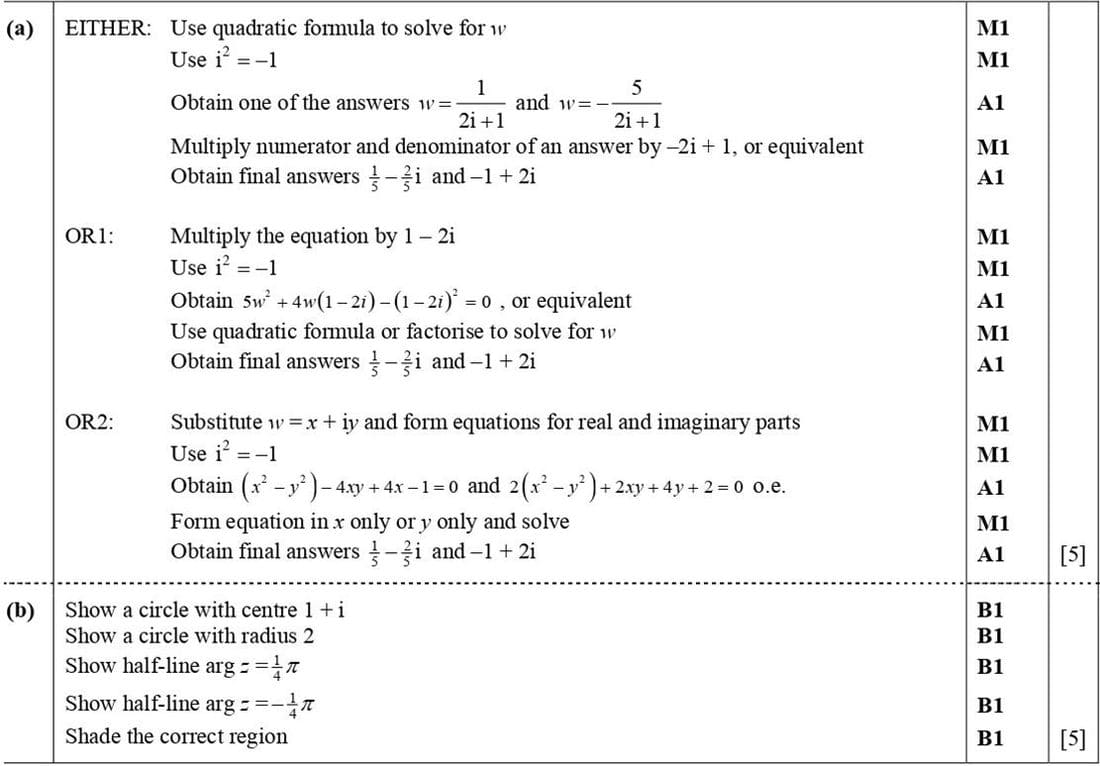
(a) Solve the equation \((1 + 2i)w^2 + 4w - (1 - 2i) = 0\), giving your answers in the form \(x + iy\), where \(x\) and \(y\) are real.
(b) On a sketch of an Argand diagram, shade the region whose points represent complex numbers satisfying the inequalities \(|z - 1 - i| \leq 2\) and \(-\frac{\pi}{4} \leq \arg z \leq \frac{\pi}{4}\).
June 2016 p33 q9
1974
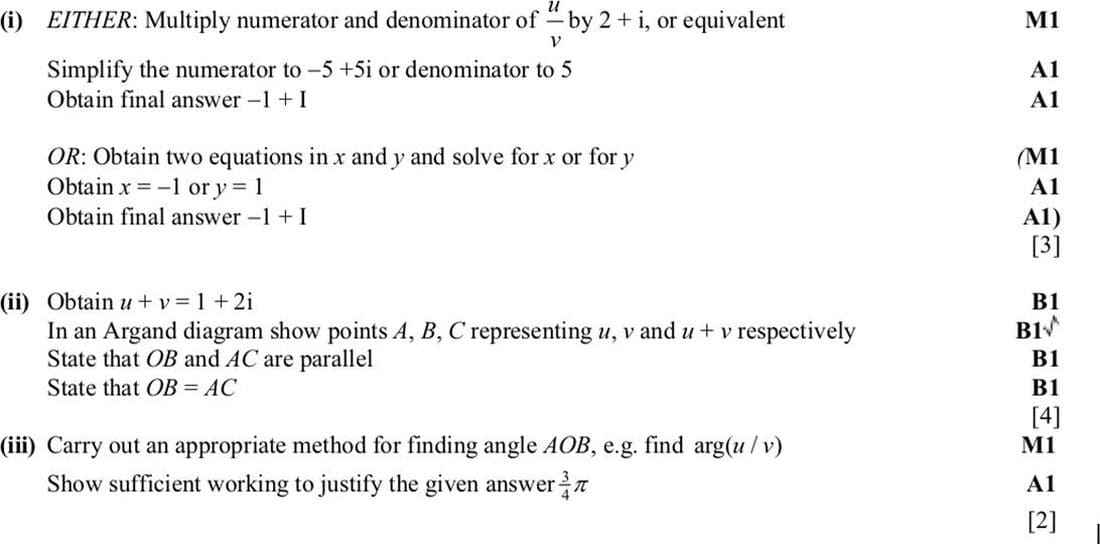
The complex numbers \(-1 + 3i\) and \(2 - i\) are denoted by \(u\) and \(v\) respectively. In an Argand diagram with origin \(O\), the points \(A, B\) and \(C\) represent the numbers \(u, v\) and \(u + v\) respectively.
- Sketch this diagram and state fully the geometrical relationship between \(OB\) and \(AC\).
- Find, in the form \(x + iy\), where \(x\) and \(y\) are real, the complex number \(\frac{u}{v}\).
- Prove that angle \(AOB = \frac{3}{4}\pi\).