Exam-Style Problems
⬅ Back to SubchapterFM June 2024 p12 q05
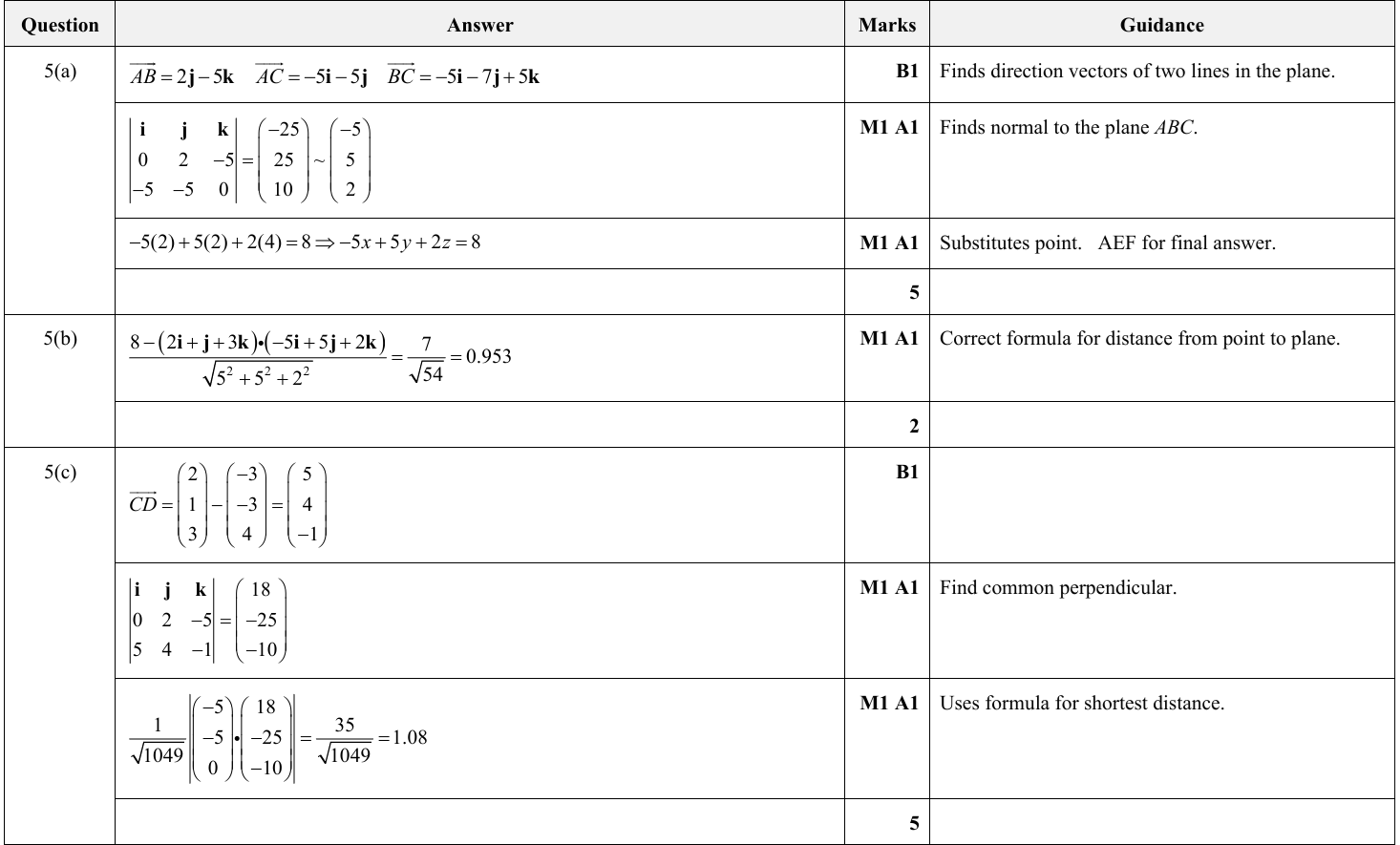
The points A, B, C have position vectors
\(2\mathbf{i} + 2\mathbf{j} + 4\mathbf{k}, \quad 2\mathbf{i} + 4\mathbf{j} - \mathbf{k}, \quad -3\mathbf{i} - 3\mathbf{j} + 4\mathbf{k},\)
respectively, relative to the origin O.
(a) Find the equation of the plane ABC, giving your answer in the form \(ax + by + cz = d\).
The point D has position vector \(2\mathbf{i} + \mathbf{j} + 3\mathbf{k}\).
(b) Find the perpendicular distance from D to the plane ABC.
(c) Find the shortest distance between the lines AB and CD.
FM June 2024 p12 q06
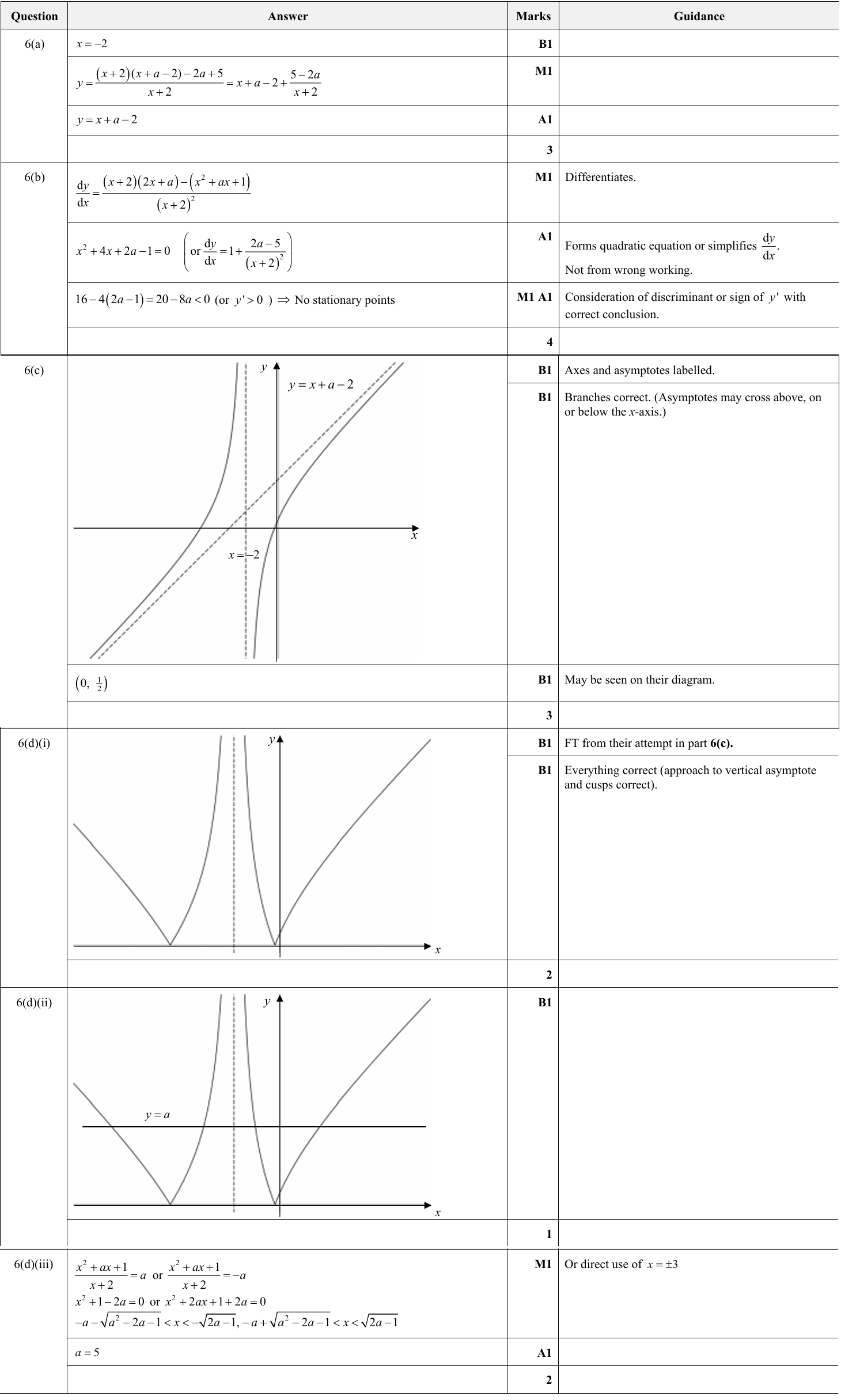
The curve \(C\) has equation \(y = \frac{x^2 + ax + 1}{x + 2}\), where \(a > \frac{5}{2}\).
- (a) Find the equations of the asymptotes of \(C\).
- (b) Show that \(C\) has no stationary points.
- (c) Sketch \(C\), stating the coordinates of the point of intersection with the \(y\)-axis and labelling the asymptotes.
- (d)
- Sketch the curve with equation \(y = \left| \frac{x^2 + ax + 1}{x + 2} \right|\).
- On your sketch in part (i), draw the line \(y = a\).
- It is given that \(\left| \frac{x^2 + ax + 1}{x + 2} \right| < a\) for \(-5 - \sqrt{14} < x < -3\) and \(-5 + \sqrt{14} < x < 3\). Find the value of \(a\).
FM June 2024 p12 q07
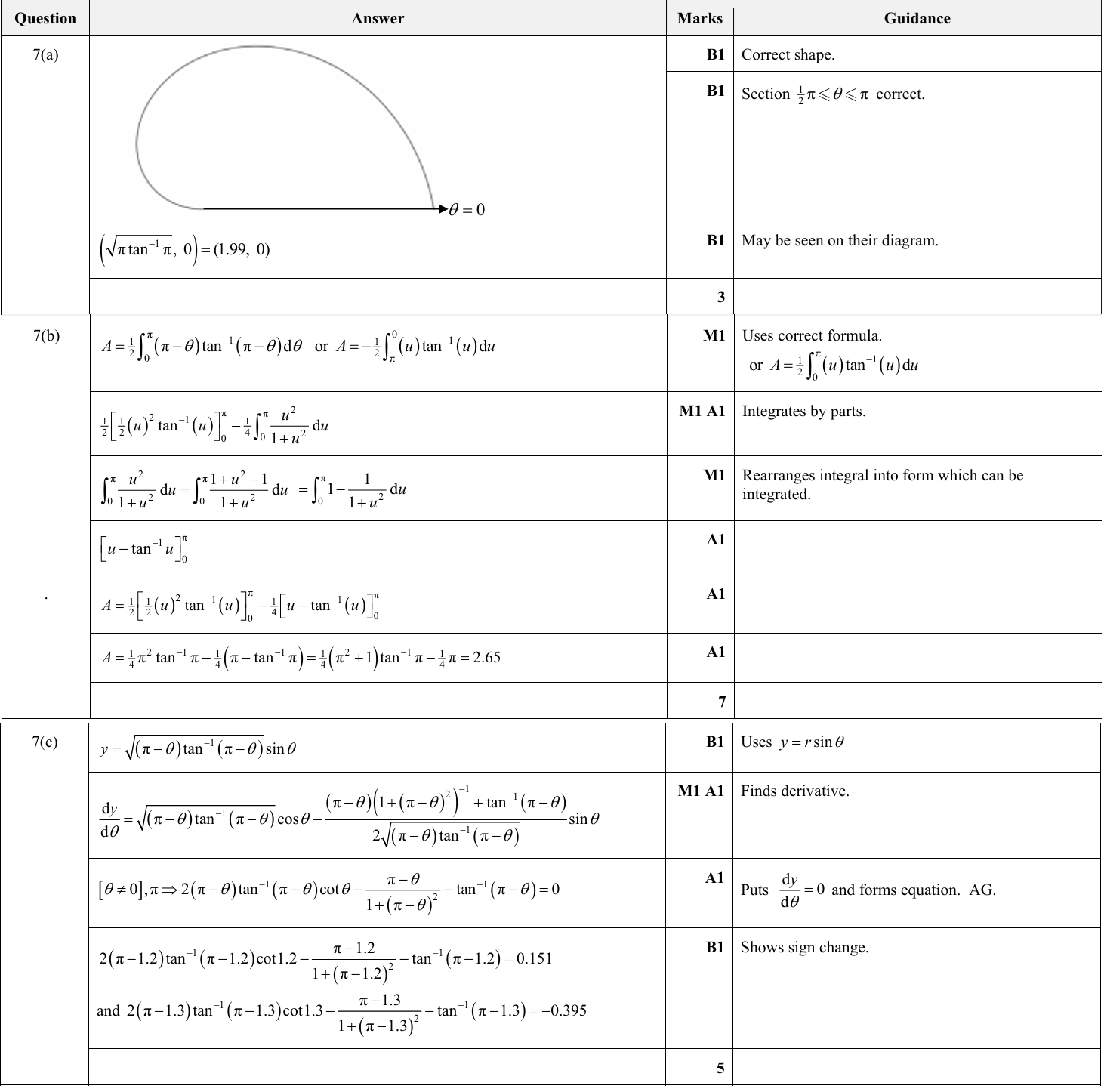
The curve C has polar equation \(r^2 = (\pi - \theta) \arctan(\pi - \theta)\), for \(0 \leq \theta \leq \pi\).
(a) Sketch C and state the polar coordinates of the point of C furthest from the pole. [3]
(b) Using the substitution \(u = \pi - \theta\), or otherwise, find the area of the region enclosed by C and the initial line. [7]
(c) Show that, at the point of C furthest from the initial line,
\(2(\pi - \theta) \arctan(\pi - \theta) \cot \theta - \frac{\pi - \theta}{1 + (\pi - \theta)^2} - \arctan(\pi - \theta) = 0\)
and verify that this equation has a root for \(\theta\) between 1.2 and 1.3. [5]
FM June 2024 p13 q01
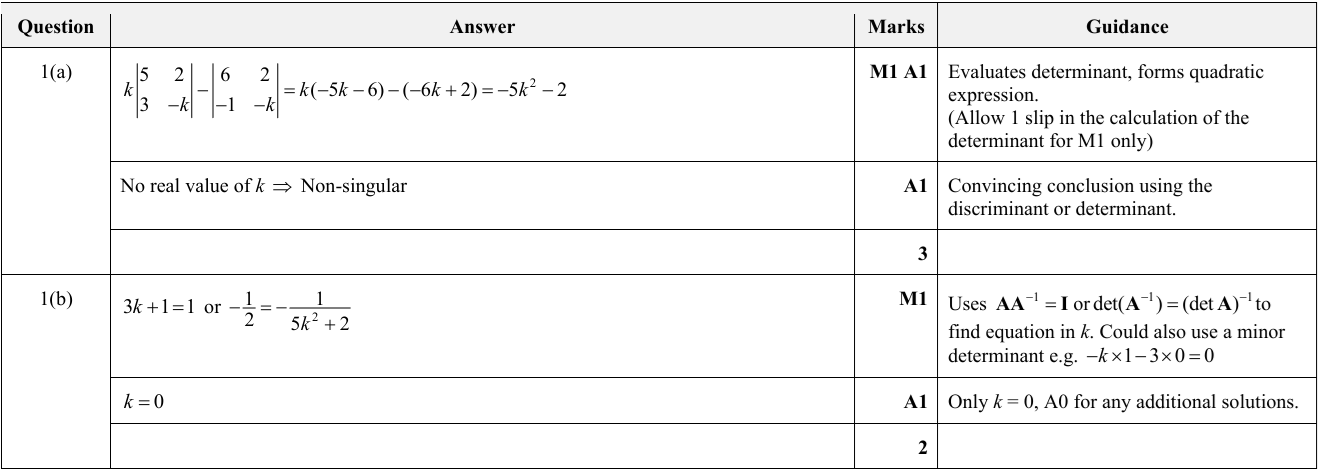
The matrix A is given by
\(A = \begin{pmatrix} k & 1 & 0 \\ 6 & 5 & 2 \\ -1 & 3 & -k \end{pmatrix}\),
where \(k\) is a real constant.
(a) Show that A is non-singular.
(b) Given that \(A^{-1} = \begin{pmatrix} 3 & 0 & -1 \\ 1 & 0 & 0 \\ -\frac{23}{2} & \frac{1}{2} & 3 \end{pmatrix}\), find the value of \(k\).
FM June 2024 p13 q02
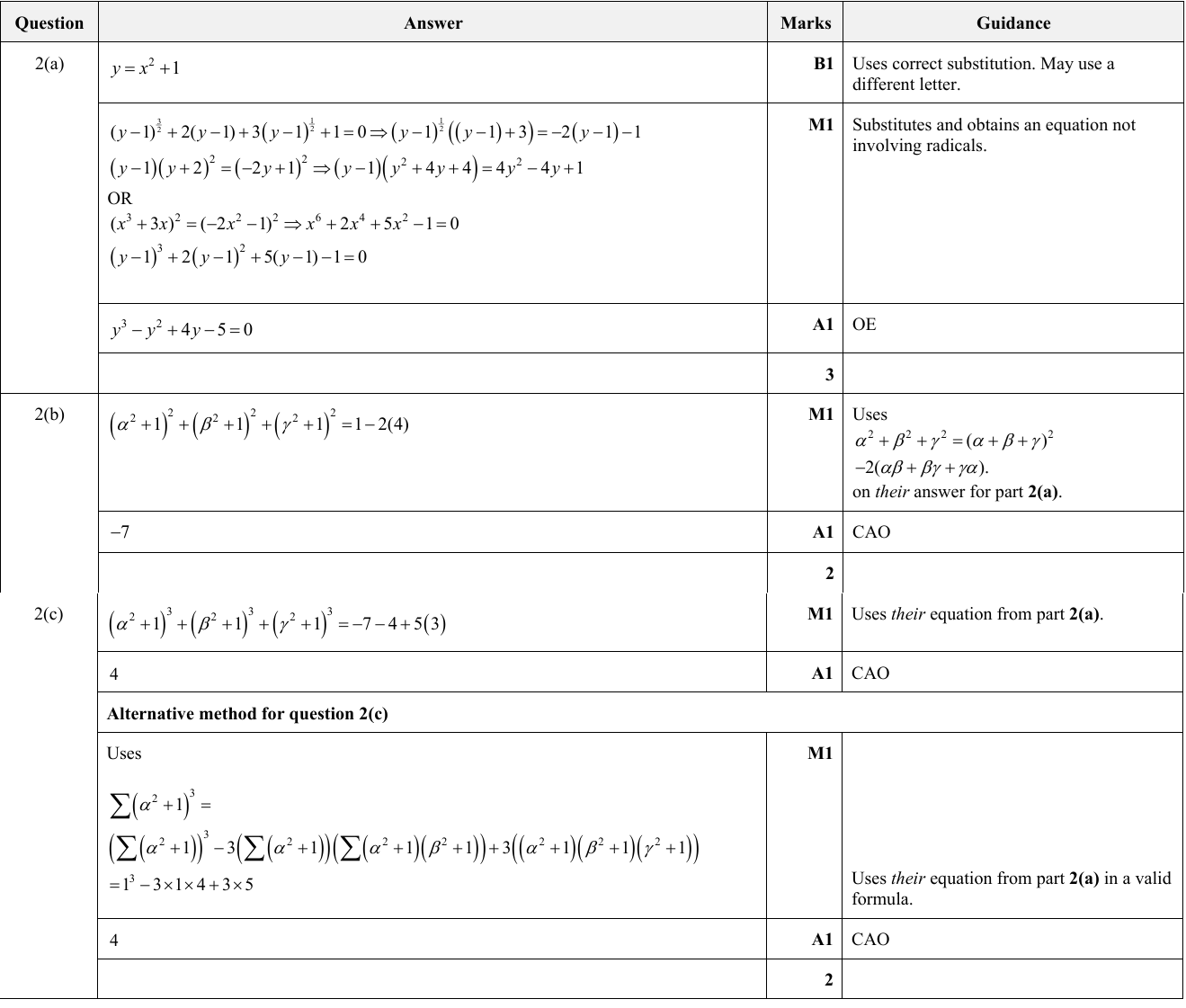
The cubic equation \(x^3 + 2x^2 + 3x + 1 = 0\) has roots \(\alpha, \beta, \gamma\).
(a) Find a cubic equation whose roots are \(\alpha^2 + 1, \beta^2 + 1, \gamma^2 + 1\).
(b) Find the value of \((\alpha^2 + 1)^2 + (\beta^2 + 1)^2 + (\gamma^2 + 1)^2\).
(c) Find the value of \((\alpha^2 + 1)^3 + (\beta^2 + 1)^3 + (\gamma^2 + 1)^3\).