Exam-Style Problems
⬅ Back to SubchapterJune 2012 p43 q4
A car of mass 1230 kg increases its speed from 4 m/s to 21 m/s in 24.5 s. The table below shows corresponding values of time \(t\) s and speed \(v\) m/s.
| \(t\) | 0 | 0.5 | 16.3 | 24.5 |
|---|---|---|---|---|
| \(v\) | 4 | 6 | 19 | 21 |
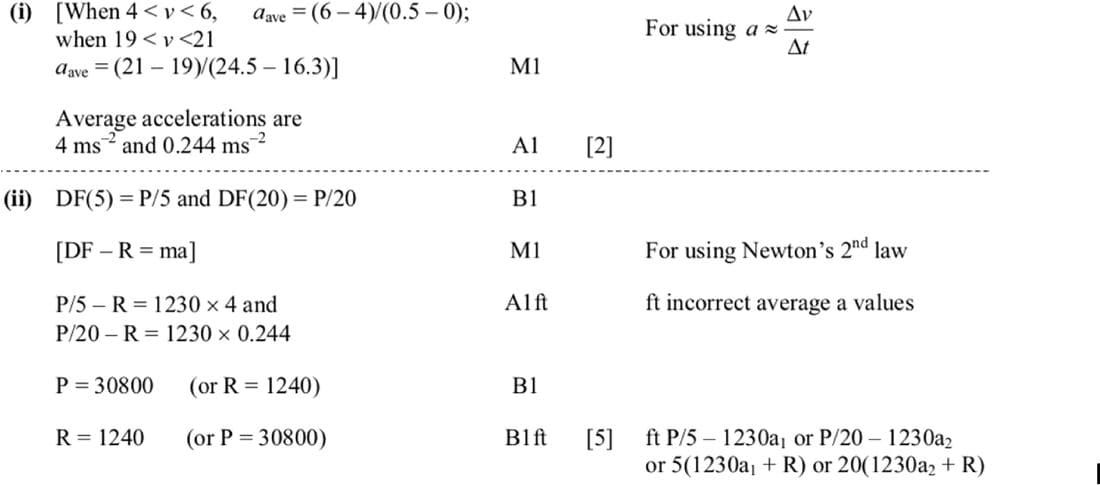
(i) Using the values in the table, find the average acceleration of the car for \(0 < t < 0.5\) and for \(16.3 < t < 24.5\).
While the car is increasing its speed the power output of its engine is constant and equal to \(P\) W, and the resistance to the car’s motion is constant and equal to \(R\) N.
(ii) Assuming that the values obtained in part (i) are approximately equal to the accelerations at \(v = 5\) and at \(v = 20\), find approximations for \(P\) and \(R\).
June 2012 p41 q1
A car of mass 880 kg travels along a straight horizontal road with its engine working at a constant rate of \(P\) W. The resistance to motion is 700 N. At an instant when the car's speed is 16 m s-1 its acceleration is 0.625 m s-2. Find the value of \(P\).

Nov 2011 p43 q7
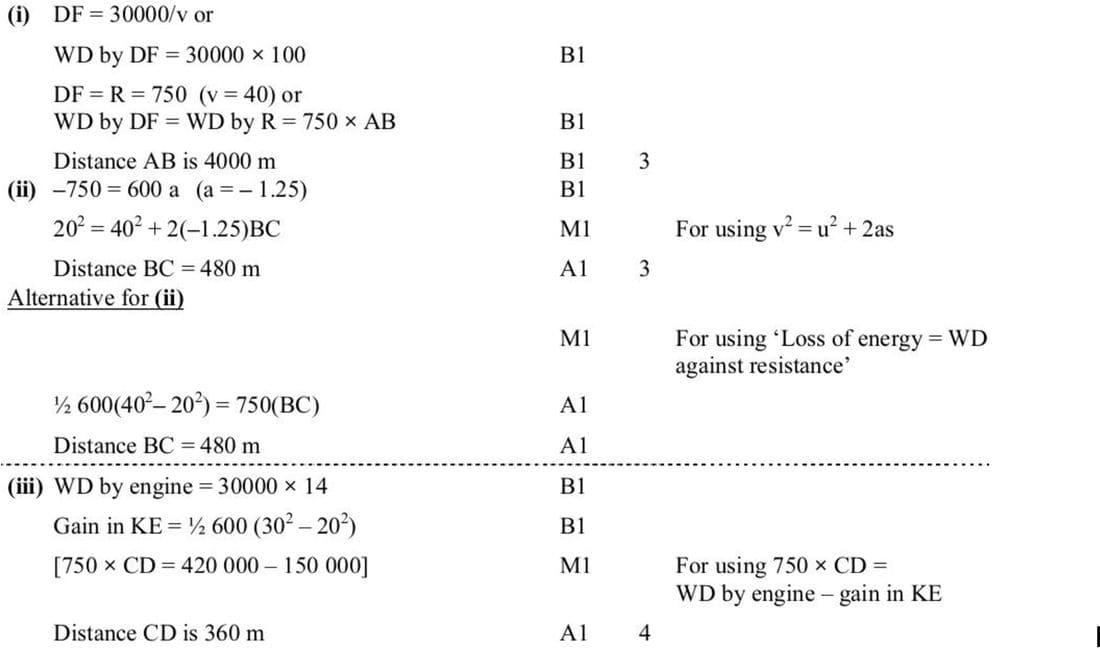
A car of mass 600 kg travels along a straight horizontal road starting from a point A. The resistance to motion of the car is 750 N.
- The car travels from A to B at constant speed in 100 s. The power supplied by the car's engine is constant and equal to 30 kW. Find the distance AB.
- The car's engine is switched off at B and the car's speed decreases until the car reaches C with a speed of 20 m/s. Find the distance BC.
- The car's engine is switched on at C and the power it supplies is constant and equal to 30 kW. The car takes 14 s to travel from C to D and reaches D with a speed of 30 m/s. Find the distance CD.
Nov 2011 p42 q1
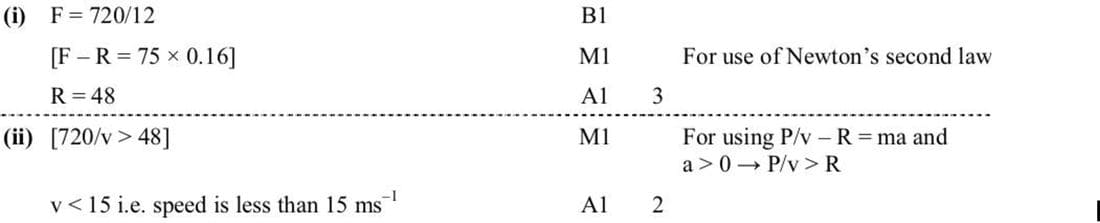
A racing cyclist, whose mass with his cycle is 75 kg, works at a rate of 720 W while moving on a straight horizontal road. The resistance to the cyclist’s motion is constant and equal to \(R N\).
- Given that the cyclist is accelerating at \(0.16 \, \text{m/s}^2\) at an instant when his speed is \(12 \, \text{m/s}\), find the value of \(R\).
- Given that the cyclist’s acceleration is positive, show that his speed is less than \(15 \, \text{m/s}\).
June 2011 p43 q2
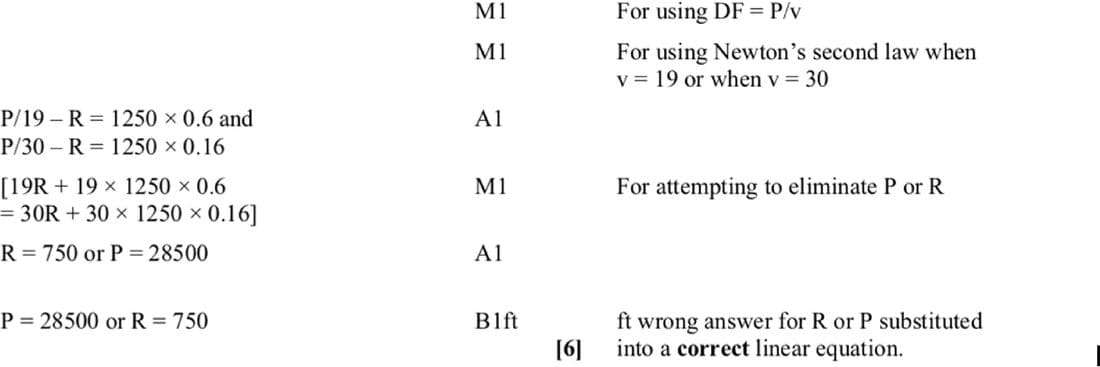
A car of mass 1250 kg is travelling along a straight horizontal road with its engine working at a constant rate of \(P\) W. The resistance to the car’s motion is constant and equal to \(R\) N. When the speed of the car is 19 m s\(^{-1}\) its acceleration is 0.6 m s\(^{-2}\), and when the speed of the car is 30 m s\(^{-1}\) its acceleration is 0.16 m s\(^{-2}\). Find the values of \(P\) and \(R\).