Exam-Style Problems
⬅ Back to SubchapterNov 2012 p42 q6
3553
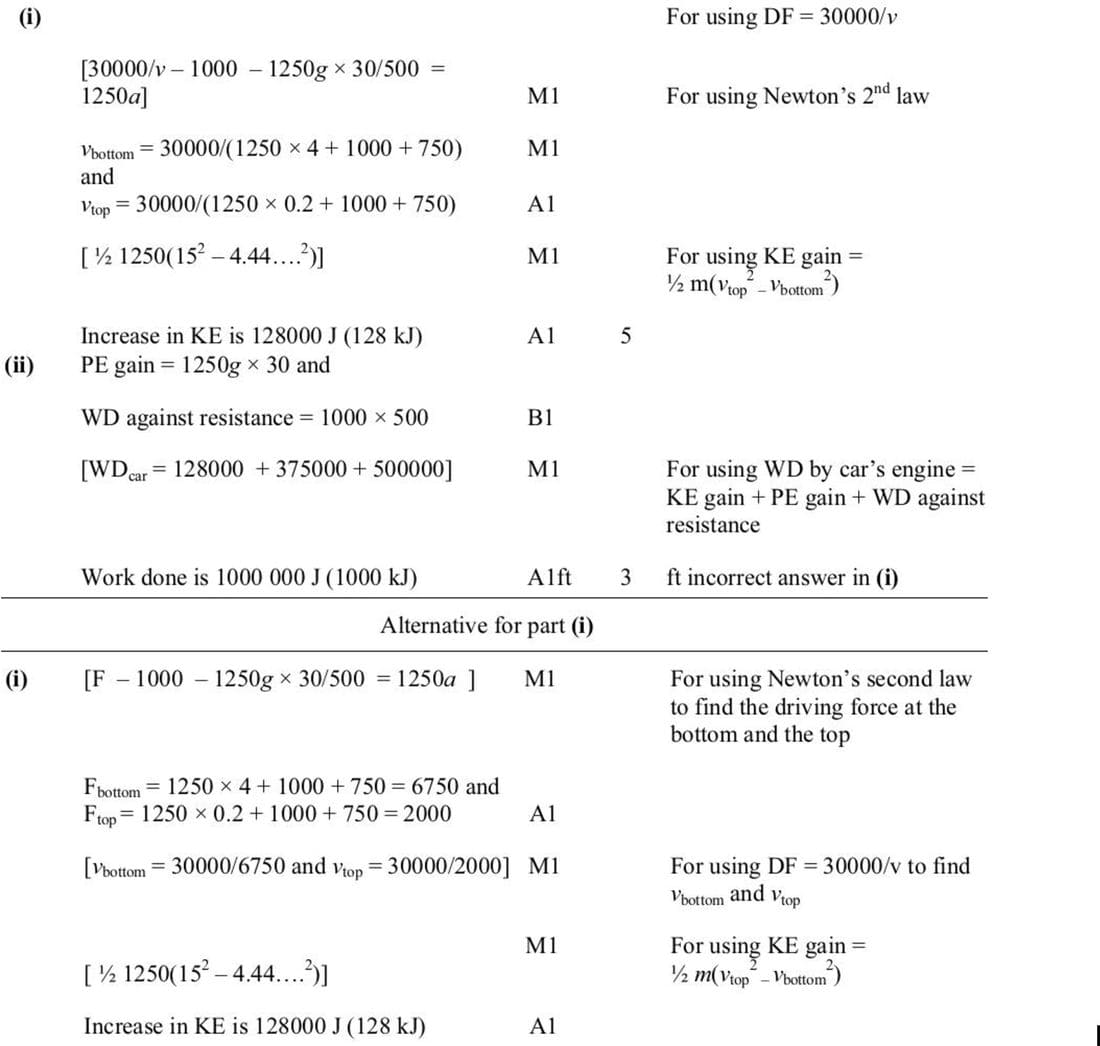
A car of mass 1250 kg moves from the bottom to the top of a straight hill of length 500 m. The top of the hill is 30 m above the level of the bottom. The power of the car’s engine is constant and equal to 30000 W. The car’s acceleration is 4 m/s2 at the bottom of the hill and is 0.2 m/s2 at the top. The resistance to the car’s motion is 1000 N. Find
- the car’s gain in kinetic energy,
- the work done by the car’s engine.
Nov 2012 p41 q6
3554
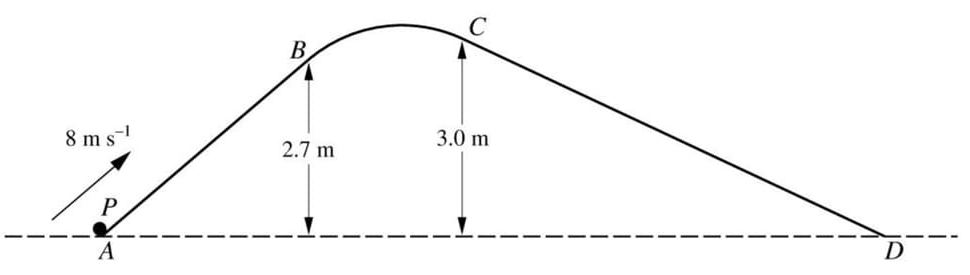
The diagram shows the vertical cross-section ABCD of a surface. BC is a circular arc, and AB and CD are tangents to BC at B and C respectively. A and D are at the same horizontal level, and B and C are at heights 2.7 m and 3.0 m respectively above the level of A and D. A particle P of mass 0.2 kg is given a velocity of 8 m s-1 at A, in the direction of AB (see diagram). The parts of the surface containing AB and BC are smooth.
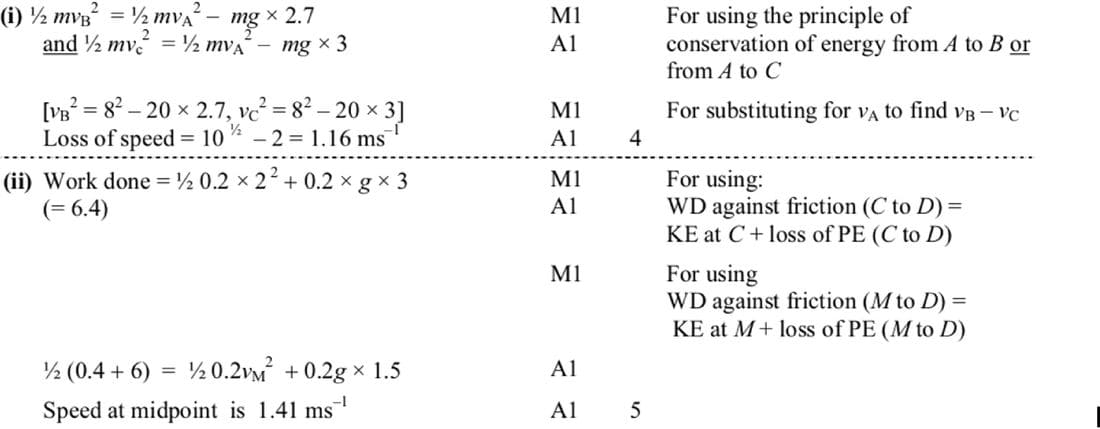
- Find the decrease in the speed of P as P moves along the surface from B to C.
- The part of the surface containing CD exerts a constant frictional force on P, as it moves from C to D, and P comes to rest as it reaches D.
- Find the speed of P when it is at the mid-point of CD.
June 2012 p43 q5
3555
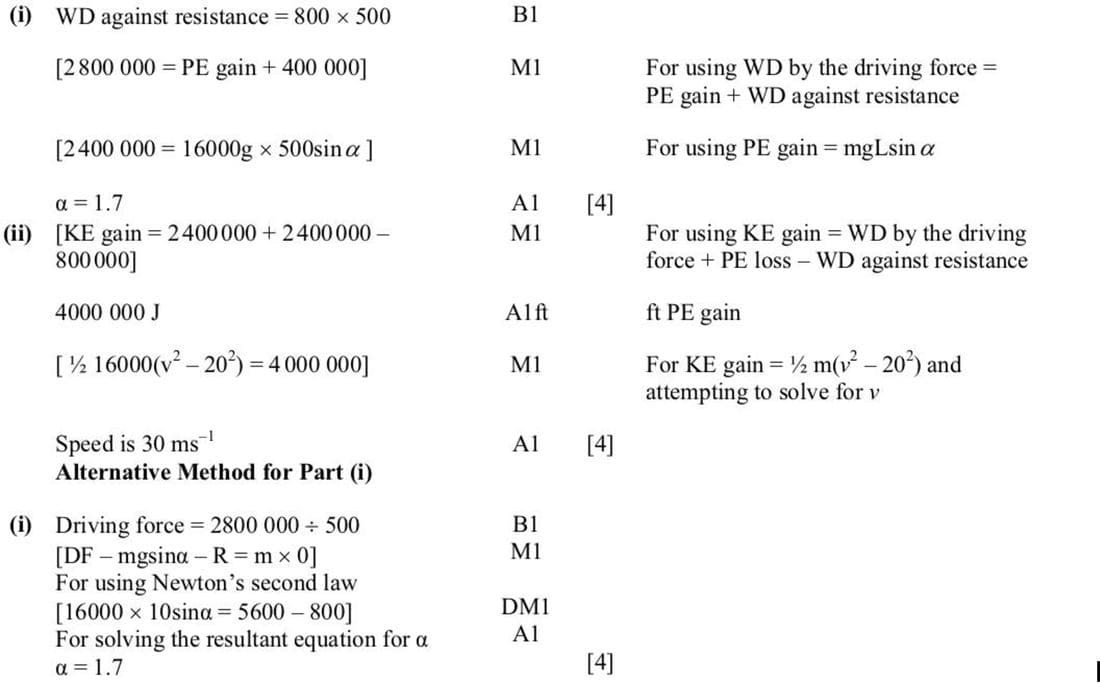
A lorry of mass 16,000 kg moves on a straight hill inclined at angle \(\alpha^\circ\) to the horizontal. The length of the hill is 500 m.
- While the lorry moves from the bottom to the top of the hill at constant speed, the resisting force acting on the lorry is 800 N and the work done by the driving force is 2800 kJ. Find the value of \(\alpha\).
- On the return journey the speed of the lorry is 20 m s\(^{-1}\) at the top of the hill. While the lorry travels down the hill, the work done by the driving force is 2400 kJ and the work done against the resistance to motion is 800 kJ. Find the speed of the lorry at the bottom of the hill.
June 2012 p42 q7
3556
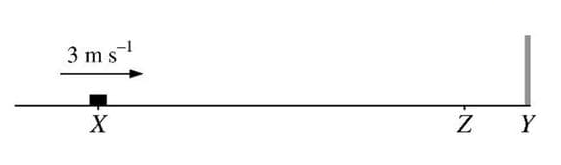
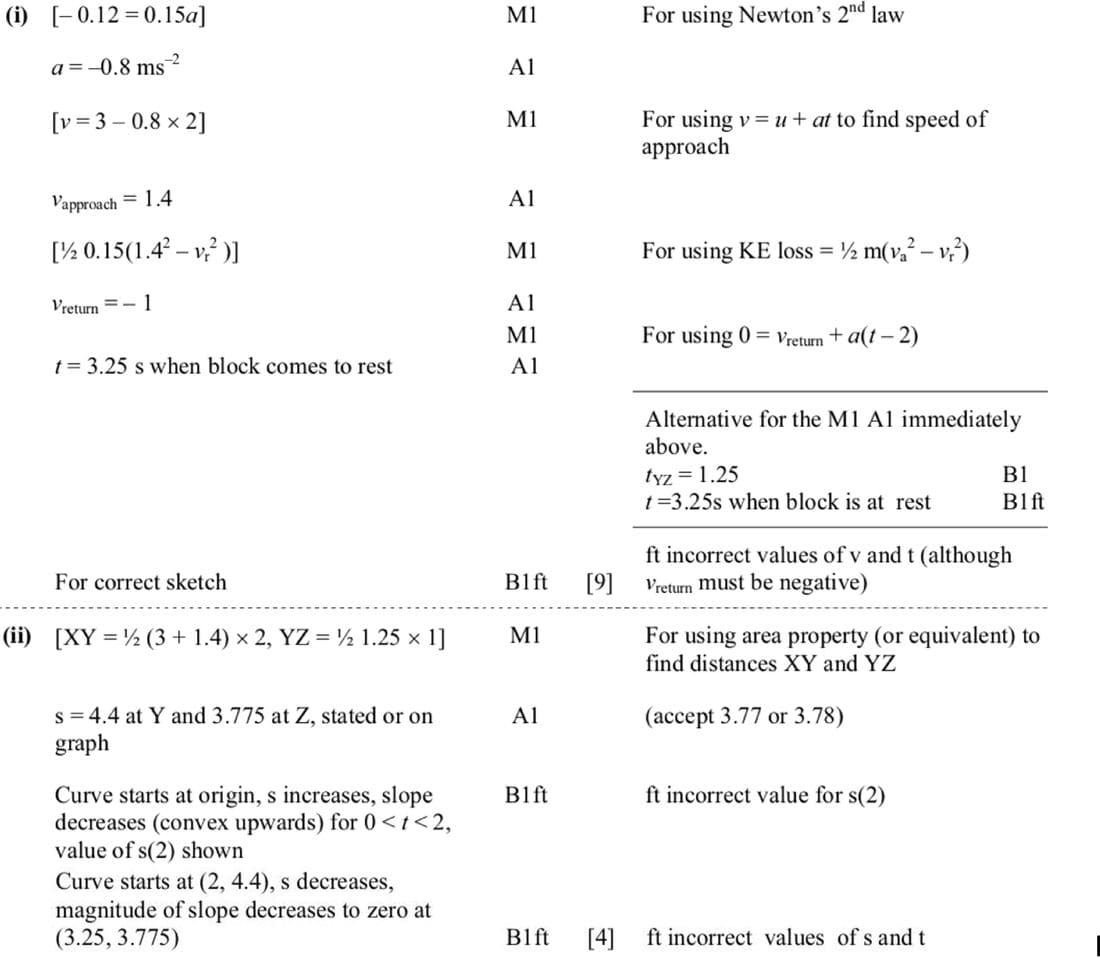
The frictional force acting on a small block of mass 0.15 kg, while it is moving on a horizontal surface, has magnitude 0.12 N. The block is set in motion from a point X on the surface, with speed 3 m/s-1. It hits a vertical wall at a point Y on the surface 2 s later. The block rebounds from the wall and moves directly towards X before coming to rest at the point Z (see diagram). At the instant that the block hits the wall it loses 0.072 J of its kinetic energy. The velocity of the block, in the direction from X to Y, is v m/s-1 at time t s after it leaves X.
- Find the values of v when the block arrives at Y and when it leaves Y, and find also the value of t when the block comes to rest at Z. Sketch the velocity-time graph.
- The displacement of the block from X, in the direction from X to Y, is s m at time t s. Sketch the displacement-time graph. Show on your graph the values of s and t when the block is at Y and when it comes to rest at Z.
June 2012 p42 q6
3557
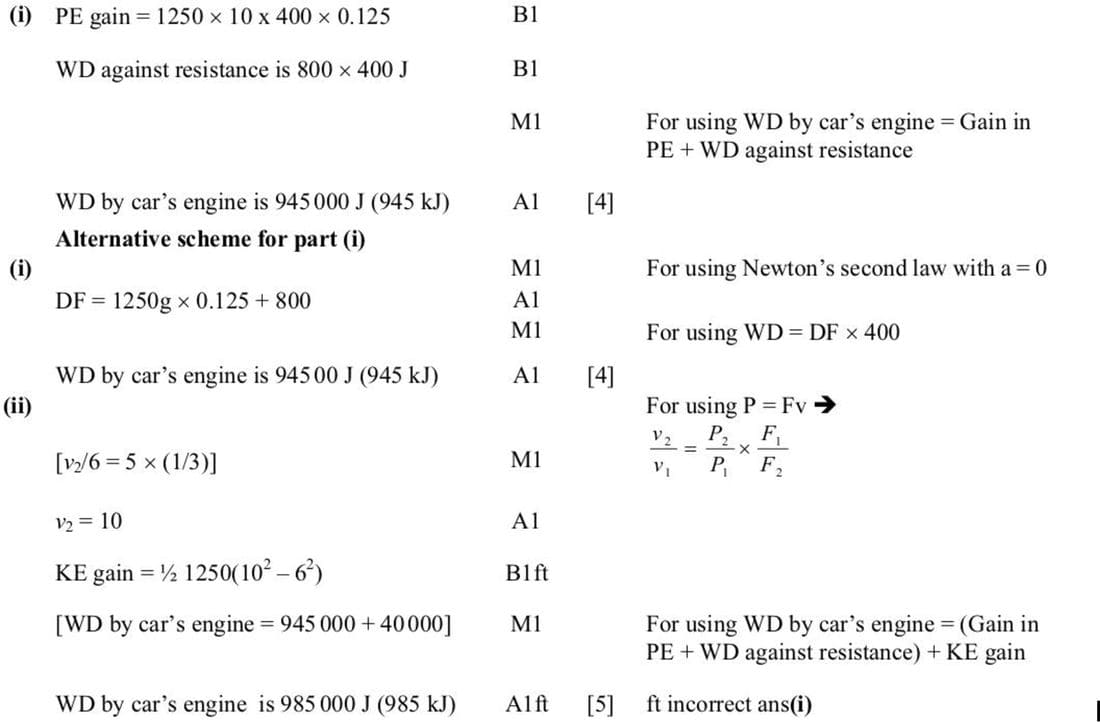
A car of mass 1250 kg travels from the bottom to the top of a straight hill which has length 400 m and is inclined to the horizontal at an angle of \(\alpha\), where \(\sin \alpha = 0.125\). The resistance to the car’s motion is 800 N. Find the work done by the car’s engine in each of the following cases.
- The car’s speed is constant.
- The car’s initial speed is 6 m s\(^{-1}\), the car’s driving force is 3 times greater at the top of the hill than it is at the bottom, and the car’s power output is 5 times greater at the top of the hill than it is at the bottom.