Exam-Style Problems
⬅ Back to SubchapterNov 2014 p41 q7
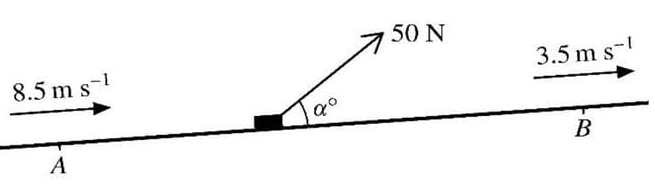
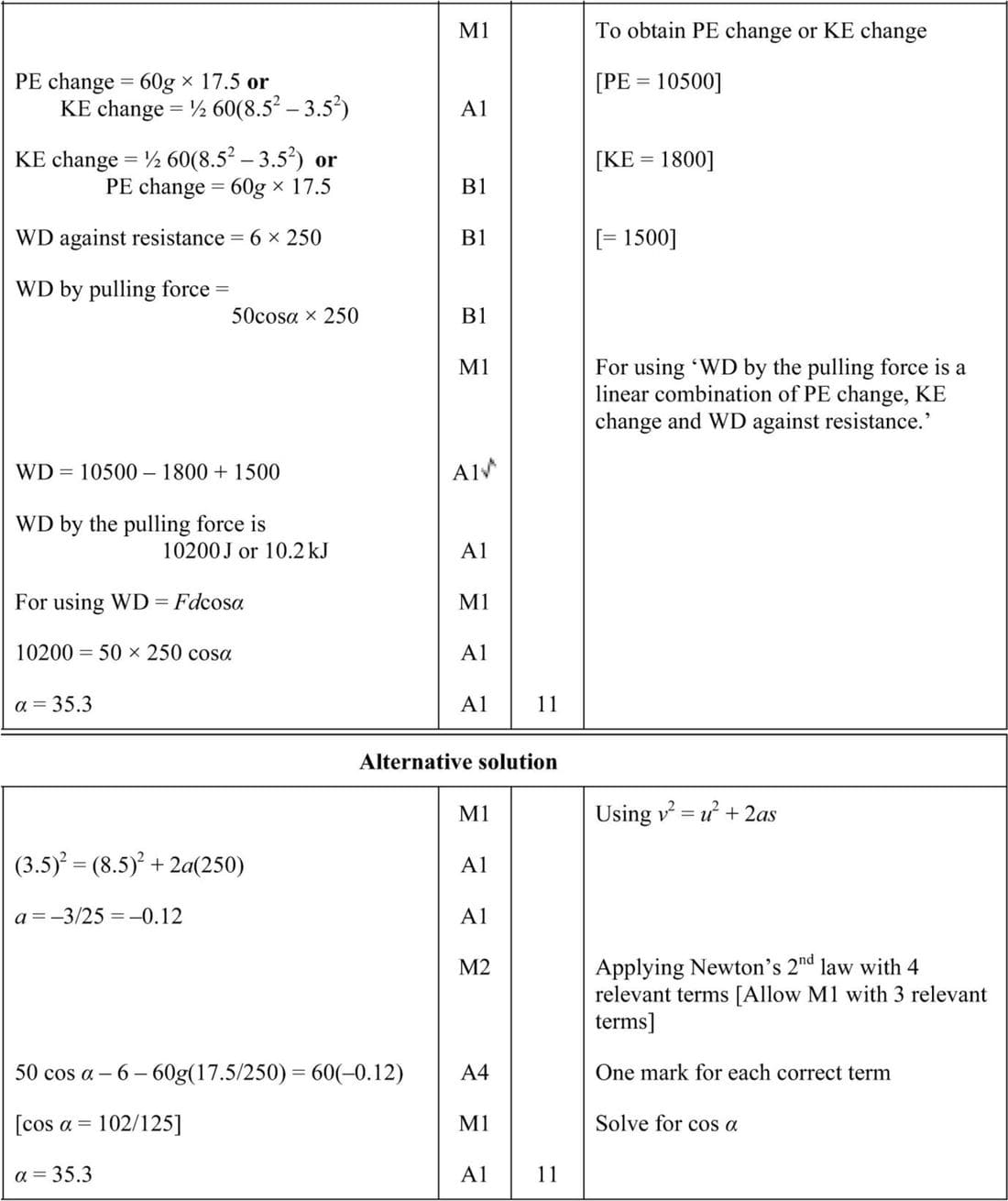
A block of mass 60 kg is pulled up a hill in the line of greatest slope by a force of magnitude 50 N acting at an angle \(\alpha^\circ\) above the hill. The block passes through points A and B with speeds 8.5 m s\(^{-1}\) and 3.5 m s\(^{-1}\) respectively (see diagram). The distance \(AB\) is 250 m and \(B\) is 17.5 m above the level of \(A\). The resistance to motion of the block is 6 N. Find the value of \(\alpha\).
Nov 2013 p43 q1
A particle moves up a line of greatest slope of a rough plane inclined at an angle \(\alpha\) to the horizontal, where \(\sin \alpha = 0.28\). The coefficient of friction between the particle and the plane is \(\frac{1}{3}\).
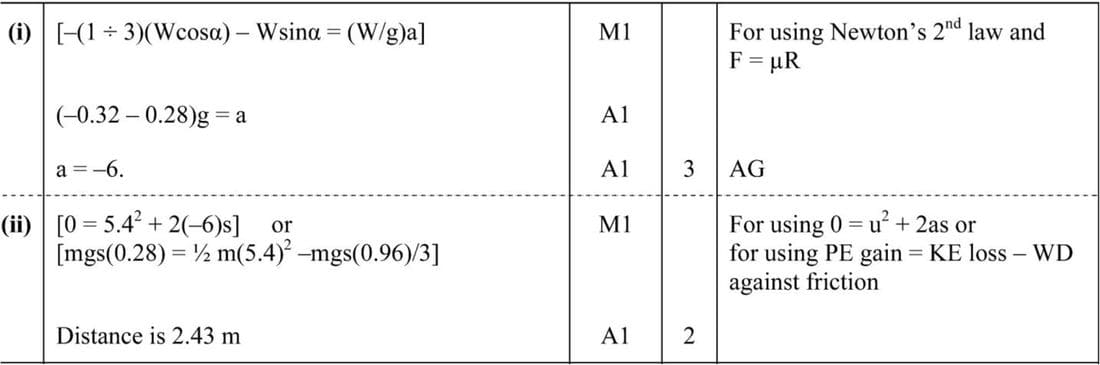
- Show that the acceleration of the particle is \(-6 \text{ m s}^{-2}\).
- Given that the particle’s initial speed is \(5.4 \text{ m s}^{-1}\), find the distance that the particle travels up the plane.
Nov 2013 p41 q3
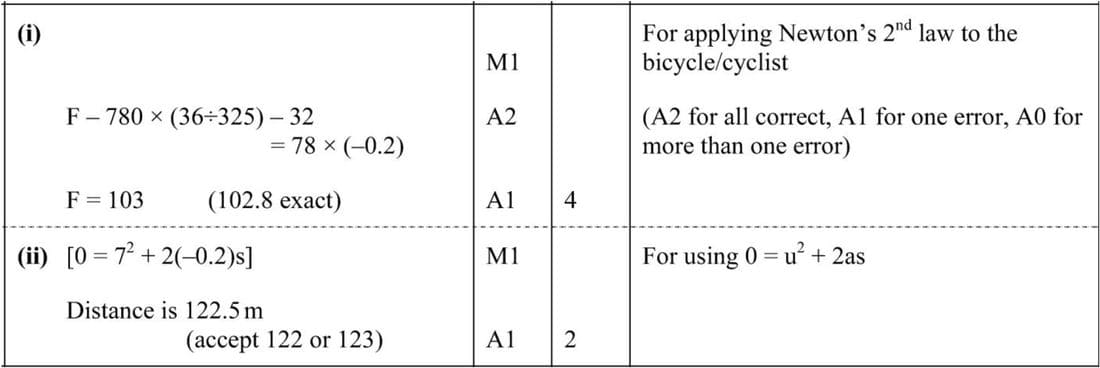
A cyclist exerts a constant driving force of magnitude \(F\) N while moving up a straight hill inclined at an angle \(\alpha\) to the horizontal, where \(\sin \alpha = \frac{36}{325}\). A constant resistance to motion of 32 N acts on the cyclist. The total weight of the cyclist and his bicycle is 780 N. The cyclist's acceleration is \(-0.2 \text{ m s}^{-2}\).
(i) Find the value of \(F\).
The cyclist’s speed is 7 m s-1 at the bottom of the hill.
(ii) Find how far up the hill the cyclist travels before coming to rest.
June 2012 p43 q6
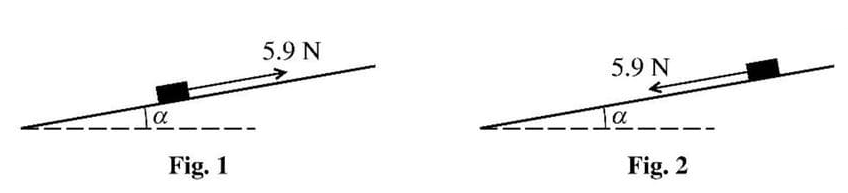
A block of weight 6.1 N is at rest on a plane inclined at angle \(\alpha\) to the horizontal, where \(\tan \alpha = \frac{11}{60}\). The coefficient of friction between the block and the plane is \(\mu\). A force of magnitude 5.9 N acting parallel to a line of greatest slope is applied to the block.
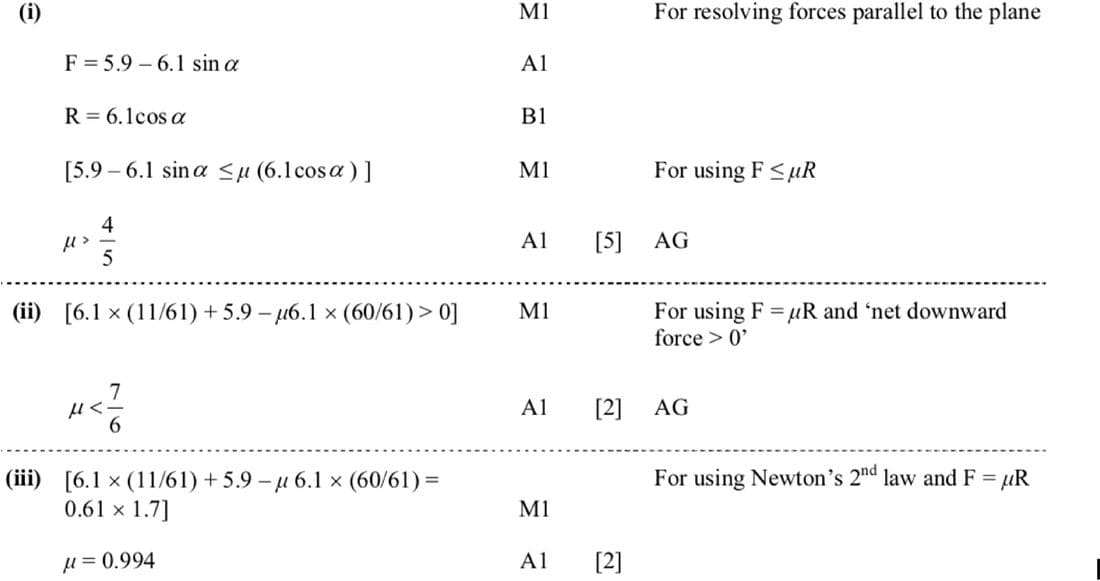
(i) When the force acts up the plane (see Fig. 1) the block remains at rest. Show that \(\mu \geq \frac{4}{5}\).
(ii) When the force acts down the plane (see Fig. 2) the block slides downwards. Show that \(\mu < \frac{7}{6}\).
(iii) Given that the acceleration of the block is 1.7 m s\(^{-2}\) when the force acts down the plane, find the value of \(\mu\).
Nov 2009 p42 q4
A particle moves up a line of greatest slope of a rough plane inclined at an angle \(\alpha\) to the horizontal, where \(\cos \alpha = 0.96\) and \(\sin \alpha = 0.28\).
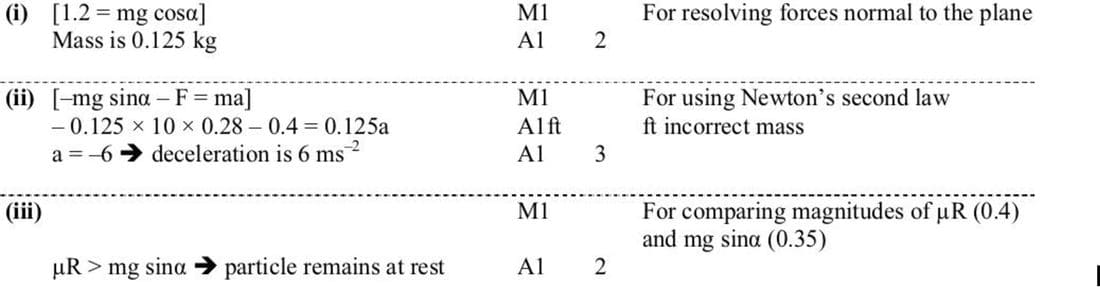
- Given that the normal component of the contact force acting on the particle has magnitude 1.2 N, find the mass of the particle.
- Given also that the frictional component of the contact force acting on the particle has magnitude 0.4 N, find the deceleration of the particle.
The particle comes to rest on reaching the point \(X\).
- Determine whether the particle remains at \(X\) or whether it starts to move down the plane.