Exam-Style Problems
⬅ Back to SubchapterJune 2010 p63 q5
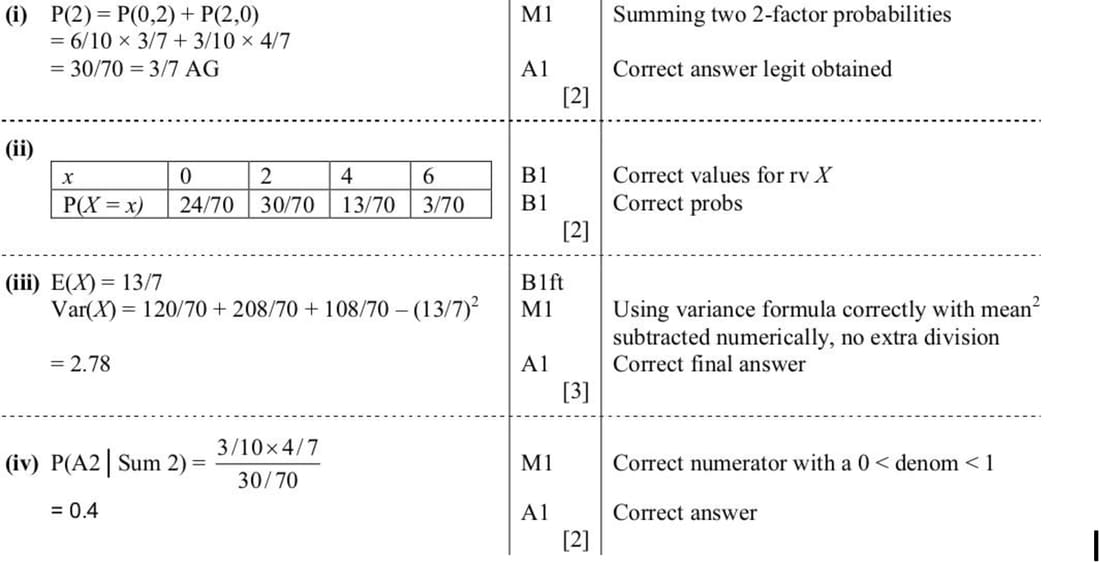
Set A consists of the ten digits 0, 0, 0, 0, 0, 0, 2, 2, 2, 4.
Set B consists of the seven digits 0, 0, 0, 0, 2, 2, 2.
One digit is chosen at random from each set. The random variable X is defined as the sum of these two digits.
- Show that \(P(X = 2) = \frac{3}{7}\).
- Tabulate the probability distribution of X.
- Find \(E(X)\) and \(\text{Var}(X)\).
- Given that \(X = 2\), find the probability that the digit chosen from set A was 2.
June 2010 p62 q6
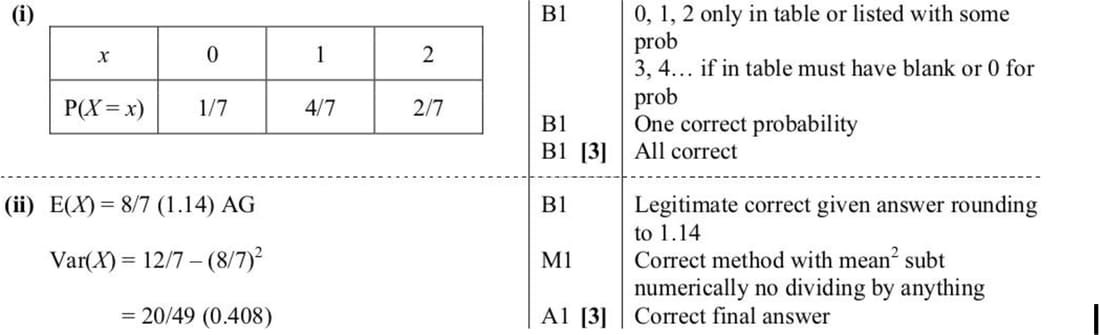
A small farm has 5 ducks and 2 geese. Four of these birds are to be chosen at random. The random variable \(X\) represents the number of geese chosen.
- Draw up the probability distribution of \(X\).
- Show that \(E(X) = \frac{8}{7}\) and calculate \(\text{Var}(X)\).
Nov 2009 p62 q5
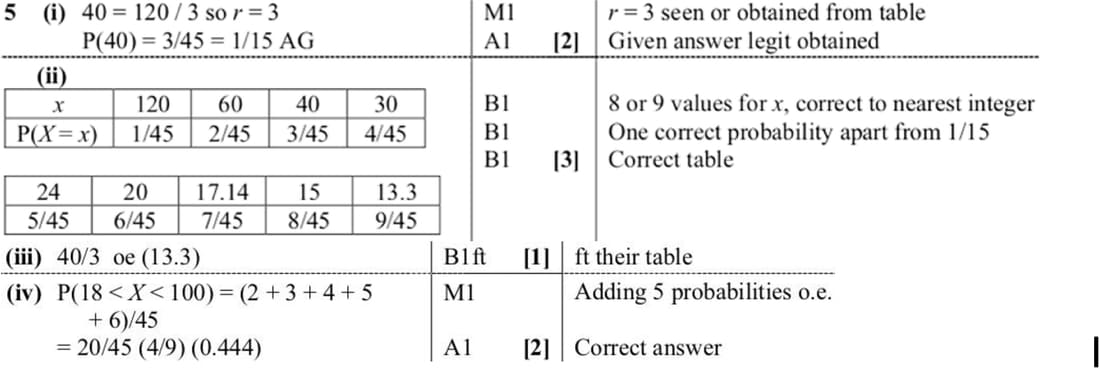
In a particular discrete probability distribution the random variable \(X\) takes the value \(\frac{120}{r}\) with probability \(\frac{r}{45}\), where \(r\) takes all integer values from 1 to 9 inclusive.
- Show that \(P(X = 40) = \frac{1}{15}\).
- Construct the probability distribution table for \(X\).
- Which is the modal value of \(X\)?
- Find the probability that \(X\) lies between 18 and 100.
Nov 2008 p6 q7
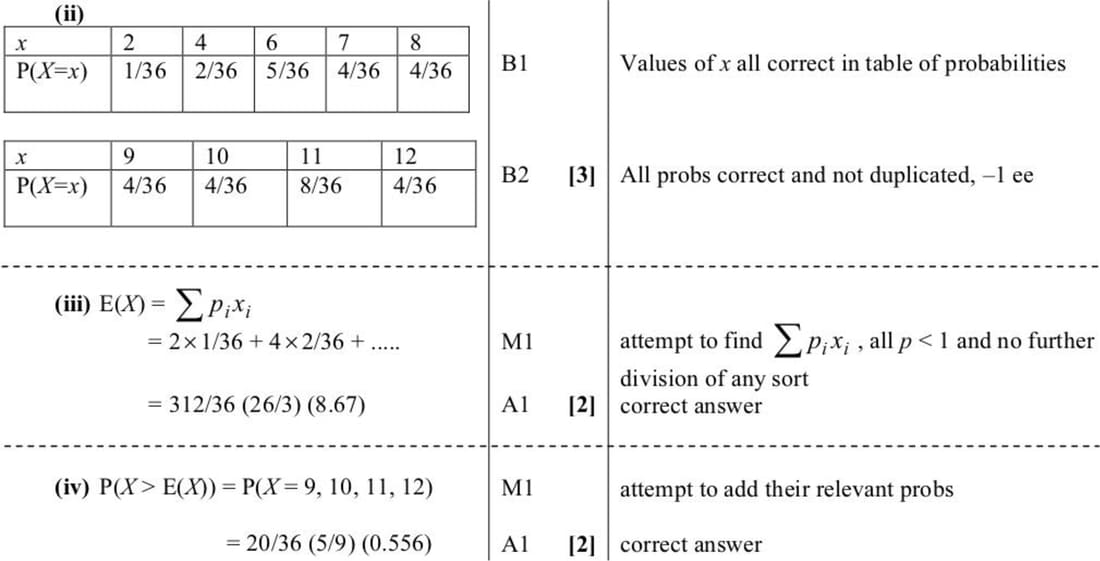
A fair die has one face numbered 1, one face numbered 3, two faces numbered 5 and two faces numbered 6.
The die is thrown twice. Let \(X\) be the sum of the two scores. The following table shows the possible values of \(X\).
| Second throw | ||||||
|---|---|---|---|---|---|---|
| First throw | 1 | 3 | 5 | 5 | 6 | 6 |
| 1 | 2 | 4 | 6 | 6 | 7 | 7 |
| 3 | 4 | 6 | 8 | 8 | 9 | 9 |
| 5 | 6 | 8 | 10 | 10 | 11 | 11 |
| 5 | 6 | 8 | 10 | 10 | 11 | 11 |
| 6 | 7 | 9 | 11 | 11 | 12 | 12 |
| 6 | 7 | 9 | 11 | 11 | 12 | 12 |
- Draw up a table showing the probability distribution of \(X\).
- Calculate \(E(X)\).
- Find the probability that \(X\) is greater than \(E(X)\).
June 2008 p6 q6
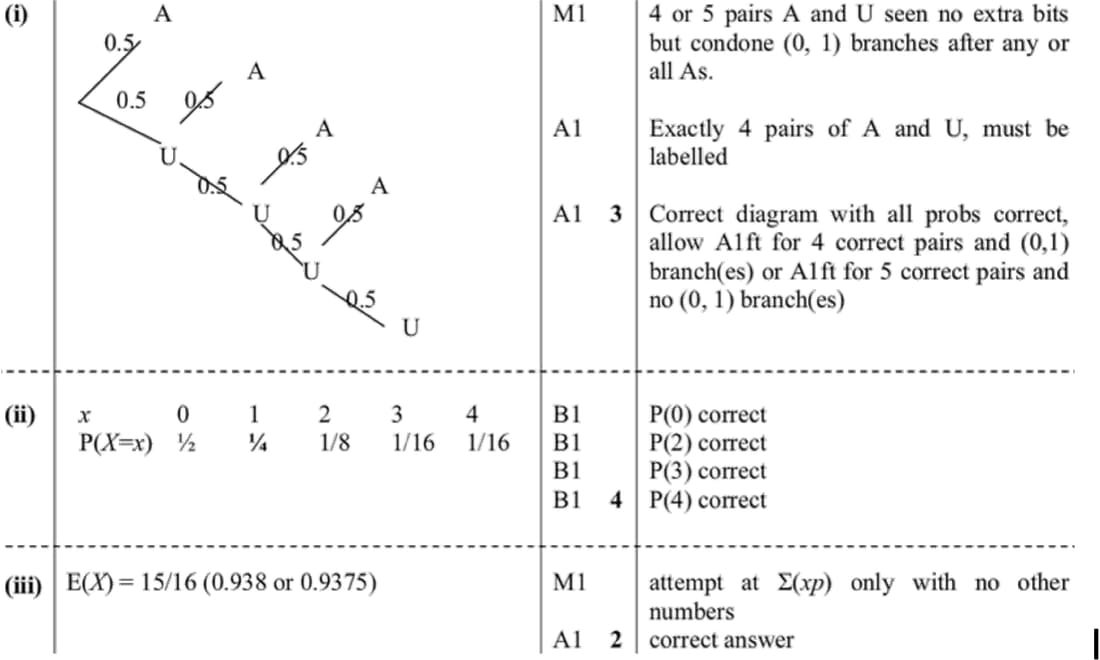
Every day Eduardo tries to phone his friend. Every time he phones there is a 50% chance that his friend will answer. If his friend answers, Eduardo does not phone again on that day. If his friend does not answer, Eduardo tries again in a few minutes’ time. If his friend has not answered after 4 attempts, Eduardo does not try again on that day.
(i) Draw a tree diagram to illustrate this situation.
(ii) Let \(X\) be the number of unanswered phone calls made by Eduardo on a day. Copy and complete the table showing the probability distribution of \(X\).
| \(x\) | 0 | 1 | 2 | 3 | 4 |
|---|---|---|---|---|---|
| \(P(X = x)\) | \(\frac{1}{4}\) |
(iii) Calculate the expected number of unanswered phone calls on a day.