Exam-Style Problems
⬅ Back to SubchapterNov 2017 p32 q7
1965
The complex number \(1 - (\sqrt{3})i\) is denoted by \(u\).
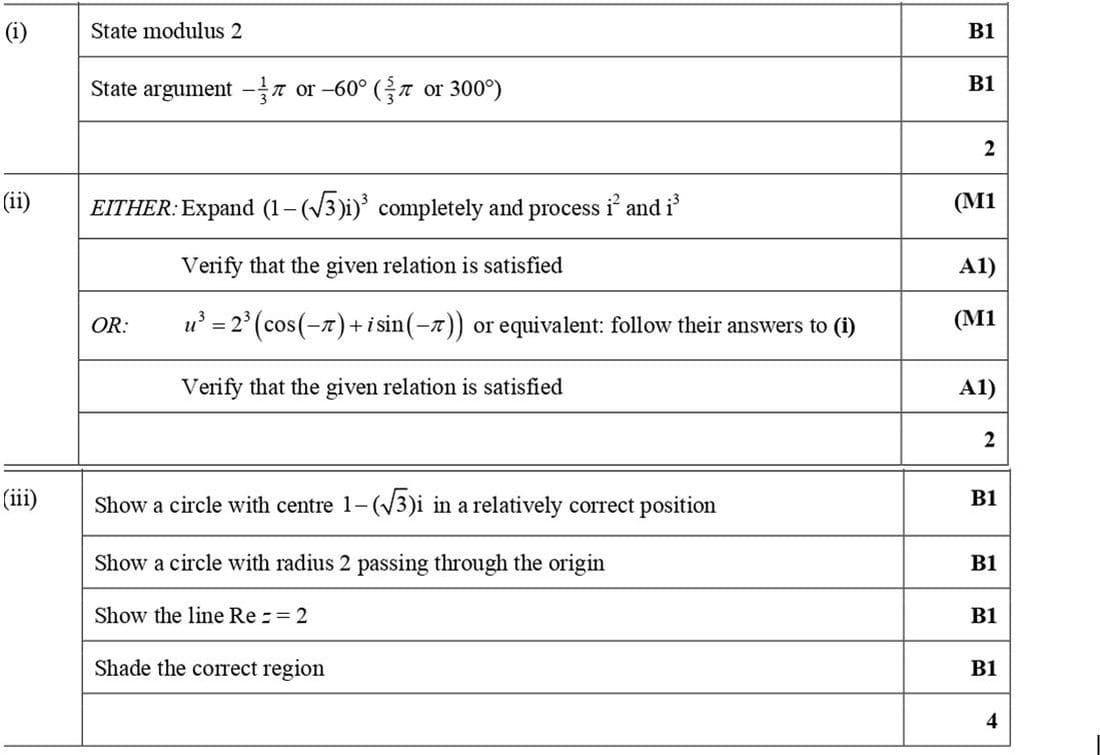
(i) Find the modulus and argument of \(u\).
(ii) Show that \(u^3 + 8 = 0\).
(iii) On a sketch of an Argand diagram, shade the region whose points represent complex numbers \(z\) satisfying both the inequalities \(|z - u| \leq 2\) and \(\text{Re } z \geq 2\), where \(\text{Re } z\) denotes the real part of \(z\).
Nov 2017 p31 q7
1966
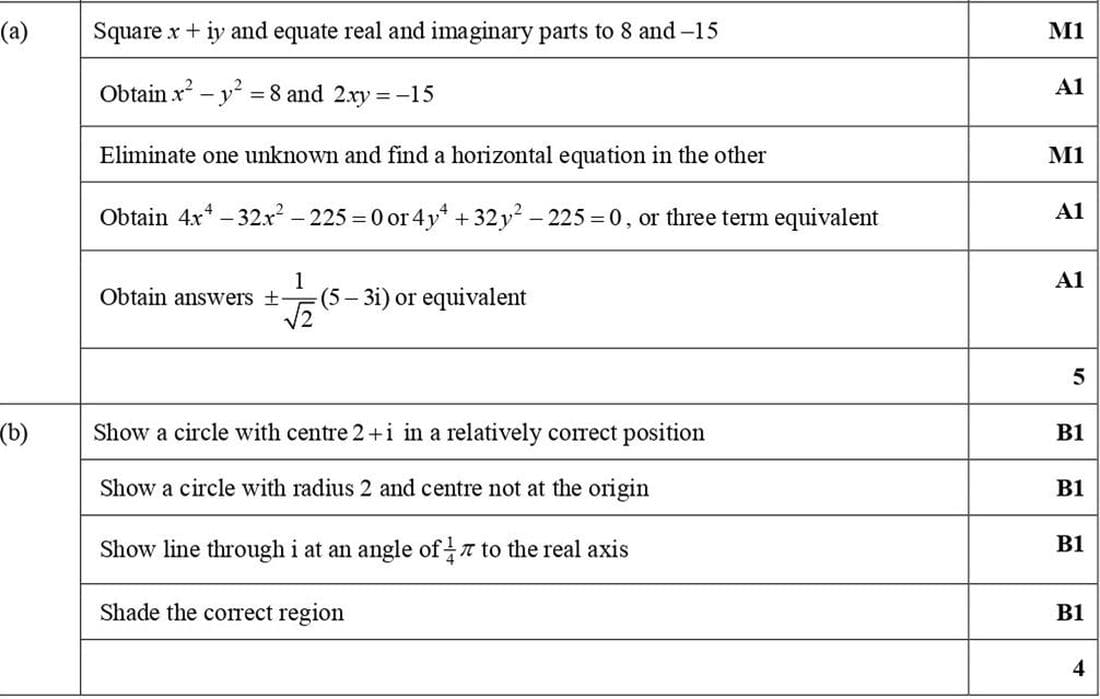
(a) The complex number u is given by u = 8 - 15i. Showing all necessary working, find the two square roots of u. Give answers in the form a + ib, where the numbers a and b are real and exact.
(b) On an Argand diagram, shade the region whose points represent complex numbers satisfying both the inequalities \\(|z - 2 - i| \leq 2\\) and \\(0 \leq \arg(z - i) \leq \frac{1}{4}\pi\\).
June 2017 p33 q11
1967
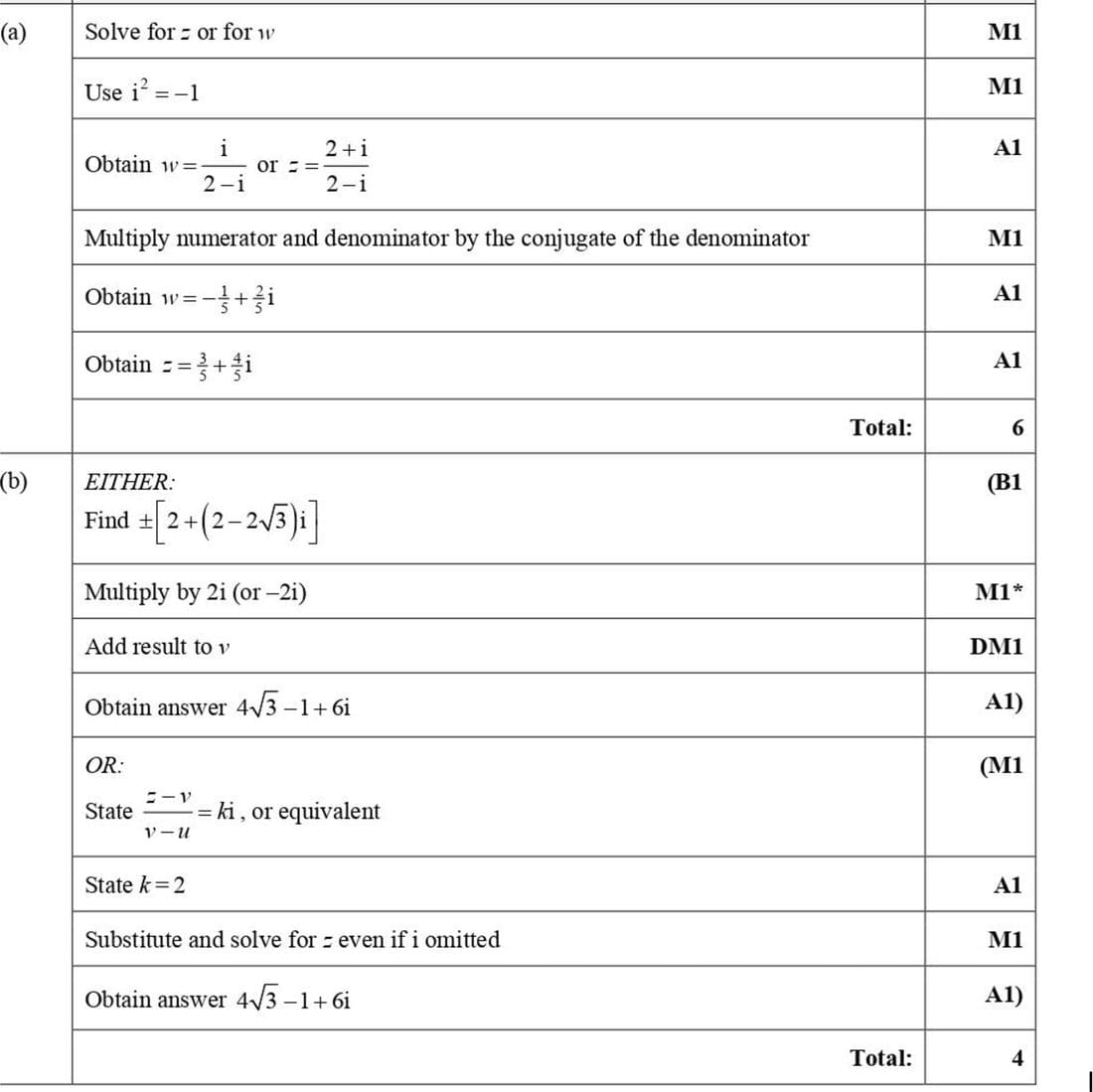
(a) The complex numbers z and w satisfy the equations
\(z + (1+i)w = i\)
and
\((1-i)z + iw = 1\).
Solve the equations for z and w, giving your answers in the form x + iy, where x and y are real.
(b) The complex numbers u and v are given by \(u = 1 + (2\sqrt{3})i\) and \(v = 3 + 2i\). In an Argand diagram, u and v are represented by the points A and B. A third point C lies in the first quadrant and is such that \(BC = 2AB\) and angle \(\angle ABC = 90^\circ\). Find the complex number z represented by C, giving your answer in the form x + iy, where x and y are real and exact.
June 2017 p32 q6
1968
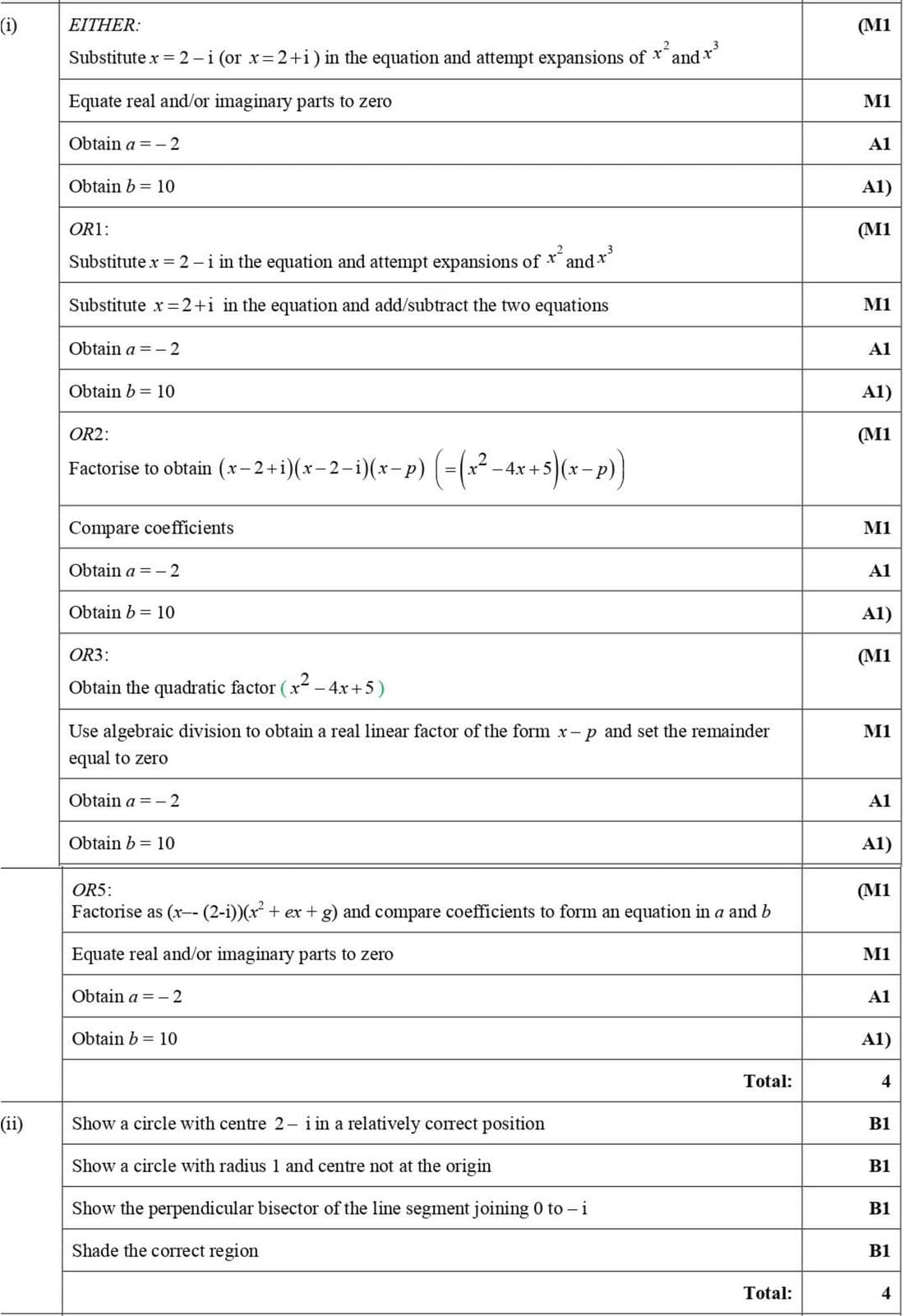
The complex number \(2 - i\) is denoted by \(u\).
(i) It is given that \(u\) is a root of the equation \(x^3 + ax^2 - 3x + b = 0\), where the constants \(a\) and \(b\) are real. Find the values of \(a\) and \(b\).
(ii) On a sketch of an Argand diagram, shade the region whose points represent complex numbers \(z\) satisfying both the inequalities \(|z - u| < 1\) and \(|z| < |z + i|\).
June 2017 p31 q7
1969
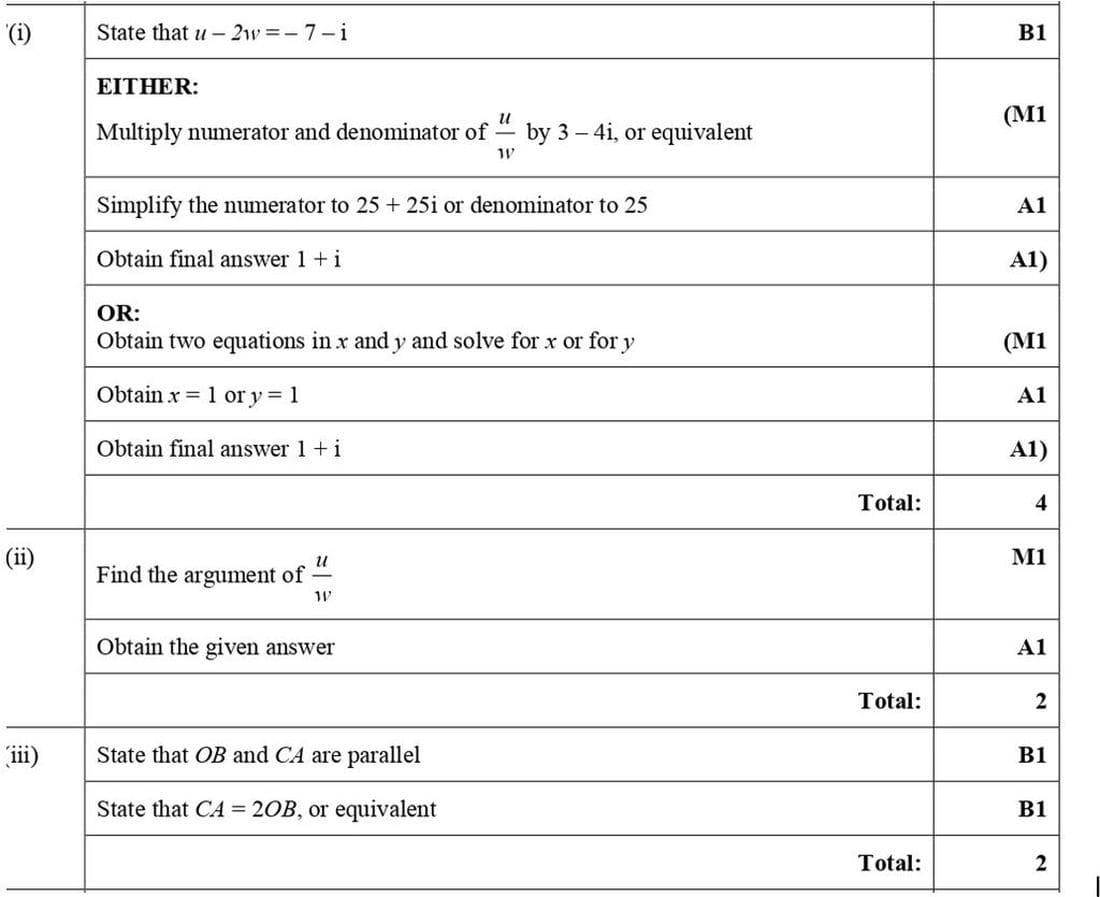
\(The complex numbers u and w are defined by u = -1 + 7i and w = 3 + 4i.\)
- Showing all your working, find in the form x + iy, where x and y are real, the complex numbers u - 2w and \(\frac{u}{w}\).
- In an Argand diagram with origin O, the points A, B and C represent the complex numbers u, w and u - 2w respectively. Prove that angle AOB = \(\frac{1}{4}\pi\).
- State fully the geometrical relation between the line segments OB and CA.