Exam-Style Problems
⬅ Back to SubchapterNov 2022 p12 q11
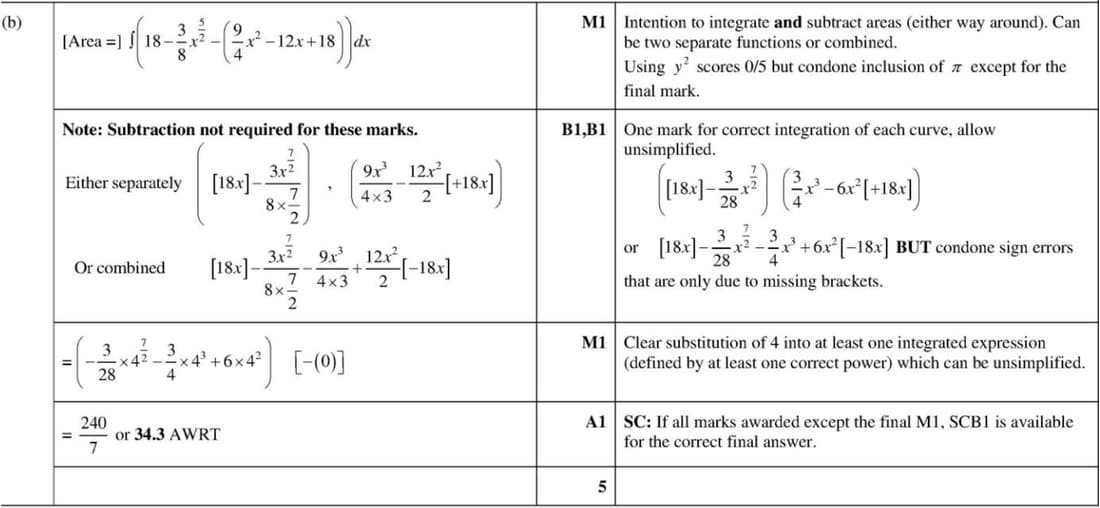
The diagram shows the curves with equations \(y = \frac{9}{4}x^2 - 12x + 18\) and \(y = 18 - \frac{3}{8}x^{\frac{5}{2}}\). The curves intersect at the points (0, 18) and (4, 6).
Find the area of the shaded region.

Nov 2002 p1 q10
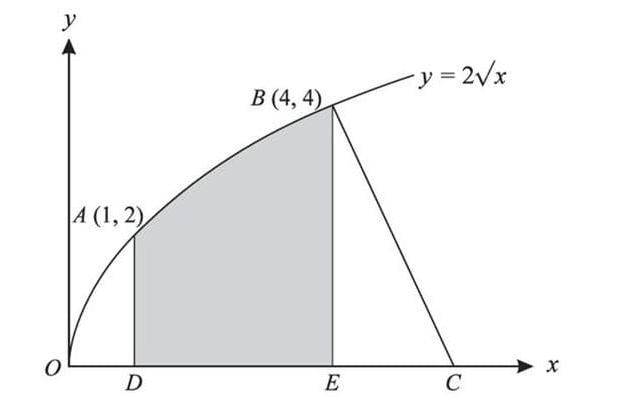
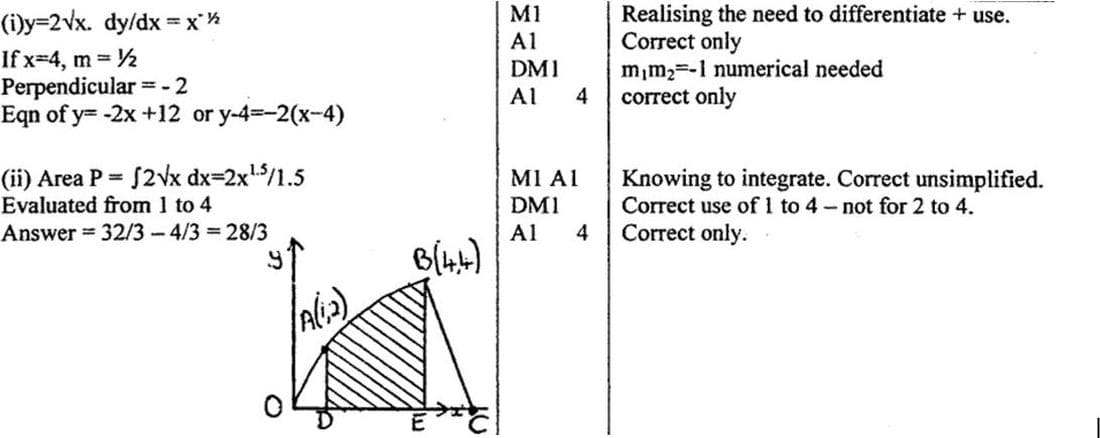
The diagram shows the points A (1, 2) and B (4, 4) on the curve \(y = 2\sqrt{x}\). The line BC is the normal to the curve at B, and C lies on the x-axis. Lines AD and BE are perpendicular to the x-axis.
(i) Find the equation of the normal BC.
(ii) Find the area of the shaded region.
June 2002 p1 q3
The diagram shows the curve \(y = 3\sqrt{x}\) and the line \(y = x\) intersecting at \(O\) and \(P\). Find
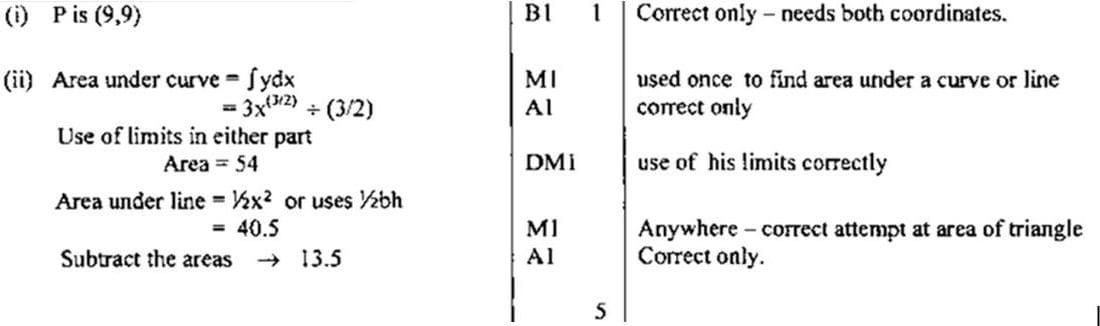
(i) the coordinates of \(P\),
(ii) the area of the shaded region.

Nov 2022 p11 q10
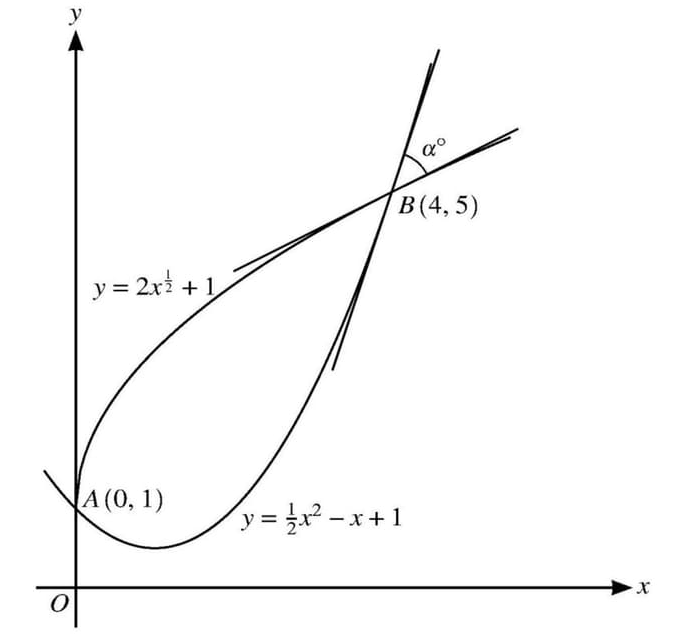
Curves with equations \(y = 2x^{\frac{1}{2}} + 1\) and \(y = \frac{1}{2}x^2 - x + 1\) intersect at \(A(0, 1)\) and \(B(4, 5)\), as shown in the diagram.
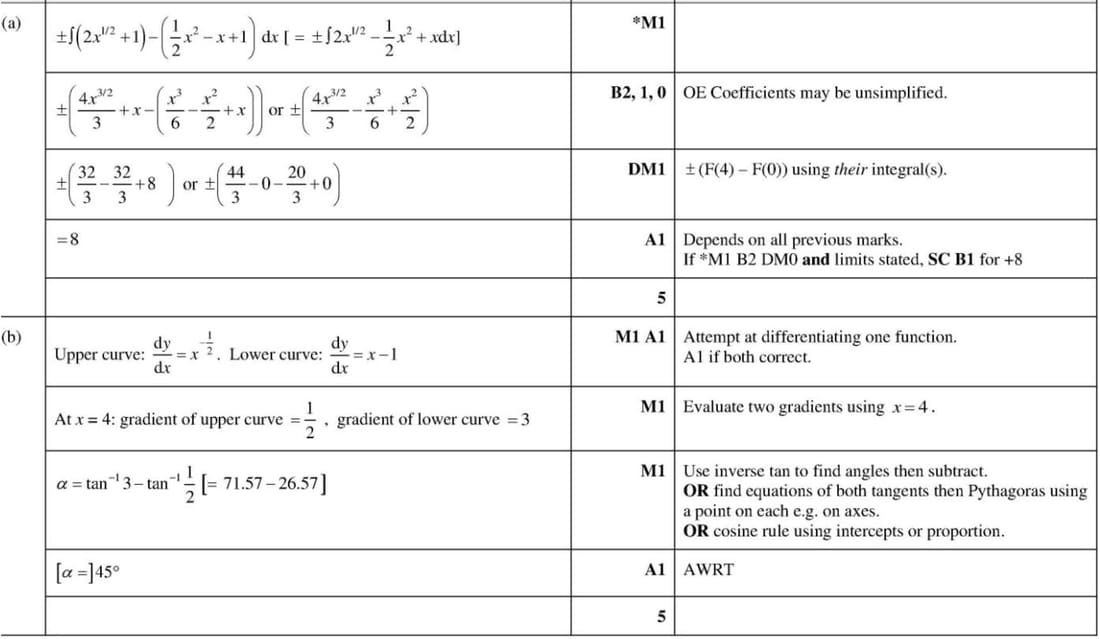
(a) Find the area of the region between the two curves.
The acute angle between the two tangents at \(B\) is denoted by \(\alpha^\circ\), and the scales on the axes are the same.
(b) Find \(\alpha\).
June 2022 p13 q8
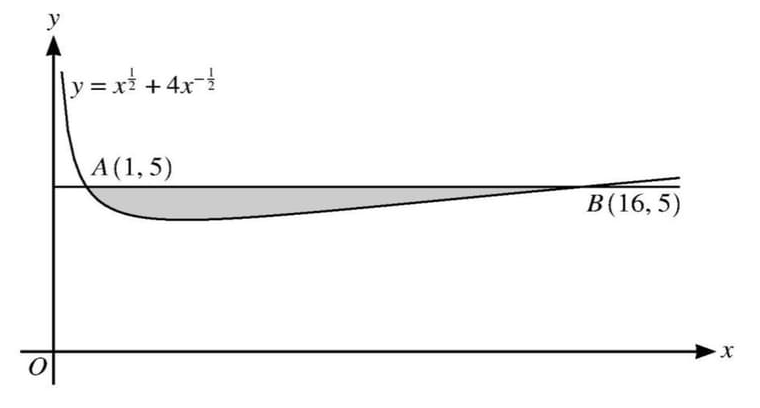
The diagram shows the curve with equation \(y = x^{\frac{1}{2}} + 4x^{-\frac{1}{2}}\). The line \(y = 5\) intersects the curve at the points \(A(1, 5)\) and \(B(16, 5)\).
(a) Find the equation of the tangent to the curve at the point \(A\).
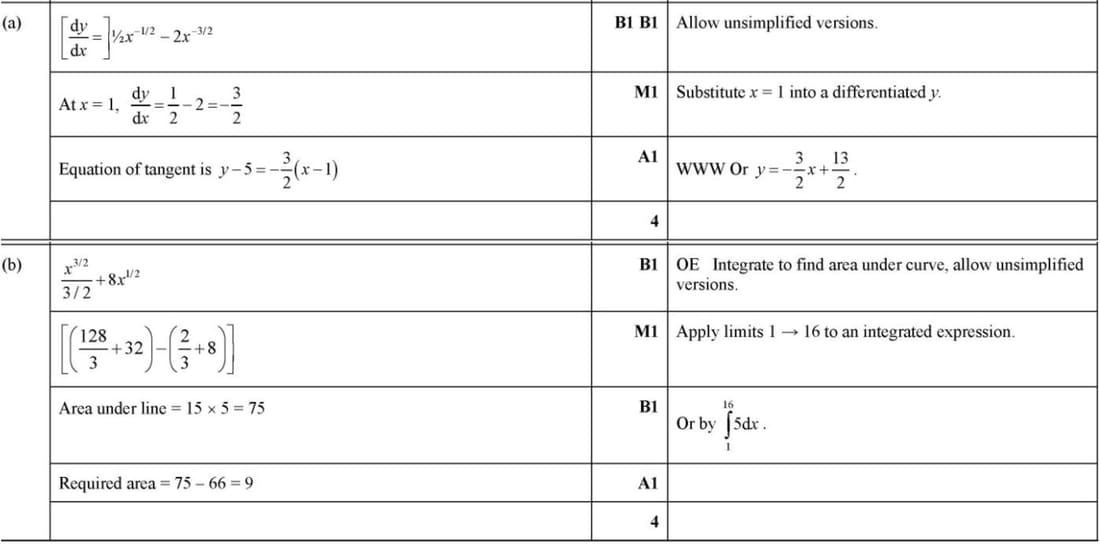
(b) Calculate the area of the shaded region.