Exam-Style Problems
⬅ Back to SubchapterFM June 2024 p11 q07
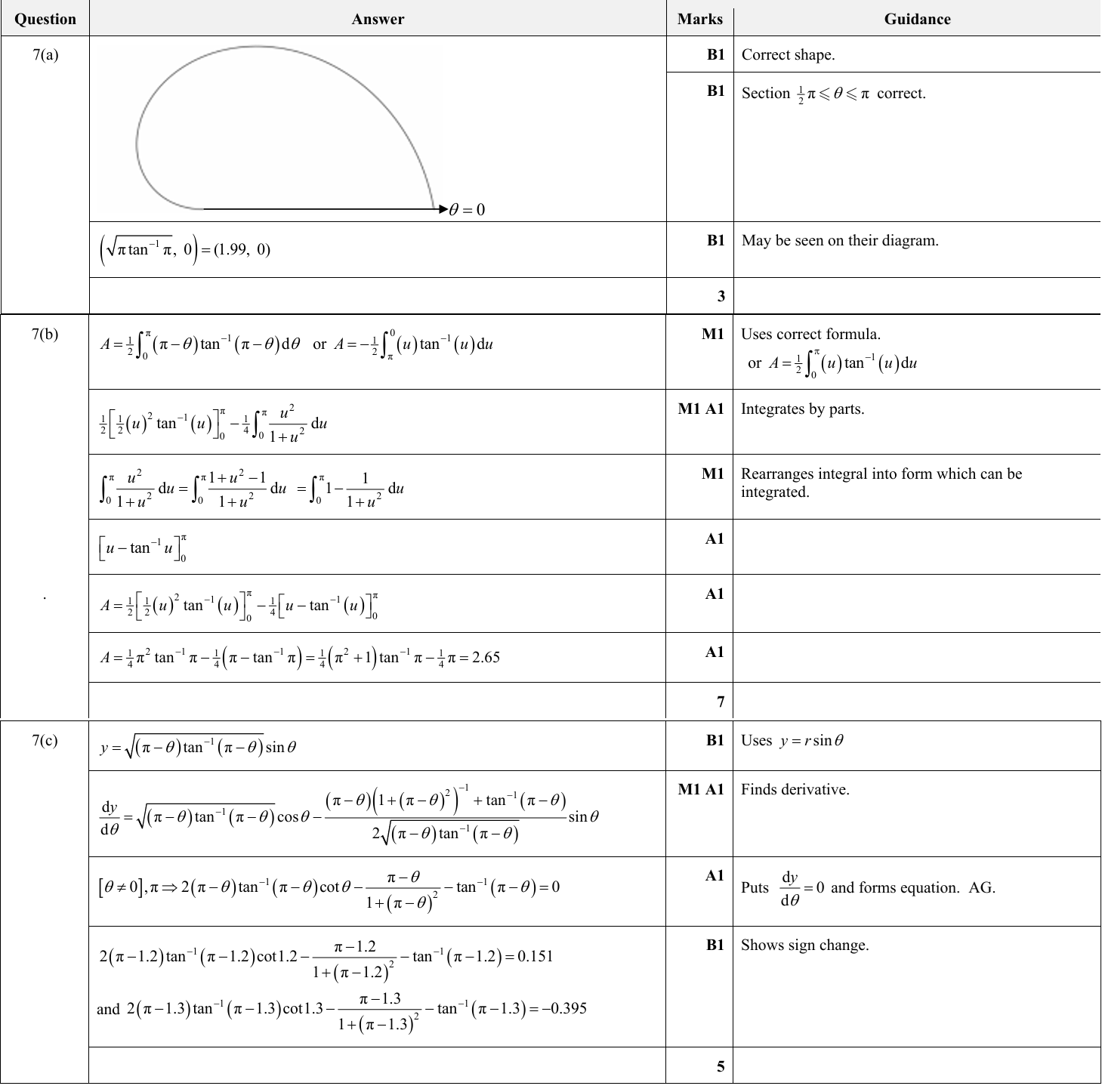
The curve C has polar equation \(r^2 = (\pi - \theta) \arctan(\pi - \theta)\), for \(0 \leq \theta \leq \pi\).
(a) Sketch C and state the polar coordinates of the point of C furthest from the pole. [3]
(b) Using the substitution \(u = \pi - \theta\), or otherwise, find the area of the region enclosed by C and the initial line. [7]
(c) Show that, at the point of C furthest from the initial line,
\(2(\pi - \theta) \arctan(\pi - \theta) \cot \theta - \frac{\pi - \theta}{1 + (\pi - \theta)^2} - \arctan(\pi - \theta) = 0\)
and verify that this equation has a root for \(\theta\) between 1.2 and 1.3. [5]
FM June 2024 p12 q01
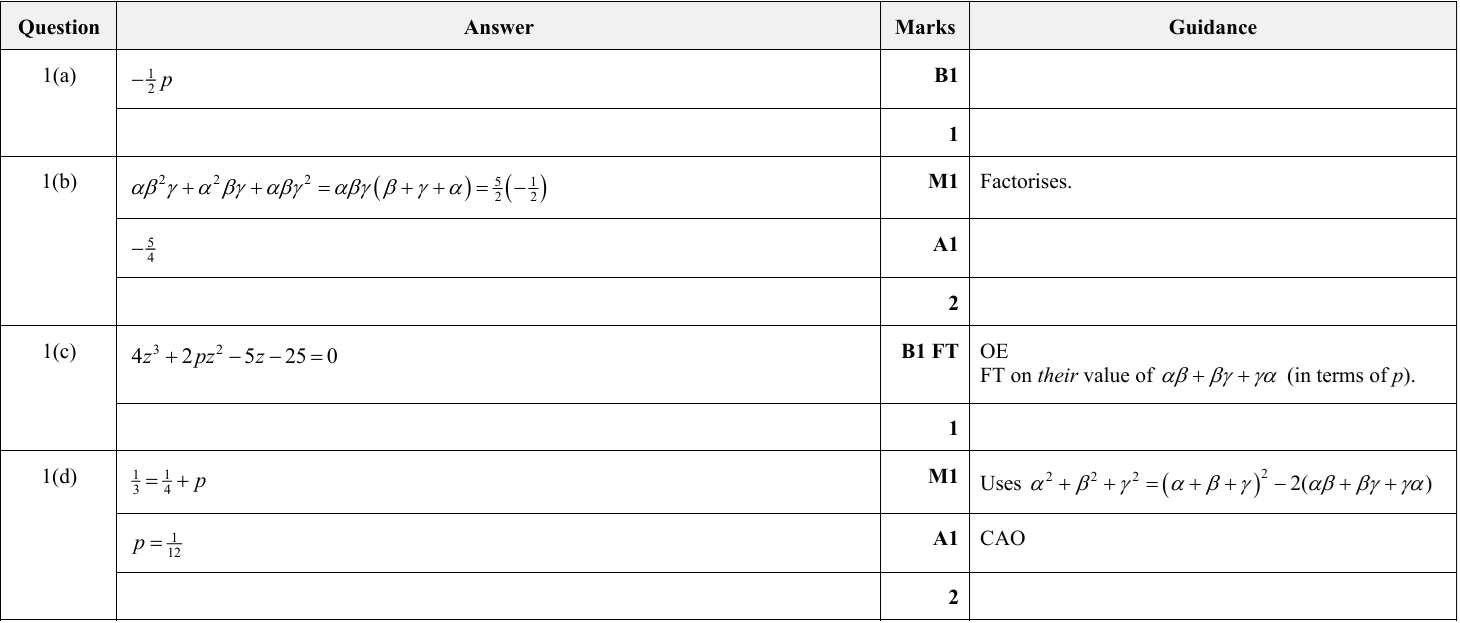
The cubic equation \(2x^3 + x^2 - px - 5 = 0\), where \(p\) is a positive constant, has roots \(\alpha, \beta, \gamma\).
- State, in terms of \(p\), the value of \(\alpha\beta + \beta\gamma + \gamma\alpha\).
- Find the value of \(\alpha^2\beta\gamma + \alpha\beta^2\gamma + \alpha\beta\gamma^2\).
- Deduce a cubic equation whose roots are \(\alpha\beta, \beta\gamma, \alpha\gamma\).
- Given that \(\alpha^2 + \beta^2 + \gamma^2 = \frac{1}{3}\), find the value of \(p\).
FM June 2024 p12 q02
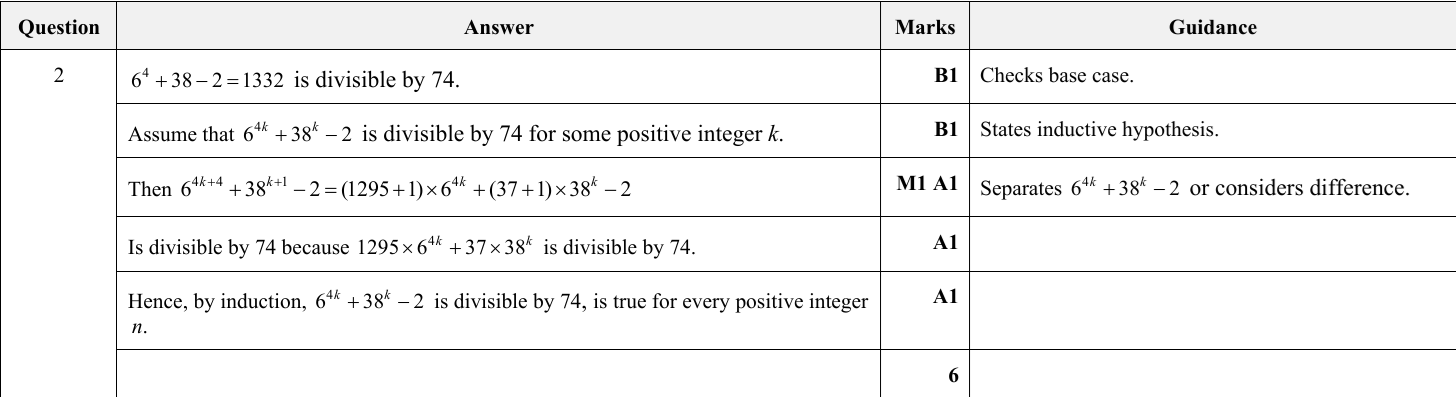
Prove by mathematical induction that \(6^{4n} + 38^n - 2\) is divisible by 74 for all positive integers \(n\).
FM June 2024 p12 q03
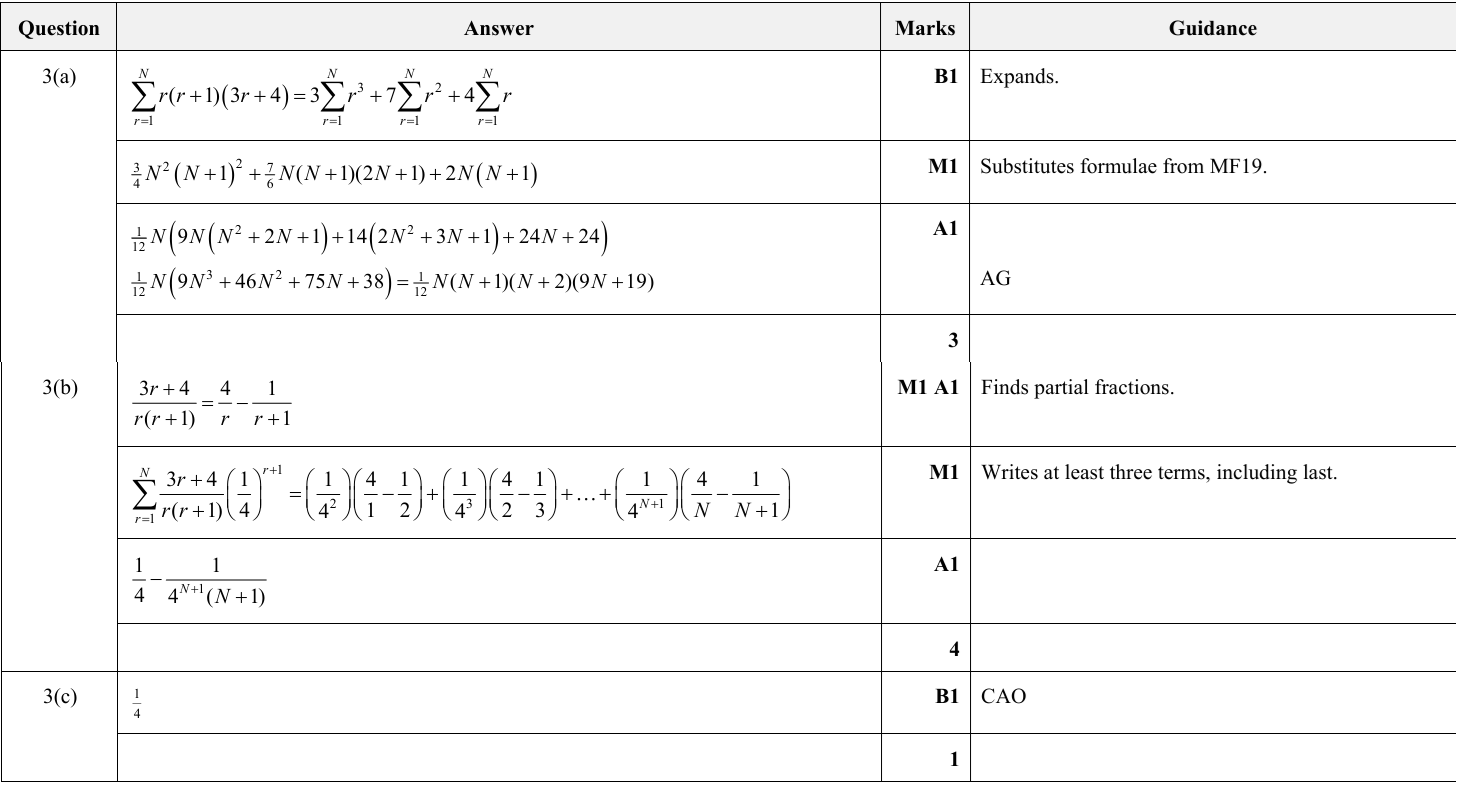
(a) Use standard results from the list of formulae (MF19) to show that
\(\sum_{r=1}^{N} r(r+1)(3r+4) = \frac{1}{12}N(N+1)(N+2)(9N+19).\)
(b) Express \(\frac{3r+4}{r(r+1)}\) in partial fractions and hence use the method of differences to find
\(\sum_{r=1}^{N} \frac{3r+4}{r(r+1)} \left( \frac{1}{4} \right)^{r+1}\)
in terms of \(N\).
(c) Deduce the value of
\(\sum_{r=1}^{\infty} \frac{3r+4}{r(r+1)} \left( \frac{1}{4} \right)^{r+1}.\)
FM June 2024 p12 q04
The matrix M is given by \(\mathbf{M} = \begin{pmatrix} \frac{1}{2} & -\frac{1}{2}\sqrt{3} \\ \frac{1}{2}\sqrt{3} & \frac{1}{2} \end{pmatrix} \begin{pmatrix} 14 & 0 \\ 0 & 1 \end{pmatrix}\).
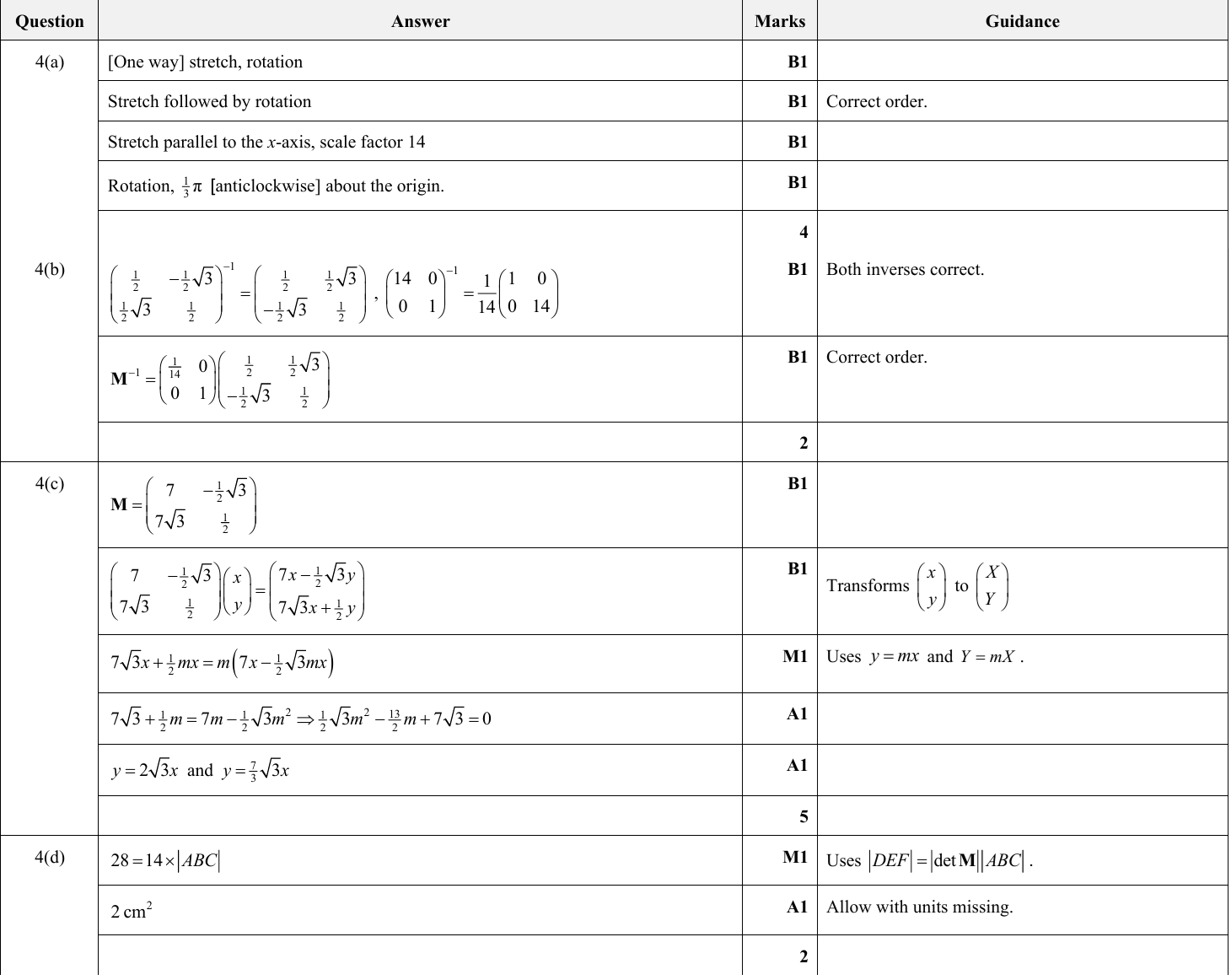
(a) The matrix M represents a sequence of two geometrical transformations in the x-y plane. Give full details of each transformation, and make clear the order in which they are applied. [4]
(b) Write \(\mathbf{M}^{-1}\) as the product of two matrices, neither of which is I. [2]
\((c) Find the equations of the invariant lines, through the origin, of the transformation represented by M. [5]\)
(d) The triangle ABC in the x-y plane is transformed by M onto triangle DEF. Given that the area of triangle DEF is 28 cm2, find the area of triangle ABC. [2]