Exam-Style Problems
⬅ Back to SubchapterNov 2022 p43 q6
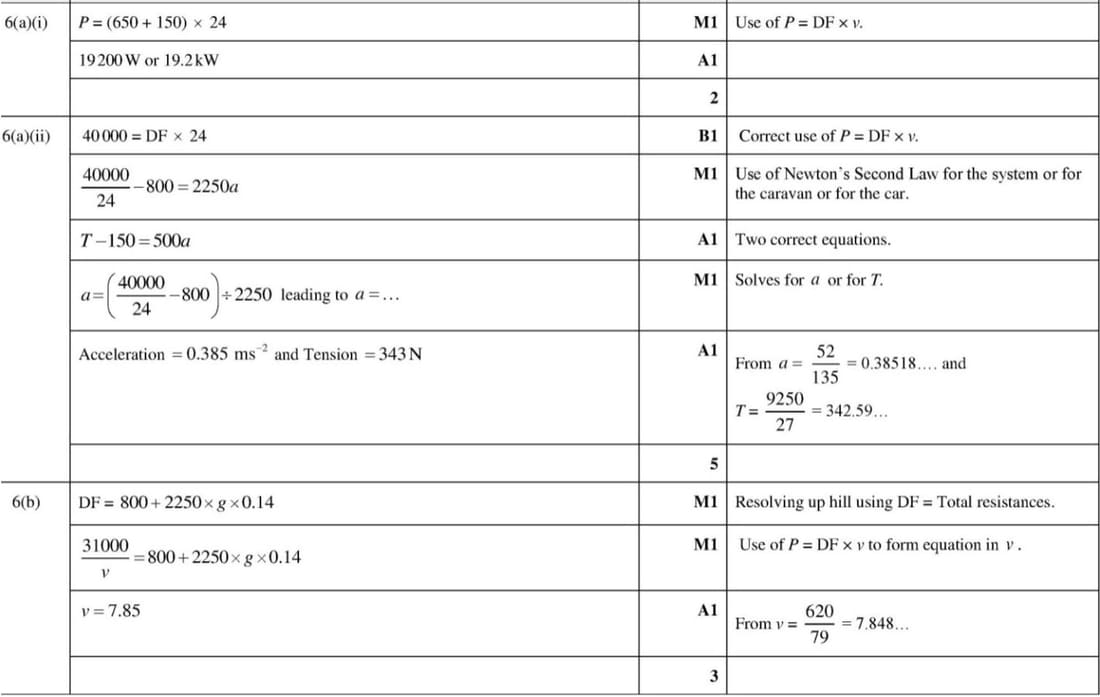
A car of mass 1750 kg is pulling a caravan of mass 500 kg. The car and the caravan are connected by a light rigid tow-bar. The resistances to the motion of the car and caravan are 650 N and 150 N respectively.
(a) The car and caravan are moving along a straight horizontal road at a constant speed of 24 m s-1.
- Find the power of the car’s engine.
- The engine’s power is now suddenly increased to 40 kW. Find the instantaneous acceleration of the car and caravan and find the tension in the tow-bar.
(b) The car and caravan now travel up a straight hill, inclined at an angle sin-1 0.14 to the horizontal, at a constant speed of v m s-1. The car’s engine is working at 31 kW. The resistances to the motion of the car and caravan are unchanged.
Find v.
June 2013 p43 q3
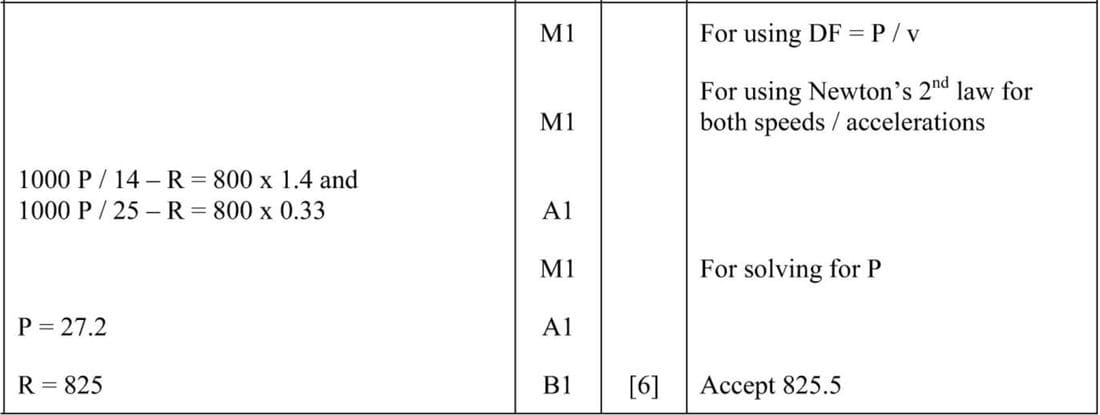
A car has mass 800 kg. The engine of the car generates constant power \(P\) kW as the car moves along a straight horizontal road. The resistance to motion is constant and equal to \(R\) N. When the car's speed is 14 m s\(^{-1}\) its acceleration is 1.4 m s\(^{-2}\), and when the car's speed is 25 m s\(^{-1}\) its acceleration is 0.33 m s\(^{-2}\). Find the values of \(P\) and \(R\).
June 2013 p42 q5
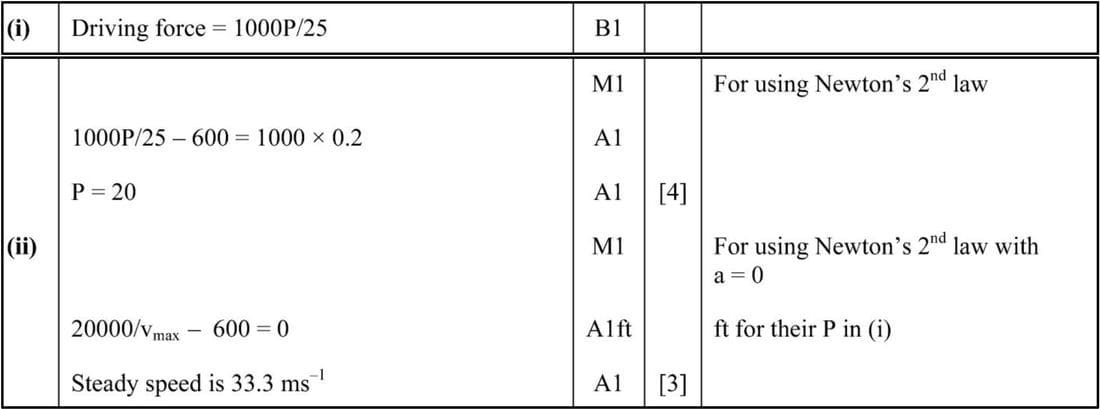
A car of mass 1000 kg is travelling on a straight horizontal road. The power of its engine is constant and equal to \(P\) kW. The resistance to motion of the car is 600 N. At an instant when the car’s speed is 25 m s\(^{-1}\), its acceleration is 0.2 m s\(^{-2}\). Find
- the value of \(P\),
- the steady speed at which the car can travel.
June 2013 p41 q4
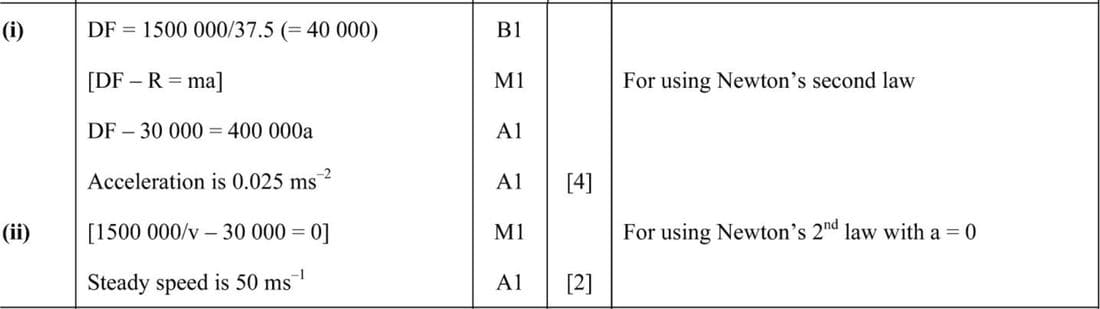
A train of mass 400,000 kg is moving on a straight horizontal track. The power of the engine is constant and equal to 1500 kW and the resistance to the train’s motion is 30,000 N. Find
- the acceleration of the train when its speed is 37.5 m s-1,
- the steady speed at which the train can move.
Nov 2012 p41 q7
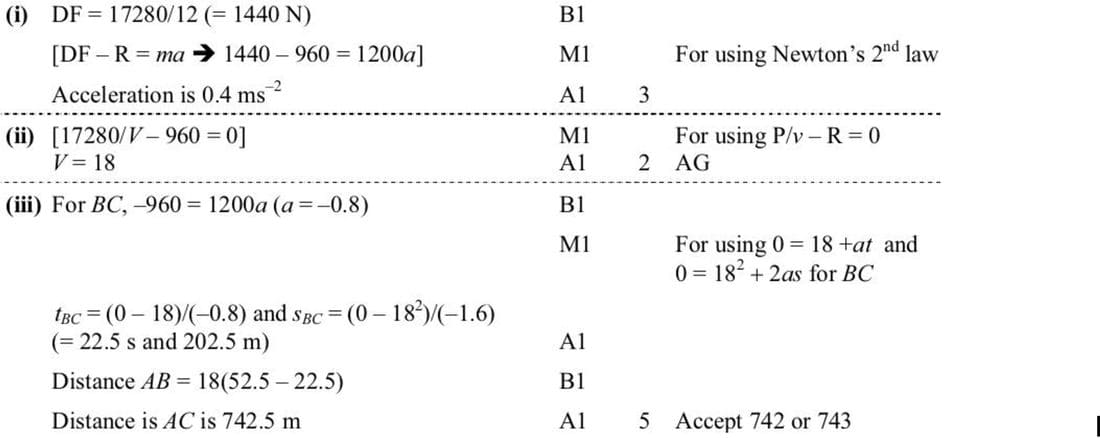
A car of mass 1200 kg moves in a straight line along horizontal ground. The resistance to motion of the car is constant and has magnitude 960 N. The car’s engine works at a rate of 17 280 W.
- Calculate the acceleration of the car at an instant when its speed is 12 m s-1.
The car passes through the points A and B. While the car is moving between A and B it has constant speed V m s-1.
- Show that V = 18.
At the instant that the car reaches B the engine is switched off and subsequently provides no energy. The car continues along the straight line until it comes to rest at the point C. The time taken for the car to travel from A to C is 52.5 s.
- Find the distance AC.