Exam-Style Problems
⬅ Back to SubchapterJune 2023 p41 q2
3548
A particle P of mass 0.4 kg is projected vertically upwards from horizontal ground with speed 10 m s-1.
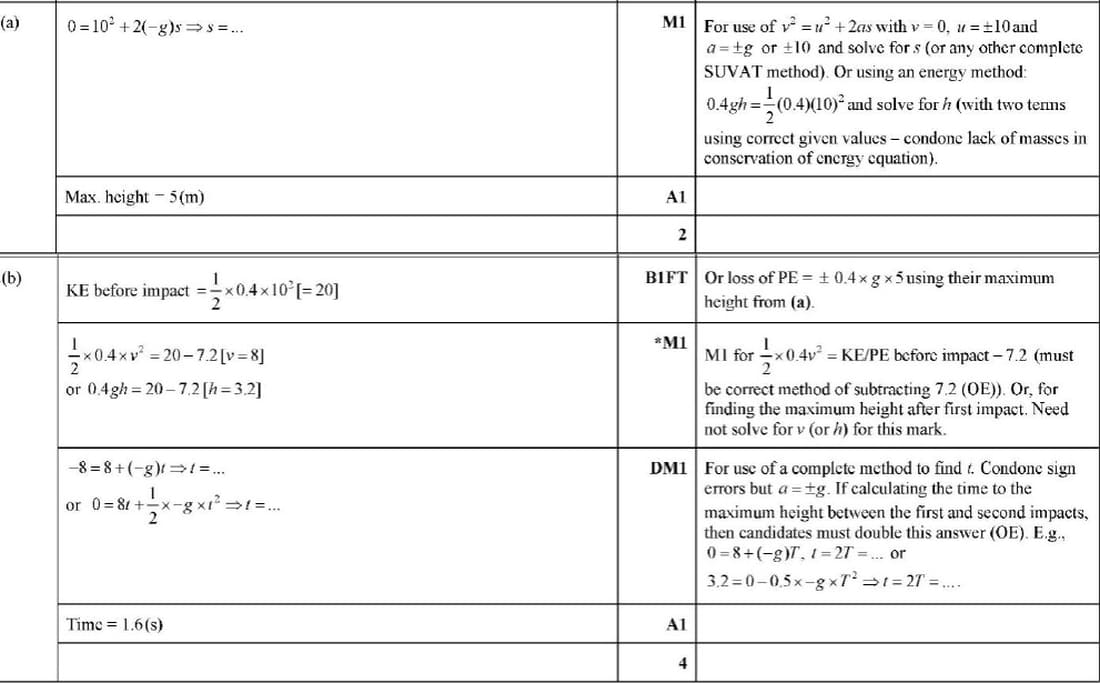
(a) Find the greatest height above the ground reached by P.
When P reaches the ground again, it bounces vertically upwards. At the first instant that it hits the ground, P loses 7.2 J of energy.
(b) Find the time between the first and second instants at which P hits the ground.
June 2014 p41 q5
3549
A car of mass 1100 kg starts from rest at O and travels along a road OAB. The section OA is straight, of length 1760 m, and inclined to the horizontal with A at a height of 160 m above the level of O. The section AB is straight and horizontal (see diagram). While the car is moving the driving force of the car is 1800 N and the resistance to the car’s motion is 700 N. The speed of the car is v m s-1 when the car has travelled a distance of x m from O.
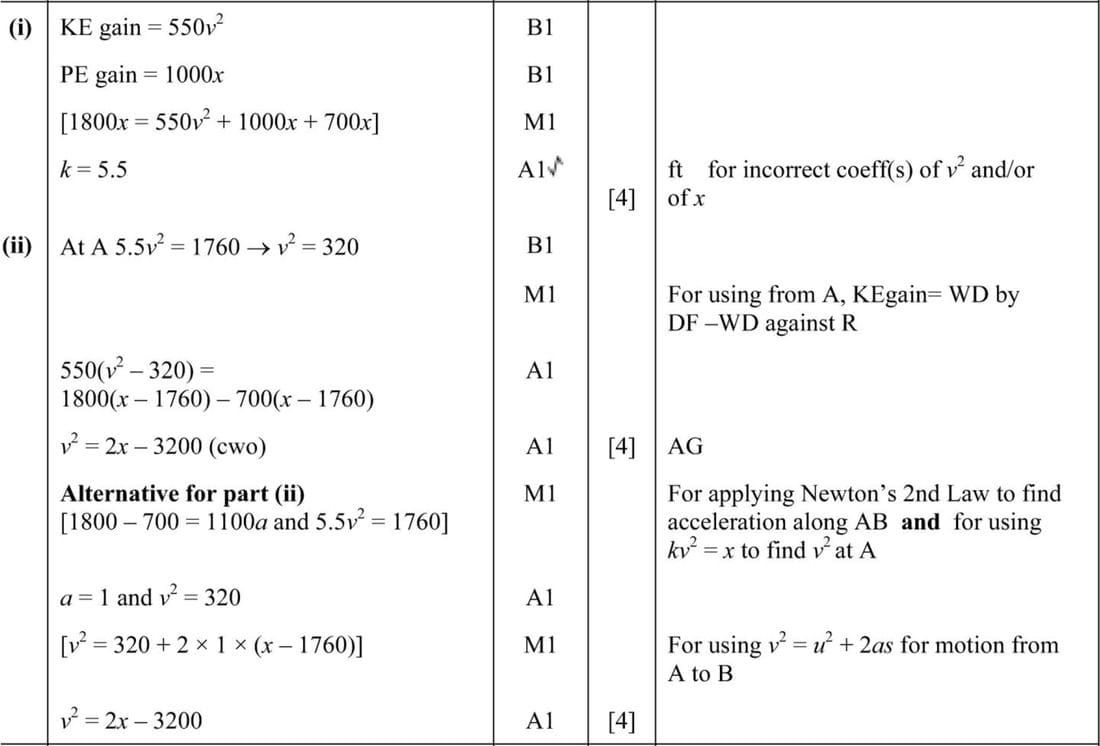
- For the car’s motion from O to A, write down its increase in kinetic energy in terms of v and its increase in potential energy in terms of x. Hence find the value of k for which kv2 = x for 0 ≤ x ≤ 1760.
- Show that v2 = 2x − 3200 for x > 1760.

June 2013 p43 q2
3550
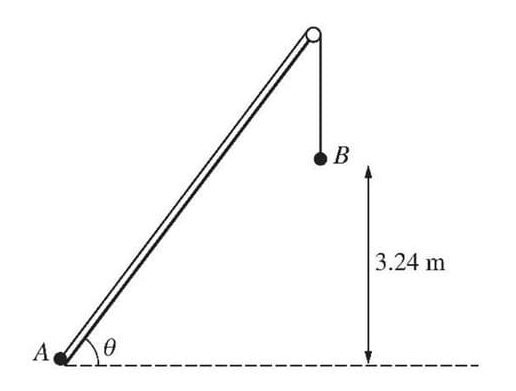
Particle A of mass 1.6 kg and particle B of mass 2 kg are attached to opposite ends of a light inextensible string. The string passes over a small smooth pulley fixed at the top of a smooth plane, which is inclined at angle \(\theta\), where \(\sin \theta = 0.8\). Particle A is held at rest at the bottom of the plane and B hangs at a height of 3.24 m above the level of the bottom of the plane (see diagram). A is released from rest and the particles start to move.
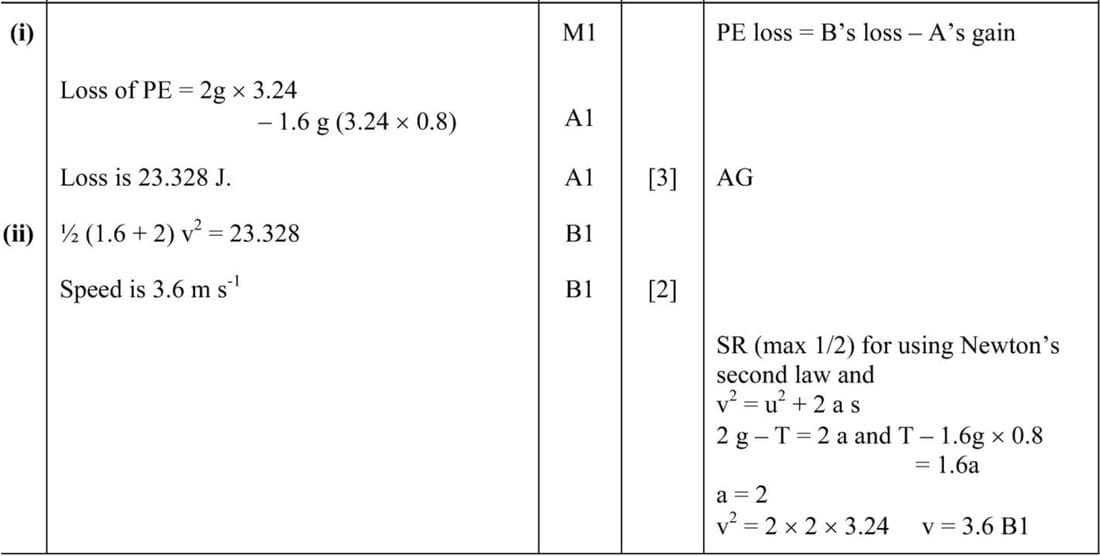
(i) Show that the loss of potential energy of the system, when B reaches the level of the bottom of the plane, is 23.328 J.
(ii) Hence find the speed of the particles when B reaches the level of the bottom of the plane.
Nov 2012 p43 q5
3551
An object of mass 12 kg slides down a line of greatest slope of a smooth plane inclined at 10° to the horizontal. The object passes through points A and B with speeds 3 m/s and 7 m/s respectively.
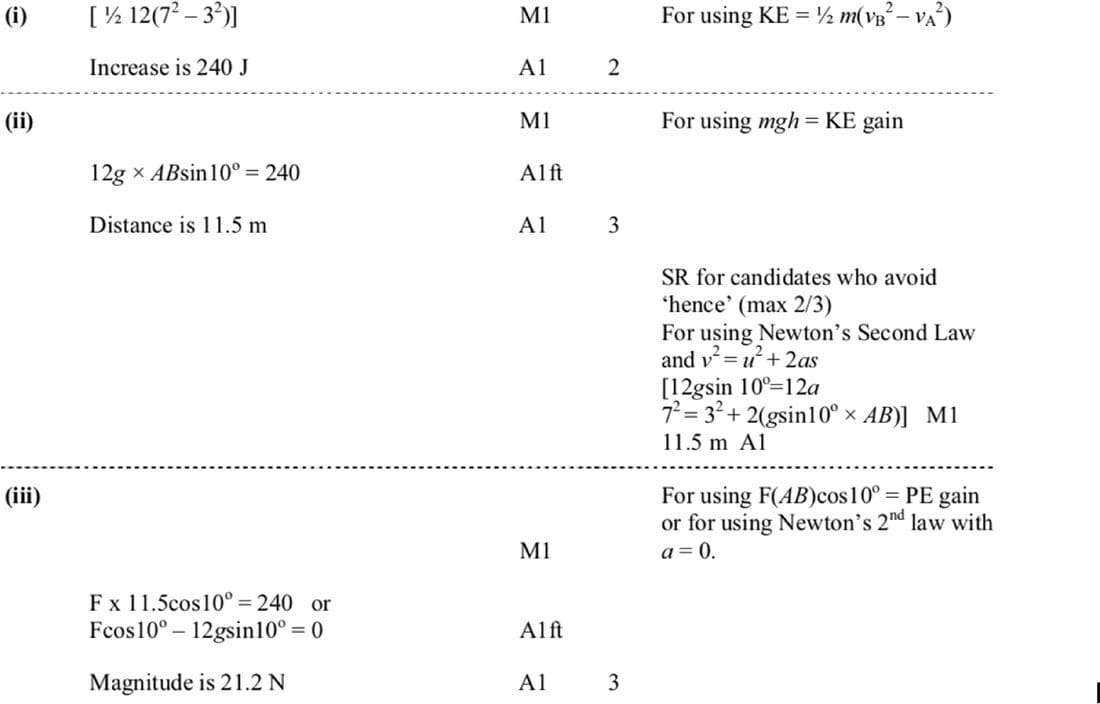
- Find the increase in kinetic energy of the object as it moves from A to B.
- Hence find the distance AB, assuming there is no resisting force acting on the object.
The object is now pushed up the plane from B to A, with constant speed, by a horizontal force.
- Find the magnitude of this force.
Nov 2012 p43 q1
3552
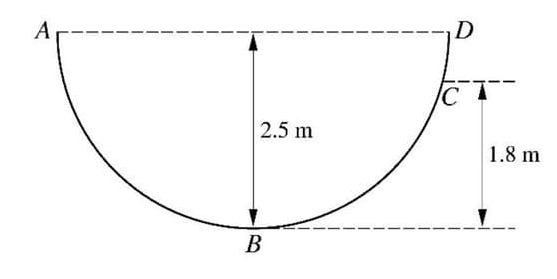
ABCD is a semi-circular cross-section, in a vertical plane, of the inner surface of half a hollow cylinder of radius 2.5 m which is fixed with its axis horizontal. AD is horizontal, B is the lowest point of the cross-section and C is at a height of 1.8 m above the level of B (see diagram). A particle P of mass 0.8 kg is released from rest at A and comes to instantaneous rest at C.
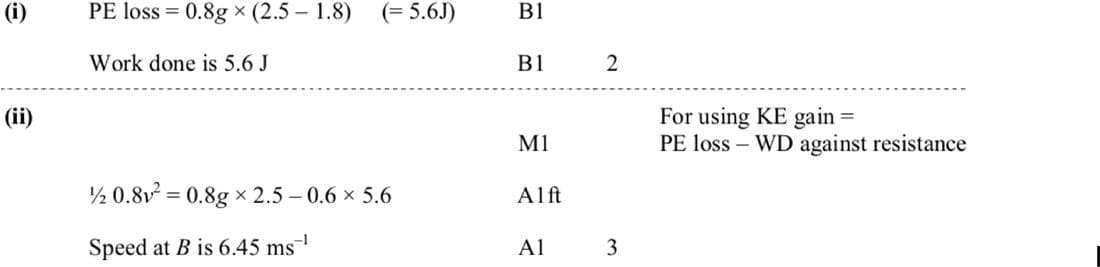
(i) Find the work done on P by the resistance to motion while P travels from A to C.
The work done on P by the resistance to motion while P travels from A to B is 0.6 times the work done while P travels from A to C.
(ii) Find the speed of P when it passes through B.